MIOGLOBIN GEN EXPRESSION IN SOLEUS MUSCLE, GASTROCNEMIUS AND CARDIAC MUSCLE AFTER AEROBIC AND ANAEROBIC EXERCISE
IN WISTAR RAT MUSCLE
Reni Farenia* Roni Lesmana* Ambrosius Purba* Ieva B.Akbar* Nurhalim Shahib** Noriyuki Koibuchi *** Noriaki Shimokawa*** *Departement of Physiology, Faculty of Medicine, Universitas Padjadjaran Bandung, Indonesia
** Departemen of Biochemistry, Faculty of Medicine, Universitas Padjadjaran
***Departement of Integrative Physiology, Graduate School of Medicine
Gunma University, Maebashi, Japan
Address for correspondence : Dr.Reni Farenia ,dr.,M.Kes.,AIF
Bagian Ilmu Faal Fakultas Kedokteran Universitas Padjadjaran Jl Raya Jatinangor Sumedang Km 21 . Jatinangor
MYOGLOBIN GENE EXPRESSION OF SOLEUS, GASTROCNEMIUS AND CARDIAC MUSCLES
AFTER AEROBIC AND ANAEROBIC EXERCISE IN WISTAR RAT
Reni Farenia*, Roni Lesmana*, Ambrosius Purba* Ieva B.Akbar* Nurhalim Shahib** Noriyuki Koibuchi ***, Noriaki Shimokawa***
ABSTRACT
Myoglobin (Mb) is a cytoplasmic hemoprotein and have an important role in oxygen binding, as an oxygen transporter and storage to maintain physiological process for human body adaptation in hypoxia condition. The role of exercise in enhancing physical fitness is already well known. Unfortunately this statement have not any scientific reason in mRNA myoglobin and its level related to aerobic and anaerobic exercise and also its function as an hypoxia indicator
Animal experimental study about mRNA Mb of soleus, gastrocnemius and cardiac muscle was done using 15 Wistar rats (Rattus Norvegicus) in Laboratorium of Integrative Physiology Graduate school of Medicine, Gunma University Japan. . The aim of this study was to know the difference effect between aerobic and anaerobic exercises using animal treadmill on myoglobin gene (mRNA) expression as an indicator of tissue hypoxia.. mRNA Mb concentration was examined by AGPC method and RT- PCR was done to know the difference effect between aerobic and anaerobic exercise on myoglobin gene expression of soleus,gastrocnemius and cardiac muscles.
The statistical analysis using Anova on myoglobin gene expression (mRNAMb) showed very significant (p 0,01) that aerobic group is higher˂ than anaerobic group, in soleus muscle (0,9303±0,0,0268 vs 0,7716±0,0250 µgr/ml), gastrocnemius muscle (1,0504±0,0531 vs 0,8760±0,0147µgr/ml) and significant (p≤0,05) in cardiac muscle (0,7249±0,0600 vs 0,6143±0,0277µgr/ml). Also the RT-PCR showed that mRNA myoglobin of soleus,gastrocnemius and cardiac muscle was stronger in aerobic than anaerobic exercise,
In conclusion myoglobin gene expression in soleus,gastrocnemius and cardiac muscles was higher and stronger gene expression after aerobic than anaerobic exercise as an indicator of tissue hypoxia.
Key words : : mRNA myoglobin, aerobic,anaerobic
Myoglobin(Mb) is a cytoplasmic hemoprotein, expressed in skeletal muscle and myocardium and reversibly to binds oxygen. The structure of myoglobin was first delineated by John Kendrew and colleagues over 40·years ago.1,-4. Myoglobin as a transport and Oxygen storage is very important to mantain physiological process for adaptation in hypoxia condition Strenuous exercise cause muscle myalgia, fatique and cramp can decrease atlet performans.5,6 In pathologic condition there are much of health problem causes by hypoxia . The role of exercise in enhancing physical fitness is already well known. Unfortunately this statement have not any scientific research in mRNA myoglobin and its level related to aerobic and anaerobic exercise and also its function as an hypoxia indicator
It is nice to know that myoglobin have an important role than haemoglobin in hypokxia condition. Myoglobin as an oxygen transporter and storage can maintain physiological process for human body adaptation in hypoxia condition3,4,,9 The important physiological features of oxymyoglobin (MbO2) equilibrium curve are that lies from the right to the left of oxyhaemoglobin (HbO2) equilibrium it has a hyperbolic shape. When the partiil pressure is low, saturation of MbO2 is lower than HbO2.1,2 Oxygen storage in myoglobin is important for intermitten exercise.1,3,4 The use of gene targetting and molecular biological techniques has revealed new insight into reulation and myoglobin function,. The aims of the study is to know mRNA myoglobin changes in skeletal and cardiac muscle after aerobic and anaerobic exercise. Myoglobin is a cytoplasmic haemoprotein that expressed in skeletal muscle and cardiac muscle that reversibly binds O2 by its heme residue a phorphyrin ring from ion complex.1,3,4 Training in hypoxia result at the molecular level an upregulation of the regulatory submit of hypoxia induced factor-1(HIF-1).17,,19 Possibly as a consequence of this upregulation of HIF-1 as a transcription factor, the level of mRNA myoglobin (mRNAMb) increased. Myoglobin are synthesized according to information in messenger RNA Mb that is synthesized on DNA template by transcription and it depends on the need of oxygen in the cell.2,3,5,18 During aerobic exercise a local hypoxia will stimulate the HIF-1. During anaerobic exercise , supply of oxygen will decrease until there is no oxygen supply led to hypoxia . Hypoxia condition will stimulate HIF-1 ,as a transcription factor to initiate the mRNA production .17,19,24 So, both aerobic and anaerobic exercise will increase the mRNA Mb. However ,it has been reported that that strenous exercise will disrupt the sarcolemna and then the Mb from the intracellullar enter the circulation. We can found the serum myoglobin will increase after strenous exercise.22,23
increases the oxygen depot. The observation agree that with the correlation between Mb concentration as oxygen supply and oxidative capasity in different species. 4,6 Without any Mb. neither cardiac muscle nor skeletal muscle functions suffers any apparent physiological impairment.6-10 Muscle strenght and function of muscle correlate with myoglobin concentration. As we know that muscle strength and function of myoglobin will increase after 6 week exercise.4,5 But the physiological role of Mb have not yet been establish. Recently we can know the increase of myoglobin from the mRNA Mb.
These studies imply that further investigations are required to reveal the physiological role of Mb in aerobic and anaerobic exercise. Increased gene expression during recovery from consecutive aerobic and anaerobic exercise measured in mRNA Mb of soleus muscle, gastrocnemius muscle and cardiac muscle. Soleus muscle and Gastrocnemius muscle is a skeletal muscle ,but the soleus muscle is a fast fiber that have rich of myoglobin and gastrocnemius muscle is a slow twich fiber that less myoglobin. Cardiac muscle is aspecial muscle with synsitium and rich of myoglobin too.5,6,15
Animal experimental study using Male Wistar Rat, 8 weeks old.The study conducted with three groups consisted aerobic groups, anaerobic groups and control groups. Animal treadmill test for aerobic groups 15 m/minute runs for 30 minute and for anaerobic groups groups 25 m/minute runs for 30 minute, was done during 14 days.8 RT- PCR was done to evaluate the difference effect between aerobic and anaerobic physical activity on myoglobin gene (mRNA) expression on skeletal and myocardium. . All experimental prosedures were conducted in accordance with the Japanese Physiological Society Guidelines for care and use of laboratory animal, as approved by Gunma University Japan, Graduate School of Medicine Committee on animal care and use.
The objectives of this study is to know the different effect of aerobic and anaerobic exercise to the mRNA Mb in soleus muscle, gastrocnemius muscle and cardiac muscle.
METHODS
Animal. Male Wistar rat(N=15), ages 8 weeks, weight 280 – 315 gr, SPF were used in this study. The animal were kept in standard individual cages and provided with food and water ad libitum. The room temperature was kept 23±10 C , and a 12:12 hour light-dark cycle environment was maintained throughout the experiment. All experimental prosedures were conducted in accordance with the Japanese Physiological Society Guidelines for care and use of laboratory animal, as approved by Gunma University Japan, Graduate School of Medicine Committee on animal care and use.
The subject divided into three groups consisted aerobic groups, anaerobic groups and control groups. Animal treadmill test for aerobic groups 15 m/minute runs and for anaerobic groups 25 m/minute runs for 30 minute was done during 14 days.8.At the end of research (day 14) , under anasthetized ether the subject was sacrifice to get the muscles. To prevent contamination with haemoglobin, before sacrifice ,perfussion with DiethylPyrocarbonat 97% (DEPC) was done. After excess connective tissue and fat were remove, each muscle immediately frozen by liquid Nitrogen and stored at -800 C.
After all samples were collcted we make RNA extraction using AGPC method to measured the mRNA concentration and to know the mRNA Mb gene expression we used RT-PCR.
The myoglobin expression were read by sofware Kodak 2500 under UV light.
All data reported as mean±SD. An analysis of variance (ANOVA) was used to determine overall differences and Duncan’s post hoc analyses were used to compare control , aerobic and anaerobic post exercised data. All data processed using SPSS 15.0, p 0,˂
RESULT :
TABLE 1
The difference of mRNA myoglobin concentration of soleus muscle after 14 days aerobic and anaerobic exercise
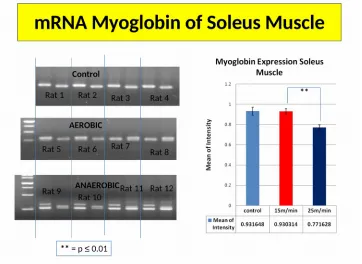
After 14 days aerobic and anaerobics intermitten exercise , the mRNA Mb of soleus muscle after aerobics exercise is higher than anaerobics
exercise.
Table 2
The difference of mRNA myoglobin concentration of
gastrocnemius muscle after 14 days aerobic and anaerobic exercise control 15m/min 25m/min Mean of
Intensity 0.931648 0.930314 0.771628
Control 15m/min 25m/min Mean of
intensity 0.869887 1.050406 0.876036
SD 0.044526 0.053192 0.014795
After 14 days aerobic and anaerobics intermitten exercise , the mRNA Mb of gastrocnemius muscle after aerobics exercise is higher than
anaerobics exercise
Table 3
The difference of mRNA myoglobin concentration of cardiac muscle after 14 days aerobic and anaerobic exercise
Control 15m/min 25m/min Mean of
Intensity 0.886129 0.724951 0.614331
SD 0.052121 0.060031 0.02772
After 14 days aerobic and anaerobics intermitten exercise , the mRNA Mb of cardiac muscle after aerobics exercise is higher than anaerobics exercise
As showed in table 1,2 and 3 , mRNA Mb concentration is increase higher after 14 days aerobic exercise compare than after anaerobics exercise. The ANOVA among groups led to be increase in aerobic group higher than anaerobic group.
As showed in table 1 for soleus muscle( 0.930314 ± 0.053192 vs 0.771628±0.025086 µgr/ml),
as showed in table 2 for gastrocnemius
muscle(1.050406±0.060031vs0.876036 ± 0.014795 µgr/ml ),
and as showed in table 3 for cardiac muscle (0.724951±0.060031 µgr/ml vs 0.614331±0.02772 µgr/ml). p≤05
Myoglobin gene expression is increase also showed in the figure 1,2 and 3 the electrophoresis of mRNA Mb . Myoglobin gene expression showed stronger after aerobic exercise compare to after anaerobic exercise in soleus muscle, gastrocnemius muscle and cardiac muscle. The mRNA myoglobin expression showed in 330 bp .
Changes in mRNA myoglobin of soleus muscle after aerobic and anaerobic exercise .
Figure 1. showed mRNA gene expression of soleus muscle, after aerobic exercise is more stronger mRNA Mb gene expression (330bp) than after anaerobic exercise. Also the intensity of mRNA Mb of soleus muscle showed very significant higher after aerobic exercise than anaerobic. ( 0.930314 ± 0.053192 vs 0.771628±0.025086 µgr/ml), p≤0,01
Figure 2
Figure 2, Using RT-PCR showed mRNA Mb electrophorese of gastrocnemius muscle, after aerobic exercise is more stronger mRNA Mb gene expression (330bp) than after anaerobic exercise. Also the intensity of mRNA Mb of gastrocnemius muscle showed very significant higher after aerobic exercise than anaerobic. (1.050406±0.060031 vs 0.876036 ± 0.014795 µgr/ml ), p≤0,01
Figure 3.
Figure 3. Using RT-PCR showed mRNA Mb electrophorese of cardiac muscle, after aerobic exercise is more stronger mRNA Mb gene expression (330bp) than after anaerobic exercise. Also the intensity of mRNA Mb of cardiac muscle showed higher after aerobic exercise than anaerobic.(0.724951±0.060031 µgr/ml vs 0.614331±0.02772 µgr/ml). p≤05
CONCLUSION
As summarized in the Figure 1, showed the mRNA Mb of soleus muscle is very significant higher after aerobic exercise than after anaerobic exercise. (p≤0,01)
Also the electrophoresis show stronger mRNA expression in the soleus muscle after aerobic exercise.
As summarized in the Figure 2, showed the mRNA Mb of gastrocnemius muscle is significant higher after aerobic exercise than after anaerobic exercise. (p≤0,01)
Also the electrophoresis show stronger mRNA expression in the gastrocnemius muscle after aerobic exercise.
Also the electrophoresis show stronger mRNA expression in the cardiac muscle after aerobic exercise than after anaerobic exercise.
All of the mRNA Mb in soleus muscle, gastrocnemius muscle and cardiac muscle after anaerobic exercise is lower than after aerobic exercise . This showed that streunous exercise can caused disruption of the cell that led to the myoglobin enter the extracellular or the circulation, so we can found the myoglobin in the serum.
DISCUSSION
It was previously demonstrated that, when different exercise aerobic and anaerobic give different effect to the mRNA Mb expression.1,3,4, Gas mixtures containing 21-100% oxygen were inhaled during aerobic exercise , the oxygen content in arterial and venous blood flowing from working muscles and the time of work without fatique. This accompanied by a higher oxygen uptake by muscles, Aerobic exercise will increase oxygen demand lead to relatif hypoxia because the supply is also increase,2,5 This condition will stimulate the HIF-1 to increase . HIF-1 as a factor for transcription will initiate to increase the mRNA Mb 1,4,10-12. It is means the gene expression of myoglobin will increase after aerobic exercise. In the other hand, during the anaerobic exercise , demand of oxygen increase but there is no supply , this condition will lead to hypoxia.22,24 So the HIF-1 also increase. Activation of of HIF-1 appears to trigger adaptations which diminish the negative effects of chronic exposure to hypoxia. 23,24
This study showed that aerobic and anaerobic physical activity increased the mRNA Mb in soleus muscle, gastrocnemius muscle and cardiac muscle. Whatever the type of exercise can increase mRNA Mb , but as we know streunous exercise will lead to anaerobic metabolism .5,6,12 Anaerobic metabolism will increase lactate production that lead the decreased pH in the tissue and circulation.5,6,21 This condition can damage the sarcolemma anddisrupt the cell. Myoglobin as a macromolecul globin will enter the extracellular fluid and circulation.16,17 We can found the myoglobin in the serum., so the myoglobin content in the muscle tissue will decrease.
In conclusion myoglobin gene expression in soleus,gastrocnemius and cardiac muscles was higher and stronger after aerobic than anaerobic exercise as an indicator of tissue hypoxia. Aerobic exercise is better to increase the mRNA myoglobin , so it can increase the physical fittness by maintain supply oxygen to the cells or tissue, even though in hypoxia condition .
1. Ordway GA, Garry DJ. Myoglobin an essential hemoprotein in striated muscle. J Exp Biol.2004;207 : 3441-46
2. Mooren FC, Volker K. Molecular and Cellular Exercise Physiology, Human kinetics, USA.2005:31-46:55-101
3. Hoppeler H, Vogt M. Muscle tissue adaptions to hypoxia. The Journal of Experimental Biology 204, 3133-3139 (2001)
4. Wittenberg JB, Wittenberg BA. Myoglobin function reassessed. J Exp Biol. 2003; 206:2011-20.
5. Foss ML, Keteyian SJ. Physiological basis for exercise and sport, Mc.Graw Hill New York.2006;59-64:
6. Guyton AC, Hall JE. Textbook of Medical Physiology 11th edition. Elsevier Saunders, Philadelphia, Pensylvania.2006;79-82;530;1056-60 7. Grange RW, Meeso A, Chin E, Lau KS, Stull JT, Shelton JM et al.
Functional and molecular adaptation in skeletal muscle of myoglobin-mutant mice. AJP Cell Physiol .2001; 281:1487-94.
8. Soya H, Mukai A, Deocaris, Ohiwa N, Nishijima, Fujikawa T et al. Threshold like pattern of neuronal activation on the hypothalamus during treadmill running : Estasblishment of minimum running stress (MRS) rat model. Neuroscience research.2007;58: 341- 8
9. Wilson MT. Reeder BJ.Oxygen binding haem Protein .J Exp Physiol. 2008;93:128-132
10.Brunori, M. Nitric oxide,cytochromme oxidase and myoglobin, Trends Biochem. scie. 2001; 26: 21-23
11.Brunori, M.. Nitric oxide moves myoglobin centre stage. Trends Biochem.scie. 2001; 26 : 209-21
12.Wittenberg B.A , Wittenberg JB. Role of Myoglobin in oksigen supply to red skeletal muscle.J Biol Chem .2005 ;250: 9038-43
13.Ulrike B, Hendgen C, Marc WM, Sruti S, Schmits J, Stefanie B Johan et al. Nitrite reductase actvity of myoglobin regulates respiration and cellular viability in myocardial ischemia-reperfusion injury. PNAS.2008;22.
14.Flogel U, Merck M.W,Godecke AL., Decking UKM, Schrader Jurgens, Myoglobin : A scavenger of Bioactive NO.PNAS. 2001
15.Mc.Comas AJ.,Gardiner PF. Skeletal Muscle form and function. Human Kinetics., USA,2006:215-220.
16.Akitoshi, Seiyama.Virtual cooperativity in myoglobin oxygen saturation curve in skeletal muscle in vivo. J. of Dynamic Medicine .2006
17.Kanatous SB, Mammen P, Rosenberg. PB. Martin.CM, Michael DW, Garry, DJ et al. Hypoxia reprograms calcium signaling and regulates myoglobin expression. Am J Physiol .2008;296:C393-C402.
18.Shahib.N . Biologi Molekuler Medik I .2005
20.Friedman,B, Kincherf, Borish.S, Richter.G.Effect of low resistance/high repetition strengh training in hypoxia on muscle structure and gene expression. Eur.J. Physiol. 2003;446:742-51.
21.Despopoulos. Color Atlas of Physiology. Thieme 2003
22.Zoll J, Ponsot E, Dufour S, Doutreleau S. Exercise training in normobaric hypoxia in endurance runners. J Appl Physiol 2006. 100: 1258-66.
23.Meyer RA. Aerobic performance and the function of myoglobin in human skeletal muscle. AJP-regul 2004;287:1304-05