viii ABSTRACT
Geribka, Marchellino. 2016. A study on the content validity and authenticity of English national examination 2015 for junior high school. Yogyakarta: English Language Education Study Program, Sanata Dharma University.
As the highest standardized test in Indonesia, National examination is nationally and annually administered by the government represented by BSNP to measure students’ achievement. By passing the examination, students could continue their study to senior or vocational high school. There are four subjects which are examined for junior high school level namely Mathematics, Natural Science, Indonesian Language, and English. For English, it covers reading and writing skills. In designing English national examination, examination-constructors need to follow principles of assessment. In this research, the aspect of validity, content validity and authenticity are the main focus. Examination-constructors need to follow the test specifications and criteria of authenticity so that they could produce examination which meets the criteria of content validity and authenticity stated by Brown (2004). In this research, content validity refers to the appropriateness between the test specifications and the examination items while authenticity refers to the appropriateness between the criteria of authenticity (Brown, 2004) and the examination topics.
This research was conducted to find the answers of the two research English National Examination 2015 for Junior High School. Moreover, the research objects were the documents of the English national examination. The instruments of this research were checklists. Besides, the method of the data analysis was matching method. To obtain results related to the research question, the researcher analyzed the data by using checklists in form of checklist tables. Then, the findings were revealed and explained to answer the research questions.
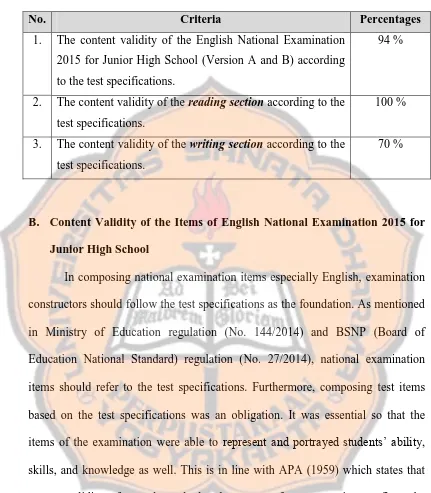
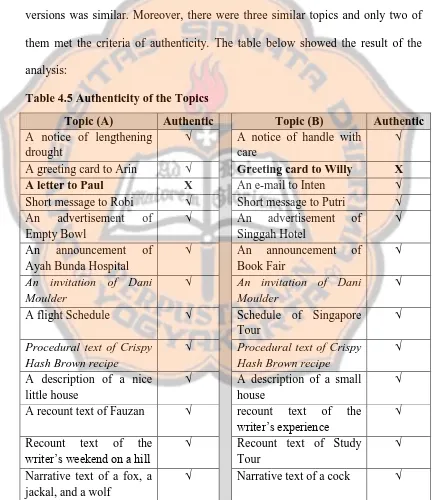
This research demonstrated two findings. First, the content validity of the examination items reached 94%. Almost of the test items were valid according to the test specifications. Only three test items in writing section did not obey the contents of the test specifications. Second, the authenticity of the topics of the National examination reached 89% since almost of the topics met the criteria of authenticity. Only two topics in reading and writing sections did not meet the criteria of authenticity. The researcher expected that this research could provide meaningful feedback for the administration of English National Examination for Junior High School. Besides, it was suggested that the next English national examination should be designed better in terms of the items and topics.
ix ABSTRAK
Geribka, Marchellino. 2016. A study on the content validity and authenticity of English national examination 2015 for junior high school. Yogyakarta: English Language Education Study Program, Sanata Dharma University.
Sebagai ujian standar terpenting di Indonesia, setiap tahun dan secara nasional Ujian Nasional diselenggarakan oleh pemerintah melalui BSNP untuk mengukur pencapaian para siswa. Para siswa dapat melanjutkan studi mereka ke level selanjutnya, yakni Sekolah Menengah Atas atau Kejuruan setelah lulus dari Ujian Nasional tersebut. Terdapat empat mata pelajaran yang diujikan pada Ujian Nasional pada tingkat SMP yakni matematika, IPA, bahasa Indonesia, dan bahasa Inggris. Salah satu mata pelajaran tersebut adalah bahasa Inggris yang mencakup skil membaca dan menulis. Dalam membuat ujian ini, penyusun soal harus memperhatikan prinsip-prinsip asesmen. Pada penelitian ini, salah satu segi validitas yakni validitas isi dan autentisitas menjadi fokus utama. Penyusun ujian harus mengikuti kisi-kisi ujian agar mampu membuat ujian yang memenuhi kriteria validitas isi. Disamping itu, Ujian Nasional juga harus memenuhi kriteria autentisitas kaitannya dengan teori Brown (2004). Dalam hal ini, validitas isi mengacu pada kesesuaian antara kisi-kisi ujian terhadap soal-soal ujian. Sementara itu, autentisitas mengacu pada kesesuaian kriteria autentisitas terhadap topik-topik ujian.
Penelitian ini dilakukan guna mencari jawaban atas dua rumusan masalah, yakni 1) Bagaimana soal Ujian Nasional Bahasa Inggris Tahun 2015 untuk SMP memenuhi kriteria validitas isi dalam kaitannya dengan kisi-kisi ujian? 2) Bagaimana soal Ujian Nasional Bahasa Inggris Tahun 2015 untuk SMP memenuhi kriteria autentisitas dalam kaitannya dengan teori Brown?
Dalam penelitian ini, peneliti menerapkan pendekatan kualitatif dalam bentuk analisis dokumen. Objek penelitian ini adalah naskah Ujian Nasional Bahasa Inggris Tahun 2015 untuk SMP. Disamping itu, instrumen penelitian ini adalah checklist. Sedangkan metode analisi data adalah pencocokan. Untuk memperoleh hasil yang sesuai dengan rumusan masalah, peneliti menganalisa data terkait dengan menggunakan chekclists dalam bentuk tabel. Kemudian, hasil temuan tersebut diungkap dan dijelaskan untuk menjawab rumusan masalah.
Terdapat dua temuan terkait rumusan masalah tersebut. Pertama, validitas isi pada soal Ujian Nasional tersebut mencapai 94% karena hampir semua soal sesuai dengan kisi-kisi ujian. Hanya tiga soal pada skil menulis yang tidak sesuai dengan kisi-kisi. Kedua, autentisitas topik ujian ini mencapai 89% karena hampir semua topik sesuai dengan kriteria autentisitas. Hanya dua topik pada skil membaca dan menulis yang tidak sesuai kriteria autentisitas. Peneliti berharap penelitian ini berguna sebagai umpan balik terhadap pelaksanaan Ujian Nasional. Selain itu, peneliti menyarankan agar Ujian Nasional disusun lebih baik lagi.
A SARJANA PENDIDIKAN THESIS Presented as Partial Fulfillment of the Requirements
to Obtain the Sarjana Pendidikan Degree in English Language Education
By
Marchellino Geribka Student Number: 121214101
ENGLISH LANGUAGE EDUCATION STUDY PROGRAM DEPARTMENT OF LANGUAGE AND ARTS EDUCATION
FACULTY OF TEACHERS TRAINING AND EDUCATION SANATA DHARMA UNIVERSITY
YOGYAKARTA 2016
A STUDY ON THE CONTENT VALIDITY AND AUTHENTICITY
OF ENGLISH NATIONAL EXAMINATION 2015
i
A SARJANA PENDIDIKAN THESIS Presented as Partial Fulfillment of the Requirements
to Obtain the Sarjana Pendidikan Degree in English Language Education
By
Marchellino Geribka Student Number: 121214101
ENGLISH LANGUAGE EDUCATION STUDY PROGRAM DEPARTMENT OF LANGUAGE AND ARTS EDUCATION
FACULTY OF TEACHERS TRAINING AND EDUCATION SANATA DHARMA UNIVERSITY
YOGYAKARTA 2016
A STUDY ON THE CONTENT VALIDITY AND AUTHENTICITY
OF ENGLISH NATIONAL EXAMINATION 2015
vi
ACKNOWLEDGEMENTS
First of all, I would like express my greatest gratitude to God Almighty,
Jesus Christ for His endless love. I would not be able to finish this final thesis without His guidance. I thank Him for giving a wonderful life with great parents
and friends in my life. I also would like to express my great gratitude to my only
one advisor, Dr. Emanuel Sunarto, M.Hum. I thank him for helping me find
and fix the topic for my thesis, spent his time to give me suggestions, beneficial
feedback, corrections, and encouragement from the beginning until the end of my
thesis.
I also would like to express my sincere thankfulness to Gregorius
Harjanto, S.Pd., English teacher of SMP Pangudi Luhur Wedi, Klaten who has permitted me to lend the documents of English National Examination Year 2015
for Junior High School. The documents are important for this research since it
becomes the research objects.
I dedicate this final thesis especially to my beloved parents, Christian and
Merlinda Erni. I would like to express my greatest gratitude to them for their prayer, endless love, inspirations, and motivations in finishing my thesis. I also
thank to my brothers, David and Yosua who gave me support in finishing my
thesis. They always gives me spirit when I was giving up in doing my thesis.
Moreover, I also thank to school principal of SMP Pangudi Luhur Wedi, Br.
vii
Klaten. I also thank to my academic advisor: Ag. Hardi Prasetyo, M.A.,
Christina Kristiyani, M.Pd., Markus Budiraharjo, Ed.D., and Christina Lhaksmita Anandari, Ed.M. who patiently helped me when I consulted problems and difficulties I faced during finishing the thesis. I also would like to
express my special gratitude to my mother, Merlinda Erni for the help since I
studied at Sanata Dharma University of Yogyakarta and also paid for my study.
My gratefulness also goes to my beloved friends, Intan, Venta, Aileen, Kefas, Fathur, Eka, Herris, Ema, Agni, all Penguin Kejam group members as all my classmates, and SIX POINT FOUR as my SPD group members who
wanted to hear my sharing. Furthermore, I thank Resya and Tami who were
willing to proofread my thesis. Last but not the least, I thank everyone whom I
cannot mention one by one who helped me finish my thesis.
viii ABSTRACT
Geribka, Marchellino. 2016. A study on the content validity and authenticity of English national examination 2015 for junior high school. Yogyakarta: English Language Education Study Program, Sanata Dharma University.
As the highest standardized test in Indonesia, National examination is nationally and annually administered by the government represented by BSNP to measure students’ achievement. By passing the examination, students could continue their study to senior or vocational high school. There are four subjects which are examined for junior high school level namely Mathematics, Natural Science, Indonesian Language, and English. For English, it covers reading and writing skills. In designing English national examination, examination-constructors need to follow principles of assessment. In this research, the aspect of validity, content validity and authenticity are the main focus. Examination-constructors need to follow the test specifications and criteria of authenticity so that they could produce examination which meets the criteria of content validity and authenticity stated by Brown (2004). In this research, content validity refers to the appropriateness between the test specifications and the examination items while authenticity refers to the appropriateness between the criteria of authenticity (Brown, 2004) and the examination topics.
This research was conducted to find the answers of the two research English National Examination 2015 for Junior High School. Moreover, the research objects were the documents of the English national examination. The instruments of this research were checklists. Besides, the method of the data analysis was matching method. To obtain results related to the research question, the researcher analyzed the data by using checklists in form of checklist tables. Then, the findings were revealed and explained to answer the research questions.
This research demonstrated two findings. First, the content validity of the examination items reached 94%. Almost of the test items were valid according to the test specifications. Only three test items in writing section did not obey the contents of the test specifications. Second, the authenticity of the topics of the National examination reached 89% since almost of the topics met the criteria of authenticity. Only two topics in reading and writing sections did not meet the criteria of authenticity. The researcher expected that this research could provide meaningful feedback for the administration of English National Examination for Junior High School. Besides, it was suggested that the next English national examination should be designed better in terms of the items and topics.
ix ABSTRAK
Geribka, Marchellino. 2016. A study on the content validity and authenticity of English national examination 2015 for junior high school. Yogyakarta: English Language Education Study Program, Sanata Dharma University.
Sebagai ujian standar terpenting di Indonesia, setiap tahun dan secara nasional Ujian Nasional diselenggarakan oleh pemerintah melalui BSNP untuk mengukur pencapaian para siswa. Para siswa dapat melanjutkan studi mereka ke level selanjutnya, yakni Sekolah Menengah Atas atau Kejuruan setelah lulus dari Ujian Nasional tersebut. Terdapat empat mata pelajaran yang diujikan pada Ujian Nasional pada tingkat SMP yakni matematika, IPA, bahasa Indonesia, dan bahasa Inggris. Salah satu mata pelajaran tersebut adalah bahasa Inggris yang mencakup skil membaca dan menulis. Dalam membuat ujian ini, penyusun soal harus memperhatikan prinsip-prinsip asesmen. Pada penelitian ini, salah satu segi validitas yakni validitas isi dan autentisitas menjadi fokus utama. Penyusun ujian harus mengikuti kisi-kisi ujian agar mampu membuat ujian yang memenuhi kriteria validitas isi. Disamping itu, Ujian Nasional juga harus memenuhi kriteria autentisitas kaitannya dengan teori Brown (2004). Dalam hal ini, validitas isi mengacu pada kesesuaian antara kisi-kisi ujian terhadap soal-soal ujian. Sementara itu, autentisitas mengacu pada kesesuaian kriteria autentisitas terhadap topik-topik ujian.
Penelitian ini dilakukan guna mencari jawaban atas dua rumusan masalah, yakni 1) Bagaimana soal Ujian Nasional Bahasa Inggris Tahun 2015 untuk SMP memenuhi kriteria validitas isi dalam kaitannya dengan kisi-kisi ujian? 2) Bagaimana soal Ujian Nasional Bahasa Inggris Tahun 2015 untuk SMP memenuhi kriteria autentisitas dalam kaitannya dengan teori Brown?
Dalam penelitian ini, peneliti menerapkan pendekatan kualitatif dalam bentuk analisis dokumen. Objek penelitian ini adalah naskah Ujian Nasional Bahasa Inggris Tahun 2015 untuk SMP. Disamping itu, instrumen penelitian ini adalah checklist. Sedangkan metode analisi data adalah pencocokan. Untuk memperoleh hasil yang sesuai dengan rumusan masalah, peneliti menganalisa data terkait dengan menggunakan chekclists dalam bentuk tabel. Kemudian, hasil temuan tersebut diungkap dan dijelaskan untuk menjawab rumusan masalah.
Terdapat dua temuan terkait rumusan masalah tersebut. Pertama, validitas isi pada soal Ujian Nasional tersebut mencapai 94% karena hampir semua soal sesuai dengan kisi-kisi ujian. Hanya tiga soal pada skil menulis yang tidak sesuai dengan kisi-kisi. Kedua, autentisitas topik ujian ini mencapai 89% karena hampir semua topik sesuai dengan kriteria autentisitas. Hanya dua topik pada skil membaca dan menulis yang tidak sesuai kriteria autentisitas. Peneliti berharap penelitian ini berguna sebagai umpan balik terhadap pelaksanaan Ujian Nasional. Selain itu, peneliti menyarankan agar Ujian Nasional disusun lebih baik lagi.
x
TABLE OF CONTENTS
Page
TITLE PAGE... i
APPROVAL PAGES... ii
STATEMENT OF WORK’S ORIGINALITY... iv
xi
1. Language Testing... 12
2. Language Test... 13
3. Test Purposes... 14
4. Validity... 16
5. Authenticity... 18
C. Theoretical Framework... 19
CHAPTER III. METHODOLOGY A. Research Method... 23
B. Research Objects... 25
C. Research Instruments... 26
D. Data Gathering Techniques... 26
E. Data Analysis Techniques... 27
F. Research Procedure... 33
CHAPTER IV. RESULTS AND DISCUSSION A. Validation Results of the Items of English National Examination 2015 for Junior High School... 35
B. Content Validity of the Items of English National Examination 2015 for Junior High School... 36
xii
D. Other Findings... 47
CHAPTER V. CONCLUSIONS AND SUGGESTIONS
A. Conclusions... 51
B. Suggestions... 54
xiii
LIST OF TABLES
Page
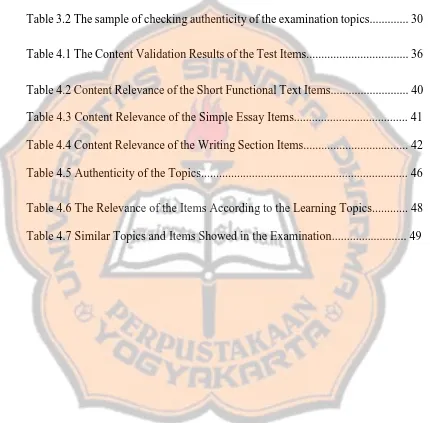
Table 3.1 The Sample of Items Validation of the Examination... 28
Table 3.2 The sample of checking authenticity of the examination topics... 30
Table 4.1 The Content Validation Results of the Test Items... 36
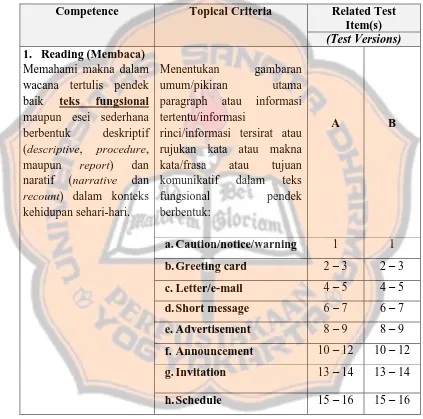
Table 4.2 Content Relevance of the Short Functional Text Items... 40
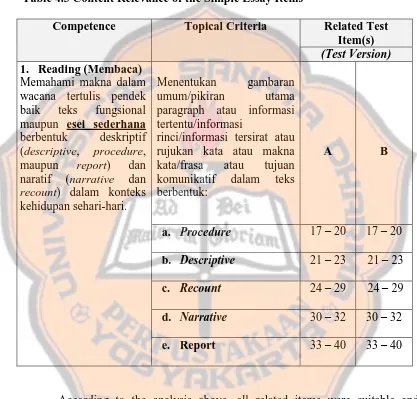
Table 4.3 Content Relevance of the Simple Essay Items... 41
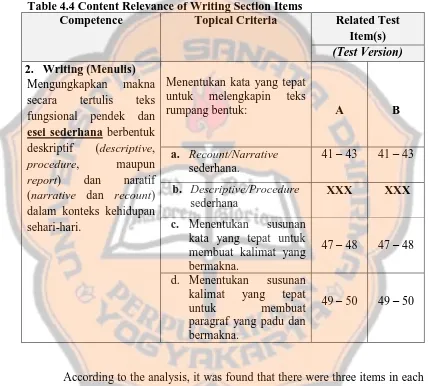
Table 4.4 Content Relevance of the Writing Section Items... 42
Table 4.5 Authenticity of the Topics... 46
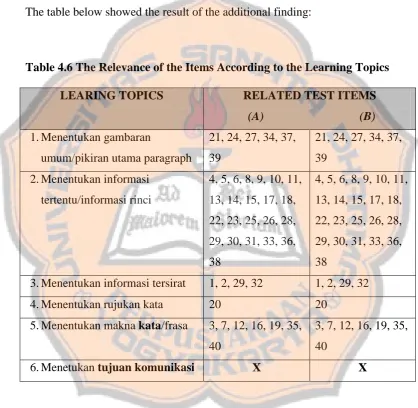
Table 4.6 The Relevance of the Items According to the Learning Topics... 48
xiv
LIST OF APPENDICES
Page 1. The Document of the Test Specifications of English National Examination
2015 for Junior High School... 61
2. The Documents of English National Examination 2015 for Junior High School
(Test Version A and B)... 64
3. Checklist tables of the content validity of English National Examination 2015
for Junior High School (Test Version A and B)... 97
4. Checklist tables of the authenticity of English National Examination 2015 for
CHAPTER I
INTRODUCTION
This part describes the research background, problem formulation,
research objectives, benefits and significance, and problem limitation. In addition,
the definition of terms is also presented to explain essential key terms of this
research in order to avoid misunderstanding on certain terms.
A. Research Background
National Examination plays essential role. Moreover, in Indonesia,
National Examination is one of requirements that students must pass. By passing
National Examination, students can graduate from a certain education level and
continue their study to the next education level. Moreover, National Examination
in Indonesia also has essential function as the highest standardized test to measure
students’ achievement in a particular subject. Furthermore, National Examination
is administered annually and nationally by Department of Culture and Education.
As mentioned in Ministry regulation (No. 59/2011), “National Examination,
abbreviated as UN (Ujian Nasional), is a national standardized test which is
administered nationally in order to test students’ competency achievement on a
particular subject in a group of science and technology subjects”. Besides, the
regulation also states that the development and construction of National
Examination topics and items refer to competence standard, basic competence,
and test specifications.
According to Ministry regulation (No. 59/2011), test specifications of
National Examination are the reference of developing and constructing National
Examination questions which are compiled based on the competence standard and
the basic competence in Content standard of basic and middle education. In this
case, the Content standard contains competence standard and basic competence.
Moreover, in competence standard, there are four aspects of language which are
measured namely listening, speaking, reading, and writing in every level of
education. These four skills in English are explained by each point in basic
competence. Besides, basic competence then creates materials for students in
order to assess students’ competence. From here, test specifications are developed
and constructed. All items and topics in English national examination are
explicitly stated in the test specifications. In junior high school, for example,
English subject is examined no matter what the majors are.
The examination constructors (Ministry of Education) should pay attention
in developing and constructing items and topics in order to test students’
competencies. In this context, content validity and authenticity should be
considered as two important things in measuring students’ achievement. Good
tests validly and authentically measures students’ skills, abilities, and knowledge
by presenting appropriate test score. It means that the tests are measure what is
intended to be measured. Moreover, American Psychological Association (1985)
advances validity of a test to reveal the meaningful, appropriate, and useful test
To become a valid test, a test requires test-takers to perform the behavior
that is going to be measured (Mousavi, 2002 as cited in Brown, 2004). If the test
does not measure particular skills, there is no logical outcome and the examiners
could not determine how far student achievement in particular subject (as cited in
Jandhagi & Shaterian, 2008).
Next, examination constructors should pay attention to authenticity as well
as content validity. Bachman and Palmer (1996) argue authenticity as “the degree
of correspondence of the characteristic of a given language test task to the feature
of a language task”. It means that a language test should connect to the real world.
Furthermore, Brown (2004) says authenticity is determined by five indicators,
namely the natural language used in the test, the contextualization of the test
items, the relevance of the test topics and the learners, the presence of the
thematic test items, and the representation of the real-world task or source. These
five indicators build a test which is relevant for students’ skills and represent an
original situation to the test-takers.
The researcher analyzes the content validity and authenticity of English
national examination 2015 since the examination is considered as the highest
standardized test in Indonesia. Moreover, this research is conducted to obtain
information related to the quality of the content validity and authenticity of the
examination. Till now, National Examination is employed to measure students’
skill especially for English. In any case, criteria of content validity and
B. Research Problems
The research problems of this research are formulated as follows:
1. How valid are the examination items of English National Examination 2015
for Junior High School related to the test specifications?
2. How authentic are the topics found in English National Examination 2015 for
Junior High School related to Brown’s theory?
C. Research Objectives
The researcher analyzes the content validity of the English national
examination items and the authenticity of the English national examination topics
in order to obtain information related to the quality of English National
Examination 2015 for Junior High School. Moreover, there are two research
objectives of the research. They are formulated as follows:
1. To obtain information how valid are the items of English National
Examination 2015 for Junior High School
2. To obtain information how authentic are the topics of English National
Examination 2015 for Junior High School
D. Benefits and Significance
There are benefits and significance of this study for English teachers,
examination-constructors, and future researchers. They are described as follows:
1. For English Teachers
This study provides and gives information for teachers so that they would
Examination in the following years. Furthermore, this study also gives some
directions in order to ensure the content validity which covers materials and topics
and authenticity of English tests before the tests are given to the students. Besides,
it aims to get meaningful results which reflect students’ abilities. In the future,
English teachers are highly expected to develop and construct daily English tests
which meet the criteria of content validity and authenticity.
2. For Examination-Constructors
This research is able to be used to evaluate the items and topics of English
National Examination according to the principles of assessment (Brown, 2004)
and test specifications which are developed from the competence standard and
basic competence of certain education level. In addition, this research also can be
the important consideration in developing and constructing the next National
Examination in terms of topics and items since National Examination is
considered as the highest standardized test. In the future, the examination
constructors are highly expected to design and construct National Examination
which is valid and authentic.
3. For Future Researchers
This research provides information related to principles of assessment
(Brown, 2004) especially content validity and authenticity and English National
Examination 2015 for Junior High School as the research object. Besides, future
researchers can use this research as additional source in conducting a research
is also useful for future researchers who conduct the same researches with
different objects and also related to other aspects of validity such as construct
validity or face validity and other facets of principles of assessment such as
practicality, reliability or washback.
E. Problem Limitation
The researcher focuses on analyzing the items and the topics of English
national examination which is administered annually and nationally in junior high
school level. In this research, English national examination 2015 for Junior High
School becomes the main subject of the research. In addition, content validity and
authenticity set by Brown (2004) are used as instruments in this research to
analyze the topics and the items of the examination. In addition, analyzing the
content validity of the examination items, the researcher matches each item of the
examination with the contents of the test specifications. In analyzing the
authenticity, the researcher employs three criteria of authenticity set by Brown
(2004) to ensure whether or not the topics meet all three criteria of authenticity.
The documents of English National Examination 2015 are obtained from
SMP Pangudi Luhur Wedi, Klaten. In addition, the documents are divided into
two versions namely test version A and B. The test versions have some different
types of items and topics in order to avoid students’ fraudulence. Even though the
examination items and topics are partially different, the competence standard and
basic competence, and test specifications are the reference in developing and
F. DEFINITION OF TERMS
This part explains the key terms of this research namely content validity,
authenticity, national examination, and junior high school. The definition of each
key term itself is obtained from experts and education ministry regulation related
to National Examination. In addition, BSNP (Board of Education National
Standard) regulation which organizes national examination is also employed. The
key terms are defined as follows:
1. Content Validity
Content validity refers to measure what is going to be measured. Hughes
(2003) argues that a test is said to have content validity if its content constitutes a
representative sample of the language skills, structures, etc. If a test does not
contain a representative sample of skills, materials, or topics in measuring
students’ capability, the test content is considered as not valid. Moreover, content
validity also refers to the appropriateness between the test items and test
specifications (Jihad & Haris, 2013). In this case, appropriateness means the test
items match with the test specifications. In addition this research analyzes the
appropriateness between the test items and test specifications to ensure the quality
of the content validity of the English national examination.
2. Authenticity
Authenticity is a matter of degree of correspondence. Bachman and
Palmer (1996, p. 23) define authenticity as the degree of correspondence of the
language task (as cited in Brown, 2004). The language test should represent
appropriate contents related to the target language. Furthermore, Nurgiyantoro
(2011) adds authenticity refers to real-world task. Real-world task itself refers to
meaningful task since the task exists and comes from real-world. It means that
topics, materials, and knowledge measured should be connected to the real-world.
It clearly states that the materials, topics, and knowledge are selected from
real-world sources that test-takers are likely to have encountered or will encounter
(Brown, 2004).
3. National Examination
National examination in Indonesia is annually and nationally administered
at the end period of certain education level to measure students’ capability.
According to Education Ministry regulation (No. 144/2014), National
Examination is measurement activity and evaluation of standard competence
achievement in certain subject particularly for Mathematics, Natural Science,
Indonesian Language, and English. Standard competence should be achieved by
the students since it is the target of the measurement and evaluation which
administered at the end period. This is in line with Aldersen at al. (2003, p. 12)
who argue national examination belongs to achievement test given at the end of
the course.
4. Junior High School
In Indonesia, Junior High School is the level education after passing
High School is classified into elementary and mid education levels. Junior high
school has the same level with Madrasah Tsanawiyah (MTs). Moreover, the
purpose of junior high school is to prepare students to continue their education to
senior or vocational high school level. The first level of junior high school is
grade 7th, second is grade 8th, the highest level is grade 9th. Each grade is achieved
CHAPTER II
LITERATURE REVIEW
This part shows the theories used by the researcher. Moreover, there are
two theoretical part, namely theoretical description and theoretical framework. In
addition, previous studies are also reviewed. The previous studies provide related
issues, additional theories, and additional sources related to the topic of this
research. Besides, theoretical description presents the relevant theories related to
the research topic. Furthermore, the theoretical framework summarizes all
relevant theories which help the researcher in conducting this research.
A. Previous Studies
Principles of assessment has been used as the main instruments of
researches related to the education problems. Principles of assessment which
widely used in researches consist of five elements, namely practicality, reliability,
validity, authenticity, and washback. There are five studies used by the researcher
to support this research. From those studies, the researcher also shows the
different between the researcher’s research and those five studies so that the
researcher is able to show the uniqueness of this research.
The five previous studies used by the researchers used the principles of
assessment in national examination as the main topic. All of the studies used
qualitative inquiry or well-known as document analysis or content analysis.
Moreover, most of the research dominantly used words to explain and elaborate
the results. Numbers are also used to complete the results. Besides, the objects of
those five previous studies are English National Examination and some teachers
and lecturers. The writers of those studies are Aprianto (2013), Fiktorius (2015),
Umam (2015), Wiratmo (2007), and Desi (2013).
Started from the first study, Aprianto (2013) conducted a research entitled
Validity and Washback in the National Examination for Senior High School Year
2010 and 2011. The research stated that EN examination year 2010 and 2011
were less authentic. On the other hands, some items of the examinations were not
valid because some indicators of Graduate Competence standard were not
covered. In addition, the examination only covered two receptive skills namely
reading skill and listening skill, not covered speaking and writing. Next, Fiktorius
(2015) conducted a research entitled A Validation Study on English National
Examination of Junior High School in Indonesia. The results stated that English
National Examination for Junior High school Year 2013 has fulfilled the criteria
of having content validity. Then, Umam (2015) conducted his research entitled
National Examination of English in Indonesia: A Validity and Reliability-Based
Elucidation. The results stated that English National Examination year 2011 for
Senior High School did not facilitate speaking skill and writing skill. The next
study came from Wiratmo (2009) entitled An Analysis of Face and Content
Validity of Reading Section of the 2007 National Final Examination for
Vocational High Schools. The research stated that the examination met the criteria
of face validity because it was acceptable to the research interviewees. Moreover,
the examination met the criteria of content validity because almost of the items
entitled Content Validity and Authenticity of the 2012 English Test of the Senior
High School National Examination. The research proved that the examinations
were valid since the contents were relevant to the test specifications. Next, the
examination was authentic since the examination met the criteria of authenticity
set by Brown (2004).
On the other hand, the researcher tries to analyze the content validity and
authenticity of English National Examination 2015 for Junior High School.
Besides, the uniqueness of this research is the object. This research uses the recent
English National Examination 2015 because the examination is the latest version.
The researcher presumes that the latest test version fulfills the criteria of
principles of assessment in terms of content validity and authenticity.
Furthermore, checklists in form of checklist tables will be used to check the
content validity and authenticity of the examination topics and items. Besides, the
research method used is similar with the research method used by Wiratmo (2009)
and Desi (2013).
B. Theoretical Description
1. Language Testing
Language testing is the activity of developing and using language test
(Davis, 2015). In this case, the use of language testing is the main focus. In this
social life, language testing is important for every aspect in life. In addition,
McNamara (2000, p. 4) states that this activity plays a powerful role in many
abilities, knowledge, or performances. In addition, language testing also plays its
role as an entrance at essential intercessor moment in education, for instance if
students are going to continue their education to the next level. Students have to
pass particular tests or examination like achievement test so that they graduate
from certain level and continue their education to the next level. Since it is
language test, the test is related to one’s skill in language use or performing some
language skills. This is in line with Brown (2004) who states that performing
language skills (speaking, writing, reading, or listening) is able to be
administered.
2. Language Test
Tests refer to examination for measuring someone’s capability. Generally,
tests consist of questions to be answered or performance which is to be presented.
Brown (2004, p. 3) argues that a test is a method of measuring a person’s ability,
knowledge, or performance in a given domain. In addition, by measuring a
person’s capability, data and information related to a person’s capability can be
obtained (Nurgiyantoro, 2010, p. 90). In practice, test is divided into two kinds
based on the method and the purpose namely traditional paper-and-pencil test and
performance test (McNamara, 2000, pp. 5-6).
Paper-and-pencil tests are well-known as writing tests and still exist in
present day. According to McNamara (2000, p. 5), the tests are typically used to
assess separate components of language knowledge (grammar, vocabulary, etc.)
are commonly in form of fixed-response format so that the tests are easy to
administer and score. An example of the most popular form of fixed-response
format is multiple choice format (McNamara, 2000). In Indonesia, National
Examination belongs to paper-and-pencil test and fixed-response format.
On the other hand, performance tests are popularly called oral test.
According to McNamara (2000), performance test is conducted to assess the act
of communication. Nowadays, the tests are used to assess speaking and writing
skills.
To make effective tests, language tests should meet five principles of
language assessment namely practicality, reliability, validity, authenticity, and
washback (Brown, 2004). In this case, one aspect of validity namely content
validity and authenticity are employed to analyze the English national
examination.
3. Test Purposes
According to the purpose, the most familiar language tests are
differentiated into two types namely achievement and proficiency tests
(McNamara, 2000, p. 6). In addition, Brown (2004) states that by defining the
purpose of testing, the test constructors will more focus on the certain objectives
of the test (p. 42). Furthermore, the test constructors later can determine the
objectives of the tests.
Achievement tests tend to be given at the end of the course (Alderson at
and always administered to measure students’ achievement after certain period.
Because of that, achievement tests are not able to cover all materials which has
been learned before. Furthermore, Brown (2004) argues that an achievement test
is limited to certain materials related to a curriculum within a particular time
frame. The example of the implementation of achievement test in Indonesia is
National Examination (UN). According to Hughes (2003), there are two kinds of
achievement test, namely final and progress achievement tests. English National
Examination is classified into final achievement test which may be administered
by ministries of education, official examining boards, or members of teaching
institutions at the end of particular course (Hughes, 2003). Moreover, this
examination is administered by ministry of education at the end period of certain
course. This is in line with Hughes’s statement (2003) related to final achievement
test.
On the other hand, proficiency tests are not limited and different from
achievement tests. Brown (2004) states that proficiency test is not limited to any
one course, curriculum or single skill in the language; rather, it tests overall
ability. In order to test overall ability, students from any field or any study
program of education could join the test to test overall ability. Besides, the tests
are not based on the content or objectives of language course (Hughes, 2003). It is
different from tests in general which follow the lesson contents or objectives. In
addition, proficiency test is not based on a particular language program (Alderson
at al., 2003). Moreover, the composition of the tests consists of standardized
comprehension (Brown, 2004, p. 44). These kind of tests in Indonesia are
well-known as TOEFL, IELTS, etc.
Other types of tests according to Brown (2004) are placement tests,
diagnostic tests, and language aptitude tests. Placement tests are employed to
place a student into a certain level or course correctly (Brown, 2004). Moreover,
the tests will help to place students at the stage or in the correct program (Hughes,
2003). Since it helps for placing students to a certain level or course, the tests
commonly comprise the sample of the material completed in various levels in a
certain curriculum. The form of the tests covers written test and oral test and it
also depends on the characteristics of a certain program.
Meanwhile, diagnostic tests are utilized to diagnose certain aspects of a
language (Brown, 2004). Later, the administrators of the tests have a checklist of
features to point toward difficulties. The main goal of the tests is to identify the
learners’ strengths and weaknesses (Hughes, 2003). Later, the teachers will know
the difficulties faced by the students and then decide what aspects the students
have to focus and need to understand. In addition, the results of the tests will
make the students aware of errors and pay attention to the aspects that become the
difficulties they face. The last type is language aptitude test. According to Brown
(2004), language aptitude test is “a test which is designed to measure capacity or
general ability to learn a foreign language and ultimate success in that
undertaking”. The main goal of language aptitude tests is to predict one’s
achievement of language aptitude test is assessed by likewise processes of
mimicry, memorization, and puzzle-solving.
4. Validity
According to Nurgiyantoro (2010, p.152), validity is related to the domain
which is going to be measured used to measure and the score as the outcome of
measurement. It means that the test measures what is intended to be measured
(knowledge, ability, or performance). Furthermore, Tuckman (1975) and Ebel
(1979) state that validity refers to what the test could measure what is going to be
measured (As cited in Nurgiyantoro, 2010). What is going to be measured should
be really measured in order to meet the validity. In any case, the test should
measure target skills or knowledge so that it is able to produce meaningful
outcome.
In this research, content validity is employed to analyze English National
Examination 2015 for Junior High School. As cited in Nurgiyantoro (2010),
Gronlund (1985) states that content validity is the process of how far a test
instrument shows the relevancy and representation of measured domain. It means
that tests should be relevant to what is going to be measured and represent certain
skill which is going to be measured. In addition, as cited in Nurgiyantoro (2010),
Tuckman (1975) argues that content validity is about the appropriateness of a test
with the test objectives and materials description taught. If a test does not present
appropriate materials, the test is not valid. Furthermore, if a test samples the
takers to perform the behavior being measured, it can claim content related
evidence of validity (Brown, 2004). In addition, the tests also should represent
particular skills, materials, and topics in order to have content validity (Hughes,
2003). In any case, the tests obviously should cover all skills, materials, and topics
according to the test specifications.
In this research, test specifications are used to prove the quality of the
content validity of English National Examination 2015 for Junior High School.
This is in line with Aldersen at al. (2003) who argue that this is the common way
to analyze the content of the test and to compare it with a statement of what the
content ought to be such as analyzing the content of the test and compare it with
the test specifications. Besides, BSNP regulation (No. 27/2014) states that items
of national examination should be based on the test specifications and the test
specification should be based on the competence standard and basic competence.
In this case to be valid test, the materials and the items should cover the contents
of the test specifications.
5. Authenticity
There are many definitions of authenticity stated by the experts. According
to Scarcella and Oxford (1992), authenticity refers to unedited and unabridged
text (as cited in Day, 2004). In this case, original materials or topics are absolutely
needed. Furthermore, Brown (2004) also argues that authenticity in a task should
simulate real world tasks. It means that a test should cover materials which are
world task. According to Richards (2001), there are several criteria of authentic
materials namely, authentic materials are used for communication and exist in the
real world, authentic materials are considered as having lots of appropriate
information about the target language, and authentic materials are composed not
to illustrate grammatical rules or discourse types. This is in line that actually
English national examination assigns student to find out certain or detailed or
implicit information of certain passage according to the test specifications.
In this research, the criteria of authenticity set by Brown (2004) are used to
check the authenticity of English National Examination 2015 such as the language
in the test is as natural as possible, items are contextualized, topics are relevant
and interesting for the learner, some thematic organization to items is provided,
such us through a story line or episode, and tasks represent, or closely
approximate, real world tasks. Besides, there are two categories of authenticity
namely task characteristics and text characteristics. Moreover, the focuses of task
characteristics are the test instructions and the answer options provided in the test.
Meanwhile, text characteristics cover the passages used in the test as the topics.
To be authentic, the passages used in the examination which cover topics should
meet the criteria of authenticity.
C. Theoretical Framework
Tests refer to examination for measuring someone’s capability. Generally,
tests consist of questions to be answered or performance which is to be presented.
person’s ability, knowledge, or performance in a given domain. Moreover, by
measuring a person’s capability, data and information related to a person’s
capability or test-taker can be obtained (Nurgiyantoro, 2010, p. 90). In order to
measure someone’s capability and obtain information related to someone’s
information of the capability, the tests should cover five principles of assessment
such as practicality, reliability, validity, authenticity, and washback. In any case,
these five principles should be applied in developing and constructing tests
especially language tests since the language tests are employed in national
examination.
In Indonesia, one of language tests is English national examination which
is administered at the end of academic year. The national examination itself refers
to paper-and-pencil test because it tests someone’s receptive skills which covers
reading and listening skills (McNamara, 2000). According to the test purpose, the
national Examination in Indonesia is categorized into achievement test because
the test is given at the end of the course (Alderson at al., 2003, p. 12).
Furthermore, the materials of the National Examination are limited by the test
specifications which formulated by the curriculum which produce competence
standard and basic competence. In addition, Brown (2004) also states that an
achievement test or well-known as national examination in Indonesia is limited to
certain materials related to a curriculum within a particular time frame. In
measuring somebody’s capability, the national examination itself should have
good criteria so that the test can inform someone’s capabilities. In addition, to
In this research, the National Examination especially English National
Examination 2015 for Junior High School only covers two sections which
measure two receptive skills, namely reading and writing skills. The related tests
will be valid if reading skill and writing skill of students are measured. It means
that the tests are relevant to the test specifications (Brown, 2004). In other words,
the test meets the criteria of content validity. If the test meets no criteria of content
validity, the tests can not be effective in measuring somebody’s achievement
because the information and data of somebody’s achievement can not obviously
be obtained. It means the tests do not represent the test specifications and the
lesson objectives. According to Aldersen at al. (2003), test specifications provide
the official statement about what the test tests and how it tests it. In Indonesia, the
test specifications are published by official board namely BSNP (Board of
National Standard Education). In addition, the contents of the test specifications
are in line with Aldersen at al. (2003) who state that test specifications are about
official statement, what is going to be tested, and the method of testing. Besides,
the test specifications of BSNP consist of the rules of developing and constructing
test items and topics and all the materials tested in the national examination.
Furthermore, BSNP regulation (No. 27/2014) states that composing national
examination items should refer to the test specifications. Moreover, the test
specifications should be based on the competence standard and basic competence.
To be valid tests, the tests should be based on the test specifications. This is in line
with Education Ministry regulation (No. 144/2014). The test specifications consist
will be valid if the items contain materials of the test specifications which taught
in the classroom for certain period.
Next, authenticity becomes one of the principles of assessment used in this
research. According to Richards (2001), authenticity resembles how the language
test shows the real world-tasks and show true language use. Authentic materials
also provide advantages in form of true language in context and appropriate
information about the target language for students (Richards, 2001). Talking about
the target language, English in Indonesia refers to American English and British
English because they are spoken by most people in the whole world. According to
Brown (2004), there are five criteria of authenticity should be fulfilled by
language tests, namely the language in the test is as natural as possible, items are
contextualized, topics are relevant and interesting for the learners, some thematic
organization to items is provided, such us through a story line or episode, tasks
represent, or closely approximate, real world tasks. In this case, there are three
criteria used, namely thematic organization, the relevance of the topics and the
learners, and the representativeness of the real world-tasks. In this research, the
topics of the national examination are the focus. Moreover, the topics cover all
texts or passages in the examination. In addition, to become authentic, the topics
used in the examination should meet the criteria of authenticity set by Brown
(2004). The researcher decides to focus on the topics used in English National
CHAPTER III
METHODOLOGY
This research is aimed to obtain information related to the quality of
content validity and authenticity in English National Examination 2015 for Junior
High School. In any case, criteria of content validity and authenticity are
employed to analyze the examination. Furthermore, this research also tries to
portray the content validity of the items and authenticity of the topics of the
examination in form of words rather than numbers. This chapter consists of
research method, research objects, research instruments, data gathering
techniques, data analysis techniques, and research procedure.
A. Research Method
This research is classified into qualitative research. According to Neuman
(2011), qualitative research more often consists of written or spoken words,
actions, sounds, symbols, photographs, and videos rather than data in the form of
numbers. In addition, Myers (1997) states that data of qualitative research are in a
form of descriptive data not in a form of numbers. In this research, descriptive
data are utilized as the main sources. Furthermore, Wahyuni (2012) declares that
qualitative research is descriptive. Documents are the data utilized in qualitative
research. In conducting this research, the researcher selects particular setting of
interest especially in education field. Moreover, principles of assessment in
national examination become the instruments of the research.
Related to qualitative research, descriptive data are utilized to be observed
since the inquiry uses descriptive data rather than numeral and statistic ones (Ary
at al. 2002). This research is conducted with descriptive analysis to analyze the
documents. In this case, the documents as the descriptive source are documents of
English National Examination 2015 for Junior High School. Moreover, this
research is intended to obtain information related to the quality of the content
validity on the items and authenticity on the topics of English national
examination. Furthermore, the data which are analyzed are in the form of
descriptive data.
In addition, the qualitative method applied in this research is document
analysis or well-known as content analysis. According to Wahyuni (2012),
content analysis is one of numerous methods used to analyze text data.
Furthermore, Kondracky and Wellman (2002) point out that the text data might be
in verbal, print, or electronic form which might be obtained from articles, books
or manuals (as cited in Wahyuni, 2012). Documents become the text data in this
research. Besides, the documents in form of text data are the documents of
English National Examination 2015 for junior high school.
Furthermore, Fraenkel and Wallen (2008) argue that document analysis is
useful to prevail information in dealing with education matters. Moreover, one of
the matters in education is related to principles of assessment in national
examination. The focus of this research is on validity represented by content
content validity on the items and authenticity on the topics of the English national
examination.
B. Research Objects
The research objects of this research were documents consisted of items
and topics of English National Examination 2015 for Junior High Schools which
were administered in Klaten, Central Java. The documents were obtained from an
English teacher of SMP Pangudi Luhur Wedi. Besides, the documents consisted
of two test versions namely test version A and B.
The documents consisted of two sections according to BSNP regulation
(No. 27/2014), namely reading section and writing section. These two skills were
put together in the examination. This is in line with Luke and Freebody (1990)
and Gee (1996) who argue that, in many educational circles, reading and writing
are commonly combined (As cited in McKay, 2011, p. 218). The total numbers of
the items of English National Examination 2015 for Junior High School were 50
items and the type of the examination was multiple choice. Moreover, the reading
section consisted of 40 items including 15 topics and the writing section consisted
of 10 items including 4 topics.
There were two different types of English National Examination 2015 for
Junior High School. In the title page of the examination, there was no number or
letter code to differentiate them. In this case, the researcher gave code for each
to distinguish the two test versions. Moreover, this method was implemented to
facilitate the researcher in analyzing the documents.
C. Research Instruments
The research instruments employed in this research were checklists in
form of checklist tables. The checklists were compiled according to the focus of
this research. In this context, the forms of the instruments were divided into two
parts namely content validity checklists and authenticity checklists. The first
checklists in form of checklist tables were about content validity. The checklist
were compiled according to the test specifications of English National
Examination 2015 for Junior High School. In addition, the contents of the
checklists were all contents of the test specifications in order to check the content
validity of each test item.
The next was the checklists related to authenticity. The checklists in form
of checklist tables were compiled according to the criteria of authenticity set by
Brown (2004) namely the use of natural language, contextualized items, relevant
topics, thematic organization, and real-world representativeness. In this research,
only three criteria were used in the checklists to analyze the examination topics
namely relevant topics, thematic organization, and real-world representativeness.
D. Data Gathering Techniques
In this research, the researcher analyzed documents as the main source in
for Junior High School were obtained from an English teacher when the
researcher was conducting teaching practice (Praktek Pengalaman Lapangan) at
SMP Pangudi Luhur Wedi, Klaten. Furthermore, the researcher also collected the
blueprints of test Specifications of English national examination by browsing.
First of all, the researcher used the test specifications of English national
examination to check the validity of English National Examination 2015 for
Junior High School. The test specifications consisted of the competence and the
topical criteria employed to match the examination items and ensure whether or
not the items were suitable with the test specifications. Later, the researcher made
checklist tables which were consisted of the contents of the test specifications.
After that, the researcher also made the second checklist tables consisted of the
theories of authenticity set by Brown. There were three criteria involved
according to Brown (2004) namely relevant topics, thematic organization, and
real-world representativeness. Later, the checklist tables were going to be
employed to check whether or not the topics of the National Examination met the
criteria of authenticity.
E. Data Analysis Techniques
In this part, techniques of analyzing data were presented. Checklists in
form of checklist tables were utilized to check the quality of the content validity
and authenticity of the examination. Later, each criteria of content validity and
authenticity in the tables would be given a tick (√) to state whether or not the
examination met the criteria of content validity and authenticity. The techniques
1. Checklist to Check the Content Validity of the English National Examination Items
This checklist table was employed to check whether or not the English
national Examination 2015 for Junior High School items met the criteria of
content validity. Moreover, this was the common way to analyze the contents of a
test. The researcher used the following checklist table to analyze the examination
items.
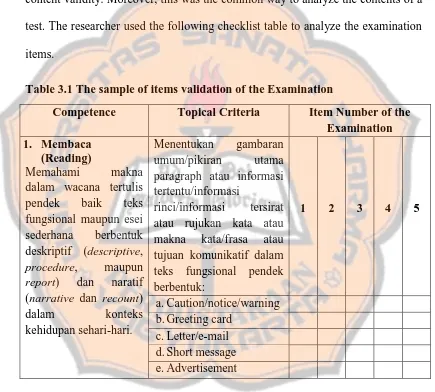
Table 3.1 The sample of items validation of the Examination
Competence Topical Criteria Item Number of the Examination
The checklist tables of this parts were divided into two parts according to
the test specifications published by BSNP (Board of Education National
Standard), namely reading and writing section. The table above was the sample
for the number of competence standard and the competence standard which
covered the skills going to be measured, materials, topics, and the purpose in
comprehending particular skills, materials, and topics, and the main themes taught
in particular semester. In addition, the competence standard of the examination
was the integration from grade 7th to grade 9th Junior High School in six
semesters. It represented all materials, topics, and skills which were taught in
teaching-learning activities. The second column was for the topical criteria. This
topical criteria consisted of the requirements which should be passed by students
to reach the competence standard. Furthermore, the criteria were also aimed to
ensure whether or not the students reached the competence standard. In addition,
the topical criteria also enlightened the materials and topics in order to measure
students’ knowledge, skills, and abilities. The contents of the first and second
columns were taken from the test specifications of English National Examination
2015 for Junior High School. Then, the third column was item number of the
examination which consisted of some number of the test items and boxes. There
were some boxes bellow the numbers. It aimed to give the symbol of a tick (√) as
a part of analyzing the examination items.
In this part, the researcher utilized the checklist table to analyze the
content validity of the examination items. The first step of analyzing the
examination items was to match the materials or topics of the test specifications
with each item of the examination. After matching, the results would be obtained
whether or not the test items followed the contents of the test specifications. If the
column beneath the numbers were given a tick (√) which meant Yes, the items
met the criteria of content validity. If there was no tick (√), the items did not
represent the materials and topics in the test specifications. It meant No, the items
did not meet the criteria of content validity and an “X” was given to that items in
the third column.
Next, the researcher also utilized other checklist tables in similar type to
analyze writing section items. Furthermore, the similar method was applied to
gather the data of content validity in this section. A tick (√) was given if the test
items in writing section matched with the test specifications. Then, an “X” was
given to the test items which did not match with the test specification. Later, the
result would be presented in form of percentage and word description.
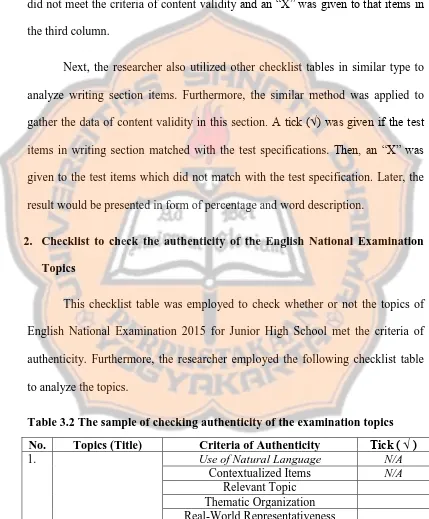
2. Checklist to check the authenticity of the English National Examination Topics
This checklist table was employed to check whether or not the topics of
English National Examination 2015 for Junior High School met the criteria of
authenticity. Furthermore, the researcher employed the following checklist table
to analyze the topics.
In this part, three-column table was utilized to gather the data of
authenticity of the examination topics. The first column was for the number of
each topic. Actually, the numbers in the first column did not portray the real
number of the topics in the examination sheet. Each topic was given number by
the researcher from the very beginning at the first page to the end at the last page.
The second column then was for the topics in the examination. Later, the topics
covered the titles would be written down in the column. There were seventeen
topics in the test version A and B. The third column was for the criteria of
authenticity utilized to match the topics and each point of authenticity.
Next, the focus of the research was the topics which referred to the text
characteristics. Moreover, the test topics was essential since it played important
role as represented materials in the examination. In analyzing the authenticity of
the examination topics, there were three criteria of authenticity (Brown, 2004)
used namely relevant topic, thematic organization, and real-world
representativeness. Meanwhile, the other two criteria, use of natural language and
contextualized items were not employed since they were not applicable to analyze
the examination. Use of natural language was not applicable because the analysis
target was the examination for junior high school level. Besides, use of natural
language was not suitable for junior high school students since it assumed as
something difficult. Next, contextualized items were not applicable since the
focus of this research was the examination topics.
Relevant topic was employed as the first aspect to check the authenticity