Corresponding author: Roselinda
E-mail: [email protected]
Genotype and transmission Human Immunodefi ciency Virus-1 in seven provinces in
Indonesia
Roselinda, Rabea Pangerti Jekti
Center for Biomedical and Basic Technology of Health, National Institute of Health Research and Development, Ministry of Health of Indonesia
Abstrak
Latar belakang: Penelitian sebelumnya di Indonesia dengan sampel terbatas mengungkapkan bahwa distribusi subtipe HIV-1 dan modus penularan berbeda antar daerah. Tujuan analisis ialah untuk mengungkapkan subtipe dan cara penularan HIV-1 di daerah yang lebih luas di Indonesia.
Metode: Tulisan ini menggunakan sebagian data studi potong lintang di tujuh provinsi di Indonesia pada 2011 di antara kasus HIV/AIDS yang dipilih purposif yang mengunjungi klinik Perawatan Sukarela dan Pengobatan (VCT) di tujuh provinsi (Sumatera Utara, Sumatera Barat, Kepulauan Riau, Sulawesi Selatan, Sulawesi Utara, Maluku, dan Papua). Untuk setiap provinsi yang dipilih 1 atau 2 rumah sakit secara purposif.
Hasil: Subtipe AE terdapat di semua propinsi sampel. Subtipe B ditemukan di hampir semua provinsi kecuali di Kepulauan Riau. Jenis lainnya (A, C, dan AG) ditemukan hanya di 2 provinsi, dan jenis yang paling langka (D) ditemukan hanya di satu provinsi.
Proporsi penularan yang tinggi yaitu melalui heteroseksual di semua provinsi kecuali di Sulawesi Selatan. Persentase tertinggi transmisi via suntikan vena (IDU) terdapat di Sulawesi Selatan, dan melalui transmisi perinatal terjadi di Papua.
Kesimpulan: Distribusi Subtipe dan cara penularan HIV-1 berbeda antar propinsi. Subtipe AE terdapat di seluruh provinsi, sedangkan proporsi tertinggi transmisi melalui perinatal terjadi di Papua. (Health Science Indones 2012;2:xx-xx)
Kata kunci: HIV-1 subtipe, distribusi, cara penularan, Indonesia
Abstract
Background: Previous studies in Indonesia with a limited sample of HIV-1 subtypes revealed that HIV-1 subtype distribution and mode of transmission differed between the regions. This analysis aimed to describe subtypes and mode of transmission of HIV-1 in wider area in Indonesia.
Methods: This analysis used a part of HIV/AIDS cross sectional study in seven provinces in Indonesia in 2011 among HIV/AIDS purposive selected cases visited Volunteer Care and Treatment (VCT) clinics in seven provinces (North Sumatera, West Sumatera, Riau islands, South Sulawesi, North Sulawesi, Maluku, and Papua). For each province was selected 1 or 2 hospitals purposive.
Results: AE subtype of HIV-1 was existed in all participating. Subtype B was found in almost all provinces except in Riau islands. The other type (A, C, and AG) found in 2 provinces only, and the rarest type (D) found in one province only.
The high proportion of transmission was through heterosexual in all provinces except in South Sulawesi. The percentage of the common transmission by intra venous drug user (IDU) IDU occurred in South Sulawesi, whereas via perinatal transmission occurred in Papua.
Conclusion: HIV-1 subtype distribution and mode of transmission differed between the provinces.
The AE subtype HIV-1 was existed in all provinces, whereas among provinces the highest proportion transmission via perinatal occurred in Papua. (Health Science Indones 2012;2:xx-xx)
HIV/AIDS cases reported to have been found in all provinces in Indonesia with an estimated cumulative total of 6,871 reported cases.1
Based Genotyping of Human Immunodefi ciency Virus (HIV) in people with HIV/AIDS (Acquired Immune Defi ciency Syndrome) or known by people living with HIV, HIV can be divided into type 1 (HIV-1) and type 2 (HIV-2).2
Previous studies in Indonesia with a limited sample of HIV-1 subtypes have done in the province of West Papua, Jakarta, East Java, West Java, and Bali, and revealed that HIV-1 subtype distribution and mode of transmission differed between the regions and tended to change from time to time.3-5
This analysis aimed to describe subtypes and mode of transmission of HIV-1 in seven provinces in Indonesia.
METHODS
This analysis used a part of HIV/AIDS cross sectional study in seven provinces in Indonesia in 2011. The subjects consisted of HIV/AIDS cases visited Volunteer Care and Treatment (VCT) clinics in purposive selected seven provinces (North Sumatera, West Sumatera, Riau islands, South Sulawesi, North Sulawesi, Maluku, and Papua). For each province was selected 1 or 2 hospitals purposive.
The subjects consisted of confi rmed positive HIV/ AIDS using 3 rapid test by different methods or 2 rapid tests by different and 1 time test by ELISA method in participating. We excluded severe cases.
Based on sequencing test and information analysis results for serum positive HIV-1 (using MEGA 5.0 software), the sub-type consisted of sub-type AE, A. B, C, D, AG, and unidentifi ed.
Interviewers and data collection for 1 week by rese-archer’s personnel of the Center for Biomedical and Basic Health Technology until 70 subjects collected.
Mode of transmission divided into heterosexual, homosexual, intra venous drug user (IDU), transfusion, perinatal, and others. Perinatal transmission confi rmed based on hospital medical records. While the other (tattoo, more than one transmission) mode of transmission based on interview with the subjects in addition to hospital medical records.
This study received ethical clearance from the Ethical Committee of the Litbangkes, and informed consent available from the subjects.
RESULTS
Table 1 shows that in term of gender, the highest proportion of women with HIV/AIDS was in Papua province (70.0%) and lowest in the province of South Sulawesi (27.1%).
Table 2 shows that not identifi ed HIV-1 sub-type existed in all provinces, and the highest proportion (62.9%) found in Maluku and Papua.
In general, AE subtype HIV-1 was existed in all provinces and the highest was in North Sumatra (80.0%) and lowest in Papua (24.6%). 64.1%). In addition, subtype B was found in almost all provinces except in Riau islands.
The other type (A, C, and AG) found in 2 provinces only, and the rarest type (D) found in one province only (North Sulawesi).
Table 2 is here
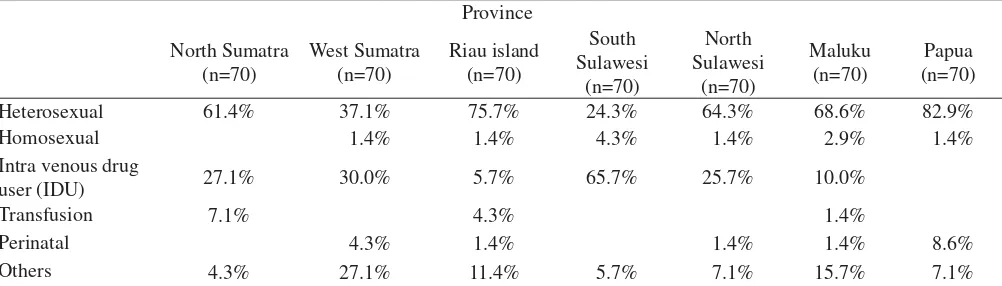
Table 3 shows that high proportion of transmission through heterosexual in all provinces except in South Sulawesi (24.3%). The percentage of the common transmission through IDU occurred in South Sulawesi, whereas via perinatal transmission occurred in Papua.
DISCUSSION
In interpreting our fi ndings, there are several limi-tations, among others; the subjects were purposive selected in term of hospital and provinces. In addition, data collection was performed in one week only until 70 subjects were available from each province.
Table 1. Percentage HIV-1 by province and gender
Female 37.1% 32.9% 55.7% 27.1% 32.9% 54.3% 70.0%
Male 62.9% 67.1% 44.3% 72.9% 67.1% 45.7% 30.0%
Table 2. Percentage HIV-1 sub-type by province and subtype
Province
HIV-1 sub-type North Sumatra (n=70)
Table 3. Percentage HIV-1 by province and transmission
Province
Heterosexual 61.4% 37.1% 75.7% 24.3% 64.3% 68.6% 82.9%
Homosexual 1.4% 1.4% 4.3% 1.4% 2.9% 1.4%
Intra venous drug
user (IDU) 27.1% 30.0% 5.7% 65.7% 25.7% 10.0%
Transfusion 7.1% 4.3% 1.4%
Perinatal 4.3% 1.4% 1.4% 1.4% 8.6%
Others 4.3% 27.1% 11.4% 5.7% 7.1% 15.7% 7.1%
Our study noted that the proportion of not identifi ed virus HIV-1 subtype were relatively high. This is because in this study, due to limited funds, to identify the subtype of HIV-1 used four primaries only which were still in accordance with the WHO minimum standards.
The nature of the HIV virus which it’s envelops highly mutable, it was likely a mutation in it’s envelop can not be detected by the primers used in this examination. Another possible cause was the viral load very low.
Our study noted that HIV-1 subtypes differed among provinces. The AE subtype 1 existed in all provinces.
However, subtype B was found in almost all provinces except in Riau islands, and the other type (A, C, D, and AG) found in 1 or 2 provinces only. Our fi ndings were similar with the previous study. HIV-1 subtype distribution was differently found between the regions.7
In addition, the other studies reported that in Papua found subtype B and AE, while in Jakarta and East Java found subtype B, E, and AE, whereas in West Java and Bali obtained mostly subtype AE followed by subtype B, C, and G (AG).1,8 Furthermore, in Papua New Guinea, in the heterosexual population, subtype C were reported.9
Furthermore, transmission through heterosexual was highest in all provinces except in South Sulawesi (24.3%). This is also in accordance with the results of research on HIV transmission patterns in Jakarta province that noted more transmission through sexual intercourse.8
Percentage of transmission through intravenous drug user (IDU) was still high in South Sulawesi, but none in Papua. This situation most likely the other mode of transmission in stead of IDU the other mode more common already, except for Papua.
The other study revealed that traditional practices such as polygamy, early marriage and contract marriage (mut’a) play an important role in enhancing women’s likelihood of acquiring HIV within the Indonesian context.10
Transmission through heterosexual occurred in all provinces. This is also in accordance with the results of research on HIV transmission patterns Jakarta province more transmission through heterosexual.8
Our study noted that perinatal transmission relatively common occurred in Papua. Research in Thailand reported that the transmission from mother to child was often found in subtype D or A. While other studies found no relationship between subtypes and transmission from mother to child.3
In conclusion,in term of gender, the highest proportion of women with HIV/AIDS was in Papua province. HIV-1 subtype distribution and mode of transmission differed between the provinces.
The AE subtype HIV-1 was existed in all provinces and the highest was in North Sumatra. High proportion of transmission through heterosexual occurred in all provinces except in South Sulawesi. Whereas among provinces the highest proportion transmission via perinatal occurred in Papua.
REFERENES
Directorate for General Communicable Diseases 1.
Control. HIV/AIDS surveilans in Indonesia. Jakarta. The offi ce. 2007.
Sharp PM, Robertson DL, Gao F, et al. Hahn B. Origins 2.
and diversity of human immunodefi ciency virus AIDS. AIDS 1994 (suppl-1):S27-42.
Foley B, Donegan E, Silitonga N, et al. Importation 3.
of multiple HIV type 1 strain into West Papua, Indonesia (Irian Jaya). AIDS Res Hum Retroviruses. 2001;17:1655-9.
Raharjo E, Wibowo HA, Roselinda. Epidemiology of 4.
molecular genotype Human Immunodefi ciency Virus-1 (HIV-1) in HIV/AIDS adults in East Java and Jakarta. Jakarta. National Institute of Health Research and Development, Ministry of Health of Indonesia. 2009. Merati TP, Ryan C, Turnbul S, et al. HIV-1 subtype in 5.
several REAS IN Indonesia and its role as epidemic HIV dynamics. [cited 2011 Apr 19]. Available from
www.e-journal.unud.ac.id/e_journal_tuti_parwati.pdf.
Jacubowsk
6. i N. Marriage is not a safe place: Heterosexual marriage and HIV-related vulnerability in Indonesia. Culture, Health & Sexuality: An International J Research, Intervention and Care. 2008;10:87-97. Gloriani BN, Graham RR, Santiago EG, Manalo 7.
MA, Chan VF, Valdez T. Genotype analysis of HIV-1 isolates from various risk groups in Metro Manila. Phil J Microbiol Infect Dis 1998:27(4):137-142.
World Health Organization. WHO network for HIV 8.
isolation and characterization:HIV-1 variation in WHO-sponsored vaccine evaluation sites: genetic screening, sequence, analysis and preliminary biological characterization of selected viral strain. AIDS Res Hum Retroviruses. 1994;10:1325-41.
Ryan CE, Gare J, Crowe SM, et al.
9. The Heterosexual
HIV type 1 epidemic in Papua New Guinea is dominated by subtype C. AIDS Research and Hum Retroviruses, 2007;23:941-4.
Jacubowsk
10. i N. Marriage is not a safe place: Heterosexual marriage and HIV-related vulnerability in Indonesia. Culture, Health & Sexuality: An International J Research, Intervention and Care. 2008;10:87-97. Foley