The journal homepage www.jpacr.ub.ac.id p-ISSN : 2302 – 4690 | e-ISSN : 2541 – 0733
Preparation and Characterization of Poly-(methacrylatoethyl
trimethylammonium vinylbenzyl
Chloride-co-Ethylene Dimethacrylate) Monolith
Eko Malis1, Aprilia Nur Tasfiyati1, Elvina Dhiaul Iftitah1,3, Setyawan Purnomo Sakti2,3, Akhmad Sabarudin 1,3,*
1
Department of Chemistry, Faculty of Science, Brawijaya University, Jl Veteran Malang 65145, Indonesia
2
Department of Physics, Faculty of Science, Brawijaya University, Jl Veteran Malang 65145, Indonesia
3
Research Center for Advanced System and Material Technology, Brawijaya University, Jl Veteran Malang 65145, Indonesia
*
Corresponding email: [email protected]; [email protected]
Received in reviewed form 6 April 2015; Revised 1 May 2015; Accepted 8 May 2015
ABSTRACT
A polymer monolithic column, poly-(methacrylatoethyltrimethylammonium chloride-co-vinylbenzyl chloride-co-ethylene dimethacrylate) or poly-(MATE-co-VBC-co-EDMA) was successfully prepared in the current study by one-step thermally initiated in situ
polymerization, confined in a steel tubing of 0.5 mm i.d. and 1/16” o.d. The monoliths
were prepared from methacrylatoethyltrimethylammonium chloride (MATE) and vinylbenzyl chloride (VBC) as monomer and ethylene dimethacrylate (EDMA) as crosslinker using a binary porogen system of 1-propanol and 1,4-butanediol. The inner wall of steel tubing was pretreated with 3-methacryloxypropyl-trimethoxysilane (MAPS).
In order to obtain monolith with adequate column efficiency and low flow resistance, some
parameters such as total monomer concentration (%T) and crosslinker concentration (%C) were optimized. The morphology of this monolith was assessed by scanning electron microscopy (SEM). The properties of the monolithic column, such as permeability, binding capacity, and pore size distribution were also characterized in detail. From the results of the characterization of all monolith variation, monolith with %T 30 %C 50 and %T 35 %C 50 give the best characteristic. These monoliths have high permeability, adequate molecular recognition sites (represented with binding capacity value of over 20 mg/mL), and have over 80% flow through pores in their pore structure contribute to low flow resistance. The resulted monolithic columns have promising potential for dual mode liquid chromatography. MATE may contribute for anion-exchange while VBC may responsible for reversed-phase liquid chromatography.
Key word: monolith, porous structure, HPLC, dual mode LC, anion exchange, reversed-phase
INTRODUCTION
and the ability to design desired length are the main advantages of monolithic stationary phase over conventional packed column [8-10].
There are two main types of monolithic material, which is silica-based monolith and organic polymer-based monolith. Silica-based monolith is more easily controlled to produce a regular pore structure. Despite of the advantage, silica-based monolith has low pH stability, and the presence of silanol effects may lead to irreversible adsorption, causing serious problems in the analysis of biological samples. Organic polymer-based monoliths are slightly weaker than silica-based monoliths in terms of mechanical stability due to swelling and shrinking in contact with some organic solvents. However, this type of monolith has the advantage of stability in a wide pH range, high chemical stability, and inertness toward biomolecules. Drawbacks in organic polymer-based monolith can be overcome by optimizing the composition of the functional monomer, cross-linker, and porogen, as well as post-polymerization strategy [10-14].
Methacrylate-based and styrene-based polymers are some of the most popular among polymer chemistries used as separation media. There are several advantages related with their use as stationary phase, including high stability under wide range pH conditions, fast and simple preparation, and wide selection of monomers available with wide range of polarities. Both mechanical and chemical stability are high enough to withstand extreme conditions during the implementation [15-19]. Therefore, methacrylate-based and styrene-based monolith can be considered as the supports of choice for efficient separation.
In terms of system miniaturization and analysis, the utilization of capillary-scale monolithic column with inner diameters of 75–250 µm is more appropriate [20-26]. It may be related to the fact that such capillary-scale columns are well-suited to the needs of research in the field of life-sciences, where the amount of sample available is limited. Capillary-scale columns not only require minimum consumption of sample and reagents, but also enhanced sensitivity from the limited sample volume. However, capillary scale columns require dedicated HPLC equipment and high skills. In terms of ease of use for general HPLC users as well as preparative applications, a little bit larger-diameter of monolith is more desirable. Several work has been reported on the development of microbore columns with internal diameter of 0.5 – 1.5 mm [13,27-29]. Microbore column can be easily connected to commercially available standard HPLC system with minor modification. Although requiring more attention to the uneven heating along the diameter of the column during the polymerization process, microbore columns combine the advantages of both capillary and conventional-size columns, that is low sample and reagent consumption, reduced waste, shorten analysis time, and enhanced sensitivity from the small amount of sample [13,28,30-32].
promising potential for dual mode liquid chromatography. MATE may contribute for anion-exchange whereas VBC may responsible for reversed-phase liquid chromatography.
EXPERIMENT
Chemicals and instrumentation
All chemicals used were of analytical grade. Methacrylatoethyltrimethylammonium chloride, vinylbenzyl chloride, ethylene dimethacrylate, bovine serum albumin (BSA), 3-methacryloxypropyl-trimethoxysilane (MAPS), 1-propanol, 1,4-butanediol, tetrahydrofuran (THF), and polystyrene standard set (Mw 500-1800000) were purchased from Sigma-Aldrich Co. (USA). NaOH, acetonitrile, and toluen were form Merck KGaA (Darmstadt, Germany). Steel tubing (0.5 mm i.d, 1/16 inch o.d) was from Supelco (Bellefonte, Pennsylvania, USA) and azobis(isobutyronitrile) (AIBN) was from Himedia (Mumbai, India). Methanol was purchased from Fulltime (Anhui, China), while ethanol, HCl, and acetone were from Smart Lab Indonesia. All reagents were used as received without further purification.
All liquid chromatography experiment was performed using Shimadzu Prominence HPLC system consists of pump (LC-20AD), oven (CTO-20AC), a model 8125 Rheodyne injector with a home-made 2 µL sample loop, detector (SPD-20A UV/VIS) with semimicro flow cell (2.5 µL). Morphology of monolith was observed by scanning electron microscopy (SEM) model TM-3000 (Hitachi, Japan).
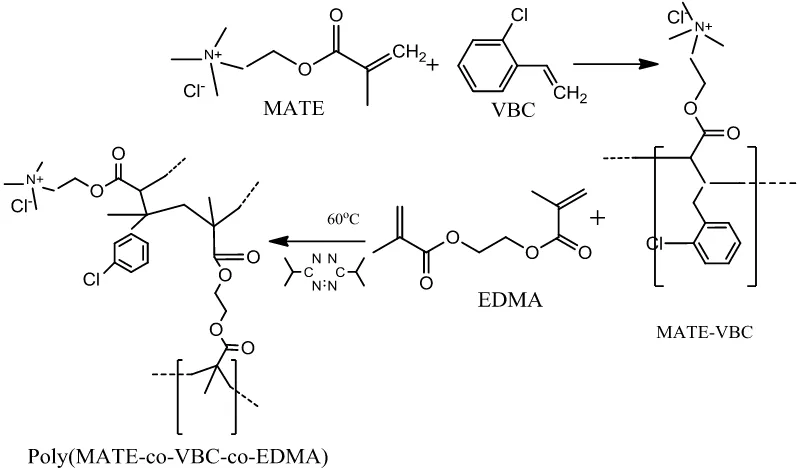
Figure 1. Preparation of Poly(MATE-co-VBC-co-EDMA) monolith
Procedure
Preparation of Monolith Column poly-(MATE-co-VBC-co-EDMA)
with distilled water, filled with 0.2 M NaOH for 2 x 30 minutes, rinsed with water 3 times, then filled with 0.2 M HCl for 2 x 30 minutes, and rinsed with water followed by acetone. MAPS solution (MAPS: acetone: pyridine = 30:65:5 v/v) was used to fill steel tubing. After closing both ends with end caps, the column was placed in room temperature for 2 x 12 hours. The pretreated column was then washed thoroughly with acetone and then cut into 10 cm long pieces.
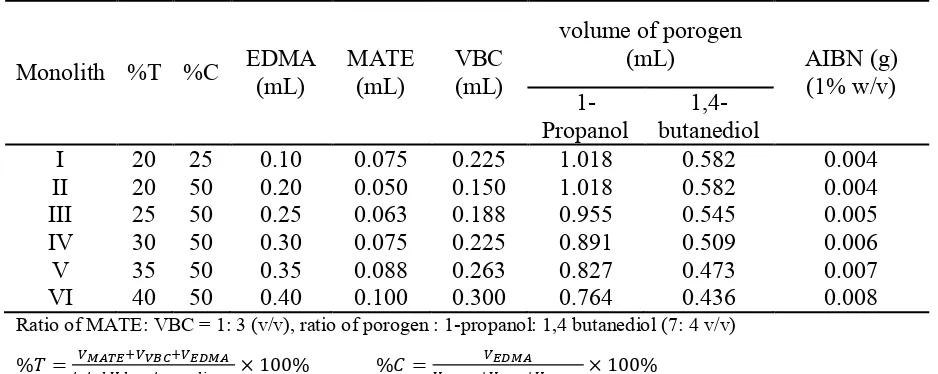
Poly-(MATE-co-VBC-co-EDMA) monolith was prepared by one-step thermally initiated in situ polymerization method, as described by Chen et al. [33] with minor modification as shown in Fig 1. Firstly, porogen 1-propanol was mixed thoroughly with 1,4-butanediol. Subsequently, all monomers and cross-linker (MATE, VBC and EDMA) were added into porogenic solvents and mixed properly to form polymerization solution, with composition as indicated in Table 1. Radical initiator AIBN was then added to the polymerization solution and thoroughly mixed using vortex to form a homogeneous solution. The polymerization solution was then injected into the pretreated steel tubing, sealed at both ends, and placed in the oven to proceeds the polymerization at 60°C for 20 hours. Finally, the prepared monolithic column was excessively washed with ethanol and water to remove
Ratio of MATE: VBC = 1: 3 (v/v), ratio of porogen : 1-propanol: 1,4 butanediol (7: 4 v/v)
(expressed in mg.mL─1 column volume), calculated at 10% of the final absorbance value of the breakthrough curve using the following equation:
where V1 : the 10% breakthrough volume (mL), V0 : the extracolumn volume of the HPLC
Detection and separation were performed at room temperature. The value of V0 was
estimated to be 0.37 mL at flowrate 0.05 mL.min-1. The monolith was then eluted with NaCl 1 M in ACN solution (ACN/H2O : 95/5) after DBC measurement to release BSA.
Estimation of Pore Size Distribution by Inverse Size Exclusion Chromatography Method
To determine the distribution of flow-through pores (macropore), mesopore, and micropore, inverse size exclusion chromatography (ISEC) method was performed using polystyrene standards (MW 500-1800000) as described by Al-Bokari et al. [34]. Sample injection volume was set to 2 µL for each polystyrene standard. All ISEC experiments were performed with THF as mobile phase at constant flow rate of 0.05 mL.min-1 and at room temperature. Wavelength of 254 nm was used to detect the maximum absorption of polystyrene standard.
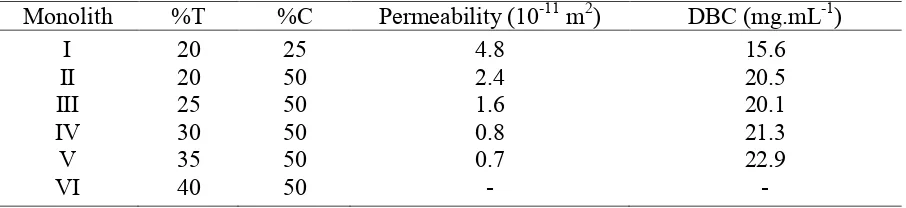
Table 2. Permeability, and DBC data of poly-(MATE-co-VBC-co-EDMA) monolithic column
Preparation of monolith poly-(MATE-co-VBC-co-EDMA) was performed by direct copolymerization of a cationic monomer with a crosslinker. MATE has hydrophilic properties naturally. This will lead to a non-homogenous polymer solution with cross-linker used in this work (EDMA), which possesses hydrophobic property. Consequently, the porogenic solvents have to be carefully chosen since their characteristics will determine the homogeneity of the resulting polymerization solution. Binary porogen consist of 1-propanol and 1,4-butanediol was selected since they could perfectly homogenize polymer solution of MATE, VBC, and EDMA. The ratio of MATE : VBC was adopted from Chen and co-workers [33]. Each variation of the polymerization condition has significant effect on the structure of monolith. In fact, minor changes in the composition of the polymer mixture can affect the performance of monolithic column [23, 35]. Hence, it is important to obtain the optimized polymerization condition.
Characterization of Monolith Column poly-(MATE-co-VBC-co-EDMA)
Permeability of monolith poly-(MATE-co-VBC-co-DMA) was tested at flow rate 0.05 mL.min-1 using ethanol as mobile phase. The permeability data was shown in Table 2. Monolith II to V with increasing %T from 20 to 35% have permeability value decreasing from 2.4 x 10⁻¹¹ m2 to 0.7 x 10⁻¹¹ m2. Furthermore, when %T was increased to 40% (monolith VI), the permeability of the monolith deteriorated into zero value; indicate that monolithic column is not permeable for mobile phase. It can be concluded that column permeability is significantly affected by the composition of porogenic solvent. The smaller the amount of porogenic solvent (indicated by the higher value of %T), the lower the permeability of monolithic column was obtained.
Moreover, permeability value was also decrease along with the increasing of %C. The permeability of the monolithic column I and II with %C value of 25 and 50% was slightly decreased from 4.8 x 10⁻¹¹ m2 to 2.4 x 10⁻¹¹ m2. This is presumably because monolith becomes more rigid due to the increasing amount of cross-linker involved in the polymerization process. These experimental results confirmed that monolith I to V with %T ranging from 20 to 35 have quite high permeability under flow rate of 0.05 mL.min-1. Therefore, only monolith I-V was used in further experiments. It should be noted that higher flow rate could be applied to the column.
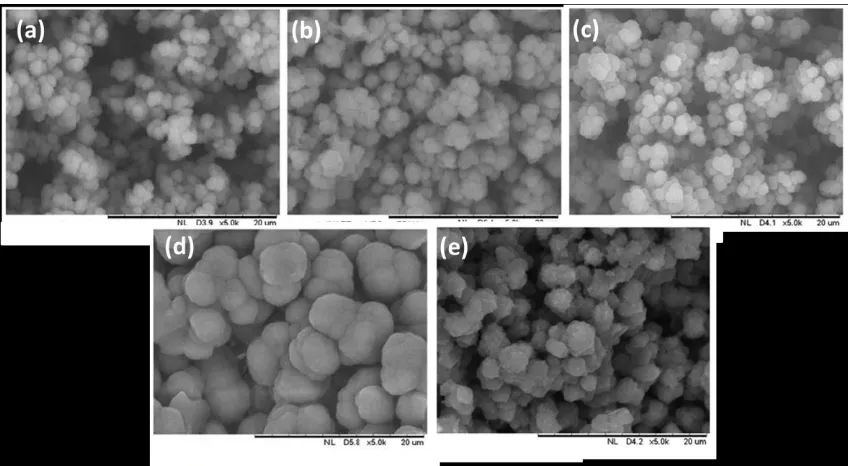
Figure 2. SEM profile of the cross section of poly-(MATE-co-VBC-co-EDMA) monolithic column with 5000× magnification. (a) monolith I, (b) monolith II, (c) monolith IV, (d) monolith V, (e) monolith VI
monolith IV and V have the highest DBC values of 21.3 and 22.9 mg.mL-1 , respectively at flow rate of 0.05 mL.min-1. The good DBCs of these monoliths are attributed not only to a high incorporation of functional monomer, but also to their high-through pore structures that afford good pore accessibility by proteins.
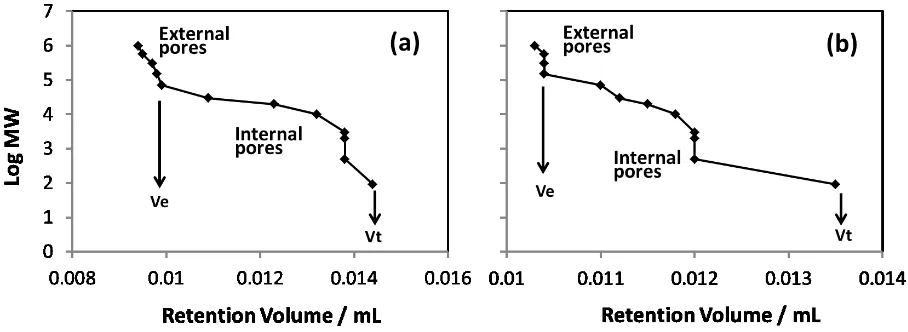
Two monolith columns with the highest DBC value (monolith IV and V) was then assessed their porosity and pore size distribution using ISEC method. As shown in Fig. 3a, total porosity (εt) of monolith IV derived from the retention volume of toluene was 0.72,
which is comparable to its porogen fraction (0.70), while the interstitial/external (εe) and
internal (εi) porosities were 0.50 and 0.23, respectively. The total porosity of monolith V (Fig
3b) was found to be 0.67, showing the commensurate value to the fraction of its porogen content (0.65), whereas εe and εi porosities of this monolith was estimated to be 0.52 and
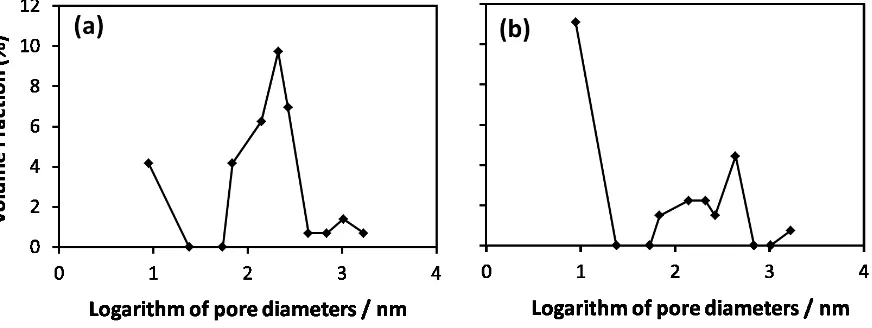
0.16, respectively. The external porosities of both monoliths are larger than their internal porosities, indicating predominant flow-through pores existing in these stationary phases. As given in Fig. 4a and Table 3, the volume fractions for micropores (<2 nm), mesopores (2–50 nm), and macropores or flow-through pores (>50 nm) were estimated to be 4.2, 27.8, and 68 %, respectively for monolith IV. And for monolith V, as displayed in Fig. 4b and Table 3, the volume fractions were 11.1, 11.9, and 77%, respectively. These results show certainly that both monoliths are dominated by flow through pores, which contribute for convective mass transfer and low flow resistance. This is consistent with high permeability value of both monoliths.
Figure 3. Plot of the molecular masses (MW) logarithm of polystyrene standards versus their elution volume for monolith IV (a) and monolith V (b). Vt is the retention volume of the unretained tracer (toluene) and Ve is the retention volume of the excluded molecular mass.
acetonitrile and 5% in THF. This indicates that both monoliths shrink in acetonitrile as well as THF, although not in excessive degree. The degrees of shrinkage did not exceed 10%, which is still reasonable.
Figure 4. Plot of logarithm of pore diameter of poly-(MATE-co-VBC-EDMA) versus volume fraction for monolith IV (a) and monolith V (b)
Table 3. Pore size distribution of poly-(MATE-co-VBC-co-EDMA) monolithic column Monolith % T %C Micropores (%) Mesopores (%) Macropores (%)
IV 30 50 4.2 27.8 68
V 35 50 11.1 11.9 77
CONCLUSION
An organic polymer based monolithic column with adequate column efficiency and low flow-resistance were successfully produced by in situ copolymerization of MATE, VBC, and EDMA in the presence of 1-propanol and 1,4-butanediol (7:4, v/v) at a polymerization temperature 60oC for 20 hours. Monolith prepared in this work has potential for dual mode liquid chromatography. MATE may contribute for anion exchange whereas VBC may responsible for reverse phase liquid chromatography. This monolith has great potential for separations of a variety of compounds from small analyte to large biomolecules, and may find various applications in biomedical and pharmaceutical analysis.
ACKNOWLEDGMENT
This work was supported by the Penelitian Unggulan Perguruan Tinggi (No. 023.04.2.414989/2013-2014) from Directorate General of Higher Education, Ministry of Education and Culture, Indonesia.
REFERENCES
[1] R.D. Arrua, M. Talebi, T.J. Causon, E.F. Hilder, Anal. Chim. Acta, 2012, 738, 1-12. [2] S. Hjertén, J.L. Liao, R. Zhang, J. Chromatogr. A., 1989, 473, 273-275.
[3] J.L. Liao, R. Zhang, S. Hjertén, J. Chromatogr. A., 1991, 586, 21-26.
[4] S. Hjertén, Y.Y.M. Li, J.L. Liao, J. Mohammad, K. Nakazato, G. Pettersson, Nature,
1992, 810-811.
[6] Q.C. Wang, F. Svec, J.M.J. Fréchet, J. Chromatogr. A., 1994, 669, 230-235. [7] F. Svec, J.M.J. Fréchet, J. Chromatogr. A., 1995, 702, 89-95.
[8] M. Barut, A. Podgornik, L. Urbas, B. Gabor, P. Brne, J. Vidič, S. Plevčak, A. Štrancar,
J. Sep. Sci., 2008, 31, 1867–1880.
[9] A. Podgornik, S. Yamamoto, M. Peterka, N. L. Krajnc, J. Chromatogr. B., 2013, 927, 80-89.
[10] T. Nema, E.C.Y. Chan, P.C. Ho, J. Pharmaceut. Biomed., 2014, 87, 130-141.
[11] Y. Ueki, T. Umemura, J. Li, T. Odake, K. Tsunoda, Anal. Chem., 2004, 76, 7007-7012. [12] D. Schaller, E.F. Hilder, P.R. Haddad, J. Sep. Sci., 2006, 29, 1705-1719.
[13] T. Umemura, Y. Ueki, K. Tsunoda, A. Katakai, M. Tamada, H. Haraguchi, Anal.
Bioanal. Chem., 2006, 386, 566-571.
[14] M. Guerrouache, B. Carbonnier, C. Vidal-Madjar, M.C. Millot, J. Chromatogr. A.,
2007, 1149, 368-376.
[15] I. Gusev, X. Huang, C. Horváth, J. Chromatogr. A., 1999, 855, 273-290. [16] D. Lee, F. Svec, J.M.J. Fréchet, J. Chromatogr. A., 2004, 1051, 53-60.
[17] Y. Ueki, T. Umemura, Y. Iwashita, T. Odake, H. Haraguchi, K. Tsunoda, J.
Chromatogr. A., 2006, 1106, 106-111.
[18] J. Vidič, A. Podgornik, J. Jančar, V. Frankovič, B. Košir, N. Lendero, K. Čuček, M. Krajnc, A. Štrancar, J. Chromatogr. A., 2007, 1144, 63–71.
[19] A. Korolev, E. Victorova, T. Ibragimov, A. Kanatyeva, A. Kurganov, J. Sep. Sci., 2012, 35, 957–963.
[20] E.C. Peters, M. Petro, F. Svec, J.M.J. Fréchet, Anal. Chem., 1997, 69, 3646-3649. [21] B. Carbonnier, M. Guerrouache, R. Denoyel, M.C. Millot, J. Sep. Sci., 2007, 30, 3000–
3010.
[22] S. Eeltink, F. Svec, Electrophoresis, 2007, 28, 137–147. [23] J. Urban, P. Jandera, J. Sep. Sci., 2008, 31, 2521–2540.
[24] I. Nischang, O. Brüggemann, J. Chromatogr. A., 2010, 1217, 5389-5397. [25] J. Urban, F. Svec, J.M.J. Fréchet, J. Chromatogr. A., 2010, 1217, 8212-8221. [26] X. Chen, H.D. Tolley, M.L. Lee, J. Chromatogr. A., 2011, 1218, 4322-4331.
[27] X. Huang, Q. Wang, H. Yan, Y. Huang, B. Huang, J. Chromatogr. A., 2005, 1062, 183-188.
[28] Z. Xu, L. Yang, Q. Wang, J. Chromatogr. A., 2009, 1216, 3098-3106.
[29] E.P. Nesterenko, P.N. Nesterenko, D. Connolly, F. Lacroix, B. Paull, J. Chromatogr. A.,
2010, 1217, 2138-2146.
[30] S. Shu, H. Kobayashi, N. Kojima, A. Sabarudin, T. Umemura, J. Chromatogr. A., 2011, 1218, 5228-5234.
[31] A. Sabarudin, J. Huang, S. Shu, S. Sakagawa, T. Umemura, Anal. Chim. Acta., 2012, 736, 108-114.
[32] S. Shu, H. Kobayashi, M. Okubo, A. Sabarudin, M. Butsugan, T. Umemura, J.
Chromatogr. A., 2012, 1242, 59-66.
[33] M.L. Chen, Y.L. Liu, X.W. Xing, X. Zhou, Y.Q. Feng, B.F. Yuan, Chem. Eur. J., 2013, 19, 1035–1041.
[34] M. Al-Bokari, D. Cherrak, G. Guiochon, J. Chromatogr. A., 2002, 975, 275-284.
[35] P. Jandera, J. Urban, V. Škeříková, P. Langmaierm, R. Kubíčková, J. Planeta, J.