2 (2) 84 - 97 ©UB 2013 University of Brawijaya Malang, Indonesia http://apmba.ub.ac.id
The Models of Human Resource Development in
Preparing Prisoners for Entrepreneurship
in Banjarmasin
Zainal Arifina*
Akhmad Yafiz Syamb
Muhammad Maladic
a,b,c STIEI Kayutangi, Banjarmasin, Indonesia
Abstract
Tendency to ex-prisoners back into previous environment after being released from the detention center is a phenomenon that raises a big question. Although training programs have become routine activities provided by the government every year and inmates are trained in various skills in preparation for their after-free, some still choose to return to the criminal world. Empirical studies show that there are two main causes, namely (1) the training program is given to make them skilled workers that after they acquire freedom no company will hire former prisoners, (2) there are constraints such as capital and knowledge emerge as for those starting and running a business. A new approach is necessary for construction problems. This study attempts to test the model of human resource development for former prisoners to prepare them for entrepreneurship. This study is the first step in testing the model of development of human resources for ex-prisoners to prepare them for entrepreneurship. In this study, the object to be examined is inmates of a prison in Banjarmasin. The data collection is done by filling in questionnaires, in-depth interviews to 150 inmates of their last year before the end of the period of detention, business confidence surveys, training and mentoring consultancy. The results from the test using MSC-T Miner questionnaire method showed 100 of the 150 prisoners have entrepreneurial potential. 100 people have been matched with their preferred business qualifications only 50 people who have interest in accordance with market rates. Intervention by the research team is to provide motivation and knowledge about entrepreneurship and personality development showed better results than before the intervention of the 50 inmates in preparing for entrepreneurship.
Keywords
Human Resource Development, Entrepreneurship, Prisoner
Introduction
The number of prisoners in Indonesia, based on data from the Directorate General of Corrections, Ministry of Justice and Human Rights in 2008 amounted to 75,447 people is an interesting condition. Prisoners are assets because when managed properly by the government not only they will have a positive impact and provide economic value to prisoners themselves but also for the government and community through the activities of Micro Unit.
Law of the Republic of Indonesia Number 20 of 2003 on National Education System, especially the explanation of chapter 26, article 3 (Depdiknas, 2003), states that “life skills education is education that provides personal skills, social skills, intellectual skills, and vocational skills for work or independent business “. Life skills programs, especially in non-formal education path are intended to equip learners with the five aspects, namely (1) Self-awareness, which is also often called personal skills, (2) rational thinking skills, (3) social skills, or often called inter-personal skills, (4) academic skills which is often called scientific thinking skills (scientific method), and (5) vocational skills. General Life Skills Learning Model for prisoner assimilation is a learning model that aims to provide life skills provision (especially the variety of life skills that are general) for prisoners who will soon breathe free air. Refusal of society to former prisoners makes them tempted to look for shortcuts to earn money with their old ways that is committing a crime. Entrepreneurship training is expected to overcome the dependence on employers currently provided at community institutions who have failed in practice. There are several things in the process of entrepreneurship
training to prisoners that is suspected to cause failure in practice.
Human Resource Development (HRD) is the means used to support the mission of human resource management, which is to maximize the performance of employees (Desimone, 2006), while according to Noe etc. (2007) interpret “how do we prepare our employees for career advancement and to face new challenges“ in the context of human resource development of entrepreneurship, it means that human resource development is a entrepreneur maximizing one’s ability to entrepreneurship and prepare to face the problems and challenges entrepreneurship.
To conduct Human Resource
Development (HRD), entrepreneurship should be understood characteristic of an entrepreneur. Some research on entrepreneurial traits, among others, 1. Focus and self-control (Khan, Ahmed
Nawaz, Ramzan, 2011)
2. Efficient, self-determination, personal consequences, meaning, belief in others (Toma, Chirita, Sarpe, 2011) 3. Intention for entrepreneurship,
personal factors, the perception of potential employers, focus, self-control, subjective norms and role preparedness (Topping, Tariq, 2011) 4. Needs for power, free-spirited,
self-reliance, self-confidence, non- conformism, risk-taking, innovation, and the need for achievement (Sonfield 2010)
In addition to the material presented should be practiced and the impact of long-term influence. So the goal changed the cognitive, behavioral, and affective achieved through learning. including; Analysis of the marketing aspect of the components that must be analyzed and examined, including the needs and desires of consumers; Market segmentation, targeted, value -added, life span of the product, market structure and competition and competitors’ strategies. While elements of the production aspects / operation of which must be analyzed; operating location. Volume operations, machinery and equipment, raw materials and auxiliary materials, labor, lay out. Being from the analysis of some elements of the management aspects that should be analyzed in whom the ownership, organization, management team, and employees. Then from the financial aspect includes the following components: funding requirements, sources of funds, projected balance sheet, profit and loss projections and projected cash flow (cash flow).
Information regarding the nature of entrepreneurship and business feasibility study is an early stage in the development of the human resource need assessment, it must be prepared if a lot of priority. Furthermore, etc Demimonde (2006) set the next stage which involves determining training design objectives clearly and in detail, the development of training material plan, develop training materials, selecting a coach, selecting training methods techniques, and make a schedule
of activities. Then proceed to carry out the training in accordance with the methods that have been selected, including preparing or designing a training ground. Last stage consists of training evaluation criteria determine the evaluation, determine the purpose of evaluation, conducting evaluations, and assess the results of the evaluation.
Although the idea of prisoners as an entrepreneur is not entirely new, systematically entrepreneurship research is still lacking (Lockwood, Teasley, Carland, & Carland, 2006). Maulani (1999) of coaching skills to support the efforts of industries or agricultural activities (plantations) using intermediate or high-tech technology, in addition to the existence of barriers to training, among others, the low level of education of inmates (formal and non - formal) who are not able to develop themselvess. Mr. H Probo Sutedjo and Bob Hassan often helped many inmates in the form of business capital that they have, but unfortunately there is no continuation after a few years. Bob Hassan helped prisoners in making agate, but then the prisoner is not possible to expand their business after being released since they no capital. (Indarini, 2012).
1) Training provided by the institution is lack of supporting data about the interests and talent of prisoners; 2) Instructors, when giving
entrepreneurship training, often ignore the diversity of prisoner backgrounds including the ability to accept new lesson, practice the skills, personality and other life issues;
3) Lack of motivation from the trainers when teaching the prisoners so that they become passive learners, participants’ feelings of inferiority and the feeling of being forced to attend the training;
4) Provision of material was limited to the manufacture of products entrepreneurial less attention to business feasibility studies, marketing aspects, coaching subordinates and business partners, and financial management aspects as well as aspects of soft skills;
5) No design or preparation with training materials, detailed and measurable goals, coach, schedule and training sites
6) There is no evaluation of the training process as well as the delivery of content and delivery of material to the effectiveness of training;
7) Lack of cooperation with external parties who are competent in organizing training.
So based on these conditions, this study, the model is formulated in the research to answer the question;
1. Do the prisoners have the potential or the entrepreneurial spirit?
2. Does the interest in entrepreneurial talent deserve to be practiced to get the benefit?
3. How to transfer knowledge entrepreneurship based on questions 1 and 2 above?
4. Do consultation and mentoring help inmates in the practice of entrepreneurship?
5. Are inmates successfully practiced in accordance with the interests and talent after being given proper training to be practiced and consulting business?
Research Methods
This article presents a structured, manageable approach to the complex problem of how to choose, from the vast arsenal loosely labeled “qualitative methods,” sets of techniques appropriate to advancement of the emerging field of entrepreneurial cognition. Summary consideration is given to four key issues of philosophical context as a necessary predicate to presentation of a “canonical development” approach, stylized in diagrammatic form. The approach is able to accommodate due regard for both methodological controversy and operational complexity without being overwhelmed by either. Three illustrative examples indicate how use of the approach can stimulate a researcher to create productive matches between questions evolved from the entrepreneurial cognition canon and techniques selected from the complex array of qualitative methods. (Hindle, 2004),
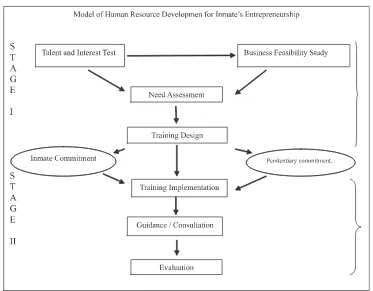
in the field of entrepreneurship in order to prepare the inmates to become an entrepreneur before they will be freed. Indicator of the success of this first phase is measured from the increase of awareness and understanding on entrepreneurship. For that reason, an awareness test is required to measure the understanding on entrepreneurship between before training and after training.
The second phase is the phase of testing or evaluating the success of former inmates
after inmates set up businesses both related to behavioral aspects as well as economic aspects. At this stage the researchers are looking for information on the progress of former inmates who had prepared in advance for entrepreneurship. After that guidance or business consultation is given. Indicator of the success of the second phase is measured by whether the entrepreneurial activities are implemented or not.
Figure 1. Model of Human Resource Developmen for Inmate’s Entrepreneurship
Research Procedures Data Collection Method
Methods used in collecting the data are as follows:
Year I: extracting information on the talents and interests of prisoners to
interests of selected participants. Based on these data, the research team then spends time with community in order to obtain eligible business information that interests inmates. Confirmation of interest and the feasibility study are applied to select 50 inmates to be given opportunities to join training of entrepreneurship. In the first year the information on the readiness of the penitentiary for entrepreneurship training is collected, and also the research team ensures that training is conducted correctly.
Year II: Data was collected on the points where the business had been done by the prisoners or ex-prisoners after free from custody on the successes and challenges of their endeavor. Performance is measured by the business activities and business profitability.
Data Analysis Methods
Year I: Data analysis was done by descriptive analysis, which described the interest and talent of inmates to
entrepreneurial activity and feasibility of business. Information is then made into matrix to determine training needs, design training, entrepreneurship training implementation.
Year II: Testing the proposed model by using Structural Equation Modeling (SEM) with two-step approaches. In the two-step approach to SEM, the measurement model is formulated and evaluated first separately and then the second step is set when structural model is estimated (Anderson &Gerbing, in Purwanto, 2002).
Results Overview
Banjarmasin Penitentiary is located on Jl. Mayjen Sutoyo S. No. 01 Banjarmasin is classified as Class IIA Penitentiary. Occupancy rate of inmates far exceeds its the capacity up to 600% more, where its capacity is only 276 people but resided by over 1900. This place is the second most populated for national level.
Table 1. The Case of Inmates in Banjarmasin jail
No Case Number of Prisoners %
1 Drug 1350 71.05
2 Theft And Vıolence 200 10.53
3 Harrasment 150 7.89
4 Burglary 80 4.21
5 Gamblıng 75 3.95
6 Illegal Loggıng 25 1.32
7 Murder 20 1.05
Total 1900 100.00
Miner Test
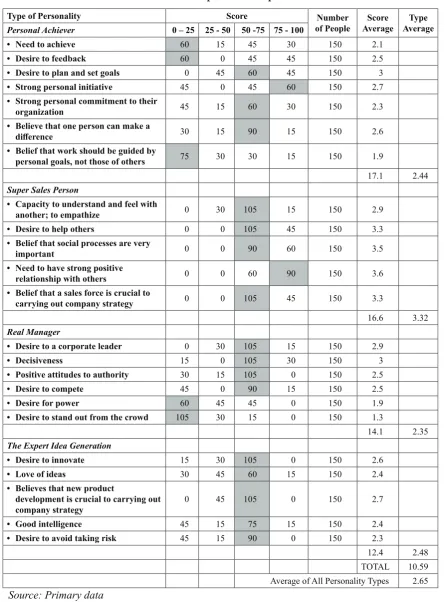
From 150 prisoners who have less than 1 year to spend, based on Miner Test, it can be seen that most of the personality type is weak because most of the inmates average score of personality types is below 3, except for the type of personality that has a Super Sales Person score of 3.32.
In the Personal Achiever personality type most inmates are weak in ability to cooperate with the team or other party (Need to Achieve) and less willing to accept feedback from others (Desire to feedback), which indicated 60 people had a score under 25. This shows they often work individually and selfish. In other words, most of them avoid the participation of a group activity that may put pressure on them when making decisions. This is also reinforced by a score Belief that work should be guided by personal goals, not those of others where as many as 75 people have a score below 25. Only
for Strong personal initiative the scores are high enough, that there are above 75 who showed himself very initiative, they act independently and initiate action in the absence of stimulation or support of others,
On personality type of Super Sales Person the average score is quite good, especially the characteristic of Need to have strong positive relationships with others that most inmates have scored above 75, which indicates they are getting satisfaction from personal relationships with other people. While the type of personality of Real Manager for the characteristics Desire for power and Desire to stand out from the crowd most of the inmates had scored below 25, which indicates they are not able to relate to the people there and those who are at the same level, and suppose they are leaders, they cannot fully delegate to subordinates.
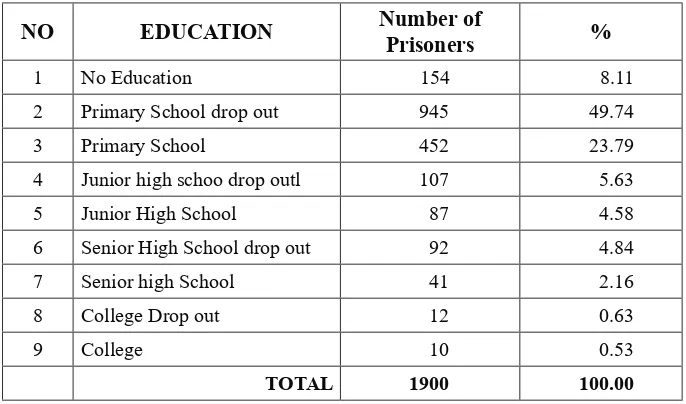
Table 2. Highest Education of Inmates
NO EDUCATION Number of Prisoners %
1 No Education 154 8.11
2 Primary School drop out 945 49.74
3 Primary School 452 23.79
4 Junior high schoo drop outl 107 5.63
5 Junior High School 87 4.58
6 Senior High School drop out 92 4.84
7 Senior high School 41 2.16
8 College Drop out 12 0.63
9 College 10 0.53
TOTAL 1900 100.00
Source ; Detention Center Banjarmasin, 2013 From table1 it is known that most of the
inmates are related to correctional drug cases as many as 1350 people or 71.05%, while the second is in case of theft with
While the type of personality of The Expert Idea Generation all the characteristics for this is good enough, in the range of 50 to
75. This shows they still have potential to be developed.
Table 3. Description of Respondent
Type of Personality Score Number
of People AverageScore AverageType Personal Achiever 0 – 25 25 - 50 50 -75 75 - 100
• Need to achieve 60 15 45 30 150 2.1
• Desire to feedback 60 0 45 45 150 2.5
• Desire to plan and set goals 0 45 60 45 150 3
• Strong personal initiative 45 0 45 60 150 2.7
• Strong personal commitment to their
organization 45 15 60 30 150 2.3
• Believe that one person can make a
difference 30 15 90 15 150 2.6
• Belief that work should be guided by
personal goals, not those of others 75 30 30 15 150 1.9
17.1 2.44
Super Sales Person
• Capacity to understand and feel with
another; to empathize 0 30 105 15 150 2.9
• Desire to help others 0 0 105 45 150 3.3
• Belief that social processes are very
important 0 0 90 60 150 3.5
• Need to have strong positive
relationship with others 0 0 60 90 150 3.6
• Belief that a sales force is crucial to
carrying out company strategy 0 0 105 45 150 3.3
16.6 3.32
Real Manager
• Desire to a corporate leader 0 30 105 15 150 2.9
• Decisiveness 15 0 105 30 150 3
• Positive attitudes to authority 30 15 105 0 150 2.5
• Desire to compete 45 0 90 15 150 2.5
• Desire for power 60 45 45 0 150 1.9
• Desire to stand out from the crowd 105 30 15 0 150 1.3
14.1 2.35
The Expert Idea Generation
• Desire to innovate 15 30 105 0 150 2.6
• Love of ideas 30 45 60 15 150 2.4
• Believes that new product
development is crucial to carrying out
company strategy 0 45 105 0 150 2.7
• Good intelligence 45 15 75 15 150 2.4
• Desire to avoid taking risk 45 15 90 0 150 2.3
Ranking based on the average test score of 150 inmates, with appraisal system 4 is excellent, 3 good, 2 poor, and 1 very poor, on average they have a score of 2, 65. A total of 50 people have scores below the average value of 2.65 and 100 people
rank above the median value of 2.65. The next 100 people who have above average business feasibility study environment where the inmates live. Average test results test scores Miner can be seen in Table 4.
Table 4. Milner Test Average Score Results
No Personality Type Score Average Number of People
1 Personal achiever, supersales person, real manager, expert idea generator
<2.65 50
2 Personal achiever, supersales person, real manager, expert idea generator
>2.65 100
Source: Primary Data
Talent and Interest Test
Based on the answers of inmates in an open questionnaire provided to the areas of interest of entrepreneurship, there are 14 classification answers such as sales of electronic goods, sales of goods, tailoring, grocery sales, clothing sales, electronic sales, security, food business, music, light making, travel business, selling gold, teacher.
Most participants inmates who have the highest scores (top 100) have an interest in the sales of goods as many as 52 people (sales of sports equipment, sales of goods, grocery sales, clothing sales, electronics sales, and selling gold). This one is in accordance with Miner Test that personality type where type Super Sales Person is pretty good. It is also reinforced the background which most convicts participants have criminal backgrounds as drug dealers.
But not all the inmates’ decent interest based on aspects inmates’ skills is needed
for the field of business interests (skill test), supply support or access to supply for inmates around the neighborhood, the adequacy of which is available around the market, neighborhood of inmates, and the calculation of a reasonable profit for fulfilling basic needs are also important. Six enthusiasts of sport equipment and electronic salesmen despite having expertise feasibility, market and promised benefits, but for sports equipment which is not available in the local area that needs are expensive to transport it from other cities, while enthusiasts as sales of goods, groceries, clothing sales, and selling gold are supported by enough expertise, availability of raw materials, markets and profits.
Interest in the production sector prisoners like sewing and food making should be supported, except the interest to make the lights is not supported by skills.
the music is not supported, then travel services lack of expertise, and the least of becoming a teacher due to profit reasons.
Of all the inmates, 23 people cannot or fail to describe his/her interest, so we need further psychological counseling.
Table 5. Talent and Interest Test
No Business Interest Number of People
Feasibility Study
Conclusion Skill Availability Market ProfitabilitySupply
1 Sporting goods Salesperson 3 F NF F F Not Feasible
2 Merchandise Salesperson 37 F F F F Feasible
3 Sawing 1 F F F F Feasible
4 Grocer 6 F F F F Feasible
5 Clothes Salesperson 2 F F F F Feasible
6 Elektronic Salesperson 3 F NF F F Not Feasible
7 Security 3 F F NF F Not Feasible
8 Food Making 3 F F F F Feasible
9 Music 9 NF NF NF NF Not Feasible
10 Light Making 3 NF F F F Not Feasible
11 Travel 3 TL L L L Not Feasible
12 Gold Selling 1 F F F F Feasible
13 Teacher 3 F F NF NF Feasible
14 Others 23 - - - -
-100
Source: Primary Data
Conclusion viable business interest is sales of goods, tailoring, grocery sales, clothing sales, food business, and the sale of gold amounted to as many as 50 inmates. Based on the Table 3 matrix can also be made between feasibility and interest in the field of entrepreneurship as shown
in Figure 1. Inmates’ greatest interest is in sales or marketing, and this is also supported by its feasibility. While quite a few enthusiasts who engaged in the manufacturing or operations that require a lot of personality type of The Expert of Idea Generation while inmates for this type of condition is not too good.
From figure 2 can also be known weaknesses of prisoners’ mentality that must be met Personal Achiever and Real Manager which requires the ability to cooperate and manage the business. The Expert Idea Generation from a fairly decent aspect of the business in market and profit, but the skill aspects needs improvement.
Then from figure 2, it can be determined that the training needs for cooperation, leadership, creativity and effort. The low personality type of Personal Achiever and Real Manager showed that stimulate them to actively socialize, the training should be in the form of game and discussion.
Training Results
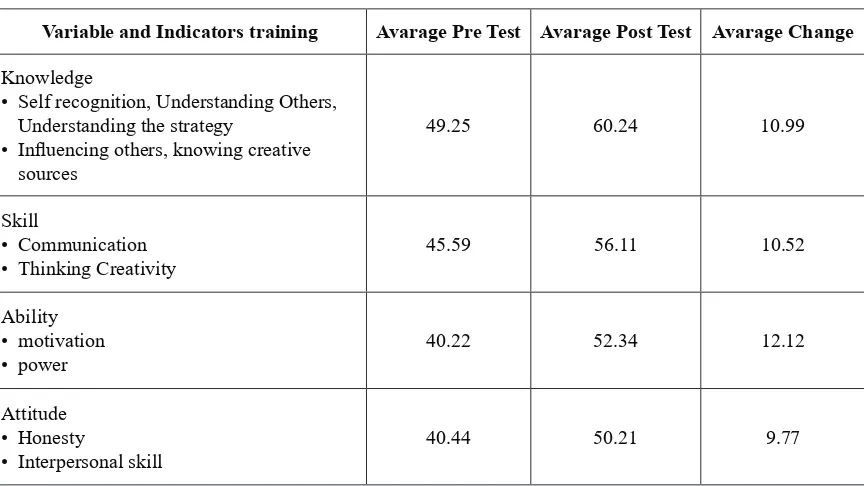
According to Desimore (2006), there are four aspects of the training such as knowledge, skill, ability and attitude. A single training is needed for every
aspect. Pre-test is needed to determine the condition of prisoners before training, and post test is given once the training is completed.
Changes in training results occurred in the form of increase in motivational abilities, and the ability to search for contacts. It goes with improvement in knowledge about knowing themselves, understanding others, including empathy, strategies to influence others, the introduction of the idea of the sources of creativity.
The skill to communicate and creative thinking also improve significantly which later is needed for conducting business externally and to attract more customers. While the lowest change occurred on attitude in the type of honesty and the ability to look attractive which still require a further training. Training approach is best suited to correct this condition is ESQ (spiritual emotional quotient).
Table 6. Result of the Research
Variable and Indicators training Avarage Pre Test Avarage Post Test Avarage Change
Knowledge
• Self recognition, Understanding Others, Understanding the strategy
• Influencing others, knowing creative sources
49.25 60.24 10.99
Skill
• Communication
• Thinking Creativity 45.59 56.11 10.52
Ability • motivation
• power 40.22 52.34 12.12
Attitude • Honesty
• Interpersonal skill 40.44 50.21 9.77
Dıscussıon
Most of the inmates, or more than70 % who inhabit prisons in Indonesia, including in Banjarmasin are drug dealers, and they pursue the profession for years so they know exactly how to benefit from the drug business, how to trade, partnership, and distribute the drug. Even, they can create a market which is not previously existed by inviting, persuading, and deceiving so that the market becomes so gigantic for drug users. Habits are formed from long real experience, and it is of course difficult to remove. Various attempts to create a variety of activities to distract them often end up in vain.
On the one hand to create such capabilities that possessed by drug dealers in doing business is difficult for the ordinary society, through various activities to create entrepreneur with various training fail, because they do not have experience. With the inmate drug dealers only a little polish is needed to make them as reliable sale person, but now to guide them to conduct legal business. They must change their mindset that doing legal business is as easy as black market business. This matter is never noticed by the government through coaching in public institutions. Most of the inmates do not recognize their potential, so many of them are interested in businesses but not suitable with their talent. Various technical training like brick making, sandal, and handicraft, with hopes of someday prisoners freed in continuing the business for sale, but the fact itself is doubtful inmate gains in the business. In addition they never get managerial training, they most often just follow advice or opinion from public institutions officer without having many options.
Some are already doing well in selecting areas of interest to the business that suits to their hobby or interest such as music or sport, but because they are only amateurs, so still a long time is needed to pursue a path of success in the business field in that some people worry that in the middle of the road, they will be tempted to do drug business again which can give more promising benefit in the short term.
Others have been completely appropriate to choose a business that is in demand with a combination of interests or preferences, expertise, and considerable market interest. Without the support of course it will be difficult to practice business skills, without feasibility market then there will not be many transactions. With the combination of these preferences, expertise and market feasibility then logically they are able to create a profitable business. Then the next step is to provide motivation for them to focus on the legal business market.
The same thing has been done by Sonfield, (2008) comparing MSC - T Miner test among the inmates where inmates found that not everyone is gifted in entrepreneurial activity, then the results of the test in practice after they come out of prisoners showed that they have talent to become entrepreneurs and managers - scientists, who are not being regifted tend to commit crimes.
Proof of the effectiveness of the stages that have been passed to inmates become self-employed ex- convicts who must also be proved markedly after them out of the penitentiary. But we need to realize and anticipate that the outside world is not necessarily the same as the picture which has been given in training. Concerns about the difficulty of ex- prisoners to practice what they have acquired during training in public institutions, not reasonable because most people only often failed to set up a business. The push to ensure model proposed in this study requires further training intervention after a period of detention of prisoners. But not in the classical form but in the form of coaching, mentoring and consultative SMEs (Megginson, WL, MJ Byrd, and LC Megginson. 2000) because there is the possibility of problems faced vary between inmates.
Conclusion
Inmates entrepreneurial potential is associated with his or her background occupation.
Most inmates who are interested in the field of entrepreneurship are eligible to practice and potential to earn profits. Based on the test results of Miner Test, personality types that need to be developed are personal achiever, real managers, idea
generation expert, through training in games and discussion methods and ESQ Inmates who are selected through the Miner test and feasibility study of business interest are able to improve the knowledge, skills, abilities, and attitudes.
Notes on Contributors
Zainal Arifin is a lecture in STIEI Kayutangi Banjarmasin, South Kalimantan, Indonesia.
Akhmad Yafiz Syam is a lecture in STIEI Kayutangi Banjarmasin, South Kalimantan, Indonesia. And he is a consultant, trainer, business coach and learner pratisi NPL and hypnotherapy, in addition to providing workshops, seminars and training in business / entrepreneurship. Muhammad Maladi is a lecture in STIEI Kayutangi Banjarmasin, South Kalimantan, Indonesia. he is a supervisor at LBPP – LIA.
References
Departemen Pendidikan Nasional, (2003), Undang-undang Republik Indonesia Nomor 20 tahun 2003 tentang Sistem Pendidikan Nasional, khususnya pada penjelasan pasal 26 ayat 3. Desimone, RL, Werner, JM and Harris,
DM, (2006), Human Resource Development. Orlando, Harcourt College Publishers Orlando, Harcourt College Publishers.
Indarini Nurvita, (2012), Perlu Perbaikan Pembinaan Napi Agar Tak Jadi Residivis, detikNews.
Khan Mubbsher Munawar, Ahmed
Ishfaq, Nawaz Muhammad
Musarrat, Ramzan Muhammad, (2011), Impact Of Personality Traits On Entrepreneurial Intentions Of University Students, Interdisciplinary Journal of Research in Business.
Lockwood, F R Teasley, (2006), An examination of the power of the dark side of entrepreneurship, JAC Carland
Megginson, W.L., M.J. Byrd, and L.C. Megginson. (2000). Small Business Management: An Entrepreneur’s
Guidebook. Third Ed. Irwin
McGraw-Hill. Boston.
Metzler, J.C. (2005). “How the AICPA Helps Members Serve Small Business.” Journal of Accountancy, 199 (March).
Maulani Diah Gustiniati (1999) Sistem Sosial Dalam Lembaga
Pemasyarakatan dan Praktik
Pembinaan (Studi Pada Lembaga
Pemasyarakatan Tanjungkarang
dan Lembaga Pemasyarakatan Kalianda) Tesis. Masters thesis, Program Pascasarjana Universitas Diponegoro.
Miner, J.B. (1996). The 4 routes to
entrepreuneurial success. San
Fransisco: Berrett Koehler
Noe, Hollenbeck, Gerhart, Wright, (2007), Fundamentals of Human Resources Management, The McGraw Hill Companies, Inc All right reserved. Sonfield Matthew C. (2008),
Entrepreneurship and prisoner re-entry: The development of a concept, Small Business Institute® Research Review, Volume 35, 2008.
Toma Simona Valeria ; Chirita Mioara; Sarpe Daniela, (2011), Entrepreneurial Phenomenon: Some Reasons for Career Choice Intentions. Journal Annals of Dunărea de Jos University. Fascicle I: Economics and Applied Informatics.