_________________________________________________
Digital Evolution of the Written Language
Adnan Omar
[email protected]
Muhammed Miah
[email protected]
Department of Management Information Systems
Southern University at New Orleans
6801 Press Drive, New Orleans, LA 70126
Abstract
Digital technology is an increasingly popular means of communication with profound effects on almost every aspect of life. Many are concerned that some of the effects may be negative. A recent survey carried out at a four year public institution examined the impact of information technology on writing skills. Fifty seven percent of students and sixty two percent of faculty members believed that current digital trends adversely affected writing skills. This study investigates the relationship between technology and writing skills as well as its impact on literacy and language development.
Keywords: Electronic communication, written language, development, computer, technology.
1. INTRODUCTION
The importance of writing in the job market cannot be overemphasized; up to two-thirds of salaried jobs at large American companies require some kind of writing. Writing is a complex process that involves many skills, processes, and strategies. It requires a codifiable medium to convey meaning, and uses a vocabulary, based on known conventions and rules of usage to create new ideas. Good writing is defined by clarity, accuracy and logical thinking, among other characteristics (National Commission on Writing, 2006). Students need to master writing skills to succeed in their education and as members of the workforce. The use of computers in learning processes is growing exponentially; however, information technology has changed the process of composition and the level of participation of the writer in writing activities to such an extent that the communicative functions of the internet and cell phones are the main reason why teens use
these technologies. A recent study shows that more than four in ten teens (45%) own or use both a computer and a cell phone, (Pew Internet & American Life Project Teen/Parent Survey, 2007).
_________________________________________________
years. There are different forms of communication technology. Those associated with the internet, now accessible through both computers and mobile phones; include electronic mail (e-mail), instant messaging (IM) services, chat rooms, forums, social networking sites, interactive online gaming networks, and Web-logs (bWeb-logs).
Almost all American adolescents use the internet; 87% of teenagers own a cell phone and report that use of the Internet was the most important technology in their lives — more important than television (Department of Children, School and Family, 2007). However there are worries that this trend is having a
detrimental effect on students’ writing skills.
While the computer spell checker can help students make quick corrections on their writing activities, it can also cause deterioration in spelling ability as students may no longer bother about their spelling since they can rely on the spell checker. Boyle (1998) argues that information technology may actually be making us stupid, because computers take away from students much of the learning process.
Information technology will continue to play an important role in present and future learning processes, but efforts must be made to carefully understand and monitor its effects on fundamental skills like writing. Considering the diverging opinions on the impact of technology on language development, investigation of the topic is timely. This study addresses the effects of these new technologies on the writing skills of students. Based on the assumption that our findings at a four year public institution are somewhat representative of students’ writing habits at a national level, this study reviews and discusses the relationship between technologies and writing among students in general and at the institution studied in particular. Our surveys of faculty and student perceptions revealed actual and potential writing problems related to use of technologies. Additionally, this paper reviews existing research to identify problems and propose solutions with regard to future trends of technological adoption that will enhance English language writing and development. This research focuses on questions such as: Do social networks and chat groups threaten proper written English? Do students use text shortcuts and emoticons in school writing activities? Do the shortcuts and abbreviations in Short Messaging Service (SMS) cause poor written English today?
2. REVIEW OF LITERATURE
Student writing improves when they are given multiple opportunities to write on a regular
basis. Writing activities also increase students’
critical-thinking skills, which can be applied to other tasks (Calkins, 1994). In spite of the recommendations of educators and researchers that students write at length and across the curriculum in a variety of content areas, many teenagers report that they write mostly short pieces that are not research based, and receive longer assignments primarily in English and language arts classes (Pew Internet & American Life Project, 2007).
Below are some statistics on the writing habits of students according to race and gender. - Nearly six in ten black teens (57%) write in
a journal for school, and 17% write music or lyrics. In contrast, just four in ten whites (41%) write in a journal and fewer than one in ten (6%) write music or lyrics for school. - Teens from families earning $50,000 or
more per year are more likely than lower-income teens to write up science labs (72% vs. 61%).
- Girls are slightly more likely than boys to write essays at school (96% of girls do this, compared with 91% of boys), while boys are slightly more likely to write computer programs (13% of boys and 7% of girls have done so in the past year).
Students also use the internet as a primary method for conducting research for school writing purposes. About 94% of teens use the internet at least occasionally to research their school writing assignments.
- Outside of a relatively small group of intense writers, non-school writing is something teens do infrequently (Pew Internet & American Life Project Teen/Parent Survey, 2007).
Electronic Communication
Today’s students, dubbed the “Net Generation,”
_________________________________________________
more than four in ten teens (45%) personally have both a computer and a cell phone with cell phone and computer ownership (81% and 65% respectively) being particularly high among older teens (Pew Internet & American Life Project Teen/Parent Survey, 2007). A relationship between year in school and technology use quickly emerged, with upperclassmen being more likely to spend more than one hour per day using communication technologies like phones and email. Conversely, on an average day, freshmen were twice as likely as upperclassmen to spend more than an hour daily on social networking sites or text messaging (Vitak, 2008).
This dramatic shift to digital interactions has led to changing educational landscapes, according to Trilling & Fadel (2009). In order to develop relevant life and career skills, students now need instruction not only in academic subjects like reading, writing, and arithmetic, but also in other abilities such as digital learning, information gathering and management, media awareness and usage. Since many of these technologies are text-based, they constitute another potential space for writing under a broadly constructed definition of the term (Lenhart, Hitlin, & Madden, 2005). One of the most dramatic changes that this digital revolution has prompted is a transformation in how students write and communicate. Not only are students expected to write more traditional communications such as research reports and persuasive essays, but they are also exposed to new digital forms of writing (Richardson, 2006). Electronic discourse, such as that used in
e-language register (Greenfield & Subrahmanyam, 2003). The increased use of communication in such an alternative language form may have implications for language skills, and many educators and observers have expressed concern that the abbreviated language styles of text messaging, e-mail and wall posts are filtering inappropriately into formal school writing. While teen bloggers and social network users are prolific writers, they also have a tendency to use textual shortcuts, emoticons and informal writing styles in their school writing. Similarly, teen cell phone owners are
more likely than non-cell phone users to use textual shortcuts in school (42% vs. 30%) (Pew Internet & American Life Project Teen/Parent Survey, 2007).
Since much of the writing teens do at school (such as writing in a journal, taking notes in class, or crafting creative fiction) is relatively informal in nature, it is not necessarily surprising to find teens adopting the conventions of texting, e-mail or other online speech into their writing for school. An attitudinal factor also correlates with usage of technology-based writing conventions in school. In particular, teens who view their electronic communications
with friends as “writing” are significantly more emoticons (35% vs. 17%). Black teens are more likely than whites (48% vs. 35%) to use text shortcuts in school, although there are no ethnic differences with respect to usage of informal writing styles or emoticons. In the college environment, however, students who use these informal styles are unlikely to find sympathy from professors if these should appear in their midterms, exams or other written work (Vitak, 2008).
A recent study by Omar & Miah (2012) reviewed the relationship of new technologies to writing and its implications, as well as case studies and existing research on the effects of electronic communication on literacy and language development more specifically on English writing among teens are evaluated.
Information Technology and English Writing
_________________________________________________
and nonverbal language cues may be lost, and it is questionable whether language maxims such as appropriateness, relevance and formality level are still adhered to in electronic communication (Sahandri, Ghorbani, & Saifuddin, 2009).
However, research on the topic brings out some positive aspects of these technologies on language skills. For many teens, the ability to change, edit and revise their texts on the fly is one of the clearest advantages of writing on a computer. Nearly six in ten teens (57%) say they edit and revise more when they write using a computer compared with when they write by hand. Whites, older teens and those whose parents have higher levels of education are among the most likely to say that computers help them edit and revise more (Pew Internet & American Life Project Teen/Parent Survey, 2007).
In a study by Greenfield & Subrahmanyam (2003), teenage chat room users were found to adapt to features of the chat room environment by developing new communication strategies with a new communicative register. There is evidence that computer-mediated communication has encouraged new behaviors and strategies, and chat groups and online forums have developed dialects. Users accommodate their own language to take into account the environment. This again suggests that language and social communication skills are promoted by using communication technology and are not adversely affected. Some studies of electronic discourse show evidence that conversational language rules are still adhered to (Crystal, 2006). Computers are increasingly being used to promote early language learning. Programs are available that develop pragmatic language skills in children with impaired language skills while computer-mediation is also widely encouraged for second-language learning (Bosseler & Massaro, 2003). Moreover availability of computer technology at home has been linked to positive academic achievements in reading and math (Espinosa et al., 2006), with households from lower socioeconomic groups deriving the greatest benefit. Parents do not view computers as a
monolithic “good” or “bad” influence on their child’s writing. Rather, most parents say they
appreciate the value of technology in helping
their child’s writing, while at the same time recognizing certain downsides and tradeoffs.
While it would seem that communication technology does not appear to have negative effects on specific language skills, parallel research indicates the contrary and affirms the concerns and worries of critics. According to Danet (2001), the seeming playfulness in e-mail greetings indicate that it is more informal in comparison to traditional norms governing the form of official letters. Trupe (2002) also found an emergent diversity in written communication in terms of word choice and syntax. Sutherland (2002), an eminent and recently retired professor of English from University College, London, has spoken out in the media about the damage that this communication style is having on literacy skills and attainment.
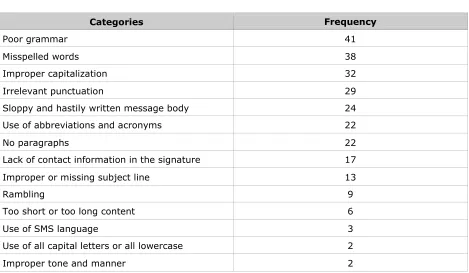
The language of e-mail and short messaging service is an inherently informal communication system because it is associated with acronyms and changes in spelling norms (Abdullah, 1998), thus paving the way for a new context for the writing process. An analysis of e-mails and SMS messages of students in Malaysia revealed that some e-mails lacked subject lines while others crammed the entire message body into the subject line (Sahandri et al., 2009). Standard spelling, punctuation, and capitalization, which are some of the characteristics of the normal written language, were absent in the studied e-mails. Some e-mail users used SMS language in their messages. Lack of contact information in the signature, sloppy written message body, and other deviations found in the emails point to the
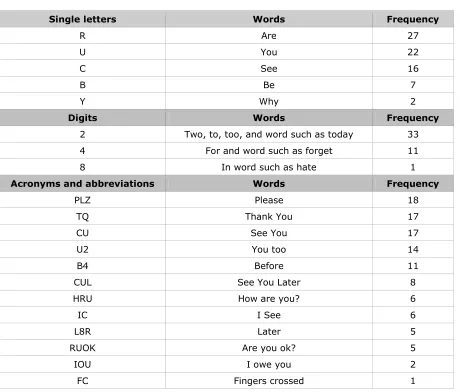
fact that the language used in the students’ e -mails was more informal and casual than the traditional letter-writing language (See Table 1 in Appendix). This “net speak” or shortened
“text speak” language register which includes
abbreviations like “b4 = before” is being used in inappropriate contexts (See Table 2 in Appendix). Some major concerns on the negative impacts of new technologies on writing skills are listed below.
Possible effects on writing skills
- Punctuation rules are affected. E-mail and SMS are used for speed of communication in which shortened sentences are commonly used to ease writing, thus making it prone to occasional errors and absence of punctuation rules (Pew Internet & American Life Project Teen/Parent Survey, 2007).
- Grammatical, syntactic rules. The linguistic shortcuts and less formal language like
“emoticon” used to convey meaning in
_________________________________________________
written English and encourage grammatical and syntactic rules to be overlooked (Crystal, 2006).
- More graphical rather than textual. The graphic-intensive nature of electronic communication can distract students from writing and instead waste a great amount of time on perfecting fonts, colors, or images (Halio, 1990).
- Absence of proof-reading and standard
spelling skills. Dependence on computer assisted spell-checking may decrease standard spelling skills; the speed of some electronic communication encourages spelling and typing mistakes to be overlooked (Crystal, 2006).
- Reduction in critical thinking abilities. The copy and paste options that these technologies often present may result in the loss in critical thinking abilities. It has also paved the way for practices like online plagiarism which takes a variety of forms from the blatant and intentional (e.g., purchasing an essay online) to the accidental and ill-informed (e.g., quoting small amounts of online material without proper citation) (Burbules & Casllister, 2000). - Loss of linearity and sequencing. Hypertext
which is inherent in electronic communication allows writers to organize information loosely. This is contrary to traditional writing in which ideas are expressed in a logical, linear fashion, with coherent narrative in large chunks of text to form a well-developed thesis (Gibson, 1996).
- Attention Problems. The use of
communication technology may be linked to attention problems in children and adolescents, which, in turn, may have a negative impact on writing and on learning in general (Espinosa et al., 2006).
3. METHODOLOGY AND FINDINGS
The purpose of this paper is to review the impact of information technology on writing and discuss strategies for future trends in technology intensive writing that will ensure language development. While communication technologies play an important role in present and future learning processes, efforts must be made to monitor its effects on the writing skills of
students. It is therefore vital to carefully understand the relationship between these new technologies and the writing activities of youths. To this end, two perception surveys on students and faculty were conducted at the end of the spring semester in 2012 in a four year public university, to which 50 students and 32 faculty members responded. The survey was collected through the university website.
Students and Faculty Perception Surveys
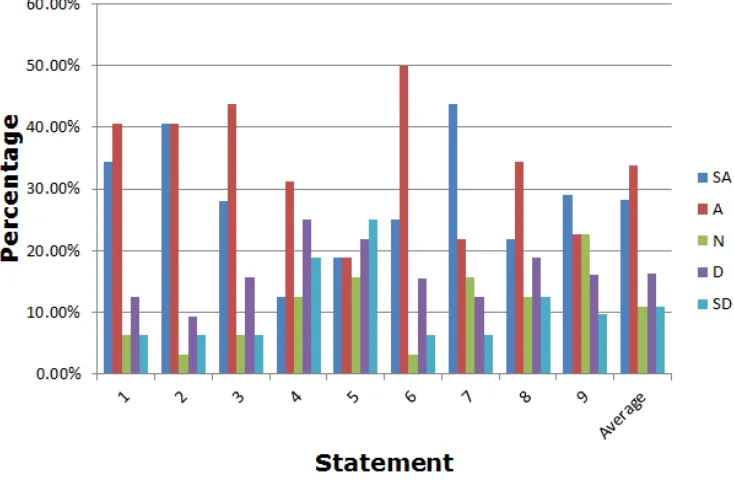
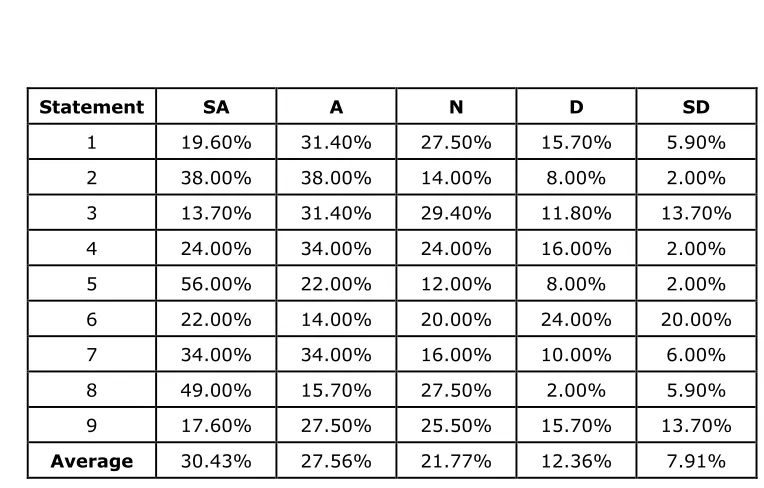
The survey consisted of nine statements for students and nine statements for instructors. These statements of interest were associated with overall conceptions of writing and electronic communication. Figures 1 & 2 show the students and faculty perception on effects of technology on writing. (See Appendix.)
Data analysis was accomplished by using the
arithmetic means: to measure the central tendency of the respondents as shown in Table 3 (see Appendix). Students were required to mark strongly agree (SA); agree (A); neutral (N); disagree (D); or strongly disagree (SD) in response to the following statements:
1) The shortcuts and abbreviations in SMS text encourage poor written English.
2) Students use improper capitalization and
punctuation in emails and “chat” groups.
3) Students use text shortcuts and emoticons in school writing activities.
4) Social networks and chat groups threaten proper written English.
5) The internet is the primary tool for students’ school research activities.
6) Increased use of internet for school work destroys critical thinking among students. 7) Among students, editing (proof reading) and
spell checking of essays is mainly done using computer.
8) Using a computer for writing makes students write better because they can revise and edit easily.
9) Use of computers for writing makes students put less effort in spelling, personal writing and proof reading.
_________________________________________________
understanding of English and consequently poor writing skills.2) Informal writing styles and short message systems are replacing proper capitalization, punctuation and expression in work-related writing.
3) Text shortcuts and abbreviations are increasingly being used in formal English correspondences.
4) Social networks and chat groups spell the end of correct grammar and linguistic fluency.
5) Increased use of internet destroys critical thinking and communication skills.
6) Editing and spell checking of reports, executive summaries, and other professional correspondence are mainly done using computer aided devices.
7) Incorporating graphics and other technology-generated illustrations enhances understanding.
8) Increased use of technology for writing and editing distracts from traditional writing leading to less attention to text and writing skills.
9) Informal writing using smartphone emails negatively affects clear and succinct writing. Some differences worth noting between students and faculty perceptions of technology and writing are evident in an analysis of Tables 3 and 4:
Approximately 45% of students and 52% of faculty agreed that increased use of computer aided devices for writing, editing and spell checking makes students put less effort in writing and hence promote the loss of basic writing and spelling skills (Students Statement #9, Faculty Statement #8). Approximately 45 % of students and 71% of
faculty feel that the informal style of electronic communication is replacing proper punctuation and capitalization in formal writing (Student Statement #3, Faculty Statement #3).
Over 57% of students and 76% of faculty indicated that the informal and abbreviated language styles of text messaging, emails and other electronic communications have a negative impact on English writing (Student Statements #1, 2, 3, Faculty Statements #1, 2, 3).
Overall, 57% of students and 62% of faculty indicate that technology has had a negative impact on writing.
Table 5 (see Appendix) shows that on statements 2, 4, 5, 7, and 8, students agree that improper capitalization and chat groups posed a threat to proper written English. The internet is the primary tool for research, and computer programs require less effort from students in spelling. Statements 1, 3, 6 and 9 lean towards a neutral conclusion. On the other hand statements 1, 2, 3, 6 and 7 show the faculty agree that the informal language and shortcuts result in poor understanding of English. Informal writing styles are replacing proper capitalization and editing. However, statements 4, 5, 8, and 9 responses were neutral.
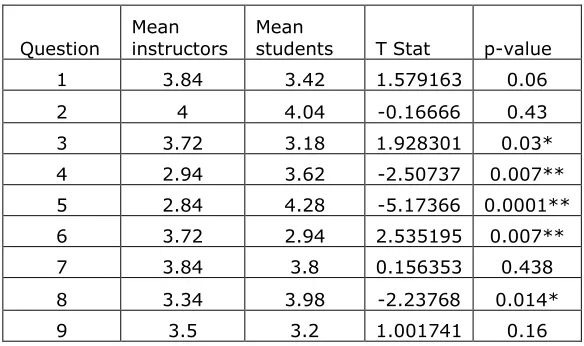
Table 6 shows the output of the t-Test under the following hypothesis (Mean response of each statement is different between the faculty and student or not, see Appendix). Results indicate a significant difference between faculty and student mean response for questions 3, 4, 5, 6 and 8. For example on average, faculty Agree (average = 3.72) while students were Neutral (average = 3.18) about the proposition that the informal style of electronic communication is replacing proper punctuation and capitalization in formal writing (student statement #3, faculty statement #3). However there is no significant difference between faculty and student mean response for questions 1, 2, 7, and 9.
These findings show a strong relationship between technology and writing. Students and all actors in the educational systems consider technology to be a vital factor in the learning process. However this investigation identified some detrimental effects of these new technologies on the writing abilities of students. Measures must therefore be put in place for preserving and developing the language skills of students in this digital era. Strategies must be adopted that will bring together school administrators, instructors, students and parents around the common goal of preserving language
_________________________________________________
additional in-class writing time would improve their writing abilities, similar to the 78% who feel the same way about computer-based writing tools (Pew Internet & American Life Project Teen/Parent Survey, 2007). Furthermore recent studies have found that many students are given inadequate writing instruction, little time to practice writing in the classroom environment, and few opportunities to write longer research-type papers. Likewise, high school students are seldom offered writing instruction that spans their curriculum, is authentic and tied to their lives, and is delivered by quality teachers with specific training in content-based writing instruction (Applebee & Langer, 2006). An effective strategy will be one which involves students in frequent writing activities with teachers and parents supervising them.There is a strong body of research on best practices in teaching and learning writing that can guide individual and institutional reform efforts. Broadly, this research suggests that writing is best taught as an integrated subject, and that strong writing practice combined with consistent feedback and follow up from parents and caregivers is important in developing student skills and achievement (Graham & Perin, 2007). Classroom research indicates that students largely respond to the expectations set by the instructor. Teachers who set up assignments demanding a product that includes both sophisticated writing and a highly professional look are more likely to achieve both. In contrast, to overemphasize the design of a Website can result in students paying little attention to texts, whereas to under emphasize design issues can limit students' opportunities to develop important new multimedia literacy (Warschauer, 1999).
Discussions should be held on electronic communication geared towards making students read through e-mails more than once before sending. Collaborative method like peer tutoring should be encouraged among students to enrich students’ writing compositions as they work together. Changing from a teacher sponsored model of writing with grades and marks to a real purpose orientation will also improve and keep writing capacities at high levels. Moreover writing in the classroom should shift from
typically being descriptive and narrative to a more persuasive, argumentative and expressive use of language (Tella, 1992). University authorities should also provide writing evaluation software that generates scores for written essay and produces other structural or linguistic error reports found in the essay; such engines could be used for school and practice writing activities. Technology, like every other aspect of society today, is constantly evolving, and these changes come with new integration challenges and threats. Communities and education professionals need up-to-date evidence of trends in technology in order to support parents and caregivers in ensuring that children make the best use of communication technology to promote their language and literacy development. In the past, parents and caregivers have often stayed at the background while the children and students discovered these technologies, thus exposing the children to the unforeseen dangers. Today, parents and all those involved in the educational process need to get involved in discovering these technologies with the students in order to monitor and curtail any unwanted effects.
4. CONCLUSIONS AND FUTURE STUDY
Information technologies are taking center stage in modern writing. This trend, which will continue to evolve in the coming decades, has
introduced new forms of language like “net speak”. Such adaptations typically do not follow the grammatical and syntactic rules of written English and are unfortunately permeating into formal school work. This study investigated student and faculty perceptions on the impact of the digital evolution on writing. The adverse effects new technologies may have on language development were presented and solutions were proposed to curtail them. Parents and caregivers need to recognize such potentially negative impacts and promote means to safeguard their
children’s interests as technology becomes more
pervasive in everyday life. For educators; the challenge is incorporating new technologies into the learning process while avoiding negative effects on students. This study offers proposals for accomplishing this goal.
_________________________________________________
curriculum must be reevaluated in light of the ubiquity of technology in all aspects of our lives. Additionally, institutions should conduct research designed to determine how new technologies can be used to teach information literacy and new types of writing that are emerging with the online era.
5. REFERENCES
Abdullah, M. H. (1998). Electronic discourse: Evolving conventions in online academic environments. (ERIC Document Reproduction Service No. ED 422 593) Applebee, A., & Langer, J. (2006). The state of
writing instruction in America’s schools:
What existing data tell us. Albany, NY: Center on English Learning and Achievement.
Bosseler, A., & Massaro, D. (2003). Development and evaluation of a computer-animated tutor for vocabulary and language learning in children with autism. Journal of Autism and Developmental Disorders, 33(6), 653–672.
Boyle, F. T. (1998). IBM talking head’s and our classrooms. College English, 55 (6), pp. 618-626.
Biesenbach-Lucas, S. & Wiesenforth, D. (2001). E-mail and word processing in the ESL classroom: How the medium affects the message. Language Learning and Technology, 5(1), 135-165.
Burbules, N. C., & Casllister, T. A. J. (2000). Watch IT: The risks and promises of information technologies for education. Boulder, CO: Westview Press.
Calkins, L. M. (1994). The art of teaching writing, (2nd ed.), Portsmouth, NH: Heinemann.
Crystal, D. (2006). Language and the Internet. Cambridge, U.K.: Cambridge University Press.
Danet, B. (2001). Cyber play: Communicating online. Oxford: Berg Publishing.
Department for Children, School, and Families. (2007). Retrieved 14th of May 2012 from
http://www.dcsf.gov.uk/rsgateway/DB/RRP/ u015312/index.shtml
Espinosa, L. M., Laffey, J. M., Whittaker, T., & Sheng, Y. (2006). Technology in the home and the achievement of young children: Findings from the Early Childhood Longitudinal Study. Early Education & Development, 17(3), 421–441.
Gibson, S. B. (1996). Is all coherence gone? The role of narrative in web design. Interpersonal Computing and Technology, 4(2), 7-26. Retrieved 14th of May 2012 from http://www.helsinki.fi/science/optek/1996/n 2/gibson.txt
Graham, S., & Perin, D. (2007). Writing next: Effective strategies to improve writing of adolescents in middle and high schools. A report to Carnegie Corporation of New York. Washington, DC: Alliance for Excellent Education.
Greenfield, P., & Subrahmanyam, K. (2003). Online discourse in a teen chat room: New codes and modes of coherence in a visual medium. Journal of Applied Developmental Psychology, 24, 713–738.
Halio, M. P. (1990). Student writing: Can the machine main the message. Academic Computing, 4, 16-19, 45.
Kupelian, M. (2001). The use of e-mail in the L2 classroom: An overview. Second Language Learning & Teaching, 1(1). Retrieved
November.14, 2011, from
http://www.usq.edu.au/opacs/cllt/sllt/1-1/Kupelian01.htm.
Lenhart, A., Hitlin, P., & Madden, M. (2005). Teens and Technology: Youth are Leading the Transition to a Fully Wired and Mobile Nation, Pew Internet & American Life Project, Washington, DC, July.
National Commission on Writing. (2006). writing: The View From Campus, National Commission on Writing for America’s Families, Schools and Colleges.
Omar, A., & Miah, M. (2012). Impact of
Technology on Teens’ Written Language,
_________________________________________________
Pew Internet & American Life Project. (2007). Teen/Parent Survey on Writing, September-November 2007. Margin of error is ±5%.
Provenzo, E. F., Brett, A., & McCloskey, G. N. (1999). Computers, curriculum, and cultural change. Mahwah, NJ: Lawrence Erlbaum Associates, Publishers.
Rideout, V. J., Foehr, U. G., & Roberts, D. F. (2010). Generation M2: Media in the Lives of 8- to 18-Year-Olds: A Kaiser Family Foundation Study. Menlo Park, CA: The Henry J. Kaiser Family Foundation17
Richardson, W. (2006). Blogs, Wikis, Podcasts and other powerful Web tools for classrooms. Thousand Oaks, CA: Corwin Press
Sahandri M. B, Ghorbani M. R, Saifuddin K. B (2009). The impact of electronic communication technology on written language, volume 6, No.11 (Serial No.60). Sutherland, J. (2002). Cn u txt? The Guardian,
Retrieved 14th, May 2012 from
http://www.guardian.co.uk/technology/2002 /nov/11/
Tella, S. (1992). Talking shop via e-mail: A thematic and linguistic analysis of electronic mail communication. (Research report 99): Department of teacher education, University of Helsinki.
Trilling, B., & Fadel, C. (2009). 21st century skills, learning for life in our times, San Francisco, CA: John Wiley & Sons
Trupe, A. (2002). Academic literacy in a wired world: Redefining genres for college writing courses. Retrieved Sept. 27, 2008, from http://www.bridgewater.edu/~atrupe/AcadLi t/WiredWorld.htm.
Vitak, J. (2008). How Does Technology Impact
Young Adults’ Writing Habits?, gnovis. Retrieved 15th of November 2011 from http://gnovisjournal.org/journal/
_________________________________________________
Appendix
Categories Frequency
Poor grammar 41
Misspelled words 38
Improper capitalization 32
Irrelevant punctuation 29
Sloppy and hastily written message body 24
Use of abbreviations and acronyms 22
No paragraphs 22
Lack of contact information in the signature 17
Improper or missing subject line 13
Rambling 9
Too short or too long content 6
Use of SMS language 3
Use of all capital letters or all lowercase 2
Improper tone and manner 2
Table 1: The main characteristics of the analyzed e-mails (N=100)
_________________________________________________
Single letters Words Frequency
R Are 27
U You 22
C See 16
B Be 7
Y Why 2
Digits Words Frequency
2 Two, to, too, and word such as today 33
4 For and word such as forget 11
8 In word such as hate 1
Acronyms and abbreviations Words Frequency
PLZ Please 18
TQ Thank You 17
CU See You 17
U2 You too 14
B4 Before 11
CUL See You Later 8
HRU How are you? 6
IC I See 6
L8R Later 5
RUOK Are you ok? 5
IOU I owe you 2
FC Fingers crossed 1
Table 2: The main text devices found in the analyzed SMS’s (N=50)
_________________________________________________
Figure 1: Student Perception on the effects of technology on writing
_________________________________________________
Table 3: Students Perceptions on the effects of technology on writing
Statement SA A N D SD
1 34.40% 40.60% 6.30% 12.50% 6.30%
2 40.60% 40.60% 3.10% 9.40% 6.30%
3 28.10% 43.80% 6.30% 15.60% 6.30%
4 12.50% 31.30% 12.50% 25.00% 18.80%
5 18.80% 18.80% 15.60% 21.90% 25.00%
6 25.00% 50.00% 3.10% 15.50% 6.30%
7 43.80% 21.90% 15.60% 12.50% 6.30%
8 21.90% 34.40% 12.50% 18.80% 12.50%
9 29.00% 22.60% 22.60% 16.10% 9.70%
Average 28.23% 33.78% 10.84% 16.37% 10.83%
Table 4: Faculty Perceptions on effects of technology on writing
Statement SA A N D SD
1 19.60% 31.40% 27.50% 15.70% 5.90%
2 38.00% 38.00% 14.00% 8.00% 2.00%
3 13.70% 31.40% 29.40% 11.80% 13.70%
4 24.00% 34.00% 24.00% 16.00% 2.00%
5 56.00% 22.00% 12.00% 8.00% 2.00%
6 22.00% 14.00% 20.00% 24.00% 20.00%
7 34.00% 34.00% 16.00% 10.00% 6.00%
8 49.00% 15.70% 27.50% 2.00% 5.90%
9 17.60% 27.50% 25.50% 15.70% 13.70%
_________________________________________________
Student Faculty
Question Count Average Variance Question Count Average Variance
1 50 3.42 1.35 1 32 3.84 1.49
2 50 4.04 0.94 2 32 4.00 1.42
3 50 3.18 1.54 3 32 3.72 1.50
4 50 3.62 1.18 4 32 2.94 1.87
5 50 4.28 1.06 5 32 2.84 2.20
6 50 2.94 2.10 6 32 3.72 1.43
7 50 3.80 1.43 7 32 3.84 1.68
8 50 3.98 1.41 8 32 3.34 1.85
9 50 3.20 1.71 9 32 3.50 1.81
Table 5: represents descriptive statistics output for student and faculty
Question
Mean instructors
Mean
students T Stat p-value
1 3.84 3.42 1.579163 0.06
2 4 4.04 -0.16666 0.43
3 3.72 3.18 1.928301 0.03*
4 2.94 3.62 -2.50737 0.007**
5 2.84 4.28 -5.17366 0.0001**
6 3.72 2.94 2.535195 0.007**
7 3.84 3.8 0.156353 0.438
8 3.34 3.98 -2.23768 0.014*
9 3.5 3.2 1.001741 0.16