TEMPORAL PATTERNS IN SOCIAL MEDIA STREAMS: THEME DISCOVERY
AND EVOLUTION USING JOINT ANALYSIS OF CONTENT AND CONTEXT
Yu-Ru Lin Hari Sundaram Munmun De Choudhury Aisling Kelliher
Arts Media Engineering, Arizona State University
Tempe, AZ 85281
Email: {yu-ru.lin, hari.sundaram, munmun.dechoudhury, aisling.kelliher}@asu.edu
ABSTRACT
Online social networking sites such as Flickr and Facebook provide a diverse range of functionalities that foster online communities to create and share media content. In particular, Flickr groups are increasingly used to aggregate and share photos about a wide array of topics or themes. Unlike photo repositories where images are typically organized with respect to static topics, the photo sharing process as in Flickr often results in complex time-evolving social and visual patterns. Characterizing such time-evolving patterns can enrich media exploring experience in a social media repository. In this paper, we propose a novel framework that characterizes distinct time-evolving patterns of group photo streams. We use a non-negative joint matrix factorization approach to incorporate image content features and contextual information, including associated tags, photo owners and post times. In our framework, we consider a group as a mixture of themes – each theme exhibits similar patterns of image content and context. The theme extraction is to best explain the observed image content features and associations with tags, users and times. Extensive experiments on a Flickr dataset suggest that our approach is able to extract meaningful evolutionary patterns from group photo streams. We evaluate our method through a tag prediction task. Our prediction results outperform baseline methods, which indicate the utility of our theme based joint analysis.
1 INTRODUCTION
This paper aims at characterizing the time-evolving patterns of visual content and context from community-generated media. The Web 2.0 technology has enabled social networking sites such as Flickr, YouTube and Facebook to provide a diverse range of functionalities that facilitate social interactions. One such functionality, particularly provided by “groups” on Flickr, allows user generated media to be easily shared among online communities. While on one hand, such sharing enriches end
users’ experiences through exploring diverse media, the
exponential growth of the size of these groups, in terms of both the numbers of photos and users, puts forth several challenges. First, it becomes increasingly difficult for a user to reach to older photos or trace community sharing practices. Second, for a new user, it is difficult to comprehend the changing interests of users in the group or infer the different genres of photos usually posted on the group. Note, the group titles are often not sufficient to understand these changes of patterns over time. We conjecture that these challenges can be attributed to the time-evolving patterns of the relationships among photo content and context in the groups. We define a group photo stream (or group) to be a collection of photos posted in a Flickr group pool (http://www.flickr.com/groups/), and all the users (who posted
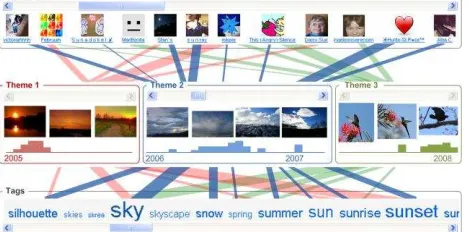
the photos) and tags associated with the photos become part of it. The primary motivation of this work is to conduct exploratory analysis in group photo streams, through tackling the following questions: Are there typical patterns in the shared photos? Do the patterns grow or diminish over time? How can we extract those patterns, and how can we determine which patterns are followed by particular photos, users, tags, etc. Answers to these questions can be shown to users through an interface as in Figure 1, where the group photos are organized based on
patterns over time which we call “themes”. The interface allows
an effective exploration of group photos with respect to time-dependent themes, and how each theme is contributed by particular users or associated by particular tags.
Related work. Mining time-evolving patterns of visual content
and context in social media streams deals with the interrelatedness of media content features as well as contextual and temporal information associated with the media. To our knowledge, little work has been done to tackle this problem. There has been prior work on mining text corpus by incorporating additional information such as hyperlinks, authors, etc. In text mining, Zhu et al. [12] propose a matrix factorization algorithm combining both the linkage and the document-term matrices to improve the hypertext classification. Mei et al. [8] extract spatiotemporal theme patterns from blogs via a probabilistic approach. On community-generated media analysis, most work has focused on investigating and improving the use of tags, e.g. [1]. In [9], the authors analyze the topical interests of Flickr groups based on the co-occurrences of groups and tags.
Figure 1: The interface for browsing themes extracted in a
However, all these studies did not consider the dynamic nature of visual content and context in the media streams generated by community shared practices.
Our approach. In this work, we propose a novel framework that characterizes the time-evolving patterns of group photo streams. We use a non-negative joint matrix factorization approach to incorporate image content features and contextual information, including associated tags, photo owners and post times. In our framework, we consider a group as a mixture of themes – each theme exhibits similar patterns of image content and context. The theme extraction is formulated as an optimization problem where the objective is to best explain the observed image content features and associations with tags, users and times. We provide a scalable iterative algorithm to solve the objectives. Based on the theme extraction results, a group can be represented and explored as shown in Figure 1. The rest of the paper is organized as follows. Section 2 describes the image content features and context information used in our work. Section 3 presents our theme extraction algorithm. Section 4 discusses the experimental results and section 5 concludes.
2 IMAGE CONTENT AND CONTEXT
This section describes the image content feature extracted from a group photo (section 2.1) and the context information associated with the photo (section 2.2).
2.1 Content Feature Extraction
We use a number of image features that have been found effective in image content analysis. We briefly summarize these features as follows (the details may be referred to in [5,6,7,11]): 1. Color: We use two color based features, color histogram
and color moments.
2. Texture: We use a phase symmetry [11] method for
detecting textures from “blobs” in images based on phase information.
3. Shape: We use two shape features: radial symmetry [7] and
phase congruency [5]. The radial symmetry feature detects points of interest in an image. Phase congruency is an illumination and contrast invariant measure.
4. SIFT: We use Scale Invariant Feature Transform (SIFT)
[6], a content-based image feature that detects stable keypoint locations in scale space of an image by computing the difference of two nearby scales.
After feature extraction, we construct a D-dimensional feature vector per photo, where D=1064 in this work. Let P be the set of group photos, we obtain a photo-feature matrix W(F)|P|×D, where the i-th row is the feature vector of the i-th photo. We use standard normalization with a logistic function g(x)=1/(1+exp(-x)) to bound the feature values within the range [0,1].
2.2 Image Context
We discuss the context of a shared photo. In social media, a media object such as a photo generally has rich contextual information, e.g. who shares the photo, when the photo is shared, and what additional information is associated with the photo. Three kinds of primary contextual information used in our work are discussed as follows.
1. Users: The content and concepts of a photo is determined
by its owner, and hence the ownership provides the most important contextual information. Let U be the set of users who post the group photos, i.e. photo owners, we construct
a photo-user matrix W(U)|P|×|U|, where each entry Wij(U) =1 if the i-th photo is posted by the j-th user; 0 otherwise. 2. Tag: Tags are assigned by users to describe the content of a
photo, e.g. “sky”, “bird”, etc., or provide additional contextual and semantically information, e.g. “summer”, “vacation”, “nikon”, etc. Let Q be the set of tags associated with the group photos, we construct a photo-tag matrix
W(Q)|P|×|Q|, where each entry Wij(Q) =1 if the i-th photo has the j-th tag, and 0 otherwise.
3. Time: A photo in Flickr has timestamps indicating when
the photo is taken or posted (uploaded). Here we use photo post time since the photo taken time may not be available or may not be set correctly for some photos. We segment the timestamps into S time slots and construct a photo-time matrix W(T)|P|×S, where each entry Wij
(T)
=1 if the i-th photo is posted during the j-th time slot, and 0 otherwise. We further smooth each row vector of W(T) using a moving average filter, so that W(T) contains smooth temporal information.
In our analysis, the data representing the group photo stream over time is given as data matrices described above, including image content features as well as contextual and temporal information of the images. In our notations, a matrix W() is indexed based on its second dimension. Without loss of generality, we normalize W() to ensure ijWij()=1. The data representation is illustrated as in Figure 2.
3 THEME EXTRACTION
We now present our method for extracting time-evolving patterns of visual content and context from group photo streams. We consider a group as a mixture of themes – each theme consists of photos having similar patterns of content and context. In our approach, patterns are deemed to be similar in terms of multiple aspects: visual content, associated tags, photo owners, and post times. We extract themes based on the observations from these aspects – which are represented by the data matrices discussed in the previous session. We shall discuss each of these aspects in the following.
Visual features. In order to extract themes having similar visual
patterns, let us assume each theme k has a length D feature vector zk where each entry zkj can best represents the significance of the j-th feature of the set of photos in the theme k. Our goal is to determine the coefficient zkj based on how likely a photo i belongs to the theme k. We define pik to be the probability that a particular photo i belongs to the theme k. The parameters pik are non-negative numbers satisfying i pik=1. Let
Z(F)={z
ki} denote a KD matrix, P={pik} denote a |P |K matrix.
Figure 2: The data representing the group photo stream over
We use an idea similar to principal component analysis to derive between two matrices. In this paper we focus on KL (Kullback-Leibler) divergence between two matrices. The corresponding objective is to minimize: The constraint that rows of P must sum to one is added to avoid scaling solutions. With the non-negative constraints, this optimization problem is a case of non-negative matrix factorization (NMF) [3].
Users and Tags. Now considering the contextual information of
photos, two photos might belong to the same theme not only due to visually similarity, but also because they are posted by the same users, or associated with the same tags. For a set of users U, suppose we have a K|U| user coefficient matrix Z(U), where each entry zkj indicates how likely the j-th user posts a photo that falls in the k-th theme. Similar to the feature matrix factorization, we approximate the photo-user matrix W(U) by P and Z(U) by the as in eq. <2>. Similarly, let Z(Q) be the tag coefficient matrix, we approximate the photo-tag matrix W(Q) by P and Z(Q) by:
( ) ( ) ( )
( , Q) ( Q || Q)
J P Z D W PZ <4>
s.t. Z(Q)+K|Q|, with other constraints defined as in eq. <2>.
Temporal information. To extract themes having temporal
trends, we consider two photos to be in the same theme if they are posted in the same time slot. For S time slots, let Z(T) be the time coefficient matrix, where each entry zkj indicates how likely a photo posted at time j belongs to the k-th theme. We
Joint Factorization. Putting together all objective functions
with respect to different aspects, we have the following joint dimensionality of the second dimension of the coefficient matrices. Note, eq. <6> can be easily extended to incorporate additional aspects or to incorporate weights on aspects.
Solution. We provide a solution to the objective defined in eq.
<6>. Since eq. <6> is not convex in all variables, it is difficult to guarantee a global minima solution. By employing the concavity
of the log function given in the KL-divergence, a local minima solution can be derived as the following updating algorithm:
( ) ( ) ( ) ( ) ( ) solving a single non-negative matrix factorization problem. The proof for the convergence of our algorithm is omitted due to limited space. In eq.<7>, due to the sparseness of the data matrices (most data matrices W() have few non-zero entries), the most time-consuming part, computing (PZ(r))ij is reduced to
This section reports our experimental studies on a collection of Flickr group dataset. We first briefly describe the dataset used in our experiments, and present a qualitative analysis on the group theme extraction. Finally we quantitatively evaluate and discuss the quality of our mining results through a prediction task.
Flickr dataset. We have collected the data using Flickr API. We
sample 52 groups based on the group size distribution. We download all photos for each group. In total, there are 50,875 photos, 3,499 unique users, and 54,501 unique tags in this collection. The photo post times range from May 23, 2004 to November 11, 2008, enabling us to analyze long-term temporal patterns in this collection.
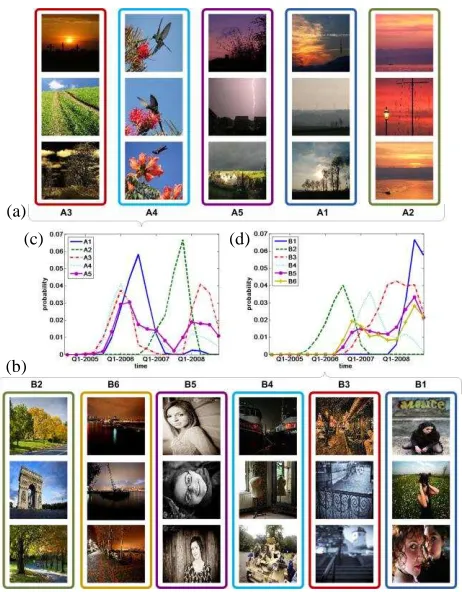
Theme discovery and evolution. We discuss the theme
captures the dynamics of group patterns and gives meaningful summary of group photo streams.
Prediction task. We design a prediction task to examine the
quality of our mining results. For each group, we randomly choose 90% photos to train the theme model, and use the remaining 10% as a testing set. The task is to predict tags associated with the testing images. Our prediction utilizes the coefficient matrices obtained from the training stage, with an estimation of pik for the test images using a folding-in technique [10]. We compare our prediction results with three baseline methods: (a) feature-based prediction – predicting tags from photos having most similar visual features (i.e. nearest neighbor); (b) tag-based – predicting tags based on the tag frequency; (c) feature/tag (denoted by “F/T”) – predicting tags by only using the feature and tag information in joint factorization. The prediction performance is evaluated based on S@10 (success, i.e. at least one tag is correct, among the top 10 results) and NDCG (Normalized Discount Cumulative Gain [2]).
The prediction performance averaged over all groups is shown in Table 1. The result shows that our method significantly outperforms all baselines by 45% – 3.9X on an average. Note, prediction based on visual features alone performs the worst. We observe that our joint analysis that incorporates contextual information (tags, users, post times) with visual features, finds the highest quality tags for the testing images – suggesting the effectiveness of our mining approach.
Features Tags F/T Joint
NDCG 0.0880.057 0.2990.120 0.2970.122 0.4330.105
S@10 0.3780.260 0.7280.193 0.7330.190 0.7960.122
Table 1: The average tag prediction performance evaluated by
NDCG and S@10 metrics.
5 CONCLUSION
In this paper, we propose a framework to characterize the time-evolving patterns of group photo streams. We consider a group as a mixture of themes and use a non-negative joint matrix factorization approach to incorporate image content features and contextual information, including associated tags, photo owners and post times. Extensive experiments on a Flickr dataset show that (a) our analysis is able to capture the dynamics of group patterns, and give meaningful summary of group photo streams; (b) compared with baseline methods, our joint analysis performs the highest quality tag prediction. These results indicate the utility of our theme based joint analysis
As part of our future work, we plan to (a) extract higher level concepts from the theme mining results, and (b) investigate the hierarchical structures of themes. We are also extending the current matrix factorization framework to tensor based analysis.
6 REFERENCES
[1] N.GARG and I.WEBER (2008). Personalized, interactive tag recommendation for flickr, RecSys, 67-74, 2008. [2] K. JÄRVELIN and J. KEKÄLÄINEN (2000). IR evaluation
methods for retrieving highly relevant documents, SIGIR, 41-48, 2000.
[3] D.LEE and H.SEUNG (2001). Algorithms for non-negative
matrix factorization, NIPS, 556–562, 2001.
[4] Y. LIN, Y. CHI, S. ZHU, H. SUNDARAM and B. TSENG
(2008). Facetnet: a framework for analyzing communities and their evolutions in dynamic networks, WWW, 2008. [5] Z. LIU and R. LAGANIERE (2007). Phase congruence
measurement for image similarity assessment. Pattern Recogn. Lett. 28(1): 166-172.
[6] D.G.LOWE (2004). Distinctive Image Features from Scale-Invariant Keypoints. Int. J. Comput. Vision 60(2): 91-110. [7] G.LOY and A.ZELINSKY (2003). Fast Radial Symmetry for
Detecting Points of Interest. IEEE Trans. Pattern Anal. Mach. Intell. 25(8): 959-973.
[8] Q.MEI, C.LIU, H.SU and C.ZHAI (2006). A probabilistic approach to spatiotemporal theme pattern mining on weblogs, WWW, 533-542, 2006.
[9] R. NEGOESCU and D. GATICA-PEREZ (2008). Analyzing Flickr groups, CIVR, 417-426, 2008.
[10] A. SCHEIN, A. POPESCUL, L. UNGAR and D. PENNOCK
(2002). Methods and metrics for cold-start recommendations, SIGIR, 253-260,
[11] Z.XIAO, Z. HOU, C.MIAO and J. WANG (2005). Using
phase information for symmetry detection. Pattern Recogn. Lett. 26(13): 1985-1994.
[12] S.ZHU, K. YU, Y.CHI and Y.GONG (2007). Combining content and link for classification using matrix factorization, SIGIR, 487-494, 2007.
Figure 3: Theme discovery for (a) group “sky's the limit” and (b) “Full Frame Sensor group”. Their theme evolutions are shown in plot (c) and (d) respectively. We use our joint analysis to extract five themes in group (a) and six themes in group (b). The results interestingly show that group patterns emerge due to dedicated users, tag co-occurrences, as well as similar visual content.
(a)
(b)