MASTER THESIS
Anisa Fatwa Sari NIM 107785050
THE STATE UNIVERSITY OF SURABAYA
POSTGRADUATE STUDIESiii
For the
you gave me,
For
and
you taught me,
For every single
through so many nights for me,
For never ending
you show me,
I dedicate this thesis only for you,
My greatest
and my number one
in the
iv
of Rectangles and Squares. Master Thesis, Mathematics Education Study Program, Postgraduate Program of Surabaya State University.
Supervisor: Prof. Dr. Dwi Juniati, M. Si., and Dr. Agung Lukito, M.S.
Keywords: Area measurement, multiplicative structure, rectangle, square, RME Area measurement is supported by four basic principles: complete covering, spatial structure, size relation, and multiplicative structure. Particularly in primary school, the two dimensional arrays for measuring area are usually given right away to students commonly in Indonesia without allowing them to construct it by themselves. It raises the need of constructing a conceptual basis to learn a formula of area which emphasizes the construction of spatial and multiplicative structure in measuring area.
This study used the design research as an approach. It was conducted to support students’ in acquiring the initial concept of area measurement. It was focused on how a concrete model of two-dimensional arrays can support students’ initial understanding of the formula for measuring area of rectangle and square. This study was conducted at one of the primary school in Surabaya during March – April 2012. A series of six activities was designed by using Realistic Mathematics Education (RME) approach. An instructional design contained those activities as the part of a hypothetical learning trajectory was implemented in the teaching and learning process. Six students were involved in the first cycle and 18 students became the subject of study in the second cycle. Data collections were generated from video recording during the teaching, collecting the students’ work, giving pre-test and post-test, and interviewing the students.
v
Sari, Anisa Fatwa. 2012. Developing Multiplicative Structure of Measuring Area of Rectangles and Squares. Tesis, Program Studi Pendidikan Matematika, Program Pascasarjana Universitas Negeri Surabaya. Pembimbing: (I) Prof. Dr. Dwi Juniati, M. Si., dan (II) Dr. Agung Lukito, M.S.
Kata Kunci: Pengukuran luas, struktur multiplikatif, persegi panjang, persegi Pengukuran luas tersusun dari empat prinsip dasar: complete covering, struktur spasial, hubungan antar ukuran, dan struktur multiplikatif. Di tingkat sekolah dasar di Indonesia, susunan petak dua dimensi dalam untuk mengukur luas diberikan langsung kepada siswa tanpa memberi mereka kesempatan untuk membangun sendiri struktur tersebut. Hal ini menumbuhkan kebutuhan siswa untuk mempelajari konsep dasar pengukuran luas sebagai landasan rumus mengukur luas. Konsep dasar tersebut menekankan pada pengembangan stuktur spasial dan multiplikatif saat mengukur luas.
Metode yang digunakan dalam penelitian ini adalah design research. Tujuan penelitian ini adalah mendukung proses belajar siswa dalam menguasai konsep dasar pengukuran luas. Fokus penelitian terletak pada bagaimana model kongkrit dari petak dua dimensi dapat mendukung pemahaman awal siswa untuk belajar tentang luas persegi panjang dan persegi. Penelitian ini dilaksanakan di salah satu sekolah dasar di Surabaya selama bulan Maret hingga April tahun 2012. Serangkaian aktivitas dikembangkan menggunakan pendekatan Pendidikan Realistik Matematika. Desain pembelajaran dengan 6 aktivitas yang merupakan bagian dari hipotesis trayektori pembelajaran (HLT) diuji dalam pembelejaran. Enam orang siswa dilibatkan pada siklus pertama dan 18 orang siswa turut menjadi partisipan pada siklus kedua. Proses pengumpulan data dilakukan dari rekaman video, pengumpulan hasil kerja tertulis siswa, pemberian pre-test dan post-test, serta wawancara dengan siswa.
vi
Accomplishing this thesis has been a great achievement for me. Through this hard times, I would say Alhamdulillah and grateful thanks to The Almighty Allah SWT for His blessing so that this thesis can be finished in due time. It is a great effort and the most challenging project during my study in the master program. I need a lot of motivations and supports from many people surrounding. That is why I want to express the deepest gratitude to:
1. Prof. Dr. Dwi Juniati, M.Si and Dr. Agung Lukito, M.S as supervisors who gave assistance and guidance during in writing this thesis.
2. Frans van Galen and Dr. Dolly van Eerde who give support strongly in designing activities and completing the methodological aspect of this study. 3. Jaap Den Hertog as the Coordinator of the IMPOME Program in Netherland. 4. All lecturers in Postgraduate Studies, UNESA and Freudenthal Institute,
Utrecht University for all the supports.
5. Bu Anda and Bu Yuli who are willing to be partner in my research.
6. Riza agustiani, Intan Kemala Sari, and Devita kahardini for their kindness in helping me conducting the study.
7. All of my colleague in IMPOME program for their warmth and friendship during this program.
Finally, I consciously understand that this thesis is far from being perfect. Thus, any critics and constructive ideas will be gladly accepted.
vii
2.2 Realistic Mathematics Education……….. 12
2.3 Emergent Modeling……… 14
2.4 Emergent perspective………. 16
2.5 Area measurement in Indonesian curriculum……… 18
viii
3.3.6 Validity and reliability……….………... 26
3.4 Data analysis……….……….. 26
3.4.1 Pre-test……….………... 26
3.4.2 Preliminary teaching …………...………... 27
3.4.3 The implementation of the improved-HLT………. 27
3.4.4 Post-test……….. 28
3.4.5 Reliability……….………... 28
CHAPTER IV HYPOTHETICAL LEARNING TRAJECTORY 4.1 Comparing two cracker’s trays……….. 30
4.2 How large is the tray?... 34
4.3 Square or rectangular crackers?... 38
4.4 Measuring area with limited number of units……… 40
4.5 Measuring area using strip of square units……… 43
4.6 Measuring area using strip of standard units………. 45
CHAPTER V RETROSPECTIVE ANALYSIS 5.1 The research timeline………. 48
5.2 Remarks on the students’ pre-knowledge in the first cycle…………... 49
5.2.1 The lack of awareness toward attribution of area during comparing the area of two shapes………... 50
5.2.2 The relation between the structuring arrays and the way of counting the units……… 50
5.2.3 The various iteration process among students………... 51
5.3 Preliminary teaching experiment………... 51
5.3.1 Developing the idea of identical units to measure area…………. 52
5.3.2 Developing idea of multiplication in counting units……….. 56
5.3.3 Determining the flexible unit for measuring area……….. 59
5.3.4 Constructing the shortcut to determine area……….. 62
5.3.5 Constructing the row-by-column structure……… 67
ix
5.4.1 The awareness toward identical units……… 71
5.4.2 Structuring arrays and its support to the idea of multiplication…. 72 5.4.3 Visualization of measuring process………... 74
5.5 Conclusion of students’ learning process in the first cycle……… 74
5.6 HLT 2 as the refinement of the HLT 1……….. 76
5.7 Remarks of students’ pre-knowledge in the pre-test (2nd cycle)…….. 78
5.8 Teaching experiment in the second cycle……….. 81
5.8.1 Developing the idea of identical unit to measure area…………... 82
5.8.2 Developing idea of multiplication in counting units…...……….. 88
5.8.3 Determining the flexible unit for measuring area……….. 94
5.8.4 Constructing the shortcut to determine area……….. 100
5.8.5 Constructing the row-by-column structure……… 104
5.8.6 Developing the use of standard unit for area measurement……... 109
5.9 Remarks of the students’ knowledge in post-test (2nd cycle)………... 111
5.9.1 The lack of awareness toward identical units in comparing area... 112
5.9.2 The use of multiplicative structure in estimating area…………... 113
5.9.3 The visualization of area measurement……….. 115
CHAPTER VI CONCLUSION AND DISCUSSION 6.1 Conclusion………. 117
6.1.1. Answer to the research question………... 117
6.1.2. Local instructional Theory on learning area measurement……... 124
6.2 Discussion……….. 124
6.2.1. The weakness points of study………... 124
6.2.2. Reflection on the important issues……… 126
6.3 Recommendation for further research………... 127
References………. 129
x
xi
Figure 4.1 Two bamboo tray for drying the crackers ………... 30
Figure 4.2 Two rectangular papers as substitution for crackers... 32
Figure 4.3 Two cardboards as substitution of two different trays…………. 32
Figure 4.4 Students cover different trays with different types of crackers… 33 Figure 4.5 The same strategy with Figure 4.4 but the crackers are swapped 33 Figure 4.6 Covering trays with the same crackers………...……….. 34
Figure 4.7 Counting one by one strategy………...……….... 37
Figure 4.8 Skip counting by rows….………. 37
Figure 4.9 Skip counting by column..……… 37
Figure 4.10 Putting the rectangular unit in the different direction………… 40
Figure 4.11 Iterating the units one by one………. 42
Figure 4.12 Iterating the units by row………...………. 42
Figure 4.13 Iterating units by column………..….. 42
Figure 4.14 Row by column structure……….... 43
Figure 5.1 Covering with gaps……….. 53
Figure 5.2 Complete covering in the same direction……… 55
Figure 5.3 Row by column structure………. 58
Figure 5.4 Work of second group………. 63
Figure 5.5 Additivity of area………. 64
Figure 5.6 Students' work in estimating the area of rectangle……….. 65
Figure 5.7 Identical units as reference……….. 72
Figure 5.8 Estimating the area of given figures……… 73
Figure 5.9 Student's visualization of area measurement………... 74
Figure 5.10 From top to bottom: the change of worksheet in activity 1…... 77
Figure 5.11 Students' response that using 'perimeter' as reference of the bigger pool………....79
Figure 5.12 An example of unclear reasoning……….. 80
xii
Figure 5.15 Various ways of iteration process of covering the cardboard… 89
Figure 5.16 The drawing on the board……….. 91
Figure 5.17 Checking the size of cardboard and the square units…………. 92
Figure 5.18 The work of the focus group……….. 93
Figure 5.19 Students' reasoning in using multiplication………... 94
Figure 5.20 Students' strategies in covering the cardboard………... 96
Figure 5.21 Discussion with the focus group……… 97
Figure 5.22 Students' strategies in estimating the area……….. 101
Figure 5.23 The individual task on estimating area………... 104
Figure 5.24 Three different sizes of strip………... 105
Figure 5.25 Measuring the surface of object………. 106
Figure 5.26 The demonstration of measuring area………. 107
Figure 5.27 The students' work on area measurement of five objects……... 108
Figure 5.28 The students measured the area of given cardboard………….. 110
Figure 5.29 The result of area measurement performed by students………. 111
Figure 5.30 The drawing added by students on the given figure………….. 114
Figure 5.31 The way students use the structure of arrays to estimate area……….114
1 CHAPTER I INTRODUCTION
1.1 Background
Area measurement has already played an important role in human life since centuries ago when people dealt with Earth measurement. The area problem has also been studied since Babylonian civilization. It is also part of human culture, science, and technology and even can be found in our daily life (Hirstein, Lamb, & Osborn in Kordaki & Potari, 1998). Similar to the other units of measurement in mathematics, the measurement of area serves as a bridge between two critical aspects of mathematics: spatial relations and real numbers (Clements & Stephan, 2004). Area measurement is closely related to the number concepts in which it provides a model and an application for both numbers and its arithmetical operations (Skemp, 1986; Clements & Stephan, 2004). Moreover, Freudhental (1983) states that area models for the generalization of area measurement from discrete to continuous application can be natural means for teaching fractions and its multiplication.
because two-dimensional arrays are a major model for and application of multiplicative thinking (Battista, Clements, Arnoff, Battista, & Van Auken Borrow, 1998). Consequently, students should learn covering a region with units and gradually develop their spatial ability to support them in constructing the multiplicative structure.
However, some research findings in mathematics education often reveal students’ difficulties in learning area measurement. Zacharos (2006) states
that these difficulties are attributed to the emphasis of using formulae while introducing this topic to students. In Indonesia, the first introduction of this topic is given at third grade of primary school. Fauzan (2002) argues that one of fundamental problem in Indonesia is that most of the learning objectives only focus on memorizing facts and concepts, and computational aspects (i.e. applying formula). Particularly, the two dimensional arrays for measuring area are usually given right away to students without allowing them to construct it by themselves. These findings raise the need of constructing a conceptual basis to learn a formula of area which emphasizes the construction of spatial and multiplicative structure in measuring area.
1.2 Research Questions
Based on the aim of this study, the research question is stated as follows. How can multiplicative structure support students’ initial understanding of area measurement for rectangles and squares?
1.3 Aim of the research
Considering the aforementioned issues, the aim of the present study is contributing to the development of a local instructional theory for area measurement. It will be conducted by designing and implementing classroom activities based on a RME approach that can support students’ to understand
the two- dimensional array and multiplicative structure in measuring area of rectangle and square. Specifically, this study is focused on the third grade of primary school in Indonesia.
1.4 Significance of the research
1.5 Definitions of key terms
In order to avoid misleading for the readers, the researcher defines some terms used in this study as listed below.
1. Array is a rectangular arrangement of units of area measurement in rows and columns.
2. Cracker is a traditional snack that usually made from flour with special seasoning. In Indonesian language, it is known as kerupuk.
5
THEORETICAL FRAMEWORK
2.1 Area measurement
Area is defined as an amount of surface inside the boundary of a two-dimensional shape (Baturo & Nason, 1996; Sarama & Clements, 2009). In general, measuring area can be defined as quantifying the amount of surface inside the boundary. Specifically, Clements & Stephan (2004) define an area measurement as tilling (or partitioning) a region with a two-dimensional unit of measure. Hence, measuring the area means enumerating how many two-dimensional units completely fit in the surface without gaps or overlapping.
There are some important aspects need to be addressed in learning area measurement. Outhred & Mitchelmore (2000) formulate four basic principles that constitute children’s intuitive understanding of area measurement. These
principles are complete covering, spatial structure, size relation, and multiplicative structure in which successively shows the children’s
acquisition in learning area measurement. In addition, Clements & Sarama (2009) describe some foundational concepts for learning area measurement as follows.
1. Understanding the attribute of area
Intuitively, comparing area of two shapes can be stated by a relative statement such as “bigger (or larger) than” and “smaller than” (Yuberta,
2011). However, this relative statement cannot be applied in a case of comparing objects that cannot be directly compared. For instance, compare the surface of two tables in a different place will raise the need of the third object as a standard measure in order to quantify the amount of surface in those tables.
2. Equal partitioning
Partitioning is defined as the mental act of splitting two-dimensional space into parts or units. In the mathematics textbook, this aspect is often given as a grid inside the shapes. However, Clement & Stephan (2004) argue that the construction of a two-dimensional array from linear units is nontrivial for children. In addition, it is crucial that students have opportunities to construct grids for themselves rather than simply observing ones that have been already prepared (Cavanagh, 2008).
Therefore, students need to experience the activity of tiling a region with two-dimensional units and also discuss issues of leftover spaces, overlapping units, and precision. Discussions of these ideas lead students to mentally construct subregions of the whole shape that can be counted. 3. Unit iteration
covers a flat surface without leaving gaps or overlaps is a basis of understanding of measuring area. Moreover, it is also important to address the extension of units beyond the boundaries if subdivisions of unit are needed.
According to Wijaya (2008), unit iteration is the process of finding how many units would fit to the attribute of the measured object. In case of measuring area, unit iteration is needed when a unit is not enough to cover up the measured space. In a more formal stage, unit iteration can involve a row (or a column) of square units for enumerating the area of shape. This argument is supported by Outhred & Mitchelmore (2000) that emphasize the significance of forming a row as unit iteration and the relation between the size of unit and the dimension of the shape. Furthermore, a concept of unit iteration supports the development of multiplicative structure to enumerate the units. According to Sarama and Clements (2009), tilling activity with incomplete units to cover rectangles encourage students to use multiplication principle along with the conceptual understanding behind it.
4. Accumulation and additivity
5. Structuring space
Students need to comprehend the concept of two-dimensional array before they can construct the formula of measuring area meaningfully (Clements & Stephan, 2004). The structure of array in two-dimensional space related to the way a surface can be covered with unit squares that are arranged in row and column. Battista et al. (1998) stated that the structuring is significant for developing a concept of area measurement and closely related to multiplication because the two-dimensional array serves as model for and application of multiplicative thinking. Moreover, it is suggested that students must understand a row-by-column structure of the array in order to apply multiplication in determining the unit of measure. It will lead them to get conceptual understanding of the formula for measuring area.
6. Conservation
The concept of area conservation is based on the understanding of getting exactly equal area if the parts of a given shape is rearranged and formed into another shape.
However, in order to focus on the aim of this study, the researcher only addresses some concepts from the aforementioned discussion. It includes area attribution, partitioning, units and its iteration, and also structuring space. These concepts are focused on the construction of multiplicative structure in enumerating unit covered the measured surface. Therefore, the instructional activities in this study are designed in such a way the students can build up their understanding by acquiring those concepts.
Clements & Sarama (2009) suggest that building upon students’ initial spatial intuitions can lead to a more successful approach in learning area measurement. In addition, Clements & Stephan (2004) formulate a set of general instructional activities for area measurement that are described as follows:
1. Investigation of covering region with a unit of measure
measurement. Starting from the use of rectangular cracker as a “natural” unit for measuring area, students then shift to the use of square crackers, and finally construct the idea of square units. It is in line with Zacharos (2006) who suggested that area can be measured using two-dimensional units such as squares and rectangles.
2. Structuring array
This activity enables students to experience covering quantities with appropriate measurement units and enumerating the units. Through these experiences, students can make a link between the structure of rectangular arrays and counting by groups (i.e. row or column). It supports them for spatially structuring the shapes they are going to measure. Structuring the unit into an organized array can support students to achieve multiplicative thinking in measuring area.
In this study, the activity of covering surfaces using square unit and completing drawing of units contained in shape can facilitate them to construct the structuring array. Although it is a long-term process for students to develop an idea of two-dimensional array of square, but Clements & Stephan (2004) confirm that even second grade students can make significant gains.
explicitly addressed, students can still develop a sense of choosing appropriate size of unit to measure a certain surface.
3. Linking the area measurement to the linear measurement
Outhred & Mitchelmore (2000) highlight the importance of a good understanding of linear measurement as prerequisite for learning area measurement. This understanding enables them to build a relation between unit size and rectangle dimensions. Therefore, there should be an activity in which students can learn that the length of the sides of a rectangle can determine the number of units in each row and the number of rows in the array. From this, they can construct two-dimensional space and correspond it to the multiplicative relations. However, the sequence of instructional activities in the present study is designed as a small part of a broader learning line in area measurement. Hence, it does not include this aspect in the design of lesson.
4. Making a shortcut for measuring area
2.2 Realistic Mathematics Education
One of principles emphasized by Freudenthal (1991, p.56) in doing mathematics is the selection of learning situation within students’ current
reality which appropriate for horizontal mathematizing. It means that a problem situation involved in a mathematical learning must be experientially real or imaginable for students. In other word, by using their common sense students can be encouraged to expose their ideas and develop their own strategies to solve the problem.
As stated by Freudenthal, mathematics is as a human activity. Therefore, mathematics should be taught in such a way students can learn mathematics with experience-based instead of memorizing a ready-made algorithms or formulae. In line with this principle, this study attempts to develop an instructional design on teaching and learning area measurement. Through this instruction, it is expected that students could gain an insight about how to measure the area of a surface by engaging them in a series of meaningful activities instead of giving them a formula for measuring the area.
The process of designing a sequence of instructional activities in this study is guided by five tenets of realistic mathematics education defined by Treffers in Bakker (2004). The following description elaborates how these tenets fit in the present study.
1. Phenomenological exploration
experiencing a real situation to be a basis of developing the mathematical concept. Moreover, this study starts with using a context of drying cracker as introduction area measurement. The aim of using this situation is prompting the students thinking in using the cracker as a natural unit to cover a cracker tray and determine the area.
2. Usingmodels and symbols for progressive mathematization
This second principle characterizes a progression from a concrete level to the more formal level. The progression is bridged through the use of models and symbols. The initial understanding from the contextual activity will be brought into formal knowledge of area measurement. In this study, the students will be involved in several covering activities. Once they realize the efficiency of using unit square, they starting to use more formal objects for measuring area. They begin to develop their own model when they are asked to complete the drawing of the crackers tray. The drawing serves as a model to represent the arrangement of square crackers in two-dimensional array.
3. Using students’ own constructions and productions
enhance their understanding of multiplicative principle in enumerating the area using unit squares.
4. Interactivity
The learning process of students involves an individual process as well as a social process. The latter process requires an existence of interaction among students and also between teacher and the students. Building this interaction can be done by designing a working group environment in which students communicate, compare, and justify their ideas. Almost all of the instructional activities in this study such as covering tray or measuring using strips are designed for group working that enables the students to interact each other.
5. Intertwinement
Intertwinement suggests integrating various mathematics topics in one activity. The instructional activities designed not only support learning for area measurement, but also support the development of spatial ability which is important in geometry domain. It also supported the students’ comprehension toward multiplicative principle since the structure of array enables them to count the number of unit by using repeated addition.
2.3 Emergent Modeling
The second tenet of RME implies the use of models that support students’ understanding of the area measurement concept. Gravemeijer (1994,
become models-for more formal reasoning. In the end of the lesson sequence in this study, it is aimed that the students can measure the area of surface of rectangle and square using standard unit (i.e. centimeter square). Though they are not expected to apply formal formula for measuring area, they are also expected to enumerate the number of units fit in the surface using multiplication. The implementation of the four levels of emergent modeling in the present study is described as follows:
1. Situational level
Situational level is the basic level of emergent modeling where domain-specific, situational knowledge and strategies are used within the context of the situation. In this study, comparing two crackers tray is used as a contextual situation to promote the need of third object to measure the area of rectangular surface. This context can elicit the use of cracker as a natural unit measurement for covering the shape.
2. Referentiallevel
3. General level
In general level, models-for emerge where a mathematical focus on strategies dominates the reference to the context. In other word, in this level students are supported to develop a model which is applicable in different situations. The use of the unit square in this study serves as model-for area measurement when they become strips as tool for measuring different size of surface.
4. Formallevel
In the formal level, working with conventional procedures and notation is independent from the use of model-for mathematical activity. Though the end goals of this study do not reach the formal formula of area measurement, the use of multiplicative principle in enumerating units covered a surface and the standard unit for measuring area becomes the focus of the discussion.
2.4 Emergent perspective
students’ reasoning. The social perspective includes the social norms, socio -mathematical norms, and classroom -mathematical practices.
Social norms is defined as the ways of acting and explaining as the process of mutual negotiation between teacher and students. In this study, it is expected that the classroom will have different approach than the traditional ways of learning. It is important to put the norms of reform math class in to account such as students explain their reasoning and justify solution, indicate agreement and disagreement, try to make a sense the explanation given by other and question some possible alternative in such situation where a conflict in interpretation is apparent (Gravemeijer & Cobb, 2006).
Different from socio norms, Gravemeijer & Cobb (2006) define socio-mathematics norm as the ways of explicating and acting in whole class discussions that are specific to mathematics. In this study, it will be particularly about the concept of area measurement. This norms enable students to make independent judgments. For instance, each student might have their own ways of explaining what they understand about measuring area of a surface. It also enables the teacher and students to participate in a discussion to negotiate and redefine about the concept discussed in the learning process. These norms will also help teacher to facilitate students in their thinking process.
instructional activities in the Hypothetical Learning Trajectory designed in this study, there will be some mathematical practices that are more specific to particular mathematical ideas. Comparing two trays of crackers will help the students to directly experience the mathematical practices of comparing the area. Students will also experience to use square units and strips of square units for measuring area of different surfaces. In the students’ learning processes about the concept area measurement, their interpretation and their mathematical practices are related each other. It is implied that their mathematical development occurs as they contribute to the constitution of mathematical practices.
2.5 Area measurement in Indonesian curriculum
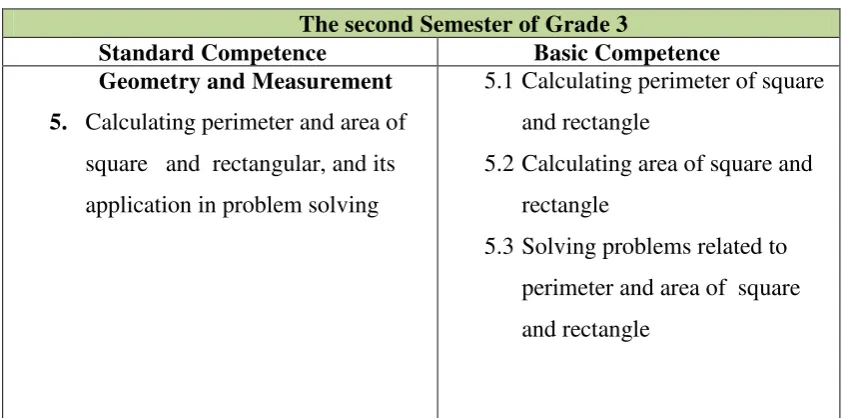
The area measurement in Indonesian curriculum is being introduced start from second semester of the third grade. The table below describes topic measurement for grade 3 in Indonesia curriculum.
However, it is common that the focus in teaching area measurement in Indonesia is placed in understanding and applying the formula. It gives less emphasis to the reason behind the formula, the reason why it works. Indeed, the formal approach in measuring area is important but it should be based on a conceptual basis. Therefore, the present study would like to focus on the process of how students understand the use of the formula and its meaning.
According to the aforementioned discussion of the framework, the general research question in this study is elaborated into two specific sub questions as follows.
1) How do the third grade students structure two-dimensional array in covering a surface to measure area?
20 3.1 Research approach
Design research is used as an approach in this study since it is appropriate to the aim of this study. This study is aimed to provide an empirically grounded theory about how mathematical instruction works in the domain of area measurement. The theory concerns both the process of learning and the means designed to support that learning. Therefore, during this study series of activities are designed and developed as means to contribute the improvement of educational practices in area measurement for the third grade of primary school in Indonesia. Specifically, this study focuses on how a concrete model of two-dimensional array can support students’ initial understanding of the formula for measuring area of rectangle and square.
The definition of design research is given by Gravemeijer & Cobb (2006) in the discussion of the three phases of conducting this type of research. These phases are described as follows.
1. Preparing for design study
The goal of the preliminary phase of a design research experiment is to formulate a conjectured local instructional theory that can be elaborated and refined while conducting the experiment (Gravemeijer & Cobb, 2006). The sequence of instructional activities including conjectures of students’
serves as initial Hypothetical Learning Trajectory (HLT). However, this initial HLT is dynamic in which it can be adjusted to the students’ actual
learning during the teaching experiment phase. 2. Conducting the design study
According to Gravemeijer & Cobb (2006), the purpose of this phase is both to test and improve the conjectured local instruction theory that was developed in the preliminary phase, and to develop an understanding of how it works. In this phase, the sequence of activities developed in the previous phase is implemented in the classroom. In this study, the teaching implementation of the design will be conducted in six lessons. During the teaching, the conjectures in the HLT will be tested and adjusted while reacting to students’ learning process. There will be two cycles for this
3. Retrospective Analysis
The goal of the retrospective analyses depend on the theoretical intent of the design implementation. However, one of the primary aims is typically to contribute to the development of a local instruction theory (Gravemeijer & Cobb, 2006). In this retrospective analysis, researcher will make an analysis of the entire data set collected in the teaching. The HLT is compared to the actual learning process of the students. The explanation is not merely about the instances that support the conjectures, but also the examples that contradict the conjectures. Based on this analysis, the research question will be answered. The recommendations of how the next HLT should be improved for further study are underpinned by the analysis. In addition, the HLT has different three functions in each phase of the design research (Bakker, 2004). In the phase of preparing the design study, the HLT guides the design of instructional activities that have to be developed. In the implementation phase, it functions as a guideline the focus of teaching, interviewing, and observing. During the retrospective analysis, it serves as a guideline in determining what to focus on in the analysis.
3.2 Subjects of the study
different classes, 3C and 3D. The students who involved in each cycle were different.
For the first cycle, the researcher involves only 6 students from 3C. It was because the goal of the implementation of design in this cycle is mainly to adjust with the initial HLT and improve it to get a better design for the next cycle. The selection of the students was based on the recommendation from their mathematical teacher. These students were those who have middle level of achievement. During this cycle, the researcher itself took a role as the facilitator.
Different from the previous cycle, the implementation of the design in the second cycle involved a class of students from 3D. The number of students in this class was 18. In addition, there were four out of these students chosen as the focus of observation during the teaching. These four students were selected based on the recommendation of teacher who knew which students were in the middle level of achievement. Later, these students would be called the focus group. The facilitator of learning during this cycle was the teacher.
3.3 Data collection 3.3.1 Preparation phase
The information about students’ pre-knowledge will be used to do first
adjustment of the initial HLT regarding the aspect of starting point of the instructional activities.
Moreover, the classroom orientation is important to get an overview of how the learning process works in that class. It concerns both social and socio-mathematical norms in the classroom and other aspects that constitute the mathematical learning. This kind of data is collected by observing the learning environment in the classroom and interviewing teacher. The researchers write notes based on the list of observation points during the observation and make an audio recording during the interview. Both observation points and the interview scheme with teacher are provided in the appendix section.
3.3.2 Pre-test
Pre-test is used to assess students’ pre-knowledge regarding the concept of area measurement. This test is given to all students involved in the beginning of the series of lessons. An interview is also conducted to know the students’ way of structuring two-dimensional arrays. In the first cycle,
3.3.3 Preliminary teaching
The first cycle of the design study served as preliminary teaching. In this cycle, the instructional activities are tried out with six students (See 3.2). The goal of this phase is to investigate students’ thinking of the problems
in the HLT and to test the conjectures about it. In turn, the data collected from this phase is used to improve the HLT. The data is collected by making a video recording of the activities during the lessons and collecting students’ written work. The video is recorded by using one camera while
the researcher takes the role as a teacher in the lessons. One colleague assists the researcher in making a video registration.
3.3.4 The implementation of the improved-HLT
The improved HLT from the first cycle will be tested in this phase. The students’ work and strategies in solving the problems during the lesson is
observed by video. Short discussions with focus group (See 3.2) and class discussions are also recorded to investigate students’ reasoning. Moreover,
3.3.5 Post-test
Post-test is used to assess students’ development in understanding the concept of area measurement. This test is given to all students at the end of the whole lessons in each cycle. There is an interview with the focus group about their post-test. It is aimed to get clarification of their thinking and reasoning. The questions in the post-test are slightly similar to the pre-test, but there is an additional question. These items can be seen in Appendix G.
3.3.6 Validity and reliability
This study involves different types of data such as interview data, video observations, and students’ written works. The interview is recorded by
using an audio device, while the observation process is recorded by using video-tape tool. The different types of data that relate to the students’ learning process will be used as source triangulation to contribute the internal validity of the data. Testing conjectures in the HLT during the teaching also contributes to the internal validity. The data registration from different methods in collecting the data will contribute to the reliability of the data.
3.4 Data analysis 3.4.1 Pre-test
students’ thinking about a unit for measuring area and their strategies in
enumerating the units covered the surface. From this aspect, the HLT will be adjusted in such a way that it is appropriate to students’ pre-knowledge. 3.4.2 Preliminary teaching
The video and the students’ written works in the first cycle are analyzed to
investigate the learning processes of the students. The learning process of students is assessed by testing the conjectures in the HLT. It means the assumptions about students’ learning will be compared to the students’
actual learning. From this analysis, it can be seen which part of the HLT supports students in learning and which part is not. In turn, an improved HLT will be designed and will be implemented in the next cycle based on the analysis of this phase.
3.4.3 The implementation of the improved-HLT
The video recording will be observed to get the overview of the whole teaching and learning process in the classroom. During watching the video, the researcher makes field note. This note is used to make general description of the lesson including notes of important things such as students’ ideas and strategies. The researcher then selects interesting
fragments and makes transcription of it. Then the selected fragments will be transcribed to make an interpretation of students’ thinking. However,
the irrelevant part of the students’ learning process will be neglected. The selected fragments and the students’ written works in the second cycle the
improved HLT. The result of this analysis will be used to answer the research question, draw the conclusion, and also become a basis to redesign the improved HLT.
3.4.4 Post-test
The result of post-test is analyzed by comparing it to the result of pre-test. It is aimed to investigate students’ development in understanding the
concept of area measurement and their strategies in solving problems in measuring area. It will enrich the analysis of the teaching experiment to draw a conclusion.
3.4.5 Reliability
The reliability of the data analysis is contributed by two aspects namely the track ability and the inter subjectivity. The clear description of how the researcher works on this study so that people can easily follow the process constitutes the track ability aspect. This description contains the explanation of the process of doing each phase of this study. It includes the process of how the preparation is done, how the teaching experiment was happening, and how the researcher analyze, interpret the data, and give conclusion. Moreover, a cross interpretation with colleagues and supervisors is needed to fulfill the inter subjectivity aspect. It is done to avoid the researcher’s own point view or subjectivity toward the
29
CHAPTER IV
HYPOTHETICAL LEARNING TRAJECTORY
According to Simon (1995) as cited in Simon and Tzur (2004), Hypothetical Learning Trajectory (HLT) is used as a term to describe key aspects of planning mathematics lesson. It includes the mathematical goals of students, the mathematical learning activities, and the hypotheses about the process of students’
thinking and learning.
The aim of this study is to contribute to the development of a local instruction theory for area measurement. In achieving this aim, the instructional activities are designed to facilitate students to learn the initial understanding of the formula for measuring area of rectangles and squares. There are two main goals of the activities designed in the HLT. First, students can structure two dimensional arrays in covering the surface when measuring area. Second, they can develop multiplication structure in the array and then apply multiplication as the most efficient way in enumerating unit squares.
4.1 Comparing two cracker’s trays A. Starting points
Area measurement is one of mathematical topic that will be taught in the second semester of third grade of primary school. It is the first time for them in learning about the concept of area measurement. The knowledge and the skills that students already have as prerequisite are as follows.
- Students know rectangle and its visual representation
- Students know square and its visual representation
- Students can draw square and rectangle
- Students can determine the number of objects. This skill is important because students need to enumerate units covered the surface. It is adequate that they can do it either use counting one by one or do skip counting.
- Students can do multiplication of whole numbers up to hundred. They already learnt this skill in the second semester of the second grade level.
B. The Learning goals Main goal:
- Students understand the use of identical unit as a unit for measuring area (the attribution of area)
Sub goals:
- Students can cover the rectangle using units without overlap and leave a gap
- Students can count the number of units covered the shape by using their own strategies
- Students can compare the area of two rectangles by comparing the number of units covered each rectangle
C. Description of Activity
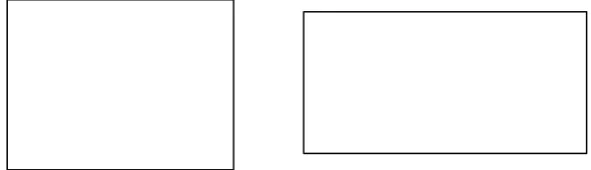
In this activity, teacher tells students about drying cracker under the sun. The teacher then shows two rectangular bamboo trays in different size. One is wider while another is longer. Teacher also shows some raw crackers to thestudents.
Teacher tells the students that he/she needs the largest tray to be used in drying crackers. The students are asked what the meaning of the largest tray is. Teacher then hold a class discussion about it. There may be some students who say that the largest tray contains more crackers. After students realize that the number of crackers contained in the tray can indicate the area of trays, they will work in a small group to compare the
area of trays. Each group will be given two pieces of cardboard as a representation of the trays. They are also given several rectangular papers with two different sizes as a substitution of using real crackers. It uses papers as a substitution because the shape of the real crackers is not neat. The task are describing the method to compare the trays and telling how large each cracker tray is in order to be compared during the class discussion.
D. Conjectures of students’ thinking
In determining the number of crackers contained in the tray, the students may put the rectangular paper in the cardboard. Some students may put the papers but overlapping each other or even leaving gap among it. Some other students may already cover the cardboard completely without gap and overlap.
In the class discussion, the teacher compares the result of students’ work
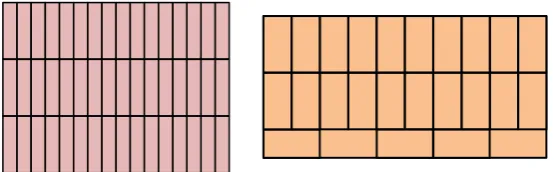
and their method. Most of students may cover each tray with different type of crackers. They may tell the teacher that the tray with the most
Figure 4.2: Two rectangular papers as substitution for crackers
crackers is bigger. These students do not aware of the difference size of the rectangular papers. This type of strategy can be seen in Figure 4.4 and Figure 4.5.
However, it is expected that some students give a response that those trays should be measured using the same crackers. By giving such a response, it can be inferred that these students already realize the identical size of unit is required to compare area of two shapes requires. Their strategies are covering one tray with one size of crackers, and then use the same size of crackers to cover another tray (see Figure 4.6 as an example). Teacher should emphasize this strategy and invite the students to compare two trays using another size of crackers to check whether they can get the same result.
Figure 4.4: Students cover different trays with different types of crackers
If there is no student answer in this way, that is because they ignore the size of the crackers, teacher can pose prompting question.
“Look at the crackers, what do you think about the size of them. Do
those crackers have same size?”
The next discussion will be focused on students’ strategies in enumerating the crackers. They may use different ways in enumerating the crackers. Some of them may just count them one by one, the others may do skip counting by considering the crackers in one row or column and then add it as many as the number of cracker in the different direction. It is also possible that some students already come up with the idea of multiplication. All possible way of counting is allowed, and the most efficient way to count the crackers will be discussed in the next lesson.
4.2 How large is the tray? (Measuring area of tray by using square crackers) A. Starting point
From the previous activity, students have learnt that comparing area of two rectangles can be done by covering the shapes with units. They have been involved in the activity of complete covering (covering without gap or overlap). Therefore, students are expected to have abilities as follows.
- Students can cover the rectangle using units without overlap and leave a gap
- Students can count the number of units covered the shape by using their own strategies
- Students can state the area of rectangle by referring to the number of units that cover the rectangle
B. Learning Goals Main Goal:
- Students can use multiplication as the efficient way in enumerating the number of unit covered the shape
Sub goals:
- Students can determine the number of units in a row and in a column
- Students can determine total number of units by multiplying the number of units in a row with the number of rows
- Students can determine total number of units by multiplying the number of units in a column with the number of column
- Students can determine total number of units by multiplying the number of units in a row with the number of units in a column
C. Description of Activity
special moment. However, teacher needs more tray as a place for more crackers. The carpenter who made the tray asks the teacher how large the tray is in order to make another one. Teacher then asks them the way they can inform the others about how large the tray is. It is sufficient if students state that the area of the tray can be indicated by the number of crackers on the tray. Teacher can remind them about determining the largest tray in the previous activity if the students do not have an idea how to it.
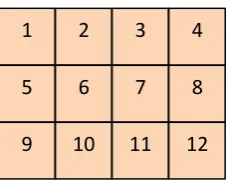
The teacher then gives each group of students a cardboard as substitution of tray. The first cardboard given to students is the rectangular cardboard. Teacher also distributes some square papers as substitution of crackers. The students are asked to determine how many crackers that can be put in that size of tray. They are also asked to give explanation about their method in counting the squares. The class discussion will be held after the students finish their work. The second cardboard will be distributed to students after the class discussion as an exercise for students.
D. Conjectures of students’ thinking
- Students may also count the papers in a row and then add it up so many times the number of rows (skip counting).
- In the similar way of counting by rows, students may count the papers in a column and then add it up so many times the number of columns.
9 10 11 12
5 6 7 8
1 2 3 4
Figure 4.7: Counting one by one strategy
1 2 3 4
4 + 4 = 8
4 + 4 + 4 = 12
Figure 4.8: Skip counting by rows
6 3 2 1
12 9
- Students who already have an idea of multiplication may figure out the total number of squares by multiplying the number of units in a row.
4.3 Square or rectangular crackers? (Determining the flexible unit for measuring area)
A. Starting points
Based on students’ previous activities, it is expected that they already
acquired abilities as follows.
- Students understand that area of rectangle and square can be measured by covering those shapes with identical units
- Students are able to cover the shape without gap and overlap
- Students can use multiplication to determine the total number of units that cover the shapes
B. Learning goals
The aim of this activity is supporting students in realizing the efficiency of using square as a unit measurement.
Main goal:
- Students can determine the most efficient unit for area measurement Sub goals:
- Students can measure the area of rectangle and square using square units
- Students know that multiplication can be easily applied if the unit used for area measurement is square
C. Description of Activity
In the previous activity, the students already discuss the use of multiplication in counting the number of units covered a shape. Now, they will measure one tray using two different kind of unit. Each group of students will get a cardboard, rectangular papers with size 10 cm x 5 cm, and 10 cm square papers. They are asked to determine the area of the tray using those units. The main theme of the class discussion following the activity is which shape is more efficient if we want to apply a multiplication in enumerating the units.
D. Conjectures of students’ thinking
- It is expected that some students realize the flexibility of square. They are expected to reason that no matter how to put the square it is always in the same direction. Therefore, using square makes people easier to apply multiplication because the direction of arranging them will always be the same.
4.4 Measuring area with limited number of units A. Starting points
Based on the previous activities, students have already learnt area measurement as covering shape with units and learnt the multiplication as the efficient method to enumerate the units. The following list shows the abilities that are expected to be acquired by students from the activities.
- Students know area can be measured by covering a shape with identical unit
- Students know area can be referred to the number of units covering the shape
- Students can apply multiplication to find the total number of units that cover the shape
B. Learning Goals
In the previous activities (see 4.2 – 4.3), students started to recognize row-by-column structure by applying the multiplication and arguing the most efficient shape of unit in such a way multiplication can be hold. This activity is aimed to supporting students more in developing the structure of array in measuring area using a unit square. This aim is formulated as learning goals as follows.
Main goal:
- Students are able to develop row-by-column structure of the units Sub goals:
- Students are able to determine the total number of units needed to cover the whole shape if they area only provided by limited number of square
- Students can understand that multiplication can be used to predict the total number of units
C. Description of Activity
column of the shape. The main theme of a class discussion is finding the easy way of predicting the area of the tray.
As additional activities, the students are also given a worksheet which contain incomplete square covering a shape. The task remains the same; determine the number of square needed to cover the whole shape.
D. Conjectures of students’ thinking
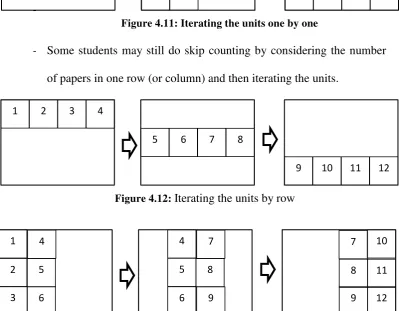
- Some students may put the given square one by one in a row and counting them continuously for other rows.
-- Some students may still do skip counting by considering the number of papers in one row (or column) and then iterating the units.
Figure 4.11: Iterating the units one by one
1 2 3 4
Figure 4.12: Iterating the units by row
1
- Some students may put the given square in the edge of tray for different direction and then multiply the number of units in each edge.
4.5 Measuring area using strip of square units A. Starting point
During the previous activities, students have already learnt the way of measuring area and the method for enumerating units. They have also learnt to construct the structure array by themselves (see sub section 4.4). Through those activities, students are expected to acquire the following abilities as the starting point of this lesson.
- Students know area can be measured by covering a shape with identical unit
- Students know area can be referred to the number of units covering the shape
- Students can apply multiplication to find the total number of units that cover the shape
3 2
1 2 3 4
Four columns in a row
Three rows in a column
- Students can understand that multiplication can be used to predict the total number of units if they are given a limited amount of units
B. Learning Goals Main goal:
- Students are able to measure area by using strip of unit squares Sub goals:
- Students can choose an appropriate size of unit square to measure different sizes of shape
- Students can apply multiplication in predicting the total number of units
C. Description of Activity
D. Conjectures of students’ thinking
The students may get different list of surfaces of object in the classroom. In measuring the small surface some students may use the small strip, while they use the big strip for measuring the big region.
In counting of units, some students may use skip counting by rows (or column) because the strips may help them to structure the units. Some other students may use multiplication after they find the number of units in the vertical direction as well as in the horizontal direction.
4.6 Measuring area using strip of standard units A. Starting points
Since students are involved in the previous activities, it is expected that they already acquired the following abilities.
- Students know area can be measured by covering a shape with identical unit
- Students know area can be referred to the number of units covering the shape
- Students can apply multiplication to find the total number of units that cover the shape
- Students can understand that multiplication can be used to predict the total number of units if they are given a limited amount of units
B. Learning Goals Main goal:
- Students are able to measure area using standardize unit Sub goals:
- Students can measure the area of surface by using a strips of centimeter square
- Students can measure the area of surface by using a strips of decimeter square
C. Description of Activity
Teacher gives each group of students a cardboard and two different strips of standardize unit square (i.e. in decimeter square and centimeter square). Teacher informs students that these two standard units of measurement are commonly used by people to communicate about the area achievement other.
D. Conjectures of students’ thinking
- Some students may keep telling the number of units as a square unit.
48
CHAPTER V
RETROSPECTIVE ANALYSIS
This chapter provides the retrospective analysis of data collected from both the first and the second cycle. The analysis will be described chronologically starting from the remarks of students’ pre-knowledge in the first cycle. These remarks are
used as consideration to adjust the initial HLT into HLT 1. The students’ learning process and the remarks from the post-test are described afterwards. These descriptions lead to general conclusion of students’ learning process of the first cycle. Based on the finding and explanation in each activity in the first cycle, some refinements were made into HLT 2. The analysis of implementation of HLT in the second cycle is presented in the same order with the previous cycle. In addition, the mathematical ideas occurred in the experiment became the main issue of the analysis. It can be projected either from focus group or the rest of students in the classroom.
5.1 The research timeline
Table 5.1: Research Timeline
DATE DESCRIPTION
Preparation phase
November 2011 – Feebruary 2012 Studying literature and designing initial HLT
5th– 6th March 2012 Discussion with teachers Preliminary teaching (the first cycle)
7th March 2012 Pre-test
12th March 2012 Activity 2: Measuring area of tray by using square crackers
Activity 3: Determining flexible unit for measuring area
13th March 2012 Activity 4: Measuring area without enough number of units
14th March 2012 Activity 5: Measuring area using strip of square units
Activity 6: Measuring area using strip of standard units
15th March 2012 Post-test
Trying out the design in the second cycle
14th March 2012 Pre-test
15th March 2012 Interview with focus group regarding the result of pre-test.
19th March 2012 Activity 1: Comparing two trays using crackers
21st March 2012 Activity 2: Measuring area of tray by using square crackers
22nd March 2012 Activity 3: Determining flexible unit for measuring area
2nd April 2012 Activity 4: Measuring area without enough number of units
4th April 2012 Activity 5: Measuring area using strip of square units
5th April 2012 Activity 6: Measuring area using strip of standard units
Post-test
9th April 2012 Interview for clarifying the result of post-test.
5.2 Remarks on the students’ pre-knowledge in the first cycle
Six students who are involved in the first cycle were given two items of written test and one oral problem. The aim of pre-test was to know students’ current knowledge and ability. Specifically, the result of pre-test was used to check the correspondence between the starting point of initial HLT and the students’ pre-knowledge. During the investigation through pre-test, the researcher found several critical issues of students’ pre-knowledge that
correspond to the learning design in HLT as follows:
5.2.1 The lack of awareness toward attribution of area during comparing the area of two shapes
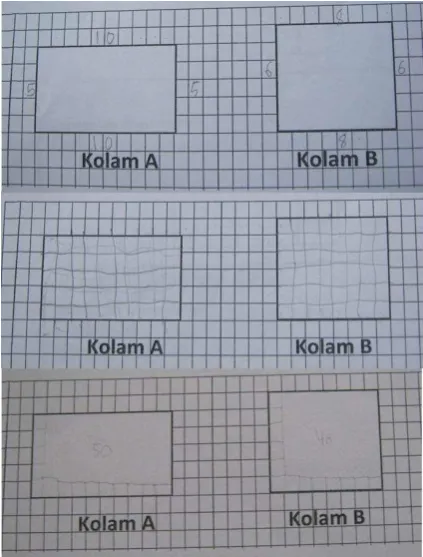
Generally, the students built on their statement of a larger area to the dimension of the shapes. One student stated the longer rectangle has larger area. Instead of using square units around the shapes to quantify the area of each shape, they used the units outside the shapes as the reference to its size. Indeed, the dimension could lead to the area, but this case tends to refer to the perimeter. (See Appendix E)
5.2.2 The relation between the structuring arrays and the way of counting the units
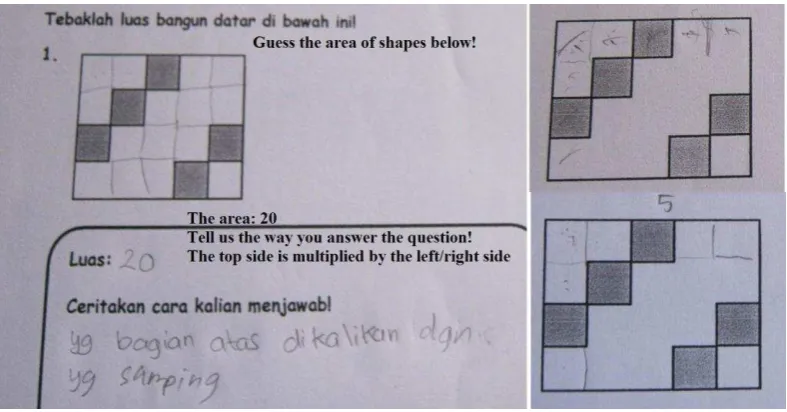
rectangle. The second way is that students use repeated addition based on the number of units in a row or in a column. The third way of students is using complete the drawing and then count the units one by one. However, there is a student who uses a unique method. This student estimates the missing units then add it to the units that are already given. It can be considered as the fourth type of structuring arrays.
From these different ways of counting, it can be inferred that the students already build the relation between the structuring arrays in the figures and the way they count. Some of them could build the multiplicative way from the structure while the others were still in the process of it (repeated addition or counting one by one).
5.2.3 The various iteration process among students
Interview in the pre-test is aimed to know how the students deal with unit iteration process. Individually, the students are given two square units and a figure of rectangle. They are challenged to estimate the total number of units needed to cover the rectangle. There are two students who are unaware of overlapping during doing the iteration of units. In other case, three students already apply multiplication by finding out the number of units in a row and in the column. One student can correctly predict the number of units needed to cover the rectangle by using unit iteration. 5.3 Preliminary teaching
called HLT 1. Design of initial HLT is adjusted to students’ current knowledge by considering pre-test results (See Appendix F). The feedback from the result of this experiment will become consideration for the improvement of the hypothetical learning trajectory. The analysis of how the HLT 1 works during the first cycle is explained as follows.
5.3.1 Developing the idea of identical units to measure area Activity 1: Comparing two trays using crackers.
This activity was aimed to facilitate students in developing the idea of identical units to measure area. In addition, covering the shape without gap and overlap with units was also important ideas that were addressed in this activity.
Using the context of comparing two bamboo trays, students were asked to determine the largest tray. One tray was wider, while another was longer. The students directly gave a response that the longer one was the biggest one.
Researcher : Can you show me how do you compare them?
Irsyad : (Use hand span to measure the length of each rectangle). This is four (pointing out the wider tray) and that is three (pointing out the longer tray).
Vitto : What do you mean with that?