EDUCATIONAL DESIGN RESEARCH:
DEVELOPING STUDENTS’ UNDERSTANDING OF AREA
MEASUREMENT THROUGH THE UNIT OF AREA
MASTER THESIS
Febrian NIM 117785029
UNIVERSITAS NEGERI SURABAYA PROGRAM PASCASARJANA
EDUCATIONAL DESIGN RESEARCH:
DEVELOPING STUDENTS’ UNDERSTANDING OF THE AREA
MEASUREMENT THROUGH THE UNIT OF AREA
MASTER THESIS
A Thesis submitted to
Surabaya State University Postgraduate Program as a Partial Fulfillment of the Requirement for the Degree of
Master of Science in Mathematics Education Program
Febrian NIM 117785029
UNIVERSITAS NEGERI SURABAYA PROGRAM PASCASARJANA
PROGRAM STUDI PENDIDIKAN MATEMATIKA 2013
345 … Thanks God … you showed me that nothing great’s
achieved without great pain …
This thesis is dedicated for my beloved family and friend
ABSTRACT
Febrian. 2013. Educational Design Research: Developing Students’ Understanding of theArea Measurement through the Unit of Area.Thesis, Mathematics Education Study Program, Postgraduate Program of Surabaya State University. Supervisors: (I) Prof. Dr. Dwi Juniati, M.Si. dan (II) Dr. Agung Lukito, M.S.
Keywords. Area measurement, Unit of area issues, Pendidikan Matematika Realistik Indonesia, Hypothetical Learning Trajectory, Local Instruction Theory
Many researches found that students have a poor understanding of the tool and process used for the area measurement of a plane figure. One of the reasons on this poor understanding is the lack of concern on the construction of the concept of appropriate unit for area measurement. Hence, the need to construct the understanding of area measurement through the concept of unit of area becomes crucial. In this study, some important ideas like area unit issues: unit overlapping, gap between unit,and leftover; the appropriate shape of unit to cover region; the use of identical units to measure and to compare the area of region; the inverse relation between unit size and number of units used are concerned to help the students to construct their understanding on the use of unit of area on area measurement. The students are then expected to flexibly use the square grids which represent the model of unit of area measurement.
For this reason, a sequence of instructional activities is designed. Pendidikan Matematika Realistik Indonesia(PMRI) approach was used in our design research. The Hypothetical Learning Trajectory (HLT) becomes source for design and research instruments. Two cyclic design research is conducted. The result of preliminary teaching experiment is used to improve our HLT for teaching experiment. At the final of our study, Local Instruction Theory on area measurment trhough the area unit is proposed.
The study shows that activity with cookie and cashewnut topping could emerge the issues on area mesurement unit: overlapping; gap in between unit; leftover and could give students the initial understanding of relation between the number of units and the area from measuring top of cookie with cashewnuts. The extension of cookie context, choosing the topping shape, could promote the students to understand the best shape of unit to cover the surface. The photoframe context in which students measured the frame size with the photos could emerge the concept of unit consistency (the use of identical units) either to measure and to compare the area. This context could also support students’ understanding of the inverse relation between the size of unit and the number of units used in measurement. The experience of finding the cookie’s size by the use of topping conducted by hands on activity and prior lesson sequence to it could help students to understand the use of square grids, a model used to find the area. We found that this sequence of lessons generally could support the students’ understanding of the area measurement through the unit of area.
ABSTRAK
Febrian. 2013. Educational Design Research: Developing Students’ Understanding of theArea Measurement through the Unit of Area. Tesis, Program Studi Pendidikan Matematika, Program Pascasarjana Universitas Negeri Surabaya. Pembimbing: (I) Prof. Dr. Dwi Juniati, M.Si. dan (II) Dr. Agung Lukito, M.S.
Kata Kunci. Pengukuran luas, Isu unit luas, Pendidikan Matematika Realistik Indonesia, Hypothetical Learning Trajectory, Local Instruction Theory
Banyak penelitian menemukan bahwa siswa memiliki pemahaman yang kurang mengenai alat dan proses yang digunakan dalam mengukur luas bidang datar. Salah satu alasan kurangnya pemahaman ini adalah kurangnya perhatian pada pembangunan konsep unit yang tepat untuk pengukuran luas. Dengan demikian, kebutuhan untuk pembangunan pemahaman pengukuran luas melalui unit luas menjadi hal yang penting.Dalam penelitian ini, beberapa konsep penting seperti isu unit luas: unit bertumpukan, gap diantara unit, dan bagian yang belum tertutupi pada sebuah permukaan; bentuk unit yang tepat untuk menutupi permukaan; penggunaan unit identik untuk mengukur dan membandingkan luas permukaan; relasi invers antara ukuran unit dan jumlah unit yang digunakan ditekankan untuk membantu siswa mengkonstruksi pemahaman mereka terhadap penggunaan unit luas dalam pengukuran luas. Siswa kemudian diharapkan dapat menggunakan grid sebagai model unit pengukuran luas yang terbaik secara fleksibel.
Untuk tujuan tersebut, beberapa aktifitas pembelajaran dirancang. Pendekatan Pendidikan Matematika Realistik Indonesia (PMRI) digunakan dalam penelitian desain dua siklus ini. Hypothetical Learning Trajectory (HLT) menjadi sumber untuk mendesain pembelajaran dan instrumen pembelajaran. Hasil dari siklus pertama digunakan untuk perbaikan HLT untuk siklus kedua. Selanjutnya, Local Instruction Theory pengukuran luas melalui unit luas kemudian diajukan.
Penelitian menunjukkan bahwa kegiatan dengan kue kacang mede dapat memunculkan unit isu: tumpukan antar unit; celah antar unit; bagian yang belum terttutupi pada permukaan dan dapat meberikan siswa pemahaman awal hubungan antara jumlah unit dan luas dari aktifitas mengukur permukaan atas kue dengan kacang mede. Kelanjutan konteks kue ini, bentuk topping untuk menutupi permukaan kue dapat membantu siswa memahami bentuk unit yang tepat.Konteks foto frame dapat memunculkan konsep unit konsistensi (penggunaan unit identik) baik dalam mengukur maupun membandingkan luas. Konteks ini juga mendukung pemahaman siswa terhadap relasi invers antara ukuran unit dan jumlah unit dalam pengukuran luas. Pengalaman dalam menemukan ukuran kue dengan menggunakan topping dilkukan dengan metode hands-on activity bersama dengan pelajaran sebelumnya dapat membantu siswa memahami penggunaan grid petak, sebuah model yang digunakan untuk menemukan luas. Kami temukan bahwa secara umum, rancangan aktifitas pemebelajaran ini dapat mendukung pemahaman siswa terhadap pengukuran luas melalui unit luas.
PREFACE
Thanks to Allah for its blessing on me to finish my greatest job in my recent education. Accomplishing this thesis has been such great experience that was not even out of priceless guidance and support from my truly blessed people around me. Hence, I would like to appreciate and thank to:
1. Prof. Dr. Dwi Juniati, M.Si. and Dr. Agung Lukito, M.S. as my supervisors who guided and assisted me during the period of collecting data, writing the analyses and preparing the report of my research.
2. Drs. Monica Wijers and Dr. Dolly van Eerde from Freudenthal Institute of Utrecht University who warmly guided and assisted me during the period of establishing instructional theory, designing learning materials, and completing research methodology.
3. Dr. M.L.A.M. Dolk, the coordinator of the International Master Program on Mathematics Education in the Netherlands, for his warm support and motivation during our study period in Utrecht University the Netherlands. 4. PMRI Center Board for the opportunity given to me as one of the grantees of
the International Master Program on Mathematics Education.
5. All lecturers and staff of postgraduate program of Surabaya State University and Utrecht University for their support during conducting my master study. 6. The principles, the mathematics teacher and the third grade students of SD
LAB UNESA and SDIT Al Ghilmani Surabaya for their excellent cooperation during the period of collecting data.
7. My parents, my sisters, my brothers, and my friends for their motivation and support. Especially my soul friend for her supports, motivation, and inspiration.
Finally, I consciously understand that this thesis is far from being perfect. Thus, any critics and kindly constructive ideas will be warmly accepted.
Febrian
TABLE OF CONTENT
E. Significance of the Research ... 8
CHAPTER II THEORETICAL BACKGROUND A. Area Measurement ... 9
B. The Understanding of the Unit of Area Measurement ... 11
C. Area Measurement in Indonesian Curriculum ... 14
D. Building Up the Understanding of a Unit of Area Measurement through The Contexts ... 16
E. Indonesian Version of Realistic Mathematics Education (RME) ... 18
CHAPTER III METHODS A. Research Approach ... 20
B. Data Collection ... 23
1. Preparation Phase... 24
2. Preliminary Teaching Experiment (first Cycle) ... 26
3. Teaching Experiment (s)... 26
4. Pretest and Posttest ... 27
5. Validity and Reliability of Data Collection ... 28
C. Data Analysis ... 31
1. Preparation Phase... 31
2. Preliminary Teaching Experiment ... 31
3. Teaching Experiment ... 32
4. Validity and Reliability of Data Analysis ... 34
CHAPTER IV INITIAL HYPOTHETICAL LEARNING TRAJECTORY
A. Meeting 1 ... 46
B. The information Obtained from the Classroom Observation and Teacher’s Interview (Teaching Experiment Class/Cycle 2) ... 81
C. Prior Knowledge of First Cycle Pupils on the Area Measurement and Area Unit ... 84
D. Preliminary Teaching Experiment ... 91
1. Meeting 1 ... 91
E. The Remarks of Knowledge of pupils after Cycle 1 Study ... 132
F. The Conclusion of the Pupils’ Learning Process in First Cycle ... 138
G. The Improved HLT for Teaching Experiment (Cycle 2) ... 140
H. Prior Knowledge of Second Cycle Pupils on the Area Measurement and Area Unit ... 146
J. The Remarks of Knowledge of pupils after Cycle 2 Study ... 209
K. The Conclusion of the Pupils’ Learning Process in Second Cycle ... 214
CHAPTER VI CONCLUSION AND DISCUSSION A. Conclusion ... 219
1. Answer to the Research Question ... 219
2. Local Instruction Theory on Learning Area Measurement through Area Unit ... 232
B. Discussion ... 234
1. The Weakness Points of Study ... 234
2. Reflection on the Important Issues ... 238
C. Recommendation for Further Research ... 240
References ... 242
Appendices ... 244
LIST OF TABLE
Table 2.1 Indonesian mathematics curriculum of area measurement for third graders Elementary School ... 15 Table 3.1 The outline of the data collection of the study ... 32 Table 5.1 The research timeline ... 80 Table 6.1 Local Instruction Theory in learning area measurement through area
unit ... 232
LIST OF FIGURES
Figure 3.1 Two cyclic process on area unit and area measurement learning
design ... 24
Figure 4.1 The cookie and 12 nuts ... 50
Figure 4.2 The conjectured pupils’ work ... 51
Figure 4.3 The conjectured pupils’ work ... 59
Figure 4.4 The top view of tiled floor ... 65
Figure 4.5 The unfinished tiled floor ... 68
Figure 4.6 The unfinished tiled floor (next problem) ... 70
Figure 4.7 The oval and rectangular cookie ... 73
Figure 4.8 The oval table on tiled floor... 74
Figure 4.9 Measuring the area of palm ... 77
Figure 5.1 Discussion on the number of nuts ... 92
Figure 5.2 Pupils arranging 12 nuts ... 94
Figure 5.3 Groups’ responses on activity 2 ... 95
Figure 5.4 Groups’ arranging nuts on their own cookie ... 96
Figure 5.5 Groups’ work on putting toppings on top of cookies ... 101
Figure 5.6 Groups’ work on putting photos on frames ... 108
Figure 5.7 Groups’ work on measuring cookies with square chips ... 123
Figure 5.8 Groups’ work on measuring area of oval table ... 124
Figure 5.9 Groups’ work on measuring area of palm by the transparent grid ... 129
Figure 5.10 Nana’s strategy to find the area of tiled floor ... 132
Figure 5.11 Pupils’ strategy to find the area of plane question number 4 and 5 .. 135
Figure 5.12 Pupils’ constrcuted grid to find the area ... 135
Figure 5.13 Groups’ work on activity 1 ... 153
Figure 5.14 Pupils discussing about the difference of the arrangement of 14 nuts on both cookies ... 154
Figure 5.15 Pupil making a representation of cookie with ideal size of given fourteen nuts ... 157
Figure 5.16 Measuring and comparing the cookie size ... 159
Figure 5.17 Focus group’s work on arranging topping on top of cookie ... 162
Figure 5.18 Other groups’ works on topping arrangement ... 165
Figure 5.19 The frames ... 168
Figure 5.20 Adhif showed why he thinks the frame is the largest ... 169
Figure 5.21 Comparing the size of frame by the sides ... 171
Figure 5.22 Groups’ work on frame ... 171
Figure 5.23 The groups’ asnwers on the questions of the worksheet ... 172
Figure 5.24 Our focus group’s answers on the worksheet ... 173
Figure 5.25 The pupils’ work in group to make the frames ... 181
Figure 5.26 Visualization of pupils’ strategy on first frame ... 181
Figure 5.27 Ranti’s written work for second frame size ... 182
Figure 5.28 Visualization of pupils’ strategy on second frame ... 183
Figure 5.29 Visualization of pupils’ strategy on third and forth frame ... 184
Figure 5.30 Asti and Raffa strategy to answer the area of the fifth frame ... 185
Figure 5.31 Visualization of Raffa’s thinking... 186
Figure 5.32 Measuring and comparing the area of frame A and B ... 187
Figure 5.33 Pupils’ reasoning on the measuring and comparing task ... 187
Figure 5.34 Frame with complete photos ... 188
Figure 5.35 The carpet task ... 189
Figure 5.36 From left to right: Other group’s strategy and our focus group strategy ... 193
Figure 5.37 From left to right: Other group’s work and our focus group’s work 194 Figure 5.38 Adit’s group’s work ... 195
Figure 5.39 Adit’s strategy cover the oval cookie ... 195
Figure 5.40 The area of oval table table task and pupil’s response ... 197
Figure 5.41 Dinda’s argumentation on what treated as a half part ... 198
Figure 5.42 From left to right: Ranti’s strategy and Asti’s strategy ... 199
Figure 5.43 Class discussion on the area of oval table ... 200
Figure 5.44 Pupils of focus group joined the unfully covered tiles in counting the tiles ... 204
Figure 5.45 Groups’ result of palm area measurement ... 205
Figure 5.46 Ranti’s response to question number 4 ... 211
Figure 5.47 Asti’s response to question number 7 ... 212
LIST OF DIAGRAM
Diagram 5.1 Refinement of HLT ... 145
LIST OF APPENDICES
Appendix A.Visualization of Final HLT ... 244
Appendix B. The Teacher’s Interview Scheme ... 245
Appendix C. The Classroom Observation Scheme ... 246
Appendix D. Teacher Guide ... 247
Appendix E. Pupil Worksheet and Materials ... 280
Appendix F. Pretest (Cycle 1) ... 292
Appendix G. Posttest (Cycle 1) ... 300
Appendix H. Pretest (Cycle 2) ... 303
Appendix I. Posttest (Cycle 2) ... 306
Appendix J. The Overview of Pupils Response on Pretest Result (Cycle 2) ... 308
Appendix K. The Overview of Pupils Response on Posttest Result (Cycle 2) .... 310
CHAPTER I
INTRODUCTION
A. Background
Area measurement, one of the most commonly utilized forms of measurement, is a part of mathematics that is closely connected to real-world applications. The study of measurement indeed becomes an important part of the elementary school curriculum starting from the third grade. Furthermore, it is important since there is a relation between the basic concepts of area measurement with other mathematical ideas (Haris, 2011). Hence, this study focuses on supporting the understanding of area measurement by students in the third grade of elementary school.
Research in the field of education often reveals poor understanding of the processes used for the area measurement of a plane figure (Zacharos, 2006). One potential aspect of the poor understanding towards the area measurement is the way teachers teach the concept of area directly by length-times-width formula. In Indonesia, it is commonly found that the teachers and textbooks tend to move quickly to the use of formulas for the areas of basic shapes without giving the students the opportunity to study the pattern and structure of array (Fauzan in Haris, 2011). The teachers often demonstrate the length-time-width formula to get the area of given plane. This issue is not appropriate for the aspect of measurement in which the unit used must be related to the aspect of the object to be measured. Using this formula in area measurement means generating a wrong
understanding since it is not appropriate to measure the area with a linear tool. This also provides the students with the difficulty in measuring area, because they sometimes treat length as a space-filling attribute, and they measure linearly, instead of area units (Nitabach and Lehrer, 1996). Hence, this kind of learning might confuse the students or even brings them to produce misconceptions about the concept of area and its relation to the length and the width.
Another way to teach area measurement happening in Indonesia is that the students are asked to partition the rectangular plane figure into several square units, and then count them by multiplying the number of square units vertically and horizontally, to finally obtain the formula for the area. This last procedure only makes sense, however, if the students understand that this calculation is equivalent to dividing the rectangular shape into identical square units and counting them (Nitabach and Lehrer, 1996).
There is one consideration that can be derived from this observation which is the idea of understanding of the area unit. In order to become proficient in measuring an area, students need to understand two fundamental concepts which are the idea of an area unit and the process of iterating an area unit to complete an area measurement (Nitabach and Lehrer, 1996). In line with this idea, Fauzan (in Haris, 2011) stressed on the understanding of specific unit, unit pattern and unit structure on the area measurement.
students’ understanding of characteristics of the area unit by introducing the students to the context of the traditional Indonesian handicraft called anyaman. Anyaman used in this learning already showed up several iterative rectangular shapes on the body of anyaman itself. In his study, the researcher got the students to understand several important aspects related to unit issues of the area concept such as an identical unit, a different size of unit used, and others like unit iteration, and area conservation. What becomes highlighted is that the context used being considered already presents the idea of a rectangular-shaped of a unit area arranged in an array form which can be regarded as the necessary condition for the invention of area formula.
We rather think that introducing this array form from beginning of the lesson could seemingly close the possibility for children to recognise the informal unit and its irregular shape, since irregular shaped units are more revealing in everyday life related to area concept from the perspective of an area unit. We also regard that giving array from the beginning of the lesson would also seemingly close the possiblity for children to discuss about the unit issues: overlapping unit, leftover, and gap between unit.
that include shapes other than rectangular or square units since our focus is to help the students understand the coordination of the units in a particular setting instead of just generating particular formulae. We also keep in mind that complete covering is generally more difficult than covering a length, since it is not that clear how to choose and arrange units, especially for the students who have little or no sense of “square” units. They often leave small holes or use inconsistent
units when covering an area (Nitabach and Lehrer, 1996).
This study addresses the issues on the designed hypothetical learning trajectory in learning area measurement through the area unit for the third grade elementary school students. A learning sequence with Pendidikan Matematika Realistik Indonesia (PMRI) approach is used in this study.
B. Research Question
Based on the background of the study, we propose our research question as follows;
How can students’ understanding of unit of area help them to understand the
concept of area measurement?
To support us answering the general research questions, we derive research sub-questions as follows;
1. What activities focusing the understanding of an area unit can be used to support students understand the area measurement?
C. Aim of the Research
The first aim of our study is to support students’ learning process on area measurement through the area unit. The second aim of our study is to contribute to the development of a local instruction theory for the topic of area measurement. In effort to reach this aims, a hypothetical learning trajectory is designed, tested, analyzed, and redesigned to fullfil the needs of our research aims. Included in the process, some classroom activities based on PMRI approach are designed. Specifically, this study focuses on the third grade of elementary school in Indonesia.
D. Definitions of Key Terms
In order to avoid readers from misleading, some operational terms are defined as follow.
1. The understanding is defined as the ability to perceive and comprehend something into an appropriate schema. Schema is an organized structure of knowledge, into which new knowledge and experience might fit. It also can be perceived as the ability to comprehend something or particular knowledge. The root of understanding is to comprehend or to understand.
To make it more operational, we describe ‘to understand’ in our study as follows “to understand x means to give appropriate response to x”. For
inverse relationship is an opposite relation between the numbers of unit obtained with the size of the unit used in measuring activity.
2. Surface in this study particularly refers to the bounded region or just region. However, surface is only used in context-related situation. For example, top surface of cookie.
3. Bounded region or just region refers to plane figure that is defined to include all the points on its boundary and all the points in its interior (Jacob, 1974). For example is a triangular region which is different with triangle. Triangle is defined as a set of three line segments. Meanwhile, triangular region is plane figure that contains both triangle and all the points in the interior.
In our study, we extensively use the term rectangular region for instance to describe the plane figure that contains both a rectangle and all the points in the interior. Hence, in this study we extensively use it as in the expression “the area of top surface of rectangular cookie”.
4. Area is defined as a spatial extend and the quality of space (Lehrer, 2003). Area can also be defined as space contained within flat and enclosed shape. Then, we have area measurement as the measurement of space contained within flat and enclosed shape.
To shorten the situation, we propose the aggrement as follows; if we state the area of rectangular paper, it will mean that we are searching for the result of area measurement of rectangular paper which is the number.
5. The understanding of unit of area in this study belongs to the understanding of unit issues (overlapping units, gap between units, leftover); the appropriate shape of unit to cover a surface (bounded region); the idea of identical units, the inverse relation between unit size and the number of units used in covering a region (Nitabach and Lehrer, 1996); and finally how this unit understanding can lead to the use of square or rectangular units in measuring and comparing area of both rectangular and non-rectangular plane figures.
6. Overlapping unit is a unit that covers part of another unit.
7. Gap between units refers to the situation in which space occurs between units. The units are not arranged really next to each other.
8. Leftover means the part of bounded region near the edge that is not yet covered by unit.
9. Uncovered part of region referred to what students represented as both the gap in between unit and leftover during the study.
10. Identical units refers to the units which have the same size and shape as well 11. Area determiner refers to the units of area that are used to derive the area of
particular region.
For example, with the same plane figure or region, the area will be less if the unit used is larger. The area will be more if the unit used smaller.
13. Array is rectangular arrangement of unit in rows and columns
14. Interior partial array refers to the array constructed inside the plane figure when looking for area of plane figure.
E. Significance of the Research
CHAPTER II
THEORETICAL BACKGROUND
A. Area Measurement
The area measurement is defined as the measurement of the space contained within flat and enclosed shape (if we refer area as the spatial extend). Area on the other hand is defined as an amount of two-dimensional surface that is contained within the boundary and that can be quantified in some manner (Baturo and Nason, 1996). Moreover, in regard to the idea of quantifying, in everyday life, the idea of the area of a shape or an object can be defined as the “amount of stuff” needed to cover the shape (Konya and Tarcsi, 2010). It is commonly implied that the concept of area is the idea of finding the amount of tiles, for example, needed to cover a surface.
Stephan and Clements (2003) show that there are at least four foundational concepts that are involved in learning to measure area: (1) partitioning, (2) unit iteration, (3) conservation, (4) structuring an array.
Partitioning is a mental act of cutting dimensional space with a two-dimensional unit. Firstly, the experience given to students are activites including tilling a region and discussion on overlapping units, gap between units, and leftover. Then this experience gives the opportunity to the idea of partition a region mentally into sub-regions that can be counted.
Unit iteration is an another concept that students construct as they cover regions with area units. There is a big concern on issues: overlapping units, gap
between units, and leftover. Then, the students are led to the idea that an area is number of a unit in total after iteratively used in covering the region.
Conservation, is another concept related to the idea of cutting a given region and rearranging its parts to form another shape resulting in the same area. In this case, the students need to experience the exploration and discussion on the folding and rearranging pieces to establish that one region, cut and reassembled, covers the same space.
Another concept is structuring an array which is an extremely sophisticated process of finding area of rectangular shape.In this case, the students need to learn such structuring to understand area.
Regarding these four foundational concepts in learning area mesurement, some thoughts are drawn. To understand area means to assimilate the area in an appropriate schema (Skemp, 1987). Appropriate schema refers to these foundational concepts. Mostly these concepts highlight the importance of unit area in area measurement. Specifically, the concept of unit iteration suggests that the understanding of area unit could contribute to the understanding of area measurement through tilling activity that concerns on the issues of units and the iteration itself that leads to the idea of counting units. In consequence, the area unit and its isues take important role in area measurement. Therefore, a concern on building up students’ understanding of area measurement through the area unit
becomes main part in this study.
B. The Understanding of the Unit of Area Measurement
Many researchers have described the importance of the unit concepts in measurement (e.g., Battista, 2006; Kamii, 2006; Mulligan, Mitchelmore, & Prescott, 2005 in Barrett, 2011). Reynolds and Wheatley (1996) contend that to understand area a child must construct and coordinate units. This idea implies that once the idea of constructing an area unit is formed, and the coordination of all constructed area units is made, the children are possibly assisted when they are dealing with the area measurement. According to these literatures, the need of understanding area unit becomes more centralized in the topic of area measurement since it takes a worthwhile role during area measurement learning.
There are several consideration related to the understanding of area unit. The first thing is the unit appropriateness; a unit must be related to the aspect of the object to be measured. Several researchers have described young students’ difficulty measuring area (Nitabach and Lehrer, 1996), demonstrating how they sometimes treat the length as space-filling attribute. In this occasion, the students measure the length of a side, then move the ruler a bit and measure the length between the sides again, and so on, and finally treat the length as a space-filling attribute.
instruction begins with a ruler, one of the most common mistakes is for children to measure the length of each side and add the two linear measures together, or the students may easily multiply the length and the width of the rectangle to get an area, and still it is a misconception.
Moreover, determining the area can be thought of essentially as a tiling of a plane with congruent regions that become units of measure (Reynolds &Wheatley, 1996, p. 567). This idea implies the consistency of the units used when measuring the area through the covering activity which is also important to consider. The consistency implies the use of consistent units throughout the measuring task. When doing covering, the students often use a variety of shapes to cover an area and then calculate the area by counting the total number of shapes without consideration on how many units each shape represents (Nitabach and Lehrer, 1996). This occasion is proven by the situation when provided manipulative (i.e. squares, triangles, circles, and rectangles) for use in finding the area measure of variety of forms, most children in grades 1 through 3 freely mixed units and reported the total count of units. To a certain degree, the idea of mixed units is allowed as long as students report the number of each shape used, and not treat all the shapes inasingle amount of used units. Hence, the learning set must be carefully designed to address this situation. Students must be guided to ‘see’ the idea of unit consistency. Once the students have chosena unit to cover an area, they must iteratively use it until the surface entirely covered without overlapping, gaps in between or leftover space.
This implies the idea of quantifying the area surface. The number of identical units used represents the measured area.
Meanwhile, the result of iterating units ought to signify an array structure for students (Stephan and Clements, 2003). While the students at a particular stage seem unsure how to deal with measuring area, the teacher introduces a square grid as a measurement device. At later phase, the students will gradually accept this notation and use it to estimate and combine partial units.
After all, teachers should always be attentive to creating young children’s initial spatial intuitions and appreciate the need for students (Stephan and Clements, 2003):
1. to construct the idea of measurement units
2. to have many experiences in covering quantities with appropriate measurement units and counting those units
3. to spatially structure the object they are to measure
4. to construct the inverse relationship between the size of a unit and the number of units used in a measurement.
C. Area Measurement in Indonesian Curriculum
Third Grade of Elementary School, Second Semester
5.1 Menghitung keliling persegi dan persegi panjang
5.2 Menghitung luas persegi dan persegi panjang
5.3 Menyelesaikan masalah yang berkaitan dengan keliling, luas persegi dan persegi panjang
5.1 Counting the perimeter of square and rectangle
5.2 Counting the area of square and rectangle 5.3 Solving the problem relating to the
perimeter, the area of square and rectangle Source: Badan Standar Nasional Pendidikan (BSNP), 2006
At this level, the concept of area is introduced from square and rectangular plane. The concept of area is introduced as ‘counting’. In this level also, the students need not only to grasp the concept of area and how to count it, but also need to implement this concept of area to particular mathematical problems.
However, the concept of area as we can see on the table is more stressed on the ‘counting’ that leads to the use of particular formulae, known as multiplication strategy on length and width, for the area of particular planes: rectangle and squares. We noted that the textbook and the teaching tend to directly move to the formula without regarding the appropriate way of unit used to
measure the area. There is almost no regard that the area cannot be measured by linear tool, length and width.
Moreover, it can be caused by the lack of understanding of the connection between the formula and the partition of planes into an array of square. The formula is supposed to appear after the understanding of plane which can be partitioned into an array of square. It is because the number of squares will be easily found by multiplying the number of squares itself in vertical and horizontal way. Finally, to reach an understanding of why square can be precise unit used to measure the area, the students firstly need to experience the learning sequences that create their development of understanding on the unit of area itself.
Based on this occasion, there is consideration of the importance of unit in area measurement that emerges. The learning process that builds up students’ understanding of the area unit in Indonesia becomes very highly demanded to support students’ understanding in area measurement. We intend to derive some innovation to the learning of area measurement that can improve the learning process itself. We consider that the use of context in learning process can be the solution.
D. Building Up the Understanding of a Unit of Area Measurement through the Contexts
this historical aspect on area measurement can be a good inspiration in designing particular learning.
In this study, we try to pursue the answer to our research question by firstly designing and then testing the learning sequence on area measurement through the area unit. It starts from building up the understanding of the area unit through the learning using irregular shape of unit in covering activities. The context appropriate for starting the learning is cashewnut cookie which is brought into the class. Cashewnuts have nearly irregular shapes that can be used to fit the idea of resemblance aforementioned. The use of irregular shape is also potential enough to build the initial area unit understanding: overlapping units, gap between units and leftover. The instruction makes them estimate how many nuts used to entirely cover the top of cookie. This context is also possible for generating the initial idea of relation between the number of unit and the area.
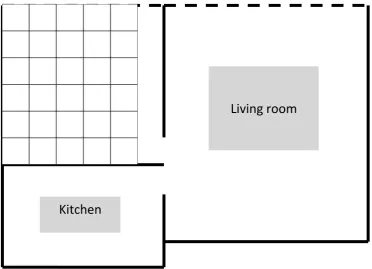
used. The students will try to figure out which carpet or other thing is larger by laying them on the tiled floor.
Hands-on activity on measuring the area of both rectangular and non-rectangular cookie by the use of non-rectangular square chocochips is set to generate the initial understanding of measuring non-rectangular plane figure. Finally, we guide the students into a more precise model of the area unit like square units, and we let the students develop their understanding of area unit as the measurement of the area. The multiplication on interior partial array is also concerned to help the students deal with quick counting of the units.
By this designed learning sequence, we research on whether the students will learn the idea of a unit of area measurement and its contribution to the area measurement without giving too much stress on that length-times-width formula.
E. Indonesian Version of Realistic Mathematics Education (RME)
The concept in mathematics is abstract which makes it difficult for students to study. Hence, the need to make it concrete and ‘real’ becomes an issue. Realistic Mathematics Education can address this issue since the idea is to create a situation in which what children’s learning becomes more sensible and realistic for them. The meaning of realistic in this kind of instruction can also be realistically imagined by the students themselves. RME itself has been developed in the Netherlands since the 1970s (de Lange, 1996).
supported to see mathematics which becomes more tangible for them to study, yet the students will take an active role since it evokes the students’ contribution towards learning process.
Realistic Mathematics Education has five basic tenets defined by Treffers (1987, in Bakker, 2004). The following is a description of each tenet followed with the explanation of the use of the tenets in our designed learning.
1. Phenomenological exploration or the use of context
The students explore mathematics from a real situation that has meaning to develop basic concepts of mathematics. In our study, the students will face several realistic contexts such as cashewnuts. We conjecture the context can promote the students’ understanding of unit overlapping, gap in between unit and leftover space. We also use the context of making a photo frame as handicraft which is familiar with children’s life. We conjecture that this context can evoke students’ understanding of the idea of unit consistency and relationship between unit size and the number of unit used. To support students’ understading on the use of unit to measure the size of thing, we use the tiled floor context.
2. Using models and symbols for progressive mathematization
more formal level. We also expect in the end that students can finally use grid to figure out the area of plane figure.
3. Using students’ own constructions and productions
Students will use their own strategies when solving the problems. In this level students will actively construct and produce their understanding of several important ideas like unit characteristics during the activities.
4. Interactivity
This characteristic makes the students to become ‘social learners’, not only an individual learner. The studentsshare their strategy and work with others. Hence, in the learning, the students work in several groups of children to facilitate this purpose.
5. Intertwinement
CHAPTER III
METHODS
This chapter describes the method which is used to reach the research aim as well as to answer the research questions. In this chapter, there are three issues which are discussed. The issues are the research approach, the data collection, and the data analysis.
A. Research Approach
We intend to make innovation on mathematics education especially in topic of area measurement through anarea unit based on the problem in our country aforementioned. One of the studies which have aims for making innovation in learning process of mathematics and improving the mathematics education especially regarding our topic, area measurement, is called design research.
Design research is a research approach that consists of planning and creating educational settings, and analysing teaching and learning process (Doorman, 2005). Design research or also known as developmental research is aimed to develop theories, instructional materials and empirical grounded understanding of how the learning process works (Bakker, 2004; Drijvers, 2003; Gravemeijer, 1994 in Putra 2011). This implies that understanding of how the learning process goes in classroom activity becomes heart of design research.
There are three phases of design research in our study (Gravemeijer & Cobb, 2006)
1. Preliminary design
In this phase, we studied some literatures related to area measurement, the unit of area measurement, realistic mathematics education and design research. After getting knowledge, we tried to create the students’ learning sequence or trajectories focusing on the understanding of unit area issues and the area unit for measuring area. We formulated lessons in the learning sequence. For each lesson in this sequence, we formulated the learning goals for students, mathematical activities, and hypothesis about the thinking process of students’ learning. These three aspects are known as the components of hypothetical learning trajectory (Simon, 1995). We also tried to find the appropriate context to support our lesson design. We also discussed about the context issue and the learning design with the expert, our supervisor, who experienced in designing the learning. For generating students’ understanding on the unit area issues and the idea of area unit to measure the area we used the context of cashewnuts cookies and photo frame, tiled floor and the grid paper. We set the the mathematical activities and tried to make the conjectures of learning process that happens in the classroom.
2. Teaching experiment
experiment or commonly called pilot study as the first cycle and teaching experiment(s). The pilot study was conducted in small group containing six students of third grade with the researcher as the teacher. The aim of doing the pilot study in a small group of students is to get ourself focus on adjustment of the HLT during the execusion. The analysis and the result of this pilot study were used to revise and to improve our hypothetical learning trajectory for the next cycle. The next cycle(s) was conducted in larger group which was group of students of one class with the mathematics teacher as the teacher and the researcher as the observer. The result of the latest teaching experiment in which the learning goals were pursued was analysed to develop the local instruction theory for the area measurement domain. It implies that we stopped the cycle of the study whenever we already reached the learning goals and he hypothetical learning trajectory was supported by actual learning trajectory. Local instruction theory is a theory that describes the envisioned learning route, successive patterns in the teaching and learning process (Cobb et al., 2003; Gravemeijer.,1994; Gravemeijer, et al. 2003).
3. Retrospective analysis
and our hypothetical learning trajectory was supported by actual learning trajectory, we stopped the cycle. The result obtained through the latest retrospective analysis contributed to the local instruction theory.
McKenney & Reeves (2012) imply that each cycle slightly changes indicating that the time and the number of participant which might increase. Based on this consideration, we proposed cycles of the study in this design research portrayed as preliminary teaching experiment or pilot study which was conducted in small group of students. The aim of doing the pilot study in a small group of students is to get ourself focus on adjustment of the HLT during the execusion. The next cycle(s) is teaching experiment which was conducted in a classroom as described previously. The phase of the design research in this study can be shown in this following scheme.
In this research we propose the criteria to stop our cyclical process of design research. Stopping the cycle of this research is under the following circumstances
Figure 3.1. The cyclic processes on area unit and area measurement learning design Preliminary design on area
unit and area measurement
Revising and improving HLT
Conjectured local instruction theory on area measurement Preliminary
teaching experiment
1. We generally already achieve the intended learing goals we set up in every activity of our designed lesson sequences.
2. Our hypothetical learning trajectory is supported by the actual learning trajectory.
B. Data Collection
The study of area unit and the area measurement was conducted in two of elementary schools in Surabaya, Indonesia, which are already partners of Surabaya State University in implementing Pendidikan Matematika Realistik Indonesia (PMRI). The school is called Ghilmani Elementary School (during preliminary teaching experiment with six students of class IIIB and the researcher as the teacher) and Laboratory School of Surabaya State University (during teaching experiment with students of class IIIA, the mathematics teacher as the teacher and the researcher as the observer). The target group of this study is the third graders (age around 9 to 10 years) as well as the mathematics teacher. During the study, we collected the data through several phases described below.
1. Preparation Phase
The data collected in this phase are the data o sociomathematical norms, students’ activity, students’ thinking process, and teacher activity
in this phase are the participants of the teaching experiment. The students are the third graders.
Firstly, the data of socimathematical norms, students’ activity, and teacher’s activity were obtained through observation on the classroom (Appendix C). The data collection was conducted by using the video recording. During the observation, we also interviewed several students focusing on their mathematical thinking while they were solving the problem. Field notes were also used to record the result of small interview.
The second data were sociomathematical norm, classroom culture, students’ proficiency spread, students’ activity, and the teacher’s teaching
approach (Appendix B). These data were obtained through the interview with the teacher of teaching experiment after doing the observation. The interview was recorded with the audio recorder. The data obtained through this interview was triangulated with the data of the classroom observation. In this interview also, the researcher informed the teacher about the study and asked the teacher for helping the researcher to pick up several focused students in the class to be extensively concerned in the second cycle of the study.
1. Students’ recognition on the units as the area determiner. For example in our pretes, do the students recognize the use of units (strawberry problem, tiled floor problem, table and book problem) to derive area?
2. Students’ conception on the amount of units as the area. For example in pretest, do the students count the units (strawberry, tile, and book) and report the number of units as the area?
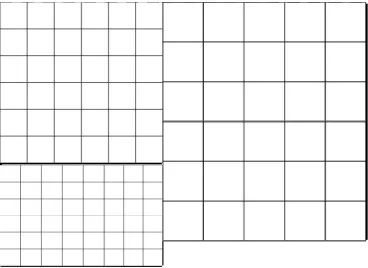
3. Strategy on representing area with amount of different units (unit consistency). For example, in our pretets, how the students derive the area of floor which contains different sized tiles?
4. Students’ conception on the use of unit to measure and compare area. For example, do the students use square in paperquilt to derive the area and compare the area?
5. The students’ use and exploration of ruler in finding the area?
Finally, the data of classroom observation, teacher interview, and the pretest for teaching experiment class were altogether used to be analysed. This informed us to take appropriate adjustment to our HLT relating to initial point of lesson sequence.
2. Preliminary Teaching Experiment (first cycle)
This preliminary teaching experiment also served as the pilot study. We treat preliminary teaching experiment as the first cycle. The participants of this preliminary teaching experiment were six third grade students pointed by the mathematics teacher. The students in this preliminary teaching experiment were not from the class of next cycle (teaching experiment). The students in this experiment have middle level of understanding. The aim for this data collection is to get the data of students’ activity and students’ thinking during the lessons (see tables in the next pages). These data was used in analysis and comparison of what we conjecture in the HLT of cycle 1.
3. Teaching Experiment (s)
The improved HLT was conducted in this teaching experiment. We called this teaching experiment as second cycle. The participants of this second cycle were the mathematics teacher and the third grade studentsof one class coming from different school. There were two kinds of observation during the learning process of second cycle. The first one was the overall classroom observation focusing on the teacher’s and students’ activities. For this occasion, we used the static video recording to catch the classroom environment. The second observation was focused in several students in a group who had middle level of understanding as discussed during the teacher interview in preparation phase. The activities of these focused students were recorded with dynamic second video recorder. In addition, small interview was also conducted to record what these focused students think during the activity. Then the result was recorded in field notes. Finally, students’ written work focusing in the concerned students was collected for further analysis.
4. Pretest and Posttest
As elaborated above, the pretest was conducted before the cycles but with different importance. The first pretest was conducted to several students of the preliminary teaching experiment. This aims to get the students’ initial understanding of the use of unit of area to measure and compare the area. This test contained five different tasks (Appendix F and H). The first pretest conducted in the preliminary teaching experiment was also used to see whether the problems designed in the test understandable for the students. This was very important for us to derive some revision towards this pretest. The revised version of the first pretest (second pretest) was conducted in teaching experiment (second cycle) aiming at getting the students’ prior knowledge of the area units and its use in measuring and comparing the planes. The revised version of second pretest was conducted before next cycle and so on. In all pretests, the result was the students’ written works that were very important to the quantitative and qualitative analysis. After the pretest, in all cycles, small interview was conducted to get the clarification of the students’ thinking process towards the tasks. Finally, the result helped us take appropriate adjustment on our HLT in cycles regarding the initial point of lesson in the sequence.
experiment, the interview was also conducted to get the clarification of their thinking process during accomplishing the test.
5. Validity and Reliability of Data Collection
Phase Activities Participants Data Collection
Small Conducting Video recording To get
interview small interview
Field notes To get additional data for purpose
Small way as the previous teaching experiment (cycle 2). However, we keep respect to our criteria for stopping the cycle of our design research study (see page 24). However, we would like to propose the data in our study during the cycles. We noted that we stopped the cycle after the second one since we already achieved the criteria set on stopping the cycle. Then, based on our designed hypothetical learning trajectory (both initial one in chapter IV and refined one on second cycle see Appendix D) we entail the data during the cycles as follows.
The first table displays the data we collected through the preparataion phase (pretest), preliminary teaching experiment and posttest relating to students’ preknowledge (pretest), students’ mathematical activity, and students’ thinking
process based on our initial hypothetical learning trajectory (entailed in chapter IV).
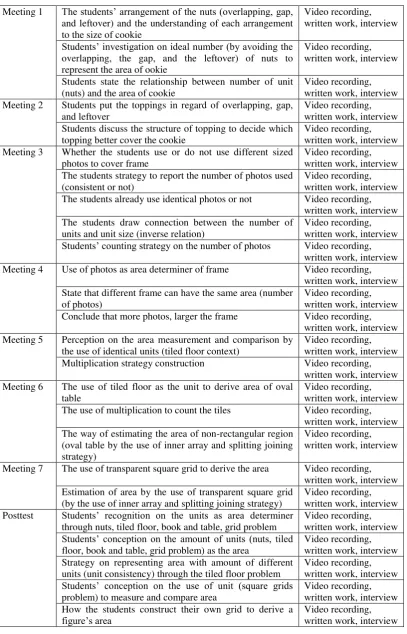
The Phase Data Collection Method
Pretetst The use of ruler to find the area Video recording, written work, interview strawberry, tile, and book problem) as the area
Video recording, written work, interview Strategy on representing area with amount of different
units (unit consistency) through the tiled floor problem
Video recording, written work, interview Students’ conception on the use of unit (tiled floor and
paperquilt problem) to measure and compare area
Meeting 1 The students’ arrangement of the nuts (overlapping, gap, and leftover) and the understanding of each arrangement to the size of cookie
Video recording, written work, interview
Students’ investigation on ideal number (by avoiding the overlapping, the gap, and the leftover) of nuts to represent the area of ookie
Video recording, written work, interview
Students state the relationship between number of unit (nuts) and the area of cookie
Video recording, Students discuss the structure of topping to decide which
topping better cover the cookie The students strategy to report the number of photos used
(consistent or not)
Video recording, written work, interview The students already use identical photos or not Video recording,
written work, interview The students draw connection between the number of
units and unit size (inverse relation)
Video recording, written work, interview Students’ counting strategy on the number of photos Video recording,
written work, interview Meeting 4 Use of photos as area determiner of frame Video recording,
written work, interview State that different frame can have the same area (number
of photos)
Video recording, written work, interview Conclude that more photos, larger the frame Video recording,
written work, interview Meeting 5 Perception on the area measurement and comparison by
the use of identical units (tiled floor context)
Video recording, written work, interview Multiplication strategy construction Video recording,
written work, interview Meeting 6 The use of tiled floor as the unit to derive area of oval
table
Video recording, written work, interview The use of multiplication to count the tiles Video recording,
written work, interview The way of estimating the area of non-rectangular region
(oval table by the use of inner array and splitting joining strategy)
Video recording, written work, interview
Meeting 7 The use of transparent square grid to derive the area Video recording, written work, interview Estimation of area by the use of transparent square grid
(by the use of inner array and splitting joining strategy)
Video recording, written work, interview Posttest Students’ recognition on the units as area determiner
through nuts, tiled floor, book and table, grid problem
Video recording, written work, interview Students’ conception on the amount of units (nuts, tiled
floor, book and table, grid problem) as the area
Video recording, written work, interview Strategy on representing area with amount of different
units (unit consistency) through the tiled floor problem
Video recording, written work, interview Students’ conception on the use of unit (square grids
problem) to measure and compare area
Video recording, written work, interview How the students construct their own grid to derive a
The second table displays the data we collected through the preparation phase (pretest), teaching experiment and posttest relating to the students’ preknowledge (through pretest), students’ masthematical activity, and students’ thinking process
based on our second cycle hypothetical learning trajectory (see Appendix D).
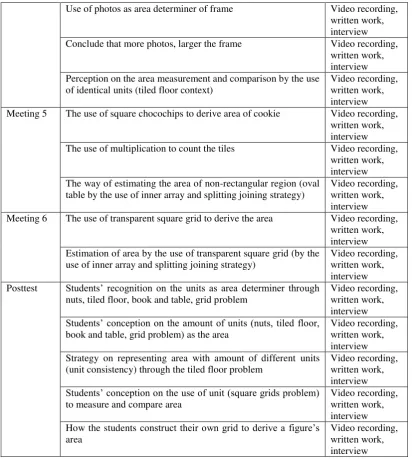
The Phase Data Collection
Method Pretetst Students’ recognition on the units as area determiner through
banana, tiled floor, and book and table problem)
Video recording, written work, interview Students’ conception on the amount of units (through banana,
tile, and book problem) as the the area
Video recording, written work, interview Strategy on representing area with the amount of different units
(unit consistency) through the tiled floor problem
Video recording, written work, interview Students’ conception on the use of unit (tiled floor and
paperquilt problem) to measure and compare area
Video recording, written work, interview Meeting 1 The students’ arrangement of the nuts (overlapping, gap, and
leftover) and the understanding of each arrangement to the size of cookie
Video recording, written work, interview Students’ investigation on ideal number (by avoiding the
overlapping, the gap, and the leftover) of nuts to represent the area of ookie
Whether the students use or do not use different sized photos to cover frame The students already use identical photos or not Video recording,
written work, interview The students draw connection between the number of units and
unit size (inverse relation)
Video recording, written work, interview Students’ counting strategy (multiplication) on the number of
photos in unfinished frame shown through quik image
Use of photos as area determiner of frame Video recording, written work, interview Conclude that more photos, larger the frame Video recording,
written work, interview Perception on the area measurement and comparison by the use
of identical units (tiled floor context)
Video recording, written work, interview Meeting 5 The use of square chocochips to derive area of cookie Video recording,
written work, interview The use of multiplication to count the tiles Video recording,
written work, interview The way of estimating the area of non-rectangular region (oval
table by the use of inner array and splitting joining strategy)
Video recording, written work, interview Meeting 6 The use of transparent square grid to derive the area Video recording,
written work, interview Estimation of area by the use of transparent square grid (by the
use of inner array and splitting joining strategy)
Video recording, written work, interview Posttest Students’ recognition on the units as area determiner through
nuts, tiled floor, book and table, grid problem
Video recording, written work, interview Students’ conception on the amount of units (nuts, tiled floor,
book and table, grid problem) as the area
Video recording, written work, interview Strategy on representing area with amount of different units
(unit consistency) through the tiled floor problem
Video recording, written work, interview Students’ conception on the use of unit (square grids problem)
to measure and compare area
Video recording, written work, interview How the students construct their own grid to derive a figure’s
area
interview with the teacher of cycle two was transcribed and triangulated with the data from classroom observation. Then, we tried to give interpretation on the initial situation of the classroom norms and sociomathematical norms, teacher and students’ activities and thinking process.
2. Preliminary Teaching Experiment
To get insight on the students’ initial understanding relating to the concept of area before preliminary teaching experiment, the pretest was conducted. The data (see page 27) obtained was analysed to get the insight on the students’ initial understanding of area concept as well as to analyse whether the students understand the problems or questions about area given in the test. The analysis included: the quantitative analysis for the number of good answers and the qualitative analysis for the students’ strategy in solving the problem. This is important for revising the pretest which would be given to students in cycle two prior to the teaching experiment.
transcribed. Then, we tried to give our interpretation focusing on the students’ thinking process through the learning process they were engaged in.
The data from small interview during the learning was also analysed to give more insight on their mathematical thinking. This data was complemented with the notes from field notes and we gave interpretation also to these data. These data were then triangulated with the data from students’ written work. At the final of cycle one, the posttest result was analysed to see how far the students develop their understanding through the lessons in cycle 1. The result of the data analysis in preliminary teaching was then used to revise our hypothetical learning trajectory for the second cycle; teaching experiment. 3. Teaching Experiment(s)
Before teaching experiment, the pretest was conducted. The data obtained was analysed to get the insight on the students’ initial understanding of area concept. The analysis included: the quantitative analysis for the number of good answer and the qualitative analysis for the students’ strategy in solving the problem.
the students would be focused. These fragments were then transcribed. Then, we tried to give our interpretation focusing on the students’ thinking process through the learning process they are engaged in.
The data from small interview during the learning was also analysed to give more insight on their mathematical thinking. This data was complemented with field notes and we will give interpretation also to these data. These data were then triangulated with the data from students’ written work. At the final of cycle one, the posttest result was analysed to see how far the students develop their understanding through the lessons in cycle 2. The result of the data analysis in teaching experiment was then used to revise our hypothetical learning trajectory for the second cycle. The same analysis process is conducted for the possible next cycle. This final revision of HLT for the last cycle contributed to the local instruction theory in the domain of area measurement.
For every cycle, we triangulated the data analysis through the video, field notes, and students’ written work to improve the validity of our study relating to the data analysis. We also wanted to have discussion about these data analysis with our supervisor to get the quality of analysis improved.
lessons to find out how far the succession or development of the students’ thinking and learning process during the teaching experiment. At the end, we drew a conclusion based on the retrospective analysis and answer our research questions. We also provide some recommendation to improve the hypothetical learning trajectory in domain of area measurement.
4. Validity and Reliability of Data Analysis
We intend to have our internal validity in this study improved. The data obtained through students’ activity by using video was analysed and compared with what we conjecture in HLT. This data analysis was triangulated with analysis from the data gained by small interview (field notes) and pupil’s written work. This aims for getting more valid analysis about the students’ mathematical activities and their mathematical thinking. This analysis was carried out in both cycles.
We also wanted to present the analysis in such a way so that the other people who also want to do study can find out if and how they will adjust the HLT in this study to their own local setting. In this occasion, we tried to improve our external validity of the study.
During the analysis, we also discussed with the expert (supervisor) to have the same track on analysis process. We equated our interpretation to derive such conclusions. This contributed to our internal reliability of the study.
CHAPTER IV
INITIAL HYPOTHETICAL LEARNING TRAJECTORY
For each lesson in this sequence, we formulated the learning goals for students, mathematical activities, and hypothesis about the process of students’ learning. These three aspects are known as the components of hypothetical learning trajectory (Simon, 1995). Hypothetical Learning Trajectory is used to plan mathematic lesson.
In this study, we aim to contribute to the development of a local instruction theory for area measurement which focuses on the understanding of area units. For this reason we build up instructional activities designed in a learning trajectory to promote the students to learn the area measurement through the understanding of area units. The students will develop their understanding on unit characteristics to grasp the concept of area of surface.
of learning area measurement. Learning to cover is the activity used in learning to measure area. This aims to generate the idea of unit iteration. Nitabach and Lehrer (1996) revealed that the students have difficulty to see the concept of unit iteration. The students often leave small holes between units, arrange unit overlapping each other which is not allowed during covering the region to derive the area. This is the reason why the learning that addresses these unit issues becomes so important. Furthermore, students need to be guided to see the connection between unit and area. In other way, the students need to have in mind that unit of area is the area determiner. In addition, the unit of choice is also becoming issue to address so that the students understand why particular shape of unit can be better as area unit based on the argument on unit issues: overlapping, gap, and leftover. This is our consideration to derive the next lesson in our designed learning sequence.