Volume 28, Number 2, 2013, 269 – 285
PERSONALITY AND COGNITIVE FACTORS IN INFORMATION
SYSTEM MIGRATION PROCESS
Willy Abdillah
Faculty of Economics Universitas Bengkulu ([email protected])
ABSTRACT
This study predicts potential resistance of IT adoption from perspective of cognitive and personality. Research conducted on 30 employees of PT. Berau Coal and 54 employees of PDAM Boyolali who are undergoing the process of migration of ERP and e-billing. Non-probability sampling procedure was using in this research with purposive-judgment techniques. Primary data retrieved through a questionnaire with a closed question format. Hypothesis testing conducted using Partial Least Square with software applications 2.0.M3 version SmartPLS. The results show only the cognitive factors have positively influence on intention to adopt ERP and e-billing. This finding reinforces that the development of IT adoption theory will lead to perceptual factors. Also, this finding indicates that the employees of PT. Beraucoal and PDAM Boyolali have great intentions to use IT in term of ERP and e-billing migration process. Managerial implication and further researches are discussed.
Keywords: personality factors, cognitive factors, information technology acceptance, ERP and e-billing.
INTRODUCTION
The development of information system (IS) in business applications showed increased strategic role to win the competition through changing patterns and business models, such as e-commerce or e-business and mobile commerce (Turban, et al., 2008). IS has no longer just seen as a necessity but has become a requirement that must be met to improve the competitiveness of the organization. Some companies are encouraged to migrate infor-mation technology (IT) to develop and opti-mize the function and role of IT as a resource in the competition to win business.
Based on management perspective, the migration process is expected to enhance the role and function of the Information System
problem of acceptance and adoption of IT (Hartono, 2007).
Empirical study of IT adoption shows that the personality and cognitive factors are strong predictors of IT usage. However, the debate about concept of situational and dispositional is still inconclusive in the area of behavioral IS. McElroy, et al. (2007) examined the effects of personality factors and cognitive dispositional to predict intention to use the internet. The results indicated that personality factors are better predictor of internet usage intention than cognitive factors. Meanwhile, Abdillah (2009) compared the predictive effects of personality factors and cognitive situational dispositional on intention to use internet within higher education institutions. The research found that cognitive situational factors as better predictors of internet and problem of construct validity in personality factors. In addition, other empirical studies indicate that dispositional personality factors are not strong predictor of intentions but it is an indirect relationship mediated by situational factors (Weiss & Adler, 1984). Based on two previous studies, it can be conclude that situational and disposisional factors have major impact in IT acceptance theory. However, previous studies mainly use internet as research object thus the empirical findings can not be generalized to other area of IT context. Therefore, it is important to study cognitive and personality factors in specific area of IT adoption.
This study predicts potential resistance of IT adoption from perspective of cognitive and personality in the context of ERP and e-billing system. This study is important because there are limited research to examine cognivite and personality factors in specific area of IS adop-tion. This research examines cognitive and personality factors as predictors of IT usage because both factors have identified as accel-erator of IS migration process and willingness to use new IT (Davis, et al., 1989; McElroy, et al., 2007; Venkatesh, et al., 2003). Both
factors are also indicate as successful indi-cators of IS migration process (DeLone & McClean, 2003). This research provides ex-planation the concept of situational and dispositional factors in the area of IS beha-vioral researches and implication of resistance problems in IS migration process for stakeholder.
LITERATURE REVIEW AND HYPOTHESES DEVELOPMENT
Personality
Research in the field of IS that uses the concept of personality started by Zmud (1979) who examined dispositional individual char-acteristics (personality and cognitive style) of the IS implementation success. Factor person-ality dimensions measured by cognitive and affective structure of individuals in response to events, people and situations encountered. Personality factors that are believed to strongly influence the success of Management Information System (MIS) is the locus of con-trol, dogmatism, tolerance of ambiguity, ex-trovert/introvert, need for achievement, risk taking, and the defense evaluative anxiety (Zmud,1979). However, this research usedper-sonality facet outside of the IS area and this study has not directly examined personality factorsand cognitive style.
Agarwal & Karahanna (2000) extracted dimensional factor model of personality trait of the Big Five Factor (Costa & McCrae, 1992) in the field of psychology by taking the dimensions of neuroticism (computer anxiety) and openness to experience (personal innova-tiveness). These personality dimensions asso-ciated with the technology acceptance model (TAM) by adding the construct of cognitive absorption. The results showed that personal innovativesness predictssituational cognitive factors, namely perceived usefulness and per-ceived ease of use.
computer anxiety, and personal innovative-ness) predict intention to use IT. In this study, Thatcher et al. (2007) used the term internet anxiety to replace computer anxiety as a dispositional personality. Internet raises emotions which produce interactions with unfamiliar situations or people. Internet usage presents risks, such as the potential for viruses, spyware or an invasion of privacy of the users (user privacy). Therefore, computer anxiety reflects the length of time experience with computers and the internet anxiety reflects the difficulty with which information technology in the context of internet use.
McElroy, et al. (2007) pulled back the re-search model using the dimensions of person-ality and cognitive factors to the basic theory in the field of psychology. Personality factors measured using a five-dimensional model of personality (Big Five Factor: Openness to ex-perience, conscientiousness, extraversion, agreeableness and neuroticism) and cognitive factors measured by using a model of MBTI cognitive style (Costa, et al., 1992). The re-search objective was to compare the influence of both personality and cognitive factors and the use of the internet with computer anxiety, self-efficacy and gender as control variables. The results indicated that personality factors are better predictors than cognitive style. However, MBTI is not considered an appro-priate tool to measure cognitive style if it is associated with personality in the context of internet use. McCrae & Costa (1989) claims that the MBTI has a weakness in measuring cognitive style in personality perspective. MBTI shows the limitations and weaknesses of the validity of the construct reliability of the data while still achieved in this model.
Buchanan, et al. (2005) examined the influence of personality factors by using the International Personality Item Pool (IPIP) instrument (Goldberg, 1990). There are three reasons for use of IPIP instrument.First, some previous research showed that the IPIP instrument was better than Big Five
Factor-Costa & McCrae for measuring personality (Costa & McCrae, 1992). Second, the IPIP was available for free without paying a license as instruments. Third, the IPIP consists of 50 items while Big Five has 240 questions. The results indicate that IPIP has better validity and reliability than Big Five.
Yi, et al. (2006) stated that individual characteristics and personality as predictors of cognitive factors, such as perceived ease of use and perceived usefulness. Landers & Lounsbury (2006) found that agreeableness was a predictor of internet use but do not like to interact in a long time, especially if he finds difficulties in its use. Therefore, this character is expected as a predictor of perceived utility and efficacy of IT users.
Based on these statements, hypotheses which are developed in this research are: H1a: Agreeableness affects user’s perceived
ease of use in IT migration process. H1b: Agreeableness affects user’s self
effi-cacy in IT migration process.
Venkatesh (2000) stated that the individ-ual characteristics and personality factors are antecedent cognitive factors (i.e. perceived ease of use, perceived usefulness and self effi-cacy) in predicting intention and IT usage be-havior. Landers & Lounsbury (2006) found that conscientiousness was a disciplined character, assertive and tend to use IT for productive activities, such as search for journal articles and publications. Instead, these characters avoid the use of IT things that are not productive, such as the chat room.
Based on this, then the hypotheses devel-oped in this research are:
H2a: Conscientiousness affects user’s per-ceived ease of use in IT migration proc-ess.
variety of information with virtual communi-ties (Amiel & Sargent, 2004) and assume that IT is useful facilities for fun and happiness. Venkatesh (2000) stated that this character has a self-efficacy in using IT for the sake of so-cializing and fun.
Based on these explanations is the hy-potheses which are built in this research are: H3a: Extraversion affects user’s perceived
usefulness in IT migration process. H3b: Extraversion affect user’s self-efficacy
on IT migration process.
IT Neuroticism tend to avoid socializing but for the sake of using it to meet personal pleasure, are like playing online and search for identity in a virtual community (Amiel & Sargent, 2004). Venkatesh (2000) stated that perceived usefulness and self-efficacy of IT usage was influenced by feelings of fear or anxiety. That is, individual who has a neurotic character will affect his functionality and level of self efficacy to use IT.
Based on these explanations, the hy-potheses which are built in this research are: H4a: Neuroticism affects user’s perceived
ease of use in IT migration process. H4b: Neuroticism self efficacy affects users
of IT migration process.
Openness to experience tends to use IT to seek new ideas (Tuten & Bosnjak, 2001). These characters have a high desire to explore IT, positive perceptions and self efficacy in using IT (Venkatesh, 2000).
Based on these explanations, the hy-potheses which are built in this research are: H5a: Openness to experience affects users'
perceived ease of use in IT migration process.
H5b: Openness to experience affects users' self-efficacy in IT migration process.
Cognitive Factors
Cognitive is a term used in cognitive psy-chology to describe a form of thought or per-ception of the individual or the tendency to use perceptual and information events in solving problems. The cognitive psychology learn how people think, feel, learn, remember, make de-cisions, and how people process (perceive, interpret, store and retrieve) data in the mem-ory of the brain (Hartono, 2007).
The development of cognitive concepts in IS begun when mainstream behavioral re-search appeared in the 1960’s. Ackoff (1960) initiated by doing a case study to explore causes of IS failure. The study has stimulated the following research although this study failed to find the cause of the system failure, but it has indicated a link user attitudes and behavior toward the success of the IS system.
Schultz & Slevin (1975) proposed attitude dimension to the use IS. Dimension consists of performance, interpersonal, change, purpose, support or rejection, clients or researchers and interests. The results found the influence of user's perception of the IS use on IS success. This research model was then used in many subsequent studies to examine the influence of beliefs, attitudes (cognitive perception) and the intention to use IS.
Therefore, according to Triandis (1980) TRA should separate aspects of cognitive and af-fective dimensions of attitudes. Davis (1989) developed a model by extending the TRA constructs (i.e. belief) with the perceived ease of use and perceived usefulness. TAM is considered more parsimony in explaining the behavior of IS use and supported by most empirical research. However, TAM model separates the belief as cognitive aspect and attitude as affective.
This study use cognitive factors from TAM, namely perceived usefulness, perceived ease of use and self-efficacy (Bandura, 1982; Compeau & Higgins, 1995a, b; Hsu & Chiu, 2004). The selected constructs are based on several reasons. First, TAM is a useful be-havioral model to explain why many informa-tion systems failure. TAM is considered as one of model that consists of psychological or be-havioral factors. Second, TAM is developed by strong theoretical basis. Third, TAM has been supported by a lot of empirical research and concluded that TAM is anapropriate model to explain individual usage of IS. In fact, TAM is more robust than TRA and the TPB. Fourth, self-efficacy has been widely used in research as a cognitive construct that affects individual use of IS.
Perceived Usefulness
Perceived usefulness is level of personal belief in using a technology that will improve their performance (Davis, et al., 1989). Per-ceived usefulness is also a perPer-ceived belief about decision-making process. If someone believes in system then he will use it. Con-versely, if someone was believed that the sys-tem less useful information he would not use it.
Previous studies have shown that per-ceived usefulness positive effect on use of IS (Davis, et al., 1989; Igbaria, et al., 1996). Perceived usefulness is the most powerful construct to influence attitudes, interests and behavior of technology than other constructs.
Venkatesh, et al. (2003) examined the influence of perceived usefulnesson IT usage behavior between men and women. The results showed that perceived usefulness influ-ence was stronger for men than women. This result shows that men judge more on the as-pects of IT utilization compared to women, so that this perception will influence the attitude of men in the use of IT.
Gardner & Amoroso (2004) developed extended TAM by adding external variables to examine the acceptability internet technology. Four external variables are gender, experience, complexity and volunteerism. The results showed that men tend to have higher per-ceived utility than women. In contrast, women tend to have higher perceived ease of use than men.
Taylor and Todd (1995) combined TPB decomposition model by adding the age as external variables in the acceptance of tech-nology. The results showed a younger was more influential on the attitude variables (cog-nitive) on the use of IS. In contrast, older was more influential on perceived control vari-ables. Implications of these findings indicate that the dimensions of cognitive factors are more variable at a young age, while the per-ceived control variables are more variable at old age.
Based on the explanation above, the proposed hypotheses are:
H6: Perceived usefulness affects user intention in IT migration process.
Perceived Ease of Use
et al. (1989) found that perceived ease of use could explain why a person used IS and how users accepted new developed IS. Based on the explanation above, the proposed hypothe-ses are:
H7: Perceived ease of use has positively influ-ence on user intention to participate in the IT migration process.
Furthermore, Davis, et al. (1989), Venkatesh, et al. (2003), and Yi, et al. (2006) found that perceived ease of use is one of strong predictor of perceived usefulness. Based on these explanations, the hypothesis which is built in this research is:
H8: Perceived ease of use positively influence on user’s perceived usefulness in IT migration process.
Self-Efficacy
Self-efficacy is defined as individual con-fidence in ability to perform an action and persistence to deal with obstacles to achieving the performance of a behavior (Hartono, 2007). Self-efficacy is an aspect of human psychology changes in response to different treatments, such as when individuals face dif-ferent task complexity then his self-efficacy will also be different (Bandura, 1982).
Results from many studies show that self-efficacy influenced intention to use IT, com-puter anxiety (Agarwal, et al., 2000), the adoption of high-tech products (Hill, et al., 1987) and the intention to innovate (Burkhat & Brass, 1990). Venkantesh (2000) found that self-efficacy is one of a strong predictors on perceived usefulness.
Based on the explanation above, the pro-posed hypotheses are:
H9: Self-efficacy positively affects perceived usefulness in IT migration process.
H10: Self-efficacy positively affects user’s intention to participate in the IT migra-tion process.
RESEARCH METHOD
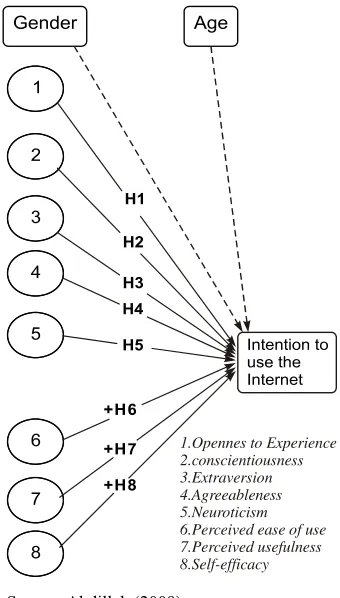
This research is descriptive-confirmatory research. The empirical model proposed in this research developed from prior research of Abdillah (2009) whose examined the direct effect of dipositional personality factors and situational cognitive factors on the intention to use the internet (see following figure 1).
1.Opennes to Experience 2.conscientiousness 3.Extraversion 4.Agreeableness 5.Neuroticism 6.Perceived ease of use 7.Perceived usefulness 8.Self-efficacy
Source: Abdillah (2009)
Figure 1. Theoritical Model from Prior Research
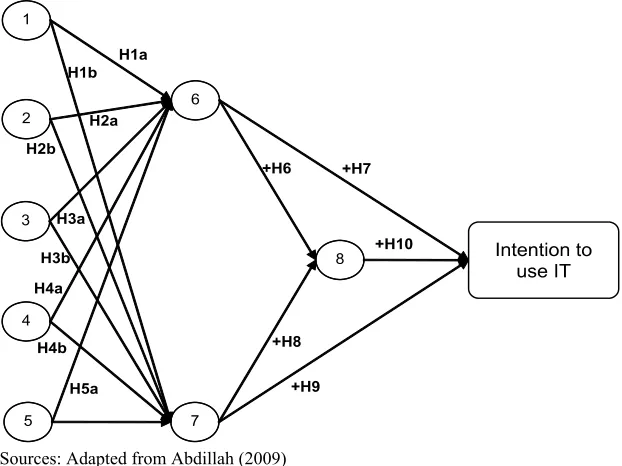
factors have indirect effect on intention. Indi-vidual personality will be reflecting indiIndi-vidual characteristics of belief and attitude toward IT. And then, these belief and attitude will be re-flecting individual intention to use IT. How-ever, individual intention to use IT will be different, depend on individual characteristics such as agreeableness has positive attitude toward IT but only use IT in short time, meanwhile conscientiousness only use IT if they perceive IT has positive benefit for them. The differences of individual characteristics, belief and attitude toward IT will predict dif-ferent intention to use IT. The following is empirical research model examined in this study.
The perceived usefulness and the per-ceived ease of use construct are measured by the likert scale, starting from point 1 as a
strongly disagree to point 5 as strongly agree, which is measured through six questions adopted from Davis, et al. (1989). Self-efficacy is also assessed with the likert scale, starting from point 1 as strongly disagree to point 5 as strongly agree, which is assessed through five questions adopted from Hsu & Chiu (2004). The dispositional personality is measured by using the Five Factor Personality instrument from the IPIP as cited by Goldberg (1990) which consist of five dimensions; the openness to experience, the conscientiousness, the extraversion, the agreeableness, and the neuroticism. Each dimension is assessed through the likert scale starting from point 1 as strongly disagree, to point 5 as strongly agree. Whereas the intention to use the internet is measured through the likert scale as strongly disagree to point 5 as strongly agree by
Sources: Adapted from Abdillah (2009)
1.Opennes to Experience 5. Neuroticism
2.Conscitiousness 6. Perceived ease of use
3.Extraversion 7. Self-efficacy
4.Agreeableness 8. Perceived usefulness
adapting three questions based on Davies, et al. (1989).
Population in this study is employees of PT. Beraucoal and PDAM Boyolali who are being migrated into the ERP and e-billing system. We use the non-probability with con-venience sampling technique because not all employees can be reached as research sample regarding on organizational rules. This re-search employs primary data drawn at cross-sectional during July-October 2009. Data col-lected through the questionnaire as much as 84 the number of samples taken with the structure of closed questions.
This research conducts measurement
model for construct validity and internal con-sistency of reliability, namely convergent, discriminant validity, Cronbach's alpha and Composite Reliability. Statistical data analysis uses Partial Least Squares method with appli-cations SmartPLS ver. 2.0.M3.
DATA ANALYSIS AND DISCUSSION
Research Sample
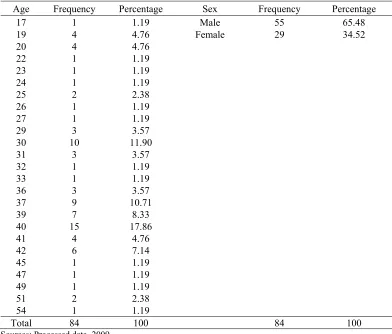
Unit of analysis in this study are employ-ees of PT. Beraucoal and PDAM Boyolali. Of the 150 questionnaires distributed through informants and enumerators directly to the respondents, 85 returned questionnaires and 84 that can be processed further because 1
ques-Table 1. The characteristics of the 84 samples in the study
Age Frequency Percentage Sex Frequency Percentage
17 1 1.19 Male 55 65.48
19 4 4.76 Female 29 34.52
20 4 4.76
22 1 1.19
23 1 1.19
24 1 1.19
25 2 2.38
26 1 1.19
27 1 1.19
29 3 3.57
30 10 11.90
31 3 3.57
32 1 1.19
33 1 1.19
36 3 3.57
37 9 10.71
39 7 8.33
40 15 17.86
41 4 4.76
42 6 7.14
45 1 1.19
47 1 1.19
49 1 1.19
51 2 2.38
54 1 1.19
Total 84 100 84 100
tionnaire filled out by the respondent (Table 1).
Based on frequency distribution, it shows that most respondents are adults in the pro-ductive age category. This became the basis for determining personality and cognitive characteristics of respondents in the adult life cycle. Meanwhile, gender distribution shows the proportion of men more than women. This is in accordance with the characteristics of companies that are carried out by more domi-nant males, so conclusions on the perceptions respondents can not be generalized based on gender.
This research uses a technique Partial Least Square (PLS) with the asisstance of ap-plications Smart PLS 2.0.M3 version. To analyze the proposed model, the author uses 27 questions with interval scale. Here are the results of statistical analysis using PLS tech-nique.
Measurement Model
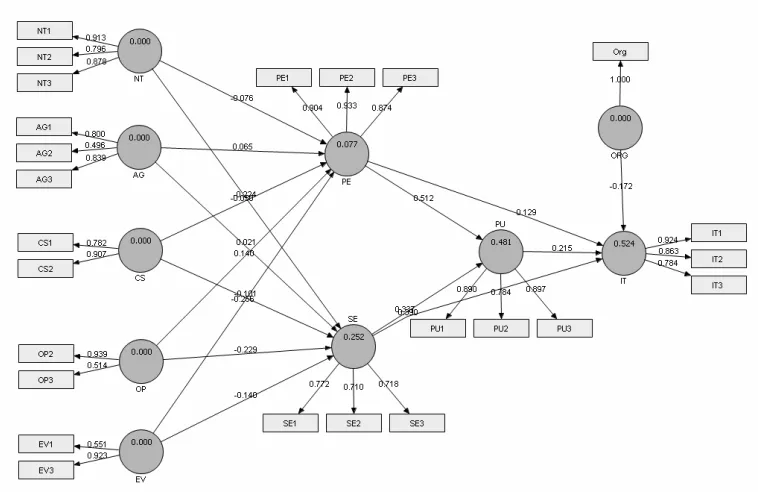
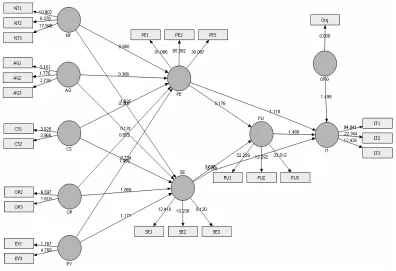
The measurement model of PLS technique consist of construct validity and reliability test (Figure2).
Construct Validity
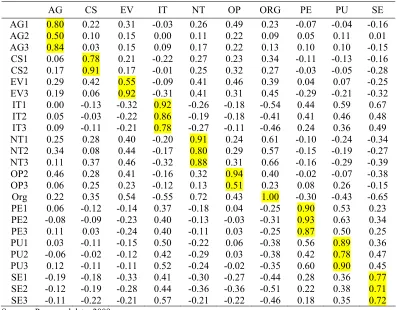
Construct validity consist of convergent validity and discriminant validity. Convergent validity assessed by factor loading (correlation between item score/component scores with construct scores) indicators that measure these constructs. In this study there were 9 con-structs with each construct has 3 indicators. Based on the results of the measurement model test, the majority of construction attain the validity test (loading scores> 0.7), except for the construct of Conscientiousness, Open-ness to experince and Extraversion have re-duced one indicator for each. Based on these results it can be concluded that the proposed model of personality and cognitive attain con-vergent validity test.
Discriminant validity is assessed by meas-uring the construct cross-loading. The follow-ing table shows the correlation between the constructs in the model with the indicator. Indicators of all constructs showed a strong correlation with its construct compared to the other constructs. Another method used to as-sess discriminant validity is by comparing the square root of average variance Extracted (AVE) for each construct with the correlations between constructs in the model. The model has sufficient discriminant validity if the root of AVE for each construct is greater than the correlation between constructs with other con-structs in the model. The correlation value indicators and latent variables can be seen in the following table 2.
Based on cross-loading table above, it can be concluded that the proposed model of per-sonality and cognitive constructs have attained the discriminant validity.
Reliability
Reliability indicates the stability and in-ternal consistency of the instrument (Cooper & Schindler, 2006; Hair, et al., 2006). Reliability can be measured by the value of Cronbach's alpha and Composite Reability. Rule of thumb value of alpha or Composite Reliability must be greater than the value of 0.7 although 0.6 is acceptable on exploratory study (Hair, et al., 2006). The construct reliability results can be seen in the following table 3.
Based on the table, it can be concluded
Table 2. Cross-Loading
AG CS EV IT NT OP ORG PE PU SE
AG1 0.80 0.22 0.31 -0.03 0.26 0.49 0.23 -0.07 -0.04 -0.16 AG2 0.50 0.10 0.15 0.00 0.11 0.22 0.09 0.05 0.11 0.01 AG3 0.84 0.03 0.15 0.09 0.17 0.22 0.13 0.10 0.10 -0.15
CS1 0.06 0.78 0.21 -0.22 0.27 0.23 0.34 -0.11 -0.13 -0.16 CS2 0.17 0.91 0.17 -0.01 0.25 0.32 0.27 -0.03 -0.05 -0.28 EV1 0.29 0.42 0.55 -0.09 0.41 0.46 0.39 0.04 0.07 -0.25 EV3 0.19 0.06 0.92 -0.31 0.41 0.31 0.45 -0.29 -0.21 -0.32 IT1 0.00 -0.13 -0.32 0.92 -0.26 -0.18 -0.54 0.44 0.59 0.67 IT2 0.05 -0.03 -0.22 0.86 -0.19 -0.18 -0.41 0.41 0.46 0.48 IT3 0.09 -0.11 -0.21 0.78 -0.27 -0.11 -0.46 0.24 0.36 0.49 NT1 0.25 0.28 0.40 -0.20 0.91 0.24 0.61 -0.10 -0.24 -0.34 NT2 0.34 0.08 0.44 -0.17 0.80 0.29 0.57 -0.15 -0.19 -0.27 NT3 0.11 0.37 0.46 -0.32 0.88 0.31 0.66 -0.16 -0.29 -0.39 OP2 0.46 0.28 0.41 -0.16 0.32 0.94 0.40 -0.02 -0.07 -0.38 OP3 0.06 0.25 0.23 -0.12 0.13 0.51 0.23 0.08 0.26 -0.15 Org 0.22 0.35 0.54 -0.55 0.72 0.43 1.00 -0.30 -0.43 -0.65 PE1 0.06 -0.12 -0.14 0.37 -0.18 0.04 -0.25 0.90 0.53 0.23 PE2 -0.08 -0.09 -0.23 0.40 -0.13 -0.03 -0.31 0.93 0.63 0.34 PE3 0.11 0.03 -0.24 0.40 -0.11 0.03 -0.25 0.87 0.50 0.25 PU1 0.03 -0.11 -0.15 0.50 -0.22 0.06 -0.38 0.56 0.89 0.36 PU2 -0.06 -0.02 -0.12 0.42 -0.29 0.03 -0.38 0.42 0.78 0.47 PU3 0.12 -0.11 -0.11 0.52 -0.24 -0.02 -0.35 0.60 0.90 0.45 SE1 -0.19 -0.18 -0.33 0.41 -0.30 -0.27 -0.44 0.28 0.36 0.77 SE2 -0.12 -0.19 -0.28 0.44 -0.36 -0.36 -0.51 0.22 0.38 0.71 SE3 -0.11 -0.22 -0.21 0.57 -0.21 -0.22 -0.46 0.18 0.35 0.72
that the all indicators used in this study at-tained the reliability test.
Structural Model
PLS evaluated structural model using R-square for the dependent variable and the
value of the path coefficients (β) for the inde-pendent variables and then assessed the sig-nificance based on t-values of each path.
The structural model results can be seen in the figure 4 below.
Table 3. Cronbach’s Alpha and Composite Realibility
Cronbachs Alpha Composite Reliability
Agreeableness 0.652424 0.763617
Conscientiousness 0.618796 0.834892
Extraversion 0.314398 0.719759
Intention 0.821919 0.893881
Neuroticism 0.830298 0.897804
Openness to experience 0.313897 0.711548 Perceived ease of use 0.887986 0.930624 Perceived usefulness 0.819946 0.893233
Self-efficacy 0.571511 0.77787
Sources: Processed data, 2009.
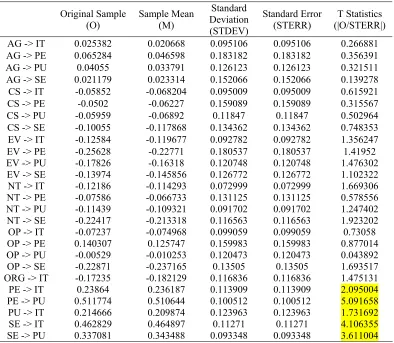
To assess the significance of model paths between constructs in the structural model visits from t-value paths between constructs. Following the path coefficients indicated by the value of t the construction.
Structural model results show that only the cognitive constructs influence intention to IT whereas personality constructs have no effect. Thus, only five hypotheses are sup-ported, namely the influence of perceived ease of use on intentions, percevid eease of use on perceived usefulness, self-efficacy to inten-tions, self-efficacy to perceived usefulness and perceived ease of use.
Theoretically there are several hypotheses that are consistent, such as personality factors can not be mediated by cognitive factors but should be a direct predictor of IT intention (Abdillah, 2009; McElroy, et al., 2007). This means that research findings have been confirmed previous studies and debates about the concept of personality. In addition, only the cognitive constructs that influence adop-tion intenadop-tions so that it can be concluded that the migration of IT is risky and costly demands of rationality, as measured by perceptions of ease, usefulness and self-efficacy in the process of cognition.
Table 4. Structural Model
Original Sample (O)
Sample Mean (M)
Standard Deviation (STDEV)
Standard Error (STERR)
T Statistics (|O/STERR|)
AG -> IT 0.025382 0.020668 0.095106 0.095106 0.266881 AG -> PE 0.065284 0.046598 0.183182 0.183182 0.356391 AG -> PU 0.04055 0.033791 0.126123 0.126123 0.321511 AG -> SE 0.021179 0.023314 0.152066 0.152066 0.139278 CS -> IT -0.05852 -0.068204 0.095009 0.095009 0.615921 CS -> PE -0.0502 -0.06227 0.159089 0.159089 0.315567 CS -> PU -0.05959 -0.06892 0.11847 0.11847 0.502964 CS -> SE -0.10055 -0.117868 0.134362 0.134362 0.748353 EV -> IT -0.12584 -0.119677 0.092782 0.092782 1.356247 EV -> PE -0.25628 -0.22771 0.180537 0.180537 1.41952 EV -> PU -0.17826 -0.16318 0.120748 0.120748 1.476302 EV -> SE -0.13974 -0.145856 0.126772 0.126772 1.102322 NT -> IT -0.12186 -0.114293 0.072999 0.072999 1.669306 NT -> PE -0.07586 -0.066733 0.131125 0.131125 0.578556 NT -> PU -0.11439 -0.109321 0.091702 0.091702 1.247402 NT -> SE -0.22417 -0.213318 0.116563 0.116563 1.923202 OP -> IT -0.07237 -0.074968 0.099059 0.099059 0.73058 OP -> PE 0.140307 0.125747 0.159983 0.159983 0.877014 OP -> PU -0.00529 -0.010253 0.120473 0.120473 0.043892 OP -> SE -0.22871 -0.237165 0.13505 0.13505 1.693517 ORG -> IT -0.17235 -0.182129 0.116836 0.116836 1.475131 PE -> IT 0.23864 0.236187 0.113909 0.113909 2.095004 PE -> PU 0.511774 0.510644 0.100512 0.100512 5.091658 PU -> IT 0.214666 0.209874 0.123963 0.123963 1.731692 SE -> IT 0.462829 0.464897 0.11271 0.11271 4.106355 SE -> PU 0.337081 0.343488 0.093348 0.093348 3.611004
In general, the R2 for measuring variations in the dependent variable changes caused by the independent variables showed a fairly good indication, which is 0.52 or 52 percent of the variation of the dependent variable, can be explained by variations of independent vari-ables. However, R2 is not a single parameter model for estimation of significance the most important is the consistency of the results with the existing theories. Thus it can be conclude that proposed model is able to explain the phenomenon of IS migration process from the cognitive and personality aspects.
Discussion
This study examines relationship between personality and cognitive factors on the inten-tion to use IT in term of IT migrainten-tion. The results shows only cognitive factors (perceived usefulness, perceived ease of use, and self-efficacy) have positive relationship on inten-tion to use IT. It is indicated from t-value of structural model examination.
Theoretically, this finding is in line with the statement of Robey (1983) who predicted the development trend of IT adoption theory was more directed at the cognitive constructs. It can be seen in the many theoretical models developed, such as TAM, TPB and UTAUT. This finding also confirms previous studies that found cognitive factors were the estab-lished predictor of intentions (Abdillah, 2009; Davis, et al., 1989; Venkatesh, et al., 2003).
Other interesting finding from this re-search is unsupported of personality factors hypotheses. Trait theory is the appropriate concept to explain the concept of personality. Personality is a part of trait theories which shows the stability of the individual thought, attitudes and behavior patterns. These con-structs are widely used in behavioral science but the dispositional factors have tendency of less construct validity (Abdillah, 2009). In addition, along with the development of em-pirical studies of trait theory, the nature of the trait can be divided dispositional and
situ-ational. Dispositional trait reflects consistency and persistency of the individual existing character when respond toward an object or event and reflection of behavior exhibited. In contrast, situational traits reflect a change in the individual character when respond toward something and behave. This debate increas-ingly becomes marginalized trait theory in behavioral science. Although a lot of literature try to confirm this differences, however the debate never end, even when the concept was adapted to behavioral information system.
Mitchell (1979) explained that the mar-ginality of trait factors - as one of the founda-tions of the theory of motivation, attitude and leadership - because the strong influence of situational factors in term of causality com-pared to trait. That is, predictors of behavior are not only determined by the permanent character of the individual but also by situ-ational factors, even the comparative magni-tude of these two factors indicate the influence of situational factors influence greater than the trait. Furthermore, Weiss & Adler (1984) stated that trait factors should not only as an independent variable but it can be a mediating variable, dependent variable or moderating variable. However, there are many other fac-tors that cause the marginality of trait factor in empirical research.
George (1992) stated that the debate over the nature dispositional or situational trait can be explained through an evolutionary process of trait factors. Individual characters could directly affect behavior but these effects can also be mediated by situational factors. Thus, the specific context of a permanent character allows person changes to appropriate context in shaping behavior. Moreover, George (1992) suggested that research on trait factors should develop based on strong theory and research design should able to explain the problem and research phenomenon.
world. One of the main issues is practical validity and realiabity. For example, the Five-Factor Model (FFM) or Big Five Personality Factor established by Costa, et al. (1992) is one of the most popular instruments and commercially used by many researchers and psychologists. Meta-analysis study conducted by Salgado (1997) showed that five dimen-sions of the FFM trait, namely Agreeableness, Conscientiousness, Neuroticism, Openness to Experience and Extraversion, has different effects on individual performance and it has lower validity and reliability compared to nar-row instrument (Ashton, 1998), such as Inter-national Personality Item Pool (IPIP) (Goldberg, 1990). Buchanan, et al. (2005) compared validity and reliability between Big Five Personality Factor-Costa and IPIP and found that narrow instrument has higher validity and reliability than the broader in-strument. For that, researchers should be more critical while using personality instruments. Based on these explanations, it can be con-cluded that the use of a trait variable in the adoption studies is still relevant but potential of measurement bias regarding validity and reliability issues should be concerned by re-searchers.
This research also find that cognitive factors (perceived usefulness, ease of use and self-efficacy) have positive relationship on intention to IT adoption. It can be concluded that the employees of PT. Beraucoal and PDAM Boyolali have intention to use IT then it is expected that the ERP and e-billing mi-gration process would not being constrained.
In line with research findings, it appears that cognitive factors have more influence on intention to use IT than personality factors. These results indicate that the use of IT deci-sions more influenced by aspects of rationality than permanent aspects of the individual char-acter. So that, corporations and local govern-ment should feel confident that the IS migra-tion decision will be success as long as IS control and management system is running well.
CONCLUSIONS AND RECOMMENDA-TIONS
This study examines the relationship of personality and cognitive factors on the inten-tion to use IT. Personality factors are meas-ured by openness to experience, conscien-tiousness, extraversion, agreeableness and neuroticism, whereas cognitive factors meas-ured by perceived ease of use, perceived use-fulness and self-efficacy. The results shows that only the cognitive factors that positively relationship on intention to use IT. These re-sults theoretically support the statement that the development of IT adoption theory tends to lead to perceptual factors (Robey, 1983). Although IS adoption theories assume that rationality and volunteerism predict the use of IT but in practice, the organization requires employees who use IT based on perceived benefits and ease of use (Davis, 1989).
Eventhough this study does not find rela-tionship personality factors on intention to use IT, hovewer personality factors still one of predictor of attitude and intention use use IT (Mitchell, 1979; Weiss & Adler, 1984; George, 1992). Marginality of personality factors can be caused by inadequate theory and research design, particularly measurement issues of construct validity and internal con-sistency. For future research, it should be more cautious while using personality instruments. Based on these explanations, it can be con-cluded that the use of a trait variable in the adoption studies is still relevant but potential of measurement bias regarding validity and reliability issues should be concerned by re-searchers.
to use it. Therefore, corporations and local government should feel confident on IS mi-gration process but still consider IS control and management system is running well.
However, this study has several limita-tions. First, this study used a limited number of observations (i.e. 84 respondents) that po-tentially produce sampling biased. Second, although the researchers used two research subjects with two types of IT migration proc-ess but the number of observations lead to unbalanced variant and potentially comparison bias. Third, study examined IT adoption model in the context of the ERP and e-billing migra-tion process. Regarding to IT uniqueness, this study can only be interpreted in the context of ERP and e-billing, not for other IT’s. There-fore, this study suggest for further researches that should use a lot of observations by in-creasing the response rate, equal sample size for comparison among group, and generalized this results to other IT contexts appropriately.
REFERENCES
Abdillah, W., 2009. "The Situational Cog-nitive Mediation Effects on Dispositional Personality Influence on the Intention to Use the Internet: An Empirical Study of Information Technology Acceptance within Higher Education Institution". International Journal Management in Education, 3(4), 359-374.
Ackoff, R.L., 1960. "Case Histories Five Years After-A Symposium: Unsuccessful Case Studies and Why". Operations Research, 8(2), 259-263.
Agarwal, R., & Karahanna, E., 2000. "Time Flies When You're Having Fun: Cognitive Absorption and Beliefs about Information Technology Usage". MIS Quarterly, 24(4), 665-694.
Agarwal, R., Sambamurthy, V., and Stair, R., 2000. "The Evolving Relationship between General and Specific Computer Self-Efficacy: An Empirical
Investiga-tion".Information Systems Research, 11(4), 418-430.
Amiel, T., and Sargent, S.L., 2004. "Individual Differences in Internet Usage Motives". Computers in Human Behavior, 20(6), 711-726.
Ashton, M.C., 1998. "Personality and Job Per-formance: The Importance of Narrow Traits". Journal of Organizational Behav-ior, 19(3), 289-303.
Bandura, A., 1982. "Self-efficacy Mechanism in Human Agency". American Psychologist, 2(37), 122-147.
Behling, O., 1980. "The Case of the Natural Science Model for Research in Organizational Behavior and Organization Theory". Academy of Management Review, 5, 491-500.
Buchanan, T., Johnson, J.A., and Goldberg, L.R., 2005. "Implementing a Five-Factor Personality Inventory for Use on the Internet". European Journal of Psycho-logical Assessment, 21(2), 115-127.
Burkhat, M.E. and Brass, D.J., 1990. "Changing Patterns or Patterns of Change: the Effects of a Structure and Power". Administrative Science Quarterly, 35, 104-127.
Compeau, D.R. and Higgins, C.A., 1995a. "Application of Social Cognitive Theory to Training for Computer Skills". Infor-mation Systems Research, 6(2), 118-143. Compeau, D.R. and Higgins, C.A., 1995b.
"Computer Self-Efficacy: Development of a Measure and Initial Test". MIS Quarterly, 19(2), 189-211.
Cooper, D.R. and Schindler, P.S., 2006. Busi-ness Research Methods, 9th ed. New York, NY: Irwin/McGraw-Hill.
Davis, F.D., 1989. "Perceived Usefulness, Per-ceived Ease of Use, and User Acceptance of Information Technology". MIS Quarterly, 13(3), 319-340.
Davis, F.D., Bagozzi, R.P., and Warshaw, P.R., 1989. "User Acceptance of Com-puter Technology: A Comparison of Two Theoretical Models". Management Science, 35(8), 982-1003.
DeLone, W.H. and McClean, E.R., 2003. "DeLone and McClean Model of Informa-tion System Success: Ten-Year Update". Journal of Management Information Sys-tems, 4(19), 9-30.
Fishbein, M. and Ajzen, I., 1975. Belief, Atti-tude, Intention, and Behavior: An Intro-duction to Theory and Research. Reading, Mass.: Addison-Wesley Pub. Co.
Gardner, C. and Amoroso, D.L., 2004. Devel-opment of an Instrument to Measure the Acceptance of Internet Technology by Consumers. In: the Proceedings of the 37th Hawaii International Conference on System Sciences.
George, J., 1992. "The Role of Personality in Organisational Life: Issues and Evidence". Journal of Management, 18, 185-213. Goldberg, L.R., 1990. "An Alternative
'De-scription of Personality': The Big-Five Factor Structure". Journal of Personality and Social Psychology, 59(6), 1216-1229. Hair, J.F., Black, W.C., and Babin, B., 2006.
Multivariate Data Analysis, 6th ed. Upper Saddle River, NJ: Pearson/Prentice Hall. Hartono, J. 2007. Sistem Informasi
Keperi-lakuan [Behavioral Information System]. Yogyakarta: Andi Offset.
Hill, T., Smith, N.D., and Mann, M.F., 1987. "Role of Efficacy Expectations in Predicting the Decision to Use Advanced Technologies: The Case of Computers". Journal of Applied Psychology, 72(2), 307-313.
Hsu, M.H., and Chiu, C.M., 2004. "Internet Self-Efficacy and Electronic Service
Acceptance". Decision Support Systems, 38(3), 369-381.
Igbaria, M., Parasuraman, S., and Baroudy, J.J., 1996. "A Motivational Model of Microcomputer Usage". Journal of Management Information Systems, 13, 127-143.
Landers, R.N. and Lounsbury, J.W., 2006. "An Investigation of Big Five and Narrow Personality Traits in Relation to Internet Usage". Computers in Human Behavior, 22(2), 283-293.
McCrae, R.R. and Costa, P.T., 1989. "More Reason to Adopt the Five-Factor Model". American Psychology, 44(2), 451-452. McElroy, J.C., Hendrickson, A.R., Townsend,
A.M., and DeMarie, S.M., 2007. "Dispo-sitional Factors in Internet Use: Per-sonality Versus Cognitive Style". MIS Quarterly, 31(4), 809-820.
Pinder, C.C., 1998. Work Motivation in Or-ganizational Behavior. Upper Saddle River, N.J.: Prentice Hall.
Robey, D., 1979. "User Attitudes and Manage-ment Information System Use". Academy of Management Journal, 22(3), 527-538. Robey, D., 1983. "Cognitive Style and DSS
Design: A Comment on Huber’s Paper". Management Science, 29(2), 580-592. Salgado, J.F., 1997. "The Five Factor Model
of Personality and Job Performance in the European Community". Journal of Applied Psychology, 82(1), 30-43.
Taylor, S. and Todd, P.A., 1995. "Understand-ing Information Technology Usage: A Test of Competing Models". Information System Research, 6(1), 144-176.
Thatcher, J.B., Loughry, M.L., Lim, J., and McKnight, D.H., 2007. "Internet Anxiety: An Empirical Study of the Effects of Personality, Beliefs, and Social Support". Information Management, 44, 353-363. Thompson, R.L., Higgins, C.A., and Howell,
Conceptual Model of Utilisation". MIS Quarterly, 15(1), 125-143.
Turban, E., King, D., McKay, J., Marshall, P., Lee, J., and Viehland, D., 2008. Electronic Commerce: A Managerial Perspective: Pearson Education, Inc. Upper Saddle River, NJ.
Tuten, T. and Bosnjak, M., 2001. "Under-standing Differences in Web Usage: The Role of Need for Cognition and the Five Factor Model of Personality". Social Behavior and Personality, 29(4), 391-398. Venkatesh, V., 2000. "Determinants of Per-ceived Ease of Use: Integrating Control, Intrinsic Motivation, and Emotion into the Technology Acceptance Model". Infor-mation Systems Research, 11(4), 342-365.
Venkatesh, V., Morris, M.G., Davis, G.B., and Davis, F.D., 2003. "User Acceptance of Information Technology: Toward a Unified View". MIS Quarterly, 27(3), 425-478.
Weiss, H.M. and Adler, S., 1984. "Personality and Organizational Behavior". Research in organizational behavior, 6, 1-50. Yi, Y., Wu, Z., and Tung, T.T., 2006. "How
Individual Differences Influence Techno-logy Usage Behavior? Toward an Inte-grated Framework". Journal of Computer Information Systems,.46(2), 52-63.