THE LEARNING STYLES OF MILLENNIAL GENERATION IN UNIVERSITY: A
STUDY IN INDONESIAN CONTEXT
Patrisius Istiarto Djiwandono
Universitas Ma Chung, Malang, Indonesia
First draft received: 8 February 2017 Final proof received: 20 August 2017
Abstract
The paper reports a study of the learning styles of Millennial Generation. It aims to identify their learning styles, determine the correlations between their learning styles and their achievements in language skill courses and in a content course, and determine the relationship between the amount of their verbal report of learning styles and their achievement in the content course. A group of 22 learners described how they manage their learning of a content subject. Their written answers were coded to find their preferred styles in learning the subject. The coding generated a common profile of their learning styles, most of which differ considerably from the common characteristics of Millennial Generation in the literature. No significant correlation is evident between their learning styles and their achievements in language and content course. Finally, there is a modest correlation between the amount of verbal report and their ultimate mastery of the content course. The instructional context and cultural aspects are
thought to have shaped the respondents’ learning styles.
Keywords: Millennial Generation; learning styles; cultural influence.
To cite this paper (in APA style):
Djiwandono, P. I. (2017). The learning styles of millennial generation in university: A study in Indonesian context. International Journal of Education, 10(1), 12-19. doi: http://dx.doi.org/10.17509/ije.v10i1.5085
INTRODUCTION
Much has been written about Millennial Generation, but to the best of the writer’s knowledge, studies on their styles to the impact on their learning have not been known. Close investigation into the issue should inform language educators how to adjust instructional practices to the learning habits of the future generation, following a suggestion by Felder and Henriques (1995) at the need for matching teachers’ teaching styles with students’ learning styles in language education. The study aims to describe a comparison between the learning styles of a group of Indonesian EFL learners and the characteristics of Millennial Generation as currently discussed in the literature. In general, they do not stick exclusively to a given learning style, but exhibit a tendency of using a number of learning styles in a sequence. Auditory learning, for example, is combined with writing, and then refined with intensive rehearsing. Although the majority of the participants state that cooperative learning is beneficial, a few of them are inclined to individual learning. This accords with a finding from Li (2012). Finally, with regard to the use of Information and Communication Technology, many claim the
advantages of the Internet to enrich their knowledge and help with difficulties.
A classroom is full with students who come to the class bringing their respective learning styles. Generations after generations of learners, the learning styles may undergo changes in accordance with the changes in the society and modern technology. The ways students from the 1950s learned may differ considerably from the ways students in the second millennium learn. Fueled by rapid advances of computer and communication technology, students in this current era come to classes with distinct predisposition and attitude toward learning. For example, while their parents and grandparents were used to learning new knowledge from their teachers and the prescribed textbooks, the current generation have many more other learning resources that they can easily access from their handheld gadgets. Their intense interaction with gadgets and Internet earn the term “Net Generation”, “Millennial Generation”, or “Generation Y, which refers to cohorts born between 1982 and 2001 (Williams, 2013).
around the ways this current Millennial Generation learn new knowledge and skills. A few were conducted within Asian instructional setting. Thus, it would be interesting to conduct research in the context of Asian learners studying English and a content course, with the aim of identifying their styles and the relationship between the styles and their academic achievements.
LITERATURE REVIEW
Williams (2013) conducted a study that compared the learning styles of three different generations: Baby Boomers, Generation X, and Generation Y. Using Felder and Soloman Index Learning Style, he found that they differ only in terms of visual and verbal style, but share much in common with respect to other kinds of styles. Thus, this runs counter to the contemporary notion of Millennial Generation being very much different from the previous generations.
Li (2012) investigated the learning styles of Chinese students majoring in language education. She found that they exhibit tactile, kinesthetic, visual and auditory styles. Young and Fry (2008) investigated the relationship between metacognitive awareness and academic achievements. They conceived metacognitive strategy as consisting of two types: metacognitive knowledge, and metacognitive regulation. Using Metacognitive Awareness Index, they measured how far the scores on the index correlate with the students’ GPA. Their analysis showed a high correlation between metacognitive awareness and GPA. A similar result was also found by Jaish (2010), who revealed even further two important points: first, the strongest tendencies are tactile and kinesthetic, followed by group, visual, and auditory learning styles. Secondly, he noted that auditory learning style is highly correlated with academic achievements. reflective, analytical, and group. The authors claimed that students with this kind of combination seem more likely to demonstrate more effective learning.
Interestingly, the authors maintained that the learning styles are somehow shaped by the characteristics as well as the demand from the lectures. The respondents were all students of a language department which featured mostly one-way lecture and strong emphasis on aural comprehension of the target language sounds. It should not come as a surprise that visual and auditory styles were predominant among the respondents. This seems to corroborate a hypothesis that the learning styles of a certain community are intertwined with the instructional context where they learn. In contrast, notions about the learning styles of Millennial
Generation are often presented without any definite context. The contemporary ideas about Millennial Generation’s learning styles seem to be a sweeping generalization that is not bound to any influential context. When systematic investigations to identify them are carried out, the results turn out to be not far different from the styles of their predecessors. With the educational paradigm remaining unchanged for the past four decades, it should not be surprising to see that learners seem to share much in common regardless of their generation types.
The current literature in the area of generational learning depicts Millennial Generation as predominantly visual and kinesthetic in their learning (Weiler, 2004), gravitating toward community, but also displaying lack of interpersonal skills, enjoying interactivity, and favoring image-rich learning environment over reading books (Lower, 2007).
The research is aimed to achieve the following objectives:
(1) Identify the learning styles of some students of English Letters Department and compare them to the common conception of Millennial Generation’s learning styles;
(2) Determine the relationship between the diversity of their learning styles and their academic achievements, which include their grades in a subject matter, and in four language skill courses (grammar, reading, listening, writing).
(3) Determine the relationship between the amount of their retrospective verbal report and their academic achievements.
METHOD
type of elicitation technique, its validity has been proved in several studies. Durning et al (2013) carried out a brain imaging of a group of subjects when they are thinking aloud, and conclude that the physiological data support the idea that thinking aloud is a valid measure of thinking.
Data Analysis
The written answers on the questionnaires were then coded to generate sets of learning styles. The coding was done by highlighting key words perceived to represent the primary features of learning styles. To determine scores of their diversity, a point of 1 was given for every major learning style identified. Thus, if for example a learner reported to have 3 different styles, he or she would earn a score of 3.
The academic achievements were determined to consist of previous grades in 4 language skill courses, namely Grammar, Listening, Reading, and Writing. Scores from Discourse Analysis as the subject matter was also considered as their academic achievement.
To determine the amount of the respondents’ verbal report, the number of words in their respective report was counted.
Correlational analysis was used to determine the relationship between the diversity of their learning styles and their academic achievements, and between the amount of their retrospective report and their academic achievement in Discourse analysis. The normal distribution tests by Shapiro-Wilk test indicate that all scores distributions did not follow a normal pattern. Therefore, instead of using a parametric correlation analysis, Spearman correlation, a non-parametric analysis, was used.
RESULTS
The section below presents the finding to the first research objective, namely, identify the respondents learning styles, and compare them to a common
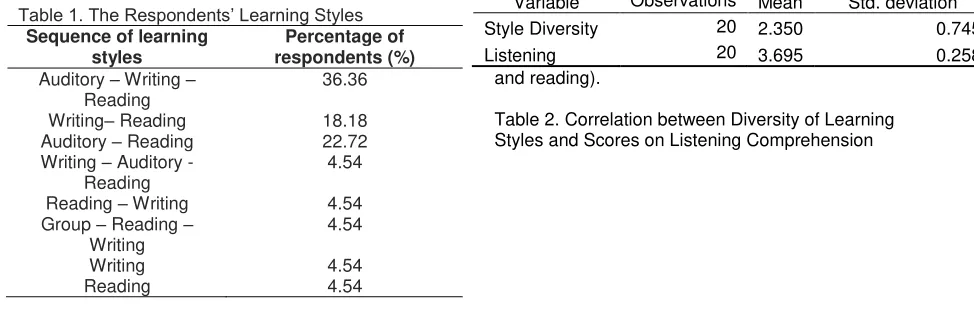
profile of Gen Y’s learning styles. The coding of the transcripts generated learning styles that respondents reported to have used. Most of them displayed sequences of learning styles as summed up in the Table 1.
Table 1. The Respondents’ Learning Styles
Sequence of learning styles
Percentage of respondents (%) Auditory – Writing –
Reading
36.36
Writing– Reading 18.18 Auditory – Reading 22.72 Writing – Auditory -
Reading
4.54
Reading – Writing 4.54 Group – Reading –
Writing
4.54
Writing 4.54
Reading 4.54
Sequence of learning styles
Percentage of respondents (%)
Total 100
A contrast appears when the above list is compared to a set of common characteristics of Millennial Generation as often cited in recent literature: visual, kinesthetic, lacking interpersonal skills, tendency to avoid reading, strong inclination toward image-rich materials, and interactivity (Weiler, 2004; Lower, 2007). They are also generally perceived as fast-paced, fun-seeking, technology savvy, but also stereotyped as technology dependent, having short attention span, and spoiled (Information Resources Management Association, 2014). Clearly the respondents demonstrate learning preferences which do not necessarily share much in common with the contemporary description of Millennial Generation’s learning style predispositions. These features hardly manifest in the respondents’ learning style profile as shown in Table 1. The respondents’ styles even bear close resemblance to those of Baby Boomers, who is described as preferring lectures, note-taking, and group discussions (Williams, 2013). The profile emerging from this study is also similar to another research by Li (2012) in Chinese context, which reports that Chinese college students prefer tactile, kinesthetic, and visual learning. Li (2012, p. 10) argued that the profile is shaped by a time-honored culture of learning in China where students listen to teachers’ instructions, reading books, and doing exercises under the teacher’s guidance; these comprise practices that are also predominant in the respondents’ academic environment of this current study. The notion that learning styles are shaped by the immediate teaching context is also borne out by previous research by Ajisukmo (1996) and Tulbure (2012).
The next section presents the findings that answers the second research objectives, namely to determine the relationship between the diversity of their learning styles and their academic achievements The achievements include their grades in four language skill courses (listening, writing, grammar,
and reading).
Table 2. Correlation between Diversity of Learning Styles and Scores on Listening Comprehension
Variable Observations Mean Std. deviation
Style Diversity 20 2.350 0.745
Variables Style Diversity Listening
Style Diversity 1 0.046
Listening 0.046 1
Values in bold are different from 0 with a significance level alpha=0.05
p =0.847
Table 3. Correlation between Diversity of Learning Styles and Scores on Writing
Variable
Values in bold are different from 0 with a significance level alpha=0.05
p = 0.377
Table 4. Correlation between Diversity of Learning Styles and Scores on Grammar
Variable
Values in bold are different from 0 with a significance level alpha=0.05
p= 0.947
Table 5. Correlation between Diversity of Learning Styles and Scores on Reading Comprehension
Variable
Values in bold are different from 0 with a significance level alpha=0.05
p = 0.445
As the tables show, there is no correlation between diversity of learning styles and their listening comprehension abilities ( p = 0.847), there is no correlation between diversity of learning styles and their grammar scores ( p = 0.947), there is no correlation between diversity of learning styles and writing abilities (p = 0.377), and between diversity of learning styles and reading comprehension skills (0.445).
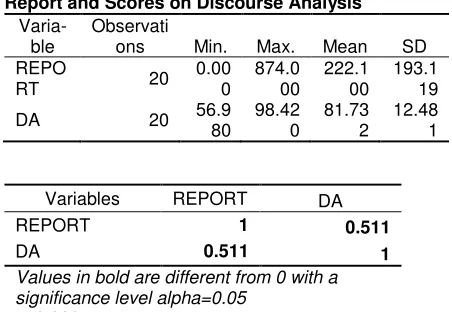
Finally, the following section presents the result to the last research objective, that is, to determine the relationship between the amount of their retrospective verbal report and their achievements in the content course they were taking, namely Discourse Analysis (shortened into “DA” in the following tables). It was conjectured that the richer the report and the deeper the description, the more aware they are of their learning styles, which then should correlate highly with their grades on the content subject. The finding can raise educators’ and learners’ awareness about the value of conscious strategy building in learning content subjects:
Table 6. Correlation between Amount of Verbal Report and Scores on Discourse Analysis
Varia-
Values in bold are different from 0 with a significance level alpha=0.05
p = 0.023
With p = 0.023, it is to be concluded that there is no correlation between the amount of verbal report and the scores on a content subject, i.e. Discourse Analysis.
DISCUSSION
It is apparent from the finding that the respondents’
nature of lecturing style, and the culture of learning that have long been ingrained in the respondents’ mind contribute to the profile of their learning styles. In this respect, this study is in line with that of Ajisukmo (1996), and a more recent one by Abidin et al. (2011) and Almutairi (2007). Abidin et al. (2011) identified visual and auditory as two major styles used by their respondents, and maintained that these learning styles are influenced by the predominant one-way lecture and the emphasis on discrete skill of listening to individual sounds in the target language. In
Almutairi’s study (2007) on the learning styles of Arabic students, it was found that the dominant learning style is memorization. She also contends that cultural background has a significant influence on the
students’ learning styles, a point which buttresses the
ongoing argument about the impact of culture on learning styles. Comparing the millennials with the older generation, DiLullo (2015, p. 13) contended that
“the learning style of the millennial generation may not
be as radically different from previous generations as
is often proposed.” The two authors argue that what makes them different from their predecessors is the media, not the activity. Thus, millennials still tend to read, but they do so with e-books rather than printed textbooks. Still, another study by Sugahara and Borland (2010) highlighted the difference between the collectivist Japanese students and individualistic Australian students in their learning styles. The former preferred watching, while the latter preferred doing. The authors ascribed this difference to the underlying cultural dimension of those two different groups of learners, thereby strengthening the notion that their respective culture casts a massive influence on their approach to learning. Charlesworth (2008) found that Indonesian students tended to be inclined toward reflectors learning style. As such, they tended to observe carefully and view an issue from different perspectives before deciding to apply or execute their plans. This seems to account for the predominant reading and writing styles that the respondents in my study exhibited during their classroom learning. Finally, one most recent study by Sikkema and Sauerwein (2015) suggested the existence of culture-specific learning styles that more or less shaped
learners’ learning styles. The respondents in my study may have been using learning styles which conform to their culture, and as such demonstrate styles that have long been common in Indonesian culture.
The analysis shows that there are no significant
correlations between the respondents’ learning styles
and their language skills. Several factors may have caused this result. First of all, there seems to be a significant difference in terms of the cognitive demand between learning language skills and learning a subject matter. With regard to this, Tomlinson (2016) proposed different cognitive demands: those that call for only familiar and oft-rehearsed materials, those that involve the transfer of new information which both the senders and receivers have never met before, and
those which require weighing up alternatives and proposing arguments against opposing views. The first type is undoubtedly typical of learning language elements, while the second and the third ones apparently characterize the learning of subject matters like the one leaned by the respondents in this study. This distinction has an important bearing on the styles that the learners performed during their learning. When engaged in learning language elements such as grammar or vocabulary, they may have been more inclined toward more verbal style and memorizing patterns and words. The discrete nature of the language elements may have prompted these learning styles. In contrast, as they shifted toward learning a content course, which is arguably of more integrative in nature, they apparently adjusted their learning styles, and hence reported a set of styles which feature the combination of visual, verbal, reading and writing. This could also be viewed as a piece of evidence that learning styles are to some extent shaped by the nature of the materials to be learned and the characteristics of the lecturing style.
The result is in line with a few previous studies. Aylin (2005) studied a group of Turkish students learning English as a foreign language and found that their logical-mathematical intelligence and visual style contribute most to their language proficiency. This implies that other styles like kinesthetic, auditory, and reading and writing are not strongly correlated with language proficiency. Jean and Simard (2013) conducted a study on the relationships between gains in a grammar course and learning styles. They found that learning styles do not correlate significantly with the gains in the grammar class. More importantly, they suggested that conscious learning is associated with a favorable attitude toward the lesson. Opportunities
which invoke students’ conscious learning quite
possibly also spur their desire to learn to the best of their abilities. Thus, this is a piece of empirical evidence that espouses the finding of this study. Another recent study by Srijongjai (2011) also found that Thailand learners studying English writing prefer social and aural styles, but did not find any
relationship between the two styles and the subjects’
writing skills. Still, another study which did not come from the field of language teaching, yet still bear some relevance is the one by Ghaffari et al. (2013). They found that even among a group of medical science students exhibiting a set of different learning styles (diverger, assimilator, converger and accommodator), there was no correlation with their GPAs in various courses. It is reasonable to conclude then that this absence of relationship between learning styles and achievements seems to apply across all disciplines.
semester may have changed in the course of their studies. The change may also have been partly prompted by the changing nature of the lessons they learned in the later semesters, as discussed in the previous point.
Third, it has long been known in a correlation analysis that data obtained through an objective measurement (e.g. a set of final test scores) will not correlate highly with data obtained through a more or less subjective measurement (i.e. self-reported styles). This is what apparently happened with the data in this study. The objectively generated grades in language skill courses do not correlate highly with the subjectively generated reports from the respondents.
Still another possible cause is the difference in when they learned the discrete language elements. Quite a handful authors have proposed different classifications of learning styles. Riding and Sadler-Smith (1997) proposed analyst-holist, field dependence – field independence, and verbalizer – visualizer. Felder and Silverman (1988) came up with sensory – intuitive, visual – verbal, inductive – deductive, active – reflective, and sequential – global. Finally, Kolb (cited in Tulbure, 2012) distinguishes learning styles according to two dimensions: perception (concrete and abstract), and processing (active experimentation, or reflective observation), which in turn generate four major styles: assimilator, convergers, divergers, and accommodators. Thus, there is a wider range of learning style classifications than the styles reported by the respondents. The narrow focus may have resulted in the low correlation index.
As the finding shows, there is a modest correlation between the amount of retrospective report and the respondents’ achievements in the subject equally enthusiastic when reporting their own learning styles. Conversely, those respondents who reported less substantially may happen to be lacking in studied the relationship between metacognitive strategies and academic achievements. They found that students with higher metacognitive strategies, i.e. those with higher awareness about their metacognitive strategies and show stronger initiative
in English learning, also tend to have better Thus, it makes sense from here to establish the strong connection between the amount of their report and their achievement in the subject matter that they were learning.
Indeed, a correlation cannot be used to establish a causal relationship between the variables. Nevertheless, it can still serve as a foundation on which a prediction concerning the relationship of two variables can be proposed. Thus, learners who are made to be aware of their own styles and are more articulate when reporting their styles may have a higher possibility of making higher achievements.
CONCLUSION
The paper reports an investigation into the learning styles of 22 EFL learners in their twenties, and compares the styles to the characteristics of Millennial Generation as widely discussed in the literature. The study also looked into the relationship between the quality of their learning styles and their achievements on the content subject they were taking, and scores on their other language skills subjects. The results of the analysis show that their learning styles are different from what has been commonly believed as typical of Millennial Generation. Quite possibly their learning styles are shaped by the local culture and dominant instructional approaches. Also, no substantial correlations are found among the quality of their learning styles and listening, writing, grammar, and reading abilities. The changes of their learning styles over time, the nature of the data, and the limited scope of the styles that were elicited from the respondents may have accounted for the low correlations. Finally, there is a modest correlation between the amount of their verbal report and their achievement in the content course they were taking. An explanation that can be offered about this result is that the high-achieving students may be those who are more aware and more motivated to generate longer report.
REFERENCES
Abidin, M. J. Z., Rezzaee, A. A., Abdullah, H. N., and Singh, K. K. B. (2011). Learning styles and overall academic achievement in a specific educational system. International Journal of Humanities and Social Science. 1 (10), 143– 152.
Ajisukmo, C. R. P. (1996). Self-regulated learning in Indonesian higher education. Jakarta: Atma Jaya Research Centre.
Almutairi, N. H. (2007). The influence of educational and sociocultural factors on the learning styles and strategies of female students in Saudi Arabia (Unpublished dissertation). School of Education, University of Leicester, England. Aylin, T. (2005). Styles and multiple intelligences and
their effects on English proficiency of Turkish young adults (Unpublished thesis). The Graduate School Of Informatics Of The Middle East Technical University.
Charlesworth, Z. (2008). Learning styles across cultures: Suggestions for educators. Education & Training, 50, 2, 127 – 155.
DiLullo, C. (2015). Learners of a new generation. In L.K. Chan and W. Pawlina (eds.), Teaching anatomy: A practical guide (pp. 11-21). Switzerland: Springer International Publishing. DOI 10.1007/978-3-319-08930-0_2
Durning, A. J. Artino A. R. Jr, Beckman T. J, Graner J., van der Vleuten C., Holmboe E, & Schuwirth L. (2013). Does the think-aloud protocol reflect thinking? Exploring functional neuroimaging differences with thinking (answering multiple choice questions) versus thinking aloud. Med Teach, 35(9), pp. 720-726.
Felder, R. M., & Henriques, E. R. (1995). Learning and teaching styles in foreign and second language education. Foreign Language Annals, 28(1), 21-31.
Felder, R. M., & Silverman, L. (1988). Learning and teaching styles in engineering education.
Engineering Education, 78 (7), 674 – 681. Ghaffari, R., Ranjbarzadeh, F. S., Azar, E. F., &
Hassanzadeh, S. (2013). The analysis of learning styles and their relationship to academic achievement in medical students of basic sciences program. Research and Development in Medical Education, 2(2), pp. 73-76
Huit, W. (2001). Humanism and open education. Educational Psychology Interactive. Valdosta, GA. Retrieved 14 September 2013 from http://www.edpsycinteractive.org/topics/affect/h umed.html
Jaish, M. A. (2010). The relationship among learning styles, language learning strategies, and the academic achievement among the English majors at Al-Aqsa University (Unpublished Master’s thesis). The Islamic University of Gaza Deanery of Graduate Studies, Palestine.
Jean, G., & Simard, D. (2013). Deductive versus inductive grammar instruction: investigating possible relationships between gains, preferences and learning styles. System41, 1023 – 1042. the relationship between metacognitive strategies and online-learning behavior & test achievements. Journal of Language Teaching and Research, 2(1), 183-187.
Lower, J. (2007). Brace yourself: here comes Generation Y. Critical Care Nurse, 28(5), 80-85. Mayer, R. E. (2001). Multimedia learning. New York:
Cambridge University Press.
Reid, J. (ed.) (2002). Learning styles in the ESL/EFL classroom. Beijing: Beijing Foreign Language Teaching and Research Press.
Riding, R. J., & Sadler-Smith, E. (1997). Cognitive style and learning strategies: Some implications for training design. International Journal of Training and Development, 1(3), 199 – 208.
Sikkema, S. E., & Sauerwein, J. A. (2015). Exploring culture-specific learning styles in accounting education. Journal of International Education in Business, 8, 2, 78 – 91.
Srijongjai, A. (2011). Learning styles of language learners in an EFL writing class. Procedia - Social and Behavioral Sciences, 29, 1555 – 1560.
Sugahara, S., & Boland, G. (2010). The role of cultural factors in the learning style preferences of accounting students: a comparative study between Japan and Australia. Accounting Education, 19(3), 235 - 255.
Tomlinson, B. (2016). SLA research and materials development for language learning. New York: Routledge.
Tulbure, C. (2012). Investigating the relationships between teaching strategies and learning styles in higher education. Acta Didactica Napocensia,
5(1), 65-75.
Weiler, A. (2004). Information-seeking behavior in Generation Y students: motivation, critical thinking, and learning theory. The Journal of Academic Librarianship, 31(1), 46-53.
Wessels, P. L., & Steenkamp, L. P. (2009). Generation Y students: appropriate learning styles and teaching approaches in the economic and management sciences faculty. South African Journal of Higher Education, 23(5), 78 – 86.
Williams, J. C. (2013). Generational perspective of online higher education student learning styles
Young, A., & Fry, J. D. (2008). Metacognitive awareness and academic achievement in