Botnets
Cross Site Scripting Attacks
Physical and Logical Security Convergence
PCI Compliance
Asterisk and VoIP Hacking
Social Engineering
Infosecurity
2008 Threat
Analysis
FOREWORD BY RICHARD FORD IN F O S E C U R IT Y MAG A Z I N E BOA R D ME M B E R
Your One-Stop Reference Containing the
Most Read Topics in the Infosecurity Security Library
“Makers”) of this book (“the Work”) do not guarantee or warrant the results to be obtained from the Work. There is no guarantee of any kind, expressed or implied, regarding the Work or its contents.The Work is sold AS IS and WITHOUT WARRANTY.You may have other legal rights, which vary from state to state.
In no event will Makers be liable to you for damages, including any loss of profits, lost savings, or other incidental or consequential damages arising out from the Work or its contents. Because some states do not allow the exclusion or limitation of liability for consequential or incidental damages, the above limitation may not apply to you.
You should always use reasonable care, including backup and other appropriate precautions, when working with computers, networks, data, and files.
Syngress Media®, Syngress®,“Career Advancement Through Skill Enhancement®,”“Ask the Author UPDATE®,” and “Hack Proofing®,” are registered trademarks of Elsevier, Inc.“Syngress:The Definition of a Serious Security Library”™,“Mission Critical™,” and “The Only Way to Stop a Hacker is to Think Like One™”are trademarks of Elsevier, Inc. Brands and product names mentioned in this book are trademarks or service marks of their respective companies.
PUBLISHED BY Syngress Publishing, Inc. Elsevier, Inc.
30 Corporate Drive Burlington, MA 01803
Infosecurity 2008 Threat Analysis
Copyright © 2008 by Elsevier, Inc. All rights reserved. Printed in the United States of America. Except as permitted under the Copyright Act of 1976, no part of this publication may be reproduced or distributed in any form or by any means, or stored in a database or retrieval system, without the prior written permission of the publisher, with the exception that the program listings may be entered, stored, and executed in a computer system, but they may not be reproduced for publication.
Printed in the United States of America 1 2 3 4 5 6 7 8 9 0
ISBN-13: 978-1-59749-224-9
Publisher: Amorette Pedersen Page Layout and Art: Patricia Lupien Cover Designer: Michael Kavish Indexer: Edmund J. Rush
Acknowledgments
v
Syngress would like to acknowledge the following people for their kindness and sup-port in making this book possible.
Greg Valero and the team at Infosecurity magazine for their willingness to try and work with the “new kids on the block.” Good things will happen because of Greg’s entrepreneurial approach to publishing and sales.
Steve Mathieson at Infosecurity for providing an additional platform for Syngress/Elsevier authors and for helping us pull together this book.
vii
Foreword
Dr. Richard Fordgraduated from the University of Oxford in 1992 with
a D.Phil. in Quantum Physics. Since that time, he has worked extensively in the area of computer security and malicious mobile code prevention. Previous projects include work on the Computer Virus Immune System at IBM Research, and development of the world’s largest web hosting system whilst Director of Engineering for Verio. Ford is currently an Associate Professor at Florida Institute of Technology, and director of the University’s Center for Security Science. His research interests include Biologically-inspired Security Solutions, Rootkit detection, Behaviorally-based Worm Prevention, Development of Meaningful Security Metrics and Computer Forensics. Ford is currently Executive Editor of Reed-Elsevier’s Computers & Security,Virus Bulletinand co-editor of a column in IEEE Security & Privacy with Michael Howard. Dr. Ford lives with his wife Sarah in Florida.
Champ Clark III (Da Beave)has been involved in the technology
industry for 15 years. Champ is currently employed with Vistech
Communications, Inc. providing network support and applications develop-ment. Champ is also employed with Softwink, Inc. which specialized in security monitoring for the financial industry. Champ is one of the founding members of “Telephreak”, an Asterisk hobbyist group, and the Deathrow OpenVMS cluster. When he’s not ripping out code or writing papers, he enjoys playing music and traveling.
viii
network consulting company specializing in VoIP, WLAN, and security. An accomplished author, he contributed to Syngress’s Managing Cisco Secure Networks(ISBN: 1931836566);Skype Me! (ISBN: 1597490326);Practical VoIP Security (ISBN: 1597490601);Configuring Check Point NGX VPN-1/FireWall-1 (ISBN: 1597490318);Configuring Juniper Networks NetScreen and SSG Firewalls (ISBN: 1597491187); and Essential Computer Security: Everyone’s Guide to Email, Internet, and Wireless Security (ISBN: 1597491144). He is the author of Building a VoIP Network with Nortel’s MS5100(ISBN: 1597490784), and he has coauthored or ghostwritten 11 other technology books on VoIP, WLAN, security, and optical technologies.
Larry has over 29 vendor certifications from companies such as Nortel, Cisco Avaya, Juniper, PMI, isc2, Microsoft, IBM, VMware, and HP. Larry has been a principal architect designing VoIP, security, WLAN, and optical net-works in 22 countries for many Fortune 100 companies. He is viewed by his peers as one of the most well respected experts in the field of VoIP and security in the world. Larry has spent countless hours teaching and con-ducting seminars/workshops around the world in the field of voice/VoIP, security, and wireless networks. Larry is currently working on a follow-up to Building a VoIP Network with Nortel’s MCS 5100as well as new books on Cisco VoIP networks, practical VoIP case studies, and WAN acceleration with Riverbed.
Dr. Anton Chuvakin, GCIA, GCIH, GCFA (http://www.chuvakin.org) is
ix
Jason Chan for his help reviewing my chapters’ contents. Finally, Anton would like to dedicate his book chapters to his lovely wife, Olga.
Scott Paladino (CISSP) is a security architect with EDS (www.eds.com),
a leading global technology services company. He is the Engineering Organization Leader at EDS supporting identity, access, and other security solutions across a variety of industries. Scott resides in metro Detroit with his wife Linda and his two daughters, to whom he owes pretty much everything.
Dan Dunkelbrings over 22 years of successful sales, management, and
executive experience in the information technology industry to a con-sulting practice focused on the emerging field of security convergence. His background includes domestic and international responsibilities for direct sales organizations, value added reseller channels, and OEM contracts. His product knowledge spans enterprise software, server architectures, and networking technologies. Dan’s employment history includes senior roles in pre-IPO ventures, mid cap IT manufacturers, and Fortune 50 organizations. His firm, New Era Associates, is a privately held consultancy specializing in sales strategy and business partner development between IT and physical security vendors and integrators. NEA client’s range from Fortune 500 enterprises to privately funded and venture backed start-ups. All share a common interest in collaborating on integrated security solutions deployed within the framework of an enterprise policy.The goal is to accelerate secu-rity deployments to defend organizations against both traditional business risk and new global threats.
x
where he oversees the research & development of security products for mobile platforms. Seth has co-authored several books, such as Maximum Wireless Security, Aggressive Network Self Defense, Security Warrior,and even contributed to PSP Hacks.Seth also writes articles for various online resources, including Pearson Education’s InformIT.com where he is acting co-host for their security section. In addition, and as time permits, Seth provides training on wireless and web application security and speaks at IT and security related conferences and seminars, such as Blackhat, Defcon, and RSA.
Michael Gregg is the President of Superior Solutions, Inc. and has more
than 20 years’ experience in the IT field. He holds two associate’s degrees, a bachelor’s degree, and a master’s degree and is certified as CISSP, MCSE, MCT, CTT+, A+, N+, Security+, CNA, CCNA, CIW Security Analyst, CCE, CEH, CHFI, CEI, DCNP, ES Dragon IDS, ES Advanced Dragon IDS, and TICSA.
Michael’s primary duties are to serve as project lead for security assess-ments helping businesses and state agencies secure their IT resources and assets. Michael has authored four books, including:Inside Network Security Assessment,CISSP Prep Questions,CISSP Exam Cram2, and Certified Ethical Hacker Exam Prep2. He has developed four high-level security classes, including Global Knowledge’s Advanced Security Boot Camp, Intense School’s Professional Hacking Lab Guide, ASPE’s Network Security Essentials, and Assessing Network Vulnerabilities. He has created over 50 articles featured in magazines and Web sites, including Certification Magazine, GoCertify,The El Paso Times, and SearchSecurity.
xi
the Chief Technology Officer. Prior to WhiteHat, Jeremiah was an informa-tion security officer at Yahoo! responsible for performing security reviews on the company’s hundreds of websites. As one of the world’s busiest web properties, with over 17,000 web servers for customer access and 600 web-sites, the highest level of security was required. Before Yahoo!, Jeremiah worked for Amgen, Inc. A 6-year security industry veteran, Jeremiah’s research has been featured in USA Today, NBC, and ZDNet and touched all areas of web security. He is a world-renowned leader in web security and frequent speaker at the Blackhat Briefings, NASA,Air Force and Technology Conference, Washington Software Alliance, ISSA, ISACA and Defcon. Jeremiah has developed the widely used assessment tool “WhiteHat Arsenal,” as well as the acclaimed Web Server Fingerprinter tool and tech-nology. He is a founder of the Website Security Consortium (WASC) and the Open Website Security Project (OWASP), as well as a contributing member of the Center for Internet Security Apache Benchmark Group.
Robert “RSnake” Hansen (CISSP) is the Chief Executive Officer of
SecTheory. SecTheory is a web application and network security consulting firm. Robert has been working with web application security since the mid 90s, beginning his career in banner click fraud detection at ValueClick. Robert has worked for Cable & Wireless heading up managed security ser-vices, and eBay as a Sr. Global Product Manager of Trust and Safety,
focusing on anti-phishing, anti-cross site scripting and anti-virus strategies. Robert also sits on the technical advisory board of ClickForensics and con-tributes to the security strategy of several startup companies. Before
xii
London, United Kingdom. His day-to-day work involves identifying vul-nerabilities, building attack strategies and creating attack tools and penetra-tion testing infrastructures. Petko is known in the underground circles as pdp or architect but his name is well known in the IT security industry for his strong technical background and creative thinking. He has been working for some of the world’s top companies, providing consultancy on the latest security vulnerabilities and attack technologies. His latest project, GNUCI-TIZEN (gnucitizen.org), is one of the leading web application security resources on-line where part of his work is disclosed for the benefit of the public. Petko defines himself as a cool hunter in the security circles.
Anton Rager is an independent security researcher focused on
vulnera-bility exploitation, VPN security and wireless security. He is best known for his WEPCrack tool, but has also authored other security tools including XSS-Proxy,WEPWedgie, and IKECrack. He has presented at Shmoocon, Defcon,Toorcon, and other conferences, and was a contributing technical editor to the book Maximum Wireless Security.
Craig A. Schiller (CISSP-ISSMP, ISSAP) is the Chief Information
Security Officer for Portland State University and President of Hawkeye Security Training, LLC. He is the primary author of the first Generally Accepted System Security Principles. He was a coauthor of several editions of the Handbook of Information Security Management and a contributing author to Data Security Management. Craig was also a contributor to Combating Spyware in the Enterprise(Syngress, ISBN: 1597490644) and Winternals Defragmentation, Recovery, and Administration Field Guide(Syngress, ISBN: 1597490792). Craig was the Senior Security Engineer and
Chapter 2 Botnets Overview . . . 25
Backdoors Left by Trojan Worms or Remote Access Trojans . . . .29
Chapter 4 XSS Theory. . . 81
Introduction . . . .82
Getting XSS’ed . . . .82
Non-persistent . . . .83
DOM-based . . . .87
Persistent . . . .89
DOM-based XSS In Detail . . . .89
Identifying DOM-based XSS Vulnerabilities . . . .90
Exploiting Non-persistent DOM-based XSS Vulnerabilities . . . .94
Exploiting Persistent DOM-based XSS Vulnerabilities . . .96
Preventing DOM-based XSS Vulnerabilities . . . .98
Redirection . . . .100
Redirection Services . . . .104
Referring URLs . . . .105
CSRF . . . .107
Flash, QuickTime, PDF, Oh My . . . .111
Playing with Flash Fire . . . .112
Hidden PDF Features . . . .119
QuickTime Hacks for Fun and Profit . . . .130
Backdooring Image Files . . . .135
HTTP Response Injection . . . .137
Source vs. DHTML Reality . . . .139
Bypassing XSS Length Limitations . . . .145
XSS Filter Evasion . . . .147
When Script Gets Blocked . . . .153
Browser Peculiarities . . . .164
CSS Filter Evasion . . . .166
XML Vectors . . . .168
Attacking Obscure Filters . . . .169
Encoding Issues . . . .170
Summary . . . .173
Solutions Fast Track . . . .173
Chapter 5 XSS Attack Methods . . . 177
Part III Physical and Logical Security Convergence . . . . 205
Chapter 6 Protecting Critical Infrastructure: Process Control and SCADA . . . 207
Introduction . . . .208
Technology Background: Process Control Systems . . . .209
Real-Life Examples . . . .243
PCI Requirement 3: Protect Stored Cardholder Data . . . . .281
File- or Folder-level Encryption . . . .282
Full Disk Encryption . . . .283
Implications . . . .284
Database (Column-level) Encryption . . . .285
Overview . . . .287
Other Encryption Method Considerations . . . .287
PCI Requirement 4—Encrypt Transmission of Cardholder Data Across Open, Public Networks . . . .288
Requirement 4.1—Cryptography and Protocols . . . .288
SSL/TLS . . . .288
Provide Ability to Restrict Access to Cardholder Data or Databases . . . .293
Step 2—Identify Where the Sensitive Data is Located . .296 Step 3—Determine Who and What Needs Access . . . .296
Step 4—Develop Policies Based On What You Have Identified . . . .297
The Absolute Essentials . . . .297
Keep Cardholder Storage to a Minimum . . . .297
Do Not Store Sensitive Authentication Data Subsequent to Authorization . . . .297
Mask the PAN When Displayed . . . .298
Render PAN (at Minimum) Unreadable Anywhere it is Stored . . . .298 Protect Encryption Keys Used for Encryption of
Summary . . . .299
Solutions Fast Track . . . .299
Frequently Asked Questions . . . .301
Part V Asterisk and VoIP Hacking . . . 303
Chapter 10 Understanding and Taking Advantage of VoIP Protocols . . . 305
Extracting the VoIP Data with Wireshark (Method # 1) . . . .315
Legalities and Tips . . . .370
World Wide Web, E-mail, and Instant Messaging . . . . .397
Trojan Horses and Backdoors . . . .397
Education,Training, and Awareness Programs . . . .404
Regulatory Requirements . . . .409
Privacy Laws . . . .409
Corporate Governance Laws . . . .412
Making the Case for Stronger Security . . . .416
Risk Management . . . .416
Asset Identification and Valuation . . . .417
Threat Assessment . . . .418
Impact Definition and Quantification . . . .421
Control Design and Evaluation . . . .421
Residual Risk Management . . . .421
People Layer Security Project . . . .422
Orangebox Phreaking . . . .422
Summary . . . .424
Solutions Fast Track . . . .424
Frequently Asked Questions . . . .425
The expression tempus fugit(essentially, time flies) brings to my mind vivid memories of
studying Latin at school twenty-something years ago.The very fact that these memories are over two decades old is a perfect illustration: time really does fly.Thinking back to that class, the idea that a book on computer security would ever make it to a general bookstore would have brought amazement to my classmates. Zombie computers attacking businesses? Science fiction! A popular book that teaches how to handle credit cards securely? Who could ever need such a thing!
Of course, from the fact that you’re reading this, you understand who needs it.You do. If you’ve already purchased this book, congratulations – you’ve taken a critical step toward staying current in an endlessly-churning environment. If you’re leafing through the ever-expanding “security” or “web” section of your local bookstore wondering if this book is for you, please read on. Put into practice, the information here could save your business, your money, or (last but not least) your reputation.
E-commerce, the ubiquity of the Internet, and the World Wide Web have changed society in ways in which we are only just beginning to quantify. In today’s world, not only is time money, but information is, too. Even as I write this, goods ordered online are on their way to me from locations unknown; money and materials have changed hands – all I needed was a few short numbers to make it happen. Information is the key, but as our information systems evolve so do the threats they face.
If there is anything predictable about computing, it is that the electronic world is con-stantly off-balance. In a scant handful of years, technology has become an enabler for busi-nesses, services and communities that would have seemed like pure fantasy two decades ago. These innovations are exciting; they shape society and groups. However, as they have grown so has their darker, malevolent twin: for every development, there exist those who seek to
Foreword
gain somehow from it or its users at any cost.The only defense is knowledge. When you awake tomorrow morning there will be a whole new set of threats to deal with. Do you know what direction they are likely to take?
In this book you will learn what new trends are on the horizon, and what areas are cur-rently deserving of more attention.The contents represent the most read topics in the Infosecurity Security Library – as such, they are the subjects that your peers judged the most relevant.These are the issues forward-looking defenders are thinking about.
For example, what is the impact of the rise of Botnets on you, both at home and at work? Are you or your customers vulnerable to Cross Site Scripting? Is your critical infras-tructure safe from a well-motivated attacker? How about your SCADA systems? Are your procedures for handling Credit Card information as good as they can be? The amount of raw information out there is overwhelming, and with the rapid evolution in technology, people are often too busy cleaning up from yesterday’s fires to prepare for the fires of tomorrow, but prepare you must.The first step is to digest the issues and break them down. Here, that work has been done for you.
Learning about emergent threats is important, but only if that learning can be turned into useful action. Security flaws in your business are a sleeping giant that could awaken at any moment.They may lay dormant for days, months or even years, but know this: attackers are continually testing your defenses. Sooner or later, someone will find that flaw; better to accept that eventuality before it becomes a reality.The authors of this book have gone to great length to provide for practical steps you can take to help reduce your risk of becoming the next victim. Put them into practice.
Tempus fugit… time flies… but people remain the same. No matter how far technology
takes us, there will always be a subset of people who will seize any available opportunity for their own ends.Time has moved on; technology has moved on; the threat has moved on.
Locks and bars may have once kept the wily thief out, but new environments require new countermeasures. Ignoring the problem, or using yesterday’s solution and blindly hoping all is well is naïve at best (and potentially actionable at worst!). For as long as there is money to be made, some will turn to crime online: when it comes to people, there really is nothing new under the sun.To understand how to cope with that… well, that’s the remainder of the book.
Part I: Botnets
3
Botnets:
A Call to Action
Solutions in this chapter:
■ The Killer Web App ■ How Big Is the Problem? ■ The Industry Responds
Chapter 1
Summary
Solutions Fast Track
Introduction
Throughout 2006, technical security conferences have been discussing the latest “killer Web app.” Unfortunately, this Web technology works for the bad guys. With funding from orga-nized crime and spam lords, a generation of talented hackers without morals has created a devastating arsenal of deadly toys, in the form of botnets. Norman Elton and Matt Keel from the College of William & Mary in the 2005 presentation “Who Owns Your Network?” called bot networks “the single greatest threat facing humanity.”This may be an exaggera-tion, but Botnets are arguably the biggest threat that the Internet community has faced. John Canavan, in a whitepaper titled “The Evolution of Malicious IRC Bots,” says that Botnets are “the most dangerous and widespread Win32 viral threat.” According to the cover of eWEEK magazine for October 16, 2006, we are “Losing the Botnet War.”The article by Ryan Naraine titled “Is the Botnet Battle Already Lost?” describes the current state of the Botnet environment: Botnets are “the key hub for well-organized crime rings around the globe, using stolen bandwidth from drone zombies to make money from nefarious Internet activity.” (for more information, go to www.eweek.com/article2/
0,1895,2029720,00.asp.) By contrast the security response is in its infancy with several ven-dors releasing version 1 of botnet-related products. Badly needed intelligence information is locked away with only the slightest means of communicating it to the security professionals that need it.There isn’t any such thing as an information security professional security clear-ance. One vendor told us that the quality of their product depends on the quality of their intelligence sources and then went on to say that they could give us no information that could vouch for the quality of their intelligence sources.
This book will attempt to add new soldiers and new weapons to the battle. In doing so, the authors hope to stem the tide of lost morale and help security professionals regain focus. It is necessary to lay a foundation for deeper discussions.
This chapter describes the current state and how we got to this place. We come from many levels and as such we must start from the very beginning. What is a botnet? In its sim-plest form, it is an army of compromised computers that take orders from a botherder. A botherder is an immoral hacker who uses the botnet for financial gain or as a weapon against others.
The Killer Web App
How does this make a botnet a “killer Web app?”The software that creates and manages a botnet makes this threat much more than the previous generation of malicious code. It is not just a virus; it is a virus of viruses.The botnet is modular—one module exploits the vul-nerabilities it finds to gain control over its target. It then downloads another module that protects the new bot by stopping antivirus software and firewalls; the third module may begin scanning for other vulnerable systems.
A botnet is adaptive; it can be designed to download different modules to exploit spe-cific things that it finds on a victim. New exploits can be added as they are discovered.This makes the job of the antivirus software much more complex. Finding one component of a botnet does not imply the nature of any of the other components because the first compo-nent can choose to download from any number of modules to perform the functionality of each phase in the life cycle of a botnet. It also casts doubt on the capability of antivirus soft-ware to claim that a system is clean when it encounters and cleans one component of a multicomponent bot. Because each component is downloaded when it is needed after the initial infection, the potential for a system to get a zero day exploit is higher. If you are in an enterprise setting, you take the risk of putting a bot back into circulation if the effort to clean the malicious code isn’t comprehensive. Rather than take that risk, many IT depart-ments opt to re-image the system from a known clean image.
Botnet attacks are targetable.That is, the hacker can target a company or a market sector for these attacks. Although botnets can be random, they can also be customized to a selected set of potential hosts.The botherder can configure the bot clients to limit their scanning to hosts in a defined set of Internet Protocol (IP) addresses. With this targeting capability comes the capability to market customized attacks for sale.The targeting capability of botnets is adaptive as well.The bot client can check the newly infected host for applications that it knows how to exploit. When it determines that the host owner is a customer of, for
How Big Is the Problem?
The latest Internet Threat report (Sept 2006) released by Symantec states that during the six-month period from January to June 2006 Symantec observed 57,717 active bot network computers per day. Symantec also stated that it observed more than 4.5 million distinct, active bot network computers. From our experience in an academic environment, many bots we saw were not usually detected until the botherder had abandoned the computer. As soon as the bot client stopped running, the remnants were detected.This is to say, the actual number is much larger than what Symantec can report. Recall that one of the bot client modules is supposed to make the antivirus tool ineffective and prevent the user from con-tacting the antivirus vendor’s Web site for updates or removal tools.
The November 17 issue of E-WEEK’s online magazine featured the news that the
recent surge in penny stock and penile enhancement spam was being carried out by a 70,000-member botnet operated by Russian botherders. If left unabated, the botnet plague could threaten the future of the Internet, just as rampant crime and illegal drug use con-demn the economic future of real neighborhoods.
Examine the extraordinary case documented by McAfee in its white paper,“Killing Botnets—A view from the trenches,” by Ken Baylor and Chris Brown. Even though the conclusion of the paper is clearly a sales pitch, the case it documents is real and potentially prophetic. In March of 2006, McAfee was called in to, in essence, reclaim a Central American country’s telecommunications infrastructure from a massive botnet. In the first week of the engagement McAfee documented 6.9 million attacks of which 95 percent were Internet Relay Chat (IRC) bot related.The national telco reported the following resulting problems:
■ Numerous network outages of up to six hours ■ Customer threats of lawsuits
■ Customer business disruptions
■ Lengthy outages of bank ATM service
Consider the power in one botnet attack alone, the distributed denial-of-service (DDoS) attack. A small botnet of 10,000 bot clients with, conservatively, 128Kbps broadband upload speed can produce approximately 1.3 gigabits of data per second. With this kind of power, two or three large (one million plus) botnets could, according to McAfee,“threaten the national infrastructure of most countries.” Individually, these large botnets are probably pow-erful enough to take down most of the Fortune 500 companies.
A Conceptual History of Botnets
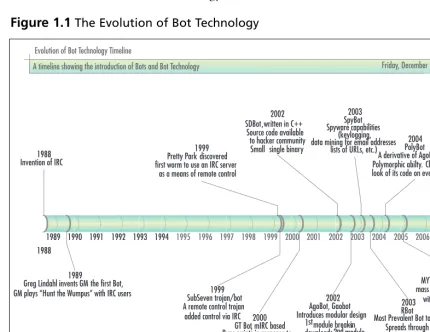
Like many things on the Internet today, bots began as a useful tool without malicious over-tones. Bots were originally developed as a virtual individual that could sit on an IRC channel and do things for its owner while the owner was busy elsewhere. IRC was invented in August of 1988 by Jarkko “WiZ” Oikarinen of the University of Oulu, Finland. Figure 1.1 traces the evolution of bot technology.
Figure 1.1The Evolution of Bot Technology
1988 2006
1989 1990 1991 1992 1993 1994 1995 1996 1997 1998 1999 2000 2001 2002 2003 2004 2005 2006 Friday, December 29, 2006 Evolution of Bot Technology Timeline
A timeline showing the introduction of Bots and Bot Technology
2004 PolyBot A derivative of AgoBot with Polymorphic abilty. Changes the look of its code on every infection 1988
Invention of IRC
1989
Greg Lindahl invents GM the first Bot, GM plays “Hunt the Wumpus” with IRC users
1999 Pretty Park discovered first worm to use an IRC server
as a means of remote control
1999 SubSeven trojan/bot A remote control trojan
added control via IRC 2000 GT Bot, mIRC based Runs scripts in response to
IRC server events Supports raw TCP and UDP
Socket connections 2nd module turns off anti virus
Hides from detection, downloads 3rd module
Module 3 has attack engines/payload data mining for email addresses
GM
The original IRC bot (or robot user), called GM according to Wikipedia, was developed the next year, in 1989, by Greg Lindahl, an IRC server operator.This benevolent bot would play a game of Hunt the Wumpus with IRC users.The first bots were truly robot users that appeared to other IRC netizens as other users. Unlike today’s bot net clients (robots), these robots were created to help a user enjoy and manage their own IRC connections.
From this simple example, other programmers realized they could create robot users to perform many tasks currently done by humans for both users and the IRC operator, such as handling tedious 24-hour-a-day requests from many users. An important bot development was the use of bots to keep a channel open and prevent malicious users from taking over the channel when the operator was busy doing other things. In order to assist the IRC operator, bots needed to be able to operate as a channel operator.The bots had evolved from being code that helps a single user to code that manages and runs IRC channels as well as code that provides services for all users.Serviceis the term used for functionality that is offered by
server-side bots as opposed to client-side bots. Around this time, some IRC servers and bots began offering the capability to make OS shell accounts available to users. The shell account permits users to run commands on the IRC host. Wikipedia notes that “a lot of shell
providers disappear very fast because of abusive behavior of their members.”
Pretty Park
In May 1999, Pretty Park, a bot client written in Delphi, was discovered. PrettyPark, according to “The Evolution of Malicious IRC Bots,” a Symantec white paper authored by John Canavan, had several functions and concepts that are common in today’s bots,
including:
■ The capability to retrieve the computer name, OS version, user information, and
other basic system information.
■ The capability to search for and retrieve e-mail addresses and ICQ login names ■ The capability to retrieve usernames, passwords, and dial-up network settings ■ The capability to update its own functionality
■ The capability to upload/download files ■ The capability to redirect (tunnel) traffic
SubSeven Trojan/Bot
By the late 1990s, a few worms (such as IRC/Jobbo) had exploited vulnerabilities in IRC clients (particularly mIRC) that let the clients be remote controlled via a “backdoor.” In June, 1999, version 2.1 of the SubSeven Trojan was released.This release was significant in that it permitted a SubSeven server to be remotely controlled by a bot connected to an IRC server.This set the stage for all malicious botnets to come. SubSeven was a remote-con-trolled Trojan, also written in Delphi, touted by its author as a remote administration tool. Its toolset, however, includes tools a real administrator would not use, such as capabilities to steal passwords, log keystrokes, and hide its identity. SubSeven gave bot operators full administra-tive control over infected systems.
GT Bot
A botnet client based on the mIRC client appeared in 2000. It is called Global Threat (GT) Bot and was written by Sony, mSg, and DeadKode. mIRC is an IRC client software
package. mIRC has two important characteristics for botnet construction: it can run scripts in response to events on the IRC server, and it supports raw TCP and UDP socket connec-tions.
GT bot had the following capabilities:
■ Port Scanning It can scan for open ports. ■ Flooding It can conduct DDoS attacks.
■ Cloning A clone is any connection to an IRC server over and above the first
connection.
■ BNC (Bounce) A method for anonymizing Bot client access to a server.
Today, all variations of bot technology that are based on mIRC are said to be members of the GT Bot family.These bot clients did not include a mechanism for spreading itself directly. Instead, they would use variations on social engineering ploys. A common ploy used to infect systems was an e-mail that claimed to be from a security vendor. If the user clicked on the embedded link they were taken to a Web site that delivered the client to the victim. These early botnet clients were not modular, but rather were all contained in a single package.
SDBot
pub-lished a Web page, and provided e-mail and ICQ contact information.This made it acces-sible to many hackers. It was also easy to modify and maintain. As a result, many subsequent bot clients include code or concepts from SDBot. SDBot produced a small single binary file that contained only 40KB of code.
A major characteristic of the SDBot family is the inclusion and use of remote control backdoors.
SDBot family worms spread by a variety of methods, including:
■ NetBios (port 139) ■ NTPass (port 445) ■ DCom (ports 135, 1025) ■ DCom2 (port 135)
■ MS RPC service and Windows Messenger port (TCP 1025)
■ ASN.1 vulnerability, affects Kerberos (UDP 88), LSASS.exe, and Crypt32.dll (TCP
ports 135, 139, 445), and IIS Server using SSL
■ UPNP (port 5000)
The SDBot exploits two server application vulnerabilities: WebDav (port 80) and MSSQL (port 1433). It exploits two third-party application vulnerabilities: DameWare remote management software (port 6129) and Imail IMAPD Login username vulnerability (port 143). It also exploits the following Cisco router vulnerability: CISCO IOS HTTP authorization (Port 80) vulnerability.
The following backdoors are exploited by SDBot:
■ Optix backdoor (port 3140) ■ Bagle backdoor (port 2745) ■ Kuang backdoor (port 17300) ■ Mydoom backdoor (port 3127) ■ NetDevil backdoor (port 903) ■ SubSeven backdoor (port 27347)
If an exploit is successful, the worm creates and runs a script that downloads SDBot onto the new victim and executes it. Once executed, the new victim is infected. Note that many of these attacks are still used today, especially brute force and password guessing attacks targeted at ports 139, 445, and 1433.
Today, variants are spread by many other means including spam attacks in Instant
sites. In 2002, the motivation for SDBot was to build a capability to launch DoS attacks. In November 2006, Panda labs reported that SDBot.ftp.worm, a component of SDBot, was the most frequently detected virus.This is a testament to the staying power and adaptability of this approach.The June 2006 Microsoft report about the Malicious Software Removal Tool listed the SDBot as having been detected on 678,000 infected PCs, the second-highest total.
Agobot
Agobot (aka Gaobot) arrived in 2002 and added modular design and significant functionali-ties. By modular design, we mean that Agobot does not infect a system with the entire bot code at one time. Agobot has three modules.
1. The initial module delivered contains the IRC bot client and the remote access backdoor.
2. Module 2 attacks and shuts down antivirus processes.
3. Module 3 prevents the user from accessing a list of Web sites (usually antivirus vendor sites).
Each module retrieves the next module when it completes its primary tasks.This aspect permits the botherder to update modules 2 and 3 as new techniques or sites are available. This modular update capability makes the list of variants soar into the thousands. Agobot uses IRC for C&C, but is spread using peer–to-peer (P2P) file-sharing applications (for example, Kazaa, Grokster, and Bear Share).The bot client could be commanded through IRC, but Agobot also opened a remote access backdoor to permit individual clients to be accessed directly. Agobot has the following capabilities:
■ Scans for certain vulnerabilities ■ Can launch a variety of DDoS attacks ■ Searches for CD keys to games
■ Terminates antivirus and monitoring processes
■ Modifies the host files to prevent access to antivirus Web sites
■ Hunts for systems with the Bagle worm and if it infects one, shuts down the Bagle
processes
■ Hides itself using rootkit technology
■ Uses techniques to make reverse engineering difficult
From Code-Based Families
to Characteristic-Based Families
From this point in the evolution of bots, bot family groups are being created less based on the original code and based more on unique characteristics.Take note of family names like Spybot, MyTob, and Polybot. While MyTob does indicate a code base, it is also a new char-acteristic, the mass mailing bot that happens to be based on MyDoom. Similarly, detections by antivirus (A/V) vendors are becoming less concerned with identifying the overall bot. Instead, they are tagging components they find with functional identifiers. Symantec, for example, tags individual components it finds with names like Hacktool.HideWindow and Trojan.Dropper.The overall bot was an RBot, but Symantec never identified that connec-tion.To the A/V vendor, they’ve done their job if they find the malicious code and deal with it. However, the corporate security officer would really like to know more.The orga-nizing schema for the bot tells the security officer what potential attack vectors were used to infect the computer so that they might plug the holes instead of just fixing the broken machines.
Each of the original bot families has evolved to incorporate improvements that are seen in other bots. Since many of the bots are open source, modular, and in C/C++, it is easy to take source from one bot and add its capabilities to another bot.There is also a tendency for the A/V companies to use the names that they designated to the exclusion of other vendor-created names. Partially, this is because there are so many variants of each bot family that two bots in the same family can have significantly different capabilities. For example, one variant may use IRC as its C&C and have keylogging capabilities, while the other variant may use P2P networks for C&C and search its botclients for PGP public and private keys, cached passwords, and financial account information. One vendor may call them both variants while another may tag one of the variants as a new family.
New family names from this point have tended to highlight a new capability.
Spybot
■ Port scanning for open ports
■ Launching DDoS attacks like UDP and SYN flooding
■ Checking to prune or manage older systems (Win 9x) and systems that connect via
modem
■ Using social engineering to entice P2P users to download the infection module of
Spybot
■ Attempting to deceive users by posting a fake error message after the user runs the
infection module
■ Logging of all keystrokes or only of keystrokes entered in Internet Explorer ■ Logging of everything copied to the Windows clipboard
■ Grabbing cached passwords on Win 9x systems
■ Some newer variants of Spybot capture screenshots around the part of the screen
where a mouse click has occurred.This capability permits the botherder to defeat new security measures taken by some banks.These banks have users click on a graphical keypad to enter their PIN or password.
■ Although rare, some variants of Spybot are capable of sending spam messagesover
instant messaging systems.These messages are reffered to as spim.
■ Sniffing the network, sometimes for user IDs and passwords, sometimes for the
presence of other IRC channels to exploit.
■ Killing the processes of antivirus and other security products
■ Newer variants have begun including a rootkit, usually a hacked or modified
ver-sion of the FU rootkit.
■ Control of webcams, including streaming video capture
■ Recent exploit scanning.According to John Canavan’s whitepaper titled “The
Evolution of Malicious IRC Bots,” variants in 2005 included:
■ Microsoft Windows DCOM RPC Interface Buffer Overrun (MS03-026) ■ Microsoft Windows Local Security Authority Service Remote Buffer Overflow
(MS04-011)
■ Microsoft Windows SSL Library Denial of Service (MS04-011)
■ Microsoft SQL Server User Authentication Remote Buffer Overflow
(MS02-056)
■ Microsoft Windows Workstation Service Buffer Overrun (MS03-049)
■ DameWare Mini Remote Control Server Pre-Authentication Buffer Overflow
(CAN-2003-0960)
■ VERITAS Backup Exec Agent Browser Remote Buffer Overflow (UNIRAS
20041217-00920)
■ Microsoft Webdav Buffer Overrun (MS03-007) ■ Beagle
■ MyDoom ■ Netdevil ■ OptixPro ■ SubSeven ■ Kuang2
For more information, go to www.symantec.com/avcenter/reference/the.evolution.of. malicious.irc.bots.pdf.
RBot
RBot first appeared in 2003. According to the June 2006 MSRT report from Microsoft (“MSRT: Progress Made,Trends Observed” by Matthew Braverman), the RBot family had the most detections, with 1.9 million PCs infected. It is a backdoor Trojan with IRC C&C. It introduced the idea of using one or more runtime software package encryption tools (for example, Morphine, UPX, ASPack, PESpin, EZIP, PEShield, PECompact, FSG, EXEStealth, PEX, MoleBox, and Petite). RBot scans for systems on ports 139 and 445 (systems with open Microsoft shares). It then attempts to guess weak passwords. It can use a default list or a list provided by the botherder. It can attempt to enumerate a list of users on the target system, a default list of user IDs and passwords, or try a list of user IDs and password combi-nations it found on other systems.
Polybot
Mytob
The Mytob bot was discovered in February 2005.The bot is characterized as being a hybrid since it used source code from My Doom for the e-mail mass mailing portion of code and bot IRC C&C functionality. Note that “tob” is “bot” backwards.
Mytob uses social engineering and spoofed e-mail addresses, carries its own SMTP client, and has C&C capabilities similar to Spybot.
Capabilities Coming to a Bot Near You
This section contains brief descriptions of a few new bot components:
■ GpCoder A potential bot component that encrypts a user’s files then leaves a
message to the user on how they can buy the decoder. Current versions can be decrypted by A/V vendor “fix” tools, but if later versions use stronger encryption the potential for damage could be big.
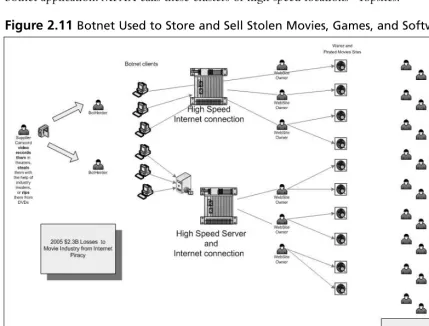
■ Serv-U Installed on botclients, the Serv-U ftp server enables botherders to store
stolen movies, software, games, and illegal material (for example, child pornography) on their botnets and serve the data upon demand. Using other software, the Serv-U ftp server appears to be Windows Explorer in Task Manager.The data is being stored in hidden directories that can’t be reached using Windows.
■ SPIM Spam for Instant Messaging. Bots have now been used to send phishing
attacks and links to Web sites that upload malicious code to your PC.
An example SPIM message:
ATTENTION...Windows.has.found.55.Critical.System.Errors...
To fix the errors please do the following:..
1 Download Registry Update from: www.regfixit.com.
2 Install Registry Update
3 Run Registry Update.
4 Reboot your computer
FAILURE TO ACT NOW MAY LEAD TO SYSTEM FAILURE!
McAfee’s Site Advisor flags the aforementioned site as one that uploads malicious code.
Cases in the News
“THr34t-Krew”
In February 2003, Andrew Harvey and Jordan Bradley (two authors of TK worm), a GT Bot variant, were arrested in County Durham, in the U.K.The U.K.’s National Hi-Tech Crime Unit worked in conjunction with the United States multiagency CATCH team (Computer and Technology Crime Hi-Tech Response Team). According to the NHTCU, the two men were members of the International Hacking group “THr34t-Krew.” Rick Kavanagh, in an article on IT Vibe (www.itvibe.com), Oct 10, 2005, reported that “Harvey, 24, and Bradley, 22, admitted ‘conspiracy to cause unauthorized modification of computers with intent,’ between 31 December 2001 and 7 February 2003.” It’s estimated that the worm did £5.5 million, or approximately US$11 million in damage.TK worm exploited a
common Unicode vulnerability in Internet Explorer.
Additional evidence was seized from an address in Illinois through a simultaneous search warrant.The worm had infected over 18,000 infected computers.The American member, Raymond Steigerwalt, was sentenced to 21 months in jail and ordered to pay $12,000 in restitution.
Axel Gembe
Axel Gembe is the author of Agobot (aka Gaobot, Nortonbot, Polybot), a 21-year-old hacker reported by police at the time of his arrest as “Alex G.” He was arrested May 7, 2004, at his home in Germany (Loerrach or Waldshut, different reports conflict) in the south-western state of Baden-Württemberg. He was charged under Germany’s computer sabotage law for creating malicious computer code. He has admitted responsibility for creating Agobot in Oct 2002. Five other men have also been charged.
180Solutions Civil Law Suit
Sometime prior to 2004, a Lithuanian mob contacted Dutch hackers and asked them to create a botnet.The hackers created and delivered the botnet. It occurred to the hackers that the Lithuanians must be using it in some way to make money.They reasoned that they could do the same thing for themselves.They created their own botnet with 1.5 million zombie clients.
the FBI who tracked down the hackers. On August 15, 2005, 180Solutions filed a civil suit against seven hackers involved in the DDoS attacks: Eric de Vogt of Breda, the Netherlands; Jesse Donohue of South Melbourne, Australia; Khalil Halel of Beirut; Imran Patel of
Leicester, England; Zarox Souchi of Toronto;Youri van den Berg of Deventer, the Netherlands; and Anton Zagar of Trbovlje, Slovenia.
Operation Cyberslam:
Jay Echouafni, Jeanson James Ancheta
The first U.S. criminal case involving a botnet went to trial in November 2005. Jeanson James Ancheta (aka Resili3nt), age 21, of Downey, California, was convicted and sentenced to five years in jail for conspiring to violate the Computer Fraud Abuse Act, conspiring to violate the CAN-SPAM Act, causing damage to computers used by the federal government in national defense, and accessing protected computers without authorization to commit fraud. He was also ordered to pay $57,000 in restitution.
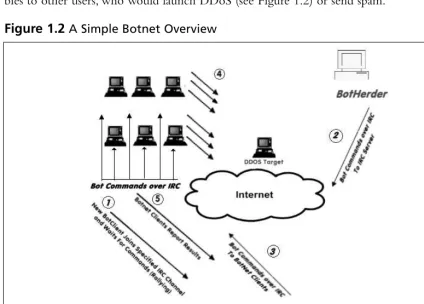
Ancheta’s botnet consisted of thousands of zombies. He would sell the use of his zom-bies to other users, who would launch DDoS (see Figure 1.2) or send spam.
Notes from the Underground…
A Simple Botnet
Figure 1.2 depicts a simple botnet being commanded to launch a DDoS attack against a competitor or other individual. The numbered steps illustrate a timeline from a new botclient joining the botnet and then participating in the DDoS attack. Steps 2-5 repeat ad infinitum with step 4 changing to whatever attack was commanded in step 2.
1. When a new botclient has been created (compromised), one of its first duties is to rally back to the C&C server. It does this by joining a specified IRC Channel and waiting for commands to be posted there.
2. The botherder posts a command to the C&C server, possibly in response to a paying customer’s request. In this case, the customer has requested that the botherder prevent a competitor’s Web site from getting any orders for several days. The botherder sends a command to the C&C server, speci-fying the target, the time and type of attack, and which of the botclients are to participate.
3. The botclients monitor the C&C server on the specified channel. When the botherder sends the command, the botclients see that it has been posted and schedule the requested activity.
4. At the appointed time, all of the selected botclients begin sending net-work traffic to the target. With enough traffic, the target Web site is unable to process both the attack traffic and the legitimate traffic and soon attempts to process only attack traffic.
5. In step 5, optionally the botclients report back to the C&C server any results or that they have completed the task and are ready for new com-mands.
He also used a botnet of more than 400,000 zombies to generate income in a “Clicks for Hire scam” by surreptitiously installing adware for which he was paid more than
Anthony Scott Clark
In December 2005, Anthony Scott Clark of Beaverton, Oregon, pled guilty to infecting thousands of computers and then to using those computers to conduct a DoS attack. According to the DOJ press release (www.usdoj.gov/criminal/cybercrime/clarkPlea.htm), Mr. Clark admitted to the following:
From July through August 2003, Mr. Clark participated with several others in DDoS attacks on the Internet against eBay, Inc. and other enti-ties. A DDoS attack is one in which many compromised computers (or bots) attack a single target, thereby causing a denial of service for legiti-mate users of the targeted system.
Mr. Clark and his accomplices accumulated approximately 20,000 bots by using a worm program that took advantage of a computer vulnerability in the Windows Operating
System—the “Remote Procedure Call for Distributed Component Object Model,” or RPC-DCOM vulnerability.The bots were then directed to a password-protected IRC server, where they connected, logged in, and waited for instructions. When instructed to do so by Mr. Clark and his accomplices, the bots launched DDoS attacks at computers or com-puter networks connected to the Internet. Mr. Clark personally commanded the bots to launch DDoS attacks on the nameserver for eBay.com. As a result of these commands, Mr. Clark intentionally impaired the infected computers and eBay.com.
Mr. Clark’s case was investigated by agents of the U.S. Secret Service’s Electronic Crimes Task Force.The effort was overseen by the U.S. Attorney’s Office’s Computer Hacking and Intellectual Property (CHIP) Unit.
Farid Essebar
Farid Essebar, 18, of Morocco, is the author of the Zotob worm. Essebar is facing charges in Morrocco that he released the Zotob worm that crippled the world’s banks and medical companies.
Christopher Maxwell
(www.usdoj.gov/criminal/cybercrime/maxwellPlea.htm), Maxwell pled guilty to “con-spiracy to intentionally cause damage to a protected computer and to commit computer fraud,” and “intentionally causing or intending to cause damage to a protected co-conspira-tors created the botnet with over one million clients to fraudulently obtain commission income from installing adware on computers without the owners’ permission.The govern-ment estimates that Maxwell and friends earned approximately $100,000 from this venture. Maxwell’s bot damaged 400 DoD computers at Germany’s Department of Defense (DoD). He was ordered to pay the hospital and the DoD restitution in the amount of $252,000 and sentenced to 37 months in federal prison.
Jeffrey Parson
In August of 2003, Jeffrey Parson released a variation of the Blaster Worm, which infected 48,000 computers worldwide. According to a U.S. Department of Justice press release (www.usdoj.gov/criminal/cybercrime/parsonSent.htm),“Parson admitted that he created his worm by modifying the original MS Blaster worm and adding a mechanism that allowed him to have complete access to certain infected computers. Parson then infected approximately fifty computers that he had previously hijacked with his worm. From those fifty computers, Parson’s worm spread to other individual computers. Parson’s worm then directed those infected computers to launch an attack against a Microsoft Web site. Attorneys for the gov-ernment calculate that more than 48,000 computers were infected by Parson’s worm.”
Parson was sentenced to 18 months in jail, three years of supervised release, and a resti-tution amount dependent on his observance of the conditions of supervised release. From the DOJ press release,“In sentencing Parson to eighteen months, Judge Pechman said she considered his unique circumstances: that he was just three weeks past his 18th birthday when he released the worm, his history of mental illness, and that his parents had failed to monitor or guide him on his computer activities. Pechman told Parson his community ser-vice had to be through face-to-face contact with others and restricted his use of computers to only educational and business purposes. She told him,‘No video games, no chat rooms. I don’t want you to have anonymous friends; I want you to have real world friends.’ She also stressed that part of Parson’s supervised release would involve a mental health program.
The pattern that you can see in these criminal and civil prosecutions is that the punish-ment doesn’t appear to fit the crime. In most cases here, there was no record of sentencing.
The Industry Responds
Microsoft is basing this conclusion on data collected by its Malicious Software Removal Tool (MSRT).The article says that MSRT has removed 16 million instances of malicious code on 5.7 million unique Windows systems. Sixty-two percent of these systems were found to have a Trojan or bot client.
The Alliance Against IP Theft, an organization in the U.K., published a document titled “Proving the Connection—Links between Intellectual Property Theft and Organised Crime” (www.allianceagainstiptheft.co.uk) that supports Microsoft’s claim.
On August 10, a group of information security professionals, vendors, and law enforce-ment gathered at Cisco Headquarters in San Jose. With little notice, the “Internet Security Operations and Intelligence Workshop” attracted around 200 attendees. Led by the enig-matic Gadi Evron (security evangelist for Beyond Security and chief editor of the security portal SecuriTeam), speaker after speaker painted a bleak and complex picture. Many lamented the increasing ineffectiveness of the prevailing strategy, which focused on identi-fying and taking out C&C servers.This is the “kill the head of the snake” approach. Bots have begun to evolve beyond this weakness now. Some now have multiple C&C servers, and, like a Hydra, if you cut off one C&C server, two more pop up. Some used protocols that lend themselves to a more decentralized organization. Some are using “Fast Flux” DNS technology (see Chapter 3) to play an electronic version of the shell game with the C&C server.There was much wailing and gnashing of teeth by the security and network profes-sionals. However, amidst the lamentations, some very interesting and innovative ideas were presented.
Summary
Botnet technology is the next killer Web application. It is a tremendous force multiplier for organized crime.The money from organized crime has created a fertile technology incu-bator for the darkside hacker.The problem they have created is huge, global in scope.Their primary victims targeted to become clients are the innocents, the elderly, the young, and the non-computer literate. Many of the botherder schemes also target this defenseless group.The appetite for power doesn’t stop there. In the DDoS attack, bots have grown big enough to be a threat to major corporations and even nations.
Bot technology has evolved from simple agents that played games with users to merce-nary robotic armies without morals, ready to carry out designer crimes on demand. From “Hunt the Wumpus” we now have botnets that collect information about customers of a specific bank, then target those customers with special botclients that contain features designed to defeat or bypass that bank’s security.Today’s bots are easy to customize, modular, adaptive, targetable, and stealthy.They are moving to a more decentralized approach and diversifying their C&C techniques.
Law enforcement has begun to catch and arrest some botnet developers and operators. The Microsoft bounty fund has proven useful in improving law enforcement opportunities to find the bad guys. Unfortunately, the court system is in serious need of change.
Investigations take months for crimes that are over in seconds. Cases drag out for years, so much so that the affected businesses cannot afford to support prosecution efforts.The penal-ties being given are rarely more than a slap on the wrist, if anything at all is done. In many cases the arrested individual trades information for little or no punishment.The public reporting of light sentences and fines sends the message that crime does indeed pay and that you will likely never have to pay the piper.
In May of 2006, news articles were trumpeting the success of efforts by security and net-work professionals in taking down C&C servers around the world. By August, the headlines had changed to claims that we’ve already lost the botnet war.The hacker community responded to the security strategy of taking down C&C servers by reducing their depen-dence on a single C&C server.They’ve shifted their approach by creating multiple C&C servers and by employing “fast flux” DNS. By changing their architecture, they decimated the effectiveness of our best weapon. Many of us had been touting the slogan “cut off the head of the snake.”The network and security professionals had been moving to implement a large-scale implementation of that in May. In hindsight, the war wasn’t lost, although it was a significant battle.This war will never be won or lost.The war between good and evil, like the road, goes ever on.
2007. In these meetings, a clearer view of the problem is emerging. Innovations are being shared and improved upon. For the new threat, new strategies and tools are being forged. The remainder of this book will bring you up to speed to join the battle.
Solutions Fast Track
The Killer Web App
The botnet is modular—one module exploits the vulnerabilities it finds to gain
control over its target.
A botnet is adaptive; it can be designed to download different modules to exploit
specific things that it finds on a victim.
Botnet attacks are targetable.That is, the hacker can target a company or a market
sector for these attacks.
How Big Is the Problem?
Since January 2005, Microsoft has been delivering the Windows Malicious
Software Removal Tool to its customers. After 15 months, Microsoft announced that it had removed 16 million instances of malicious software from almost six million unique computers. According to the Microsoft report “Progress Made, Trends Observed,” bots represented a majority of the removals.
If left unabated, the botnet plague could threaten the future of the Internet, just as
rampant crime and illegal drug use condemn the economic future of real neighborhoods.
In March of 2006, McAfee was called in to, in essence, reclaim a Central American
country’s telecommunications infrastructure from a massive botnet.
The Industry Responds
At the TechEd 2006 conference in Boston, Microsoft confirmed that
Some bots now have multiple C&C servers, and, like a Hydra, if you cut off one
C&C server, two more pop up.
Q:
Have we lost the war of the botnets?A:
No. Until 2006, security and network professionals had not truly engaged the enemy. For the most part we saw victim response. When the victim was big, the response was big. 2005-2006 marks the beginning of efforts to coordinate larger responses to the threat. Up to this point, many security professionals had not made the connection that these attacks were being fueled by money from organized crime. Now that the connection to organized crime has been made, the playing field is forever altered. Law enforcement and other government agencies are now joining the fight. Several consortiums have emerged to gather, aggregate, and distribute information as well as to coordinate responses.The battle has only begun.Q:
How much is the Microsoft bounty for virus authors and how do I get me some?A:
In 2003, Microsoft established a $5 million antivirus reward program. Microsoft periodi-cally announces that it is offering a bounty for information leading to the arrest and conviction of authors of a specific virus. Rewards of $250,000 have been paid for the creator of the Sasser worm.Today, awards are posted for the authors of the SoBig virus and the Blaster worm. If you have information about a virus that Microsoft has offered a bounty for, you should contact law enforcement. From the Microsoft Q&A pageregarding the bounty
(www.microsoft.com/presspass/features/2003/nov03/11-05AntiVirusQA.mspx) “Persons with information should go directly to the law enforce-ment agencies by calling their local FBI (www.fbi.gov/contact/fo/fo.htm) or Secret Service office, or the Interpol National Central Bureau (www.interpol.int) in any of Interpol’s 181 member countries, or by going to the FBI Internet Fraud Complaint Center Web site (www.ic3.gov).” The Microsoft Web page for information about cur-rent rewards is located at www.microsoft.com/security/
antivirus/default.mspx.
Frequently Asked Questions
25
Botnets Overview
If only it were possible to reproduce yourself a million times over so that you can achieve a mil-lion times more than you can today.
—Dr. Joseph Goebbels, Propaganda Minister for Nazi Germany; from the 15 Feb 1943 entry in his personal diary.
Solutions in this chapter:
■ What Is a Botnet? ■ The Botnet Life Cycle ■ What Does a Botnet Do? ■ Botnet Economics
Chapter 2
Summary
Solutions Fast Track
What Is a Botnet?
What makes a botnet a botnet? In particular, how do you distinguish a botnet client from just another hacker break-in? First, the clients in a botnet must be able to take actions on the client without the hacker having to log into the client’s operating system (Windows, UNIX, or Mac OS). Second, many clients must be able to act in a coordinated fashion to accomplish a common goal with little or no intervention from the hacker. If a collection of computers meet this criteria it is a botnet.
A botnetis the melding of many threats into one.The typical botnet consists of a bot
server (usually an IRC server) and one or more botclients (refer to Figure 1.2). Botnets with hundreds or a few thousands of botclients (called zombies or drones) are considered small botnets. In this typical botnet, the bot herder communicates with botclients using an IRC channel on a remote command and control (C&C) server. In step 1, the new botclient joins a predesignated IRC channel on an IRC server and listens for commands. In step 2, the bot herder sends a message to the IRC server for each client to retrieve. In step 3, the clients retrieve the commands via the IRC channel and perform the commands. In step 4, the bot-clients perform the commands—in the case of Figure 1.2, to conduct a DoS attack against a specified target. In step 5, the botclient reports the results of executing the command.
This arrangement is pleasing to hackers because the computer performing the actions isn’t their computer and even the IRC relay isn’t on their computer.To stop the botnet the investigator has to backtrack from a client to an IRC server to the hackers.The hacker can add another layer of complexity by sending all commands to the IRC channel through an obfuscating proxy and probably through a series of multiple hops, using a tool like Tor (http://tor.eff.org/download.html.en). Having at least one of these elements in another country also raises the difficulty of the investigation. If the investigator is charged with pro-tecting one or more of the botnet clients, they will usually stop the investigation once they realize the individual damage to their enterprise is low, at least too low to justify a complex investigation involving foreign law enforcement. Add to this the fact that some botnet code-bases include commands to erase evidence, commands to encrypt traffic, and even polymor-phic stealth techniques, and it’s easy to see why hackers like this kind of tool. Modern botnets are being fielded that are organized like real armies, with divisions of zombies con-trolled by different bot servers.The bot herder controls a set of bot servers, which in turn each control a division of zombies.That way, if a communications channel is disrupted, only one division is lost.The other zombie divisions can be used to retaliate or to continue to conduct business.
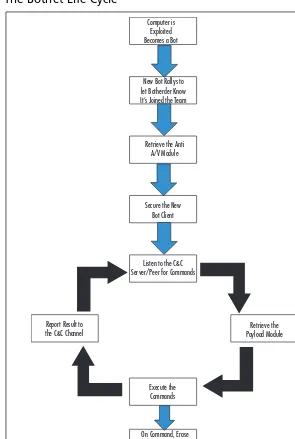
The Botnet Life Cycle
under-standing of the botnet life cycle can improve our ability to both detect and respond to botnet threat.
Exploitation
The life of a botnet client, or botclient, begins when it has been exploited. A prospective botclient can be exploited via malicious code that a user is tricked into running; attacks against unpatched vulnerabilities; backdoors left by Trojan worms or remote access Trojans; and password guessing and brute force access attempts. In this section we’ll discuss each of these methods of exploiting botnets.
Malicious Code
Examples of this type of exploit include the following:
■ Phishing e-mails, which lure or goad the user to a Web site that installs malicious
code in the background, sometimes while convincing you to give them your bank userid and password, account information, and such.This approach is very effective if you are looking for a set of botnet clients that meet certain qualifications, such as customers of a common bank.
■ Enticing Web sites with Trojan code (“Click here to see the Dancing Monkeys!”). ■ E-mail attachments that when opened, execute malicious code.
■ Spam in Instant Messaging (SPIM). An instant message is sent to you by someone
you know with a message like “You got to see this!” followed by a link to a Web site that downloads and executes malicious code on you computer.
Attacks against Unpatched Vulnerabilities
To support spreading via an attack against unpatched vulnerabilities, most botnet clients include a scanning capability so that each client can expand the botnet.These scanning tools first check for open ports.Then they take the list of systems with open ports and use vulner-ability-specific scanning tools to scan those systems with open ports associated with known vulnerabilities. Botnets scan for host systems that have one of a set of vulnerabilities that, when compromised, permit remote control of the vulnerable host. A fairly new development is the use of Google to search for vulnerable systems.
that you don’t normally use, a host-based firewall can protect you against this attack vector. However, if it is a protocol that you must keep open you will need intrusion detection/pro-tection capabilities. Unfortunately there is usually a lag of some time from when the patch comes out until the intrusion detection/protection updates are released.Your antivirus soft-ware may be able to detect the exploit after it happens, if it detects the code before the code hides from the A/V tool or worse, turns it off.
Vulnerabilities Commonly Exploited by Bots:
Agobot spreads via several methods including:
■ Remote Procedure Call (RPC) Distributed Component Object Model (DCOM)
(TCP ports 135, 139, 445, 593, and others) to XP systems
■ RPC Locator vulnerability ■ File shares on port 445
■ If the target is a Web server, the IIS5 WEBDAV (Port 80) vulnerability
SDBot Spreads through the following exploits:
■ NetBios (port 139) ■ NTPass (port 445) ■ DCom (ports 135, 1025) ■ DCom2 (port 135)
■ MS RPC service and Windows Messenger port (TCP 1025)
■ ASN.1 vulnerability, affects Kerberos (UDP 88) , LSASS.exe and Crypt32.dll (TCP
ports 135, 139, 445), and IIS Server using SSL
■ UPNP (port 5000)
■ Server application vulnerabilities ■ WebDav (port 80)
■ MSSQL (port 1433)
■ Third-party application vulnerabilities such as DameWare remote management
software (port 6129) or Imail IMAPD Login username vulnerability (port 143)
■ A CISCO router vulnerability such as CISCO IOS HTTP authorization (Port 80)
vulnerability