Building Web Applications with
Erlang
Building Web Applications with Erlang by Zachary Kessin
Copyright © 2012 Zachary Kessin. All rights reserved. Printed in the United States of America.
Published by O’Reilly Media, Inc., 1005 Gravenstein Highway North, Sebastopol, CA 95472.
O’Reilly books may be purchased for educational, business, or sales promotional use. Online editions are also available for most titles (http://my.safaribooksonline.com). For more information, contact our corporate/institutional sales department: 800-998-9938 or [email protected].
Editor: Simon St. Laurent
Production Editor: Melanie Yarbrough Proofreader: Emily Quill
Cover Designer: Karen Montgomery Interior Designer: David Futato Illustrator: Robert Romano
Revision History for the First Edition: 2012-06-04 First release
See http://oreilly.com/catalog/errata.csp?isbn=9781449309961 for release details.
Nutshell Handbook, the Nutshell Handbook logo, and the O’Reilly logo are registered trademarks of O’Reilly Media, Inc. Building Web Applications with Erlang, the cover image of a Silver Moony, and related trade dress are trademarks of O’Reilly Media, Inc.
Many of the designations used by manufacturers and sellers to distinguish their products are claimed as trademarks. Where those designations appear in this book, and O’Reilly Media, Inc., was aware of a trademark claim, the designations have been printed in caps or initial caps.
While every precaution has been taken in the preparation of this book, the publisher and author assume no responsibility for errors or omissions, or for damages resulting from the use of the information con-tained herein.
ISBN: 978-1-449-30996-1
Table of Contents
Preface . . . vii
1. Building Scalable Systems with Erlang and REST . . . 1
Why Erlang? 1
Erlang’s Advantages 2
Lack of Types 3
OTP—For More Than Just Telecom! 4
Why Web Services? Why REST? 4
New Opportunities for Scaling and Resilience 6
Cloud Computing 6
System Architecture and Erlang Scaling 7
Data Storage Options 9
2. Getting Started with Yaws . . . 15
Working with Yaws 16
Starting Yaws 16
Serving Static Files 17
Compiling, Loading, and Running Code 18
Clustering Yaws 20
Dynamic Content in Yaws 21
EHTML 24
Headers and Redirects 25
Templates 26
ErlyDTL 26
Logging 30
Erlang OTP error_logger 31
3. Appmods: Dynamic Content in Yaws . . . 33
Appmod Configuration 34
When the URI Does Not Correspond to a File 34
Session Handling 36
Access Control 38
Interacting with Erlang Services and Business Logic Layers 39
4. Implementing REST . . . 41
Decoding a Request 41
Extracting the User’s Request 41
Response and Headers 43
Building the Response 45
JSON 47
XML 49
Responding to the REST Request 51
A Full Example 51
5. File Upload . . . 59
The File Upload Request 59
Saving to Disk 61
Putting It All Together 63
Storage in a Distributed System 65
Saving to Amazon S3 66
6. WebSockets . . . 69
The WebSocket Request 70
Basic WebSocket Handler 72
Advanced WebSocket Handler 74
7. Streaming . . . 79
Simple Streaming 79
8. Using the HTTP Client . . . 83
Making a Request 83
Using OAuth 86
Facebook Canvas 86
9. Building an Application with OTP . . . 91
Directory Structure 92
Building an Application Server 93
The Generic Server 93
The Multicast Server 96
Interfacing the Server with the Web 101
Some Client-Side Code 102
A Little Optimization 108
Bundling as an Application 114
The App File 115
Wrapping Up OTP 117
A. Installing Erlang and Yaws . . . 119
B. Beyond Yaws . . . 121
C. Interfacing with Ruby and Python . . . 125
Preface
Erlang promises to let you build robust, fault-tolerant servers far more easily than with Java or C#. It almost sounds too good to be true, but Erlang has become a program-mer’s secret handshake. As much as many of us hate our phone company, there is a basic truth that must be recognized: when you pick up your phone to make a call, it normally just works. So people have started to realize that telecom folks must be doing something right!
Erlang was built to program telephone switches at Ericsson, and most of the language design choices reflect what was necessary to program a telephone switch. That means, for example, that Erlang software can run for years at a time without interruption be-cause phone switches are expected to do that. Erlang applications can be upgraded in place without taking the system offline or even losing state because the phone company can’t drop a city’s worth of calls every time they have to patch a bug or roll out a new feature.
When a web service goes down, a lot of things break. It may not be as obvious as a suddenly interrupted call, but it may actually create more problems as failures create new failures. Web services can benefit from the language design decisions Erlang’s creators made in a telephone switching environment. Having a server that can run without interruption can allow a development team to provide a better service to their customers.
Who This Book Is For
This book shows you the baby steps to building a web service with Erlang. It does not try to teach you Erlang (there are other books for that), nor does it try to show you how to build the large-scale applications that really call for Erlang. Instead, it shows you how to build simple web services as a step along the way to learning to build large-scale web services.
perhaps you have become frustrated with some aspect of building web applications in those other languages and are looking for something a bit more powerful.
You need to know at least basic Erlang, but you should also be familiar with web development—in PHP, Perl, Ruby, Java, or something else. I assume that you have seen HTML and know the basics of how HTTP works.
There are a few examples in this book that use JavaScript to interface a browser with the Erlang example. Except in Chapter 9, this code is not critical to understanding what the Erlang code is doing, although of course if you are building a large web application it will contain JavaScript. I also use CoffeeScript in a few places. CoffeeScript is a small language that compiles down to JavaScript and generally makes for a much nicer pro-gramming experience than straight JavaScript.1
Learning Erlang
This book will not teach you Erlang. There are already a number of good resources for that, including:
• Learn You Some Erlang for Great Good, by Fred Hébert. Learn You Some Erlang
will also be published by No Starch Press in September 2012.
• Erlang Programming, by Francesco Cesarini and Simon Thompson, published by O’Reilly.
• Programming Erlang, by Joe Armstrong, published by The Pragmatic Programmers.
Reading the first few chapters of any of these and understanding the basics of how Erlang works should be enough. However, you should plan to really work through those chapters and write some simple programs before attempting the projects here. In particular, you should read up on sequential code and the very basics of how con-currency works in Erlang. When building large-scale applications in Erlang, taking advantage of the Open Telecom Platform (OTP) will allow the programmer to leverage a large amount of well-tested functionality. And while OTP is very powerful and will make development in Erlang much easier, the details of OTP are less important to learn up front and can be learned as you go along after you have an understanding of how other parts of the system work.
Before You Start
Before you dive into this book, you should have Erlang and Yaws installed on your system. (If you need help in this, check Appendix A.) Erlang and Yaws can be run on Windows, Mac, and Linux, so any type of system will work fine.
Several people have asked me why I wrote this book around Yaws and not some other web package. There were a few reasons. First of all, Yaws seemed the easiest package to get something simple working in. Second, several of the other packages do not support web sockets (or at least didn’t when I started writing), and I knew that I would be needing web sockets in my own development.
I am also assuming that you are familiar with the Unix command line. While it is not necessary to be a Bash Kung-Fu Master (I’m not), you should be able to interact with the bash shell and not freak out.
What You Will Learn
Building a full Erlang application requires a large set of skills. This book will help you get to the point where you can build a basic web service application and get it running. First, you’ll explore some of the power and mystery of Erlang and REST. You’ll see why Erlang makes sense as a foundation for building scalable and reliable systems and why REST is a popular approach to building web services and explore some of the tradeoffs involved in using the two together. This first chapter will also explore some of your data storage options.
The Yaws web server is the foundation of our application, so you’ll learn to configure Yaws and serve static content. Yes, static content. In many cases, a website with dy-namic content will have a collection of static files as resources. Once you know how to manage static files, you can move on to working with dynamic content, embedding Erlang into an HTML file or other kind of file (see “Dynamic Content in Yaws” on page 21). You’ll learn about working with HTTP itself and basic debugging tools like logging.
You’ll need a way to route client requests presented as URLs to the internal resources of your service. Appmods, discussed in Chapter 3, will let you map arbitrary URLs onto relevant resources.
Next we cover output formats. I will show three general ways to output data to the user. The first, and least useful, method is to use ehtml to directly translate Erlang data into HTML or XML. We also will see how to use the erlydtl library to use the Django template language to create formatted output. (DTL is a common template package on Python and should be familiar to some readers of this book.) Finally, we will see how to encode Erlang data structures into JSON or XML, which can be sent to the user. In many cases, modern web applications will have a page of static (or almost static) HTML and a lot of JavaScript that will interact with the server by sending JSON or XML over Ajax channels.
and return useful information. You’ll also learn how to handle large chunks of incoming information, dealing with multipart requests and file uploads.
If you’d like to go beyond HTTP’s request-response model, Chapter 6 presents a live bidirectional method of communication between the client and the server. Yaws sup-ports web sockets, and the dynamic, event-driven nature of Erlang makes for an ideal platform for pushing dynamic data to the client.
Finally, Chapter 9 presents a somewhat larger example that pulls together most or all of the previously discussed topics into one complete application. This chapter will show how to build a complete small application with Yaws and OTP.
The Limits of This Book
If you want a complete guide to building large, fault-tolerant sites with Erlang, you’ll be disappointed. The architecture of a large-scale website requires a book of its own. (A project like that will probably end up being 90% backend and logic and 10% web interface.)
I also deliberately did not cover any of the half dozen or so frameworks for building web applications with Erlang, as I wanted to focus on the task of building a basic service in Erlang with just Yaws and custom code. MochiWeb, Chicago Boss, Nitrogen, Zo-tonic, and the rest need their own books, but I summarize them briefly in Appendix B. This book does not attempt to show how to structure an Erlang application beyond the very basics: a full introduction to OTP requires a longer book than this one. It is also not an introduction to supervision trees. They are covered briefly in Chap-ter 9, but this is a short introduction to a very large topic.
Erlang has a full set of features to allow it to monitor the state of an application and respond when processes or nodes go offline. This is amazingly powerful on many levels. For example, in the case of a node failing at 2:00 AM, Erlang can generate a log message and create a new node from a cloud with no need for human intervention—a far better scenario than an emergency wake up call for the sysadmin!
For automated testing, Erlang has a test framework called EUnit (documented in Erlang Programming) as well as a version of the Haskell QuickCheck testing suite. These are beyond the scope of this book, but can be quite useful for development.
Help! It Doesn’t Compile or Run!
When working with a new framework in a language you may not know very well, it is inevitable that sooner or later you will hit a few problems. Code won’t compile, or else it will compile and then crash in all sorts of strange ways.
If you are anything like me, you probably won’t be doing a copy/paste of code directly from this book (though you are welcome to do so if you want); instead, you’ll probably try to adapt this code to some other problem you are trying to solve. After all, that’s the whole point of books like this—to give you tools to solve problems in fun new ways. So what should you do if something doesn’t work as expected?
Diagnosing the Error
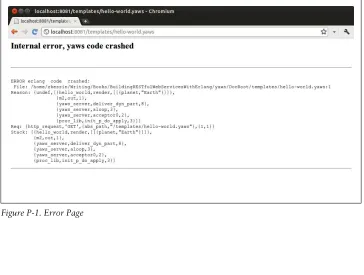
If a request to Yaws does not work, it will show a screen link, as shown in Figure P-1. This may look a bit cryptic at first glance, but is actually quite helpful. First of all, you will notice the path to the file that contains the Erlang module with the offending code. Then you will see the reason why it crashed (in this case, a call to a function in an unloaded module), and then the request that was made and the stack trace. In Erlang R15 this stack trace will also include line numbers; this screen shot is from R14B02, which does not include them.
What Version of Erlang and Yaws Are You Running?
This book was built around Erlang R14B02 and R15B. Ideally you should use R15B or later. This is a major release that among other features includes line numbers in stack traces, which makes finding errors much easier. You can find the version of Erlang you have by running erl -v from the command line.
This book was also built with Yaws version 1.92. You can find your version of Yaws by running yaws -v from the command line. The web sockets interface described in
Chapter 6 changed in a major way between Yaws versions 1.90 and 1.92.
Is Everything Loaded Correctly?
Programmers who have come to Erlang from languages like PHP or Perl will find that there is an extra step in Erlang. While Yaws will automatically compile and load new .yaws files (see “Dynamic Content in Yaws” on page 21), any other Erlang mod-ule must be compiled and loaded into the Erlang runtime. Compilation can be done from within the Erlang shell by using the c(Module). command, which will also load the new code into the Erlang runtime. This is very useful for interactive testing of code and for the speed of your development cycle. It's certainly possible that someone con-verting from PHP to Erlang will forget this step from time to time.
Erlang code can also be compiled from an external command line with the erlc com-mand from a Unix shell.2 Erlang will autoload the code; however, it is important to set
the include paths correctly so that it can find the .beam files. This option is good for doing things like automatic builds. The loading of external modules may be automated by adding the load commands to the .erlang file or other configuration options. In addition, Erlang applications will often be composed of many modules, all of which must be loaded into the system for it to work. So if something fails, check to see if a module has not been loaded or is not in the path. To see the current path from the shell, run code:get_path().
One nice thing about Erlang is that if the system is set up in a reasonable way, you should never need to take the entire system offline to upload a new version of code.
Are You Calling Everything Correctly?
The Erlang command line is your friend! This is a good place to try out your code and see if it works as expected. Don’t be afraid to create test data at the command line and give your functions test inputs to make sure that they return the correct results.
When you load a module, its records are not loaded into the shell. This has to be done explicitly with the rr command from the Erlang shell. You can also define a record with rd and remove a record with rf. To
use these, type help() on the Erlang command line.
Is Mnesia Running with Correct Tables?
Mnesia, Erlang’s built-in database, has to be started up and tables created for it to work. Before you start Mnesia you have to run the command mnesia:create_schema/1, which creates the basic database storage for Mnesia; then, to start Mnesia use the command application:start(mnesia). If you are having trouble with Mnesia tables, you can use the table viewer by typing tv:start() at the Erlang command prompt.
Is the Example Just Plain Wrong?
Obviously, I’ve tried to ensure that all the code in this book runs smoothly the first time, but it’s possible that an error crept through. You’ll want to check the errata on this book’s web page (see the How to Contact Us section at the end of the Preface), and download the sample code, which will be updated to fix any errors found after publication.
Conventions Used in This Book
The following typographical conventions are used in this book:
Italic
Indicates new terms, URLs, email addresses, filenames, and file extensions. Constant width
Used for program listings, as well as within paragraphs to refer to program elements such as variable or function names, databases, data types, environment variables, statements, and keywords.
Constant width bold
Shows commands or other text that should be typed literally by the user. Constant width italic
This icon signifies a tip, suggestion, or general note.
This icon indicates a warning or caution.
Using Code Examples
This book is here to help you get your job done. In general, you may use the code in this book in your programs and documentation. You do not need to contact us for permission unless you’re reproducing a significant portion of the code. For example, writing a program that uses several chunks of code from this book does not require permission. Selling or distributing a CD-ROM of examples from O’Reilly books does require permission. Answering a question by citing this book and quoting example code does not require permission. Incorporating a significant amount of example code from this book into your product’s documentation does require permission.
We appreciate, but do not require, attribution. An attribution usually includes the title, author, publisher, and ISBN. For example: “Building Web Applications with Erlang by Zachary Kessin (O’Reilly). Copyright 2012 Zachary Kessin, 978-1-449-30996-1.” If you feel your use of code examples falls outside fair use or the permission given above, feel free to contact us at [email protected].
Safari® Books Online
Safari Books Online (www.safaribooksonline.com) is an on-demand digital library that delivers expert content in both book and video form from the world’s leading authors in technology and business.
Technology professionals, software developers, web designers, and business and cre-ative professionals use Safari Books Online as their primary resource for research, problem solving, learning, and certification training.
Technology, and dozens more. For more information about Safari Books Online, please visit us online.
How to Contact Us
Please address comments and questions concerning this book to the publisher: O’Reilly Media, Inc.
1005 Gravenstein Highway North Sebastopol, CA 95472
800-998-9938 (in the United States or Canada) 707-829-0515 (international or local)
707-829-0104 (fax)
We have a web page for this book, where we list errata, examples, and any additional information. You can access this page at:
http://oreil.ly/build_webapps_erlang
To comment or ask technical questions about this book, send email to: [email protected]
For more information about our books, courses, conferences, and news, see our website at http://www.oreilly.com.
Find us on Facebook: http://facebook.com/oreilly Follow us on Twitter: http://twitter.com/oreillymedia
Watch us on YouTube: http://www.youtube.com/oreillymedia
Acknowledgments
A book is a team effort, and I could not have written this book without a great team behind me. First of all, I must thank Simon St. Laurent for giving me the chance to write this book and supporting me through the process of putting it together.
I would also like to thank Reuven Lerner, who has helped me become a consultant and made it much more fun than it would have been otherwise.
I also need to thank my Technical Reviewers:
Fred Hébert is the person behind Learn You Some Erlang for Great Good, which is a great way to learn Erlang. You can find Fred on Twitter at @mononcqc.
Francesco Cesarini is the coauthor of Erlang Programming and the CEO of Erlang Solutions.
I also want to thank all the various people who emailed and tweeted me about this book. I hope you find it useful! Please feel free to contact me on Twitter at @zkessin. Of course I need to thank Joe Armstrong for creating Erlang, and “klacke” (Claes Wikstrom) for creating Yaws along with various other parts of the Erlang Ecosystem. Without them, this book would not exist.
CHAPTER 1
Building Scalable Systems with Erlang
and REST
In the early days of the Web, building systems was simple. Take a Linux box, put Perl or PHP on it, add Apache and MySQL, and you were ready to go. Of course, this system was pretty limited. If you wanted to scale it past one or two servers it got real hard, real fast. It turns out that building scalable distributed applications is difficult, and the tools available to build them are often less than ideal.
Over the first decade of the 21st century, companies like Google, Amazon, eBay, and many others found that they needed to scale not to a few servers but to a few thousand servers, or even tens or hundreds of thousands or more. This requires a very different way of thinking about how to build a system, and dropping many of the patterns that had been used in the past for smaller systems.
One alternate recipe that offers scalability, resilience, and flexibility is to create your sites and applications using Erlang, with the frontend being defined by a variety of web services.
Why Erlang?
One of the first major projects to use Erlang was the Ericsson AXD301 switch, which used about a million lines of Erlang code along with some device drivers and other low-level components that were written in C. The AXD301 switch has achieved an unpre-cedented level of reliability in the field—in some cases, it has achieved “nine 9s” reli-ability!1 The amount of time that the system could be expected to be offline could be
measured in milliseconds per year. (This was for the entire network, not a single node.) Clearly, most systems written in Erlang will not achieve that level of reliability. With careful design and testing, it’s possible for a system to hit six 9s (about 30 seconds of downtime per year). However, reaching that is beyond the scope of this book, and requires a very careful study of risks that may cause the system to be unavailable and ensuring that no single failure (in particular, beyond your code) could cause that. For example, having three connections to the Internet with different ISPs is great, but if all three go through the same conduit it only takes one guy with a backhoe to cut all three wires and take a system offline.
Erlang applications can be upgraded in place. If an application is running on a cluster of servers and a bug is discovered in one module, there is no need to stop the system to upgrade to a new version of the software—Erlang provides a method to upgrade the code as it runs so that customers never need to be interrupted. This is a major advantage over a system where an application needs to be offline for an hour or more each time a new version of the software is rolled out, costing real money as customers are not able to use the system.
Erlang is also designed to support clusters of computers. In fact, to have a scalable and fault-tolerant system, it must run on more than one computer. As any given computer can fail, it is important that the system be able to deal with the case of a node in the cluster going offline and still providing services to the customers. How many nodes a system should run on is a complex issue, but it starts with the question “What is the probability of all the remaining nodes failing before I can bring a new node online?”
If you Google “Erlang”, you will see references to “Erlang-B” and “Er-lang-C”. These are measures of telephone capacity that are probably of great importance if you are building a call center, but have nothing to do with the programming language.
Erlang’s Advantages
Erlang does many things differently. In most programming languages, concurrency is an afterthought. Each process in PHP, for example, runs independently and generally communicates with other PHP processes only via external resources like a database or memcached server. In Erlang, concurrency is built in from the very base of the system.
Another difference is that Erlang is a compiled language. In PHP you can just edit a file and go to the web server, and it will be running the new version. In Erlang you need to compile the code and load it into the system, and while this is not difficult, it does represent an extra step.
Perhaps the strangest thing about Erlang for a new Erlang programmer is that all vari-ables are single assignment. In Java terms, it’s as if all varivari-ables are final. This takes some time to adapt to, but is in fact quite powerful in a language where concurrent processing is normal. If a variable can never be changed, then locks become almost an irrelevant detail. The other advantage is that a single assignment variable can only have its value assigned in one place, so if it has the wrong value then determining where that value came from becomes much easier: it must have been set at initial assignment. Erlang features a message passing model for concurrency, so there is no shared state between threads—removing the need for a programmer to set locks in code. If you need shared state, you can do it via the Mnesia database (see “Mnesia” on page 11), Mnesia supports transactions and locks, providing in effect a form of software transactional memory (STM) shared memory.
Erlang’s processes are a feature of the language, not the operating system. An Erlang process is much lighter in weight than a similar OS process. Processes in Erlang com-municate with each other by sending messages, which generally has very low overhead, but can be heavy if a large amount of data is being copied between processes.
Unless specified otherwise, “processes” in this book refer to Erlang pro-cesses, not OS processes. Erlang’s processes are very lightweight and have very fast switching and startup times.
Lack of Types
Erlang has been criticized for its lack of a type system, and it’s true that Erlang does not have static typing like Haskell does. Type systems give programmers a way to prove that the program is consistent in how it treats data. However, in a distributed system like Erlang, providing that kind of static consistency has some practical costs. Erlang allows you to upgrade a system while keeping it running. However, by doing this, you create a system that is inconsistent. If types are changed in a version change (and it is reasonable to assume that most version changes will involve changing types), demanding static typing means that nodes running the old version cannot communicate with nodes running the new version—and the same with processes within the same node.
period of time when one node is running the new software and the other is running the old software. At this point you have an inconsistent system with regard to types. At this point you have a few options. If you had built your system in Haskell, you would probably need to have a partition in which nodes running the old version of the software could not talk to those running the new version. You could also just take the system down for a short period of time while you did the upgrade, therefore sacrificing the availability of the system but ensuring that the system while running is never partitioned and never inconsistent.
There is no general perfect solution to this problem. Erlang was built to optimize for maximum availability, as choices were made to allow it to be inconsistent in some ways while still making services available. It may in fact be possible to solve this in Haskell, but thus far no one has done so. Erlang was built with the assumption that errors will happen and that the system should have methods of dealing with them on an ongoing basis. Haskell was built to minimize errors, period. Different priorities led to different designs.
OTP—For More Than Just Telecom!
The Open Telecom Platform (OTP) framework for building fault-tolerant applications ships with Erlang. By setting up software to run inside the OTP framework, applications can take advantage of OTP’s built-in fault recovery and monitoring. OTP automates much of the concurrency of Erlang, but what really makes it shine is its ability to mon-itor a running application and keep it running.
Erlang code takes a “let it crash” approach, unlike the try/catch blocks in many other languages. Erlang figures that when something goes wrong, let it go wrong, and don’t try to duct tape it back together in an unknown state. OTP will restart monitored processes that die. This also has the benefit that a process that is on a node that has died can be restarted elsewhere. (Obviously a node cannot fix itself if the server it is on has died.) If you want a system that can be fault tolerant and continue to provide your service, you want a framework that can deal with failure and simply work around it. This book builds an application using OTP in Chapter 9; however, this is not a complete introduction to the subject as I cover only the elements that are needed to write this specific application. The books Erlang Programming and Programming Erlang both provide a more detailed introduction, while the book Erlang and OTP in Action goes into much greater detail on OTP.
Why Web Services? Why REST?
case how the URL relates to the underlying resource. For a web page meant to be read by a person with a web browser, this is a useful representation.
Before REST surfaced, emerging from careful study of how and why HTTP succeeded, developers created a number of ways to send a remote procedure call over a network. When HTTP became the dominant mechanism for Internet communications, many of those same mechanisms were repurposed to run over HTTP. This made broad sense, as HTTP tools are common, but didn’t always take advantage of HTTP’s strengths. Prior to REST, people tended to tunnel services over SOAP. However, SOAP does not make very good use of HTTP—it sends only XML messages back and forth over HTTP POST requests. It doesn’t take advantage of caching proxies or other features of the HTTP infrastructure, beyond HTTP’s frequent ability to go through a firewall. REST takes much better advantage of HTTP, using HTTP’s limited set of request verbs and living within the expectations for their processing. This forces an approach of working with a limited number of actions on an unlimited number of possible resour-ces. It takes some getting used to, but it offers a consistent and powerful way to send information across networks that it easily integrated with web infrastructure and interfaces.
For full details on how a REST service should work, take a look at REST in Practice by Webber, Parastatidis, and Robinson (http://restinpractice .com).
REST treats URLs—usually called Uniform Resource Identifiers (URIs) in this context —as the fundamental way to address an underlying resource. Furthermore, a resource may have several representations; so for example, an ebook may be accessible as a PDF, mobi, or some other format.
In a RESTful service, the four HTTP verbs GET, POST, PUT, and DELETE have well defined meanings. A GET request should only retrieve information. A GET should also be idem-potent: a client can call it as many times as needed, and it will not change the state of the system in any way the client will care about. (For example, it may add information to logs, but not change user-facing data.) As long as the server sets an ETag or a Cache-Control header, this makes it easy for a proxy server or client to cache a resource, allowing much faster response on reads across a network. (HEAD and OPTIONS requests, if you use them, should also be idempotent.)
For example, if you call DELETE on a resource one time or four, it should still have the end result that the resource is deleted (or an error is generated).
In a RESTful service the URL should reliably serve to identify the resource to be worked on. In many ways, you’ll want to build by identifying your resources first, and then figuring out how the interactions mesh to create an application.
New Opportunities for Scaling and Resilience
Erlang and RESTful web services fit into a larger picture of recent technical changes that make it easier to apply Erlang’s strengths.
Cloud Computing
Cloud computing, at least on the “Infrastructure as a Service” (IaaS) model, makes adding a new server to a network easy and fast. In a pre-cloud system, adding a new server would require ordering it, going to the data center, and physically installing it in a rack. Most cloud setups reduce that to a REST API that can start up a server in a minute or two.
This complements Erlang perfectly. Erlang has lots of features that allow a networked system to add nodes in real time and to detect when they fail. Of course, the specifics of how to set up an Erlang application in the cloud will depend a lot on the details of the application and what kind of loading it is expected to get.
In IaaS cloud implementations the service provides virtual platforms, each of which runs a full OS. For use with Erlang that would probably be some form of Linux, but could also be Windows or some other OS.
Erlang provides a built-in function (BIF) called erlang:monitor_node/2 that will send a message of the form {nodedown, Node} if the node in question goes offline. It would be simple to have the monitoring process use the REST API from AWS or another cloud provider to automatically bring up a new node in this case. It would also be possible to have the system bring up new nodes if the system is becoming overloaded.
It is probably also smart to include an option to override the automatic system and allow an admin to set a number of servers manually. For example, if your company is going to run an ad in the Super Bowl,2 then it makes sense to have enough servers
running and ready before the ad runs and the systems overload.
In addition to scaling out, there is also the issue of scaling down during those times when a system has more nodes than are needed. Your system may have been running up to 300 nodes to handle the load from the Super Bowl advertisement, but now that it’s over it can be scaled back to a lower level. This is also useful for running the appli-cation on a test machine in development.
System Architecture and Erlang Scaling
From about 1970 to about 2002, system processors got faster, doubling in speed every 18 months or so. However, somewhere around 2002 something changed. As speeds kept getting faster, the laws of physics threw a brick in this progress. Faster speeds generate more heat, which uses more power and causes more problems in getting rid of waste heat. In addition, the speed of light puts a hard limit on how far a signal can travel in one clock cycle. Therefore, since 2002 the trend has not been to make pro-cessors faster but to put more of them on each chip.
When the CPUs were getting faster, it was pretty easy to speed up your code. If you just waited 18 months and did nothing, your program would go twice as fast! In the age of multi-core processors, this no longer works. Now programmers need to write programs that will use all the cores on a system. On a six-core chip, a sequential program can be running full steam on one core, but the other five are sitting around doing nothing.
As of the fall of 2011, Intel’s high-end server chips have eight cores, the consumer chips from Intel have up to six cores (in many of those cases, each core can run two threads), and AMD has announced a line of processors with eight cores. IBM’s Power7 chip has eight cores that run four threads each. It is not crazy to expect that in a few years we will be talking about chips with 32, 64, or even 128 cores or more. The way we write programs for these processors will be different from the way we wrote programs for the single-processor chips of the past. It is not clear that Erlang will scale to 64 or 128 cores, but it probably has a better chance to do so than most other languages.
If you want to use a multi-core chip efficiently, you need a large number of processes ready to run. Ideally the number of processes should be much larger than the number of chips to simplify distribution. If there are 16 processor threads running on the CPU, having only 16 or 32 processes will probably not work well, as statistically there needs to be a pool of processors waiting to run so that there is never a time when all the processes are blocked. There will be many times when the chip is doing nothing while
processes are waiting on the disk or network or the like. Having a large number of processes waiting means that the system can always have tasks in the queue when one process goes into a wait state.
Assuming that the time to switch between processes is very small (which for Erlang processes it is) then having several thousand processes or more would be best, so the system can make sure there are always processes to be thread into a waiting core. The ability of a system like Erlang to scale well is dependent on three things: the speed at which processes are started, the speed at which the system can switch between them, and the cost for passing messages. Erlang does a good job minimizing all three of these factors.
Scaling up versus scaling out
There are two basic ways to scale a system: up or out. To scale a system up means to replace the server with a larger one—you take out the existing server and add in one with more CPUs, more memory, more disk, etc. There are limits to this, however, and it can be expensive. IBM’s top-of-the-line servers can have as many as 32 CPUs with 1024 processor threads running at the same time. In web scale, however, that can still seem rather small.
To scale a system out means to spread it over a number of smaller servers. So instead of buying the million-dollar IBM Power7 server, you buy a bunch of Intel class servers and spread the work across them. The advantage of this is that if set up correctly, there are no limits besides the budget in how far it can scale. When used with today’s cloud-based PaaS platforms, it can be possible to scale up for unexpected loads in minutes by ordering more servers from AWS or another cloud provider.
Amdahl’s law
Gene Amdahl is a computer architect originally known for designing mainframes for IBM and others from the 1950s to the 1980s. He presented a strong argument about the nature of systems in which some parts are parallel and other parts are not. This argument, known as Amdahl's law, states that in a system where parts of the process are sequential and other parts are parallel, then the total speedup can never be more than the parts that are sequential—adding more cores won’t make the whole system go faster. (For a full explanation of Amdahl’s law, see the Wikipedia page on the subject: http://en.wikipedia.org/wiki/Amdahl%27s_law.)
As an analogy, imagine that you go to a bank in which there are a bunch of tellers but only one cash counting machine. As more customers come in, the manager can always add more tellers, but if they must stand in line to use the cash counter the system will never get faster.
as it will normally be run only when new services are being brought online, it is probably not a major source of bottlenecks.
One place that sequential resource uses can become a problem is access to disk. Disks are by definition sequential in that a given disk can be reading or writing only one thing at a time. The disk is also usually orders of magnitude slower than memory or CPU cache. Components like data stores that write data to disk or logging modules are often places where a bottleneck for the whole system can occur.
Another place that can cause a lot of sequential code is locks. In general, this is not an issue in Erlang the way it would be in Java or C#, but at least in theory it could be an issue with Mnesia or similar tools if things get blocked waiting for transactions.
Data Storage Options
Back in the “old days” of say, 1998 to 2005, the options for data storage when devel-oping a web service was a choice of SQL databases. MySQL was always the easy choice; other options included Postgres, Oracle, and Microsoft SQL Server. All of these prod-ucts are SQL databases, with all that is good and bad about SQL built into them. SQL databases are very good for many things, but fail rather badly when it comes to horizontal scaling. Trying to build a partitioned database or a multi-master setup in most SQL databases is at best a major pain in the neck and at worst actively difficult. If Erlang and Yaws have been chosen for a project with the goal of having the service be fault tolerant and scalable, then of course those properties must be present in the data storage solution as well.
In the modern age, many web development projects are moving to “NoSQL,” which is a loosely defined set of data storage technologies that have been created to deal with web-scale data. The good thing about NoSQL is that there are many more choices in terms of how data will be stored than there are in SQL. The bad thing is that since there are many more choices, the team developing an application must be ready to under-stand those choices and select the system or systems that will work best.
NoSQL solutions lack some SQL features that programmers have become used to. The first thing to note is that there is no idea of a join in most NoSQL data stores. Trying to join two tables across multiple hosts is a problematic task, requiring multiple phases of searching and joining using MapReduce techniques or something similar.
Many NoSQL data stores also lack any concept of a transaction. Ensuring consistency is up to the programmer. Again, this flows from the distributed nature of the data store. Trying to ensure that all the data across several hosts is always constant can often be an O(N) or even O(N^2) task. So it falls to the developer to ensure that data manip-ulations work in a sensible manner.
The other thing to be aware of when moving from SQL to NoSQL is that finding de-velopers and system administrators who have been doing SQL for many years is rela-tively easy. There is a base of knowledge around SQL that has not yet been developed around NoSQL, which is still quite young. It is safe to say that 10 years from now SQL databases will look similar to the way they do today, while NoSQL still has a lot of evolution left simply because it is a new product family.
In order to be fault tolerant, a database, like an application server, must be able to scale to more than one computer and be able to handle the case where a server dies. In addition, to be scalable, each server must be independent. If with three nodes a cluster can serve N requests per minute, then with six nodes it should be able to serve 2N requests per minute (or at least close). In reality this is not usually possible, as conten-tion for shared resources will get in the way. True linear scaling is a theoretical best case.
CAP Theorem
The CAP theorem is an idea proposed by Eric Brewer that states that it is impossible for a distributed computer system to provide strict guarantees on all three of Consis-tency, Availability, and Partition Tolerance at the same time. This theorem has in fact been mathematically proven to be true. A Google search will reveal the full details of the proof for those who may be interested.
A consistent system is one in which all nodes see the same data at all times. This is traditionally seen in single-node systems or those running on a small number of nodes. Most SQL databases feature extensive features in terms of transactions and the like to make sure that the data is always consistent at any given time, and in some cases this is an important feature.
It is possible to achieve consistency on massively concurrent systems; however, it must be done at the cost of fault tolerance or availability. In some cases the cost of achieving this may be quite high. In addition, if all nodes must agree on the state of data, this can making handling failures much harder as nodes can go offline.
The problem with a fully consistent system is that when scaling up to many nodes, the communication overhead can get very high. Every node must agree on all aspects of the state of the data at all times. This can make scaling systems difficult, as two-phase commits cause more and more locks to spread through the system.
An available system is one in which all clients can always read and write data. Obvi-ously, having a system with guarantees about availability is a good thing; however, it is not possible to combine this with partition tolerance and constancy. If a system must be fully constant in the face of a network split, it must disallow writes as it will have no way to make sure the data is consistent across all nodes.
The best example of a partition-tolerant database is the DNS system. The DNS system is pretty much always available, but it is possible that some of the servers may be split from others at any given time, in which case they will serve up old data until the issue is resolved. Thus all users on the net will always be able to use the DNS system, but may not always see the same data for a given query.
The CAP theorem is mostly brought up in terms of databases, but in truth it applies to any distributed computing system. For example, Git and Mercurial version control tend to be AP systems, while CSV and Subversion tend to be CA systems. Systems like Git and Mercurial also need to explicitly handle the case where two sets of changes have to be merged.
In fact, the CAP theorem applies to many areas that might not be obvious. For example, foreign exchange is a widely available system that is not always exactly consistent. The price quotes in exchanges around the world will in general be similar, but may differ by a little bit and since it takes time for a signal to travel between London and New York, being 100% consistent would actually be impossible.
Erlang systems are by definition distributed, so CAP applies to not just the data store but the system as a whole. Understanding this idea is key to building a successful ap-plication in a distributed environment.
Mnesia
Mnesia is Erlang’s own database. It is a very fast data store designed to work well with Erlang, and it has several nice advantages. It works with native Erlang records and code, and it is also possible to set it up to serve data from RAM or from disk and to mirror data across nodes. You can even set it up so that data lives in memory on most nodes but is mirrored to disk on one or two nodes, so that all access is in memory for very fast operations but everything is written out to disk for long-term persistence.
Technically the Mnesia data store is ETS and DETS. Mnesia is a trans-action and distribution layer built on top of them.
Mnesia is built into Erlang so there is nothing to install. However, it must be started when Yaws is started. To do this, use the OTP function application:start(mnesia). to start up the Mnesia database. From here, tables can be created with the mnesia:cre ate_table/2 function, which uses Erlang records as its table schema. For full details of how to use Mnesia, see some of the Erlang references. The Erlang documentation also includes a set of man pages on Mnesia.
By using the qlc module, it is also possible to treat a Mnesia table as if it were a big array, so you can use Erlang’s array comprehensions to pull data out of Mnesia. It is even possible to do things like foldl to summarize data in a table.
CouchDB
CouchDB is a data store that is actually written in Erlang. Unlike Mnesia and MySQL, CouchDB is not organized around records with a fixed schema; rather, it’s a document store that takes some ideas from Lotus Notes. In fact, Damien Katz, who created CouchDB, used to work on Lotus Notes.
CouchDB also gives up strict consistency for an eventual consistency. By doing this, it can create guarantees of partition tolerance and availability. In a CouchDB network every node can be a master, and even if two nodes are not in communication, both can be updated.
This lack of consistency has some costs, but it also has some major benefits. In many cases, making sure all nodes agree about the state of data at all times is a very expensive operation that can create a lot of load on a large system.
There are multiple interfaces from Erlang to CouchDB, including couchbeam, eCouch, erlCouch, and erlang_couchdb. Each of these offers somewhat different features, but several of them (including couchbeam and eCouch) run as OTP applications. Links to all of these are available on the CouchDB wiki: http://wiki.apache.org/couchdb/Getting _started_with_Erlang.
MongoDB
MongoDB is also a NoSQL database, but it is designed to assume a consistent database with partition tolerance and the ability to share data easily. MongoDB can be accessed from Erlang with the emongo driver available from https://bitbucket.org/rumataestor/ emongo. The API is quite straightforward and documented at the website.
Redis
There are two sets of drivers for Redis in Erlang, Erldis and Eredis, both of which can be found on the Redis home page at http://redis.io.
Riak
Riak is yet another document database that is similar to CouchDB in some ways. Like CouchDB, it is written in Erlang and gives up strict consistency for availability, scala-bility, and partition tolerance. It is meant to be a distributed system and has good support for scaling out by adding nodes~, and scaling back in by removing nodes that are no longer needed. Riak can be found at http://www.basho.com.
Riak is derived in large part from Amazon’s Dynamo database. The idea is that you split many nodes over a consistent hashing ring, and any key in the database gets sent to the nodes taking charge of a given section of the ring.
The great thing about availability is that the nodes are split in a way that might allow a quorum system. That is to say that in a system of N nodes, for a write to be successful all the nodes must agree to the transaction. That is a fully consistent system with lower availability. If only some subset (M) of the nodes need to agree, then only a subset of the cluster has to be responsive for things to work.
By adjusting the ratio of M:N it is possible for a system to be tuned in terms of the level of consistency versus availability desired. This tuning can be set on a per-query basis so the system is very flexible.
CHAPTER 2
Getting Started with Yaws
Most developers who are moving from other web development environments to Erlang and Yaws will have used other web servers such as Nginx or Apache. The Erlang Yaws web server performs the same basic tasks, but the details of performing common actions are often different.
Erlang is not only a language, but also a runtime system and something that looks a lot like an application server. As such, Erlang and Yaws (or other web servers) will fill the same role as Apache/PHP/MySQL and other components all in one system.
The major differences between Erlang/Yaws and Apache/PHP have a lot to do with how Erlang tends to set things up. Erlang assumes that systems will be clustered, and processes in Erlang are somewhat different from those used in many other systems. If you’ve used Apache with mod_php, you may remember that each request is handled by a process or thread (depending on how things are set up). The classic Common Gateway Interface (CGI) would start a new process for every request. These threads and processes are constructions of the OS and are relatively heavyweight objects. In Erlang the processes are owned not by the OS, but by the language runtime.
When building an application with Apache and PHP, for each request the web server must bring up a copy of the PHP interpreter and quite possibly recompile the various bits of PHP code that are to be run. This is an expensive operation. By comparison, in Yaws the Erlang code is probably already compiled and loaded, so in practice most of the time all Yaws will need to do is call the correct function.
As Erlang processes are so lightweight and can be started up so quickly, Yaws can also create a new process for each request that comes in without any problem. This means that Yaws can scale up very well and quite quickly.
Working with Yaws
If you’ve never worked with Yaws, you have a few things to get used to. Yaws naturally sets up clusters, and it has its own way to create dynamic content and handle requests. Overall, however, Yaws is pretty easy to work with, and it uses the Erlang REPL so you can try code out at the command line.
Starting Yaws
Once Yaws is installed (see Appendix A) it must be started. To start Yaws at the Unix command line, simply run yaws. In Windows there are several options for starting Yaws from the Start menu, but the most common method is to open a DOS command win-dow from the Start menu and do it from there.
There are a number of command-line switches that you can pass to Yaws. These let you set the node name or other options. This can also be done via the .erlang file, which Yaws will read when it first starts up. This file should contain valid Erlang code and should live in the user’s home directory.
When Yaws is started it will print out a few lines of information that look similar to
Example 2-1 and then drop into the Erlang REPL. At this point Yaws is fully functional and will serve any requests that you send it. It may take a second or two from when you start the Yaws executable to when it is ready to serve content to users.
By default, Yaws will be set up to listen on port 8000 (Example 2-1 changes it to 8081 due to something else using that port). Normally we want to run a web server on port 80 for HTTP or port 443 for HTTPS; however, many Unix-type systems will not allow nonroot users to bind to ports numbered below 1024. Clearly, running Erlang as root is probably not a good idea, so we need a different solution to this. It would be possible to run Yaws behind a catching proxy server that will map port 80 to a higher port. Alternatively, you could use a number of methods to attach to a higher port. Various ways of doing this are documented on the Yaws website at http://yaws.hyber.org/priv bind.yaws; you will need to figure out which one works best for your setup.
Example 2-1. YAWS at startup
'auth_log' global variable is deprecated and ignored. it is now a per-server variable (yaws@sag)1> yaws:Add path "/usr/lib/yaws/custom/ebin"
(yaws@sag)1> yaws:Add path "/usr/local/lib/yaws/examples/ebin" (yaws@sag)1> yaws:Running with id="default" (localinstall=false) Running with debug checks turned on (slower server)
Logging to directory "/var/log/yaws"
Yaws: Listening to 0.0.0.0:8081 for <1> virtual servers:
- http://www:8081 under /home/zkessin/Writing/ErlangBook/yaws/DocRoot (yaws@sag)1>
Unless you redirect them to a file, any logging commands sent by programs running in Yaws will appear in the Yaws startup code. You can also compile modules and test code here. In a system that needs to be kept running for a long period of time, it may be useful to start up the Yaws command line inside the Unix program screen, which will allow the session to be suspended and resumed later from a different computer. For testing and development I often run Yaws inside an Emacs shell buffer, from which I can easily copy and paste code from a scratch buffer to test things.
When you start up Yaws it reads a yaws.conf file. The default location of this file will vary depending on how Yaws was set up, but it can also be specified by a command-line switch. If you need to reload the yaws.conf file for some reason, you can do so by calling yaws --hup.
Serving Static Files
While web applications are built around dynamically generated content, almost all of them also have some static files that need to be served to clients. These will often be HTML, CSS, JavaScript, images, and other media. Yaws is capable of serving up static files, and as in Apache there is no special configuration needed: just place the files under the doc root and Yaws will happily push them out to the browser. (If Yaws is embedded inside a larger Erlang application, this may not be the case.)
It may also be possible to use a system like CouchDB to replicate resources around a network.
Using the CGI Interface
While it is best to use Yaws to manage code written in Erlang, you may find cases where using another language via the old-fashioned CGI interface still makes sense. Thank-fully Yaws can do this quite well—simply configure the yaws.conf file to recognize files ending in .cgi or .php for correct handling.
In order to run scripts from Yaws, the <server> block in the yaws.conf file must have
allowed_scripts set to include “php” or “cgi” as appropriate. The Yaws website has
full details.
In addition, the out/1 function can be set up to call a CGI function by invoking the
yaws_cgi:call_cgi/2 function, in the case where a CGI function should be called con-ditionally or otherwise need special handling.
Compiling, Loading, and Running Code
When you launch Yaws from a terminal, it will present a command-line REPL, which can be used to interact with Yaws and Erlang. This is a very easy way to play around with Yaws and try things out.
There are several ways to compile and load Erlang code. In testing, the easiest way is to type c(module). at the Yaws command line. This will compile the Erlang code down to a .beam file, which is Erlang’s binary format, and load it into the Erlang system. Using lc([module1, module2]). will do the same with a list of modules. In general, the .beam files should be placed in directories in the code search path. In this case, when an unknown module is required, it will be loaded automatically. To explicitly load a .beam file compiled externally, l(module). will load the .beam file. (All of these take an atom, which is the name of the module. Other options from the shell may be found by running the help/0 function from the Yaws command line.)
Erlang programs run in a virtual machine, in the same way that Java and .NET programs do. In Erlang’s case, the virtual machine was orig-inally called “Bogdan’s Erlang Abstract Machine” and is now “Bjorn’s Erlang Abstract Machine” (Bogdan and Bjorn being the programmers who created them). As such, Erlang’s binary object files have the ex-tension .beam.
Example 2-2 shows a simple interaction in the Erlang shell. The shell is opened, we check the current directory with pwd/0, and then check the files in the directory with ls/0.
Example 2-2. ls and pwd
Erlang R14B02 (erts-5.8.3) [source] [64-bit] [smp:4:4] [rq:4] [async-threads:0] [kernel-poll:false]
Eshell V5.8.3 (abort with ^G) 1> pwd().
/home/zkessin/Writing/ErlangBook/running ok
2> ls().
.svn example.erl test.erl ok
3> c(test). {ok,test}
4> test:test(1234). 1234
5>
Then the test module, shown in Example 2-3, is compiled with the c/1 function. In this case the module compiled correctly, so it returns {ok,test}. If there were errors they would be reported here as well. Finally we run the test:test/1 function, which just returns its arguments.
Example 2-3. test.erl
-module(test). -export([test/1]). test(X) -> X.
The c/1 and l/1 functions will only load code on the current node. If you want to load code on all connected nodes, use the nc/1 and nl/1 functions. These work just like the single-node versions, but will propagate the changes out to all connected nodes. The compile and load options mentioned above will also reload a module that is run-ning. So it is easy to upgrade software; just reload it and make sure that functions are called with an explicit module name to do an upgrade (this can happen with an explicit message if desired).
In some cases—like if you’re doing something larger involving make—compiling from the Yaws command line may not be the best choice. In that case there is an explicit Erlang compiler erlc,1 which can be called from a Unix command line or from a build
utility such as Make, Ant, or Maven. The modules can be explicitly loaded from a Yaws command-line switch or from the yaws.conf file. Normally an Erlang project is set up
so that sources live in a src directory and the compiled files are moved to an ebin di-rectory during the build process.
Erlang supports code autoloading. When a call is made to my_module:my_function/n, if the module my_module is not loaded then Erlang will attempt to load the module. When Erlang attempts to load a module, it will look in its file path in a very similar way to how bash will find programs. You can see the contents of the Erlang path by running code:get_path() from the Erlang REPL. This will produce a result similar to Exam-ple 2-4. To add a new directory to the front of the path, call code:add_patha/1, and to add one to the end call code:add_pathz/1. Both will return true if the call is successful or {error, bad_directory} if not. Normally this should be done from an .erlang file in your home directory.
Example 2-4. Erlang path (Truncated)
(yaws@sag)16> code:get_path(). ["/usr/local/lib/yaws/ebin",".",
"/usr/lib/erlang/lib/kernel-2.14.3/ebin", "/usr/lib/erlang/lib/stdlib-1.17.3/ebin", "/usr/lib/erlang/lib/xmerl-1.2.8/ebin", "/usr/lib/erlang/lib/wx-0.98.9",
"/usr/lib/erlang/lib/webtool-0.8.7/ebin", "/usr/lib/erlang/lib/typer-0.9/ebin", "/usr/lib/erlang/lib/tv-2.1.4.6/ebin", "/usr/lib/erlang/lib/tools-2.6.6.3/ebin",
Clustering Yaws
One of the major benefits of Erlang (and by extension, Yaws) is the fact that it is de-signed to exist in a clustered environment. The Yaws service itself can be clustered by simply starting it up on multiple nodes and then putting a standard load balancer in front of the web servers. However, in many cases the real power of Yaws will come from clustering a few nodes running Yaws with a larger Erlang application. As Yaws is native Erlang code, Yaws code can send and receive Erlang messages, which enables a Yaws application to exist inside an Erlang ecosphere.
In order for hosts to communicate, they must share a cookie value that should be kept secure. This cookie can be specified on the command line, set with an Erlang built-in function (BIF), or set in the .erlang.cookie file. Erlang will create that file with a random value if it is needed but not found. When setting up an Erlang network, finding a good way to distribute this cookie file is probably a good idea.
When working across multiple nodes one must be careful that the same code is always loaded on all nodes. Erlang has features to do that, such as the shell command lc/1, but will not load a new module on every
Setting up links between nodes in Erlang is actually quite easy. The first time a message is sent from one node to another, they will be connected together. So calling net_admin:ping/1 or sending any other message will connect two nodes.
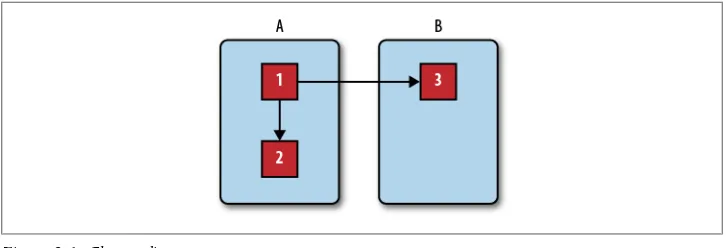
One nice thing about Erlang’s processes is that when sending messages between them it does not matter where each process is running. The code Pid ! message sends message to the process Pid. Pid can be on the same computer, in a second Erlang process on the same host, on a different computer, or even on a computer running in a data center halfway around the world.
In Figure 2-1 there are two nodes—A and B; within those nodes, there are three pro-cesses numbered 1, 2, and 3. Messages can be sent between them via the ! operator (represented here with an arrow) regardless of where the two nodes are.
In general, setting up cross–data center connections between nodes should use SSL tunneling, and may have a number of issues relating to delays between nodes.
Dynamic Content in Yaws
If the desired result is to output a page of HTML or XML, there are several good ways to go about this. If you give Yaws a file with the extension .yaws, it will look for any blocks in that file with the tag <erl> and run the out/1 function that is found in that block. This is similar to how PHP will invoke code inside of a <?php ?> tag and how many other systems do templates. It is also possible to render HTML or XML with a template system like “ErlyDTL” (see “ErlyDTL” on page 26).
Yaws will in fact compile these files down to an .erl file, which will live in the $HOME/.yaws directory. If there is a syntax error the exact path will be given.
It is customary in Erlang to name a function with the name and parity. So out/1 is the function named “out” that takes one parameter, in this case a data structure that describes the request. The function out/2
would be a separate function that simply shares a name with out/1.
How Yaws Parses the File
When the browser requests a file with a .yaws extension, Yaws will read the file from the disk and parse that file. Any parts that are pure HTML will be sent to the browser. However, anything in an <erl> block will be handled separately. Yaws will take each
<erl> block and convert it into an Erlang module. Yaws will then compile the code and cache it in memory until the .yaws file is changed. As such, Yaws will not have to recompile the source except when the file is changed or first accessed.
Yaws will then call the function out/1 and insert the return value of that function into
the output stream. If there is an <erl> block without an out/1 function, Yaws will flag it as an error.
If Yaws finds two or more <erl> blocks in a file, it will just convert each one into a
module and compile and run them individually.
It is also important to note that unlike PHP, Yaws will not send any output to the socket until the entire page is processed. So it is possible to set a header from the bottom of the page after some HTML output has already been generated if that is needed. If you want to understand the full process of how Yaws does all this, read the Yaws Internals Documentation at http://yaws.hyber.org/internals.yaws and the source code in yaws_compile.erl.
The out/1 function is called with a parameter of an #arg{} record that is defined in the
yaws_api.hrl file (see Example 2-5). All the data that might be needed to figure out details of the current HTTP request are here and can be used to determine what to do. This is the definition of the #arg{} record from the Yaws sources. In any .yaws files this will be automatically included; otherwise you will have to include it in the header of your module.
Example 2-5. Structure of the #arg{} record
-record(arg, {
clisock, %% the socket leading to the peer client client_ip_port, %% {ClientIp, ClientPort} tuple
headers, %% headers req, %% request
clidata, %% The client data (as a binary in POST requests) server_path, %% The normalized server path
%% (pre-querystring part of URI) querydata, %% For URIs of the form ...?querydata %% equiv of cgi QUERY_STRING
%% of the path leading up to the query
docroot, %% Physical base location of data for this request docroot_mount, %% virtual directory e.g /myapp/ that the docroot %% refers to.
fullpath, %% full deep path to yaws file
cont, %% Continuation for chunked multipart uploads state, %% State for use by users of the out/1 callback pid, %% pid of the yaws worker process
opaque, %% useful to pass static data
appmod_prepath, %% (deprecated - use prepath instead) path in front %%of: <appmod><appmoddata>
prepath, %% Path prior to 'dynamic' segment of URI.
%% ie http://some.host/<prepath>/<script-point>/d/e %% where <script-point> is an appmod mount point, %% or .yaws,.php,.cgi,.fcgi etc script file. pathinfo %% Set to '/d/e' when calling c.yaws for the request %% http://some.host/a/b/c.yaws/d/e
%% equiv of cgi PATH_INFO }).
In Example 2-6, the HTTP method is extracted from the #arg{} structure and then returned to be rendered into HTML, as shown in Figure 2-2.
Example 2-6. Using ARG
<erl>
method(Arg) -> Rec = Arg#arg.req, Rec#http_request.method.
out(Arg) ->
{ehtml, f("Method: ~s" , [method(Arg)])}. </erl>
Figure 2-2. Output of Example 2-6