Hong Kong, 18-20 March, 2015
Conferences Publications Membership About IAENG FAQ Contact Us The IMECS 2015 Program Committee
As the IMECS is organized by the International Association of Engineers and the Engineering Letters, some of the editorial board members of the Engineering Letters and the IAENG journals and the committee members of IAENG Societies are taking part in the IMECS 2015 International Program Committee.
IMECS MultiConference Co-chairs
Prof. Craig Douglas (honorary co-chair)
School of Energy Resources Distinguished Professor, Departments of Mathematics & Director, Institute for Scientific Computation, University of Wyoming, USA
Visiting Professor and Associate Director, Center for Numerical Porous Media Methods King Abdullah University of Science & Technology, Saudi Arabia &
Former Senior Research Scientist (corresponding to nonteaching full professor), Computer Science Department, Yale University, USA
Prof. David Dagan Feng (honorary co-chair) Head, School of Information Technologies, University of Sydney, Australia
Prof. Alexander M. Korsunsky (honorary co-chair) Professor of Engineering Science
Former Dean, Trinity College
Department of Engineering Science, University of Oxford, UK
Prof. Ping-kong Alexander Wai (honorary co-chair)
Vice President and Chair Professor of Optical Communications Hong Kong Polytechnic University, Hong Kong
Prof. Oscar Castillo
Professor and Research Director of Computer Science Tijuana Institute of Technology, Mexico
Former Adjunct Professor of San Diego State University, USA President of HAFSA (Hispanic American Fuzzy Systems Association)
Vice-Chair of the Mexican Chapter of the Computational Intelligence Society (IEEE)
Prof. Jeong-A Lee
Dr. S. I. Ao (Congress secretary)
Ph.D. University of Hong Kong; Post-doc Oxford University Computing Laboratory, University of Oxford, U.K. & Harvard School of Engineering and Applied Sciences, Harvard University, USA; Former Visiting Professor, Cranfield University, UK & University of Wyoming, USA
Editor-in-chief of Journal: Engineering Letters
IMECS Program Committee & Conferences Co-Chairs
Yousry H. Abdelkader Alexandria University, Egypt Daoud Ait-Kadi University Laval, Canada Basim Al-Najjar Vaxjo University, Sweden Ali Allahverdi Kuwait University, Kuwait Bala P. Amavasai Sheffield Hallam University, U.K. Carlos Henggeler Antunes University of Coimbra, Portugal Djamel Bouchaffra Oakland University, USA
Indranil Bose The University of Hong Kong, Hong Kong Anthony Brabazon University College Dublin, Ireland Mietek Brdys The University of Birmingham, UK Fidel Cacheda University of A Coruna, Spain Alan Hoi-shou Chan City University of Hong Kong, Hong Kong Felix T.S. Chan The Hong Kong Polytechnic University, Hong Kong Chin-Chen Chang Feng Chia University, Taiwan
Pranay Chaudhuri University of the West Indies, West Indies Chun-Hsien Chen Nanyang Technological University, Singapore Chung Shue Chen INRIA, France
Mu-Song Chen Da-Yeh University, Taiwan Qingfeng Chen Deakin University, Australia
Wallace Choy The University of Hong Kong, Hong Kong T.S. Chung The Hong Kong Polytechnic University, Hong Kong Orville Leverne Clubb City University of Hong Kong, Hong Kong
Manuel Jose Damasio Universidade Lusofona de Humanidades e Tecnologias, Portugal Chuangyin Dang City University of Hong Kong, Hong Kong
Alexandar Djordjevich City University of Hong Kong, Hong Kong Yu-fai Fung Hong Kong Polytechnic University, Hong Kong G. Ganesan Adikavi Nannaya University, India
Robert Gay Kheng Leng Nanyang Technological University, Singapore Zhao-qiang Ge Xi'an Jiaotong University, China
Goh Ong Sing National Technical University of Malaysia, Malaysia Angel Marin Gracia de la Universidad Politecnica de Madrid, Spain Nalan Gulpinar University of Warwick, UK
Phil Heaton-Adegbile University of Portsmouth, UK Enrique Herrera-Viedma University of Granada, Spain
Chi-Kuang Hwang Chung-Hua University, Taiwan Heung Suk Hwang TongMyong University, South Korea Shigekazu Ishihara Hiroshima International University, Japan Limin Jia Beijing Jiaotong University, China Hsueh-Fen Juan National Taiwan University, Taiwan Rajgopal Kannan Louisiana State University, USA George P. Karatzas Technical University of Crete, Greece Hideki Katagiri Hiroshima University, Japan Graham Kendall University of Nottingham, UK Kensaku Kikuta University of Hyogo, Japan
Haeng Kon Kim Catholic University of DaeGu, South Korea Sung-il Kim Korea University, South Korea
Cartik Kothari The University of Memphis, USA
Mohan Krishnamoorthy CSIRO Mathematical & Information Sciences Division, Australia Tadahiko Kumamoto Chiba Institute of Technology, Japan
Reggie Kwan The Open University of Hong Kong, Hong Kong Ho Woo Lee Sungkyunkwan University, South Korea Layuan Li Wuhan University of Technology, China Xueliang Li Nankai University, China
Yiming Li National Chiao Tung University, Taiwan Chih-Min Lin Yuan-Ze University, Taiwan
Baoding Liu Tsinghua University, China Liping Liu University of Akron, USA
Elsa M. Macias Lopez Las Palmas de Gran Canaria University, Spain Kazuaki Maeda Chubu University, Japan
Prabhat K.Mahanti University of New Brunswick, Canada Qusay H. Mahmoud University of Guelph, Canada Nikolaos Matsatsinis Technical University of Crete, Greece George Mavrommatis Hellenic Military Academy, Greece Michael McGuigan Brookhaven National Laboratory, USA Patricia Melin Tijuana Institute of Technology, Mexico Ludmil Mikhailov The University of Manchester, UK Hiroshi Mineno Shizuoka University, Japan
Herman Monsuur Netherlands Defense Academy, The Netherlands Chiung Moon Yonsei University, South Korea
Alejandro Murua University of Montreal, Canada Nysret Musliu Vienna University of Technology, Austria Didier Nakache CNAM de Paris, France
Jun Ni The University of Iowa, USA
Lars Nolle Nottingham Trent University, UK A. Alper Ozalp Uludag University, Turkey
Wan- Kai Pang The Hong Kong Polytechnic University, Hong Kong Apostolos N. Papadopoulos Aristotle University, Greece
Selwyn Piramuthu University of Florida, USA I.M. Premachandra University of Otago, New Zealand Quah Tong Seng Nanyang Technological University, Singapore Dharmendra Sharma University of Canberra, Australia
Jiuh-Biing Sheu National Chiao Tung University, Taiwan
Shey-Huei Sheu National Taiwan University of Science and Technology, Taiwan Cornel I. G. Resteanu National Institute for Research and Development in Informatics,
Bucharest, Romania
Rosemary R. Seva De La Salle University, Philippines Elhadi Shakshuki Acadia University, Canada
Vrijendra Singh Indian Institute of Information Technology Allahabad, India Yannis Siskos University of Piraeus, Greece
Yuri Grigoriyevich Stoyan Institute for Problems in Machinery of National Ukrainian Academy of Sciences, Ukraine
Junping Sun Nova Southeastern University, USA Zhaohao Sun University of Wollongong, Australia A.B. Rad Swinburne University of Technology, Australia Marina Resta Universita' degli Studi di Genova, Italy Maria Luque Rodriguez University of Cordoba, Spain Raul Rojas Freie Universitat Berlin, Germany
Manoj Kumar Tiwari National Institute of Foundry and Forge Technology (NIFFT), India Dat Tran University of Canberra, Australia
Francisco Herrera Triguero University of Granada, Spain Lin-Yu Tseng Providence University, Taiwan Shinichi Tsuda Tokai University, Japan Gwo-Hshiung Tzeng Kainan University, Taiwan
Lev V. Utkin St.Petersburg Forest Technical Academy, Russia Ismael Vaz Universidade do Minho, Portugal
Jose Luis Verdegay Universidad de Granada, Spain Hsiao-Fan Wang National Tsing Hua University, Taiwan Long Wang Peking University, China
Shyh-Hau Wang Chung Yuan Christian University, Taiwan Toyohide Watanabe Nagoya University, Japan
Frank Werner Otto-von-Guericke-University of Magdeburg, Germany Igor Wojnicki AGH - University of Science and Technology, Poland Ed Xuekui Wu University of Hong Kong, Hong Kong
Trong Wu Southern Illinois University Edwardsville, USA Guangming Xie Peking University, China
Li Xu Zhejiang University, China
Susan H. Xu Penn State University, USA
Gi-Chul Yang Mokpo National University, South Korea Xin-She Yang University of Cambridge, UK Ali Riza Yildiz University of Michigan, USA Kun-Ming Yu Chung Hua University, Taiwan Cecilia Zanni Marc Bloch University, France Xiaohua (Douglas) Zhang Merck Research Laboratories, USA Zhe George Zhang Simon Fraser University, Canada Yao Zhao Beijing Jiaotong University, China
Yong Zhao Nanyang Technological University, Singapore Constantin Zopounidis Technical University of Crete, Greece
IMECS Conferences Committees:
The titles and contact authors of submitted papers that have been reviewed and accepted (or accepted
with minor revisions) for IMECS 2015 are listed here:
A_C
,
D_N
,
O_Others
Titles (A_C)
Contact Authors
A Behavior Approach to Instant Messaging Worm Detection Dr. hanxun zhou
A Business Architecture Capability Meta Model and Tool-set for Providing Function Point
Estimation for Enterprise Architecture Management Mr. Francois du Toit
A Cell-centered Scheme for Solving Anisotropic Diffusion Equations on Skewed Meshes Dr. Lina Chang A Closed-Loop High-Gain Multiphase-Switched-Capacitor-Inductor Step-Up DC-DC
Converter Prof. Yuen-Haw Chang
A Closed-Loop High-Gain Switched-Capacitor-Inductor-Based Boost DC-AC Inverter Prof. Yuen-Haw Chang A Cloud-based Wireless Mesh Network with Adaptive Data Storage Functions Mr. Shengtao YANG A Comparative Study of Analysing Transformed and Noisy Data in Taguchi Orthogonal
Arrays Mr. Nattapat Imsap
A Comparative Study on CT Image Segmentation Using FCM-based Clustering Methods Prof. Chih-Hung Wu A Comparison of Biomass Gasification Technologies using Data Envelopment Analysis Dr. Choosak Pornsing
A Comprehensive Review on Long Term Evolution (LTE)-Advanced Dr. Prashant Pandey
A Decision Support Application for Teak Log Supplier to Simulate Scenarios of Utilizing
Forest Resources by Considering the Sustainability of Teak Log Supply Mr. Silvester Adi SuryaHerjuna A Graphical User Identifier Suggestion Function Scheme Using Sketching for Mobile
Web-Services Mr. Yusuke Matsuno
A Method for Identifying Photo Composition of the Panoramic Image Mr. Shin Yen Te
A Method for Investigation and Analyzing of Software Product Line Ecosystems Dr. Abbas ramazani fard A Network-Based Scalability Model for Distributed Real-Time Resource Management Prof. Sergei Gorlatch A New AM Demodulation Scheme with a Blind Carrier Recovery Method Prof. Jeerasuda Koseeyaporn A New Method Based on Tree Simplification and Schema Matching for Automatic Web
Result Extraction and Matching Mr. Yasar Gozudeli
A New Method for Marshaling of Freight Train with Generalization Capability Based on
the Processing Time Dr. Yoichi Hirashima
A New ONU-initiated Doze Mode Energy-saving Mechanism in EPON Prof. I-Shyan Hwang
A Novel Approach for Classification of Congestive Heart Failure Using Relatively
Short-term ECG Waveforms and SVM Classifier Mr. Ken Ying-Kai Liao
A Novel Centralized Control Implementation For Identity-Location-Separated Network
Architecture Mr. Chaoqi Yu
A Novel Methodology for Test Scenario Generation Based on Control Flow Analysis of
UML 2.x Sequence Diagrams Mr. Saroj Kanta Misra
A Novel Symmetric Cryptography Algorithm for Fast and Secure Encryption Dr. Aswathy A S A Numerical Scheme for the Black-Scholes Equation with Variable Interest Rate Using
Spectral Collocation and Backward-Differences Dr. Roden Jason David, Ms.Fernandina Ko
A Parallel Minimum Attribute Co-reduction Accelerator based on Quantum-inspired
SFLA and MapReduce Framework Dr. Weiping Ding
A PC-Based Controller for the Computer Numerically-Controlled (CNC) LASER
Machine Mr. Jayson Rogelio
A PLC-Based Adaptive Control of Superheated Steam Treatment System (SSTS) for
Stabilized Brown Rice (SBR) Dr. Dominic Guevarra
A Practical Study of Exact-BASIC Codes at the MSR Point in Distributed Storage
Systems Miss Yumeng Zhang
A Proposal of Graph-based Blank Element Selection Algorithm for Java Programming
Learning with Fill-in-Blank Problems Prof. Nobuo Funabiki
A Python Class for Higher-Dimensional Schrodinger Equations Dr. Amna Noreen
A report on Returns to Scale in UAE Banks Dr. Aqila
Terrnimal
A Secure Mobile Payment Framework Based On Face Authentication Mr. Zhaomiao Xu
A Source Code and Test Cases Impact Analysis Tool for Database Schema Changes Mr. Chanwit Sriarpanon A Standalone Near Filed Communication Based Library Automation System Prof. Amol D. Potgantwar A Study an Impact of Daylight with Period Time on Illuminance and Uniformity for
Building Dr. Chaiyan Jettanasen
A Systematic Approach for Configuration Management in Software Product Lines Dr. K.L.S.Soujanya Adaptive Delay Constraint Admission Control with Hierarchical DBA over GPON-LTE
Converged Network Prof. I-Shyan Hwang
Adaptive Feedforward Cancellation (AFC) in Sound Fields: Computer-Based Approach
for Active Noise Control (ANC) Mr. Suparoek Junsupasen
Adsorption of Pt from Chloride Leaching Solution of Spent Catalyst with Anionic Resins Dr. PANPAN SUN Air Conditioning Control System Learning Sensory Scale Based on Reinforcement
Learning Dr. Noritaka Shigei
Algorithms for Optimization of Convex Quadratic Functions Miss BELABBACI Amel
An Agri-food Supply Chain Model for Cultivating the Capabilities of Farmers in
Accessing Capital Using Corporate Social Responsibility Program Mr. Rillo S Wahyudin
AN AUTOMATED TOOL FOR A NON-CONTACT, REAL TIME EARLY DETECTION
OF DIABETES BY COMPUTER VISION Dr. Jamal firmat banzi
An Efficient Implementation of Multi-Context Algebraic Reasoning System with Lazy
Evaluation Prof. Masahito Kurihara, Mr.ChengCheng Ji
An Empirical Research into the Effect of Blended Learning on English Writing Learning
in Institutions of Higher Vocational Education Dr. Mingyong Zhang
An Experimental Setup Investigation to Study Characteristics of Fault on Transmission
System Dr. Chaiyan Jettanasen
An Exploratory Study in Displaying Interactive Car Catalogue System on Multi-Touch
Tabletop Mr. Ahsanullah Abro
An Exploratory Study: an Integrated Approach for Design for Testability Dr. Megha Joshi
An Extended HDL SoC TAB-model for Diagnosability and Repair Dr. Woon Kian Chong
An FLP Model for Optimizing Supply Chain Management in Steel Company Dr. Mansur Hassan An Image Size Invariant Method for Quick Detection of Dissimilar Binary Images Dr. Adnan Mustafa An Improved Collaborative Filtering Recommendation Algorithm Combining Item
Clustering and Slope One Scheme Dr. Haipeng You
AN INTEGRATED SWITCHING TECHNIQUE FOR MINIMIZING POWER
CONSUMPTION USING DOMINO LOGIC SYSTEM Dr. Naveenkumar D
An Investigation of Residual Stress Gradient Effects in FIB-DIC Micro-Ring-Core
Analysis Dr. Alexander M. Korsunsky
An IT Driven Approach for Global Production Network Design Mr. Carlo Hausberg
An Iterative Algorithm for Generalized Mixed Equilibria with Variational Inequalities Prof. Ching-Feng Wen An Optical Tunable Fiber Filter based on The Concatenated Single-mode Optical Fibers
with Different Cut-off Wavelengths Miss Wanvisa Talataisong
Analysis of Refraction Phenomenon on Green's Function with The Two Product of
Gaussian-PDFs Dr. Atirat Maksuwan
Analysis of Vehicle Tracking Maps in Iwate Prefecture Following the 2011 Tohoku
Earthquake Prof. Noriaki Endo
AOS: Adaptive Out-of-order Scheduling for Write-caused Interference Reduction in Solid
State Disks Dr. Pingguo Li
Application of Differential Evolution to Parameter Identification of Bhumibol Hydro
Power Plant in Thailand Dr. Jukkrit Kluabwang
Application of Language Modelling in Sentiment Analysis for Faculty Comment
Evaluation Mrs. Ria Sagum
Application of YIQ Color Model for Color Pattern Recognition with Shifted and Rotated
Training Images in Optoelectronic Correlator Dr. Chulung Chen
Applying Classifier Algorithms to Organizational Memory to Build an Attrition Predictor
Model Dr. K.M. Suceendran
SURIYAKAT
Architectural Design for Allocation, Storage and Retrieval of Distributed Multimedia Data Mrs. Nithya Deenadayalan Assessing Household Energy Savings and Consumer Behavior in Padang City Mrs. PRIMA FITHRI Assessment of WileyPLUS' Instructional Design as Learning Management System Tool
for Distance Learning Dr. Dante L. Silva
Automated Translation of Java Control Flow into Promela Miss Jirapat Lueangviriyayarn
Automatic Detection of Diabetic Retinopathy from Eye Fundus Images: A Review Mr. Manpreet Kaur Sidhu Band Mapped and Distributed Energy Best Tree Encoding Features for Tri-Phone-Based
Automatic Speech Recognition Mr. Sayed Zaky
Big Data Technology Adoption in Chinese Small and Medium-sized Enterprises Dr. Woon Kian Chong Block-diagonal preconditioner for Darcy equations with random coe cient Dr. Adel Al-Mahdi Business Analytics in Tourism, Exploring Event, Industry, and Brand Potentials Dr. William Claster
Capacity and performance analysis of STC MB-OFDM UWB Systems Dr. Ines BEN HASSINE
Characteristics and Behaviour of Transient Current during Lightning Strikes on
Transmission Tower Dr. Chaiyan Jettanasen
Classifications of Emotion Expressed by Filipinos through Tweets Mr. Miguel Angelo Tolentino,Mr. Michael Jr. Pippin
Cloud computing: A new era of IT opportunity and challenges Dr. G. Harsha Vardhan
Commercialization Strategy Formulation for University Spin-Off: A Case Study Mr. Aam Hamid Al Ghabid Common Design Elements and Strategies in Participatory Safety Sign Redesign among
Construction Workers Dr. Alan H.S. Chan
Compact S-box Hardware Implementation with an Efficient MVP-CSE Algorithm Mr. Xiaoqiang ZHANG Comparatative Performance Analysis of Modified Filter Bank MultiCarrier Prototype
Filter Under Strategic Conditions Dr. Er.A.S.Kang
Comparison Analysis Study in to Palm Print Image Acquisition Methods Dr. K.Mariyappan Comparison between Two HLL-type Riemann Solvers for Strong Shock Calculation on
ALE Framework Prof. Zhijun Shen
Comparison of Efficient parallel Index Algorithms used for RDF data store Dr. Rajani Sharma Comprehensive Curriculum of Programming for Engineers, its Teaching Models and
in-Lab Monitoring Technique Mr. Mohit Nitin Satoskar
Computer Ergonomic And Its Effects On Students' Interest in Computer Programming Dr. Yekini Nureni Asafe Corrective Controllers with Switching Capability for Modeling Matching of Input/State
Asynchronous Machines Prof. Jung Min Yang
Cross-Layer Design of Power Assignment and Power Balance in Wireless Ad-hoc
Networks Mrs. Arivoli Vijay
The titles and contact authors of submitted papers that have been reviewed and accepted (or accepted
with minor revisions) for IMECS 2015 are listed here:
A_C
,
D_N
,
O_Others
Titles (D_N)
Contact Authors
Data Network Threats and Penetration Testing Dr. Vladimir Sanchez Padilla DePAT: A Framework for Specification-Based Automatic Test Generation Dr. Simona Vasilache Deregulation of Electric Power in a Developing Economy: Prospects for Nigeria Dr. Nnoli Kosisochukwu Pal Design by Analysis versus Design by Formula of a PWR Reactor Pressure Vessel Mr. Usman Tariq Murtaza Design of Beidou satellite timing and communication system for power fault location
system with traveling wave Mr. HUANG Long
Design of Channel Filter based on Asymmetric One-Dimensional Defective Photonic
Crystal for Broadband Responses Miss Asmar Aming
Design Principles of Slotted Holes Mr. Xiangyu Cheng
Development of a Region-of-Uninterest (ROU) Detection System for Multimedia
Applications Ms. Kana Miyawaki
DEVELOPMENT OF ELECTRICAL PORCELAIN INSULATORS FROM LOCAL
CLAYS Dr. Okolo C.C
Diffusion Stability of Mechanical Equilibrium in Compressible Isothermal Gases Dr. K.Kaliyeva Driving Behavior Analysis Based on Vehicle OBD Information and AdaBoost
Algorithms Mr. Shi-Huang Chen
Dropped Ball Travel Time using Variation and Integration Dr Dieudonne Ndong Ovono eAttendance System for Academic Institutions Mr. Gaurav Madan
Economic and Environmental Impact Assessment of Micro Grid Dr. Su Youli
Economic Value of Femtocell Networks for Mobile Solution Mr. Akinlabi O Akindeji Effect of Ambient Illumination, Brightness and Tilt Angle on Typing Performance Mr. Kasidech Srestthaporn Efficiency of Bivariate Copula on the CUSUM Chart Ms. Sasigarn Kuvattana Efficient Multimedia Contents Management System with Tag Recommendations Dr. Seungmin Rho ENERGY OPTIMIZATION FOR UAV COMMUNICATION USING GRID
CONFIGURED ADHOC NETWORK Dr. M. Suresh Kumar
Enhanced Mathematical Model for Studying Fundamental Behaviors of Injection
Locked Relaxation Oscillator Prof. Paramote Wardkein
Entropy Information Based Assessment of Cascade Control Loops Prof. Junghui Chen
Equitable Total Coloring of Flower Snarks and its Related Graphs Dr. Kh. Md. Mominul Haque Establishing Relationships between Emotion Taxonomies Using the Vector Space
Model Mr. Lei Duan
ESTIMATION OF LEAD AND OTHER ELEMENTS IN CONTAMINATED SOIL OF BAGEGA IN ANKA LOCAL GOVERNMENT AREA OF ZAMFARA STATE,
NIGERIA Dr. BISHIR UMAR
Evaluation of a Similarity Search Method for Human Behavior (Extended LDSD) Miss ZHANG ZUO Evaluation of Music Classification Method based on Lyrics of English Songs Mr. Mizuki Furuya Evaluation of Sine-Based Chaotic Strategy for Adapting Inertia Weight of Particle
Swarm Optimization Prof. Yu-Huei Cheng
Existence and Uniqueness of the Navier-Stokes Problem for Compressible Flows Dr. K.Kaliyeva EXPERIMENTAL STUDIES ON PRODUCTION OF METHANE USING ANIMAL
MANURE Dr. Saravanan A M
Exploit Collision: Network Coding in Switch based on VOQ Scheduling Algorithm Miss Li Ma Exploiting the Potential Water Supply for Eco-Industrial Parks in an Extreme Arid Area Prof. Zulati Litifu Extraction of the Combination Rules of Colors and Derived Fashion Images Using
Fashion Styling Data Mr. Yuta Koge
Feature Extraction based Approaches for Improving the Performance of Intrusion
Detection Systems Prof. Long-Sheng Chen
FIB-SEM Serial Sectioning Nanotomography of Flax Fibres Dr. Alexander M. Korsunsky Filter pattern for consistent use of data in real-time systems Dr. Thierry Noulamo Finite Difference Method for Boundary Value Problems Application: High Precision
Electrostatics Dr. David Edwards Jr
Finite Element Solution to Integral Equations Dr Dieudonne Ndong Ovono First-Order Perturbation of Correspondence Analysis with Multiple Categories Prof. Masaaki Ida
Forecasting Optimal Production Program Using Profitability Optimization by Genetic
Algorithm and Neural Network Dr. Galal H. Senussi
Forecasting the Prices of TAIEX Options by Using Genetic Programming and Support
Vector Regression Dr. Chih-Ming Hsu
Framework Enabling End-Users to Maintain Web Applications Mr. Masayuki Nii
Friction Stir Spot Welding between Copper and Aluminium: Microstructural Evolution Prof. Esther Titilayo Akinlabi Functional Cognitive Rehabilitation Game Technology Applying Orientation and
Memory for Preventing Dementia Dr. Seungmin Rho
Fundamental Design for a Beacon Device Based Unconscious Participatory Sensing
System Mr. Mizukami Takamasa
Funding-based Productivity Decision Support System for SMEs Prof. Buliaminu Kareem Hard Limit CoDel: An Extension of the CoDel Algorithm Mr. Fengyu Gao
Hindi Speech Synthesis by concatenation of recognized Hand written Devnagri Script
using Support Vector Machines Classifier Mr. Saurabh Farkya HiRE- A Heuristic Approach for user Generated Record Extraction Dr.Santhi Thilagam How to Select Measurement Points in Access Point Localization Ms. Xiaoling Yang
Humanitarian Space and Security of Humanitarian Workers: A Review Prof. Esther Titilayo Akinlabi Hybrid Evolutionary Model for Diabetes Diagnosis Dr. Ojugo, A.A
Hybrid Neural Network Models for Rainfall Runoffs: A Comparative Study Dr. Arnold Adimabua Ojugo Hydropower Producer Day-ahead Market Strategic Offering Using Stochastic Bi-level
Optimization Ms. Yelena Vardanyan
Identifying Stress-induced and LDL-induced Differentially Expressed Genes in
Vascular Smooth Muscle Cells Dr. Ka-Lok Ng
Identifying System Calls Invoked by Malware using Branch Trace Facilities Mr. Yuto Otsuki Image Dissection and Categorization in Satellite Metaphors from Space Video
Reconnaissance Dr. Dhanalakshmi V
Impact of Coagulation Mixing and Time on CST Values Dr. Dewi Fitria Impact of Rapid Mixing's Initial Value on CST and SRF values Dr. Dewi Fitria IMPLEMENTATION OF LEAN CONCEPTS IN SCRUBBER MACHINE
ASSEMBLY LINE- A CASE STUDY Dr. Paramasivam K
Implementation of Self-Tuning Fuzzy PI Controller on DCS for Flow Control System Mr. KHEMJIRAASSAWATHANATORN Incubation Scheme of the University Spin Off to Commercialize the Invention in
Sebelas Maret University Miss Citra Kusuma
Indirect Tracking of Functional Target for Respiration Compensation in Radiotherapy Dr. Woon Kian Chong Indoor Communication: Femtocell Behavior in an Indoor Environment Mr. Akinlabi O Akindeji Investigation into the Use of Mobile Technology in English Teaching and Learning in
Institutes of Higher Vocational Education in Hubei Province in China Dr. Zhang Mingyong
Isaac Newton, Leonhard Euler and F =ma Dr. Ajay Sharma
Key Factors Affecting User Experience of Mobile Recommendation Systems Dr. Woon Kian Chong Latent Training for Convolutional Neural Networks Dr. Zi Huang
Load Value Prediction Method to Utilize Prediction Miss Bias Mr. Nobuhiro Moriwaki Low Power State Machine Design for AES Encryption Coprocessor Mr. Xiaoqiang ZHANG Low-cost Bit Permutation Circuit with Concise Configuration Rule Dr. He Zhangqing Marketing via Social Networking Sites: A Study of Brand-Post Popularity for Brands in
Singapore Prof. Alton Chua
Debugging
Methods for Classifying Pictures and Generating Music by 2D DFA and 1D FFT Prof. Hidefumi Kawakatsu Mining Association Rules on Students' Profiles and Personality Types Mr. Glenn Paul Gara MINING HIGH UTILITY ITEMSETS - A RECENT SURVEY Dr. U.Kanimozhi Mitigation of Conducted and Radiated EMI Generation in High-Frequency Switching
Devices Dr. Chaiyan Jettanasen
Model of Price Stabilization In Staple Food Distribution Using Game Theory:
Comparative Study Mr. Danis E. P. Wicaksana
Modification on the Synthesis Process of Hydroxyapatite Dr. Dora Elena Ledesma-Carrion Modified A-LTK: Improvement of a Multi-dimensional Time Series Classification
Method Miss YU FANG
Modified Resource Allocation Scheduling Algorithm for QoS in WiMAX Networks
using Qualnet Dr. Ajay Roy
Monitoring of a Wireless Network Using a Password Recovery Tool Dr. Vladimir Sanchez Padilla Monotone Finite Volume Schemes for Diffusion Equations on Distorted Quadrilateral
Meshes Dr. Jingyan Yue
Multi-Beam Engineering Microscopy - a Versatile Tool for Optimal Materials Design Dr. Alexander M. Korsunsky Multi-Initiator C-Wave Algorithm for Arbitrary Networks Dr. Mehmet Karaata
Multi-Objective Optimal Power Flow With Generalized Interline Power Flow
Controller Using NSHCSA Prof.M.Balasubba Reddy
Music Recommendation and Play based on Content and SNS Analysis Dr. Seungmin Rho Music Recommender System Using a Forehead-mounted Electrical Potential
Monitoring Device to Classify Mental States Mr. Sungri Chong Mutual Information-based Feature Selection in Spectrometric Data for Agriculture
Applications Dr. Luis Javier HerreraMaldonado
Numerical Analysis for Some Parallel Algorithms with Large Step Length Spatial
The titles and contact authors of submitted papers that have been reviewed and accepted (or accepted
with minor revisions) for IMECS 2015 are listed here:
A_C
,
D_N
,
O_Others
Titles (O_Others)
Contact Authors
On Duality Concepts regarding Hypergraphs and Propositional Formulas Prof. Stefan Porschen On the Capability of a Fuzzy Inference System with Improved Interpretability Mr. Hirofumi Miyajima
On the Entringer and Slater problem Dr. Chunhui Lai
Online Signature Verification for Multi-modal Authentication using Smart Phone Mr. Bruce Poon On-Premises Cloud Storage - Security Aspects for Small and Medium-sized Enterprises Prof. Markus Stopper Optimization of Microwave Vacuum Dryer Design Parameters using CST Microwave
Studio for Low-Moisture Food Application Mr. Ronie Alamon
Optimizing Line Power Flows by Series Capacitor Placement Ms. Samiya Zafar Optimizing Line Power Flows by Shunt Capacitor Placement using Synchrophasor
Technology Ms. Samiya Zafar
Optimizing Pricing and Remanufacturing Decisions in Multi-level Green Supply Chain Dr. Huang, Yun
OTK: Key Distribution Center at Cloud Providers towards Secure the Services Mr. RAMARAO GOSE Parallel Implementation of Iterative Methods for Solving PDEs Dr. Muhammad Naveed Akhtar Path Optimization for Electrically Inspecting Printed Circuit Boards with Alignment
Marks Dr. Hideki Katagiri
Path-overlap Avoidance in Multiple Route Construction for Mobile Relay on WSN Mr. Yogi Anggun Saloko Yudo PERFORMANCE ANALYSIS OF CLASSIFICATION AND CLUSTERING
ALGORITHMS USING HADOOP MAHOUT Dr. Asadi Srinivasulu
Performance Analysis of Maximum Power Transfer in Piezoelectric Energy Harvesting Dr. Chaiyan Jettanasen Performance Evaluation of Extended Kalman Filtering for Obstacle Avoidance of
Mobile Robots Prof. Chih-Hung Wu
Performance Evaluation of Photon Diffusion Models Configured in Planar Source
Illumination Geometry for Quantifying the Optical Properties of Turbid Media Prof. Sheng-Hao Tseng Performance of a Variable Speed of the Split Unit Air Conditioning System using Fuzzy
Logic Controller Dr. Henry Nasution
Performance of Three Preconditioners for Image Deblurring Problem in Primal-Dual
Formulation Dr. FAISAL FAIRAG
Police Officer Selection Process for Incident Response Miss Johanna Leigh Power Supply Circuit With Zero Standby Power Consumption on Infrared Remote
Controlled Product by Using Energy Harvesting Prof. Akira Yamawaki
Practical Design of a Passive EMI Filter for Reduction of EMI Generation Dr. Chaiyan Jettanasen Prospective of Medical Cost for Diabetes Mellitus for Sex and Age Group in Range
2012-2050: Case of Mexico Dr. Dora Elena Ledesma-Carrion
Provision Buffer for Ongoing Launch Product Mr. KUO HSING WU
Putting a Technology Innovation Culture to Realize Indonesian Vision 2025: A Case
Study Dr. Wahyudi Sutopo
Putting Numbers to Value: Going Simplistic for Reaching Lean Manufacturing Miss Zuhara Ivette Chavez Lopez
Python Classes for Numerical Solution of PDE's Prof. Kare Olaussen
QBSA 4 W2S : QoS-Based Scalable Approach for Web Services Selection Dr. Mansour Mekour
Queuing Model For Shinde Restaurant Dr. Rameshwar Bhutada
Quine-McCluskey Repair Technique for Evolutionary Design of Combinational Logic
Circuits Mr. Xiaoqiang ZHANG
RAID-5 STRATEGY IN VIRTUAL HYBRID CLOUD (R5 VHC) Dr. Ch Prem Kumar
Real Time Recognition of Filipino Sign Language Using Bayesian Network Dr. Vera Geroda Real-Time Implementation of a Power Series Based Nonlinear Controller for the
Balance of a Single Inverted Pendulum Prof. Hien Tran
Reliability Analysis for a Repairable System under N-policy and Imperfect Coverage Dr. Richa Sharma
Network and Application to Optimal Control Problems
Research in Modeling of Complex Adaptive Petri Net Dr. Jun Wang
Research in Virtual Cotton Spinning Process based on CAPN Dr. Jun Wang RESEARCH ON MUTUAL COUPLING CORRECTION OF ARRAY OUTPUT
SIGNAL BY BP NETWORK Dr. Yuan Shiji
Response Surface Methodology for the Optimization of Paddy Husker by Medium
Brown Rice Peeling Machine 6 Rubber Type Dr.Surapong Banphan
Reversible Data Hiding with Lossless Data Embedding Dr. Chinchu A.V Review and analysis of Research and Application of Software Ecosystem Dr. A.M.Yousefzade Risk Management - Comparison of Islamic and Conventional banks in GCC Dr. Aqila
Roadmap to a DO-178C Formal Model-Based Software Engineering Methodology Dr. Emanuel Grant Scalable Instruction Set Extension for Dual-field Public-key Cryptosystem Dr. Wang Liao
Scientific Computing with HOMsPy Dr. Asif Mushtaq
Selection of Anchor Nodes in Time of Arrival(TOA) for localization in Wireless Sensor
Networks Dr. K. Raghava Rao
Self Checking Systolic Sorter Dr. Ali Maamar
Signal Persistence Checking of Asynchronous System Implementation using SPIN Mr. Weerasak Lawsunnee Simulation Analysis of Modified Filter Bank Multicarrier for Physical Layer Cognitive
Radio under Radio Environment Dr. Er.A.S.Kang
SIMULATIONS ON CAR REPARING TIME ESTIMATION Dr. K.RADHA
Solving the General Two Water Jugs Problem via an Algorithmic Approach Dr. YIU KWONG MAN Some Properties of Bipolar Max-min Fuzzy Relational Equations Prof. Yan-Kuen Wu Some Properties of Nonnegative Interval Matrices in Max Algebra Prof. Yung-Yih Lur Space-Time Hotelling Model and Its Application to Retail Competition in a Duopoly Prof. Hiroaki Sandoh Speed control of Direct Current motor using Artificial Neural Network Dr. R.M.S.B Ratnayake Sports Play Visualization System for American Football Mr. Toshihiro Tani Star-Topology Virtual Network Construction with Optimization Problems for Video
Streaming System of Sightseeing Information Dr. Takuji Tachibana, Mr.YASUHIRO URAYAMA Statistical Problems on Estimating for Heat Seal Parameters Mr. Takashi Inomata, Prof.Toshinari Kamakura Stochastic Decision Model of the Remanufactured Product with Warranty Dr. Swee Kuik
Stochastic Technique for Face Detection System Dr. Arnold Adimabua Ojugo
Study of Aerodynamic Drag Reduction Devices on a Heavy Vehicle Dr. Z. Namazian Study of AZO Thin Films Under Different Annealing Atmosphere on Structural, Optical
and Electrical Properties by rf Magnetron Sputtering Prof. Hung-Wei Wu Study of Reaction Temperature and Sulfur Dioxide Feed Rate in the Sulfur Iodine
Production Cycle Reactions Miss Warunee Chankerd
Study on Screw-Ball Differential Gear Operating Process Dr. A.A. Shelepov Study on the Behavior of Particles in High Reynolds Number in Semi Ellipse Lid Driven
Cavity Mr. MUHAMMAD AMMARNIK MUTASIM
Subspace Iteration on Steroids - A New Highly Parallel Non-Hermitian Eigensolver Dr. Peter Tang Support System for Developing Evacuation Guidance for Tourists: Visualization of the
Number of Evacuees in a Space Mr. Naoto Emori
Suppressing Redundant TCP Retransmissions in Wireless Mesh Networks Mr. Shuhei Aketa
Survey on Various Image Segmentation Techniques Mr. R. Subalakshmi
Synchronous Interleaved DBA for Upstream Transmission over GPON-LTE Converged
Network Prof. I-Shyan Hwang
Test Case Impact Analysis from Use Case Description Changes Mr. Tawan Sakkarinkul The Ageing Construction Workforce in Hong Kong: A Review Mr. Yu Ki Jacky NG The Anomalous Reflection of Acoustic Waves Based on Metasurface Dr. Changlin Ding The Classification of Matching Applications for End-User-Initiative Development Prof. Takeshi Chusho The Design and Development of Drowsiness Detection System for Road Safety
Improvement Mr. Suparoek Junsupasen
The Effect of Attitude on Foreign Language Learning and Teaching in Institutes of
Higher Vocational Education Based on Affective Filter Hypothesis Dr. Zhang Mingyong The Effect of Temperature on Manual Dexterity, Reaction Time, and Optimum
Grip-Span Dr. Alan H.S. Chan
The Influence of Subjective Norm on Behavioral Intention In Using E-Learning: An
Empirical Study in Hong Kong Higher Education Dr. Hon Keung Yau
The Relationship Between Ability of Instructors to Interpret Knowledge to Students and
In Class Engagement of Students: An Empirical Study in Hong Kong Higher Education Dr. Hon Keung Yau The Usage Analysis of Web and Email Traffic on the University Internet Backbone
Links Mr. Shwan Dyllon
The Wigner System Coupled with Hartree-type Nonlinearity Dr. Bin Li Thermal Comfort Evaluation of Emergency Tent Using PMV and PPD Model Dr. Lusi Susanti Thermal Image Resolution on Angular Emissivity Measurements using Infrared
Thermography Dr. Navaphattra Nunak
Three-echelon Inventory Model with Defective Product and Rework Considerations
under Credit Period Dr. Ming-Cheng Lo
Time Series Forecasting of Energy Commodity using Grey Wolf Optimizer Dr. Yuhanis Yusof TiMers: Time-based Music Recommendation System based on Social Network Services
Analysis Dr. Seungmin Rho
Towards an Approach to Guide End-user in Interactive Web Services Composition Dr. Yassine Jamoussi, Mrs.KOMMANABOYINA SOUJANYA
Transient Thermal Analysis of Power Cable-Considering Skin Effect Mr. Yuandong Gong Triple Band Miniaturized Patch Antenna Using GSRR Metamaterial Dr. S. ZEMOULI Trustworthy Movie Recommender System with Correct Assessment and Emotion
Evaluation Dr. Seungmin Rho
Ultrasonically Driven Antibubbles Encapsulated by Newtonian Fluids for Active
Leakage Detection Mr. Kristoffer Johansen
Using Decision Trees to Characterize and Predict Movie Profitability on the US Market Prof. Juan Alfonso Lara Torralbo Using Feature Selection Approaches to Identify Crucial Factors of Mobile
Advertisements Prof. Long-Sheng Chen
Value Chain Improvement for Cocoa Industry in Indonesia by Input-Output Analysis Miss Arinda Soraya Putri Variation of Air Circulating Velocity in Thermal Drying Oven to Reduce Energy Loss Miss Patsarawan Lipikanjanakul WAVEGUIDE PROPAGATION IN EX- TENDED PLATES OF VARIABLE
THICKNESS Dr. Akhmedov MaqsudSharipovich
Wavelet-Based Fractal Analysis of Beat-to-Beat Interval Data: A Preliminary Study Dr. Suparerk Janjarasjitt Well-Provisioned First Person Shooter and Massively Multiplayer Online Role-Playing
Games Traffic in Enhanced EPON Prof. I-Shyan Hwang
Wikiaudia: Crowd-sourcing the Production of Audio and Digital Books Prof. Kavi Mahesh
Wireless Transport Layer Security Dr. vikas yadav
Abstract— As a tourist place, Indonesia is supported by its
beautiful natural scenaries and unique cultures. Actually most of Indonesia incomes came from tourism sectors. Padang as the administrative center of West Sumatra is one of tourism places in Indonesia. Unfortunately, all the facilities and touris actractions here need improvement, for example the hotels. Hotels in Padang need attention on the performance management system. One of the them is Premier Basko Hotel. This hotel depends on profit targets and classification of IHRA (Indonesian Hotel & Restaurant Association). For the increasement of this hotel, SWOT (Strength, Weakness, Opportunity, Threats) analysis and balanced scorecard method were applied. It began with the strategic information gathering based on interviewing the company, then continue processing it into a questionnaire which based on SWOT research. At this point, it is known that Premier Basko Hotel is in quadrant II (strength-threat) SWOT analysis diagram. So, this hotel needs to implement a diversification strategy. It also has 14 types of alternative strategies with strategic goals, 14 factors on Critical Success Factors (CSF), 38 indicators on Key Performance Indicators (KPI), and 38 pieces forms of performance management system. All of these are as the form of guidelines for the performance management system Premier Basko Hotel.
Index Terms— Hotel, KPI, Performance Management
System, SWOT-BSC
I. INTRODUCTION
NDONESIA’S beautiful natural views and cultural diversities are the advantages that Indonesia has to be a tourist place. As a tourist place, it is going to contribute greatly to the nation’s economy.
West Sumatra as part of Indonesia tourism has to provide facilities and tourist attractions and this is the role and responsibility of the central government. Through interviews with the Licensing to The Tourism Section Head of Culture and Tourism of Padang, it is known that the attractiveness of tourism in Padang is the mix of natural shades to legend, cultural attractions, sports interests, and supported with a taste of traditional Minangkabau food that has been widely recognized by the world. The combination can be encountered on various objects and attractions such as Air Manis Beach, Caroline Beach, Nirwana Beach, Siti Nurbaya Festival, Dragon Boat Festival and Tour of The Batur. The presence of food such as rendang, beef jerky
Manuscript received January 8, 2015; revised February 1, 2015. Difana Meilani is a lecturer in Industrial Engineering Department, Faculty of Engineering, Andalas University, Padang, West Sumatera, Indonesia (e-mail: difana.meilani@ gmail.com and [email protected]).
Ilham Anugrah was with Andalas University, Padang, West Sumatra, Indonesia. (email:[email protected])
and various chips Sanjai, are the tourist attractions of Padang. So it can be concluded that tourism sector is the focus of development and the biggest income of Padang.
Realizing tourism as an economic power of Padang, revamping and improving the assessment of development of various objects are needed. One of the objects is the hotels. Hotels are included as a primary means of supporting tourism activities. From interviewing IHRA executive director of West Sumatra, Elvis Syarif, he said that, the hospitality industries like hotels need a guidance for internal performance improvement.
Premier Basko Hotel is one of the 52 unit hotels in Padang [3]. This Hotel is located at Jalan Prof. Dr. No. Hamka. 2A Padang. It has 180 rooms with 9 units of different types, 9 units meeting rooms with different capacities, restaurant with international cuisine, lounges, swimming pool, laundry, as well as a wide range of facilities at the business center. Actually, it is the only 5 star hotel in Padang. This hotel is applying SWOT (Strength, Weakness, Opportunity, and Threat) in its effectiveness operational.
Rangkuti said that SWOT is a form of long-term development plan in the streamline operations, based on the opportunities, threats, strengths and weaknesses of the company [9], [20]. The combination of SWOT analysis of the balanced scorecard method, which was introduced by Robert S. Kaplan and David P. Norton in 1992 is able to give a clear description for the improvement and development direction of the company [11].
So the design of the performance management system generated from the combination of these two methods can be a guide for Premier Basko Hotel in particular, and for industry hospitality in general.
II.REVIEW OF RELATED LITERATURE
A.Hotel
There are several definitions of a hotel. The following is two of them.
1.Hotel Proprietors Act, 1956 said that hotel is a company managed by its owner, by providing services in food, beverages, and room for people who are travelling, and they are able to pay amount of money based on the service they got without any special agreement [8]. 2.Endang, 2013 said that Hotel is a commercially organized
lodging which meets the government’s requirements by providing services in food, beverage, and other services [4].
Endang classified a hotel which is [4]: 1.Based on the layout of the building
The Design of Hotel Performance Management
System in Padang
Difana Meilani, Ilham Anugrah
I
Proceedings of the International MultiConference of Engineers and Computer Scientists 2015 Vol II, IMECS 2015, March 18 - 20, 2015, Hong Kong
ISBN: 978-988-19253-9-8
ISSN: 2078-0958 (Print); ISSN: 2078-0966 (Online)
a. Resort hotel: a hotel which is located in the attractions area.
b. City hotel: a hotel which is built in urban areas. c. Airport hotel: a hotel which is built adjacent to the
airport.
d. Urban hotel: a hotel which is built in rural areas. e. Suburb hotel: a hotel which is built in the suburb. 2. Based on long time stay
a. Transit hotel: a hotel that is used for one or two nights. b. Resident hotel: a hotel that is used as a residence. c. Semi resident hotel: a hotel that is used as a temporary
shelter.
3. Based on room tariff
a. American plan: hotels with room rates + the cost of three meals.
b. European plan: hotels with room rates which do not include the cost of eating.
c. Modified American plan: hotels with room rates + the cost of two meals.
d. Continental plan: hotels with room rates which include continentall breakfast basis.
e. Bermuda plan: hotels with room rates which include American breakfast.
4. Based on the number of hotel rooms
a.Small hotel: a hotel with number of rooms maximum 28 units.
b.Medium hotel: a hotel with number of room around 28-299 units.
c.Large hotel: a hotel with number of rooms more than 300 units.
B.Performance Management
There are several definitions of performance. Rizki and Mutia shows that performance is a whole view of the condition of a company in a certain period of time, and it is the result of an achievement from a company operational activities by processing the available resources [22]. While Wibowo said that performance is the result of a strong work associated with the strategic objectives of the organization, customer satisfaction and contribute to the economic [23].
Performance management is an agreement-based interactive control model [18]. Performance measurement is an essential part of the performance management. By measuring, people transform complex reality into simplified numerical concepts that can be communicated easily and acted upon. According to Lebas, the simplification of reality by measuring is the prerequisite of successful management [15]. Similarly, Bititci et al and Forza, argue that performance measurement is at the heart of the performance management process and it is of critical importance to the effective and efficient functioning of performance management [2], [5].
C.Balanced Scorecard
A Robert S. Kaplan and David P. Norton agreed that Balanced Scorecard is one measurement set for getting a quick and whole view of a business based on the financial which contains the finished programs in order to complement the size of the non-financial and operational, customer satisfaction, internal processes, innovation and
size of operations of organizational improvement activities, in order to spur future financial performance [13].
Balance scorecard has four terms, as follows: 1.Financial and nonfinancial indicators 2.Past, present and future indicators 3.Internal and external indicators 4.Cause and effect indicators
The balanced scorecard has four perspectives [12]. According to Kaplan and Norton, they are:
1.Finance 2.Customers
3.Internal business processes 4.Learning and growth
D.SWOT
Rangkuti said that SWOT stands for strength, weakness, opportunity and threat. It is a kind of company development which derived from a long term planning in creating effective operational activities based on SWOT [1]. TOWS’ matrice is a way for brainstorming in order to create several alternative or strategies for the company [6], [7].
E.SWOT - Balanced Scorecard
The implementation of SWOT - balanced scorecard in a company can produce speed and ease monitoring and controlling a business [23]. Conjoining the SWOT matrix with the balanced scorecard (BSC) makes a systematic and holistic strategic management system [16]. Here is a picture of a SWOT matrix - the balanced scorecard:
Fig. 1. Matrice of SWOT-BSC
F.CSF and KPI
Critical Success Factors (CSF) are the essential elements for the success of the company in implementing the strategy [19]. CSF is determined based on the process of collecting data in order to reach the goals of every stakeholder.
Once CSF is known, the Key Performance Indicators (KPIs) can be formulated. Here is some characteristics of CSF:
1.Easy to understand 2.Can be optional choice
3.Related to balanced scorecard perspective 4.Focus on specific areas
Key Performance Indicators (KPI) is a set of measurements that focuses in every critical performance aspect for the success of a company in present and future [19].
Strengths StrengthsFinancial Costumer Strengths Business Internal Learning & Growth
Weaknesses WeaknessesFinancial WeaknessesCostumer Business Internal Learning & Growth
Opportunities OpportunitiesFinancial OpportunitiesCostumer Business Internal Learning & Growth
Threats Financial Threats Costumer Threats Business Internal Learning & Growth Internal
Proceedings of the International MultiConference of Engineers and Computer Scientists 2015 Vol II, IMECS 2015, March 18 - 20, 2015, Hong Kong
ISBN: 978-988-19253-9-8
ISSN: 2078-0958 (Print); ISSN: 2078-0966 (Online)
III. RESEARCH METHOD
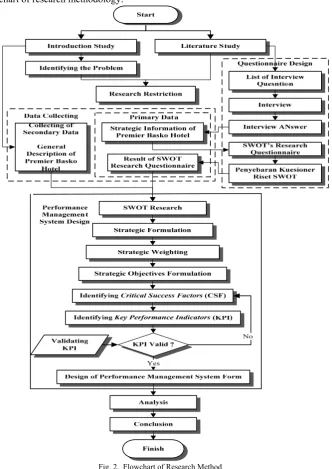
Below is the flowchart of research methodology:
Fig. 2. Flowchart of Research Method
IV. RESULT AND DISCUSSION
A.Data Collecting
The data of the internal and external aspects (strategic information) of Premier Basko Hotel were obtained from the formulation of the questions list and from the interview. The results were then written in SWOT research questionnaire. The questionnaire was distributed to 8 respondents that responsible in Hotel manageria. They are the General Manager, Head of the Department of Human Resources, Accounting, Housekeeping, Sales & Marketing, Front Office, Food & Beverage and Engineering. From the questionnaires, we can know the average existing condition from respondents of the hotel and the average urgency handling also from the respondents. From this, the rank or the handling priority can be determined and it is shown in Appendixes Table I
B.Data Processing
1.Research of SWOT
The position of the hotel which is based on the difference between the average values of accumulative aspects of internal and external and with the median value (value of 3). The position of the hotel is in quadrant II (strength-threats) with the coordinate (0.17, -0.19).
2.Strategic Formulation
The strategic formulation at Premier Basko Hotel can be obtained with TOWS matrix by brainstorming in order to create several alternatives or strategies at the hotel. The alternative strategies for Premier Basko Hotel is derived from the result of strategic formulation on TOWS matrix. The strategies are divided into SO (Strengths Opportunity),
Proceedings of the International MultiConference of Engineers and Computer Scientists 2015 Vol II, IMECS 2015, March 18 - 20, 2015, Hong Kong
ISBN: 978-988-19253-9-8
ISSN: 2078-0958 (Print); ISSN: 2078-0966 (Online)
WO (Weakness Opportunities), Strengths Threat (ST) and WT (Weakness Threats). It is shown in Table II Appendix
3.Strategic Weighting
Weighting strategy is done by assessment (in value range 1-5) for each alternative strategy which is based on the relationship of each indicator in relation to the external and internal aspects. The highest weight is 368 from the ST strategy and the strategic alternatives is strengthening the characteristic of the hotel.
4.Formulation of Strategic Objectives and Identifying Critical Success Factors
Formulation of strategic objectives is done by classifying each alternative strategy into four perspectives in balanced scorecard. Critical Success Factors (CSF) are obtained from the critical factors of each hotel strategy objectives. The strategic objectives and the Critical Success Factors of Premier Basko Hotel are as shown in Table III Appendix.
5.Key Performance Indicators of Identifying and Validating The valid Key Performance Indicators (KPI’s) in the Premier Basko Hotel is shown in Table III Appendix
6.Designing form of Performance Management System There are 38 forms of Performance Management System that have been designed for the Premier Basko Hotel
V.CONCLUSION
From the research, it is concluded that Premier Basko Hotel is currently in kuadran II (strength-weaknesses) SWOT analysis diagram, so the hotel needs to implement diversification strategic. It is a strategic for collecting all internal powers and avoiding all company external threats in order to get all the long term opportunity. This research also produces 14 strategic alternatives for Premier Basko hotel. Furthermore, this Hotel also has 14 Critical Success Factors (SCF) and 38 Key Performance Indicators (KPI), and 38 forms of performance management system which can be a guidance for Premier Basko Hotel in improving company performance management system quality.
APPENDIX A
Appendix A shows the table of the Existing Condition and urgency handling from the respondents of Premier Basko Hotel, table of TOWS Matrix at Premier Basko Hotel and also table of Strategic Objectives, Critical Success Factors and Key Performance Indicator of Premier Basko Hotel
REFERENCES
[1] Arslan A, Adeel R, Muhammad S, Hanan I, “A Conceptual
Framework On Evaluating SWOT Analysis As The Mediator In Strategic Marketing Planning Through Marketing Intelligence”,
European Journal of Business and Social Sciences, Vol 2, No 1, pp
91-98, April 2013.
[2] Bititci, U.S., Carrie, A.S. and Mcdevitt, L., “Integrated Performance
Measurement Systems: a Development Guide”, International Journal
of Operations & Production Management, Vol. 17, No. 5 -6, 1997,
pp. 522- 534.
[3] IHRA (Indonesian Hotel & Restaurant Association) West Sumatera.
Data of Member Accomodation in Padang : IHRA West Sumatera 2013.
[4] Endang, Module of the Process of Establishing a Business trip for SMK and MAK, Erlangga. 2013.
[5] Forza, C. and Salvador, F., “Assessing Some Distinctive Dimensions
of Performance Feedback Information in High Performing Plants”,
International Journal of Operations & Production Management, Vol.
20, No. 3, 2000, pp. 359 - 385.
[6] Gomatesh M. Ravanavar, Dr. Poornima M. Charantimath, Strategic
Formulation Using TOWS Matrix – A Case Study, International
Journal of Research and Development, Volume 1, Issue 1, 2012.
[7] Heinz Weihrich, "Analyzing the Competitive Advantages and
Disadvantages of China with the TOWS Matrix - An Alternative to Porter's Model" in Ralph Berndt, ed. Innovative Management,,
Berlin: Springer Verlag, 2000, pp. 191-205.
[8] Hotel Proprietors Act 1956 (4 & 5 Eliz. 2 c.62), Government of Gibraltar. Available: www.gibraltarlaws.gov.gi.
[9] Houben G., Lenie K., Vanhoof K., “A knowledge-based
SWOT-analysis system as an instrument for strategic planning in small and
medium sized enterprises,” Decision Support Systems, pp.125–135,
1999, Elsevier Science B.V.
[10] Ittner, C., Larcker, D. and Randall, T., “Performance Implications of
Strategic Performance Measurement in Financial Service Firms”,
Accounting, Organizations and Society, Vol.28, No.7 - 8, 2003,
pp.715 – 741.
[11] Kaplan, Robert S., and David P. Norton. The Balanced Scorecard:
Translating Strategy into Action. Boston: Harvard Business School
Press, 1996.
[12] Kaplan R.S., Conceptual Foundations of the Balanced Scorecard,
Harvard Business School, 2010.
[13] Kaplan, R. S., and David P. N. Using the Balanced Scorecard as a
Strategic Management System, Boston: Harvard Business School
Press, 2005.
[14] Kerssens - Van Drongelen, I. C. and Fisscher, O. A. M., “Ethical
Dilemmas in Performance Measurement”, Journal of Business Ethics,
45 (1 - 2), 2003, pp: 51 - 63.
[15] Lebas, M.J., “Performance Measurement and Performance
Management”, International Journal of Production Economics, Vol.
41, No. 1 - 3, 1995, pp. 23 - 35.
[16] Lee S.F, Andrew S.O.K, “Building balanced scorecard with SWOT
analysis, and implementing “Sun Tzu’s The Art of Business
Management Strategies” on QFD methodology”, Managerial Auditing
Journal. Vol. 15 Iss: 1/2, pp.68 – 76, 2000.
[17] Lynch, R.L. and Cross, K.F., Measure Up - The Essential Guide to
Measuring Business Performance, Mandarin, London, 1991.
[18] Matti Salminen and Marja-Leena Viitala, Handbook on Perfomance
Management, Governance and Accountability, Ministry of Finance,
April 2006, pp 22.
[19] Moeheriono. Application Planning and the Development of Key
Performance Indicators (KPI) for business and public. Jakarta: Rajawali Pers. 2012.
[20] Rangkuti, Freddy. SWOT Analysis Technique in Business Case.
Jakarta: PT Gramedia Pustaka Utama. 2009.
[21] Rangkuti, Freddy. SWOT Balanced Scorecard: The Technique of
Arranging Effective Strategies and the Way to Handle Performances and Risks. Jakarta: PT Gramedia Pustaka Utama. 2011.
[22] Rizki, Muthia. Balance Scorecard as a Means of the Assessment of Performance on the Royal Hotel Ribbon. Universitas Lancang Kuning, Pekanbaru. 2011.
[23] Wibowo. Performance Management, Third Edition. Jakarta: Rajawali
Pers. 2010.
Proceedings of the International MultiConference of Engineers and Computer Scientists 2015 Vol II, IMECS 2015, March 18 - 20, 2015, Hong Kong
ISBN: 978-988-19253-9-8
ISSN: 2078-0958 (Print); ISSN: 2078-0966 (Online)
APPENDIX A
TABLE I.
EXISTING CONDITION AND URGENCY HANDLING FROM THE RESPONDENTS OF PREMIER BASKO HOTEL
Aspect No. Indicator
12 Human resources professionality in hotel 3.38 2.25 13
13 Organizational climate of hotel 3.13 1.88 21
1. The role of hotel rooms in hotel profitability 1. The role of Food & Beverage (FB) asset in hotel profitability
2. Hotel profitability 2. The role of Meeting Incentive, Convention & Exhibition (MICE) asset in hotel profitability
3. Human resources professionality in hotel 3. Enpowerment of FB & MICE asset
4. Organizational climate of hotel 4. Development of hotel facilities
5. Hotel services 5. Hotel cash flow
6. The quick response and hotel service hours 7. Procurement creativity of events, suchs as : new year celebration, christmas, etc
8. Technology of the hotel Opportunities (O)
1. Padang Tourism 1. Increasing the number and quality of hotel rooms (S1,S2,S5,S6,O1,O2,O3,O4,O5&O6) 1. Improving asset quality of hotel FB (W1,W3,W4,O1,O2,O3,O4,O5&O6) 2. The development of
tourism in Padang 2. Inproving the quality of hotel services (S1,S2,S3,S4,S5,S6,O1,O2,O3,O4,O5&O6) 2. Improving asset quality of hotel MICE (W2,W3,W4,O1,O2,O3,O4,O5&O6) 3. The arrival of
customers (tourists) 3. Improving the professionality of hotel human resources (S3,S4,S5,S6,O1,O2,O3,O4,O5&O6)
3. Increasing the promotion of FB & MICE asset of the hotel
(W1,W2,W3,O1,O2,O3,O4,O5&O6) 4. Government's role
toward the hotel 4. Enhacing procurement creativity of events (S2,S3,S7,O1,O2,O3,O4&O5) 4. Developing hotel facilities (W4,O1,O2,O3,O4,O5,O6) 5. Investors' role toward
the hotel
5. Developing technologies owned by hotels (S2,S8,O1,O2,O3,O4,O5&O6)
5. Improving cash flow management systems of the hotel (W5,O5&O6)
6. Bangking's role toward
the hotel 6. Increasing hotel promotion (S1,S2,S3,S5,S7,S8,O1,O2,O3,O4,O5&O6)
Threats (T) 1. The influence of the
tariff war between hotels 1. Establishing cooperation and communication between the hotels (S3,S4,T1&T2) 1. Developing assets variations and other services of the hotel (W3,W4,T1&T2) 2. The presence of an
apartment or condominium
2. Strengthening the characteristics of the hotel (S1,S2,S3,S5,S6,S7,S8,T1&T2)
Strategic Alternatives
Strategic Alternatives Matrix TOWS of Premier Basko Hotel
Internal
External
Proceedings of the International MultiConference of Engineers and Computer Scientists 2015 Vol II, IMECS 2015, March 18 - 20, 2015, Hong Kong
ISBN: 978-988-19253-9-8
ISSN: 2078-0958 (Print); ISSN: 2078-0966 (Online)
TABLE III.
STRATEGIC OBJECTIVES,CSF AND KPI OF PREMIER BASKO HOTEL
Balanced Scorecard Perspective
Strategy Strategic Objectives Critical Success Factors (CSF) Key Performance Indicator (KPI)
Finance
Increasing the number and
quality of hotel rooms Increased profit hotel The level of hotel profits Revenue percentage of hotel Profit percentage of hotel
Increasing hotel promotion Increased number of hotel guests arriving in the hotel The number of hotel guests arriving in the hotel
Percentage of hotel guest arrivals (customer)
Increasing the promotion of FB
& MICE asset of the hotel Increased number of guest arriving in hotel FB&MICE
The number of guest arriving in hotel FB&MICE
Percentage of customer arrival of hotel FB
Percentage of customer arrival of hotel MICE
Establishing cooperation and communication between the hotels
Stability sales price of hotel
rooms The level of hotel room sales
Percentage of hotel room sales Stability of sales price of hotel rooms
Improving cash flow
management systems of hotel Improved cash flow management system of hotel The management of hotel financial cash flow Cash flow of the hotel
Custom
er
Strengthening the characteristic
of hotel Strengthened the brand image of the hotel The brand image of hotel
Market share of hotel guest Amount of new hotel guest Market share of hotel FB customer Amount of new hotel FB customer Market share of hotel MICE customer
Amount of new hotel MICE customer
Developing hotel facilities Increased hotel guest satisfaction toward hotel facilities
The satisfaction level of hotel guest toward hotel facilities
Satisfaction level of guest on hotel facilities
Improving the quality of hotel services
Increased hotel guests satisfaction toward hotel services
The satisfaction level of hotel guest toward hotel services
Satisfaction level of guest on hotel service
Frequency of hotel guest complaint Service time of hotel guest Loyality level of hotel guest
Improving asset quality of hotel
FB Increased customer satisfaction of FB hotel The satisfaction level of customers FB hotel
Satisfaction level of hotel FB customer
Frequency of hotel FB customer's complaint
Service time of hotel FB customer Loyality level of hotel FB customer
Improving asset quality of hotel
MICE Increased customer satisfaction of MICE hotel The satisfaction level of customers MICE hotel
Satisfaction level of hotel MICE customer
Frequency of hotel MICE customer's complaint Service time of hotel MICE customer
and other services of the hotel Improved services asset variation of hotel The innovation level of hotel service assets
Amount of new service asset of hotel
Level of hotel facilities development Enhancing procurement
creativity of events Increased creativity procurement events The creativity level of procurement events Amount of hotel procurement event Developing technologies
owned by hotels Developed hotel technology The technology level owned by hotel Level of hotel technological development
Lear
of hotel human resources Increased professionality of hotel human resources The profesionality level of hotel human resources
The Absence of hotel human resources on working
Frequency of human resource fault on working
Frequency of work accident Amount of hotel human resource with good performance Frequency of training on hotel human resources
Amount of human resources with an increasing performance after training
Frequency of fault of human resources
Satisfaction level of human resources
Proceedings of the International MultiConference of Engineers and Computer Scientists 2015 Vol II, IMECS 2015, March 18 - 20, 2015, Hong Kong
ISBN: 978-988-19253-9-8
ISSN: 2078-0958 (Print); ISSN: 2078-0966 (Online)