®
An Exploration of the
Responses of Stakeholders
to a Mother Tongue-Based
Multilingual Education
(MTB-MLE) Programme Being
Implemented in Pilot
Schools in Mindanao,
Philippines
to a Mother Tongue-Based Multilingual Education
(MTB-MLE) Programme Being Implemented in Pilot
Schools in Mindanao, Philippines
Xinia Skoropinski
54
2013 SIL International
®ISBN: 978-1-55671-346-0
ISSN: 1934-2470
Fair-Use Policy:
Books published in the SIL e-Books (SILEB) series are intended for scholarly research and educational use. You may make copies of these publications for research or instructional purposes free of charge (within fair-use guidelines) and without further permission. Republication or commercial use of SILEB or the documents contained therein is expressly prohibited without the written consent of the copyright holder(s).
Editor-in-Chief
Mike Cahill
Managing Editor
Bonnie Brown
Compositor
An Exploration of the Responses of Stakeholders
to a Mother Tongue-Based Multilingual Education (MTB-MLE) Programme
Being Implemented in Pilot Schools in Mindanao, Philippines
Xinia Skoropinski
Submitted in partial fulfilment of the requirements for the award of
MA Literacy Programme Development, Middlesex University
Acknowledgments
I want to thank my mentors, Ian Cheffy and Catherine Young, who have given me helpful feedback, advice and encouragement throughout this project and in the process of writing this paper.
Thanks to my friends and colleagues in Save the Children who trusted in me to do this
collaborative research, seeking first evidences of the effects of implementation of the MTB-MLE programme they had been planning for about three years.
I want to thanks the teachers, principals and parents who opened their hearts, sharing the stories presented in this paper, telling of their experiences and dreams for their children.
Abstract
This Exploration of the Responses of Stakeholders to a Mother Tongue-Based Multilingual Education (MTB-MLE) Programme Being Implemented in Pilot Schools in Mindanao, Philippines has focused on
three of ten pilot schools in which the international NGO Save the Children has been managing implementation of MTB-MLE as part of a nationwide transition to using the mother tongue as the medium of instruction in Grades 1 through 3.
The goal has been to identify early evidences of potential impact of MTB-MLE through accounts from immediate stakeholders, primarily parents and teachers of Grade 1 pupils. The qualitative Most Significant Change (MSC) methodology and direct observation in the MTB-MLE classrooms were used to monitor change through the academic year in two research domains: (1) Changes in Teachers’ Practices and Attitudes toward the MTB-MLE Programme and (2) Changes Resulting
from Use of the MTB-MLE Instructional Materials. Findings show that, formerly, the non-MT educational materials were largely ineffective. Educators and parents were frustrated, seeing the pupils’ low rate of success and lack of enjoyment of their educational experience. In contrast,
under MTB-MLE, stakeholders reported increased comprehension by pupils, success in learning to read and improved teacher-pupil relationships. They perceived the MTB-MLE programme as the beginning of restoration of a dysfunctional system.
Abbreviations
BICS Basic Interpersonal Communication Skills CALP Cognitive Academic Language Proficiency DepEd Department of Education
ECCD Early Childhood Care and Development HES Hiligaynon Elementary School
L1 First Language L2 Second Language L3 Third Language
MES Maguindanaon Elementary School MOI Medium of Instruction
MSC Most Significant Change MT Mother Tongue
MTB-MLE Mother Tongue-Based Multilingual Education NGO Non-Governmental Organization
SCMPO Southern Central Mindanao Programme Office TES Tboli Elementary School
Contents
1.2 Rationale for This Research ... 3
Chapter 2: Literature Review ... 6
2.1 Cognitive Theory as It Relates to Language ... 6
2.2 The Process of Reading ... 9
2.2.1. Working Memory Processes ... 9
2.2.2. Lower-level Processes of Reading... 10
2.2.3. Higher-level Processes of Reading ... 12
2.3 Reading Acquisition ... 13
2.4 Summary ... 16
Chapter 3: Methodology ... 17
3.1 Qualitative Research ... 17
3.2 Research Domains of Focus ... 19
3.3 Most Significant Change Methodology (MSC) ... 22
3.4 Most Significant Change as Applied in This Research ... 25
3.5 Direct Observation in the Classroom ... 28
3.6 Summary ... 29
Chapter 4: Analysis and Discussion ... 31
4.1 Summary of Stories Classified by Domain for Each Monitoring Period ... 32
4.2 Most Significant Changes in the Eyes of the Stakeholders ... 36
4.2.1 Evidence for Stakeholder Values: Domain 1 ... 37
4.2.2 Direct Observation and Further Discussion: Domain 1 ... 40
4.2.3 Evidence for Stakeholder Values: Domain 2 ... 42
4.2.4 Direct Observation and Further Discussion: Domain 2 ... 46
4.3 Thematic Analysis of the Stories and Emergent Domains ... 47
Chapter 5: Observations and Recommendations ... 51
5.2 Stakeholder Responses Related to Changes Resulting from Use of the MTB-MLE
Instructional Materials ... 53
5.3 Stakeholder Responses in Other Domains of Their Interest... 54
5.4 Recommendations and Final Reflections ... 55
References ... 57
Appendices ... 60
Appendix A: Maps of the Philippines and Mindanao ... 60
Appendix B: Lesson Two from the Maguindanaon Alphabet Pri er Teacher s Guide, Teachi g the Sou ds a d a ... 62
Appe dix C: I structio s for shared readi g of Big Books ... 63
Appendix D: Instructions for Teaching a Primer Lesson ... 65
Appendix E: Example of Interview Form, for the Maguindanaon Language... 68
Appendix F: Template for Direct Observation in the Classroom ... 73
List of Figures and Tables
Figure 1. Cummins’ Underlying Proficiency Model ... 6
Figure 2. Flow of stories and feedback in the selection process of most significant stories ... 26
Table 1. Skills fluent readers use for reading comprehension ... 10
Table 2. Scenarios in which MSC has been evaluated as useful or not as useful ... 23
Table 3. School codes, locations and languages of the MTB-MLE pilot schools ... 25
Table 4. Dates and times of classroom observations ... 29
Table 5. Stories collected for each reporting period, by domain ... 31
Table 6. Changes described in stories collected in Monitoring Period I (September 2011) ... 33
Table 7. Changes described in stories collected in Monitoring Period II (November 2011) ... 34
Table 8. Changes described in stories collected in Monitoring Period III (March 2012) ... 35
Table 9. Most significant changes identified by stakeholders ... 37
Table 10. Percentage of occurrence of themes identified by analysis of all 58 stories ... 48
Table G1. Story S1-HES... 74
Table G2. Story S30-MES ... 75
Table G3. Story S49-TES ... 76
Table G4. Story S9-HES... 77
Table G5. Story S31-HES ... 78
Table G6. Story S37-MES ... 80
Table G7. Story S52-HES ... 81
Chapter 1: Introduction
We should become tri-lingual as a country. Learn English well and connect to the world. Learn
Filipino well and connect to our country. Retain your dialect and connect to your heritage
(Benigno Aquino, President of the Philippines, 2010).
The intent of this research has been to identify early evidences of potential impact of a mother tongue-based multilingual education (MTB-MLE) programme being implemented in the public school system of the Philippines as revealed through responses of immediate stakeholders. Educators, primarily the Grade 1 teachers in the MTB-MLE classrooms in three pilot schools, and parents of their pupils were invited to tell their stories, related to the programme, as a means of monitoring change in two domains:
(1) Changes in Teachers’ Practices and Attitudes toward the MTB-MLE Programme; (2) Changes Resulting from Use of the MTB-MLE Instructional Materials.
These domains were chosen in consultation with another immediate stakeholder, Save the
Children, the international non-governmental organization (NGO) that is managing implementation in partnership with the Department of Education (DepEd). Stakeholder responses have also served as a window into the experience of perhaps the most important direct beneficiaries, the pupils themselves. The purpose has been to understand the effectiveness of programme outputs with the goal of identifying adjustments or improvements that might be appropriate as
implementation proceeds.
is for them a revolutionary system where children for the first time are learning to read in their languages.
Of the three languages included in this research, two, Hiligaynon and Maguindanaon, number among the 12 of the 171 living Philippine languages (Lewis 2009) with more than one million speakers. Hiligaynon serves as the lingua franca of a sector of the population that largely belongs to the country’s predominant Roman Catholic culture. Maguindanaons comprise the nation’s largest
Muslim people group. The third language, Tboli, is spoken by a minority indigenous group. The three schools are located on Mindanao, the second largest island in the Philippines, in the municipalities of Bagumbayan and Lutayan in Sultan Kudarat Province and Lake Sebu in South Cotabato Province (Appendix A).
1.1 Rationale for MTB-MLE
On May 21, 1987, the Department of Education, Culture and Sports of the Philippines issued Order No. 52, ‘The 1987 Policy on Bilingual Education’, in which the newly adopted Constitution
of the Philippines was quoted as stating, ‘For purposes of communication and instruction, the official languages of the Philippines are Filipino and until otherwise provided by law, English’
(Department of Education 1987). The order thus mandated the national language and English as the languages of instruction, recognizing regional languages as ‘auxiliary media of instruction’
especially in Grades 1 and 2 (1987).
Results … reveal stark regional differences, with a very small percentage of children unable
to read in Filipino and English (1% and 2%, respectively) in Manila, compared with 24% and 30% of students in Mindanao (Gove and Cvelich 2011, 13).
Students in the Manila area enjoy the benefits of being taught first in their first language and of having a substantial body of written literature available in their mother tongue (MT), a luxury that most pupils in most other regions of the country do not have. In particular, those in rural
communities who are not regularly exposed to Filipino and English would seem to be most at risk of failing to learn to read.
The bilingual policy remained in place until July 14, 2009, when, driven by considerations such as the statistics above, the Department of Education issued Order No. 74, ‘Institutionalizing Mother Tongue-Based Multilingual Education’ mandating use of the local languages as media of instruction from preschool through Grade 3 (2009).
1.2 Rationale for This Research
In the Philippine context, MTB-MLE aims for children to be multicultural, multilingual and multi-literate (Nolasco 2009, 3). Fluency in English is valued as a sign of education, perceived to give the best opportunity for economic advancement. Filipino is needed to communicate with government agencies and other institutions. But for most, the language they use at home is neither Filipino nor English. Their MT, their first language (L1), is the language they understand best and the language most closely tied to personal identity and worth. It is the most natural language to use for early literacy, developing skills that can then be transferred to other languages.
Textbook provision continues to be woefully inadequate; reading books are even rarer, both in schools and homes. Furthermore, many cultures have rich oral traditions and do not routinely practice reading. Yet children who report having reading books in the home, not just textbooks, are also more likely to be able to read (Gove and Cvelich 2011, 44).
Though limitations in the social, economic and physical environment often hinder the development of adequate instructional materials (Malone 2003, 332), educators in the southern Philippines have joined forces with a team from Save the Children to do just that. Teachers from local schools have been trained to make ‘Big Books’, short, simple children’s stories written by community members in the local languages and with simple, culturally appropriate illustrations. Alphabet primer teacher’s guides for teaching the sounds of the languages have also been developed and
published in the three languages of focus, using words and illustrations that represent objects familiar to the children. These have now been used for a full academic year as the primary teaching materials for implementation of MTB-MLE in Grade 1 in the pilot schools.
Another barrier to widespread implementation of MTB-MLE in the Philippine context concerns the complexities of matching teachers with classrooms. In many places, too few teachers speak the MT, and those who do often lack experience in teaching Grade 1. Furthermore, teachers have themselves been educated in Filipino and English and have experience teaching curricula in those languages (Paulson 2012, 31-32). The minimally-developed MT curricula coupled with lack of experience in teaching in their own languages presents a combination of challenges that produces fears and uncertainty in some (Paulson 2012, 171, 189). These are issues to be faced as
implementation progresses.
Simultaneously with this research, tools for quantitative evaluation of other programme
Chapter 2: Literature Review
We should not guide the children in memorizing drills without understanding. Memorizing without
meaning is useless (Grade 1 teacher in an MTB-MLE class, March 2012).
In this chapter, I review relevant points in the current literature in bilingual education on the topics of cognitive/academic language proficiency theories and the processes involved in reading and reading acquisition. The thematic areas of focus in this review relate primarily to linguistic and curricular factors that contribute to or hinder success of the pupil in learning to read, as well as how these relate to second or third language acquisition and literacy transfer. These
considerations should provide a framework for understanding the characteristics of an effective MTB-MLE programme to aid in interpreting stakeholder responses.
2.1 Cognitive Theory as It Relates to Language
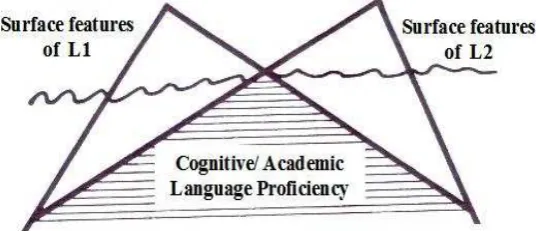
The MTB-MLE programme being implemented in the pilot schools aims to teach children to read and write first in their MT, and then to transfer their skills to the L2, Filipino; and L3, English. This accords in principle with widely held opinion that, with sufficient environmental exposure and motivation, proficiency in one language can be transferred to a second. Cummins calls this ‘interdependence across languages’ (2007, 232). To illustrate, he uses a two iceberg analogy
(Figure 1). While at the surface, two different languages are orally distinct like two separate pieces
of ice, underneath the surface it is as though they are fused together like an iceberg. The internalized common cognitive skills facilitate the transfer of proficiency from one language to another.
Along similar lines but with a focus on literacy, Perfetti and Dunlap propose the Universal
Phonological Principle, which ‘expresses the generalization that word reading activates phonology at the lowest level of languages allowed by the writing system: phoneme, syllable, morpheme, or word’ (2008, 14). These ‘universal categories’ apply to any language. Baker adds that for minority
language children, the general skills involved in decoding and reading may transfer easily from the MT to an L2 as long as the writing systems are similar (2006, 351).
The above assertions provide the theoretical foundation that underlies MTB-MLE, that once children have learned to read their MT, transferring skills to other languages can succeed given the right educational approach. In this study, though, the shift that is being evaluated is not primarily transfer of first language skills to an L2 or L3, but the more basic shift to teaching first in the MT in Grade 1 rather than attempting to introduce reading and writing through a written and spoken medium that is not that of the pupils. Oral L2 and L3 were scheduled to begin later in the academic year and to proceed in earnest in the second and third years of elementary education, along with continued MT instruction.
To understand the advantages of this new approach, I next consider Cummins’ distinction between ‘basic interpersonal communicative skills’ (BICS) and ‘cognitive academic language proficiency’
Others make the BICS-CALP distinction too, but with different terminology. Cummins’ interprets Kozulin’s analysis of ‘spontaneous’ and ‘scientific’ concepts, related to Vygotsky theory with its
description of the ‘zone of proximal development’, along similar lines:
Spontaneous concepts emerge from the child’s own reflections on immediate, everyday
experiences; they are rich but unsystematic and highly contextual. Scientific concepts originate in the structured and specialized activity of classroom instruction and are characterized by systematic and logical organization (Kozulin 1998, 48, cited in Cummins 2000, 60).
Cummins understands Kozulin to say that the zone of proximal development refers to concepts the child has already learned without a teacher from the social and physical environment, and which enable scientific concepts explained by a teacher to be processed mentally (2000, 61). If a teacher starts with cognitively undemanding activities in an ‘embedded’ or familiar context, such as working with other pupils to do simple tasks, learners will communicate in ways that facilitate mutual understanding. Then they move to more cognitively demanding activities such as reporting orally what they are learning. The teacher can respond by expressing the same ideas in more technical terms, since the pupils would then have a mental schema about the task. Finally, pupils work in a ‘reduced’ or less familiar context, for example, individually writing reports about what
they learned (Cummins 2000, 68-69).
According to Baker (2006, 169-170), Cummins’ model explains that, since the basic communication skills come from one ‘central engine’, people can easily function in more than one language. But to
This has great implications for learners from minority language communities: pupils can learn multiple languages, but their chances of success will increase by building ability first in their MT before bridging to an L2, and then bridging in a way that does not violate these principles. This will include allowing adequate time for pupils to gain academic proficiency (CALP) first in their MT before moving into the L2 and L3. Bridging to the L2 and L3 could begin, as in this MTB-MLE programme for example, with oral exposure to the new languages, allowing adequate time for BICS-type skills to develop in the new language before introducing more demanding
academic tasks.
Next I discuss the reading process, followed by reading acquisition, to evaluate what features of L1 instruction will support learner success at the beginning stages of literacy.
2.2 The Process of Reading
A vast amount has been written about reading comprehension processes. My intention is not to review all available literature, but to consider a model that will provide a useful theoretical
framework for this research with regard to factors relevant to the design and implementation of an effective MTB-MLE programme. One of the more recent texts, by Grabe and Stoller (2011), offers an updated overview of reading theory and relates research results to implications for instructional practices, considering issues in first and second language contexts. Their analysis thus provides a useful framework for understanding what is involved in becoming a fluent reader and the
implications for teaching and learning to read.
2.2.1. Working Memory Processes
Higher-level processes, on the other hand, make use of a reader’s background knowledge and ability to understand implications or inferences in what is read and therefore to draw appropriate conclusions about its meaning (2011, 13).
Grabe and Stoller consider that ‘working memory’, akin to what is commonly called ‘short-term memory’, holds and processes fresh information for just a few moments. The content of working memory becomes part of a ‘working network of information’ that will be used actively (or,
consciously) in cognitive processing by what the authors and others call ‘working memory activation’ (2011, 13, 295).
2.2.2. Lower-level Processes of Reading
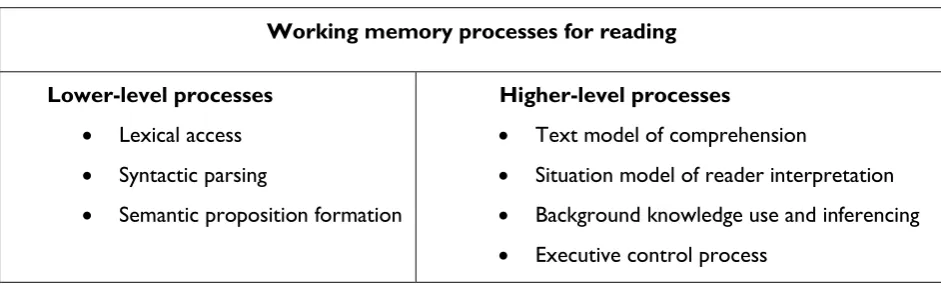
Lower-level processes such as recognizing a word and its associated meaning (‘lexical access’), understanding typical grammatical relationships and the propositions so formed (‘syntactic parsing’), and combining or processing local combinations of these meaningfully (‘semantic
proposition formation’) occur relatively instantaneously in skilled readers, without much conscious
effort (Grabe and Stoller 2011, 19). When the lower-level processes ‘are functioning well, they work together effortlessly in working memory. When they are not functioning fluently in combination, the reading comprehension process slows down considerably and comprehension becomes more difficult to maintain’ (2011, 19). Working memory activation is inhibited because
the content of working memory is not processed quickly enough and the new information fades –
Table 1. Skills fluent readers use for reading comprehension (Grabe and Stoller 2011, 14)
Working memory processes for reading
is forgotten – and so must be accessed again (i.e., by re-reading the text). Poor readers, who
struggle to read and understand complete sentences within the span of time that the working memory retains fresh input, might lose that content, necessitating re-reading the sentence several times before they can comprehend its meaning. Building reading skills to the point of quickly recognizing and understanding the words that are being read (lexical access) and how they relate to each other in the immediate context (syntactic parsing and semantic proposition formation) is essential to the process of effective reading. Reading instruction at the beginning level, then, should facilitate building skills with this end in mind. At this very beginning, lexical access, enabling pupils to recognize and read words that will have meaning for them, would seem to be the first step.
In this research, I have looked for evidence of beginning development of these more fundamental skills. However, learning to decode and gaining lexical access are only the beginning. At some point, there should no longer be much need to decode letters and their associated sounds. Grabe and Stoller consider that a fluent reader can recognize between 98 and 100 per cent of the words in a text at a rate of four to five words per second. This makes this process practically automatic in that words eventually should be recognized as units, as ‘sight words’. The fluent reader sees the
word as a whole, as a symbol that represents its meaning, so it is the meaning that comes to mind when the word is seen. Whether or not a reader will be able to move from decoding to such fluency will depend on the volume of available reading material and time spent reading. Grabe and Stoller state,
‘Both rapid processing and automaticity in word recognition (for a large number of words)
typically require thousands of hours of practice in reading’ (2011, 15).
given local language that will be used for education. MTB-MLE is a first step toward giving pupils the advantage of being taught in their first language first, but development of a growing body of vernacular literature should be seen as an on-going need and challenge that should be part of a comprehensive MTB-MLE programme.
2.2.3. Higher-level Processes of Reading
In addition to having adequate input from the lower-level processes, comprehension of what is read involves the higher-level processes (Table 1, column 2, above). The ‘text model of
comprehension’ in Table 1 refers to the reader’s mental representation of the meaning of the text in terms of its main ideas, like a summary of the text. The ‘situation model of reader
interpretation’ refers to the sense the reader makes of the text, which will depend on what the
reader understands (the text model that is being formed) as well as personal prior knowledge and experiences of the reader. Such background knowledge guides the inferences that the reader might draw. Finally, an internal process of assessment of how well the text has been
comprehended, using strategies to monitor and repair comprehension if needed, is part of the ‘executive control process’ (Grabe and Stoller 2011, 22). For this research, discussion of
background knowledge would seem to be most fundamental and relevant.
The ‘background knowledge’ mentioned in connection with higher-level processes (Table 1) refers
not to basic knowledge such as sound-letters correspondences or meanings of individual words, which are important in the lower-level processes, but to cultural awareness and specific
informational knowledge. ‘Inferencing’ skills, the ability to understand not only the literal meaning of words but the communicative goal of an author and the potential significance of a text, are necessary too. The background knowledge that a reader brings to the text interacts with its meaning to make it possible to draw inferences about what is stated. Without appropriate
What children bring with them to the classroom will undoubtedly impact the process of reading comprehension. If their background knowledge or experience is inadequate for interpreting the information they are asked to process in the classroom, they are unlikely to succeed regardless of ability. These are real difficulties which can bring discouragement to beginning readers, robbing them of motivation to read (Grabe and Stoller 2011, 24). If, on the other hand, what they read relates to familiar topics, they will be able to connect it with what they know, helping them to understand the meaning and resolve ambiguities. This research is looking for evidences that early readers in this programme can make sense of what they read, that the reading materials relate adequately to their world, facilitating comprehension.
An implication of this discussion for those learning to read their L1 who have not yet mastered these basic skills to gain fluency is a low likelihood of success in learning to read an L2. There will be little opportunity for them to transfer still underdeveloped skills. Furthermore, learning other languages in which they have insufficient knowledge of the lexicon or grammar and in which they have little or no cultural background knowledge will also adversely impact success. Informing learners about L2 and L3 cultures should be mandatory to help comprehension when exposure to other languages begins.
I have presented a model with the intent to explain some relevant aspects of the complex
processes that take place in what is seemingly an ordinary activity, reading with comprehension by skilled readers. But for new readers, those who are the focus of this research, reading starts slowly and in a fragmentary manner, with learners sometimes decoding with difficulty. The next section discusses strategies for teaching reading as applied in the development of instructional materials.
2.3 Reading Acquisition
role and effectiveness of these materials. The description of the processes involved in reading (Section 2.2 above) seems to indicate that early reading should focus primarily on skills needed for the lower-level processes to function well, especially lexical access, while children are just
beginning to recognize printed words. In developing materials, attention has been given to elements such as naturalness of the text, consistency of orthography and familiarity of content, all of which have been considered critically, believing that they will directly affect reader success. But it has also been considered important for pupils to learn to relate orthographic symbols with the sounds they represent in order to be able to use them in any context, so that when they
encounter totally new words, or long or complex words, they will be able to decode and read them (Stuart, Masterson and Dixon 1999, 127-28).
Not all agree with the last assertion above. Stanovich and Stanovich (1999) discuss the ‘reading war’, waged since the 1970’s by proponents of the two major models of reading theory, and the application to reading acquisition: the teaching of phonics versus the whole-language approach. Stanovich and Stanovich strongly affirm the value of teaching phonics, asserting that the whole-language approach is based on the underlying but incorrect assumptions of the top-down models of reading. These models argue ‘that skilled readers rely less on graphic cues than do less-skilled readers’ (1999, 15), which has been interpreted by advocates of the whole-language approach as
the absence of a foundational need to decode words. They have assumed that contextual
dependency is always associated with good reading so that ‘guessing words based on the previous
context of the passage is an efficacious way of reading and of learning to read’ (1999, 15). For
example, Stanovich and Stanovich (1999, 15) cite Goodman (1976) as stating:
In contrast, Stanovich and Stanovich argue that the assumption that guessing words is easy and very accurate is incorrect. They state that word recognition by skilled readers is not characterized by more reliance on contextual information and that recent research demonstrates that it is not appropriate to generalize hypotheses regarding the role of context in reading comprehension to the level of word-recognition (1999, 17). They contend that because of the rapidity and
automaticity of word recognition in a skilled reader, there is no need to depend on context to recognize words. Conversely, unskilled readers whose decoding skills are not sufficiently developed are those who might make guesses based on context (1999, 19). They conclude:
Two decades of empirical research have largely resolved these debates in favour of the bottom-up models. A greater use of context cues to aid word recognition is not a characteristic of good readers, developing phonological sensitivity is critical for early success in reading acquisition, and instructional programmes that emphasize spelling-sound decoding skills result in better reading outcomes because alphabetic coding is the critical subprocess that supports fluent reading (1999, 29).
With the intent to develop decoding skill in the children, Primer Teacher’s Guides for teaching the sounds of the language have been developed for each language community involved in this study (Appendix B). These guides are intended to give teachers direction as to how to instruct the children so they can learn the letter-sound correspondences, thus developing phonological awareness and the skills needed to decode the printed word.
Clearly, however, decoding is not enough:
In that light, the MTB-MLE pilot project is also producing literature in the vernacular languages and with many visual images to aid in developing listening skills and stimulate reading comprehension. In reading these ‘Big Books’ to the children, reading is modelled even when the children are not yet
able to read text. Learners certainly can ‘read’ the pictures and relate them to what they are
hearing. As the pupils begin to learn to decode, they can apply their developing skills by using the Big Books themselves. The intent is to communicate to the children that there is meaning in the printed page, and that they themselves can begin to access it.
In this research, I have looked for evidence that pupils are building decoding skills, but also for evidence that the illustrations in the Big Books and teacher’s guides communicate clearly, and that pupils understand what they read at least at the word level.
2.4 Summary
I have considered here technical topics such as Perfetti’s Universal Phonological Principle as it relates to the transfer of first language literacy skills to other languages, the cognitive processes involved in reading, and approaches to teaching reading to facilitate reading acquisition. I have noted the importance of beginning in the familiar cultural context in which the children are
Chapter 3: Methodology
It is very important to me that what I teach be useful to the pupils
(Grade 1 teacher in an MTB-MLE Class, November 2011).
For this research, I have used the relatively new methodology called ‘Most Significant Change’
(MSC), a qualitative participatory monitoring approach developed in Bangladesh in 1996 to monitor a rural development project (Davies and Dart 2005, 9). In this chapter, I discuss the validity and advantages of qualitative approaches in social research, describe the research domains of focus, summarize MSC, and describe how it has been applied here. Finally, I mention direct classroom observation, used as a complement to the MSC approach.
3.1 Qualitative Research
Qualitative approaches to research are now widely accepted and have been applied in many social fields, including education (Robson 2011, 130-131). A qualitative approach affords a more ‘flexible’ design than might be possible with more traditional quantitative assessment tools in the sense that the design, at least in part, ‘emerges’ as the research progresses and is adjusted to the realities of
the situation (Robson 2011, 131).
Qualitative research has its basis in a social constructionist view, defined by Robson as follows:
Social constructionism indicates a view that social properties are constructed through interactions between people, rather than having a separate existence. Meaning does not exist in its own right; it is constructed by human beings as they interact and engage in interpretation (2011, 24).
which all are immersed and, inevitably, to contribute to the process of constructing and interpreting meaning. This sort of subjectivity is welcomed, considering ‘that the task of the researcher is to understand the multiple social constructions of meaning and knowledge’ (Robson
2011, 24) because not only are the values and attitudes of the researcher important, but also those of the participants. Their values will be reflected in their constructions of meaning (Roche 2000, 547). This is important, because project sustainability will likely be compromised if stakeholder values are ignored (Abeyratne 2010, 1).
Whether or not the stakeholders themselves should participate in monitoring and evaluation has been a matter of discussion, asking what degree of involvement a researcher can have with that which is being evaluated and still be an appropriate evaluator (Cracknell 2000, 329). Over the last two decades, interest in participatory approaches has increased, originating from the discussion of ‘fourth generation’ evaluators (Guba and Lincoln 1989). The three previous generations of
evaluators focused on ‘mastery of the facts’ (1989, 22), tended toward managerialism, failed to
acknowledge the non-homogeneity of participants’ value systems and were overcommitted to the scientific paradigm of inquiry. Guba and Lincoln argue that a research methodology that uses the traditional scientific method is not necessarily independent of a value system (1989, 34-35), and propose a ‘constructivist methodology’ as ‘a replacement for the scientific mode’ (1989, 43),
removing the pre-established parameters and boundaries of previous models in favour of an ‘emergent model’ where indicators are not pre-determined and stakeholders are involved in an
‘interactive process of negotiation’ (1989, 39). There is a loss, in a sense, of complete control, of
finding ‘universal solutions’, but it is a loss in favour of ‘solutions with local meaning and utility’
(1989, 47). Those who fit these characteristics are fourth generation evaluators.
This discussion basically advocates for Cracknell’s ‘recognition that various categories of
stakeholders will have their own value systems, and each of these is significant and cannot be ignored’ (2000, 319). Researchers should adjust their roles to become negotiators or ‘change
groups of participant stakeholders, helping them to achieve consensus. Such negotiation gives stakeholders opportunities for empowerment and education. The goal is a real participatory method rather than ‘donor-dominant practices’ (Cracknell 2000, 331). As Patton states, ‘the best
way to be sure that evaluation is targeted at the personal concerns of the stakeholders is to involve them actively at every stage of the evaluation’ (1997, cited in Cracknell 2000, 319). This demonstrates respect for the dignity and integrity of beneficiaries, welcoming everyone’s contribution, so that ‘participants continue to be treated as human, not as objects of
experimentation’ (Guba and Lincoln 1989, 10). It promotes genuine interest in hearing their
concerns in order to learn what actions will meet felt needs, not just to measure the degree of success or failure (Cracknell 2000, 56).
3.2 Research Domains of Focus
A goal of this research has been to discover the values and attitudes of the participants as they relate to this new educational paradigm. In dialogue with Save the Children, two research domains were chosen for particular emphasis in this exploration of responses. These are to seek evidences of (1) changes in teachers’ practices and attitudes toward the MTB-MLE programme and
(2) changes resulting from use of the instructional materials that were produced specifically for the programme.
cyclical nature of the process, that as teachers’ attitudes improve, they might make other changes
in practice which will improve student outcomes even further (2002, 385-386).
The changes in teacher’s practices and attitudes observed in this research are those described by
stakeholders as implementation of the MTB-MLE programme has progressed. Parents and educators have related their own experiences and assessments of progress of their pupils compared to the former paradigm.
With regard to instructional materials, others have used quantitative fixed-design methodologies for evaluation (Abdulrahman 2008; Eash 1972; Khan et al. 2007). But the materials being assessed in this research are quite simple. These are not textbooks, but two particular teaching aids. First are 38 Big Books, some in each of the three languages. These are simple children’s books,
handmade by the educators and intended to be predictable. They might be traditional folk tales or simple storylines about the experiences of a child. But in all cases, stories are intended to
represent what is familiar to the children in their everyday lives. Large lettering makes it possible for all the pupils in a classroom to see the text and the simple illustrations that accompany it on each page as the teacher reads or has the class read the story aloud together. Instructions for using Big Books for ‘shared reading’ have been made available to teachers (Appendix C).
relate to and use them; and evidences of their contribution to the process of beginning acquisition of literacy, specifically, the decoding skills of the beginning reader.
The approach has been monitoring rather than impact assessment. Implementation of the MTB-MLE programme was at a very early stage, but impact assessment requires a model that would ‘embrace the wider context of influences and change processes that surrounds projects and
programmes, and the wide variety of the resulting impacts’ (Roche 2000, 548). Fullan asserts that
‘change is a process, not an event’ (2007, cited in Robson 2011, 192), explaining that effective
change takes years before it causes significant impact. However, even though impact assessment focuses on longer term changes, ‘significant change or progress towards long-term change can also be detected in the short term’ (Save the Children 2003, 127). While it might be too early to
measure impact in its fullest sense, stakeholders were expected to have perceptions, to feel effects, to see changes in the educational process and in the people involved as a result of implementation of MTB-MLE in their communities. They likewise were expected to have impressions as to the effectiveness and role of the new materials, written in their languages and used in the school system as instructional aids for the first time. The stakeholders all have an interest in these perceptions as a window into what is working and what could be improved as the pilot project is expanded to include many more schools and language groups nationwide.
Because of the less precise nature of a qualitative approach and to increase confidence in the validity of the findings of this study, more than one method of gathering data and analysis have been applied (Robson 2011, 87; Roche 2000, 547). These are:
1. Accounts or stories from primary stakeholders using the MSC methodology, examined from the points of view of
b. themes identified over the range of all stories collected from stakeholders and frequency of occurrence of each; and
2. Corroboration of MSC results by direct classroom observation.
Additionally, as mentioned in Chapter 1 Section 1.2, more traditional quantitative evaluation being done by Save the Children should complement this study as well.
3.3 Most Significant Change Methodology (MSC)
The MSC qualitative participatory method involves stakeholders in planning what changes or domains of change will be researched as well as in documenting and evaluating the relative significance of results. Research is carried out at intervals as the programme progresses in order to monitor change. In this way, it is intended to provide feedback to managers with regard to performance and programme outcomes (Davies and Dart 2005, 15-34).
In practice, participants are asked to tell or write stories reflecting what they believe to be the most significant change resulting from the programme or a domain of focus. Then other
participants and stakeholders, or the group of stakeholders who have written the stories, evaluate and select the most significant of the accounts of change. Story selection is made using the existing hierarchical structure of the organization (Davies and Dart 2005, 72).
MSC intentionally uses the ambiguity of the term ‘significant’. As Roche states, ‘how significant or
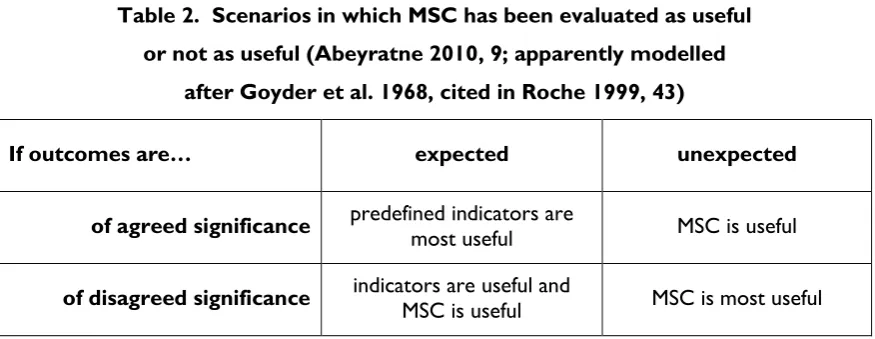
A strength of MSC is its potential for discovery of unanticipated areas of change, making the method suitable for ‘monitoring that focuses on learning rather than just accountability’ (Davies and Dart 2005, 13). Indicators are not predetermined, but emerge from the stories of the people, reflecting how change is being perceived as beneficial or harmful, according with their values, helping to facilitate corrective action. As Table 2 suggests, the methodology seems to be more useful in situations where the significance and probability of a given outcome are less clearly known or anticipated.
Conversely, a weakness of MSC is its dependence on many participants at different levels to accomplish the task, from coordinating interaction with stakeholders in their communities to fitting the selection process into the schedules of busy people to whom this aspect of the project might not have highest priority. The barriers of language and culture are formidable at times, as are the challenges involved in obtaining meaningful stories and processing them. Communicating the goals and even transferring the meaning of ‘significant’ into other languages is not always straightforward. In this research, repeated attempts to rephrase a question in the local languages were sometimes needed before participants could grasp the goal. Additionally, there is potential for bias in favour of the views of those who are better storytellers than others, and those who make the selections might not fully represent the wider voice of beneficiaries. Also, asking for an account of change presupposes that participants have observed change and could bias them toward inventing something to avoid embarrassment. For these reasons and possibly others, evaluation of ‘most
Table 2. Scenarios in which MSC has been evaluated as useful
or not as useful (Abeyratne 2010, 9; apparently modelled
after Goyder et al. 1968, cited in Roche 1999, 43)
If outcomes are… expected unexpected
of agreed significance predefined indicators are
most useful MSC is useful
of disagreed significance indicators are useful and
significant change’ should not stand as the only tool for monitoring and evaluation in a
particular study.
A personal consideration related to the potential for bias is that, because of my technical
background in making primers and knowledge of two Philippine languages, I was involved in training teachers and in developing the teaching aids being evaluated here. Consequently, the question of my objectivity could be raised. I have assumed a dual role, first as an insider participating in materials development, and then as an outsider assessing the effects of the materials as used in community. Another consideration in my role as an outsider researcher is the cross-cultural situation involved. Differences in background and experience of the researcher from those whose situation is under study can create distance:
These features may include the lack of a shared language, physical distinctiveness, lack of genealogical qualifications to enter into the society or lack of knowledge of the ‘normative
rules and constraints’ (Ellen 1984:32) of the group being studied. The most obvious
existence of this challenge may be observed in the situation of a Western researcher originating in an industrial context conducting research in a non-Western, pre-industrial context (Young 2001, 6).
Young urges the researcher to be aware of how personal worldview might affect the process, and to make an intentional effort to understand the culture in which the study is taking place
(2001, 19).
3.4 Most Significant Change as Applied in This Research
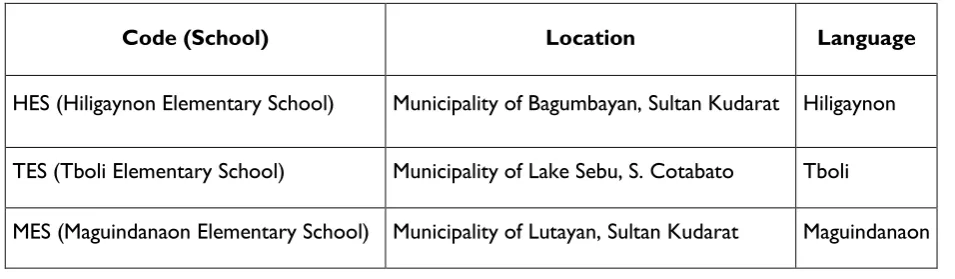
The data gathered in this study are in the form of accounts written by parents and educators (principals, Grade 1 and other grade teachers) from the three pilot schools. A code designating each school, its location and language is shown in Table 3.
The pilot schools were visited several times during the 2011-12 school year, which runs from June through March in the Philippines. The procedure was as follows:
During each data collection visit, participants were asked to respond to one question in
each of the two domains of research, in accordance with the prescribed MSC procedure (Davies and Dart 2005,10; see the example interview form in Appendix E):
What changes have you noticed in implementing MTB-MLE in the last months related
with teachers’ practices and attitudes toward the programme?
What changes have you noticed in implementing MTB-MLE in the last months related with the instructional materials they use?
Participants were asked to answer in two parts, first describing what they had observed,
and then explaining why they considered that change to be the most significant. The
Table 3. School codes, locations and languages of the MTB-MLE pilot schools
Code (School) Location Language
HES (Hiligaynon Elementary School) Municipality of Bagumbayan, Sultan Kudarat Hiligaynon
TES (Tboli Elementary School) Municipality of Lake Sebu, S. Cotabato Tboli
preferred method was to write the stories rather than record them, but some recording was done, with permission of participants, to aid in confirming the written records.
From among the stories written, the writers were encouraged to participate in preliminary
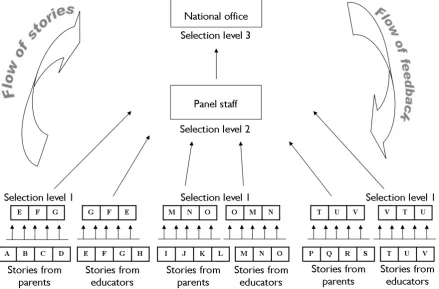
selection of the story they considered to describe the most significant change for that period (Figure 2).
After selection at the first level, all stories were passed to an appointed panel of regional
staff of Save the Children. From the preliminary selections of the writers, the panel selected those they considered to be most significant for the monitoring period in each domain and wrote a short statement supporting their selection (Figure 2). In this way, potential for bias in the selections of the NGO was minimized since they could only choose from stories preselected at the grassroots level.
Figure 2. Flow of stories and feedback in the selection
The stories selected at the regional level were then passed to the national office of Save
the Children, where the final selection was made or confirmed (see Figure 2).
Visits began in early September 2011, during the second grading period, which runs from August through October. Teachers and parents gathered in two groups to write stories. Some required transcription and translation before selection to review content and if the desired procedure had been followed. Teachers then made their selection of the most significant story. In some instances parents were uncomfortable making selections, in which case the task was done solely by
the educators.
In the September data collection, the actual procedure that was followed deviated from the last two points of the desired procedure above in that the Southern Central Mindanao Programme Office (SCMPO) of Save the Children and the national office made a joint selection rather than a sequential selection of the most significant stories. After collection, transcription, review and sorting by domain, the stories were presented to the two offices of Save the Children, designating which had been pre-selected by the teachers at the community level as most significant. Then, from the pre-selected stories, one from each domain of focus was chosen as most significant for the first monitoring period. Due to the limited time available to Save the Children staff for assessment activities, most communication regarding story selection took place by email, by majority vote, rather than in face-to-face discussion. Feedback was taken to the schools the first week of October, giving opportunity too for advocacy and orientation for the second
data collection.
the teachers tended to yield to the person in highest authority, accepting that individual’s selection.
So for the second collection, stories were exchanged by the small groups so participants would not feel threatened to have to select stories from among their immediate peers. Then the stories selected were considered by SCMPO personnel (Figure 2, Selection Level 2), and their selections were passed to the national office of Save the Children for Selection Level 3 (Figure 2), according to the intended procedure. These selections then were considered to represent the most significant changes for the second monitoring period.
The third data collection took place in the second half of February and first half of March 2012, during the fourth grading period. The many school activities near the end of the school year made it challenging to find help from parents and teachers. Only a dozen stories total were collected, making selection at the lowest level unnecessary, though the same procedure as for the second data collection was followed in all other respects.
Stories selected as Most Significant in each monitoring period and the reasons for selection are discussed in Chapter 4.
3.5 Direct Observation in the Classroom
Observation is widely use in social research (Robson 2011, 316), and it was applied in this research too during visits to the pilot schools. The purpose was to observe classroom dynamics, especially related to the domains of focus, as a means of cross-checking and perhaps expanding the MSC results. I assumed the role of a ‘participant observer’, anticipating that perhaps children would
look at me as a teacher or teaching assistant, as commonly occurs with younger pupils when an adult visitor is present (Robson 2011, 323).
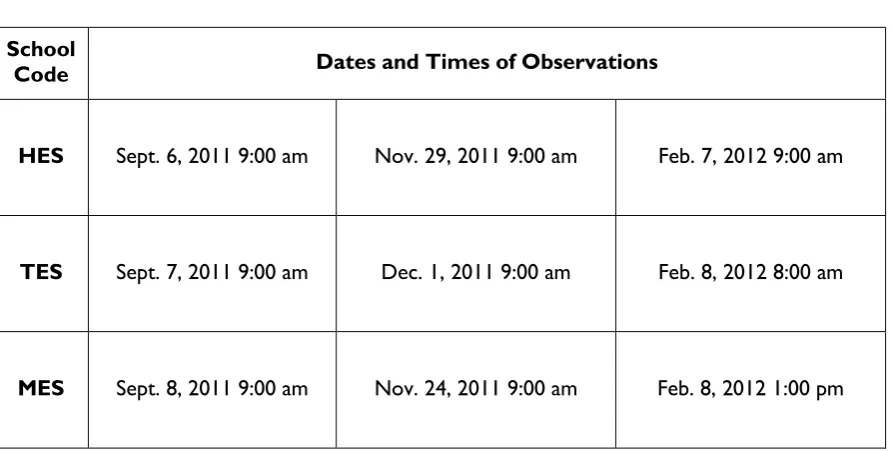
total combined observation time was about nine hours (Table 4). All of the teachers in the classrooms where the observations occurred were speakers of the MT used as the language of instruction, and all had completed the series of MTB-MLE trainings held by Save the Children in 2010. During the first quarter of the 2011-2012 school year, each had received a Sounds of the
Language Primer Teacher’s Guide in their language and a copy of the MTB-MLE Curriculum for Grade 1, both of which are documents that were developed by the teachers during teacher trainings.
Some activities were video-recorded during the observation session, and I took handwritten notes using a simple template (Appendix F), observing teachers’ practices and how they were applying what they had been taught in the MTB-MLE trainings. After their lessons, I sometimes asked the teachers clarification questions related to what I had observed that day.
3.6 Summary
I have discussed qualitative research in general, in terms of its advantage of considering stakeholder values as important in influencing acceptability and sustainability of a programme. I have described the research domains of focus, have discussed MSC as a means of researching specific domains and have considered its potential for discovering other important domains that emerge over the course
Table 4. Dates and times of classroom observations
School
Code Dates and Times of Observations
HES Sept. 6, 2011 9:00 am Nov. 29, 2011 9:00 am Feb. 7, 2012 9:00 am
TES Sept. 7, 2011 9:00 am Dec. 1, 2011 9:00 am Feb. 8, 2012 8:00 am
Chapter 4: Analysis and Discussion
My pupils are not afraid to participate in the class. … this is a significant change that impacts my
attitude toward teaching pupils (Grade 1 teacher in an MTB-MLE class, November 2011).
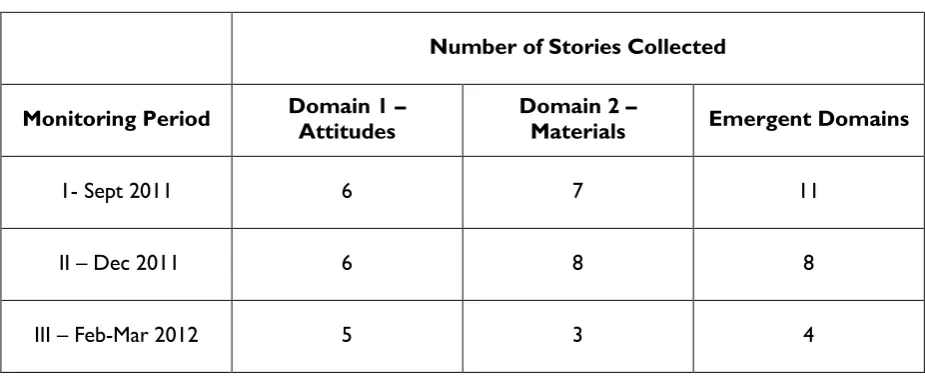
Of 58 stories collected from the three pilot schools over the three monitoring periods, 35 were classified as fitting the two principal domains of focus (Table 5):
(1) Changes in Teachers’ Practices and Attitudes toward the MTB-MLE Programme; (2) Changes Resulting from Use of the MTB-MLE Instructional Materials.
The 23 stories that did not fit either domain were classified as belonging to Emergent Domains (Table 5), from which stakeholders might also learn. In the following exploration of these
responses, all changes reported are first summarized and classified by domain for each monitoring period. Next, l comment on changes identified by stakeholders as most significant and examine evidences for stakeholder values as reflected at each selection level. For each domain of focus, I include additional insights gained from my direct classroom observations. Finally, I consider themes identified in the 58 stories, whether related to a domain of focus or not, as a means of examining
Table 5. Stories collected for each reporting period, by domain
Number of Stories Collected
Monitoring Period Domain 1 – Attitudes
Domain 2 –
Materials Emergent Domains
1- Sept 2011 6 7 11
II – Dec 2011 6 8 8
all the data from another perspective and helping to evaluate potentially significant emergent domains.
4.1 Summary of Stories Classified by Domain for Each Monitoring Period
In Tables 6, 7 and 8 below, changes described in all stories are listed by domain of focus for each monitoring period, respectively, and selections at each selection level are indicated. Changes relating to emergent domains are listed in the bottom section of each table.
Table 6. Changes described in stories collected in Monitoring Period I (September
2011), classified by domain (underlining: selection at the first selection level;
bold-underlining: final selection as most significant)
Story–School Domain 1 (Teachers’ Practices and Attitudes)
S1-HES Improved teacher-student rapport (principal)
S2-HES Pupil is learning, attitude greatly improved (parent) S3-HES Children now learning to read, unlike before (parent) S4-TES Teacher is good at teaching, children learn (parent)
S5-TES Teacher uses the MT in teaching, children capture the meaning (parent) S6-MES Teachers teach well, unlike before; children learn (parent)
Domain 2 (Instructional Materials)
S7-HES Children like to read; not afraid, unlike before (teacher) S8-HES Reading habits using Big Books (principal)
S9-HES Pupils comprehend Big Books & learn easily (parent)
S10-HES Pupil can do homework & parent can help (parent) S11-TES Children can understand and are learning (teacher) S12-MES Teacher’s success, children are learning (teacher) S13-MES Easy to teach in MT and children are learning (teacher)
Emergent Domains
S14-HES Concerned about transition to L2 and L3 (teacher)
S15-TES Harder to teach for one who doesn't speak the MT (teacher) S16-TES Teacher’s concern for pupils’ success in Grade 2 (teacher) S17-TES Teacher’s concern about lack of transfer materials (teacher) S18-TES Children being taught in an MT that is not theirs (parent) S19-TES No changes noted (parent)
S20-MES Teacher nervous to teach in a language not hers (teacher) S21-MES Grade 3 teacher’s concern: pupil development delayed (teacher) S22-MES Child’s interest in school has increased (parent)
Monitoring Period II (Table 7). In the second reporting period (November 2011), the number of stories from each school that fit a domain of focus was nearly balanced. Two stories selected as most significant came from MES, one from HES, and none from TES. Of those that fit Emergent Domains, six were from HES and two from MES. Unlike results for Monitoring Period I, where most stories classified as fitting Emergent Domains expressed concerns or problems, in this period all but one were positive.
Table 7. Changes described in stories collected in Monitoring Period II (November
2011), classified by domain (underlining: selection at the first selection level;
bold-underlining: final selection as most significant)
Story–School Domain 1 (Teachers’ Practices and Attitudes)
S25-HES Teaching in MT helps communication with pupils (teacher) S26-HES Pupil is developing oral skills, she understand now (parent)
S27-TES Actions taken due to a lack of MT teachers (teacher) S28-TES Teacher and pupils understand each other (parent)
S29-MES Improvement in teacher’s professional development (teacher)
S30-MES Teacher attitudes transformed by educational reforms (parent)
Domain 2 (Instructional Materials)
S31-HES Big Books in MT improve pupils’ learning & behaviour (teacher)
S32-HES Pupils are learning independently, now they understand (parent) S33-HES Change in children’s learning & reading habits (teacher)
S34-TES Easier to teach with MLE materials & pupils engaged (teacher) S35-TES Pupil is smarter, now he remembers the lesson (parent) S36-MES Pupils easily learning to write and read (teacher)
S37-MES MT as MOI & in written materials benefits pupils, parents (parent)
S38-MES Use of MT promotes unity in community (parent) Emergent Domains
S39-HES Pupils becoming interested in reading (principal) S40-HES Better education experience for pupils (parent) S41-HES Improvement in pupil’s interest in school (parent)
S42-HES Using another MT in the classroom than my own (parent) S43-HES Lessens the burden in assisting our child in his study (parent) S44-HES Pupil is learning and growing in knowledge (parent)
Monitoring Period III (Table 8). Due to the many school activities at the end of the academic year, only 12 stories were collected, of which five fit Domain 1, and three fit Domain 2. Though the fewest contributions came from TES, all three fit domains of focus and one from each domain was selected as most significant. One story from HES was also selected for this period, but none from MES. Four stories were categorized as fitting Emergent Domains, all about positive changes in the pupils.
Table 8. Changes described in stories collected in Monitoring Period III (March 2012), classified by domain (bold-underlining: final selection as most significant)
Story–School Domain 1 (Teachers’ Practices and Attitudes)
S47-HES Teachers should not have pupils memorize drills; no drop-outs (teacher) S48-TES Teachers not upset, children not absent; no need to repeat Grade 1 (parent)
S49-TES Teacher develops strategy to transfer reading skills(teacher)
S50-MES Teaching comfortable because pupils participate enthusiastically (teacher) S51-MES Teachers & parents partners in children’s success; reduced absences (parent)
Domain 2 (Instructional Materials)
S52-HES Children develop reading habits using Big Books (teacher)
S53-HES Develop relationship of teachers & pupils with familiar materials (teacher)
S54-TES With MTB-MLE instructional materials, pupils are no longer confused (parent)
Emergent Domains
S55-HES Pupils are attentive and participative in all activities in class (teacher) S56-HES Pupils now understand what is been taught (parent)
S57-MES Pupils learn easily, don't need parents’ help, don’t want to be absent ‘repeater’ learning (parent)
Overall, participants in the Hiligaynon community (HES) produced more stories (24) than those at TES (15 stories) or MES (18 stories), perhaps because Hiligaynon is a language of wider
communication in the region, more commonly used for written communication. As far as content, however, no differences or trends are evident when comparing results from any one school community to any other with respect to the nature of the changes identified as significant. Cultural differences related to social or religious backgrounds (Chapter 1, page 3) were not evident in the stories.
Following this brief summary of how reported changes have been classified for each monitoring period, what follows focuses on changes identified by stakeholders as most significant, and examines evidences for stakeholder values as reflected in the selections.
4.2 Most Significant Changes in the Eyes of the Stakeholders
4.2.1 Evidence for Stakeholder Values: Domain 1
Representative quotations and reasons for selection of each change chosen as most significant in Domain 1, Changes in Teachers’ Practices and Attitudes, are discussed below for each monitoring
period.
Domain 1, Monitoring Period 1(Appendix G, Table G1). The school principal at HES who
authored this selection observed improved interpersonal relationships between teachers and pupils as the most significant result of the new practice of teaching in the MT. This improved rapport was perceived as creating a better educational environment:
Then I realized, ‘That it is why there is a smoother relationship between the pupils and the
teachers in the classroom using the mother tongue. It is because now they can understand each
other in the process of learning.’ This is for me a very significant change (S1-HES).
Table 9. Most significant changes identified by stakeholders
Monitoring
Period
Domain 1 - Changes in
Teachers’ Practices and Attitudes
Domain 2 - Changes Resulting from Use of
the MTB-MLE Instructional Materials
I – Sept 2011 S1-HES - Improved teacher-student rapport
S9-HES - Pupils comprehend Big Books & learn easily
II – Nov 2011 S30-MES - Teacher attitudes transformed by educational reforms
Selection 1 - S31-HES - Big Books in MT improve pupils’ learning & behaviour
Selection 1 - S52-HES - Children develop reading habits using Big Books
Teacher-pupil rapport in a teaching-learning situation is a value for this educator which she identified as being evident and supported by the teaching practices introduced in the
implementation of the MTB-MLE programme. Similarly, the officers of Save the Children agreed that the improved relationships reflect ‘fundamental’ change in the manner of communicating and
teaching, facilitating teaching and learning as a ‘two-way process’ between teachers and pupils, promoting understanding rather than memorization (Table G1). A good relationship between pupils and teachers, then, is an important value for both the educator and the implementing NGO, perceived as a basic requirement for teaching and learning in the classroom environment.
Domain 1, Monitoring Period 1I (Appendix G, Table G2). This parent described a transformation from a malfunctioning educational system in which discouraged pupils avoided school and
discouraged teachers and parents seemed powerless to change things, to a situation where pupils again had motivation to learn. MTB-MLE is credited as helping to reform the system, making it possible for pupils to ‘easily understand’ what they are being taught.
Before, what I have observed about the practices and attitudes of the teachers was that they
sometimes seemed not to care about the learning of the pupils. Maybe it was because they were
quite tired of trying to convince the children to go inside the class. Some of the teachers frequently
stayed away from the school. … What might have happened is that the children who had been
excited about going to school and eager to learn were no longer enthusiastic. …We, the parents,
felt somewhat upset about this practice, but we still forced our children to go to school as if
everything was fine (S30-MES).
Domain 1, Monitoring Period III (Appendix G, Table G3). The initiative of a Grade 1 teacher in the MTB-MLE programme in giving her pupils advance preparation for transferring reading skills to L2 and L3 languages, knowing that the Grade 2 teachers are not MT speakers, reveals her concern for her pupil’s future educational success:
I began to transition my pupils from reading in the MT to the other languages, starting with some
oral Filipino … and … oral English. … I instructed my pupils that when the context is about
Filipino we should read the ‘e’ sound like in ‘babae’, the Filipino word for woman; and if the
context is about English, we should read it as in the word ‘hell’ in English. If the lesson context is
MT, we should read ‘e’ as e in the MT. The pupils … automatically developed their own way of
transferring or shifting techniques based on the context given. … I know that … since the Grade 2
teachers are not mother tongue speakers in our school, if the children don’t have any background
about the shifting of sounds, they could have difficulties … (S49-TES).
Save the Children personnel appreciated her creativity and willingness to take initiative on behalf of her students; and to use MTB-MLE techniques such as Total Physical Response (TPR), where students learn vocabulary in a new language by doing an action in response to a command rather than responding verbally (Table G3). They counted as most significant her dedication in doing something to meet a perceived need that her pupils would soon face. Other teachers expressed similar concerns in other stories, and one reported having taken a similar experimental pro-active approach.
The teacher noted how her new Grade 1 readers successfully made use of context to differentiate which language they were reading, their MT, Filipino or English (Table G3). It might be