Results of examining the relationship between cortical regional GMV and dimensions of psychopathology with parental income and education as additional. Results of examining the relationship between subcortical regional GMV and psychopathological dimensions with parents' income and education as additional covariates……….50 Additional table 5. Results of examining the relationship between cortical regional GMV and psychopathological dimensions with added medication as an additional covariate………. 51 Supplementary Table 6.
Results examining the relationship between subcortical regional GMV and psychopathological dimensions, with the addition of medication. Results examining the relationship between subcortical regional GMV and psychopathology dimensions, adding ICV as an additional covariate….54 Supplementary Table 8. Results examining the relationship between subcortical regional GMV and psychopathology dimensions, adding total subcortical GMV as an additional covariate… .55 Supplementary Table 9.
Brain volume loadings were derived from PLS analysis on the training sample examining the relationship between regional GMV and psychopathology. Psychopathological loadings derived from PLS analysis in the reproduction sample examining the association between regional dimensions of GMV and psychopathology……….60.
Introduction
Additionally, psychopathology dimensions have been found to be more reliable and valid than psychopathology categories (Markon et al., 2011). Specifically, some have shown a conceptualization of psychopathology that consists of a hierarchy of related symptom domains (Caspi et al., 2014; Kotov et al., 2017; Lahey et al. Multivariate approaches such as partial least squares (PLS) analysis or canonical correlation analysis (CCA), help overcome this limitation (Kaczkurkin et al., 2020).
In particular, several mental health disorders have been found to share similar neural mechanisms (Kaczkurkin et al., 2020). Furthermore, the emergence of psychopathology symptoms during development has been found to be a significant risk factor for psychopathology during adulthood (Reef et al., 2010). In addition, there are significant levels of brain development (Giedd et al., 1999) and neural plasticity (Sale et al., 2014) during childhood.
As a result of this enhanced neural plasticity, childhood is a time of heightened sensitivity to environmental influences that are likely to influence the development of psychopathology (Sale et al., 2014). Consistent with previous findings (Kaczkurkin, Park, et al., 2019), we hypothesized that Study 1 would demonstrate general psychopathology associated with smaller regional GMVs across multiple brain regions.
Methods
- Participants
- Final sample for Study 1
- Final Sample for Study 2
- Measures of Psychopathology
- Image Acquisition, Processing, and Quality Assurance
- Bifactor Modeling of Psychopathology Dimensions
- Statistical Analyses
- Study 1: Structural Equation Modeling
- Study 2: Partial Least Squares Analysis
- Sensitivity Analyses
- Data Availability
In addition, this study provides a baseline measure for longitudinal analyzes of the ABCD data set in the future. In addition, the researchers of the ABCD study provide post-stratification weights, which can be used to adjust the sample and make it more representative of the general US. Details of the exact methods for imaging data exclusions can be found elsewhere (Hagler et al., 2019).
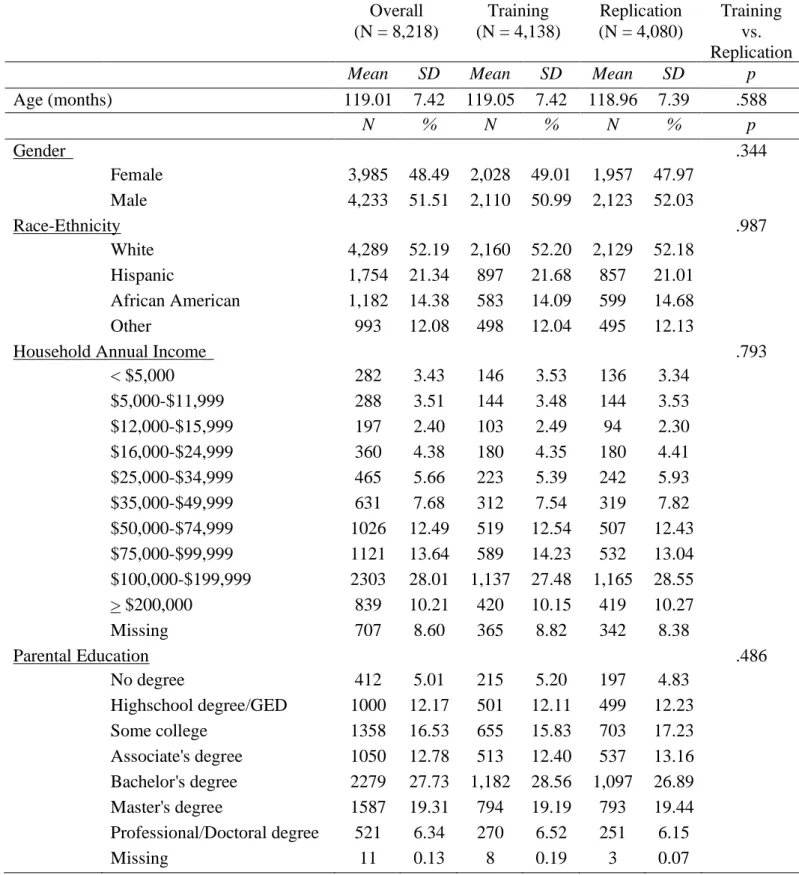
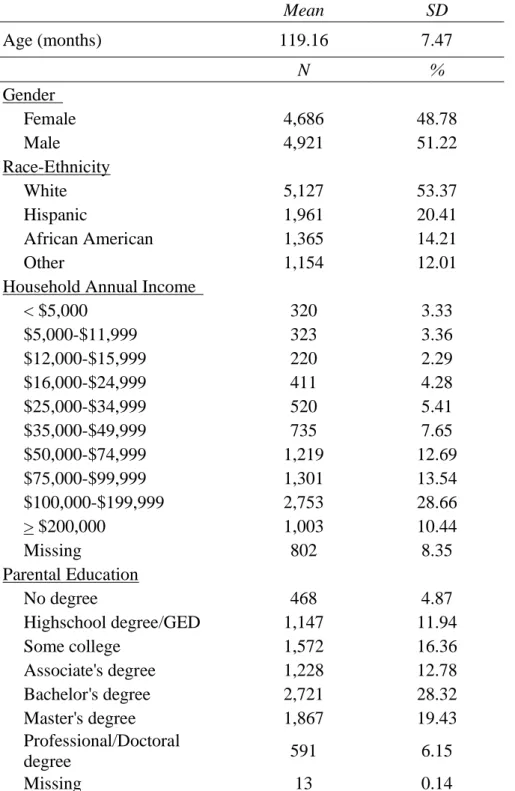
A summary of the demographic characteristics of the sample included in the PLS analysis can be found in Table 2. Full descriptions of the procedures for processing and analyzing the brain data of the ABCD Study can be found elsewhere (Hagler et al., 2019). Exploratory factor analyzes of CBCL data from a random half of the ABCD study sample (N = 5,932) were conducted by Moore et al.
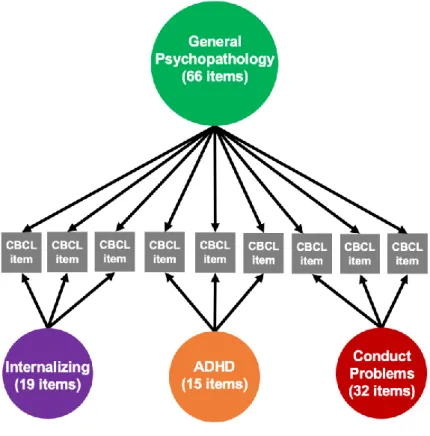
For additional details on the specific calculation procedures and results of this bifactor modeling process, such as. as well as the validity and reliability of the psychopathological dimensions, see Moore et al. A confirmatory bifactor model of the CBCL data defined four orthogonal psychopathological factors: general. psychopathology, which represents symptoms across all domains, in addition to specific factors for symptom internalization, ADHD symptoms, and conduct problems.
Results
Study 1 Results
- Study 1 Primary Results
- Study 1 Sensitivity Results
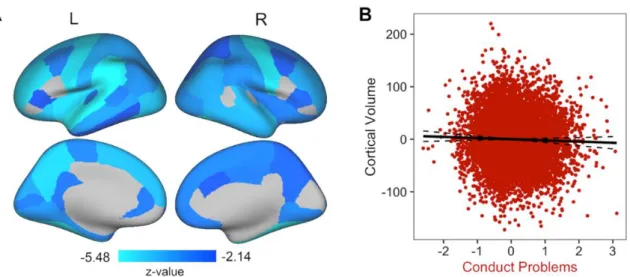
Finally, in both studies, analyzes were repeated including intracranial volume (ICV) and then including total GMV to determine whether associations between regional GMVs and psychopathology remained when controlling for skull size or total GMV. Of the 68 cortical and 19 subcortical regions included in the analyses, the general factor was reversed. The ADHD symptoms factor was inversely associated with 25 cortical regions (Supplementary Table 1 and Figure 4), as well as with 8 subcortical regions (Supplementary Table 2).
There were no significant associations between the internalizing symptoms factor and regional GMV (pfdr values .068; cortical GMV in 52 out of 68 regions (FDR corrected).
Several replications of sensitivity analyzes were conducted in Study 1 to ensure that the primary results of the structural equation modeling were robust to possible confounding. Sensitivity results accounting for parental education and family income were largely convergent with the primary results (see Supplementary Tables 3 and 4 for cortical and subcortical results, respectively). Psychopathology was inversely associated with GMV in many regions for the general factor (37 cortical, 18 subcortical) and the conduct problems factor (29 cortical, 3 subcortical), with a weaker inverse association for the ADHD symptoms factor (14 cortical, 0 subcortical) (pfdr values .049).
No significant association was found between the internalizing symptoms factor and regional GMV (pfdr-values .133). Sensitivity scores for medication use were also convergent with the primary outcomes (see Supplementary Tables 5 and 6 for cortical and subcortical scores, respectively). Psychopathology was inversely associated with GMV across multiple regions for the general factor (51 cortical, 19 subcortical) and the conduct problems factor (50 cortical, 16 subcortical), with a weaker inverse association demonstrated for the ADHD symptoms (23 cortical, 8 subcortical) (pfdr-values .049).
No significant relationship was found between the internalizing symptoms factor and regional GMV (pfdr-values .068). Sensitivity scores accounting for total cortical/subcortical ICV or GMV showed that most significant region-specific results became nonsignificant. When accounting for ICV, the only significant association was an inverse association between general psychopathology and bilateral hippocampus GMV (left hippocampus: β = −0.04, pfdr-value = .019; right. hippocampus: β = −0.03, pfdr -value = .019) (Supplementary Table 7).

Study 2 Results
- Study 2 Primary Results
- Study 2 Sensitivity Results
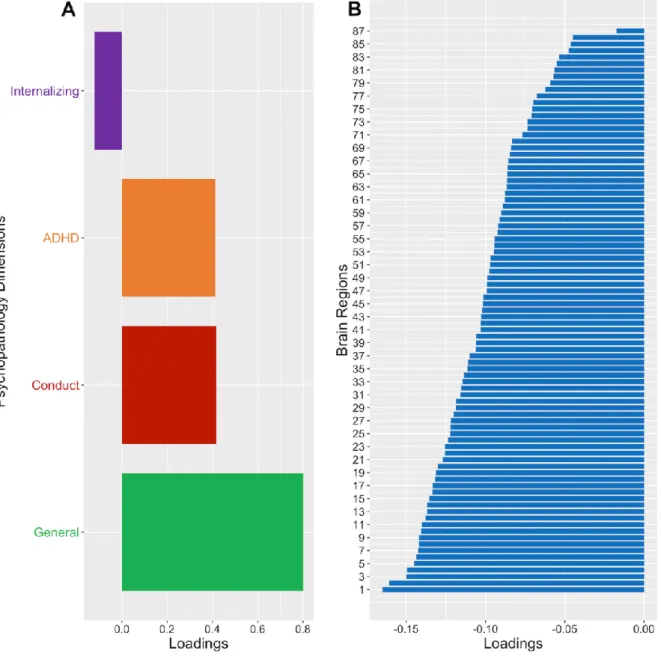
Bootstrapping analysis in the training group shows reliable loadings for the general, behavioral, and ADHD psychopathology dimensions. Several versions of sensitivity analyzes were conducted with the training sample to ensure that the results of the primary PLS analysis were robust to potential confounding. Specifically, these sensitivity results suggested that people with mainly general psychopathological symptoms, but also with notable degrees of ADHD symptoms and behavioral problems, exhibit smaller brain volumes globally.
Discussion
The current project does this by investigating the relationship between regional GMV and dimensions of psychopathology using a univariate approach (Study 1) and a multivariate approach (Study 2). The results of these two approaches are largely the same in the current sample, suggesting that there is a global association between lower GMV and factors of general psychopathology, conduct problems, and ADHD symptoms both when brain regions are tested independently and when brain regions and psychopathology are check the dimensions at the same time. Importantly, the univariate analyzes in Study 1 suggest that in addition to the relationship between general psychopathology and smaller brain volumes, there may also be specific or unique associations between ADHD or conduct problems and brain volumes.
Note that in Study 1 and Study 2, we did not find significant associations between regional GMV and the specific internalizing factor. First, the general psychopathology factor may account for most of the variance explained by internalizing-type symptoms, leaving little for the remainder. . However, although these associations appear broad and nonspecific in the current analyzes with the ABCD study sample at Wave 1, it is possible that neurostructural deficits diverge into more specified patterns over development.
These findings are consistent with the emerging notion that general psychopathology may be associated with non-specific structural variations in the brain, and may suggest that environmental and genetic factors affecting brain size are risk factors for general psychopathology. Together, these findings support and extend previous work on the relationship between neurostructural variations and psychopathology in childhood and further illuminate the dimensional, overlapping nature of psychopathology. Prevalence, severity, and comorbidity of 12-month DSM-IV disorders in the National Comorbidity Survey Replication.
Supplemental Figure 2. PLS analysis in the replication sample shows that greater levels of general psychopathology, conduct problems, and ADHD symptoms are associated with smaller volumes across many brain regions. Bootstrapping analysis in the replication sample shows reliable loadings for the general, behavioral, and ADHD psychopathology dimensions. Results examining the relationship between subcortical regional GMV and psychopathological dimensions with income and parental education as additional covariates.
Results examining the relationship between cortical regional GMV and psychopathology dimensions with medication added as an additional covariate. Results examining the relationship between subcortical regional GMV and psychopathology dimensions with medication added as an additional covariate. Results examining the relationship between subcortical regional GMV and psychopathology dimensions with ICV added as an additional covariate.
Results examining the association between regional subcortical GMV and psychopathological dimensions with total subcortical GMV added as an additional covariate. Psychopathological loadings emerged from PLS analysis on the training sample examining the association between regional dimensions of GMV and psychopathology. Brain volume loadings were derived from PLS analysis on the training sample examining the relationship between regional GMV dimensions and psychopathology.
Psychopathological loadings emerged from PLS analysis in the replication sample examining the relationship between regional dimensions of GMV and psychopathology.