Rural health in the United States is defined in many ways and is often modified to reflect the specific demographic or situation. Traditionally, rural health inequities have been addressed through the public sector through a range of government programs, financing and initiatives at both structural and individual levels. Americans expect the solution to their health care problems to come from innovative technology; they expect technological solutionism.11 The combination of Americans' declining confidence in government initiatives and the growing expectation of technological solutionism, especially among rural populations, means that the problems of inequality in the field of rural health care threshold of the private sector.
Morozov's argument is crucial in finding solutions to rural health inequalities through the private sector. Just because the rural population may be interested in private investment is not a sufficient reason for the private sector to be interested in investing in rural health. It is a result of both the sociopolitical status of rural American culture today and a political shift in health care financing that offers an opportunity to use creative solutions to address health inequities in rural United States.
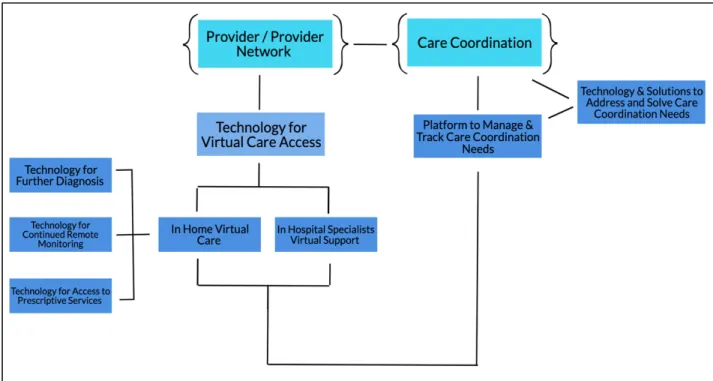
Clinton MacKinney et al., “From Health Care Volume to Health Care Value Success Strategies for Rural Health Care Providers,” The Journal of Rural Health 30, no. In creating a model that attempts to holistically address rural health disparities without perpetuating others, both the lenses of technological benevolence and social impact theory must be applied. The skeleton ecosystem framework for addressing rural health disparities (figure 1) is an overview that identifies all the needs that need to be addressed when addressing rural health disparities.
The third phase produces the Model Ecosystem for Addressing Rural Health Disparities (figure 3), which organizes.
METHODOLOGY
This deep dive created the Skeletal Ecosystem Framework for Addressing Rural Health Disparities for which existing companies were screened and analyzed to design the required ecosystem and fully build out the framework. First, as discussed in the methodology section, the research required the creation of a Skeletal Ecosystem Framework for addressing rural health disparities. In creating this framework, researchers had to think through each immediate inequity facing rural health and, additionally, inequities that result from addressing another inequity.
For example, telehealth is the current champion of rural health access in the United States and abroad. Because these holistic or continuum of care factors are critical to total health improvement to appropriately address rural health, a care coordination component and all the additional resources needed to accomplish full care coordination are critical to the rural health ecosystem. To create a fully fleshed out ecosystem to address rural health disparities with innovative health solutions, the study started with telehealth.
While providing support directly to patients in rural areas and increasing their access to health care resources in their area is vital to improving rural health disparities, it is only one side of the issue that needs to be addressed. The study labels this need as Virtual Hospital Specialist Support and identifies this capability as vital to supporting rural health and fully addressing disparities in access. Like the assumptions made for this study surrounding physician/provider networks, the study makes the same assumptions about care coordination.
The study identifies that there needs to be some sort of care coordinator component to adequately address overall rural health disparities. As found in the 2021 study “Evaluation of an Interprofessional Care Coordination Model: Benefits for Health Professions Serving Students and the Community,” when a successful care coordination system is implemented, there is an overall reduction in emergency room visits and hospital admissions among the population.26 The research findings make a case for utilizing a care coordination model to reduce dependency and drain on care resources.27. Within the technology and service ecosystem, care coordination addresses various aspects of rural healthcare inaccessibility.
Care coordination includes scheduling appointments, transportation to/from in-person appointments, and navigating technology for a virtual appointment. While coordination of care is assumed for this study, the need for a technology platform to help streamline and succeed coordinated care is still a component of the ecosystem framework. Evaluation of an Interprofessional Care Coordination Model: Benefits for Health Professions Students and the Community Served.” Nursing Outlook 69, no.
METHODOLOGY
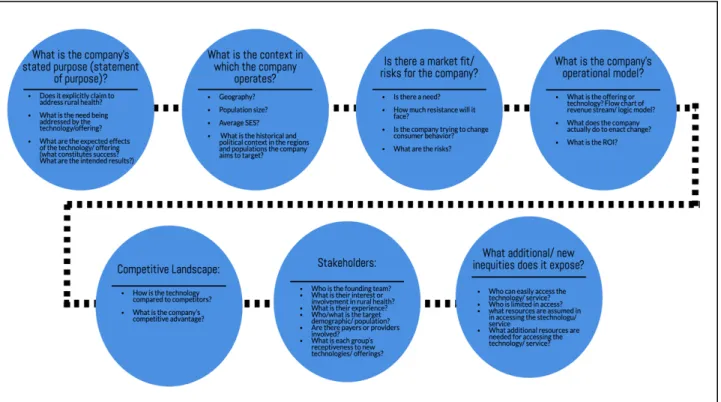
Using the data found in the company's analysis, a strategic framework for addressing rural health inequalities through the private sector was fully developed and created. The skeletal ecosystem framework for addressing rural health inequities (Figure 1), described in the methodology section, serves as a guiding map for analyzing what types of businesses are needed to build the ecosystem. In addition, the skeletal ecosystem framework for addressing rural health inequalities contributed to the questions posed in creating the analytical framework for the individual enterprise analysis (Figure 2).
Using the Framework Ecosystem Framework for Addressing Rural Health Disparities as general guidelines to identify the types of companies needed to build the ecosystem, the study listed companies to evaluate within the criteria of the Analytical Framework for Individual Company analysis reduced to a list. of 20 companies. Therefore, most of the companies analyzed for this research and placed in the ecosystem do not have a rural health focus. To select the appropriate companies needed to fill the sample framework, the study conducted a more extensive analysis of all companies that address each specific need identified in the Skeletal Ecosystem Framework for Addressing Rural Health Inequalities.
The findings were then expanded upon by analyzing each through the lens of rural health inequalities. The Enterprise Decision Matrix and Enterprise Evaluation Matrix inform the selection and organization of completion and completion of the Rural Inequalities Addressing Skeletal Ecosystem Framework to create a sample ecosystem for addressing rural inequalities. The example ecosystem for addressing rural health disparities, presented below in Figure 3, is the product of the researcher's application of the skeleton ecosystem framework model for addressing rural health disparities and the enterprise analysis framework.
The example of the ecosystem for addressing rural health disparities shows the eleven companies identified that demonstrate what is required to address rural health carefully without promoting more health disparities. The care coordination component of the ecosystem is critical to the long-term and sustained success of addressing rural health disparities. With the need for a care coordination technology to anchor the trial ecosystem in mind, the study selected UniteUs as the solution for the trial ecosystem to address rural health disparities.
By placing UniteUs in a company-specific analysis matrix (Appendix D), the study analyzes how UniteUs best fits into the model ecosystem and where and how it can best address rural health inequities. Either way, addressing all components of a skeletal ecosystem framework for addressing rural health inequities will address rural health inequities through the lens of sustainability. For this reason, these specific services and needs are not addressed in the framework of the skeleton ecosystem, and the specific companies that provide these services are not identified as a model ecosystem for addressing rural health inequities.
CarePool should do or adapt to fit within the framework to specifically address rural health. Conscious application of the Skeletal Ecosystem Framework for Addressing Rural Health Disparities allows for the creation of a private sector sustainable ecosystem of complementary companies to address rural health disparities. In turn, the sample ecosystem for addressing rural health disparities is a general sample of what it would look like if a party used the framework and built accordingly.
The limited scope of health inequalities in rural areas allows for the creation of a framework on which to focus.