www.asean.org
@ASEAN ASEAN
one vision one identity one community
ASEAN HOMESTAY STANDARD
ASEAN: A Community of Opportunities ASEAN HOMESTAY STANDARD
The ASEAN Secretariat Jakarta
ASEAN Homestay Standard
The Association of Southeast Asian Nations (ASEAN) was established on 8 August 1967. The Member States of the Association are Brunei Darussalam, Cambodia, Indonesia, Lao PDR, Malaysia, Myanmar, Philippines, Singapore, Thailand and Viet Nam. The ASEAN Secretariat is based in Jakarta, Indonesia.
For inquiries, contact:
The ASEAN Secretariat
Public Outreach and Civil Society Division 70A Jalan Sisingamangaraja
Jakarta 12110 Indonesia
Phone : (62 21) 724-3372, 726-2991 Fax : (62 21) 739-8234, 724-3504 E-mail : [email protected]
Catalogue-in-Publication Data ASEAN Homestay Standard
Jakarta: ASEAN Secretariat, January 2016 338.4791
1. ASEAN – Tourism
2. Accommodation – Standard – Guidelines
ISBN 978-602-0980-74-4
General information on ASEAN appears online at the ASEAN Website: www.asean.org
The text of this publication may be freely quoted or reprinted, provided proper acknowledgement is given and a copy containing the reprinted material is sent to Public Outreach and Civil Society Division of the ASEAN Secretariat, Jakarta
Copyright Association of Southeast Asian Nations (ASEAN) 2016.
All rights reserved
The Association of Southeast Asian Nations (ASEAN) was established on 8 August 1967. The Member States of the Association are Brunei Darussalam, Cambodia, Indonesia, Lao PDR, Malaysia, Myanmar, Philippines, Singapore, Thailand and Viet Nam. The ASEAN Secretariat is based in Jakarta, Indonesia.
For inquiries, contact:
The ASEAN Secretariat
Public Outreach and Civil Society Division 70A Jalan Sisingamangaraja
Jakarta 12110 Indonesia
Phone : (62 21) 724-3372, 726-2991 Fax : (62 21) 739-8234, 724-3504 E-mail : [email protected]
Catalogue-in-Publication Data ASEAN Homestay Standard
Jakarta: ASEAN Secretariat, January 2016 338.4791
1. ASEAN – Tourism
2. Accommodation – Standard – Guidelines
ISBN 978-602-0980-74-4
General information on ASEAN appears online at the ASEAN Website: www.asean.org
The text of this publication may be freely quoted or reprinted, provided proper acknowledgement is given and a copy containing the reprinted material is sent to Public Outreach and Civil Society Division of the ASEAN Secretariat, Jakarta
Copyright Association of Southeast Asian Nations (ASEAN) 2016.
All rights reserved
ASEAN Homestay Standard 3
FINAL
ASEAN HOMESTAY STANDARD
ASEAN HOMESTAY STANDARD
4 ASEAN Homestay Standard - Index v
INDEX
I. ASEAN HOMESTAY STANDARD
1. Foreword 1
2. Introduction 1
3. Scope 2
4. Terms and Definitions 2
4.1. Attraction 2
4.2. Authenticity 2
4.3. Basic First Aid 2
4.4. Biodiversity 2
4.5. Booking 2
4.6. Code of Conduct 3
4.7. Communal Activity 3
4.8. Community Centre/Area 3
4.9. Communication Equipment 3
4.10. Community to Community Training 3
4.11. Culture 3
4.12. Database 3
4.13. Emergency Rescue 3
4.14. Environmentally Friendly 3
4.15. Familiarisation Trip 3
4.16. Guest 4
4.17. Hands on Approach Training 4
4.18. Homestay 4
4.19. Homestay Provider 4
4.20. Host 4
4.21. Interpretation Skill 4
4.22. Management 4
4.23. Manual 4
4.24. Micro Enterprise 4
4.25. Nature 4
4.26. Package 4
4.27. Reservation System 5
4.28. Social Media Network 5
4.29. Target Market 5
4.30. Unique Selling Proposition (USP) 5
4.31. Village 5
5. Criteria 5
5.1. Host 5
5.1.1. The Village and Community 5
5.1.2. Homestay Provider 5
5.2. Accommodation 6
5.2.1. The House 6
5.2.2. The Bedroom 6
5.2.3. The Toilet/Bathroom 6
5.3. Activities 6
5.3.1. Village and Community Based Activities 6
5.3.2. Surrounding Activities 7
5.3.3. Authenticity 7
5.4. Management 7
5.4.1. Leadership 7
5.4.2. Organisation 7
5.4.3. Database 7
5.4.4. Capacity Building and Training 8
5.4.5. Collaboration 8
5.5. Location 8
5.5.1. Accessibility 8
5.6. Hygiene and Cleanliness 9
5.6.1. House (Kitchen, Bedroom and Toilet) 9
5.6.2. Surrounding Compound 9
5.6.3. Food Preparation 9
5.7. Safety and Security 9
5.7.1. Safety Training 9
5.7.2. Safety Features for Facilities /Activities 9
5.7.3. Briefing on Safety Aspects 10
5.7.4 Emergency Rescue and Evacuation 10
5.8. Marketing and Promotion 10
5.8.1. Promotion Activities 10
5.8.2. Partnership with Tour Operators 10
5.8.3. Web Marketing 10
5.9. Sustainability Principles 11
5.9.1. Economic Sustainability 11
5.9.2. Environmental Sustainability 11
5.9.3. Sociocultural Sustainability 11
II. ASEAN HOMESTAY STANDARD - AUDIT CHECKLIST
1. Foreword 15
2. Introduction 15
3. Scope 15
4. Terms and Definitions 16
5. Prerequisite Entry Requirement 16
6. Assessment Criteria 17
7. Assessment 17
7.1. Weightage 18
7.2. Determining ASEAN Homestay Standard 19
7.3. Requirements for ASEAN Homestay Standard 20
III. ASEAN HOMESTAY STANDARD - AUDIT PROCESS AND CERTIFICATION BODY
1. Foreword 29
2. Introduction 29
3. Scope 29
4. Terms and Definitions 29
5. Proposed Certification Body 31
5.1. Homestay Audit Process Implementation 33
5.2. Assessment Checklist for Assessor 34
vi ASEAN Homestay Standard - Index
5.3. Activities 6
5.3.1. Village and Community Based Activities 6
5.3.2. Surrounding Activities 7
5.3.3. Authenticity 7
5.4. Management 7
5.4.1. Leadership 7
5.4.2. Organisation 7
5.4.3. Database 7
5.4.4. Capacity Building and Training 8
5.4.5. Collaboration 8
5.5. Location 8
5.5.1. Accessibility 8
5.6. Hygiene and Cleanliness 9
5.6.1. House (Kitchen, Bedroom and Toilet) 9
5.6.2. Surrounding Compound 9
5.6.3. Food Preparation 9
5.7. Safety and Security 9
5.7.1. Safety Training 9
5.7.2. Safety Features for Facilities /Activities 9
5.7.3. Briefing on Safety Aspects 10
5.7.4 Emergency Rescue and Evacuation 10
5.8. Marketing and Promotion 10
5.8.1. Promotion Activities 10
5.8.2. Partnership with Tour Operators 10
5.8.3. Web Marketing 10
5.9. Sustainability Principles 11
5.9.1. Economic Sustainability 11
5.9.2. Environmental Sustainability 11
5.9.3. Sociocultural Sustainability 11
II. ASEAN HOMESTAY STANDARD - AUDIT CHECKLIST
1. Foreword 15
2. Introduction 15
3. Scope 15
4. Terms and Definitions 16
5. Prerequisite Entry Requirement 16
6. Assessment Criteria 17
7. Assessment 17
7.1. Weightage 18
7.2. Determining ASEAN Homestay Standard 19
7.3. Requirements for ASEAN Homestay Standard 20
III. ASEAN HOMESTAY STANDARD - AUDIT PROCESS AND CERTIFICATION BODY
1. Foreword 29
2. Introduction 29
3. Scope 29
4. Terms and Definitions 29
5. Proposed Certification Body 31
5.1. Homestay Audit Process Implementation 33
5.2. Assessment Checklist for Assessor 34
vii ASEAN Homestay Standard - Index
5.3. Prerequisite Entry Requirement 34
6. Proposed Audit Process 35
6.1. Unsuccessful Homestay in Assessment 37
6.2. Successful Homestay 37
7. Assessment Method 38
8. Assessment Approach 39
9. Validity Period 39
10. Benefits and Privileges 40
11. Certification Logo 40
12. ASEAN Homestay Certificate and Plaque 41
13. Assessment Form 42
14. Homestay Assessment Guidelines 43
14.1. Prerequisite Entry Requirements 45
14.2. Assessment Criteria for Homestay Organisation 46
14.3. Assessment Criteria for Homestay Provider 58
14.4. Summary of Homestay Assessment for Homestay Organisation 64 14.5. Summary of Homestay Assessment for Homestay Provider 65
viii ASEAN Homestay Standard - Index ASEAN Homestay Standard 1
ASEAN Homestay Standard
I
ASEAN Homestay Standard
2 ASEAN Homestay Standard 1
1. Foreword
The objective of this standard is to develop a comprehensive homestay standard that can be adapted by ASEAN Member States as recommended in the ASEAN Tourism Strategic Plan (ATSP): 2011 – 2015 to create quality visitor experience by showcasing their rural resources in a presentable, safe, and attractive manner. The establishment of the standard shall increase the quality of services, facilities and human capital in ASEAN homestay programmes by providing a more organised path to a professional level of management, taking into consideration the needs, capability and cultural diversity of all ASEAN member states.
In developing the standard, existing homestay standards and guidelines used by all ASEAN member states were analysed, where common grounds and gaps were identified. The resulting standard will focus on nine criteria, namely host, accommodation, activities, management, location, hygiene &
cleanliness, safety & security, marketing and sustainability principles.
2. Introduction
All over the ASEAN region, the homestay programme is a form of alternative tourism in which tourists are given the opportunity to experience the way of life in a typical village with local community. The experiential nature of this form of tourism is becoming increasingly popular with foreign tourists. In contrast to mass tourism, the homestay programme should preferably be low scale, low density, flexible and spontaneous. More importantly it should be owned and operated by the local communities so that the economic benefits go directly to them.
As a form of Community Based Tourism, the homestay concept is currently well accepted as a rural development tool in many ASEAN countries. The homestay programme can enhance local quality of life through generation of income, support local culture, arts and crafts business, encourages restoration of local and historic sites, and foster nature conservation efforts through community education.
With many of the world’s international tourists looking to ASEAN countries for rural tourism, a more systematic development of homestay will be crucial in creating a ‘new brand’ of tourist experience, showcasing the rural way of life, offering an affordable form of holiday that contains a high degree of cultural and educational elements. The selling point of the homestay programme is not the physical entity of the village but more towards the total village experience, where the community and communal activities are strong influential factors.
The success of the homestay programme in the ASEAN region is highly dependent on a strong understanding of the basic requirements of a quality visitor experience from a homestay perspective.
Therefore the establishment of ASEAN Homestay standard is necessary, providing an opportunity to standardize a base level understanding of what a homestay is and to establish a minimum standard
across all ASEAN member states. The standard also facilitates a coordinated approach, encouraging partnership with the relevant stakeholders, creating a positive environment while revitalizing the rural economy as well as poverty reduction.
3. Scope
The standard focuses on the homestay, where guests will stay with the host’s family and experience the everyday way of life of the family and community in both a direct and indirect manner. The standard also focuses on the following essential criteria such as host, accommodation, activities, authenticity, management, location, safety and security, marketing and sustainability principles.
4. Terms and Definitions
The terms and definitions applied in the ASEAN Homestay Standards are as follows:
4.1. Attraction
A place of interest and pleasure where guests visit, typically for its inherent or exhibited values especially of cultural and historical significance such as historic sites, performing arts institutions, handicraft centres, local industries and natural areas.
4.2. Authenticity
Genuine, original, unadulterated or the real thing in order to give real experience to the guests especially related to local culture and nature.
4.3. Basic First Aid
The basic of emergency care and treatment of an injured or ill guest before professional medical care is available.
4.4. Biodiversity
The existence of a wide variety of plant and animal species in their natural environment.
4.5. Booking
Making a reservation for homestay services via the appropriate communication medium, such as the internet, fax, phone etc.
ASEAN Homestay Standard 2
across all ASEAN member states. The standard also facilitates a coordinated approach, encouraging partnership with the relevant stakeholders, creating a positive environment while revitalizing the rural economy as well as poverty reduction.
3. Scope
The standard focuses on the homestay, where guests will stay with the host’s family and experience the everyday way of life of the family and community in both a direct and indirect manner. The standard also focuses on the following essential criteria such as host, accommodation, activities, authenticity, management, location, safety and security, marketing and sustainability principles.
4. Terms and Definitions
The terms and definitions applied in the ASEAN Homestay Standards are as follows:
4.1. Attraction
A place of interest and pleasure where guests visit, typically for its inherent or exhibited values especially of cultural and historical significance such as historic sites, performing arts institutions, handicraft centres, local industries and natural areas.
4.2. Authenticity
Genuine, original, unadulterated or the real thing in order to give real experience to the guests especially related to local culture and nature.
4.3. Basic First Aid
The basic of emergency care and treatment of an injured or ill guest before professional medical care is available.
4.4. Biodiversity
The existence of a wide variety of plant and animal species in their natural environment.
4.5. Booking
Making a reservation for homestay services via the appropriate communication medium, such as the internet, fax, phone etc.
ASEAN Homestay Standard 3 4.6. Code of Conduct
A set of rules outlining the responsibilities or proper practices for guests and homestay provider/host. Also known as the dos and don’ts, to instil the appropriate behaviour of guests suitable for the particular environment.
4.7. Communal Activity
Activity emphasizing social cohesion, where villagers get together and conduct activities such as cleaning the village and preparation before an event.
4.8. Community Centre/Area
A place where locals and guests meet with each other. It can be in the form of gathering, a place for cultural performance or a venue to conduct activities.
4.9. Communication Equipment
Tool or equipment used for disseminating information between sender and receiver such as mobile telephones, hand held radio, GPS etc.
4.10. Community to Community Training
Training programme conducted mainly through visiting successful homestay, learning through case studies and best practise. Also able to cultivate mentor-mentee relationship between established homestays and new entrants.
4.11. Culture
Habits, traditions, local practise and beliefs of a society.
4.12. Database
Systematic collection, organization and classification of information.
4.13. Emergency Rescue
A situation or occurrence that happens unexpectedly and demands immediate action for the victim to be evacuated/removed from the area.
4.14. Environmentally Friendly
Also related to eco-friendly, nature friendly, and green, refer to goods and services, laws, guidelines and policies claimed to inflict minimal or no harm to the environment and local community.
4.15. Familiarisation Trip
Organize trips for travel agents, tour operators, tour wholesalers, media or other members of the travel trade for the purpose of educating and “familiarizing” them with tourism destinations.
By seeing the destinations themselves, the travel trade is better prepared to answer customer questions and promote travel to the location. Also known “FAM Trip”.
4.16. Guest
A person staying in a homestay, usually participating in community and village based activities.
4.17. Hands on Approach Training
Learning which emphasized the practical aspect, looking at the real situation on the ground rather than theory or class room approach.
4.18. Homestay
An alternative tourism where tourists will stay with the host’s family in the same house and will experience the everyday way of life of the family and the local community.
4.19. Homestay Provider
Local family that offer their house as a homestay.
4.20. Host
A person/community that represents the homestay and provide services/hospitality to homestay guests.
4.21. Interpretation Skill
A complex task that combine several abilities beyond language competency in order to deliver an effective presentation in a given setting.
4.22. Management
The process of managing that involves the people in charge of running a committee or an organization such as planning, organizing, staffing, leading, and controlling to achieve the organization objectives.
4.23. Manual
Comprehensive and step-by-step guide to a particular topic, that also serves as a reference book. It details out what is required, explains how to put the presented information into practice, and instructs how to solve problems as they occur.
4.24. Micro Enterprise
Locally owned enterprises producing goods and services utilizing village based resources.
4.25. Nature
Natural resources such as forests, rivers, caves, mountains, etc.
4.26. Package
A fixed price product that makes it easy for guest to buy and enjoy the activities of the homestay.
The packages usually offer a mixture of components like transportation, accommodation, meals, activities and sightseeing.
ASEAN Homestay Standard 4
4.16. Guest
A person staying in a homestay, usually participating in community and village based activities.
4.17. Hands on Approach Training
Learning which emphasized the practical aspect, looking at the real situation on the ground rather than theory or class room approach.
4.18. Homestay
An alternative tourism where tourists will stay with the host’s family in the same house and will experience the everyday way of life of the family and the local community.
4.19. Homestay Provider
Local family that offer their house as a homestay.
4.20. Host
A person/community that represents the homestay and provide services/hospitality to homestay guests.
4.21. Interpretation Skill
A complex task that combine several abilities beyond language competency in order to deliver an effective presentation in a given setting.
4.22. Management
The process of managing that involves the people in charge of running a committee or an organization such as planning, organizing, staffing, leading, and controlling to achieve the organization objectives.
4.23. Manual
Comprehensive and step-by-step guide to a particular topic, that also serves as a reference book. It details out what is required, explains how to put the presented information into practice, and instructs how to solve problems as they occur.
4.24. Micro Enterprise
Locally owned enterprises producing goods and services utilizing village based resources.
4.25. Nature
Natural resources such as forests, rivers, caves, mountains, etc.
4.26. Package
A fixed price product that makes it easy for guest to buy and enjoy the activities of the homestay.
The packages usually offer a mixture of components like transportation, accommodation, meals, activities and sightseeing.
ASEAN Homestay Standard 5 4.27. Reservation System
System that allows access to booking reservations for homestay packages and services such as online booking or through phone.
4.28. Social Media Network
Social networking websites that allow registered users i.e. homestay providers/ homestay management to create profiles, upload photos and video of their homestay, send message and keep in touch with guests, colleagues and business associates.
4.29. Target Market
A specific group of visitors in which marketing communications are directed to.
4.30. Unique Selling Proposition (USP)
The main attraction or uniqueness of the homestay, a main pull factor in attracting guests.
4.31. Village
A rural area where the people live as a community, unique with its own cultural and natural resources.
5. Criteria
5.1. Host
5.1.1. The Village and Community
5.1.1.1 There shall be a minimum number of 5 registered homestay providers within the village to reflect community involvement and cohesion.
5.1.1.2 The homestay shall be located close to nature-based and cultural tourism attractions in the surrounding areas.
5.1.1.3 Priority shall be given to villages with a proven track record in organisation and beautification such as past winners of best village and best landscaping competitions.
5.1.1.4 There shall be a community centre/area to be used as a base for the homestay operation and activities such as for welcoming ceremony, cultural performance, etc.
5.1.2. Homestay Provider
5.1.2.1 The homestay provider shall be free of criminal record.
5.1.2.2 The homestay provider shall be in good general health and not inflicted with communicable diseases.
5.1.2.3 A basic homestay course shall be formulated, attended and completed by each and every registered homestay provider.
5.2. Accommodation 5.2.1. The House
5.2.1.1 The structure of the house shall be in good, stable and safe condition such as roof, walls, doors, floor, etc.
5.2.1.2 The design and building materials shall reflect the vernacular architecture and local identity.
5.2.1.3 The homestay provider shall provide a guest bedroom(s) that is separated from the other bedrooms in the house.
5.2.1.4 There shall be a minimum of one (1) bathroom/toilet for the guest either inside the guest room or inside the house.
5.2.1.5 It is recommended that the house shall have electricity supply.
5.2.1.6 The house shall have adequate and clean water supply made available at all times inside the house.
5.2.2. The Bedroom
5.2.2.1 Provide basic amenities and furnishing in the guest bedroom(s) such as fan, desk, mini cupboard, mirror, electric socket, mosquito net or coil etc.
5.2.2.2 A maximum of four of the total number of bedrooms in the house, which are not being used by any member of the homestay provider/host shall be allocated to homestay guests
5.2.2.3 Provide standard and appropriate type of beds such as single beds and double beds with comfortable mattresses and pillows.
5.2.2.4 If necessary, windows should be fitted with a mesh frame to keep out mosquitoes and other insects.
5.2.2.5 Bed linen shall be changed as needed; and following the departure of each guest, a fresh set of clean bed linen shall be provided to the next guest.
5.2.3. The Toilet/Bathroom
5.2.3.1 Provide either sitting or squatting type of toilet inside or outside close to the house.
5.2.3.2 Provide basic toilet and bathroom facilities including doors with locks in all toilets and bathrooms
5.2.3.3 Adequate and clean water shall be provided at all times
5.3. Activities
5.3.1 Village and Community Based Activities
5.3.1.1 The village and community based activities shall optimise and showcase
ASEAN Homestay Standard 6
5.2. Accommodation 5.2.1. The House
5.2.1.1 The structure of the house shall be in good, stable and safe condition such as roof, walls, doors, floor, etc.
5.2.1.2 The design and building materials shall reflect the vernacular architecture and local identity.
5.2.1.3 The homestay provider shall provide a guest bedroom(s) that is separated from the other bedrooms in the house.
5.2.1.4 There shall be a minimum of one (1) bathroom/toilet for the guest either inside the guest room or inside the house.
5.2.1.5 It is recommended that the house shall have electricity supply.
5.2.1.6 The house shall have adequate and clean water supply made available at all times inside the house.
5.2.2. The Bedroom
5.2.2.1 Provide basic amenities and furnishing in the guest bedroom(s) such as fan, desk, mini cupboard, mirror, electric socket, mosquito net or coil etc.
5.2.2.2 A maximum of four of the total number of bedrooms in the house, which are not being used by any member of the homestay provider/host shall be allocated to homestay guests
5.2.2.3 Provide standard and appropriate type of beds such as single beds and double beds with comfortable mattresses and pillows.
5.2.2.4 If necessary, windows should be fitted with a mesh frame to keep out mosquitoes and other insects.
5.2.2.5 Bed linen shall be changed as needed; and following the departure of each guest, a fresh set of clean bed linen shall be provided to the next guest.
5.2.3. The Toilet/Bathroom
5.2.3.1 Provide either sitting or squatting type of toilet inside or outside close to the house.
5.2.3.2 Provide basic toilet and bathroom facilities including doors with locks in all toilets and bathrooms
5.2.3.3 Adequate and clean water shall be provided at all times
5.3. Activities
5.3.1 Village and Community Based Activities
5.3.1.1 The village and community based activities shall optimise and showcase
ASEAN Homestay Standard 7 the local resources such as the following:
5.3.1.1.1 Local culture and heritage
5.3.1.1.2 Local enterprises (Micro enterprises, farms, local industries, handicrafts).
5.3.1.1.3 Natural resources (forests, rivers, caves, lakes, etc.)
5.3.1.2 The design and implementation of the activities shall encourage the interactive participation between local community and guests.
5.3.2. Surrounding Activities
5.3.2.1 Visits to popular tourist attractions in the surrounding areas shall be integrated into the homestay package/itinerary with the homestay functioning as a base.
5.3.2.2 Collaborate with other villages in the adjacent/surrounding areas to add variation to the activities as well as create multiplier effects.
5.3.3. Authenticity
5.3.3.1 The homestay community shall retain its identity, values, and culture, to portray a distinct and authentic experience.
5.3.3.2 Preserve and involve guests in communal activities to showcase the community spirit and social cohesion.
5.3.3.3 Preserve local handcrafts and showcase local performing arts by establishing cultural groups and associations.
5.4. Management 5.4.1. Leadership
5.4.1.1 The homestay organisation shall be led by a local champion with strong leadership qualities and respected by the local community e.g. head of village.
5.4.2. Organisation
5.4.2.1 The homestay organisation shall have a systematic structure with clear roles, responsibilities and line of communication.
5.4.2.2 The organisation shall facilitate the empowerment of the local women and youths.
5.4.2.3 The village management shall give the blessing for the setting up of a homestay organisation that is operated in a commercial manner but answerable to the former.
5.4.3. Database
5.4.3.1 Homestay Operator Database
5.4.3.1.1 Establish a database of the homestay operators containing information such as home address, number of family members and any special talent, knowledge or skills.
5.4.3.2 Guest Database
5.4.3.2.1 Create a reservation and registration system to keep record of guest arrivals, country of origin and length of stay, etc.
5.4.3.2.2 The guest database shall also record comments, complaints, and suggestions from guests.
5.4.3.3 Product Database
5.4.3.3.1 Carry out and update an inventory of existing tourism resources within the village and in the adjacent/surrounding areas.
5.4.4. Capacity Building and Training
5.4.4.1 The homestay organisation shall produce simple manuals and guidelines covering the following aspects:
5.4.4.1.1 Welcoming and guest handling 5.4.4.1.2 Registration, billing and payment 5.4.4.1.3 Hygiene and cleanliness
5.4.4.1.4 Communication skills
5.4.4.1.5 Planning, organising and handling of activities 5.4.4.1.6 Marketing and promotion
5.4.4.1.7 Storytelling and interpretation skills
5.4.4.2 The training programmes and modules shall emphasise ‘hands on approach’
and ‘community to community training’.
5.4.5. Collaboration
5.4.5.1 The homestay organisation shall establish smart partnerships with:
5.4.5.1.1 Other homestays and private agencies especially tour operators and hoteliers to develop packages and enhance promotional activities.
5.4.5.1.2 Public agencies such as international, national and state tourism organisations to seek assistance in terms of training, funding, marketing and promotion and other technical advice.
5.4.5.1.3 Non-Governmental Organisations (NGOs) to develop joint programmes in environmental conservation and cultural preservation.
5.4.5.1.4 Universities and institutions of higher learning to seek assistance in training and technical advice.
5.5. Location
5.5.1. Accessibility
5.5.1.1 The location of the homestay is accessible to any mode of transportation.
5.5.1.2 Clear signage shall be provided to guide guests to the homestay.
ASEAN Homestay Standard 8
5.4.3.2 Guest Database
5.4.3.2.1 Create a reservation and registration system to keep record of guest arrivals, country of origin and length of stay, etc.
5.4.3.2.2 The guest database shall also record comments, complaints, and suggestions from guests.
5.4.3.3 Product Database
5.4.3.3.1 Carry out and update an inventory of existing tourism resources within the village and in the adjacent/surrounding areas.
5.4.4. Capacity Building and Training
5.4.4.1 The homestay organisation shall produce simple manuals and guidelines covering the following aspects:
5.4.4.1.1 Welcoming and guest handling 5.4.4.1.2 Registration, billing and payment 5.4.4.1.3 Hygiene and cleanliness
5.4.4.1.4 Communication skills
5.4.4.1.5 Planning, organising and handling of activities 5.4.4.1.6 Marketing and promotion
5.4.4.1.7 Storytelling and interpretation skills
5.4.4.2 The training programmes and modules shall emphasise ‘hands on approach’
and ‘community to community training’.
5.4.5. Collaboration
5.4.5.1 The homestay organisation shall establish smart partnerships with:
5.4.5.1.1 Other homestays and private agencies especially tour operators and hoteliers to develop packages and enhance promotional activities.
5.4.5.1.2 Public agencies such as international, national and state tourism organisations to seek assistance in terms of training, funding, marketing and promotion and other technical advice.
5.4.5.1.3 Non-Governmental Organisations (NGOs) to develop joint programmes in environmental conservation and cultural preservation.
5.4.5.1.4 Universities and institutions of higher learning to seek assistance in training and technical advice.
5.5. Location
5.5.1. Accessibility
5.5.1.1 The location of the homestay is accessible to any mode of transportation.
5.5.1.2 Clear signage shall be provided to guide guests to the homestay.
ASEAN Homestay Standard 9 5.6. Hygiene and Cleanliness
5.6.1. House (Kitchen, Bedroom and Toilet)
5.6.1.1 All rooms, kitchen and toilets shall be kept clean and free of malodour, dirt, dust, cobwebs etc.
5.6.1.2 The kitchen floor shall be regularly mopped and kept free from stains and spills.
5.6.1.3 Toilet(s), shower tray(s), bath tub (s), well and sinks shall be regularly cleaned and kept free from dirt, stains and malodour.
5.6.1.4 Disinfectants shall be used to keep toilets clean and free from germs.
5.6.1.5 Soap, shampoo, toilet tissue and clean towel shall be provided by the homestay provider.
5.6.2. Surrounding Compound
5.6.2.1 The surrounding compound shall be litter free.
5.6.2.2 Eradicate breeding ground for mosquitoes (especially Aedes mosquitoes) such as clogged drains, discarded tins, etc.
5.6.2.3 It is recommended that the homestay provider and other residents to carry out village beautification and landscaping using local plants that are maintained on a regular basis.
5.6.3. Food Preparation
5.6.3.1 Kitchen shall be in good, clean condition and well ventilated
5.6.3.2 Kitchen utensils shall be in good condition, clean, and kept in a dry place.
5.6.3.3 Chipped plates, glasses and mugs, etc. shall not be used to serve meals for guests.
5.6.3.4 Family members involved in food preparation shall have good personal hygiene and be properly attired.
5.6.3.5 Meat, chicken, fish and other ingredients used in food preparation shall be fresh and preferably sourced from the local market/suppliers.
5.6.3.6 Served food shall be properly covered.
5.6.3.7 Guests shall only be served safe drinking water.
5.7. Safety and Security 5.7.1. Safety Training
5.7.1.1 Safety personnel shall undergo basic training in first aid and emergency rescue.
5.7.2. Safety Features for Facilities Activities
5.7.2.1 At least 2 safety personnel shall accompany guests and ensure safety and security during homestay activities.
5.7.2.2 Any water-based activity (such as river cruise, white water rafting etc.) shall provide guests with appropriate and sufficient safety attire/equipment recognised by the relevant authorities.
5.7.2.3 Any physical facility such as jetties shall have safety features such as railings, slip proof flooring, etc.
5.7.2.4 Trails and trekking routes shall be well marked and signposted.
5.7.3. Briefing on Safety Aspects
5.7.3.1 Guests shall be briefed on safety aspects prior to taking part in any homestay activity.
5.7.3.2 Provide leaflets on safety guidelines and tips for guests.
5.7.3.3 Guests participating in eco-adventure activities shall be required to register their name and contact number for record/monitoring purposes.
5.7.3.4 Formulate a manual for safety procedures and guidelines to be used as a Standard Operating Procedure (SOP).
5.7.4. Emergency Rescue and Evacuation
5.7.4.1 Personnel in charge of safety shall be equipped with emergency/first aid kit during activities.
5.7.4.2 Safety personnel shall also be equipped with communication equipment to alert authorities of any impending danger or if a guest is sick or injured.
5.7.4.3 It is recommended for guests to have insurance coverage as part of the package.
5.7.4.4 Adhere to safety requirements of respective country.
5.8. Marketing and Promotion 5.8.1. Promotion Activities
5.8.1.1 Identify and approach target markets and design itineraries/packages to suit their needs and expectations.
5.8.1.2 Identify the Unique Selling Proposition (USP) of the village to differentiate it from other homestays.
5.8.1.3 Create promotional materials e.g. brochure, interpretative boards, panels to relay information about the homestay programme and community.
5.8.1.4 Cooperation with local government and tour operators for marketing.
5.8.2. Partnership with Tour Operators
5.8.2.1 It is recommended to organize familiarisation trips and invite tour operators and tourism companies to sample the homestay experience.
5.8.2.2 It is recommended to work closely with prominent tour operators, possibility of them becoming advisors for the homestay organisation.
5.8.3. Web Marketing
5.8.3.1 It is recommended to develop website and utilise social media network to promote the homestay and handle online booking.
5.8.3.2 It is recommended to engage the village youth to maintain and update the online promotional mediums.
ASEAN Homestay Standard 10
5.7.2.3 Any physical facility such as jetties shall have safety features such as railings, slip proof flooring, etc.
5.7.2.4 Trails and trekking routes shall be well marked and signposted.
5.7.3. Briefing on Safety Aspects
5.7.3.1 Guests shall be briefed on safety aspects prior to taking part in any homestay activity.
5.7.3.2 Provide leaflets on safety guidelines and tips for guests.
5.7.3.3 Guests participating in eco-adventure activities shall be required to register their name and contact number for record/monitoring purposes.
5.7.3.4 Formulate a manual for safety procedures and guidelines to be used as a Standard Operating Procedure (SOP).
5.7.4. Emergency Rescue and Evacuation
5.7.4.1 Personnel in charge of safety shall be equipped with emergency/first aid kit during activities.
5.7.4.2 Safety personnel shall also be equipped with communication equipment to alert authorities of any impending danger or if a guest is sick or injured.
5.7.4.3 It is recommended for guests to have insurance coverage as part of the package.
5.7.4.4 Adhere to safety requirements of respective country.
5.8. Marketing and Promotion 5.8.1. Promotion Activities
5.8.1.1 Identify and approach target markets and design itineraries/packages to suit their needs and expectations.
5.8.1.2 Identify the Unique Selling Proposition (USP) of the village to differentiate it from other homestays.
5.8.1.3 Create promotional materials e.g. brochure, interpretative boards, panels to relay information about the homestay programme and community.
5.8.1.4 Cooperation with local government and tour operators for marketing.
5.8.2. Partnership with Tour Operators
5.8.2.1 It is recommended to organize familiarisation trips and invite tour operators and tourism companies to sample the homestay experience.
5.8.2.2 It is recommended to work closely with prominent tour operators, possibility of them becoming advisors for the homestay organisation.
5.8.3. Web Marketing
5.8.3.1 It is recommended to develop website and utilise social media network to promote the homestay and handle online booking.
5.8.3.2 It is recommended to engage the village youth to maintain and update the online promotional mediums.
ASEAN Homestay Standard 11 5.9. Sustainability Principles
5.9.1. Economic Sustainability 5.9.1.1 Employment
5.9.1.1.1 The homestay organisation shall recruit and employ staff from the local community.
5.9.1.1.2 It is recommended to allocate the provision of incentives and bonuses linked to good performance and/or service levels to motivate staff.
5.9.1.1.3 It is recommended to provide micro finance to deserving locals for them to participate in business activities related to the homestay programme.
5.9.1.2 Purchasing
5.9.1.2.1 It is recommended that the homestay organisation buy materials and products from the local micro enterprises.
5.9.1.2.2 It is recommended to request guests to buy locally made goods and set up craft sales area within the homestay centre/common areas to showcase the local products.
5.9.1.3 Local Product/Attraction
5.9.1.3.1 Promote local festivals and visits to nearby markets.
5.9.1.3.2 Offer guests traditional handicraft, food and organise cultural events and performances.
5.9.2. Environmental Sustainability
5.9.2.1 Limit and mitigate the physical impact of tourists particularly on sensitive natural and cultural environments.
5.9.2.2 Discourage the participation of guests in activities, which could exploit local flora and fauna.
5.9.2.3 Adopt nearby beach, forest or river and organise litter clean ups with guests.
5.9.2.4 Develop a code of conduct (or dos and don’ts) for interaction with wildlife and disseminate it to guests.
5.9.2.5 Ensure the local community is educated about the importance of conserving biodiversity.
5.9.2.6 Ensure that the design and construction of tourism facilities and services are environmentally friendly.
5.9.3. Sociocultural Sustainability
5.9.3.1 Set up information corners and cultural displays at the homestay centre and common areas.
5.9.3.2 Inform guests about the need to respect local customs and the appropriate behaviour.
5.9.3.3 Ensure the local community is educated about the importance of preserving their culture.
5.9.3.4 Actively ban the participation or endorsement of commercial sexual activities or illegal drug use.
ASEAN Homestay Standard 12
5.9.3.4 Actively ban the participation or endorsement of commercial sexual activities or illegal drug use.
ASEAN Homestay Standard - Audit Checklist 13
ASEAN Homestay Standard Audit Checklist
II
ASEAN Homestay Standard - Audit Checklist
14 ASEAN Homestay Standard - Audit Checklist 15
1. Foreword
The objective of this ASEAN Homestay Checklist is to measure the performance and achievement of homestays in the ASEAN region in adhering to the quality requirements specified in the ASEAN Homestay Standard. This checklist was developed as a practical tool for homestay organisations, homestay providers, and assessors to evaluate the performance of a homestay in determining its qualification as an ASEAN Standard Homestay. This checklist can also be used by homestay organisations and homestay providers as a self-administered test to identify gaps in their current offerings and take the necessary actions and changes to improve the quality of their homestay.
The criteria, sub criteria and requirements contained within this checklist is based on the approved ASEAN Homestay Standard. The Standard will be adopted by all ASEAN member states as recommended in the ASEAN Tourism Strategic Plan (ATSP): 2011 – 2015 to create quality visitor experience by showcasing their rural resources in a presentable, safe and attractive manner.
2. Introduction
Having formulated an ASEAN Homestay Standard, the development of an ASEAN Homestay Checklist is the necessary step to ensure its successful implementation. A comprehensive checklist shall ensure that the assessment will be carried out in a systematic and consistent manner as to evaluate whether a particular homestay deserves to be accorded the status of an ASEAN standard homestay. Towards this end the checklist shall equip the assessor(s) with the tool to make a scientific and objective judgement in his/her assessment.
In addition to the above, the checklist could also be used to rank the homestays in terms of quality.
Homestays that perform well in the assessment shall be awarded the ASEAN Standard Homestay.
The assessment could be subsequently used to identify gaps in homestays that have yet to qualify, which will help the key stakeholders in addressing the current shortcomings.
3. Scope
Focus on the development of the method and indicators to be used in the assessment process by refining the guidelines formulated in the ASEAN Homestay Standard (9 criteria and 27 sub criteria).
The criteria are: host, accommodation, activities, management, location, hygiene & cleanliness, safety & security, marketing and sustainability principles.
4. Terms and Definitions
The terms and definitions applied in the ASEAN Homestay Checklist are as follows:
4.1. Checklist
A list of items required or points to be considered that is used as a reminder during the assessment.
4.2. Criteria
A set of quality areas/ requirements on which is evaluation and decisions can be based.
4.3. Homestay Provider
Local family that offers their house as a homestay.
4.4. Method of Assessment
The method used to measure the criteria on the homestay checklist.
4.5. Nominal scale
Placing data into categories, without any order or structure.
4.6. Scale
A measuring system used to measure the marks in certain range.
4.7. Weightage
A measurement used to determine the importance or priority of each criteria.
5. Prerequisite Entry Requirement
In order for a homestay in the ASEAN region to qualify for assessment, the homestay provider or homestay organisation will have to fulfil certain requirements which are:
a. The village shall have a minimum of 5 registered homestay providers b. The homestay provider shall be free of a criminal record
c. The homestay provider shall be in good general health
In the case that a homestay provider or a homestay organisation does not fulfil the related requirements mentioned above, it is immediately disqualified from applying the ASEAN Homestay.
ASEAN Homestay Standard - Audit Checklist
16
4. Terms and Definitions
The terms and definitions applied in the ASEAN Homestay Checklist are as follows:
4.1. Checklist
A list of items required or points to be considered that is used as a reminder during the assessment.
4.2. Criteria
A set of quality areas/ requirements on which is evaluation and decisions can be based.
4.3. Homestay Provider
Local family that offers their house as a homestay.
4.4. Method of Assessment
The method used to measure the criteria on the homestay checklist.
4.5. Nominal scale
Placing data into categories, without any order or structure.
4.6. Scale
A measuring system used to measure the marks in certain range.
4.7. Weightage
A measurement used to determine the importance or priority of each criteria.
5. Prerequisite Entry Requirement
In order for a homestay in the ASEAN region to qualify for assessment, the homestay provider or homestay organisation will have to fulfil certain requirements which are:
a. The village shall have a minimum of 5 registered homestay providers b. The homestay provider shall be free of a criminal record
c. The homestay provider shall be in good general health
In the case that a homestay provider or a homestay organisation does not fulfil the related requirements mentioned above, it is immediately disqualified from applying the ASEAN Homestay.
ASEAN Homestay Standard - Audit Checklist 17
6. Assessment Criteria
In order to measure the quality and performance of the homestays, The ASEAN Homestay Standard uses 9 main criteria and 27 sub-criteria containing 91 requirements. The criteria and sub-criteria are as follows:
Table 6.1. The 9 main criteria and 27 sub criteria
CRITERIA SUB-CRITERIA NO OF REQUIREMENT
1. Host 1. The village and community 3
2. Homestay operator 1
2. Accommodation 3. The house 6
4. The bedroom 5
5. The toilet/bathroom 3
3. Activities 6. Village and community based activities 2
7. Surrounding activities 2
8. Authenticity 3
4. Management 9. Leadership 1
10. Organisation 3
11. Database 3
12. Capacity building & training 2
13. Collaboration 1
5. Location 14. Accessibility 2
6. Hygiene &
Cleanliness 15. House (kitchen, bedroom & toilet) 5
16. Surrounding compound 3
17. Food preparation 7
7. Safety & Security 18. Safety training 1
19. Safety features for facilities/activities 4
20. Briefing on safety aspects 4
21. Emergency rescue and evacuation 4
8. Marketing 22. Promotion activities 4
23. Partnership with tour operators 2
24. Web marketing 2
9. Sustainability
Principles 25. Economic sustainability 8
26. Environmental sustainability 6
27. Sociocultural sustainability 4
TOTAL 91
7. Assessment
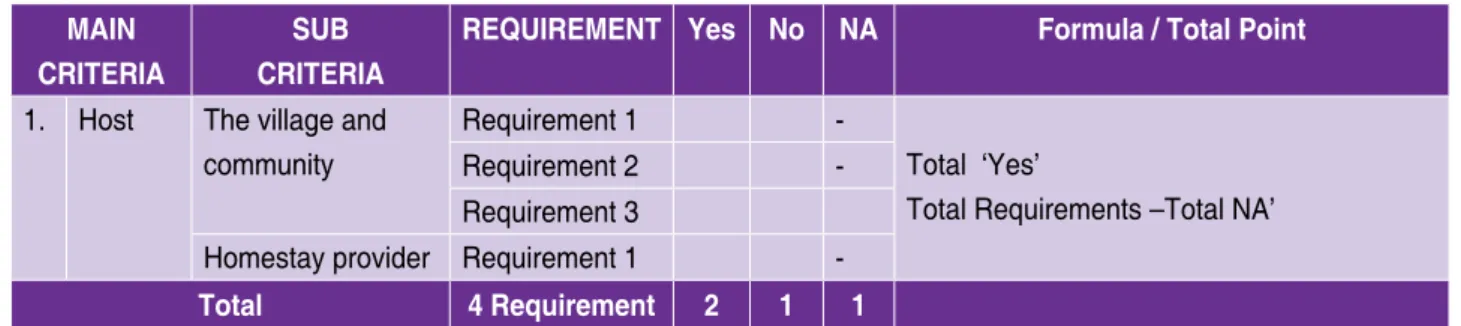
Assessment is based on predetermined criteria and requirements. For each requirement that adheres to the standard, a tick mark is given in the ‘Yes’ columnifotherwiseand. in the For elements that are not relevant to the homestay, a tick mark is put ’in (not applicable) the ‘NA column (see Box 1).
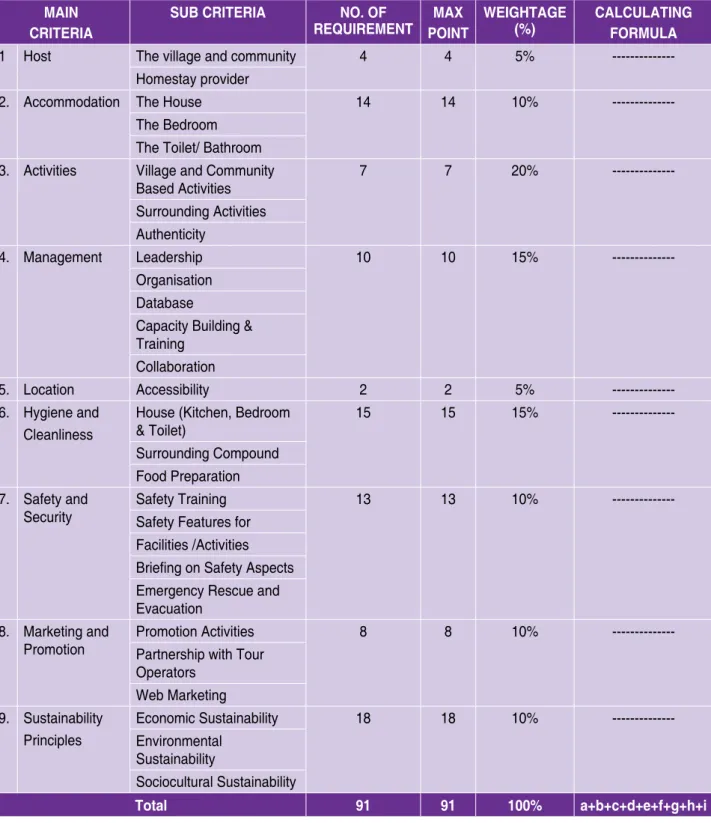
Each criteria is also given a weightage (percentage) based on its priority (Table 7.2). The calculation of the full assessment is shown in Table 7.3 and the requirements for ASEAN Homestay Standard are shown in section 7.3.
Box 1: Example of assessment
MAIN CRITERIA
SUB CRITERIA
REQUIREMENT Yes No NA Formula / Total Point 1. Host The village and
community
Requirement 1 -
Total ‘Yes’
Total Requirements –Total NA’
Requirement 2 -
Requirement 3
Homestay provider Requirement 1 -
Total 4 Requirement 2 1 1
This assessment is applicable to both the homestay provider and the homestay organization.
Depending on the criteria, feedbacks are obtained either from the homestay organization or the homestay provider (Table 7.1).
Table 7.1. Assessment Feedback
ANSWERED BY CRITERIA
Homestay organization 1. Host 2. Activities 3. Management 4. Location
5. Safety and Security 6. Marketing and Promotion 7. Sustainability Principles Homestay Provider 1. Accommodation
2. Hygiene and Cleanliness
7.1. Weightage
The weightage values will determine the importance or priority of each criteria in allowing a collective and balanced assessment. The weightage values are as follows:
Table 7.2. Criteria and weightage based on importance/priority MAIN CRITERIA WEIGHTAGE
1. Activities 20%
2. Management 15%
3. Hygiene and Cleanliness 15%
4. Accommodation 10%
5. Safety and Security 10%
6. Marketing and Promotion 10%
7. Sustainability Principles 10%
8. Host 5%
9. Location 5%
Total 100%
ASEAN Homestay Standard - Audit Checklist
18
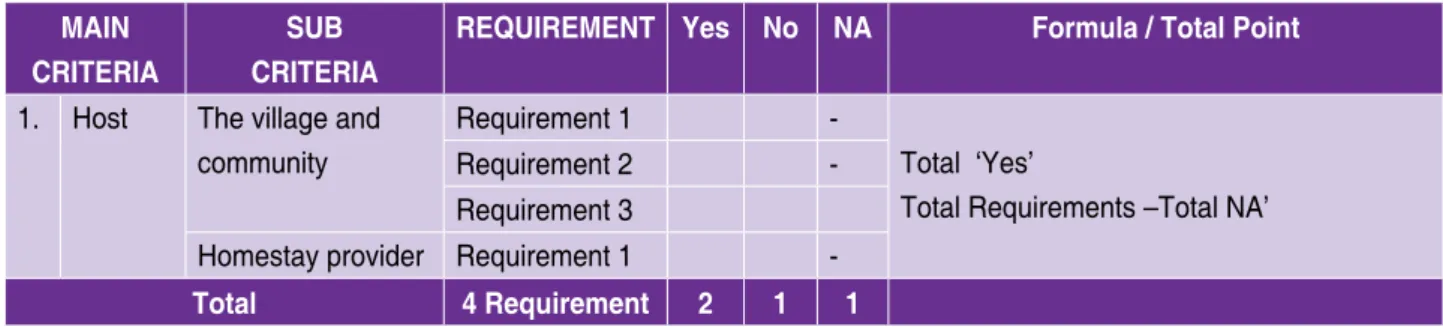
Box 1: Example of assessment
MAIN CRITERIA
SUB CRITERIA
REQUIREMENT Yes No NA Formula / Total Point 1. Host The village and
community
Requirement 1 -
Total ‘Yes’
Total Requirements –Total NA’
Requirement 2 -
Requirement 3
Homestay provider Requirement 1 -
Total 4 Requirement 2 1 1
This assessment is applicable to both the homestay provider and the homestay organization.
Depending on the criteria, feedbacks are obtained either from the homestay organization or the homestay provider (Table 7.1).
Table 7.1. Assessment Feedback
ANSWERED BY CRITERIA
Homestay organization 1. Host 2. Activities 3. Management 4. Location
5. Safety and Security 6. Marketing and Promotion 7. Sustainability Principles Homestay Provider 1. Accommodation
2. Hygiene and Cleanliness
7.1. Weightage
The weightage values will determine the importance or priority of each criteria in allowing a collective and balanced assessment. The weightage values are as follows:
Table 7.2. Criteria and weightage based on importance/priority MAIN CRITERIA WEIGHTAGE
1. Activities 20%
2. Management 15%
3. Hygiene and Cleanliness 15%
4. Accommodation 10%
5. Safety and Security 10%
6. Marketing and Promotion 10%
7. Sustainability Principles 10%
8. Host 5%
9. Location 5%
Total 100%
ASEAN Homestay Standard - Audit Checklist 19 Table 7.3. Example of calculation
MAIN
CRITERIA SUB CRITERIA NO. OF
REQUIREMENT MAX
POINT WEIGHTAGE
(%) CALCULATING FORMULA
1 Host The village and community 4 4 5% ---
Homestay provider
2. Accommodation The House 14 14 10% ---
The Bedroom The Toilet/ Bathroom 3. Activities Village and Community
Based Activities 7 7 20% ---
Surrounding Activities Authenticity
4. Management Leadership 10 10 15% ---
Organisation Database
Capacity Building &
Training Collaboration
5. Location Accessibility 2 2 5% ---
6. Hygiene and Cleanliness
House (Kitchen, Bedroom
& Toilet) 15 15 15% ---
Surrounding Compound Food Preparation 7. Safety and
Security Safety Training 13 13 10% ---
Safety Features for Facilities /Activities Briefing on Safety Aspects Emergency Rescue and Evacuation
8. Marketing and
Promotion Promotion Activities 8 8 10% ---
Partnership with Tour Operators
Web Marketing 9. Sustainability
Principles
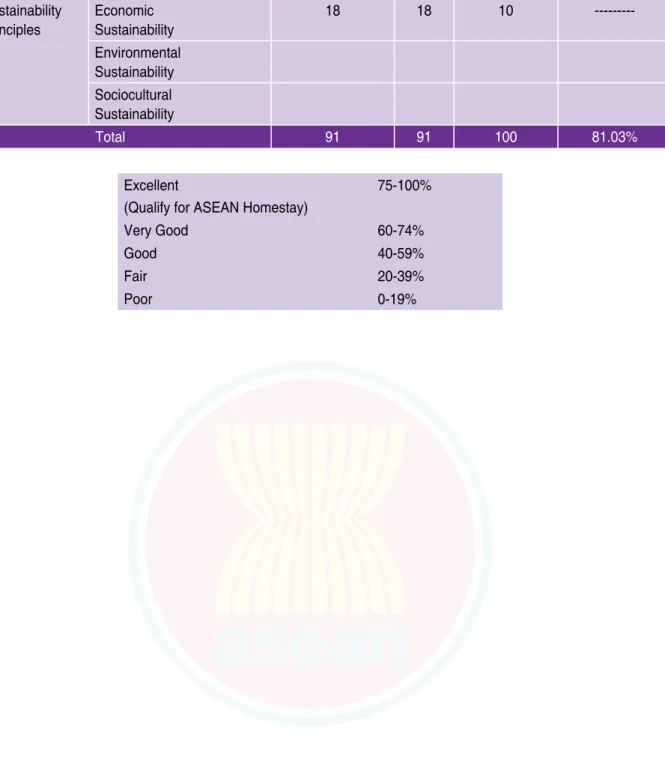
Economic Sustainability 18 18 10% ---
Environmental Sustainability
Sociocultural Sustainability
Total 91 91 100% a+b+c+d+e+f+g+h+i
7.2. Determining ASEAN Homestay Standard
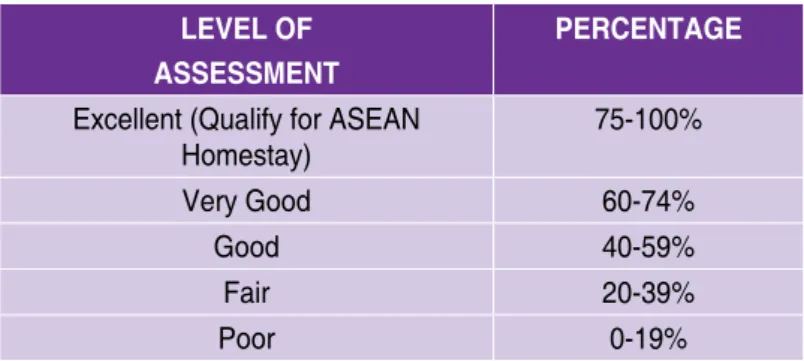
To determine if a homestay is showcasing the quality and prestige of ASEAN, any score above 75% would be categorised as an ASEAN Homestay. The following table shows the scale of scoring to determine the achievement of a homestay.
Table 7.4. Achievement/Quality Scale LEVEL OF
ASSESSMENT
PERCENTAGE Excellent (Qualify for ASEAN
Homestay) 75-100%
Very Good 60-74%
Good 40-59%
Fair 20-39%
Poor 0-19%
7.3 Requirements for ASEAN Homestay Standard
Table 7.5. Prerequisite entry requirements
NO QUESTION YES NO
1. Minimum of 5 registered homestay providers in the village 2. Homestay provider is free of criminal record
3. Homestay provider is in good general health
If a homestay provider or a homestay organisation does not fulfil the related requirements mentioned above, it is immediately disqualified from applying the ASEAN Homestay.
Table 7.6. Standard requirements MAIN CRITERIA SUB
CRITERIA
REQUIREMENT YES NO NA
1. Host
(WEIGHTAGE:
5%)
The village and community
• Located close to nature and cultural attractions.
>>Nearest attraction: ________ km
• Past winner of village based competitions.
>> Name of awards: _________
• There is a community centre/area in the village.
Homestay provider
• Homestay provider have completed homestay course.
2. Accommodation (WEIGHTAGE:
10%)
The house • Structure of house is in good and safe condition.
• Design and building materials reflect local architecture and identity.
• Separate guest bedroom(s)
>> Number of separate guest bedrooms: _______
• Minimum one (1) bathroom/toilet for the guest.
>> Number of bathroom/toilets: ______
• Electricity supply in the house.
• Adequate clean water supply inside the house.
The bedroom • Basic amenities such as fan, desk, mini cupboard, mirror, electric socket, mosquito net or coil, etc.
>>Amenities available:______________
• Maximum of four (4) bedrooms allocated to guests.
ASEAN Homestay Standard - Audit Checklist
20
Table 7.4. Achievement/Quality Scale LEVEL OF
ASSESSMENT
PERCENTAGE Excellent (Qualify for ASEAN
Homestay) 75-100%
Very Good 60-74%
Good 40-59%
Fair 20-39%
Poor 0-19%
7.3 Requirements for ASEAN Homestay Standard
Table 7.5. Prerequisite entry requirements
NO QUESTION YES NO
1. Minimum of 5 registered homestay providers in the village 2. Homestay provider is free of criminal record
3. Homestay provider is in good general health
If a homestay provider or a homestay organisation does not fulfil the related requirements mentioned above, it is immediately disqualified from applying the ASEAN Homestay.
Table 7.6. Standard requirements MAIN CRITERIA SUB
CRITERIA
REQUIREMENT YES NO NA
1. Host
(WEIGHTAGE:
5%)
The village and community
• Located close to nature and cultural attractions.
>>Nearest attraction: ________ km
• Past winner of village based competitions.
>> Name of awards: _________
• There is a community centre/area in the village.
Homestay provider
• Homestay provider have completed homestay course.
2. Accommodation (WEIGHTAGE:
10%)
The house • Structure of house is in good and safe condition.
• Design and building materials reflect local architecture and identity.
• Separate guest bedroom(s)
>> Number of separate guest bedrooms: _______
• Minimum one (1) bathroom/toilet for the guest.
>> Number of bathroom/toilets: ______
• Electricity supply in the house.
• Adequate clean water supply inside the house.
The bedroom • Basic amenities such as fan, desk, mini cupboard, mirror, electric socket, mosquito net or coil, etc.
>>Amenities available:______________
• Maximum of four (4) bedrooms allocated to guests.
ASEAN Homestay Standard - Audit Checklist 21
• Standard beds with mattresses and pillows.
• Windows are fitted with a mesh frame.
• Clean and fresh bed linen for every guest.
The toilet/
bathroom
• Sitting or squatting toilet inside or outside, but close the house.
• Basic toilet and bathroom facilities.
• Adequate clean water provided at all times.
3. Activities (WEIGHTAGE:
20%)
Village and community based activities
• Showcases local resources such as local culture and heritage, local enterprises, or natural resources.
• Activities encourage interactive participation between the local community and guests.
Surrounding activities
• Visits attractions in the surrounding areas.
• Collaborates with surrounding villages in carrying out activities.
Authenticity • Community retains its identity, values, and culture (language, lifestyle, etc).
• Preserve and involve guests in communal activities.
• Preserve local handcrafts and showcase local performing arts.
4. Management (WEIGHTAGE:
15%)
Leadership • Leader has strong leadership qualities and respected by local community.
Organisation • Homestay organisation has systematic structure with clear roles, responsibilities and line of communication.
• Homestay organisation facilitates the empowerment of local women and youths.
• Homestay organization has support/blessing from village management.
Database • Has homestay operator database e.g. home address, number of family members, special talents, knowledge or skills.
• Has guest database e.g. records of guest arrivals, origin, length of stay, comments, complaints and suggestions from guests.
• Has updated inventory of tourism resources in the village and surrounding area.
Capacity building and training
• Has simple manuals and guidelines covering :
- Welcoming and guest handling - Registration, billing and payment - Hygiene and cleanliness - Communication skills
- Planning, organising and handling of activities
- Marketing and promotion
- Storytelling and interpretation skills
• Training programmes and modules emphasiseon
‘hands approac ‘community community to.
• Has smart partnerships e.g. with other homestays, private agencies, public agencies, NGOs,
institutions of higher learning.
5. Location (WEIGHTAGE:
5%)
Accessibility • Location is accessible to any mode of transportation.
• Clear signage to guide guests to the homestay.
6. Hygiene and cleanliness (WEIGHTAGE:
15%)
House (kitchen, bedroom and toilet
• All rooms, kitchen and toilets are clean e.g. free of malodour, dirt, dust, and cobwebs.
Kitchen floor is clean.
• Toilet(s), shower tray(s), bath tub(s), well and sinks are clean e.g. free from dirt, stains and malodour.
• Disinfectants are used in toilets.
• Soap, shampoo, toilet tissue and clean towels are provided.
Surrounding compound
• Surrounding compound is litter free.
• No breeding grounds for mosquitoes.
• Village beautification and landscaping using local plants.
Food preparation
• Kitchen isin good, clean condition and well ventilated.
• Kitchen utensils are in good condition, clean, and kept in a dry place.
• Presentable plates, glasses, mugs etc. are used in serving meals.
• Individuals involved in food preparation have good personal hygiene and properly attired.
• Fresh ingredients used in food preparation are sourced from local suppliers.
• Served food are properly covered.
• Have safe drinking water.
7. Safety and security (WEIGHTAGE:
10%)
Safety training
• Safety personnel have undergone basic training in first aid and emergency rescue.
Safety features for facilities / activities
• At least 2 safety personnel accompanying guests during activities.
• Water-based activity have safety attire/equipments.
• Physical facility have safety features e.g.
railings and slip proof flooring.
• Trails and trekking routes are marked and signposted.
Briefing on safety aspects
• Briefing on safety aspects prior to taking part in any related activity.
• Leaflets on safety guidelines and tips are provided.
• Registering of guests participating in eco-
adventure activities e.g. name and contact number.
• There is a manual for safety procedures and guidelines as part of the Standard Operating Procedure (SOP).
ASEAN Homestay Standard - Audit Checklist
22
5. Location (WEIGHTAGE:
5%)
Accessibility • Location is accessible to any mode of transportation.
• Clear signage to guide guests to the homestay.
6. Hygiene and cleanliness (WEIGHTAGE:
15%)
House (kitchen, bedroom and toilet
• All rooms, kitchen and toilets are clean e.g. free of malodour, dirt, dust, and cobwebs.
Kitchen floor is clean.
• Toilet(s), shower tray(s), bath tub(s), well and sinks are clean e.g. free from dirt, stains and malodour.
• Disinfectants are used in toilets.
• Soap, shampoo, toilet tissue and clean towels are provided.
Surrounding compound
• Surrounding compound is litter free.
• No breeding grounds for mosquitoes.
• Village beautification and landscaping using local plants.
Food preparation
• Kitchen isin good, clean condition and well ventilated.
• Kitchen utensils are in good condition, clean, and kept in a dry place.
• Presentable plates, glasses, mugs etc. are used in serving meals.
• Individuals involved in food preparation have good personal hygiene and properly attired.
• Fresh ingredients used in food preparation are sourced from local suppliers.
• Served food are properly covered.
• Have safe drinking water.
7. Safety and security (WEIGHTAGE:
10%)
Safety training
• Safety personnel have undergone basic training in first aid and emergency rescue.
Safety features for facilities / activities
• At least 2 safety personnel accompanying guests during activities.
• Water-based activity have safety attire/equipments.
• Physical facility have safety features e.g.
railings and slip proof flooring.
• Trails and trekking routes are marked and signposted.
Briefing on safety aspects
• Briefing on safety aspects prior to taking part in any related activity.
• Leaflets on safety guidelines and tips are provided.
• Registering of guests participating in eco-
adventure activities e.g. name and contact number.
• There is a manual for safety procedures and guidelines as part of the Standard Operating Procedure (SOP).
ASEAN Homestay Standard - Audit Checklist 23 Emergency
rescue and evacuation
• Safety personnel are equipped with emergency/
first aid kit.
• Safety personnel is equipped with communication equipment
• Guests have insurance coverage
• Adhere to safety requirements of the respective country.
8. Marketing and promotion (WEIGHTAGE:
10%)
Promotion activities
• Packages are designed according to target markets needs and expectations.
• Unique Selling Proposition (USP) of village have been identified.
• Promotional materials e.g. brochure, interpretative boards and panels have been developed
• Cooperation with local government and tour operators for marketing.
Partnership with tour operators
• Have familiarisation trips e.g. with tour operators and media.
• Have partnership with prominent tour operators e.g. including them as advisors.
Web marketing
• Have website and utilise social media to promote homestay and online booking.
• Village youth are involved in maintaining and updating online promotional materials.
9. Sustainability principles (WEIGHTAGE:
10%)
Economic sustainability
• The homestay organisation employs staff from the local community.
• Allocates incentives to motivate staff.
• Provide micro finance to deserving locals.
• Purchasing
• The homestay organisation purchase materials and products from local micro enterprises.
• Guests are requested to buy locally made goods.
• Craft sales area within the homestay centre to showcase local products.
• Local Product/Attraction
• Promote local festivals and visits to nearby markets.
• Offer guests local goods and services e.g.
traditional handicraft, food and cultural events Environmental
sustainability
• Limit physical impact of guests on sensitive natural and cultural environments.
• Discourage the participation of guests in activities which could exploit local flora and fauna.
• Guests are involved in environmental programs such as litter clean ups, adopting nearby beach, forest or river.
• A code of conduct for guests for interaction with wildlife
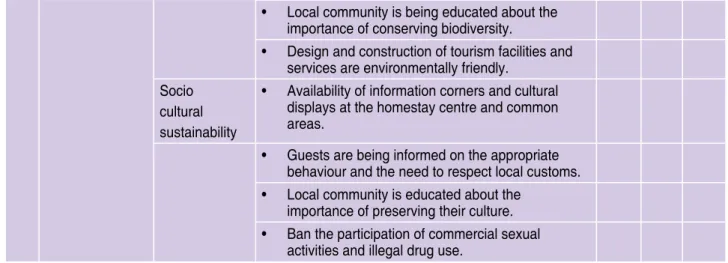
• Local community is being educated about the importance of conserving biodiversity.
• Design and construction of tourism facilities and services are environmentally friendly.
Socio cultural sustainability
• Availability of information corners and cultural displays at the homestay centre and common areas.
• Guests are being informed on the appropriate behaviour and the need to respect local customs.
• Local community is educated about the importance of preserving their culture.
• Ban the participation of commercial sexual activities and illegal drug use.
Table 7.7 below shows an example of calculation based on the assessment done by an assessor
Table 7.7. Summary of Assessment MAIN
CRITERIA
SUB CRITERIA
NO. OF REQUIREMENT
MAX POINT
WEIGHTAGE (%)
CALCULATING FORMULA
1. Host The village and community 4 4 5 ---
Homestay provider
2 Accommodation The House 14 14 10 ---
The Bedroom The Toilet/Bathroom 3. 3. Activities Village and Community
Based Activities 7 7 20 ---
Surrounding Activities Authenticity
4 Management Leadership 10 10 15 ---
Organisation Database
Capacity Building & Training Collaboration
5 Location Accessibility 2 2 5 ---
6. Hygiene and Cleanliness
House (Kitchen, Bedroom &
Toilet) 15 15 15 ---
Surrounding Compound Food Preparation 7. Safety and
Security
Safety Training 13 13 10 ---
Safety Features for Facilities /Activities
Briefing on Safety Aspects Emergency Rescue and Evacuation
8. Marketing and Promotion
Promotion Activities 8 8 10 ---
Partnership with Tour Operators
Web Marketing
ASEAN Homestay Standard - Audit Checklist
24
• Local community is being educated about the importance of conserving biodiversity.
• Design and construction of tourism facilities and services are environmentally friendly.
Socio cultural sustainability
• Availability of information corners and cultural displays at the homestay centre and common areas.
• Guests are being informed on the appropriate behaviour and the need to respect local customs.
• Local community is educated about the importance of preserving their culture.
• Ban the participation of commercial sexual activities and illegal drug use.
Table 7.7 below shows an example of calculation based on the assessment done by an assessor
Table 7.7. Summary of Assessment MAIN
CRITERIA
SUB CRITERIA
NO. OF REQUIREMENT
MAX POINT
WEIGHTAGE (%)
CALCULATING FORMULA
1. Host The village and community 4 4 5 ---
Homestay provider
2 Accommodation The House 14 14 10 ---
The Bedroom The Toilet/Bathroom 3. 3. Activities Village and Community
Based Activities 7 7 20 ---
Surrounding Activities Authenticity
4 Management Leadership 10 10 15 ---
Organisation Database