Volume 44 Issue 8 Article 5
2019
Can Secondary Teaching Graduates Support Literacy in the Can Secondary Teaching Graduates Support Literacy in the Classroom? Evidence from Undergraduate Assignments Classroom? Evidence from Undergraduate Assignments
Brian R. Moon
Edith Cowan University, [email protected] Barbara R. Harris
Edith Cowan University, [email protected] Anne-Maree Hays
Edith Cowan University, [email protected]
Follow this and additional works at: https://ro.ecu.edu.au/ajte Part of the Secondary Education and Teaching Commons Recommended Citation
Recommended Citation
Moon, B. R., Harris, B. R., & Hays, A. (2019). Can Secondary Teaching Graduates Support Literacy in the Classroom? Evidence from Undergraduate Assignments. Australian Journal of Teacher Education, 44(8).
http://dx.doi.org/10.14221/ajte.2019v44n8.5 This Journal Article is posted at Research Online.
https://ro.ecu.edu.au/ajte/vol44/iss8/5
Can Secondary Teaching Graduates Support Literacy in the Classroom?
Evidence from Undergraduate Assessments
Brian Moon Barbara Harris Anne-Maree Hays Edith Cowan University
Abstract: Education policy in Australia and comparable countries requires that all secondary content teachers actively teach the literacy of their learning area and support the literacy development of students in their classes. In this paper we present evidence on the capacity of graduating teachers to meet that obligation. We review assessment data from 393 Initial Teacher Education students who completed a core unit in secondary curriculum literacy prior to graduation. We report that while the majority met the unit requirements,
approximately 30% graduated as teachers with marginal or
inadequate capacity to teach the literacy of their subject or support student learning through literacy. Approximately 12% of the sampled cohort failed the unit on their first attempt; yet 76% of those who failed went on to graduate. We show that such performance is
consistent across the secondary disciplines included in the survey. We pose the questions as to whether secondary teachers with a marginal command of literacy strategies and poor literacy knowledge can be expected to provide effective literacy support, and whether education policy goals and provision of training in this area are therefore realistic.
Introduction
Secondary school teachers in Australian schools are required to support student
literacy in their learning area regardless of their subject specialisation. This is now the official policy position of the Australian Commonwealth Government, state education authorities and teacher registration boards. In the nationally agreed Australian Professional Standards for Teachers, Standard 2.5 requires that teachers "know and understand literacy and numeracy teaching strategies and their application in teaching areas” (AITSL, 2015, p.2); and the Australian Curriculum: General Capabilities document declares that "all teachers are responsible for teaching the subject-specific literacy of their learning area" (ACARA, 2012, p.10). In practice, this means that teachers of Art, Mathematics, Music, Physical Education, Science and the like must demonstrate the capacity to assist students with the specialised language and literacy demands of their subject. Typically, such demands include the ability to access and comprehend written course materials, learn and use specialised vocabulary, and compose in relevant written genres.
University Schools of Education now train future teachers in literacy support strategies, to ensure they can meet this obligation. The relevant course units vary across institutions, in their theoretical frameworks, specific content and mode of delivery; but common elements include coverage of literacy policy, key concepts in literacy and learning
(such as text and context, discourse, genre, readability) and a variety of practical routines and strategies for integrating language and literacy support into content teaching. Among the strategies promoted in such courses are the design and preparation of reading and discussion guides and note-making templates; concept mapping and diagramming strategies; multimodal representations of information; vocabulary building strategies; and writing models, templates and style guides of various kinds. These pedagogical tools are intended to improve the capacity of teachers to assist their students with the reading, writing and language challenges of secondary schooling. In Western Australia such strategies have previously been codified and distributed to teachers in professional development materials under the Stepping Out professional development banner (Bradley, 1996)—a professional development initiative of the Western Australian Education Department, combining teacher in-servicing, publications, and classroom resources. Other countries and jurisdictions have produced equivalent policies and materials—for example, the US National School Boards Association Next Chapter program (National School Boards Association, 2006); Ontario’s Think Literacy resources (Ministry of Education, 2011); New Zealand’s Secondary Schools Literacy Initiative (Ministry of Education, 2007); and the UK government’s Improving Literacy program (Ofsted, 2013).
This development work has paralleled the establishment of more explicit literacy curricula in primary and secondary schooling. The Australian Curriculum defines literacy broadly as a combination of knowledge, skills, behaviours and dispositions that enable students to comprehend and compose in a wide range of forms and for diverse purposes, through “reading, viewing, speaking, writing and creating oral, print, visual and digital texts”
(ACARA 2012, p.9). The curriculum recognises literacy as foundational to success in all learning areas, and it acknowledges the variety of literacy practices that exist within and across disciplines. It places much emphasis on integrating literacy into content subjects. In the words of the curriculum, “This means that:
• all teachers are responsible for teaching the subject-specific literacy of their learning area;
• all teachers need a clear understanding of the literacy demands and opportunities of their learning area; and
• literacy appropriate to each learning area can be embedded in the teaching of the content and processes of that learning area.” (ACARA 2012, p.10)
This emphasis on the importance of literacy and the need to embed literacy in the teaching of content subjects has made classroom literacy support an essential component of Initial Teacher Education (ITE) courses.
Teacher educators know that new entrants to the profession vary greatly in their capacity to adapt and apply the literacy strategies taught to them. A number of factors appear to explain that variance. The first of these is personal language and literacy competence—
that is, the beginning teacher's own ability to read and understand content materials, spell correctly, write clearly, and communicate effectively in oral and written modes. A second factor is the beginning teacher's explicit knowledge about language (KAL)—which includes knowledge of key language concepts (subject, verb, clause, phrase, and so on) and command of the metalanguage (grammatical terms) used to name such concepts. These two pre-
requisite abilities are distinct from a third factor, which is the beginning teacher’s capacity to learn and apply the pedagogical tools and methods associated with literacy instruction.
In spite of widely reported professional and community anxieties about the
capabilities of students in Initial Teacher Education courses (Bantick, 2008; Buckingham, 2015; Donnelly, 2015; Hosking, 2015; Gannicott, 2017; Leigh, 2012), there has been little direct measurement and appraisal of the quality of classroom literacy support provided by graduating teachers—including the role played by personal literacy competence. Research
and policy development has focussed more on the performance of school students, and on promoting cross-curricular literacy teaching through the dissemination of strategies and resources to teachers. Whether the bulk of new teachers can use such resources and strategies effectively has been under-researched.
It is difficult to gain access to large numbers of beginning teachers so as to compare their performance under controlled conditions. In this study we examine the performance of beginning teachers just prior to graduation and after the completion of a tightly controlled period of instruction in literacy support. We focus on their ability to develop teaching
materials and apply literacy knowledge and strategies, as demonstrated in graded assessment tasks. This is not a direct evaluation of classroom performance, but it is a measure of the capacity to correctly apply the resources and strategies recommended to teachers by training institutions and employing authorities. We make the assumption that the ability to develop effective teaching materials, following a unit of instruction, is a valuable indicator of the graduate’s capacity upon entry into the school system.
Through this study we have sought to answer the following questions.
1. To what extent are secondary teaching graduates capable of teaching the literacies of their discipline and supporting the literacy development of school students?
2. What proportion of graduating teachers have high, marginal, or inadequate levels of skill in developing literacy support materials?
3. What strengths and weaknesses are evident in the teaching materials developed by secondary ITE students who have received instruction in literacy support strategies?
What factors might account for these?
History and Review of Literature
A Short History of Cross-Curriculum Literacy
Current policies and practices in cross-curriculum literacy support have a long history.
The core principles emerged from seminal research in cognitive psychology and
psycholinguistics, which emphasised the roles of language and literacy in learning. Vygotsky (1934) stressed the role of language in mediating experience and understanding, through the learner's engagement with social speech and egocentric talk. Bruner (1966a, 1996b) likewise proposed that language codes help configure thought processes, providing a “scaffold” for subsequent learning. Bruner's work contributed to the development of language-based scaffolding strategies, whereby teachers provide students with physical, iconographic and linguistic resources that assist concept formation. Ausubel (1968) argued the importance of prior knowledge in setting the parameters for new learning, and advocated the use of advance organisers to help learners map new knowledge against existing schemata. Britton (1970) and Barnes (1976) articulated the need to accommodate language processes in the classroom rather than focus exclusively on subject content. Their notions of exploration, approximation and shaping contributed to the realisation that novices pass through stages of language acquisition and development in their journey toward mastery of a discourse or body of content. Piaget's (1926), Bartlett's (1932) and, later, Anderson's (1978) work on cognitive schemata established the idea of concept-structures that consist of relations between ideas—
including the words and word meanings used to communicate those ideas. Collectively, this early work indicated the importance of language, processes and structures in learning:
insights that invited greater consideration of how content is presented and communicated within disciplines, and how students themselves represent and construct their knowledge.
These foundational ideas have since been elaborated through further research, and codified in pedagogical routines and strategies for teachers. Representative developments
include studies in content area reading, and strategies for activating reading schemata (Herber, 1970); investigations of reading comprehension and concept formation (Rumelhart 1980); the concept of “reader-friendly” texts and the value of metacognitive reading
strategies (Armbruster & Brown 1984); the development of integrated cross-curricular literacy support schemes (Morris & Stewart-Dore, 1984; Alvermann & Phelps, 1989; Vacca
& Vacca, 1989; Bradley, 1996); assessments of textbook readability (Ruddell, 2008); and studies of subject-specific reading strategies (Shanahan & Shanahan, 2008). Much of this research has focussed on making the case for integrating literacy instruction into content subjects. Some work has led to general-purpose and widely applicable strategies, such as the use of anticipation guides (Duffelmeyer, 1994); while other research has suggested the need to tailor literacy strategies to particular discipline areas, such as science and mathematics (see for example, Wellington & Osborne, 2001; Barton, Heidema & Jordan, 2002). This broad field of research and development has been known by various names over the years, including "content area literacy," "disciplinary literacy," "literacy for learning," "whole-of- school literacy," and "literacy across the curriculum."
Two key propositions have come to dominate in content literacy research. The first is that subject content is always communicated through language and that literacy skills can therefore affect learning even in content-based subjects. The second proposition is that the rules and uses of literacy can vary across learning areas, such that good practice in one discipline may be considered poor practice in another. Shanahan and Shanahan (2008) note, for example, that it is appropriate to skim-read in some disciplines, such as when focussing on a chronology in History, but that skim reading in Mathematics is not appropriate because there is no redundant information in mathematical problems. These two propositions have led to the conclusion that school students require explicit instruction in the literacy of each discipline area. The foundational literacy taught in elementary school, and the general- purpose literacy skills acquired through the English curriculum, are not considered sufficient to help students cope with the specialised reading, writing and vocabulary skills of content disciplines—especially in the secondary school. Thus the expectation has arisen that specialist content teachers must become teachers of literacy.
Though broadly welcomed by educators, cross-curriculum approaches to literacy have had their critics. Hirsch (1996, 2006) has criticised the inherent formalism of some reading and writing strategies promoted to teachers, arguing that a focus on portable routines ignores the very specific role of knowledge in facilitating comprehension and conferring competence.
Cope and Kalantzis (2000), Healy (2007), and members of the New London Group (1996) have suggested that the focus on traditional print literacies in some programs ignores the increasing multimodality of communication and the emergence of new literacies that are more relevant to the twenty-first century. Though valid, these critiques fall outside the scope of this study, which focuses solely on the capacity of graduating teachers to provide literacy support in the traditional areas of reading, writing and vocabulary.
Recent Research and Policy
Recent research in the field has been directed mainly toward extending and refining established policies and procedures in literacy support. This can be seen in work by May and Smyth (2007), May and Wright (2007), Wright (2007), Fisher and Frey (2008), Love (2010), Lesley (2014), Masuda (2014) and others—all of whom promote the established paradigm of content literacy policy and practice. This paradigm assumes that effective content literacy support is a matter of finding the right mix of policy settings, classroom strategies and teacher commitment. Curriculum authorities have accepted these arguments and have shaped
educational policy accordingly. In Australia, the national Curriculum and Reporting Authority has included literacy as a key strand in its General Capabilities framework (ACARA 2015) and is now in the process of disseminating Literacy Progression Maps for secondary school discipline areas, including Civics, Design Technology, Economics, History, and Science (ACARA 2018). These policy initiatives show that the “cross-curriculum”
literacy paradigm is still influential in education policy and practice.
The question whether graduating teachers can use literacy strategies competently to offer accurate and effective literacy support—and whether literacy policies are therefore likely to bear fruit in reality—has been under-researched. The link between personal literacy competence and attitudes to teaching literacy has been explored. Louden (2005) and Louden and Rohl (2006), for example, found many graduates complain that ITE courses contain too much theory and not enough practical training in literacy support. Lesley (2014) explored the provision of literacy training offered to secondary teachers, and its effect on the
“dispositional barriers” (p.50) of secondary content teachers—that is, their personal and professional attitudes to literacy, finding that a single semester unit of instruction for secondary teachers does not appear sufficient to improve the take-up of literacy strategies.
Other researchers have noted high correlations between personal literacy competence and teaching efficacy, with some offering evidence that the teacher’s own verbal competence is one of the few truly predictive indicators of successful teaching (Ehrenberg & Brewer, 1994;
Mead & Leigh, 2005; Leigh, 2012). Such studies have not directly measured the effect of personal competence and literacy training on instructional skill, however.
A major three-year investigation of New Zealand’s Secondary Schools Literacy Initiative explored the range of institutional and professional adjustments required to build cross-curricular commitment to literacy, and the challenges of recruiting teachers to the cause; but researchers did not examine in detail the question of instructional capacity or the role of personal literacy competence in literacy pedagogy (May & Smith, 2007; May &
Wright, 2007; Wright, 2007). Moon (2014), in a report on diagnostic testing of ITE students, suggested that a significant number of secondary education undergraduates exhibited
shortcomings in personal literacy, including spelling, vocabulary and sentence structure—
problems that would presumably undermine their ability to teach the literacy of their
discipline and support the literacy development of students. That study did not directly assess the impact of personal literacy on instructional capacity, however. There has been some promising research on the topic in primary and early childhood education contexts (see Bromley, 2017; Cajkler & Hislam 2002; Carreker et al., 2010; Fenwick, 2014; Meeks &
Kemp 2017); but secondary investigations are scant.
Fagella-Luby, Ware and Capozzoli (2009), in a broad ranging review of reports on adolescent literacy and policy responses, surveyed the range of “critical questions” raised in the literature. None of the critical questions related specifically to the personal literacy competence of teachers and how it might effect performance. Like most such reports, that review included a recommendation that education authorities:
. . . strengthen certification requirements by requiring teachers to demonstrate
competency in subject area literacy instruction. Currently very few teacher education programs require students to complete subject-specific literacy courses or to
demonstrate competency in teaching reading. Colleges and universities are encouraged to build capacity and expertise by providing more courses in literacy instruction, providing more courses in content-area literacy instruction, offering a specialization option in adolescent literacy, and providing training in adolescent literacy to principal and district leaders. (468)
Schools of Education have since responded to such calls for more training in content literacy support. But it is by no means clear that the provision of training in literacy
instruction is enough. Much of the research and policy development has supposed that outcomes will automatically improve once teachers have been given access to appropriate routines and resources, and encouraged in their use. That ignores the question whether teachers are capable of giving effective support, whatever their level of commitment. It is to that question that we have directed our attention in this study.
Sample and Method
This study is a retrospective analysis of grades and assignment materials from core education units taught over a period of three years at one institution. It uses descriptive statistics to quantify aspects of student performance, in combination with grading criteria and work samples that illustrate different levels of achievement. The purpose of this design is to facilitate an appraisal of the skills demonstrated by ITE students following a course of instruction in literacy support, and to identify specific strengths and weaknesses in their performance.
Population
The surveyed population consisted of Bachelor of Education students in three
graduating cohorts across the years 2015, 2016 and 2017 at a metropolitan university campus in Perth, Western Australia. The students in these cohorts represented the full range of curriculum specialisations in secondary schooling: Design and Technology, Drama, English, Home Economics, Humanities and Social Science, Mathematics, Music, Physical Education, Science, and Visual Art. The students had all completed a required semester unit on
secondary curriculum literacy, taken during the third or fourth year of their degree preparation as secondary teachers. More detail about the unit is provided below.
A combination of three rare circumstances made this population ideal for
retrospective analysis. First, the content, delivery and assessment tasks in the literacy unit remained stable during the years 2015-2017, having previously been developed and refined over a long period. Second, the classes were all taught in workshop mode by the same small team of three staff—all very experienced and all involved in the design and writing of the unit. Third, as this was a core unit, the grading of assessments was required to conform to university protocols for comparability and moderation, which included benchmarking, cross- marking of assignments and double-marking of failing assignments and those at grade cut-off points. This conjunction of circumstances meant that there was a high degree of consistency in the delivery of the unit, in the student experience, and in the assessment of the work, across the three surveyed years. It is a degree of uniformity that would occur rarely within a single institution and which would be very difficult to achieve in a cross-institutional study. The circumstances conferred on this study the twin benefits of a large sample size and relatively low variability in the educational context from which the data were derived.
Data
Two kinds of data were obtained for the study: numerical assessments and grades, and samples of assignment work. Ethics approval was obtained for access to both. Assessment data were collected from official records, aggregated and de-identified, removing names and student numbers from the results. The anonymous results were labelled only by learning area
and gender. Samples of assignment work were collected via a written invitation to students, seeking permission for the researchers to analyse the strategies, strengths and weaknesses in the teaching materials they had produced in the unit. Of the 393 students in the total pool, 67 (17%) responded giving permission for their assignment work to be included in the study.
These assignments were collected in electronic format (Word or pdf files), de-identified, tagged with non-identifying item numbers, and stored in digital form for analysis.
The data were used to generate descriptive statistics for the sampled cohort. Results from the total pool of scores were examined to determine the range, means, and scales of achievement for the population as a whole and for individual teaching specialisations. These scores were used to determine the proportion of ITE students capable of providing effective literacy support after training in the various concepts and strategies. This was done by investigating the overall pass/fail percentages as well as the distribution of grades across the Pass, Credit, Distinction and High Distinction categories. Based on the original grading criteria used by markers in the unit, the grades were equated to highly competent, competent, marginal and inadequate capacities to support literacy.
Samples of assignment work were reviewed in order to determine specific areas of strength and weakness in the use of literacy strategies at each level, including types and rates of error. In this report the work samples are used primarily for illustration of the different standards of achievement. A deeper analysis, classifying the specific error types and rates, and diagnosing the likely causes of errors, is progressing. It will be the subject of a separate publication.
The Teaching Program and Assessments
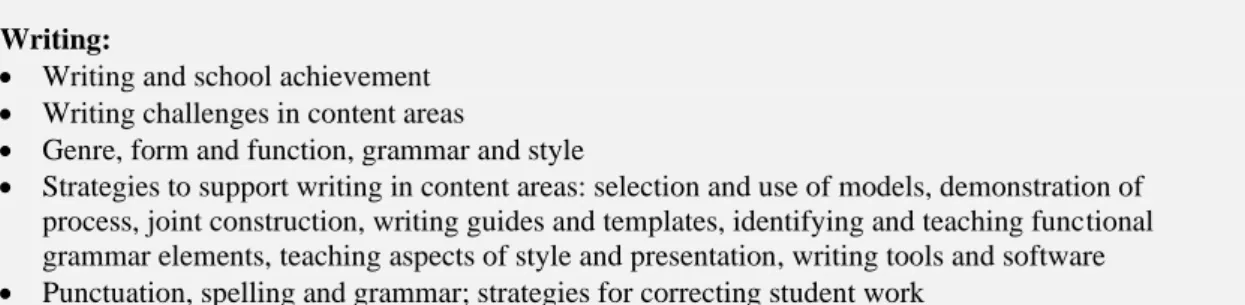
The data were generated from instruction and assessments in a core education unit addressing literacy teaching and literacy support in the secondary curriculum. The unit focussed primarily on print literacy, aspects of viewing and digital literacy having been addressed in earlier core education units. The content covered comprehending and
composing, in the form of reading support, vocabulary assistance, writing instruction, and classroom talk, along with literacy policy and issues of diversity and cultural difference.
Figure 1, below, shows an outline of the key topics covered in the unit. The summary omits some specific details, to protect the intellectual property of the institution.
Literacy in teaching and learning:
• Literacy standards and literacy policy in Australian secondary schools
• Literacy and school achievement
• Content area discourses and disciplinary literacy Reading:
• Reading and school achievement
• Reading challenges in content areas
• Appraising readability: formulae and checklist methods
• Strategies to support reading and comprehension: topic preview, vocabulary preview, anticipation guides, note-making guides, concept mapping, diagramming, retrieval charts, et cetera
Vocabulary and subject terminology:
• Vocabulary and reading readiness
• Morphology, etymology, meaning and usage
• Subject-specific vocabulary and codebreaking
• Strategies to support vocabulary knowledge: identifying challenging terms; grouping by form and meaning; word walls and glossaries, pronunciation and usage guides, explanation of form and meaning, Greek and Latin roots, prefixes and affixes, English spelling rules, dictionary usage
Writing:
• Writing and school achievement
• Writing challenges in content areas
• Genre, form and function, grammar and style
• Strategies to support writing in content areas: selection and use of models, demonstration of process, joint construction, writing guides and templates, identifying and teaching functional grammar elements, teaching aspects of style and presentation, writing tools and software
• Punctuation, spelling and grammar; strategies for correcting student work Oral language:
• Oral language and school achievement
• Oracy as a precursor to literacy
• Classroom talk, group talk, and subject discourses
• Strategies to support literacy through talk: talking before writing, code switching in classroom talk, oral and written genres, talk formats and cognitive processes, convergent and divergent talk, talk as an adjunct to writing: conferencing and consultation
Literacy and diversity:
• Language and cultural diversity in secondary schools
• Diversity and school achievement
• First language literacy and EALD literacy: policy and strategies
• Adapting literacy strategies to support EALD students and students with learning difficulties.
Figure 1. Outline of topics and instructional sequence in a core curriculum literacy unit.
The teaching program consisted of weekly readings on literacy and pedagogy, explicit instruction in literacy strategies, and practicals. Samples of authentic text materials, taken from current textbooks, online resources, and school assessment tasks, were used in classes to illustrate the literacy challenges facing secondary students. The ITE students were taught to identify literacy demands in the source materials, and to evaluate levels of challenge, including complex vocabulary, lexical density, nominalisations, sentence cohesion,
grammatical intricacy, text signposting, and other factors (Fang & Pace, 2013). They learned to use and evaluate a variety of published readability measures, ranging from mathematical formulae (for example, Fry & Kress, 2006) to checklist-style tools (for example, Ruddell, Ruddell & Singer, 1994; Ruddell 2008). A wide range of support strategies was demonstrated in workshops using authentic curriculum resources, and adapted from established literacy support schemes (including Morris & Stewart-Dore, 1986; McKenna & Robinson, 1993;
Bradley, 1996, and others). Students practiced applying the strategies in both small group and individual activities. Models and demonstration materials in the unit were tailored to specific curriculum specialisation areas.
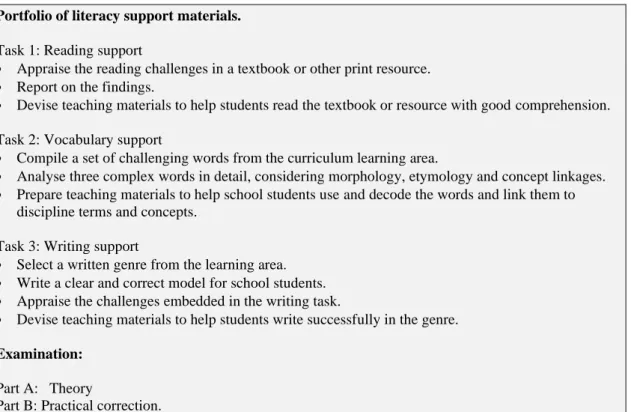
In their assessments, students worked with materials from their preferred curriculum specialisation. Thus, Physical Education specialists worked with extracts from Physical Education textbooks, and devised support materials that addressed the vocabulary and content literacies of Physical Education studies. The same was true for other specialisations. The assessment tasks included building a portfolio of teaching materials intended for classroom use, and a written examination. Details of the assessments are set out in Figure 2.
Portfolio of literacy support materials.
Task 1: Reading support
• Appraise the reading challenges in a textbook or other print resource.
• Report on the findings.
• Devise teaching materials to help students read the textbook or resource with good comprehension.
Task 2: Vocabulary support
• Compile a set of challenging words from the curriculum learning area.
• Analyse three complex words in detail, considering morphology, etymology and concept linkages.
• Prepare teaching materials to help school students use and decode the words and link them to discipline terms and concepts.
Task 3: Writing support
• Select a written genre from the learning area.
• Write a clear and correct model for school students.
• Appraise the challenges embedded in the writing task.
• Devise teaching materials to help students write successfully in the genre.
Examination:
Part A: Theory
Part B: Practical correction.
Figure 2. Assessment tasks embedded in a secondary curriculum literacy unit.
The portfolio task required students to design classroom materials that teach literacy skills and support literacy processes. The examination tested knowledge of policy and theory and included a practical correction task. The correction task tested the beginning teacher’s ability to identify and correct errors in a sample of writing. This was designed to simulate the marking and correction of student work, and also to test the beginning teacher’s knowledge of spelling, punctuation and grammar conventions. All of the tested conventions had been taught and reviewed in the unit, minimising any advantage that might accrue to specialists in English and languages, who might be expected to already have this knowledge.
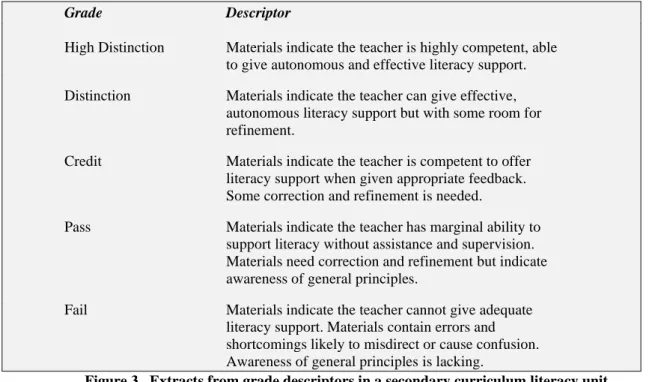
Marking of the assessments in the unit was by application of task-specific criteria and achievement descriptors. All markers used the same grading criteria. In keeping with the institution’s requirements for core units, comparability and consistency in the marking was achieved through benchmarking, cross marking of work samples at grade cut-offs, and by double-marking of all failing assignments. Benchmarks were established by the unit coordinator, who provided graded work samples as needed and also certified the marks of individual staff members.
Guidelines for the marking included grade level descriptors that rated the capability of beginning teachers to offer autonomous and effective literacy support. Relevant extracts from the guidelines are reproduced in Figure 3.
Grade Descriptor
High Distinction Materials indicate the teacher is highly competent, able to give autonomous and effective literacy support.
Distinction Materials indicate the teacher can give effective, autonomous literacy support but with some room for refinement.
Credit Materials indicate the teacher is competent to offer literacy support when given appropriate feedback.
Some correction and refinement is needed.
Pass Materials indicate the teacher has marginal ability to support literacy without assistance and supervision.
Materials need correction and refinement but indicate awareness of general principles.
Fail Materials indicate the teacher cannot give adequate literacy support. Materials contain errors and shortcomings likely to misdirect or cause confusion.
Awareness of general principles is lacking.
Figure 3. Extracts from grade descriptors in a secondary curriculum literacy unit.
As this report is a survey of historical data, there are unavoidable limitations in the degree of confidence that can be attributed to its methods. The scores have not been subjected to blind marking or external validation, as would be the case for an experimental design. The data reflect past events and real-world assessments. They are presented here at face value, with that caveat in mind. Extracts from work samples are provided, however, to illustrate the standards of work associated with the grading scale.
Findings
Assessment Scores
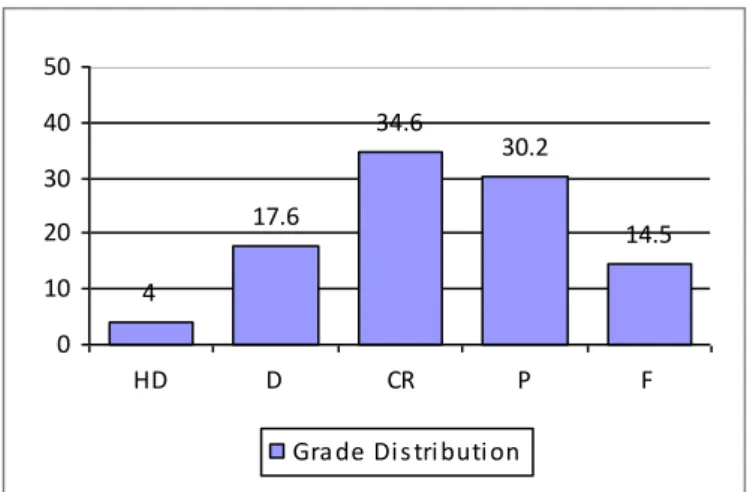
The distribution of scores for the surveyed population was found to be heavily skewed. Figure 4 records the undifferentiated grade distributions. It shows that 30%
completed the course with a Pass grade, indicating marginal capacity to offer effective literacy instruction and support. 34% achieved a Credit, indicating competence to offer beneficial literacy support after appropriate feedback and correction. A combined 22%
achieved Distinction and higher, indicating highly competent ability to offer effective, autonomous literacy instruction, without significant errors in either content or pedagogy.
Conversely, 14% of the cohort failed the unit on the first attempt. When non-triers (such as enrolment errors and late withdrawals) were removed from the count, this number fell closer to 12%. The mean for the combined cohort was 59%.
Figure 4. Grade distributions for the sampled population, as percentages.
n=393 Mean = 59.9. Totals are not exact, due to rounding.
Differences across discipline specialisations were found to be smaller than might be expected. Figure 5 records the means and distributions for the ten discipline areas in the ITE course. Science and Mathematics have been combined into a single category due to the very low numbers in those cohorts (n=11 and n=8 respectively).
English majors achieved the highest mean score of 64.3%, as might be expected. But their mean was not substantially higher than some other discipline cohorts, notably
Science/Mathematics (64%), Drama (61.7%) and Music (60.3%). English majors did record the smallest percentage of failing grades, however, and the highest proportion of High
Distinction scores. Despite this comparably good showing, their scores were nevertheless still skewed toward marginal capability. The lowest mean of 56.7% was achieved by Humanities and Social Science (HASS) majors, who also scored the lowest proportion of High
Distinction scores at 2.9% – an unexpected outcome for specialists in a group of disciplines (Economics, Geography, History, Politics and Law) in which literacy is so pervasive and important.
Science and Mathematics specialists were found to perform comparatively well, despite the popular conception that they deal only with numbers rather than words. They achieved the second highest mean score and the most symmetrical distribution, with as many very high achievers as failing grades (5.2% for both). This was the only discipline
distribution that was not skewed toward lower achievement grades.
Included in the unit assessments was a literacy correction task, designed to simulate the capacity of ITE students make corrections on written work when marking assignments and tests. Students were required to locate and correct ten errors of spelling, punctuation and grammar in a sample of writing. This was the most direct measure of personal language competence in the assessment tasks. Scores on this activity ranged from 0 (four students) to 10 (five students), with a mean of 4.8, and a failure rate of 38%.
4
17.6
34.6 30.2
14.5
0 10 20 30 40 50
HD D CR P F
Gra de Di s tri buti on
5.1 Design Technology. n=31 Mean = 57.9 % 5.2 Drama. n=39 Mean = 61.7%
5.3 English. n=42 Mean = 64.3 % 5.4 Health/Phys. Ed. n=116 Mean = 58.7 %
5.5 Home Economics. n=30 Mean = 58.1% 5.6 Humanities & Soc. Sci. n=34 Mean = 56.7 %
%
5.7 Music. n=51 Mean = 60.3 % 5.8 Science-Mathematics. n=19 Mean = 64%
2.6
13.8
31.9 36.2 15.4
0 10 20 30 40 50
HD D CR P F
HPE Grades
3.8
15.6 43.1
23.5 13.6 0
10 20 30 40 50
HD D CR P F
MUS Grades
2.9
14.7 35.2
26.4 20.4
0 10 20 30 40 50
HD D CR P F
HASS Grades
5.2 21
47.5
21 5.2 0
10 20 30 40 50
HD D CR P F
SCI-MAT Grades 3.2
9.6
38.7
25.8 22.5
0 10 20 30 40 50
HD D CR P F
DTE Grades
5.1
28.2 30.7 25.6
10.1 0
10 20 30 40 50
HD D CR P F
DRA Grades
14.2 16.6 28.5
35.7
4.6 0
10 20 30 40 50
HD D CR P F
ENG Grades
3.3
13.3
36.6 33.3
13.2 0
10 20 30 40 50
HD D CR P F
HEC Grades
5.9 Visual Art. n=31 Mean = 58.1 %
Figure 5. Grade distributions for discipline cohorts, shown as percentages. n=393.
List is alphabetical. Totals are not exact, due to rounding.
Sciences versus Humanities and Arts
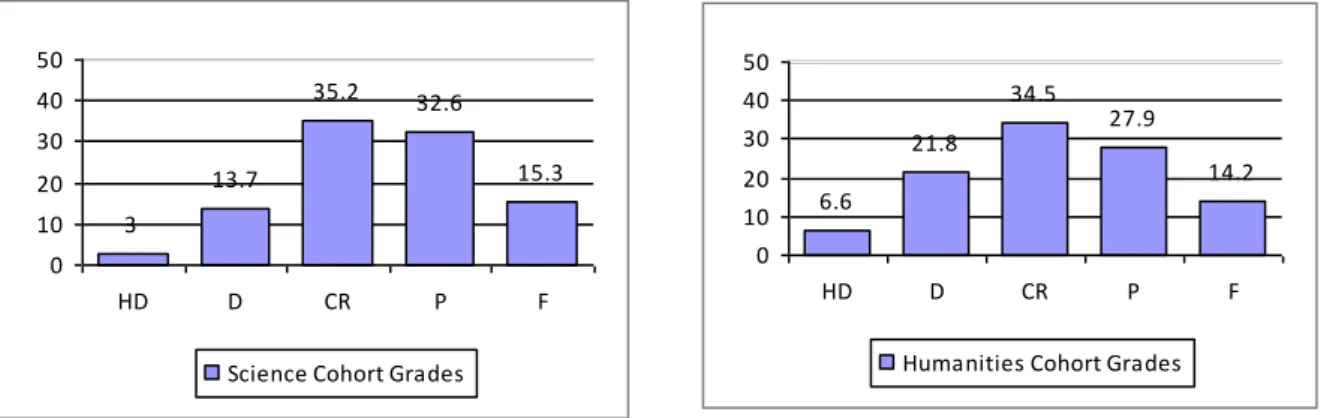
Despite some notable differences between discipline cohorts, the distributions and means for the STEM-oriented disciplines (Science, Technology, Engineering, Mathematics, Physical Education, Home Economics) were not greatly different from the combined
Humanities and Arts disciplines (Drama, English, HASS, Music, Visual Arts). The combined
“Sciences” mean was 59.6%, compared to the combined “Humanities and Arts” mean of 60.2%, as shown in Figure 6.
6.1 “Sciences” cohort. n=196 Mean = 59.6 % 6.2 “Humanities” cohort. n=197 Mean = 60.2%
Figure 6. Comparison of combined “Science” and combined “Humanities and Arts” cohorts.
Totals are not exact, due to rounding.
Failing Grades
Failing grades in the sample required a separate analysis. A small but significant percentage of students were taking the unit for a second time during the surveyed period.
Some had failed the unit on earlier attempts, prior to the survey period, while others
attempted the unit a second time within the survey period. Taking these factors into account, and extracting non-triers, allowed for a determination of how many students initially failed the unit but subsequently graduated as teachers after a second or later attempt.
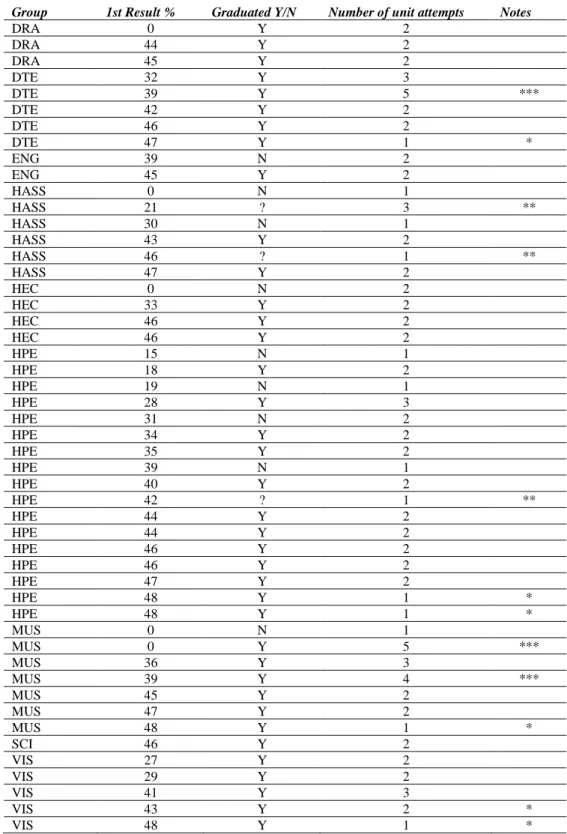
Table 1 records the first-attempt score, number of attempts and final graduation status of students in the survey sample who failed the unit at least once. There were 50 students who failed the first attempt, constituting 12% of the total cohort. Of these, 38 (76%) went on to graduate as teachers at the time of writing, after attempting the unit one or more times. Eight students (16% of the cohort) required more than two attempts to pass. The highest number of unit attempts with eventual graduation was five (5), which exceeds the normal institutional limit of three attempts. The particular circumstances of these extreme cases cannot be
6.4 6.4
32.2 29 25.7
0 10 20 30 40 50
HD D CR P F
VIS Grades
3
13.7
35.2 32.6
15.3
0 10 20 30 40 50
HD D CR P F
Science Cohort Grades
6.6
21.8 34.5
27.9 14.2 0
10 20 30 40 50
HD D CR P F
Humanities Cohort Grades
reported with anonymity, except to say that one student was excluded from the course for a period and was later readmitted and allowed further attempts at the unit, while another was granted special consideration by the Institution on the basis of learning difficulties.
Group 1st Result % Graduated Y/N Number of unit attempts Notes
DRA 0 Y 2
DRA 44 Y 2
DRA 45 Y 2
DTE 32 Y 3
DTE 39 Y 5 ***
DTE 42 Y 2
DTE 46 Y 2
DTE 47 Y 1 *
ENG 39 N 2
ENG 45 Y 2
HASS 0 N 1
HASS 21 ? 3 **
HASS 30 N 1
HASS 43 Y 2
HASS 46 ? 1 **
HASS 47 Y 2
HEC 0 N 2
HEC 33 Y 2
HEC 46 Y 2
HEC 46 Y 2
HPE 15 N 1
HPE 18 Y 2
HPE 19 N 1
HPE 28 Y 3
HPE 31 N 2
HPE 34 Y 2
HPE 35 Y 2
HPE 39 N 1
HPE 40 Y 2
HPE 42 ? 1 **
HPE 44 Y 2
HPE 44 Y 2
HPE 46 Y 2
HPE 46 Y 2
HPE 47 Y 2
HPE 48 Y 1 *
HPE 48 Y 1 *
MUS 0 N 1
MUS 0 Y 5 ***
MUS 36 Y 3
MUS 39 Y 4 ***
MUS 45 Y 2
MUS 47 Y 2
MUS 48 Y 1 *
SCI 46 Y 2
VIS 27 Y 2
VIS 29 Y 2
VIS 41 Y 3
VIS 43 Y 2 *
VIS 48 Y 1 *
DRA= Drama, DTE=Design Technology, ENG=English, HASS=Humanities Social Science, HEC=
Home Economics, HPE=Health and Physical Education, MUS=Music, SCI=Science, Maths, VIS=Visual Art.
Key: * granted a supplementary assessment or conceded pass
** inactive status - outcome unknown
*** granted special permission to exceed three attempts
Table 1. Final graduation status of students who failed a core literacy unit at least once.
Work Samples
Work samples were collected and examined for the purpose of identifying the strengths and weaknesses associated with different levels of achievement, and the type and degree of errors made, in the preparation of literacy teaching materials. Presented here are extracts from just one assessment task: vocabulary teaching. The vocabulary teaching task was found to have the highest correlation with overall performance (r = .614). Extracts are provided for the purpose of illustrating the levels of performance. A more complete study of error rates, error types and correlations in the work samples is ongoing and will be the subject of a separate publication.
In the vocabulary task, students were asked to demonstrate the ability to teach words from their discipline, and to support comprehension, usage and codebreaking of new words.
Three hours of instruction were dedicated to this topic. Through readings and practical activities, students were taught about word roots, morphemic patterns and linkages in the vocabulary of their disciplines. They were shown models for defining and explaining new words, and they practised strategies for teaching pronunciation, meaning, usage, and
codebreaking of unfamiliar words (that is, deducing meaning from known prefixes, roots and suffixes).
Figure 7 shows one of the teaching models used in the workshop. The model
demonstrated a number of strategies for vocabulary assistance, including the use of phonetic pronunciation guides, clear and direct definitions of new words, the use of sentence
explanations and sentence examples, and the listing of words sharing the same root, to promote code-breaking of new words. These are standard strategies for teaching word meanings and morphology in discipline contexts (see, for instance, Ebbers, 2008; Harmon &
Wood 2008). The students were required to adapt and apply these strategies when creating their own teaching materials for the assignment portfolio.
Secondary ITE students were found to vary dramatically in their ability to follow the model and apply the required knowledge and skills when developing teaching materials. The most capable students produced teaching materials that were error-free, clear and accessible, following closely the style and format of the model. They also demonstrated full
understanding of the terminology of their discipline and an ability to make sound judgements about the degree of complexity required in their teaching. The least capable students produced teaching materials that were ambiguous, jumbled and unclear. They made errors with terminology, misjudged the relevance and complexity of background details, and displayed poor awareness of literacy principles involved in word building and codebreaking.
The extracts and commentaries below illustrate this range of abilities.
Note: All errors in work samples are as they appear in the originals.
HYPERBOLE (noun). Pronounced high-PER-bo-lee
Definition: Hyperbole is exaggeration. It refers to a statement that is unrealistic or excessive. For example, “Beyonce is the greatest singer of all time.”
Using the word:
“The boy’s excuse was full of hyperbole.” (noun)
“The advertisement was filled with hyperbolic claims.” (adjective)
The word is built from two parts:
- hyper means “beyond or above”
- bole comes from the Greek word bolos, meaning “to throw.”
It literally means “to throw too far” and miss your target. Exaggerated claims often said to “go too far”
— they fail to be convincing because they are unbelievable.
Related words:
“hyper” is the base for words like hyperactive, hypersensitive, and hypercritical
Figure 7: A model showing strategies for vocabulary teaching and support.
Highly Competent Performance
Teaching materials awarded High Distinction and Distinction grades demonstrated highly competent literacy instruction and support with minimal or no need for refinement or correction of materials. Work at this level indicated a teacher with a capacity for
autonomous planning and teaching of terminology and new vocabulary.
7.1 Music: ‘Drammatico’
Drammatico (command) pronounced dra-MA-ti-co
Drammatico is a musical instruction telling the performer to play with excitement and emotion. It signals a dramatic style.
Using the word:
Drammatico can be a command or instruction to performers, and also a label for a section of music.
“The flutes were instructed to play the passage drammatico” (adjective) “The orchestra rehearsed the drammatico” (noun)
The word is built from the Latin word dramaticus, from the root word drama.
Related words:
drama, dramatic, dramatist, dramaturge
(the -o ending is like: allegro, largo, presto. What others do you know?)
The example in Figure 7.1 follows the model closely and shows sound understanding of the principles involved in supporting vocabulary acquisition. It anticipates potential points of confusion (for example, the fact that drammatico functions as an imperative, a noun, and an adjective) and offers only as much explanatory detail as needed to clarify the meaning and usage. It is clear, correct and helpful, and it engages the student through direct address.
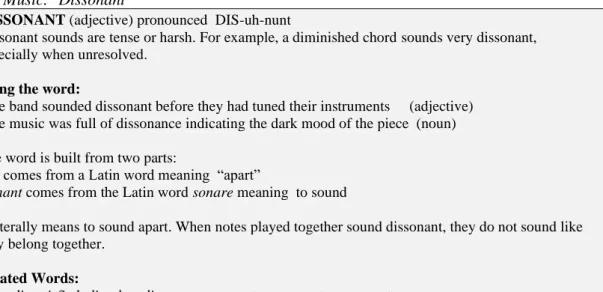
7.2 Music: ‘Dissonant’
DISSONANT (adjective) pronounced DIS-uh-nunt
Dissonant sounds are tense or harsh. For example, a diminished chord sounds very dissonant, especially when unresolved.
Using the word:
The band sounded dissonant before they had tuned their instruments (adjective) The music was full of dissonance indicating the dark mood of the piece (noun)
The word is built from two parts:
dis comes from a Latin word meaning “apart”
sonant comes from the Latin word sonare meaning to sound
It literally means to sound apart. When notes played together sound dissonant, they do not sound like they belong together.
Related Words:
dis = dissatisfied, dissolve, disappear; sonant = resonant, consonant
Figure 7.2 shows work that is sound and substantially correct but with room for refinement. It would be more effective to use the noun (dissonance) as the headword. The definition, though clear, repeats the headword, potentially introducing some circularity. The explanations are delivered in full sentences with a high degree of clarity. Overall, the material is helpful, and it succeeds in linking the key word to others with the same roots.
7.3 English: ‘Exhortation’
EXHORTATION (noun), pronounced ex-hor-TAY-shun
An exhortation is a strong encouragement. If you are trying to convince someone to take a particular action or adopt a particular viewpoint, you are exhorting them.
Using the word:
“He finished his speech with an exhortation for the audience to sign up to the charity.” (noun) “His mother exhorted him to wear gloves when gardening.” (verb)
The word is built of three parts:
ex is a prefix that usually means “out”, but here it means “thoroughly”.
hort comes from the Latin word hortari, which means ‘encourage’.
ation is a suffix that turns an action (verb) into a concept (noun).
It literally means “to thoroughly encourage”. An exhortation can be more like a plea (as in the first two examples above) or an instruction (as in the third example). In either case, the person who is exhorting is thoroughly encouraging their audience to do something.
(Related words: ex- = excruciating, exhilarating; -ation = perspiration, adoration, discrimination)
The example in Figure 7.3 is thorough and accurate, but it shows some misjudgement of how much information students will need, and how much they can cope with. It introduces some unnecessary detail by over-emphasising the suffix. A focus on the root word hortari would be sufficient. The written explanations are clear and helpful, however, if somewhat verbose. The material can be improved with some pruning of detail, leaving a sound and useful resource.
Competent Performance
Teaching materials awarded a Credit grade (CR) were rated as competent, demonstrating an ability to offer beneficial assistance with vocabulary and special
terminology, but with the need for feedback, correction and refinement of materials before use. There is awareness of the key principles but the work does not indicate full autonomy and an ability to self-correct when judging the accuracy and effectiveness of the materials.
7.4 Physical Education: ‘Eversion’
Word: Eversion (noun). ee-VUR-shun
Meaning: An act of turning inside out: the state of being turned inside out. - The condition (as of the foot) of being turned or rotated outward.
Usage: Fracturing an ankle can be done by an extreme eversion of the foot.
Origin: 1425-75; late Middle English.
Root Words: Latin words evertere, vertere, vers, ‘turn’
Suffixes: the ending ion appears in words of Latin origin, indicating action, process or state. Used in Latin and English to form nouns from stems of Latin objectives.
Similar Words: Evert, everted, conversion,
The item in Figure 7.4 shows an understanding of the key principles. The required strategies are all there, and most sections fulfil their purpose. The definition and explanations are a little awkward, however, having been phrased in the abstract and abbreviated style of a dictionary. There is some unnecessary detail regarding dates, and the etymology is not clear.
The root word vers should be given prominence, as it assists in codebreaking a range of words that indicate ‘turning’ of some kind: reverse, converse, obverse, and so on. Eversion belongs to that corpus. Discussion of the suffix is potentially confusing and could have been omitted.
7.5 Drama: ‘Dialogue’
Dialogue (noun) pronounced DI-ah-log
A dialogue is a conversation between two or more people. It can refer to plays, movies, books, or real life. For example, a scripted dialogue would be:
Jane: Have you taken the rubbish out yet?
John: Oh no! I forgot, sorry
Using the word: “This play has a lot of dialogue in it.”
“Let’s open up a dialogue between our two companies.”
The word comes from two words:
Dia- which means “across”
Legein- which means “speak”
It literally means “speech across two people”
(Related words- lecture, dialect, thoroughly)
Sample 7.5 contains a clear definition and shows awareness of the key principles.
There are some points of potential confusion, however. The implied distinction between scripted and unscripted dialogue is not made entirely clear. There is also some inaccuracy in the derivation and word linkages. The root logos would be better emphasised, with links to monologue, dialogue, prologue, epilogue, and so on. Confused word linkages, such as the inclusion of thoroughly, weaken the material further.
Marginal Performance
Teaching materials awarded a Pass grade (P) demonstrated a marginal capacity to teach vocabulary and word-building. Typically, such work was found to contain one or more technical errors, as well as some misjudgement in the level and volume of information prepared. There was awareness of literacy support principles, but significant awkwardness in their application, indicating a need for external feedback and revision of materials.
7.6 Science – ‘Cytoplasm’
Cytoplasm (Noun) sahy-tuh-plaz-uh -m
Meaning: Cell substance between membrane and nucleus containing the cytosol, organelles, cytoskeleton, and various particles.
Usage: “The limitation of development in a particular case lies in the cytoplasm rather than the nuclei of the cells.”
Origin: Cytosplasm has an origin dating back to 1870. ‘cyto’ is a combing form meaning “cell” which is derived from the greek word kyto-. ‘Plasm’ is deriven from the Greek word ‘plasma’
Key Words: ‘cyto’ + ‘plasm’ are both of Latin nature.
Similar Words: plasma (eg, blood plasma)
The work sample shown in Figure 7.6 demonstrates marginal capacity to offer vocabulary support. There is an attempt to follow the form and principles of the model, but a number of errors and misjudgements limit the value of the teaching material. The definition is somewhat abstract (cell substance) and it introduces additional complex terms (cytosol, organelles) that assume too much prior knowledge. The example of usage goes beyond merely clarifying the part of speech and seems to say something complex about the concept (though what it means is unclear). Dates (1870) and references to “a combining form”
indicate copying from a reference source without appropriate adaptation of the content and style. There is some confusion about whether the word origins are Latin or Greek. The closing reference to blood plasma is at odds with the original focus on cyto/cell. Overall, it is barely adequate.
7.7 Visual Art: ‘Aesthetic’
Aesthetic (es-thet-ik)
Adj – concerned with beauty or appreciation of beauty.
e.g “the pictures give great aesthetic pleasure.”
Noun – a set of principle underlying the work of a particular artist or artistic movement.
e.g “the Cubist Aesthetic.”
Origin – Greek aisthetikos “pertaining to perception, perceptible, sensitive.”
The example in Figure 7.7 demonstrates understanding of the term but offers little assistance beyond what students would find in a dictionary or a glossary of terms. The explanations are terse and undeveloped, with inadequate translation into familiar usage.
There are no linkages to words such as aesthete, aesthetics or aesthetician. This reflects marginal capacity to apply the principles of vocabulary support.
Inadequate Performance
Teaching materials awarded a Fail grade (F) demonstrated inadequate capacity to teach vocabulary and word building. Typically, work at this level was of a standard that could not be made acceptable by light redrafting or correction, but required complete revision.
There was a lack of awareness of the principles of literacy instruction and sometimes an indication of poor literacy skills on the part of the ITE student.
Variability in this category was greater than in the other grades, so additional examples have been provided for this grade.
7.8 Physical Education – ‘Dehydration’
Dehydration (Noun) DEE-hahy-drey-shuh-n Meaning: The process of dehydrating.
Usage: “She was getting a little dehydrated, so she went a drank a bottle of water to make her headache go away.”
Origin: ‘dehydrate’ which in 1855 was derived from hydrate + ‘ion’ which is a latin stem of -iōn Key Words: ‘hydrate’ and ‘de’ which indicates removal and separation
Similar Words: Thirst, dryness, sunstroke
Figure 7.8 shows well-intended but ineffective vocabulary teaching. The definition merely restates the headword, making no mention of water – an essential part of the concept.
The usage example is ambiguous: it does not make clear whether thirst or headache is the relevant concept. Information about the word’s origin contains unnecessary detail in the form of dates and suffixes. The related words listed at the end are related in meaning but not morphology, thus contributing nothing to codebreaking knowledge.
7.9 Home Economics: ‘Warp knit’
WARP KNIT
A category of knits using many knits running in a lenghtwise direction interlockinng vertically.
Remember: warp knits runs top to bottom.
Two principal warp knits are tricots made from fine nylon or polester, and Raschel, a novelty knit, lacy in construction, best for nets curtains and carpet.
The example in Figure 7.9 demonstrates a failure to distinguish between the discipline content and the language through which the content is communicated. There is no attention to literacy in the form of pronunciation, usage, word building or codebreaking. The key words warp and weft are not defined as words (and weft is omitted entirely), while additional puzzling words (tricot and Raschel) are used without comment. This shows very poor awareness of the principles of vocabulary teaching.
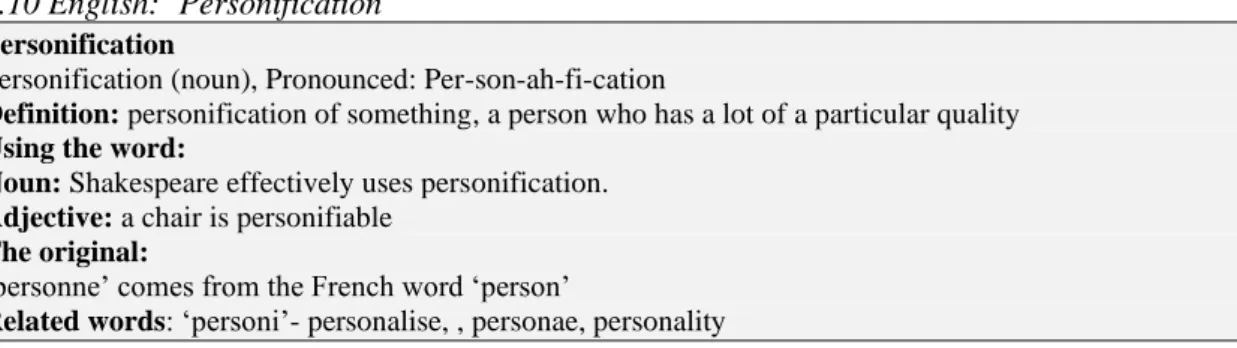
7.10 English: ‘Personification’
Personification
Personification (noun), Pronounced: Per-son-ah-fi-cation
Definition: personification of something, a person who has a lot of a particular quality Using the word:
Noun: Shakespeare effectively uses personification.
Adjective: a chair is personifiable The original:
‘personne’ comes from the French word ‘person’
Related words: ‘personi’- personalise, , personae, personality
Item 7.10 exhibits some awareness of the codebreaking function, in its linking of personification with words such as person and personality. But the definition and usage guides are so poor that the item falls short of offering any beneficial support. The definition,