1
‘BEHIND THE CHINESE WALL’
corporate adj. 1. forming a corporation; 2. forming one body of many individuals; 3. of or belonging to a corporation or group.
finance noun 1. the management of (esp public)
money; 2. monetary support for an enterprise; 3 (in pl) the money resources of a state, company, or person.
The Oxford English Dictionary, 2nd Edition, 1989 by permission of Oxford University Press
T
hus, corporate finance – a phrase relating to how companies obtain and use finance to grow their business. In the City, on Wall Street and wherever banks and investment banks congregate, corporate finance takes on a specific meaning.This book has three goals: to provide a description of some of the major corporate finance transactions; to describe the role of corporate financiers in such transac- tions; and to introduce the main valuation tools used in the transactions.
CORPORATE FINANCE IN INVESTMENT BANKING
Corporate finance tends to become more narrowly focused when one talks to an investment banker or in- vestment bank. Corporate finance departments advertise their abilities to provide advice and complete transac- tions in the following areas:
. Mergers, Acquisitions and Divestitures (M&A).
. Financial Advice (capital structure and fairness opinions).
. Flotations/Initial Public Offerings (IPOs).
. Further Equity Offerings.
Note that the last two in the list, relating to equity fundraising, are often placed in a separate department called Equity Capital Markets (ECM) (see below).
Corporate finance is about building relationships with companies as much as it is about transactions. Before we describe the roles of the corporate financier in the above transactions, we need to place the corporate finance department in the context of an investment bank.
CHINESE WALLS
Corporate financiers are said to work behind Chinese Walls – separating them from other members of the firm, in particular those who have daily contact with investors. The name, presumably, is taken from the Great Wall of China.
Chinese Walls are established arrangements in the form of procedures, systems, management and physical loca- tion which act as barriers within a firm to ensure that confidential information which is generated by one part of the firm or obtained from a client in one part of the firm (i.e., Corporate Finance) does not penetrate another part of the firm (i.e., Research, Sales and Trading).
They exist (or should do) in any integrated securities firm, investment bank, accounting firm or any other organisation where some members of the firm have access to and deal with information that could affect the share price of clients. Strengthening Chinese Walls became increasingly important in the aftermath of the
‘Internet Bubble’ of the late 1990s and early 2000s. Re- search analysts, particularly in the US, became highly
involved in IPOs and further equity offerings, where they should not have done.
Corporate finance departments in large investment banks are almost always located on a separate floor than other departments. In some cases, at the largest banks, the corporate finance team may even reside in another building. At the very least, access is restricted in the corporate finance area to those who work there or escorted visitors who are signed in and out.
Chinese Walls provide a mechanism for firms to func- tion as multi-disciplinary operations. Without Chinese Walls, a firm could not offer both corporate finance advice and research, sales and trading with clients.
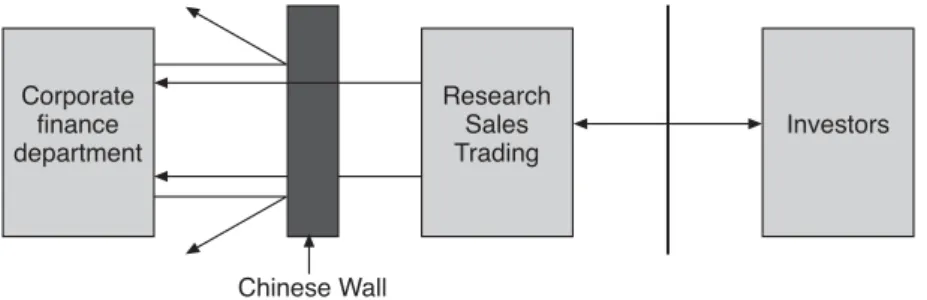
They work like porous membranes that allow infor- mation to flow only in one direction as illustrated in Figure 1.1.
Corporate financiers’ work involves ‘price-sensitive’ in- formation. Knowing that Company A plans to bid for Company B would send B’s share price shooting up if the information found its way to the market. If a sales-
Figure 1.1 Information flow through the Chinese Wall – arrows represent the flow of information, and its direction.
man in the investment bank working on the bid discov- ered the potential bid as a result of weak Chinese Walls, he or she potentially could feed the information to selected clients who would benefit illegally from this inside information on announcement of the bid.
If Company C plans to raise funds through a new equity issue, the Chinese Wall should be maintained until an- nouncement, as share prices typically drop on announce- ment of new issues. A party with inside information, gained from a leaky Chinese Wall, would be able to sell shares prior to the announcement of a new issue and buy them back at a lower price following the offer- ing’s announcement.
In order to advise clients, corporate financiers must receive information regarding the market, investors’
attitudes, etc. from research analysts and salesmen who are in contact with investors. However, the con- fidential corporate information received by corporate financiers must not flow in the other direction as it could have an impact on the price of the shares.
CORPORATE FINANCE ASSIGNMENTS
The following paragraphs contain summaries of the cor- porate finance role in major corporate transactions.
Flotations/IPOs
The IPO of any company is one of the most important moments in its corporate life – it only happens once, and while companies can become skilled at acquisitions and divestitures, they do not get practice of IPOs. Thus, the role of the corporate financier in guiding companies and their management to market is crucial.
Many investment banks have specialist departments that sit alongside corporate finance – called Equity Capital Markets (ECM). ECM professionals specialise in the flotation of companies and any subsequent equity offerings. Throughout the book, I refer to ‘cor- porate financiers’; in sections relating to equity new issues (Chapters 3–5), the reader should understand that a person in ECM would be doing the same job.
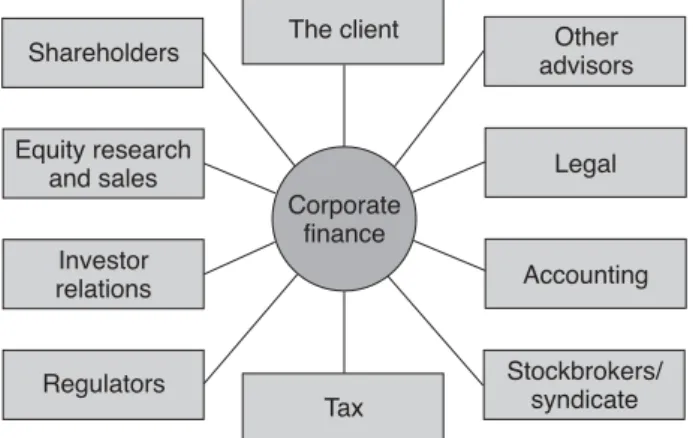
The corporate finance team co-ordinates the flotation process from start to finish. Figure 1.2 provides a schematic of the interested parties in a flotation. The
Figure 1.2 Parties involved in flotations and M&A.
corporate financier keeps everything together: he or she is the main interface with the company, although soli- citors, accountants and investor relations people also sit around the meeting table.
Chapters 3 and 4 provide a full description of the flota- tion process, from both the domestic and international perspective. The following paragraphs briefly summarise the corporate financier’s role in these transactions.
The corporate finance team is usually the first appointed external advisor. It then aids the company in selecting the other advisors to work on the transaction. Corporate financiers provide advice on the capital structure, developing the investment story, appointing external directors, determining the timing of an issue and, gen- erally, managing the project.
The team then co-ordinates the new issue timetable.
From start to finish, the flotation process takes from 3 to 6 months, sometimes longer if there are particularly difficult corporate structuring issues to be resolved.
Corporate financiers deal with documentation (listing particulars, prospectuses, underwriting agreement) and the regulators. They are also responsible for the co- ordination of the different departments in their invest- ment bank and members of the syndicate (i.e., equity research has been produced, the sales departments know the timetable and devote sufficient time to the new issue, etc.).
Finally, junior members of the corporate finance team are responsible for the organisation of the closing dinner;
a gala affair for all the participants in the transaction that usually takes place a month or so after the shares have been trading on the Stock Exchange.
Rights issues/Secondary offerings
Corporate financiers and their equity capital markets colleagues perform much the same role in rights issues and secondary offerings as they do in flotations. They co- ordinate the work of the other advisors, lead the prep- aration of documentation, advise the issuer or vendor on the pricing of shares and so on.
There is one complication, and it can be a large one.
During a rights issue, the company’s shares continue to trade in the stock market every day and the fluctua- tions in price can be large. The biggest disaster in sec- ondary offerings was the offer of BP shares just before the Stock Market crash of 1987. Prior to the announcement of a sale of shares at 330 pence, BP’s shares had been trading in the 345p–355p range. The Stock Market crash occurred after the offering was underwritten (at 330p per share), but before it closed. Following the crash, BP shares traded well below 300p each, resulting in signifi- cant losses to the underwriters and sub-underwriters.
Mergers, acquisitions and divestitures
After flotation, a merger or acquisition is the most significant corporate event that most companies go
through. Corporate financiers, acting alone or alongside strategy consultants, help senior management with planning for the future. They may recommend a dives- titure, acquisition or joint venture, depending on the client’s strategic, operational and financial criteria.
Once the client has decided what course of action to pursue, corporate financiers help in the execution of the transaction.
Whatever the recommendation, the corporate finance team will co-ordinate all parties involved in the trans- action. Figure 1.2 is also appropriate to describe the corporate finance role in mergers, acquisitions and divestitures.
Acquisitions and mergers
If the client has determined that growth through acquisi- tion or merger is its preferred strategy, the corporate finance team swings into action.
The corporate financier will conduct a search of domes- tic and international businesses that fit his client’s criteria. In most instances, the client will know its industry well enough to identify the most likely targets without the assistance of an investment bank.
Corporate financiers add value in analysing potential targets, as well as in broadening the search to international markets, if required.
Working with the client, corporate financiers evaluate potential candidates to determine a short-list based on potential fit and the receptiveness to an offer. The
friendly welcome of an offer is vital. Only in the Anglo- Saxon economies are hostile takeover bids common and commonly successful. The vast majority of transactions are ‘friendly’, although the press given to hostile bids makes them seem to be more prevalent.
Once the client has agreed a short-list, the bankers analyse each target’s business, competitive position and future prospects. Valuations on a stand-alone and merged entity basis (i.e., including potential synergies) are conducted.
Corporate financiers (the senior ones) can act as con- fidential intermediaries in approaching the potential vendor. Depending on the experience and inclination of his client, the corporate financier can take the lead in negotiations throughout the transaction. In any event, he will help to develop a bidding strategy and assist in structuring and negotiating terms and conditions.
In integrated securities houses, the corporate financier will bring in his colleagues in funding departments who can arrange financing (both short-term and permanent).
Investment banks are increasingly providing loans to help complete deals; competing with banks.
From the agreement to negotiate exclusively with his client through closing, the corporate financier co- ordinates the activities of the lawyers, accountants and other advisors in managing the due diligence effort and the documentation required to support and close the deal.
Of course, not all transactions happen in such a struc- tured manner. In some instances, an offer can be devised, proposed and accepted over the course of a frantic weekend. Such speedy transactions are usually in con- tested situations, where the client is second into the battle over a target which has great strategic importance.
Divestitures
Organised sales of divisions, subsidiaries or businesses make up the majority of M&A transactions. Investment bankers are hired in order to maximise the value re- ceived by the vendor, minimise the length of the process and minimise the disruption caused to management of the business that is for sale. On the other side of the transaction, interested purchasers hire investment banks to aid in valuation, deal structuring and negotiation.
The first stage in an orderly divestiture is to determine the most likely purchaser(s). To add value at this stage, the corporate finance team should decide on a short-list of the most likely purchasers based on business fit and the strategic rationale for the acquisition. Private equity houses are now included as potential purchasers in most transactions, as are international businesses.
At the same time as the team is assembling a list of potential bidders, others will conduct a valuation to determine the worth of the business. The valuation helps the vendor in deciding whether an offer should be accepted or not.
Corporate financiers also recommend whether a nego- tiated transaction (with only a small number of potential bidders invited to take part) or an auction should be held.
The auction process best serves larger businesses that are likely to elicit a high degree of interest. The extra work should result in a higher sale price.
Next, the corporate finance team prepares a confidential information memorandum that describes the operations of the business, its markets and prospects, contains his- torical financial results and often includes manage- ment’s forecasts for the next year.
Letters are sent to prospective purchasers, followed by telephone calls from corporate financiers attempting to determine their interest. Those who are interested re- ceive a copy of the information memorandum.
In an auction, prospective buyers are given several weeks to submit an initial bid based on the information contained in the memorandum. Once the preliminary, non-binding ‘expressions of interest’ are submitted, the corporate financiers assist the vendor in determining the short-list of potential purchasers. Bidders on the short- list then have access to a ‘data room’, which has more information than contained in the information memor- andum and site visits, if appropriate. Data rooms, which were once an actual room with reams of corporate in- formation, now are often ‘virtual’. PDF files, with con- fidential information are posted on a secure Internet site, accessible to potential bidders via a password.
Throughout the process, corporate financiers manage
the distribution of information, contact with man- agement and aim to maintain competitive tensions between/among potential bidders.
When the final bids are submitted, corporate financiers aid in evaluation of the offers and assist in negotiations over the terms and conditions until the sale is complete.
Leveraged buyouts and management buyouts
Corporate financiers advise management groups on structuring, arranging financing and implementing buy- outs of divisions, privately held businesses and public to private transactions (where a public company is pur- chased and delisted from the Stock Exchange).
FINANCIAL ADVICE
A good corporate financier monitors his clients’ share price and reputation among investors. When the market persistently undervalues a company, the corporate financier provides advice regarding actions his client might take. These actions might include disposal of certain divisions, a ‘carve-out’ (IPO of part of a sub- sidiary) or increasing the gearing of the balance sheet through share buybacks or special dividends.
Corporate financiers also provide fairness opinions to boards of directors. This typically involves the
preparation of an independent valuation of potential acquisitions, divestitures or restructuring proposals.
The opinion assures directors that the proposed transac- tion is fair, from a financial perspective, to all share- holders.
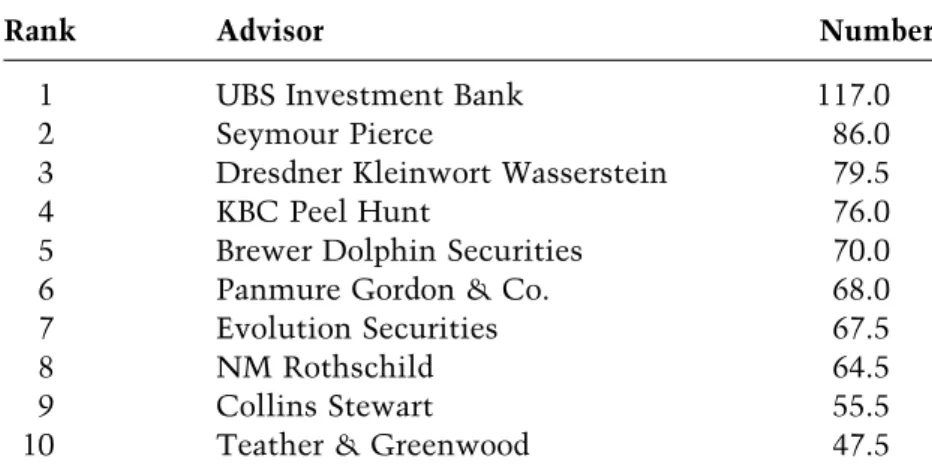
In the UK, all quoted companies must have a named financial advisor. The named advisor provides continu- ing advice in return for an annual retainer. The advisor also tends to be the investment bank that executes the majority of a client’s transactions. However, companies are not bound to use their advisor on all or any transac- tion. Many companies will reward other investment banks with a leading role if the bank provides compel- ling ideas. Table 1.1 lists the top financial advisors as of mid-2005.
Table 1.1 Leading UK corporate finance advisors (by number of LSR clients).
Rank Advisor Number
1 UBS Investment Bank 117.0
2 Seymour Pierce 86.0
3 Dresdner Kleinwort Wasserstein 79.5
4 KBC Peel Hunt 76.0
5 Brewer Dolphin Securities 70.0
6 Panmure Gordon & Co. 68.0
7 Evolution Securities 67.5
8 NM Rothschild 64.5
9 Collins Stewart 55.5
10 Teather & Greenwood 47.5
Note:An advisor is awarded 0.5 if it shares a client with another advisor.
CAREERS IN
CORPORATE FINANCE
Corporate financiers will tell you that it takes a rare combination of attributes to be successful in their field. But they would, wouldn’t they? According to established bankers, a corporate finance professional has the cunning of a snake, the stamina of a camel, the creativity of a chameleon, the memory of an elephant, the work ethic of a beaver, the negotiating finesse of a mouse sharing a bed with an elephant and so on.
To join the corporate finance zoo is not easy. Applica- tions exceed the number of positions by multiples. The two main entry points are as executives/analysts and managers/associates. To get these sought-after positions investment banks universally demand:
. academic excellence;
. ability to work in teams;
. ability to work under pressure;
. quantitative skills;
. verbal and written communication strength.
The main entry points into corporate finance are as a graduate, following the completion of an accountancy designation, or following an MBA.
Box 1.1 gives excerpts from some job advertisements for the skills required.
Box 1.1 Excerpts from corporate finance job advertisements.
1. Corporate Finance Executive
Early responsibility is encouraged in an entrepreneurial team working closely with banks and insurance companies throughout Europe. Participate in both deal origination and execution includ- ing primary and secondary equity, M&A, advisory, and hybrid capital and debt.
Candidates should have financial institutions’ experience gained either in investment banking, a ‘Big 5’ firm of chartered accountants or a leading law firm.
2. Corporate Finance Associates and Analysts
Will be involved in all aspects of analysis and presentations relating to mergers, acquisitions, divestitures, restructuring, leveraged buyouts and general corporate finance advice. Will participate in structuring and negotiating transactions and marketing.
Associates should have at least 3 years’ experience in another leading investment bank. Analysts should be recently qualified ACAs or MBAs with relevant experience.
3. Associate
Associate to join team of leading investment bankers; consider- able client contact and responsibility. Rapid career development possible.
ACA qualified with minumum 1 year’s corporate finance transaction experience, or graduate with 2–3 years’ experience in investment banking, M&A experience preferred. English mandatory, one other European language advantageous. Client- facing, results driven and ambitious.
4. Manager/Associate Director
The vacancy is for an established corporate financier with Yellow and Blue Book experience in transaction execution and an ability to originate at a senior level.
This role will attract a ‘hands-on’ marketeer wishing to be closer to the decision process and the client in a flexible, more entrepreneurial environment with a young culture.
Table 1.2 sets out illustrative job titles within a cor- porate finance department of a UK and a US investment bank. The paragraphs following the table provide more detail of the actual responsibilities held by the corporate financier at each level.
Table 1.2 Typical career progression of a corporate financier.
Years of experience Title(s)
0–2 Executive/Analyst
3–4 Manager/Associate
5–8 Assistant Director, Associate Director, Vice President
8þ Director
Too many Managing Director
Banks try to fill corporate finance with people who have the attention to detail, quantitative skills and stamina to successfully gather information, conduct valuations and carry out other tasks during the early years of their career. After being in the bank for 4 to 6 years, the most important skills gradually change, ultimately be- coming the ability to manage existing clients and attract new ones.
The above is not meant to be a definitive list of titles.
Banks are different; some have Assistant Managers, others both Assistant and Associate Directors. Titles change. Many organisations suffer from ‘title inflation’, a disease that occurs when too many big egos clash with a bonus pool that is too small.
Executives and Analysts are typically hired for corporate finance positions on completion of a degree. A small percentage may join a bank as an executive after a short stint at another job. Most larger banks have comprehen- sive induction/training programmes to ensure that all their employees start working life on an even footing.
The role of the Executive/Analyst is to collect information, prepare valuations, keep notes of meetings, and aid in the drafting and proof-reading of prospectuses and takeover circulars. The days are long, the pressure high.
American investment banks have a tradition of chuck- ing out all their analysts at the end of 2 years. The traditional analyst will then go to business school to get an MBA in the hopes of returning to the bank as an Associate; the sane ones go to Hawaii and take up surfing.
Managers and Associates are Executives who have put in around 3 years of hard graft. In addition, there is a large intake of recently qualified accountants at this level. In American banks, Associates arrive with MBAs. The Associate’s job is similar to that of the Executive’s, except there is more. Most Associates and Managers are assigned to industry teams, where they reside for 3 to 4 years.
The Corporate Finance role may be defined as one of project management. Mid-ranking corporate financiers, Associate Directors and Vice Presidents are expected to keep two, three or even four deals on the go at any one
time (now that the Blackberry allows him to be in contact 24/7). At this level the job entails: making sure that the lawyers draft the documentation, accountants prepare financial statements and conduct due diligence, ensure that the PR team gains favourable press coverage and all the while ‘holding the client’s hand’. At this stage, the corporate financier is also spending more time marketing the firm’s capabilities. (He’s also prob- ably questioning his sanity for staying in the business so long, but big mortgages and school fees keep the mind concentrated). After approximately 4 years in this role, the corporate financier can be expecting his next promotion.
The smart, some might say Machiavellian, corporate financier will make a habit of socialising and developing relationships with company managers who are 5 to 10 years older. Assuming that some of these friends and acquaintances are competent, they should be reaching senior corporate positions as the corporate financier becomes a director/managing director. These relation- ships should then bear fruit. A lucky corporate financier is one who has older siblings who are able to make appropriate introductions.
Directors and Managing Directors are generally respons- ible for client acquisition and retention. They go to the important meetings where decisions are taken, but they leave the day-to-day running of transactions to the people at the level below.
There are few corporate financiers who remain in the City after the age of 50 or so. Most switch to less pressurised jobs at client corporations, while a lucky few are able to retire at an early age in order to take up organic farming or purchase a vineyard.
ORGANISATION OF THIS BOOK
This book has two parts. The first introduces the various types of transactions in which a corporate financier may become involved. It commences with an overview that presents the various forms of capital that a company may use in financing its operations or growth. Short- and long-term debt securities, ordinary and preference shares, and convertibles are described and their attri- butes listed. Those who have a grounding in finance or accounting can skim Chapter 2 or skip it entirely. The remainder of the book concentrates on ordinary shares, particularly the process by which companies issue new ordinary shares, and the purchase or sale of shares in an M&A transaction.
Chapters 3, 4 and 5 relate to equity fundraising – i.e., IPOs and further equity offerings. These chapters de- scribe the process of the offerings, the documentation required, and how the marketing and sale of new shares is undertaken. Numerous examples are used to illustrate the transactions.
Chapters 6 and 7 look at M&A and Management Buy Outs. The reasons that a company might undertake an acquisition or divestiture are examined as are the exist-
ence of ‘merger waves’. The regulatory aspects of public market transactions are presented.
Part II, which is the shorter of the two, covers some of the basics of valuation techniques that a corporate finance practitioner needs to have in his ‘toolbox’ in order to provide good advice to clients.
Chapter 8 describes the two main methods of corporate valuation that are in use today: comparable valuations and Discounted Cash Flows (DCF). A junior corporate financier can expect to spend much of his first 5 years putting together valuations as described in this chapter.
Chapter 9 introduces some of the most common meth- ods for determining the discount rate to be used in a DCF valuation. It also makes use of worked examples that should help the reader understand how the complex concepts are applied. The book concludes with a chapter on economic profit, more often referred to as shareholder value added. The ability to calculate a client’s economic profit (or loss) will help the corporate financier to deter- mine whether the client is creating value for its share- holders. If it is not, it may be possible that a corporate advisory assignment is in order.