ATOLL RESEARCH BULLETIN NO. 176
THE BIRDS OF THE ILES GLORIEUSES by C. W. Benson, H. H. Beamish, C. Jouanin,
J. Salvau, and G . E. Watson
Issued by
THE SMITIISONIAN INSTITUTION Washington, D.C., U.S.A.
Contents
Introduction Acknowledgements
The Individual Species I
.
Land birdsA. Resident species
B. Migratory species, and species status
C. Species of purely hypothetical 2. Shore birds
3. Sea birds Discussion
Land birds Shore birds Sea birds References
Page 1 2
3 3 3 of uncertain
1 6 occurrence 1 8 1 8 20 2 6
2 6 2 9 2 9
30
Aldabra
B
Assumption - 1 0
d)
Astove
,c: Geyser Reef
i'- , > -.
-
F i g . 1. Location o f Iles Glorieuses
I
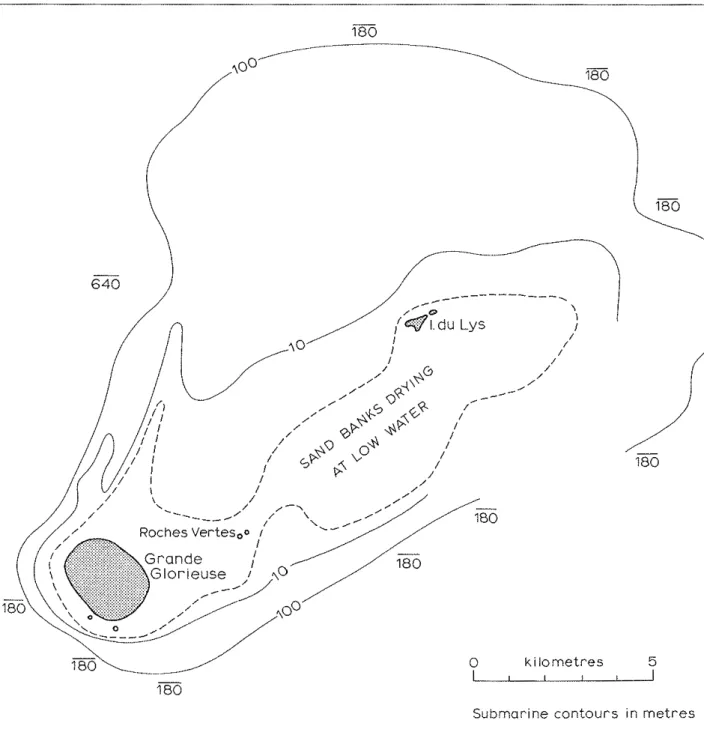
Submarine contours in m e t r e sFig. 2. I l e s G l o r i e u s e s , i n p a r t a f t e r hydrographic c h a r t (from ARB 159)
by C , 'If. Denson, ;I. IT. D c a m i s b , C . J o u a n i . n , J. S a l v a n , and G . E. bratson
Thc:i.r o b s c r i ~ a t i o n : ; h a v e b e e n col.:lL;l-tcrl i3y Jo1.ian:i.n. joua:iiZl and 1lara.i~. co:Ll.ec-Led 1.1 s p e c i ~ i r e n s whic!~. arc d o p o s i . t c t i i.n tkle
;i:u:;i'ur:: N a - t i o r r a l d'ii:i.s~i;o.iLl-c ! Q a t ~ ~ : r o l : l o , i'ar:is, and iiavo bcell
stucl:j.cc:. ijy Benson. iial3ran orrly irnd -ti.i~ic -to s e a r c h i h t ? n o r k h ~ r n par-t of (IrancIc G l o r : j . e u s c , pari;icr.i_l.arl.y -tho s c r u b ai70a c a . 0 , 8 irlll
igcs-k ar::l i?ast of t 1 - t ~ : 0:i.d " . c t o o r o i o g i c a l S t a - L i o n . 1lu.L ire w a s a l s o i r i h i s s h i p 0f.f-.shore, c a . 1
.
5 krn n o r i ; b of' t h e :islmtI, f o r 1 2 t r o u r s , when had t h e eppor'Lun:i.Ly i,o o b s e r v e severa!. slieCiC?S of t e r n s , b u t lie saw n o b o o b i e s a ~ t a l . 1 .of which there were two i n November, two in April, one in May and one in June. The actual. drafting of this paper has been the responsibility of Benson.
Previous visits to the Iles Glorieuses have been few.
Published accounts of earlier observations are as follows:
The recording of three species ( ' f o u r , 'colibri' and
'cicogne') seen during a visit to Ile d u Lys in 1818 ( ~ r a p p a z 1820, 1824). The last of these was probably a heron or egret.
The record is unaccompanied by any comment, and is only in the 1820 report. It is not referred to again below.
Dr. R. W. Coppinger visited Ile d u Lys and Grande Glorieuse on 3-8 May 1882, during the cruise of the Alert in 18'78-82
1
--( ~ o p ~ i n g e r 1883
.
The four birds which he coll.ected were listed by Sharpe(1884 ,
and are in the British Museum (Natural ~istory).Dr. V. L. Abbott was on Grande Glorieuse during 18-29 January 1893 where his ship was incapacited. On February 1 he also called at Ile d u Lys. Tn a brief field report he described the island and some of the birds ( ~ b b o t t 1894), while the orni- thological results were detailed by Ridgway
(1894,
1896), who included abstracts from Abbottls field notes but without the benefit of personal discussion with the collector. The birds he collected and his field notes are in the National Museum of Natural History, Smithsonian Institution.M. J. Nicoll visited Grande Glorieuse and Ile d u Lys on 1 0 - 1 1 March
1906,
during the voyage of the Valhalla in 1905-6( ~ i c o l l 1906, 1908). His collections are in the British Museum ( ~ a t u r a l
ist tor^).
Arnoux (1950) has given a brief account of a breeding colony of Sooty Terns Sterna fuscata on Ile d u Lys, inspected on
5
April .1948.
Coppinger's and Nicoll's specimens have been re-examined by Benson, and Abbott's specimens and field notes by G. E.
Watson.
Earlier lists of species of bi-rds on certain islands in the western Indian Ocean are available in Dupont
(1907)
and Watson- -
et al.(1963).
The former is simply a bare list,unaccompanied by any supporting detail. The latter, by contrast, contains a much fuller and more informative account although
based only on a survey of the literature. No cognisance is taken in the present paper of the sea bird observations by Bailey (1 968), during voyages of the Discovery in
1963-64,
although around 20-21 July 1964 he appears to have been close to the Iles Glorieuses.
There is a brief summary of the ecology of the Iles Glorieuses by Stoddart
(1967),
and a longer account on the geomorphology and vegetation by Battistini and Cremers (1972)ACKNOWLEDGEMENTS
Jouanin is most grateful to M. l'Ing6nieur en chef Marcel Malik, directeur de la MQt6orologi.e Nationale la RQunion, who
made all the arrangements for his journey, and also for that of A. Barau, to the Iles Glorieuses. Jouanin is grateful too to M. Paul Cousseran, Prkfet de l a R6union, who lent his own outboard, making possible the visit to Ile d u Lys.
We are also most grateful to Dr. D. R. Stoddart for
assistance in various ways, especially for making available the papers by Frappaz and by Battistini & Cremers in manuscript.
M. J. Penny, who was on several visits from the Lindblad Explorer to the Iles Glorieuses towards the end of 1971, has - been kind enough to comment on certain points. It is hoped
that he will publish his own observations from these cruises in due course.
THE INDIVIDUAL SPECIES
The term 'Aldabra Archipelago,' wherever used, includes Assumption, Cosmoledo and Astove, as well as Aldabra. An asterisk denotes that the species under discussion on the
existing evidence cannot be regarded as of entirely certain occurrence, either now or at some time in the past.
1
.
Land birds A. Resident species Gallus gallus Domestic Fowl--
Abbott (in Ridgway 1896, as G. ferrugineus) records Domestic Fowl as wild and plentiful on Grande Glorieuse, but
'quite shy and by no means easy to shoot.' Nicoll (1906, 1908) writes in similar terms. But in 1970-71 there was no sign of them and they must have been extirpated. Coppinger (1 883) makes no mention of fowl. At the time of his visit there was a popu-
lation of 29 humans on Grande Glorieuse. Obviously chickens must have been introduced directly by man, presumably between 1882 and 1893.
Turnix nigricollis Madagascar Buttonquail or Hemipode
Madagascar Buttonquail were widespread on Grande Glorieuse during 1970-71, inhabiting more open grassy areas near beaches, bare ground under C a s u a r i ~ trees, the lower slopes of sandhills, and the airfield and its edges. Beamish estimated that there might be as many as 300 pairs on the island; G. E. Watson found them particularly abundant in long grass near the airfield in early April
1971.
Although no specimen was collected there can be no doubt about the identification, as Beamish sent Benson four colour slides of the birds for comparison with specimens.One of these was good enough for it to be possible to determine the sex (female).
T h e r e i s a o e a r l i e r r e c o r d o:f t h e s p e c i e s . ;LI* J. Pc?nny ( p r s . comn!, ) h a s t h e imprcss:ion t h a . t i t was d e l i b e r a t e l y i r i - t r o - d u c e d by man many y e a r s a g o f o r s p o r t , d e s p i t e :L-ts s m a l l s i z e . IHe h a s b e e n t o l d t h a t p l a n t a t i o n l a b o u r e r s w e r e f o r b i d d e n t o
!<ill i t . L i k e Ge0pe:L:i.a s t r i a t a , s e e b e l o w , i t may h a v e b e e n b r o u g h - t :from R Q u n i o n , w h e r e i - t i s v e r y common i n c u l t i . v a t i o n
!
A . 13arau - i n . - l i t t . t o J o u a n i n ) , a n d h a s b e e n s o 'or a l o n g t i m e i 3 e r l i . o ~ 1946: 3 8 ; P L l o n 1951 : 1 5 9 ) . A b b o t t ( I 894) a n d N i c o l l . ( 7 9 0 6 ) w r i t e of Craside G l o r i e u s e b e i n g c o v e r e d w i t h a - t h i c k g r o w t h o f t r e e s arid s c r u b ( h i n b o t t ' s s p e c i m e n n o - t e s r e f e r t o" ~ u n g ~ e " ) e x c e p t f o r a c o c a n u % p l a n t a t i o n and a L a r g e m a i z e f i e . R e c e n t a c - t i v i i i e s by man, e s p e c i a l l y t h e c l e a r i n g oof
t h e a : i . r : f i e l c l , iilus.t 1127re f a v o u r e d t h o ii~.~ttonclua.i:L. I n M a d a g a s c a r , Rand ( - l 9 3 6 : 3 6 9 ) f'cL;xd i t a s s o c i . a t o c ! w:i.tii t r e e l e s s , :;rassy a r c a s arrci c u : L t i v a t i c ~ . , much a s T . sy:Lvat:i.ca ~ i n i?:f:rica.
D r , I,, I f a t s o n Coun.d a n e s t ccntai.n:i.:ng t h r e e e g g s 1.n . i.oW f,;rass o n 1 8 Na:rch 1 9 7 1 . !$hen ncam:i.sll a n d C . I*;. V a t s o n vi.si.tcr!
t h e s i t e ori 8 A i i r - i L L .. -~ : i i w a s c i e s e r l e d , t h e young I i a v i n g p:resumab:iy hccii h a t c h e d ailci. l e C t , C , i:, V a t s o n o b s e r v e d -two f a n l i l i e s of
sma:Ll c l i i c k s i n bea-vy f o r e s t a l o z g - t h e r o a d . The d a t a i n Xand.
( 1 9 3 6 : 3 6 9 ) :i.nd:icaLc egg-.l.ayj~rq; d u t i n g S e p t e m b e r t o F e b r i i a r y i.n Madagasc:lr, th,ouf;h i.f -t;i:~.ose f o r - T . --.- s y l v a t i c a i n . s o u t l i - c e r i t r a l A:f::.i.ca. (Uerrs on
--
i . L I ! I : 3 ) a : r e 8. g,--iiile,
e g g - l a y i.ng ?:!rayo c c u r v:i.2?C~inl~!.y ti-!.:ro~u{:.hoi<t - t h e y e a r , 7learn:ish f o u n d t h a t 'ifre i?i-cds cou:l~d be approached t o w:~-tl.rin 5 m e t r e s w k t h o u t b d n g cI.:istiirbcc?, l h c ye?.low c y e b e i n g mosL n o t i c e a b l e .
StrecI;oi:nli.a , s i c t u r = ! - ? %._" -::-- L=--z.::.:' ?,iaciagascar 'f~'itrt:Ledove
o p i g e ( I 8 8 3 ) coi.!~ected a T u r t l e d o v e s p e c i m e n o n :Tie (iu Lys ::!hich. se-.::cci a t h e t y p e of ' I h r - t u r c o p p i . i l g e r i S h a r p e
i 8 4 ) C o p p i r i g e r a p p a r e n t l y a l s o s a w i.i osi Grande G:Lor:i.euse, s:ii~.ce h e s - t a t e s t h a - t lie s a w t h e same l a n d l b i r d s t h e r e a s on IClc d1.1 L y s , wj.") u.L. t h e addfiLion o f t h e "?laclagascar crow
"
( i.
e.
C o r v u s a l b u s ) , Xnbc-i-t a l s o co:!.::.ected a Cema1.e o n Grande G l . o r i e u s e(Il:i.(~.gwa~ .lS96)
,
b u t i n h i s f i e l d n o t e s , s t a t e s tha.1; a:Li;hough ' a fe!w cx1i.s: o n Gl.or:iiosa i - t i s riot commos~~ a n d ' h a s v e r y p r o b a b i y b e e n :i.n:;rocluced.'
N-iLcol.:i. (-1906, - i 9 0 8 ) inacle a spec:i.a:L s e a r c h f a j- .i:t, bi.it wii;:~o-~.!t s u c c e s s , arid s u s p e c t e d t h a t :it m:i.&t b ee x t i r i c l . The o n l y p o s s i b ? e s i g h - l i n g f o r 1370-71 i s a ' M a d a g a s c a r
r 1.. > , !??>. . d e :Eove1 r e c o r d e d by l3ouri:iBre on -~ 28 A u g u s t 1 9 7 0 But i n
A p r i l 197-1 G. E. !\la-tson c o u l d n o t f i n d j . t , c i e s p i t e a d e t e r m i n e d s e a r c h . I-i: i s c u r i o u s t h a t i - t sh.ou:l.d o-Lherwise h a v e b e e n o v e r -
Lookei!, a l . t h o u g h S e a s o n & Penny (.I 971 : b 6 2 ) n o t e t h a t on Alclabra :iLL i s c o r s p i c u o u s e a r l y i n t h e d a y , a l b e f i t s k u l k i n g i n c o - v e r lili;ei* o n - ? o s s i h l y i.t was a l r e a d y e x t i n c t on t h e i l . e s G l o r i e u s e s b e f o r e Nicol:l.'s v i s i t .
Genson (3967: 75-'79) a p p l i e d t h e name e p p i n g e r i riot o n l y t o t h e a b o v e two p u r p l e - h e a d e d s p e c i m e n s , b o t h o f v z c h w e r e avai..Lab:i.e -to h i m , b . ~ i % a l s o t o s i r n : i . l . a r c o l o r e d b j ~ r d s :Cram hsswnp- - t i o n and. A!.dabra. Yi; a p p e a r s t h a t - ... S . p . now s u r v i v e s
only on Aldabra. Even there, on West Island, its numbers have been reduced, probably due to a combination of tameness and human predati.on (Denson & Penny
1971
: 462). It has apparently been extirpated on Assumption (Stoddart - et -- al. 1970:134).
Presumably this was also the form that inhabited Cosmoledo and Astove, but there is no definite evidence of its occurrence on either atoll to-day (Denson 1970a: 68; 1970b:
115).
Denson &Penny (1971: 425) suggest that turtle doves colonised the Iles Glorieuses from Aldabra, not from Madagascar, which is occupied by the grey-headed
S.
2 . picturata. The land area of Aldabrais much larger than that of the Iles Glorieuses, Assumption, Cosmoledo or Astove, and so the most likely place for the evolution of coppingeri, which subsequently spread to these smaller islands.
Geopelia striata Barred Ground Dove or Zebra Dove
Several individual Barred Ground Doves were seen on every visit from the Lindblad E x p a , mainly around the northern and extreme southern ends of Grande Glorieuse. Salvan saw one or perhaps two small doves, presumably also this species, 200 m west of the Old Meteorological Station. There is no previous record. It was presumably deliberately introduced by man into the Seychelles, and thence in 1960 to Diego Garcia (Dourne 1971). This surely also applies to the Iles Glorieuses.
Indeed, M. J. Penny (pers. comm.) was told that it was intro- duced from R h n i o n about 1969 by one of the meteorologists, Harry Desramais. As with -- Turnix nigrico-, - recent ecological changes must favour it. Thus, ~ o o d ~ 1 9 6 7 ) writes that it is characteristic of 'cleared areas, gardens and agricultural land Parker
(1970)
found it common on North island, Farquhar Atoll, and Benson (1970a) gives a single record from Menai Island, Cosmoledo, which he sugp;ests 'may represent a not very success- ful artificial introduction.'Hypsipetes madagascariensis Madagascar Rulbul
The Madagascar Bulbul was first recorded by Abbott who collected three specimens on Grande Glorieuse (Rid~,way 1896, as Ixocincla madagascariensis). In his field notes Abbott states that it was not common and had an 'entirely different notet from that of Aldabra birds. Nicoll (1906) also found it, but only saw four birds and collected one. No record was made of it in 1970-71, unless the following from Deami.shts notes applies: 'Both Dr. Backhaus and Dr. Fradrich reported seeing a small group of birds of thrush-like appearance near the hi.gh sandhills at the extreme northern tip of Grande Glorieuse. I did not see these birds myself.' Prddrich (1972) did not men- tion it i n his account. It is perhaps relevant that the Sey- chellois name (reasonably apt) for H e i p e t e s is 'Merle,' i.e.
French for Turdus merula, and that o n Aldabra it is usually in two's or three's (Benson & Penny
1971
:476).
Nevertheless, wi.th every respect, it is far from certain that it still survives inth.e I l e s G l o r i e u s e s . D u r i n g h i s v i s i t i n A p r i l 1971 G. E. Watson c o u l d n o t f i n d i t , d e s p i t e a d e t e r m i n e d s e a r c h . He had no d i f f - i c u l t y i n f i n d i n g t h e s p e c i e s on Grand Comoro and A l d a b r a , and H. c r a s s i r o s t r i s on Mah6 and Pras1j.n i n t h e S e y c h e l l e s , t h e b i r d s r e s p o n d i n g r e a d i l y
b e e n cornxion on G l o r i o s a , Penny found i t numerous, Assumption, Cosmoledo o r 1 9 7 0 a , 1 9 7 0 b ) .
t o s q u e a k i n g . I t a p p e a r s n e v e r t o have i n c o n t r a s t t o A l d a b r a , where Benson &
a n d i t h a s n e v e r been r e c o r d e d from Astove ( s t o d d a r t -- e t - a l . 1 9 7 0 ; Benson
The q u e s t i o n now t o be r e s o l v e d i s w h e t h e r o r n o t t h e r e i s a s u b s p e c i e s
N.
m. g r o t e i Friedmann ( 1 929) e n d e m i . ~ t o t h e I l e s G l o r i e u s e s .enso on
a c c e p t s e n t i r e r e s p o n s i b i . l i t y f o r t h e e n s u i n g d i s c u s s i o n . He h a s examined a l l t h e m a t e r i a l of t h e s p e c i e s i n t h e B r i t i s h Museum ( N a t u r a l H i s t o r y ) from Madagascar ( v i r t u a l l y t h r o u g h o u t ) , t h e Comoros (Grand Comoro, Anjouan, Moheli, M a y o t t e ) , A l d a b r a and t h e I l e s G l o r i . e u s e s (N:icoll's s i n g l e specimen, a f e m a l e ) . T h i s , i n c l u d i n g a l s o 1 4 i n t h e U n i v e r s i t y Museum of Zoology, Cambridge, amounted t o o v e r 100 s p e c i m e n s , t h e measurements of which, e x c l u s i v e of a few from Madagascar, a r e shown i n t h e t a b l e below. F u r t h e r m o r e , ofs p e c i a l i m p o r t a n c e he h a s had t h e l o a n of t h e two G l o r i o s a p a r a - t y p e f e m a l e s c o l l e c t e d by A b b o t t , and Watson h a s examined t h e t y p e of g r o t e i , a m a l e , and s e n t comments t o Benson. Most of t h e m a t e r i a l . h a s a l s o b e e n s e e n by R . W a g s t a f f e , who i n p a r t - i c u l a r h a s checked c e r t a i n culrnen l e n g t h s , of c r i t i c a l import- a n c e .
The problem i s b e s t c o n s i d e r e d a g a i n s t t h i s r e l a t i v e l y
wide background of p o s s i b l e v a r i a t i o n among t h e i s l a n d s nrer~tioried a b o v e . There h a s a l r e a d y b e e n some d i s c u s s i o n by Benson (1960,
1967) and by Benson & Penny ( 1 971 ) , b u t t h e v a l i d i t y of t h e G l o r i o s a s u b s p e c i e s was n o t e s t a b l i s h e d . I n Benson ( 1 9 6 0 ) t h e s e x e s were n o t s e p a r a t e d ( w h i l e t h e r e i s no d i f f e r e n c e i n c o l o u r , males a r e n o r m a l l y a l i t t l e l a r g e r t h a n f e m a l e s ) . I n t h e second and t h i r d r e f e r e n c e s , a t t e n t i o n was c o r ~ c e n t r a t e d on t h e Aldabra form,
H.
g. r o s t r a t u s .Friedmann ( 1 9 2 9 ) compared I l e s G l o r i e u s e s b i r d s o n l y w i t h specimens from A l d a b r a and bestowed t h e rlanle g r o t e i on them, on a c c o u n t of t h e l o n g e r , s t r o n g e r b i l l , d i f f e r i n g a l s o i n c o l o u r , b e i n g wholly o r a n g e - r e d , n o t d u s k y , a l m o s t b l a c k i s h , towards t h e t i p a s i n t h e f o r m e r . These p o s s i b l e d i f f e r e n c e s c a n be con- s i d e r e d i n t u r n , and a l s o p o s s i b l e d i f f e r e n c e s i n c o l o u r of plumage :
( a ) B i l l . - l e n g t h : Wing and t a i l - l e n g t h s , a s w e l l as culmen- l e n g t h s , a r e s e t o u t i n t h e t a b l e . These f i r s t two a r e remark- a b l y u n i f o r m , and t h e o n l y p o i n t w o r t h n o t i n g i s t h a t males a r e a l i t t l e l a r g e r t h a n f e m a l e s , b u t w i t h a n a p p r e c i a b l e amount of o v e r l a p . Friedmann ( 1 9 2 9 ) d o e s n o t i n d i c a t e how he t o o k culmen- l e n g t h s . H i s f i g u r e s do n o t show even any o v e r a l l o v e r l a p b e t - ween r o s t r a t u s and g r o t e i , and t h e r e i s none i n t h e p r e s e n t s e t
between females. On the other hand, the single male of grotei is at the minimum for males of rostratus. Furthermore, while
the females of grotei are around the maximum for Madagascar females (nominate madagascariensis), the male is near the mean for Madagascar males. There are a number of unusually long- billed individuals from Grand Comoro, Anjouan and Moheli, in
the Comoros, though none from Mayotte, the nearest of these four islands to Madagascar. It is well known that island forms often have longer bills than their mainland counterparts (in this
taking PIadagascar as 'mainlandt), and this has been shown for various Comoro forms in comparison with Madagascar (see most recently Benson 1971). In the present case it is curious that, i.n comparison with Madagascar, while no tendency to lengthening is apparent on Mayotte or Aldabra, there is on the Iles Glori- cuses, less remote from the 'mainland'. In any case, the leng- thcning on the Iles Glorieuses is not such as to justify the recognition of grotei on this ground alone.
(b) Bill-colour: On only a relatively few specimens is there any record of what was the colour of the bill in life.
Nevertheless it does appear that everywhere (in ].ire) the colour approximates to orange-red, with the apical half of the culmen dark brown. The orange-red soon fades after death. Thus in specimens collected by Benson on Aldabra in the first three months of 1968, which he recorded at the time as having bill
'vermillion, sepj.a towards tip of upper mandible,' the bright colour has changed four years later to pale yellow, as i n the remainder of the specimens, all of them older, some of which were collected more than a century ago. Rut the dark brown seems not to fade at all., so that the contrast is still. easily discerned. In Aldabra birds this darkening on the culmen is consistently apparent. Of those from the Iles Glorieuses, in Abbott's three it is reduced to a trace at the extreme tip and Abbott's notations on the label of the male and one female read,
'bill orange-red.' On the other hand, in Nicoll's specimen it is quite well marked. Most Madagascar specimens have it well marked, although four have been found in which it is reduced or absent as in Abbott's two. Reduction of the darkening seems best marked on Grand Comoro, in contrast to the other islands
in the Comoro archipelago. However, apart from this possibility, the variability would appear to be on a n individual rather than geographical basis. Incidentally there may be little or no
variation in the colour of the iris. Benson & Penny (1971:
478)
give it as 'red-brownt on Aldabra ('greyish brown' in a juven- ile), and Benson (1960:
67)
tchestnut-brownl in the Comoros.Nicoll
(1906)
gives it as 'brown1 for his Grande Glorieuse specimen, although on the label it is recorded as 'hazel.' An old Madagascar specimen in Cambridge, collected by E. Newton, had iris 'reddish brown.' Eleven collected by Benson and A.Williams in Madagascar i n 1972 had it 'dark red' or 'rich red- brown.
'
(c) Plumage-colour: As remarked by Benson & Penny (1971:
W W 42 m C, W id id
-
idN N id idN C7 N+ In C7 r
-
a, id N- .. -3 W .. -7 - C7-. OC7N .. C7.r NNN C7 N* N N W - N N + +- 0 WIn id id C,- W 06. ..-id C?k -3-m ~n id
N IN NN N a NN i a, Fi
-
h m-
Fii M. In- r. m-m- -
0 C7kO moo E i -0 I n0InM m
f e m a l e 4 I O&--i 7 0 (.I 06'~;) 4 88-92 (89.5) 3 .?2~.5? ~ 3 2 4 ~ 5 ~ 5 ~
7
-
+ i ~ h c ? l i
m a l e 3 113,
I l k ,
1 1 4 2 95? .i 00 3 2 3 ,24,
25f e m a l e
9
103-1 1 1 (1 06.7) 8 t?6-.9j.l. ( 9 0 ~ I 9 -i at 2 2 , 2 a t 23, 3 a t 23 ~ J , 2 a t94,
7 a t 2i.t " 5 ( 2 3 , id.).-
, ,\layo
-
'i -i: cm a l e
7
108-118 ( 1 1 2 . 0 )7
[rs7-;ol ( 9 . 2 . 1 ) 5 I a, . :- 22,.5? 2 a t 23, 2 a t 23.5 (23.1 )1. M e a s u r e d :froin ' b a s e of :chci!~ipl~.o-I;::,eca t o t i p , :mi; f r o m sicxl.?. t o t i p . Tkis g i v e s a more c o n s i s t e l ? - t l y a c c l x r c t e fi{:.ure t h a n :fro:n -ti-ic s k u l l , e l i s x i z a t i n g t h e possiisi.1.i-ty o f s l i p p i n g of t h e p o i c t o f t h e d i v i d c r s o n t i l e skull.
2. Normal g r e y c o l o u r c d b : i r d s , similar t o t:!osc on. a i l t h e o t h e r i s l a n d s , may b e c o n f i n e d o n Grand Comoro t o c o a s t a l a r e a s , an<: b e r e p : i a c e d a t h i . g b e r a l t i t u c \ e s by g r e e n c o l o u r e d b i r d s , p c u i a p s i x e r e l j . a co!~our p h a s e
enson on
Ii\6Gr 6 6 ) , a1tbouo.h. o n M o h e l i t h e r e i s a g r e e r i c o l o u r e d form, iiiucl:~ i a r g ' c r -than - I-!. - ii!ai!af:ascarii;nsis,-
b e l o n g i . n g t o a n o t h e r s p e c ~ e s , - H . c r a s s i r o s t : i : i s of t b e Seychelles. F i g u r e s f o r e i g h t f u r t h e r g r e e n c o l . o u r e d s p e c i m e n s f r o m Grand Cocloro ( i n c l u d i n g t h e t y p e of E!.
e a r v i r o s t r i s Milne4Zdwards & O u s t a l e t 1885: ~ 2 % ) ~ a n d o f It? g r e y c o l o u r e d oiles fTo!n t h r o u g h o u t t i l e Comoros
,
i l l t h e FIusduii~ Kat:i c n a l cl ! ! : l i s t o i r e X a t u r e l l e,
P a r i s , h a v e been. a d d e d t o t h e f i g u r e s b a s e d m a i n l y 011 n i a t e r i a l i n tile B r i - t i s l i Xuseurn ( s e e t e x t ) . A few spec:imen.s i n t h e m a t e r i a l . a s a w h o l e were - a l u e x c d , ? > u t a r e p l a c e d i i h e r e t h e y seem c o r r e c t l y t o h e l o n c .477),
specimens collected in the first three months of the year are often so worn in plumage as to be useless in making sub- specific coniparisons. The name H. m. ~ ~ v i r o s t r i s has been applied to the Comoro birds, which Tthe 'green' birds apart, see table) are somewhat paler, less bluish in tone than nominate madagascariensis, although the difference is not strongly marked.H.
m.
rostratus of Aldabra is characterised by a brownish wash - on the mantle and flanks. The specimen collected by Nicoll on Grande Glorieuse, on 1 0 March, is heavily worn on the underparts.However, it is in a fairly fresh dress on the mantle. There is none of the brownish tone of rostratus, and it can be matched
-
with many Madagascar specimens. Abbott's male, collected 2 0
January, and two females, collected on 18 January, are in worn dress and are molting, both wings and body. The few fresh feathers on the mantle, however, show no sign of the brownish tone, although there is a slight brownish tone on the flanks of all three. But it is not so pronounced. as in rostratus, and the three can be matched with individual specimens from Madaga- scar.
To conclude, there does not appear to be any real justif- ication for recognising _H. m. grotei, which is best considered a synonym of nominate madaGscariensis. Mr. Wagstaffe and Dr.
Watson agree with this decision. Benson is most grateful to them for their advice.
Cisticola cherina Madagascar Grass-Warbler
Benson drew Jouanin's attention to the likelihood that he would find a grass warbler in the Iles Glorieuses. This proved correct, Tor Jouanin duly found it abundant on Grande Glorieuse, as also did G. E. Watson. Beamish reports that the largest
number seen on Grande Glorieuse in one day was approximately thirty. The birds were most numerous around the airfield at the south end of the island, and in degraded vegetation in the centre. During his visit to the north of the island Salvan saw none at all, and suggests that it is restricted mainly to the south, including the airfield. However at the time of his visit a strong wind was blowing, s o that the birds might have been overlooked. Beamish found them usually in pairs, and thought them rather more timid than those which he saw on West North Island in the Cosmoledo Atoll, and on Astove. Frgdrich erro- neously identified this warbler as Nesillas typica, another
widespread Madagascar species. There is no record from the Iles Glorieuses prior to
1970-71.
It is virtually certain that there has been a colonisation subsequent to Nicollls visit in 1906, since so competent an observer could scarcely have overlooked it. It is no less sure that a small insectivorous species such as this could not have been deliberately introduced by man, although his activities may have favoured its establishment.In Madagascar, which must be the source of the colonisation, - C.
cherina frequents 'grasslands
. . .
and other cultivated land'and 1936
:449).
C i s t i c o l a m n a h a s a l s o c o l o n i s e d Cosmoledo and Astove (Benson l97Oa, 1 9 7 0 b r Vesey-FitzGerald ( 1 940) found i t abund- a n t on b o t h t h e s e a t o l l s i n 1937, b u t u n f o r t u n a t e l y t h e r e a r e no e a r l i e r comprehensive o r n i t h o l o g i c a l a c c o u n t s t o h e l p d e t e r - mine when i t might have o r i g i n a l l y a r r i v e d . Benson & Penny
(1971 : 420, 479) s u g g e s t t h a - t i t may e v e n t u a l l y c o l o n j - s e Aldabra and Assumption. I t i s p o s s i b l e th.at i t h a s a l r e a d y c o l o n i s e d Remire i n t h e A m i r a n t e s , where S t o d d a r t & Poore ( 1 9 7 0 ~ ) t h o u g h t t h e y saw and h e a r d i t .
F i v e specimens from Grande G l o r i e u s e a r e a v a i l a b l e , some p a r t i c u l a r s f o r which. a r e a s f o l l o w s (measurements a r e i n m i l l i m e t r e s ) :
P a r i s Fluseum
r e g i s t r . no. Apparent Culmen
-
( 1 9 7 1 ) s e x Wing T a i I. from b a s e651 male 50 i t 0 12
653 male 50
4
2 12650 f e m a l e
4
5 2 8 10652 f e m a l e
4
74
14 1 1 . 5Specimen 651 was c o l l e c t e d on 2 November 1 9 7 0 , t h e remain- d e r on I 8 A p r i l 1971. None was s e x e d a t t h e t i m e of c o l l e c t i n g , b u t w i n g - l e n g t h s s u g g e s t s e x i n g a s a b o v e , i n a c c o r d a n c e w i t h t h e f i g u r e s i n Benson ( 1 9 7 0 a ) . Numbers 651 and 654 a r e consi.dered t o b e a d u l t s i n worn sumnier ( b r e e d i n g ) d r e s s ; t h e r e m a i n d e r , r u s t y above and on t h e f l a n k s , j u v e n i l e s . L i k e Cosmoledo and Astove s p e c i m e n s , t h e r e i s no e v i d e n c e t h a t t h e y a r e s u b s p e c i f -
i c a l l y s e p a r a b l e from Madagascar - C . c h e r i n a which i s monotypic.
From i t s measurements, specj~rnen 650 a p p e a r s t o b e n o t f u l l y grown, t h e t a i l . b e i n g e s p e c i a l l y s h o r t . I t was p r o b a b l y from an
egg l a i d n o t c a r l i e r t h a n t h e p r e v i o u s month, i . . e . i n March.
O t h e r e v i d e n c e of b r e e d i n g comes from Bcamish, who r e p o r t s a n e s t w i t h t h r e e eggs s e e n i n May 1971
.
Bensorl ( 1 970a) r e p o r t s b r e e d i n g a c t i v i t y on Cosmoledo and Astove i n March, and i n d i c - a t e s t h a t t h e b r e e d i n g s e a s o n ofC.
c h e r i n a may be more e x t e n - s i v e t h a n t h a t of t h e r e l a t e d - j u n c i d i s i n s o u t h - c e n t r a l A f r i c a . Corvus a l b u s-
P i e d CrowOne was s e e n on Grande G l o r i e u s e by B o u r l i h r e on 28 August 1970, and a c o u p l e by J o u a n i n on 2 November 1970. Deamish r e p o r t s t h a t t h r e e o r f o u r were s e e n on e v e r y v i s i t , around o r p e r c h e d on h i g h C a s u a r i n a t r e e s i n abandoned c u l t i v a t i o n a t t h e n o r t h end of t h e i s l a n d . Coppinger ( 1 8 8 3 ) n o t e d i t ( a s 'Mada- g a s c a r c r o w 1 ) . Abbott ( f i e l d n o t e s ) found t h e crow ' p l e n t i f u l on G l o r i o s a where t h e y a r e v e r y d e s t r u c t i v e t o t h e eggs of t h e
boobi.es a n d o . t h e r b i r d s , N i c o l l ( l 9 0 6 , -1908) s a w a f e w , a n d wa.s t o l d t h a t i t was r e s i d e n t . A l t h o u g h no n e s t h a s b e e n r e c o r d - e d , p r o b a b l y i t d o e s b r e e d i n s m a l l n u m b e r s . Even o n Alc'rabra, w h e r e i t i s b e l i e v e d t h a t t h e r e a r e be-tween 50 a n d 1 0 0 i n d i v i d - ua:l.s, few n e s - t s h a v e b e e n f o u n d ( t h e y a r e e a s y t o s e e ) , p e r h a p s b e c a u s e b r e e d i n g . t a k e s p l a c e o n l y a ~ t i n f r e q u e n t i . n t e r v a l s ( l i e n s o n
& P e n n y 1971 : 484-Lr87).
C o r v u s a l b u s i s -ciel.l known t o b e s t r o n g l y commensal w i t h
-- -
man, scaveng:-:;r!.g a r o u n d h i s h a b i t a t i o n s . I t i s t h e r e f o r e u n i i k e 1 . y t o h a v e f ~ n h a b i t e d t h e 110s G l o r : i . e u s e s be-?ore h i s a d v e n t . Cop- p i r i g e r d i d n0.t s e e i . t on .i.le clu L y s , w h i c h was u i i . n h a b i t e d by man, bu-t d i d s e e i t or1 G r a n d e G L o r i c u s e , rillere t h e r e was a
p o p u l . a t i . o n o.f 29 humans, a n d col:l.ccted a spccj~rnen ( ~ h a r p e 1 8 8 4 , a s .- C . s c a p u l . a - t u s ) . Benson & Penny
(loco G.
) c o u l d no-t f i n d a n y v a r i . a ~ t i o n i n i;kr:is w i d e r a n g i n g s p e c i e s , a n d - t o o k c o g n i s a n c e o.f a G l o r i o s a s p e c i h c n ( i n . f a c t !;he o n e col.:Lected b y C o p p i . n g e r ) . A s t h e y s u p w s t , , <, t h c r e i s proba'o:Ly some : i n t e r - i s l a ~ i c l gone-fl..ow;i h e c r o w s 1 h a b i t o f s o a r i n g anc: ricl:i.r;g or1 up-clraug:.llts may t a k e them f r o m o n e i s ?.and. -to a n o t b e r ,
Z o s t e r - n ~ a c l e r a s p a t a n a XacIa(;ascar White-eye
--
J0uan:i.n r e p o r t s tha-I; t h e whi.to-eye was s e e n o n Grancle G i . o . r i e u s e by a l l . o h s e - r v o r s , Uearnisb t h a - t i t o c c u r r e d i n all.1 p a r k o:f t h e :i.s:l.aritl .i~ilvest:i.$ya-Leci. '!;he : L a r ~ e s t nuntber r e p o r t e d by t h e : L a t t e r a s s o e n a t o n e -t:i.nro was a f l o c k o f 25 f e e d i n g o n r i p e f r u i t :L% a.ban.d.oned c u l t i v a t i o n n e a r t h e n o r t h c o a s t , a l -
l;.h.ough : i ~ L was n o t conmlon i n t h e d e n s e s c r u b i n t h e c e n t r a l z o n e s , I t seemed t o p r e f e r !;he l a r g e r t r e o s , and a n y o f - t h e s e i n f l o w e r o r . f r u . i . t would. be f r e q u e n t e d i n v a r i a b l y by a few w h i t e - e y e s .
7:ir:i.s and t h e sunb:i.rd N o c - t a r i n i a sovi.manga a r e u.r~clo~zbtecily t h e two mos-t p l e r l t i f u l . s p e c i e s o f l a n d b i r d t o - d a y ; Abbo.tt ( f i e l d n o t e s ) s p e c i i i c a l : l L y s t a t e s t h a t t h e w h i t e - e y e was t h e comnmnesi;
:i.ai.id bi.rd d:uri.rri~; h i s v:is i . t , I t i s c u r i o u s t h a t rihi-t e-ey e a n d sui?.bi.rd s h o u l d be a b l e t o - t h r i . v e o n s o srna1.l a n : i s l a n d as G r a n d e G J - o i - j ~ e ~ ~ s e . I n c o r r t r a s t t o .S. . s o v i m a n g a , -which i s comnron,
g.
;iiatif?raspa- i s uncommon o n Mcnai ITsl.ancl, t h e on2.y i s L a n d i i l
Lhe Cosmoledo A'i"iol1 f r o m w h i c h i t h a s b e e n r e c o r d e d , and on Asl;o-ve, a n d i s unknown o n ilssurnptiorl
enson on
197Oa$ 197Db;S t o d d a r - t
- -
e-t a l . . l 9 7 0 ) . On t h e mnucl-1 l a r g e r A l d a b r a ,2.
i n a d e r a s - p a t a r l a i s t h e most p l e n t i . f u 1 l.and b i r d a f t e r .- N , s o v : i ! n a n ~ s o n -& P e n n y -1 971 : 11-97)
.
S h a r p o ( 1 8 8 4 ) I . i . s t s a s p e c i m e n o:f - %. macieraspa.i;ana c o l 1 e c i ; - eel b y C o p p i n g e r , c v i d e n t : L y f r o m i l e d u :Lys ( C o p p i n g e r 1 8 8 3 1 , a l ~ t h o u g h h e a l s o s a w i t o n Grancie G l o r i . e u s e . A b b o t t t h o u g h t i t t h e conunonest l a n d b i r d ( ~ i . r l ~ w a y 1 8 9 6 ) ~ a s di.d N i c o l l ( 1 906
1 9 0 8 ) ~ b o t h a g r e e j . n g s u b s - t a n t i a l l y w i t h - t h e r e c e n - t o b s e r v a t i o n s . Ridgway ( 1 8 9 4 ) named t h o f o u r speci.mens c o l l e c - b e d b y A o b o t t
Z. g , g l o r i o s a e , b u t w a s n o t f u l l y c o n v i n c e d t h a t - t h i s w a s j u s t -
- i f i e d as h e h a d o n l y one M a d a g a s c a r s p e c i m e n f o r c o m p a r i s o n .
Moreau (1957:
4 1 6 ) ~
using the six specimens collected by Nicoll, could not separa-le then] f rorn the yellowest ones froin Madagascar(from drier areas), and placed both Madagascar and Gloriosa birds with Z. 5. maderaspatana (see also pp. 393,
397).
Moreau does however mention that most of the Gloriosa specimens have a little yellow wash on the grey belly, and that an immaturefemale had most of the underparts washed with gamboge, together with a golden tinge on the ].ores. Measurements (p. 1128) also
show no di.fference. Denson (1969) was unable to separate either Gloriosa or Astove specimens from Z.
m.
maderaspatana, althoughthe latter were thc greener of the-two series, matching those from the riiore humi.d parts of Madacascar. Incidentally, he sep- arated the population of Menai. Island, Cosmoledo, as
z. m.
menaiensis, but later (1970a) thought that the difference claimed mieht have been due merely to immersion in alcohol.
Particular interest attaches to two of the three known Menai specimens in that they have the green of the upperside partially replaced by grey. A watch should be kept for the occurrence of further such individuals.
One unsexed spccirnen was coJlected on Grande Glorieuse on 18 April
1971.
It is not in good. condition. Its measurements are within the ranires as given by Moreau and by Benson, i.e. it has wing57,
tail37.5,
culrnen from base14
mn. Watson has re- examined Abbott's specimens, measurements of which are:Wing Tail Culnren - f rorn b a ~ 2 males
57,
59 35, 35.5 13.5, one broken 2 females56, 59 35,
36.5 13, 13.5These figures too are similar to Moreau's and Denson's.
Watson finds that these four specimens are similar i.rl colour to those collected in Madagascar by Abbott at Andrangoloaka and Zmahatsara (see Richnronrl 1897: 6 9 3 ) and three by H. G. Deignan at Ambatosoratra, although three collected by Ueignan at Didy an<' P6ri.net are darker and grecner. Fol1owi.ne; Moreau (1957:
397)
all these birds must be known as Z . m. rr~aclcraspatana ?--although ;h.f one wishes to use finer divisions only the llidy and PBrinet birds would be so known, and the remainder (including of course those from the Iles Glorieuses) as % . m . ampotakae.
But if s o , there is the absurdity that in contrast to those in the Iles Glorieuses, Astove birds are nominate gacleraspatana (as per Benson 1969). It is surely wise to follow Moreau (&.
cit.) in this matter, and use only the one name for all of these -- birds, i.e. - Z. - rn. maderaspatana, for the reasons explained by hi.n1.
Nectarinia sovimanga, Souirnanga Sunbi~rd
The relative abundance of the sunbird and Zosterops maderaspatana, both on Grande Glorieuse and in the Aldabra Archipelago, has been di.scussed. above. Jouanirr reports it as
seen on Grande Glorieuse by all observers, Beami-sh as common and widespread on flowering trees all over the island. Many old nests were seen, usually at a height of about 2 metres, in the outer branches of bushes. Frappaz (1820, 1824) mentions
'colibris' on Ile d u Lys, and was presumably referring to this species. Coppinger (1883) saw a sunbird on both Ile d u Lys and Grande Glorieuse. Alnrost certainly it was this species, although Sharpe (1884) does not mention any specimen. Abbott (in Ridgway
1896) found it common, and states that 'A very few were nestingt;
he coll.ected a nest and an egg 25 January. This is the only def- inite record of an occupied nest. Nicoll (1906) states that at the time of his visit (in March) it was 'not in its full beauty,' and that it kept almost entirely to coconut trees (he states
that he collected two males, but actually they are females, accordingly lacking any metallic feathering). lluring his visit in October, Salvan saw no nests at all. Probably, as on Aldabra
e ens on
& Penny 1971:491),
egg-laying occurs at least from August to March.. The same authors record an eclipse dress i.n the male on both Aldabra and Assumption, and probably this applies i n the Iles Glorieuses too.A female was collected on 3 November 1970 and two males on 18 April
1971.
The males have only a little metallic feathering, and only the odd red feather on the chest. They must either be immature or adults i n a n eclipse dress. Using also the two females collected by Nicoll and Abbott's material (four males, two of which, collected on 18 and 20 January, are in a metallic dress with red chest-band, such as is worn in the breedingseason), the following are some comparative fi.gures (i.n milli- metres) :
Wing -- Tail Culmen from base Madagascar
14
males51-56 (54.1) 33-40
(36.6) 20.5-24 (22.14 females 47-52
(49.4)
28-33 (31.1 ) 19-21 .5 (20 Iles Glorieuses6 males
54-57
(55.2)33-40
(35.2) 21-23 (22.0 )3
females49, 49, 50
30, 31 , 3219,
19.5, one broken The Madagascar figures are from Renson (1967: 85), from which Nicoll's two females have now been transferred to thosefor the Iles Glorieuses. The two seri.es of figures do not
indicate any appreciable difference. Nor does there seem to be any difference in colour except that Watson finds that Abbott's two Iles Glorieuses males in metallic dress, compared with others such also collected by Abbott at Mahanoro and on the River
Sakale, in eastern Madagascar (see Richmond 1897: 693), and by H. G. Deignan at Marovoay, Didy, PQrinet, and Ambatosoratra, also in Madagascar, have the red chest-band slightly broader and the black on the abdomen slightly less extensive. But Watson finds that there is enough variation for there to be no
justification for bestowing a name on the lles Glorieuses birds.
Thus we follow all previous workers, including Rand (1967), in placing them with the nominate subspecies. By contrast, there is a very well marked form on Cosmoledo and Astove
(N.
2 .&-
henorum),
--
and others on Assumption (abbotti)--
and Aldabra Taldabrensis); see most recently Benson & Penny(1971
: 493).Watson finds that material collected by Abbott supports the validity of these last two names (Abbott did not visit
Cosmoledo or Astove).
Foudia madagascariensis Madagascar Fody
In
1970-71
the Madagascar Fody was widely dispersed on Grande Glorieuse both in forest and in bushes and trees in more open areas near the airfield. Beamish notes that it was in the largest numbers at the north end of the island, among Casuarina trees there. I-Ie counted over Ik0 birds on each of two visits in November and December1970.
Two specimens were collected, one by Jouanin on 2 November1970
with wing-length 66 mm, and one by Barau on 18 April1971
with wing-length 60 mnl. Comparison with the figures i n Moreau (1960: 35) and Benson (1960: 98) suggests that the first is a male, the second a female. Both authors give a minimum length for males of64
mm. The apparent male does not show any red coloration, although it is likely that it was about to assume the breeding dress. Salvan noted that four males had assumed about50%
of the breeding dress o n 29 October 1970, while Beamish found that males were assuming it in November, but by the early May following it had almost completely disappeared (as has been noted on some other islands, see for example Benson 1960, some males were orange rather than red in colour). Jouanin, on 2-4 November 1970, found some males just starting to come into breeding dress (and incidentallyaround the New Meteorological Station behaving like sparrows, Passer domesticus). These observations accord quite well with -- those of Rand (1936:
481),
who found no birds i n the red plumage in south-eastern Madagascar during June to October, but was told that it was assumed in November. In the Comoros Benson records birds assuming it i n late October, and others still in full breeding dress in mid-June.This is yet another species which is evidently a recent colonizer. It is not mentioned by Abbott (in Ridgway 1896), who was on the Iles Glorieuses during the breeding season in January when red males would have been conspicuous. The same applies to Nicoll (1906, 1908), who was there in March, thus still in the breeding season. Benson found it to be a recent arrival in the Comoros, and thought that this might have been unaided by man, since he could find no evidence of it being kept as a cage-bird. The earliest record he gives is of a specimen collected by Kirk on Moheli. This would have been about 1860, though colonisation of Anjouan and Grand Comoro was probably much later, since Krishnasamy Naidoo did not collect this fody on either of these two islands i n
1906-07.
Probably, as in the Comoros, colonisation of the Iles Glorieuses has been unaidedby man, although i n both areas man's activities may have fav- oured it. Thus in the Comoros Benson found it common in scrub- land and cultivation. It is common on Farquhar Atoll, but while one report has it that it is 'native,' another is that it was
'introduced' (stoddart & Poore 1970a). In any case, introduc- tions to some other islands further to the north, such as the Chagos Archipelago and the Seychelles (see for example Watson et al. 1963), must have been deliberately effected by man.
-- -
There is still no record from the Aldabra Archipelago, unless a n old record of a 'Sourin' ( ? Serin) from Cosmoledo, attributed by Benson (1970a) to Serinus - mozambicus, was in reality of a female F. madagascariensis. 'Serin' is in fact a Seychellois name for Foudia spp. In any case, whatever the species may have been, it appears no longer to exist there.
B. Migratory species, and species of uncertain status There have been so few and infrequent bird observers in the Iles Glorieuses that the following list of migrants is undoubtedly incomplete. Thus almost any of those recorded by Benson & Penny (1971: 512-521) on Aldabra might be expected, as visitors from the palaearctic or on passage between Madagascar
(breeding area) and Africa (wintering area), although lost intra- African migrants such as Porzana marginalis, Striped Crake, are obviously of less likely occurrence than on Aldabra, much nearer to Africa.
Milvus migrans Black Kitc
Ridgway (1896, as
M.
aegyptius) records 'No specimens,' although evidently Abbott saw it. Nicoll (1908) states that'Now and again a black kite Milvus migrans was observed sailing -- - overhead.' There is no record of it seen during
1970-71.
Benson& Penny (1
971
:51
4 ) discuss a few records from Aldabra, forAugust-October and December-January, and conclude that it occurs there only as a stray. This must also be the case on the Iles Glorieuses.
Eurystomus glaucurus Broad-billed Roller
Ridgway (1896) gives the same comment as for the last species. There is no further record. Benson & Penny (1
971
:517)
discuss a few records from Aldabra and Cosmoledo for October-December, considered to be of birds returning to Mad- agascar to breed (E. g. glaucurus), and one from Aldabra for 25 March, considered to be post-breeding (also this subspecies).Doubtless it can be seen periodically on the Iles Glorieuses too. Abbott would have seen it in January, either very late or very early. The breeding records in Rand (1936:
417)
indicate egg-laying in October and November, while Benson & Pitman (1962) record a n oviduct egg in November.*Terpsiphor~e mutata Madagascar Paradise Flycatcher
Bourli&re saw a 'paradise flycatcher' on Grande Glorieuse on 28 August
1970.
Quite independently, Beamish has provided.some further records of an 'unidentified paradise flycatcher:'
"A very reliable observer saw at close quarters on 12 November 1970, near the west
coast of the island, a bird closely resembling the female of Terpsiphone corvina, at rest in the lower branches of a tree. The observer, a former resident of La D i m e i n the Seychelles, the only island on which T. corvina still survives, was already well acquainted with that species. A
similar bird was seen again two weeks later. Despite an intensive search, no further observation was made."
Kym Morton, the observer, told G. I:. Watson that the bird had wholly rufous underpar-ts, characteristic of the Madagascar speci.es and unlike the whi.Le-bel.lied Seychelles form. Later Lindblad visitors to the island, incl-uding G. E. Watson, were alerted to watch for the bird., but none was seen. One possible interpretation of these records is that there is a very small resident population of
2.
mutata on Grande Glorieuse. If so, it must represent a recent colonisation from Madagascar, since there is no earlier record. The November records would appear to fall within the breeding season, since Rand (1936:433)
records eggs in Madagascar in November, and males with enlarged testes i n October-January, while Benson (1960:
74)
gives various records for the Comoros indicating egg-laying in October. Alt- ernatively, the observations might refer to one and thc same individual, which was either a vagrant or a rnigran%T.
mutatafrom Madagascar which had failed to return. 1Je are not aware that this species has any regular movements, although
2.
xiridis in southern Africa is well known to be a long distance migrant (see for example McLachlan & Liversidge1970).
Riparia riparia Sand Martin
Ri.dgway (-1896) records a male specimen col1.ected on 29 January by Abbott who states i n his notes that several were seen but that it was not common. Benson & Penny
(1971:
520) also mention a few records from Aldabra and Maclaeascar (its main wintering area is in Africa). Probably it can be seen in the Iles Glorieuses occasionally."Ncctarinia notata Grccn Sunbird
Beamish reports that a number of observers, including Dr. Frgdrich (1972), Dr. Backhaus and himself, saw a sunbird larger tban
g.
sovirnanga, several times in association with that species for comparison. It was a yellowish green colour, res- embling in this respect a Zosterops. The large size suggests N. notata the only other species of sunbird also found in-
--?Madagascar, w h i l e t h e c o l o u r s u g g e s t s a f e m a l e , a l t h o u g h t h e f e m a l e of n o t a t a i s n o t y e l l o w i s h a s i n Z o s t e r o p s , b e i n g brown- i s h o l i v e a b o v e , d i n g y y e l l o w s t r e a k e d d a r k brown below. As w i t h T e r p s i p h o n e m u t a t a , t h i s i s a p r o b l e m a t i c a l c a s e . A t a l l . e v e n t s , l i k e t h a t s p e c i e s ,
N.
n e t a t a h a s c o l o n i s e d Lhe Comoros, --and c o u l d a l s o t h e I l e s G l o r i e u s e s .
C . S p e c i e s of p u r e l y h y p o t h e t i c a l o c c u r r e n c e
*Dryolimnas c u v i e r i W h i t e - t h r o a t e d R a i l
No evi-dence h a s been t r a c e d of t h i s s p e c i e s e v e r h a v i n g i n h a b i t e d t h e I l e s G l o r i e u s e s . Coppihger ( 1 8 8 3 ) found no s i g n of I l e du Lys e v e r h a v i n g been i n h a b i t e d (by man), b u t d o e s n o t mention i t e i t h e r t h e r e o r on Grande G l o r i e u s c . T h i s i s l e s s s u r p r i s i n g s o f a r a s t h e l a t t e r i s c o n c e r n e d , s i n c e he s t a t e s t h a t t h e r e were 29 p e o p l e l i v i n g on t h e i s l a n d , and moreover t h a t i t was s o i n f c s t e d w i t h r a t s t h a t it was i m p o s s i b l e t o r a i s e any v e g e t a b l e s . Howcvcr, he d o e s a l s o mention t h e
p r e s e n c e of a 'brown r a t ' on I l e du L y s , and t h e s e a s w e l l as c a t s would b e i n i m i c a l t o t h e r a i l (penny & Jliamend 1971: 5 3 4 ) . N i c o l l ( 1 9 0 8 ) made p a r t i c u l a r i n q u i r i . e s a b o u t t h e r a i l , b u t o b t a i n e d no i n f o r m a t i o n . N e v e r t h e l e s s , i n view of < t s f o r m e r e x i s t e n c e a p p a r e n t l y t h r o u g h o u t t h e A l d a b r a A r c h i p e l a g o ( i t now s u r v i v e s o n l y on p a r t s of A l d a b r a , Pcnny & 1)j.amond 1971 : 5 2 9 ) , i t i s s t r a n g e i f i t n e v e r e x i s t e d on t h e I l e s G l o r i e u s c s . Pos- s i b l y some o l d a c c o u n t of i t s f o r m e r e x i s t e n c e w i l l e v e n t u a l l y be b r o u g h t t o l i g h t , s u c h a s h a s r e c e n t l y bcen r e v e a l e d of i t s o c c u r r e n c e on Astove i n 1836 ( S t o d d a r t 1971 )
.
2. Shore b i r d s
-
The f o l l o w i n g s p e c i e s were l i s t e d among o t h e r s by Dupont ( 1 9 0 7 ) w i t h o u t s u p p o r t i n g d o c u m e n t a t i o n :
B u t o r i d e s s t r i a t u s ( a s B. a t r i c a p i l l u s ) , Green-backed Heron
- -
Numenius a r q u a t a , Curlew
-
A c t i t i ~ s h y p o l e u c o s , Common S a n d p i p e r
-
T r i n g a m i n u t a , L i t t l e S t i n t
-- - C h a r a d r i u s l e s c h e n a u l t i i ( a s A e g i a l i t i s g e o f f r o y i ) , G r e a t e r Sand P l o v e r
P r o b a b l y a l l of t h e s e do o c c u r , a l t h o u g h t h i s s h o u l d be c o n f i r m e d . Thus B u t o r i d e s s t r i a t u s o c c u r s t h r o u g h o u t t h e
--
Aldabra A r c h i p e l a g o (Renson & Penny 1971 : 1121 ) . I t would be i n t e r e s t i n g t o know w h e t h e r t h e subspeci.es i s B. s . r u t e n b e r g i , a s i n Madagascar, o r c r a w f o r d i . , a s on Aldabra 2 n d - ~ s s u m ~ t i o n
( o r p e r h a p s even b o t h , a s mere s t r a y s ) . The f o u r o t h e r s p e c i e s have a l l b e e n r e c o r d e d from Aldabra (penny 1 9 7 1 ) . I n d e e d t h e l a s t named o c c u r s t h r o u g h o u t t h e A l d a b r a A r c h i p e l a g o ( s e e a l s o S t o d d a r t - - e t a l . 1970; Benson 1 9 7 0 a , 1 9 7 0 b ) , and i s s u r e l y r e g - u l a r a s a v i s i t o r . Bubulcus
Ibis,
C a t t l e E g r e t , o c c u r s t h r o u g h - o u t t h e A l d a b r a ~ r c h ? ~ e l a g o ( a c t u a l l y i n l a n d ) , and b r e e d s on Aldabra ( s e e t h e same r e f e r e n c e s ) , and must o c c u r o c c a s i o n a l l yon G l o r i o s a . P r o b a b l y a l l of t h e s p e c i e s r e c o r d e d by Penny
( 1 9 7 1 ) from Aldabra o c c u r , a t l e a s t o c c a s i o n a l l y . I n p a r t i c u l a r , t h e e x t e n s i - v e sandy b e a c h e s of Grande G l o r i e u s e must s u r e l y b e f r e q u e n t e d r e g u l a r l y a t t h e r i g l ~ t s e a s o n by C r o c e t h i a
*,
S a n d e r l i n g .
The s p e c i e s which now f o l l o w may b e c o n s i d e r e d a s m o s t l y of r e a s o n a b l y d e f i n i t e o c c u r r e n c e :
Ardea c i n e r e a Grey Heron
The Grey Heron was e v i d e n t l y s e e n by A b b o t t , s i n c e i t i s l i s t e d by Ridgway ( 1 8 9 6 ) , w i t h t h e b a r e comment 'No s p e c i m e n s . ' There i s no f u r t h e r r e c o r d .
E g r e t t a g a r z e t t a L i t t l e E g r e t
Beamish r e p o r t s t h a t w h i t e p h a s e L i t t l e E g r e t s were s e e n f l y i n g s i n g l y o v e r t h e n o r t h - w e s t c o r n e r of Grande G l o r i e u s e on 8 A p r i l ( o b s e r v e d by G . E . Watson) and 19 June 1971--the o n l y r e c o r d s . A p p a r e n t l y i t i s no more t h a n a v a g r a n t , a l t h o u g h
E. g . dimorpha o c c u r s t h r o u g h o u t t h e A l d a b r a A r c h i p e l a g o T ~ e n s o n & Penny 1971: 4 2 1 ) , a s w e l l a s i n Madagascar.
*Ardeola r a l l o i d e s Squacco Heron
J o u a n i n i d e n t i f i e d a Squacco Heron on I l e du Lys on 2 November 1970. T h e r e i s no o t h e r r e c o r d , n o r from t h e Aldabra A r c h i p e l a g o , a l t h o u g h - A .
--,
i d a c Madagascar Squacco Heron, w e l l known a s a n o f f - s e a s o n m i g r a n t from Madagascar t o e a s t e r n A f r i c a , b r o e d s on A l d a b r a