1
Carcass Characteristics and Pure Meat Production of Broiler Chickens in Traditional Markets on Lombok and Sumbawa Islands
Bulkaini1*, Syamsuhaidi1, Yusuf Sutaryono1, Djoko Kisworo1, Sukirno1, Sukarne1, and Tapaul Rozi1
1 Faculty of Animal Science University of Mataram, Majapahit Street, No. 62, Mataram Lombok, 83125, Tel: (0370). 633007, West Nusa Tenggara, Indonesia
Email: [email protected]; Mobile phone number: +6281805209049 and [email protected]; Mobile phone number: +6283139787878
Article yang di submit (24 April 2022)
2
Abstract
Carcass characteristics and pure meat production of broiler chickens are indicators to assess carcass quality. This study was conducted to evaluate the carcass characteristics and production of pure meat broiler chicken circulating in the traditional markets of Lombok and Sumbawa based on the Indonesian National Standard. The material used was 191 heads of broiler chickens with a slaughter age of 45-49 days. Ninety heads from a chicken slaughterhouse in Mataram City, sixty heads from a chicken slaughterhouse in West Lombok Regency and forty-one heads from Sumbawa Regency. Determination of broiler chicken samples in each Regency was done by random sampling method. Research variables such as live weight, carcass weight and percentage, offal weight and percentage, edible offal weight and percentage, meat weight and percentage were analyzed using the Microsoft Excel program and regression correlation analysis.The results showed that carcasses with large size categories 77.67%, medium size 17.51% and small size 4.81%, while quality, which includes quality I, was 63.06%, quality II was 32.68%, and quality III was 4.26%.Broiler chicken pure meat products circulating in the traditional markets of Lombok and Sumbawa were respectively 54.21% and 57.83%. Conclusion: Carcass characteristics and pure meat production of broiler chickens circulating in traditional markets on the islands of Lombok and Sumbawa have met Indonesian National Standards i.e. broiler chickens had a live weight of 2.162.15 g, carcass weight of 1.582.38 g (72.94%), pure meat 1.202.04 g (55.43 %), offal 172.97 g (7.99 %), and edible offal of 140.84 (6.65%).
Keywords: Characteristics, carcass, pure meat, traditional, market
3 INTRODUCTION
Broiler chicken is one of the most popular poultry as a meat producers to meet animal protein (Khotimah and Mayulu, 2018). The high and low selling value of broiler carcasses is very dependent on the weight of the carcass and the amount of meat produced (Suryanah and Anggraini, 2016).Chicken carcasses can be classified based on age and carcass weight (BSN, 2009). Furthermore, it was explained that based on the age of the chicken, carcasses were grouped into 3 age categories,namely: 1) < 6 weeks or young chickens (fryer/broiler), 2) 6-12 weeks or mature chickens (roaster), and 3) > 12 weeks or old chickens (stew). Based on carcass weight, it is divided into 3 (three) sizes, namely: 1) <1.0 kg or small size, 2) 1.0 kg- 1.3 kg or medium size, and 3) >1.3 kg or large size.
Carcass characteristics and broiler meat production are influenced by several factors, namely genetic factors (Soeparno, 2015); feed quality (Suryanah and Anggraini, 2016), poultry handling before and after slaughter (Ulupi et al., 2018) and broiler slaughter methods (Bulkaini et al., 2019). The slaughter process that meets the standards will produce carcass and meat whose quality meets the provisions of the Indonesian National Standard (Amin and Nurhalizah, 2021). The stages in slaughtering poultry are: transporting, receiving, hanging poultry, stunning, removing blood, washing with boiling water, removing feathers, removing offal, processing organs, cooling, slaughtering, packaging, freezing, storage, and shipping (Daniel, 2011).
The transportation of poultry that is not handled professionally from the location of the breeder to the slaughterhouse can reduce the quality of the carcass and meat produced because the livestock is under high stress (Tamzil et al., 2022). Livestock with high stress causes muscle glycogen to undergo glycolysis enzymatically and produces lactic acid, which triggers changes in the pH of the meat so that the meat becomes pale, tender and watery. Changes in the pH of the meat in the carcass from an acidic environment ((pH 5.1-5.8) to an alkaline
4 environment (pH more than 6) caused the meat colour to turn pale and dark with low water holding capacity and high cooking loss (Bulkaini et al., 2020).
The low quality of carcasses is largely due to the traditional way of slaughtering chickens in chicken slaughterhouses (Subagyo et al., 2021). Handling or slaughtering that was still traditional will cause damage to the carcass in the form of bruises on the chest and thighs. It can reduce the profits of chicken slaughter entrepreneurs by 10-20% (Khotimah et al., 2018).
The results of research by Abubakar (2003), slaughtering broiler chickens in a chicken slaughterhouse that uses a simple machine to clean feathers and does not apply a hazard analysis critical control point (HCCP) system produces carcass quality I of 51.85-66.55%, quality II ( 27.97-43.02%) and quality III (5.13-10.17%), while the cleaning of chicken feathers by hand resulted in carcass quality I of 50.75-58.91%, quality II of 32.63-40.45% and quality III of 7.76-11.25%. Furthermore, it was said that slaughtering chickens by inserting them into a funnel and cleaning the feathers by hand resulted in the best quality carcass percentage of 66.67%.
The quality of broiler carcass circulating in the Banyuwangi traditional market with the traditional slaughter method was found that the percentage of quality I broiler carcass quality was 60%, quality II was 30%, and quality III was 10% (Subagyo et al., 2021).The quality of meat circulating in the traditional market in Magelang, Yogyakarta district contains tetracycline residues ranging from 0.272-0.416 mg/kg, is not contaminated with bacteria, does not contain formaldehyde and the water content is classified as normal (Supriyanto et al., 2019).
Geographical location and completeness of chicken slaughterhouse equipment facilities affect carcass quality and pure meat production (BPS NTB, 2021; Supriyanto et al., 2019). Chicken slaughterhouses in West Nusa Tenggara, as a place for slaughtering poultry, have different facilities, resulting in varied carcass quality (Bulkaini et al., 2020). There are no specific
5 research data related to carcass quality and broiler meat production circulating in traditional markets on the islands of Lombok and Sumbawa, so research is urgently needed.
Based on geographical position, West Nusa Tenggara Province has the following boundaries:
To the north, it is bordered by the Java Sea and the Flores Sea; To the south, it is bordered by the Indian Ocean; the west is bordered by the Lombok Strait and the Province of Bali, and in the east, it is bordered by the Sape strait and the province of East Nusa Tenggara.West Nusa Tenggara consists of two islands, namely the island of Lombok and the island of Sumbawa, with very different climatic conditions. Lombok Island consists of: West Lombok Regency, Central Lombok, East Lombok, North Lombok, and Mataram City, while Sumbawa Island consists of: West Sumbawa Regency, Sumbawa, Dompu, Bima Regency, and Bima City (BPS NTB, 2021). As a tropical area, West Nusa Tenggara has a relatively high average humidity between 48-95%, with a maximum temperature of 30.9°–32.1°C (Hariarta and Setyawan, 2022).
Based on the description above, research was carried out to evaluate the carcass characteristics and production of broiler chicken meat circulating in the traditional markets of Lombok and Sumbawa based on Indonesian National Standard number 3924:2009.
MATERIALS AND METHODS Ethical approval:
The broiler chicken used in this study was approved by the Ethics Committee of the Faculty of Animal Husbandry, University of Mataram, Indonesia, with the Approval Number:
08/UN18.F2/EC/2021, April 5, 2021. The broiler chickens in this study were handled professionally; that is, before slaughtering the broilers, they were transported using a 4- wheeled pick-up vehicle from the maintenance location to the chicken slaughterhouse and before slaughtering the broiler chickens, they were still given food and drink as needed.
6 According to Islamic sharia rules in a chicken slaughterhouse, all broiler chickens are slaughtered to obtain pure carcass and meat by Indonesian National Standards.
Research material
The material used was 191 heads of broiler chickens with a slaughter age of 45-49 days.
Ninety heads from a chicken slaughterhouse in Mataram City, sixty heads from a chicken slaughterhouse in West Lombok Regency and forty-one heads from Sumbawa Regency.
Broiler chickens as research material get the same treatment in terms of the type of feed used i.e. broiler feed aged 0-10 days using BR 0 super F crumble concentrate; broiler chicken aged 11-20 days using BR 1 super crumble concentrate, and broilers aged 21 until harvest using BR II super pellet concentrate.
Research methods
Preparation of research samples
The broiler chickens used as research samples were sourced from the island of Lombok, namely Mataram City and West Lombok Regency, while the island of Sumbawa was taken from the Sumbawa Regency. Determination of the number of samples of broiler chickens in each regency was done by the random sampling method. Broiler chicken samples which amounted to 191 heads before being slaughtered, received the same treatment, namely: 1) Transportation of broiler chickens from the farmer to the slaughterhouse uses the same transportation, namely a four-wheeled pick-up vehicle; 2) Before slaughtering broiler chickens, fasted for 12 hours in the shelter; and 3) Slaughter is carried out using the Islamic sharia method.
Research sampling location
The location for taking broiler chickens as the research sample was set as follows: The Mataram City area was located in a poultry slaughterhouse (traditional market) Sweta- Baratais Sandubaya District, Kebun Rowek traditional market Ampenan District and Sindu
7 traditional market Cakranegara District. West Lombok Regency was located in a poultry slaughterhouse (traditional market) Cengok Gunung-Sari District, Gunung Pengsong traditi- onal market Labuapi District, and Lembar traditional market Lembar District. The Sumbawa Regency area is located in the poultry slaughterhouse (traditional market) Brang Biji Sumbawa District, Utan traditional market Utan District, and Brangbara traditional market Sumbawa District.
Observation of research variables
Observations of research variables were carried out at the Animal Health Laboratory of each research locationi.e.:1) The Mataram City area was carried out at the Laboratory of Animal Products Processing Technology, University of Mataram; 2)West Lombok region conducted at the Animal Health Laboratory of the West Lombok Agriculture and Livestock Service, and 3) The Sumbawa Regency area was carried out at the Animal Health Laboratory of the Livestock Service Office of Sumbawa Regency.
Research of variable a. weight of life
Live weight was obtained by weighing broilers after being fasted for 12 hours (Bulkaini, 2021).
b. Carcass Weight
Carcass weight was obtained by subtracting live weight from the weight of the neck, head, feathers, shank (knees to fingers), and parts of the viscera except for the lungs (Bidura et al., 2017).
c. Carcass Percentage
Carcass percentage was obtained by dividing carcass weight by live weight multiplied by 100%.
d. Weight and percentage of offal.
8 The weight of the offal was obtained by weighing the weight of the intestines, liver, heart, and gizzard after being cleaned of feces. The percentage of offal was obtained by dividing the total weight of offal divided by live weight and multiplied by 100%.
e. Weight and percentage of edible offal (foot, neck, and head)
The edible offal weight was obtained by weighing each edible offal weight, while the percentage of offal was obtained by dividing the weight of offal by live weight and multiplied by 100%.
f. Pure meat weight
The weight of pure meat can be determined by weighing the weight of the meat in the chest muscles after being separated from the bones (Bulkaini, 2021).
Carcass Weight and Quality Classification
The carcass weight obtained in the study was grouped into three, namely:1) Small carcass size (<1 kg); 2) Medium size carcass (>1.0-1.3 kg); and 3) Large carcass (>1.3 kg) (BSN, 2009).
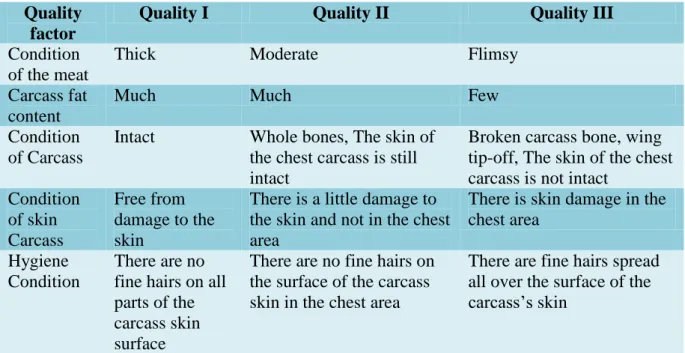
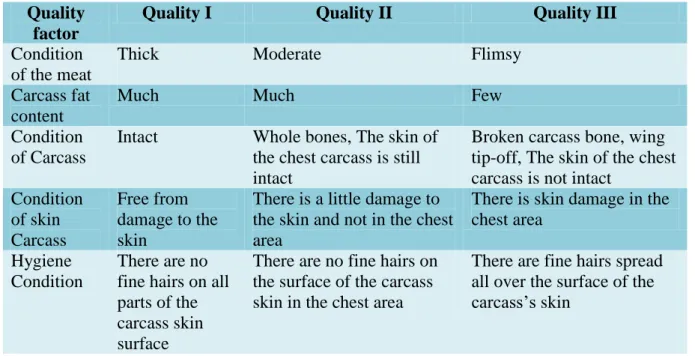
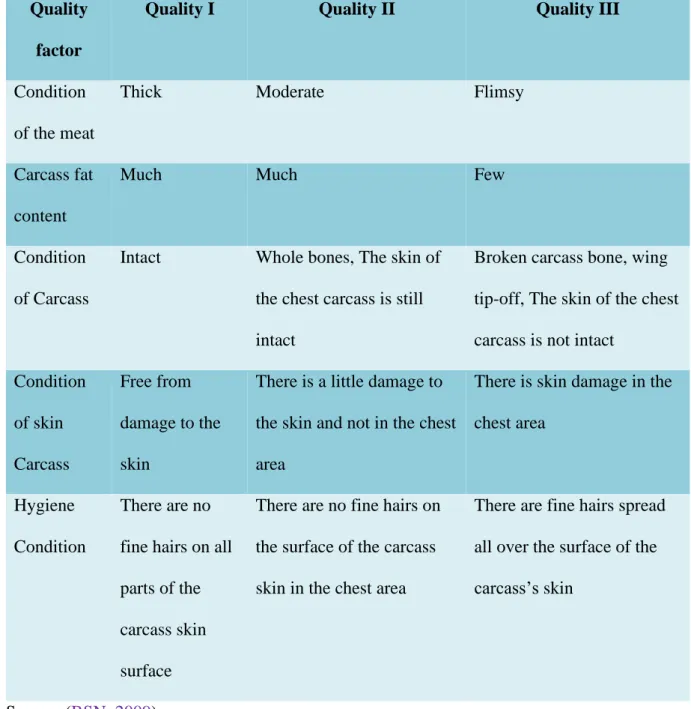
The grouping of carcass quality was divided into 3, namely quality I, quality II and quality III, with indicators as shown in Table 1.
Table 1. Indicators for Determining Carcass Quality Quality
factor
Quality I Quality II Quality III
Condition of the meat
Thick Moderate Flimsy
Carcass fat content
Much Much Few
Condition of Carcass
Intact Whole bones, The skin of the chest carcass is still intact
Broken carcass bone, wing tip-off, The skin of the chest carcass is not intact
Condition of skin Carcass
Free from damage to the skin
There is a little damage to the skin and not in the chest area
There is skin damage in the chest area
Hygiene Condition
There are no fine hairs on all parts of the carcass skin surface
There are no fine hairs on the surface of the carcass skin in the chest area
There are fine hairs spread all over the surface of the carcass’s skin
Source: (BSN, 2009)
9 Determination of carcass quality based on quality indicators (Table 1) involved 15 semi- trained panellists from the Faculty of Animal Husbandry, University of Mataram.
Determination of carcass quality was carried out at the Animal Health Laboratory of each Regency, except for the Mataram City area, which was carried out at the Animal Product Processing Technology Laboratory, Faculty of Animal Husbandry, University of Mataram.
Analysis of Data
The data from the research results at each location were arranged from the largest data to the smallest data for live weight parameters. In contrast, the other parameters followed the results of sort live weight parameters. Analysis of data such as live weight, carcass weight and percentage, weight and percentage of offal, weight and percentage of edible offal, weight and percentage of meat were analyzed using the Microsoft Excel program and regression correlation analysis (Steel and Torrie, 2015).
RESULTS AND DISCUSSION
Weight Proportion of Broiler Chicken Body Parts
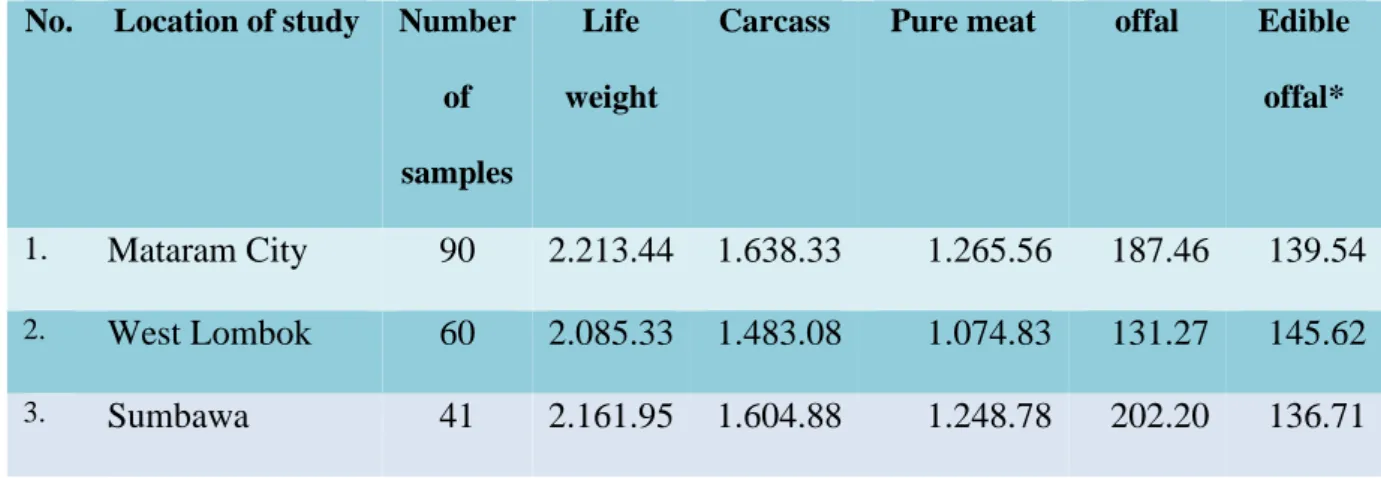
The proportions of broiler chicken body weight, including live weight, carcass weight, pure meat weight, and offal and edible offal weight, are presented in Table 2.
Table 2. Average Weight Proportion of Body Parts of Broiler Chickens in West Nusa Tenggara (in g)
No. Location of study Number of samples
Life weight
Carcass Pure meat offal Edible offal*
1. Mataram City 90 2.213.44 1.638.33 1.265.56 187.46 139.54
2. West Lombok 60 2.085.33 1.483.08 1.074.83 131.27 145.62
3. Sumbawa 41 2.161.95 1.604.88 1.248.78 202.20 136.71
Average 2.162.15 1.582.38 1.202.04 172.97 140.84
Maximum value 3.100.00 2.300.00 1.900.00 270.00 200.00
Minimum value 1.100.00 750.00 550.00 50.00 40.00
Deviation standard 424.43 345.29 276.97 44.02 25.66
Coefficient of
Variation (CV) 19.63 21.82 23.04 25.45 18.22
* Head, neck, and shank.
10 The results (Table 2) show that the average live weight of broiler chickens in West Nusa Tenggara was 2.161.15 ± 424 g. The weight varies between research locations, with a maximum weight of 3.100 g and a minimum weight of 1.100 g. The variation was still within the normal range, as reflected by the Coefficient of Variation (CV) value of 19.63%. The live weight obtained in this study was almost the same as that of Sjofjan and Djunaidi (2016), namely, the average live weight of broiler chickens aged 35 days reached 2.016 g, and the results of Prasetyo et al. (2020) reached 2.047 g. In contrast, Liani et al. (2021) stated that broiler chickens with a harvest age of 30-35 days have a body-weight of around 1.500-2.000 g.
Sources of variation include broiler strain, age, sex, type of feed, maintenance management (cage density, presence or absence of access outside the cage) or natural conditions such as ambient temperature, humidity and air pressure. Fanatico et al. (2005) showed that age differences would produce different live weights. Ages of 48; 63; and 70 days will produce live weight: 2.210 g, 2.890 g, and 3.450 g, respectively. According to Yitbarek et al. (2016), male broilers at 49 days of harvest had a live weight of 2.315, while female broilers at the same age weighed 1.932 g.
Fanatico et al. (2005) once investigated the effect of access outside the cage on broilers’ life.
Broilers with large access to the outside of the cage will produce a higher live weight than broilers with limited access or media access outside the cage. Broilers with access outside the cage had an average live weight of 2.458 g at the age of 53 days, while those with limited and medium access had an average live weight of 2,110 and 2.327 g at the age of 81 and 67 days, respectively. HS et al. (2019) also explained that intensive maintenance and free-range access affected broiler chickens' morphometrics and body weight. Prasetyo (2018) explained that broiler body weight is also influenced by the material and thickness of the cage.
11 Mebratie et al. (2017) explained that sex differences in broiler chickens produce different live weights. Differences in body weight due to sex differences are also related to the cecum microbiota and its metabolites (Cui et al., 2021). Male broiler chickens at the age of 42 days have a live weight of 2.142 g, while female broiler chickens of the same age have 2.022 g (Kryeziu et al., 2018). It was further explained that the density would sometimes also affect the live weight of broilers, namely cages with high (22 fish/m2), medium (18 fish/m2) and low (14 fish/m2) density levels will produce an average live weight of each: 1.958 g, 2,149 g, and 2.139 g at the age of 42 days.
Broiler chicken body parts percentage
The percentages of broiler body parts, including the percentage of the carcass, the percentage of pure meat and skin, the percentage of offal, the percentage of edible offal and the percentage of other body parts, are presented in Table 3.
Table 3. Average Percentage of Broiler Body Parts in West Nusa Tenggara (in %) No. Location of study Number
of samples
Carcass Pure meat
offal Edible offal*
Other**
1. Mataram City 90 73.92 57.04 8.65 6.36 11.07
2. West Lombok 60 70.76 51.37 6.31 7.25 15.68
3. Sumbawa 41 73.98 57.83 9.43 6.37 10.22
Average 72.94 55.43 8.08 6.65 12.33
Maximum value 84.62 69.23 13.33 13.57 29.29
Minimum value 60.00 34.00 3.33 2.58 4.76
Deviation standard 4.70 5.58 1.86 1.33 4.84
Coefficient of Variation
(CV) 6.44 10.07 23.05 20.03 39.22
*Head, neck, and shank; **feathers, blood and dirt.
The results (Table 2) showed that the average carcass weight of broiler chickens was 1.582.38
± 345 g. The maximum carcass weight obtained in this study was 2.300 g, and the minimum weight was 750 g, with a CV value of 21.82%. The average percentage of broiler carcasses obtained in this study (Table 3) was 72.94%, with a maximum percentage of 84.62% and a minimum percentage of 60%. Variations in weight and carcass percentage were caused by
12 several factors, including broiler strain, age, sex, type of feed, maintenance management, or natural conditions such as ambient temperature, humidity and air pressure.
Research by Sjofjan and Djunaidi (2016) shows that differences in feed composition (especially protein content) will result in different weights and percentages of carcasses.
Broiler chickens fed a protein content of 22.68, and 20.88% will produce a carcass percentage of 75% and 73% of live weight, respectively, at 5 weeks of slaughter. Carcass weight obtained in this study also closely correlates with live weight. This is evidenced by the very high value of the correlation coefficient and R2, namely: 0.92 with the regression correlation equation y = 0.7799x – 103.95 (x=live weight; y=carcass weight) shown in Figure 1.
With this regression correlation equation, it can be used to predict carcass weight if live weight is known.
Pure meat percentage
The study results (Table 3) show that the average weight of pure broiler chicken meat is 1.202.04 ± 277 g with a maximum value of 1.900 g and a minimum value of 550 g and a standard deviation of 276.97 and a CV of 23%. The average percentage of pure meat to live weight was 55.43%, and the maximum and minimum values were 69.23% and 34%, respectively, with the standard deviation of 5.58% and CV of 10.07%. Several factors, including cage density, influence the ratio of meat to the bone; as described by Suhita et al.
(2019) that the cage density of 8 fish/m2 resulted in a meat-to-bone ratio of 2.61 while rearing with a density of 20 fish/m2 resulted in a ratio of 2.16.
This study proves that the weight of pure meat produced tends to be higher than the results of research by Sari et al. (2019) that a chicken with the age of 42 days has a pure meat weight of 730.33 g. It was further explained that the weight of pure meat was strongly influenced by the ability of livestock to absorb nutrients, especially the protein content of the feed. Pure meat and skin also have a very close relationship (correlation) with carcass weight; this is
13 evidenced by the very high value of the correlation coefficient and R2, namely: 0.90, as shown in Figure 2 with the regression correlation equation: y=0.759x+1.0013 (x = weight of carcass;
y = weight of pure meat). The regression correlation equation can predict pure meat weight based on carcass weight.
Offal Percentage
The results (Table 3) show that the average weight of broiler innards is 172.97 ± 44 g, with maximum and minimum values of 270.00 g and 50.00 g, respectively, and 25% CV. The offal to live weight percentage was 8.08 ± 1.86%, with maximum and minimum values of 13.33%
and 3.33%, respectively, and CV 23%. The results of this study are in line with the results of Abdullah & Buchtova's (2016) study, which compared the weight of offal between organic and conventional broilers reared. The offal weight of organic broiler chickens aged 81 days was 188.16 g, while those reared conventionally at the age of 38 days of slaughter weighed 152.96 g of innards. The research results by Yitbarek et al. (2016) in Ethiopia reported lower yields than the average weight of broiler innards at 56 days of harvest of about 107.6 g. The research results of Indumathi et al. (2019) also showed that the weight of broiler innards at the age of 42 days was around 102.2 g. Kastalani et al. (2021) explained that the type of feed strongly influences the weight of offal. Feeds containing fibre tend to stimulate the work of organs such as the heart, gizzard, and liver to increase the weight of these organs. The weight of offal will also increase along with the high live weight of chickens. Yassin et al. (2020) explained that broiler chickens weighing 2.840 g have an offal weight of about 232 g.
The Percentage of Edible Offal (Head, Neck, and Shank)
The study results (Table 3) showed that broiler chickens' average edible offal weight was 140.84 ± 25.66 g with a maximum and minimum value of 200.00 g and 40.00 g and CV 18.22%, respectively. Meanwhile, the average percentage of edible offal to live weight was 6.65±1.33%, with maximum and minimum percentages of 13.57% and 2.58%, respectively,
14 and 20.03% CV. The results of this study were lower than those of Kidane et al. (2017), who stated that the weight of edible offal, such as the head, neck and claws of broiler chickens, at the harvest age of 49 days was around 167.9 g. Indumathi et al. (2019) examined broiler chickens at 49 days, which had a higher offal weight of 223.16 g. Yassin et al. (2020) reported that broiler chickens with a live weight of 2.840 g had an edible offal weight of 242.5 g.
Percentage of others (Feathers and Blood)
The results (Table 3) showed that the average percentage of the combined weight of feathers, blood and faeces calculated by the formula: [100 - (% carcass + % offal + % edible offal)]
was 12.33±4.84%, with the maximum. Minimum scores were 29.29% and 4.76%, and CV 39.22%, respectively. The results of this study were in line with the research results of Indumathi et al. (2017), who reported that broiler chickens with a live weight of 1.930.8 g had blood and featherweight of 12.76%. Yassin et al. (2020) explained that broiler chickens with a live weight of 2.840 g have a feather and blood weight of 180 gr.
A general description of the proportions of the components that make up the body of broiler chickens in West Nusa Tenggara Province was presented in Figure 3.
Carcass Weight and Quality Group
Determination of the weight and carcass quality of broiler chickens circulating in traditional markets on the islands of Lombok and Sumbawa was guided by the provisions of SNI 3924:2009 (BSN, 2009).
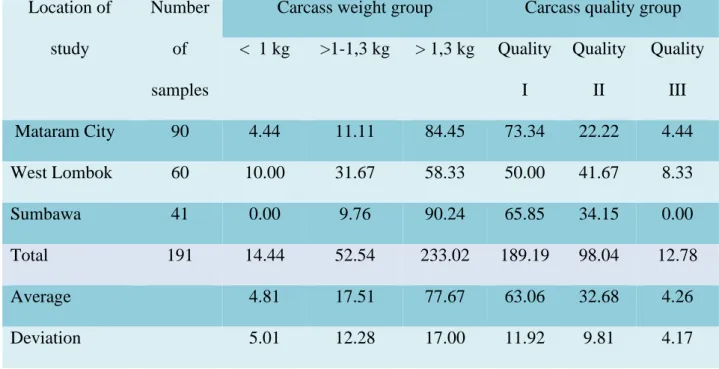
The weight and carcass quality of broiler chickens circulating in the traditional markets of Lombok and Sumbawa are presented in Table 4.
15 Table 4. Broiler Chicken Carcass Weight and Quality (%)
Location of study
Number of samples
Carcass weight group Carcass quality group
< 1 kg >1-1,3 kg > 1,3 kg Quality I
Quality II
Quality III
Mataram City 90 4.44 11.11 84.45 73.34 22.22 4.44
West Lombok 60 10.00 31.67 58.33 50.00 41.67 8.33
Sumbawa 41 0.00 9.76 90.24 65.85 34.15 0.00
Total 191 14.44 52.54 233.02 189.19 98.04 12.78
Average 4.81 17.51 77.67 63.06 32.68 4.26
Deviation
Standard 5.01 12.28 17.00 11.92 9.81 4.17
The results of the study (Table 4) showed that the carcasses of broiler chickens circulating in the traditional markets of Lombok and Sumbawa in the large size category (weight above 1.3 kg) were 77.67±17.00%; the medium-size category (weight >1-1.3 kg) was 17.51±12.28%
and the carcass with small size (weight<1 kg) was 4.81±5.01%. Carcasses circulating in the traditional market of Sumbawa Regency were large in the large size category (90.24%), larger than West Lombok Regency (58.33%) and Mataram City (84.45%). The difference in carcass weight was caused by live weight (Soeparno, 2015), reproductive organ weight (Bulkaini, 2021), and stress levels before slaughter (Tamzil et al., 2022).
Carcass quality circulating in traditional markets on the islands of Lombok and Sumbawa was found to be 63.06±11.92% in the first quality category, the second quality with 32.68±9.81%
and the third quality with 4.26±4, 17%. Carcasses circulating in the traditional market of Mataram City with quality category I (74.34%) were greater than those of West Lombok Regency (50.00%) and Sumbawa Besar Regency (65.85%). The difference in carcass quality was caused by the completeness of the feather removal facility (Subagyo et al., 2021) and errors during the slaughter of chickens or in the transportation process (Kartikasari et al., 2019); and stress levels before cutting (Tamzil et al., 2022). The main cause of the decline in the quality of broiler carcasses was unprofessional handling of slaughter, such as manual feather removal, which causes bruises on the carcass surface (Amin and Nurhalizah, 2021)
16 and the presence of shoot hairs and spreads over the entire skin surface (Supriyanto et al. al., 2019).
CONCLUSIONS AND RECOMMENDATIONS
Carcass characteristics and pure meat production of broiler chickens circulating in traditional markets on the islands of Lombok and Sumbawa have met Indonesian National Standardsi.e.
broiler chickens had a live weight of 2.162.15 g, carcass weight of 1.582.38 g (72.94%), pure meat 1.202.04 g (55.43 %), offal 172.97 g (7.99 %), and edible offal of 140.84 (6.65%).
Based on the conclusion of this study, it is suggested that in order to obtain carcass quality and broiler meat production in accordance with the Indonesian National Standard, broiler chickens should be slaughtered with a weight range above 1,300 g.Furthermore, the results of this study can be a consideration for the local government through the Department of Agriculture and Livestock in each Regency and City in determining the standard of broiler chicken slaughter weight that can produce carcass and pure meat in accordance with the Indonesian National Standard.
ACKNOWLEDGMENT
The authors wish to thank the Ministry of Education, Culture, Research and Technology for providing research grants. The authors also thank to the laboratory team of the Animal Products Processing Technology Laboratory for helping in the measurement of research variables.
CONFLICT OF INTEREST
We declare that there is no conflict of interest related to the publication of this scientific article.
17 AUTHOR'S CONTRIBUTION
Bulkaini and Syamsuhaidi were fully responsible for conducting the research and writing the paper. Sukirno and Sukarne are in charge of processing research data, while Yusuf Sutaryono, Djoko Kisworo and Tapaul Rozi are in charge of editing the paper. Collectively revise the substance of the paper so that it is worthy of publication.
REFERENCES
Abubakar (2003). Mutu Karkas Ayam Hasil Pemotongan Tradisional dan Penerapan Sistem Hazard Analysis Critical Control Point.Jurnal Litbang Pertanian, 22(1):33-39.
Abdullah F AA, Buchtova H (2016). Comparison of qualitative and quantitative properties of the wings, necks and offal of chicken broilers from organic and conventional production systems. Veterinární medicína, 61(11), 643-651. https://doi: 10.17221/286/2015- VETMED.
Amin M, Nurhalizah (2021). Proses Pemotongan dan Marinasi Ayam Broiler: Studi Kasus Pemotongan Ayam Di Rpa Pt. Ciomas Adisatwa. Jurnal Peternakan Lokal: 3 (2), ISSN 2685-7588.
BSN (2009). Mutu karkas dan daging ayam. Standar Nasional Indonesia, SNI 3924:2009.
Bidura IGNG., Suasta IM (2017). Penerapan Bioteknologi Probiotik Pada Pakan Serat Bermutu Rendah Terhadap Penampilan Dan Karkas Itik.Seminar Nasional PERSEPSI II. Bali 28-29 April 2017. Pengembangan Agribisnis Peternakan untuk Meperkuat Ekonomi Pedesaan di Indonesia.
Bulkaini, Kisworo D, Yasin M (2019). Physical Characteristics And Organoleptic Valuesof Horse’s Meat Sausage Based On Level Subtitution of Tapioca Flour. Jurnal Veteriner, 20(4): 548-557. DOI: 10.19087/jveteriner.2019.20.4.548.
Bulkaini, Wulandani BRD, Kisworo D, Wahid Yulianto, Yasin M, Chusnul Chotimah Mr,
18 Ahmad Fudholi (2020). The Effect of Slaughter Age on Chemical and Physical Characteristics of Beef of Bali Cattle Reared Extensively. International Journal of Pharmaceutical Research,12(2):2812-2816. DOI:http://doi.org/10.31838/
ijpr/2020.SP2.134.
Bulkaini, Kisworo D., Budi Indarsih, and Sumadi IK (2021). Production Performance of Peking Ducks with Feeding of Fermented Yeast Culture Pineapple Peel (Saccharomyces cerevisiae). Jurnal Biologi Tropis,21(3):1013–1021. DOI: http://dx.doi.org/10.29303- /jbt.v21i3.3034.
BPS (2021). Nusa Tenggara Barat dalam Angka. Kantor Statistik Propinsi Nusa Tenggara Barat.
Cui L, Zhang X., Cheng R, Ansari AR, Elokil AA, Hu Y & Liu H (2021). Sex differences in growth performance are related to cecal microbiota in chicken. Microbial Pathogenesis, 150, 104710. https://doi.org/10.1016/j.micpath.2020.104710.
Daniel S (2011). Risk Analysis in a Poultry Slaughtering Unit. Bulletin UASVM, Veterinary Medicine: 68(2): 253-259.
Fanatico AC, Pillai LC, Cavitt CM, Owens and Emmert JL (2005). Evaluation of Slower- Growing Broiler Genotypes Grown with and Without Outdoor Access: Growth Performance and Carcass Yield. Poultry Science Vol. 84, pp.1321–1327.
https://doi.org/10.1093/-ps/84.11.1785.
HS IR, Darwati S, & Mu'iz A (2019). Morfometrik ayam broiler dengan pemeliharaan intensif dan akses free range di daerah tropis. Jurnal Ilmu Produksi dan Teknologi Hasil Peternakan, 7(2): 75-80. DOI: https://doi.org/10.29244/jipthp.7.2.75-80.
Hariarta IGW dan Setyawan MB (2022). BMKG Stasiun Klimatologi Lombok Barat.
Indumathi J, Kumar MS, Gnanprakash M, Babu AJ & Reddy GB (2019). Comparative study on slaughter characteristics between spent broiler breeder hens and broilers. The Pharma
19 Innovation Journal, 8(7): 153-158.
Kidane Z, Mengistu A & Singh H. (2017). Effect of different mixture levels of oyster mushroom, garlic and ginger powder as substitutes for antibiotic growth promoter on carcass traits of broilers. Advances in Biological Research, 11(4):183-189. DOI:
10.5829/idosi.abr.2017-.183.189.
Khotimah DKh, Mayulu H (2018). Preferensi Konsumen Terhadap Karkas Ayam Broiler Segar Dan Beku Di Kota Samarinda. jurnal Peternakan Lingkungan Tropis, 1(1): 2654 – 2501.
Kryeziu AJ, Kamberi M, Muji S, Mestani N, Berisha S (2018). Carcass traits of broilers as affected by different stocking density and sex. Bulgarian Journal of Agricultural Science, 24(6):1097-1103.
Kartikasari AM., Hamid IS., Purnama MTE., Damayanti R., Fikri F., & Praja RN (2019).
Isolasi dan identifikasi bakteri Escherichia coli kontaminan pada daging ayam broiler di rumah potong ayam Kabupaten Lamongan. Jurnal Medik Veteriner, 2(1): 66-71.
Kastalani K, Kusuma ME, Herlinae H, Yemima Y(2021). Pengaruh penambahan pakan berbahan dasar maggot dan dedak padi pada pakan basal terhadap bobot hidup, karkas dan giblet ayam broiler. majalah ilmiah pertanian, 46(1):44-52.
http://dx.doi.org/10.31602-/zmip.v46i1.3732.
Liani Y A, Munthe IR, Irmayani D, Broto BE, Yanris GJ, Prasetya DA, Arifuddin R (2021).
The Broiler Chicken Coop Temperature Monitoring Use Fuzzy Logic and LoRAWAN.
In 2021 3rd International Conference on Electronics Representation and Algorithm (ICERA): 161-166). IEEE. https//:doi.org/10.1109/ICERA53111.2021.9538771.
Mebratie W, Shirali M, Madsen P, Sapp RL, Hawken R & Jensen J (2017). The effect of selection and sex on genetic parameters of body weight at different ages in a commercial broiler chickenpopulation. Livestockscience, 2(4):78-87. https://doi.org/10.1016/j.livsci-
20 .2017.08.013.
Prasetyo RA (2018). Pengaruh Bahan Dan Ketebalan Litter Terhadap Bobot Hidup, Persentase Karkas Dan Organ Dalam Pada Broiler. Doctoral dissertation, Universitas Brawijaya.
Prasetyo AF, Ulum MY, Prasetyo M, & Sanyoto JI (2020). Performa Pertumbuhan Broiler Pasca Penghentian Antibiotic Growth Promoters (AGP) dalam Pakan Ternak Pola Kemitraan di Kabupaten Jember. Jurnal Peternakan, 17(1):25-30.
DOI: http://dx.doi.org/10.24014/-jupet.v17i1.7536.
Soeparno (2015). Ilmu dan Tenologi Daging. Gajah Mada University Press. Edisi Revisi Cetakan ke enam 2015; Yogyakarta.
Steel RGD, Torrie JH (2015). Prinsip Dan Prosedur Statistika. Penterjemah Bambang Sumantri. Gramedia Pustaka, Jakarta.
Suryanah H and Anggraeni (2016). Effects Of Rations With Different Cation-Anion Balances On Carcass And Giblet Weight Of Broiler Chickens. Jurnal Peternakan Nusantara, 2(1):1-8. ISSN 2442-2541.
Sjofjan O & Djunaidi IH (2016). Pengaruh beberapa jenis pakan komersial terhadap kinerja produksi kuantitatif dan kualitatif ayam pedaging. Buletin Peternakan, 40(3): 187-192.
Supriyanto, Nur Prabewi, Mentari, Rukmananda HRA, Hargiati DP, Adiningsih A (2019).
Quality Of Broiler Chicken Meat In Several Traditional Markets In Magelang Regency.
Jurnal Pengembangan Penyuluhan Peternakan. 16(30):25-37 http://jurnal.- polbangtanyoma.ac.id/index.php/jp3/index.
Sari D, Suprijatna E, Setyaningrum S, Mahfudz LD (2019). Suplementasi inulin umbi gembili dengan Lactobacillus plantarum (sinbiotik) terhadap nisbah daging-tulang ayam broiler. Jurnal Peternakan Indonesia (Indonesian Journal of Animal Science), 21(3):284- 293. DOI: https://doi.org/10.25077/jpi.21.3.284-293.2019
21 Suhita D, Atmomarsono U, Sarengat W, Sarjana TA (2019). Peningkatan Kepadatan
Kandang Berdampak Terhadap Rasio Daging Tulang dan Perlemakan Ayam
Broiler. AGROMEDIA: Berkala Ilmiah Ilmu-ilmu
Pertanian: 37(1). https://doi.org/10.47728/ag.v37i1.246.
Subagyo SF, Harijani N, Wibawati PA, Effendi MH, Chusniati S, Yunita MN (2021).
Carcass Quality and Tetracycline Residues in Broiler Chicken Meat in Banyuwangi Traditional Market. Jurnal Medik Veteriner: 4(1)1-7. DOI: 10.20473/jmv.vol4.iss1.
Tamzil MH, Indarsih B, Sukartha Jaya IN, Dewi Haryani NK (2022). Stres pengangkutan pada ternak unggas, pengaruh dan upaya penanggulangan. Livestock and Animal Research, 20(1): 48-58. https://doi.org/10.20961/lar.v20i1.53135.
Ulupi N , Nuraini H, Parulian J, Kusuma SQ (2018). Characteristics of carcass and non carcass of male and female broiler chickens at 30 days of cutting age. Jurnal Ilmu Produksi dan Teknologi Hasil Peternakan, 6 (1): 1-5.
Yitbarek MB, Tamir B, Mengistu A (2016). The effect of dried blood rumen content mixture (D BRCM) on carcass characteristics of SASSO C44 broiler chicks. European scientific journal, 12(12). doi: 10.19044/esj.2016.v12n12p166.
Yassin M, Nurfeta A, Banerjee S (2020). The effect of supplementing fenugreek (Trigonella foenum-graecum L.) seed powder on growth performance, carcass characteristics and meat quality of Cobb 500 broilers reared on conventional ration. Ethiopian Journal of Agricultural Sciences, 30(3), 129-142.
Manuscript MH20220424210422 is submitted to Journal Advances in Animal and Veterinary Sciences
Yahoo/Email Masuk
Manuscript Handler <[email protected]>
Kepada:[email protected] Cc:[email protected] Sel, 26 Apr jam 10.53
Dear Bulkaini Bulkaini,
Your manuscript entitled "Carcass Characteristics and Pure Meat Production of Broiler Chickens in Traditional Markets on Lombok and Sumbawa Islands" has been successfully submitted online and is presently being given full consideration for publication in the Advances in Animal and Veterinary Sciences.
Your manuscript ID is MH20220424210422
Please mention the above manuscript ID in all future correspondence or when calling the office for questions. If there are any changes in your street address or e-mail address, please log in at https://manuscripthandler.com/researcherslinks/Advances-in-Animal-and-Veterinary-Sciences and edit your user information as appropriate.
You can also view the status of your manuscript at any time by checking your Author Center after logging in to https://manuscripthandler.com/researcherslinks/Advances-in-Animal-and-Veterinary-Sciences .
Thank you for submitting your manuscript to the Advances in Animal and Veterinary Sciences.
Sincerely, Editorial Office
ResearchersLinks, Ltd 35 Oxford Road, Burnley, Lancashire BB11 3BB
United Kingdom
Email: [email protected] Tel: +44 (0)1524383621
+44 (0)7733040586
Twitter: @ResearchersLinks
Facebook: https://www.facebook.com/researchers.links.1
LinkedIn: https://www.linkedin.com/in/researchers-links-94a72478 Web: www.researcherslinks.com
Email bukti pemerimaan submit (26 April 2022)
Komentar reviewer 1 dan 2 (22 mei 2022)
1
Carcass Characteristics and Pure Meat Production of Broiler Chickens in Traditional Markets on Lombok and Sumbawa Islands
Bulkaini1*, Syamsuhaidi1*, Yusuf Sutaryono1, Djoko Kisworo1, Sukirno1, Sukarne1, and Tapaul Rozi1
1 Faculty of Animal Science University of Mataram, Majapahit Street, No. 62, Mataram Lombok, 83125, Tel: (0370). 633007, West Nusa Tenggara, Indonesia
Email: [email protected]; Mobile phone number: +6281805209049 and [email protected]; Mobile phone number: +6283139787878
Article yang sudah di revisi sesuai komentar reviewer (diketik
tanda mera) (26 Mei 2022)
2
Abstract
Carcass characteristics and pure meat production of broiler chickens are indicators to assess carcass quality. This study was conducted to evaluate the carcass characteristics and production of pure meat broiler chicken circulating in the traditional markets of Lombok and Sumbawa based on the Indonesian National Standard. The material used was 191 heads of broiler chickens with a slaughter age of 45-49 days. Ninety heads from a chicken slaughterhouse in Mataram City, sixty heads from a chicken slaughterhouse in West Lombok Regency and forty-one heads from Sumbawa Regency. Determination of broiler chicken samples in each Regency was done by random sampling method. Research variables such as live weight, carcass weight and percentage, offal weight and percentage, edible offal weight and percentage, meat weight and percentage were analyzed using the Microsoft Excel program and regression correlation analysis.The results showed that carcasses with large size categories 77.67%, medium size 17.51% and small size 4.81%, while quality, which includes quality I, was 63.06%, quality II was 32.68%, and quality III was 4.26%.Broiler chicken pure meat products circulating in the traditional markets of Lombok and Sumbawa were respectively 54.21% and 57.83%. Conclusion: Carcass characteristics and pure meat production of broiler chickens circulating in traditional markets on the islands of Lombok and Sumbawa have met Indonesian National Standards i.e. broiler chickens had a live weight of 2.162.15 g, carcass weight of 1.582.38 g (72.94%), pure meat 1.202.04 g (55.43 %), offal 172.97 g (7.99 %), and edible offal of 140.84 (6.65%).
Keywords: Characteristics, carcass, pure meat, traditional, market
3 INTRODUCTION
Broiler chicken is one of the most popular poultry as a meat producers to meet animal protein (Khotimah and Mayulu, 2018). The high and low selling value of broiler carcasses is very dependent on the weight of the carcass and the amount of meat produced (Suryanah et al., 2016). Chicken carcasses can be classified based on age and carcass weight (BSN, 2009).
Furthermore, it was explained that based on the age of the chicken, carcasses were grouped into 3 age categories,namely: 1) < 6 weeks or young chickens (fryer/broiler), 2) 6-12 weeks or mature chickens (roaster), and 3) > 12 weeks or old chickens (stew). Based on carcass weight, it is divided into 3 (three) sizes, namely: 1) <1.0 kg or small size, 2) 1.0 kg-1.3 kg or medium size, and 3) >1.3 kg or large size.
Carcass characteristics and broiler meat production are influenced by several factors, namely genetic factors (Soeparno, 2015);feed quality (Suryanah et al., 2016), poultry handling before and after slaughter (Ulupi et al., 2018) and broiler slaughter methods (Bulkaini et al., 2019).
The slaughter process that meets the standards will produce carcass and meat whose quality meets the provisions of the Indonesian National Standard (Amin and Nurhalizah, 2021).The stages in slaughtering poultry are: transporting, receiving, hanging poultry, stunning, removing blood, washing with boiling water, removing feathers, removing offal, processing organs, cooling, slaughtering, packaging, freezing, storage, and shipping (Daniel, 2011).
The transportation of poultry that is not handled professionally from the location of the breeder to the slaughterhouse can reduce the quality of the carcass and meat produced because the livestock is under high stress (Tamzil et al., 2022). Livestock with high stress causes muscle glycogen to undergo glycolysis enzymatically and produces lactic acid, which triggers changes in the pH of the meat so that the meat becomes pale, tender and watery. Changes in the pH of the meat in the carcass from an acidic environment ((pH 5.1-5.8) to an alkaline
4 environment (pH more than 6) caused the meat colour to turn pale and dark with low water holding capacity and high cooking loss (Bulkaini et al., 2020).
The low quality of carcasses is largely due to the traditional way of slaughtering chickens in chicken slaughterhouses (Subagyo et al., 2021). Handling or slaughtering that was still traditional will cause damage to the carcass in the form of bruises on the chest and thighs. It can reduce the profits of chicken slaughter entrepreneurs by 10-20% (Khotimah et al., 2018).
The results of research by Abubakar (2003), slaughtering broiler chickens in a chicken slaughterhouse that uses a simple machine to clean feathers and does not apply a hazard analysis critical control point (HCCP) system produces carcass quality I of 51.85-66.55%, quality II ( 27.97-43.02%) and quality III (5.13-10.17%), while the cleaning of chicken feathers by hand resulted in carcass quality I of 50.75-58.91%, quality II of 32.63-40.45% and quality III of 7.76-11.25%. Furthermore, it was said that slaughtering chickens by inserting them into a funnel and cleaning the feathers by hand resulted in the best quality carcass percentage of 66.67%.
The quality of broiler carcass circulating in the Banyuwangi traditional market with the traditional slaughter method was found that the percentage of quality I broiler carcass quality was 60%, quality II was 30%, and quality III was 10% (Subagyo et al., 2021).The quality of meat circulating in the traditional market in Magelang, Yogyakarta district contains tetracycline residues ranging from 0.272-0.416 mg/kg, is not contaminated with bacteria, does not contain formaldehyde and the water content is classified as normal (Supriyanto et al., 2019).
Geographical location and completeness of chicken slaughterhouse equipment facilities affect carcass quality and pure meat production (BPS NTB, 2021; Supriyanto et al., 2019). Chicken slaughterhouses in West Nusa Tenggara, as a place for slaughtering poultry, have different facilities, resulting in varied carcass quality (Bulkaini et al., 2020). There are no specific
5 research data related to carcass quality and broiler meat production circulating in traditional markets on the islands of Lombok and Sumbawa, so research is urgently needed.
Based on geographical position, West Nusa Tenggara Province has the following boundaries:
To the north, it is bordered by the Java Sea and the Flores Sea; To the south, it is bordered by the Indian Ocean; the west is bordered by the Lombok Strait and the Province of Bali, and in the east, it is bordered by the Sape strait and the province of East Nusa Tenggara.West Nusa Tenggara consists of two islands, namely the island of Lombok and the island of Sumbawa, with very different climatic conditions. Lombok Island consists of: West Lombok Regency, Central Lombok, East Lombok, North Lombok, and Mataram City, while Sumbawa Island consists of: West Sumbawa Regency, Sumbawa, Dompu, Bima Regency, and Bima City (BPS NTB, 2021). As a tropical area, West Nusa Tenggara has a relatively high average humidity between 48-95%, with a maximum temperature of 30.9°–32.1°C (Hariarta and Setyawan, 2022).
Based on the description above, research was carried out to evaluate the carcass characteristics and production of broiler chicken meat circulating in the traditional markets of Lombok and Sumbawa based on Indonesian National Standard number 3924:2009.
MATERIALS AND METHODS Ethical approval:
The broiler chicken used in this study was approved by the Ethics Committee of the Faculty of Animal Husbandry, University of Mataram, Indonesia, with the Approval Number:
08/UN18.F2/EC/2021, April 5, 2021. The broiler chickens in this study were handled professionally; that is, before slaughtering the broilers, they were transported using a 4- wheeled pick-up vehicle from the maintenance location to the chicken slaughterhouse and before slaughtering the broiler chickens, they were still given food and drink as needed.
6 According to Islamic sharia rules in a chicken slaughterhouse, all broiler chickens are slaughtered to obtain pure carcass and meat by Indonesian National Standards.
Research material
The material used was 191 heads of broiler chickens with a slaughter age of 45-49 days.
Ninety heads from a chicken slaughterhouse in Mataram City, sixty heads from a chicken slaughterhouse in West Lombok Regency and forty-one heads from Sumbawa Regency.
Broiler chickens as research material get the same treatment in terms of the type of feed used i.e. broiler feed aged 0-10 days using BR 0 super F crumble concentrate; broiler chicken aged 11-20 days using BR 1 super crumble concentrate, and broilers aged 21 until harvest using BR II super pellet concentrate.
Research methods
Preparation of research samples
The broiler chickens used as research samples were sourced from the island of Lombok, namely Mataram City and West Lombok Regency, while the island of Sumbawa was taken from the Sumbawa Regency. Determination of the number of samples of broiler chickens in each regency was done by the random sampling method. Broiler chicken samples which amounted to 191 heads before being slaughtered, received the same treatment, namely: 1) Transportation of broiler chickens from the farmer to the slaughterhouse uses the same transportation, namely a four-wheeled pick-up vehicle; 2) Before slaughtering broiler chickens, fasted for 12 hours in the shelter; and 3) Slaughter is carried out using the Islamic sharia method.
Research sampling location
The location for taking broiler chickens as the research sample was set as follows: The Mataram City area was located in a poultry slaughterhouse (traditional market) Sweta- Baratais Sandubaya District, Kebun Rowek traditional market Ampenan District and Sindu
7 traditional market Cakranegara District. West Lombok Regency was located in a poultry slaughterhouse (traditional market) Cengok Gunung-Sari District, Gunung Pengsong traditi- onal market Labuapi District, and Lembar traditional market Lembar District. The Sumbawa Regency area is located in the poultry slaughterhouse (traditional market) Brang Biji Sumbawa District, Utan traditional market Utan District, and Brangbara traditional market Sumbawa District.
Observation of research variables
Observations of research variables were carried out at the Animal Health Laboratory of each research locationi.e.:1) The Mataram City area was carried out at the Laboratory of Animal Products Processing Technology, University of Mataram; 2)West Lombok region conducted at the Animal Health Laboratory of the West Lombok Agriculture and Livestock Service, and 3) The Sumbawa Regency area was carried out at the Animal Health Laboratory of the Livestock Service Office of Sumbawa Regency.
Research of variable a. weight of life
Live weight was obtained by weighing broilers after being fasted for 12 hours (Bulkaini, 2021).
b. Carcass Weight
Carcass weight was obtained by subtracting live weight from the weight of the neck, head, feathers, shank (knees to fingers), and parts of the viscera except for the lungs (Bidura et al., 2017).
c. Carcass Percentage
Carcass percentage was obtained by dividing carcass weight by live weight multiplied by 100%.
d. Weight and percentage of offal.
8 The weight of the offal was obtained by weighing the weight of the intestines, liver, heart, and gizzard after being cleaned of feces. The percentage of offal was obtained by dividing the total weight of offal divided by live weight and multiplied by 100%.
e. Weight and percentage of edible offal (foot, neck, and head)
The edible offal weight was obtained by weighing each edible offal weight, while the percentage of offal was obtained by dividing the weight of offal by live weight and multiplied by 100%.
f. Pure meat weight
The weight of pure meat can be determined by weighing the weight of the meat in the chest muscles after being separated from the bones (Bulkaini, 2021).
Carcass Weight and Quality Classification
The carcass weight obtained in the study was grouped into three, namely:1) Small carcass size (<1 kg); 2) Medium size carcass (>1.0-1.3 kg); and 3) Large carcass (>1.3 kg) (BSN, 2009).
The grouping of carcass quality was divided into 3, namely quality I, quality II and quality III, with indicators as shown in Table 1.
Table 1. Indicators for Determining Carcass Quality Quality
factor
Quality I Quality II Quality III
Condition of the meat
Thick Moderate Flimsy
Carcass fat content
Much Much Few
Condition of Carcass
Intact Whole bones, The skin of the chest carcass is still intact
Broken carcass bone, wing tip-off, The skin of the chest carcass is not intact
Condition of skin Carcass
Free from damage to the skin
There is a little damage to the skin and not in the chest area
There is skin damage in the chest area
Hygiene Condition
There are no fine hairs on all parts of the carcass skin surface
There are no fine hairs on the surface of the carcass skin in the chest area
There are fine hairs spread all over the surface of the carcass’s skin
Source: (BSN, 2009)
9 Determination of carcass quality based on quality indicators (Table 1) involved 15 semi- trained panellists from the Faculty of Animal Husbandry, University of Mataram.
Determination of carcass quality was carried out at the Animal Health Laboratory of each Regency, except for the Mataram City area, which was carried out at the Animal Product Processing Technology Laboratory, Faculty of Animal Husbandry, University of Mataram.
Analysis of Data
The data from the research results at each location were arranged from the largest data to the smallest data for live weight parameters. In contrast, the other parameters followed the results of sort live weight parameters. Analysis of data such as live weight, carcass weight and percentage, weight and percentage of offal, weight and percentage of edible offal, weight and percentage of meat were analyzed using the Microsoft Excel program and regression correlation analysis (Steel and Torrie, 2015)
RESULTS AND DISCUSSION
Weight Proportion of Broiler Chicken Body Parts
The proportions of broiler chicken body weight, including live weight, carcass weight, pure meat weight, and offal and edible offal weight, are presented in Table 2.
Table 2. Average Weight Proportion of Body Parts of Broiler Chickens in West Nusa Tenggara (in g)
No. Location of study Number of samples
Life weight
Carcass Pure meat offal Edible offal*
1. Mataram City 90 2,213.44 1,638.33 1,265.56 187.46 139.54
2. West Lombok 60 2,085.33 1,483.08 1,074.83 131.27 145.62
3. Sumbawa 41 2,161.95 1,604.88 1,248.78 202.20 136.71
Average 2,162.15 1,582.38 1,202.04 172.97 140.84
Maximum value 3,100.00 2,300.00 1,900.00 270.00 200.00
Minimum value 1,100.00 750.00 550.00 50.00 40.00
Deviation standard 424.43 345.29 276.97 44.02 25.66
Coefficient of
Variation (CV) 19.63 21.82 23.04 25.45 18.22
* Head, neck, and shank.
10 The results (Table 2) show that the average live weight of broiler chickens in West Nusa Tenggara was 2.161.15±424 g. The weight varies between research locations, with a maximum weight of 3.100 g and a minimum weight of 1,100 g. The variation was still within the normal range, as reflected by the Coefficient of Variation (CV) value of 19.63%. The live weight obtained in this study was almost the same as that of Sjofjan and Djunaidi (2016), namely, the average live weight of broiler chickens aged 35 days reached 2.016 g, and the results of Prasetyo et al. (2020) reached 2.047 g. In contrast, Liani et al. (2021) stated that broiler chickens with a harvest age of 30-35 days have a body-weight of around 1.500-2.000 g.
Sources of variation include broiler strain, age, sex, type of feed, maintenance management (cage density, presence or absence of access outside the cage) or natural conditions such as ambient temperature, humidity and air pressure. Fanatico et al. (2005) showed that age differences would produce different live weights. Ages of 48; 63; and 70 days will produce live weight: 2.210 g, 2.890 gr, and 3.450 g, respectively. According to Yitbarek et al. (2016), male broilers at 49 days of harvest had a live weight of 2.315, while female broilers at the same age weighed 1.932 g.
Fanatico et al. (2005) once investigated the effect of access outside the cage on broilers’ life.
Broilers with large access to the outside of the cage will produce a higher live weight than broilers with limited access or media access outside the cage. Broilers with access outside the cage had an average live weight of 2.458 g at the age of 53 days, while those with limited and medium access had an average live weight of 2,110 and 2.327 g at the age of 81 and 67 days, respectively. HS et al. (2019) also explained that intensive maintenance and free-range access affected broiler chickens' morphometrics and body weight. Prasetyo (2018) explained that broiler body weight is also influenced by the material and thickness of the cage.
11 Mebratie et al. (2017) explained that sex differences in broiler chickens produce different live weights. Differences in body weight due to sex differences are also related to the cecum microbiota and its metabolites (Cui et al., 2021). Male broiler chickens at the age of 42 days have a live weight of 2.142 g, while female broiler chickens of the same age have 2.022 gr (Kryeziu et al., 2018). It was further explained that the density would sometimes also affect the live weight of broilers, namely cages with high (22 fish/m2), medium (18 fish/m2) and low (14 fish/m2) density levels will produce an average live weight of each. : 1.958 g, 2.149 g, and 2.139 gr at the age of 42 days.
Broiler chicken body parts percentage
The percentages of broiler body parts, including the percentage of the carcass, the percentage of pure meat and skin, the percentage of offal, the percentage of edible offal and the percentage of other body parts, are presented in Table 3.
Table 3. Average Percentage of Broiler Body Parts in West Nusa Tenggara (in %) No. Location of study Number
of samples
Carcass Pure meat
offal Edible offal*
Other**
1. Mataram City 90 73.92 57.04 8.65 6.36 11.07
2. West Lombok 60 70.76 51.37 6.31 7.25 15.68
3. Sumbawa 41 73.98 57.83 9.43 6.37 10.22
Average 72.94 55.43 8.08 6.65 12.33
Maximum value 84.62 69.23 13.33 13.57 29.29
Minimum value 60.00 34.00 3.33 2.58 4.76
Deviation standard 4.70 5.58 1.86 1.33 4.84
Coefficient of Variation
(CV) 6.44 10.07 23.05 20.03 39.22
*Head, neck, and shank; **feathers, blood and dirt.
The results (Table 2) showed that the average carcass weight of broiler chickens was 1.582.38
± 345 g. The maximum carcass weight obtained in this study was 2.300 g, and the minimum weight was 750 g, with a CV value of 21.82%. The average percentage of broiler carcasses obtained in this study (Table 3) was 72.94%, with a maximum percentage of 84.62% and a minimum percentage of 60%. Variations in weight and carcass percentage were caused by
12 several factors, including broiler strain, age, sex, type of feed, maintenance management, or natural conditions such as ambient temperature, humidity and air pressure.
Research by Sjofjan and Djunaidi (2016) shows that differences in feed composition (especially protein content) will result in different weights and percentages of carcasses.
Broiler chickens fed a protein content of 22.68, and 20.88% will produce a carcass percentage of 75% and 73% of live weight, respectively, at 5 weeks of slaughter. Carcass weight obtained in this study also closely correlates with live weight. This is evidenced by the very high value of the correlation coefficient and R2, namely: 0.92 with the regression correlation equation y = 0.7799x – 103.95 (x=live weight; y=carcass weight) shown in Figure 1.
With this regression correlation equation, it can be used to predict carcass weight if live weight is known.
Pure meat percentage
The study results (Table 3) show that the average weight of pure broiler chicken meat is 1,202.04 ± 277 g with a maximum value of 1,900 g and a minimum value of 550 g and a standard deviation of 276.97 and a CV of 23%. The average percentage of pure meat to live weight was 55.43%, and the maximum and minimum values were 69.23% and 34%,
13 respectively, with the standard deviation of 5.58% and CV of 10.07%. Several factors, including cage density, influence the ratio of meat to the bone; as described by Suhita et al.
(2019) that the cage density of 8 fish/m2 resulted in a meat-to-bone ratio of 2.61 while rearing with a density of 20 fish/m2 resulted in a ratio of 2.16.
This study proves that the weight of pure meat produced tends to be higher than the results of research by Sari et al. (2019) that a chicken with the age of 42 days has a pure meat weight of 730.33 gr. It was further explained that the weight of pure meat was strongly influenced by the ability of livestock to absorb nutrients, especially the protein content of the feed. Pure meat and skin also have a very close relationship (correlation) with carcass weight; this is evidenced by the very high value of the correlation coefficient and R2, namely: 0.90, as shown in Figure 2 with the regression correlation equation: y=0.759x + 1.0013 (x = weight of carcass; y = weight of pure meat). The regression correlation equation can predict pure meat weight based on carcass weight.
Offal Percentage
The results (Table 3) show that the average weight of broiler innards is 172.97 ± 44 g, with maximum and minimum values of 270.00 g and 50.00 g, respectively, and 25% CV. The offal
14 to live weight percentage was 8.08 ± 1.86%, with maximum and minimum values of 13.33%
and 3.33%, respectively, and CV 23%. The results of this study are in line with the results of Abdullah & Buchtova's (2016) study, which compared the weight of offal between organic and conventional broilers reared. The offal weight of organic broiler chickens aged 81 days was 188.16 g, while those reared conventionally at the age of 38 days of slaughter weighed 152.96 g of innards. The research results by Yitbarek et al. (2016) in Ethiopia reported lower yields than the average weight of broiler innards at 56 days of harvest of about 107.6 g. The research results of Indumathi et al. (2019) also showed that the weight of broiler innards at the age of 42 days was around 102.2 g. Kastalani et al. (2021) explained that the type of feed strongly influences the weight of offal. Feeds containing fibre tend to stimulate the work of organs such as the heart, gizzard, and liver to increase the weight of these organs. The weight of offal will also increase along with the high live weight of chickens. Yassin et al. (2020) explained that broiler chickens weighing 2,840 g have an offal weight of about 232 g.
The Percentage of Edible Offal (Head, Neck, and Shank)
The study results (Table 3) showed that broiler chickens' average edible offal weight was 140.84 ± 25.66 g with a maximum and minimum value of 200.00 g and 40.00 g and CV 18.22%, respectively. Meanwhile, the average percentage of edible offal to live weight was 6.65±1.33%, with maximum and minimum percentages of 13.57% and 2.58%, respectively, and 20.03% CV. The results of this study were lower than those of Kidane et al. (2017), who stated that the weight of edible offal, such as the head, neck and claws of broiler chickens, at the harvest age of 49 days was around 167.9 gr. Indumathi et al. (2019) examined broiler chickens at 49 days, which had a higher offal weight of 223.16 g. Yassin et al. (2020) reported that broiler chickens with a live weight of 2,840 g had an edible offal weight of 242.5 g.