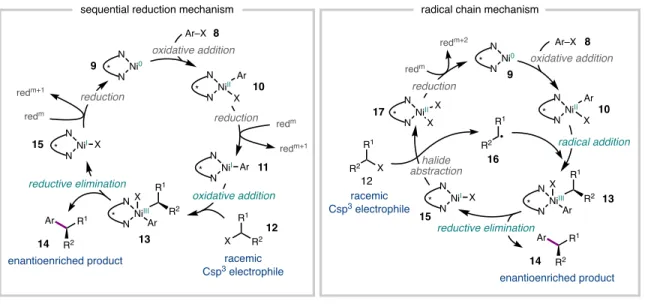
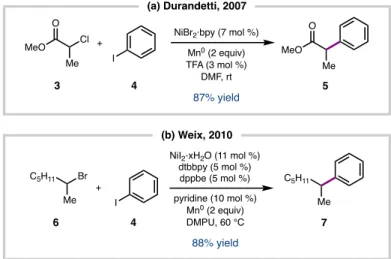
The work presented in the following sections represents the state of the art when we began our own studies with the aim of applying enantioselective Ni-catalyzed RCCs to natural product synthesis (Chapter 5); we note that additional studies (especially regarding mechanistic considerations) are available, and we discuss them in later chapters. In 2013, the Reisman group reported the first highly enantioselective Ni-catalyzed reductive cross-coupling (Figure 2.5).40 In this reaction, racemic benzyl chlorides were cross-coupled with acyl chlorides using a NiII pre-catalyst, a chiral bis(oxazoline ) ) (BOX) ligand (L1), and Mn0 as the terminal reductant. Importantly, the addition of dimethylbenzoic acid (DMBA) was found to suppress homocoupling of the Csp3 electrophile.
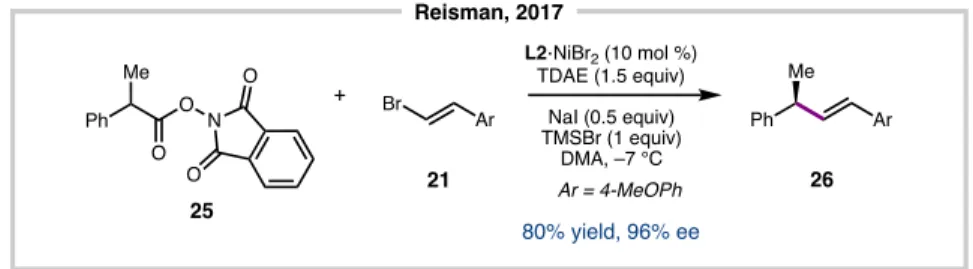
In 2014, Reisman and co-workers reported a related reaction in which alkenyl bromides undergo Ni-catalyzed enantioselective RCC with benzylic chlorides (Figure 2.6a).41 BOX Chiral L2 was identified as the optimal ligand for this reaction, giving given to products that carry stereo audio. in excellent ee when the reaction was carried out in DMA. NaI was determined to be an important additive in the reaction, improving the yield of 22 and decreasing the formation of the dibenzyl homodimer. While efforts to make reductive couplings more stable and scalable have been reported for racemic coupling reactions, comparable asymmetric efforts are few in number.8,10,11 The Reisman group showed that enantioselective reductive alkenylation reactions catalyzed by Ni, such as that between 18 and 21 to give 22, can be directed electrochemically (Figure 2.6c).45 In addition, for Ni-catalyzed asymmetric reductive alkenylation of N-hydroxyphthalimide (NHP) esters, 46,47 the most promising results good ones were obtained with the organic reductant tetrakis(dimethylamino)ethylene (TDAE);8,48 Mn0 and Zn0 as terminal reductants provided significantly lower yields (Figure 2.7).49 The coupling of NHP esters was useful for improving the field of benzylic systems. electron-rich, where the corresponding benzyl chlorides were unstable.
Despite early success with activated Csp3 coupling partners, variation of the Csp2 electrophile required chiral ligands outside the BOX family. In 2015, Reisman and co-workers reported a Ni-catalyzed asymmetric RCC of α-chloronitriles and (hetero)aryl iodides (Figure 2.8).51 This reaction required a phosphinooxazoline (PHOX) ligand (L3) and provided high yields and enantioselectivities of the secondary nitrile product when TMSCl was used as an additive.38, 52 In the case of diarylalkane formation, the development of a new bioxazoline (BiOX) ligand bearing secondary alkyl substituents with long alkyl chains (L4) was necessary to achieve good yield and enantioselectivity (Figure 2.9a). .53 Interestingly, the coupling of α-chloronitriles or benzyl chlorides with (hetero)aryl iodides worked optimally under similar reaction conditions but required a different ligand. Concurrent with the development of the diarylacan formation in Figure 2.9a, the groups of Doyle and Sigman reported the enantioselective reductive cross-coupling of racemic styrenyl-derived aziridines and aryl iodides using a similar stereoconvergent.
In 2021, we reported that the coupling of similar substrates using L4 with Mn0 as terminal reductant was performed with a similar level of reactivity and enantioselectivity (Figure 2.9d). can be cross-linked with improved enantioselectivity (up to 98% ee) also using L4 as the ligand.
ENANTIOSELECTIVE RCCs OF OLEFINS
Although this transformation successfully linked a series of aryl substituents to the alkene partner, only 1,1-dissubstitution of the alkene was tolerated. The key to these processes is the ability of the catalyst to sequentially engage the olefin and the cross-coupling partner. In a redox-neutral system, Fu and colleagues have shown that intermediate organonickel species can rapidly undergo olefin insertion to form a five-membered ring capable of capturing an electrophile in an enantioselective manner.61 It is believed that the reductive two-component couplings continue via analogous mechanisms.58,60 Oxidative addition of the aryl halide (42 or 45), followed by reduction, is proposed to access a NiI aryl species.
The NiI-alkyl species resulting from this 5-exo-trig cyclization is then ready to undergo oxidative addition of the Csp2 coupling partner (1 or 46) to provide final product 43 or 47, respectively, with high levels of enantioselectivity. Wang and co-workers reported the reductive 1,2-arylalkylation and 1,2-arylbenzylation of unactivated olefins to form enantioenriched benzene-fused cyclic products (Figure 2.12a,b).62 While chiral BiOX ligand L7 for primary bromides is required,62a the coupling of benzyl chlorides was optimal with PyOx L9.62b These reactions are notable for their ability to form indane products; however, the corresponding tetralines are inaccessible, and tetrahydroisoquinolines were formed with significantly reduced ee,. Soon after, the Wang group demonstrated the ability to couple styrene-bound acyl chlorides and Csp3 electrophiles (Figure 2.12c).63 The reaction, proceeding with Mn0 as terminal reductant, was found to produce groups of varying steric mass at the benzyl position tolerated. of 54.
Although the heterocyclic products were available in moderate to good yields with PyOx L9, morpholino-substituted PyOx L10 was required to obtain good levels of enantioselectivity. In 2019, the Diao group reported the first intermolecular enantioselective 1,2-dicarbofunctionalization of activated alkenes, using BiOX L11 (Figure 2.13a).64 Interestingly, catalytic amounts of an N-oxyl radical addition (ABNO) gave the cross linking made possible. styrenes and aryl halides to proceed with consistent and high enantioselectivities. In the following year, Chu and co-workers reported the intermolecular reductive coupling of olefins with (hetero)aryl bromides and perfluorinated alkyl iodides (Figure 2.13b).65 Use of a pendant directing group facilitated the regiospecific reaction of unactivated alkenes.
Chiral BiOX ligands were found to be uniquely effective in this three-component reaction; while previously developed L4 promoted the formation of 1,2-fluoroalkylarylated products in high yields, extension of the alkyl chains of the ligand (L12) did not result in enhanced enantioselectivity. This transformation is a significant advance from intramolecular olefinic RCCs; Difunctionalization of olefins with distinct electrophiles will continue to be an interesting and significant extension of this intermolecular methodology.

CONCLUDING REMARKS
Activated alkyl coupling partners currently dominate the enantioselective RCCs of Csp2 and Csp3 electrophiles, and several limitations remain within this category. Thus, diversifying the pool of competent alkyl(pseudo)halide electrophiles is an important future focus. To access a broader scope of Csp3 coupling partners that can serve as alkyl radical precursors, radical generation mechanisms other than halogen abstraction need to be explored.
For example, using synergistic photoredox/Ni catalysis for C–H functionalization is an exciting new direction; however, making these reactions enantioselective has been a challenge.66,67 Ultimately, the development of new methods for Csp3 radical generation will improve the availability and synthetic applicability of enantioselective RCCs. An advantage of using olefinic coupling partners is the ability to access all-carbon quaternary centers not yet realized in enantioconvergent RCCs. Further development of formally three-component couplings will depend on deeper mechanistic understanding to address the challenges of electrophilic differentiation.
In particular, Ni-catalyzed reductive cross-couplings have enabled the development of mild reaction conditions that provide the desired products in good yields with high levels of enantioselectivity. We are convinced that this field will continue to grow and revolutionize the way carbon-.
Overall, transition metal-catalyzed cross-coupling reactions remain an invaluable tool for the synthesis of small molecules and natural products. Expanding the Medicinal Chemist Toolbox: Comparison of seven C(Sp2)-C(Sp3) cross-coupling methods by library synthesis. -Mediated inter- and intramolecular reductive cross-coupling of unactivated alkyl bromides and aryl iodides at room temperature.
Intra- and intermolecular nickel-catalyzed reductive cross-electrophilic coupling reactions of benzyl esters with aryl halides. Development and performance of a Ni(II)-catalyzed reductive cross-coupling of substituted 2-chloropyridine and ethyl 3-chloropropanoate. Nickel-Catalyzed Cross-Coupling of Photoredox-Generated Radicals: Uncovering a General Manifold for Stereoconvergence in Nickel-Catalyzed Cross-Couplings.
Ketone formation via mild nickel-catalyzed reductive coupling of alkyl halides with aryl acid chlorides. DFT study of the single electron transfer mechanisms in Ni-catalyzed reductive cross-coupling of aryl bromide and alkyl bromide. Ligand Redox Effects in the Synthesis, Electronic Structure and Reactivity of an Alkyl-Alkyl Cross-Coupling Catalyst.
Mechanism and selectivity in nickel-catalyzed cross-electrophilic coupling of aryl halides with alkyl halides. A related reductive cross-coupling of chiral 3,4-epoxy alcohols with aryl iodides gives 1,1-diaryldiol products with enriched ee; see: Banerjee, A.; Yamamoto, H.