This form of marketing communication involves a face-to-face dialogue between two persons or by one person and a group. Message flexibility is an important attribute, as is the immediate feedback that often flows from use of this promotional tool.
For an applied interpretation see David Stringer’s MiniCase entitled Selling the benefits of personal sellingat the end of this chapter.
The aims of this chapter are to examine personal selling as a promotional tool and to consider management’s use of the sales force.
The learning objectives of this chapter are to:
1. consider the different types, roles and tasks of personal selling;
2. determine the strengths and weaknesses of personal selling as a form of communication;
3. explore the ways in which personal selling is thought to work;
4. establish the means by which management can organise a sales force;
5. compare some of the principal methods by which the optimum size of a sales force can be derived;
6. discuss the future role of the sales force.
Aims and learning objectives
Chapter 22
Personal selling
Introduction
In an era when relationship marketing has become increasingly understood and accepted as the contemporary approach to marketing theory and practice, so personal selling characterises the importance of strong relationships between sellers and buyers.
The traditional image of personal selling is one that embraces the hard sell, with a brash and persistent salesperson delivering a volley of unrelenting, persuasive messages at a confused and reluctant consumer. Fortunately, this image is receding quickly as the professionalism and breadth of personal selling has become more widely recognised and as the role of personal selling becomes even more important in the communications mix.
Personal selling activities can be observed at various stages in the buying process of both the consumer and business-to-business markets. This is because the potency of personal com- munications is very high, and messages can be adapted on the spot to meet the requirements of both parties. This flexibility, as shall be seen later, enables objections to be overcome, information to be provided in the context of the buyer’s environment and the conviction and power of demonstration to be brought to the buyer when they request it.
Personal selling is different from other forms of communication in that the transmitted messages represent, mainly, dyadic communications. This means that there are at least two persons involved in the communication process. Feedback and evaluation of transmitted mess- ages are possible, more or less instantaneously, so that these personal selling messages can be tailored and be made much more personal than any of the other methods of communication.
Types of personal selling
One way of considering the types of personal selling is to examine the types of customer served through this communication process:
1. Intermediaries
This involves selling offerings onward through a particular channel network to other resellers. They in turn will sell the offering to other members who are closer to the end-user.
For example, computer manufacturers have traditionally distributed their products through a combination of direct selling to key accounts and through a restricted number of dealers, or value-added resellers. These resellers then market the products (and bundle soft- ware) to their customers and potential customer organisations.
2. Industrial
Here the main type of selling consists of business-to-business marketing and requires the selling of components and parts to others for assembly or incorporation within larger offer- ings. Goodman manufactures car radio systems and sells them to Ford, which then builds them into its cars as part of the final product offering.
3. Professional
This type of selling process requires ideas and offerings to be advanced to specifiers and influencers. They will in turn incorporate the offering within the project(s) they are devel- oping. For example, a salesperson could approach an architect to persuade them to include the alarm system made by the salesperson’s organisation within the plans for a building that the architect has been commissioned to design.
4. Consumer
This form of personal selling requires contact with the retail trade and/or the end-user consumer.
The association of personal selling with the hard sell is receding as the role of personal selling becomes more important in the communications mix.
It will be apparent that a wide range of skills and resources is required for each of these types of selling as a result of which, salespersons usually focus their activities on just one of these types.
The tasks of personal selling
The generic tasks to be undertaken by the sales force have been changing because the environ- ment in which organisations operate is shifting dramatically. These changes, in particular those associated with the development and implementation of new technologies, have had repercussions on the activities of the sales force and are discussed later in this chapter.
The tasks of those who undertake personal selling vary from organisation to organisation, and in accord with the type of selling activities on which they focus. It is normally assumed that they collect and bring into the organisation orders from customers wishing to purchase the offering. In this sense the order aspect of the personal selling tool can be seen as one of four order-related tasks:
z Order takers are salespersons to whom customers are drawn at the place of supply.
Reception clerks at hotels and ticket desk personnel at theatres and cinemas typify this role.
z Order gettersare sales personnel who operate away from the organisation and who attempt to gain orders, largely through the provision of information, the use of demonstration tech- niques and services and the art of persuasion.
z Order collectorsare those who attempt to gather orders without physically meeting their customers. This is completed electronically or over the telephone. The growth of telemar-
keting operations was discussed in the previous chapter, but the time saved by both the buyer and the seller using the tele- phone to gather repeat and low-value orders frees valuable sales personnel to seek new customers and build relationships with current customers.
z Order supporters are all those people who are secondary salespersons in that they are involved with the order once it has been secured, or are involved with the act of ordering, usually by supplying information. Order processing or financial advice services typify this role. In a truly customer-oriented organisations all customer-facing employees will be order supporters.
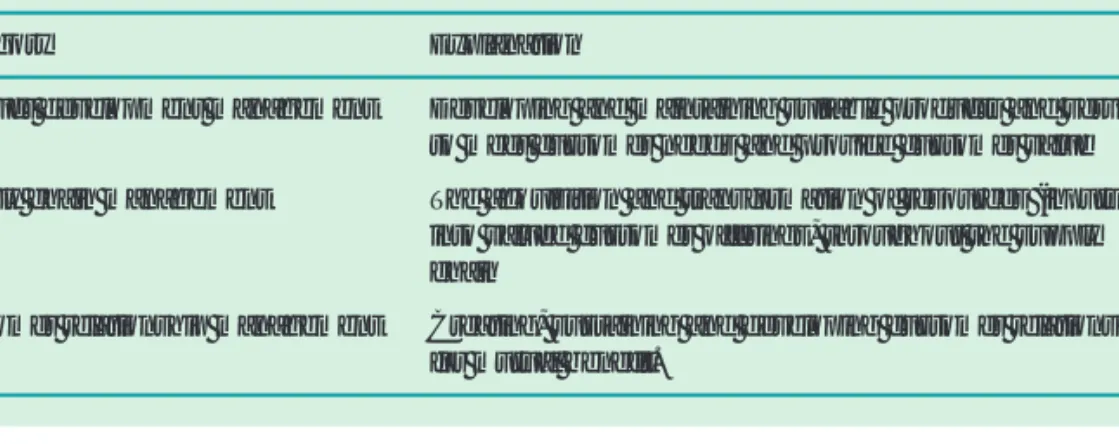
However, this perspective of personal selling is too narrow as it fails to set out the broader range of activities that a sales force can be required to undertake. Salespersons do more than get or take orders. The tasks listed in Table 22.1 provide direction and purpose, and also help to establish the criteria by which the performance of members of the personal selling unit can be evaluated. The organisation should decide which tasks it expects its representatives to undertake.
One view of personal selling is that the sales force is responsible for selling, installing and upgrading customer equipment and another is they are responsible for developing, selling and protecting accounts. The interesting point from both of these views is that responsibilities, or rather objectives, are extended either vertically upstream, into offer design, or vertically down- stream, into the development and maintenance of long-term customer relationships, or both.
It is the last point that is becoming increasingly important. In the business-to-business sector the sales activity mix is becoming much more oriented to the need to build and sustain the relationships that organisations have with their major customers. This will be discussed later.
Some of the key questions that need to be addressed when preparing a communications plan are ‘What will be the specific responsibilities of the sales force?’ and ‘What role will personal selling have relative to the other elements of the mix?’
Personal selling is the most expensive element of the communications mix. The average cost per contact can easily exceed £150 when all markets and types of businesses are considered. It Order gettersare sales personnel who
operate away from the organisation.
is generally agreed that personal selling is most effective at the later stages of the hierarchy of effects or buying process, rather than at the earlier stage of awareness building. Therefore, each organisation should determine the precise role the sales force is to play within the communication mix.
The role of personal selling
Personal selling is often referred to as interpersonal communication and from this perspective Reid et al. (2002) determined three major sales behaviours, namely getting, giving and using information:
z Getting information refers to sales behaviours aimed at information acquisition, for example gathering information about customers, markets and competitors.
z Giving information refers to the dissemination of information to customers and other stakeholders, for example sales presentations and seminar meetings designed to provide information about products and an organisation’s capabilities and reputation.
z Using information refers to the sales person’s use of information to help solve a customer’s problem. Associated with this is the process of gaining buyer commitment through the generation of information (Thayer, 1968, cited by Reid et al., 2002).
These last authors suggest that the using information dynamic appears to be constant across all types of purchase situations. However, as the complexity of a
purchase situation increases so the amount of giving infor- mation behaviours decline and getting information behaviours increase. This finding supports the need for a sales person to be able to recognise particular situations in the buying process and then to adapt their behaviour to meet buyer’s contextual needs.
However, sales people undertake numerous tasks in association with communication activities. Guenzi (2002) determined that some sales activities are generic simply because they are performed by most sales people across a large number of industries. These generic activities are selling, customer relationship management and communicating to
Prospecting Finding new customers
Communicating Informing various stakeholders and feeding back information about the market
Selling The art of leading a prospect to a successful close
Information gathering Reporting information about the market and reporting on individual activities
Servicing Consulting, arranging, counselling, fixing and solving a multitude of customer ‘problems’
Allocating Placing scarce products and resources at times of shortage Shaping Building and sustaining relationships with customers and other
stakeholders
Table 22.1
Tasks of personal sellingPersonal selling is the most expensive element of the communications mix.
As the complexity of a purchase situation increases so the amount of giving information behaviours decline.
Sales people undertake numerous tasks in association with communication activities.
customers. Other activities such as market analysis, pre-sales services and the transfer of information about competitors to the organisation are industry-specific. Interestingly, he found that information-gathering activities are more likely to be undertaken by organisations operating in consumer markets than in b2b, possibly a reflection of the strength of the market orientation in both arenas.
The role of personal selling is largely one of representation. In business- to-business markets sales personnel operate at the boundary of the organ- isation. They provide the link between the needs of their own organisation and the needs of their customers. This linkage is absolutely vital, for a number of reasons that will be discussed shortly, but without personal selling, communication with other organisations would occur through electronic or print media and would foster discrete closed systems. Representation in this sense therefore refers to face-to-face encounters between people from different organisations. Wright and Fill (2001) found that doctors used the sales representatives of pharmaceutical companies as a means of forming images of the companies themselves. In other words, the sales force, whether inten- tionally or not, served as a corporate identity cue and provided valuable signals.
Many authors consider the development, organisation and completion of a sale in a market exchange-based transaction to be the key part of the role of personal selling. Sales per- sonnel provide a source of information for buyers so that they can make the right purchase decisions. In that sense they provide a good level of credibility, but they are also perceived, understandably, as biased. The degree of expertise held by the salesperson may be high, but the degree of trustworthiness will vary, especially during the formative period of the relationship, unless other transactions with the selling organisation have been satisfactory. Once a number of transactions have been completed and product quality established, trustworthiness may improve.
As the costs associated with personal selling are high, it is vital that sales personnel are used effectively and efficiently. To that end, some organisations are employing other methods to decrease the time that the sales force spends on administration, travel and office work and to maximise the time spent in front of customers, where they can use their specific selling skills.
The amount of control that can be exercised over the delivery of the messages through the sales force depends on a number of factors. Essentially, the level of control must be regarded The role of personal selling is
largely one of representation.
It can be argued that members of the sales team must be free to adapt messages at the point of delivery because individual clients are themselves different and have different needs and requirements. Lloyd (1997) believes that, when selling to doctors, medical representatives enter into conversations that are appropriate for individual doctors.
An example concerns two products manufactured by Schering-Plough. They have two hayfever products (one nasal and the other an oral antihistamine), and sales representatives are expected to decide which to present (in detail) to doctors, based on the representatives’ knowledge and experience of each individual doctor’s preferences and the needs of their patients.
This flexibility is framed within the context of the product strategy. Decisions that impact upon strategy are not allowed. There is freedom to adapt the manner in which products are presented, but there is no freedom for the sales representatives to decide the priority of the products to be detailed.
Question
Why do you believe the presentation of medical products is controlled so strictly?
Task
Next time you come into contact with a sales person, in a non-work situation, find out if the products or ser- vice they sell are prioritised.
Hayfever under control
ViewPoint 22.1
as low, because each salesperson has the freedom to adapt messages to meet changing circum- stances as negotiations proceed. In practice, however, the professionalism and training that many members of the sales force receive and the increasing emphasis on measuring levels of customer satisfaction mean that the degree of control over the message can be regarded, in most cir- cumstances, as very good, although it can never, for example, be as high as that of advertising.
Strengths and weaknesses of personal selling
There are a number of strengths and weaknesses associated with personal selling. It is interesting to note that some of the strengths can in turn be seen as weaknesses, particularly when manage- ment control over the communication process is not as attentive or as rigorous as it might be.
Strengths
Dyadic communications allow for two-way interaction that, unlike the other communication tools, provides for fast, direct feedback. In comparison with the mass media, personal selling allows for the receiver to focus attention on the salesperson, with a reduced likelihood of distraction or noise.
There is a greater level of participation in the decision process by the vendor than in the other tools. When this is combined with the power to tailor messages in response to the feed- back provided by the buyer, the sales process has a huge potential to solve customer problems.
Weaknesses
One of the major disadvantages of personal selling is the cost. Costs per contact are extremely high, and this means that management must find alternative means of communicating partic- ular messages and improve the amount of time that sales personnel spend with prospects and customers. Reach and frequency through personal selling are always going to be low, regard- less of the amount of funds available.
Control over message delivery is very often low and, while the flexibility is an advantage, there is also the disadvantage of message inconsistency. This in turn can lead to confusion (a misunderstanding perhaps with regard to a product specification), the ramifications of which can be enormous in terms of cost and time spent by a variety of individuals from both parties to the contract.
The quality of the relationship can, therefore, be jeopardised through poor and inconsistent communications.
When personal selling should be a major part of the communications mix
In view of the role and the advantages and disadvantages of personal selling, when should it be a major part of the communications mix? The following is not an exhaustive list, but is presented as a means of considering some of the important issues: complexity, network factors, buyer significance and communication effectiveness.
Complexity
Personal selling is very important when there is a medium to high level of relationship complexity. Such complexity may be associated either with the physical characteristics of the product, such as computer software design, or with the environment in which the negotiations
Costs per contact are extremely high.
Personal selling is very important when there is a medium to high level of relationship complexity.
are taking place. For example, decisions related to the installation of products designed to automate an assembly line may well be a sensitive issue. This may be due to management’s atti- tude towards the operators currently undertaking the work that the automation is expected to replace. Any complexity needs to be understood by buyer and seller in order that the right product is offered in the appropriate context for the buyer. This may mean that the buyer is required to customise the offering or provide assistance in terms of testing, installing or sup- porting the product.
When the complexity of the offering is high, advertising and public relations cannot always convey benefits in the same way as personal selling. Personal selling allows the product to be demonstrated so that buyers can see and, if necessary, touch and taste it for themselves.
Personal selling also allows explanations to be made about particular points that are of con- cern to the buyer or about the environment in which the buyer wishes to use the product.
Buyer significance
The significance of the product to the buyers in the target market is a very important factor in the decision on whether to use personal selling.
Significance can be measured as a form of risk, and risk is associated with benefits and costs.
The absolute cost to the buyer will vary from organisation to organisation and from consumer to consumer. The significance of the purchase of an extra photocopier for a major multinational organisation may be low, but for a new start-up organisation or for an established organisation experiencing a dramatic turnaround, an extra photocopying machine may be highly significant and subject to high levels of resistance by a number of different internal stakeholders.
The timing of a product’s introduction may well be crucial to the success of a wider plan or programme of activities. Only through personal selling can delivery be dovetailed into the client’s scheme of events.
Communication effectiveness
There may be a number of ways to satisfy the communication objectives of a campaign, other than by using personal selling. Each of the other communication tools has strengths and weak- nesses; consequently differing mixes provide different benefits. Have they all been considered?
One of the main reasons for using personal selling occurs when advertising alone, or any other tool or medium, provides insufficient communications. The main reason for this inad- equacy surfaces when advertising media cannot provide buyers with the information they require to make their purchasing decisions. For example, someone buying a new car may well observe and read various magazine and newspaper advertisements plus information on the web. The decision to buy, however, requires information and data upon which a rational decision can be made. This rationality and experience of the car, through a test drive perhaps, balances the former, more emotional, elements that contributed to the earlier decision.
The decision to buy a car normally evokes high involvement, and motivation occurs through the central route of the ELM. Therefore, car manufacturers provide a rich balance of emotional and factual information in their literature, from which a prospective buyer seeks further information, experience and reassurance from car dealers, who provide a personal point of contact. Car buyers sign orders with the presence and encouragement of sales persons.
Very few cars are bought on a mail order basis, although some are bought over the Internet.
Personal selling provides a number of characteristics that make it more effective than the other elements of the mix. As discussed, in business-to-business marketing the complexity of many products requires salespeople to be able to discuss with clients their specific needs; in other words, to be able to talk in the customer’s own language, to build source credibility through expertise and hopefully trustworthiness, and build a relationship that corresponds with the psychographic profile of each member of the DMU. In this case, mass communi- cations would be inappropriate.
Significance can be measured as a form of risk.
There are two further factors that influence the decision to use personal selling as part of the communications mix. When the customer base is small and when it is dispersed across a wide geographic area, it makes economic sense to use salespersons, as advertising in this situation is inadequate and ineffective.
However, web sites and the use of interactive marketing com-
munications can provide increased communication richness and obviate the need for sales representatives in some situations.
Channel network factors
If the communications strategy combines a larger amount of push rather than pull activities, then personal selling is required to provide the necessary communications for the other mem- bers of the channel network. Following on from this is the question regarding what infor- mation needs to be exchanged between members and what form and timing the information should be in. Handling objections, answering questions and overcoming misconceptions are also necessary information exchange skills.
When the number of members in a network is limited, the use of a sales force is advisable, as advertising is inefficient. Furthermore, the opportunity to build a close collaborative rela- tionship with members may enable the development of a sustainable competitive advantage.
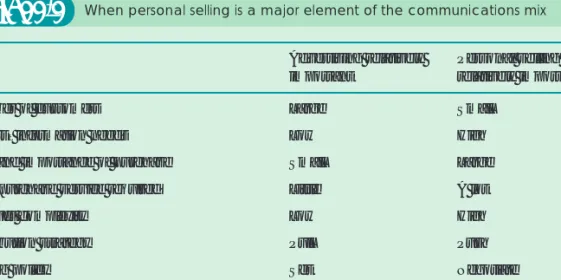
Cravens (1987) suggested that the factors in Table 22.2 are important and determine when the sales force is an important element of the communications mix.
The roles of personal selling and the sales force are altering because the environment in which organisations operate is changing dramatically. The repercussions of these changes will become evident following the discussion of the tasks that personal selling is expected to complete.
Web sites and the use of interactive marketing communications can provide increased communication richness
Advertising relatively Personal selling important relatively important
Number of customers Large Small
Buyers’ information needs Low High
Size and importance of purchase Small Large
Post-purchase service required Little A lot
Product complexity Low High
Distribution strategy Pull Push
Pricing policy Set Negotiate
Web-enabled communications and exchanges High Low
Resources available for promotion Many Few
Table 22.2
When personal selling is a major element of the communications mixSource: Adapted from Cravens (1987).
How personal selling works: sales processes
A number of conceptual schemes have been proposed to explain the various stages in the sales process. These can be distilled into nine main stages, set out in Figure 22.1. The alignment and rigidity of the sequence should not be overstated, as the actual activities undertaken within each of these stages will vary not only from organisation to organisation but also between salespeople.
This rather simplistic approach to the sales process fails to explain how a salesperson should approach a customer or why some negotiations are successful and others are not. There have been many attempts to explain how the personal selling process works. One of the first methods proposed was discussed in Chapter 8 when exploring the hierarchy of effects models.
The AIDA sequence put forward by Strong (1925) says that prospects must be drawn along a continuum of mental states, from attention to interest, desire, and finally stimulation to act in accordance with the vendor’s wishes. This approach allows for a good deal of flexibility in the salesperson’s approach and permits movement around a central theme.
A further model, the stimulus–response model, suggests that if a salesperson can create the right set of circumstances then it is probable that the buyer will react in a particular way.
Therefore, by controlling the circumstances of the sales process it is possible to induce the desired response. The salesperson is trained to deliver a particular stimulus (that is, what to say) and the buyer provides predictable responses, to which the salesperson has a number of expected responses. The sales presentation is therefore ‘canned’, ensuring that all aspects of the sale are covered in a logical order.
Jolson (1975) studied the results of such canned or prepared presentations with those that are personalised and determined more ‘on the hoof ’. His results indicated that buyers learned more through on-the-hoof presentations, but revealed that buyers had greater intentions to
The main stages in the sales process
Figure 22.1
The stimulus–response model suggests that if a salesperson can create the right set of circumstances then it is probable that the buyer will react in a particular way.
buy after the prepared presentation. This behavioural view is vendor-led and discounts the cognitive processes of the buyer in its attempt to control the process and the differing needs of different buyers.
A third model focuses on buyers and their needs. The role of the salesperson is to assist buyers to find solutions to their problems. According to Still et al.(1988), the salesperson needs to understand the cognitive processes of buyers in respect of their decision to buy or not to buy. This approach has been termed the
‘buying formula’ and is based on the satisfactions that a buyer experiences when placing orders as a solution to perceived prob- lems (from work based on Strong, 1938).
The sequence of the model, therefore, is that a buyer first recognises a problem or a need.
A solution is then found, which is purchased, and the buyer experiences a level of satisfaction.
This formula can be seen in Figure 22.2. The solution contains two components, the product or service and the name of the organisation or the salesperson who facilitated the solution.
When a buying habit is formed, the formula adjusts to that in Figure 22.3. To complete the formula, buyers must regard the product and the source as adequate and experience pleasant feelings when thinking of the components to the solution (see Figure 22.4).
Still et al. (1988) emphasise the need for salespersons to ensure that all the components of the buying habit are in place. For example, it is important that the buyer knows why the
The ‘buying formula’ is based on the satisfactions that a buyer experiences when placing orders as a solution to perceived problems.
The mental stages involved in a purchase
Figure 22.2
The buying formula
Source: Still and Cundiff, Sales Management: Decisions, Strategies and Cases, 5th,
© 1988. Electronically reproduced by permission of Pearson Education, Inc., Upper Saddle River, New Jersey.
Figure 22.3
product is the best one to resolve the identified problem and they must also have a pleasant feeling towards the source. This means that any competitor attack will be rebuffed because the current solution is deemed adequate. Reasons and pleasant feelings constitute the major elements of defence in a buying habit.
While some people might reject this approach, the essence of the buying formula is that a long-term relationship can develop as a result of the satisfaction with the solutions offered by the salesperson. If solutions are based on knowledge and experience that the buyer can iden- tify and empathise with, then the strength of the relationship is likely to be reinforced. It will come as no surprise that successful salespeople appear to hold high levels of interpersonal skills, are able to relate to customer problems, have solved similar problems and are experts at solving such problems (Rothschild, 1987).
A host of factors can influence the buying process, but one growing area of interest concerns the symbolic meaning of offerings and the communication aspects of products and services. This is referred to as semiotics, the science of signs and meaning. Through consump- tion, people communicate non-verbally who they are and the roles they are playing at a par- ticular moment. Consumption allows people self-expression. This perspective is important to the salesperson, as the perception that buyers have of them can influence the sales process.
Stuart and Fuller (1991) found that a buyer’s initial perception of a salesperson, the products and the organisation they represent, is strongly influenced by the clothing worn by the repres- entative. Dress codes and uniforms, they conclude, can be used by an organisation to shape the desired customer perceptions of an organisation’s size and ethics.
The implication is that marketing communications should not ignore issues about the dress code of an organisation. Although expectations have changed radically since IBM insisted that all its representatives wore a white shirt and plain tie, dark blue suit and black shoes, the way salespeople present themselves affects the perception of others and can influence the outcome of the sales process.
‘Communication apprehension’ refers to the degree to which an anxiety concerning communication will negatively affect a
The complete buying formula
Source: Still and Cundiff, Sales Management: Decisions, Strategies and Cases, 5th,
© 1988. Electronically reproduced by permission of Pearson Education, Inc., Upper Saddle River, New Jersey.
Figure 22.4
‘Communication apprehension’ refers to the degree to which an anxiety concerning communication will negatively affect a salesperson’s performance.
salesperson’s performance. There appears to be a range of situations in which apprehension might be observed. McCroskey (1984) developed a framework depicting different apprehen- sion levels. Essentially there are two main conditions. One is a condition that affects indi- viduals in situations that normal people would not consider threatening. The other is a state that refers to the normal apprehension felt by people when speaking in meetings, group situ- ations, dyadic communications and public speaking situations. Generally speaking, it is not uncommon to find that above-average sales performance is achieved by individuals who have the lowest level of communication apprehension. Not surprisingly, those with low levels of sales performance tend to have high levels of communication apprehension (Pitt et al., 2000).
Having repeatedly failed to get appointments with major organisations in order to sell his services about compliance with the regulations in the technology sector, Steve Kerner tried a different approach. He wrote to Dell and offered to pay for their time if they agreed to meet him. Not only did they meet but he got the job, didn’t have to pay and they gave him a referral to AT&T.
Richard Knight runs an advertising agency in Hampshire, which concentrates on poster-sized advertise- ments. However, he sensed that prospects were bored and cynical of standard presentations so he has adopted a number of different approaches. One of these requires him to fold a poster until it is small and proclaim that this size will cost £300 (in a local paper). He unfolds it once and announces that will cost £600 and then completely unfolds it and states that he will put this at bus stops for just £40. The response is immediate and based on the visual impact of the value that was so clearly demonstrated.
Source: Armistead (2002).
Question
Do you think these examples of alternative selling approaches can only be applied by small and medium- sized organisations?
Task
Think through how you would present an air conditioning system and a new brand of fruit juice.
Different selling approaches
A further issue concerns the degree of ambiguity that both parties to a sales meeting might experience. Such ambiguity might refer to specific product-related information, failure to understand the problem that needs to be resolved, the time available to resolve it or the impact on other stakeholders related to the specific situation.
Sales force management and organisation
The target market and profile of the customer will have been established previously during the development of the communication plan. In particular, the communication strategy should have indicated the degree of push and pull to be used and will have illuminated detail about the nature of the channels in which the salesperson is to operate. Such information is import- ant, as it helps to shape the sales strategy and the messages to be transmitted. Essentially, the salesperson acts as a link between a supplier and a customer, the primary role being to arrange matters so that the relationship can be continued and developed to the mutual benefit of both organisations and their participants.
ViewPoint 22.2
The primary and traditional sales channel is the field sales force.
These are people who are recruited and trained to find prospective customers, to demonstrate or explain the organisation’s products and services and to persuade prospects that they should buy the offering.
Orders are then signed, and the salesperson reports the order to their organisation, which then fulfils the details of the customer’s order, as agreed. However, while life is not this simple, this broad perspective is assumed to be the primary sales channel of many organisations, particu- larly those operating in the business-to-business sector.
In some ways, salespersons are like any other unit of resource in that they need to be deployed in a way that provides maximum benefit to the organisation. Grant and Cravens (1999) suggest that the effectiveness of the sales organisation (or unit) is determined as a result of two main antecedents: the sales manager and the sales force itself. These are shown in Figure 22.5.
An organisation is linked to its customers through three main processes that Srivastava et al.(1999) refer to as core business capabilities, namely product development management, supply chain management and customer relationship management (see Table 22.3). Ingram et al. (2002) make the point that the centrality of the customer to the organisation highlights the crucial role of sales strategy with regard to the organisation’s overall customer interaction process.
In order to decide on an appropriate sales strategy, the nature of the desired communi- cation needs to be examined. Are there to be salespersons negotiating individually, or as a team with a single buyer or buying team? Is a sales team required in order to sell to buying teams or will conference and seminar selling achieve the desired goals? What is the degree of importance of the portfolio of accounts, and how should the organisations be contacted?
The primary, and traditional, sales channel is the field sales force. These are people who are fully employed by the organisation and are referred to as the direct sales force. Salespersons, like any other unit of resource, should be deployed in a way that provides maximum benefit to the organisation. Sales organisation effectiveness results from the performance of salespeople, organisational factors and various environmental factors (Baldauf et al., 2002).
The primary and traditional sales channel is the field sales force.
Antecedents of sales organisational effectiveness Source: Grant and Cravens (1999). Used with kind permission.
Figure 22.5
The performance of salespeople is a measure of their work or task-related behaviours, and the results of their activities and inputs. Therefore, a sales management control strategy should refer to the degree to which sales managers actively manage the inputs as a well as reward against targeted outcomes (sales, market share, etc.).
From this it is possible to identify two main sales management approaches, behaviour based- and outcome-based control systems (Baldauf et al., 2002). Essentially, control through behaviour-based systems is founded upon managing the
inputs or processes to a salesperson and rewarding them with a high fixed salary and low commission. Conversely, control through outcome-based approaches is characterised by a focus on results, little managerial supervision and direction and high levels of commission as an incentive to perform. Some see the outcome–behaviour systems as a continuum (Anderson and Oliver, 1987) whereas others see these as two discrete activities (Piercy et al.2004).
Many organisations use a hybrid approach, but research by Baldauf et al.indicates that sales managers appear to utilise a ‘coaching rather than command and control management styles’.
The emphasis appears to be on the long term and the value of developing relationships. The performance of salespeople is therefore enhanced by sales management strategies that are based on generating positive behaviour. However, results from previous work undertaken by Piercy et al. (1998) supported many previous findings that salespeople with high levels of behaviour performance also exhibit high levels of outcome performance. This implies that sales managers should spend a greater amount of their time selecting, training and developing salespeople rather than just selecting, directing and measuring results. Further research by Piercy et al.(2004) indicates that the way sales managers emphasise outcome or behaviour controls needs to reflect region or country differences, local personnel inputs and the need for flexibility in the implementation of control strategies.
From this brief overview of sales management responsibilities it can be concluded that they are responsible for five broad activities associated with salespeople. These are:
z selection and recruitment;
z training;
z size and deployment;
z motivation and supervision;
z evaluation, control and reward.
Of these space is devoted only to the issue of size and deployment.
Category Explanation
Product development management Developing and maintaining suitable products and services to meet customer needs and provide customer value Supply chain management The acquisition and transformation of resources (inputs)
into valued customer offerings, throughout the supply chain
Customer relationship management Creating, sustaining and developing customer relationships for mutual benefit.
Table 22.3
Core business capabilitiesSource: Adapted from Srivastava et al.(1999) by permission of American Marketing Association.
Control through outcome-based approaches is characterised by a focus on results, little managerial supervision and direction and high levels of commission as an incentive to perform.
Sales force size and structure
One of the first questions that needs to be addressed concerns the type of sales force to be used (assuming the decision has been made that some form of personal selling is required in the communications mix). Further questions are concerned with how many salespersons are required and where and how they should operate. Decisions regarding the type, structure, size and territory of the sales force will be discussed on the basis that this is the only sales channel used by an organisation.
There are a number of ways in which an organisation can structure the sales force, but there are three broad approaches (geographic, product and market/customer) that most organisations have used. The following examples are based upon Tgi PLC, which designs, manufactures and distributes loudspeaker products. These are purely examples of how it might organise its sales force and are not intended to represent the way in which Tgi approaches its markets.
Geographic-based sales force
The most common and straightforward method of organising a sales force is to assign individuals to separate geographic territories (see Figure 22.6). In this type of sales force the salesperson is responsible for all the activities necessary to sell all products to all potential customers in the region or area in which the territory is located. This method of assignment is used by new companies, in situations where customers tend to buy a range of products, where there is little difference in the geographic spread of the products or when resources are limited.
Strengths
This approach provides for the lowest cost, concentrates the selling effort throughout the territory and allows for a quick response to regional or local needs. This structure also ensures that customers only see one person from the selling organisation and are not at risk of becom- ing the recipient of multiple and conflicting messages.
The most common and straightforward method of organising a sales force is to assign individuals to separate
geographic territories
A geographically based sales force structure
Figure 22.6
Weaknesses
The level of specialised knowledge is reduced, as many products have to be promoted by each salesperson. Furthermore, salespeople under this structure tend to be allowed greater freedom in the design and execution of their working day. Consequently, the number of new customers is often low and the line of least resistance is usually pursued. This may also conflict with the objectives of the organisation, as, for example, call patterns may not be compatible with the overall goals of the sales force.
Product-based sales force
Under this type of structure, the organisation has different sales teams, each carrying a par- ticular line of products (see Figure 22.7). This is often used by organisations with large and diverse product lines. Also, organisations with highly technical and complex products, which require specialist knowledge and particular selling techniques, prefer this form of sales force structure.
Strengths
The most important advantage of this approach is that it allows the development of product knowledge and technical expertise. In business-to-business markets this factor can lead to improved source credibility, since the level of expertise, and possibly trustworthiness, can be important if the messages are to be persuasive and effective. If the organisation’s production facilities are organised by product (separate factories), each with a sales team operating out of the unit, then there can be increased cooperation, which in turn benefits the customer.
Sales management is better able to control the allocation of the selling effort across all prod- ucts under this type of structure. If greater focus on a particular product is required, then more salespersons can be allocated appropriately.
A product-based sales force structure
Figure 22.7
Weaknesses
The major disadvantage is that there is a high probability that there will be duplication of sales effort. A customer could be called on by a number of different salespeople, all from the same organisation.
Selling expenses are driven higher and management time and costs rise as the company attempts to achieve coordination.
Market-based sales force
Organising a sales force by market or customer type is an activity complementary to the marketing concept (see Figure 22.8). This form of sales force organisation has increased in popularity, as it allows products with many applications to be sold into many different markets and hence to different customers.
Strengths
By calling on a single type of customer, a greater understanding of customer needs develops.
Such customer specialisation can be used to foster specialist selling approaches for different markets. The size of specialist sales forces can be varied in accordance with internal and external requirements. This is important for organisations operating in highly competitive and fast-changing environments.
Weaknesses
As with the product structure, duplication is a primary difficulty. The costs, however, of operating under this form of structure are higher than any of the others.
These three approaches to sales force design are not mutually exclusive, and most major organisations use a combination of the three to meet the needs of their various stakeholders.
A market-based sales force structure
Figure 22.8
As Still et al. (1988) state, the sub-division of the structure is usually related to primary and secondary needs for marketing success. Most organisations use geography as a sub-division, but whether this is a pri- mary or secondary sub-division depends largely on the importance of customer or product sub-divisions for the achievement of com-
petitive advantage. Such hybrid structures are not static and should evolve as the organisation and the environment in which it operates develop. Tgi uses the customer approach not only for the sales force but at an SBU (strategic business unit) level as well.
Sales force size and shape
The size of the sales force needs to be determined on a regular basis because the environments in which sales forces are operating are changing rapidly. The decision regarding the size of the sales force presents a dilemma. Increasing the size of the sales force will increase sales revenue, but it will also increase costs. A balance needs to be achieved and the decision is often a blend of market and resource factors. Market-related issues concern the number of potential customers, the sales potential of each of these accounts, the geographic concentration of the customers and predictions concerning the strength and volatility of the economy. Resource- related issues concern the corporate and marketing strategy, competitive conditions and the availability of financial resources.
There are many different approaches to the determination of the appropriate sales force size. Many of the more recent ones are based on sophisticated software, but these are derived essentially from three main approaches: the breakdown, workloadand sales potentialmethods.
The intuitive method is a label for all of the methods not based on reason, logic, market information or, in some cases, sense. At one extreme are the hunch and the ‘I have been in this business for x years’ approach, while at the other extreme there is the ‘If it is good enough for the competition, then it is good enough for us’ approach. These are to be rejected.
The breakdown method
This is the simplest method. Each salesperson is viewed as possessing the same sales produc- tivity potential per period. Therefore, divide the total expected sales by the sales potential and the resultant figure equates to the number of salespeople required:
n =
where nis the number of salespeople required, svis the anticipated sales volume and spis the estimated sales productivity of each salesperson/unit.
This technique is flawed in that it treats sales force size as a consequence of sales, yet the reverse is probably true. A further difficulty concerns the estimate of productivity used. It fails to account for different potentials, abilities and levels of compensation. Furthermore, there is no account of profitability as it treats sales as an end in itself.
The workload method
Underlying this method is the premise that all salespeople should bear an equal amount of the work necessary to service the entire market. The example offered here is based on work by Govoni et al. (1986).
The first task is to classify customers into categories based on the level of sales to each account. The ABC rule of account classification holds that the first 15 per cent of customers account for 65 per cent of sales (A accounts), the next 20 per
sv sp
The three approaches to sales force design are not mutually exclusive.
The premise is that all salespeople should bear an equal amount of the work necessary to service the entire market.
cent will produce 20 per cent of sales (B accounts) and the final 65 per cent will yield only 15 per cent (C accounts).
z Task 1. Classify customers into categories:
Class A: large/very attractive =300 Class B: medium/moderately attractive =400
Class C: small/unattractive =1,300
z Task 2. Determine the frequency and desired duration of each call for each type of account:
Class A: 15 times/pa 95 mins/call =23.75 hours Class B: 10 times/pa 63 mins/call =10.50 hours Class C: 6 times/pa 45 mins/call =4.50 hours
z Task 3. Calculate the workload in covering the market:
Class A: 300 accounts 23.75 hours/account =7,125 hours Class B: 400 accounts 10.50 hours/account =4,200 hours Class C: 1,300 accounts 4.50 hours/account =5,850 hours
Total workload =17,175 hours
z Task 4. Determine the time available per salesperson:
40 hours/week ×46 weeks/pa =1,840 hours
z Task 5. Determine selling/contact time per salesperson:
Contact: 45% =828 hours
Travelling: 31% =570 hours
Non-selling: 24% =442 hours
z Task 6. Calculate the number of salespersons required:
number of salespersons = =20.74
A total of 20 or 21 salespeople would be required using this method. While this technique is easy to calculate, it does not allow for differences in sales response among accounts that receive the same sales effort. It fails to account for servicing and assumes that all salespersons have the same contact time. This is simply not true. One further shortcoming is that the profitability per call is neglected.
The sales potential method
Semlow (1959) was one of the earliest to report the decreasing-returns principle when applied to sales force calculations. The principle recog- nises that there will be diminishing returns as extra salespeople are added to the sales force. For example, one extra salesperson may gen- erate £120,000, but two more may only generate a total of £200,000 in new sales. Therefore, while the first generates £120,000, the other two only generate £100,000 each.
Semlow found, for example, that sales in territories with 1 per cent potential generated
£160,000, whereas sales in territories with 5 per cent averaged £200,000. Therefore, 1 per cent potential in the second territory equates to £40,000 (200,000/5) and £160,000 (160,000/1) in the first.
The conclusion reached was that a higher proportion of sales per 1 per cent of potential could be realised if the territories were made smaller by adding salespeople. As asked above, what is the optimum number of salespersons, because costs rise as more salespeople are added?
Semlow’s work provides the basis for some of the more sophisticated techniques and derivatives of the incremental or marginal approach. It is relatively simple in concept but exceedingly difficult to implement. The conclusion, that a salesperson in a low-potential territory is expected to achieve a greater proportion of the potential than a colleague in a high- potential territory is, as Churchill et al. (1990) say, ‘intuitively appealing’.
17,175 828 total work load
contact hours
The principle recognises that there will be diminishing returns as extra salespeople are added to the sales force.
Territory design
Having determined the number of salespeople that are necessary to achieve the set promotion objectives, attention must be given to the shape, potential and equality of the territories to be created. The decomposition of the total market into smaller units facilitates easier control of the sales strategy and operations. A sales territory is a grouping of customers and prospects assigned to an individual or team of salespeople. The reason for the establishment of sales territories is mainly oriented to aspects of planning and control. Sales territories enable the organisation to cover the designated market, to control costs, to assist the evaluation of sales- person performance, to contribute to sales force morale and to provide a bridge with other promotional activities, most notably advertising (Still et al., 1988).
Churchill et al. (1990) suggest that the steps depicted in Figure 22.9 are the most appro- priate. The objective is to make all territories as equal as possible with respect to, first, sales potential, as this facilitates performance evaluation, and, second, work effort, as this tends to improve morale and reduce levels of conflict.
The most basic unit is a small geographic area. Small units permit easier adjustments to be made and allow for the reassignment of accounts from one salesperson to another. Units can
Key steps in territory design
Source: Churchill et al.(1990) Sales Force Management, 3rd edition. Reproduced with permission of The McGraw-Hill Companies.
Figure 22.9
be based on counties, local authority areas, postcodes (important in Greater London and other metropolitan areas), cities and regions.
Once the market potential in each unit has been established, approximate territories can be set up. From this point, account analysis helps to determine the call frequency and duration necessary for the larger accounts. A matrix approach, based on the attractiveness of the account and the ability of the organisation to exploit the opportunities presented, can help this part of the management process, as shown in Figure 22.10. The penultimate step is to make adjust- ments to the boundaries of the tentative territories established earlier. These adjustments are designed to equalise potential and workload in each area.
It should be remembered that sales potential is never static, at the market, the territory or the account level. In particular, potential will vary with call frequency. It will be apparent that there is a relationship between account attractiveness (AA) and account effort (AE). While AA determines how hard the account should be worked, the frequency and duration will affect the sales derived from each account. There is a need to balance potentials and workloads if computer programs, such as CallPlan, are not being used.
There are several methods available. Empirically based methods use regression analysis to represent the relationship between sales and a number of key sales variables such as the number of calls, potential or workload. Judgement-based methods require the salesperson to estimate the sales/sales call ratio so that the optimum number of calls can be made on each account. The subjectively based method involves executives making changes in call frequency to reflect changes in the mar- ket or to achieve a specific objective.
The final task is to assign salespeople to territories. It should be remembered that salespeople have varying levels of ability.
To overcome this disparity, the most able is allocated an index of 1.00 and all others rated relative to that individual. For
Account planning matrix
Source: Churchill et al.(1990) Sales Force Management, 3rd edition. Reproduced with permission of The McGraw-Hill Companies.
Figure 22.10
Judgement-based methods require the salesperson to estimate the sales/sales call ratio so that the optimum number of calls can be made on each account.
example, an index of 0.75 means that a salesperson could achieve 75 per cent of the business that a salesperson with an index of 1.0 could achieve in the same territory. Salespeople can then be allocated on a basis that maximises the return to the organisation.
Grant and Cravens (1999) found that the effectiveness of a sales organisation is partly determined by the design of sales territories. For sales organisations that place high value on directing, evaluating, rewarding and monitoring, territory design and sales force commitment appear to be linked to sales unit effectiveness. From their research they state that territory design plays a ‘pivotal role in sales unit effectiveness’. Decisions regarding the size, shape and form of the sales force need to be made once a strategic decision has been made to employ a sales force. An alternative approach is to hire or rent a sales force, by region, product or time, to suit the needs of the task at hand. These temporary sales forces are recruited from com- panies in the field marketing sector. This sector has grown in significance and stature over the past few years, and more detail is provided in Chapter 29.
Changing channels
The previous discussion of the role of the field sales force was pre-empted by the statement that this is the primary sales channel for many organisations in the business-to-business sector. There are, however, a growing number of organisations that see a different role for the sales force and which are introducing other sales channels in order to improve productivity and the bottom line. These have been explored in other parts of the book, most notably Chapter 21. There are many implications for organisations arising from the development of a multichannel approach. Two of these include team selling and sales force automation, which are discussed below. Others include key and global account management, which are discussed in Chapter 29, and direct marketing, which is the subject of Chapter 21.
Team selling
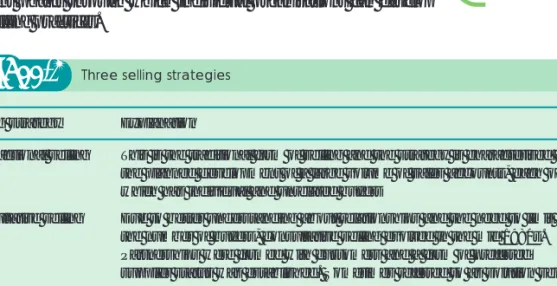
Three distinct selling strategies can be identified: transactional, consultative and alliance sales (Rackham and DeVincetis, 1999) (see Table 22.4). These strategies represent different eras of thought and approaches to selling and sales management. However, they also represent phases through which individual organisations can develop their selling practices.
Three distinct selling strategies can be identified: transactional, consultative and alliance sales.
Selling strategy Explanation
Transactional selling This is the traditional form of selling and the strategy is characterised by the planned development of a large volume of sales accounts, each of which has individual and unrelated buyers
Consultative selling Due to better understanding about relationships and the need to limit the number of buyers, consultative selling evolved in the mid 1980s.
Partnerships were formed with customers and a form of preferred supplier status was established. Sometimes referred to as solution selling Alliance sales An alliance sales strategy was developed when various processes of the
selling organisation were integrated with those of the partner. Sales moved from a quantitative perspective (transactional) to a qualitative perspective (both consultative and alliance-based).
Table 22.4
Three selling strategiesSource: Adapted from Rackham and DeVincetis (1999).
In order that partnership and more collaborative selling approaches be implemented it has become increasingly necessary and common for organisations to assign a team of sales- people to meet the needs of key account customers. A variety of different skills are thought necessary to meet the diversity of personnel making up the DMUs of the larger organisations.
Consequently, a salesperson may gain access to an organisation, after which a stream of engin- eers, analysts, technicians, programmers, training executives and financial experts follow.
For example, when one of Goodman’s (a division of Tgi discussed earlier) car-manufacturing clients plans a new model, a salesperson opens the door to provide a communication link between the two organisations. Soon, a project team evolves, consisting of engineering, manu- facturing, purchasing, production and quality staff, all working to satisfy the needs of their client. Goodman even uses the same project code number as the client to provide for clarity and avoid confusion. It also helps to build the relationship and identification between the partners.
Most leading IT-based organisations used to sell the hardware and then leave the customer to work out how to use it. Team selling is now used by Digital, Hewlett-Packard, IBM and others to provide customised combinations of hardware, software and technical support as solutions to their customers’ business problems. This requires teams of salespeople and technical experts working closely with the customer’s DMU throughout the sales/purchasing cycle and beyond.
The sales team approach requires high levels of coordination and internal communication if it is to be successful and sell across product lines from various locations (Cespedes et al., 1989). In addition, the range of activities associated with team selling requires a culture that is focused on customers’ needs and the team must be supported and self-driven to deliver on these internally recognised performance barriers. Indeed, Workman et al. (2003) refer to the need to develop an esprit de corpsin order that selling teams, primarily used for key accounts, be successful. Team selling requires a different approach to both the customer and also the associated internal activities from those required for regular field force selling. Both the levels of commitment and costs associated with cross-functional team selling are large, and these reasons alone restrict the use of this selling approach to those accounts that are strategically important.
Sales force automation (SFA)
The use of technology to assist field force selling has grown substantially, and 3G technology has accelerated usage of digital technology in the sales and selling context. There are a number of reasons for this interest, most notably the attraction of lower selling costs, improved com- munication effectiveness and enhanced market and customer information. Various forms
of technology have been employed (Engle and Barnes, 2000).
What constitutes sales force automation is questionable, simply because of the breadth of internal and external activities under- taken in the name of selling. One perspective is that such technology embraces sales force automation, communication technology and customer relationship management (Widmier et al., 2002). These authors identify six main sales-related func- tions, namely organising, presenting, reporting, communicating, informing and supporting transactions. These are set out in Table 22.5.
Research by these authors shows that technology is used extensively to assist all of the selling functions, but is used least by salespersons when in the field for actually supporting transactions (e.g. order status and stock enquiries and qualifying customers). It also indicates that technology is more likely to be used by salespersons in the office (preparing presentations, proposals, route planning, scheduling and reporting) than the field.
The deployment of SFA varies among organisations and its effectiveness will, to a large extent, be dependent upon appropriate implementation, proper utilisation by the sales force Both the levels of commitment
and costs associated with cross- functional team selling are large.
Six main sales-related functions are identified, namely organising, presenting, reporting, communicating, informing and supporting transactions.
and suitable support processes. However, SFA has not been entirely successful (Honeycutt et al., 2005) and Morgan and Inks (2001) report SFA failure rates between 25 and 60 per cent, a large proportion of which can be accredited to poor management of change and sales force resistance to change.
The factors that relate to the successful implementation of SFA will vary according to industry and organisation and perhaps even individual salespeople. Research by Morgan and Inks identified four main elements associated with the successful implementation of SFA:
management commitment, training, user involvement and accurate expectation setting. They also determined that implementation will be less than satisfactory when there are fears of technology, of interference in an individual’s selling activities, or a loss of power (over the information they have on their customers), and where there is a general resistance to change.
It would appear logical that the adoption of SFA should lead to substantial productivity gains. However, high implementation costs, sales force resistance and under-utilisation have been cited as some of the key reasons for the failure to substantially increase productivity. This apparent conflict of views should be considered in the light of varying industry characteristics, operational circumstances and different definitions of SFA and technology. To date, there is little research evidence to show the impact of SFA on relationships. In addition to this are emerging ethical issues concerning SFA. For example, issues relating to sales force exploitation and control were identified by Bush et al. (2007) while they also found that SFA ‘helps efficiency but hinders effectiveness aspects of sales force productivity’ (p. 1203).
There can be little doubt that most salespeople use technology much more in their work than their counterparts of 20 years ago. However, it may be that technology is used by sales force personnel to engage with internal colleagues more than their customers. The greater adoption of SFA will only come through appropriate management leadership, training, accurate expectations and the influence and encouragement of users themselves (Morgan and Inks, 2001).
The future role of the sales force
For several years the performance networks of many markets have been in transition. This has influenced the structure and strategy of organisations and has stimulated recognition that organisations should seek cooperative relationships (Jarillo, 1993) rather than be competitive in the manner that Porter (1985) and the Design School advocates.
Sales function Use of technology
Organising Call schedules, route plans, contacts, sales plans Presenting with Portable multimedia presentations, customised proposals Reporting on Call reports, expense claims, monthly performance
Informing about Prospecting, product performance and product configuration information
Communicating via Mobile phones, pagers, the Internet, email, personal organisers, fax machines
Supporting transactions Order status and tracking, stock control, stock availability
Table 22.5
The use of technology in salesSource: Adapted from Widmier et al.(2002).
Transition has also been brought about because of changing customer needs, the overall general health of the European economy and the shifting balance of key stakeholders. The expectations of organisational buyers and consumers have shifted so that new skills are required of a salesperson. Internally, organisations have moved their focus. For example, the manner in which performance is measured and resources are deployed has moved from a sales to a profit basis, while the sharp rise in costs of personal selling has required organisations to seek new ways of reaching and communicating with customers.
In consideration of the multiple sales channel approach and the factors that have brought significant change to the way in which field sales forces are organised, it is not surprising that the roles salespeople are expected to undertake are changing. Some of these roles are set out in Figure 22.11.
When these factors are brought together the salesperson, seen earlier as working at the boundary of the organisation to generate sales, is now expected to act as a network coordin- ator and as a manager of customers