Optimizing the dosage of antibiotic for hospitalized pneumonia patients
Benjamin Margono*
abstract
Optimizing antibiotic therapy should mean prompt achievement and maintenance of optimal exposure of the antibiotic at the site of infection, administered in a timely manner. Basic
criteria to be fulilled are: 1) does the patient really have an infection treatable by antibiotics. 2)
are microbial samples warranted before starting treatment, because quantitative assessment is needed for bacteria isolated from the respiratory tract, while bacteria isolated from cerebrospinal
luid, ascites, pleural or articular aspirates are pathogens 3) mono or Combined therapy 4) which
administration route? 5) duration of therapy and 6) how to prevent resistance. The interaction
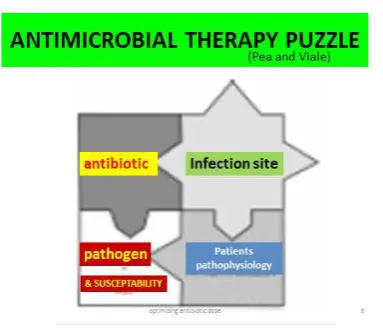
of antibiotic – infection site – pathogen and susceptibility –patients pathophysiology- is known as the antimicrobial therapy puzzle. PK-PD knowledge is of paramount importance. High dose,
short course regiment with a once daily administration schedule for concentration dependent
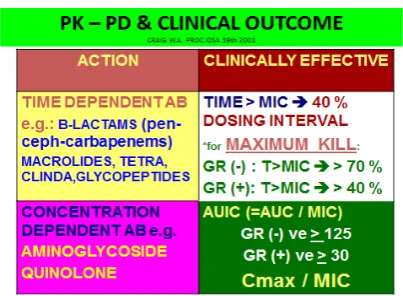
antibiotics e.g. levoloxacin may yield more rapid bacterial killing and prevention of resistance development, because its eficacy is related to the achievement of high Cmax / MIC ratio (>10) and AUC / MIC ratio, which for gram negative bacteria is > 100-125 and for gram positive bacteria > 30-35. Duration of antibiotic therapy can be as short as 5 days, but can also be determined by procalcitonin levels of < 0.5 mcg / ml or if it has declined > 80% of its peak
level.
Keywords: antimicrobial therapy puzzle – PK = pharmacokinetics- PD = pharmacodynamics
- Cmax = maximal concentration- MIC = minimal inhibitory concentration – AUC = area undercurve–procalcitonin
OPTIMAlISASI TERAPI ANTIBIOTIK PADA PNEuMONIA RAwAT
INAP
ABSTRAK
Untuk mengupayakan optimalisasi terapi antibiotik diperlukan pencapaian serta
dipertahankannya konsentrasi antibiotik yang optimal ditempat infeksi pada waktu yang tepat. Kriteria dasar yang harus dipenuhi adalah 1) Apakah penderita benar benar menderita penyakit
infeksi yang bisa ditanggulangi dengan antibiotika. 2) Apakah memerlukan identiikasi spesimen
mikrobial untuk pemilihan antibiotika, karena infeksi saluran nafas memerlukan assesmen kwantitatif. 3) Apakan memerlukan MONO atau terapi KOMBINASI. 4) Rute administrasi
lewat jalan apa ? 5) Patogen, kepekaan serta patoisioli. 6) Mencegah timbulnya resistensi.
merupakan bagian dari TEKA TEKI terapi antibiotik ( antibiotic puzzle) Kata kunci : PK – PD – Antibiotic Puzzle - MIC
___________________________________________________________________________
* Fakultas Kedokteran Universitas Katolik Widya Mandala Surabaya
Jl. Kalisari Selatan 7 Tower A Lantai 6, Pakuwon City, Surabaya
INTRODuCTION
Optimizing antibiotic therapy should mean prompt achievement and maintenance of optimal exposure of the antibiotic at the site of infection. Questions that need to be addressed are :
Does the patient really have an •
infection treatable by antibiotics? Are microbial samples warranted •
BEFORE starting therapy?
All bacteria isolated from o
cerebrospinal luid, asci tes,
pleural effusions,and articular
luid are pathogens, BUT
quantitative assessment is needed for bacteria isolated from the respiratory tract. Mono or combined drug regiments? • Ideal drug usage in much of the same line:
The CORRECT drug, by the best ROUT, at the right DOSE, at OPTIMUM INTERVALS,
for an APPROPRIATE PERIOD, based upon
an ACCURATE DIAGNOSIS.
So appropiate antibiotic treatment is summarize in table 1. Implementation of this
appropiate antibiotic treatment guide, brings forth the problem of the” ANTIMICROBIAL
THERAPY PUZZLE” requiring knowledge of
the Pharmacokinetic and Pharmacodynamic
laws (igure 1)
Table 1. Appropiated Antibiotic Treatment
Correct choice of antibiotic on the 1)
By the right route and schedule b.
In short, pharmacokinetic is about the dosage regimen and the serum concentration it attains, while pharmacodynamics is about the biologic effect and the drug concentration
at the site of infection (igure 2)
Figure 2 : PK – PD Of Antimicrobials The anti microbial therapy puzzle reminds us of the interaction between : the antibiotic used – the infection site – the patient’s pathophysiology e.g. sepsis / septic shock – and- the pathogen and its susceptability. As this topic is too broad to be covered here (see Pea and Viale), only some points relevant to this paper will be mentioned.
Antibiotic at the site of infection, depend
on the diffusion proile of the drug, whether
they are hydrophilic or lipophilic ( table 2) Table 2. Hydrophilic and lipophylic drugs at
site of infection
Patient pathophysiology, the importance of correcting hypoalbuminemia, especially when using high protein bound antibiotics e.g. teicoplanin, ertapenem, ceftriaxone. Because hypoalbuminemia results in an increase in the unbound fraction, which results greater renal clearance of the drug and less antibiotic concentration at the site of infection.
PK-PD parameters of antimicrobials devide antimicrobials into 2 broad categories; 1) concentration dependent antibiotics and time dependent antibiotics (graphically depicted at
table 3 and igure 3)
Table 3. PK-PD Clinical outcome
Figure 3 PK-PD parameters of antimicrobials
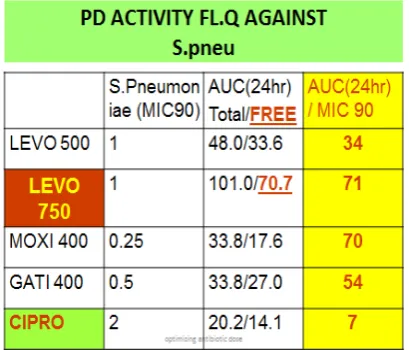
Table 4. Pharmacodynamics activity of Fluoro quinolones against Str.pneumoniae
Table 4, shows why Ciproloxacine
is not considered a respiratory quinolone,
because its AUC/MIC ratio against Gr(=)
cocci is only 7, far below the needed ratio of 30-35, resulting in less bactericidal kill and as such less clinical effectiveness and also resistance (Table 4 ). The simple explanation for this is that dead bugs do not mutate !!. lEvOflOxACINE 750 mg.
Although Paul Ehrlich’s maxim of high dose, short course was coined in 1913, a century ago and meant for parasitic infections, Lala Dunbar landmark study in 2002 proved that the same holds true for high dose short
course Levoloxacine in Community Acquired
Pneumonia (CAP)
Simple math tells us that 5 days of 750 mg = 3750 mg, while 10 days of 500 mg is 5000 mg. (Table 6, 7 )
Table 6. Quicker symptom relief
Levofloxacin 750 mg for 5 days provides greater symtom resolution at day 3
Table 7. Comparable safety 750 mg OD -500 mg OD
DuRATION of ANTIBIOTIC THERAPy IN CAP
There are several suggestions, but no precise guidelines, all empirical IDSA ( Infectious diseases society of •
America) : 72 hrs afebrile
Canadian infectious and thoracic •
Society : 1-2 wks
BTS (British Thoracic Society) •
: 7-21 days, subj. to clin.judg. ATS ( American Thoracic Society) •
: 7-14 days for hosp.5-7 d out pat.
Using PROCALCITONIN to
customized duration of antibiotic therapy, when its concentration is less than 0.5 ng/ ml or has decreased by more than 80% from its peak concentration, antibiotics can be stopped, but vigilance must be maintained to detect recurrence.
SuMMARy HIGH DOSE SHORT
COuRSE lEvOflOxACIN IN CAP:
more rapid bacterial killing and prevention of
resistance development, because its eficacy
is related to the achievement of high Cmax / MIC ratio (>10) and auc / mic ratio, which for gram (-) bacteria should be > 100-125 and for gram (+) > 30-35
REfERENCES:
Frederico Pes, Pierlugi Viale : Bench to Bedside review : Appropiate antibiotic therapy in severe sepsis and septic shock – does the dosse matters? (2009)
J.M.Guerin : Optimizing Antibiotic in a hospital setting (1999)
Lala M. Dunbar: High dose, short course
Levoloxacin for CAP: A new treatment
paradigm (2003)
Marin H.Kollef : Optimizing Antibiotic therapy in the intensive care settings (2001) Nicoleau D.P.,Sutherland C., Winget D., Baughman R.P.: Bronchopulmonarary pahrmacokinetic and pharmacodynamic
proilesof levoloxacin 750 mg once daily
in adults undergoing treatment for AECB (2012)
Rianto Setiabudi : Optimizing antimicrobial treatment with PK-PD (2011)