and Uses of Funds
Once regarded as a specialized backwater of global banking, Islamic banking has gained substantial strength in the world of international finance. It is developing into a full-fledged financial system offering a broad range of Shari’a-compliant products and services to meet the needs of individuals and institutions. At year-end 2007, global Islamic banking assets totaled approximately US$500 billion, a growth rate of nearly 30 percent in 2007 alone (Eaves 2008). And according to Standard
& Poor’s, over the last decade, Shari’a-compliant financial assets have grown at a 10 percent annual clip (Robinson 2007). In September 2008, Morgan Stanley forecasted that Shari’a-compliant banking deposit assets would reach US$1 trillion in 2010 (“Morgan Stanley Says . . .” 2008).
Since its inception in the early 1960s, modern Islamic banking has been widely adopted throughout the Muslim world. In this period, Islamic finance has expanded in complexity through the creation of new Shari’a-compliant products in response to the increasing global demand for such products. Viewed by many as a financing system that encourages entrepreneurship, Islamic banking and finance are making inroads into the areas of commercial and investment banking.
This chapter focuses on how Islamic financial products are structured and explains the mechanics of Islamic banking, which operates without charging interest on borrowed funds.
Islamic Banking Overview
Unlike conventional banks, Islamic banks are not allowed to charge interest by lending money to their customers because, under Islamic commercial law, making money from money (riba) is strictly prohibited. In Islamic finance, money is not considered a commodity and, therefore, cannot be “rented out” for a fee. In lieu of charging interest on money lent, Islamic banking practices and financial transac- tions are based primarily on sharing (for instance, musharka), trading (for example, murabahah), or leasing (ijarah). The contracts for profit-and-loss sharing are preferred from a Shari’a perspective, although in practice, industry relies on trading or leasing, in which the bank sells an asset to the customer on an installment basis or leases the asset to the customer and earns a fixed return in that way.
In contrast, conventional banks charge interest on loans made to customers and pay interest on customers’ deposits. The bank charges a higher rate of interest on loans made than it pays on deposits and thus earns a profit from the spread between the interest rate on its assets (the rate on the loans it makes) and the rate on its liabilities (the rate it pays depositors).
Another difference between Islamic and conventional banking is that Islamic banks do not follow the principle of having a fractional reserve requirement.
Conventional banks operate with a fractional reserve requirement that is applied to transaction accounts (commonly referred to as checking accounts). Savings accounts and time deposits are not subject to a reserve requirement.
In a fractional reserve system, a bank can loan funds equal to the reciprocal of the reserve requirement. For example, a 10 percent reserve requirement on a deposit of $100 allows the bank to loan up to $90 while maintaining the other $10 of the
$100 deposit to meet normal withdrawal requests. If the full $90 is loaned out and deposited in another bank, that bank, which is also subject to the 10 percent reserve requirement, can then make new loans of $81. The process continues until the initial deposit of $100 has been multiplied 10 times to $1,000. The rationale behind a fractional reserve banking system is that under normal circumstances, only a portion of a bank’s deposits will be needed to meet customer redemptions. The central bank acts as a lender of last resort if a bank is unable to replenish a low reserve position by borrowing in the money markets, selling assets, or drawing on lines of credit.
Fractional reserve banking is not Shari’a compliant because it is accomplished through the creation of loans on which interest is charged. This interest is strictly prohibited under Islamic banking.
Islamic finance comprises features of both commercial and investment banking.
Figure 3.1 outlines the general approach to profit generation for an Islamic bank, beginning with the sources of funds. The figure shows that Islamic banks make a profit by mobilizing the savings of investors to meet the financial requirements of borrowers. The sources of funds of an Islamic bank include deposits in various accounts and deposits in special investment accounts that are earmarked for bor- rowing by corporate investors to fund specific projects. Shareholder funds are also a source of funds for Islamic banks. All of these sources of funds are channeled into general financing, trade financing (working capital, domestic and international import- and export-related financing, and so forth), country treasury products (Islamic money market instruments), and other services.
An Islamic bank shares in the profit and loss of each borrower’s business transaction. In turn, the bank divides its share of profits and losses with its general and special investors who have deposited funds in the bank. Profit is calculated ex post and is determined by the outcome of the borrowers’ business transactions. The profit earned by a bank is reduced by the bank’s operating expenses, by zakat (the Islamic welfare tax), and by government taxes before it is shared with shareholders as dividends (Shanmugam and Gupta 2007).
Sources of Funds. Islamic banks are deposit-taking institutions but do not pay interest on deposits. Their sources of funds include shareholder investments, savings accounts, current accounts, and investment accounts, classified as either
general or special. Similar to conventional bank depositors, Islamic banking depos- itors are seeking safe custody of their funds and convenience in using their funds.
Islamic banking depositors may also expect to earn some profit on deposit balances, but this profit is not guaranteed. Account holders may use automated teller machine (ATM) facilities, internet and mobile banking, and international debit cards.
■ Shareholder funds. An Islamic bank may raise initial equity by following the principle of musyarakah (equity participation). Under this principle, the capital owner enters into a partnership with the bank by contributing equity in return for a share of the bank’s profit or loss on the basis of a predetermined ratio (for example, 70 percent/
30 percent or 60 percent/40 percent), with the larger fraction due the investor.
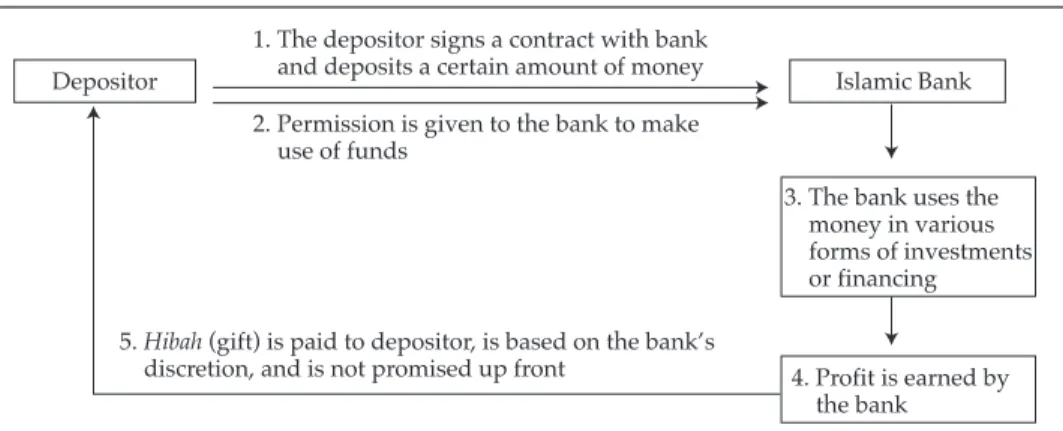
■ Wadiah savings accounts. Islamic banks practice the principle of wadiah in operating customer savings accounts. The structure of the wadiah savings account offering is illustrated in Figure 3.2. The bank may request permission to use customer funds deposited in these accounts as long as these funds will remain within the bank’s discretion. The bank does not share with the customer profits earned from the use of the customer’s funds but does guarantee the customer’s deposits. The bank may, however, reward customers with a hibah (gift) as a token of its appreciation for being allowed to use the funds. Hibah could be a portion of the profit generated from the use of the funds. Hibah may be paid at any time, but in practice, most Islamic banks pay hibah at a regular periodic interval, such as quarterly or semiannually.
■ Current accounts. The current account is a deposit account that can be used for business or personal purposes and, like a savings account, is based on the Islamic principle of wadiah. Account holders are not guaranteed any return for keeping their funds with the bank, but they may be rewarded with hibah. Customer current account balances are guaranteed. The primary distinction between savings and current accounts is that minimum balance limits and withdrawals are more flexible for current accounts.
Figure 3.1. Overview of Profit Mechanism in Islamic Banking
Source: “Islamic Banks Are on the Rise” (2008).
Source of Funds Shareholder
Funds Saving/Current
Accounts General/Special
Investment Accounts
Application of Funds Profit
Shareholder’s Dividend General
Depositors Bank Special Depositors Π
Π Π General Financing
Trade Financing Investment
Treasury Products General Funds
Pool
Special Funds Pool Statutory
Funds
Distribution of Profit
In certain countries, such as Iran, the principle of qard hassan (a benevolent or interest-free loan) governs the use of depositors’ funds by the bank. In this case, deposits are treated as benevolent loans by the depositor to the bank, so the bank is free to use the funds in a qard hassan current account without permission of the depositor. The depositor (in the role of lender) is not entitled to any return on the use of the funds, which would constitute riba. As in the wadiah savings account, the bank guarantees that the amount deposited will be returned.
■ Investment accounts. Investment accounts operate on the principle of mudharabah (profit sharing), with banks accepting deposits from investors for either a fixed or unlimited period of time. Investment accounts are also known as “profit- and-loss–sharing” deposits. The ratio for sharing profits and losses identifies the only return guarantee the account holder receives from the bank.
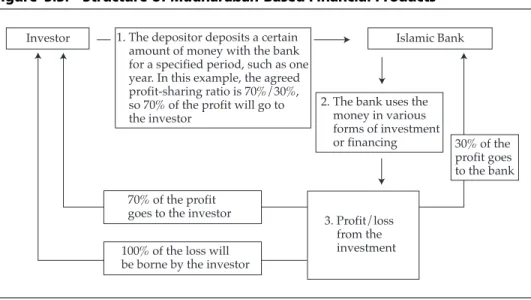
For this kind of arrangement, the customer is referred to as an “investor” (rabb- ul-mal) with the characteristics of a silent partner. The bank acts as an agent (mudarib) for the investor in the management of the funds and invests them in Shari’a-compliant stocks, economic projects, and so forth. Although these accounts are known as profit-and-loss–sharing accounts, all investment losses are borne solely by the investor, except when the loss results from the bank’s misconduct or negli- gence. In general, Islamic banks do not charge any investment management fee; the returns are mainly from shared profits (Ebrahim and Joo 2001). Investment accounts are an important source of funds for Islamic banks and are used for investment and financing activities. According to Björklund and Lundstrom (2004), Islamic banks seek to earn a profit on investment accounts, in contrast to their expectations for savings or current account deposits, which are more likely to be held for precaution- ary or transaction purposes to serve the needs of customers. The transaction structure for mudharabah-based financial products is illustrated in Figure 3.3.
Figure 3.2. Structure of Wadiah Savings Account
Depositor
3. The bank uses the money in various forms of investments or financing
4. Profit is earned by the bank
5. Hibah (gift) is paid to depositor, is based on the bank’s discretion, and is not promised up front
Islamic Bank 1. The depositor signs a contract with bank
and deposits a certain amount of money 2. Permission is given to the bank to make use of funds
An investment account may be classified as follows:
•
Mudharabah mutlaqah (general investment account): In this type of account, the investor, or account holder, authorizes the bank to invest the funds in any Shari’a-compliant investment manner deemed appropriate by the bank. No restrictions are imposed on the use of the funds.•
Mudharabah muqayyadah (special investment account): In this type of account, the investor, or account holder, may impose conditions, restrictions, or prefer- ences regarding where, how, and for what purpose the funds are to be invested.The bank is required to fulfill the investor’s requests and ensure that the investments are Shari’a compliant.
Recently, banks have chosen to operate savings accounts on the principle of mudharabah to provide better returns to account holders and to gain a competitive edge in the market.
Table 3.1 summarizes the main sources of funds for Islamic banks and com- pares their account features.
Applications of Funds. Recall that the basis of Islamic finance is risk sharing between the parties in an underlying asset-based transaction, so profit-and- loss sharing is a prominent feature of Islamic finance. Recall also that Islamic financial products and practices must avoid gharar (uncertainty, risk, and specula- tion) and pursue investment in halal (religiously permissible) activities. Islamic modes of finance fall into the following three broad categories (Al-Jarhi, no date):
•
Equity financing and profit sharing: In both equity financing and profit-sharing activities, the bank provides funds to an enterprise in return for a share of the profits generated by the borrowed funds. The distinction between the twoFigure 3.3. Structure of Mudharabah-Based Financial Products Investor 1. The depositor deposits a certain Islamic Bank
amount of money with the bank for a specified period, such as one year. In this example, the agreed profit-sharing ratio is 70%/30%, so 70% of the profit will go to the investor
2. The bank uses the money in various forms of investment
or financing 30% of the profit goes to the bank 70% of the profit
goes to the investor 100% of the loss will be borne by the investor
3. Profit/loss from the investment
structures is that equity financing allows the bank to participate in the enterprise’s decision making. Profit-sharing arrangements preclude bank par- ticipation in the borrower’s management decisions.
•
Credit purchases: For credit purchase transactions, the bank provides immediate delivery of the goods or services sought by the customer in exchange for the customer promising to make a series of deferred payments to the bank equal to the cost of the goods or services plus a markup.•
Leasing: In leasing arrangements, the bank purchases a durable asset and leases it to the customer in return for regular payments that reflect the cost of holding and maintaining the asset.In general, penalties imposed by Islamic banks for late payment or default are not collected for the bank’s own benefit but are donated to charity. Some Muslim countries allow banks to charge a penalty to recoup the costs of collecting the missed payment.
Financing Structures. Islamic banks offer a broad spectrum of financial structures, ranging from simple Shari’a-compliant retail products, such as savings and current accounts, to leasing, trust financing, and large-scale infrastructure financing. Not all of the financial structures described are acceptable to all Muslim investors. This controversy is a byproduct of the different schools of Islamic thought and their various interpretations. No single body currently serves as the mediator of these differences of opinion. Financing structures include the following.
Bai’ bithaman ajil. Bai’ bithaman ajil (BBA) financing refers to the sale of goods by a bank to a customer on a deferred-payment basis over a specified period at a price that includes a markup or profit margin agreed to by both parties. Deferred
Table 3.1. Sources of Funds in Islamic Banking
Account Type Objective
Principal Value Guaranteed?
Profit-Sharing
Method Risk
Wadiah savings account
Precaution and to earn a profit
Yes Hibah at bank’s discretion
None
Wadiah current account
To have liquidity available on demand
Yes Generally no profit sharing
None
Qard hassan current account
To have liquidity available on demand
Yes Generally no profit sharing
None
General investment account
To earn a profit No Profit sharing at
negotiated ratio
High Special investment
account
To earn a profit No Profit sharing at
negotiated ratio
High Source: Björklund and Lundstrom (2004).
payments may be made in monthly installments. A BBA plan is commonly used for financing the purchase of real property, vehicles, or consumer goods and is predominantly a Malaysian practice. The BBA structure is controversial; supporters of the structure argue that the profit earned is justified under Shari’a because it is derived from a buy-and-sell transaction and is not considered interest accrued from the lending of money.
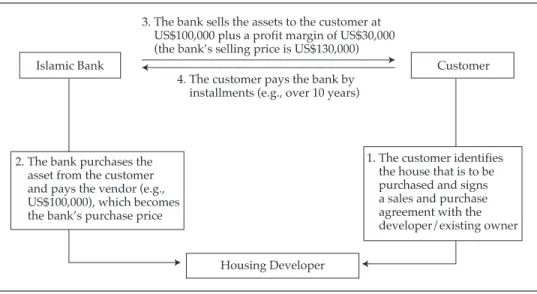
BBA financing involves essentially three separate agreements. In the case of real property, the first agreement details the bank’s purchase of the property from the developer. In the second agreement, the bank sells the property to the customer. And the third agreement stipulates that the bank can sell the property in the event of default by the customer. Figure 3.4 depicts such a typical BBA transaction structure.
At year-end 2003, according to statistics compiled by Malaysia’s central bank, Bank Negara Malaysia, 87.8 percent of total Islamic financing was in fixed-rate instruments, 58.8 percent of which were long term in nature.6 Therefore, in 2003, Bank Negara Malaysia introduced a variable-rate BBA product to:
enable the Islamic financial institutions which operate in a dual banking environ- ment [Islamic and conventional banking] to . . . match the current market financing rate in order to give matching returns to their depositors. . . . (“Intro- duction of Islamic Variable Rate Mechanism” no date, p. 1)
Figure 3.4. Structure of Fixed-Rate Bai’ Bithaman Ajil Financing
6See “Introduction of Islamic Variable Rate Mechanism” (no date).
Islamic Bank Customer
3. The bank sells the assets to the customer at US$100,000 plus a profit margin of US$30,000 (the bank’s selling price is US$130,000)
4. The customer pays the bank by installments (e.g., over 10 years)
2. The bank purchases the asset from the customer and pays the vendor (e.g., US$100,000), which becomes the bank’s purchase price
Housing Developer
1. The customer identifies the house that is to be purchased and signs a sales and purchase agreement with the developer/existing owner
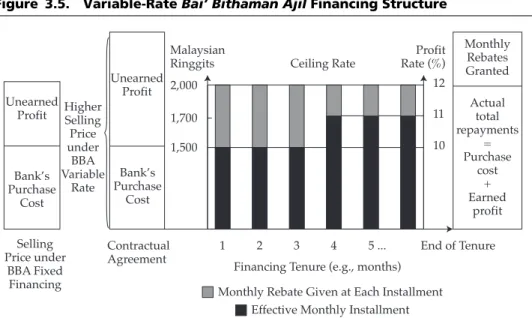
In a variable-rate BBA, the contractual selling price and the customer’s pay- ment installments are higher than in a fixed-rate BBA, which guarantees the bank a profit (the ceiling profit rate) higher than that of a fixed-rate BBA. A waiver of the right to claim unearned profit is given to the bank by the customer to permit the bank to grant rebates (ibra) of the unearned profit to the customer by reducing the contracted monthly installment amount that the customer must pay. This flexibility in determining the monthly installment amount gives the BBA its variable-rate characteristic.
Figure 3.5 explains the mechanics of a variable-rate BBA. The financing is created when the bank purchases the asset for cash and immediately sells the asset to the customer on deferred-payment terms. In this example, the ceiling profit rate is set at 12 percent a year and the selling price of the asset is higher than in the case of a fixed-rate BBA. Both parties to the transaction agree on the amount of the monthly installments—in this case, 2,000 Malaysian ringgits (RM2,000)—and on the repayment period.
Assume that in the first month of the repayment period, the benchmark in the pricing calculation is 10 percent a year. The benchmark is the base lending rate (BLR), or market rate, plus the predetermined profit margin. Although the ceiling profit rate is typically capped at 400 bps above the BLR, the effective profit margin is usually required to be observed at 250 bps above the BLR.
Figure 3.5. Variable-Rate Bai’ Bithaman Ajil Financing Structure
Source: Bank Negara Malaysia (2004).
2,000
1,700 11
12
3 2
1 4 5 ...
1,500 10
Ceiling Rate Malaysian
Ringgits
Profit Rate (%) Unearned
Profit
Bank’s Purchase
Cost
End of Tenure Contractual
Agreement
Financing Tenure (e.g., months) Monthly Rebate Given at Each Installment
Effective Monthly Installment Unearned
Profit Higher Selling Price under BBA Variable
Rate Bank’s Purchase
Cost Selling Price under
BBA Fixed Financing
Monthly Rebates Granted Actual
total repayments
= Purchase
cost + Earned
profit
The result is that the bank will give a rebate to the customer in the first month in the amount of RM500. The rebate represents the difference between the ceiling profit rate of 12 percent a year and the effective profit rate of 10 percent a year. If in the fourth month of the repayment period the BLR or market rate rises so that the effective profit rate increases to 11 percent a year, the monthly rebate will be reduced to RM300.
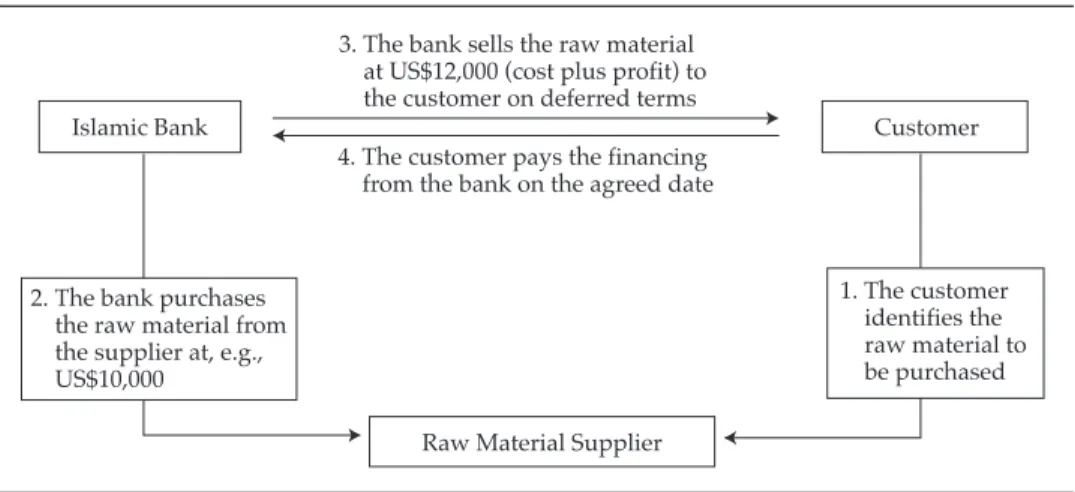
Murabahah. Murabahah financing is a popular method used by an Islamic bank to meet the short-term trade-financing needs of its customers. It is often referred to as “cost-plus financing” or “markup financing.” In this type of financing, the bank agrees to fund the purchase of a specific asset or goods from a supplier at the request of the customer. Upon acquiring the asset, the bank sells it to the customer at a predetermined markup. Figure 3.6 illustrates the transaction structure of murabahah-based products.
A bank practices murabahah financing when it has obtained a legally enforce- able promise by the client buyer that he or she will buy the good from the bank once the bank has purchased the good. In this case, because the bank takes constructive or physical receipt of the goods before selling them to its customer, the bank accepts whatever risk is inherent in the transaction, such as the risk that the asset is destroyed while in the bank’s possession. Thus, any profit from the transaction is considered to be derived from a service and is legitimate under Islamic law. The customer’s repayment schedule may be in equal or staggered installments or in a lump sum. The goods must be in the possession of the bank before being sold to the customer; this aspect is the critical element that allows the transaction to be Shari’a compliant (Ahmad 1993).
Figure 3.6. Structure of Murabahah Financing
Islamic Bank Customer
3. The bank sells the raw material at US$12,000 (cost plus profit) to the customer on deferred terms 4. The customer pays the financing from the bank on the agreed date
2. The bank purchases the raw material from the supplier at, e.g., US$10,000
Raw Material Supplier
1. The customer identifies the raw material to be purchased
Murabahah financing has become the backbone of contemporary Islamic banking. It is commonly used for financing the purchase of raw materials, machin- ery, equipment, and consumer durables. The profit margin is mutually agreed between the client and the bank.
Critics argue that the substance of a murabahah transaction is no different from that of a conventional loan because the Islamic bank purchases the goods only after it has obtained a promise from the client that he or she will purchase those goods from the bank; the purchase and sale are processed as quickly as possible so that the length of time goods are owned by the bank is minimized; the trade takes place only if credit is involved; the markup is usually benchmarked to prevailing interest rates;
and the amount payable to the bank tends to depend on the length of the credit period. Together, all these elements make the substance of murabahah trade the same as a conventional loan, which carries credit risk rather than the risk associated with the ownership of an asset or a business enterprise.
The current form of murabahah financing—also known as “murabahah to the purchase orderer”—is also materially different from classic murabahah financing, which took place before there were banks. Sellers carried inventories and assumed ownership risk of the goods being sold, credit was an exception, spot trading was the rule, and unilateral promises to purchase were not systematically used in conjunction with a sales contract.
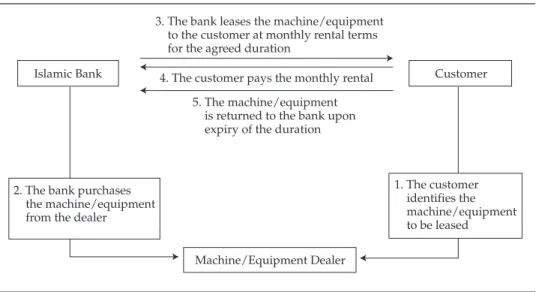
Ijarah. Ijarah financing or leasing is growing in popularity in the Muslim community. In Arabic, the word “ijarah” means “to give something on rent.” Under an ijarah financing arrangement, the bank purchases a tangible asset based on the client’s specifications and leases it to the client. The lease duration varies from three months to five years or more, depending on the nature of the asset and the lessee’s requirements.
The Islamic lease differs from a conventional hire/purchase in that the owner- ship of the asset remains with the bank during the lease period. The bank gives the right of use of the asset to the lessee, as well as physical possession of the asset. In return, the lessee makes rental payments based on an agreed schedule. Upon expiration of the lease, the lessee returns the asset to the lessor (the bank).
Ijarah is typically used for high-cost assets with long life spans. The financing structure for ijarah-based products is illustrated in Figure 3.7. The owner of the asset, or lessor (the bank), bears all the risks associated with ownership, such as asset maintenance, while the user of the asset (lessee) pays a fixed price (rent) for enjoying the benefits of the asset.
Many scholars are critical of a practice whereby the Islamic bank makes the lessee the actual payer of the takaful (Islamic insurance) contribution or premium by passing on the premium costs as part of the lease installments to be paid by the lessee (Ayub 2007). The problem is that some of the risks of ownership may be assumed by the bank but the cost of the transfer of these risks is actually borne by the lessee.
To summarize, an ijarah contract is essentially the sale of the usufruct of the asset for a specified period of time. The bank receives profit from the rental of the asset and retains ownership of the asset. The lessee enjoys the immediate benefits of using the asset without incurring a large capital expenditure.
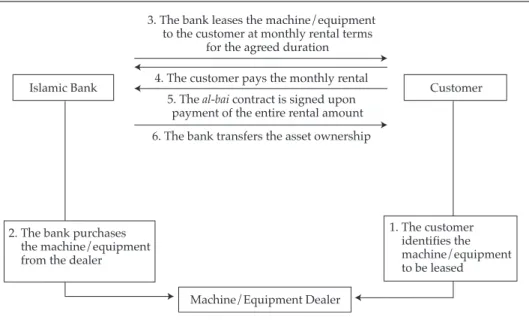
Al-ijarah thumma al-bai. Al-ijarah thumma al-bai (AITAB) financing is essentially an ijarah (leasing) contract combined with a bai (purchase) contract.
Under the first contract, the purchaser (customer) leases the goods from the owner (the bank) at an agreed rental price for a specified period. Upon expiration of the leasing period, the purchaser enters into a second contract to purchase the goods from the owner at an agreed price. The transaction can also be referred to as an
“ijarah contract ending with purchase.” The structure for AITAB financing is illustrated in Figure 3.8.
As with a straight ijarah contract, the bank owns the asset during the leasing period. The purchase agreement (bai), which is executed automatically at the end of the leasing period, transfers ownership of the asset to the customer. If the customer fails to carry out the obligation to pay the rental price or otherwise breaches the terms and conditions of the AITAB contract, the bank has the right to exercise reasonable actions to mitigate its losses (Bank Negara Malaysia 2005). The amount of the lease payments is based on the profitability of the asset, not on the bank’s capital investment in the asset (Zineldin 1990).
AITAB financing is practiced mainly in Malaysia. Similar products found in the Middle East and other parts of the world are usually based on the principle of ijarah wa iqtina—a lease contract with a put and/or call option on the leased asset held by the customer. There is a unilateral undertaking by the bank whereby at the
Figure 3.7. Structure of Ijarah Financing
Islamic Bank Customer
3. The bank leases the machine/equipment to the customer at monthly rental terms for the agreed duration
4. The customer pays the monthly rental 5. The machine/equipment is returned to the bank upon expiry of the duration
2. The bank purchases the machine/equipment from the dealer
Machine/Equipment Dealer
1. The customer identifies the machine/equipment to be leased
end of the lease period, the ownership of the asset will be transferred to the lessee.
The undertaking or the promise given is unilateral and does not become an integral part of the contract. Hence, the undertaking or promise does not become an integral part of the lease contract, whereby it would be conditional.
The rental payments and the purchase price are determined in such a manner that the bank receives its principal invested in the asset plus a profit, or markup.
Musyarakah. Musyarakah financing is a type of partnership financing in which one of the partners is an Islamic bank. Profits and losses are shared among the partners according to a predetermined formula. Profit sharing need not be based on the proportion of shares owned, but liability is limited to the contributions of the shareholders. In other words, investors cannot be held liable for more than the amount of capital they invest in the partnership (Shanmugam and Gupta 2007).
The structure of musyarakah financing is illustrated in Figure 3.9. The partners are entitled to participate in the management and audit operations of the venture, but it is not mandatory that they do so. In addition, the partners are allowed to charge a fee for any managerial efforts or other forms of labor they contribute to the project. The bank may act as a passive (silent) partner while the customer manages the venture. In practice, most banks closely monitor the venture to ensure that it is well managed.
A musyarakah partnership or joint venture is often regarded as the purest form of Islamic finance. Only selected banks offer it, however, because many banks consider it highly risky.
Figure 3.8. Structure of AITAB Financing
Islamic Bank Customer
3. The bank leases the machine/equipment to the customer at monthly rental terms
for the agreed duration 4. The customer pays the monthly rental
5. The al-bai contract is signed upon payment of the entire rental amount 6. The bank transfers the asset ownership
2. The bank purchases the machine/equipment from the dealer
Machine/Equipment Dealer
1. The customer identifies the machine/equipment to be leased
Diminishing musyarakah financing is a special form of partnership that culminates in the bank’s client owning the asset or project being financed. One partner (the client) promises to gradually buy the shares of the other partner (the bank) until ownership of the asset is completely transferred to the client. This type of financing is widely used in Malaysia to finance the purchase of homes and involves the use of two written contracts, an ijarah agreement and a musyarakah- diminishing-ownership agreement.7
In a musyarakah-diminishing-ownership agreement, the bank purchases the house and leases it to the customer on the basis of ijarah. Concurrent with the rental payments during the term of the lease, the customer also pays installments to the bank to buy the bank’s ownership stake in the property. The bank’s ownership stake is divided into a specified number of units, which the client agrees to purchase gradually within a specified time period. Each installment reduces the bank’s ownership share in the property. At the end of the financing term, the title of the property passes to the customer.
Istisna. Istisna financing involves a contract of exchange providing for deferred delivery of the good or the asset that is being financed. In istisna financing, a commodity is purchased or sold before it comes into existence, which is an exception to the Shari’a principle requiring that an underlying asset be present in order for a financial transaction to take place. The fact that nothing is exchanged on the spot or at the time of contracting is the unique feature of an istisna contract.
Both parties agree on the price of the good or asset. The bank purchases the good or asset for sale to the customer on deferred-payment terms.
Figure 3.9. Structure of Musyarakah Financing
7See Meezan Bank (2008).
Customer Islamic Bank
Construction Project
1. The bank and customer enter into a musyarakah contract for, e.g., a construction project based on 50%/50% capital contribution
40% share in the profit 50% share in the loss
60% share in the profit 50% share in the loss 2. Profit/loss from
the joint venture
Istisna financing is most often used to finance construction, shipbuilding, manufacturing projects, or turnkey infrastructure projects. The istisna agreement provides flexibility by permitting a transaction to be structured with payment made in advance and delivery of the good or asset at a future date or with both payment and delivery made at a future date.
Commodity murabahah. A commodity murabahah contract replicates short-term money market deposits for fixed terms of one week to one year. The underlying asset in this structure is a commodity, such as copper, aluminum, lead, palm oil, or crude oil. The structure works as follows. A bank buys the commodity at the spot price, or current price, and sells the commodity to another bank on a deferred-payment basis, perhaps for three months, at the spot price plus a markup (profit). The bank that buys the commodity on a deferred basis immediately sells it to a broker or another institution at the spot price. The first bank makes a profit from the markup in the transaction, and the second bank raises funds it can use immediately for investment.
This financing structure is considered Shari’a compliant because the bank’s markup is considered profit rather than interest. The portfolio does not include tangible assets; rather, it comprises cash or receivable debts, neither of which are negotiable.
Many scholars criticize commodity murabahah financing because it involves trading of commodities that are not needed for use by either party to the contract and because the underlying objective is to lend/borrow money at interest. Never- theless, it is widely practiced by Islamic banks in many locations.
Tawarruq. Islamic banks use the tawarruq structure to facilitate cash financ- ing to their clients. Tawarruq financing structure is illustrated in Figure 3.10. In this structure, the bank directly or indirectly buys an asset and immediately sells it to a customer on a deferred-payment basis. The customer then sells the same asset to a third party for immediate delivery and payment. The result is that the customer receives an immediate cash payment with an obligation to make deferred payments to the bank for the marked-up price of the asset.
The asset financed is typically a freely tradable commodity, such as platinum or copper. Gold and silver are treated by the Shari’a as currency and cannot be used.
In modern Islamic banking, the bank usually performs all the transactions needed for tawarruq financing.
Tawarruq financing is somewhat controversial and has been the subject of debate in Islamic financial circles because the customer involved has no real intention of buying or selling the underlying commodity that supports the financial transaction.
Because of the absence of any exchange of actual goods, tawarruq financing is prohibited by the Islamic Fiqh Academy of Jeddah, Saudi Arabia. Tawarruq gener- ates debts, adding to the gap between the real sector and the financial sector of the
economy. It leads to a debt market, and a debt instrument does not represent any real asset. The customer’s purpose when engaging in the transaction is merely to generate cash, which can be construed as inconsistent with Shari’a. Mohammad Nejatullah Siddiqi, a prominent researcher in Islamic finance, has said:
The introduction of tawarruq into the body of Islamic economy is sure to act like a virus destroying the immune system that would protect it from increasing indebtedness leading to speculation, monetary fluctuations, instability and ineq- uity. (Siddiqi 2007, p. 4)
Bai’ inah. Bai’ inah financing is a sale-and-buyback transaction that involves two back-to-back aqad (agreements). The structure is designed to provide the customer with a cash sum. The bank sells an item to the customer at an agreed price (first agreement) and then buys it back from the customer at a lower price (second agreement). The difference is the bank’s profit on the transaction and is predeter- mined. Figure 3.11 depicts the structure of bai’ inah financing.
Bai’ inah financing is very similar to tawarruq financing, but it is practiced mainly in Malaysia. And like tawarruq financing, the bai’ inah product is somewhat controversial because of its abstract or intangible nature.
Mudharabah. Mudharabah financing, which is also known as “trust financ- ing,” is based on the mudharabah principle of profit sharing. Mudharabah financing is a commercial activity in which an Islamic bank entrusts funds to an entrepreneur.
The arrangement enables the entrepreneur to carry out business projects. Profits are distributed between the bank and the entrepreneur on the basis of a predeter- mined ratio. All losses are borne by the supplier of the funds (the bank) as long as there has been no negligence on the part of the entrepreneur.
Figure 3.10. Structure of Tawarruq Financing
Islamic Bank Customer
1. The customer approaches the bank for cash financing (US$5,000) 3. The asset is sold to the customer for US$6,000
5. Payment of US$6,000 is made to the bank per the agreed installment plan 2. The bank purchases
the commodity equivalent to the client’s need for cash (i.e., US$5,000)
Commodity Dealer
4. The customer sells the commodity in the open market or to the same vendor to realize cash (i.e., US$5,000)
In this form of financing, the bank is the sole contributor of capital and the entrepreneur manages the project. The structure encompasses a two-tier mudhara- bah agreement. The first agreement is between the bank and the investor (who is a different individual from the entrepreneur); the agreement governs the bank’s investment of funds in the project and specifies the profit-sharing ratio. The second agreement is between the bank and the entrepreneur; its purpose is to meet the financing needs of the entrepreneur for its Shari’a-compliant business activities.
Hence, this model comprises both fund gathering (in the form of deposits from investors) and fund use (funds advanced to entrepreneurs). The model is thus based on profit sharing among three parties: the investor, the bank, and the entrepreneur.
In a way, the bank acts as a financial intermediary to provide the mechanism for profit-and-loss sharing.
Bai’ salam. Bai’ salam financing is a forward financing transaction frequently used in the agriculture industry. In this structure, the bank purchases specified assets in advance of a predetermined delivery date. Typically, the bank receives a discount for the advance payment plus a profit margin. The quality of the commodities that are being purchased is fully specified so as to leave no room for ambiguity. The agreement is structured to benefit both parties to the transaction (Rosly 2005).
The following mandatory conditions must be met in bai’ salam arrangements (Gulaid 1995):
•
Payment is immediate unless otherwise stipulated in the contract. If not imme- diate, payment must be made when the seller submits the goods to the buyer.•
Delivery of the goods is at a future date.•
The deliverable goods are specific and can be clearly defined physically and quantitatively.Figure 3.11. Structure of Bai’ Inah Financing
Islamic Bank Customer
1. The customer approaches the bank for personal financing (e.g., US$5,000)
3. The bank sells the asset on a deferred-payment basis (e.g., US$6,000) 4. The customer buys back the asset at a cost price (e.g., US$5,000)
5. The customer pays the selling price of US$6,000 as agreed
2. The bank identifies
the asset Asset
Qard hassan. Qard hassan financing refers to a gratuitous, or charitable, contract in which the borrower is required to repay only the amount borrowed with no profit (markup) to the lender. It may also be described as a form of benevolent financing extended on a goodwill basis. Such loans may be given to the needy for a fixed term.
Qard hassan literally means “good loan.” The word “qard” is derived from the Arabic “qirad,” which means “to cut.” The use of qard refers to the fact that the giving of the loan depletes a certain amount of the lender’s property. The word
“hassan” derives from the Arabic “ihsan,” which means kindness to others. So, hassan is an act that benefits a party other than the party from whom the act proceeds and requires no obligation from the receiving party.
Growth of Islamic Banking
From its inception four decades ago in Egypt, the Islamic banking and finance movement is expected to top US$1 trillion in banking assets by 2010.8 The Islamic banking industry now encompasses Muslim and non-Muslim participants, includ- ing major Western financial institutions, such as Citibank, HSBC, Standard Chartered Bank, the Royal Bank of Scotland, the Australia and New Zealand Banking Group, and JPMorgan Chase.
According to Asian Banker Journal, the world’s 100 largest wholly Islamic banks held almost US$350 billion in assets in 2006 (“Islamic Banks Are on the Rise”
2008). In 2006, the annual rate of growth of these 100 Islamic banks’ assets outpaced asset growth at the world’s 100 largest conventional banks by a margin of 26.7 percent versus 19.3 percent. The 100 key Islamic banks are located throughout 24 countries in Asia, the Middle East, and Europe. Figure 3.12 shows the location of the top 100 Islamic banks and the aggregate size of banking assets managed according to Islamic principles, by country, as of 2007.
Figure 3.12 shows that Iran has a total of 14 state-owned and privately managed banks on the list of the top 100. Combined, the 14 Iranian banks hold nearly half of the 100 largest Islamic banks’ assets. Malaysia, which is the dominant Islamic financial market in Asia and which aims to be the international hub for Islamic finance, has 10 full-fledged Islamic banks. Their total assets at the time of the survey (2007), however, accounted for only 5.2 percent of Malaysia’s entire banking assets.
Table 3.2 lists and describes the world’s top 25 Islamic banks. Bank Melli Iran (BMI) is the largest Islamic bank; it is followed by Saudi Arabia’s Al Rajhi Bank.
The Islamic banking landscape in Southeast Asia at year-end 2007 is outlined in Exhibit 3.1. In Southeast Asia, the primary banking centers are Singapore and Kuala Lumpur, Malaysia, but Islamic banking services are currently offered in
8“Morgan Stanley Says …” (2008).
Brunei, Indonesia, Malaysia, the Philippines, Singapore, and Thailand. According to Kuo (2008), Malaysia, with roughly 15 percent (about US$62 billion) of the entire assets of the Malaysian banking system attributable to Shari’a-compliant products, leads the region in terms of total Islamic banking assets.
Figure 3.12. Location and Aggregate Assets of Top 100 Islamic Banks, 2007
Source: “Islamic Banks Are on the Rise” (2008).
Exhibit 3.1. Islamic Banking Presence in Southeast Asia, Year-End 2007
Country Major Participants Market Penetration
Brunei Bank Islam Brunei Darussalam Market share is 36%; approximately US$4 billion in assets.
Malaysia 11 full-fledged Islamic banks; 7 Islamic banking units of conventional banks; 1 development bank
Market share is 15.4%; approximately US$62 billion in assets.
Philippines Development Bank of the Philippines, which acquired Al-Amanah Islamic Investment Bank of the Philippines in 2005
Market share and asset size are insignificant.
Indonesia 3 full-fledged Islamic banks; 26 Islamic banking units of conventional banks
Market share is less than 2%; approximately US$3 billion in assets.
Singapore The Islamic Bank of Asia (established in 2007)
Market share and asset size are insignificant.
Bangladesh Islami Bank Bangladesh (established in 1983); 5 full-fledged Islamic banks; 20 Islamic banking units of conventional banks
Market share is 25%.
Thailand Islamic Bank of Thailand Market share and asset size are insignificant.
Source: Adapted from Kuo (2008).
Bahrain, 10 United Arab
Emirates, 6 Malaysia, 10 Bangladesh, 5
Sudan, 19
Iran, 14 Others, 27
Qatar, 4 Pakistan, 5
United Arab Emirates,
US$34.3 Kuwait, US$26.4 Bahrain, US$17.7
Qatar, US$7.9 Turkey, US$6.0
Sudan, US$5.6
A. Number of Banks
Saudi Arabia, US$35.3 Malaysia,
US$35.2
Iran, US$162.2 Others, US$19.0
B. Aggregate Assets (in billions)
Table3.2.Statistics for World’s Top 25 Islamic Banks RankBankCountryAssets ($ millions)Islamic Financing ($ millions)Islamic Deposits ($ millions)
Net Profit After Tax and Zakat ($ millions)ROA (%)ROE (%) 1Bank Kerjasama Rakyat MalaysiaMalaysia7,796.35,392.16,437.6109.61.410.6 2Maybank IslamicMalaysia7,077.15,193.54,703.555.10.89.7 3Bank Islam MalaysiaMalaysia5,533.92,460.65,098.572.71.324.1 4Bank Muamalat MalaysiaMalaysia3,808.81,457.83,477.020.50.510.1 5AmIslamic BankMalaysia3,048.41,853.11,474.738.41.310.1 6Bank Islam Brunei DarussalamBrunei2,910.01,295.42,293.237.21.37.3 7RHB Islamic BankMalaysia2,291.51,174.52,017.624.51.113.3 8Islami Bank BangladeshBangladesh2,175.51,644.51,904.420.30.914.0 9Faysal BankPakistan1,894.91,222.41,463.647.12.532.8 10Hong Leong Islamic BankMalaysia1,801.81,063.31,541.716.40.99.5 11Eoncap Islamic BankMalaysia1,454.11,158.01,106.13.60.23.1 12CIMB Islamic BankMalaysia1,261.1458.8688.14.80.43.1 13Affin Islamic BankMalaysia1,106.3362.1768.210.40.918.6 14Bank Syariah MandiriIndonesia1,059.3792.8916.37.30.79.4 15Bank Syariah Muamalat IndonesiaIndonesia928.0720.6781.812.01.313.8 16Meezan BankPakistan771.7443.7635.411.51.513.3 17The Islamic Bank of AsiaSingapore500.0nanananana 18Oriental Bank BangladeshBangladesh358.5277.1359.26.71.931.0 19Social Investment BankBangladesh309.4252.3240.06.82.227.8 20Shahjalal Islami BankBangladesh309.0224.7278.96.72.238.4 21Al-Arafah Islami BankBangladesh285.1221.7231.80.80.35.9 22Islamic Bank of ThailandThailand149.293.3134.03.92.634.5 23Bank Syariah Mega IndonesiaIndonesia91.325.016.90.30.44.7 24Bank Islami PakistanPakistan66.117.630.40.10.20.4 25First Dawood Islamic BankPakistan44.30.2nananana Note: Zakat is the religious tithe. Source: Asian Banker Research (2008).
The Islamic banking share of the total banking system in Indonesia is currently less than 2 percent (US$3 billion), but the Bank of Indonesia, the central bank, aims to increase the market share of Islamic banking in Indonesia to 5 percent by 2010 (Suharmoko 2008). Islamic financing has grown at a competitive clip, increasing by 30 percent in 2007. This growth rate is higher than that of conventional bank lending in Indonesia (which, according to Suharmoko, grew by 25.5 percent in the same year). The Philippines, Singapore, and Thailand each have only one dedicated Islamic bank, and although the share of Islamic banking assets in Brunei is 36 percent, the absolute size, at US$4 billion, is small.
The national Islamic banking markets have been developing at varying paces for different reasons, such as the size of each nation’s Muslim population, govern- ment initiatives, and the availability of new products and services. Malaysia has perhaps the most developed market in the world for Islamic financial products, partly because of the presence of a significant number of players and partly because of strong government support (Cook 2008). The forecast is for the Islamic banking business in Malaysia to grow to 20 percent of its entire banking system by 2010.9
In the oil-rich Gulf Cooperation Council countries—Bahrain, Kuwait, Oman, Qatar, Saudi Arabia, and the United Arab Emirates (UAE)—Islamic banking is expected to grow to 40 percent of the banking system by 2010 from 30 percent in 2005 (Grail Research 2007). Until recently, the Islamic finance industry in the Persian Gulf, a major growth area, has been somewhat fragmented, with each country having a single predominant bank. Doha in Qatar, Manama in Bahrain, and Dubai in the UAE are the main Islamic banking centers in the region. In 2008, Dubai and Saudi Arabia launched large government-backed Islamic banks. This move changed the traditional face of the Islamic banking industry, which has traditionally been populated by many small institutions (“Dubai Forms Islamic Banking Body” 2008).
In the UAE, total Islamic banking assets, including takaful, are projected to rise at a 28 percent annual rate to a total of US$87 billion (319 billion dirhams) by 2010, raising the country’s global market share of Islamic banking assets to around 11.5 percent (Augustine 2008). An additional goal is to have 20 percent of the nation’s banking industry Shari’a compliant by 2010 (Grail Research 2007). The share of Islamic banking assets in Kuwait rose from 8.8 percent in 2002 to 13.4 percent in 2008 (“Islamic Banking Statistics” 2008).
In Southeast Asia, Pakistan has experienced solid growth in Islamic banking over the past five years. In 2003, the market share of the Islamic banking system in Pakistan was only 0.5 percent. The country had only one full-fledged Islamic bank and one branch of a conventional bank that offered Islamic banking services. Five years later, Islamic banks in Pakistan had garnered a 4.5 percent market share with
9Grail Research (2007).
deposits of 160 billion rupees, or US$2.6 billion (“Islamic Banking Captures 4.5%
Market Share” 2008). The nation now boasts six full-fledged Islamic banks with 230 branches and 12 conventional banks with 103 Islamic branches. The State Bank of Pakistan, the central bank, plans to strengthen regulation of Islamic banking while expanding market share of the sector to 12 percent by 2012 (Al-Huda 2008).
In Turkey, banks that operate under Islamic principles are known as “partici- pation banks.” They are a small but rapidly expanding segment of the Turkish financial sector. As of October 2008, the participation banks—Albaraka Türk, Bank Asya, Kuveyt Türk, and Türkiye Finans—administered about US$21.5 billion in assets, representing 5 percent of the Turkish banking system. The Islamic banking market share in Turkey is expected to double within the next 10 years (“Islamic Finance in Turkey 2009” 2009).
In Europe, London is vying to be the gateway to the continent for Islamic finance. The United Kingdom hosted the first purely Islamic banks in Europe, the Islamic Bank of Britain (which began operations in September 2004) and the European Islamic Investment Bank (which opened its doors in 2006). London is emerging as a hub for Islamic finance because of the financial center’s well- established depth and breadth of investment and banking skills and its historical links to the Middle East and Asia.
The future of Islamic banking is bright, with 50 percent of the estimated 1.3 billion to 1.5 billion Muslims worldwide expected to deposit their money in Islamic banks by 2015. The future is even brighter in Asia, where 50–60 percent of all Muslim saving is forecasted to be managed by Islamic financial institutions by the end of the next decade (Murugiah 2007).