Chapter 4. Heat-induced Chemical Changes in Tholins: the Case Against Pyrolysis
4.1. Introduction
Pyrolysis is a common technique for the analysis of organic polymers, since it enables the volatilization of high molecular weight species, allowing gas chromatography and mass spectrometry to be used. Many hundreds of polymers have been analyzed by pyrolysis [Haken, 1998]; [Haken and Iddamalgoda, 1996], and a number of variations have appeared, such as Curie-point pyrolysis and thermochemolytic techniques [del Rio, et al., 1998] .
It is thus inevitable that pyrolysis would be applied to the examination of tholins.
From the beginning of work on tholins, it was noted that the material was particularly intractable to analysis [Ehrenfreund, et al., 1994]; [Pietrogrande, et al., 2001]. Pyrolysis- GC, however, gives a wealth of peaks, and so became a favored method of analysis. A pyrolyzer has been included on the Huygens probe to examine the atmospheric aerosols and analyze the products by GC-MS [Israel, et al., 1997].
The compounds obtained from the pyrolysis of tholins gives a wide range of nitriles, alkenes, and aromatic compounds, but all the studies agree broadly with one another. For instance, benzene and acetonitrile are seen in large quantities by most researchers [Coll, et al., 1999]; [Israel, et al., 1997]. However, there are some
differences. In particular, the quantity of nitrogen heterocycles observed varies widely between reports [Coll, et al., 1998]. These differences may reflect differences in tholin composition, due to the conditions under which it was produced, or exposure to oxygen.
Also, different pyrolysis and chromatographic conditions will affect the type of products that are observed.
Pyrolysis relies on a fundamental assumption, that the pyrolytic fragments are substructures (or easily accounted for reactive products) of the original polymer. While this assumption is probably valid for homogeneous polymers, a material like the tholins, which is composed of thousands of different compounds, not necessarily structurally alike, is not a good candidate for pyrolysis as a means of structure determination.
Reactions between components of the tholins, as well as fragmentation, will obscure any structural information that can be gained.
We have examined in detail the process of the thermal decomposition of tholins.
Thermal gravimetric analysis and differential scanning calorimetry reveal that tholins begin to degrade at relatively low temperatures, and eventually pyrolyze to a hard, insoluble material. Headspace gas chromatography of heated tholins enables us to
identify some of the products of heating, which turn out to be mostly small nitriles. Laser desorption ionization of the residue from these experiments shows an increase in
unsaturation occurs with heating, suggesting crosslinking or aromatization. Further experiments using evolved gas analysis investigate the facile release of ammonia at temperatures as low as 100 °C, and attempt to relate this unusual behavior to a particular functional group. Tholins undergo a drastic chemical change beginning at 100 °C, releasing large quantities of ammonia and small organics. Pyrolysis cannot be used to infer the structure of tholins, since these changes will occur before pyrolysis can
volatilize components of the tholin. The instability of tholins to heat should also be taken into account in studies of the surface of Titan.
4.2. Thermal gravimetric analysis and differential scanning calorimetry of tholins
Thermal gravimetric analysis is a commonly used technique in the analysis of polymeric materials. The experiment is simple. A small amount of sample, on the order of a few milligrams, is placed in a small pan and weighed as the temperature is increased at a constant rate. This procedure is usually conducted under inert atmosphere (N2), although in principle any gas can be used. As the sample is heated, it changes
chemically, and components will desorb, leading to a decrease in mass. Information on the amount of desorbed volatiles and on the heat-induced degradation of a polymer can be obtained [Campbell, et al., 2000].
Differential scanning calorimetry is a related, but more powerful technique. The sample and a reference are placed in individual pans with separate provisions for heating.
The power required to keep the sample and reference at the programmed temperature is monitored. From this data, the enthalpy changes associated with sample transformations, such as melting or glass transitions, can be calculated [Campbell, et al., 2000].
We performed thermal gravimetric analysis and differential scanning calorimetry on tholin samples as a first step in our studies of the behavior of tholins at elevated temperatures. A Netzsch STA 449C TGA-DSC was used to perform simultaneous TGA and DSC measurements. 3.32 mg of tholins (sample MS133A) was loaded into the instrument. A purge gas of N2 was used at a flow rate of 50 mL/min, and the sample was heated from room temperature to 950 °C at a rate of 10°C/min.
The residue remaining after the TGA/DSC scan was performed was obtained.
The residue is shiny, black, and reminiscent of asphalt, and consisted of spherical
globules, indicating that the tholins had melted at some stage during the scan. Further analysis of the residue was eventually abandoned, due to the insolubility of the residue in any common solvent.
100
90
80
70
60
50
Mass (% remaining)
900 800
700 600
500 400
300 200
100
T(ºC) Figure 4.1. Thermal gravimetric analysis of tholins.
The results of the thermal gravimetric analysis are shown in Figure 4.1. There is a clear onset of mass loss that occurs at around 210 °C. At approximately 550 °C, a change in the slope of the mass loss is visible, suggesting that a difference in the process leading to desorption is occurring. Overall, only 50% of the mass of the sample was lost on heating to 950 °C. Tholins have a rather high thermal stability, although it must be remembered that the material that remains at 950 °C will be chemically quite distinct from pristine tholin. This stability to high temperatures was noted by other workers who
performed thermal analysis of the tholins.
8
6
4
2
0
DSC (mW/mg)
900 800
700 600
500 400
300 200
100
T(ºC)
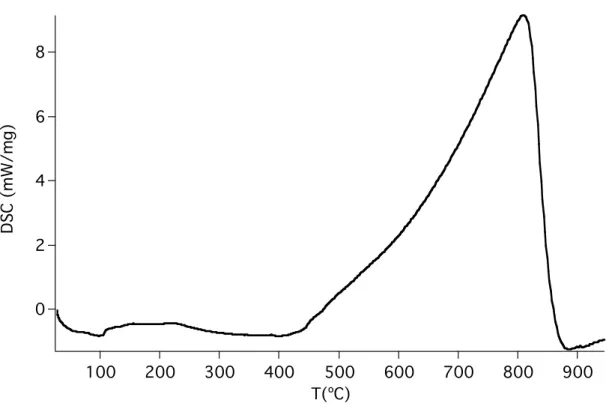
Figure 4.2. Differential scanning calorimetry of tholins.
Figure 4.2 gives the results from differential scanning calorimetry. A large exothermic feature peaking at 800 °C dominates the graph. The onset of this peak roughly coincides with change of slope we see in the TGA trace at around 500 °C, suggesting the two features are related. This is most likely due to an exothermic reaction of some kind, leading to the desorption of material at a different rate than seen
previously. Another possibility is melting as the cause of the exothermic peak, although it seems unlikely melting would not have already occurred at such a high temperature.
The DSC trace is relatively featureless at lower temperatures, although the small endothermic peak at around 100 °C is reproducible. The origin of this feature is unknown.
4.3. Headspace gas chromatography of heated tholins
The TGA and DSC experiments lead inevitably to one question: What is the nature of the compounds desorbing from the tholins as it is heated? While there are numerous means to characterize the evolved gases, we initially chose to perform gas chromatography on the headspace gases that remain after the tholin is heated in a sealed vial.
Approximately 1-2 mg of tholins (sample NS27) was placed in three small (1 mL) vials sealed with septum caps. The vials were flushed with nitrogen, and then heated at 100 °C, 200 °C, and 300 °C, respectively, for 10 minutes. The vials were allowed to cool, and 50 µL of the headspace gas was injected in to the gas chromatograph, an HP 5890 with a 5972 MS detector, using an RTX-5MS column. The temperature program was as follows: -50 °C for 3 min, then ramped at 8 °C/min to 30 °C, then ramped at 30 °C/min to 150 °C, which was held for 2 minutes. The low initial temperature was achieved with liquid nitrogen cooling of the GC oven.
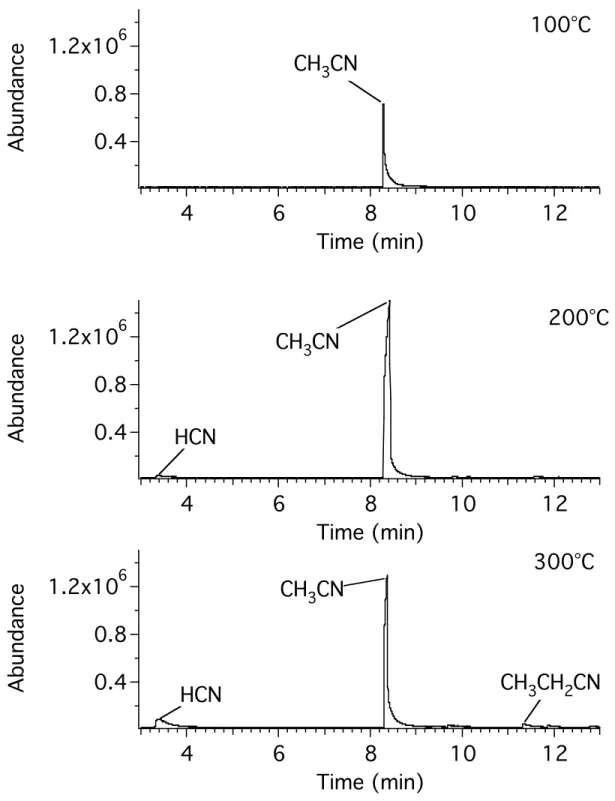
Figure 4.3 shows the chromatograms obtained for the tholin samples heated at 100, 200 and 300 °C. The identity of the peaks was determined by examination of their
1.2x10
60.8 Abundance 0.4
12 10
8 6
4
Time (min) CH
3CN
HCN CH
3CH
2CN
300°C 1.2x10
60.8 Abundance 0.4
12 10
8 6
4
Time (min) CH
3CN
100°C
1.2x10
60.8 Abundance 0.4
12 10
8 6
4
Time (min) CH
3CN
HCN
200°C
Figure 4.3. GC-MS chromatograms of the headspace gases of tholin heated for 10 minutes at the indicated temperature.
mass spectra, and comparison to the NIST database [Linstrom and Mallard, 2005].
Acetonitrile is seen as the major peak at all three temperatures. As the temperature increases, HCN, and then propionitrile begin to evolve from the tholin sample. Other small peaks are apparent in the 300 °C sample. These correspond to other small organic nitriles. It is unlikely that such large quantites of acetonitrile are trapped in the tholin matrix. The tholins are undergoing a degradation reaction that releases acetonitrile, as well as other small organic nitriles, and HCN. The evolution of such large quantities of acetonitrile at 100 °C suggest that this reaction is facile, and underscores the thermal instability of the tholins.
CN CN CN
CN N NHCN CN
N N H
X X
n n
NH N CN
X
n -NH3
-HCN -H2 n
Scheme 4.1. Thermal degradation of polyacrylonitrile. X refers to any possible nucleophile, including nitriles.
Once again, polyacrylonitrile (PAN) can serve as a useful model system to compare to the tholins, and the thermal degradation of PAN is well studied [Mellottee
and Vovelle, 1982]. The evolution of HCN and NH3 is seen to begin at 160 °C. The mechanism is quite complicated, but involves cyclization and aromatization of the polymer, followed by release of HCN [Xue, et al., 1997]. A simplified overview of the process is shown in Scheme 4.1. The end result of the thermal degradation of
polyacrylonitrile is an extensively cyclized aromatic chain. This type of material would likely have properties similar to that seen in heated tholins residues: black, shiny and insoluble. Acetonitrile has also been seen in the products of the thermal degradation of polyacrylonitrile [Surianarayanan, et al., 1998]. Acetonitrile could be produced by a mechanism similar to the one that produces HCN. Tholins do contain nitriles, and it is likely that some of the processes occurring in the thermal decomposition of
polyacrylonitrile occur in tholins as well.
4.4. Laser desorption ionization mass spectrometry of heated tholin residues
It is now apparent that tholins are a thermally unstable material, releasing large quantities of small nitriles, especially acetonitrile, on heating. The evolution of these gases from the tholins may occur via a mechanism similar to those that occur in the thermal degradation of polyacrylonitrile. The next step is to examine the residues left behind after these gases have evolved.
Since the residual material is largely insoluble, we chose laser desorption
ionization (LDI) mass spectrometry as a means of studying the residue. This technique is well suited to the study of polymeric materials. The residues left in the sample vials after the headspace analysis were finely ground in a mortar and pestle, and the resulting
3.0x10
42.0 1.0
Rel. Abundance 0.0 100 200 300 400 500 600 m/z
300ºC 2.5x10
42.0 1.5 1.0 0.5 Rel. Abundance 0.0
600 500
400 300
200 100
m/z
200ºC 8x10
36 4 2
Rel. Abundance 600 500 400 300 200 100
m/z
100ºC 1.2x10
40.8 0.4
Rel. Abundance 600 500 400 300 200 100
m/z
unheated
Figure 4.4. Laser desorption ionization mass spectra of heated tholin residues.
4x10
43 2 1 Rel. Abundance 0
210 205
200 195
190 185
m/z
300 °C 4x10
43 2 1 Rel. Abundance 0
210 205
200 195
190 185
m/z
200 °C 4x10
43 2 1 Rel. Abundance 0
210 205
200 195
190 185
m/z
100 °C
Figure 4.5. Magnified view of the spectra presented in Figure 4.4. In each panel, the lower trace is the spectrum obtained from unheated tholin, while the upper trace is the spectrum obtained from tholin that was heated to the indicated temperature.
powder was applied to a piece of double-sided sticky carbon tape, which was affixed to the sample plate of a Voyager DePro time of flight mass spectrometer. The laser power was adjusted for the best signal, and between 300 and 500 shots were averaged for each spectrum.
The results are presented in Figure 4.4. At first glance, the spectra are all quite similar. They all exhibit the characteristic polymeric distribution of the tholins, clusters of peaks spaced 14 mass units apart. Some small differences are are apparent. In the material heated to 200 °C and 300 °C, the distribution peaks just before 200 m/z, while in the unheated and 100 °C material, the distribution peaks at around 225 m/z. This is in agreement with the loss of small molecules on heating noted in the previous section. A closer inspection of the spectra reveals more definitive differences.
Figure 4.5 is a magnified view of a region of the spectra shown in Figure 4.4. The spectrum obtained from residue heated to the indicated temperature is compared to the spectrum of unheated tholin. At 100 °C and 200 °C, the spectra of the residue and of unheated tholin are basically identical. However, at 300 °C, the spectra of the residue undergoes a shift to lower masses. Each cluster of peaks is shifted about two mass units lower. The loss of H2, from an increase in unsaturation, would lead to this result.
The LDI spectra corroborate the results obtained from headspace gas
chromatography, discussed in the previous section. As they are heated, the tholins are chemically altered. Small molecules, such as acetonitrile, are evolved, and the residual material is less saturated than pristine tholins. A mechanism similar to that which occurs in the thermal degradation of polyacrylonitrile is likely at work. The tholins become increasingly cyclized and aromatic, resulting in a black, insoluble material. Since the
LDI spectra exhibit an overall shift to lower masses (Figure 4.4) on heating, the cyclization reactions are predominantly intramolecular, and little intermolecular crosslinking seems to be occurring.
4.5. Thermal analysis of tholins by UV absorption spectroscopy of desorbed species
Further studies were undertaken to elucidate the role of the evolved gases in the thermal degradation of tholins, and as a possible means of studying tholin-like materials on Titan. Evolved gas analysis has been performed by infrared absorption spectroscopy [Materazzi and Curini, 2001b], mass spectrometry [Materazzi and Curini, 2001a], and a number of other techniques [Xie and Pan, 2001]. Here we use ultraviolet absorption spectroscopy to identify the gases evolved from tholins as they are heated. In some cases, we can also quantify the amount of evolved gas, and use this information to expose some aspects of the structures of the tholins.
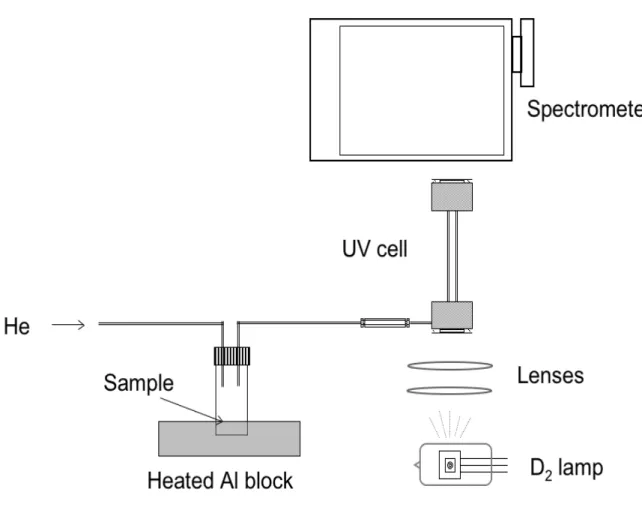
The experimental arrangement used in these experiments in shown in Figure 4.6.
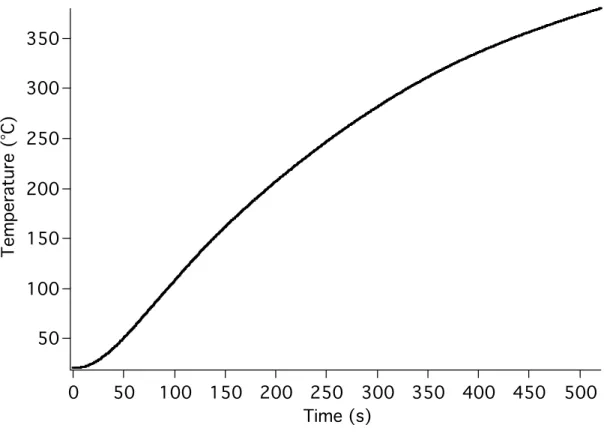
A few milligrams of tholins (sample PNNL 1) is placed in a small vial (1 mL) fitted with a septum cap. The vial is supported in an aluminum block that can be heated with heating tape, controlled by a Variac. Figure 4.7 gives the heating curve produced by this arrangement. The Variac setting was kept constant for all experiments described in this section, so the heating curve is also the same for all experiments. The temperature is recorded by a thermocouple positioned in contact with the bottom of the vial. A continuous flow of He at 100-200 mL/min is passed over the tholins and into an
ultraviolet absorption cell. The cell consists of two aluminum blocks supporting a quartz
tube (3 mm OD) between them, with silica windows on either side. The tube serves as both a light pipe and a conduit for the gaseous products. The cell has a pathlength of ~6 cm. The light from a 30 W deuterium lamp (Oriel 63163) is coupled into the cell using silica lenses. Unfocused light exiting the cell is directed into a Chromex 250is imaging spectrograph equipped with an Apex SPH-5 CCD detector. The resolution of the system is approximately 0.5 nm. The
Figure 4.6. Experimental arrangement for UV absorption spectroscopy of gases evolved during tholin thermal degradation.
entire optical path, including the spectrometer, is purged with nitrogen to allow operation below 200 nm. Spectra from 180-240 nm are acquired approximately every 1.5 seconds, with an integration time of 1 s.
350 300 250 200 150 100 50
Temperature (°C)
500 450
400 350 300
250 200 150
100 50
0
Time (s)
Figure 4.7. Heating curve for UV absorption spectroscopy experiments.
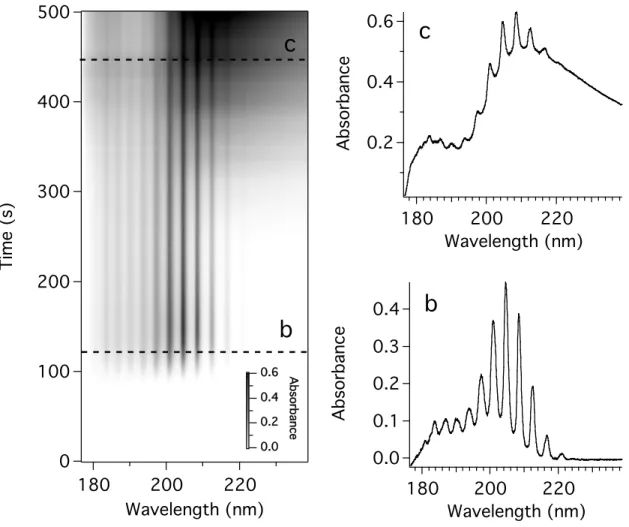
A three-dimensional graph of the data obtained with an 11.6 mg tholin sample is shown in Figure 4.8a. There are a number of ways to present this data. Here, we show wavelength on the x-axis, time on the y-axis, with darker shades of gray indicating increased absorbance. Figure 4.8b and c are cuts through the three-dimensional graph in Figure 4.8a at the indicated time. The graph exhibits a banded feature, peaking in intensity at around 150 seconds, which is an excellent match for the absorption spectrum of ammonia [Chen, et al., 1999]. Ammonia was not seen in the gas chromatography
experiments, probably because the column used was unsuitable for ammonia analysis.
This spectrum is shown in the cut labeled 4.8b. At later times (and thus higher temperatures) a broad feature peaking at around 210 nm can be seen overlapping the ammonia spectrum, as shown in
220 200
180
Wavelength (nm) 500
400
300
200
100
0
Time (s)
0.6 0.4 0.2 0.0
Absorbance
0.6
0.4
Absorbance 0.2
220 200
180
Wavelength (nm)
0.4 0.3 0.2 0.1 0.0
Absorbance
220 200
180
Wavelength (nm)
b
c c
b
Figure 4.8. a) Three-dimensional graph of the ultraviolet absorption of the gases evolved during the thermal degradation of tholin. b) Cut through a) at the indicated time (~120 s).
c) Cut through a) at the indicated time (~450 s).
Figure 4.8c. This is likely due to small organics, probably nitriles, as seen in the
headspace gas chromatography experiments. The samples were weighed before and after the experiment, and showed an average mass loss of 26%. It is unlikely such a a large amount of mass could be lost from the tholin without significant structural
rearrangement.
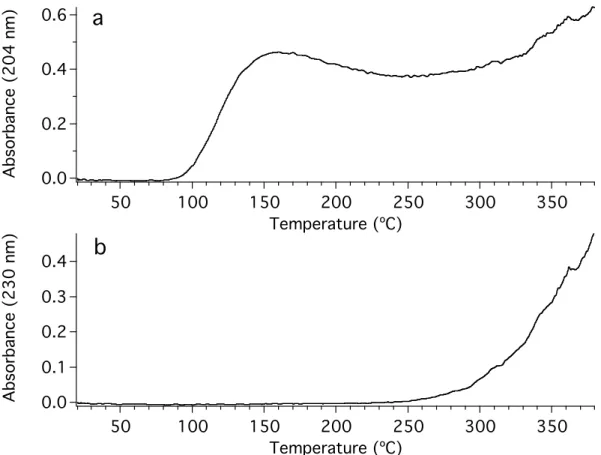
Using the heating curve, we can make a graph of the absorbance at a certain wavelength against the temperature. By choosing a wavelength that corresponds to the absorption of a particular species, we can graph the dependence of the evolution of this molecule against temperature. We hereafter refer to such a graph as a “thermogram.”
Two such thermograms are shown in Figure 4.9. In Figure 4.9a, the absorbance at 204 nm is plotted against temperature, giving the thermogram for ammonia. Ammonia begins evolving from the tholin sample at a very low temperature, only 100 °C.
Ammonia evolution reaches a peak at 160 °C, declines and begins to rise again at around 300 °C, although much of this rise can be attributed to the overlapping broad absorption that begins to emerge at around 250 °C. The broad absorption feature can be tracked by monitoring the absorbance at 240 nm; this thermogram is shown as Figure 4.9b.
Ehrenfreund et al. [Ehrenfreund, et al., 1994] performed evolved gas analysis with mass spectrometry on a sample of tholin produced by corona discharge. They report the evolution of compounds beginning at approximately 260 °C, and identified ammonia, hydrogen cyanide, and acetonitrile as some of the evolved products. The ammonia signal peaks at around 410 °C, and then declines. The acetonitrile signal peaks later, around 490 °C. Although the temperatures are different, the behavior of the ammonia and
acetonitrile evolution is similar in our system. However, the samples were not protected from oxidation, and also showed the release of CO2 and acetamide.
An experiment to determine the amount of ammonia that can be lost at low temperatures was undertaken. A sample of tholin was heated at 120 °C while monitoring the absorbance due to ammonia. After 30 minutes, the absorbance spectrum of ammonia was no longer apparent, and the sample was weighed, yielding a mass loss of 9%.
0.4 0.3 0.2 0.1 Absorbance (230 nm) 0.0
350 300
250 200
150 100
50
Temperature (ºC) 0.6
0.4
0.2
Absorbance (204 nm) 0.0
350 300
250 200
150 100
50
Temperature (ºC)
a
b
Figure 4.9. Thermograms for a) ammonia and b) the broad nitrile absorption.
The experiment was performed on a 15.0 mg sample of tholins that had been hydrolyzed in an ammonia-water solution. Approximately 20 mg tholin was sealed in a
vial with a Teflon cap with 1 mL concentrated ammonia, and the solution was heated at 100 °C for 12 hours. The residue was dried under vacuum before use.
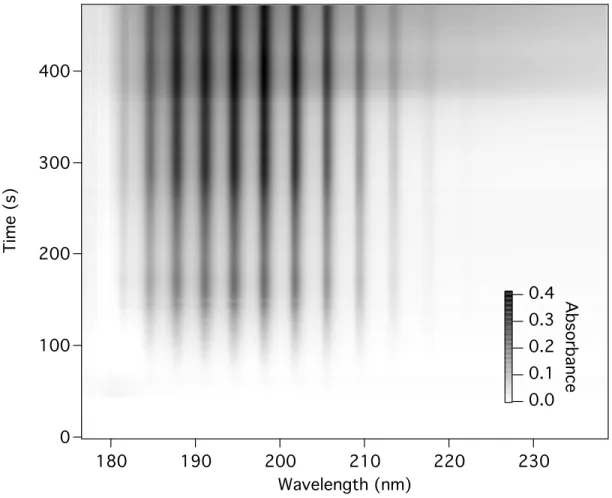
A graph of the data is shown in Figure 4.10. The strong ammonia features are still present, but the broad feature seen at later times in the data obtained for pristine tholins is diminished. This is more obvious in an examination of the relevant thermograms, shown in Figure 4.11.
230 220
210 200
190 180
Wavelength (nm) 400
300
200
100
0
Time (s)
0.4 0.3 0.2 0.1 0.0
Absorbance
Figure 4.10. Three-dimensional graph of the ultraviolet absorption of the gases evolved during the thermal degradation of hydrolyzed tholin.
0.10 0.08 0.06 0.04 0.02 Absorbance (230nm) 0.00
350 300
250 200
150 100
50
Temperature (ºC) 0.3
0.2 0.1 Absorbance (204 nm) 0.0
350 300
250 200
150 100
50
Temperature (ºC)
a
b
Figure 4.11. Thermograms for a hydrolyzed tholin sample. a) ammonia thermogram. b) Organic nitrile thermogram.
As before, the thermogram of ammonia is obtained by graphing the absorbance at 204 nm against temperature. The small amount of ammonia that evolves beginning at 50
°C is probably due to residual ammonia left by the hydrolysis procedure trapped in the tholin matrix. The ammonia release peaks at around 190 °C, declines and then rises again, as before. The thermogram for the broad feature is shown in Figure 4.11b. This is the same in shape as with the pristine tholins, but of much diminished intensity. If this feature is indeed due to the evolution of small nitriles, hydrolysis of the nitriles
themselves may be responsible for the loss of this signal.
Once again, data from model polymers is useful as a comparison to the tholins.
The data for PAN is shown in Figure 4.12, and the thermograms for polyacrylonitrile are shown in Figure 4.13. We see that this sample of PAN evolves ammonia beginning at much higher temperatures than the tholins, along with other organics that lead to a broad absorption feature. The low temperature evolution of ammonia from the tholins is thus not due to the presence of nitrile functionalities, but must be the result of the
decomposition of another nitrogen containing moiety.
230 220
210 200
190 180
Wavelength (nm) 400
300
200
100
0
Time (s)
1.2 0.8 0.4 0.0
Absorbance
Figure 4.12. Ultraviolet absorption spectra of the gases evolved during the heating of polyacrylonitrile.
0.8 0.6 0.4 0.2 Absorbance (230 nm) 0.0
350 300
250 200
150 100
50
Temperature (ºC) 1.2
0.8
0.4
Absorbance (204 nm) 0.0
350 300
250 200
150 100
50
Temperature (ºC)
a
b
Figure 4.13. Thermograms for a) ammonia and b) organics obtained from the thermal decomposition of PAN.
In order to try to determine the nature of this other nitrogenous functional group or groups, several other polymers were subjected to the same experimental procedure.
The structure of these polymers, and of PAN, is shown in Scheme 4.2. The
polyethyleneimine (Aldrich) sample had an average molecular weight of 423, and a boiling point of 250 °C, and so the sample was heated to only 225 °C. Polyallylamine (CarboMer, Inc.) was obtained as a 20% solution in water, and had an average molecular weight of 10,000. The water was removed under vacuum before the experiment.
Polypyrrole (Aldrich) was obtained doped onto carbon black. The sample also contained a “proprietary organic acid.” Unfortunately, pure polypyrrole was not available.
Data for the thermal decomposition of polyallylamine is shown in Figure 4.14.
We see immediately that the evolution of ammonia begins at much longer times (and thus higher temperatures) than in the tholin samples, and we can conclude that amine groups are not responsible for the ammonia signal in tholins.
Figure 4.15 gives the thermal decomposition pattern for polypyrrole. In contrast to polyacrylonitrile and polyallylamine, ammonia evolution is apparent beginning around 100 s (which corresponds to approximately 100 °C), as in the tholin samples. However, the amount of ammonia produced is far lower, as can be seen in the far smaller scale for absorbance. The carbon black on which the polypyrrole is doped may be absorbing some of the ammonia. A group of bands appears between 210 and 225 nm at approximately 150 °C. The compound responsible for this absorption is unknown, but it may be a product of the sulfonic acid doping agent added to the composite.
Data for polyethyleneimine is shown in Figure 4.16. The polymer could only be heated to 225 °C, as its boiling point is 250 °C. As with polypyrrole, we observe slight evolution of ammonia at low temperatures, but the amount is negligible. Towards the top of the plot, the broad absoption is likely due to polyethyleneimine itself.
CN CN CN
n H2N H2N NH2 n
NH
NH2
n
NH N
H
* *
n
polyacrylonitrile polyallylamine
polyethyleneimine polypyrrole
Scheme 4.2. Nitrogen containing polymers used for comparison to tholins.
230 220
210 200
190 180
Wavelength (nm) 400
300
200
100
0
Time (s)
0.8 0.6 0.4 0.2 0.0
Absorbance
Figure 4.14. Ultraviolet absorption data for the thermal decomposition of polyallylamine.
230 220
210 200
190 180
Wavelength (nm) 400
300
200
100
0
Time (s)
5x10⁻² 4 3 2 1 0
Absorbance
Figure 4.15. Thermal evolved gas ultraviolet spectra of polypyrrole. The horizontal banding is an artifact caused by variations in the output of the D2 lamp.
230 220
210 200
190 180
Wavelength (nm) 200
150
100
50
0
Time (s)
0.05 0.04 0.03 0.02 0.01 0.00
Absorbance
Figure 4.16. Ultraviolet spectra from the thermal decomposition of polyethyleneimine.
Note that the polymer was heated for a shorter length of time, as its boiling point is 250 °C.
4.6. Conclusions
The thermal decomposition of tholins is a complex process, beginning at fairly low temperatures (~100 °C). A key property of the decomposition is the release of large quantities of ammonia, easily detected by ultraviolet absorption spectroscopy of the evolved gases. Thermal gravimetric data and differential scanning calorimetry show that the decomposition occurs in several stages. Hydrogen cyanide and small organic nitriles, especially acetonitrile, evolve from the tholins as well. The residual material left after heating is chemically distinct from unheated tholin. LDI mass spectrometry studies show an increase in unsaturation, and a movement towards products of lower mass, consistent with the evolution of volatiles.
The thermal decomposition of tholins proceeds as follows. Beginning at 100 °C, ammonia begins to evolve. This low energy decomposition pathway is the primary means of decomposition until around 250 °C, where small organics, mostly nitriles, begin to dominate. This corresponds approximately to the temperature at which a dramatic change in slope is seen in the TGA data. As well, LDI mass spectrometry data on heated residues shows an increase in unsaturation between material that had been heated to 200
°C and 300 °C, supporting a transition in the mechanism of decomposition flanked by these two temperatures. Both the loss of ammonia and small organics continues as the temperature is increased, until a highly carbonized and glassy material remains. Only 50% of the mass of tholin is lost on heating to 950 °C under N2.
The nature of the functional groups that release volatiles at such low temperatures is still a mystery. The evolution of HCN and acetonitrile can be explained through a mechanism similar to the one by which polyacrylonitrile thermally degrades, involving
cyclization and aromatization. Experiments with model polymer systems rule out nitrile and amine functionalities as the source of the ammonia. At 100 °C, secondary amines release very small amounts of ammonia; polypyrrole releases somewhat more. Nitrogen containing rings such as pyrrole or pyridine may be the source of the ammonia, but more work is necessary to confirm this hypothesis. Observing the volatiles released from the thermal degradation of additional nitrogenous polymers would be useful.
The poor thermal stability of tholins has several implications for further research, and for Titan itself. On Titan, impactors would raise the temperature locally well above 100 °C, for brief period of time. This would both change the structure of the Titan aerosols, as well as release large quantities of ammonia. This ammonia would eventually either condense onto the cold surface, or dissolve into melt-water formed by the impact.
Either way, there would be a likely be a noticeable influence on the local environment as a result of the additional ammonia.
Pyrolysis is not a good method for the volatilization of tholins, since significant changes to the material occur at low temperatures. This renders the usual assumption of pyrolysis, that the fragments are structurally related to the polymer, invalid, since the polymer appears to condense, and lose a great deal of nitrogen as ammonia in the
pyrolysis process. However, tholins are difficult to volatilize by other means. Chemical derivatization may be a viable alternative. Thermochemolytic methods, which involve simultaneous pyrolysis and chemical derivatization, may also be useful. Analytical methods other than gas chromatography, such as HPLC and mass spectrometric methods, should also be pursued in the future.
4.7. References
Campbell, D., et al. (2000), Polymer Characterization: Physical Techniques, Stanley Thomas, Cheltenham, UK.
Chen, F. Z., et al. (1999), Low and room temperature photoabsorption cross sections of NH3 in the UV region, Planetary and Space Science, 47, 261-266.
Coll, P., et al. (1998), Review and latest results of laboratory investigations of Titan's aerosols, Origins of Life and Evolution of the Biosphere, 28, 195-213.
Coll, P., et al. (1999), Experimental laboratory simulation of Titan's atmosphere: aerosols and gas phase, Planetary and Space Science, 47, 1331-1340.
del Rio, J. C., et al. (1998), Structural characterization of bio- and geo-macromolecules by off-line thermochemolysis with tetramethylammonium hydroxide, Journal of Chromatography A, 823, 433-448.
Ehrenfreund, P., et al. (1994), Analytical Pyrolysis Experiments of Titan Aerosol
Analogs in Preparation for the Cassini Huygens Mission, Life Sciences and Space Research XXV (4), 15, 335-342.
Haken, J. K. (1998), Pyrolysis gas chromatography of synthetic polymers - a bibliography, Journal of Chromatography A, 825, 171-187.
Haken, J. K., and P. I. Iddamalgoda (1996), Degradative polymer analysis by chromatography, Journal of Chromatography A, 756, 1-20.
Israel, G., et al. (1997), The Aerosol Collector Pyrolyser (ACP) Experiment for Huygens, in Huygens: Science, Payload and Mission, ESA Publications Division,
Noordwijk, The Netherlands.
Materazzi, S., and R. Curini (2001a), The coupling of mass spectrometry with thermoanalytical instruments: Applications of evolved gas analysis, Applied Spectroscopy Reviews, 36, 169-180.
Materazzi, S., and R. Curini (2001b), On-line evolved gas analysis by infrared spectroscopy coupled to thermoanalytical instruments, Applied Spectroscopy Reviews, 36, 1-9.
Mellottee, H., and C. Vovelle (1982), Pyrolysis of Polyacrylonitrile.1. Study by
Thermogravimetry and the Analysis of Free Gases, European Polymer Journal, 18, 999-1006.
Linstrom, P.J., and Mallard, W.G. (Eds.) (2005), NIST Chemistry WebBook, NIST Standard Reference Database Number 69, National Institute of Standards and Technology, Gaithersburg, MD.
Pietrogrande, M. C., et al. (2001), Analysis of complex mixtures recovered from space missions - Statistical approach to the study of Titan atmosphere analogues (tholins), Journal of Chromatography A, 939, 69-77.
Surianarayanan, M., et al. (1998), Spectroscopic investigations of polyacrylonitrile thermal degradation, Journal of Polymer Science Part a-Polymer Chemistry, 36, 2503-2512.
Xie, W., and W. P. Pan (2001), Thermal characterization of materials using evolved gas analysis, Journal of Thermal Analysis and Calorimetry, 65, 669-685.
Xue, T. J., et al. (1997), The thermal degradation of polyacrylonitrile, Polymer Degradation and Stability, 58, 193-202.