An Explanatory message from the author
Plant Conservation: A Natural History Approach by Krupnick and Kress (eds.) was published in 2005 by University of Chicago Press.
The Chapters are divided into sections and each Chapter has a literature cited that includes the references for all of the sections of that chapter. The Press did not provide PDF's of the papers. We have scanned in the four sections for which I am a co-author and included the literature cited for the entire Chapter. There are, therefore, many extraneous references in the Literature Cited for each paper and the page numbers for the literature cited and the actual paper are not sequential in three of the four papers. Color plates follow the chapters and like the literature cited contain extraneous material. This presentation is not perfect but it appears to be our only option. - Vicki
The four papers included are as follows:
Chapter 4.3. The Guiana Shield by V. A. Funk and P. E. Berry, article pages76-79, literature 89-92
Chapter 5.7 Daisies and Sunflowers: Family Asteraceae by V. A. Funk and H. E.
Robinson, article pages 115-124, literature 130-137.
Chapter 10.1 Herbarium Collections, Floras and Checklists by W. J. Kress and V. A.
Funk, article pages 209-218, literature at end of next section.
Chapter 10.3 Phylogenetic Considerations by M. A. Jaramillo and V. A. Funk, article
pages 223-229, literature 229-235.
PLANT CONSERVATION
A NATURAL HISTORY APPROACH
Edited by Gary A. Krupnick and W. John Kress With a foreword by Daniel H. Janzen
UNITED S1ATES NATIONAL MUSEUM
A
Planiae Schlechterianae Austro-Africanae.
y^ lter vruydinii.
near two artificial lakes, the Laguna Negra and the Laguna de Los Cedros. Both are located on the northwestern edge of the park, and both have large numbers of in- troduced and adventive plant species. As yet, few foreign tourists visit Guaramacal National Park. Those who do, however, seem most interested in birds. Ecotourism could probably be expanded with negligible impact on the parks biodiversity.
It is likely, given the enormous human pressure being exerted on all tropical forests, that relatively well studied natural areas such as Guaramacal National Park will become increasingly important as isolated exemplars of entire biomes. Our obligation is therefore not only to protect them, but also to understand them.
4.3 THE GUIANA SHIELD
Vicki A. Funk and Paul E. Berry
THE GUIANA SHIELD underlies the northeastern corner of South America and includes much of the area east and south of the Rio Orinoco and east and north of the Rio Negro and Rio Amazonas. The area includes Bolivar, Amazonas, and Delta Amacuro states in Venezuela; most of Guyana, Surinam, and French Guiana;
parts of northern Brazil; and parts of southeastern Colombia. The area, which in- cludes the famous tepuis of Sir Arthur Conan Doyle's Lost World, is known to be rich in species diversity; for many groups, including some plant families, it serves as a center of species diversity. The Venezuelan portion of the Shield is the subject of a detailed flora (families A-M have been published), with the first volume dedi- cated to extensive background information on the Guiana Shield and its flora (Steyermark et al. 1995-present). The Flora of the Guianas (Guyana, Surinam, and French Guiana) is in progress, and a number of volumes have been published (Gorts-van Rijn 1989-present).
The Guiana Shield refers to an ancient craton that was formed well before the
breakup of the supercontinent of Gondwana. The Shield's igneous-metamorphic
basement was laid down in several events from 0.8 to 3.6 billion years ago (Mendoza
1977; Schubert and Huber 1990). This granitic basement is easily observed in the
many black "hills" of granite that dot the landscape across the Guiana Shield and is
exposed on some of the mountains and massifs. Between 1 and 1.6 billion years ago,
sedimentary covers of sand were successively laid down and cemented during ther-
mal events (Huber 1995). The resulting quartzite and sandstone rocks are known
today as the Roraima Formation. Some recent work has suggested that the eastern
rocks are the oldest (Huber 1995), so this would make the Pakaraima Mountains
and the eastern parts of Venezuela older than the rest of the Roraima Formation.
Over the last 200 to 600 million years, intrusions of diabases and granite have pen- etrated both the granitic basement and the quartzite sedimentary rocks.
The most distinctive feature of the Guiana Shield is the tepuis, the steep-walled table mountains prominently featured in photos and films. For many groups of organisms, they support a unique flora and fauna. Tepui elements begin to appear in the biota at around 300-1,000 m elevation, but predominate above 1,500-1,800 m. The easternmost peaks that reach heights of 2,000 m include Mount Ayanganna and Mount Wokomong in Guyana. The highest tepui, Sierra de la Neblina, just ex- ceeds 3,000 m elevation and occurs in the western part of the Shield on the border of Venezuela and Brazil. Many of the remaining Venezuelan tepuis have summits between 2,000 and 2,400 m. There is a large, midelevation, sandy plateau between 400 and 1,500 m called La Gran Sabana that occupies southwestern Venezuela and adjacent parts of Guyana, and there are variously sized areas of lowland white-sand savannas scattered in different parts of the Shield.
The Guiana Shield is located slightly north of the equator and is affected by trade winds blowing off the Atlantic Ocean. The trade winds bring moisture and collide with other masses of air in what is known as the intertropical convergence zone (ITCZ). Over the course of the year, the ITCZ migrates north and south, leading to distinct wet and dry seasons in different parts of the equatorial zone of South Amer- ica. The rainy part of the year in the Venezuelan part of the Guiana Shield is from May to August, and the driest part is from January to March (earlier to the south, later to the north). As one moves to the east, a second rainy season develops from December to January. This second rainy season is shorter, is less intense, and does not penetrate as far inland from the Atlantic Ocean. As a whole, the Guiana Shield has a tropical climate characterized by a high mean annual temperature exceeding 25°C at sea level (but decreasing with elevation); a diurnal range of temperature ex- ceeding the annual range; and an annual temperature range of less than 5°C. Most of the Shield area is covered by evergreen forest, but scrub or savanna predominates in some lowland areas, particularly when soil conditions are extremely poor or clay hardpans prevent penetration by tree roots and lead to flooding during the rainy season. Slopes of mountains that face the incoming trade winds usually have higher precipitation than the leeward sides (Clarke et al. 2001).
Only a few parts of the Guiana Shield have well-known floras, such as Mount Roraima (Venezuela), Iwokrama—Mabura Hill and Kaieteur (Guyana), Tafelberg (Surinam), and Saul (French Guiana). Most areas, such as the lowland forests and tepui slopes in Venezuela, the Pakaraima Mountains and New River Triangle in Guyana, and southern Surinam and French Guiana, are very poorly known. Hol- lowell et al. (2001) recently published a checklist for about half the flowering plants of the Guiana Shield (families from A to L). Using this publication and subsequent online updates (see Biological Diversity of the Guiana Shield 2004) as a guide, we estimate there are 12,500 species of flowering plants currently known for the Guiana Shield (excluding Brazil and Colombia). The ten largest groups are the Fabaceae (sensu lato), ferns orpteridophytes (allfamilies), Orchidaceae, Rubiaceae, Poaceae,
Cyperaceae, Melastomataceae, Euphorbiaceae, Myrtaceae, and Asteraceae. The Venezuelan portion of the Shield includes about 9,000 species, Guyana 6,200, Suri- nam 4,500, and French Guiana 5,000 (these species partially overlap between coun- tries). If the southern part of Surinam were better explored, the number of species for that country would surely increase. The Venezuelan Guayana includes 672 spe- cies of ferns and fern allies (Berry et al. 1995), while there are 638 species in the three Guianas. The estimated overlap of these two areas is 74%, so that the total number of ferns is predicted to be close to 1,000 species (not including the Brazilian and Colombian parts of the Shield). Thus, a conservative estimate of the total number of vascular-plant species from the Guiana Shield is 13,500 species, perhaps closer to 15,000 with the Colombian and Brazilian parts of the Shield included. Berry et al.
(1995) calculated that 40% of the plant species occurring in the Guiana Shield do not occur outside this area. A closer analysis of the flora of Kaieteur Falls, Guyana (Kelloff and Funk 2004; plate 4.2), shows that 42% of the plant species are endemic to the Guiana Shield. Consequently, we can conclude that about 6,000 species of vascular plants are restricted to the Guiana Shield. Considering just the plants of the Pantepui area (over 1,500 m elevation), Berry et al. (1995) found that the per- centage of endemics increases to 65%. Notable families with high levels of en- demism include Asteraceae, Bonnetiaceae, Bromeliaceae, Eriocaulaceae, Podos- temaceae, Rapateaceae, Rubiaceae, Tepuianthaceae, and Xyridaceae. This level of endemism must be one of the highest for noninsular floras, and documents the ex- istence of a "Guiana Shield flora" that is separate from other floras such as the An- dean, Amazonian, and Brazilian Shield floras.
With a few exceptions, such as cities along the Rio Orinoco, the Rupununi sa- vanna (Guyana), and the coastal areas of the Guianas, the Guiana Shield has be- nefited from its isolation and low population density, and much of the vegetation is still relatively undisturbed by human activities. This has led to its designation as a "tropical wilderness" (Mittermeier et al. 1998). Unfortunately, the pace of distur- bance has accelerated greatly in recent times because of logging by Asian and local companies, gold and diamond mining, oil drilling, bauxite mining, dams for hy- droelectric power, wildlife trade, burning, grazing, and agriculture. If this pace of activity continues, the Guiana Shield will lose its place as part of one of the three re- maining "tropical wilderness" areas in the world.
Efforts to conserve this interesting and unique region vary by country. Since
1962, Venezuela has set up 7 national parks, 29 natural monuments, and 2 biosphere
reserves covering 142,280 km
2, or almost 31% of the Shield that lies in the country,
and about 15% of the country. In Guyana the totals are much less, with only one
major national park, the expanded Kaieteur National Park (627 km
2or about 3% of
the country). Several other areas have been proposed, but the boundaries are am-
biguous and no legislation has been passed. Surinam has 18 areas of nature or forest
reserves or national parks that total 7,290 km
2(1,310 km
2of which is proposed; Lin-
deman and Mori 1989) and that make up 4.4% of the country. French Guiana has
no designated protected areas, but there are 18 proposed sites that total 6,710 km
2and make up 7.5% of the country (Lindeman and Mori 1989). However, just be-
cause an area is marked on a map as a park or reserve does not mean that the area is actually protected. As with many countries in the tropics, areas that are desig- nated as parks are often only "paper" parks because they lack the infrastructure and financial backing to effectively protect the areas. As a result parks often host gold miners, hunting, wildlife trade, and other disruptive activities. Currently, Venezu- ela and Guyana have the most pressure being put on their respective biodiversities, while French Guiana is probably the least threatened of the countries and therefore has the best chance to protect its environment.
The Guiana Shield encompasses parts of five countries, each with a different ad- ministrative structure and official language; there are a number of border disputes, and the borders are porous to drug, gold, and wildlife trafficking; and there are se- rious issues concerning native peoples. All of these issues will have to be overcome before a viable reserve system for the Guiana Shield can be designed and main- tained.
ACKNOWLEDGMENTS
This is number 86 in the Smithsonian's Biological Diversity of the Guiana Shield Program publication series.
4.4 PACIFIC OCEANIC ISLANDS
Warren L. Wagner, Denise Mix, and Jonathan Price
THE PACIFIC OCEAN is the earths largest feature, covering about one-third of the surface in an expanse of 155,000,000 km2. It is interspersed with thousands of islands totaling roughly 1,250,000 km2 of land, which is equal to the size of Peru and about one-half the size of Greenland. Many of the islands are situated on the Pacific plate, where the land arises from volcanic activity and has never been connected to a continental landmass. These islands are considered to be truly oceanic. The re- mainder of the Pacific Islands, which make up a greater proportion of the land area, are on the Indo-Australian plate. These islands generally have a continental origin with some volcanic composition, and will not be addressed here. Fiji is included, al- though it formerly was considered to have originated on the northeastern edge of the Indo-Australian plate. More recent syntheses of data suggest that Fiji's origin was on the Pacific plate and that it is an oceanic island that made contact with a fragment of Gondwana, now part of Tonga.
Two types of islands can be distinguished throughout the Pacific oceanic islands:
LITERATURE CITED
Alice, L. A., and Campbell, C. S. 1999. Phylogeny of Rubus (Rosaceae) based on nuclear ri- bosomal DNA internal transcribed spacer region sequences. American Journal of Botany 86:81-97.
Ballard, H. E., and Sytsma, K. J. 2000. Evolution and biogeography of the woody Hawaiian violets (Viola, Violaceae): arctic origins, herbaceous ancestry, and bird dispersal. Evolu- tion 54:1521-1532.
Bande, M. B., and Prakash, U. 1986. The tertiary flora of Southeast Asia with remarks on its palaeoenvironment and phytogeography of the Indo-Malayan region. Review of Palaeobotany and Palynology 49:203-233.
Berry, P. E., Huber, O., and Hoist, B. K. 1995. Floristic analysis and phytogeography. Pp. 161- 191 in Berry, P. E., Hoist, B. K., and Yatskievych, K., eds., Flora of the Venezuelan Guayana, vol. 1, Introduction. Missouri Botanical Garden, St. Louis.
Biological Diversity of the Guiana Shield. 2004. Smithsonian National Museum of Natural History, http://www.mnh.si.edu/biodiversity/bdg/.
Carlquist, S. 1974. Island Biology. Columbia University Press, New York.
. 1996. Plant dispersal and the origin of Pacific island floras. Pp. 153-164 in Keast, A., and Miller, S. E., eds., The Origin and Evolution of Pacific Island Biotas, New Guinea to Eastern Polynesia: Patterns and Processes. SPB Academic Publishing, Amsterdam.
Clague, D. A. 1996. The growth and subsistence of the Hawaiian-Emperor volcanic chain.
Pp. 35-50 in Keast, A., and Miller, S. E., eds., The Origin and Evolution of Pacific Island Biotas, New Guinea to Eastern Polynesia: Patterns and Processes. SPB Academic Pub- lishing, Amsterdam.
Clarke, H. D., Funk, V. A., and Hollowell, T. 2001. Using Checklists and Collections Data to Investigate Plant Diversity. Part 1, A Comparative Checklist of the Plant Diversity of the Iwokrama Forest, Guyana. Sida, Botanical Miscellany 21. Botanical Research Institute of Texas, Fort Worth.
Craddock, E. M. 2000. Speciation processes in the adaptive radiation of Hawaiian plants and animals. Evolutionary Biology 31:1-53.
Cuello A., N. L., ed. 1999. Parque Nacional Guaramacal. UNELLEZ-Fundacion Polar, Ca- racas.
. 2002. Altitudinal changes of forest diversity and composition in the Ramal de Guaramacal in the Venezuelan Andes. Ecotropicos 15:160-176.
Davis, S. D., Heywood, V H., and Hamilton, A. C, eds. 1995. Centres of Plant Diversity: A Guide and Strategy for Their Conservation. Vol. 2, Pacific Ocean Islands. Information Press, Oxford.
Dorr, L. J., Stergios, B., Smith, A. R., and Cuello A., N. L. 2000. Catalogue of the vascular plants of Guaramacal National Park, Portuguesa and Trujillo states, Venezuela. Contri- butions from the U.S. National Herbarium 40:1-155.
Duncan, R. A., and MacDougall, 1.1974. Migration of volcanism with time in the Marque- sas Islands, French Polynesia. Earth Planetary Science Papers 21:414-420.
. 1976. Linear volcanism in French Polynesia. Journal of Volcanology and Geother- mal Research 1:197-227.
Engel, F. A. 1976. An Ancient World Preserved: Relicts and Record of Prehistory in the An- des. Crown Publishers, New York.
Florence, J. 1987. Endemisme et evolution de la flore de la Polynesie Francaise. Bulletin de la Societe Zoologique de France 112:369-380.
Fosberg, F. R. 1948a. Derivation of the flora of the Hawaiian Islands. Pp. 107-119 in Zimmer- man, E. C, ed., Insects of Hawaii, vol. 1. University of Hawaii Press, Honolulu.
. 1948b. Immigrant plants in the Hawaiian Islands. Part 2. Occasional Papers Univer- sity of Hawaii 46:1-17.
Garcia-Perez, J. E. 1999. La herpetofauna del Parque Nacional Guaramacal. Pp. 127-137 in Cuello A., N. L., ed., Parque Nacional Guaramacal. UNELLEZ-Fundacion Polar, Caracas.
Goldstein, 1.1993. Distribucion, presencia, y conservacion del oso frontino en Venezuela. Bio- Llania 9:171-181.
. 1999. El oso frontino en el Parque Nacional Guaramacal. Pp. 161-164 in Cuello A., N. L„ ed., Parque Nacional Guaramacal. UNELLEZ-Fundacion Polar, Caracas.
Gorts-van Rijn, A. R. A., ed. 1989-present. Flora of the Guianas. Koeltz Scientific Books, Utrecht, Netherlands; and Royal Botanic Gardens, Kew, London.
Hollowell, T., Berry, P. E., Funk, V. A., and Kelloff, C. 2001. Preliminary Checklist of the Plants of the Guiana Shield. Vol. 1. Smithsonian Institution Press, Washington, DC.
Huber, 0.1995. Geographical and physical features. Pp. 1-61 in Steyermark, J. A., Berry, P. E., and Hoist, B. K., eds., Flora of the Venezuelan Guayana, vol. i, Introduction. Missouri Botanical Garden, St. Louis.
Huber, O., Duno, R., Riina, R., Stauffer, E, Pappaterra, L., Jimenez, A., Llamozas, S., and Orsini, G. 1998. Estado Actual del Conocimiento de la Flora en Venezuela. Ministerio del Ambiente y de los Recursos Naturales Renovables, Caracas.
Hundley, H. G. 1987. List of Trees, Shrubs, Herbs, and Principal Climbers, etc., Recorded from Burma with Vernacular Names. 4th revised edition. Government Printing Press, Rangoon, Burma.
j0rgensen, P. M., and Leon-Yanez, S. 1999. Catalogue of the Vascular Plants of Ecuador.
Monographs in Systematic Botany from the Missouri Botanical Garden, vol. 75. Missouri Botanical Garden Press, St. Louis.
Jargensen, P. M., Ulloa Ulloa, C, Madsen, J. E., and Valencia, R. 1995. A floristic analysis of the high Andes of Ecuador. Pp. 221-249 in Churchill, S. P., Balslev, H., Forero, E., and Luteyn, J. L., eds., Biodiversity and Conservation of Neotropical Montane Forests. New York Botanical Garden, New York.
Kelloff, C, and Funk, V. A. 2004. Phytogeography of Kaieteur Falls, Potato Plateau, Guyana:
flora distributions and affinities. Journal of Biogeography 31:501-513.
Kingdon Ward, F. 1941. The Vernay-Cutting Expedition, November, 1938, to April, 1939:
Report on the vegetation and flora of the Hpimaw and Htawgaw Hills, northern Burma.
Brittonia 4:1-19.
. 1944-1945. A sketch of the botany and geography of North Burma. Journal of the Bombay Natural History Society 44:550-574, 45:16-30, 45:133-148.
Kress, W. J., DeFilipps, R, A., Farr, E., and Daw Yin Yin Kyi. 2003. A checklist of the trees, shrubs, herbs, and climbers of Myanmar. Contributions from the U.S. National Herbar- ium 45:1-590.
Krummenacher, D., and Noetztlin, ]. 1966. Ages isotopiques K-Ar de roches prelevees dans les possessions francaises du Pacific. Bulletin du Societe Geologique de France 8:173-175.
Li H. 1994. The biological effect to the flora of Dulongjiang caused by the movement of Burman-Malaya Geoblock. Acta Botanica Yunnanica supplement 4:113-120.
Li H., Guo H.-J., and Dao Zh.-L. 2000. Flora of Gaoligong Mountains. Science Press, Beijing.
Li H., He D.-M., Bartholomew, B., and Long C.-L. 1999. Re-examination of the biological effect of plate movement: impact of Shan-Malay plate displacement (the movement of Burma-Malaya Geoblock) on the biota of the Gaoligong Mountains. Acta Botanica Yun- nanica 21:407-425.
Lindeman, J. C, and Mori, S. A. 1989. Floristic inventory of tropical countries. Pp. 376-390 in Campbell, D. G., and Hammond, H. D., The Guianas. New York Botanical Garden, Bronx.
Mendoza, V. 1977. Evolucion tectonica del Escudo de Guayana. Boletin de Geologia, publi- cacion especial 7:2237-2270.
Mittermeier, R. A., Myers, N., Robles Gil, P., and Mittermeier, C. G. 1999. Hotspots: Earths Biologically Richest and Most Endangered Terrestrial Ecoregions. Cemex, Mexico City.
Mittermeier, R. A., Myers, N., Thomsen, J. B., da Fonseca, G. A., and Olivieri, S. 1998. Bio- diversity hotspots and major tropical wilderness areas: approaches to setting conserva- tion priorities. Conservation Biology 12:516-520.
Mueller-Dombois, D., and Fosberg, F. R. 1998. Vegetation of the Tropical Pacific Islands.
Springer-Verlag, New York.
Myers, N., Mittermeier, R. A., Mittermeier, C. G., da Fonseca, G. A. B., and Kent, J. 2000.
Biodiversity hotspots for conservation priorities. Nature 403:853-858.
Nepokroeff, M., Wagner, W. L., Soltis, P. S., Weller, S. G., Sakai, A. K., and Zimmer, E. A.
In press. Monograph of Schiedea (Caryophyllaceae subfam. Alsinoideae). Systematic Botany Monographs.
Nunn, P. D. 1994. Oceanic Islands. Blackwell Publishers, Oxford.
Ortega, P., Aymard, G., and Stergios, B. 1987. Aproximacion al conocimiento de la flora de las montanas de Guaramacal, Estado Trujillo, Venezuela. BioLlania 5:1-60.
Pitman, N., Valencia, R., and Leon-Yanez, S. 2000. Resultados. Pp. 15-23 in Valencia, R., Pit- man, N., Leon-Yanez, 5., and ]0rgensen, P. M., eds., Libro Rojo de las Plantas Endemicas del Ecuador 2000. Publicaciones del Herbario QCA, Pontificia Universidad Catolica del Ecuador, Quito.
Population Reference Bureau. 2003. 2004 World Population Data Sheet of the Population Reference Bureau. Washington, DC. http://www.prb.org.
Rios U., G. A. 1999. Avifauna del Parque Nacional Guaramacal. Pp. 139-151 in Cuello A., N. L., ed., Parque Nacional Guaramacal. UNELLEZ-Fundacion Polar, Caracas.
Rivero, R., and Ortega, F. 1989. Notas fitogeograficas y adiciones a la pteridoflora de las mon- tanas y paramo de Guaramacal, Estado Trujillo, Venezuela. BioLlania 6:133-142.
Rutledge, D. T., Lepczyk, C. A., Jialong, X., and Liu, J. 2001. Spatiotemporal dynamics of en- dangered species hotspots in the United States. Conservation Biology 15:475-487.
Sauer, W. 1965. Geologia del Ecuador. Ministerio de Educacion, Quito.
Schjellerup, 1.1992. Pre-Columbian field systems and vegetation in the jalca of northeastern Peru. Pp. 137-150 in Balslev, H., and Luteyn, J. L., eds., Paramo: An Andean Ecosystem under Human Influence. Academic Press, London.
Schubert, C, and Huber, 0.1990. The Gran Sabana: Panorama of a Region. Lagoven Book- lets, Caracas.
Sierra, R., ed. 1999. Propuesta Prelim in ar de un Sistema de Gasification de Vegetation para el Ecuador Continental. Proyecto INEFAN/GEF-BIRF y EcoCiencia, Quito.
Smith, A. C. 1979-1996. Flora Vitiensis Nova: A New Flora of Fiji (Spermatophytes Only).
Vols. 1-5 and comprehensive indexes. Pacific Tropical Botanical Garden, Lawai, Hawaii.
Soriano, P. J., Utrera, A., and Sosa, M. 1990. Inventario preliminar de los mamiferos del Parque National General Cruz Carillo (Guaramacal), Estado Trujillo, Venezuela. BioLlania 7:85-99.
Stein, B. A., Kutner, L. S., and Adams, J. S. 2000. Precious Heritage: The Status of Biodiver- sity in the United States. Oxford University Press, Oxford.
Steyermark, ]. A., Berry, P. E., and Hoist, B. K., eds. 1995-present. Flora of the Venezuelan Guayana. Missouri Botanical Garden, St. Louis.
Takhtajan, A. 1986. Floristic Regions of the World. University of California Press, Berkeley.
Turner, D. L., and Jarrard, R. D. 1982. K-Ar dating of the Cook-Austral island chain: a test of the hot-spot hypothesis. Journal of Volcanology and Geofhermal Research 12:187-220.
Utrera, A. 1999. Mastofauna del Parque National Guaramacal. Pp. 153-159 in Cuello A., N. L., ed., Parque National Guaramacal. UNELLEZ-Fundacion Polar, Caracas.
Vargas, P., Baldwin, B. G., and Constance, L. 1998. Nuclear ribosomal DNA evidence for a western North American origin of Hawaiian and South American species of Sanicula (Apiaceae). Proceedings of the National Academy of Science USA 95:235-240.
Wagner, W. L. 1991. Evolution of waif floras: a comparison of the Hawaiian and Marquesan archipelagos. Pp. 267-284 in Dudley, E. C, ed., The Unity of Evolutionary Biology: The Proceedings of the Fourth International Congress of Sytematics and Evolutionary Biol- ogy. Dioscorides Press, Portland, Oregon.
Wagner, W. L., and Funk, V A., eds. 1995. Hawaiian Biogeography: Evolution on a Hot Spot Archipelago. Smithsonian Institution Press, Washington, DC.
Wagner, W. L., Herbst, D. R., and Palmer, D. D. 2001-present. Flora of the Hawaiian Is- lands. Smithsonian Institution, http://ravenel.si.edu/botany/pacificislandbiodiversity/
hawaiianflora/index.htm.
Wagner, W. L., Herbst, D. R., and Sohmer, S. H. 1990. Manual of the Flowering Plants of Hawai'i. University of Hawaii Press and Bishop Museum Press, Honolulu.
. 1999. Manual of the Flowering Plants of Hawai'i. Revised edition. University of Hawaii Press and Bishop Museum Press, Honolulu.
Wagner, W. L., Herbst, D. R., and Yee, R. S. 1985. Status of the native flowering plants of the Hawaiian Islands. Pp. 23-74 in Stone, C. P., and Scott, }. M., eds., Hawai'i's Terrestrial Ecosystems: Protection and Management. Cooperative National Park Resources Studies Unit, University of Hawaii, Honolulu.
Wagner, W. L., and Lorence, D. H. 2002. Flora of the Marquesas Islands. Smithsonian Insti- tution, http://ravenel.si.edu/botany/pacificislandbiodiversity/marquesasflora/index.htm.
Williamson, M. 2002. Costs and consequences of non-indigenous plants in the British Isles.
Botanical Electronic News (BEN), no. 281. http://www.ou.edu/cas/botany-micro/ben/
ben281.html.
Xu Zh.-H. 1998. Nujiang Nature Reserve. Yunnan Art Publishing House, Kunming.
Xue J.-R. 1995. The Gaoligong National Nature Reserve. Chinese Forestry Press, Beijing.
5-7 DAISIES AND SUNFLOWERS:
FAMILY ASTERACEAE
VickiA. Funk and Harold E. Robinson
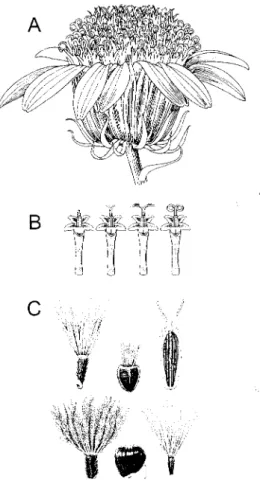
THE COMPOSITAE (Asteraceae) family contains the largest number of de- scribed species of any plant family, approximately 25,000 distributed in over 2,200 genera, and they occur on all continents except Antarctica. Estimates vary, but as- suming that there are 200,000-300,000 species of flowering plants, then one out of every 8-12 species of flowering plants is in the Compositae (about 10%). The family is monophyletic, characterized by florets arranged on a receptacle in heads (plate 5.7) and by anthers fused in a ring with the pollen pushed out by a style that acts as a plunger (fig. 5.4). Although the family is well-defined, there is a great deal of vari- ation among the members. The habit varies from annual and perennial herbs to shrubs, vines, or trees, although a few are true epiphytes. The heads can have 1 to more than 1,000 florets. Chromosome numbers range from in = 4 to high-level polyploidy with in — 228. Species grow in just about every type of habitat from forests to paramo and puna; however, they are less common in tropical wet forests and more common in open areas. They can be showy or obscure, fragrant or foul, breathtakingly beautiful or nondescript. However, the general perception of this family as "weedy" is not correct. Certainly some members benefit from distur- bance, such as a few species of dandelions, goldenrods, and thistles, but most spe- cies have a restricted distribution, and just about every "at risk" habitat in the world contains members of this family that are an important part of the flora. In fact, the 1997 IUCNRed List of Threatened Plants (Walter and Gillett 1997) lists 2,553 species of Compositae. Particularly vulnerable are previously unappreciated epiphytic members of the family in tropical forests, island floras, and the paramo and puna floras of the Andes.
That the family is monophyletic has never been in question. Every early worker
in plant classification recognized the Compositae as a group at some level. The
compound inflorescence with florets, often found in the striking ray/disk arrange-
ment (plate 5.7), enabled everyone to accurately delimit this family (e.g., Bentham
in Bentham and Hooker 1873). There are several general references that treat the
family (Bremer 1994; Heywood et al. 1977; Hind 1996); the most up-to-date is the
Kubitzki volume (in press) that provides keys to and descriptions for all the genera
of every tribe. In every molecular analysis that contains more than one member of
this family, the results show that the family is monophyletic (i.e., Jansen and Palmer
1987; Bremer et al. 1992; Hansen 1992). Within the family, however, things are not
as clear-cut. The family is traditionally divided into three subfamilies: Barnade-
sioideae, Cichorioideae, and Asterioideae (fig. 5.5). The Cichorioideae has been
M
.~LL
•MV
Figure 5.4 Characters of the Compositae. A, The head with ray florets arranged around the perimeter, disk florets in the center, and involucral bracts surrounding the outer florets. B, The pollen is released when the style pushes out through the anthers, which are fused at the margins. C, A few of the achene (cypsela) and pappus types found in the Compositae. The scale bar in C is 1 mm long.
divided into additional subfamilies (Panero and Funk 2002); for this treatment three of these are used. The Asterioideae is subdivided into two supertribes; each of these is divided into tribes (Baldwin et al. 2002). The tribes are the subunits of the family used in most treatments.
Most tribes contain some useful and noxious species as well as some that are common and some that are rare. No simplistic answers are available for manage- ment or protection of these types of plants in the various tribes other than the preservation of ample representations of the richest overall habitats.
The subfamily Barnadesioideae lacks the complex chemistry and twin hairs that characterize most of the rest of the family: their terpenoids are mostly diterpenes.
Most members have paired axillary spines. The pollen lacks the characteristic form
Mut Gp. Carduoideae Cichorioideae I 1
Figure 5.5 Relationships among the major tribes and subfamilies in the Compositae. The basal group, the monophyletic subfamily Barnadesioideae, contains less than 1% of the species in the family. The mono- phyletic terminal subfamily, the Asterioideae, contains ca. 65% of the species in the family. This large and diverse subfamily contains many of the tribes that are widespread and easily recognized, as well as several smaller ones. The third subfamily, the Cichorioideae (ca. 35% of the species in the family), vary in their mor- phological and molecular characters. Current thinking on the number of tribes ranges from 17 to 22; here 19 tribes are recognized (Funk et al., in press). B, subfamily Barnadesioideae; Mut., tribe Mutisieae; Mut. Gp., mutisioid group.
of higher Asteraceae. There is only one tribe, Barnadesieae, consisting of 9 genera and 90-95 species. Members are restricted to the Andes except for Dasyphyllum Kunfh, which extends into southern Brazil, and the monotypic Schlechtendahlia Less, in lowland southern South America. Their habit ranges from small herbs to trees. Although many of the species are rare, most of them grow in habitats that are relatively inhospitable, and only a few of these habitats are threatened.
The former paraphyletic subfamily Cichorioideae can be divided into three groups: the complex and variable Mutisieae, called the mutisioid group, and two monophyletic subfamilies, the Carduoideae and Cichorioideae. In addition there are several genera that do not fit in any of these groups, and they have been placed in subfamilies of their own (Panero and Funk 2002).
The paraphyletic mutisioid group is notable for its variable floret structure, gen-
erally showy involucral bracts, absence of much of the specialized chemistry of higher Compositae, and a nonspecialized pollen type. Members of the former large tribe Mutisieae are now found at the base of the Carduoideae and between the Mutisieae and Carduoideae and the Carduoideae and Cichorioideae.
The tribe Mutisieae sensu strictu consists of ca. 70 genera and nearly 1,000 spe- cies. The members occur mainly in Central America and South America. Most are Andean, on the Brazilian Shield, or on the Guiana Shield; however, there are also genera in Africa and Madagascar, Asia, and one monotypic genus in Australia, Am- blysperma Benth. Numerous members of the tribe are of limited distribution and at risk of extinction because of habitat destruction, such as several species of the rare small tree Wunderlichia Riedel ex Benth. from the Brazilian planalto. This tribe includes some of the most interesting plants found in the unusual tepui flora found on the Guiana Shield in northeastern South America.
Two unusual dioecious genera that used to be in the Mutisieae from southern and tropical Africa and Madagascar (Tarchonanthus L. and Barchylaena R. Br.) have been placed in their own tribe, Tarchonantheae (Keeley and Jansen 1991). They are now in the Carduoideae.
The tribe Cynareae (Cardueae) has 74 genera and ca. 2,500 species. Centers of distribution are primarily Eurasia and North Africa; some are successful weeds.
Notable members are the thistles (Cirsium L.), the artichoke (CynaraL.), and vari- ous Centaurea L. (e.g., bachelor's button). These often spiny-leaved plants are sometimes appreciated horticulturally, but can be unwelcome invaders outside of their normal range, as in western North America, the pampas of Argentina, and the fallow fields of Australia. Some taxa are restricted in their distribution, and most of these are endangered by habitat destruction and invasive species. For instance, Cen- taurodendron Johow and Yunquea Skottsb. are endemic to the Juan Fernandez is- lands, with the latter known only from a few plants from one summit. There are many small endemic genera in the Middle East {Centaurvthamnus [Forssk.] Wa- genitz & Dittrich), Central Asia (Schmalhausenia C. Winkl.), and Iran {Aegopordon Cass., Karvandarina Rech. f., Myopordon Cass.), all of which are difficult to find.
Many endemic species of various genera, such as Stemacantha australis (Gaud.) M.
Dittrich in Australia, Cirsium in the western United States, and Centaurea in the Mediterranean region, are rare and often endangered.
The subfamily Cichorioideae contains tribes with specialized asteraceous pollen, echinate or often lophate, and style branches with undivided areas of stig- matic papillae on their inside surfaces. The tribe Arctoteae is a small group of 15 genera almost totally restricted to southern Africa; one outlying genus, Cymbono- tus Cass., is endemic to Australia, where it is rare. A number of the species are used in horticulture, especially members of Gazania Gaertn. and Arctotis L. Many of the species found in the ephemeral flora of Namaqualand (a recognized conservation hot spot) are in this tribe.
Vernonieae have nearly 120 genera with ca. 1,400 species. It is widespread in North America and South America, Africa south of the Sahara, and areas around the Indian Ocean. A few species are invasive weeds such as Cyanthillium cinereum
(L.) H. Rob. of Africa. The widespread Struchium sparganophorum (L.) Kuntze of possible American origin invades agricultural fields in Africa and India. Baccha- roides anthelmintica (L.) Moench of Asia and Africa, and Gymnanthemum amyg- dalinum (Del.) Sen. Bip. ex Walp. of Africa have some medicinal value and have been introduced in a limited way into America. Lychnophora (Candelabra) is re- stricted to rocky outcrops in the Brazilian Shield and is endangered, even within the protected areas, by fire and grazing. Many species from Africa and Asia are threat- ened, such as the species of Distephanus in Madagascar and Reunion Islands. In addition, the Tanzania genus Hystrichophora Mattf. is still known from only one collection that was destroyed in Berlin; a fragment exists at the British Museum.
Located at the base of the Vernonieae is the small tribe Moquineae (Robinson 1994).
The tribe Liabeae contains 15 genera and ca. 180 species. Many genera are like the Cichorieae in having milky sap. Members of the Liabeae are found in Mexico, Cen- tral America, the Greater Antilles, and the Andes; however, the greatest diversity is in Ecuador and northern Peru. A few taxa are common, but most genera, such as Pseudonoseris H. Rob. & Brettell and Chionopappus Benth., are characterized by species that are difficult to find. One rare Peruvian genus, Bishopanthus H. Rob., is still known from only one collection, and the pygmy Microliabum humile (Cabrera) Cabrera of the Andes of northern Argentina has been collected only twice.
The tribe Cichorieae (Lactuceae) includes nearly 100 genera and several thou- sandspecies. Members of the tribe have milky sap and unusual ligulate florets. Dis- tribution is nearly worldwide, but is concentrated in Eurasia and western North America. Notable members are lettuce (Lactuca L.) and Cichorium L., used as food and flavoring, and the dandelion, Taraxacum Weber, which is usually considered a weed, can be used as a salad green and for making wine. More localized and en- dangered elements are found in restricted habitats around the world such as Cali- fornia and Eurasia, and some are island endemics, such as Dendroseris D. Don of Juan Fernandez with 11 species, 2 of which are extinct and another which is known from only three specimens.
The tribe Gundelieae contains a single genus with one to two species distributed from Turkey to the Middle East and Iran. Gundelia tournefortii L. is believed to have supplied the pollen and the plant images found on the shroud of Turin, and it has been suggested that it was the "crown of thorns." In spite of its distribution, the spe- cies may be threatened because its leaves, stems, roots, and undeveloped flower buds are edible and it is harvested from the wild before it sets seed.
The subfamily Asteroideae is notable for the familiar echinate, tricolporate, asteraceous pollen and the stigmatic papillae of the style branches often separated into two separate bands. When rays are present, they are "true" rays, and the disk florets often have short lobes. It is divided into two supertribes, one paraphyletic, Asterodae, and one monophyletic, Helianthodae. The supertribe Asterodae has tribes without phytomelanin in the walls of their achenes. Six of the seven tribes in the supertribe Asterodae are discussed below (Panero and Funk 2002; Funk et al., in press).
The tribe Astereae has ca. 190 genera and nearly 3,000 species; it is nearly world-
wide in distribution. Included are the common asters (e.g., Aster L.) and goldenrod (Solidago L.), the widespread Erigeron L., the weedy Conyza L., AmellusL. of South Africa, and the Bellidinae (the true daisies) of Europe. Some genera are very local and endangered, such as the tree genera Commidendron DC. and Melanodendron DC. of St. Helena, Remya Hildebr. ex Benth. of Hawaii, Pleurophyllum Hook. f. of the Subantarctic islands near New Zealand, Pacifigeron Nesom of Rapa Island, and the small bromeliad-like Novenia Pre ire of Peru and Bolivia. There are also a fairly high number of substrate endemics in the Andes and the western United States, particularly in Townsendia Hook, and Erigeron L., a number of which are threat- ened by mining and grazing.
The tribe Gnaphalieae (187 genera, 1,250 species) has a nearly cosmopolitan dis- tribution, and has an especially rich diversity in Australia and the southern Africa- Madagascar region. It is notable for Antennaria Gaertn. (pussytoes), Anaphalis DC.
(pearly-everlasting), and Leontopodium R. Br. ex Cass. (edelweiss). Most species have a restricted distribution; however, a few taxa such as Gamochaeta Wedd. turn up in sidewalks around the world. Calocephalus in Australia is restricted to one vul- nerable area in Canberra. Two more recently described small-statured Andean gen- era, Cuatrecasasiella H. Rob. and Jalcophila Dillon & Sagast, may or may not be en- dangered.
Inuleae (including Plucheeae) seem to be a monophyletic group with 66 genera and over 700 species with a nearly cosmopolitan distribution but concentrated in Eurasia and the Neotropics. Cultivated members include Inula helenium L. (ele- campane) and Buphthalmum salidifolium L. (yellow ox-eye). There are several weedy taxa, but most genera have only a few species nearly all of which have re- stricted distributions. Some are endemic to islands (Canary Islands: Allagopappus Cass.; Mauritius". MonarrhenusCass.; Madagascar: Neojeffreya Cabrera), or Namibia (Antiphiona Merxm.), or Australia (Allopterigeron Dunlop). CylindrodineCass. has two very rare species on Mauritius, one of which is known from ten specimens at a single locality.
The tribe Senecioneae contains 138 genera and over 3,000 species in both the Eastern and Western Hemispheres (Nordenstam, personal communication). It is on record as the largest tribe, with Senecio L. alone containing over 1,000 species, particularly in Eurasia and America. The horticultural cineraria (actually Pericallis D. Don in Sweet), native to the Canary Islands, is now widely introduced; the South African true Cineraria L. is distinguished in the tribe by its obcompressed achenes.
One narrowly endemic genus is Dendrosenecio (Hauman ex Hedberg) B. Nord.,
whose members are trees in the mountains of tropical east Africa. Other groups of
particular interest are the Jamaican genus Odontocline B. Nord., which is still
known mostly from 18th-century collections of Swartz, and Hoehnephytum Ca-
brera, a rare genus from Brazil. There are two remarkable trees on St. Helena, both
very important for conservation efforts, Lachanodes arborea (Roxb.) B. Nord.,
which is critically endangered, twice thought to be extinct, and Pladaroxylon leuca-
dendron (G. Forst.) Hook, f., also critically endangered with fewer than 50 plants
(Cronk 2000). Robinsonia DC. has seven species endemic to the Juan Fernandez is-
lands; two are extremely rare or possibly extinct, and the monotypic Lordhowea B.
Nord. from Lord Howe Island is endemic and known only from a small population.
The Mascarene Islands have two small genera as well, Faujasiopsis C. Jeffrey and Parafaujasia C. Jeffrey.
The tribe Anthemideae has over 100 genera and ca. 1,750 species that are found mostly in the Northern Hemisphere, especially in the Mediterranean region and Central Asia, with an additional center of diversity in South Africa. The chrysan- themums and daisies {Chrysanthemum L. with a conserved type and Leucanthe- mum Miller, respectively) are widely cultivated, as is Tanacetum L., which includes the tansies and pyrethrum. A few taxa, such as Matricaria matricarioides Porter ex Britton, M. recutita (L.) Rauschert, and the yarrow, Achillea L., are weeds. Members of the tribe are rich chemically, and are the source of the important insecticides named pyrethrins. Artemisia (sensu lato) is one of a handful of anemophilous gen- era in Asteraceae (Faegri and van der Pijl 1979), and its species are a major cause of allergies in humans (Lewis et al. 1983). All Artemisia (sensu lato) species produce aromatic oils, and several are culinary herbs or used as flavorings, hallucinogens, vermifuges, and pharmaceuticals (Lee and Geissman 1970; Heinrich et al. 1998;
Burrows and Tyrl 2001). The habitats of the Mediterranean and South African An- themideae are severely threatened.
The tribe Calenduleae is credited with 8 genera and ca. no species. Its native range is almost completely restricted to Africa. Today, genera such as Calendula L.
and Dimorphotheca Moench are often planted in gardens or on maintained road- sides. The tribe is most notable for extreme differences in the form of the ray and disk achenes. A few of the species are local and potentially endangered.
The supertribe Helianthodae contains tribes that usually have phytomelanin in the walls of their achenes. There are 12 tribes in this supertribe; here 5 are discussed.
The tribe Tageteae is an American group of ca. 16 genera and 250 species. Pectis L.
is widespread, and one species of Porophyllum is weedy, but most species of this genus have restricted distributions and some are narrowly endemic. Some species of Tagetes L. are rare and local, and the Peruvian type species of Schizotrichia Benth.
has been very rarely collected. Most notable in horticulture is the marigold (Tagetes), which is often planted among other garden plants that would benefit from its insect-repelling monoterpene chemistry.
The tribe Helenieae includes 900 species in 130 genera. It occurs prominently in western North America with some interesting disjunctions of some of the species in Chile and Argentina. The tribe contains the horticultural Gaillardia Foug., the weedy Schkuhria Roth, and Helenium L. (sneezeweed). Many of the North Ameri- can species are rich in terpenoids, and they are problems in range management.
The tarweeds (e.g., Madia Molina) of California and their relatives, including the 19 species of the Hawaiian silver sword alliance {Argyroxiphium DC, Wilkesia A.
Gray, and Dubautia Gaudich.) are especially important not only because of their distinctive natural habitats but because they are threatened and endangered. Las- thenia Cass. and Perityle Benth. contain many isolated species in California or Mex- ico that are subject to extinction.
The tribe Coreopsideae contains ca. 18 genera and over 300 species. It is basically American; some species of Bidens L. have become pantropical with the help of the retrorse barbs on the pappus awns. Horticultural genera include Coreopsis L., Cos- mos Cav., and Dahlia Cav. One particularly interesting Pacific endemic is the tree- like Fitchia Hook. f. with liguliform corollas, and a potentially endangered mono- typic genus is the St. Helena endemic Petrobium R. Br. known only from ca. 250 plants.
The tribe Heliantheae has nearly 150 genera and 2,400 species. The tribe rather characteristically has the combination of persistent pales on the receptacles of the heads and slowly maturing achenes (Robinson 1981). It is almost wholly American, with some pantropical elements such as Melanthera L. and Wedelia Jacq. Crop plants include the sunflower {Helianthus L.) from North America and Guizotia Cass. (niger seed) of Africa and India. Horticultural plants include Tithonia Desf.
(Mexican sunflower), Rudbeckia L. (black-eyed Susan), and Echinacea Moench (coneflower). Among the noxious weeds are Xanthium L., the cocklebur, and Acan- thospermum Kunth, both of which have fruits with hooked or straight spines, and ragweed [Ambrosia L.), the source of allergenic pollen. Some genera are rare en- demics such as Faxonia Brandeg., collected once in southernmost Baja California, Espeletia Mutis ex Humb. & BonpL, providing a special forested aspect to the paramo habitats of the northern Andes, and Exotniocarpon Lawalree, endemic in Madagascar. In spite of the appearance of great numbers in some species, the habi- tat is at risk, and many more-narrowly ranging species could easily become extinct.
Some genera and species of restricted distribution, such as Scales'ia Arn. and Trigonopterum laricifolium (Hook, f.) W. L. Wagner & H. Rob. of the Galapagos, may be more vulnerable than others.
The tribe Eupatorieae consists of ca. 173 genera and 2,400 species. It is almost ex- clusively American, with main centers of diversity in Mexico, the Andes, and Brazil.
Members include the well-known Ageratum L., Liatris Gaertn. ex Schreb. (blazing star), and Eupatorium L. (bonesets and joe-pye weeds). Their chemistry prevents them from being used as food, and a number of species (e.g., Chromolaena odorata [L.] R. M. King & H. Rob.) have become weeds when introduced to Hawaii, Asia, Africa, or Australia. Many of the more than 2,000 species have narrow distribu- tions, and one monotypic forest genus from Costa Rica, Standleyanthus R. M. King
& H. Rob., known from one stem, may already be extinct. There are a number of narrow endemics from eastern Brazil, such as Agrianthus Mart, ex DC. The tribe has many genera of pygmy plants known mostly from only one or two collections such as Iltisia S. F. Blake from Costa Rica and Panama, Monogerion G. M. Barroso
& R. M. King and Cavalcantia R. M. King & H. Rob. from the south edge of the Amazon basin, Piqueriopsis R. M. King from southwest Mexico, Ferreyrella S. R Blake from northern Peru, Piqueriella R. M. King & H. Rob. from northeast Brazil, Siapaea Pruski from the Guayana Highland area of southern Venezuela, Ciceronia Urban and Antillia R. M. King & H. Rob. from Cuba, Parapiqueria R. M. King & H.
Rob. from Para in Brazil, and Teixeiranthus R. M. King & H. Rob. from the Sao
Francisco area of eastern Brazil. Some of these have not been re-collected for more
than a century, and they may be extinct. Others like them may remain to be dis- covered or become extinct without ever having been known to science.
OVERVIEW
Two characteristics of the family bear examining in the context of conservation:
chemistry and pollination. The Compositae is notable for having a diverse second- ary metabolite chemistry based especially on the presence of unique structural types, sesquiterpene lactones, and a variety of types of polyenes (= polyacetylenes) (Mabry and Bohlmann 1977; Hegnauer 1977). This chemistry is considered a major factor in the success of the family. The basal element in the family, the Barnadesieae, lacks complex polyenes and sesquiterpene lactones, but has secondary metabolite chemistry based mostly on triterpenes. Most of the widespread weeds are not in these lower branches, so the chemistry may play an important role in the success of the more common taxa. Concerning pollination, insect and wind are the most common vectors for the Compositae. Bird pollination also occurs, however, being most common in the Barnadesioideae and Mutisieae and sporadic in tribes such as Cardueae, although there is bird pollination scattered in other tribes such as the Heliantheae and Senecioneae (Leppik 1977). The Barnadesioideae, Mutisieae, and Cardueae are the basal branches of the Compositae phylogeny (fig. 5.5), and one can surmise that the ancestor of the extant Compositae was bird pollinated. In ad- dition, one could say that most of the species in these basal groups are rare and at- risk taxa, and so one might surmise that it was the switch from bird pollination to insect pollination, along with the chemistry, that led to the diversification and suc- cess found in the higher branches of the phylogeny.
Endemicity in the family can also be examined from a habitat standpoint. For instance, within the area of rich diversity mentioned in the tribe Liabeae is a smaller and even more critical area of endemism. This recently noticed area is in the east- ern foothills of the Andes in Morona-Santiago and Zamora-Chinchipe Ecuador and in closely adjacent northern Amazonas Peru. The area remains moist and mostly forested to this day, although areas not far to the west and south are now de- forested and desertified. Rarities in the area include Stenopadus andicola Pruski (Mutisieae), the only member of that genus outside of the Guiana Shield;
Munnozia luyensis H. Rob. (Liabeae); three recently described species of Pipto- carpha (Vernonieae), including one that has very unusual heads; Pentacalia tilletii H. Rob. & Cuatrec. (Senecioneae); and some rarely recollected older species such as Ayapanopsis mathewsii (B. L. Rob.) R. M. King & H. Rob. (Eupatorieae). The most inexplicable endemic is the recently described new genus Holoschkuhria H. Rob., whose closest relatives are all from drier areas of North America and Mexico or from southern South America.
Around the globe various habitats contain rare and at-risk members of the Compositae. From the tree senecios of east Africa (Dendrosenecio [Hauman ex Hedberg] B. Nord., Senecioneae), to the Espeletia Mutis ex Humb. & Bonpl. of the northern Andes (Heliantheae), the hummingbird-pollinated trees of the tepuis of
the Guiana Shield (e.g., Stenopadus S. F. Blake, Mutisieae) and the planalto of Brazil {Wunderlichia Riedel ex Benth., Mutisieae), the daisy trees of Mexico to northern South America {Montanoa Cerv., Heliantheae), and the silverswords of Hawaii {Ar- gyroxiphium DC. and Wilkesia A. Gray, Helenieae), members of the Compositae are threatened, endangered, or extinct. Numerous habitats that are dominated by the Compositae are also under threat, such as the fields of spring flowers in Namaqua- land (South Africa), Western Australia, California, and the Mediterranean. While it is true that some members of the family are well-known weeds, the majority of species in the family are restricted in their distributions, and many are headed toward extinction. Clearly, this family does not deserve its reputation as "weedy,"
and indeed it might be used as an indicator of importance for many areas of the world that are not heavily forested.
5.8 AFRICAN VIOLETS:
FAMILY GESNERIACEAE
Laurence E. Skog
THE GESNERIACEAE, commonly known as the African violet family, is a moderately sized family of herbs, subshrubs, shrubs, lianas, and epiphytes, and mainly tropical. The family has over 2,500 species in about 135 genera usually grouped by seedling morphology and geography into two subfamilies of nearly equal size, the Gesnerioideae from the Neotropics and the Cyrtandroideae from the Paleotropics, and a small subfamily of few species in southern South America and the southwestern Pacific, the Coronantheroideae. Closely related to the Scrophu- lariaceae and distinguished from that family by placentation characters, the Ges- neriaceae are commonly found in humid habitats, often in wet or cloud forests at upper elevations, and are relatively uncommon in low-elevation rain forests and drier habitats. The plants, particularly those in the Neotropics, sometimes have modified storage stems, such as tubers (e.g., Sinningia spp.), or aerial and subter- ranean rhizomes (e.g., Gloxinia spp.), or stolons (e.g., Episcia spp.), all of which allow them to be propagated vegetatively, as well as from leaves and other plant parts. This ease of propagation, in addition to the attractiveness of the flowers, has made the plant family especially popular with amateur and commercial plant growers (e.g., the florists' gloxinia [Sinningia speciosa cultivars] and the African vi- olet [Saintpaulia spp. and cultivars]). Other than in horticulture and for folk uses for food and medicine, the plants have little economic importance.
Among the approximately 135 genera there a few monotypic genera (e.g., Lem-
bocarpus, Titanotrichum [plate 5.8]), as well as a few large genera with 100 species
or insufficiently known while others are common. The following genera have their only species listed as vulnerable by the IUCN Red List (Hilton-Taylor 2000):
Athyana Radlk., Euchorium Ekman & Radlk., Eurycorymbus Hand.-Mazz., Gloeo- carpus Radlk., Gongrospermum Radlk., Haplocoelopsis Davis, and Sinoradlkofera R G. Meyer. To this list, the genera Bizonula Pellegr., Blighiopsis van der Veken, Chonopetalum Radlk., Handeliodendron Rehder, Pentascyphus Radlk., Pseudopan- covia Pellegr., Scyphonychium Radlk., and Tsingya Capuron should be added, as they are rare or known from a single collection.
A few monospecific genera are not considered vulnerable or threatened because they are common, widespread, or cultivated. These include Amesiodendron Hu, Ar- feuillea Radlk., Beguea Capuron, Blomia Miranda, Cubilia Blume, Euphorianthus Radlk., HippobromusEckl. &Zeyh., HypelateV. Browne,MagoniaA. St.-Hil., Schleich- era Willd., Tristira Radlk., and Ungnadia Endl. Some genera, although local or nar- rowly endemic, need further evaluation of their conservation status. These include Bridgesia Cambess., Castanospora R V. Mueller, Delavaya Rranch., Dipteronia Oliv., Erythrophysopsis Verde, Eurycorymbus Hand.-Mazz., Gloeocarpus Radlk., Gongro- spermum Radlk., Hornea Bak., Loxodiscus Hook, f, Otonephelium Radlk., Pavieasia Pierre, Phyllotrkhum Lecomte, Sisyrolepis Radlk., Smelophyllum Radlk., Stocksia Benth., and Tripterodendron Radlk.
Elucidation of the conservation status of species requires a solid taxonomic knowledge that can be attained only through monographic studies. Species con- cepts depend on the knowledge level that we have of the organisms under study. The greater the knowledge, the better chance our hypotheses will stand the test of time.
Anybody who has been involved in the monographic studies of a group knows very well the difficulties of this multidisciplinary endeavor. Expeditions are increasingly expensive, and the logistics for exploring remote areas are complicated. In the end, it will not be possible to gather all the necessary pieces of the puzzle, since habitat destruction is usually faster than current exploration efforts. As a result, mono- graphs are written based on data that are less than ideal. It is not uncommon for monographs to contain species known only from one or a handful of collections.
These species are thus interpreted as extremely rare or in some cases as extinct.
LITERATURE CITED
Acevedo-Rodriguez, P. 1990. The occurrence of piscicides and stupefactants in the plant kingdom. Advances in Economic Botany 8:1-23.
. 1993a. A revision of Lophostigma (Sapindaceae). Systematic Botany 18:379-388.
. 1993b. Systematics of Serjania (Sapindaceae). Part 1, A revision of Serjania sect.
Platycoccus. Memoirs of the New York Botanical Garden 67:1-93.
. 2003. Melicocceae (Sapindaceae): Talisia and Melicoccus. Flora Neotropica Mono- graph 87:1-179.
Adema, R 1991. Cupaniopsis Radlk. (Sapindaceae): a monograph. Leiden Botanical Series
15:1-190.
Alongi, D. M. 1998. Coastal Ecosystem Processes. CRC Marine Science Series. CRC Press, Boca Raton, Florida.
Anderson, D. M., Cembella, A. D., and Hallegraeff, G. M. 1996. Physiological Ecology of Harmful Blooms. NATO AS I Series G, Ecological Sciences, vol. 41. Springer- Verlag, Berlin.
Ando, H. 1972. Distribution and speciation in the genus Hypnum in the circum-Pacific region. Journal of the Hattori Botanical Laboratory 35:68-98.
Arnell, 5.1962. Gymnomitrion laceratum in Peru. Bryologist 65:261.
Axelrod, D. 1.1985. Rise of the grassland biome, central North America. Botanical Review 51:
163-201.
Baldwin, B. G., Wessa, B. L., and Panero, J. L. 2002. Nuclear rDNA evidence for major line- ages of helenioid Heliantheae (Compositae). Systematic Botany 27:161-198.
Barker, R. M. 1986. A taxonomic revision of Australian Acanthaceae. Journal of the Adelaide Botanic Gardens 9:1-286.
Beck, H. T. 1990. A survey of the useful species of Paullinia L. (Sapindaceae). Advances in Economic Botany 8:41-56.
Bentham, G. 1881. Notes on Gramineae. Botanical Journal of the Linnean Society 19:14-134.
Bentham, G., and Hooker, J. D. 1873. Genera Plantarum. Vol. 2. Lovell Reeve and Co., Lon- don.
Bowen, B: 1999. Preserving genes, species, or ecosystems? Healing the fractured foundations of conservation policy. Molecular Ecology 8 (12 supplement 1): S5-S10.
Bramwell, D. 2002. How many plant species are there? Plant Talk 28:32-34.
Bremekamp, C. E. B. 1965. Delimitation and subdivision of the Acanthaceae. Bulletin of the Botanical Survey of India 7:21-30.
Bremer, K. 1994. Asteraceae: Cladistics and Classification. Timber Press, Portland, Oregon.
Bremer, K., Jansen, R. K., Karis, P. O., Kallersjo, M., Keeley, S, C, Kim, K.-J., Michaels, H. J„
Palmer, J. D., and Wallace, R. S. 1992. A review of the phylogeny and classification of the Asteraceae. Nordic Journal of Botany 12:141-146.
Brenan, J. P. M. 1952. Notes on African Commelinaceae. Kew Bulletin 7:179-208.
Brown, R. 1814. Gramineae. Pp. 580-583 in Flinders, M., A Voyage to Terra Australis. Lon- don.
Burrows, G. E., and Tyrl, R. J. 2001. Toxic Plants of North America. Iowa State University Press, Ames.
Cederwall, H., and Elmer, R. 1990. Biological effects of eutrophication in the Baltic Sea, par- ticularly in the coastal zone. Ambio 19:109-112.
Cronk, Q. C. B. 2000. The Endemic Flora of St. Helena. Anthony Nelson, Oswestry, Shrop- shire, United Kingdom.
Cronquist, A. 1981. An Integrated System of Classification of Flowering Plants. Columbia University Press, New York.
Daniel, T. F. 1993. Mexican Acanthaceae: diversity and distribution. Pp. 541-558 in Ra- mamoorthy, T. P., Bye, R., Lot, A., and Fa, J. E., eds., Biological Diversity of Mexico: Ori- gins and Distribution. Oxford University Press, New York.
Dettki, H., Klintberg, P., and Esseen, P. A. 2000. Are epiphytic lichens in young forests lim- ited by local dispersal? Ecoscience 7:317-325.
Dobson, A. P., Rodriguez, J. P., Roberts, W. M., and Wilcox, D. S. 1997. Geographic distribu- tion of endangered species in the United States. Science 275:550-553.
Dodson, C. H., and Gentry, A. H. 1991. Biological extinction in western Ecuador. Annals of the Missouri Botanical Garden 78:273-295.
Ellstrand, N., and Elam, D. R. 1993. Population genetic consequences of small population size: implications for plant conservation. Annual Review of Ecology and Systematics 24:
217-242.
Faden, R. B. 1974. Commelinaceae. Pp. 653-667 in Agnew, A. D. Q., Upland Kenya Wild Flowers. Oxford University Press, London.
. 1983. Isolating mechanisms among five sympatric species of Aneilema R. Br. (Com- melinaceae) in Kenya. Bothalia 14:997-1002.
. 1994a. Commelinaceae. Pp. 303-309 in Agnew, A. D. Q., and Agnew, S., eds., Up- land Kenya Wild Flowers, 2nd edition. East Africa Natural History Society, Nairobi.
. 1994b. New species of Commelina (Commelinaceae) from the flora of tropical East Africa. Novon 4:224-235.
. 1998. Commelinaceae. Pp. 109—128 in Kubitzki, K., ed., The Families and Genera of Vascular Plants, vol. 4, Flowering Plants: Monocotyledons: Alismatanae and Commeli- nanae (except Gramineae). Springer-Verlag, Berlin.
Faden, R. B., and Inman, K. E. 1996. Leaf anatomy of the African genera of Commelinaceae:
Anthericopsis and Murdannia. Pp. 464-471 in van der Maesen, L. J. G., van der Burgt, X. M., and van Medenbach de Rooy, J. M., eds., The Biodiversity of African Plants, Pro- ceedings of the 14th AETFAT Congress, 22-27 August 1994, Wageningen, the Nether- lands. Kluwer Academic, Dordrecht.
Faden, R. B., and Suda, Y. 1980. Cytotaxonomy of Commelinaceae: chromosome numbers of some African and Asiatic species. Botanical Journal of the Linnean Society 81:301-325.
Faegri, K„ and van der Pijl, L. 1979. The Principles of Pollination Ecology. 3rd edition. Perg- amon Press, Oxford.
Faust, M. A. 1990. Morphologic details of six benthic species of Prorocentrum (Pyrrophyta) from a mangrove island, Twin Cays, Belize, including two new species. Journal of Phy- cology 26:548-558.
. 1993. Prorocentrum belizeanum, Prorocentrum elegans, and Prorocentrum carib- baeum: three new benthic species (Dinophyceae) from mangrove island, Twin Cays, Be- lize. Journal of Phycology 29:100-109.
. 1996. Dinoflagellates in mangrove ecosystem, Twin Cays, Belize. Nova Hedwigia 112:
447-460.
Faust, M. A., and Gulledge, R. A. 1995. Population structure of phytoplankton and zoo- plankton associated with floating detritus in a mangrove island, Twin Cays, Belize. Jour- nal of Experimental Marine Biology and Ecology 197:159-175.
Fenchel, T. 1969. The ecology of marine microbenthos. Part 4, Structure and function of the benthic ecosystem, its chemical and physical factors, and the microfauna communities with special reference to the ciliate protozoa. Ophelia 6:1-182.
Fensome, R. A., Riding, J. B., and Taylor, F. J. R. 1996. Dinoflagellates. Pp. 107-169 in Janso- nius, J., and McGregor, D. C, eds., Palynology: Principles and Applications, vol. 1. Amer- ican Association of Stratigraphic Palynologists Foundation, Salt Lake City.
Funk, V. A., Bayer, R., Keeley, S., Chan, R., Watson, L„ Gemeinholzer, B., Schilling, E.,
Panero,J., Baldwin, B., Garcia-Jacas, N. X, Susanna, A., and Jansen, R. K. In press. Every- where but Antarctica: using a supertree to understand the diversity and distribution of the Compositae. In Friis, 1., and Balslev, H., eds., Plant Diversity and Complexity Pat- terns: Local, Regional, and Global Dimensions. Royal Danish Academy of Sciences and Letters, Copenhagen.
Gauslaa, Y. 1997. Population structure of the epiphytic lichen Usnea longissima in a boreal Picea abies canopy. Lichenologist 29:455-469.
Geiser, L., and Reynolds, R. 2002. Using lichens as indicators of air quality on federal lands.
Workshop report. U.S. Department of Agriculture, Pacific Northwest Region R6-NR- AG-XP-01-02.
Govaerts, R. 2001. How many species of seed plants are there? Taxon 50:1085-1090.
GPWG (Grass Phylogeny Working Group). 2001. Phytogeny and subfamilial classification of the grasses (Poaceae). Annals of the Missouri Botanical Garden 88:373-457.
Hansen, H. V. 1992. Studies in the Calyceraceae with a discussion of its relationship to Com- positae. Nordic Journal of Botany 12:63-75.
Harling, G. 1979. Xhe vegetation types of Ecuador: a brief survey. Pp. 165-174 in Larsen, K., and Holm-Nielsen, L. B., eds., Xopical Botany. Academic Press, London.
Hawkes, C. V., and Menges, E. S. 1996. The relationship between open space and fire for spe- cies in a xeric Florida shrubland. Bulletin of the Torrey Botanical Club 123:81-92.
Hed'enas, H., and Ericson, L. 2000. Epiphytic macrolichens as conservation indicators: suc- cessional sequence in Populus tremula stands. Biological Conservation 93:43-53.
Hegnauer, R. 1977. The chemistry of the Compositae. Pp. 283-355 in Heywood, V. H., Har- borne, J. B., and Turner, B. L., eds., The Biology and Chemistry of the Compositae. Aca- demic Press, London.
Heinken, X 1999. Dispersal patterns of terricolous lichens by thallus fragments. Lichenolo- gist 31:603-612.
Heinrich, M., Robles, M., West, J. E., Ortiz de Montellano, B. R., and Rodriguez, E. 1998.
Erhnopharmacology of Mexican Asteraceae (Compositae). Annual Review of Pharma- cology and Toxicology 38:539-565.
Heywood, V. H., Harborne, J. B., and Turner, B. L. 1977. The Biology and Chemistry of the Compositae. Academic Press, London.
Hillebrand, H., and Sommer, U 2000. Diversity of benthic microalgae in response to colo- nization time and eutrophication. Aquatic Botany 67:221-236.
Hilton-Taylor, C, comp. 2000. 2000 IUCN Red List of Threatened Species. IUCN, Gland, Switzerland, and Cambridge.
Hind, D. J. N., ed. 1996. Compositae. Vols. 1-2. Royal Botanic Gardens, Kew, London.
Hitchcock, A. S. 1935. Manual of Grasses of the United States. U.S. Department of Agricul- ture Miscellaneous Publication 200. U.S. Government Printing Office, Washingon, DC.
Hitchcock, A. 5., and Chase, A. 1951. Manual of Grasses of the United States. 2nd edition. U.S.
Department of Agriculture Miscellaneous Publication 200. U.S. Government Printing Office, Washingon, DC.
James, P. W. 1973. The effect of air pollutants other than hydrogen fluoride and sulphur diox- ide on lichens. Pp. 143-175 in Ferry, B. W., Baddeley, M. S., and Hawksworth, D. L., eds., Air Pollution and Lichens. University of Toronto Press, Toronto.
Jansen, R. K., and Palmer, J. D. 1987. A chloroplast DNA inversion marks an ancient evolu-