CHAPTER I INTRODUCTION
1.1 The Background of Study
Language is a purely tool of human to convey information in communicating ideas, emotions, concepts or feeling that comes from heart, in the sense of the word as a means of conveying something. Language can become a bridge to connect one another that live in different places and cultures. By using a language one can gain information, knowledge and express one’s feeling, and emotions. There are many languages in this world, one of them is English.
English is an international language or universal language which is originally of England. As international language, English used to conduct communication in almost the entire word in many countries. English is the world’s most important to be learned in order to improve the quality of social life. English has been placed in the higest position to be used in communication by many people. In developing the student’s ability in mastery English, it cannot be separated from vocabulary mastery, because it can be measurement of student understanding English. English as foreign language has been though formally the primary level up to university level.
Writing is an activity of thinking and expressing of what one’s feeling, wished and envisioned. Moreover, writing is not only for communicating to each other but also for expressing ideas. People can communicate with others without speaking directly but expressing their feeling through written text. Someone must have a good capability to construct and deliver their writing in grammatical and structural rules in the language. According to Sanggam Siahaan et.al (2011:1) There are twelve genres in writing. They are Descriptive, Expository, Explanation,
Anecdote, Report, Recount, Spoof, News, Item, Procedure, Discussion, Analytical, Exposition and Narrative.
Kane (2000:366) said that narrative is presenting the events which is truthfull that some accident happened. So, narration text means a kind of action or events that done by characters truly. Writing narrative teks is something interesting that ever happen in the real life. It usually has problem or conflict and the get the resolution in the end. To make students motivated and enjoyable to write the text, they need to know the aspects and other components become rules in writing narrative text. Refers to Jacob .et.al (1981:31) there are five significant components in writing text: content, organization, vocabulary,language use, and mechanic. Students who know these aspects will produce the good writing text. This reality is the basic problem for the students in Junior High School that their writing have not quite good.
Based on the writer’s experiences when he was teaching practice program (PPL) in SMP Negeri 1 Tigapanah, the writer found out that many student can’t write a text well especially narrative text. , the writer found out that many student can’t write a text well especially narrative text. The problem may be caused by some aspects: The first is rare opportunity to use English because the status of English as a foreign language, not as main daily communication. The second is the students do not have enough practice in writing text.
So the students may make mistake like, determining the main idea, using the suitable word, and arranging the sentences. Therefore, the students need to master the structure of the English language, should have enough vocabulary, and also know the spelling of the words in order to write correct sentences and arrange them into a good paragraph. The teacher began to teach by asking the student about the material, then the teacher only give an explanation and exercises. After that, he asked the student to write a story. The writer thought
that’s why technique that used by teacher do not support the students motivation to write the paragraph.
Based on the explanation above, the writer wants to conduct a research entitled “AN ANALYSIS OF STUDENT’S ABILITY IN WRITING NARRATIVE TEXT AT GRADE 8th IN SMP NEGERI 1 TIGAPANAH”.
1.2 The Problem of the Study
There are many unlimited number of problem about writing narrative texts. Therefore, the problem of this study is:
1. Are the student able in writing narrative text at SMP Negeri 1 Tigapanah?
2. What are the difficulties of students in writing a narrative text at SMP Negeri 1 Tigapanah?
1.3 The Objectives of the Study The objectives of this study are:
1.To know the student’s ability in writing narrative text
2. To know the difficulties of students in writing Narrative text at SMP Negeri 1 Tigapanah
1.4 The Scope of the Study
In this research, the writer were observe the ability and difficulty of the students at Class- VIII in SMP Negeri 1 Tigapanah . The writer only focus on the students’ ability and difficulty to write narrative text especially in vocabulary refers to the students’ achievements to use verb, and language use refers to the students’ ability in writing the sentences in correctly tenses
1.4 The Significance of the Study
The result of the study is expected to be useful for two aspects:
1. Theoretically
This study is to enrich the theory of writing, especially in understanding the student’s ability and difficulty in writing narrative text.
2. Practically
1. For the students of SMP N 1 Tigapanah, as the information to help them to solve their problems in writing narrative text.
2. For the English teachers of SMP N 1 Tigapanah, it can be used as a reference in terms of increasing the student’s ability in mastering writing narrative text.
3. For other writers, as references to do further research in the same subject in various topic in the different context.
CHAPTER II
REVIEW OF LITERATURE
2.1 Theoretical Framework
This chapter presents a review literature and explanation of the relate materials. Some opinions are needed to explain some concepts or terms that applied in the research concern. It is used to avoid misunderstanding between the writer and the readers. The basic concept of the study should be clear from the beginning to give a clear concept of what has been done to reach the goal of the research. It is used to make the writer and the readers have the same perception of the research. So, In order to strengthen the study, the following terms are needed in the study.
2.2 Language
Language is very important tool of communication used to communicate. Language is a system of communication: it can be spoken or written and it can be understood and that is used everywhere. People talk, share, and express their feeling with language. It is a demand of them to be able to communicate well, because they can convey their purpose to other people.
Algeo (2005:2) stated that a language is system of conventional vocal signs by means of which human being communicate. Language is the foundation for people to communicate with others. Language is not only a study oflanguage and culture, but ultimately on the word of relations and influence. In daily life people can communicate by using language, so people can not separated with language.
Based on the explanation above the writer defines language is a tool to communicate between people to express their personal reactions to situations, to share the ideas and knowledge. English in the world as the common, and teaching English in Indonesia needed
some basic skill they are listening, reading, speaking and writing.
2.3 English
English as an international language also has it’s own definition in each country. It makes some authors defined English as the needs of the particular place. Nunan (2003:138) state the English is a language that has been strongly affected by other language.
According to Dudeney and Hockly (2010:1) on of the interesting about English as a global language is that it is increasingly being used as a lingua franca(or common language) so that people from not English – speaking countries can communicate with those who speak English. Knowing some English is becoming increasingly important in today’s global world.
Based on the explanations above, the writer can be conclude that English is the worlds as the commons, and teaching English in Indonesia needed some basic skill i.e listening, reading, speaking, and writing.
2.4 Ability
Mendenhall (2012 : 22) states that the most important characteristic of ability is that it measures learning rather than time. Student progress by demonstrating their ability, which means they proven that they have mastered the knowledge and skills (called ability) required for a particular course.
Learners work on one ability at a time, which is likely a small component of a larger learning goal. The student is evaluated on the individual ability by doing a test or other instrument, and only once they have mastered it they move on to other goal. Ability is also used as a more general description of the requirements of human beings in organizations and communities. Ability is sometimes thought of as being shown in action in a situation and
context that might be different the next time a person has to act. In emergencies, competent people may react to a situation following behaviors they have previously found to succeed. To be ability a person would need to be able to interpret the situation in the context and to have a repertoire of possible actions to take and have trained in the possible actions in the repertoire, if this is relevant. Regardless of training, ability would grow through experience and the extent of an individual to learn and adapt. Ability can help organizations align their initiatives to their overall business strategy.
By aligning competencies to business strategies, organizations can better recruit and select employees for their organizations. Competencies have been become a precise way for employers to distinguish superior from average or below average performance. The reason for this is because competencies extend beyond measuring baseline characteristics and or skills used to define and assess job performance. In addition to recruitment and selection, a well sound Competency Model will help with performance management, succession planning and career development.
2.5 Difficulties
The writing difficulties are commonly shared among English native speaker and even students who are learning English both as a second or foreign language. Like all learning problems, difficulties in writing can be devastating to a students‟ education.
Heaton (1988) state that writing skills is complex and sometimes it is difficult to teach.
Requiring mastery are not only f grammatical and rhetorical devices but also of conceptual and to express what they know about many different subject through writing. If a student fails to develop certain basic skills, he will be unable to write with the speed and fluency required to
excel as these demands increase. Indeed, for a student‟s struggling with a writing problem, the writing process itself interferes with learning. Students faced with such difficult odds have trouble staying motivated.
According to Oshima and Hogue (1997:24) narration is story writing.
Narrative writing presents a story of sequence event which involves characters. When we write a narrative text, we write about events that happens in the past. Narrative text is a text that has a purpose to amuse or entertain the reader what happened in the past and to amuse or entertain the reader with actual or imaginary experience in different ways.
Additionally, Bancha Further (2013) explained that spelling mistakes may occur when students are less concentrated due to tiredness or carelessness about the correctness of words.
Furthermore, he indicates that the reason spelling is difficult for students is “the fact that not all varieties of English spell the same words in the same way”. For instance, the way
American English pronounce the word „behavior‟, differs from British English behavior‟. The way a student punctuates writing can change the meaning completely, because each punctuation mark is a distinctive way of interpreting the meaning. Therefore, students need to pay attention to the way they punctuate, which is in most cases a problem for them.
2.6 Writing
Browne (2007:81) says that: Writing is a complex activity which involves many skills.
It includes deciding what one wants to write, how best to say it and how to put these ideas into paper in a way that is intelligible to others. Writing is a language form that is distinguished from speech because it can be permanent and it can be planned and changed before it emerges.
Like talk it can be used to entertain, persuade, express feelings, inform, request, report, express opinion or ideas in written.
Nunan. D (2003:88) also gives opinion that “writing is the mental work of inventing ideas, thinking about how to express these ideas, and organizing the words into statements and paragraph that will be clear to a reader”.. Writer needs to express an idea in certain ways and choose the best for types of writing. Writing also defines as process of transferring idea into written. Holmes (2004: 11) shows that writing is simply a way to represent spoken language.
In addition, Longan (2001:335) says one major theme in pedagogical research on writing is the nature of the composing process of writing. Written products are often the result of thinking, drafting, and revising, procedures that require specialized skills that focuses students on how to generate ideas, how to organize them coherently, how to use discourse markers and rhetorical conventions to put them cohesively into a written text, how to revise text for clearer meaning, how to edit text for appropriate grammar, and how to produce a final project.
Moreover, Nunan (2003:88) states that writing is the physical act of committing worlds or ideas to some medium, whether it is hieroglyphics linked into parchment or an email message typed into a computer. kress ( 2005:8) said writing is still the most important means of access to the past repository of knowlwdge of literate. It is important to be learnest in learning language.
Writing is letters or symbols written or imprinted on a surface to represent the sounds language.
Stott and Avery (2001:235) state writing is one way of making meaning from experiance for ourselves and for other. Good writing begins with understand haw to construct and use effective sentence pharagraph. In addition, Longan (2001:335) says one major theme in pedagogical research on writing is the nature of the composing process of writing. Written products are often the result of thinking, drafting, and revising, procedures that require specialized skills that focuses students on how to generate ideas, how to organize them
coherently, how to use discourse markers and rhetorical conventions to put them cohesively into a written text, how to revise text for clearer meaning, how to edit text for appropriate grammar, and how to produce a final project.
2.6.1 Genres of Writing
Learning about writing is learning about genres, According to Sanggam Siahaan et.al (2011: 1), there are 12 genres in writing, they are, spoof, recount, procedure, hortatory exposition, anecdote, description, report, Analytical exposition, explanation, discussion, news, and narrative.
1. Spoof
Spoof is the way of twisting some of the events in the process that used to create a humor and create a tex. The punch line in the events is an unpredictable action done by a character(s) for a response to another character(s).
2. Recount
Recount is written out to make a report about an experience of a series of related event. Theoretically, the technique to write a recount is similar to the way a narration is written. Specifically, a recount is written out to inform an event or to entertain people.
Structurally, a recount is a text which contain three components, they are orientation, events, and the last is reorientation.
3. Narrative
Narrative is any written English text in which the writer wants to amuse, entertain people, and to deal with actual or vicarious experience in the different ways. It is tell the stories, experiences, and actions which happen in the past. It uses simple past tense. The elements of narrative paragraph are orientation, events, resolution and coda. But coda is optional.
4. Procedure
Procedure is any written English text in which the writer describes how something is accomplished through a sequence of action or step. Procedure is a text containing four components, namely, goal, materials, methods, andreorientation by which a writer describes how something is accomplished through a sequence.
5. Hortatory Exposition
Hortatory Exposition is a written English text in which the writer persuades people that something should or should not be the case. It is also a text containing three components, namely, the thesis, argument of issue of concern, and recommendation.
6. Anecdote
Anecdote is the tools of the writer to share with the others account of an unusual or amusing incident. Anecdote is a text containing five components, they are abstract, orientation, crisis, reaction and coda.
7. Descriptive
Descriptive is the writer describes an object. In this text, the object can be a concrete or abstract object. It can be a person, or an animal, or a tree, or a house, orcamping. It can be about any topic. Descriptive is the text containing two components, namely, identification and description.
8. Report
Report is a kind of text which can be written out with a descriptive technique. It describes an object to the readers. The lenght of the text depend on the specific details of the object being described.
9. Analytical exposition
Analytical exposition is an expository text. It is about the truthof a fact of a certain object. It is written to expose the truth of the fact of the object to the reader. The aim is just to expose the truth of the fact, in this case it is just to persuade the readers to believe
it, and to show the reader about the truth in the human’s life reality by proved it with some facts.
10. Explanation
Explanation is a written English text in which the writer explained the processes involved the information or workings of natural or sociocultural phenomena. Explanation is a text containingtwo components, namely, the general statements, and sequenced explanation.
11. Discussion
Discussion is a written English text in which the writer presents some points of view about an issue, it contains three components, they are: issue, argument, and conclusion or recommendation.
12. News item
News item is neither a paragraph nor an essay, Instead this conforms to any written English text containing one or more than one paragraph in which the writer to inform people about events of the day which are considered newsworthy or important. News item is a text containing three components namely: news worthy even(s), background events and sources.
2.6.2 Process of Writing
Process of writing is the most important thing to know before writing. Process of writing can help the writer to write easily. Carrol et al (2001 : 99), states that there are five process of writing, namely prewriting, drafting, revising, editing and proofreading, publishing and presenting.
1) Prewriting
Prewriting is jotting down in trough sentences or phrases everything that comes to
mind about a possible topic. The prewriting helps to get a writer’s creative juices flowing.
Prewriting also can helps to gap the topic and so the text can be a good. You can warm up to write with your own set of prewriting strategies and techniques.
a) Choosing your topic b) Narrowing your topic
c) Considering your audience and purpose d) Gathering Details
2) Drafting
Writing a draft involves getting ideas down on paper in taught the format that intend for the finished work. When write a first draft be prepared to put in additional thoughts and details that did not emerge during prewriting. In drafting students can choose a form for their writing. Keep purpose in mind while choosing a form. Then, keep the conventions of chosen form in mind as you draft.
3) Revising
Revising is probably the most important stage of the writing process. However, many writers also find it to be the most difficult but when you know the key, it is easy. In writing, it refers to the use of a logical step-by-step process to color code, analyze, evaluate, and rework your writing. There are a variety of things to look for when revising the overall structure of your work, including the following:
1) Check to see that your organization makes sense and that it is consistent.You may find it necessary to recognize parts of your paper
2) Make sure that your introduction will grab your readers’ interest and that your conclusion will leave lasting impression.
3) Determine whether you have provided enough support for your main idea. One strategy you can use for this purpose is shown text.
4) Editing and Proofreading
Once students have finished revising for content, proofreading their work carefully to find and eliminate errors in grammar, usage, mechanics, and spelling. These types of errors will distract readers and may cause them to respond negatively to your work-even if the content is excellent. To check their writing for errors, get in the habit of reviewing their draft several times. Each time, focus on a specific proofreading topic.
5) Publishing and presenting
This preview of the writing process provides just a glimpse of the strategies and techniques students can employ in their writing process. This is the last process in writing. From this process, they can build their portfolio reflecting on heir writing and assessing their writing.
Occasionally, latest writing with something they wrote a while ago.
2.6.3 The Component of Writing
Jacob et.al. (1981:31) point out five significant components in writing they are : a. Content
The content of writing should be clear for the readers so that the readers can understand the message convey and gain information from it. In order to have a good content of writing, its content should be well unified and completed. This term is usually known as unity and completeness, which become characteristic of good writing.
b. Organization
In organization of their writing concern with the ways through writer
arranges and organizes the ideas in order the message in the words. There are many ways used by the writers to organize or arrange the writing this organization is mainly recognized as order.
There are two parts of organization in this case, they are below:
1.) Clarity
Clarity is a characteristic of a speech or a prose composition that communicates effectively with its intended audience. In general, the qualities of clearly written prose include a carefully defined purpose, logical organization, well-constructed sentences, and precise word choice.
2.) Logical
Logical describe something that makes sense according to the rules of logic, or something that is rational. An example of something that is logical is a carefully reasoned decision that makes sense and is the right course of action.
c. Vocabulary
Vocabulary is one of language aspects dealing with the pieces of writing study. In process of writing, the writer always think about putting words into sentences and then putting sentence into paragraphs until day can create a piece of writing. The effective used of words will always result good writing both specific and technical writing, the dictionary is very considerable.
d. Language use
Language use in writing involves correct language and point grammar. And adequate grammar should be one that is capable of producing grammar. In addition, grammar can help students improve the use of formal language. There are three parts of grammar in this case, they are below:
1) Subject/Verb Agreement
Subject is the part of a sentence or clause that commonly indicates (a) what is about, or (b) who or what performs the action (that is, the agent). The subject is typically a noun, noun phrase, or pronoun. Put simply, this means that we have to remember to add an –s to the verb if its subject is singular and not to add an –s if the subject is plural. It’s really not a hard principle to follow as long as we can identify the subject and verb in a sentence. For one thing, our speech habits
sometimes interfere with our ability to apply the principle of agreement. If we have a habit of dropping the final –s from words when we talk, we need to be particularly careful not to leave off the –s when we write.
2) Singular/Plural Nouns
Singular is the simplest form of a noun (the form that appears in a dictionary): a category of number denoting one person, thing, or increase. Contrast with plural. Plural is the form of a noun that typically denotes more than one person, thing, or instance. Contrast with singular.
3) Regular/Irregular Verbs
Regular verb is the verb that forms its past tense and past participle by adding –d or – ed (or in some case –t) to the base form. (Also known as a weak verb). Contrast with Irregular verb.
Irregular verb is a verb that does not follow the usual rules for verb forms. Also known as a strong verb. Verbs in English are irregular if they don’t have a conventional –ed form (like asked or ended). Contrast with Regular Verb.
e. Mechanic
There are at least three main parts of mechanic in writing, they are:
1) Capitalization. The use of capitalization in writing can clarify the ideas. If the sentences are
not capitalized correctly, ambiguous meaning and misunderstanding will appear. Besides through correct capitalization of sentence, it also helps reader to differentiate one sentence to others.
2) Punctuations. It can be used as a unit of meaning and suggest on how the units of it relate to each other.
3) Spelling. There are three important rules followed in using spelling appropriately. They are suffixes addition, plural information, and handling error within the words.
2.6.4 Teaching Writing
Teaching writing has some obstacles for teachers. They must know in choosing good approaches appropriately. Considering the writing process, it seems difficult to teach writing.
Writing encourage students to focus on accurate language use and, because they thinks as they write, it may well provoke language development as they resolve problems which the writing puts into their minds.
Harmer. J (2004: 11) states that many traditional approahes failed to apply writing process in teaching writing. For many years the teaching of writing focused on the written product rather than on the writing process. In other words, the students’ concern was directed to the what rather than how of text construction.
As a teacher is a responsibility to encourage and guide the students in exploring and developing their creativity in writing. The teacher has to give freedom to students to express their idea. In giving material for teaching, teacher must recognize the instruction given. Writing instruction include real-life and interactive tasks.
2.7 Narrative Text
Narrative is one type of writing. A narrative is construction formats (as a work of speech, writing, song, film, television, video games, photography or theatre) that describe a sequence of
non-fictional events. The word derives from the Latin verb narrare, to “recount”, and is related to the adjective gnarus, “knowing” or “skilled”. Narrative also is a form of discourse, which present an event in a related series. Narrative involves telling a story that is often based on personal experience. A narrative is the form of writing used to relate the events, stories are accidents.
Narrative is actual or vicarious experience which deal with problematic events and gets resolution in the end. This opinion is given by Siahaan and Shinoda (2008:73).Other opinion about definition of narrative is said by Kane (2000:366) that narrative is presenting the events which is truthfull that some accident happened. So, narration text means a kind of action or events that done by characters truly.
There are many types of narrative text. There are three steps of narrative text. The three steps of writing narrative text are social functions, text structure, and lexical grammatical features. They are needed to learn before write narrative text. A social function is to amuse, entertain and to deal with actual or vicarious experience in different ways. Text structure is used to make the writing steps of narrative text well. And lexical grammatical features are used to know what grammars are used to make narrative text. Meanwhile, to write good narrative text or narrative text must learn the three steps deeply.
2.7.1 Generic Structure of Narrative Text
Derewianka (1990: 32) states that the steps for constructing a narrative are:
1) Orientation
in which the writer tells the audience about who the character in the story are, where the story is taking place, and when the action is happen.
2) Complication
Where the story is pushed along by a series of events, during which we usually expect some sort of complication or problem to arise. It just would not be so interesting if something unexpected did not happen. This complication will involve the main character(s) and often serves to (temporally) toward them, for 24 reaching their goal. Narratives mirror the complications we face in life and tend to reassure us that they are resolvable.
3) Resolution
In a “satisfying “narrative, a resolution of the complication is brought about. The complication may be resolved for better or for worse, but it is rarely left completely unresolved (although this is of course possible in certainly types of narrative, which leave us wondering (how is the end?). Meanwhile, Anderson and Anderson (1997: 8) show the steps for constructing a narrative text.They are: (1) Orientation, it is the opening story which tells about the characters, the setting of time and the setting of place. (2) Complication, that contains events of the story which stimulates the reader to guess what will happen in the story. (3) Sequence of events, where the characters react to thecomplication. (4) Resolution, where the characters finally solve the problem in the complication. (5) Coda, that contains a comment or moral values which can be learned from the story, but this is an optional step.
2.7.2 Example of Narrative Text
Title The Story of Sangkuriang and TangkubanPerahu Mountain Orientation
Once, there was a kingdom in Priangan Land. Lived a happy family. They were a father in form of dog,his name is Tumang, a mother which was called is Dayang Sumbi, and a child which was called Sangkuriang.
Complication
One day, Dayang Sumbi asked her son to go hunting with his lovely dog, Tumang. After hunting all day, Sangkuriang began desperate and worried because he hunted no deer. Then he thought to shot his own dog. Then he took the dog liver and carried home.
Soon Dayang Sumbi found out that it was not deer lever but Tumang's, his own dog. So, She was very angry and hit Sangkuriang's head. In that incident, Sangkuriang got wounded and scar then cast away from their home.
Years go bye, Sangkuriang had travel many places and finally arrived at a village. He met a beautiful woman and felt in love with her. When they were discussing their wedding plans, The woman looked at the wound in Sangkuriang's head. It matched to her son's wound who had left several years earlier. Soon she realized that she felt in love with her own son. She couldn't marry him but how to say it.
Resolution
Then, she found the way. She needed a lake and a boat for celebrating their wedding day.
Sangkuriang had to make them in one night. He built a lake. With a dawn just moment away and the boat was almost complete. DayangSumbi had to stop it. Then, she lit up the eastern horizon with flashes of light. It made the cock crowed for a new day. Sangkuriang failed to marry her.
She was very angry and kicked the boat. It felt over and became the mountain of TangkubanPerahu Bandung.
2.8 Previouse Research
There are several reseaches related to the writing narrative text among others:
Feni Aulia (2019) conducted a research about „An analysis of the student‟s ability and difficulties in writing narrative text Made by Class XI Students of MA Muallimin Muhammadiyah Makassar. She took the population of the third year student were 30 students and the sample were 23 students. She use the writing test as the instrument of collecting data.
The result in this test was good and the mean score was (88,73). The second meeting the writer explain again about questionnaire before giving the questionnaire test, the result of the questionnaire of the students got (43,78) showed the students of MA Muallimin Muhammadiyah Makassar were easy to writing narrative text.
Al’Imroah (2017) conducted a reserach about „An Analysis the students‟ ability in writing narrative text‟. This research was aimed at describing the ability of the grade VIII of students at SMPN 1Trimorja Lampung The characteristic of this research was descriptive qualitative. The data collection technique used interview and documentation. Furthermore, the writer used Donal Ary model namely familiarizing and organizing, coding and reducing, interpreting and representing the data. The data was gathered from the students of SMPN 1 Trimurjo in the academic year 2017/2018. The writer took 8 students from 32 students. The result of research data shown that subject in writing narrative text was used in the text.
Characteristics of narrative text was written based on its generic structure by the students. The students also wrote tense used in the text. Then, the students wrote conjunction generally. So, the sentences would be easy sentence.
2.9 Conceptual Framework
The conceptual framework underlying in this research is given below:
Analyis
Ability and Difficulties Of Writing
Narrative Text Vocabulary
Language use
Figure 2.9 Conceptual Framework
Based on conceptual framework, it shows the conceptual used in research. In this research, the writer will analyze the students ability in writing narrative text. The writer will focus on analysing vocabulary and language use of students.
CHAPTER III RESEARCH METHOD 3.1 Research Design
In this study, the writer used descriptive quantitative . The purpose is to analysis the students ability in writing narrative text. According to Sugiyono (2017: 21) states that the descriptive quantitative is a method used to describe or analyze the results of a study but not used to make broader conclusions. It can be said that descriptive research is a study that seeks to describe a phenomenon, an event that occurs at the present time or an actual problem. The result of the study is to find out the ability in writing narrative at grade 8th in SMP Negeri 1 Tigapanah 3.2 Population and Sample
In a research, the writer must determine the population and the sample. The population and the sample in this research are following:
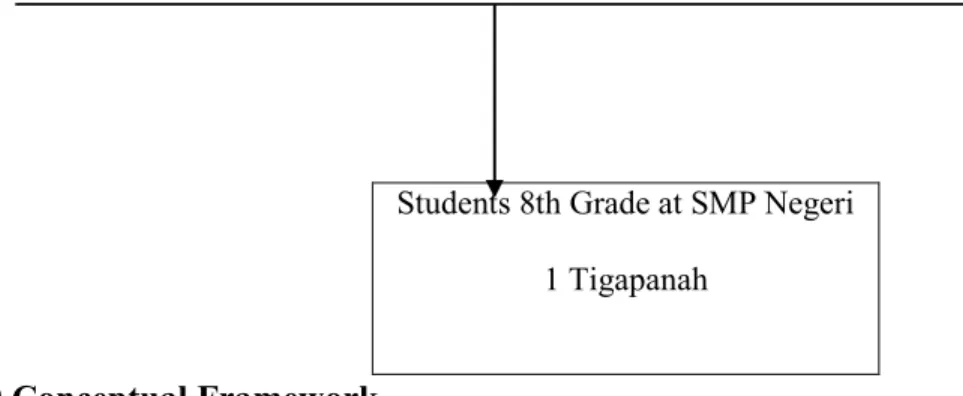
Students 8th Grade at SMP Negeri 1 Tigapanah
3.2.1 Population
Population is any group of individual that have one or more characteristic in common that are of interest to the writer. Arikunto, S (2010:173) population is a set of all elements processing one or more attributes of interest if someone want to observe all of the elements in the research area, so his research called population research. In conducting a research, the population of this research was taken from grade 8th students in SMP Negeri 1 Tigapanah there are 277 students from seven group of classes
3.2.2 Sample
A sample is a group of individuals who represents the whole individuals in the population Arikunto, S. ( 2006:38). The total number of the sample will be taken by using random sampling technique. Sample of this research was taken from the population. In this research take one class as sample by using random sampling technique VIII consisted of 25 students.
3.3 Research Instrument 1. Written test
This written test aimed to find out the students’ ability to write narrative text. The students have to write down a narrative text in two paragraphs. The topics of the narrative are
“My idol, My daily activity, and My family”.
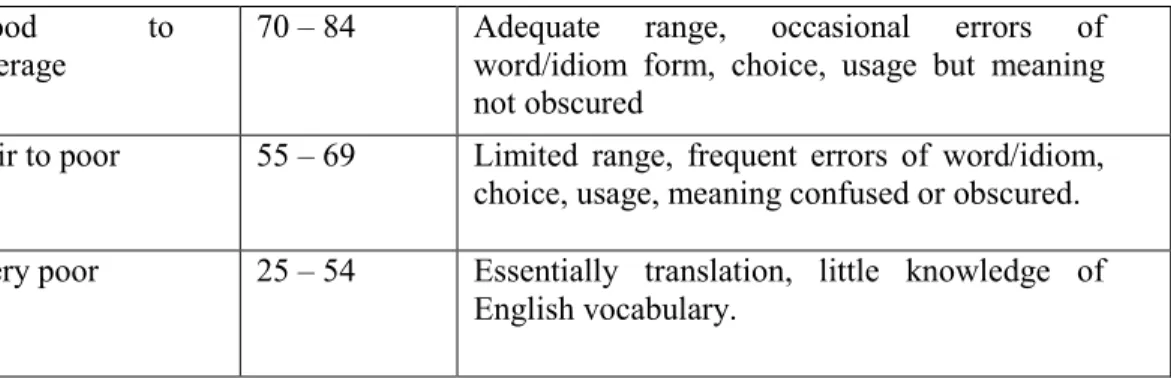
Table 3.3.1 Scoring the Students’ Ability in Writing in Vocabulary (Verbs):
Classification Score Criteria
Excellent to Very good
85 – 100 Sophisticated range, effective word/idiom choice and usage, word form mastery, appropriate register
Good to average
70 – 84 Adequate range, occasional errors of word/idiom form, choice, usage but meaning not obscured
Fair to poor 55 – 69 Limited range, frequent errors of word/idiom, choice, usage, meaning confused or obscured.
Very poor 25 – 54 Essentially translation, little knowledge of English vocabulary.
(Jacobs et al, 1981)
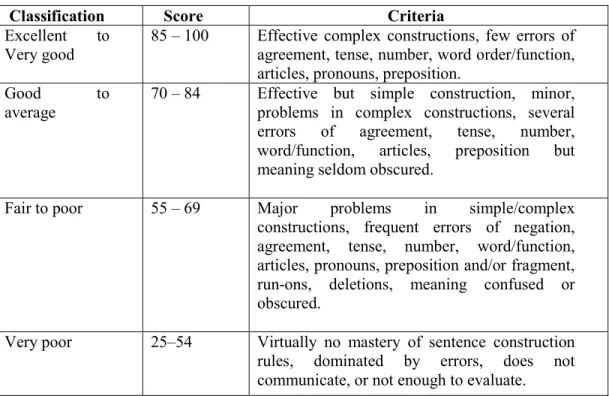
Table 3.3.2 Scoring the Students’ Ability in Writing in Language Use (Tenses):
Classification Score Criteria
Excellent to Very good
85 – 100 Effective complex constructions, few errors of agreement, tense, number, word order/function, articles, pronouns, preposition.
Good to
average
70 – 84 Effective but simple construction, minor, problems in complex constructions, several errors of agreement, tense, number, word/function, articles, preposition but meaning seldom obscured.
Fair to poor 55 – 69 Major problems in simple/complex constructions, frequent errors of negation, agreement, tense, number, word/function, articles, pronouns, preposition and/or fragment, run-ons, deletions, meaning confused or obscured.
Very poor 25–54 Virtually no mastery of sentence construction rules, dominated by errors, does not communicate, or not enough to evaluate.
(Jacobs et al, 1981) The classification of students’ mean score as follows:
Table 3.3.3 Classification of Students’ Mean Score
No Classification Score
1 Excellent to very good 85 – 100
2 Good to average 70 – 84
3 Fair to poor 55 – 69
4 Very poor 25 – 54
(Jacobs et al, 1981) 2. Questionnaire
The questionnaire aimed to find out the students’ difficulties in writing the narrative text.
Students’ were given some questions to know the writing difficulty in narrative text.
Table 3.3.4 Scoring the Students’ difficulty in Writing
Classification Score Criteria
Always 1 Every sentences are strong and
expessive with varied structure.
Often 2 Setting and characters are detail.
Sometimes 3 Errors in tenses.
Never 4 Not interesting story and unclear
or notrelated to the topic.
3.4 Procedure of Data Collection
The procedures stages in collecting data for each instrument in this research was as follows:
1. Writing Test
a. The first, the writer explain about the aim of the written test and what should they do at the paper.
b. Next, the writer ask the students to write a narrative text based on the topic that had been given.
c. The writer then given time opportunity to the students to do test is about 45 minutes.
d. Exactly at the 50th minutes the writer will ask to stop to write.
e. After that, the students will ask to collect their writing.
2. Questionnaire
a. First, the researcher explain about the questionnaire to the students.
b. Next, the researcher explain about the purposes of the questionnaire.
c. The researcher then distribute the questionnaire to the students.
d. After that, the researcher explain how to answer the question of the questionnaire.
e. The researcher ask the students to answer it.
f. The researcher give time to the students to answer the questionnaire about 10th minutes.
g. After answering the questionnaire, the researcher collect it from the students.
h. Next, the researcher say thanks to the students for their time to answer the written test and the questionnaire.
3.5 Technique of Data Analysis
1. To percentage the students’ score in the data from the test, which have been given to the students and to know how many percents the students right in answering the test. The following steps were implemented for analyzing data:
a. Scoring the result of the students’ answer
b. Determining and analyze the students’ ability by using the passing grade standard at grade 8th in SMP Negeri 1 Tigapanah (KKM) of the students is 75, at English subject in grade 8th SMP Negeri 1 Tigapanah
c. Determining the percentage the students ability by using the following formula:
∑ = 100
Where:
∑ = gained score
× = sum of excellent writing N = maximum score
100 = fixed score
The writer computed the students’ mean score by using Formula as recommended by Arikunto (2006):
M= ∑ 100
Where
M = mean score
∑x = total score
N = number of students
To know the percentage of the students’ writing test by using the following formula:
% = 100
Where :
% = the percentage of students’ writing F = the frequency of students
N = total number of students (Sudjana, 2017)
2. To find out the difficulties in writing narrative text from the questionnaires, the researcher use the percentage technique as follows:
Where:
P = × 100%
24
P : Percentage
F : Frequency of Respondent’s Answer N : Total Sample
(Sudjana, 2012 : 25)
The researcher computed the students’ mean score by using formula as recommended by Arikunto (2006):
Where:
M = ∑x M = mean score
∑x = total score
N = number of students
To rate the students’ responses percentage of communication strategy, the researcherwill use the criteria as follows:
1. Score 84.01-100% is categorized excellent 2. Score 68.01-84% is categorized very good 3. Score 54.01-68% is categorized good 4. Score 36.01-54% is categorized fair