2011] CEO EMPLOYMENT CONTRACT PROVISIONS 561 The regulatory regimes of the United States and Australia enjoy many comparable features. We begin with a brief comparative overview of the executive pay regulatory framework in the two countries.
THE REGULATORY AND CORPORATE GOVERNANCE
Finally, soft law, found for example in Principle 8 of the ASX I Principles of Corporate Governance and various business group guidelines, addresses the structure of executive pay and the process by which it is determined. In the same month, the ASX Corporate Governance Council published proposed changes to its Corporate Governance Principles in response to some of the Productivity Commission's recommendations. A number of changes were introduced during the passage of the Companies Amendment (Improvement of Severance Pay Liability) Act 2009.
LITERATURE REVIEW
For our project it is important to be aware of the underlying differences in these two national legal systems. Executive employment agreements, or service agreements as they are known in Australia, are written against the backdrop of these specific rules and regulations, but also with the underlying regulatory culture in mind. As we will see in the following sections, many of the differences in the contracts we examine may be directly related to differences in the background law.
At the same time, there are many similarities between the contracts from the two countries, even though the two legal systems are different.
Employment Contracts
Severance Agreements
2011] CEO EMPLOYMENT CONTRACT PROVISIONS 581 award of severance pay.130 He finds that more than half of a sample of 179 CEOs of Fortune 500 companies who left their firms between 1996 and 2002 received severance pay. per share with an average value of 5 million dollars. is less than the average annual CEO compensation. Rusticus studies the relationship between severance agreements and CEO turnover.131 Using a sample of 305 newly hired CEOs at S&P 1500 firms between 1994 and 1999, he finds that about half have severance agreements and the average amount of paid is cash compensation for two years. . He finds that the presence of severance agreements is positively related to uncertainty about CEOs' abilities, as measured by their number of years with the firm before becoming CEO, the degree of uncertainty about the firm's operating environment, and the amount of high levels of compensation given to executives.
They argue that ex ante severance agreements provide payments as a form of insurance to executives who join riskier firms, external CEOs, and CEOs whose predecessors were forced out of the firm, all of whom contract for higher payouts. high unemployment rates. Raghavendra Rau and Jin Xu analyze 2,192 severance agreements for 1,788 top executives in 862 firms listed in the. COMPUSTAT database in 2004.133 They define severance agreements to cover both change-of-control agreements and employment contracts that provide for termination with or without cause.
They find that severance pay increases as firm risk increases, particularly for small firms and firms that are likely takeover targets. Change-in-control agreements lead to significantly higher severance payments and are more common in firms with high levels of institutional ownership if the director is the CEO or chairman of the board.
Bonus Agreem ents
Daniel Sungyeon Kim and Jun Yang document various features of annual incentive bonus plans for CEOs using newly mandated SEC disclosures that went into effect in December. Their sample includes all S&P 500 companies for three years after the reporting change. They find that EPS targets are consistently set below expected EPS and below analysts' forecast levels, and that EPS targets are lower than companies' historical growth levels.
Stock Option Awards and Plans
They find that retiring executives face stronger sunset rules (and suffer greater value losses) at companies with strong growth opportunities. Executives who resign face tough sunset rules and are generally given very short periods to exercise their options. Given the relatively short tenure of many corporate executives, these results are consistent with the proposition that the majority of option exercise occurs after the executive has left the firm—with a significant loss in their value experienced by the executive.
Retirement Plans and Pensions
Paul Kalyta uses a sample of the sixty largest firms on the Toronto Stock Exchange to examine supplemental executive retirement plans ("SERPs" He finds that while more transparent forms of compensation (salaries, bonuses and stock options) are driven by economic variables. companies , SERP benefits, which are very difficult to observe, are closely related to an executive's power relative to the firm's board. He further finds that where executives' SERP benefits are contingent on firm performance, the company lower research and development ("R&D") expenses in the last few years before the executive's retirement, which is consistent with management behavior aimed at maintaining higher current earnings at the expense of future returns.
Other Contractual Clauses
M ETHODOLOGY
The biggest challenge in this project was to collect comparable sets of employment contracts in the two countries. Each of these databases contains all SEC filings made by US-registered companies under the federal securities laws. However, as we continued our search, we quickly realized that very few contracts were attached to the firms' proxy statements, and that we had to search through the firms' other SEC filings to find the contracts.
Therefore, we supplemented the initial search by checking SEC filings whose filing dates were close to the contract date. If we still couldn't find the contracts, we used keyword searches in the SEC filings each company filed. 34;executive agreement,” and any title for the agreement that was listed in the company's proxy statement.147 Using these search terms, we found numerous additional agreements attached to many different SEC filings.
In general, we could not find contracts that predated the start of the respective companies' EDGAR filings, mostly in 1996, and in a limited number of cases we could not find contracts that were reported in the companies' proxy statements, even not after the companies began filing disclosure documents because the contracts did not appear to be included in any of the companies' SEC filings.148. We wrote a coding manual for the contracts so that each variable we were interested in could be collected systematically.
Australian Data Collection
The degree of completeness of these contract summaries and information provided under the disclosure requirements of section 300A of the Corporations Act varies widely, and therefore we were only able to use those summaries that contained compensation and severance details. We have therefore supplemented the Summary terms of employment by retrieving the relevant information from the annual report for the relevant financial year. We then searched the EDGAR database in two ways: first, using "EDGAR Full-Text Search" to search the full text of EDGAR records from the last four years of the Australian companies; and second, we looked in "Historical EDGAR Archives".
To obtain daily stock returns for the year prior to the contract start date, we used Datastream to download the daily closing price (adjusted) for the past eight years of current ASX200 companies. For the delisted companies, we downloaded the daily closing price (adjusted) for the year prior to the contract start date from Morningside's Dat Analysis database and converted them into daily returns. Our concern is that an implicit assumption of the Australian disclosure regime is that the summaries and press releases are sufficient to provide investors and securities analysts with the details of the economically important elements of the CEO contracts, but this is an empirically untested proposition. 152 .
2011] PROVISIONS OF EMPLOYMENT CONTRACTS 591. As an initial approach to assessing the adequacy of the Australian corporate information, we had two research staff separately code this sub-sample of CEO employment contracts, one using the actual employment contract and the other using only the upcoming company summaries from press releases and remuneration reports. On the other hand, it is also possible that even with this potential bias, we may still find that the necessary summary information is less than sufficient when it comes to getting a clear picture of CEOs' financial incentives.
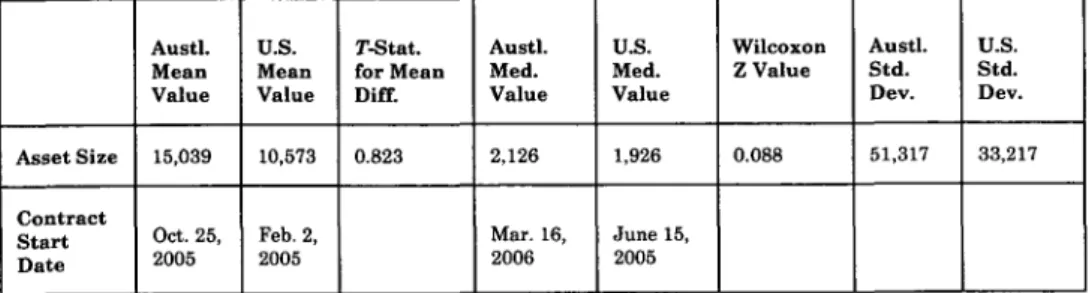
Matching Procedures for U.S. and Australian
EMPIRICAL EVIDENCE
Univariate Analysis of Major Contract Features
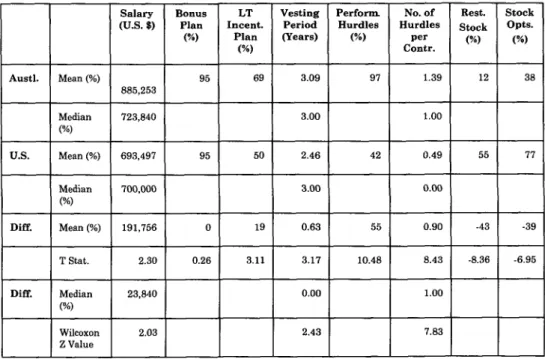
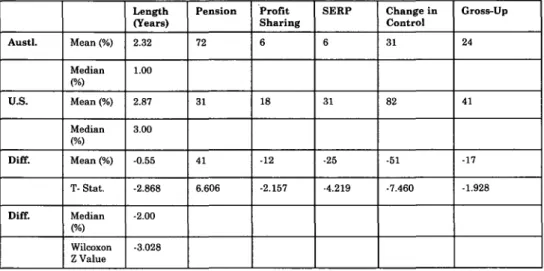
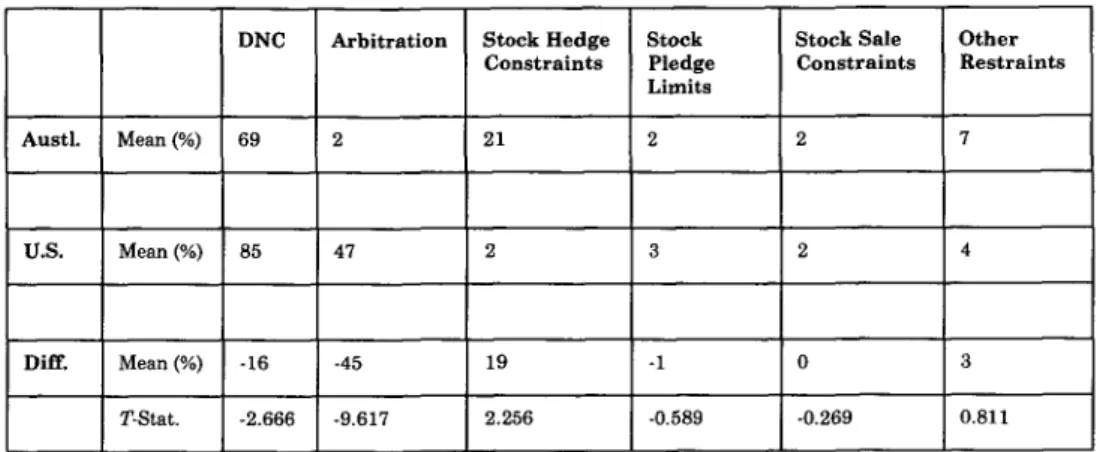
2011] PROVISIONS OF THE CONTRACT ON THE EMPLOYMENT OF THE GENERAL DIRECTOR 597 In Table 3 we see a series of very interesting differences in the characteristics of the contract. 34;[p]ordinating senior management [to] receive severance pay as a result of a change in control of the company."'164 Given these rather strict rules, it is not surprising that we see fewer change-in-control provisions in Australian contracts.165 The fact that we observe all these variables are measured by the frequency with which they appear in contracts.
While we find some notable differences in typical contract features found in Australian and US First, Australian firms that list their shares in the United States have significantly lower wages, consistent with the pattern we observe for the US . We begin by examining the frequency with which CEO employment contracts include restricted stock and stock options in the following two tables.
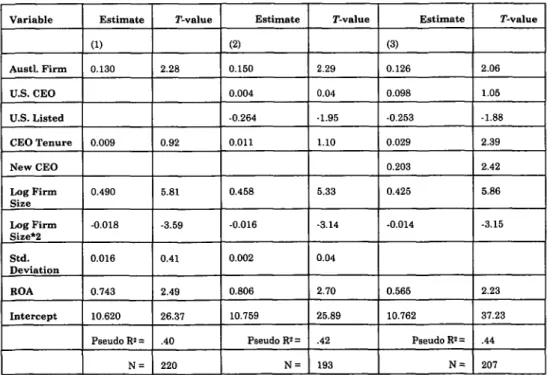
In the third regression model, we find that restricted stock is more likely to be paid to new CEOs and to CEOs with longer tenure. This performance impediment is much less common in the United States, although it appears to give CEOs stronger incentives to perform well. In summary, we find a number of similarities between CEO employment contracts in the US and Australia.
Some of these differences, such as the relative infrequency of change-in-control provisions in Australian contracts, appear to be explained by distinct differences in the legal and regulatory environments.