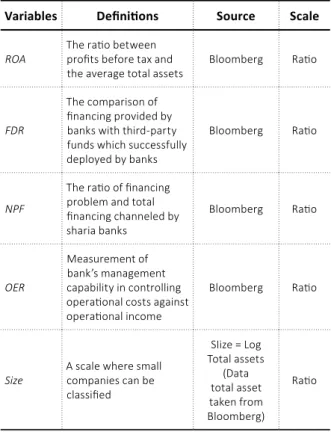
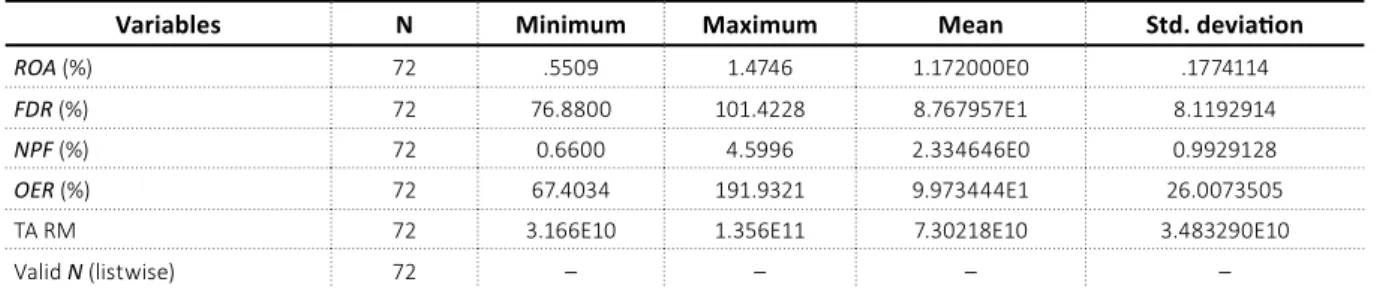
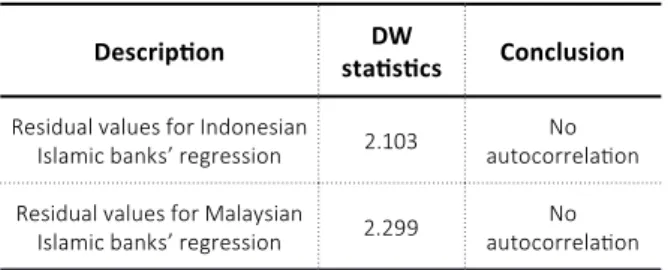
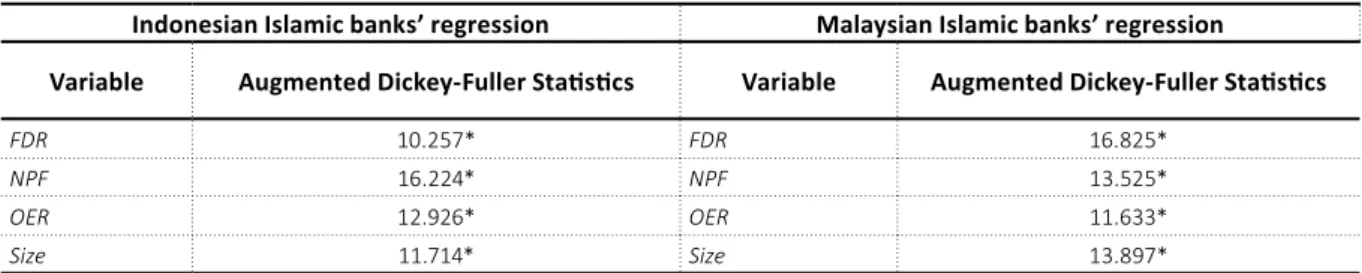
H2a: Non-Performing Financing (NPF) has a negative effect on the profitability of Indonesian Islamic banks. H3a: Operational efficiency ratio (OER) has a negative effect on the profitability of Indonesian Islamic banks.
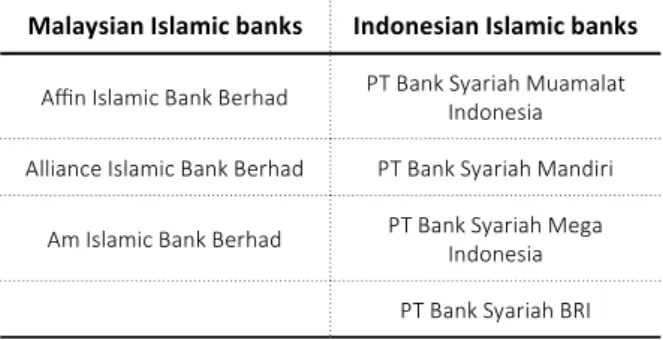
Results of the regression analysis of the Indonesian Islamic banks
The proposed hypothesis 3a states that the operating efficiency ratio (OER) has a negative effect on the profitability of Indonesian Islamic banks. Hypothesis 4a states that firm size (Size) has a positive effect on the profitability of Indonesian Islamic banks.
Results of the regression analysis of Malaysian Islamic banks
Proposed hypothesis 3b states that the operating efficiency ratio (OER) has a negative effect on the profitability of Malaysian Islamic banks. Proposed hypothesis 4b states that firm size (Size) has a positive effect on the profitability of Malaysian Islamic banks.
Chow test results on Indonesian Islamic banks and Malaysian
The proposed hypothesis 2b states that non-performing financing (NPF) has a negative effect on the profitability of Malaysian Islamic banks. The low value of NPF of Malaysian Islamic banks ensures that NPF does not negatively affect profitability.
CONCLUSION, LIMITATION OF THE STUDY AND FUTURE RESEARCH DIRECTIONS
According to Scott and Davis (2016), the best way to run an organization depends on the characteristics of the environment in which it operates. Malaysia has various characteristics, such as the economic system adopted, the characteristics of the population, the role of the government, the position of the Islamic bank in the legislation, the school adopted by the majority of its Muslim population and the elected. development strategy, thus having different effects on financial reports.
Also, future study could add more variables that affect the ROA of Islamic banks, such as capital adequacy ratio (CAR), net operating margin (NOM), bank age, and bank ownership. Assessment of bank profitability in the MENA region Comparative analysis between conventional and Islamic banks.
Submission date: 05-Jan-2020 10:14AM (UTC+0700) Submission ID: 1239278847
File name: BBS_2019_04_Chabachib.pdf (549.25K) Word count: 9109
Character count: 47612
SIMILARITY INDEX
INTERNET SOURCES
PUBLICATIONS
STUDENT PAPERS
FACTORS TOWARD MARGIN MURABAHAH OF INDONESIA ISLAMIC BANKS", JOURNAL
Instructor
PAGE 2
Celotno besedilo (https://businessperspectives.org/images/pdf/applications/publishing/templates/articles/assets/1576/BBS_en_2006_03_Al-Jarrah.pdf). Athenia zahvalni dan, Alfred Bimha. https://businessperspectives.org/images/pdf/applications/publishing/templates/articles/assets/5811/BBS_en_2014_02_Bongani.pdf). -An Wang, Chung-Hua Shen. https://businessperspectives.org/images/pdf/applications/publishing/templates/article/assets/1912/BBS_en_2007_03_Wang.pdf).
Bora Aktan, Omar Masood, Senem Yilmaz. https://businessperspectives.org/images/pdf/applications/publishing/templates/article/assets/2551/BBS_en_2009_1_Aktan.pdf). Abdou, Elena Hadjiantoni, Harry Derwin. https://businessperspectives.org/images/pdf/applications/publishing/templates/article/assets/6905/BBS_en_2015_03_Abdou.pdf).
Banks and Bank Systems
2019 Volume 13 2018
Issue #1 Issue #2
Ph.D., Professor of Finance and Head of the Department of Finance and Economics, University of Sharjah, U Google Scholar Citations. Ph.D., Professor of Banking and Finance, Department of Economics and Business Administration, University Google Scholar Citations. Dr., Professor of Economics and International Finance, Department of Economics and Finance, Sacred H Google Scholar Citations.
Professor of Finance, Chair of the Department of Finance, College of Business Administration, University of Google Scholar Citations. Dr., Professor, Vice Dean of Faculty Seymour Milstein Professor of Finance, Corporate Governance and Google Scholar Citations.
OVERVIEW KEYWORDS
Abstract
INTRODUCTION
Keywords
- LITERATURE REVIEW
- the total amount of liquidity created by German saving banks during the period un-
- the correlation between liquidity creation and monetary policy indicators was negative;
- the liquidity created by banks decreased due to monetary tightening; and
- there was no relationship between the bank-specific factors, such as profitability and
- Bank liquidity depends on how the liquidity is defined (Umar & Sen, 2016; Vodova, 2011;
- Bank liquidity depends on macroeconomic factors and bank-specific factors
- Long-term liquidity performance of banks is important
- Regulatory liquidity policies pursued by the Reserve Bank of India in the form of cash
- METHODOLOGY
- RESULTS AND DISCUSSION
As in the case of Vodova (2011), the study concluded that factors determining liquidity depend on how liquidity is defined. In studying the liquidity and performance of banks in South Africa for the period from 1998 to 2014, Marozva (2015, p. 453) “estimated the relationship between interest margin and liquidity using OLS and ARDL bond tests. The study recommended further research to examine liquidity in the context of a mismatch between assets and liabilities.
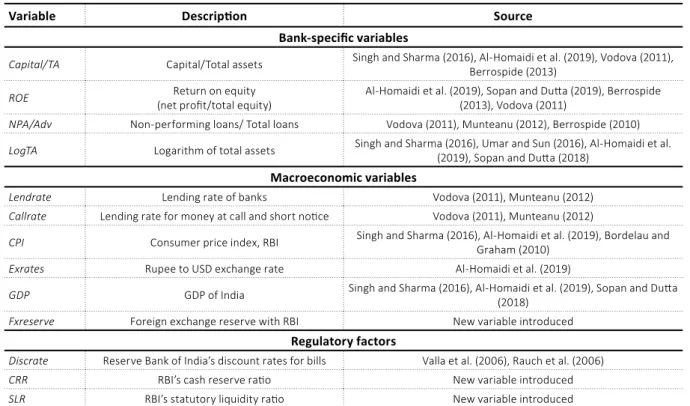
The results of the study revealed that private banks and foreign-owned banks held more liquidity in the banking system compared to those in the public sector (Singh & Sharma, 2016, p. 51). Following the literature, the study investigated the effect of macroeconomic and bank-specific factors on liquidity creation by all commercial banks in India for which data were available for the year 1996–. The data is taken from the RBI database.
CONCLUSION
RESEARCH METHODOLOGY
Relative macroeconomic stability and revitalization of the economy in 2016 brought the bank a significant increase in the deposit base. Under loans received from other banks accounted for the largest share of Ukrsibbank debt. The allocation of its funds to Ukrsibbank indicates support for the long-term strategy of the bank's development, aimed at strengthening its positions against the background of the economic situation in the country.
A significant portion of the correspondent accounts and overnight deposits of other banks in Ukrsibbank's debt to other banks amounted to 81.95% and 2013, respectively. The analysis of Ukrsibbank's financial statements shows that the bank has not received any reconfirmation.
EMPIRICAL RESULTS
- Development of the sustainability policy framework in the banking
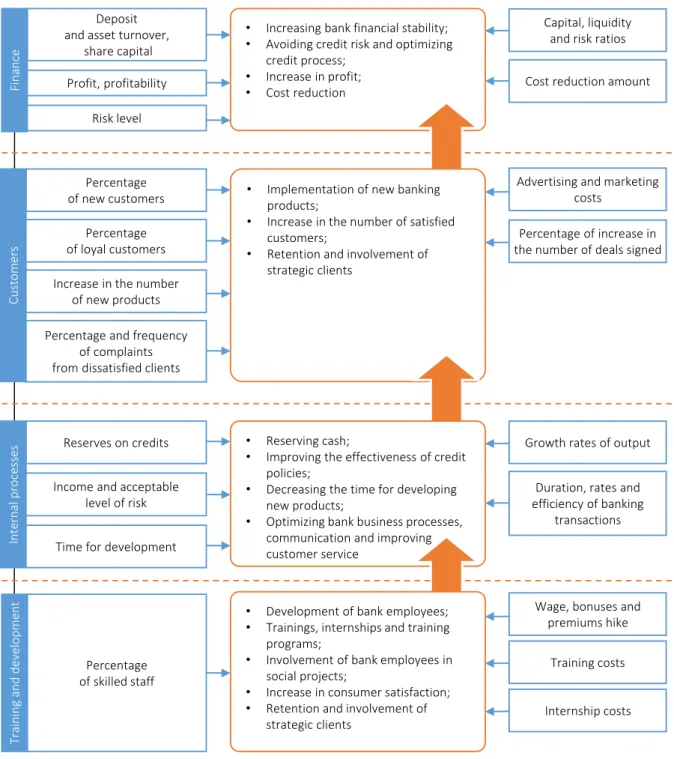
The first level of the strategy map therefore reflects the projection of the finances of the international payments department. The strategy map for the international payments department of the operational payments department at Ukrsibbank. On such a basis there is a mutual interest of both the bank (namely the management) and the staff.
The article proves that the strategic map is an important element of the bank's strategic management concept. Development of Sustainability Policy Framework in Banking Policy Framework in Bangladesh Banking Sector.
EMPIRICAL MODEL AND HYPOTHESIS
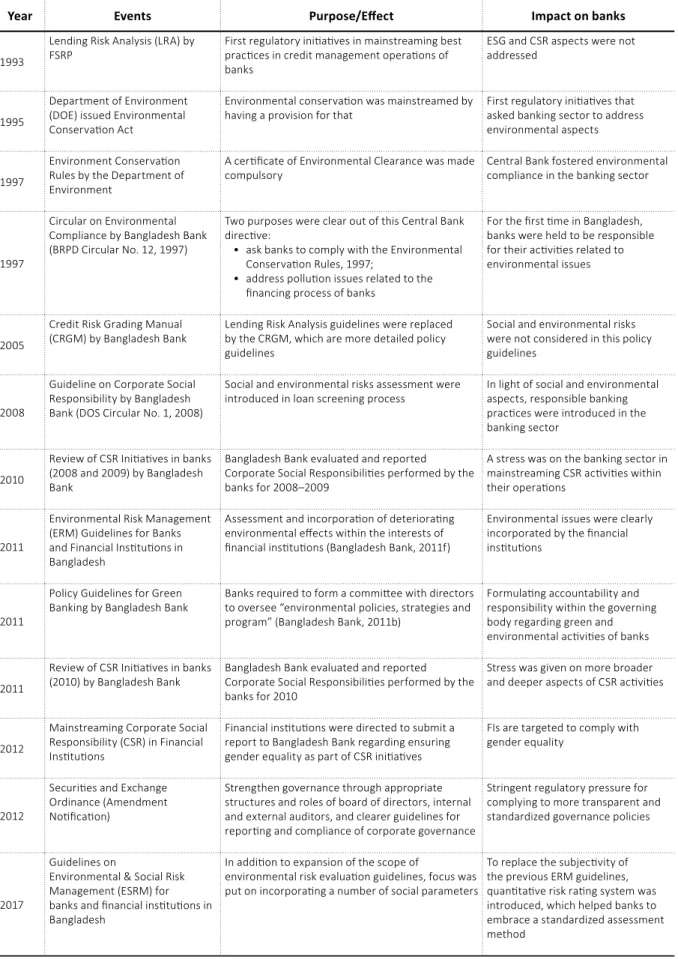
At the same time, in response to the market need for more clear policies in CSR and environmental aspects, Bangladesh Bank issued two policy documents in 2011: "Environmental Risk Management (ERM) Guidelines for Banks and Financial Institutions in Bangladesh". Bangladesh Bank, 2011a) and "Policy Guidelines for Green Banking" (Bangladesh Bank, 2011b). From the similar point of view, while emphasizing the environmental degradation issues (eg air, water, soil) of the country, Bangladesh Bank proposed green banking policies to be incorporated in banking in a structured and standardized manner. sector in three phases. In 2012, Bangladesh Bank issued another circular (DFIM Circular No. 02) focusing on mainstreaming gender equality as part of the CSR initiatives developed for the financial institutions.
In 2017, Bangladesh Bank issued “Environmental and Social Risk Management (ESRM) Guidelines for Banks and Financial Institutions in Bangladesh” where the aim was to integrate environmental and social issues into the credit management process in such a way that the risks of such factors could be taken into account when calculating the probability of loan default (Bangladesh Bank, 2017). Financial institutions have been directed to submit a gender equality report to Bangladesh Bank as part of their corporate social responsibility initiatives.
Compliance to the ESG policy framework or, in other words, having higher ESG
- METHODOLOGY
- ESG score calculations
- Data and sampling
- Variables
- RESULTS
- Descriptive statistics and correlogram
- Graphical analysis
- Regression analysis
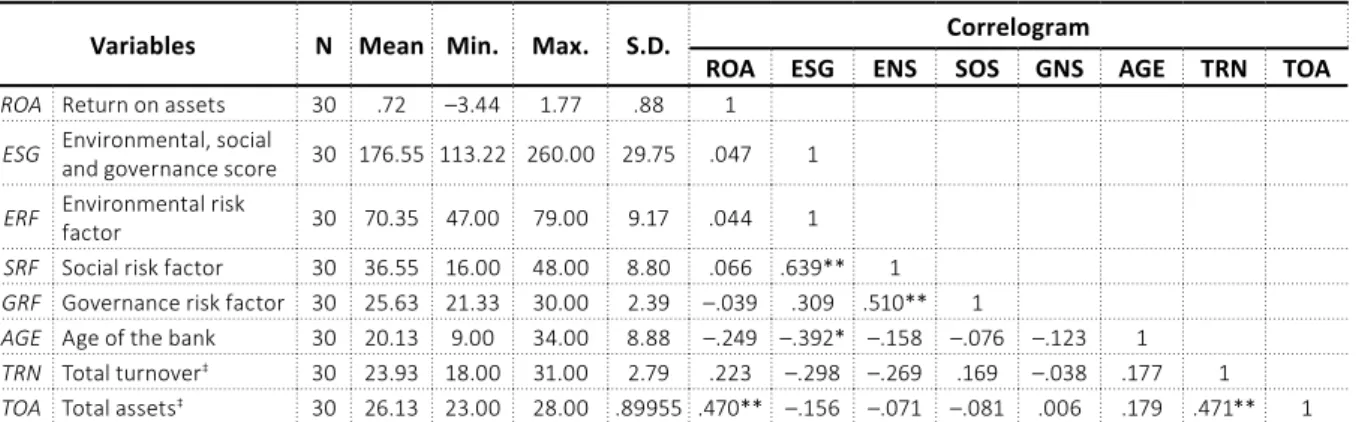
In addition to the dependent variable (ROA), a set of control variables is usually included in a model to isolate the influences of the hypothesized factors on the dependent variable. Comparative status of the descriptive statistics and correlation coefficients are summarized in Table 3 and Table 4. Age of the banks remained close to 20 years with minimum-maximum range increasing to 9 to 34 years respectively.
A scatterplot of environmental, social and governance (ESG) scores against return on assets (ROA) and bank age is shown in Figure 2. In Model 1, shown in Table 6, banks' aggregate ESG scores were taken as a proxy for sustainability, controlling for on age and traffic as a proxy.
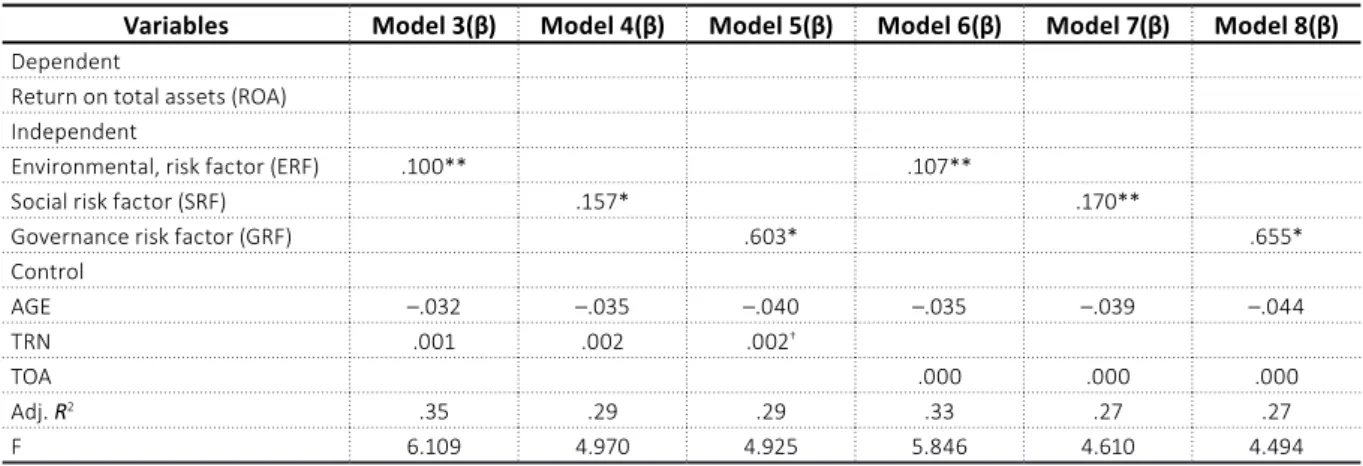
It can be concluded that the first generation banks are more sustainable by being in line with ESG. Eight models were constructed to test the impact of changing sustainability factors and control variables on the dependent variable profitability. In all models, return on assets (ROA) was used as the dependent variable and three risk factors, environmental, social and governance, were used as proxies for sustainability, replaced by control variables such as age, turnover and total. assets.
This was in contrast to what happened in 2012, when ESG showed a positively significant relationship with return on assets (see Table 5).
- DISCUSSION
None of the sustainability risk factors appeared to have a significant relationship with returns. The findings suggest that the introduction of policy guidelines improved banks' sustainability (environmental and governance). The first and most important limitation is the simplicity of the methodology used in the study.
Therefore, the results of the study are not applicable to the entire banking sector of Bangladesh. An empirical investigation of the relationship between change in corporate social performance and financial performance: a stakeholder theory perspective.
Title
Before submitting the article to the journal editors, you should review the Research Misconduct Policies, violation of possible sanctions against the author. Authors are strongly advised to read the “Guidelines for Authors and Translators of Scienti c Articles to of Science Editors (EASE) http://www.ease.org.uk/publications/author-guidelines-authors-and-translators/ read. which gu Ensure that the manuscript has academic value and research significance, and that its originality contributes to previous research on the topic. They are not overly rigid, but we recommend complying with the requirements as this improves the quality of their material and makes it easier for the editors to identify the type of manuscript from four possible variants and adhere to the keep rules. both the general guidelines and the manuscript.
Author (authors)
To bring the academic degrees, academic degrees and occupations used in some new economic standards, the corresponding table should be used. It must be written using the following algorithm: the first two or three sentences indicate the relevance of the topic; the study (for theoretical studies – its theoretical basis) is described; the results obtained and their practical value are logical from the previous one. In the abstract of a research paper, it is recommended to use the spoken results discussed without presenting the results.
In the summary, the author should not refer to any research or other sources of information. It is not appropriate to use the sentences in material that is absent in the paper, cannot be presented in the summary.
Кeywords
JEL Classi cation
Author Contributions
Introduction
Literature Review
In the literature search and throughout the text of the article as a whole, references to the sources are made in comformatting and style guide (American Psychological Association).
Aims
Supplementary Materials
Submission process
Review process
Personal Information Use and Protection Provided personal information
Publisher may use authors’ personal information to
2016 Volume 10 2015
MOST VIEWED ARTICLES MOST DOWNLOADED ARTICLES
Optimizing Financing Returns: A Case Study on Shariah Business Units of Regional Development Banks in Indonesia. The Interplay of Competition, Regulation and Stability: The Case of Commercial Banks in Sub-Saharan Africa. An Urgent Reexamination of Operational Risk Control Architecture in Public Sector Banks (PSBs) in India: A Qualitative Analysis.
The journal is committed to full open access to scientific publication (without website registration and embargo period). The journal is committed to full open access to scientific publication (without website registration and embargo period).
Issue #1 Issue #1 (cont.)