2015) further argued that PSOE – the socialist party – would not have won the election without the. Domestic Terrorism – “The unlawful use, or threatened use, of force or violence by a group or individual operating wholly within the United States or Puerto Rico without foreign direction committed against persons or property in order to destroy a government, the civilian population to intimidate or coerce, or any segment thereof in furtherance of political or social objectives” (Federal Bureau of Investigation). Infrastructure Resilience – “The ability to reduce the magnitude or duration of disruptive events that occur by anticipating, absorbing, adapting to, or rapidly recovering from the disruption” (National Infrastructure Advisory Council, 2015, p. 1).
Resilience - "The ability to prepare and adapt to changing conditions and to withstand and recover quickly from disruption" (Department of Homeland Security). START – National Consortium for the Study of Terrorism and Responses to Terrorism (Jenkins & Gerten, 2001). Terrorism – “The unlawful use of force and violence against persons or property to intimidate or coerce a government, civilian population, or any segment thereof, to further political or social objectives” (Federal Bureau of Investigation, 2006).
The Department of Defense defines terrorism as "the unlawful use of violence or the threat of violence, often motivated by religious, political, or other ideological beliefs, to instill fear and compel governments or societies to pursue goals that are usually political" (Department of Defense , 2017). The Federal Bureau of Investigation has adopted the definition of terrorism in the Code of Federal Regulations: “The unlawful use of force and violence against persons or property to intimidate or coerce the government, the civilian population, or any part thereof, to achieve political or social objectives. ". Cronin's (2002) and Kurtulus's (2011) point of view, citing a change in religious significance in terrorist motivations and trends, points to Rapoport's (2004) analysis of contemporary terrorist “waves”. Rapoport (2004) indicated a shift from the third wave—the wave of the New Left—to the fourth wave—the religious wave.
Zhang and Peeta (2011) outlined four classes of interdependencies: (a) functional (i.e., the functioning of one system requires input from another system, or can be replaced to some extent by the other system); (b) physical (i.e., infrastructure systems are linked through shared physical attributes, such that a strong connection exists when infrastructure systems share flow right-of-way, leading to shared capacity constraints); (c) budgetary (i.e., infrastructure systems involve some level of public funding, especially under a centrally controlled economy or during disaster recovery); and (d) market and economy (i.e. infrastructure systems interact with each other in the same economic system or serve the same end-users ... and influence the individual systems through policy, legislation or financial means such as taxation or investment) (Ouyang, 2014). In a similar class structure, Dudenhoeffer, Permann, and Boring (2006) identified four principle classes: (a) physical (i.e., the direct coupling between infrastructure systems from a supply/consumption/production relationship); (b) geospatial (ie there is a co-location of infrastructure components within the same footprint); (c) politics (ie, there is a binding of infrastructure components due to political or high-level decisions); and (d) informational (i.e., there is a linkage or dependence of information flow between infrastructure systems) (Ouyang, 2014). Consequences of a railway-related disturbance. economy, employment, trade and social activities at the local, regional and national level.
STUDY RESULTSSTUDY RESULTS
Test Analysis
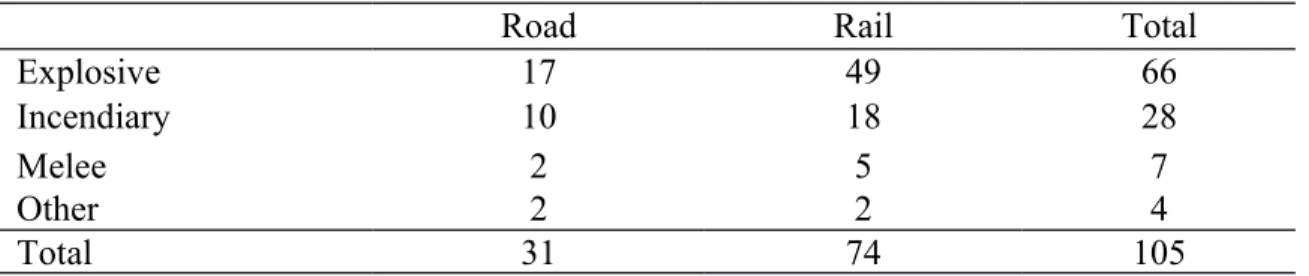
H0: There will be no significant difference in the number of terrorist incidents between Western Europe, East Asia and North America. H2: There will be a significant difference in the number of terrorist incidents between Western Europe, East Asia and North America. Research Question 3 – Looking at Western Europe, East Asia and North America together, there is a significant difference in the number of terrorist incidents in terms of weapon type.
H0: Looking at the three regions collectively, there will be no significant differences in the number of terrorist incidents related to the type of weapon. H0: Looking at the three regions collectively, there will be no change in the number of terrorist incidents related to casualties. H4: Looking at the three regions collectively, there will be a significant difference in the number of terrorist incidents related to casualties.
Research question 5 – Is there any significant difference between the three regions and the number of incidents resulting in casualties. H0: There will be no significant differences between the three regions and the number of terrorist incidents resulting in casualties. H5: There will be a significant difference between the three regions and the number of terrorist incidents resulting in casualties.
The null hypothesis is rejected, showing that there is a statistically significant relationship between the region and the number of incidents resulting in casualties. H6: When we look at the three regions together, there will be a significant difference between the weapon type and the number of incidents that result in casualties. Question one established a significant relationship between the number of terrorist incidents in rail transport and road transport.
The second research question assessed the significant difference between the region and the number of terrorist incidents. The fourth research question identified a statistically significant relationship between the number of terrorist incidents against transportation and the number of incidents resulting in casualties. The results rejected the null hypothesis and found a significant relationship between incidents in East Asia and the number of incidents resulting in casualties.
This study found a significant relationship between the number of incidents that resulted in accidents on the transport infrastructure. The fourth research question showed that there is a significant relationship between attacks targeting transportation and the number of incidents resulting in casualties.