N. Demise, Y. Miwa, M. Nakabayashi, Y. Nakoshi
Corporate Governance in Japan
From the Viewpoints of Management, Accounting, and the Market
N. Demise, Y. Miwa, M. Nakabayashi, Y. Nakoshi
Corporate Governance in Japan
From the Viewpoints of
Management, Accounting,
and the Market
Nobuyuki Demise, Ph.D.
Professor, Meiji University School of Commerce
1-1 Kanda-Surugadai, Chiyoda-ku, Tokyo 101-8301, Japan Yumiko Miwa, Ph.D.
Professor, Meiji University School of Commerce
1-1 Kanda-Surugadai, Chiyoda-ku, Tokyo 101-8301, Japan Mariko Nakabayashi, Ph.D.
Associate Professor, Meiji University School of Commerce 1-1 Kanda-Surugadai, Chiyoda-ku, Tokyo 101-8301, Japan Yoko Nakoshi
Professor, Meiji University School of Commerce
1-1 Kanda-Surugadai, Chiyoda-ku, Tokyo 101-8301, Japan
ISBN-10 4-431-30919-5 Springer-Verlag Tokyo Berlin Heidelberg New York ISBN-13 978-4-431-30919-2 Springer-Verlag Tokyo Berlin Heidelberg New York
This book is published as a volume in the Institute of Social Sciences, Meiji University Book Series.
Library of Congress Control Number: 2006925429 Printed on acid-free paper
© Nobuyuki Demise, Yumiko Miwa, Mariko Nakabayashi, Yoko Nakoshi 2006 Printed in Japan
This work is subject to copyright. All rights are reserved, whether the whole or part of the material is concerned, specifically the rights of translation, reprinting, reuse of illustrations, recitation, broad- casting, reproduction on microfilms or in other ways, and storage in data banks.
The use of registered names, trademarks, etc, in this publication does not imply, even in the absence of a specific statement, that such names are exempt from the relevant protective laws and regulations and therefore free for general use.
Springer is a part of Springer Science+Business Media springer.com
Typesetting: SNP Best-set Typesetter Ltd., Hong Kong Printing and binding: Shinano Inc., Japan
Foreword
In Japan, the problem of corporate governance has been cogently argued in the field of social science for the past decade, and the issue has also been taken up separately in law, business administration, and accounting. This book, however, is the first to take a general overview of corporate governance with respect to management, risk management, accounting, and the capital markets.
Corporate governance in the broad sense must include stakeholders with various interests while taking into consideration the sometimes unscrupulous affairs of companies and bankruptcies of big businesses, along with today’s increasing numbers of mergers and acquisitions. Both the company manager and the institutional investor have begun to be more concerned about corporate social responsibility (CSR) and socially responsible investment.
After 2003, the issue of CSR began to be taken up more frequently by the media in Japan, and study meetings and committees associated with the Ministry of Economy, Trade and Industry, Ministry of the Environment, and the Ministry of Health, Labour and Welfare were established. These trends are evidence of significant changes in Japanese corporate governance. The study presented here proposes that a company should play a social role to bring about a sustainable society.
Kouhei Yamada General Manager Institute of Social Science Meiji University Tokyo
V
Preface
In 2002, we began our international comparative study of corporate governance, setting out to study the multidimensional aspects of corporate governance: the institutional investor, the board of directors, compliance, moral hazards, obser- vance of an accountability contract, stock options, and corporate information dis- closure. This book is the result of that 3-year-long study.
Recently, corporate governance in the broad sense, including corporate social responsibility (CSR) in particular, has attracted attention. Incidents in which Japanese companies have been disgraced have occurred one after another. Mean- while, hostile buyouts are becoming a reality in Japan. One might reasonably wonder: Is stockholder value creation the one and only aim of corporate activity?
Management itself became a topic of consideration following the cases of Enron and WorldCom in 2001. The belief that a manager should not simply create profit to be able to hold it for stockholders began to acquire some currency.
In an environment in which recognition of CSR is being reawakened, risk man- agement of a company has become more important to managers. A study of reform in corporate governance and an approach to the accounting system, with concrete disclosure of managerial rewards, have been based on a critical view of whether the accounting system supports such reform. From the viewpoint of risk management, we examined errors of “goodwill” in management judgment as an element of corporate governance, viewing them as judgmental hazards as well as moral hazards faced by a manager in a complex environment.
This book is divided into three parts. In Part 1, we discuss corporate gover- nance from four approaches: management, moral hazards, accounting, and capital markets. Chapter 1 is a general approach to management. In Chapter 2, we examine moral hazards and the problem of corporate governance. Chapter 3 deals with accounting and corporate governance. In Chapter 4, we discuss cor- porate governance from the viewpoint of the institutional investor.
Part 2 examines the trend in corporate governance in Japan of recent years in several areas. In Chapter 5, we clarify the situation regarding the exercise of voting rights by Japanese institutional investors. In Chapter 6, we focus on the structure of the Japanese board of directors. Disclosure of rewards is an integral
VII
part of corporate governance, and, as discussed in Chapter 7, the movement from disclosure to expense recognition in accounting is part of corporate governance, especially with regard to stocks and related rewards such as stock options. With Chapter 8, we take the Japanese automobile insurance industry as a concrete example from the viewpoint of management judgment and risk management. We examine an ideal method of corporate governance of an individual company by management judgment over a low-cost strategy in that automobile insurance market.
In Part 3, we consider the issue of corporate governance in situations of global economic development. With Chapter 9, we clarify the influence that the “stock- holder first” principle of institutional investors (in the United States in particu- lar) has had on the Japanese financial system and on corporate governance. In Chapter 10, we examine the OECD Principles of Corporate Governance, revised in 2004, which has become an international standard of corporate governance and has exerted considerable influence in Japan.
We are deeply grateful for the grant received from the Institution of Social Science, Meiji University, which supported our study and the publication of this book.
Nobuyuki Demise Yumiko Miwa Mariko Nakabayashi Yoko Nakoshi VIII Preface
Contents
IX Foreword . . . V Preface . . . VII
Part I Four Approaches to Corporate Governance
1. Management and Corporate Governance
N. Demise . . . 3 2. Moral Hazard in Corporate Governance
M. Nakabayashi . . . 15 3. Accounting and Corporate Governance
Y. Nakoshi . . . 25 4. Institutional Investors and Corporate Governance
Y. Miwa . . . 31
Part II Corporate Governance in Japan
5. Institutional Investors Exercising Shareholder Voting Rights in Japan Y. Miwa . . . 41 6. Board of Directors
N. Demise . . . 59 7. Accounting and Disclosure in Japan
Y. Nakoshi . . . 67 8. Managerial Judgment Hazard in Corporate Governance
M. Nakabayshi . . . 75
X Contents
Part III Corporate Governance in Global Economy
9. The Effect of Global Shareholder Activism on the Japanese Financial System and the Japanese Corporation
Y. Miwa . . . 93 10. OECD Principles of Corporate Governance
N. Demise . . . 109
Index . . . 119
Part I
Four Approaches to
Corporate Governance
1
Management and Corporate Governance
NobuyukiDemise
3
1. Introduction
This chapter is intended as an exploration of the historical formation between the management and corporate governance relationship. The first section describes the process of separation of ownership and management. In modern corporations, the management is separated from the ownership, creating a need for professional managers. The second section describes the nature of profes- sional managers, and how they may change the purpose of the corporation.
According to Jensen, at the heart of the corporate governance debate there is a stark division of opinion about the fundamental purpose of the corporation.1The third section discusses the issues of the purpose of the corporation, and is related to corporate social responsibility. The last section presents the characteristics of business ethics and corporate social responsibility in Japan.
2. Separation of Ownership and Management
The founder took part in the management of his company at first. In due time, his company was listed on the stock exchange and the founder decreased his holdings relatively. Later his company grew and formed a “company group.”
After many years, he and his family left the post of his company. At the begin- ning of the 20th century, there were four gigantic financial combines, or zaibatsu, Mitsui, Mitsubishi, Sumitomo, and Yasuda. At the center of every zaibatsu was the holding company. Zaibatsu families controlled the holding companies and were the directors of the main companies. However, after World War II GHQ (the General Headquarters of the Allied Powers) broke up the Japanese zaibatsu and compelled zaibatsu families to dispose of all company shares. GHQ directed the Japanese government to prohibit holding companies and ordered many
1See Jensen (2001).
Japanese managers who had cooperated with the Japanese military authorities to leave public life. Thus, the founder and his family left the post of many Japanese companies that were founded before 1945.
After World War II many companies, including Honda Motors, Sony, and Sanyo Electric, were established. In most of these the founder wanted his family to succeed to his post. However, Soichiro Honda, the founder of Honda Motors, did not want his son to succeed him and did not allow him to enter Honda Motors.
He explained that after a company is listed it becomes a public institution. The performance of a company is influenced by the business environment. Business situations change constantly and are affected by serious aspects such as economic turbulence. In such environments, top management needs to respond to change the ability, experience, and knowledge of business administration. Although they were family, Honda believed that his son did not have enough ability, experience, and knowledge and was thus not suited for top management.
When business scandals arise or company business performance is bad for several years, founder families often leave the posts of their company. An example of this came about recently due to false reporting of share ownership:
Yoshiaki Tutumi, the chairman of Kokudo, left his post at Kokudo, which was practically the holding company of the Seibu group. It can take a long time for founder families to leave their company posts. In 2005, the top management of Sanyo Electric changed. Members of the founding families remained in positions of power, but a former outside director was appointed chief executive officer (CEO).
In the 1980s, many major Japanese national enterprises were privatized, including Japan National Railway, the Nippon Telegraph and Telephone Public Corporation, and the monopolistic Japan Tobacco enterprise. At first they were changed to companies with limited liability, whose shares were owned solely by the Ministry of Finance, but later, many of them were listed. The top manage- ment was in charge of full-time managers, who were not public servants. Thus in the privatized companies the separation of ownership and management evolved.
In the Toyota Motor Corporation, Toyoda families were in charge of top management. Toyota was first established in 1937 as a spin-off from Toyoda Automatic Loom Works, one of the world’s leading manufacturers of weaving machinery.2 Now, after roughly 70 years and immense company changes, the Toyoda families are no longer large shareholders. While Akio Toyoda is the vice president of Toyota and Shoichiro Toyoda is the honorary president, other members of top management and board members are not from Toyoda families, including the chairman and president. It is still said that the Toyoda families are a symbol of Toyota Motors, that members of the Toyoda family had excellent management ability and experience, and that they embodied Toyota corporate culture.
4 I. Four Approaches to Corporate Governance
2See http://www.toyota.co.jp/en/about_toyota/history/index.html
3. Professional Managers
Many directors and executives in Japanese companies are former employees of those companies. Most of them went to work in the company after graduation.
They were promoted to the position of executive in the same company, or other companies that belonged to the same company group, for about thirty years. As they followed their business career in the same company, they observed the customs in their business and embodied its corporate culture. This is one of the reasons why it is said that employees are key stakeholders in Japanese compa- nies. Some directors feel they represent employees in their company, rather than their shareholders. Thus, the majority of the board members are in-house direc- tors who also hold executive posts.
When many large companies collaboratively hold shares in other large com- panies it is known as cross-shareholding, considered a preventive measure for a takeover bid (TOB). Top management would not be exposed to the menace of hostile takeover and yielded relatively large power over company assets. Banks would finance many companies that belonged to the same company group, cre- ating dependency on the banks. Consequently, when the companies faced crises, the banks would send executives to help reconstruct the company. Recently however, the practice of cross-shareholding is decreasing, causing more Japanese companies to be vulnerable to TOB.
In 2005, Livedoor, a famous IT company in Japan, acquired about 30% of Nippon Broadcasting System, shares in one night. Nippon Broadcasting System belonged to Fuji-Sankei group and held many shares in Fuji Television and Pony Canyon, which belonged to the same company group. It was thus believed that Livedoor was aiming to acquire shares of Fuji Television at a lower cost. M&A Consulting, a famous investment fund in Japan, pointed out that the ownership structure in the Fuji-Sankei group was already warped. Later, Fuji Television began takeover bids for shares of Nippon Broadcasting System. In the end, Fuji Television bought all the shares of Nippon Broadcasting System that Livedoor held, and entered into an alliance with Livedoor.
Subsequently, the president of Nippon Broadcasting System left his post and the chairman of Fuji Television kept his post. At that point, Nippon Broadcasting System was essentially a subsidiary company of Fuji Television. Later, Nippon Broadcasting actually did become their subsidiary. In subsidiary companies, top management has less discretion than that of the parent company. Some execu- tives and directors in Japanese companies have less experience compared with the president or top management of their subsidiary companies. Some of them have had experience as the head of their department. There, they learn the prac- tice of top management. In Japan, it is only recently that business schools have included a curriculum for business leader education.
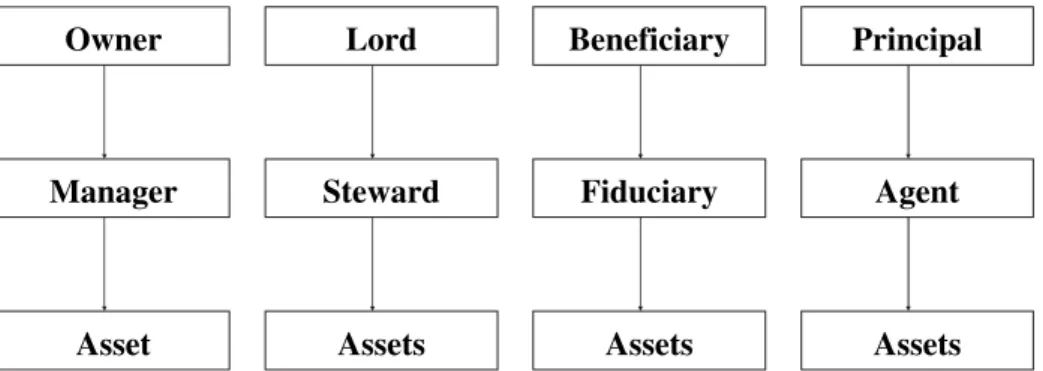
Figure 1 shows the relationship between an owner and a manager in a corpo- ration. The owner is compared with a lord, a beneficiary, and a principal. On the other hand, the manager is compared with a steward, a fiduciary, and an agent.
The manager resembles a steward, because he/she is under stewardship and is 1. Management and Corporate Governance 5
accountable to the owner, or the lord. Unless the manager discharges steward- ship and accountability, he/she will be removed from the position. The owner, or in modern-day business the assembly of shareholders, has not only power to decide but also the ability to judge the management. However, in actuality all owners/shareholders have the authority to judge the management. They rarely remove directors in a general meeting of a company. In Japan, though it is only recently that the word “accountability” has begun to be used more often, account- ability is at the heart of reforming corporate governance.
The manager resembles a fiduciary, because they are under fiduciary duty to the owner or the beneficiary. The manager is supposed to manage company assets in the interest of the owner, which means each shareholder. That is his/her fidu- ciary duty. On the other hand, the owner is supposed to have neither the ability nor desire to manage a company. Therefore the managerial ethics, or in other words, professional ethics, need to be part of his/her nature. If one of the man- agers is involved in an unfair practice within their business, he/she will lose their reputation. Later, he/she will leave their post voluntarily. In Japan, after the expo- sure of malpractice the president or CEO would be obliged to apologize to the world (seken), because malpractice damages the reputation of the company.
The manager resembles an agent, because he/she is under contract by the owner or the principal to manage the assets of a company. The agency theory that Fama applies to the firm shows some features of this relationship.3In the agency theory the manager or the agent is presumed to pursue his/her own inter- est. The owner or the principal is presumed to pursue his/her own interest as well.
The agent takes opportunistic actions such as adverse selection and moral hazard, because there is an informational asymmetry between the principal and the agent in the theory.
The central problem of the agency theory is monitoring. The board of direc- tors, the stock market, and the market for corporate control are important for 6 I. Four Approaches to Corporate Governance
Owner
Manager
Assets
Lord
Steward
Assets
Principal
Agent
Assets Beneficiary
Fiduciary
Assets
Fig. 1. The relationship between owner and manager
3See Fama (1980).
the monitoring mechanism. The board of directors is in charge of the internal control and the screening for top managers, or executive officers. In the agency theory, directors discharge their duties, because each director is evaluated in the market for candidates of directors. The lower the stock price, the easier it is for outsiders to take over the company. It is the manager’s duty to consider the price of stock to prevent outside takeover.
Many directors are selected from among executive officers who belong to the same company in Japan. In this way cross-shareholdings prevent hostile takeovers. As a result, some managers are involved in unfair practice within their business. This has led some to believe that the monitoring mechanism in Japan needs to be strengthened. One step toward this is the revision of Japanese Company Laws that took place in 2005, and requires that Japanese companies conduct an internal control. In these instances, many top managers discharge their duties to manage company assets and improve the performance of the company. What seems to be lacking is a concrete set of guidelines and purpose for the corporation rather than a monitoring mechanism.
4. Purpose of Corporation
Who controls a corporation? This is the critical question for Japanese scholars who study business administration, especially those who specialize in corporate systems. Considerable numbers of studies have been conducted on corporate control since Berle and Means published The Modern Corporation and Private Propertyin 1932. Many scholars examined the structure of ownership in large Japanese companies and debated that issue. The controversy regarding corporate control is similar to the controversy about corporate governance, because there is a focus on the relationship between the owner and the manager, the structure of ownership, and the managerial leadership.
The central problem of corporate governance, however, is the purpose of a cor- poration. It is often said that the purpose of a corporation is maximizing share- holder value. As Jensen wrote, value maximization tells the participants in an organization how they will assess their success in achieving a vision or imple- menting a strategy.4This is only one point of view regarding the purpose of a cor- poration. Monks and Minow, who are famous for corporate governance study, point out that the purposes of corporations are human satisfaction, creating social structure, beneficial efficiency and efficacy, ubiquity and flexibility, and identity.5 According to their view, maximizing shareholder value is related to human sat- isfaction and beneficial efficiency and efficacy.
In Japan, the term “shareholder value” is often used in disputes over corpo- rate governance. The mid-1990s witnessed the spread of shareholder values in Japanese business society, because the structure of ownership changed radically.
1. Management and Corporate Governance 7
4See Jensen (2001).
5See Monks and Minow (2004), pp 14–16.
On the other hand, it is said that top management in Japanese companies believe that employment is important. It is important for Japanese managers to maintain and further develop their company, because they think that companies serve as a community. Japanese companies are often called “the community firm.”6
Recently the term “stakeholder” has been increasingly used in Japanese busi- ness society. Many specialists in business administration have used this term since the 1980s. However, many scholars originally mistook stakeholders for interest groups or constituencies. Japanese scholars recognize that the term “stakeholder”
refers to persons and groups that are affected by an organization’s decisions, poli- cies, and operations.7Post, Preston and Sachs define “stakeholders” as follows8: The stakeholders in a corporation are the individuals and constituencies that contribute, either voluntarily or involuntarily, to its wealth-creating capacity and activities, and that are therefore its potential beneficiaries and/or risk bearers.
They suggest that both shareholders and stakeholders are risk bearers. Some scholars extend the concept of organizational wealth. The purpose of corpora- tions is to create organizational wealth. According to Post, Preston, and Sachs, organizational wealth is the final measure of the capacity of an organization to create benefits for any and all of its stakeholders over the long term.9
To make a profit is one of the purposes of a corporation, but it is not the exclu- sive purpose. Many corporations make a profit from a business activity but suffer a loss. Profit is one of the results of business activity. Business activity produces goods and services that consumers or society needs. Business is related to not only the market but also society. Representative companies in Japan, such as Matsushita Electric, Toyota Motors, and Honda Motors hold these ideals. Kono- suke Matsushita, founder of Matsushita Electric, formulated Matsushita’s Basic Management Objectives in 1929 as follows10: “Recognizing our responsibilities as industrialists, we will devote ourselves to the progress and development of society and the well-being of people through our business activities, thereby enhancing the quality of life throughout the world.” Matsushita recognized his business activities were related to the progress and development of society in the early 20th century. Presently the constituencies of Matsushita Electric understand his ideas and put Matsushita’s Basic Management Objectives into practice.
Toyota Motors also has guiding principles11:
1. Honor the language and spirit of the law of every nation and undertake open and fair corporate activities to be a good corporate citizen of the world.
2. Respect the culture and customs of every nation and contribute to economic and social development through corporate activities in the communities.
8 I. Four Approaches to Corporate Governance
6See Inagami and Whittaker (2005).
7See Lawrence et al. (2005), p. 7.
8See Post et al. (2002), p. 19.
9See Post et al. (2002), p. 45.
10See http://panasonic.co.jp/company/en/gp_0001.html
11See http://www.toyota.co.jp/en/about_toyota/message/index.html
3. Dedicate ourselves to providing clean and safe products and to enhancing the quality of life everywhere through all our activities.
4. Create and develop advanced technologies and provide outstanding products and services that fulfill the needs of customers worldwide.
5. Foster a corporate culture that enhances individual creativity and team- work value, while honoring mutual trust and respect between labor and management.
6. Pursue growth in harmony with the global community through innovative management.
7. Work with business partners in research and creation to achieve stable, long- term growth and mutual benefits, while keeping ourselves open to new partnerships.
The word “good corporate citizen” is used in the principles. The long-term growth and mutuality are emphasized in the principles. Recently Toyota Motors is oper- ating around the world and the constituencies of Toyota Motors are required to act in accordance with the principles.
Corporate governance is related to the philosophy in Honda Motors. Corpo- rate auditors monitor their operations from the point of view of their philoso- phy. The following is the Honda Philosophy12.
Basic Principles
Respect for the Individual
The Three Joys (the joy of buying, the joy of selling, the joy of creating) Company Principle
Maintaining a global viewpoint, we are dedicated to supplying products of the highest quality yet at a reasonable price for worldwide customer satisfaction Management Policies
Proceed always with ambition and youthfulness;
Respect sound theory, develop fresh ideas, and make the most effective use of time;
Enjoy your work, and encourage open communication;
Strive constantly for a harmonious flow of work;
Be ever mindful of the value of research and endeavor.
Honda Motors operates around the world. The constituencies of Honda Motors in the world recognize their philosophy and their values. Honda Motors regards the “three joys” as important. Honda also regards human satisfaction as one of the purposes of the company.
The purpose of corporations is related to not only economic value but also social values. Therefore there is an intimate relationship between the problem of corporate governance and corporate social responsibility (CSR).
1. Management and Corporate Governance 9
12See http://world.honda.com/profile/philosophy/
5. CSR and Business Ethics
In 1956, the Japanese Association of Corporate Executives, Keizai Doyukai, issued a statement on social responsibility for corporate executives. They sug- gested that the corporation was a public institution and that corporate executives were no longer stewards of shareholders, but that they were stewards of the society in which their companies operated. The goal of social responsibility for corporate executives was to develop the economy in harmony with society. In fact, Japan’s GNP had become second in size only to the United States by 1968.
On the other hand, the price of this rapid economic growth was steady pollution.
In those days, the different concepts of CSR were introduced into Japan from the United States. Some of these were related to interaction between business and society. One concept suggested by Friedman was that the only social respon- sibility of corporate executives was to make as much money as possible.13In the early 1970s, the members of the Japan Society of Business Administration entered into a controversy regarding CSR in their national conference. However, the oil crisis brought about economic business depression. The more business focused on economic recovery, the less it was interested in CSR.
In the mid-1980s, many Japanese companies went into the United States after the high-yen recession and the trade friction. The community in which Japanese companies operated urged them to undertake philanthropic activities. At first they started with donations and volunteer activity, after which many large com- panies introduced philanthropic activities into Japan. This was related to the
“bubble economy.”
After the collapse of the “bubble economy,” many company scandals were brought to light. Large security companies were forced to compensate for losses their customers had suffered due to heavy falls in stock prices. The Japan Busi- ness Federation, Nippon Keidanren, published the Charter of Corporate Behav- ior in 1991. After that, many large companies in Japan established a code of ethical conduct. Some large companies gave large sums of money to sokaiya, who are professional troublemakers at stockholders’ meetings, unfairly. Japanese scholars began to use the term “business ethics” to introduce and describe the situation in the United States. The Japan Society for Business Ethics Study was established in 1993. Some top managers regarded business ethics as important and were willing to institutionalize business ethics on their own initiative, but there was not a growing tendency for Japanese companies to do so, because many of them gave top priority to improving efficiency within the company. After the collapse of the “bubble economy,” many companies suffered large slumps and some went bankrupt. Some top managers believed in zhukyou, the Confucian ethic that strengthens the concept of belonging to a (their) company, and did not regard business ethics as important.
10 I. Four Approaches to Corporate Governance
13See Friedman (1972).
In 2000, a large food company sold milk that poisoned some 15,000 people. A large motor company car defect cover-up was exposed. In 2002, another food company re-labeled imported beef as domestic beef and committed malfeasance, obtaining money from the government by fraud. In a large trading company, a manager was arrested for bribery. It was found that Tokyo Electric Power Company managed for years to cover up defects in nuclear power plants. Some cases were detected by the authorities, which received their information from whistle-blowers from inside the company. Whistle blowing, however, conflicts with Confucian ethics, which hold that matters should be resolved from within, strengthening the feeling of belonging to the company.
The Japanese Financial Services Agency published an inspection manual for banks in 1999. The word “compliance” was used therein. R-BEC, the Business Ethics and Compliance Research Center at Reitaku University, published ECS 2000, an Ethics Compliance Management System Standard, in 1999. In ECS 2000, business ethics, legal compliance, and ethical–legal compliance are defined as follows14:
Business ethics are defined in practice as including all activities carried out within an orga- nization in order to ensure fair and responsible behavior of the organization.
Legal compliance is defined here as all the internal activities of an organization made in order to comply with the laws and regulations applicable to their business and to the goods and services in which they deal. Ethical–legal compli- ance is defined here as the compliance with applicable laws and regulations (including social values) and all internal activities made in order to implement the ethical standards that an organization has established upon its own volition.
In Japan, many people do not make a distinction between “business ethics”
and “compliance,” but each term is separately defined in ECS 2000. R-BEC publishes ECS 2000 to put it to practical use. Some companies have adopted methods of ECS 2000, GRI, and UNGC, as well as introducing ethics codes, ethics committees, ethics communication systems, ethics officers, and ethics training programs. Furthermore, many companies in Japan have also formulated environmental policy. These companies, taking the issue of the environment seriously, also publish an environmental report. Recently more companies have published these environmental and social reports, as well as a “sustainable report,” which contains information on the social performance evaluated by the companies.
In 2003, Keizai Doyukai published The 15th Corporate White Paper on
“Market Evolution and CSR Management: Toward Building Integrity and Cre- ating Stakeholder Value.”15Keizai Doyukai regards corporate social responsibil- ity and corporate governance as most important when companies build trust and 1. Management and Corporate Governance 11
14See http://r-bec.reitaku-u.ac.jp/files/ECS2000E.pdf
15See http://www.doyukai.or.jp/en/policyproposals/articles/pdf/030326_1.pdf
create sustainable stakeholder value. In 2004, Keizai Doyukai published the results of a survey on corporate social responsibility and corporate governance in Japan.16 It concluded that Japanese companies needed to build compliance systems with effective checking mechanisms.
In 2004, Nippon Keidanren revised their Charter of Corporate Behavior.17 Nippon Keidanren recognized that their stakeholders became more interested in corporate social responsibility and they emphasized human rights, communica- tion with their stakeholders, and supply chain. Both Keizai Doyukai and Nippon Keidanren are composed of top managers and corporate executives. In each company, it is necessary for top managers to commit to their stakeholders and to institutionalize business ethics, or to ensure corporate social responsibility.
However, not all of the top managers in large Japanese companies recognize or embrace social responsibility to the same degree, largely due to the fact that many do not understand the society in which their companies operate or that their stakeholders are continuously changing their relationship with the company.
Many of these companies are relatively cut off from society, resulting in a sort of exclusivity.
Figure 2 shows the relationship between companies and society in Japan. The companies with high transparency are responsive to the expectations of stake- holders, even if they are small. They ensure a positive corporate social responsi- bility. The company with some transparency responds to large requests from stakeholders. Large requests, for example, are the needs of customers or claims of large shareholders. The company with little transparency exploits stake- holders for its own ends.
12 I. Four Approaches to Corporate Governance
16See http://www.doyukai.or.jp/en/policyproposals/articles/pdf/040116.pdf
17See http://www.keidanren.or.jp/english/speech/spe001/s01001/s01a.html society
company
High Transparency Social Responsiveness
Little Transparency Exploitation of Society Some Transparency
Social Responsibility
society society
company company
Fig. 2. Three models of a Japanese company
6. Conclusion
In Japan, the top managers play a role in reforming corporate governance, related to the relationship between the ownership and the management. The relation- ship is largely influenced by historical factors, including the Japanese zaibatsu structure and relationships between founder families and corporations. In modern corporations, the management is separated from the ownership and the need for professional managers is created. Some of these managers recognize that they are not only stewards for the owners but also stewards for society. When they are managing the corporation they ensure corporate social responsibility.
The company with high transparency is responsive to expectations of stakehold- ers and is continuously reforming corporate governance.
References
Fama E (1980) Agency problem and the theory of firm. Journal of Political Economy 88:288–307.
Friedman M (1972) The social responsibility of business is to increase its profits. In:
Hartman LP (ed), Perspectives in Business Ethics, McGraw-Hill, 2002.
Inagami T, Whittaker DH (2005) The New Community Firm. Cambridge University Press.
Jensen MC (2001) Value maximization, stakeholder theory, and corporate objective func- tion. Journal of Applied Corporate Finance 14(3):8–21.
Lawrence AT, Weber J, Post JE (2005) Business and Society: Stakeholders, Ethics, Public Policy, 11th ed. McGraw-Hill.
Monks R, Minow N (2004) Corporate Governance. Blackwell.
Post J, Preston L, Sachs S (2002) Redefining the Corporation. Stanford Business Books.
1. Management and Corporate Governance 13
2
Moral Hazard in Corporate Governance
MarikoNakabayashi
15
1. Introduction
The usage of the concept of moral hazard has diversified since it has been increas- ingly used outside the insurance industry. For example, instead of describing the behavior of the insured, the term moral hazard has been used to describe the unethical decision making of managers, which can lead to scandals and criminal behavior.1
This chapter aims to contribute to the study on moral hazard in agency rela- tionships, specifically concerning managerial decision making. Moral hazard implies an inefficiency factor, and it is essential to cope with it in agency relation- ships. In addition to mandated prevention methods such as laws, an ethical view- point is necessary to effectively cope with the moral hazard problem. The study of ethical behavior and risk management in the insurance industry will contribute to a better understanding of moral hazard in general and will lead to more effective methods of ethics-related risk control in all types of firms and institutions.
2. Moral Hazard in an Agency Relationship
2.1 The Key Points of Moral Hazard
Moral hazard refers to the trait of dishonesty or character defects in an individ- ual that increase the frequency or severity of loss.2It is part of all human behav-
1From August 2002 to August 2005, the most widely read Japanese financial newspaper (Nihon Keizai Shinbun) published 269 articles that included the term moral hazard. All the articles pertain to the ethical aspect of managerial decision making. Meanwhile, the articles on insurance crime do not include the term at all. Many insurance crimes were exposed during this period; however, this term is not included in the articles pertaining to insurance crime. The relationship between insurance crime and moral hazard was not gen- erally acknowledged. However, by 1998, usage of the term moral hazard in the manager- ial context became one of the major fads in the most authoritative copywriting contest and it is now a commonly used word in the Japanese language.
2Rejda (2005).
ior. Although the term “moral hazard” originated in the insurance industry, it is also used outside that industry. Moral hazard may occur in all agency relationships.
Managers play a crucial role in firms. Moral hazard in managerial decision making implies violations of managers’ obligations and can lead to negative results. Many corporate scandals have been exposed on a global scale and have caused huge losses to firms. Most of them were caused by managers’ moral hazards.
2.2 Moral Hazard in an Agency Relationship
The term “agency relationship” has come to be used in economics to refer to those situations in which one individual (the agent) acts on behalf of another (the principal) and is supposed to advance the principal’s goals. A moral hazard problem arises when the agent and principal have contrasting individual objec- tives, and the principal cannot easily determine whether the agent’s reports and actions are being executed in pursuit of the principal’s goals or are a part of self- interested misbehavior.3Thus, moral hazard is an inefficiency factor, and it is essential to cope with it in an agency relationship.
The moral hazard problem is a particular issue in the insurance industry.
In this case, it refers to the tendency of the insured individuals to make inflated or fraudulent claims against the insurance company. The insurance company must cope with this tendency because the extra benefit enjoyed by the insured on account of this dishonest behavior results in significant financial losses, and eventually, the insurance becomes unavailable. The insurance company should regard the moral hazard problem as one of the most urgent issues to be tackled.
In general, moral hazard is considered to be a form of post-contractual oppor- tunism that arises because actions that have efficient consequences are not freely observable. Hence, the person executing them may choose to pursue his or her private interests at the expense of others.4
2.3 The Threat of Moral Hazards to Agency Relationships
2.3.1 Insurance Market
The insurance contract is a risk-sharing arrangement, in which both parties have reciprocal obligations. According to insurance contract law, the insurer is regarded as an agent of the insured (Fig. 1).
Further, in order to make a contract, the insured is required to act in the inter- ests of the insurer. Therefore, the insured also functions as an agent of the insurer 16 I. Four Approaches to Corporate Governance
3Milgrom and Roberts (1992).
4Milgrom and Roberts (1992).
2. Moral Hazard in Corporate Governance 17
Insurer (agent) Insured (principal)
Accept
Offer
Fig. 1. Agency relationship in an insurance contract
Insurer (principal) Insured (agent)
Agreement to pay a claim in case of loss
Compliance with all the policy conditions
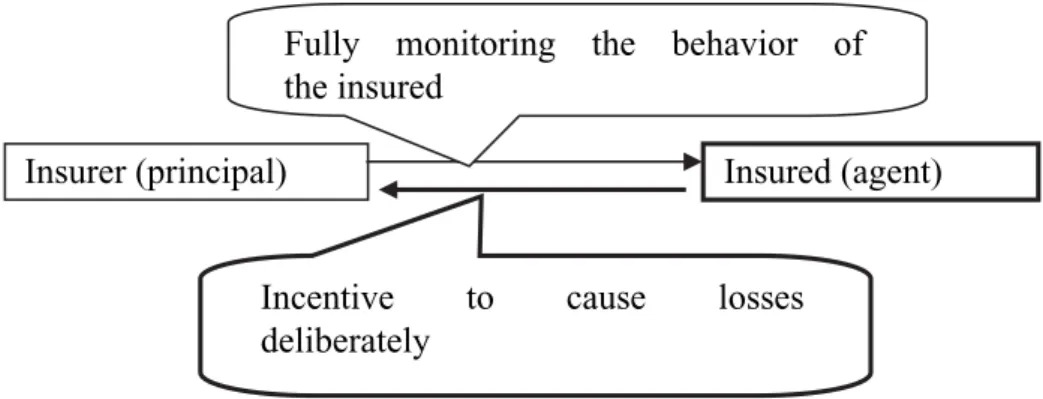
Fig. 2. Obligations to be considered when making an insurance contract
Insurer (principal) Insured (agent)
Fully monitoring the behavior of the insured
Incentive to cause losses deliberately
Fig. 3. The insured as an agent of the insurer: in theory
(Fig. 2). Ethical behavior is fundamental to this relationship, and moral hazards of the insured render this relationship fragile.
The insurance contract also functions as an aleatory contract. Depending on chance, one party may receive a value out of proportion to the value that is given.5 Therefore, the insurance system itself offers an incentive for the insured (the agent) to deliberately cause losses with the intention of collecting insurance. The- oretically, in the insurance industry, the insurer, as the principal, is assumed to be capable of fully monitoring the behavior of the agent or the insured (Fig. 3).
However, in reality, it is impossible for the insurer to do so, and as a result, the
5Redja (2005).
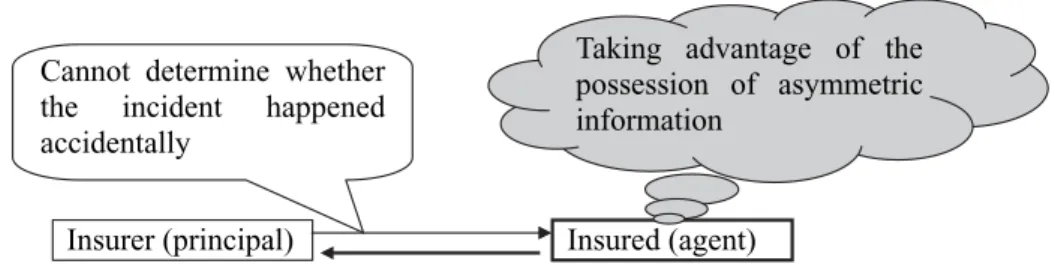
insured possess more relevant information or greater control over the outcome than the insurer.6As shown in Fig. 4, the insurer is unable to distinguish whether the incident occurred accidentally because the insured may have taken advan- tage of the possession of asymmetric information. The difficulty or the cost involved in monitoring and enforcing appropriate behavior creates the moral hazard problem. Therefore, there exist many cases where the insured can collect payment despite the incidents being intentionally caused. Insurance companies often pay for too many losses, and eventually the insured becomes uninsurable.
2.3.2 Management
Instead of describing the behavior of the insured, the term moral hazard has been used to describe the unethical decision making of managers, which can lead to scandals and criminal behavior.
Improper decision making by the manager is a moral hazard that can cause huge financial losses, and as a result, undermine the financial stability of the firm.
The manager makes decisions as an agent of the stakeholders. Stakeholders are those people and groups that affect or can be affected by an organization’s deci- sions, policies, and operations.7
There exist many agent–principal relationships in firms; every stakeholder has a unique stake in the firm, specifically in the corporation, in the position of own- ership, and the managers should give priority to the stockholders.8On the other hand, there have been many views on the priority of the stakeholders in a cor- poration. Gilbert and Freeman (1988) maintain that corporations should be managed for the benefit of all stakeholders, not merely the stockholder. Accord- 18 I. Four Approaches to Corporate Governance
6Rothschild and Stiglitz (1976).
7Post et al. (2002).
8The situation in which several risk-neutral principals simultaneously and independently attempt to influence a common agent; in the aggregate, always efficient and noncoopera- tive behavior induces an efficient action choice if, and only if, collusion among the princi- pals would implement the first-best action at the first-best level of cost (Bernheim and Whinston 1986).
Insurer (principal) Insured (agent) Cannot determine whether
the incident happened accidentally
Taking advantage of the possession of asymmetric information
Fig. 4. The insured as an agent of the insurer: in reality
ing to Goodpaster (1991), businesses have fiduciary obligations only to stock- holders; however, they also have nonfiduciary moral obligations to those affected by their actions.9Therefore, the managers need to recognize all the stakes in their firm and deal with them accordingly. However, the decisions of the managers do not always contribute to the interest of every principal.
For example, since the late 1990s several scandals and criminal behavior involv- ing Japanese firms have been exposed and have caused huge losses. They were caused and/or increased due to moral hazard. The managers made decisions that served their personal interests. In other words, they failed to play an appropriate role as agents of the stakeholders.
Japanese financial institutions have incurred huge debts because of their policy to provide indiscriminate loans during the alleged “bubble economy.”10Although the managers made indiscriminate loans, most of them did not realize their moral hazard at that time. In order to compensate for their bad loans, the Japanese Gov- ernment decided to provide financial assistance to the financial institutions in 1998. Since 1998, they have repeatedly pumped money into financial institutions.
As a result, Japanese taxpayers have had to bear the brunt of the mistakes of careless managers. However, these managers have not been held responsible for their failures. In this situation, in the absence of individual responsibility, these managers have had no incentive to reform their behavior. Thus, this involves another type of moral hazard.
3. Effect of Ethics-Related Risk Control 3.1 Methods to Cope with Moral Hazard in Insurance Companies
The basic constructions of insurance contracts are ruled by the laws and the policy conditions that stipulate each contract in detail. The insurer’s obligation to pay a claim depends on whether the insured has complied with all the policy conditions. In other words, the insurance contracts include systems to reduce asymmetric information among the parties and to prevent self-interested behav- 2. Moral Hazard in Corporate Governance 19
9Competitors, wholesalers/retailers, employees (union), customers, governments, NGO/NPOs, and media have a nonfiduciary moral obligation to the managers in the corporation.
10The Japanese Bank Association reported that outstanding nonperforming loans of nationwide commercial banks fell to ¥28.33 trillion as of March 31, 2003. This was the first time since 1998 that bad loans fell to less than ¥30 trillion. It accounted for less than 70%
of their largest bad loans at the end of March 2003 (Nihon Keizai Shinbun, December 27, 2003). In August 2005, the Bank of Japan says in its research paper titled “Financial System Report—Focusing on the Banking System,” “After more than a decade of struggle, Japan’s financial system has almost overcome the unperforming-loan problem and has entered a new phase of development.”
ior of the insured.11However, the effects of these systems are limited because the insured can participate in and leave the insurance market at will.12There does not exist a cost-effective method for the insurer to observe the precautions taken by the insured. Therefore, implementation of the monitoring system is often impossible or extremely expensive.13
As noted above, the insurance company cannot prevent moral hazard com- pletely. For example, in Japan, most insurance companies have tended to respond to the moral hazard problem with their method of cost–benefit analysis, weigh- ing the cost of preventing fraud against the loss incurred by it. However, as the losses caused by moral hazard have assumed serious proportions, it is time to think afresh on this issue.14The frequency and severity of insurance crimes, such as murder, have been increasing, and the confidence in the insurance industry has been decreasing. In order to prevent huge losses, insurance companies need to spend more money than they were previously supposed to. In other words, to cope with this problem appropriately, in addition to mandated prevention methods, a system to facilitate the conditions in which the agent can behave eth- ically is required. It can be said that the insurer should incorporate ethical values in their organizations in order to cope with the moral hazard problem in a better manner.
3.2 Corporate Scandals and “Mandated” Risk Control
In this section, I highlight a Japanese example to draw attention to the limits of
“mandated” risk control. On June 27, 2000, the products of Snow Brand, the largest producer of dairy products in Japan, caused food poisoning.15 All the plants of this company had been certified as “Hazard Analysis Critical Control 20 I. Four Approaches to Corporate Governance
11The legal effect of misrepresentation of material facts and material concealment is that the contract becomes voidable at the insurer’s discretion. Including the above-mentioned legal procedures, Takao (1978) and Takao (1980) provide the following examples as regards preventing the self-interested misbehavior of the insured: careful selection of applicants, risk sharing among both parties, and compulsory contractual provisions; on the other hand, as regards not taking advantage of the unequal possession of information in each party, using common terms in the policies, risk classification to reward good risks with better insurance rates, and careful underwriting.
12Takao (1978, 1980).
13Milgrom and Roberts (1992).
14In Japan, for example, after a murder was committed by a woman who had worked as a life insurance agent to collect life insurance proceeds, defects in the system for selecting applicants for insurance and insufficient education on professional ethics for life insurance agents were revealed. Most Japanese life insurance companies improved countermeasures to prevent fraudulent claims. The primary countermeasures are men- tioned as follows: strengthening the connection with the police, policy data registration at the registration center of the Life Insurance Association of Japan, and a policy data inquiry system (http://seiho.or.jp/).
15Snow Brand distributed contaminated milk and failed to notify the public regarding this issue for two days, and as a result, more than 15,000 people fell ill.
Point-approved” (HACCP-approved) by the Ministry of Health, Labour, and Welfare. The high-quality safety standards for this certification should have pre- vented this incident. However, the company had not been maintaining its plants to the certified standards when the incident occurred. Further, in January 2002, it was revealed that one of Snow Brand’s government subsidized subsidiaries was involved in the false labeling of beef products. As a result of these incidents, the Snow Brand group experienced huge direct and indirect losses.16 The moral hazard in managerial decision making was named as one of the most serious factors that caused and increased the losses.
The regulations and self-regulations in the industry have become more strin- gent in response to such scandals. Soon after the occurrence of the above- mentioned incident, all the Snow Brand plants with HACCP certifications were suspended.17A set of acts that sought to bolster food safety and protect public health in the wake of numerous recent scares was legislated in February 2003.
One of the acts sanctioned the setting up of a government Food Safety Com- mission to evaluate the health effects of certain foods.18
However, the effects of such laws are also limited. Most of the recent scandals cannot be exclusively classified as legal or illegal. The managers made “not illegal, but unethical” decisions, which they considered to be the most rational to tem- porarily improve their results. However, as a consequence, they caused huge losses to their firms. Following the existing laws is a “mandated” risk control,19 which forces managers to make legally appropriate decisions. In addition, it is necessary for managers to be eager not only to follow the existing laws but also to behave ethically. In other words, ethics-related risk control is a practice that serves the interests of a firm.
3.3 Ethics-Related Risk Control in Management
Ethics-related risk control is applicable to all types of firms. Managers (the agent) should be strictly controlled. As Friedman maintains in Capitalism and Freedom, self-interested actions tend to promote general welfare only when appropriate laws are in place. A variety of regulations are required to control the moral hazard by the manager. However, regulations alone cannot solve this problem.20
2. Moral Hazard in Corporate Governance 21
16A Japanese research institute estimated that a series of scandals brought down the cor- porate value of the Snow Brand group by approximately ¥70 billion (Nihon Keizai Shinbun, March 11, 2002).
17In the United States, after the accounting scandals at Enron and WorldCom had been exposed, Congress passed the Sarbanes–Oxley Act on July 30, 2002. This act is formally named “Act to protect investors by improving the accuracy and reliability of corporate disclosures made pursuant to the securities law, and for other purposes.”
18The Japan Times, February 8, 2003.
19Young and Tippins (2001).
20In addition, as Carson (2003) highlights, rules, decision procedures, and schemes for reward and compensation need to be scrutinized for the incentives created by them.
The insurer (the principal) is required to facilitate the conditions for the insured (the agent) to behave ethically. Likewise, managers should be encour- aged to behave ethically by their principals (all the stakeholders), specifically the stockholders. Further, it is the social responsibility of the managers that they control their moral hazards of their own accord and make ethical decisions as management professionals. It is not sufficient that managers themselves refrain from fraud and deception; they must also not condone or permit fraud and decep- tion by subordinates or those who work for the corporation.21
Avoiding punishment under the existing laws is the main consideration taken by managers in making decisions. Although they regard such decisions as being best suited for the financial results of the firm, it can, in fact, lead to financial ruin.
Whether the agent makes improper decisions is ultimately an ethical behavior beyond compliance with the laws. In addition to legal compliance, we must incor- porate ethics as a form of risk management in firms.
4. Conclusion
The study of moral hazard in the insurance industry will contribute to a better understanding of moral hazard in all types of firms. Moral hazard implies the inef- ficiency factor in the insurance market. The insurance company should regard the moral hazard problem as one of the most urgent issues to cope with.
Meanwhile, moral hazard in managerial decision-making has been underesti- mated as a hazard for firms because it is extremely difficult to identify the rela- tionship between moral hazards and losses and to quantify the indirect losses caused by them. Presently, we need to recognize the unethical decision making of managers as a moral hazard and cope with it accordingly.
In addition to mandated prevention methods, an ethical viewpoint is necessary to effectively cope with the moral hazard problem. It is also required for the stakeholders (the principals) to establish a system in order to support the ethical behavior of managers.22
References
Bernheim BD, Whinston MD (1986) Common Agency. Econometrica 54(4): 923–942.
Carson TL (2003) Self-interest and business ethics: some lessons of the recent corporate scandals. Journal of Business Ethics 43: 389–394.
Freeman RE, Gilbert DR Jr (1988) Corporate Strategy and the Search for Ethics.
Prentice-Hall.
22 I. Four Approaches to Corporate Governance
21Carson (2003), p. 393.
22Carson (2003) criticism is that the stakeholder theory makes extremely naive and unre- alistic assumptions regarding the abilities and moral capacities of managers of corpora- tions, and that it needs to add the explicit requirement that executives should not require, pressurize, or permit professionals who work for the firm to violate their own professional obligations, e.g., their obligations as accountants, lawyers, or engineers.
Goodpaster KE (1991) Business ethics and stakeholder analysis. Business Ethics Quar- terly 1: 53–72.
Milgrom P, Roberts J (1992) Economics, Organization & Management. Prentice-Hall.
Post JE, Frederick WC, Weber J (2002) Business and Society: Corporate Strategy, Public Policy, Ethics, 10th. ed. McGraw-Hill.
Rejda GE (2005) Principles of Risk Management and Insurance, 9th ed. Addison-Wesley.
Rothschild M, Stiglitz JE (1976) Equilibrium in competitive insurance markets: an essay on imperfect information. Quarterly Journal of Economics 90(4): 629–649.
Takao A (1978) Market failure in insurance—organizational study of insurance market [J]. The Journal of Insurance Science (The Japanese Society of Insurance Science) 481:
49–74.
Takao A (1980) Economic analysis of moral hazard [J]. The Journal of Insurance Science (The Japanese Society of Insurance Science) 489: 98–113.
Young PC, Tippins SC (2001) Managing Business Risk. AMACOM.
2. Moral Hazard in Corporate Governance 23
3
Accounting and Corporate Governance
YokoNakoshi
25
1. Introduction
There is at present an attempt to use accounting more effectively so that it might also cause management to consider corporate governance as important. More- over, this trend includes the recognition stage of accounting, exceeding the stage of disclosure. In reality, is accounting effective in making management consider corporate governance as important?
In this chapter I wish to consider accounting with regard to both these two levels, disclosure and recognition. I wish to consider the situation in which the importance of corporate governance is included in the setting of accounting stan- dards as well as the situation in which accounting information is used in corpo- rate governance.
2. The Enron Failure and the Sarbanes–Oxley Act
After the collapse of Enron, it was assumed in the United States that account- ing for the special purpose entity was one of the causes of the failure.1The Enron failure generated a distrust of accounting in the United States. Under these con- ditions, the Public Company Accounting Reform and Investor Protection Act of 2002 was enacted. This is known as the Sarbanes–Oxley Act.
According to the Sarbanes–Oxley Act, accounting reform of the public company in order to protect investors is important. New regulations demand the reorganization of public companies to improve the quality of financial reporting.
In the Sarbanes–Oxley Act, accounting is assumed to be an effective pillar in making management consider corporate governance as important. For instance, it even includes the content of the accounting standard, and the conversion from the detailed rule to the fundamental rule in the setting of accounting standards is provided for.
1See Powers (2002).
Regarding accounting standards based on fundamental rules, the unification of accounting standards by a standard-setting organization is aimed at. Historically in the United States, exceptional accounting methods were allowed and a wide variety of methods were permitted in business accounting.
In such a situation, against the rising problem of illegal accounting, there is at present a movement toward changes in accounting standards in the United States. For instance, accounting standards for stock options and the consolidation of the special-purpose entity have been changed.
3. Disclosure of Management Remuneration
First of all, in order to strengthen the watch on management and achieve the maximization of the stockholders’ value, it is imperative that the accounting material is included in discussions of the board of directors and in the agenda of the stockholders’ meeting. This is a situation in which accounting information is used for corporate governance.
The disclosure of management remuneration is of special concern in corporate governance. For instance, in the United States the remuneration of a chief exec- utive officer (CEO) is disclosed according to the Securities and Exchange Law, and the remuneration of high-ranking persons is disclosed individually.
Moreover, the report set up by the remuneration committee of the managing board must be disclosed.2This report explains how management remuneration, including CEO remuneration, is decided. Additionally, it describes the relation- ship between corporate performance and management remuneration, and the measurement standard of corporate performance and managers’ individual performance.
The U.S. Securities and Exchange Law and the aforementioned Sarbanes–Oxley Act aim to protect investors. Disclosed information is used from this viewpoint for the improvement of corporate governance. In addition, con- siderable revision has been made to the rules pertaining to listed companies on the New York Stock Exchange, and the importance of stockholders’ approval is increasing.
The problem of corporate governance over management remuneration is one of “disclosure” where accounting information is used for corporate governance.
Remuneration for each manager is disclosed individually, and the discussion over how the individual remuneration was decided upon is also disclosed in the afore- mentioned report set up by the remuneration committee of the board.
Information on the total amount of management remuneration is not made available by corporate governors, but for accounting purposes the total amount of remuneration is recognized as expenses.
26 I. Four Approaches to Corporate Governance
2See Regulation S-K.
4. Concrete Demand from Stockholders as to Accounting Method
4.1 Accounting for the Stock Option
There exists stock-based compensation (or remuneration) besides cash. Specifi- cally, whether to expense the amount that corresponds to fair value of the stock option as compensation cost or only to disclose the condition of grant, at the time of giving the stock option, will show the profit as different in the financial statement.
In the United States, when an incentive stock option is given, details of the conditions are supposed to be disclosed in the notes to the financial statements.
Moreover, the fair value of the stock option must be disclosed. However, the fair value of the stock option in the accounts does not have to be incurred as com- pensation costs.3Therefore, when giving the stock option, many enterprises avoid costing the fair value of the stock option under such a situation.
However, in the environment of the aforementioned accounting distrust that followed the Enron collapse, some enterprises expensed the fair value of the stock options in their closing accounts of the third quarter of 2002. These included General Electric, Coca-Cola, General Motors, and Citigroup. The number of such enterprises continues to increase.
The trend of expensing the fair value of the stock option as compensation cost has been assumed by some to be an answer to the atmosphere of accounting dis- trust. In the 1990s, expensing of the fair value of the stock option was not oblig- atory because many enterprises lobbied against expensing the fair value of the stock option4in setting accounting standards for it. It can be argued that some enterprises decided to expense the fair value of the stock option as compensa- tion cost voluntarily only after corporate governance came to be considered as important as a result of the Enron failure and the distrust of accounting.
In the United States the amount given and the exercise price of the incentive stock option must be disclosed in the accounting standards. If there are any con- ditions of the achievement, such conditions must be disclosed clearly. Addition- ally, information on how the fair value of the stock option was calculated must be explained.
For instance, in the notes to the financial statements in Microsoft’s annual report, the fair value of the stock option was calculated and disclosed along with the profit where expensing the fair value of the stock option. In fact many enter- prises, including Microsoft, did not in actuality expense the fair value. The profit disclosed in the notes to the financial statements was not formal but called “pro forma earnings”. This was used as the investors’ reference. Moreover, even if pro forma earnings were not disclosed and the fair value of the incentive stock option 3. Accounting and Corporate Governance 27
3See FASB (1995) and FASB (2002c).
4Compare FASB (1993) with FASB (1995).
disclosed in the notes to the financial statements, the investors should still be able to calculate this informal profit for themselves.
In December 2002, the new accounting standard for stock-based compensa- tion was issued.5The new standard does not oblige companies to expense the fair value of the stock option. However, it requires that the disclosure of the pro forma earnings in expensing the fair value of the stock option should be displayed more prominently.
One of the applications arising from the accounting distrust in the United States after the Enron failure was expensing of the fair value of the stock option as compensation cost, being an opportunity that adequate recognition of the accounting be required that exceeded the disclosure in the corporate governance.
It might be shown that mere disclosure of the stock-based compensation was ineffectual even though the accounting information was used in corporate governance.
However, when the recognition of accounting is discussed, a theoretical dis- cussion besides the viewpoint of useful or decision-making information for the investors is needed. Does corporate governance have an impact on the process of setting the accounting standard? Additionally, one should consider corporate governance within a theoretical framework.
4.2 Consolidation of Special-Purpose Entities
In January 2003 in the United States, the accounting standard of the consolida- tion of special-purpose entities was