13.1
Contents
13.1 Introduction
13.2 Cross-cultural negotiations 13.3 Intercultural preparation 13.4 Coping with expatriates
13.5 Knowledge management and learning across borders 13.6 Transnational bribery in cross-cultural negotiations 13.7 Summary
Case study 13.1 Mecca Cola
Learning objectives
After studying this chapter you should be able to do the following:
l Discuss why intercultural selling through negotiation is one of the greatest challenges in global marketing.
l Explain the major phases in a cross-cultural negotiation process.
l Discuss how learning and knowledge transfer across borders can increase international competitiveness.
l Discuss the implications of Hofstede’s research for the firm’s cross- cultural negotiation.
l Explain some important aspects of intercultural preparation.
l Discuss opportunities and pitfalls with global multicultural project groups.
l Explain the complexity and dangers of transnational bribery.
Cross-cultural sales negotiations
13 13
Introduction
Culture is a dimension that intervenes at each stage of the negotiation. It plays a role in the way people conceive of the situation even before any discussion starts because it contributes to structuring the problem. It influences the strategic approach developed in terms of competition or cooperation.
To remain competitive and to flourish in the complex and fast-changing world of international business companies must look worldwide not only for potential markets but also for sources of high quality but less expensive materials and labour. Even small business managers who never leave their home countries will deal with markets and a workforce whose cultural background is increasingly diverse. Those managers with the
skills to understand and adapt to different cultures are better positioned to succeed in these endeavours and to compete successfully in the world market.
Culture contributes to orchestrating behaviours, drawing a line between what is desirable and what is not acceptable. It conditions perception in providing meaning to what is observed, organizing and codifing communication. It influences the choice of norms for fairness that will seal the final agreement. By the importance and signifi- cance that it gives to the context, culture directly influences the negotiation process.
Fundamentally, negotiation as a process which is intended to reach a goal, is a process of strategic nature, taking place in a cultural context and conducted by people who are themselves cultural vectors. It would be quite unrealistic not to take this into account.
Culture is the variable that distinguishes international negotiation from any other type.
Before engaging in such a lengthy and complex negotiation process as establishing a joint venture, it is essential for an international negotiator, whether buyer or seller, to assimilate basic elements of the counterpart’s culture. Such a task will enable a better understanding of what really goes on around the negotiation table and in the immediate environment, to avoid misunderstandings, to communicate more effectively, to be better equipped to solve deadlocks that may surface and to be able to diagnose the real problems.
Consequently, conducting business with people from other cultures will never be as easy as doing business at home.
In the early stages of internationalization SMEs may treat cross-cultural markets as purely short-term economic opportunities to be pursued in order to maximize short- term profit.
However, learning more about the nature of culture and how it affects business practices can increase the chances of success, even in the early cross-cultural business negotiations. When people from two different cultures are conducting business making assumptions about another culture is often detrimental, and can result in miscom- munication. The managers in SMEs should develop realistic assumptions based on a truthful appreciation of the culture and should refrain from any thoughts of cultural stereotyping. Exhibit 13.1 shows that cultural influences can be difficult to predict.
Exhibit 13.1 Giving gifts in China and Japan
A US businessman once presented a clock to the daughter of his Chinese counterpart on the occasion of her marriage, not knowing that clocks are inappropriate gifts in China because they are associated with death. His insult led to the termination of the business relationship. It is also bad to give one’s Japanese counterpart gifts of greater value than those received.
Source: Hendon et al.1999.
All successful international marketers have personal representation abroad. Face-to- face negotiations with the customer are the heart of the sales job. Negotiations are necessary to reach an agreement on the total exchange transaction, comprising such issues as the product to be delivered, the price to be paid, the payment schedule and the service agreement.
International sales negotiations have many characteristics that distinguish them from negotiations in the domestic setting. First and foremost, the cultural background of the negotiating parties is different. Successful negotiations therefore require some understanding of each party’s culture and may also require the adoption of a negoti- ating strategy that is consistent with the other party’s cultural system. It is interesting
Negotiation process A process in which two or more entities come together to discuss common and conflicting interests in order to reach an agreement of mutual benefit.
13.2
to note that Japanese negotiators, among other things, routinely request background information on US companies and key negotiators. Japanese negotiators therefore often know in advance the likely negotiating strategies and tactics of the other side.
Cross-cultural negotiations
Faced with different customs, perceptions and language the most common human tendency is to stereotype the other party in a negative way. A crucial perception is knowing what to look for and thoroughly researching the characteristics of a culture before conducting negotiations. Understanding other cultures is often based on toler- ance. Trust and respect are essential conditions for several cultures, for example, the Japanese, Chinese, Mexican, and most Latin American cultures. The Japanese may require several meetings before actual negotiation issues are discussed, while North Americans and North Europeans are inclined to do business as soon as possible. Cul- ture affects a range of strategies, including the many ways they are implemented. The Israeli prefers direct forms of negotiation, and the Egyptian prefers an indirect form. The Egyptians interpret Israeli directness as aggressive, and are insulted, while the Israelis view Egyptian indirectness with impatience, and consider it insincere. This cultural difference endangers any negotiation between business people in the two countries.
Even the language of negotiation can be deceptive. Compromise for North Americans and western Europeans is equal to morality, good faith and fair play. To the Mexicans and other Latin Americans compromise means losing dignity and integrity; in Russia and the Middle East it is a sign of weakness. Furthermore, members of other cultures may regard the common western ideal of a persuasive communicator as aggressive, superficial and insincere.
The cross-cultural negotiation process
A negotiation processcan be defined as ‘a process in which two or more entities come together to discuss common and conflicting interests in order to reach an agreement of mutual benefit’ (Harris and Moran, 1987, p. 55). The negotiation process is signi- ficantly influenced by the cultures within which the negotiators (typically a buyer and a seller) have been socialized and educated. Cultural differences prevalent in the inter- national sales negotiation process can have a tremendous impact upon the process itself as well as its outcome.
The cross-cultural negotiation process can be divided into two different parts:
namely, the non-task related interaction and task related interaction (see Figure 13.1) – each part is discussed in the following sections (Simintiras and Thomas, 1998;
Simintiras and Reynolds, 2001).
Figure 13.1 shows that the cross-cultural negotiation process is very much influ- enced by the cultural ‘distance’ between seller and buyer. This perspective is further developed in Figure 13.2 later.
Non-task related interaction
The non-task related aspects of the sales negotiation process (status distinction, impression formation accuracy and interpersonal attractiveness) are considered first as it is these factors that are more relevant when establishing a relationship with the buyer; that is,approaching the buyer:
1 Status distinction
In cross-cultural negotiations it is critical that sellers and buyers understand status dis- tinction. Status distinction is defined by interpersonal rank, age, gender, education, the position of an individual in the company and the relative position of one’s company.
Different cultures attach different degrees of importance to status in negotiations.
High-context cultures are status-oriented and the meaning of communication is intern- alized in the person. The words used by negotiators in high-context cultures are not as important as the negotiator’s status. The status distinctions of negotiators between high- and low-context are sources of potential problems. For example, a seller from a high-context culture negotiating with a buyer from a low-context culture is likely to attach importance to the status of the buyer. The seller expects the buyer to reciprocate this respect, but this will rarely take place.
2 Impression formation accuracy
This stage refers to initial contact between negotiators. The first two minutes that a salesperson spends with a prospect are the most important (the ‘moment of truth’).
Meeting someone for the first time, individuals have immediate feelings that precede rationalized thought processes; these feelings lead to the formation of instant opinions that are often based on minimal information. As the perceptions of the individuals from dissimilar cultures differ, the likelihood of a negotiator forming accurate impressions of the counterpart is reduced. A bad impression based on an inaccurate impression formation may also have negative effects on subsequent stages of negotiation.
Figure 13.1 The cross-cultural negotiation process is influenced by the cultural distance between buyer and seller
Source: Adapted from Simintiras, A.C. and Thomas, A.H. (1998) and Simintiras, A.C. and Reynolds, N. (2001).
3 Interpersonal attraction
This stage refers to the immediate face-to-face impression influenced by the feelings of attraction or liking between the buyer and seller. Interpersonal attraction can have either a positive or negative influence on the negotiation outcome. Similarity between negotiators can induce trust which leads, in turn, to interpersonal attraction. Individuals who are attracted are likely to make concessions in the bargaining process. Thus an individual negotiator may give up economic rewards for the rewards of the satisfaction derived from the relationship with an attractive partner. Zhang and Dodgson (2007) give an interesting character sketch of the founder of a Korean start-up IT-company, Mr. Lee:
We found Mr. Lee was influenced by his partners, and sometimes followed their advice – even though he knew they were not necessarily right, because he could not face losing connections within his personal networks. Mr. Lee’s biggest problem is he cannot separate business relations from his personal networks (p. 345).
This also confirms that Korean negotiation culture is based on Confucianism and its values permeate every aspect of society, providing a basis for morality and social norms.
Like other Asian countries, Korea is a society where group harmony within social networks, and company loyalty and commitment, are greatly appreciated collectivistic attributes.
Task related interaction
Once a relationship has successfully been established between buyer and seller, the task related aspects of the cross-cultural negotiation process are going to be more important. However, it should be remembered that even though the non-task related factors are not of prime importance at this stage, they could still have an impact on the negotiation process and the final outcome.
4 Exchange of information
At this point in the process a clear understanding of the negotiator’s needs and expecta- tions is essential as a point of departure for an effective communication flow between the partners. More specifically, there is an emphasis on the participants’ expected utilities of the various alternatives open to them. The amount of information that has to be exchanged explicitly will vary from culture to culture, and with the extra com- plexity of several thousand languages and local dialects in the world, communication in cross-cultural negotiations through verbal means is complex and difficult. Even in cases when participants understand each other and are mutually fluent, the meaning of the information exchanged can be lost as a result of different meanings of words and across cultures. In addition to difficulties with verbal communication, cross-cultural sales negotiations are subject to non-verbal problems, such as body language, which can reduce the possibility that the negotiators will accurately understand their differ- ences and their similarities.
5 Persuasion and bargaining strategy
This phase of the negotiation process refers to a negotiator’s attempts to modify the performance expectations of the other party through the use of various persuasive tactics. There are various styles of persuasion and each culture has its own style of persuasion. According to Anglemar and Stern (1978), there are two basic strategies used in the negotiation process. These arerepresentationaland instrumental strategies.
When representational strategiesare used communication is based on identification of problems, a search for solutions and the selection of the most appropriate course of
action; for example, the salesperson may cooperate with the buyer and seek information on the buyer’s views of the situation.
When instrumental strategiesare used, communication involves affecting the other party’s behaviour and attitudes; for example, a salesperson may influence the buyer with persuasive promises, commitments, rewards and punishments. The existence of a friendly and cooperative negotiation climate favours the use of the representational bargaining strategy.
6 Concession making and agreement
This stage refers to the manoeuvring of negotiators from their initial position to a point of agreement on what is being negotiated. Negotiators from different cultures have dif- ferent approaches to concession making. For example, while in low-context cultures negotiators are likely to use logic, individuals in high-context cultures are more likely to use personalized arguments.
7 Negotiation outcome
Agreement is the last stage of the negotiation process. The agreement should be the starting point for the development of a ‘deeper’ relationship between buyer and seller.
The final agreement of a negotiation process may take the form of a gentleman’s agree- ment, which is common in high-context cultures, or more formal contracts, which are more prevalent in ‘low-context’ countries.
Implications of Hofstede’s work
From Hofstede’s work we see that there are differences (gaps) between national cultures.
Each of four dimensions is reflected in the corporate culture patterns exhibited across countries (Hofstede, 1983). In the following, implications of Hofstede’s four dimen- sions on the firm’s international negotiation strategies will be discussed (Rowden, 2001; McGinnis, 2005).
Masculinity/femininity
Masculine cultures value assertiveness, independence, task orientation and self- achievement. Masculine culture’s strategy for negotiation is usually competitive, resulting in a win–lose situation. Conflict is usually resolved by fighting rather than compro- mising, reflecting an ego-boosting manner. In this situation the person with the most competitive behaviour is likely to gain the most. On the other hand, feminine cultures value cooperation, nurturing, modesty, empathy and social relations, and prefer a collaborative or a compromising style or strategy to assure the best possible mutually accepting solution to obtain a win–win situation.
When negotiating, individuals from masculine countries are more likely to focus on the specifics of the agreement and not show much concern for its overall impact on the other party. Negotiators from feminine cultures are more likely to be concerned with the agreement’s aesthetics and longer-range effects; they feel that the details can be worked out later.
Uncertainty avoidance
This dimension refers to the comfort level of a person in an unclear or risky situation.
High uncertainty avoidance cultures have formal bureaucratic negotiation rules, rely on rituals and standards, and trust only family and friends. They require clearly defined structure and guidelines. Low uncertainty avoidance cultures prefer to work informally with flexibility. They disfavour hierarchy, and are likely to seek resolving solutions and compromises rather than the status quo.
Negotiators from high-risk avoidance cultures are likely to seek specific com- mitments in terms of volume, timing and requirements. Their counterparts from low-uncertainty avoidance cultures are likely to be comfortable with rough estimates of volume and timing and with constantly changing requirements. During the negotiat- ing process, discussions around delays in new product availability, for example, might cause great concern to those high on uncertainty avoidance. On the other hand, it would be regarded as an opportunity to creatively improvise by those who are low on uncertainty avoidance.
Power distance
This dimension refers to the acceptance of authority differences between those who have power and those affected by power. High power distance is authoritarian, and protocol formality and hierarchy are considered important. In ‘high power distance’
cultures the CEO of the company is often directly involved in the negotiations and is the final decision maker.
Business negotiations between equals (low power distance) are basically a western concept and are not found in status-oriented societies such as Japan, Korea or Russia.
Western Europeans and North Americans are normally informal and downplay status by using first names, dressing in casual attire, etc.
The Japanese dress conservatively – they always prefer dark business suits; to be dressed casually during negotiations with the Japanese would, therefore, be inappro- priate. The Japanese do not believe in using first names unless in the very best of per- sonal relationships. In Asia honours, titles and status are extremely important: address your counterparts by their proper titles. Frankness and directness are important in the western world, but are not desirable in Asia.
The valued European handshake is often out of place in Japan, where bowing is customary. When meeting a devout Muslim, never shake with the left hand or utilize the left hand for any purpose – it is considered rude and a personal affront.
When a person from a high masculine culture negotiates with a high power distance culture then conflict will most likely result if neither party makes an effort to under- stand the cultural balance. Competence is valued over seniority, which yields a con- sultative management style. Dealings between cultures with low masculinity and low power distance usually result in more cooperative and creative behaviour.
Negotiators from low power distance cultures may be frustrated by the need of negotiators from high power distance cultures to seek approvals from their supervisors.
On the other hand, negotiators from high power distance cultures may feel pressured by the pace imposed by those from low power distance cultures. The key here is to understand the power distance mindset of the people that you are negotiating with.
That understanding is the first step toward closing the deal and setting realistic expec- tations for the relationship that follows.
Individualism/collectivism
Individualistic cultures tend to put tasks before relationships and value independence highly. These cultures tolerate open conflict and place the needs of the individual over the needs of a group, community or society. In negotiations the individualistic society expects the other party to have the authority to make decisions unilaterally. In a highly individualist country such as the United States it is considered socially acceptable to pursue one’s own ends without understanding the benefits for others. In contrast man- agers from a collectivistic culture, such as China, will seek a stable relationship with a long-term orientation, stressing above all the establishment of a personal relationship.
A collectivistic society values solidarity, loyalty and strong interdependence among
individuals, and the members define themselves in terms of their membership within groups. Collectivist managers assume that details in the negotiation process can be worked out and show more concern for the needs of the other party by focusing on group goals. Members of collectivist societies are irritated when members from indi- vidualistic societies promote their own positions and ideas during negotiations.
On the other hand, negotiators from individualistic societies are more likely to focus on the short term, make extreme offers and view negotiations from a competitive perspective. A critical factor in such negotiations is for each party to understand the other’s main interests rather than just focusing solely on its own.
Different organizational models
The British model of organization seems to be that of a village market with no decisive hierarchy, flexible rules and a resolution of problems by negotiating. The German model is more like a well-oiled machine. The exercise of personal command is largely unnecessary because the rules settle everything. The French model is more of a pyrami- dal hierarchy held together by a united command issuing strong rules. If we look at international buyer–seller relations, the national culture is only one level in the cul- tural hierarchy that will influence the behaviour of the individual buyer or seller. When members of different cultures come together to communicate, whether within the sales organization or in buyer–seller encounters, they typically do not bring the same shared values, thought patterns and actions to the situation. Common ground is typically lim- ited. This increases the degree of uncertainty about the outcome of the interaction and can limit the efficiency and effectiveness of communication. To reduce uncertainty communicators must accurately predict how others will behave and be able to explain the behaviours of others (Bush and Ingram, 2001).
The gap model in international negotiation
In negotiation situations the most fundamental gap influencing the interaction between buyer and seller is the difference between their respective cultural backgrounds (gap 1 in Figure 13.2). This cultural distance can be expressed in terms of differences in com- munication and negotiation behaviour, the concepts of time, space or work patterns, and the nature of social rituals and norms (Madsen, 1994). The cultural distance between two partners tends to increase the transaction costs, which may be quite high in cross-cultural negotiations.
Cultural influence on persons, and thereby international negotiations, can be analysed at various levels of society. Furthermore there is a learning ‘effect’ in the way that a person’s cultural identity formed in one specific cultural setting will affect how they view other situations in other cultural settings. Both seller and buyer are influ- enced by (at least) the national and organizational culture they belong to. As seen in Chapter 6 (Figure 6.2) there are probably more levels in the understanding of individual negotiation behaviour.
The level of adaptation that is necessary is dependent on how culturally similar the seller and buyer are in the first place. However, the cultural differences between buyer and seller are likely to be less than the cultural differences between their two nations, as, to a certain extent, they will share a ‘business’ culture.
The influence of national culture
The national culture is the macro/societal culture that represents a distinct way of life of a group of citizens in a certain country. This national culture is composed of the norms and values that members hold, as well as their level of, for example economic
development, education system, national laws and other parts of the regulatory environ- ment (Harvey and Griffith, 2002). All these factors play an important role in socializing individuals in a specific pattern of belief (Andersen, 2003). Therefore it is typical that when individuals encounter cultural differences in their international interactions/
relationships, they tend to view people from different national cultures as strangers, that is unknown people who belong to different groups. This feeling of distance can directly impact upon trust and personal bonding, which increases the probability of conflict between seller and buyer in the negotiation process. The discussion earlier of the four dimensions of Hofstede’s research gives several examples of differences in national culture and how they may affect intercultural negotiations between two partners.
The influence of organizational culture
Organizational culture is the pattern of shared behaviour, values and beliefs that pro- vides a foundation for understanding the organizational functioning processes (Schein, 1985). When two or more organizations are negotiating with each other the relative level of consistency of core elements between organizational cultures can directly influence the effectiveness of communication and negotiation.
The overall complexity of a firm’s communication environment will vary tremen- dously when elements of national culture and organizational culture are examined. In instances where a high level of national culture distance exists between buyer and seller and the organizational cultures are inconsistent (i.e. high inter-organizational distance), then the negotiation environment will be highly complex, necessitating careful plan- ning and monitoring of the firm’s intercultural negotiation strategies. Alternatively, when the national cultural distance is low and the cultures of buyer’s and seller’s organ- izations are consistent, both partners will find it easier to employ effective negotiation strategies without too much adaptation (Griffith, 2002).
Figure 13.2 Gap analysis in a cross-cultural negotiation
In the case of a certain national and organizational cultural ‘distance’ between buyer and seller, both the buyer and especially the seller will try to adapt their own behaviour in such a way that they think is acceptable to the other party. In this way the initial gap 1 may be reduced to gap 2, through adaptation of behaviour. To what extent the seller can adjust his behaviour to another culture’s communication style is a function of their skills and experience. The necessary skills include the ability to handle stress, ini- tiate conversation and establish a meaningful relationship.
But neither the seller nor the buyer obtains full understanding of the other party’s culture, so the final result will often still be a difference between the cultural behaviour of the seller and the buyer (gap 2). This gap can create friction in the negotiation and exchange process and hence give rise to transaction costs.
Gap 2 can be reduced through market research and the education of salespeople (see next section). However, salespeople bring different ‘baggage’ with them in the form of attitudes and skills that result in different stages of intercultural awareness.
The different stages of intercultural prepareness are highlighted in the next section. For example, if a trainer chooses to give a basic cultural awareness exercise to salespeople who are already at the acceptance stage and willing to learn about behaviour strategies, then they are likely to be bored and not see the value of some types of diversity training.
Furthermore, face-to-face communication skills remain an important topic in inter- national sales training. This is especially true in consultative selling, where questioning and listening skills are essential in the global marketing context. However, learning about cultural diversity through training programmes should help salespeople and marketing executives be better prepared to predict the behaviours they encounter with diverse customers or coworkers. Yet many salespeople are sceptical of training and question its value. In fact employees may view diversity training as simply a current ‘fad’ or the
‘politically correct thing to do’. However, if not prepared many salespeople may not realize the impact of cultural diversity until they encounter an unfamiliar cultural situation.
The Walt Disney Company began scouting loca- tions for a European theme park in the mid-1980s, with France and Spain emerging as the strongest possibilities. The city of Marne-la-Vallée (about 20 miles east of Paris) eventually won the battle for the new mouse house, and in 1987 Disney created subsidiary Euro Disney. It broke ground on the
$4.4 billion project the next year, and in 1989 Euro Disney went public (Walt Disney retained a 49 per cent stake).
In preparing the opening of Euro Disney in 1992, Euro Disney’s first chairman proudly announced that his company would ‘help change Europe’s chemistry’.
However, some cross-cultural blunders occurred:
l Prior to opening the park, Disney insisted employees comply with a detailed written code
regarding clothing, jewellery, and other aspects of personal appearance. Women were expected to wear
‘appropriate undergarments’ and keep their fingernails short. Disney defended its move, noting that similar codes were used in its other parks. The goal was to ensure that guests received the kind of experience
Exhibit 13.2 Euro Disney becomes Disneyland Resort Paris – Disney learns to adapt to European cultures
Source: Copyright © Disney. Euro Disney Associés, S.C.A.
Ë
One of the main problems frequently encountered in providing salespeople with meaningful educational experience that includes cultural diversity (distance) is the inability routinely to provide on-location experiential learning opportunities. This is due to lack of time and resources. Although desirable, in many instances one cannot beforehand take the salesperson to the culture to analyse and learn from their reactions.
A viable alternative to this dilemma is to expose trainees to a simulated culturally diverse experience. The advantages of this approach are that it is more efficient and requires the active involvement of individuals resulting in experiential learning.
Simulations based on role-plays and result-oriented learning have been very successful in teaching salespeople and managers (Bush and Ingram, 2001).
associated with the Disney name. Despite such statements the French considered the code to be an insult to French culture, individualism and privacy.
l The extension of Disney’s standard ‘no alcohol’ policy from the United States meant that wine was not available at Euro Disney. This, too, was deemed inappropriate in a country renowned for its production and consumption of wine.
It took a series of adaptations, such as renaming the park ‘Disneyland Resort Paris’ and the addition of some special attractions, to make the park profitable as of 1996.
Euro Disney owns and operates the Disneyland Resort Paris theme park, Europe’s top tourist attraction.
Attendance at the Disneyland Resort Paris has surpassed the Eiffel Tower as Europe’s No. 1 tourist destination with more than 12 million visits per year.
In the fiscal year 2006, Disneyland Paris drew about 12.8 million visitors: 40 per cent were from France, with 15 per cent from Belgium, Luxembourg and the Netherlands, 20 per cent from the United Kingdom, 9 per cent from Spain and 5 per cent from Germany.
For the year 2006 Disneyland Resort Paris reported revenues of A1,087.7 million with consolidated net losses of A89 million. Of the total revenues 53.2 per cent came from the theme parks, 37.9 per cent came from the hotels and Disney Village, and the remaining 8.9 per cent came from real estate and other things.
Disneyland Resort Paris features some 50 rides and attractions, more than 60 restaurants, 54 shops, and plenty of live entertainment. The company also runs seven hotels, two convention centres, and the Disney Village enter- tainment complex that links the park to the on-site hotels. Its newest park, Walt Disney Studios Park, opened in 2002. Euro Disney pays royalty and management fees to Walt Disney.
Euro Disney restructured its debt in early 2005 and is renewing its focus on sales and marketing efforts. It is also planning a wide variety of upgrades to its hotels and rides: it revamped Space Mountain roller coaster in late 2005 to reopen as Space Mountain; Mission 2 and the Toy Story 2-themed ride Buzz Lightyear Laser Blast were inaugurated in 2006.
In 2007, Disneyland Resort Paris will mark its 15th anniversary with an exceptional celebration. Guests will enjoy Le Chateau de la Belle au Bois Dormant, which will be specially decorated for the event. And Disney stories will come to life in new ways with special character experiences and new attractions and shows. In 2008, the Twilight Zone Tower of Terror will open at the Walt Disney Studios Park. But first, in 2007, two exciting attractions are debuting in the new land called Toon Studio at the Walt Disney Studios Park. They are:
l Crush’s Coaster– Guests step through the soundstage set of Sydney Harbour, from the hit Disney/Pixar film
‘Finding Nemo’, and into an adventure onboard a spinning turtle shell, surfing the East Australian Current.
l Cars Quatre Roues Rallye– Guests take a spin through the desert landscape on a wild, figure-8 racecourse.
It’s a rigorous test drive for the guests and their rookie cars, but on hand with racing tips and encouragement are the stars of the hit Disney/Pixar film ‘Cars’ – Lightning McQueen and Mater – cheering from the sidelines over the roar of the engines.
Over the years the company has learned to cater more to European tastes, for example, by serving such foods and beverages as sausage and wine. Also on Disney Studios’ virtual tour guides are European actors.
Sources: Tagliabue, J., 2000; Della Cava, M.R., 1999, www.eurodisney.com, Hoovers Company Records: Euro Disney S.C.A, December 2006.
Source: Copyright © Disney.
Exhibit 13.2 continued
13.3
Negotiating strategies
Basic to negotiating is, of course, knowing your own strengths and weaknesses, but also knowing as much as possible about the other side, understanding the other’s way of thinking and recognizing their perspective. Even starting from a position of weakness there are strategies that a salesperson can pursue to turn the negotiation to their advantage.
Intercultural preparation
Many salespeople may be aware that cultural diversity is an important issue in their work environment. However, as evidenced by many stories of cultural ‘blunders’ (see the example in Exhibit 13.2) salespeople may not realize the impact of diversity on their ability to predict behaviour in a selling situation. Thus individuals may progress through a kind of self-revelation about their own perceived skills and how these skills impact on their interactions with coworkers or buyers of culturally diverse back- grounds. Participating in such an experimental exercise can help sales and marketing personnel begin to understand the impact of cultural diversity in different ways.
General intercultural preparation
The following five-step approach is proposed to help firms with preparing their salespeople for coping with cultural diversities when entering different international markets (Bush and Ingram, 2001):
1 Build awareness about how cultural differences impact upon them in the sales organization.
2 Motivate salespeople and managers to ‘rethink’ their behaviour and attitude towards customers.
3 Allow salespeople to examine their own biases in a psychologically safe environment.
4 Examine how stereotypes are developed, and how they can create misunderstandings between buyers and sellers.
5 Identify diversity issues that need to be addressed in the international sales organization.
This simulation may be perceived as a valuable starting point for learning about communication styles and cultural differences. Most firms realize that cultural diversity training requires much more time than expected. One of the difficulties in educating individuals about communicating between cultures or subcultures is that individuals can not be handled in only a two-hour session. Respecting and successfully interacting with members of diverse cultures is a long-term process. By participating in a long- term exercise salespeople may begin to realize that the concept of diversity goes beyond
‘the right thing to do’ or satisfying affirmative action requirements. Valuing diversity can also impact the bottom line of an organization.
Specific evaluation of partner’s intercultural communication and negotiation competences
To address the issues involved with the fit and reduction of ‘gaps’ in negotiation processes a firm must be proactive and develop specific strategies to enhance communication
Expatriates
Employees sent out from the HQ to work for the company in the foreign markets, often in its subsidiaries.
13.4
effectiveness. Most organizations have not formalized their management of cross-cultural communication but at least three steps are necessary in order to improve the selling firm’s cross-cultural communication and negotiation competences:
1 Assessing communication competences of salespersons: Given the importance of a salesperson’s communication competences for relationship success, it is critical that selling firms assess these persons’ competences. Once the technical level (e.g.
technical and standard language competences) is assessed the firm could use the above-mentioned simulation and experiential methods to gauge behavioural competences.
2 Assessing communication competences of negotiators in the buying firm:If possible the same procedure as in (1) above should be done for the buyers in the foreign culture.
However, it might be difficult to get this information about the negotiators in the buying firm.
3 Matching communication and negotiation competences of buying and selling firm:
Only if there is a match (and not too large a ‘gap’) between the communication competences of the two firms can they realistically expect success in the inter- national negotiation and in the possible future relationship. Of course it should be noted that the selling firm is only able to control its internal competences, and not those of the buying firm.
This issue of communication assessment can also be integrated into the firm’s partner selection and retention criteria. As the selling firm begins to integrate these communication competences into its partner selection and retention criteria it is also important that it shows flexibility and willingness to improve the existing competences in relation to its partner (the buying firm).
Coping with expatriates
The following discussion can be applied not only to expatriate salespeople but also to other jobs in the firm based in a foreign country (e.g. an administrative position in a foreign subsidiary). Expatriate salespeople negotiating in foreign cultures often experi- ence a culture shock when confronted with a buyer. Culture shock is more intensely experienced by expatriateswhose cultures are most different from the ones in which they are now working. What can the management of the international firm do to minimize the risk of culture shock? The following areas should be considered (Guy and Patton, 1996).
The decision to employ an expatriate salesperson
The first major decision to make is whether the use of home country expatriates is the best choice for entering and serving foreign markets. The firm should first examine its own past experience with culture shock and sales rep adjustment in other cultures.
Inexperienced firms would probably be best advised to evaluate possible agents and distributors rather than using home country expatriates. Other options for firms with their own sales force are host country or third country nationals (see also section 12.7).
The firm should try to identify the elements in the expatriate sales job that suggest potential problems with culture shock. If the job is highly technical, is located in an area with other home country nationals, and involves similar tastes and lifestyles as in the home country, then the expatriate sales force may be appropriate.
If, however, the job places the expatriate salesperson in an unfamiliar job with con- flicting expectations, the firm should consider other options. The chances of greater culture shock and adjustment problems increase with greater cultural distance. The greater the high context/low context contrast, the greater is the chance of difficulty.
When entering a different culture many familiar symbols and cues are missing. The removal of these everyday reassurances can lead to feelings of frustration, stress and anxiety.
Selection of expatriates
Since being an expatriate salesperson is a critical task the selection process should be given considerable thought and should not be decided too quickly. The selection should not be based primarily on the technical competence of the salesperson. Sub- stantial emphasis must also be placed on the following attributes:
l foreign-language skills;
l general relational abilities;
l emotional stability;
l educational background;
l past experience with the designated culture;
l ability to deal with stress.
Previous research (Guy and Patton, 1996) suggests that the following characteristics of the expatriate are associated with a lower level of cultural shock:
l open-mindedness;
l empathy;
l cultural sensitivity;
l resilience;
l low ego identity.
An assessment of the potential expatriate alone is not sufficient if the person has a family that will be making the move as well. Family issues that must be considered include marital stability, the overall emotional stability of family members, and family cohesiveness. In-depth interviews with at least the rep’s spouse and preferably other family members as well can be very useful in determining the status of these variables.
Training
Selecting the most appropriate training programme for each expatriate requires methods for classifying people into various levels of intercultural skills. Each level needs a different training programme. The initial requirement is to train the expatriate, and any accompanying family member, to know the main sociocultural, economic, political, legal and technological factors in the assigned country.
The training activities may include the following:
l area/country description;
l cultural assimilation training;
l role playing;
l handling critical incidents;
l case studies;
l stress reduction training;
l field experience;
l extensive language training.
13.5
Obviously many firms will not be able to provide all the training needed in-house or through a single source, but they may need to coordinate a variety of methods and external programmes for their expatriates to take place before and during the foreign assignment.
Support
It is very important to provide a solid support network from the head office so that the expatriate is not simply left alone to ‘sink or swim’. Support during expatriate assign- ment may include a number of elements:
l Adequate monetary compensation or other benefits.
l Constant communication from the home base regarding ongoing operations at head office and in the assigned country/area.
l Providing opportunities for periodic travel to the home country to maintain con- tacts and relationships within the firm. The home base could also send copies of forthcoming job postings in which the expatriate may be interested.
The expatriate should identify and contact individuals in the host country who can become a part of the expatriate’s social network. It is also important that the expatriate’s spouse and family are included in a social support network.
Repatriation
Companies employing expatriates should develop an integrated career plan, identi- fying likely subsequent job positions and career progression. If the expatriates, during their careers, are exposed to a series of international assignments, each assignment should be selected to develop their awareness of different cultures. For example, for a UK company the first non-UK assignment would be a culturally similar or proximate country, say Germany or the United States, the next assignment might be South Africa or Australia, the next Hong Kong, then Japan and so on. In this way cultural shock is minimized, since the process encourages the ability to manage situations in more and more distant cultures.
The return of the expatriate to the home country is sometimes difficult. Lack of job guarantees is one of the most critical challenges faced by expatriates. Some months prior to return an internal position search should be started with a home visit arranged for the expatriate to meet with appropriate managers. An internal sponsor in the head office should be appointed to maintain ongoing contact and to help the expatriate secure a desirable position upon return.
Sometimes expatriated families also experience a culture shock upon returning to the home country. Therefore some support is needed during repatriation. This includes spouse job-finding assistance and time to readjust before going back to work.
Knowledge management and learning across borders
Managing global knowledge that crosses the lines between business units, subsidiaries and departments that are dispersed geographically across continents is highly complex and requires consideration of different issues and factors. The global strategy exploits the knowledge of the parent organization (headquarters) through worldwide diffusion and adaptation. The global strategy strives to achieve the slogan, ‘think globally but act
locally’, through dynamic interdependence between the headquarters and the sub- sidiaries. Organizations following such a strategy coordinate efforts, ensuring local flexibility while exploiting the benefits of global integration and efficiencies, as well as ensuring worldwide diffusion of innovation (Desouza and Evaristo, 2003).
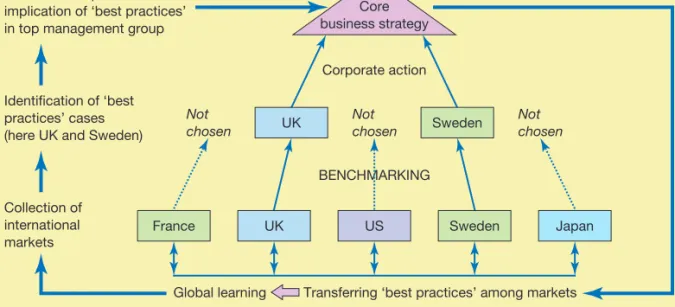
A key element in knowledge management is the continuous learning from experience (Stewart, 2001). In practical terms the aim of knowledge management, as a learning- focused activity across borders, is to keep track of valuable capabilities used in one market that could be used elsewhere (in other geographic markets), so that firms can continually update their knowledge without ‘reinventing the wheel’. See also the example in Figure 13.3 for a systematic approach to global learning from transferring
‘best practices’ in the firm’s different international markets.
The steps in transferring the firm’s ‘best practices’ to other international markets are as follows:
1 By benchmarking (comparing) the different procedures in the firm’s international markets the firm should be able to pick up best practices – in Figure 13.3 the best practices are found in the United Kingdom and Sweden. Subsequently, the possible implications of the ‘best practices’ are discussed in the ‘top management’ group.
2 After the procedures for diffusion of the ‘best practices’ have been established in the top management group the next step is to see if these ‘best practices’ can be used elsewhere in the firm’s international markets. In order to disseminate global knowledge and ‘best practices’, meetings (with representatives from all international markets) and global project groups should be established. If done successfully the benchmarking could result in a global learning process, where the different inter- national marketing managers would select the most usable elements from the pre- sented ‘best practices’ and adapt these in the local markets.
However, as noted earlier in this chapter, knowledge developed and used in one cultural context is not easily transferred to another. The lack of personal relationships, the absence of trust and ‘cultural distance’ all conspire to create resistance, frictions and misunderstandings in cross-cultural knowledge management (Bell et al., 2002).
Figure 13.3 ‘Bottom-up’ learning in global marketing
With globalization becoming a centrepiece in the business strategy of many firms – be it firms engaged in product development or providing services – the ability to manage the ‘global knowledge engine’ to achieve a competitive edge in today’s knowledge-intensive economy is one of the keys to sustainable competitiveness. But in the context of global marketing the management of knowledge is de factoa cross- cultural activity, whose key task is to foster and continually make more sophisticated collaborative cross-cultural learning (Berrell et al., 2002). Of course the kind and/or the type of knowledge that is strategic for an organization and which needs to be managed for competitiveness varies depending on the business context and the value of different types of knowledge associated with it.
Explicit and tacit knowledge
New knowledge is created through the synergistic relationship and interplay between tacitand explicitknowledge.
Explicit knowledgeis defined as knowledge that can be expressed formally using a system of symbols, and can therefore be easily communicated or diffused. It is either object based or rule based. It is object based when the knowledge is codified in symbols (e.g. words, numbers, formulas) or in physical objects (e.g. equipment, documents, models). Object-based knowledge may be found in examples such as product speci- fications, patents, software codes, computer databases, technical drawings, etc. Explicit knowledge is rule based when the knowledge is codified into rules, routines, or standard operating procedures (Choo, 1998).
Tacit knowledgeis the implicit knowledge used by organizational members to per- form their work and to make sense of the world. It is knowledge that is uncodified and difficult to diffuse across borders and subsidiaries. It is hard to verbalize because it is expressed through action-based skills and cannot be reduced to rules and recipes.
Instead tacit knowledge is learned through extended periods of experiencing and doing a task, during which the individual develops a feel for and a capacity to make intuitive judgements about the successful execution of the activity. Tacit knowledge is vital to an organization because organizations can only learn and innovate by some- how levering on the implicit knowledge of its members. Tacit knowledge becomes substantially valuable when it is turned into new capabilities, products, services or even new markets for the firm. Organizational knowledge creation is a process that organ- izationally amplifies the knowledge created by individuals in different countries and subsidiaries and crystallizes it as a part of the international knowledge network of the company. There are two sets of dynamics that drive the process of international knowledge amplification (Nonaka and Takeuchi, 1995):
1 converting tacit knowledge into explicit knowledge;
2 moving knowledge from the individual level to the group, organizational and inter- organizational levels (across subsidiaries in different countries).
A central issue in internationalized firms concerns where knowledge is created and diffused. Because of the capabilities in creating knowledge centres of excellence may be formed in certain subsidiaries, for example, regarding specific functions such as product development or international marketing.
Global project groups
Today’s business with its growing emphasis on globalization increasingly requires people to collaborate in workgroups that cross cultural and geographic boundaries.
The trend to multicultural workgroups emerged as a reaction to changed economic
conditions, forcing organizations to develop new structures in order to minimize costs and maximize flexibility. One consequence of these changes is that as a result of rapid knowledge growth and increasingly complex work environments more and more tasks can only be accomplished in international project groups by cooperation of function- ally and culturally different experts. Based on the assumption of diversity creating value and therefore competitive advantage by bringing together different ideas and pooling knowledge, multicultural project groups have become a prevailing tendency in multinational organizations. However, the use of such groups in practice often turns out to be a lot more problematic than expected. It seems that the cognitive advantages which can be gained by a diverse workforce are counterbalanced by relational prob- lems such as miscommunication and distrust, and therefore high turn-over rates (Wolf, 2002). Nevertheless, with today’s economy facing an ever increasing need to cross all kinds of borders, the existence of culturally diverse project groups has become inevitable.
Given the communication problems and trust issues that plague ad hoc global project groups, structuring the project team is particularly critical to success. The following three questions need attention from the top management of the firm (Govindarajan and Gupta, 2001):
1 Is the objective clearly defined?One of the first concerns for any global project team must be explicitly to discuss the group’s agenda and ensure that the objective/
problem is defined clearly and correctly. Many project groups do not fully resolve and discuss the issues involved and they immediately run into problems. Different framing of the same problem can produce different outcomes. Because the project group typically has members from different subsidiaries that usually compete with one another for scarce corporate resources they tend to have a high degree of internal conflict, combined with a low level of trust. As a result it is generally best to frame the problem of the project group in terms of the company’s position vis-à-vis the external marketplace instead of emphasizing internal issues. An external focus encourages benchmarking, fosters creativity and provides a compelling rationale for making the tough decisions inherent in any manufacturing rationalization and workforce reduction. Given the possible communication problems in the global project group it is imperative that the members understand the agenda of the project group: the scope of the project, the expected deliverables and the timeline. Cultural and language differences may complicate the task of getting group members to agree on the agenda and the problems to be solved. Clarity is essential to promoting commitment and accountability.
2 Choosing group members: Another key to creating a successful global team is choosing the right group members. Two issues are of particular importance: how do you bal- ance diversity within the team and what should be the size of the group? Normally we will see high levels of diversity. Why? First, members come from diverse cultural and national backgrounds – this refers to so-called behavioural diversity. Second, members generally represent subsidiaries whose agenda may not be congruent.
Third, because members often represent different functional units and departments, their priorities and perspectives may differ. The last two issues refer to so-called cognitive diversity.
Let us take a closer look at an example of behavioural diversity: consider, for example, a cross-border project group in a Swedish–Chinese joint venture. The norm in most Chinese teams is that the most senior member presents the team’s perspective, but in a Swedish team the most junior member typically does so. Unless the members of the team are sensitized to such differences misunderstandings can easily emerge and block communication. So behavioural diversity is best regarded as a necessary
13.6
evil: something that no global project group can avoid but the effects of which the group must attempt to minimize through training in cultural sensitivity.
Let us also take a closer look at an example of cognitive diversity: this diversity refers to differences in the substantive content of how members perceive the group’s challenges and opportunities. Differences in functional backgrounds can account for substantive cognitive differences on issues of ‘market pull’ (preferred by people in marketing departments) and ‘technology push’ (preferred by people in engineer- ing departments). Because no single member can ever have a monopoly on wisdom cognitive diversity is almost always a source of strength. Divergent perspectives foster creativity and a more comprehensive search for and assessment of options. But the group must be able to integrate the perspectives and come to a single solution.
3 Selection of team leadership: structuring the leadership of a global project team involves critical decisions around three roles: the project leader, the external coach and the internal sponsor. The project leaderplays a pivotal role in cross-border proj- ect groups. They must contribute to the development of trust between the members and maybe have the biggest stake in the outcome of the project. They must possess conflict-resolution and integration skills; and expertise in process management, including diagnosing problems, assessing situations and generating and evaluating options. An external coachserves as an ad hoc member of the project group and is an expert in process more than content. The need for such a coach is likely to be high when the process-management skills of the best available project leader are inadequate. This might happen if the appointed leader has some major stake in the project’s outcome, for example if a cross-border task force has to rationalize and decrease the number of subsidiaries around the world by 30 per cent. The internal sponsorof a global project group is typically a senior level executive with a strong interest in the success of the team. Among the responsibilities of the sponsor are to provide ongoing guidelines and to facilitate access to resources.
At any given time a global company will typically have many project groups work- ing on different cross-border coordination issues. Therefore it makes sense for the company to undertake initiatives to create interpersonal familiarity and trust among key managers of different subsidiaries. For example, Unilever uses several approaches to do this – such as bringing together managers from different subsidiaries in executive development education programmes.
When a project group consists of members with distinct knowledge and skills drawn from different subsidiaries in different countries the potential for cognitive diversity is high, and this can also be a source of competitive strength. But intellectual diversity will almost always bring with it some degree of interpersonal incompatibility and communication difficulty. Process mechanisms that recognize and anticipate such pitfalls – and integrate the best of individuals’ ideas and contributions – are needed to help the project group reconcile diverse perspectives and arrive at better, more creative and novel solutions.
Transnational bribery in cross-cultural negotiations
On first consideration briberyis both unethical and illegal. But a closer look reveals that bribery is not really a straightforward issue. The ethical and legal problems asso- ciated with bribery can be quite complex. Thus the definition of bribery can range from the relatively innocuous payment of a few pounds to a minor official or business
Bribery
Involving a company from an industrialized country offering an illicit payment to a developing country’s public official with perceived or real influence over contract awards. Bribery may range from gifts to large amounts of money.
manager in order to expedite the processing of papers or the loading of a truck, to the extreme of paying millions of pounds to a head of state to guarantee a company pre- ferential treatment. Scott et al. (2002) generally define bribery as ‘involving a company from an industrialized country offering an illicit payment to a developing country’s public official with perceived or real influence over contract awards’ (p. 2).
The difference between lubrication and bribery must be established. Lubrication payments accompany requests for a person to do a job more rapidly or more efficiently.
They involve a relatively small cash sum, gift or service made to a low-ranking official in a country where such offerings are not prohibited by law, the purpose being to facilit- ate or expedite the normal, lawful performance of a duty by that official. This practice is common in many countries. Bribery, on the other hand, generally involves large sums of money, which are frequently not properly accounted for, and is designed to entice an official to commit an illegal act on behalf of the one paying the bribe.
Another type of payment that can appear to be a bribe, but may not be, is an agent’s fee. When a businessperson is uncertain of a country’s rules and regulations an agent may be hired to represent the company in that country. This person will do a more efficient and thorough job than someone unfamiliar with country-specific procedures.
There are many intermediaries (attorneys, agents, distributors and so forth) who function simply as channels for illegal payments. The process is further complicated by legal codes that vary from country to country: what is illegal in one country is winked at in another and legal in a third. In some countries illegal payments can become a major business expense. Hong Kong companies report that bribes account for about 5 per cent of the cost of doing business in China. In Russia the cost is 15–20 per cent, and in Indonesia as high as 30 per cent (Gesteland, 1996, p. 93).
The answer to the question of bribery is not an unqualified one. It is easy to gener- alize about the ethics of political pay-offs and other types of payment; it is much more difficult to make the decision to withhold payment of money when not making the payment may affect the company’s ability to do business profitably or at all. With the variety of ethical standards and levels of morality which exist in different cultures the dilemma of ethics and pragmatism that faces international business cannot be resolved until more countries decide to deal effectively with the issue.
Exhibit 13.3 Does bribery also cover sexual favours? The case of Lockheed Martin and a South Korean defence contract
A US court has ruled that arms maker Lockheed Martin can be sued for allegedly using sexual favours and bribes to win a South Korean defence contract. Lockheed Martin has denied the allegations.
The case was filed by the Korea Supply Company (KSC) after it lost a contract to Lockheed subsidiary Loral for the supply of an aircraft radar system to South Korea in 1996.
KSC’s lawsuit claims a Loral employee, Linda Kim – a former model and singer – bribed South Korean military officers and offered sexual favours to the country’s defence minister, Lee Yang Ho. He has admitted to having an ‘inappropriate relationship’ with Ms Kim but denies it influenced his decision making. Ms Kim’s love letters to the defence minister made headline news in South Korea after they were implicated in another bribery scandal.
The US Foreign Corrupt Practises Act forbids US companies from bribing foreign officials to influence an official act or decision.
Source: adapted from BBC News, ‘Lockheed sex suit to go ahead’, 3 May 2003, news.bbc.co.uk/go/pr/fr/-/2/hi/business/
2,820,939.stm.
13.7 Summary
When marketing internationally negotiation skills are needed. Negotiation skills and personal selling skills are related. Personal selling typically occurs at the field sales force level and during formal negotiation processes. Cultural factors are critical to under- standing the negotiation style of foreigners.
The negotiation process is significantly influenced by the cultures within which the negotiators (typically a buyer and a seller) have been socialized and educated. Cultural differences prevalent in the international sales negotiation process can have a tremend- ous impact upon the process itself as well as its outcome.
The cross-cultural negotiation process can be divided into two different parts: namely, the non-task related interactionand task related interaction.The non-task relatedaspects of the sales negotiation process (status distinction, impression formation accuracy and interpersonal attractiveness) are considered first as it is these factors that are more relevant when approaching the buyer. Once a contact has successfully been established, the task related aspects of the sales negotiation process (exchange of information, persuasion and bargaining strategies and concession making and agreement).
Prior to the negotiation process between two partners there is a cultural distance between them. This cultural distance causes some transaction costs, which may be quite high. To reduce the cultural distance training of the negotiators is required.
The culture shock felt by expatriates indicates that sending negotiators and sales- people to foreign markets is often difficult and complex to implement successfully. Five important areas of implementation include: (1) making the initial decision to employ an expatriate sales force, (2) identifying and selecting qualified candidates, (3) providing adequate training, (4) maintaining ongoing support and (5) achieving satisfactory repatriation.
In global knowledge management a key element is the continuous learning from experiences in different markets. In practical terms, the aim of knowledge management as a learning-focused activity across borders is to keep track of valuable capabilities used in one market that could be used elsewhere (in other geographic markets), so that firms can continually update their knowledge without ‘reinventing the wheel’.
The ethical question of what is right or appropriate poses many dilemmas for inter- national marketers. Bribery is an issue that is defined very differently from country to country. What is acceptable in one country may be completely unacceptable in another.
Until now the cola war has mainly been going on in North America and Europe. But a French Tunisian, in January 2003, opened up a second front – by producing a carbonated drink named Mecca Cola, a new soft drink designed to cash in on anti- US sentiment, mainly in European markets. The new drink will be marketed in bottles of 1.5 litres and 330 ml cans.
Mecca Cola – a political choice
The new brand, which has a striking resemblance to Coca-Cola, is specifically intended to make a polit- ical statement. Its French label and advertising slogan translates as ‘No more drinking stupid – Drink with commitment’.
The creator of Mecca Cola, prominent French political activist Taoufiq Mathlouthi, claims the