CROSS CULTURAL DIFFERENCES: AMERICANS VS THAIS IN WORKING AND SOCIAL CULTURE
RATTAPOL THANGTONGTAWI
A THEMATIC PAPER SUBMITTED IN PARTIAL FULFILLMENT OF THE REQUIREMENTS FOR THE DEGREE OF MASTER OF MANAGEMENT
COLLEGE OF MANAGEMENT MAHIDOL UNIVERSITY
2014
COPYRIGHT OF MAHIDOL UNIVERSITY
Thematic paper entitled
CROSS CULTURAL DIFFERENCES:
AMERICANS VS THAIS IN WORKING AND SOCIAL CULTURE
was submitted to the College of Management, Mahidol University for the degree of Master of Management
on August 24, 2014
……….….…..………
Asst. Prof.Prattana Punnakitikashem, Ph.D.
Advisor
……….….…..………
Assoc. Prof. Annop Tanlamai, Ph.D.
Dean
College of Management Mahidol University
……….………….…..………
Mr. Rattapol Thangtongtawi Candidate
……….….…..………
Asst. Prof. Kannika Leelapanyalert, Ph.D.
Chairperson
……….….…..………
Detlef Reis, Ph.D.
Committee member
ACKNOWLEDGEMENTS
This thematic paper could not be completed without the kindness and help from all the people I am going to mention.
I would like to thank you to Mr. Francois Muguet, Mr. Rally Arthur, Mr.
Thomas McKelvey, Dr. Samarn Thangtontawi, Dr. Piyanee Thangtongtawi, Ms.
Chattrarat Chuenchom, Ms. Naraporn Saeton, Mr. Piyabute Ngoapaiboon, Ms.
Kontawan Limwilai, Ms. Suchada Tangtongtavy. In addition, I would like to thank all ten respondents for their excellent information, interesting ideas, and willingness to help me conduct this research.
I would like to pay sincere gratitude to my advisor teacher Dr. Prattana Punnakitikashem and thank you for the kindness and recommendations.
Rattapol Thangtongtawi
CROSS CULTURAL DIFFERENCES:
AMERICANS VS THAIS IN WORKING AND SOCIAL CULTURE
RATTAPOL THANGTONGTAWI 5549198
M.M. (LEADERSHIP AND HUMAN RESOURCES MANAGEMENT)
THEMATIC PAPER ADVISORY COMMITTEE: ASST. PROF. PRATTANA PUNNAKITIKASHEM, Ph.D., ASST. PROF. KANNIKA LEELAPANYALERT, Ph.D., ASSOC. PROF. ANNOP TANLAMAI, Ph.D., DETLEF REIS, Ph.D.
ABSTRACT
Thailand has more and more foreign enterprises in the country for trade and industry.
Thai people are hired to work with foreigners in these organizations so people with different culture will have to work together for the output of the companies. Difference in culture causes problems in both efficiency and working environment.
This study is for finding the cross cultural differences in working and social culture between Thais and Americans in order to find out the cause that obstruct the best performance outcome and the good working atmosphere of the multi-national and Thai- American organizations.
This basic knowledge could help to formulate a training course for preparing and improving people with these two different cultures to work together better in terms of performance and having good friendship.
The in-depth interview method was applied in this study to get maximum output from the experience of the Thais and Americans working or having experience working with people of these different cultures in the organization.
It was found from the study that Thais are comparatively of indirectness, collectivism, particularism, femininity, and short term orientation and both short term and long term orientation in result and long term orientation in relationship, while Americans are comparatively of directness, individualism, universalism, masculinity, and short term in relationship and long term orientation and both short term and long term orientation in relationship. It was also found that in order to have a better performance organization; the better value working culture should be kept while compromising with the other culture.
These approach should be researched and recorded and be applied for the Thai-American organization. If this approach could be applied successfully, the Thai-American organizations especially the multi-national organizations, in Thailand could increase their performance and having a better working environment.
Key words: Cross Cultural Differences/ Cultural Conflict/ Management Environment/ Different Culture Environment/ Multi-culture
61 pages
CONTENTS
Page
ACKONWLEDGEMENT ii
ABSTRACT iii
LIST OF TABLES vii
LIST OF FIGURES ix
CHAPTER I INTRODUCTION 1
1.1 Problem Statement 2
1.2 Research Question 2
1.3 Research Objectives 2
1.4 Scope of Studies 3
CHAPTER II LITERATURE REVIEW 4
2.1 Theoretical Foundation 4
2.2 Previous Work 8
2.3 Framework of Cross Cultural Differences Focusing on 9
Working and Social Culture CHAPTER III METHODOLOGY 10
3.1 Research Approach and Design 10
3.2 Data Collection 10
3.2.1 Open-ended Interview Questions 11
3.3 Data Procedure 12
CHAPTER IV DATA ANALYSIS AND FINDINGS 14
4.1 Data Analysis 14
4.1.1 Cross Cultural Differences between American and 15 Thai employees In Terms of Directness versus
Indirectness
CONTENTS (cont.)
Page 4.1.2 Cross Cultural Differences between American and 19
Thai employees In Terms of Individualism versus Collectivism
4.1.3 Cross Cultural Differences between American and 23 Thai employees In Terms of Universalism versus
Particularlism
4.1.4 Cross Cultural Differences between American and 27 Thai employees In Terms of Masculinity versus
Femininity
4.1.5 Cross Cultural Differences between American and 31 Thai employees In Terms of Short Term
Orientation versus Long Term Orientation
4.1.6 Cross Cultural Differences between American and 37 Thai employees In Terms of Communication
Problems
4.1.7 Cross Cultural Differences between American and 40 Thai employees In Terms of Main Cross
Cultural Differences
4.1.8 Cross Cultural Differences between American 43 and Thai Employees in Majority
4.2 Discussion 45
CHAPTER V CONCLUSION AND RECOMENDATIONS 50
5.1 Conclusion 50
5.2 Recommendation 52
5.3 Limitation and Further Research 53
CONTENTS (cont.)
Page
REFERENCES 54
APPENDICES 56
Appendix A: Interview with American 57
BIOGRAPHY 61
LIST OF TABLES
T
able Page2.1 Value Differences between American and Non-American Cultures 6
2.2 Table of Cross Cultural Differences 7
4.1 Extracts of Ideas of Each Interviewees Regarding 15 the Cross Cultural Differences between American and
Thai employees In Terms of Directness versus Indirectness
4.2 Extracts of Ideas of Each Interviewees Regarding 19 the Cross Cultural Differences between American and
Thai employees In Terms of Individualism versus Collectivism
4.3 Extracts of Ideas of Each Interviewees Regarding 23 the Cross Cultural Differences between American and
Thai employees In Terms of Universalism versus Particularlism
4.4 Extracts of Ideas of Each Interviewees Regarding 27 the Cross Cultural Differences between American and
Thai employees In Terms of Masculinity versus Femininity
4.5 Extracts of Ideas of Each Interviewees Regarding 31 the Cross Cultural Differences between American and
Thai employees In Terms of Short Term Orientation
versus Long Term Orientation (In terms of relationship and result)
4.6 Extracts of Ideas of Each Interviewees Regarding 37 the Cross Cultural Differences between American and
Thai employees In Terms of Communication Problems
4.7 Extracts of Ideas of Each Interviewees Regarding 40 the Cross Cultural Differences between American and
Thai employees In Terms of Main Cross Cultural Differences
LIST OF TABLES (cont.)
Page 4.8 Results of Each Interviewee Regarding the 43
Cross Cultural Differences between American and Thais
5.1 Majorities of Thai and American employees’ 51 Cross Cultural Differences in Working and Social Culture
LIST OF FIGURES
F
igure Page2.1 Framework of Cross Cultural Differences focusing 9 on Working and Social culture
4.1 Total Responses from Interviewees Regarding 17 The Cross Cultural Differences between American
and Thai Employees In Terms of Directness versus Indirectness
4.2 Total Responses from Interviewees Regarding 21 The Cross Cultural Differences between American
and Thai Employees In Terms of Individualism versus Collectivism
4.3 Total Responses from Interviewees Regarding 25 The Cross Cultural Differences between American
and Thai Employees In Terms of Universalism versus Particularlism
4.4 Total Responses from Interviewees Regarding 29 The Cross Cultural Differences between American
and Thai Employees In Terms of Masculinity versus Femininity
4.5 Total Responses from Interviewees Regarding 33 The Cross Cultural Differences between American
and Thai Employees In Terms of Short Term Orientation versus Long Term Orientation (In Terms of Relationship)
4.6 Total Responses from Interviewees Regarding 35 The Cross Cultural Differences between American
and Thai Employees In Terms of Short Term Orientation versus Long Term Orientation (In Terms of Result)
CHAPTER I INTRODUCTION
Nowadays there are many foreign countries investing in Thailand for manufacturing and investing, such as Japan, Taiwan, Korean, European, and Americans. Additionally, with the ASEAN countries becoming ASEAN economic community with no tax among them, the export product can be very competitive for more than 500 million (ACIF, 2011) people in ASEAN compare to products from other regions. More and more international companies and multinational companies will be established in Thailand, with unavoidably multicultural working in these organizations. Where expatriates are send by head office in mother countries to take managerial roles for controlling policy and top decision making. Thai employees are normally hired to fill up the middle and lower management of the firm.
With different culture in the managerial body there are always communication and understanding problems. This can be a barrier for more efficiency and effectiveness of the working team. If both Thai and American employees can be trained to learn about the culture difference, they could be better prepared and better adapted to work better with each other and that could render better organization output.
For example, in meetings, the Americans contribute maximum input in- terms of information, ideas for problem solving, and innovation or strategies so that the top management can make decision in right direction with valuable input from the staffs. While Thai employees, by culture will speak less due to their unwillingness to show different opinion to their boss because Thais have soft culture and any different opinion is considered to be aggressive to their superior. In the business meeting with Thai participants, Thais would speak very little or nothing due to their compromising nature. In result, managers will not get much input from the staff. At the same time they would feel reluctant to follow the directive of the boss. That cause tremendous ineffectiveness to the company.
1.1 Problem Statement
The American employees working in Thailand have got to work with Thai people and in reverse Thai workers or employees have to work with American employees. While there are a lot of differences in culture especially Thai culture and American culture, the enterprises with mix culture could have a problem or conflict due to misunderstanding from the difference in cultural background. If the American and the Thai employees can know better about other culture of their counterpart or colleagues, it would be helpful to improve the efficiency of the company with better output.
This study will concentrate on the working and social cultural difference between American people and the Thais. It could be a basic knowledge for training or preparing American employees before they start their career in Thailand.
In reverse, this is also for training and preparing Thai employees for American colleagues in the multinational enterprises for understanding each other better and becoming a more productive organization.
1.2 Research Question
What are the cross cultural differences that American and Thai employees face while working together in Thailand?
1.3 Research Objectives
1.3.1 To study the differences in working culture of Thais and American people
1.3.2 To provide knowledge about Thai general working and social culture
1.3.3 To provide knowledge about American general working and social culture
1.3.4 To compare between Thai culture and American culture for social and working environment
1.4 Scope of Studies
This study will concentrate on social and working cross cultural differences of American and Thai employees.
CHAPTER II
LITERATURE REVIEW
2.1 Theoretical Foundation
Cultural difference theory has been segregated into many theories. The Cross Cultural Differences theory has been mentioned by Geert Hofstede (1980, 1991, 2001). The theory is called the Hofstede’s Culture Framework. Geert’s theory mentions about power distance, uncertainty avoidance, collective/individual, masculine/feminine, and time orientation. This theory, explains the differences between culture and why employees act differently towards each other when they both come from different cultural backgrounds.
Geert Hofstede’s Cultural Framework (Geert Hofstede 1980, 1991, 2001)
Power Distance is that the power difference between people has been accepted in a particular level. To explain in other words, the inequality of power has been distributed and the less powerful members of organizations, firms, and institutes accept and expect it.
Uncertainty Avoidance refers to an unstructured situation which a culture programs its members to feel either uncomfortable or comfortable in. It basically means that society tries to control the uncontrollable.
Collectivism versus its opposite Individualism is when individuals want to position themselves in a group or want to look after themselves individually.
Masculinity versus its Femininity is the emotional role between genders but can be both in men and women. This distinction opposes tender feminine and tough masculine societies.
Long-term versus Short-term orientation is when a culture takes a short-term or long-term perspective on time. The bottom line is a major concern in short-term oriented cultures. Immediate results are not expected for business people in long-term oriented cultures. They are accustomed to working toward building strong
positions in their markets.
A model of differences in national cultures was developed by Fons Trompenaars (1997). The model includes seven dimensions, which are believed to shed light on how people in different national cultures interact with each other.
Fons Trompenaars’ Model of Seven Dimensions of National Culture Differences (Fons Trompenaars 1997)
1. Universalism versus Particularism (What is more important for you rules or relationships?)
2. Individualism versus Collectivism (Do we tend you function in a group or as individuals?)
3. Neutral versus Emotional (Do we show out our emotions or do we keep them inside?)
4. Specific versus Diffuse (Do we see our relationships as changing and related to contextual settings, or do we handle our relationships in specific and predetermined ways?)
5. Achievement versus Ascription (Do we need to prove ourselves to receive status, or is status given to us?)
6. Sequential versus Synchronic (Do we do task one at a time or several tasks at once?)
7. Internal versus External control (Do we feel and believe that we can control our environment, or do we feel and believe that the environment controls us?)
Fang (2003, 2005–2006) introduced the Oriental philosophy of Yin Yang to cross cultural theory building and crafted an ‘ocean’ metaphor of culture as an alternative metaphor to Hofstede’s ‘onion’ metaphor of culture to better understand the workings of culture in today’s borderless and wireless cross cultural management environment. Culture is perceived as having a life of its own full of paradox and change in a dialectical movement. Fang (2005–2006) proposed that opposite, based on the Yin Yang philosophy, can coexist within the same culture and society and argued that human beings, organizations, and cultures intrinsically embrace paradoxes for their sheer existence and healthy development.
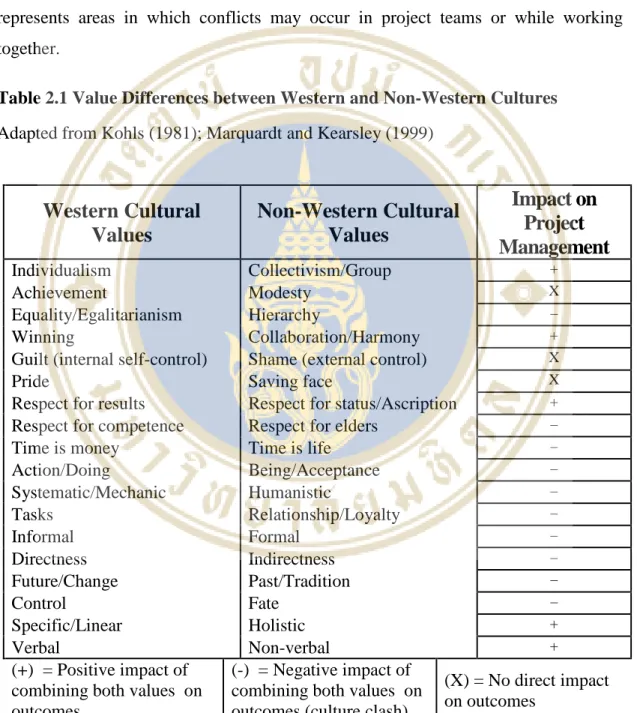
Kohls (1981) mentions that the impact of diverse value approaches on the motivation and training aspects of the management of international projects could clarify the differences between Western and non-Western cultures that can be used (see in table 2.1). Based on information not applicable in their own cultural environments, team members need to complete project tasks efficiently and make value judgments on courses of action. The item in table 1 identifies cultural values and represents areas in which conflicts may occur in project teams or while working together.
Table 2.1 Value Differences between Western and Non-Western Cultures Adapted from Kohls (1981); Marquardt and Kearsley (1999)
Western Cultural Values
Non-Western Cultural Values
Impact on Project Management
Individualism Collectivism/Group +
Achievement Modesty X
Equality/Egalitarianism Hierarchy –
Winning Collaboration/Harmony +
Guilt (internal self-control) Shame (external control) X
Pride Saving face X
Respect for results Respect for status/Ascription +
Respect for competence Respect for elders –
Time is money Time is life –
Action/Doing Being/Acceptance –
Systematic/Mechanic Humanistic –
Tasks Relationship/Loyalty –
Informal Formal –
Directness Indirectness –
Future/Change Past/Tradition –
Control Fate –
Specific/Linear Holistic +
Verbal Non-verbal +
(+) = Positive impact of combining both values on outcomes
(-) = Negative impact of combining both values on outcomes (culture clash)
(X) = No direct impact on outcomes
(http://www.gwu.edu/~umpleby/recent_papers/2003_cross_cultural_differences_managin_internatio nal_projects_anbari_khilkhanova_romanova_umpleby.htm)
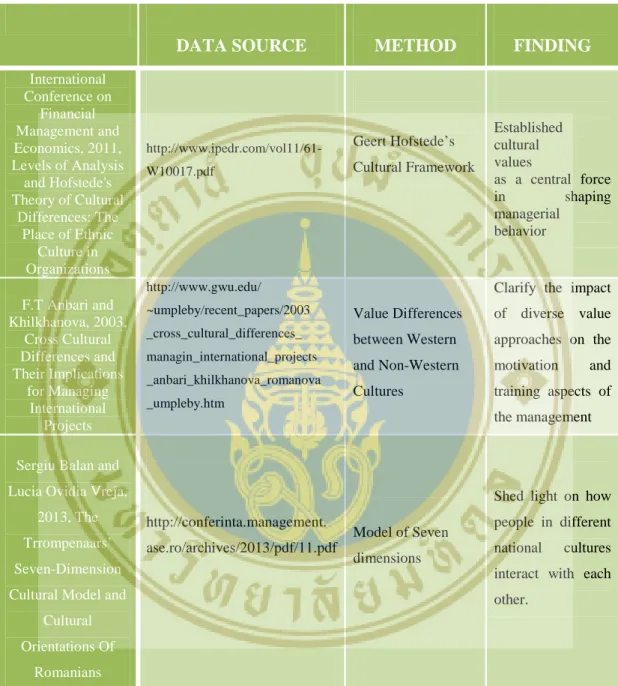
Table 2.2 Table of Cross Cultural Differences
DATA SOURCE METHOD FINDING
International Conference on
Financial Management and Economics, 2011, Levels of Analysis and Hofstede's Theory of Cultural
Differences: The Place of Ethnic
Culture in Organizations
http://www.ipedr.com/vol11/61- W10017.pdf
Geert Hofstede’s Cultural Framework
Established cultural values
as a central force
in shaping managerial
behavior
F.T Anbari and Khilkhanova, 2003,
Cross Cultural Differences and Their Implications
for Managing International
Projects
http://www.gwu.edu/
~umpleby/recent_papers/2003 _cross_cultural_differences_
managin_international_projects _anbari_khilkhanova_romanova _umpleby.htm
Value Differences between Western and Non-Western Cultures
Clarify the impact of diverse value approaches on the motivation and training aspects of the management
Sergiu Balan and Lucia Ovidia Vreja,
2013, The Trrompenaars’
Seven-Dimension Cultural Model and
Cultural Orientations Of
Romanians
http://conferinta.management.
ase.ro/archives/2013/pdf/11.pdf
Model of Seven dimensions
Shed light on how people in different national cultures interact with each other.
2.2 Previous Work
A work found related to this paper was written by Henry Holmes, Suchada Tangtongtavy (1995), which was published as a book called Working With The Thais. The study has given many case studies and examples for a guide line for the expatriates focusing on the relationship of the foreign managers and the Thai employees. Many years ago, both of them started organizing a training and seminar on this subject which the objective is to improve working relationships. Both of them found out that many expatriates and Thai employees in Thailand were having trouble with cross-culture differences in work place so they have started cross cultural training and seminars in Thailand for westerns’ better comprehension. The courses originated by Holmes and Khun Suchada have served several thousand managers and their spouses, from sixty different nationalities. It was founded that if we were to expand participates in the globalization in many of the areas; we have to understand the universal standard and being able to transmit it to the staffs.
In 1974, bicultural Japanese-American research conference in Nihonmatsu, Japan, the research team hypothesized that Japanese participants would be more task oriented and Americans would be more process oriented. It was found that the younger Japanese and American participants were more process oriented, while the older Japanese and Americans were more task oriented, thus disconfirming the hypothesis
Another previous work from Jean-Francois Cousin, had written about Hard truth for Thais working with foreigners” (Cousin, 2011). Jean mentions about the Thais having hard time working with the foreigners and how Thais behave while working with foreign colleagues. It was found that Thais do not develop themselves up to the international working standards. Finally, Jean has given 10 most important skills for success at work across cultures on how to adapt with foreign colleagues.
They are express your ideas clearly, be open-minded (listen well to ideas that are different to your own), speak English well, be straightforward (tell the truth), manage priorities effectively, listen well, Say what you think, be good at solving problems, express your ideas with confidence (be assertive), and develop harmony between people in the work place. Seven out of the 10 are communication skills.
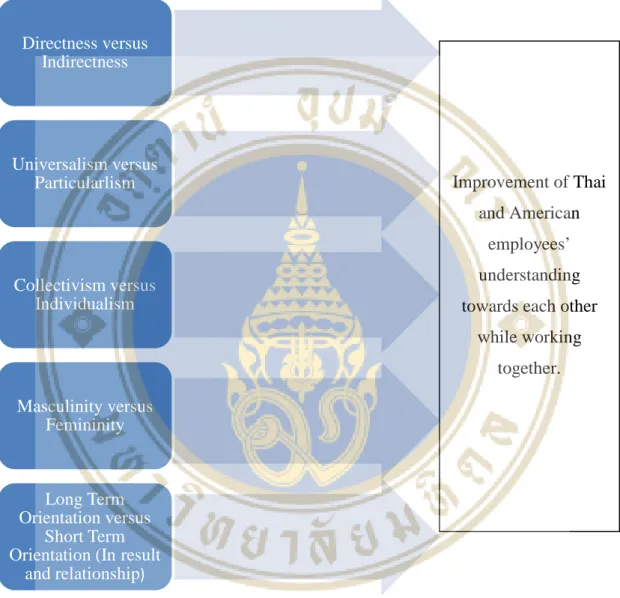
2.3 Framework of Cross Cultural Differences Focusing on Working and Social Culture
Figure 2.1 Framework of Cross Cultural Differences focusing on Working and Social culture
This framework of this study was developed from (Geert Hofstede 1980, 1991, 2001) theory of Cultural Framework, (Fons Trompenaars 1997) Model of Seven Dimensions of National Culture Differences, and Kohls (1981) The Differences Between Western and Non-Western Cultures.
Directness versus Indirectness
Universalism versus Particularlism
Collectivism versus Individualism
Masculinity versus Femininity
Long Term Orientation versus
Short Term Orientation (In result
and relationship)
Improvement of Thai and American
employees’
understanding towards each other
while working together.
CHAPTER III METHODOLOGY
3.1 Research Approach and Design
In order to answer the research question, a qualitative approach was applied. American and Thai employees in different firms and organizations were selected for the interviewing method. Formal interview or casual conversation is methods that can help researchers collect the great deal of qualitative material (Woods 2006). Open-ended questions were used to interview which gave the interviewees the chance to be able to express their answer in a wider range. The use of open-ended questions and probing technique will give participants opportunity to respond in their own words, rather than forcing them to choose the fixed responses (Mark et al 2006).
Since the research is about the cross culture differences between the American employees and the Thai employees, the interview will focus toward these two groups and including a specialist who have been conducting seminars and trainings about cross culture differences between Americans and Thais. In able to gain abundance of aspects, the research does not concentrate on any particular organizations or firms but focuses more on individuals.
3.2 Data Collection
Data collection will be applied with in-depth interviews which will be separated into three sections of interviewees. Overall, there are twelve interviewees.
Five interviewees are Americans and seven interviewees including the specialist are Thais.
The first sections of interview are the American employees who are working in Thailand.
The second sections of interview are the Thai employees who are working with American employees in Thailand.
The third section of interview is with the specialist in cross culture differences between Americans and Thais.
3.2.1 Open-ended Interview Questions
The interview questions were developed from Geert Hofstede (1980, 1991, 2001), Kohls (1981), and Fons Trompenaars (1997) then modified to adjust with the situations.
Americans
1. What do you think about the directness or indirectness after working with Thai colleagues? How does it have an impact on work or projects?
2. What is Thai working style like nowadays, collectivism or individualism? Why do you think so?
3. What do you think Thai employees are universalism or particularism?
Why do you think so?
4. How do you adapt to Thai colleagues’ masculinity or femininity working style?
5. What do you think about short term or long term orientation of Thai working culture?
6. When dealing with Thai colleagues, what are the main difficulties in communication?
7. What are your main cross culture differences problems while working with Thai colleagues? How do you think they or you can improve it?
Thais
1. What do you think about the directness or indirectness after working with American colleagues? How does it have an impact on work or projects?
2. What is Americans working style like nowadays, collectivism or individualism? Why do you think so?
3. What do you think American employees are universalism or particularism? Why do you think so?
4. How do you adapt to American colleagues’ masculinity or femininity working style?
5. What do you think about short term or long term orientation of Americans’ working culture?
6. When dealing with American colleagues, what are the main difficulties in communication?
7. What are your main cross culture differences problems while working with American colleagues? How do you think they or you can improve it?
Specialist
1. What do you think about the directness or indirectness of American and Thai employees? How do you think it has an impact on work or projects?
2. What is American and Thai working style like nowadays, collectivism or individualism? Why do you think so?
3. What do you think American and Thai employees are universalism or particularism? Why do you think so?
4. How do you think American and Thai employees adapt to masculinity/
femininity working style?
5. What do you think about short term/long term orientation of American and Thai working culture?
6. What are the main difficulties in communication for American and Thai employees?
7. What are the main cross culture differences problems of American/Thai employees working with Thai/American employees that you usually hear of? How do you think they can improve it?
3.3 Data Procedure
A formal interview was performed. One on one interview was conducted in order to record and observe data, note taking and recording on tape were applied to make sure that the information while interview is not distorted. All interviewees will be informed that the interview were recorded and used for the educational purpose. All the three sections of the interview were focused on aspects of working and social cross
cultural differences between the American and Thai employees in Thailand. After the interviews have been conducted, the recorded interview will be transcribed.
The first section of the interview with the Americans indicated the major cross culture differences that Americans have while working with the Thais. The second section of the interview with the Thais indicated the major cross culture difference problem that Thais have while working with the Americans. The third section of the interview with the specialist indicated, what the major cross culture difference problems are, that the specialist usually hears from her trainee or in the seminar.
CHAPTER IV
DATA ANALYSIS AND FINDINGS
This chapter presents the analyzed data and findings from the results. The collected data were based according to the research question indicated in chapter one.
This chapter interprets the main cross culture differences between Americans and Thais that they face while working together.
4.1 Data Analysis
After the interview with ten interviewees, it is possible to say that the modern world has changed the behavior of almost every country but sometimes culture that is in the nature of the nation never changes. According to the data gathered, it was noticed that that in some cross cultural differences, behaviors are different when segregated between men and women in the same country.
4.1.1 Cross Cultural Differences between American and Thai employees In Terms Of Directness versus Indirectness
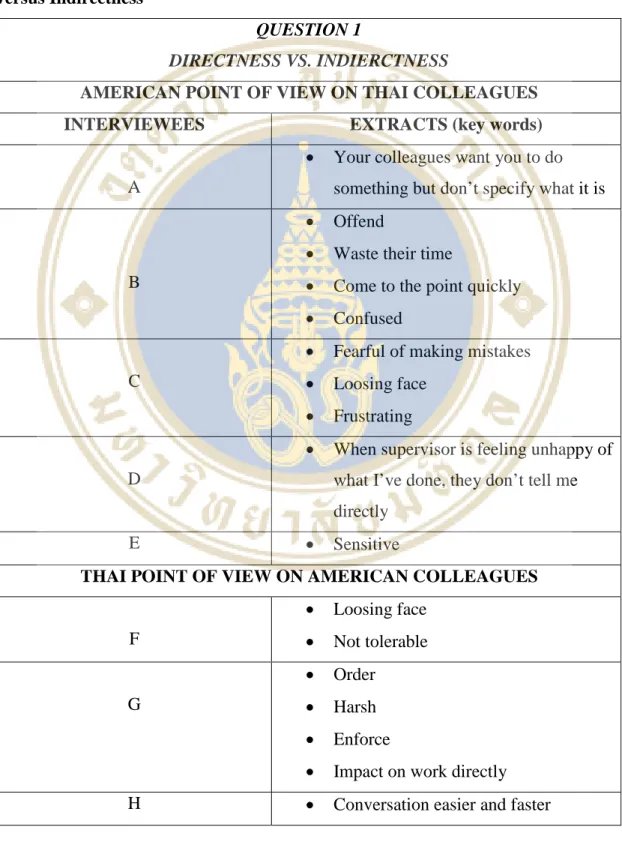
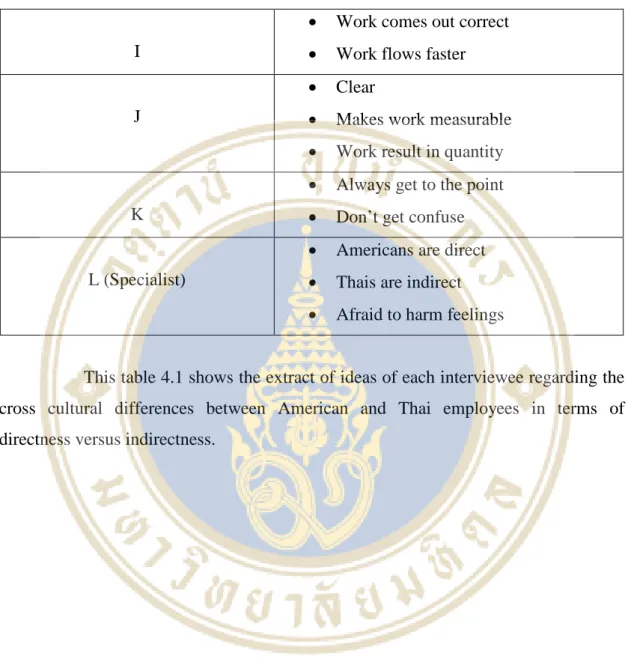
Table 4.1 Extracts of Ideas of Each Interviewees Regarding the Cross Cultural Differences between American and Thai employees In Terms Of Directness versus Indirectness
QUESTION 1
DIRECTNESS VS. INDIERCTNESS
AMERICAN POINT OF VIEW ON THAI COLLEAGUES
INTERVIEWEES EXTRACTS (key words)
A
• Your colleagues want you to do something but don’t specify what it is
B
• Offend
• Waste their time
• Come to the point quickly
• Confused C
• Fearful of making mistakes
• Loosing face
• Frustrating D
• When supervisor is feeling unhappy of what I’ve done, they don’t tell me directly
E • Sensitive
THAI POINT OF VIEW ON AMERICAN COLLEAGUES
F
• Loosing face
• Not tolerable G
• Order
• Harsh
• Enforce
• Impact on work directly H • Conversation easier and faster
Table 4.1 Extracts of Ideas of Each Interviewees Regarding the Cross Cultural Differences between American and Thai employees In Terms Of Directness versus Indirectness (cont.)
I
• Work comes out correct
• Work flows faster J
• Clear
• Makes work measurable
• Work result in quantity K
• Always get to the point
• Don’t get confuse L (Specialist)
• Americans are direct
• Thais are indirect
• Afraid to harm feelings
This table 4.1 shows the extract of ideas of each interviewee regarding the cross cultural differences between American and Thai employees in terms of directness versus indirectness.
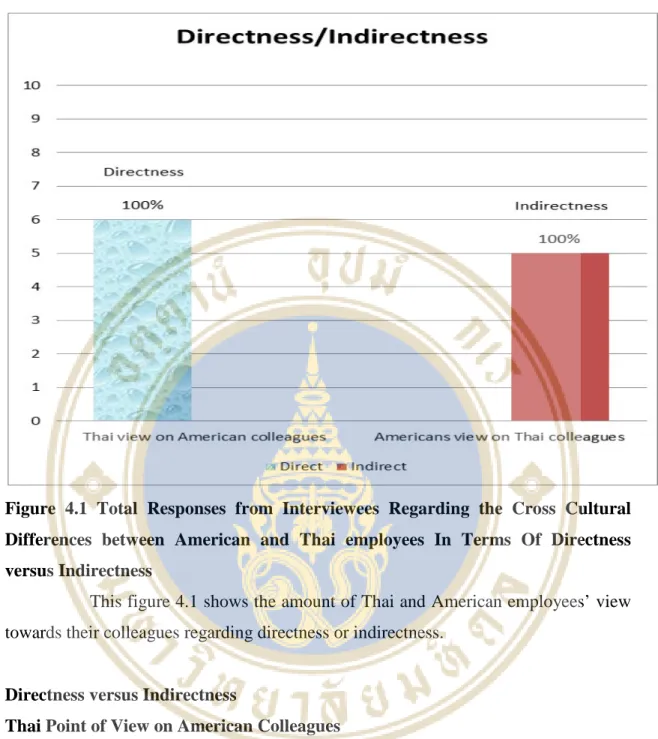
Figure 4.1 Total Responses from Interviewees Regarding the Cross Cultural Differences between American and Thai employees In Terms Of Directness versus Indirectness
This figure 4.1 shows the amount of Thai and American employees’ view towards their colleagues regarding directness or indirectness.
Directness versus Indirectness
Thai Point of View on American Colleagues
100% of Thai interviewees, out of overall 6 interviewees, agrees that Americans are direct and sometimes too direct which makes them uncomfortable at times (see in table 4.1, figure 4.1). In some situations Thai employees feel that it is not tolerable. Looking on the bright side, directness also delivers good impact to Thais employees, such as, it makes conversation easier to understand and faster to interpret.
Directness also results in fewer mistakes in work and makes to work flow faster because the directions are clear and easy to understand. It does not cause confusion.
American Point of View on Thai Colleagues
All of the American interviewees, which is 100% out of 5 interviewees, responded that they feel that their Thai colleagues are indirect which causes lots of frustration (see in table 4.1, figure 4.1). They recognized that Thai colleagues are afraid of fear of making mistakes which leads to loosing face. Therefore, Thais avoid it by not stating their point in the first part of the conversation and avoid getting to the point quickly. It can be explained that Thais are quite sensitive. This problem causes confusion for American because it is hard for them to pick up what the main point is while having conversations with their Thai colleagues. Thai colleagues also do not explain what they want from Americans specifically so Americans sometimes feel confused and cannot give the Thais according to their expectations. Obviously, when a Thai is not direct, it makes the Americans confused. Sometimes, American does not know what the problem is when their Thai colleagues do not state them clearly.
4.1.2 Cross Cultural Differences between American and Thai employees In Terms Of Individualism versus Collectivism
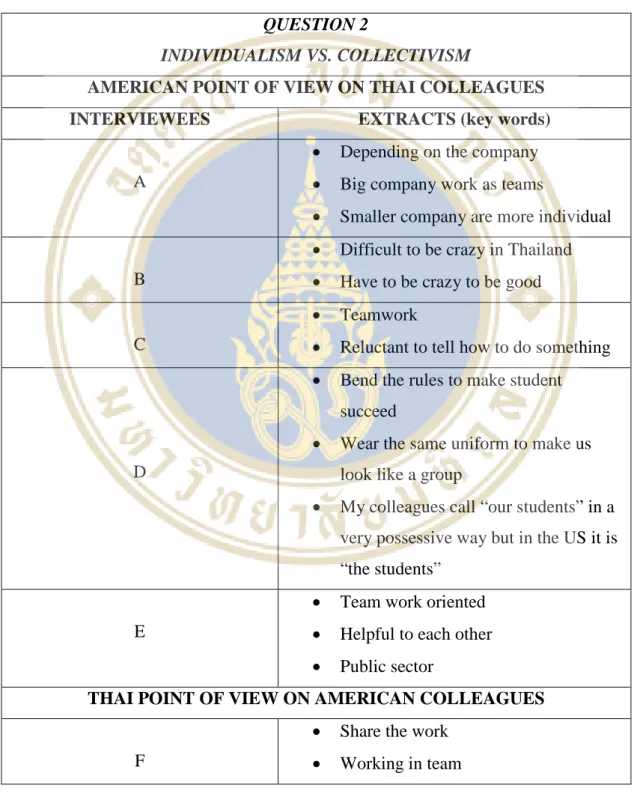
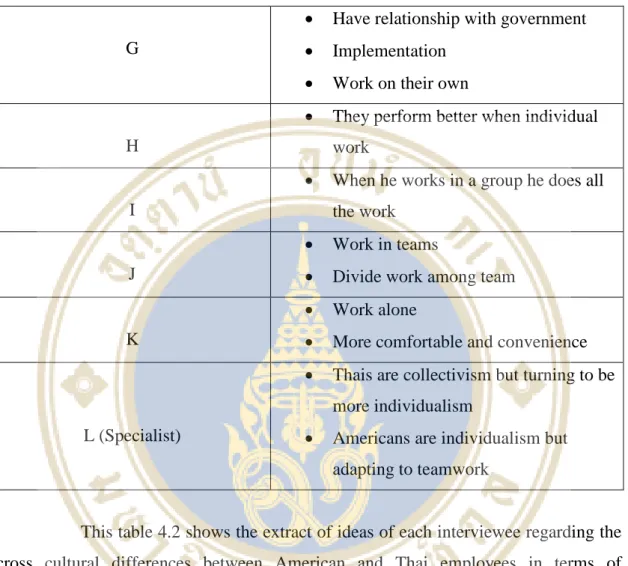
Table 4.2 Extracts of Ideas of Each Interviewees Regarding the Cross Cultural Differences between American and Thai employees In Terms Of Individualism versus Collectivism
QUESTION 2
INDIVIDUALISM VS. COLLECTIVISM
AMERICAN POINT OF VIEW ON THAI COLLEAGUES
INTERVIEWEES EXTRACTS (key words)
A
• Depending on the company
• Big company work as teams
• Smaller company are more individual B
• Difficult to be crazy in Thailand
• Have to be crazy to be good C
• Teamwork
• Reluctant to tell how to do something
D
• Bend the rules to make student succeed
• Wear the same uniform to make us look like a group
• My colleagues call “our students” in a very possessive way but in the US it is
“the students”
E
• Team work oriented
• Helpful to each other
• Public sector
THAI POINT OF VIEW ON AMERICAN COLLEAGUES
F
• Share the work
• Working in team
Table 4.2 Extracts of Ideas of Each Interviewees Regarding the Cross Cultural Differences between American and Thai employees In Terms Of Individualism versus Collectivism (cont.)
G
• Have relationship with government
• Implementation
• Work on their own H
• They perform better when individual work
I
• When he works in a group he does all the work
J
• Work in teams
• Divide work among team K
• Work alone
• More comfortable and convenience
L (Specialist)
• Thais are collectivism but turning to be more individualism
• Americans are individualism but adapting to teamwork
This table 4.2 shows the extract of ideas of each interviewee regarding the cross cultural differences between American and Thai employees in terms of individualism versus collectivism.
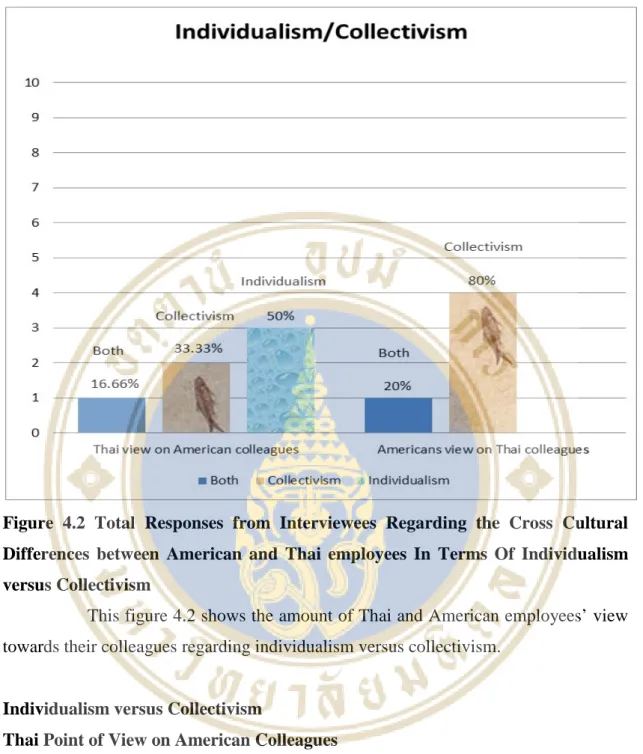
Figure 4.2 Total Responses from Interviewees Regarding the Cross Cultural Differences between American and Thai employees In Terms Of Individualism versus Collectivism
This figure 4.2 shows the amount of Thai and American employees’ view towards their colleagues regarding individualism versus collectivism.
Individualism versus Collectivism
Thai Point of View on American Colleagues
50% of Thai interviewees responded that American colleagues are of individualism, 33.33% are of collectivism, and 16.66% are of both individualism and collectivism out of overall 6 Thai interviewees. Thai employees have different views on Americans about individualism and collectivism (see in table 4.2, figure 4.2).
Though the majority leads to individualism but collectivism is not abandoned. Thai employees mentioned that their American colleagues share their work among the team and they work as a team effectively, meaning that the output from the teamwork of Americans is not bad. The specialist explained that the Americans were individualism
but adapted to the modern world of business which expects high collaboration in teamwork. However, Thais in majority, still feels that Americans like to work alone or individually more than to team up with others.
American Point of View on Thai Colleagues
80% of American interviewees responded that Thai colleagues are of collectivism and 20% are of both individualism and collectivism out of overall 5 American interviewees. Collectivism is how American employees explain about Thai colleagues (see in table 4.2, figure 4.2). Thai employees like to work in teams and are reluctant to state their own ideas as individuals. Thais are more of teamwork oriented and they are helpful to each other. However, it also depends on the company that Thais work in. In small size of company, Thai employees tend to be more of individualistic but in big companies they work more as a team. Nowadays, Thais tend to adapt to individualism, it might be because of the new educational system which teaches students to think out of the box and also encouraging the students to express their own ideas as an individual.
4.1.3 Cross Cultural Differences between American and Thai employees In Terms Of Universalism versus Particularlism
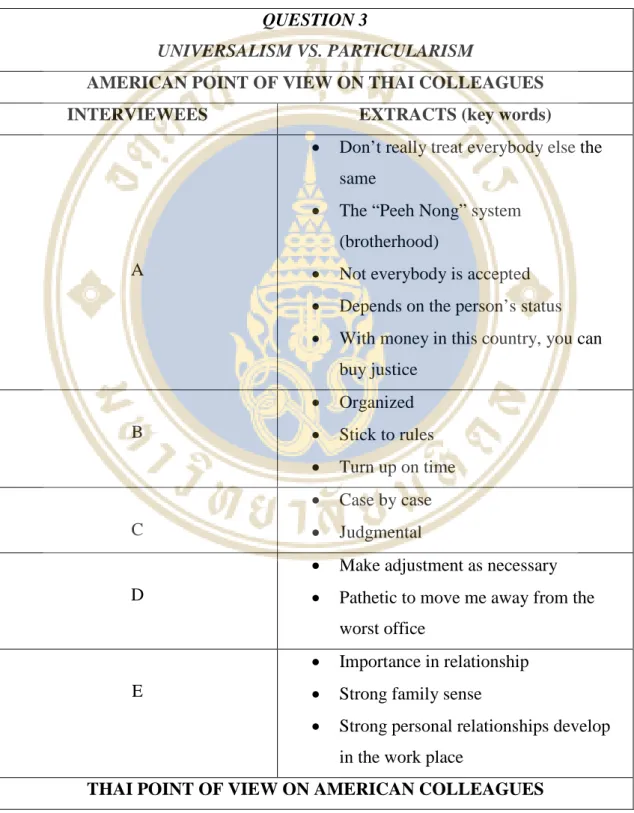
Table 4.3 Extracts of Ideas of Each Interviewees Regarding the Cross Cultural Differences between American and Thai employees In Terms Of Universalism versus Particularlism
QUESTION 3
UNIVERSALISM VS. PARTICULARISM
AMERICAN POINT OF VIEW ON THAI COLLEAGUES
INTERVIEWEES EXTRACTS (key words)
A
• Don’t really treat everybody else the same
• The “Peeh Nong” system (brotherhood)
• Not everybody is accepted
• Depends on the person’s status
• With money in this country, you can buy justice
B
• Organized
• Stick to rules
• Turn up on time C
• Case by case
• Judgmental D
• Make adjustment as necessary
• Pathetic to move me away from the worst office
E
• Importance in relationship
• Strong family sense
• Strong personal relationships develop in the work place
THAI POINT OF VIEW ON AMERICAN COLLEAGUES
Table 4.3 Extracts of Ideas of Each Interviewees Regarding the Cross Cultural Differences between American and Thai employees In Terms Of Universalism versus Particularlism (cont.)
F
• Trained to obey rules and the law
• Norm not superior
• Will not break the law for relationship
G • Close relationship
H
• Deal is a deal
• Not related to relationship I
• Direct
• Doesn’t rely on relationship
• Right way J
• Measurable
• Accurate
• Predicted
K
• Strict on rules
• Yes is yes and no is no
• Relationship not within his consideration
L (Specialist)
• Thais are stretching the rules
• Americans are strict to rules
• Take time to be educated
This table 4.3 shows the extract of ideas of each interviewee regarding the cross cultural differences between American and Thai employees in terms of universalism versus particularism.
Figure 4.3 Total Responses from Interviewees Regarding the Cross Cultural Differences between American and Thai employees In Terms Of Universalism versus Particularlism
This figure 4.3 shows the amount of Thai and American employees’ view towards their colleagues regarding universalism versus particularlism.
Universalism versus Particularlism
Thai Point of View on American Colleagues
Thai employees feel that American colleagues are of universalism in majority which 83.33% of Thai interviewees responded that American colleagues are of universalism and 16.66% are of particularism from total of 6 Thai interviewees (see in table 4.3, figure 4.3). Overall, the majority stated that the Americans are trained to obey the rules and the law; they do not rely on relationship, a deal is a deal, and will not break the law or rules for relationship. Thai employees concluded that Americans’
style of universalism is measureable and predictable.
American Point of View on Thai Colleagues
Americans feel that Thai colleagues are more of particularlism than universalism which 80% of American interviewees responded that Thai colleagues are of particularism and 20% are of universalism from overall 5 American interviewees (see in table 4.3, figure 4.3). This means that Thai employees pay great attention to the obligation of relationship. Thais have the system of “Peeh Nong”
which means bigger or younger brother or sister. Whenever Thais have to decide something that has Peeh Nong in consideration they usually have higher human friendship toward their own people. Thais do not treat everybody the same. This might be because of the Peeh Nong system and the strong family sense including that Thais give importance to relationships. Universalism also exists in Thai employees but is only in a few of them. Some Thai employees are well organized, strict to rules, and turn up on time which in these days, is quite hard to experience. The spirit of law is more important than the letter of law was added by specialist.
4.1.4 Cross Cultural Differences between American and Thai employees In Terms Of Masculinity versus Femininity
Table 4.4 Extracts of Ideas of Each Interviewees Regarding the Cross Cultural Differences between American and Thai employees In Terms Of Masculinity versus Femininity
QUESTION 4
MASCULINITY VS. FEMININITY
AMERICAN POINT OF VIEW ON THAI COLLEAGUES
INTERVIEWEES EXTRACTS (key words)
A
• They are professional in what they do
• Haven’t seen emotional issues from my colleagues
B
• Relationships
• Feeling and emotions are important
• Loosing face C
• Employers treat employees like children
D
• Feminine culture are similar to collective culture
• Avoiding conflicts
• More feminine that in the United states
E
• More emotion
• Personal relationships THAI POINT OF VIEW ON AMERICAN COLLEAGUES
F • Relationship is also important
G
• Tough
• Harsh
• Day by day work
• Tight schedule, barrier
Table 4.4 Extracts of Ideas of Each Interviewees Regarding the Cross Cultural Differences between American and Thai employees In Terms Of Masculinity versus Femininity (cont.)
H
• Make target clear
• Tough and cares about the outcome
I • Does not use feeling in work
J
• Quite tough
• Focus on task and goals K
• Strict
• Tough working style
L (Specialist) • Femininity and masculinity overlaps
This table 4.4 shows the extract of ideas of each interviewee regarding the cross cultural differences between American and Thai employees in terms of masculinity versus femininity.
Figure 4.4 Total Responses from Interviewees Regarding the Cross Cultural Differences between American and Thai employees In Terms Of Masculinity versus Femininity
This figure 4.4 shows the amount of Thai and American employees’ view towards their colleagues regarding masculinity versus femininity.
Masculinity versus Femininity
Thai Point of View on American Colleagues
Almost all of the Thai employees replied that their American colleagues are of masculinity which 83.33% of Thai interviewees responded that American colleagues are of masculinity and 16.66% are of both masculinity and femininity from overall 6 Thai interviewees (see in table 4.4, figure 4.4). American working style is tough; they try to complete their objectives as soon as they can by focusing on the task and the goals which sometimes make Thai colleagues feel the stress during accomplishing the goals. Thai employees feel that American colleagues are too strict and care too much about the outcome. In consequence, makes the Thai colleagues
uncomfortable and unable to do the job well enough. It feels like someone’s behind your back all the time. For Thai employees, American colleagues are quite hard to work with because they do not care about feelings and emotions.
American Point of View on Thai Colleagues
The majority of American employees feel that their Thai colleagues are of femininity which 80% of American interviewees responded that Thai colleagues are of femininity and 20% are of masculinity from overall 5 American interviewees (see in table 4.4, figure 4.4). Thai employers treat their employees or subordinates like their own children. When Americans work with the Thais, most of the times, they feel that Thai employees give huge importance in relationships, feelings, and emotions including the fact that they try their best to avoid conflicts. However, during an interview with an American employer, the study found an interesting issue. The discussion was about masculinity and femininity of the Thai employees. The interesting issue learnt was that Thais have both masculinity and femininity but in different gender. Thai female employees are more grownups or in other words more mature. They are able to accept complaints from the employer or the boss professionally by not taking it as a personal issue. In reverse, Thai male employees get emotionally upset after being complaint and take it as a personal issue.
4.1.5 Cross Cultural Differences between American and Thai employees In Terms Of Short Term Orientation versus Long Term Orientation
Table 4.5 Extracts of Ideas of Each Interviewees Regarding the Cross Cultural Differences between American and Thai employees In Terms Of Short Term Orientation versus Long Term Orientation (In terms of relationship and result)
QUESTION 5
SHORT TERM ORIENTATION VS. LONG TERM ORIENTATION AMERICAN POINT OF VIEW ON THAI COLLEAGUES
INTERVIEWEES EXTRACTS (key words)
A
• Retail wants immediate results
• Big companies are long term, they invest more on research and development
B
• Moving towards
• Profit in short term
C • Code of particularism
• Depending on relationship D
• Thais try to solve immediate results without thinking about the long term effect
E
• Base around the whole relationship building so it leads to long terms in results
THAI POINT OF VIEW ON AMERICAN COLLEAGUES
F
• Good relationship
• Relax
• Less concern
Table 4.5 Extracts of Ideas of Each Interviewees Regarding the Cross Cultural Differences between American and Thai employees In Terms Of Short Term Orientation versus Long Term Orientation (In terms of relationship and result) (cont.)
G
• Hunt projects
• Project last long
• Keep relationship for short and long results
H
• Friends but not friendly
• Result oriented I
• Care about relationship
• Honor J
• Focus on present
• More important than future relationship K
• Not care about relationship
• Not spare time to have conversation with employees
L (Specialist)
• Thais think to grow
• Americans arrive and start firing people
This table 4.5 shows the extract of ideas of each interviewee regarding the cross cultural differences between American and Thai employees in terms of short term orientation versus long term orientation in result and relationship.
.
Figure 4.5 Total Responses from Interviewees Regarding the Cross Cultural Differences between American and Thai employees In Terms Of Short Term Orientation versus Long Term Orientation (In Terms of Relationship)
This figure 4.5 shows the amount of Thai and American employees’ view towards their colleagues regarding short term orientation versus long term orientation in relationship.
Long Term Orientation versus Short Term Orientation In Terms of Relationship Thai Point of View on American Colleagues
66.66% of Thai interviewees responded that American colleagues are of short term orientation in relationship and 33.33% are of long term orientation in relationship from overall 6 Thai interviewees. According to figure 4.5, it shows that mainly Thai employees feel that American colleagues are of short term orientation in relationship (see in table 4.5, figure 4.5). Though majority points to short term orientation, but few still give opposing ideas. A Thai employee, who works in the
government ministry, works together with the American colleague in a long project and their relationship seems to be going well as a long term. However, majority of Thai employees feel that American colleagues are friends but not friendly. They are more result oriented. A Thai employee in a restaurant never had the chance to have a friendly chat with her American boss. The American boss never spares his time to have a conversation with his employees. According to the specialist, Thais think to grow while Americans, when arrived in the company which they are sent by the headquarters from other countries, starts firing employees.
American Point of View on Thai Colleagues
100% of American interviewees responded that Thai colleagues are of long term orientation in relationship from overall 5 American interviewees relationship (see in table 4.5, figure 4.5). For the question regarding short term or long term orientation in relationship, the majority of the American interviewees think that their Thai colleagues are of long term orientation. Interviewees have responded that, this is due to Thai society of collectivism and networking that make them give high value to personal relationship than the result. Working in a group forms Thai people to care more about others and also care about relationships. Thai colleagues will try not to do anything to harm their relationships. Thai give huge importance to Peeh Nong system which this also relates to relationship. In consequence, Thai will value their relationship and view it as a long term.
Figure 4.6 Total Responses from Interviewees Regarding the Cross Cultural Differences between American and Thai employees In Terms Of Short Term Orientation versus Long Term Orientation (In Terms of Result)
This figure 4.6 shows the amount of Thai and American employees’ view towards their colleagues regarding short term orientation versus long term orientation in result.
Long Term Orientation versus Short Term Orientation In Terms of Result Thai Point of View on American Colleagues
50% of Thai interviewees responded that American colleagues are of long term orientation in result and 50% are of both long and short term orientation in result from overall 6 Thai interviewees. It means that American colleagues are in majority of long term orientation in result and both long and short term orientation in results relationship (see in table 4.5, figure 4.6). This is because it is due to the culture that the Americans give value to efficiency and discipline. The Americans see results more in a long run. Few interviewees stated that Americans can be of both long and short term
orientation in results because sometimes it depends on the business. If the business is small then the result should be in a short term but if the business is big the result should be in a long term.
American Point of View on Thai Colleagues
20% of American interviewees responded that Thai colleagues are of long term orientation in result, 40% are of short term orientation in result, and 40% are of both short term and long term orientation in result from overall 5 American interviewees. Americans in majority, feel that Thai colleagues are of short term orientation in result and both short term and long term orientation in result (see in table 4.5, figure 4.6). From the interview with the American employees, it can be concluded that Thais tend to look for profit in short term. This can be understood that American employees feel that Thai colleagues do not show care on further relationship towards American colleagues. Thai colleagues try to solve immediate results without thinking of the long term effects. An overview on the general Thai business shows that small companies tend to be more of short term orientation in results while big companies tend to be more of long term orientation in results. Small companies give high importance to bottom line. Big companies invest huge amount of money on research and development so they don’t expect immediate results.
4.1.6 Cross Cultural Differences between American and Thai employees In Terms Of Communication Problems
Table 4.6 Extracts of Ideas of Each Interviewees Regarding the Cross Cultural Differences between American and Thai employees In Terms Of Communication Problems
QUESTION 6
COMMUNICATION PROBLEMS
AMERICAN POINT OF VIEW ON THAI COLLEAGUES
INTERVIEWEES EXTRACTS (key words)
A
• Directness even though they are professional
B • Verbal reply
C
• Insulted
• Imprecise
• Be direct
• Rude D
• Thais’ English level
• Indirect
• Not knowing the exact problems E
• No feedback result from top-down management
• Hard to know what they are thinking THAI POINT OF VIEW ON AMERICAN COLLEAGUES
F • Educate in culture
G
• Don’t understand Thai government working style
• Approach
• Line of command
H • English not understandable
Table 4.6 Extracts of Ideas of Each Interviewees Regarding the Cross Cultural Differences between American and Thai employees In Terms Of Communication Problems (cont.)
I
• Language not perfect
• Confuse J
• High expectation
• Cheapest and high quality K
• English was in very low level
• Trying to make sentences
• Low level in grammar L (Specialist)
• Hierarchy
• Top down management
This table 4.6 shows the extract of ideas of each interviewee regarding the cross cultural differences between American and Thai employees in terms of communication problems.
Main Communication Problem
Thai Point of View on American Colleagues
Most of Thai employees said that their main communication problem is the language (see in table 4.6). English language has been a problem for Thai people for a very long time. Some American colleagues do not give enough time for Thais to comprehend what they are talking about since they talk very fast which makes Thai employees responding some questions that Americans ask in the wrong direction.
When evaluating the Thai colleagues, Americans will evaluate that Thais are often confusing while communicating. Thais also feel that Americans should learn more about the Thai culture while working together because sometimes the American do things that stresses the Thais without noticing. Another issue is about the American’s high expectation on Thai colleagues, which sometimes puts a lot of stress for Thai colleagues while working.
American Point of View on Thai Colleagues
There are several communication problems for American employees while working with the Thai colleagues. After the interviews with American employees, many issues have been pointed out (see in table 4.6). These issues are being discussed because they are problems that Americans usually face when communicating with the Thais. First of all, Thai colleagues usually do not respond verbally. This means that when Americans ask or say something to Thai colleagues, they do not get verbal responses from the Thais, so it might make the American wonder if his or her Thai colleagues heard or understood what he or she said. Secondly, American employees feel that Thai colleagues are indirect while communicating. Some Americans understand that to be direct in Thai culture means being rude but being direct helps reduce frustration and saves time while communicating. The third issue is about the Thai employees’ level of English. Some Thai colleagues have very poor English grammar, which sometimes lead to misunderstanding during conversations. The last communication problem is about the top down management of the Thais. This has not only been mentioned by the American employees but also mentioned by the specialist.
From top down management, employers do not get feedback or suggestions. In modern management styles, employees are able to give suggestions and feedbacks to employers so the company or the organization can know what most employees think and what shall be improved. Communications between employees to employer cannot be made because of the top down management style.
4.1.7 Cross Cultural Differences between American and Thai employees In Terms Of Main Cross Cultural Differences
Table 4.7 Extracts of Ideas of Each Interviewees Regarding the Cross Cultural Differences between American and Thai employees In Terms Of Main Cross Cultural Differences
QUESTION 7
MAIN CROSS CULTURAL DIFFERENCE
AMERICAN POINT OF VIEW ON THAI COLLEAGUES
INTERVIEWEES EXTRACTS (key words)
A
• Don’t give me enough time for research
• Thais think I’m a dictionary B
• Mono culture but changing
• Adjusting to cultures
• Should learn to adapt C
• They are frustrating
• Assume about me before even meeting me
• Sensitive
D • Changing the subject in conversations
E
• Communication issue, they are indirect
• Americans think that Thais should be more assertive
• Learn body language to be able to know what Thais think
THAI POINT OF VIEW ON AMERICAN COLLEAGUES
F
• Frank
• Misinterpret,
Table 4.7 Extracts of Ideas of Each Interviewees Regarding the Cross Cultural Differences between American and Thai employees In Terms Of Main Cross Cultural Differences (cont.)
G
• Not concerned
• As long as possible H
• Challenges and pressure
• Sabai sabai
• Not expecting higher targets
I • Too accurate
• Very uncomfortable and feeling stress J
• Hit the target, uncomfortable
• Larger picture K
• Too direct
• Loosing face
• Uncomfortable
L (Specialist)
• Direct
• Not being direct
• Loosing face
• Understanding
This table 4.7 shows the extract of ideas of each interviewee regarding the cross cultural differences between American and Thai employees in terms of main cross cultural differences.
Main Cross Cultural Difference
Thai Point of View on American Colleagues
Thai employees feel that American colleagues are too direct. Being too direct makes it hard for Thai people to adapt with because Thais are naturally in reverse (see in table 4.7). First of all, Thais are afraid of losing face. It means that they do not expect people to say direct things to them. Secondly, when someone is direct to them, they start feeling uncomfortable and stressed. However, some Thais are
optimistic and they feel it is easier to understand when American colleagues are being direct.
American Point of View on Thai Colleagues
Obviously, when working with people from different cultures, there are always cross cultural differences, but what are the differences that each individual experience with their different national colleagues (see in table 4.7). From the interview, an American stated that Thai colleagues frequently change the subject of conversation whenever they cannot answer a particular question or solve a particular problem. Another issue is about the Thai monoculture. This means that Thais do not get to interact with many cultures or people from different nations so it is hard for them to adapt or compromise with different culture in the working place. Another issue is about a American employee who explained about his Thai colleagues being too sensitive. This makes him very frustrated and confused on why they get so easily upset on some things that he says but not intending to harm his colleagues’ feeling.
The last issue is about Thai colleagues assuming American as an encyclopedia. Thais think that American knows everything. American also needs time to find the answer for some particular problems.
4.1.8 Cross Cultural Differences between American and Thai Employees in Majority
Table 4.8 Results of Each Interviewee Regarding the Cross Cultural Differences between American and Thai Employees
INTERVIEW RESULTS
AMERICAN POINT OF VIEW ON THAI COLLEAGUES
INTERVIEWEES RESULTS
A
• Indirectness
• Both (Individualism and Collectivism)
• Particularism
• Masculinity
• Both short and long term orientation (in results)
• Long term orientation (in relationship)
B
• Indirectness
• Collectivism
• Universalism
• Femininity
• Short term orientation (in results)
• Long term orientation (in relationship)
C
• Indirectness
• Collectivism
• Particularism
• Femininity
• Both short and long term orientation (in results)
• Long term orientation (in relationship)
Table 4.8 Results of Each Interviewee Regarding the Cross Cultural Differences between American and Thai Employees (cont.)
D
• Indirectness
• Collectivism
• Particularism
• Femininity
• Short term orientation (in results)
• Long term orientation (in relationship)
E
• Indirectness
• Collectivism
• Particularism
• Femininity
• Long term orientation (in results)
• Long term orientation (in relationship) THAI POINT OF VIEW ON AMERICAN COLLEAGUES
RESULTS
F
• Directness
• Collectivism
• Universalism
• Both (Masculinity and femininity)
• Long term orientation (in results)
• Long term orientation (in relationship)
G
• Directness
• Both (Individualism and Collectivism)
• Particularism
• Masculinity
• Both short and long term orientation (in results)
• Short term orientation (in relationship)