Customer care and relationship marketing
LEARNING OBJECTIVES
By the end of this chapter you will:
n
understand the importance, scope and meaning of customer care and relationship marketing and the links between these two areas of marketing
nappreciate why customer care and relationship marketing have become
important in contemporary marketing
n
know how to develop policies and programmes to improve standards of customer care in an organization
n
understand how and when to develop policies and programmes of relationship marketing
n
be aware of recent developments in customer care and relationship marketing,
and in particular the role of new technology and its impact on these areas
INTRODUCTION
Marketing is an evolving body of thought and practice. We have seen that marketing is a concept and a management function that has developed over the years. We have seen how use of the marketing concept and tools has widened from its original primary application in marketing consumer goods in profit-seeking organizations to spread to industrial markets, service markets and not-for- profit organizations. Similarly, we have seen how new technology and technological developments are changing the practice of marketing. So much is happening with regard to developments in contemporary marketing thinking and practice that it is difficult to select what are the most important and far-reaching of these for the modern marketer. However, among the most significant changes in recent years have been the interlinked developments of an increased emphasis on customer careactivities, coupled with the growth of relationship marketing (RM). Developments in these areas represent what constitutes an almost seismic shift in marketing thinking and practice.
Why this is so we shall see shortly, together with the implications of this shift. We start with customer care. It is important to stress that these two areas of contemporary marketing are interrelated. The term customer relationship management (CRM) is also used to link relationship marketing to customer care.
CUSTOMER CARE
We have seen that the marketing concept centres on the importance of customers and the absolute necessity of identifying and satisfying their needs and wants. The marketer puts the customer at the centre of the business and the development of organizational strategies. This idea is fundamental to marketers and even non-marketers in that other business functions would not disagree with the notion of the importance and centrality of customers. If this is the case, why has there been an upsurge in the importance of customer care in marketing programmes in recent years, and how does the notion and scope of customer care differ from the traditional marketing concept? How can a company plan and implement effective customer care programmes?
Meaning and scope of customer care
Amongst the many views of the meaning and scope of customer care, the view taken here is that it involves planning all the activities involved in the customer–supplier relationship including pre-, during- and post-transaction stages to ensure that customer expectations are met or exceeded.
This view emphasizes the fact that customer care is all-embracing covering every aspect of customer–supplier relationships. It also illustrates that customer care involves planning in both the strategic and tactical sense.
Customer care entails much more than the notion of customer service, as this focuses more on
‘order-cycle’ related activities. Customer service is an important facet of overall customer care, but centres more on those activities that involve direct contact with the customer. Customer care is a much more holistic way of looking at customer satisfaction. It necessitates the involvement of every facet of the company’s marketing and customer-related programmes and should affect every stage of the marketing planning and implementation process. Why then do we need customer care, and why has it grown in importance in recent years? These are questions that we now examine.
Cost of poor customer care
It is increasingly recognized that should customer expectation at any point in the supplier/customer relationship not be met, this will result in customer dissatisfaction. The extent to which the customer feels dissatisfied depends upon the circumstances. For example, the customer may be simply mildly dissatisfied or at the other extreme might be ‘hopping mad’. Particularly where the latter is the case, we know that every displeased customer is likely to talk about this dissatisfaction to other customers or potential customers. Young1 suggests that customers with bad experiences are twice as likely to tell others about it as those with good experiences. Quite simply, poor customer care loses not only the customer involved, but many more as well.
Benefits of good customer care
We know that satisfied customers are more likely to return to buy again, and over time, become loyal. This illustrates just one of the links between customer care and RM. This is particularly important when we look at the costs of acquiring customers compared to keeping them. Kotler and Keller2have suggested that in organizational purchasing settings it can cost as much as ten times more to acquire a new customer than it does to keep an existing one. Certainly, the marketing costs required to persuade a new organizational customer to purchase are much greater than those required to persuade a satisfied customer to purchase again. In this respect, the notion of a ‘ladder of loyalty’
has been developed. Peck et al.3show this as involving the steps or rungs shown in Figure 9.1.
The first rung on the ladder, ‘Prospect’, represents an individual or an organization which the marketer could possibly persuade to do business. Once the prospect has been persuaded in this way they become a ‘Purchaser’, having done business at least once with the organization. The ‘Client’
is someone who has done business with the marketer’s organization on a repeat basis, but is still at best neutral towards the supplier. A ‘Supporter’, however, is someone who has done business with the marketer on a regular basis, but now begins to like the supplier’s organization and gives support if only passively. The penultimate stage, the ‘Advocate’, is a customer who recommends the marketer’s organization to others, i.e. effectively someone who helps to do your marketing. The highest rung of the ladder is represented by a ‘Partner’ who is a customer who effectively has the relationship of a strategic partner with the supplying organization.
As we shall see, RM is aimed at moving customers up the ladder of loyalty until they ultimately become partners. The lifetime value of loyal customers can be huge as measured in sales and profit terms. Given that customer care is a major facet in moving customers up the ladder of loyalty, we can see why marketers have become increasingly interested in the customer care aspects of marketing yet this does not explain in itself the growth in importance of customer care.
Customer expectations
Perhaps the major reason for the growth in importance of customer care is the fact that customer expectations have changed over the years both in organizational and consumer contexts. Quite simply, customers expect higher levels of customer care and satisfaction from the marketer.
In part, this is as a result of changes in education on the part of many customers. Customers are now more ready to challenge poor levels of customer care and are much better informed as regards their rights in this respect. Another factor is that customers have much better access to information about failings and shortcomings in customer care through more media exposure in this area and information that is posted on the Internet. Customers are also better protected through legislation regarding their rights as customers and what they can realistically expect with respect to customer care.
‘PARTNER’
‘ADVOCATE’
‘SUPPORTER’
‘CLIENT’
‘PURCHASER’
‘PROSPECT’
FIGURE 9.1 The relationship marketing ladder of loyalty
Source: Peck, H. et al.(1999), Relationship Marketing, Oxford: Butterworth-Heinemann, p. 45.
Today’s customers are more willing to complain if they feel their expectations have not been met. Moreover, they are increasingly likely to follow up these complaints through some form of formal procedure and even litigation if necessary. It is important to stress, however, that the average customer, even in the USA, where perhaps the highest levels of customer expectation with regard to customer care in the world exist, is still reluctant to complain. For example, a report by The US Office of Consumer Affairs4suggested that the average business does not hear from 96 per cent of its unhappy customers, and that for every complaint received there were as many as 30 customers with problems or serious problems. In countries like Germany, Ireland and the UK where customers are more reluctant to complain, these figures are likely to be even higher. One might be tempted to believe that most customers are simply not that concerned about customer care, to the extent that they perhaps do not think it is worth complaining. Certainly, many customers do not feel it is worthwhile, but this is more a reflection of the fact that they feel that their complaints will go unheeded. Other customers simply may not know how to start to complain in a formal way. This does not mean that such customers are not concerned about customer care or that the marketer need not be too concerned. Just the opposite is the case; it is probably customers who do not complain that are most important with regard to focusing improved customer care efforts. Such customers represent a majority of customers who never purchase again, and who represent the main source of negative information about a company, and this is passed by word-of-mouth to other potential customers.
STEPS IN ESTABLISHING A CUSTOMER CARE PROGRAMME
There are clear benefits of having an effective customer care programme. Mere acceptance of this is not sufficient to ensure effective customer care. A series of practical steps must be implemented in establishing effective programmes. The main steps in this process are in:
Spread the Word – But Be Careful!
Word-of-mouth implies personal one-to-one communication. One person telling another person in a face-to-face conversation or telephone call about a bad experience with a brand is a common occurrence. Imagine the problems when a dissatisfied customer can tell millions, and all virtually at the same time! Not possible, unless that person owns say a television channel or newspaper or presents a popular programme or writes a well read column. Well, it was not possible for the disgruntled customer to tell this many people, but now it is. How? Through the growth in use of social networks on the Internet such as YouTube or through the myriad of blogging sites, many of which are global and able to reach millions. In January 2009 there were estimated to be over 120 million blogging sites. If you upset customers it can be very costly. We should remember, of course, that upset customers have to be careful about what they say about companies and brands. By 2009 defamation litigation related to blogging sites in the US reached over $17 million.
Incorporating a customer care philosophy into company mission statements
The first and most important step in establishing a customer care programme is to ensure that a commitment to customer care is enshrined in the corporate mission statement. By so doing a company has taken the first step in a commitment to customer care. Moreover, being the mission statement, this commitment can be seen to come from the top. This should serve to form and guide a customer care culture and philosophy throughout the organization
Establishing a customer care culture and philosophy
Effective customer care is not something that can be left solely to marketing and sales departments.
Customer care is everyone’s business. In the same way as the adoption of the marketing concept necessitates a cultural change within many organizations, so too does the adoption of the customer care concept. However, instilling this philosophy is not easy. As with the marketing concept, customer care is often seen as being someone else’s responsibility. Adopting a customer care philosophy starts at the top and must have the full support and commitment of senior management.
The importance of customer care must be ‘marketed’ throughout the organization. This is part of the process of ‘internal marketing’ that we referred to in Chapter 1. Individuals and functions in the organization must be persuaded and shown how their activities relate to overall levels of customer care and the impact they can have on this area. Implementing this philosophy throughout an organization requires that people’s tasks, activities, responsibilities and even promotion and remuneration are linked to customer care. Customer care responsibilities are part of everyone’s job in the organization.
Needless to say, the marketing function has a primary role to play in this process; in particular the marketer or marketing function should be responsible for providing up-to-date and reliable information about what it is that customers want with regard to customer care, how various activities in the organization contribute or otherwise to the satisfaction of customer needs and any problems or shortcomings in this respect. The marketer must also ensure that track is kept of competitor levels of customer care and any trends in these levels.
Identifying customer needs and perceptions
As with all marketing programmes, the start point of effective customer care is the identification of customer needs. Customer care is about ensuring these needs are met and in particular that customer expectations are fulfilled or exceeded. Many companies still do not appreciate what their customers’ needs and expectations are with regard to various facets of the transaction process. For example, most new car customers want a full tank of fuel when they collect their new cars. In spite of this, even some of the most expensive new cars have only enough fuel in them to reach the first filling station.
As mentioned already, customers are often reluctant to complain, and in any event if the customer does complain it is already too late. The marketer must therefore research customer needs to establish precisely what constitutes customer satisfaction and the customer expectations with
regard to the various facets of the transaction process. The marketer must also at this stage consider perceptions that customers have with regard to the company and its standards of customer care.
Focus group interviews with both potential and existing customers can be useful. Customers are often more willing to reveal their true needs or, in the case of existing customers, feelings of satisfaction and dissatisfaction in a group setting. Many companies use follow up phone calls or mailed questionnaires to check on customer satisfaction. For example, ‘Home Care’, an insurance product for householders covering plumbing repairs, kitchen appliance breakdowns, etc., regularly contact a sample of customers who have had a call-out to check levels of service and customer satisfaction.
As with all marketing the marketer must be careful not to assume he/she knows what the customers needs are.
Establishing customer care standards and specifications
This step in the process involves the company establishing specific levels for customer care and the key activities and processes to be included. These must relate to customers’ expectations and needs established in the first step. For example, we need to establish delivery standards, standards for customer responsiveness, courtesy and credibility and product quality. Every facet of the company that may impinge on customer satisfaction needs to be incorporated here; not just marketing activities. Specific standards for customer care that can be measured and evaluated need to be established at this stage. Although customer care programmes should meet the highest level of standards in line with customer expectations, it is important to establish a basic minimum level below which levels of customer care should not drop under any circumstances.
Again, regular surveys and feedback from customers are essential. Consumer panels which allow for such regular feedback from customers are useful. In addition, the marketer should consult dealers and other intermediaries on a regular basis for their views.
Specifying jobs and activities
Related to required standards and specifications for customer care there needs to be detailed specifications of what this means for people’s activities and jobs within the organization. It should include, for example, the designation of tasks and activities, allocation of responsibilities, motivation and monitoring and control systems necessary to successfully implement customer care and the information systems required to facilitate effective customer care programmes.
Ensuring adequate systems for monitoring and evaluating levels of customer care
It is important that effective systems are established for measuring and evaluating standards of customer care including tracking and monitoring systems, market research and customer evaluation procedures. Clear systems and procedures for ensuring effective responses to problems with customer care levels, including complaints are necessary. These are the practical steps in implementing customer care programmes, but effective customer care also requires an organization-wide
commitment. In this respect it is important to stress that this is not just a marketing department responsibility and activity. The importance of customer care and an acceptance of this importance throughout every level and function of the organization is a critical issue. Customer care must be part of overall corporate culture. Moreover, it should impinge on every facet of the marketing programme. It is to these two aspects of implementing customer care programmes that we now turn our attention.
CUSTOMER CARE AND THE MARKETING PROCESS
Where commitment to customer care becomes part of a company’s philosophy, we find that customer care impinges on the whole of the marketing process. This notion can most easily be seen by returning to the typical steps in the marketing planning process established in Chapter 1 and extended in later chapters. We can see from this how a company-wide philosophy and commitment to customer care affects the whole marketing process. Each of the steps in the marketing planning process, together with an outline of how customer care relates to each of these steps is now outlined.
Corporate objectives/business mission
Commitment to customer care should be reflected and enshrined in the overall corporate objectives and mission statements of the organization. At this stage, mission statements about overall customer care objectives feed into and shape the subsequent stages and strategies of the marketing plan.
The marketing audit/SWOT analysis
This encompasses an appraisal of the internal and external environments of the company. With regard to the external environment analysis, this should help shape required levels of customer care in, for example, changing cultural and social values. These, in turn, are reflected in customer requirements and expectations for customer care levels. Competitor customer care levels should also be appraised in the external audit. The internal part of the audit requires the organization to assess standards of performance regarding customer care and any shortcomings. As we have seen, the internal and external audit feed into the SWOT analysis. Part of the SWOT analysis should be an assessment of strengths, weaknesses, opportunities and threats with regard to customer care levels and programmes e.g. a company may establish through the audit that it has major weaknesses in certain elements of its customer care activities that need to be remedied. Alternatively, a company may identify possible future opportunities by building on strong levels of customer care compared to competitors.
Marketing objectives and strategies
Marketing objectives and strategies should include customer care elements. Overall, marketing objectives may relate to, for example, growth and market share, but should also include specific objectives with regard to levels of customer care. Again, tools such as gap analysis can be used. As the term implies, gap analysis looks at any difference between planned levels of customer care and
service and achieved levels with a view to correcting these differences. For example, a company may specify a maximum number of rings before a call is answered by a customer service operative.
Possible reason for gaps may include operative overload or inadequate call queuing systems.
As regards marketing strategies, different strategies for growth such as diversification will often have customer care implications. If the intention is to pursue new markets e.g. as a strategy for growth, the marketer will need to establish customer needs and expectations regarding customer care levels in these markets.
Marketing tactics/marketing mix decisions
Perhaps one of the most important facets regarding customer care and the marketing mix is to ensure that marketing mix decisions and in particular specific marketing tactics that can often be short term in nature, do not conflict with or detract from overall planned levels of customer care. For example, pricing strategies designed to attract new customers may result in lower levels of customer care than is necessary or required for existing customers. Many companies only make special offers available to new customers e.g. a new subscriber to a cable TV service may be offered an initial three months at a reduced price and free installation of the latest set top box. Existing subscribers, however, must pay the full rate for the service and pay an upgrade fee for the new box. In this way, existing customers who may have been with company for a long time are dealt with less favourably than new customers when it comes to offers and price deals. Needless to say, this can result in considerable dissatisfaction amongst previously loyal customers and is a major cause of high customer
‘churn rates’ in some markets.
Virtually every facet of the marketing mix has implications for customer care. Thus, delivery and after-sales service stem from distribution and logistics decisions; product and augmented product decisions (as discussed in Chapter 4) have a major effect on customer care; promotion should be aimed at building long-term customer relationships. Therefore, pricing should reflect overall customer care strategies.
Implementation
We have seen that overall objectives for customer care need to be translated into specific action programmes with the allocation of responsibilities, systems and procedures that should include training and motivation of staff. Suitable organizational structures need to be in place to implement effective customer care programmes.
Evaluation and control
It goes without saying that effective customer care, like other areas of marketing, needs to be evaluated and controlled. Systems for monitoring achieved levels of customer care, responses to customer complaints, etc. must be built into the company’s overall evaluation and control systems.
Customer care affects, and is affected by, every single facet of the marketing planning process. Before we consider the development of relationship marketing, including how this relates to customer care, we need to consider the relationship between customer care and quality, and the distinction between customer care and customer service.
CUSTOMER CARE AND QUALITY
There is a close, but complex relationship between customer care and quality management in the organization. Quality has been a major issue in competitive strategy in recent years, and in particular the pursuit of improved and consistent quality has mainly been due to the fact that we know now that good quality is a major factor in competitive success.
Note that ‘good quality’ does not necessarily mean simply high quality. In consumer terms, good quality means ‘fitness for purpose’. In other words, the marketer must ensure that the product or service is of a quality that meets customer needs and expectations. For example, if we purchase a shovel or spade then we must at the very least be able to dig with it. Used for the purpose intended, it should not bend or break and should last what can be considered a reasonable life-time. Over and above this, the customer might be looking and paying for higher quality levels like stainless steel construction.
The PIMS programme5developed by the Marketing Science Institute and the Harvard Business School in the early 1970s, has long established the link between management strategies and profitability. The PIMSproject (Profit Impact of Management Strategies) looked at the return on investment (ROI) of a large sample of American and European businesses and compared this with information on the various strategies these businesses were using. The essence of PIMS is the use of empirical evidence to establish which strategies are associated with higher levels of profitability in an industry and thereby to steer managers in these industries towards better (more profitable) courses of action.
Some of the basic questions that PIMS seeks to answer include:
n What is the typical profit rate for each type of business?
n Given current strategies in a company, what are future operating results likely to be?
n What strategies are likely to help improve future operating results?
To obtain this information for a particular company, the company must subscribe to the PIMS project and provide detailed information, including, for example:
n competitors and market information;
n balance sheet information;
n assumptions about future sales, costs, strategies, etc.
This information is then compared with the PIMS database and a series of reports prepared for the subscribing company as follows:
1 A ‘Par’ report showing the ROI and cash flows that are ‘normal’ for this type of business given its market, competition, technology and cost structure. Also included is an analysis of strengths and weaknesses that are regarded as explaining high or low par figures compared with other businesses in the database.
2 A ‘Strategy analysis’ report which computes the predicted consequences of each of several alternative strategic actions, judged by information on similar businesses making similar moves, from a similar starting point and in a similar business environment.
3 A ‘Report on look-alikes’ (ROLA) that examines possible tactics for achieving strategic objectives such as an increase in market share, by analysing strategically similar businesses more closely.
4 An ‘Optimus strategy’ report aimed at predicting the best combination of strategies for that particular company, again based on the experiences of other businesses in ‘similar’ circumstances.
The advantages of PIMS to an individual business are that not only can management assess the likely outcome of its proposed strategies, but it can also identify those strategies that will yield the highest return on investment.
Why doesn’t every company subscribe to PIMS for its strategic planning? First, there is the question of cost. The full range of PIMS services is expensive. Second, the amount of data required to be supplied by a company for a PIMS analysis is extensive. This can be costly and time consuming.
Most important of all, there are limitations to PIMS:
n PIMS data is historical and may be misleading in conditions of rapid change.
n The underlying assumptions of the PIMS model are not clarified and must be taken on trust.
n The statistical basis of PIMS can give rise to problems of interpretation and understanding.
PIMS is not a panacea for strategic decision making in individual companies. It is best used as an aid to managerial judgement. In general terms, analysis of the PIMS database has shown that some 37 variables together account for almost 80 per cent of the variations in return on investment. These, therefore, are the key factors that most strategic marketing planners will need to consider in their marketing plans. From the viewpoint of our discussion, good quality was found to be a major factor accounting for differences in success for the companies in the PIMS database as measured by return on investment. Put simply, quality pays! PIMS offers access to a comprehensive, empirically based strategic planning tool although the full advantages of PIMS are available only to a company that subscribes to the PIMS database. However, even for the non-subscribing company, the general published findings of PIMS regarding key determinants of return on investment consistently underpin the importance of good quality and company success.
Given our definition of customer care, effective standards of customer care are impossible where the quality that the customer experiences or perceives does not match their expectations. Customer care and quality are inextricably linked.
A major development in recent years has been the total quality management (TQM)approach to business that is applied when managing every aspect of the company’s activities. Given that quality management revolves around meeting customer requirements and expectations, and what represents acceptable quality is essentially determined by customers and their requirements, then customer care and TQM are closely related. Quality programmes encompass many other areas than dealing with customers, while customer care programmes are specifically focused on customers and how to improve care. The major influence of TQM on customer care activities is the notion that with TQM processes, all activities, not only in-company activities, but also partners in both the demand chainand the supply chain(i.e. the entire value chain) can affect quality. Total Quality Management
also gives central place to the customer in designing quality systems. Customer-driven quality is one of the key distinguishing features of TQM as a philosophy.
Companies can make two types of mistakes when it comes to quality and customer needs. The first of course is producing products and services which do not come up to the target customer’s quality requirements and expectations. The quality is too low. In our previous example of the spade, obviously if on first use the spade bends or breaks then the customer to say the least is going to be disappointed. Less obvious, however is the mistake of supplying products and services which exceed the target customer’s quality requirements and expectations. The quality is too high. This may result in a product which either has too high a price, lowers company profits or both. Many British engineering companies have in the past made this mistake, producing things that were of too high a quality or specification for market needs hence leaving the way open for other lower priced, ‘lower quality’ competitors.
In many ways, TQM and customer care go hand in hand in the contemporary organization, but what is the relationship between customer care and customer service?
CUSTOMER CARE AND CUSTOMER SERVICE
A degree of confusion exists regarding the relationship and distinction between customer care and customer service. In fact, although the two are closely related there are also some major differences.
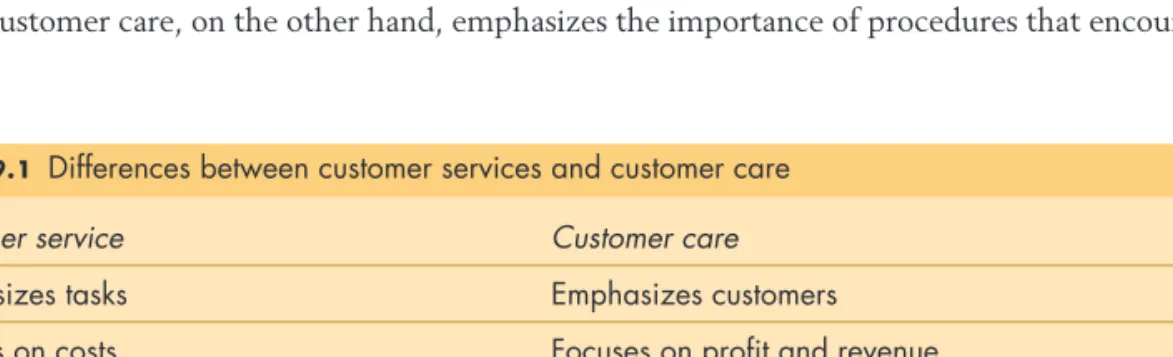
Some of the key differences are captured by Stone and Young6and shown in Table 9.1.
Taking each of these differences in turn, customer service emphasizes the tasks involved in servicing customers rather than customer needs. It is more a supplier’s view of the elements of customer requirements as opposed to the customer’s perspective. Customer service also focuses primarily on the costs associated with customer requirements, whereas customer care centres on long-term profit and revenue implications. With customer service, more attention is given to procedures, management processes and hierarchies and on technical and administrative require- ments. Customer care, on the other hand, emphasizes the importance of procedures that encourage
Customer service Customer care
Emphasizes tasks Emphasizes customers
Focuses on costs Focuses on profit and revenue
Procedures restrict responsiveness Procedures enable responsiveness
Hierarchical management Supportive management
Technical/administrative environment Commercial environment
Source: M. Stone and L. Young (1992), Competitive Customer Care: A Guide to Keeping Customers, Kingston- upon-Thames: Croner, p. 20.
TABLE 9.1 Differences between customer services and customer care
responsiveness to customer needs and ways in which management systems and procedures can support this with a view to achieving commercial, as opposed to technical or engineering, aims and goals. Having said this, in many companies we still find customer service departments. There is nothing wrong with this so long as the elements of customer service and the activities of the customer service department are set and managed in the context of a wider overall company approach and perspective regarding customer care. Put another way, customer service is but a part of overall customer care activities.
RELATIONSHIP MARKETING
Another major development in marketing thinking and practice in recent years has been the growth of relationship marketing (RM). We emphasize that RM is very much linked with the notion and practice of customer care. We shall, therefore, highlight these links between the two areas where appropriate as we discuss relationship marketing. For many RM represents an even more significant shift in marketing thinking and practice than the growth of the philosophy of customer care, so much so that it is referred to as involving a paradigm shift in the marketing concept itself. Certainly there is no doubt that the development of RM has had, and will continue to have, major implications for the marketing manager. What follows is an overview of these aspects of relationship marketing.
Essentially RM is based on the notion that instead of the marketer looking at the exchange process as one where two protagonists, supplier and customer, each look to maximize the benefit they receive from each transaction or exchange. It is more effective to look at customer and marketer as partners in an exchange, whereby both parties benefit by working together on a basis of mutual trust and loyalty. This deceptively simple statement represents a new and revolutionary marketing paradigm though there are some who dispute this (Zineldin and Phillipson7).
There are different views as to the precise nature and definition of RM. For example, Gronroos8 stresses the element of mutual exchange and trust in relationship marketing:
Relationship marketing is a process including several parties or actors, the objectives of which have to be met. This is done by mutual exchange and fulfilment of promises, a fact that makes trust an important aspect of marketing.
Gamble et al.9put more emphasis on the traditional tools of sales, communications and customer care techniques and again we see the overlap between these areas:
Relationship marketing involves the use of a wide range of marketing, sales, communications and customer care techniques and processes to: identify named individual customers, create a relationship between the company and these customers, and manage that relationship to the benefit of both customers and company.
Perhaps one of the most powerful summaries of what relationship marketing represents is that provided by Buttle:10
At its best, RM (relationship management) is characterized by a genuine concern to meet or exceed the expectations of customers and to provide excellent service in an environment of trust and commitment to the relationship.
He goes on to indicate what is involved in successful relationship marketing and the commitment of the company, required to generate this success:
To be successful relationship marketers, companies must develop a supportive organizational culture, market the RM idea internally, intimately understand customers’ expectations, create and maintain a detailed customer database, and organize and reward employees in such a way that the objective of RM, customer retention, is achieved.
This illustrates that as suggested RM has major implications for how we think about marketing and our approach to the practice of marketing. It affects and includes the provision of marketing information, organizational systems and procedures and the elements of marketing strategy. We must then consider the characteristics of an RM approach, and in particular how it compares and contrasts with the more conventional transactional marketing approach. We must also consider why RM emerged as a suggested new paradigm for marketing and the implications of this for the practice of marketing management.
RELATIONSHIP AND TRANSACTIONAL MARKETING COMPARED AND CONTRASTED
RM first became evident in B2B marketing, but this approach is now evident in the services sector and in consumer marketing. Conventional transactional marketing, based on the notion of mutual exchange, is where the seller offers immediate and hopefully attractive combinations of product, price and technical support to generate a sale. The emphasis, albeit implicitly, is on completing this individual transaction. In turn, this completion of the transaction is the measure of success of the exchange. The marketer then moves to consider the next order the customer might place and attempts to generate another individual transaction. The buyer is interested in the best possible value, and the marketer with revenue from the exchange. There is little emphasis on customer service or long-term relationships by either party – typically found in a relationship where a buyer of a raw material such as steel plate purchases purely on price, specification and delivery.
With RM the emphasis switches to developing a longer-term and more interactive set of relationships between the marketer and customer based on partnership and sharing. In particular, the marketer’s concern is to move the customer up the ladder of loyalty to the point where the customer becomes a partner with the supplier. Although transactions and immediate satisfaction are still important to both parties, in RM the success of the exchange is the extent to which both parties benefit thorough co-operation and agreement. In the most successful examples of RM, the two parties grow more trusting, more knowledgeable about each others’ interests and needs, and more interested in helping each other. Transactions cease to be negotiated each time and become part of a longer-term routine. The outcome of successful relationship marketing is the development
of solid, dependable supplier–customer relationships which form the basis of a marketing network and represent a valuable marketing asset. By so doing, the bureaucratic process of sending out enquiries, receiving quotations, placing the order and following up the order can be short circuited.
RM, as opposed to traditional transactional marketing, can be seen as opposite ends of a continuum. The distinctions between transaction marketing and RM already highlighted, together with additional key areas of difference are summarized by Kotler et al.11 and are shown in Table 9.2. We can see from this table that relationship and transactional marketing are different in several respects. But why has RM emerged and what has given rise to this paradigm shift in the concept of marketing?
Reasons for the growth of relationship marketing
The well established notions of ‘exchange’ and ‘interaction’ in marketing provide the theoretical antecedents for the emergence of RM. However, as Lancaster and Massingham12 point out, the growth of RM has more pragmatic causes. Put simply, they assert, both marketer and customer have increasingly recognized that relationship marketing, and in particular the requirements needed to develop effective relationship marketing such as the building of strong trust and confidence between the two parties, the exchange of information and effective communication, and mutual support, simply makes good sense. In particular, this commonsense approach concerns the building of strong trust and confidence between the two parties, the exchange of information, effective communication and mutual support, and this can only be good for business relationships.
To these antecedents, Gummesson13adds the notion of ‘networks’. By ‘networks’ he is referring to the fact that in many exchanges there are more than two parties involved, especially in B2B markets. For example there is a whole network of parties involved in the chain of supply, manufacture and marketing including raw material suppliers, suppliers of finance, distributors and intermediaries
Transaction marketing Relationship marketing
Focus on single sale Focus on customer retention Orientation on product features Orientation on product benefits
Short timescale Long timescale
Little emphasis on customer service High customer service emphasis Limited commitment to customer High commitment to customer Moderate customer contact Extensive customer contact Quality is primarily concern of production Quality concern of all functions
Source: Adapted from Kotler, P., Armstrong, G., Saunders, J. and Wong, V. (2001), Principles of Marketing, London: Prentice-Hall, p. 408.
TABLE 9.2 Transactional marketing vs. relationship marketing
and a whole array of service agencies like advertising and market research agencies. The suggestion is that we plan marketing strategies around the whole network of supply and marketing.
Perhaps this explains why RM first began to emerge in B2B markets, where it was readily seen to make good commercial sense in terms of improving customer retention rates. Estimates vary, but on average it can be up to six to eight times more expensive to create a new customer than to keep an existing one. For the marketer, building long-term relationships with customers can lead to substantially lower marketing and other costs, e.g. lower costs are incurred in advertising and promotion to attract and keep customers. Selling costs can be lower, particularly in B2B markets where salespeople spend less time having to prospect for new customers. Both implicitly and explicitly, RM focuses on customer retention. As we have seen with customer service, companies have realized the financial value of keeping customers and the life-time value of loyal customers is huge. This recognition of the financial pay-off of building long-term, lasting relationships with customers is now increasingly recognized in consumer goods markets.
An RM approach is felt to bestow benefits on the customer in consumer goods markets, especially if customers feel they can purchase the same brand every time because they trust the brand or supplier. This can substantially help reduce the time, effort and risk in making a purchase. In addition, many RM campaigns used in consumer markets involve some sort of financial inducement for the customer to become involved in a long-term relationship with the marketer – loyalty cards, air miles and bonus points are examples of inducements designed to encourage the customer up the ladder of loyalty. RM would not have increased if there were no benefits for the customer. Again, in the case of B2B customers these benefits are readily identified and easier to communicate as they are principally financial in nature, e.g. for the manufacturing customer, developing effective relationships with suppliers enables more cost-effective systems of purchasing to be put in place if production operates a just-in-time (JIT) lean manufacturing system. Through RM, companies are able to develop collaborative ventures with customers or suppliers with regard to developing new products.
Clearly, JIT and collaborative new product development require long-term relationships between customers and marketers.
Overall, as one would expect from any successful relationship, both parties need to feel they can benefit if RM is to be appropriate and successful. In this respect, Bund-Jackson14suggested that the development of a RM approach is not always appropriate for all customers. She suggests that some customers are better managed through the traditional transaction marketing approach. These customers she refers to as ‘always-a-share’ customers. Such customers include those who have low switching costs in terms of changing suppliers and brands and find making such change relatively easy. Because of this, they do not value long-term relationships with suppliers and for more expensive durable goods items prefer to negotiate individual transactions each time a purchase is made. Other types of customer in this category include customers who are make one-off purchases and are not interested in supplier relationships. Such customers are ‘brand promiscuous’ and want to try out as many different brands as possible in seeking variety. For this category of customers, any would-be supplier is always in a position to gain a share of this type of customer’s business so RM is less appropriate. In contrast, she terms customers who are best suited to a RM approach as
‘lost-for-good’ customers. The characteristics of such customers are that they have high switching costs in terms of changing suppliers, tend to have longer time horizons, make a series of purchases over time and view commitments to particular suppliers or brands as important and preferably
relatively permanent. Once a supplier has won this type of account, the customer is likely to remain loyal to the supplier for a long time. If lost, however, the customer often never returns, so is ‘lost- for’ good’ to the supplier. If anything, the incidence of ‘lost-for-good’ customers, particularly in business-to-business markets, has grown in recent years, again related to developments such as JIT manufacturing and collaborative ventures between companies. Such collaboration requires close co-operation between supplying and purchasing companies that can only be achieved by supplier and buyer taking a long-term RM approach. One of the first steps in developing RM, and in determining whether a RM approach should be used, is to identify which customers merit a relationship approach.
There are those who feel that RM is more relevant in B2B marketing and is not suited to marketing consumer goods where it is suggested that customers do not seek relationships with marketers.
BRANDING AND RELATIONSHIP MARKETING
When it comes to consumer goods marketing, do customers want or need a relationship with suppliers other than ensuring smooth transactions? The emergence of powerful brands has changed this. Many customers now want to develop a relationship in their purchasing, and what they seek and value is a relationship with the brand rather than the marketer.
Brands are big business and are estimated to drive nearly two-thirds of purchases in consumer markets. Coca-Cola, Sony, McDonald’s and Microsoft are global brands that transcend national boundaries. What is the link between brands and relationship marketing? The most successful brands over time develop a relationship with customers. Initially a customer may purchase a brand simply for novelty, perhaps to try something new or because of the recommendation of a friend. If the brand delivers, i.e. the customer is satisfied, then it increases the chance of the customer purchasing this brand again. Over time, provided the brand continues to deliver, the customer will become brand loyal. From a mere liking of, or satisfaction with, the brand, the customer becomes committed, seldom considering purchasing another brand and eventually possibly becoming an advocate for the brand.
Brands make the process of purchasing easier and less stressful. They reassure and build trust.
Some confer status on purchasers and become ‘badges’ that send signals out about the customer and what they feel about themselves. Reast15suggests that the marketer can build on a customer’s relationship with a brand to develop brand extensions. In the case of retail brands, Binniger16shows how strong retail brands are associated with store loyalty, providing a powerful basis for retailers to develop relationships with customers in consumer markets.
THE IMPLICATIONS OF RELATIONSHIP MARKETING
There are far-reaching implications for the marketer associated with the emergence and growth of relationship marketing. RM heightens the need for a more effective two-way communication between the marketer and customers. In B2B markets, electronic data interchange (EDI) systems have facilitated the growth of RM. In consumer markets, direct on-line communications help in developing effective customer relationships. Marketers and consumer can now communicate on a
more personal basis through the Internet. We receive e-mails from organizations with whom we have had some contact and, annoyingly for many, sometimes from those with whom we have not.
Most companies have extensive databases on their customers linked to, for example, loyalty card systems that they can ‘mine’ to reveal patterns and preferences in purchasing, giving a more detailed insight into the needs and wants of individual customers which can then be personalized for direct communications.
A second major implication is that everyone in the supplying company, not just marketing, needs to be concerned with generating customer satisfaction. This is an area where RM and customer service overlap and interact. Any failing in customer service inevitably leads to the loss of customers. Like customer service, RM needs an appropriate supportive organizational culture where everyone in the company is seeking to build relationships with customers. This heightens the importance of internal marketing in companies. The notion of total relationship marketing (TRM)is suggested by Zineldin17 who asserts that the main philosophy behind the TRM approach is to facilitate, create, develop, enhance and continuously improve all internal and external relationships with customers, employees and collaborators.
RM means an organization’s marketing effort should be designed around a series of contacts with customers over time, rather than focused on single transactions. This means that more non-marketing people are involved, and has led to the notion of what Gummesson18terms the ‘part-time marketer’.
Here, non-marketing people are increasingly brought into contact with customers at an operational level. This has always been the case in B2B marketing where, for example, engineers come into direct contact with customers, but with the growth of service industries and markets it is now true for many consumer products where the customer comes into contact with the service provider’s personnel. Non-sales personnel need to be educated in marketing principles and this has led to the notion of internal marketingwhereby all employees are encouraged to develop a customer-oriented perspective, whatever their function and role in the organization. Mele19 suggests TQM is an integrator between production orientation and marketing orientation while Mehra and Ranganathan20 suggest that TQM should focus on enhancing customer satisfaction. Combining customer satisfaction and TQM requires new attitudes and approaches by both marketing and non-marketing personnel.
In some companies, customers are still seen as being the sole responsibility of marketing, and customer contact by staff from other functional departments is sometimes seen as being counter- productive. RM, however, demands a move away from such rigid demarcations of responsibilities for customers. Some companies have moved to cross-functional multi-disciplinary teams to build relationships with customers. In industries ranging from cars and computers to jet engines and industrial controls, this inter-functional team approach is useful and it uses RM in the process of developing new products, where close relationships with, and inputs from, customers are essential.
A further implication of RM is the way the customer often leads the whole of the marketing process. This notion is central to the original marketing concept, but with RM the marketer makes a conscious effort to encourage customers to explain what is required and the marketer develops an appropriate marketing programme to respond to this. This process is referred to as reverse marketing.
This is prevalent amongst buyers in retail chains like Tesco and Sainsbury’s; buyers source appropriate suppliers and enter into contracts with them; they initiate and often help fund long-term commercial manufacturing relationships such as helping to set up a farmers’ co-operative in an overseas country to grow, process, pack and despatch agricultural products that cannot be grown in the UK.
RM puts greater emphasis on systems for enabling constant tracking and assessment of customer satisfaction and needs. Customer databases and other sources of information on customers are central to its successful implementation. Organizations can access extensive databases on customers. Such data can be analysed for patterns of behaviour and purchasing that help reveal insights into consumers and their needs. In addition, it is now possible to access external sources of information on customers ranging from their credit profile to their driving records and in some cases even their medical histories.
RM potentially affects every element of the marketing mix. As with customer care, the elements of the mix should be used carefully to encourage customers to become, and stay, loyal to the company. The use of short-term tactics such as special promotional deals, while possibly encouraging new customers, may attract the wrong sort of customer who is not interested in long-term relationships with a supplier or brand. Of all the areas of the marketing mix, it is in the area and process of personal selling that we see some of the most far-reaching implications of a relationship as opposed to a transaction approach to marketing. The following represents just some of the shifts in emphasis and perspectives in the selling process when a company moves towards a RM approach:
n The salesperson must take a longer-term perspective than that of simply making a one-off sale when dealing with customers.
n Effective relationship selling requires much more of a team effort not only between individual members of the sales force, but between the salesperson and other functions in the supplying company.
n The salesperson must be proactive with customers, calling or visiting customers at times other than when they think the customer is ready to place an order.
n The salesperson must act as an exchanger of information between his or her own company and the customer, and vice versa.
n The emphasis must be much more on levels of customer service rather than simply on special deals and attempting to generate sales.
This means that RM requires different skills and attitudes for successful selling. The relationship salesperson must be skilled at listening to customers and interpreting their problems. Moreover, systems for managing and motivating salespersons may need to change. For example, remuneration may need to be geared much more to developing customer loyalty and trust, rather than on immediate one-off sales.
The notion of customer retention is central to the practice of RM. Kotler and Keller21 discuss three ways in which a company can attempt to build and maintain stronger relationship with existing customers thereby helping to retain them over time:
1 Adding financial benefits: Essentially this involves rewarding customers financially for being loyal.
Loyalty schemes mentioned earlier, such as reward points or air miles, are examples of these types of benefits. There is some debate about the extent to which such schemes actually encourage truly loyal customers, or simply encourage customers who are looking for the best deal or value.
The supermarket group Tesco was amongst one of the first retailers in the UK to introduce a loyalty card system. At first, competitors thought that this was a throwback to the 1960s when
consumers were offered trading stamps with their purchases which they could later trade in exchange for products from a catalogue. Many of these competitors felt that customers would not be bothered to collect their reward points let alone be induced to shop at Tesco because they were available. They very quickly changed their attitudes when they found they were losing market share to Tesco partly as a result of Tesco’s loyalty scheme. Needless to say many of these competitors were quick to follow Tesco’s example when they saw how successful the scheme had proved to be.
2 Adding social benefitsThis involves company personnel increasing their personal and social bonds with customers e.g. by learning about customers’ individual and specific needs and requirements, and by giving more personal service, ‘customers’ are turned into ‘clients’, thereby strengthening the ties and the loyalty they have to the supplier. The salesperson can play a key role in this approach to building customer loyalty, but in addition, the use of more sophisticated databases to analyse individual customer needs and tailor specific marketing programmes to individual customers is growing in importance with developments in IT.
The banking industry has increasingly been using the notion of social bonds to improve customer retention rates. At one time, up to the 1970s and early 1980s, many banks had personal relation - ships with their customers, with customers often knowing and dealing with a bank manager on a close personal basis. During the late 1980s and early 1990s the banks moved away from this personal approach in an effort to reduce costs and become more like retailers than bankers.
Recently, however some of the banks have been making determined efforts to rebuild bonds with individual customers by learning about their customers’ individual and specific needs and by giving personal care. NatWest Bank introduced a product for its current account holders who may, for a fee, be given access to a range of banking services which are specifically designed to meet their individual banking needs, thus returning personal service to part of the UK banking system.
3 Adding structural ties: There are ways in which this approach to building customer loyalty and relationships can be implemented. Essentially, it involves providing customer support in the form of expertise or equipment. This provides helps to ‘lock’ the customer into the supplier.
In other words, this approach increases switching costs for a customer. Examples include companies providing computer software to a customer which helps the customer run production schedules, but which is specific to the supplier. Another example would be the supply of electronic data interchange systems for purchasing.
Research by Dodourova22 concludes that behavioural characteristics such as commitment, co- ordination and communication are found to play a more significant role in explaining overall partnership success compared with organizational characteristics like structure and control mechanisms.
Hewlett Packard provide comprehensive technical and after-purchase support systems for their customers. This is so comprehensive that customers do not need to turn to other suppliers for this service.
The implications of relationship marketing
Systems must be in place with RM to enable constant tracking and assessment of customer satisfaction and needs. Customer databases and the introduction of total quality management are important in implementing an effective relationship marketing approach.
RM, as we have seen, is based on developing long-term relationships with customers and hence heightens the need for building and maintaining customer loyalty. Although there are many reasons for their introduction, customer loyalty schemes, as introduced by many retailers, are examples of how companies are concentrating on customer retention. Similar inducements through ‘frequent flier clubs’ in the airline industry also illustrate this approach. Such benefits tend for be largely, but not exclusively, financial in nature. Obviously, if a customer feels they can purchase the same brand every time this can substantially help reduce the time and effort required to purchase. Similarly, having a trusted brand reduces the risks to the customer of making wrong or ill-advised purchase decisions.
As we saw in Chapter 4, more and more companies are involved in collaborative ventures with regard to developing new products with their suppliers. Clearly this requires effective long-term relationships.
These are just some of the ways in which a company can build and maintain stronger relationships with their customers. In turn, the application of some marketing mix elements is affected by the adoption of a relationship marketing approach. As we saw in Chapter 8, personal selling in particular requires a fundamentally different approach under the relationship marketing concept compared to transaction marketing.
Overall, and together, customer care and relationship marketing are changing the way in which marketing is practised.
SUMMARY
The two interrelated areas of customer care and relationship marketing represent some of the most significant changes in marketing thinking and practice. Both, however, reflect the essential and core concept of marketing inasmuch as they stress the importance of identifying and satisfying customer needs, but with the emphasis on building long-term partnerships with customers. Both concepts effectively add further layers to the notion of consumer orientation.
Marketers now recognize that building long-term customer loyalty, paying careful attention to retaining customers and developing effective systems of customer care can provide major long- term benefits to customer and marketer alike.
KEY TERMS
Customer care 304
Relationship marketing (RM) 304 Customer relationship
marketing (CRM) 304
Gap analysis 310
PIMS 312
Total quality management
(TQM) 313
Demand chain 313
Supply chain 313
Value chain 313
Transactional marketing 316 Total relationship marketing
(TRM) 320
Internal marketing 320
Reverse marketing 320
REFERENCES
1 Young, L. (2008), From Products to Services: Insights and Experiences from Companies Which Have Embraced the Service Economy, Chichester: John Wiley & Sons Ltd.
2 Kotler, P. and Keller, K. (2009), Marketing Management, 13th edn, Harlow, Essex: Pearson Education, pp. 238–42.
3 Peck, H., Payne, A., Christopher, M. and Clark, M. (1999), Relationship Marketing: Strategy and Implementation, Oxford: Butterworth-Heinemann, p. 45.
4 US Office of Consumer Affairs (1992), Customer Complaints Incidence and Practice, Washington, DC: The White House.
5 Buzzell, R.D. and Gale, B.T. (1984), The PIMS Principles: Linking Strategy to Performance, New York: Free Press.
6 Stone, M. and Young, L. (1992), Competitive Customer Care: A Guide to Keeping Customers, Kingston-upon- Thames: Croner, p. 20.
7 Zineldin, M. and Phillipson, S. (2007), ‘Kotler and Borden are not dead: myth of relationship marketing and the truth of the 4Ps’, Journal of Consumer Marketing, 24(4): 229–41.
8 Gronroos, C. (1994), ‘From marketing mix to relationship marketing: towards a paradigm shift in marketing’, Management Decision, 32(2): 4–20.
9 Gamble, P.R., Stone, M., Woodcock, N. and Foss, B. (2006), Up Close and Personal?: Customer Relationship Marketing at Work, London: Kogan-Page.
10 Buttle, F. (2008), Customer Relationship Management, 2nd edn, London: Paul Chapman.
11 Kotler, P., Armstrong, G., Saunders, J. and Wong, V. (2001), Principles of Marketing, London: Prentice-Hall.
CASE STUDY
CASE STUDY QUESTIONS
Why would it be necessary to implement EDI and TQM in this company, and how might this help them get this business?
Infotech
Infotech is a small engineering company producing quality engine components. The company’s management team are keen for the company to grow and have been exploring the possibility of becoming a supplier to an international car manufacturer in the North East of England.
Preliminary discussions have proved prom - ising and the manufacturer’s engineering
team seem pleased with Infotech’s engin - eering skills and production systems. The issues of Infotech possibly becoming a supplier to this company lie not so much with the engineering and design skills of Infotech, but rather with its current systems of customer service and quality management. In particular, at the moment Precincts has no experience of EDI (Electronic Data Interchange) systems with its customers, nor does it currently operate a TQM system.
12 Lancaster, G. and Massingham, L. (2002), Essentials of Marketing, 4th edn, Maidenhead, Berkshire: McGraw- Hill, p. 343.
13 Gummesson, E. (2008), Total Relationship Marketing, 3rd edn, Oxford: Butterworth-Heinemann.
14 Bund-Jackson, B. (1985), ‘Build customer relationships that last’, Harvard Business Revenue, 63(November–
December): 120–8.
15 Reast, J.D. (2005), ‘Brand trust and brand acceptance: the relationship’, Journal of Product and Brand Management, 14(1): 4–13.
16 Binniger, A.S. (2008), ‘Exploring the relationship between retail brands and consumer store loyalty’, International Journal of Retail and Distribution Management, 36(2): 94–110.
17 Zineldin, M. (1999), ‘Exploring the common ground of total relationship management (TRM) and total quality management (TQM)’, Management Decision, 37(9): 709–18.
18 Gummesson, E. (1991), ‘Marketing orientation revisited: the crucial role of the part-time marketer’, European Journal of Marketing, 25: 60–75.
19 Mele, C. (2007), ‘The synergistic relationship between TQM and marketing in creating customer value’, Managing Service Quality, 17(3): 240–58.
20 Mehra, S., and Ranganathan, S. (2008), ‘Implementing total quality management with a focus on enhancing customer satisfaction’, International Journal of Quality and Reliability Management, 25(9): 913–17.
21 Kotler, P. and Keller, K.L. (2007), Marketing Management, 13th edn, Basingstoke: Macmillan.
22 Dodourova, M. (2009), ‘Alliances as strategic tools: a cross-industry study of partnership planning, formation and success’, Management Decision, 47(5): 831–44.