91 A well-developed ability to create and sustain successful working relationships with customers gives business marketing i rms a signii cant competitive advantage. After reading this chapter, you will understand:
1. the patterns of buyer-seller relationships in the business market.
2. the factors that inl uence the profi tability of individual customers.
3. a procedure for designing effective customer relationship management strategies.
4. the distinctive capabilities of fi rms that excel at customer relationship management.
5. the critical determinants of success in managing strategic alliances.
4
Customer Relationship Management
Strategies for Business Markets
1 Frederick E. Reichheld, “Lead for Loyalty,” Harvard Business Review 79 (July–August 2001): p. 82.
2 “Cisco: Perspective on Strategic Alliances: An Interview with Greg Fox, Director of Marketing for Cisco’s Strategic Alliances,” Leading Edge Newsletter, Volume 1, No. 5 (May 2006), accessed at http://www.amanet.org on July 5, 2008.
3 Douglas Bowman and Das Narayandas, “Linking Customer Management Effort to Customer Proi tability in Business Markets,” Journal of Marketing Research 41 (November 2004): pp. 433–447.
4 For a comprehensive review, see Robert W. Palmatier, Relationship Marketing (Boston: Marketing Science Institute, 2008).
5 Rosabeth Moss Kanter, “Collaborative Advantage,” Harvard Business Review 72 (July–August 1994): pp. 96–108.
6 This section is based on George S. Day, “Managing Market Relationships,” Journal of the Academy of Marketing Science 28 (Winter 2000): pp. 24–30, except when others are cited.
7 Robert M. Morgan and Shelby D. Hunt, “The Commitment-Trust Theory of Relationship Marketing,” Journal of Marketing 58 (July 1994): pp. 20–38.
Every night, John Chambers, CEO of Cisco Systems, receives a personal update on 15 to 20 major customers via voice-mail. “E-mail would be more efi cient but I want to hear the emotion, I want to hear the frustration; I want to hear the caller’s level of comfort with the strategy we’re employing,” says Chambers. “I can’t get that through e-mail.”1 In addition to giving day-to-day attention to monitoring relationships with the i rm’s most valuable customers, John Chambers has personally taken the lead in forging important strategic alliances.2
Leading business marketing i rms like Cisco succeed by providing superior value to customers, by satisfying the special needs of even the most demanding custom- ers, and by understanding the factors that inl uence individual customer proi tability.
Compared with the consumer packaged-goods sector, customer proi tability is par- ticularly important in business markets because marketing managers allocate a greater proportion of their marketing resources at the individual customer level.3 The abil- ity of an organization to create and maintain proi table relationships with these most valuable customers is a durable basis of competitive advantage.
A business marketer who wishes to i nd a place on Cisco’s preferred supplier list must be prepared to help the i rm provide more value to its demanding customers. To this end, the marketer must provide exceptional performance in quality, delivery, and, over time, cost competitiveness. The supplier must also understand how Cisco mea- sures value and how its product and service offering can meet or surpass these value expectations. Building and maintaining lasting customer relationships requires careful attention to detail, meeting promises, and swiftly responding to new requirements.
The new era of business marketing is built upon effective relationship manage- ment.4 Many business marketing i rms create what might be called a collaborative advantage by demonstrating special skills in managing relationships with key custom- ers or by jointly developing innovative strategies with alliance partners.5 These i rms have learned how to be good partners, and these superior relationship skills are a valu- able asset. This chapter explores the types of relationships that characterize the business market. What market and situational factors are associated with different types of buyer- seller relationships? What factors inl uence customer proi tability? What strategies can business marketers employ to build proi table relationships with customers? What are the distinctive capabilities of i rms that excel at customer relationship management and consistently deliver superior i nancial performance in managing strategic alliances?
Relationship Marketing
6Relationship marketing centers on all activities directed toward establishing, developing, and maintaining successful exchanges with customers and other constit- uents.7 Nurturing and managing customer relationships have emerged as an important
strategic priority in most i rms. Why? First, loyal customers are far more proi table than customers who are price sensitive and perceive few differences among alterna- tive offerings. Second, a i rm that is successful in developing strong relationships with customers secures important and durable advantages that are hard for com- petitors to understand, copy, or displace.
Types of Relationships
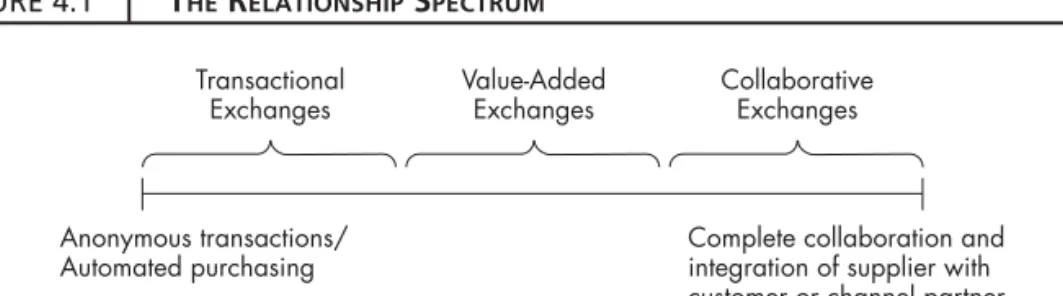
A business marketer may begin a relationship with GE as a supplier (one of many), move to a preferred supplier status (one of a few), and ultimately enter a collaborative relationship with GE (sole source for particular items). Observe in Figure 4.1 that buyer-seller relationships are positioned on a continuum, with transactional exchange and collaborative exchange serving as the endpoints. Central to every relationship is an exchange process where each side gives something in return for a payoff of greater value. Transactional exchange centers on the timely exchange of basic products for highly competitive market prices. George Day notes that such exchanges
include the kind of autonomous encounters a visitor to a city has with the taxi or bus from the airport, as well as a series of ongoing transactions in a business- to-business market where the customer and supplier focus only on the timely exchange of standard products at competitive prices.8
Moving across the continuum, relationships become closer or more collabora- tive. The open exchange of information is a characteristic of collaborative (close) versus transactional (distant) exchange. Likewise, operational linkages rel ect how much the systems, procedures, and routines of the buying and selling i rms have been connected to facilitate operations.9 These relationship connectors are a feature of a collaborative relationship. For example, such linkages provide the basis for order replenishment or just-in-time deliveries that Honda receives each day from suppli- ers at its Marysville, Ohio, production facility. Collaborative exchange features very close information, social, and operational linkages as well as mutual commitments
8 Day, “Managing Market Relationships,” p. 25.
9 Joseph P. Cannon and William D. Perreault, Jr., “Buyer-Seller Relationships in Business Markets,” Journal of Marketing Research 36 (November 1999): pp. 439–460.
FIGURE 4.1 THE RELATIONSHIP SPECTRUM
SOURCE: Figure from “Managing Market Relationships” by George S. Day from Journal of Academy of Marketing Science 28 (Winter 2000): p. 25. Copyright © 2000. Reprinted by permission of Springer.
Transactional Exchanges
Anonymous transactions/
Automated purchasing
Complete collaboration and integration of supplier with customer or channel partner Value-Added
Exchanges
Collaborative Exchanges
made in expectation of long-run benei ts. According to James Anderson and James Narus, collaborative exchange involves
a process where a customer and supplier i rm form strong and extensive social, economic, service, and technical ties over time, with the intent of lowering total costs and/or increasing value, thereby achieving mutual benei t.10
Value-Adding Exchanges
Between the two extremes on the relationship continuum are value-adding exchanges, where the focus of the selling i rm shifts from attracting customers to keeping custom- ers. The marketer pursues this objective by developing a comprehensive understand- ing of a customer’s needs and changing requirements, tailoring the i rm’s offerings to those needs, and providing continuing incentives for customers to concentrate most of their purchases with them. To illustrate, W.W. Grainger provides a customized Web page for each of its premier corporate customers that individual employees in the customer organization can use to track expenditures on maintenance and operat- ing supplies against key performance benchmarks.
Nature of Relationships
Transactional exchange involves items like packaging materials or cleaning services where competitive bidding is often employed to secure the best terms. Such exchanges are purely contractual arrangements that involve little or no emotional commitment to sustaining the relationship in the future. By contrast, customized, high-technology products—like semiconductor test equipment—fit the collaborative exchange cat- egory. Whereas transactional exchange centers on negotiations and an arm’s-length relationship, collaborative exchange emphasizes joint problem solving and multiple linkages that integrate the processes of the two parties. Trust and commitment provide the foundation for collaborative exchange.11 Relationship commitment involves a partner’s belief that an ongoing relationship is so important that it deserves maximum efforts to maintain it. In turn, trust exists when one party has coni dence in a part- ner’s reliability and integrity. Recent research highlights the powerful role that con- tact personnel (for example, salespersons) assume in forging a long-term relationship.
“Individuals who build trust in each other will transfer this bond to the i rm level.”12
Strategic Choices
Business marketers have some latitude in choosing where to participate along the relationship continuum. However, limits are imposed by the characteristics of the
10 James C. Anderson and James A Narus, “Partnering as a Focused Market Strategy,” California Management Review 33 (Spring 1991): p. 96. See also Ven Srivam, Robert Krapfel, and Robert Spekman, “Antecedents to Buyer-Seller Collaboration: An Analysis from the Buyer’s Perspective,” Journal of Business Research (December 1992): pp. 303–320.
11 Morgan and Hunt, “The Commitment-Trust Theory,” pp. 20–38. See also Patricia M. Doney and Joseph P. Cannon,
“An Examination of the Nature of Trust in Buyer-Seller Relationships,” Journal of Marketing 61 (April 1997): pp. 35–51.
12 Das Narayandas and V. Kasturi Rangan, “Building and Sustaining Buyer-Seller Relationships in Mature Industrial Markets,” Journal of Marketing 68 (July 2004): p. 74; and Robert W. Palmatier, Lisa K. Scheer, and Jan-Benedict E. M.
Steenkamp, “Customer Loyalty to Whom? Managing the Benei ts and Risks of Salesperson-Owned Loyalty,” Journal of Marketing Research 44 (May 2007): pp. 185–199.
market and by the signii cance of the purchase to the buyer. A central challenge for the marketer is to overcome the gravitational pull toward the transaction end of the exchange spectrum. According to Day,
Rivals are continually working to attract the best accounts away; customer requirements, expectations, and preferences keep changing, and the possibil- ity of friction-free exploration of options in real time on the Web conspire to raise the rate of customer defections.13
Managing Buyer-Seller Relationships
Buyers and sellers craft different types of relationships in response to market condi- tions and the characteristics of the purchase situation. To develop specii c relationship- marketing strategies for a particular customer, the business marketer must understand that some customers elect a collaborative relationship, whereas others prefer a more distant or transactional relationship. Figure 4.2 highlights the typical characteristics of relationships at the endpoints of the buyer-seller relationship spectrum.
Transactional Exchange
Customers are more likely to prefer a transactional relationship when a competitive supply market features many alternatives, the purchase decision is not complex, and the supply market is stable. This proi le i ts some buyers of ofi ce supplies, commodity chemicals, and shipping services. In turn, customers emphasize a transactional orien- tation when they view the purchase as less important to the organization’s objectives.
Such relationships are characterized by lower levels of information exchange and are less likely to involve operational linkages between the buying and selling i rms.
13 Day, “Managing Market Relationships,” p. 25.
To forge a collaborative relationship with a customer, the business marketer requires a deep understanding of the customer’s business, its key competitors, and its goals and strategies. In turn, a wealth of communication links are required across the partnering organizations at all levels of management. Salespersons not only work with the purchasing staff but also have close ties to senior executives. For example, for some of IBM’s Fortune 500 customers, account executives are direct participants in the customer i rm’s strategy planning
sessions. Here IBM adds value to the relationship by providing specii c recommendations concerning how its products and services can be used to advance the i rm’s competitive advantage. As a relationship with a large account grows and l ourishes, a full-time sales team is often created to serve the needs of that customer. The team comprises sales, service, and technical specialists who have extensive knowledge of the customer’s industry. Some team members have worked exclusively with a single customer organization for years.
B2B T OP P ERFORMERS
Understanding the Customer’s Business—The Key to Success
Collaborative Exchange
Buying i rms prefer a more collaborative relationship when alternatives are few, the market is dynamic (for example, rapidly changing technology), and the complexity of the purchase is high. In particular, buyers seek close relationships with suppliers when they deem the purchase important and strategically signii cant. This behavior i ts some purchasers of manufacturing equipment, enterprise software, or critical compo- nent parts. Indeed, say Cannon and Perreault,
the closest partnerships . . . arise both when the purchase is important and when there is a need—from the customer’s perspective—to overcome procurement obstacles that result from fewer supply alternatives and more purchase uncertainty.14
Moreover, the relationships that arise for important purchases are more likely to involve operational linkages and high levels of information exchange. Switching costs are especially important to collaborative customers.
Switching Costs
In considering possible changes from one selling i rm to another, organizational buyers consider two switching costs: investments and risk of exposure. First, organizational buyers invest in their relationships with suppliers in many ways. As Barbara Bund Jackson states:
They invest money; they invest in people, as in training employees to run new equipment; they invest in lasting assets, such as equipment itself; and they invest in changing basic business procedures like inventory handling.15
14 Cannon and Perreault, “Buyer-Seller Relationships,” p. 453.
15 Barbara Bund Jackson, “Build Customer Relationships That Last,” Harvard Business Review 63 (November–December 1985): p. 125.
FIGURE 4.2 THE SPECTRUMOF BUYER-SELLER RELATIONSHIPS
SOURCE: Adapted from Joseph P. Cannon and William D. Perreault Jr., “Buyer-Seller Relationships in Business Markets,”
Journal of Marketing Research 36 (November 1999): pp. 439–460.
Availability of Alternatives
Transactional
Exchange Collaborative
Exchange
Supply Market Dynamism Importance of Purchase Complexity of Purchase Information Exchange Operational Linkages
Many Alternatives Stable
Low Low Low Limited
Few Alternatives Volatile High High High Extensive
Because of these past investments, buyers may hesitate to incur the disruptions and switching costs that result when they select new suppliers.
Risk of exposure provides a second major category of switching costs. Attention centers on the risks to buyers of making the wrong choice. Customers perceive more risk when they purchase products important to their operations, when they buy from less established suppliers, and when they buy technically complex products.
Strategy Guidelines
The business marketer manages a portfolio of relationships with customers—some of these customers view the purchase as important and desire a close, tightly con- nected buyer-seller relationship; other customers assign a lower level of importance to the purchase and prefer a looser relationship. Given the differing needs and ori- entations of customers, the business marketer’s i rst step is to determine which type of relationship matches the purchasing situation and supply-market conditions for a particular customer. Second, a strategy must be designed that is appropriate for each strategy type.
Collaborative Customers Relationship-building strategies, targeted on strong and lasting commitments, are especially appropriate for these customers. Business mar- keters can sensibly invest resources to secure commitments and directly assist custom- ers with planning. Here sales and service personnel work not only with purchasing managers but also with a wide array of managers on strategy and coordination issues.
Regular visits to the customer by executives and technical personnel can strengthen the relationship. Operational linkages and information-sharing mechanisms should be designed into the relationship to keep product and service offerings aligned with customer needs. Given the long time horizon and switching costs, customers are con- cerned both with the marketers’ long-term capabilities and with their immediate per- formance. Because the customers perceive signii cant risk, they demand competence and commitment from sellers and are easily frightened by even a hint of supplier inadequacy.
Value Drivers in Collaborative Relationships A recent study examined this intriguing question: What avenues of differentiation can suppliers of routinely pur- chased products use to create value in business-to-business relationships, thereby win- ning key supplier status?16 From Table 4.1, observe that the study uncovered three sources of value creation—value creation through the core offering, within the sourc- ing process, and at the level of the customer’s operations. The associated relation- ship benei ts and costs for each are listed. Consistent with the total cost of ownership (Chapter 2) perspective that purchasing managers apply, costs as a value driver center on the degree to which the supplier offers a lower price or adds value by taking costs out of the sourcing process or the customer’s operations.
The results suggest that relationship benei ts display a much stronger potential for differentiation in key supplier relationships than cost considerations. Importantly, service support and personal interaction were identii ed as the core differentiators,
16 Wolfgang Ulaga and Andreas Eggert, “Value-Based Differentiation in Business Relationships: Gaining and Sustaining Key Supplier Status,” Journal of Marketing 70 (January 2006): pp. 119–136.
followed by a supplier’s know-how and its ability to improve a customer’s time to market. Product quality and delivery performance, along with cost savings associ- ated with the acquisition process and from operations, display a moderate potential to help a i rm gain key supplier status. Finally, price displayed the weakest potential for differentiation. The researchers, Wolfgang Ulaga and Andreas Eggert, conclude:
“Whereas cost factors serve as key criteria to get a supplier on the short list of those vendors considered for a relationship, relationship benei ts dominate when deciding which supplier” should be awarded key supplier status.17
Transaction Customers These customers display less loyalty or commitment to a particular supplier and can easily switch part or all of the purchases from one ven- dor to another. A business marketer who offers an immediate, attractive combina- tion of product, price, technical support, and other benei ts has a chance of winning business from a transactional customer. The salesperson centers primary attention on the purchasing staff and seldom has important ties to senior executives in the buying organization. M. Bensaou argues that it is unwise for marketers to make specialized investments in transactional relationships:
Firms that invest in building trust through frequent visits, guest engineers, and cross-company teams when the product and market context calls for sim- ple, impersonal control and data exchange mechanisms are overdesigning the relationship. This path is not only costly but also risky, given the specialized investments involved, in particular, the intangible ones (for example, people, information, or knowledge).18
Rather than adopting the approach of “one design i ts all,” the astute marketer matches the strategy to the product and market conditions that surround a particular customer relationship and understands the factors that inl uence proi tability.
17 Ibid., p. 131.
18 M. Bensaou, “Portfolio of Buyer-Seller Relationships,” Sloan Management Review 40 (Summer 1999): p. 43.
TABLE 4.1 VALUE DRIVERSIN KEY SUPPLIER RELATIONSHIPS
Sources of Value Creation Relationship Value Dimensions
Costs Benefi ts
Core offering Product quality Direct costs
Delivery performance
Sourcing process Service support Acquisition costs
Personal interaction
Customer operations Supplier know-how Operation costs Time to market
SOURCE: Wolfgang Ulaga and Andreas Eggert, “Value-Based Differentiation in Business Relationships: Gaining and Sustaining Key Supplier Status,” Journal of Marketing 70 ( January 2006): p. 122. Copyright © 2001. Reprinted by permission of Warren, Gorham, Lamont via Copyright Clearance Center.
Measuring Customer Profi tability
19To improve customer satisfaction and loyalty, many business-to-business i rms have de- veloped customized products and increased the specialized services they offer. Although customers embrace such actions, they often lead to declining proi ts, especially when the enhanced offerings are not accompanied by increases in prices or order volumes. For a differentiation strategy to succeed, “the value created by the differentiation—measured by higher margins and higher sales volumes—has to exceed the cost of creating and de- livering customized features and services.”20 By understanding the drivers of customer proi tability, the business marketing manager can more effectively allocate marketing resources and take action to convert unproi table relationships into proi table ones.
Activity-Based Costing
Most studies of customer proi tability yield a remarkable insight: “Only a minority of a typical company’s customers is truly proi table.”21 Why? Many i rms fail to examine how the costs of specialized products and services vary among individual customers.
In other words, they focus on proi tability at an aggregate level (for example, product or territory), fail to assign operating expenses to customers, and misjudge the proi t- ability of individual customers. To capture customer-specii c costs, many i rms have adopted activity-based costing.
Activity-based costing (ABC) illuminates exactly what activities are associated with serving a particular customer and how these activities are linked to revenues and the consumption of resources.22 The ABC system and associated software link cus- tomer transaction data from customer relationship management (CRM) systems with i nancial information. The ABC system provides marketing managers with a clear and accurate picture of the gross margins and cost-to-serve components that yield indi- vidual customer proi tability.
Unlocking Customer Profi tability
By accurately tracing costs to individual customers, managers are better equipped to diagnose problems and take appropriate action. For example, Kanthal, a heating wire manufacturer, learned to its surprise that one of its largest and most coveted accounts—General Electric’s Appliance Division—was also one of its most unproi t- able customers.23 A customer order that normally would cost Kanthal $150 to process cost more than $600 from GE because of frequent order changes, expedited deliver- ies, and scheduling adjustments. A senior manager at Kanthal suggested to GE that the numerous change orders were costly not only to Kanthal but also to GE. After a quick internal review, GE managers agreed, corrected internal inefi ciencies, and then
19 This section, unless otherwise noted, draws on Robert S. Kaplan and V. G. Narayanan, “Measuring and Managing Customer Proi tability,” Journal of Cost Management 15 (5, September–October 2001): pp. 5–15.
20 Robert S. Kaplan, “Add a Customer Proi tability Metric to Your Balanced Scorecard,” Balanced Scorecard Report, July–August 2005 (Boston: Harvard Business School Publishing Corporation), p. 3.
21 Kaplan and Narayanan, “Measuring and Managing Customer Proi tability,” p. 5.
22 Ibid., p. 7. See also Robert S. Kaplan and Steven R. Anderson, “Time-Driven Activity-Based Costing,” Harvard Business Review 82 (November 2004): pp. 131–138.
23 Kaplan and Narayanan, p. 11.
awarded Kanthal with the largest contract in the i rm’s history. The contract incor- porated a surcharge for any change GE made to an existing order and established a minimum order size. By isolating the true cost of serving GE, Kanthal converted an unproi table relationship to a proi table one and provided further value by helping a key customer reduce costs.
The Profi table Few
Once a i rm implements an ABC approach and plots cumulative proi tability against customers, a striking portrait emerges that is often referred to as the whale curve (Figure 4.3). Robert S. Kaplan, who is codeveloper of activity-based costing, and his colleague, V. G. Narayanan, describe the pattern that many companies i nd:
Whereas cumulative sales usually follow the typical 20/80 rule (that is, 20 percent of the customers provide 80 percent of the sales), the whale curve for cumulative proi tability usually reveals that the most proi table 20 percent of customers generate between 150 percent and 300 percent of total proi ts. The middle 70 percent of customers break even and the least proi table 10 percent of customers lose from 50 to 200 percent of total proi ts, leaving the company with its 100 percent of total proi ts.24
24 Ibid., p. 7. See also Robert S. Kaplan and David P. Norton, The Execution Premium (Boston: Harvard Business Press, 2008), pp. 255–261.
Text not available due to copyright restrictions
As a rule, large customers tend to be included among the most proi table (see left side of Figure 4.3) or the least proi table (see right side of Figure 4.3)—they are seldom in the middle. Interestingly, some of the i rm’s largest customers often turn out to be among the most unproi table. A i rm does not generate enough sales volume with a small customer to incur large absolute losses. Only large buyers can be large- loss customers. In Figure 4.3, low-cost-to-serve customers appear on the proi table side of the whale curve and high-cost-to-serve customers end up on the unproi table side unless they pay a premium price for the specialized support they require.
Managing High- and Low-Cost-to-Serve Customers
What causes some customers to be more expensive than others? Note from Table 4.2 that high-cost-to-serve customers, for example, desire customized products, frequently change orders, and require a significant amount of presales and postsales support.
By contrast, low-cost-to-serve customers purchase standard products, place orders and schedule deliveries on a predictable cycle, and require little or no presales or post- sales support.
Look Inside First After reviewing the proi tability of individual customers, the business marketer can consider possible strategies to retain the most valuable cus- tomers and to transform unproi table customers into proi table ones. However, man- agers should i rst examine their company’s own internal processes to ensure that it can accommodate customer preferences for reduced order sizes or special services at the lowest cost. For example, a large publisher of business directories reduced the cost of serving its customer base by assigning key account managers to its largest cus- tomers (that is, the 4 percent of customers who accounted for 45 percent of its sales)
Text not available due to copyright restrictions
and serving the smallest customers over the Internet and by a telephone sales force.25 These actions not only cut costs dramatically but also gave each group of customers what they had wanted all along: Large customers wanted a central point of contact where they could secure services customized to their needs; small customers pre- ferred minimal contact with a direct salesperson but wanted the assurance that they could receive advice and support if required.
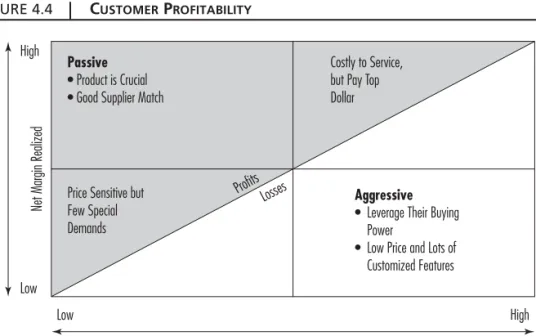
A Sharper Profit Lens Business marketing managers can view their customers through the lens of a simple 2 3 2 diagram (Figure 4.4). The vertical axis shows the net margin earned from sales to a particular customer. The net margin equals the net price, after all discounts, minus manufacturing costs. The horizontal axis shows the costs of serving the customer, including order-related costs plus the customer- specii c marketing, technical, and administrative expenses.
Identifying Profi table Customers Observe from Figure 4.4 that proi table custom- ers can take different forms. To illustrate, a customer like Honda of America would be at the lower left corner of the diagram: demanding low prices, so net margins are low, but also working with its suppliers to streamline activities so that the cost-to- serve is also low. High-cost-to-serve customers who occupy the upper right corner of Figure 4.4 can also be proi table if the net margins earned on sales to them more than compensate the company for the cost of the resources used in serving them.
A company is indeed fortunate if several of its customers occupy the upper left- hand quadrant of the diagram: high margins and low cost-to-serve. Because these
25 George S. Day, “Creating a Superior Customer-Relating Capability,” MIT Sloan Management Review 44 (Spring 2003):
pp. 77–82.
FIGURE 4.4 CUSTOMER PROFITABILITY
SOURCE: Reprinted by permission of Harvard Business Review. From “Manage Customers for Proi ts (Not Just Sales)”
by B. P. Shapiro et al., September–October 1987: p. 104. Copyright © 1987 by the Harvard Business School Publishing Corporation; all rights reserved.
High
Low
Cost-to-Serve ProfitsLosses
Low High
Passive
• Product is Crucial
• Good Supplier Match
Costly to Service, but Pay Top Dollar
Price Sensitive but Few Special Demands
Aggressive
• Leverage Their Buying Power
• Low Price and Lots of Customized Features
Net Margin Realized
customers represent a valuable asset, marketing managers should forge close relation- ships with them, anticipate their changing needs, and have protective measures (for example, special services) in place in case competitors attempt to win them away.
Managing Unprofi table Customers26
The most challenging set of customers for marketing managers is found in the lower right-hand corner of Figure 4.4: low margins and high cost-to-serve. First, the mar- keting manager should explore possible ways to reduce the cost of activities associated with serving these customers. For example, perhaps postsales support could be shifted to the Internet. Second, the manager should direct attention to the customer actions that contribute to higher selling costs. To illustrate, the high cost-to-serve may be caused by the customer’s unpredictable ordering patterns or by the large demands it places on technical and sales personnel. By detailing the costs of these activities and openly sharing this information with the customer, the business marketing manager can encourage the customer to work with the company more efi ciently. From the earlier example, recall that Kanthal used this approach not only to restore proi tability but also to help one of its largest customers, General Electric’s Appliance Division, rei ne its internal processes and reduce its costs.
Firing Customers
By improving processes and rei ning pricing strategies, business marketing man- agers can transform many, but not all, customers from unproi table to proi table.
What should we do with those unproi table customers that remain in the high- cost-to-serve quadrant of Figure 4.4? To answer this question, we have to dig deeper into the customer relationship and assess the other benei ts that certain customers may provide. Some customers are new and the initial investment to at- tract them will ultimately be repaid in higher sales volume and proi tability. Other customers provide an opportunity for learning. For example, some i rms that serve Toyota or Honda incurred initial losses in serving these demanding customers but secured insights into management processes and technology they could effectively apply to all their customers.
Suppose, however, that a customer is unproi table, not new, and offers little or no opportunity for learning. Furthermore, suppose that the customer resists all attempts to convert the unproi table relationship into a proi table one. Under these conditions, Robert S. Kaplan and Robin Cooper observe that we might con- sider i ring them, but a more subtle approach will do: “We can, perhaps, let the customer i re itself by refusing to grant discounts and reducing or eliminating mar- keting and technical support.”27 Customer divestment is a viable strategic option, but one that must be exercised sparingly and only after other options have been thoroughly examined.28
26 This section is based on Robert S. Kaplan and Robin Cooper, Cost and Effect: Using Integrated Cost Systems to Drive Prof- itability and Performance (Boston: Harvard Business School Press, 1998), pp. 193–201.
27 Ibid., p. 200.
28 Vikas Mittal, Matthew Sarkees, and Feisal Murshed, “The Right Way to Manage Unproi table Customers,” Harvard Business Review 86 (April 2008): pp. 95–102.
Customer Relationship Management
Customer retention has always been crucial to success in the business market, and it now provides the centerpiece of strategy discussions as i rms embrace customer relationship management. Customer relationship management (CRM) is a cross- functional process for achieving
a continuing dialogue with customers
across all their contact and access points, with
personalized treatment of the most valuable customers,
to ensure customer retention and the effectiveness of marketing initiatives.29 To meet these challenging requirements, business marketing i rms, large and small, are making substantial investments in CRM systems—enterprise software ap- plications that integrate sales, marketing, and customer service information. To im- prove service and retain customers, CRM systems synthesize information from all of a company’s contact points or “touch points”—including e-mail, call centers, sales and service representatives—to support later customer interactions and to inform market forecasts, product design, and supply chain management.30 Salespersons, call center personnel, Web managers, resellers, and customer service representatives all have the same real-time information on each customer.
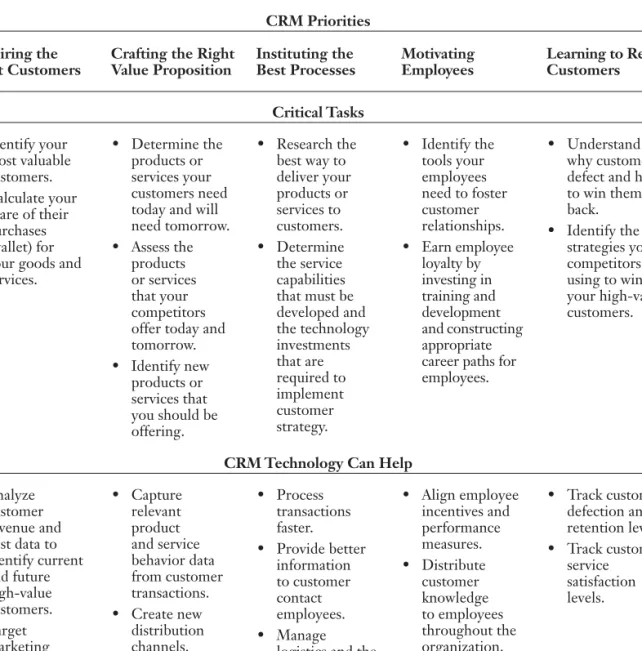
For an investment in CRM software to yield positive returns, a i rm needs a cus- tomer strategy. Strategy experts contend that many CRM initiatives fail because execu- tives mistake CRM software for a marketing strategy. Darrell Rigby and his colleagues contend: “It isn’t. CRM is the bundling of customer strategy and processes, supported by relevant software, for the purpose of improving customer loyalty and, eventually, corporate proi tability.”31 CRM software can help, but only after a customer strategy has been designed and executed. To develop responsive and proi table customer strate- gies, special attention must be given to i ve areas: (1) acquiring the right customers, (2) crafting the right value proposition, (3) instituting the best processes, (4) motivat- ing employees, and (5) learning to retain customers (Table 4.3). Observe how CRM technology from leading producers such as Oracle Corporation and Siebel Systems can be used to capture critical customer data, transform it into valuable information, and distribute it throughout the organization to support the strategy process from customer acquisition to customer retention. Thus, a well-designed and executed customer strat- egy, supported by a CRM system, provides the i nancial payoff.
Acquiring the Right Customers
Customer relationship management directs attention to two critical assets of the busi- ness-to-business i rm: its stock of current and potential customer relationships and its collective knowledge of how to select, initiate, develop, and maintain proi table
•
•
•
•
29 George S. Day, “Capabilities for Forging Customer Relationships,” Working Paper, Report No. 00-118, Marketing Science Institute, Cambridge, MA, 2000, p. 4.
30 Larry Yu, “Successful Customer-Relationship Management,” MIT Sloan Management Review 42 (Summer 2001): p. 18.
31 Darrell K. Rigby, Frederick F. Reichheld, and Phil Schefter, “Avoid the Four Perils of CRM,” Harvard Business Review 80 ( January–February 2002): p. 102.
32 Ruth N. Bolton, Katherine N. Lemon, and Peter Verhoof, “Expanding Business-to-Business Customer Relationships,”
Journal of Marketing 72 (January 2008): pp. 46–64.
33 Michael D. Johnson and Fred Selnes, “Diversifying Your Customer Portfolio,” MIT Sloan Management Review 46 (Spring 2005): pp. 11–14.
TABLE 4.3 CREATINGA CUSTOMER RELATIONSHIP MANAGEMENT STRATEGY
CRM Priorities
Acquiring the Crafting the Right Instituting the Motivating Learning to Retain Right Customers Value Proposition Best Processes Employees Customers
Critical Tasks
• Identify your most valuable customers.
• Calculate your share of their purchases (wallet) for your goods and services.
• Determine the products or services your customers need today and will need tomorrow.
• Assess the products or services that your competitors offer today and tomorrow.
• Identify new products or services that you should be offering.
• Research the best way to deliver your products or services to customers.
• Determine the service capabilities that must be developed and the technology investments that are required to implement customer strategy.
• Identify the tools your employees need to foster customer relationships.
• Earn employee loyalty by investing in training and development and constructing appropriate career paths for employees.
• Understand why customers defect and how to win them back.
• Identify the strategies your competitors are using to win your high-value customers.
CRM Technology Can Help
• Analyze customer revenue and cost data to identify current and future high-value customers.
• Target marketing communications to high-value customers.
• Capture relevant product and service behavior data from customer transactions.
• Create new distribution channels.
• Develop new pricing models.
• Process transactions faster.
• Provide better information to customer contact employees.
• Manage logistics and the supply chain more efi ciently.
• Align employee incentives and performance measures.
• Distribute customer knowledge to employees throughout the organization.
• Track customer defection and retention levels.
• Track customer service
satisfaction levels.
SOURCE: Adapted from Darrell K. Rigby, Frederick F. Reichheld, and Phil Schefter, “Avoid the Four Perils of CRM,” Harvard Business Review 80 ( January–February 2002): p. 106.
relationships with these customers.32 Customer portfolio management, then, is the process of creating value across a i rm’s customer relationships—from transactional to collaborative—with an emphasis on balancing the customer’s desired level of rela- tionship against the proi tability of doing so.33
Account selection requires a clear understanding of customer needs, a tight grasp on the costs of serving different groups of customers, and an accurate forecast of potential proi t opportunities. The choice of potential accounts to target is facilitated by an understanding of how different customers dei ne value. Value, as dei ned by James Anderson and James Narus, refers to “the economic, technical, service, and so- cial benei ts received by a customer i rm in exchange for the price paid for a product offering.”34 By gauging the value of their offerings to different groups of customers, business marketers are better equipped to target accounts and to determine how to provide enhanced value to particular customers.
The account selection process should also consider proi t potential. Because the product is critical to their operations, some customers place a high value on sup- porting services (for example, technical advice and training) and are willing to pay a premium price for them. Other customers are most costly to serve, do not value service support, and are extremely price sensitive. Because customers have different needs and represent different levels of current and potential opportunities, a marketer should divide its customers into groups. The marketer wishes to develop a broader and deeper relationship with the most proi table ones and assign a low priority to the least proi table ones.35 Frank Cespedes asserts that
account selection, therefore, must be explicit about which demands the seller can meet and leverage in dealings with other customers. Otherwise, the seller
34 Anderson and Narus, p. 98. See also Ajay Menon, Christian Homburg, and Nikolas Beutin, “Understanding Customer Value in Business-to-Business Relationships,” Journal of Business-to-Business Marketing 12 (2, 2005): pp. 1–33; and Ulaga and Eggert, “Value-Based Differentiation,” pp. 119–136.
35 Frederick F. Reichheld, “Lead for Loyalty,” Harvard Business Review 79 (July–August 2001): pp. 76–84.
For an investor, modern portfolio theory demonstrates that optimal performance, for a given level of risk, can best be achieved by building a diversii ed mix of investment assets that includes the stocks of both large and small i rms, representing both U.S. and foreign companies.
In building a customer portfolio, similar benei ts can be realized by viewing customers as assets and diversifying across categories of customers.
For example, after the technology bubble, many information technology (IT) companies, like IBM and Microsoft, were surprised to observe that small and medium-sized businesses (SMB) fueled the recovery in IT spending. Why? Most of the SMB customers did not overindulge in massive
hardware and software upgrades to the same extreme extent during the bubble as their large- enterprise counterparts did. So, SMB customers were the first to return and aggressively buy IT products and services. Because Dell, Microsoft, and IBM each have a customer portfolio that includes a strong representation of SMB customers, these i rms enjoyed an edge over rivals such as Hewlett-Packard and Sun Microsystems that were less focused on this customer group (that is, asset category) and were “caught waiting”
for large-enterprise customers to return.
SOURCE: Mark Veverka, “Little Guys Lead IT Spending Recovery,” Barron’s, October 20, 2003, p. 73.
I NSIDE B USINESS M ARKETING
Diversify a Customer Portfolio Too!
risks overserving unprofitable accounts and wasting resources that might be allocated to other customer groups.36
Crafting the Right Value Proposition
A value proposition represents the products, services, ideas, and solutions that a business marketer offers to advance the performance goals of the customer organization. Recall from Chapter 1 that the customer value proposition must address this essential question:
How do the value elements (benei ts) in a supplier’s offering compare to those of the next- best alternative? A value proposition may include points of parity (certain value elements are the same as the next-best option) and points of difference (the value elements that make the supplier’s offering either superior or inferior to the next-best alternative). For example, a supplier may offer improved technology (positive) at a higher price (negative) and fail to convince customers that the new technology justii es the price increase.
Best-practice suppliers base their value proposition on the few elements that matter most to target customers, demonstrate the value of this superior performance, and communicate it in a way that conveys a sophisticated un- derstanding of the customer’s business priorities.37
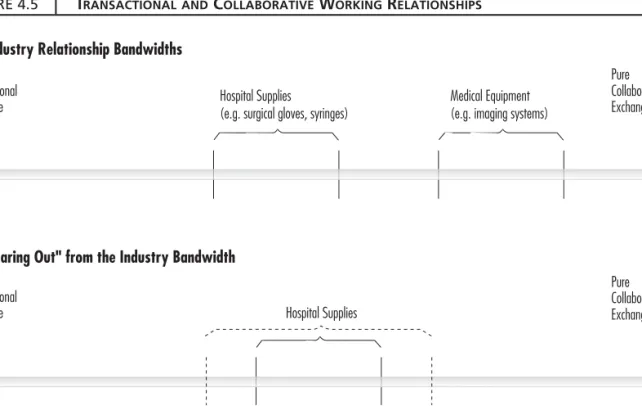
The Bandwidth of Strategies To develop customer-specii c product offerings, the business marketer should next examine the nature of buyer-seller relationships in the industry. The strategies competing i rms in an industry pursue fall into a range re- ferred to as the industry bandwidth of working relationships.38 Business marketers either attempt to span the bandwidth with a portfolio of relationship-marketing strat- egies or concentrate on a single strategy, thereby having a narrower range of relation- ships than the industry bandwidth.
Observe in Figure 4.5 how two different industries (medical equipment and hos- pital supplies) are positioned on the relationship continuum. Because the underlying technology is complex and dynamic, collaborative relations characterize the medical equipment industry. Here, a range of services—technical support, installation, profes- sional training, and maintenance agreements—can augment the core product. By con- trast, collaborative relations in the hospital supply industry tend to be more focused and center on helping health-care organizations meet their operational needs (for example, efi cient ordering processes and timely delivery).
By diagnosing the spectrum of relationship strategies competitors in an industry follow, a business marketer can tailor strategies that more closely respond both to customers who desire a collaborative emphasis and to those who seek a transaction emphasis. The strategy involves fl aring out from the industry bandwidth in the col- laborative as well as in the transactional direction (see Figure 4.5b).
Flaring Out by Unbundling An unbundling strategy can reach customers who de- sire a greater transaction emphasis. Here, related services are unbundled to yield the
36 Frank V. Cespedes, Concurrent Marketing: Integrating Product, Sales, and Service (Boston: Harvard Business School Press, 1995), p. 193. See also Don Peppers, Martha Rogers, and Bob Dorf, “Is Your Company Ready for One-to-One Market- ing?” Harvard Business Review 77 (January–February 1999): pp. 151–160.
37 James C. Anderson, James A. Narus, and Wouter van Rossum, “Customer Value Propositions in Business Markets,”
Harvard Business Review 84 (March 2006): p. 93.
38 This discussion draws on Anderson and Narus, “Partnering as a Focused Market Strategy,” pp. 95–113.
core product (a in Figure 4.5b), which meets a customer’s basic price, quality, and availability requirements. For each service that is unbundled, the price is lowered.
Augmented services, such as technical assistance, consulting, and just-in-time delivery, are each offered, but in a menu fashion, on an incremental price basis. Importantly, the price increments for the entire set of unbundled services should be greater than the price premium sought for the collaborative offering. This rel ects the efi ciencies of providing the complete bundle of services to a collaborative account. This pricing policy is market oriented in that it allows customer i rms to choose the product and relationship offering that they perceive to provide the greatest value.
Flaring Out with Augmentation At the other extreme, the collaborative offer- ing (d in Figure 4.5b) becomes the augmented product enriched with features the customer values. Augmented features might include coordinated cost-reduction pro- grams, technical assistance, delivery schedule guarantees, and cooperative advertis- ing. Because collaborative efforts are designed to add value or reduce the costs of exchange between partnering i rms, a price premium should be received for the col- laborative offering.
Allegiance Healthcare Corporation has developed ways to improve hospital supply ordering, delivery, and billing that provide enhanced value to the customer.39
39 Valarie A. Zeithaml, Roland T. Rust, and Katherine N. Lemon, “The Customer Pyramid: Creating and Serving Proi table Customers,” California Management Review 43 (Summer 2001): p. 134.
FIGURE 4.5 TRANSACTIONALAND COLLABORATIVE WORKING RELATIONSHIPS
SOURCE: Adapted from James C. Anderson and James A. Narus, “Partnering as a Focused Marketing Strategy,” California Management Review 33 (Spring 1991): p. 97.
Pure Transactional
Exchange Hospital Supplies
(e.g. surgical gloves, syringes)
Pure Collaborative Exchange Medical Equipment
(e.g. imaging systems)
Hospital Supplies
Pure Collaborative Exchange (b) "Flaring Out" from the Industry Bandwidth
(a) Industry Relationship Bandwidths
a b c d
Pure Transactional Exchange
Instead of miscellaneous supplies arriving in boxes sorted at the convenience of Allegiance’s needs, they arrive on “client-friendly” pallets customized to meet the distribution needs of the individual hospital. Moreover, hospitals can secure a struc- tural connection to Allegiance through its ValueLink ordering system for added value and convenience.
Creating Flexible Service Offerings Business marketers can gain a competitive edge by creating a portfolio of service offerings and then drawing on this portfolio to provide customized solutions for groups of customers or even individual customers.40 First, an offering should be created that includes the bare-bones-minimum number of services valued by all customers in a particular market segment. Microsoft refers to these offerings as “naked solutions.” Second, optional services are created that add value by reducing costs or improving the performance of a customer’s operations.
To meet the needs of particular customers, optional services can then be “custom wrapped” with the core offering to create added value.
Instituting the Best Processes
The sales force assumes a central relationship-management role in the business mar- ket. Technical service and customer service personnel also assume implementation roles that are important and visible in buying organizations. Successful relationship strategies are shaped by an effective organization and deployment of the personal sell- ing effort and close coordination with supporting units, such as logistics and technical service. Some i rms divide the sales organization into units that each serve a distinct relationship category such as transactional accounts or partnership accounts. Through a careful screening process, promising transaction accounts are periodically upgraded to partnerships.
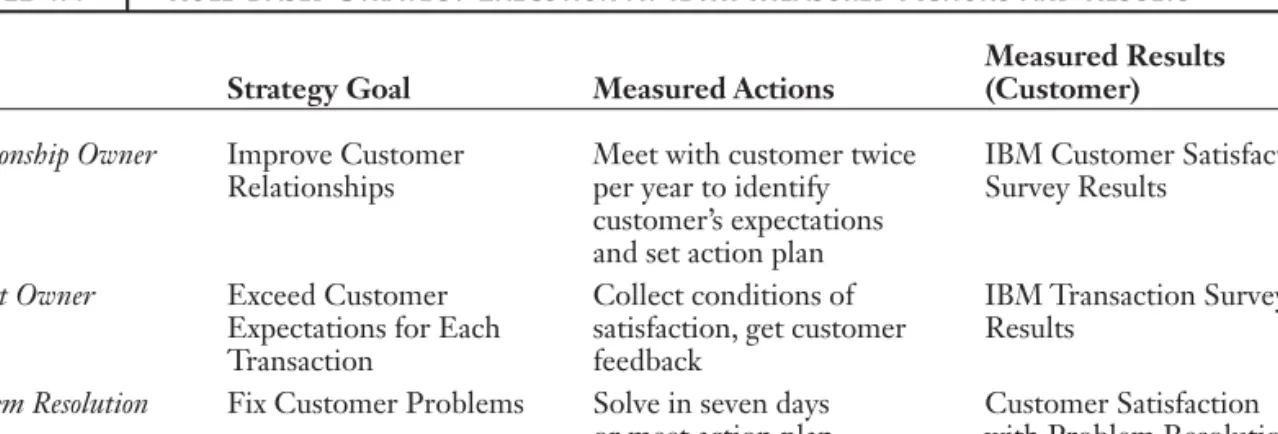
Best Practices at IBM41 In serving a particular customer, a number of IBM em- ployees come into contact with the customer organization. To ensure consistent strat- egy execution, IBM identii es three customer-contact roles for each of its accounts, specii es desired measurable actions for each role, and monitors the customer’s degree of satisfaction with each role (Table 4.4). The IBM client representative assigned to the customer is the relationship owner, but the account team may include other spe- cialists who complete a project for the customer (project owner) or solve a particu- lar customer problem ( problem resolution owner). Any IBM employee who works on the account can secure timely information from the CRM system to identify recent actions or issues to be addressed. Moreover, for each role, there is an in-process mea- sure and a customer feedback measure.
Consider an IBM technical manager assigned responsibility for installing CRM software for a large bank. As a project owner, this manager’s goal is to determine
40 James C. Anderson and James A. Narus, “Capturing the Value of Supplementary Services,” Harvard Business Review 73 ( January–February 1995): pp. 75–83. See also David Rickard, “The Joys of Bundling: Assessing the Benei ts and Risks,” The Boston Consulting Group, Inc., 2008, accessed at http://www.bcg.com on May 15, 2008.
41 This discussion is based on Larry Schiff, “How Customer Satisfaction Improvement Works to Fuel Full Business Recovery at IBM,” Journal of Organizational Excellence 20 (Spring 2001): pp. 3–18.
the customer’s conditions of satisfaction and then exceed those expectations. When the work is completed, members of the customer organization are queried concern- ing their satisfaction and the project owner acts on the feedback to ensure that all promises have been kept. Clearly, a sound complaint management process is essential.
Recent research found that if a complaint is ineffectively handled, the i rm faces a high risk of losing even those customers who had previously been very satisi ed.42
Research suggests that the performance attributes that inl uence the customer satisfaction of business buyers include:
the responsiveness of the supplier in meeting the i rm’s needs, product quality,
a broad product line, delivery reliability,
knowledgeable sales and service personnel.43
Motivating Employees
Dedicated employees are the cornerstone of a successful customer relationship strategy.
Frederick F. Reichheld notes:
Leaders who are dedicated to treating people right drive themselves to deliver superior value, which allows them to attract and retain the best employees.
That’s partly because higher proi ts result from customer retention, but more important, it’s because providing excellent service and value generates pride and a sense of purpose among employees.44
•
•
•
•
•
42 Christian Homburg and Andreas Fürst, “How Organizational Complaint Handling Drives Customer Loyalty: An Analysis of the Mechanistic and the Organic Approach,” Journal of Marketing 69 (July 2005): pp. 95–114.
43 Bowman and Narayandas, “Linking Customer Management Effort,” pp. 433–447.
44 Reichheld, “Lead for Loyalty,” p. 78.
TABLE 4.4 ROLE-BASED STRATEGY EXECUTIONAT IBM: MEASURED ACTIONSAND RESULTS
Measured Results
Role Strategy Goal Measured Actions (Customer)
Relationship Owner Improve Customer Meet with customer twice IBM Customer Satisfaction Relationships per year to identify Survey Results
customer’s expectations
and set action plan
Project Owner Exceed Customer Collect conditions of IBM Transaction Survey Expectations for Each satisfaction, get customer Results
Transaction feedback
Problem Resolution Fix Customer Problems Solve in seven days Customer Satisfaction or meet action plan with Problem Resolution
SOURCE: Adapted from Larry Schiff, “How Customer Satisfaction Improvement Works to Fuel Business Recovery at IBM,” Journal of Organizational Excellence (Spring 2001): pp. 12–14.
Employee loyalty is earned by investing heavily in training and development, providing challenging career paths to facilitate professional development, and aligning employee incentives to performance measures.45 For example, Square D, an Illinois- based producer of electrical and industrial equipment, altered its performance- measurement and incentive systems to i t the i rm’s new customer strategy. Consistent with the goal of attracting high-value customers, salesperson incentives are no longer based on the number of units sold but on the number of customers acquired and on proi t margins.
Research clearly demonstrates the link between salespeople’s job satisfaction and customer satisfaction in business markets. Christian Homburg and Ruth M.
Stock report that the relationship between salespeople’s job satisfaction is particu- larly strong when there is a high frequency of customer interaction, high intensity of customer integration into the value-creating process, and high product or service innovativeness.46
Learning to Retain Customers
Business marketers track customer loyalty and retention because the cost of serving a long-standing customer is often far less than the cost of acquiring a new customer.47 Why? Established customers often buy more products and services from a trusted sup- plier and, as they do, the cost of serving them declines. The i rm learns how to serve them more efi ciently and also spots opportunities for expanding the relationship. Thus, the proi t from that customer tends to increase over the life of the relationship. To that end, a goal for IBM is to gain an increasing share of a customer’s total information tech- nology expenditures (that is, share of wallet). Rather than merely attempting to improve satisfaction ratings, IBM seeks to be recognized as providing superior value to its cus- tomers. Larry Schiff, an IBM strategist, notes: “If you delight your customers and are perceived to provide the best value in your market, you’ll gain loyalty and market /wallet share.”48 Although loyal customers are likely to be satisi ed, all satisi ed customers do not remain loyal. Business marketers earn customer loyalty by providing superior value that ensures high satisfaction and by nurturing trust and mutual commitments.
Pursuing Growth from Existing Customers Business marketers should identify a well-dei ned set of existing customers who demonstrate growth potential and selec- tively pursue a greater share of their business. Based on the cost-to-serve and projected proi t margins, the question becomes: Which of our existing customers represent the best growth prospects? In targeting individual customers, particular attention should be given to: (1) estimating the current share of wallet the i rm has attained;
(2) pursuing opportunities to increase that share; and (3) carefully projecting the enhanced customer proi tability that will result.49
45 Rigby, Reichheld, and Schefter, “Avoid the Perils of CRM,” p. 104.
46 Christian Homburg and Ruth M. Stock, “The Link Between Salespeople’s Job Satisfaction and Customer Satisfaction in a Business-to-Business Context: A Dyadic Analysis,” Journal of the Academy of Marketing Science 32 (Spring 2004):
pp. 144–158; and Christian Homburg and Ruth M. Stock, “Exploring the Conditions Under Which Salesperson Work Satisfaction Can Lead to Customer Satisfaction,” Psychology & Marketing 22 (5, 2005): pp. 393–420.
47 Reichheld, “Lead for Loyalty,” pp. 76–84.
48 Schiff, “How Customer Satisfaction Improvement Works to Fuel Full Business Recovery at IBM,” p. 8.
49 James C. Anderson and James A. Narus, “Selectively Pursuing More of Your Customer’s Business,” MIT Sloan Management Review 44 (Spring 2003): pp. 42–49.
Evaluating Relationships Some relationship-building efforts fail because the expec- tations of the parties do not mesh—for example, when the business marketer follows a relationship approach and the customer responds in a transaction mode. By isolating customer needs and the costs of augmented service features, the marketer is better equipped to proi tably match product offerings to the particular customer’s needs.
The goal of a relationship is to enable the buyer and seller to maximize joint value. This points to the need for a formal evaluation of relationship outcomes. For example, sales executives at best-practice i rms work closely with their partnership accounts to establish mutually dei ned goals. After an appropriate period, partnerships that do not meet these goals are downgraded and shifted from the strategic market sales force to the geographic sales force.
Business marketers should also continually update the value of their product and relationship offering. Attention here should center on particular new services that might be incorporated as well as on existing services that might be unbundled or curtailed. Working relationships with customer i rms are among the most important marketing assets of the i rm. They deserve delicate care and continual nurturing!
Strategic Alliances
Not only do business marketing managers form close relationships with customers, they also develop close bonds with other i rms. Strategic alliances have become an important tool for achieving a sustainable competitive advantage for leading busi- ness i rms. To that end, the top 500 global businesses have an average of 60 major strategic alliances each.50 Strategic alliances involve “a formal long-run linkage, funded with direct co-investments by two or more companies, that pool complemen- tary capabilities and resources to achieve generally agreed objectives.”51 In contrast, a joint venture involves the formation of a separate, independent organization by the venture partners.
Accessing Complementary Skills
The driving force behind the formation of a strategic alliance is the desire of one i rm to leverage its core competencies by linking them with others who have complemen- tary expertise, thereby expanding the product, market, and geographic scope of the organization. Simon Hayes, vice president of Enterprise Strategic Alliances at Cisco Systems, observes: By combining the best that partners have to offer, “strategic alli- ances are helping companies enhance their strategic presence in the marketplace and develop new solutions to attract new customers or even create whole new market categories.”52 Cisco Systems, a recognized leader in partnering and collaboration, has formed deep, long-term relationships with a host of strategic alliance partners, including Microsoft, IBM, Hewlett-Packard, Nokia, Fujitsu, Accenture, Intel, Italtel,
50 Jeffrey H. Dyer, Prashant Kale, and Habir Singh, “How to Make Strategic Alliances Work,” MIT Sloan Management Review 42 (Summer 2001): pp. 37–43. See also Fred A. Kuglin and Jeff Hook, Building, Leading, and Managing Strategic Alliances (New York: AMACOM, 2007).
51 George S. Day, Market Driven Strategy: Processes for Creating Value (New York: The Free Press, 1990), p. 272.
52 Simon Hayes, “Getting Strategic Alliances Right,” Synnovation 3 (May 2008), p. 72, accessed at www.eds.com/synnovation on July 5, 2008.
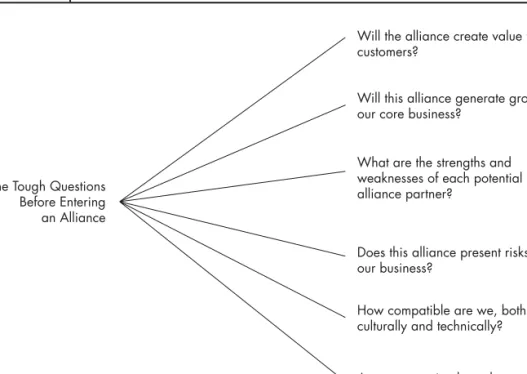
and many others. For example, the Microsoft–Cisco alliance, formed more than a de- cade ago, addresses the needs of enterprise and small and medium-size (SMB) cus- tomers who need affordable, integrated customer relationship management (CRM) solutions that advance business results and deliver superior customer service. (See Figure 4.6.)
Benefi ts of Strategic Alliances
Partners to an alliance seek benei ts such as (1) access to markets or to technol- ogy (a motivating force for General Electric’s partnerships in China and India);
(2) economies of scale that might be gained by combining manufacturing, R&D, or marketing activities; (3) faster entry of new products to markets (for example, when partners with established channels of distribution in different countries swap new products); and (4) sharing of risk.53 Simply put, there is a tremendous cost—and risk—when a i rm creates its own distribution channels, supply chain network, man- ufacturing plant, and R&D function in every key market in the world. Also, it takes time to develop relationships with channel members and customers and to develop the skills of employees. Alliances provide an inviting option.
53 Kenneth Ohmae, “The Global Logic of Strategic Alliances,” Harvard Business Review 67 (March/April 1989):
pp. 143–154.
FIGURE 4.6 A STRATEGIC ALLIANCE: BEFORETHE HANDSHAKE
SOURCE: Adapted from Simon Hayes, “Getting Strategic Alliances Right,” Synnovation 3 (May 2008): p. 74, accessed at www.eds.com.
Will the alliance create value for our customers?
Will this alliance generate growth in our core business?
What are the strengths and weaknesses of each potential alliance partner?
Does this alliance present risks to our business?
How compatible are we, both culturally and technically?
Are we committed to a long-term relationship?
Some Tough Questions Before Entering an Alliance