Better Together: Effects and Treatments of Loneliness and Social Isolation Across the Schizophrenia Spectrum
By
Laura Hieber Adery
Dissertation
Submitted to the Faculty of the Graduate School of Vanderbilt University
in partial fulfillment of the requirements for the degree of
DOCTOR OF PHILOSOPHY in
Psychology June 30, 2019
Nashville, Tennessee
Approved:
Dr. Sohee Park, Ph.D.
Dr. Andrew Tomarken, Ph.D.
Dr. Megan Saylor, Ph.D.
Dr. Bruce Compas, Ph.D.
DEDICATION
This dissertation is dedicated to the many amazing individuals in the Nashville
community that volunteered their time and vulnerability to help progress our understanding of the illness they face. Without their openness and willingness to spend countless hours describing their experience or participating in research and, sometimes quite strange seeming, intervention activities, this work would not be possible. I also dedicate to anyone struggling with feeling alone, isolated and unsure where to turn or previously turned away for support. There is a place for all of us to belong, and I hope that this work inspires and presses the field forward toward inclusion efforts to improve well-being for all.
ACKNOWLEDGMENTS
This work has spanned my time in graduate school and has truly been a labor of love.
I have many supporters, collaborators and general life cheerleaders to thank, without whom it surely would not have been possible.
Thank you foremost to my advisor, Dr. Sohee Park, for your wisdom, support, and commitment to creative and meaningful scientific investigations. Your passion for
schizophrenia research is inspiring, and only surpassed by your compassion for those we aim to study and serve. The freedom and encouragement you grant to explore, ask
questions and investigate from any angle of interest is unparalleled and an experience that has truly transformed me both as a researcher and a human.
Thank you to my committee members, Bruce Compas, Andy Tomarken and Meg Saylor. Each of you pivotally shaped the trajectory of my time in graduate school and provided functional support and mentorship that proved imperative to my arrival at this dissertation. Thank you each for your advice, time and belief in me.
Thank you to the members of the Park Clinical Neuroscience Laboratory, past and present; Joel Peterman, Taylor Benson, Rachel Aaron, Megan Ichinose and Lénie
Torregrossa, who have been like a second family to share joys and to lean on for support throughout my graduate work. To Heathman Nichols, especially, for countless hours side by side with me keeping our choirs off the ground and for endless support when I second guessed my ideas. To Lindsey McIntosh, Channing Cochran, Matthew Snodgress and all the amazing undergraduate assistants in the lab- we would be literally nowhere without you! Thank you to each of the study participants who volunteered their time and energy to contribute to expanding our scientific knowledge. This work also would not have been possible without the generous financial support of the Lisa M Quesenberry Foundation, the Vanderbilt Curb Scholar program, Vanderbilt University and the NIMH.
I cannot express how deeply appreciative I am to my family and friends for supporting and cheering me along each step of the way. Thank you especially to my husband, Ruben, for listening to me explain my research countless times, loving me unconditionally, and not leaving me when writing made me a stress-monster!
You have all had a part in bringing this to fruition and I am in awe of what is possible through extraordinary social support.
TABLE OF CONTENTS
Page
DEDICATION ... ii
ACKNOWLEDGMENTS ... iii
LIST OF TABLES ... vi
LIST OF FIGURES ... vii
CHAPTER I. Introduction ... 1
The Imperative of Human Connection ... 1
The Construct of Loneliness ... 4
Epidemiology of Loneliness ... 5
Theorized Links of Loneliness to Psychosis ... 7
Loneliness and Erosion of Identity ... 10
Review of Intervention Efforts ... 15
Thesis Aims: Characterizing the Effects and Alleviating the Distress of Isolation ... 16
II. Study 1: Effects of Social Exclusion, Isolation and Loneliness on Social Perception in Healthy College Aged Populations ... 18
Study Aims ... 19
Experiment 1A: Effects of Acute Social Ostracism on Social Perception in Healthy College Aged Populations Method ... 21
Results ... 26
Discussion ... 29
Experiment 1B: Differential Effects Of Acute Social Exclusion and Passive Social Isolation Method ... 32
Results ... 34
Discussion ... 37
Conclusions ... 38
III. Study 2: Social Exclusion, Loneliness and Social Perception in Patients with Schizophrenia and Age Matched Healthy Participants ... 40
Study Aims ... 40
Method ... 41
Results ... 44
Discussion ... 48
Conclusions ... 49
TABLE OF CONTENTS
IV. Study 3: Effects of a Choral Social Inclusion Intervention on Loneliness and
Social Impairment for Individuals Across Psychosis Spectrum ... 50
Rationale and Study Aims ... 50
Method ... 51
Results ... 55
Discussion ... 58
Conclusions ... 59
V. Study 4: Effects of a Virtual Reality Social Training Intervention on Loneliness and Social Cognition for Individuals with Schizophrenia ... 60
Rationale and Study Aims ... 60
Method ... 63
Results ... 69
Discussion ... 72
Conclusions ... 74
VI. General Discussion ... 76
REFERENCES ... 81
LIST OF TABLES
Table Page
1. Experiment 1A Demographic Data ... 21
2. 1A Group Differences On Measures Collected Post-Social Manipulation ... 27
3. 1A Correlations Between Biological Motion Threshold, Loneliness And Prodromal Scores ... 28
4. 1A Correlations Between BM, Loneliness And Measures Of Prodromal Risk By Group ... 28
5. Experiment 1B Demographic Data ... 32
6. 1B Group Differences On Measures Collected Post-Social Manipulation ... 35
7. Study 2 Participant Demographic Information ... 42
8. Study 3 Participant Demographic Information ... 51
9. Study 3 Session Attendance ... 52
10. Study 4 Participant Demographic Information ... 51
LIST OF FIGURES
Figure Page
1. Point-Light Biological Motion Displays ... 25
2. Effects Of Social Manipulation A On Biological Motion Classification Threshold ... 26
3. Effects Of Social Manipulation B On Biological Motion Classification Threshold ... 35
4. Effects Of Social Manipulation B On Biological Motion False Alarm Rate ... 37
5. Loneliness Severity In Individuals With Schizophrenia Compared To Matched Community Members ... 4
6. Social Opportunity In Individuals With Schizophrenia Compared To Matched Community Members ... 46
7. Social Task Performance Decreases With Higher Loneliness ... 48
8. Loneliness Is Significantly Reduced Pre To Post Intervention ... 57
9. Positive Mood Is Significantly Increased Over Intervention Time Points ... 57
10. Virtual Reality Training Scenario Examples ... 68
11. Virtual Reality Training Design ... 69
12. Clinical Symptom Improvement Following Training ... 70
13. BLERT Emotion Recognition Improvement Following Training ... 71
14. Social Functioning Scales: Improvement In Interpersonal Communication After Training ... 71
15. Errors In Social Conversation Decreased Over Training Sessions Across Difficulty Level ... 72
CHAPTER I
Introduction
Individuals with schizophrenia are among the most socially isolated and stigmatized individuals in our society (Perry et al., 2011), and experience distressing differences in their perception of the world and self-identity (Maher, 1974). Mounting evidence suggests powerful detrimental effects of loneliness as a result of dissonance between desired and present social interaction across virtually all populations (Cacioppo &
Cacioppo, 2018). Despite this, little is known about the influence of isolation and loneliness on social perception, severity of psychotic symptoms, or how to approach alleviation of this painful experience. First, key constructs are defined and the epidemic of loneliness is described. Next, evidence of the unique burden of loneliness and isolation on populations vulnerable to psychosis is provided. Then, current treatment of the loneliness epidemic is presented, and the importance of targeting individuals with psychosis more specifically is discussed. Finally, research questions are presented and the scope of this work is defined.
The Imperative of Human Connection
Humans are inherently social beings. This intrinsic need to belong comprises “a pervasive desire to form and maintain at least a minimum quantity of lasting, positive, and significant interpersonal relationships” (Baumeister & Leary, 1995). The strength and intensity of need for affiliation vary across individuals, but it is clear that for both physical and psychological survival and success, optimal levels of social connection and
interactions are essential (Cacioppo et al., 2006, 2014; Holt-Lunstad et al., 2010; House et
al., 1988). Obtaining these basic needs for social connection necessarily involve “frequent, positive interactions with other people in an enduring context in which relatedness is associated with concerns for one another's welfare.” (Baumeister & Leary, 1995). In other words, social contact of a somewhat reciprocal and positive nature is essential for an individual to thrive. Previous research indicates that feelings of belongingness are key to inducing a sense of meaningfulness, and that in essence, belongingness is the source of meaning in life (Heine et al., 2006; Williams et al., 2002). Indeed, loneliness has been strongly negatively correlated with life satisfaction and a sense of purpose or meaning in life as well as availability of social network (Zysberg, 2012). I argue that loneliness is a powerful common denominator at the core of cascading damages to health, cutting at the physical and psychological cores that comprise a fulfilling life.
Stress is a necessary but not sufficient mechanism for inducing illness. It may be argued that social distress is the most potent form of stress. Social distress impacts our very source of meaning and threatens the quality of connection that is necessary for survival to even experience other stressors. The stress-buffering model proposes that social
relationships protect against adverse effects of stressful life events (Cohen and Wills, 1985). When we lose touch with our community, we in turn lose touch with ourselves, the myriad of benefits gleaned from social relationship, and simple yet crucial reminders of our own humanity. Just as physical malnourishment has deleterious effects on our well-being, social malnourishment (whether determined in first years of life by environment, or later in life through environmental or self-imposed factors) may cause the self to wither away. This weakening occurs in a fashion that has proven to induce some of the most severe
symptoms of psychopathology known; namely those of florid psychosis. In fact, social deprivation and distress prove so powerful that these effects may be acutely or chronically
induced even in otherwise healthy individuals, as will be discussed to some length in this manuscript.
To a large extent we understand our world through interacting with others
(Echterhoff et al., 2009; Hardin & Higgins, 1996; Swann & Bosson, 2010) and we rely on others to confirm our conceptions of reality. Social distance or deprivation in any form can be seen to elicit undesirable effects. However, feelings of loneliness emphasize the fact that social species require not simply the presence of others but also the presence of significant others whom they can trust, inspire goals and purpose, with whom they can plan, interact, and work together to survive and prosper (Cacioppo & Patrick, 2008).
Indeed, social interactions recruit the neural circuitry that overlaps with the brain regions involved in the reward circuitry, including the ventral tegmental area (VTA) dopamine (DA) neurons and the nucleus accumbens (Gunaydin et al., 2014; Robinson et al., 2002). Conversely, the absence of social contact also triggers a strong desire or craving to seek social interaction. Socially excluded individuals display an enhanced memory for social events (Gardner et al., 2000), and individuals who endorse higher loneliness show increased attention toward social cues (Gardner et al., 2005; Pickett et al., 2004).
William James (1890) hypothesizes that social pain may be even worse than
physical pain, writing “If no one turned round when we entered, answered when we spoke, or minded what we did, but if every person we met ‘cut us dead,’ and acted as if we were non-existing things, a kind of rage and impotent despair would ere long well up in us, from which the cruelest bodily tortures would be a relief.” The intensity of distress associated with experiences of social separation have been taken as evidence demonstrating a link between physical and social pain (Eisenberger, 2012), and using aid for physical pain, such
as ibuprofen, has even been demonstrated to partially alleviate social pain (Novembre, 2014, DeWall et al., 2010).
The Construct of Loneliness
Richard Bach (1990), states, “The opposite of loneliness is not togetherness, it's intimacy”. This sentiment echoes the evidenced philosophy that physical presence of significant others in one’s social environment is not necessarily sufficient to foster
conditions of well-being. Rather, one needs to feel adequately and intimately connected to avoid feeling lonely. While the particulars of an individual’s need for affiliation vary across a spectrum, absence of optimal intimacy yields similar results for all. Accordingly, a person’s subjective emotional and cognitive assessment of their social position, rather than the pure absence of social stimulation contributes uniquely to their experience, and perhaps the gravity of consequence, of isolation (Cacioppo et al., 2010, Macdonald, Hayes, &
Baglioni, 2000).
Therefore, it may be that loneliness has a unique contribution of subjective distress across a spectrum of social involvement. Isolation leads to distress that may manifest in other forms, however the acute social pain of loneliness intensifies any experience of isolation to more dangerous degrees. Loneliness is a chronic, gnawing condition that induces distress and impedes life satisfaction and function. Loneliness has also been characterized as the aversive feelings of separateness, alienation, emptiness, rejection and perceived social isolation (Lynch & Convey, 1979, Sadler, 1978, Weiss, 1973). Perceived social isolation has often been used as an interchangeable term for loneliness (Cornwell &
Waite, 2009, Hawkley & Capitanio, 2015, Cacioppo, Fowler, & Christakis, 2009), as subjective appraisal is inherent in the distress. The opposite of loneliness is ascribed as
belongingness or social embeddedness (de Jong Gierveld et al., 2016). Loneliness has been defined as “the unpleasant experience that occurs when a person’s network of social
relations is deficient in some important way, either quantitatively or qualitatively” (Peplau et al., 1978, Hawkley et al., 2008). This term thus can be applied to define situations in which the number of existing relationships is smaller than is considered desirable, as well as instances in which the quality or intimacy one desires has not been realized.
The Cognitive Discrepancy Model of loneliness developed by Peplau and Perlman (1981) implicates an incongruity between actual versus desired level of social involvement, contributing to feelings of loneliness and suggesting that it is not necessarily the amount of social involvement, but rather a dissatisfaction with the amount that causes this distress.
The cognitive discrepancy model of loneliness represents an extension of earlier theoretical ideas developed by Thibaut and Kelley (1959), showing that satisfaction and attraction in relationships is based on an individual’s internal Comparison Level. According to this model, individuals judge their interpersonal relationships against an internal standard or expectation. When this standard is met or exceeded, social satisfaction is achieved.
However, when current social involvement is beneath this internal standard, dissatisfaction ensues, via loneliness. (Rokach, 2013). A proposed ‘‘social monitoring system’’ exists which weighs perceived information on an individual’s current and desired level of social acceptance Gardner et al., 2005; Leary et al., 1995).
Epidemiology of Loneliness
Recently, loneliness has become regarded as somewhat of an epidemic, and deadlier than obesity, and with equivalent effect on health as alcoholism or smoking 15 cigarettes per day (Holt-Lunstad et al., 2015). Holt-Lunstad and colleagues found in this
meta-analysis of 218 studies collecting data on approximately four million people, that lonely people had a 50% increased risk of early death, compared to those with good social connections. Obesity as compared raised the chance of dying before the age of 70 by around 30%. Loneliness has been found to be a prevalent, common, and disconcerting social phenomenon overall (Cacioppo and Patrick, 2008). Recent estimates suggest that up to 32% of adults in the US experience loneliness and that up to 7% report feeling intense loneliness (Hawkley et al., 2010). There is also evidence that prevalence rates are rising (Cacioppo et al., 2015), estimated as about 11-17% in the 1970s (Peplau et al., 1978), and rising to estimates of up to over 40% in some recent estimates of healthy populations and indicated as an enduring form of distress (Edmondson, 2010; Perissinotto, Cenzer, &
Covinsky, 2012, Stickley et al., 2013)
If the prevalence of loneliness in healthy people seems high, it is even more
significantly elevated in those who are diagnosed with psychotic disorders. The majority of adults with psychosis (80%) were found to endorse loneliness over the past 12 months, ranking this as one of the top two anticipated challenges in the next 12 months (Stain et al., 2012, Morgan et al., 2014). Our own work in Study 1 demonstrates clearly that patients with schizophrenia experience severe loneliness, as measured by the UCLA Loneliness Scale. In fact, patients experienced higher levels of loneliness than their healthy control counterparts (F (1,34) = 20.6955, p <.0001), contradicting traditional accounts of social anhedonia in schizophrenia. Increased loneliness also corresponded to higher levels of positive symptoms overall in individuals with schizophrenia (rs = 0.5186, p = 0.0274), as rated by the Scale for the Assessment of Positive Symptoms (SAPS: Andreasen, 1984).
Troublingly, many people and even skilled clinicians may interpret the social withdrawal of individuals with schizophrenia as globally purposeful, attributable to social anhedonia,
however patients have been demonstrated to experience consummatory social pleasure despite heterogenous difficulty with anticipatory pleasure estimates (Gard et al, 2007).
Theorized Links of Loneliness to Psychosis
Schizophrenia is characterized by social withdrawal as well as hallucinations and delusions that are almost always social and emotional in nature. It is clear that loneliness is a major factor in the lessoned well-being and potential increase of symptomatology, and large studies have confirmed its’ pervasiveness in the disorder, despite prior notions that negative symptoms such as social anhedonia and avolition exhibited by some individuals with schizophrenia were tantamount to justification of lack of attention to their social exclusion. Compared to non-clinical controls, patients with psychosis are up to six times more likely to experience loneliness and its consequences over the course of their entire life (Meltzer et al., 2013, Kimhy et al., 2006). The Australian National Survey of Psychosis showed the extent of loneliness in psychotic illness, with the majority (80.1%) of adults with a diagnosis of psychosis endorsing feeling lonely in the past 12 months (Stain et al., 2012) and loneliness being ranked as one of the greatest challenges (after financial concerns) to be faced in the year ahead (Morgan et al., 2014). In the second Australian National Survey of Psychosis this was replicated and extended, showing a higher percentage of individuals feeling lonely across all psychotic disorders compared to the general community (p < 0.001), where the majority of participants in this, 79.9%, reported feeling lonely in the past 12 months. (Badcock et al., 2015). Regression analysis on symptoms and loneliness determined that subjective thought disorder and loss of pleasure are significantly associated with loneliness, however no directionality could be determined in this study since only cross-sectional data was obtained (Badcock et al., 2015).
Overall, unfortunately patients have been found to have smaller friendship and family networks, and less social interaction, compared to the general population (Breger et al., 2006; Palumbo et al., 2015). The availability of friends and family to support patients is shown to predict hospital stay length as well as severity of psychotic symptoms (Hultman et al., 1996). Conversely, inclusive and supportive friendship and family networks are found to be associated with better outcomes and more efficient use of health services (Harvey et al., 2003; Marino et al., 2015). Severity of positive symptoms has also been linked specifically with fewer and less satisfying social relationships and high levels of loneliness in people with schizophrenia (Angell and Test, 2002).
The effects of isolation in bringing about anomalous pseudo-psychotic experiences has long been established and documented. Highly suggestive evidence of isolation as a potent social stressor, over and above simple effects of sensory restriction, are the
psychoses found of solitary confinement and of language-isolated refugees. For example, there is psychiatric reference as early as 1912 of paranoid psychoses exhibited in prisoners in solitary confinement (Nitsche et al., 1912), as well as in the hard of hearing and in communication-deprived refugees (Ziskind, 1958). It has been demonstrated that the EEG recordings of subjects under distressing isolated conditions resemble those of persons with hallucinations produced by psychotogenic drugs (Heron et al., 1956).
In the Genetic and Psychosis (GAP) longitudinal study of a catchment area in southeast London from 2005-2010, weaker social support in childhood and adulthood was also found to be associated with greater risk of psychosis not only at first contact with psychiatric service (OR 9.03) but at 1 year prior to admission (OR 5.67) and at 5 years prior to admission (OR 2.68) (Stilo et al. 2013). First episode cases were also around nine times more likely than controls to report indicators of social separation at first presentation
(Stilo et al., 2016). In particular, they were five times more likely to live alone and to be single, as well as 12 times more likely to be unemployed (Stilo et al., 2016). These associations held at 1 year and 5 years pre-first episode, but odds ratios increased as time before onset decreased (Stilo et al., 2016). This may suggest that isolation both contributes and exacerbates developing prodromal symptoms and that social adversity, through
negative emotional processes, might contribute to the occurrence and persistence of psychotic symptoms (Stilo et al., 2016, Freeman et al. 2002; Freeman & Garety, 2014).
Even in healthy individuals, greater loneliness has been found to lead to more negative evaluations of others and lack of interpersonal trust (Lamster et al., 2016). The tendency to endorse conspiracy theories has been proposed as an exaggeration of the processes involved in the search for meaning (Whitson and Galinsky, 2008). For example, researchers find that when individuals across the spectrum of health feel uncertain, or when they lack control over a situation, they are much more likely to endorse superstitious beliefs and conspiracy theories (Whitson and Galinsky, 2008, Stillman et al., 2009).
Graeunner and Coman (2017) propose that social exclusion creates uncertainty and
feelings of lack of control in individuals, motivating them to reestablish some perception of control by engaging in search for meaning.
Gradin and colleagues (2012) studied neural responses in patients with
schizophrenia to social exclusion via activation in the medial prefrontal cortex (mPFC), which is implicated in emotional and social information processing. Participants were excluded using the Cyberball social ostracism task (Williams & Jarvis, 2006). Increasing social exclusion was found to increase activation in the mPFC in controls. In contrast patients failed to modulate mPFC responses with increasing exclusion. Furthermore, this blunted response to exclusion correlated with increased severity of positive symptoms.
(Gradin et al., 2012). These data demonstrate differing neural response to social exclusion in a highly excluded population, suggesting that perhaps overtime, response to such a social stressor becomes pseudo-adaptive, at the expense of other function.
Loneliness and Erosion of Identity
Schizophrenia has been referred to as an “I am” illness (Estroff, 1989), meaning that this disorder affects an individual’s core identity, the qualities, characteristics and continuities that distinguish one person from another. Schizophrenia, it has been associated with fluidity and characterized by inconsistent autobiographical recall and changes in self- representation over time (Boulanger et al., 2013, Prebble et al., 2013, Raffard et al., 2010).
The appreciation of a sense of self has been reported as deficient in this illness (Lysaker &
Lysaker, 2010, Mishara et al., 2014, Parnas et al., 2014, Scharfetter, 2003). Persons with schizophrenia, when administered a standardized questionnaire about identity, endorsed items such as: “I didn’t know who I was”, “My ancestry changed”, “I often had to look in the mirror”, “I thought I had children”, “I had to say repeatedly “I am who I am”, “My body or parts of it changed”, “My sex changed”. They showed an imprecise awareness of the continuity over time of their body, personal history, and social function. (Scharfetter, 2003).
The disorder is also associated with the loss of a coherent sense of self, anomalous self-experience, and the blurring of the distinction between the self and other (Ferri et al., 2012; Parnas et al., 2002; Sass and Parnas, 2003; Hobson and Meyer, 2015). Just as immigrants have been reported to experience, changes of self may act as a way to blend in with a new environment, mark affiliation and discern distinction. When this goes awry, or exclusion prevents it, inadequate markers of identity may give rise to further dysfunction.
Bleuler’s original depiction of a “split mind” in coining the term ‘schizophrenia’ may be interpreted as a split or loss of unity in mental life (Roccatagliata, 1991), perhaps to be seen in a functional light as a survival attempt at creating an ‘other’ to satisfy need for
socialization.
Fineberg and colleagues (2015) used latent semantic analysis to examine first- person accounts of patients with schizophrenia, finding that patients used fewer first-person singular pronouns (‘I’), and more third-person plural pronouns (e.g., ‘they’) compared to patients with mood disorders. This has also been replicated in findings by our lab, as well as the significant correlation between loneliness and word count (rs= 0.61, p< 0.05) in a sample of narrative essays from participants with schizophrenia spectrum disorders.
McIntyre et al. (2016) propose that the Social Identity Approach may have
important implications for mental health outcomes, and for psychosis in particular, as it is associated with a loss of contact with self and reality. Social Identity Theory posits that a person’s sense of who they are, and self-image is based on their group membership, and that belonging to groups gives us a sense of social identity; a sense of belonging to the social world. (Tajfel & Turner, 1979). McIntyre et al. (2016) specifically showed that
‘cultural disidentification', reduces feelings of belonging, and conversely that ‘positive group membership identification’ promotes a greater internal locus of control, in other words a more concrete ‘self’, in turn safeguarding mental health (Greenaway et al. 2015, Thoits, 1983).
These findings suggest that more precise and intense identification may reduce paranoid ideation, promoting internal locus of control. In fact, paranoid delusions are the symptom most sensitive to the effects of weak social identity. Patients experiencing
paranoid delusions may think others are out to get them, at times to the extent of fearing for
their very lives. Paranoid beliefs are the most common symptom of first psychotic episode and are reported to be present in over 90% of patients (Moutoussis et al., 2007). Other groups have found an association between migrant groups, victims of social defeat, and greater positive syndrome- in particular, paranoid and manic symptoms (Westermeyer, 1989, Cantor-Graae & Selten, 2005).
Migrant groups and other socially defeated groups (such as those who have
survived trauma) have a commonality of drastic changes in self-identity, in addition and in relation to their increased psychosis risk. ‘Self’ and ‘Other’ distinctions are argued to be functionally dependent, via a theory known as functional antagonism (Turner et al., 1987).
Essentially, as the salience of one self-category increases, the salience of other categories consequently decreases (Turner et al. 1987). There is evidence that one's human identity may become less salient when interacting with animals that display human-like behaviors, and more salient during nonsocial inanimate observation, such as when watching the moon landing (Bora & Pantelis, 2013).
People who are at very high risk of psychosis, and who are experiencing the prodromal symptoms that typically precede a first episode of illness, may also lack the social cognitive skills that are required to maintain firm social identities, such as theory of mind skills (Bora & Pantelis, 2013). Loss of sense of self identification, separation from old or native groups, and exclusion or difficulty assimilating to new ones, produces a weakened self-identification as the defining characteristics fade and an individual in stuck in a limbo-like state, scanning for meaning and confirmation of sense of self. This scan for meaning combined with lack of social sensory input may lead to creation of anomalous compensatory symptoms, that while distressing, compensate a concrete reality and identity to cling to. Loneliness, as a social signal, motivates the self to reach out and extend
outwards, hoping for the attachment and social stimulation it craves, and as a byproduct weakening and dissolving the concrete self-boundary outwards for purposes of social survival.
The self-disturbances that occur so often in social isolation may be in part
attributable to changes in sensory and multisensory function (Parnas et al., 2003, Nelson et al., 2009a), over-extended sense of presence (Blanke et al., 2014) and the loss of the self- other boundary (Nelson et al., 2009b; Thakkar et al., 2011; Michael and Park, 2016), which are all commonplace in schizophrenia and which without anchor of “other” may be
symptoms of erosion of “self”.
More recently, it has been suggested that weaker bodily self-representation may be a core component of the pathology of schizophrenia, and that this may be caused by inadequate body-related multisensory integration processes (Postmes et al., 2014), which manifests as a loss of implicit self-knowledge and self-other differentiation (Gallese and Ferri, 2014). Weaker and more variable sense of body boundary has also been
demonstrated in patients with schizophrenia via the Pinocchio Illusion, bringing about a sensation that one's nose is growing in response to a tactile-proprioceptive manipulation (Michael and Park, 2016). Interestingly, this illusion is found to associate with social isolation regardless of diagnosis, suggesting that reduced self-other social interactions may contribute to disturbances of the bodily self across the psychosis spectrum (Michael and Park, 2016; Benson and Park, 2018).
Thakkar et al. (2011) used the Rubber Hand Illusion, which can be elicited by stroking an individual’s unseen hand simultaneously with a visible dummy hand, bringing about the sense of ownership over the rubber hand in those susceptible to the illusion.
Thakkar et al. (2011) found a stronger sense of this illusion in patients with schizophrenia
over healthy controls, demonstrated by self-report as well as measured proprioceptive drift.
Furthermore, associations of severity of symptoms as assessed by the PANSS are observed with greater variability when judging the limits of peripersonal space (Delevoye-Turrell et al., 2011). Overall a more variable representation of the body, and reduced distinction between bodily self and other can be observed as a function of the lack of concrete social stimulation necessary for concretizing such distinction.
Even symptoms such as thought disturbance can be viewed as a phenomenon of self-disturbance, of less of definition of concrete individual perhaps due to weakened availability of context. Sterzer (2016) notes that the early Heidelberg School (Gruhle, Mayer-Gross, Beringer), which first named and defined the self-disturbances, proposed that thought insertion involves a disruption of the inner connectedness of thoughts and experiences, and a “becoming sensory” of those thoughts experienced as inserted.
Further deficits in social cognition found in individuals with schizophrenia demonstrate relationship to impaired self-identity. For example, biological motion
processing is one of the most basic abilities in a repertoire of human social cognitive skills and has been emphasized as important for inferring the identity and social role of the other person (“social perception”) (Troje, 2013). Biological motion is recognized as one of the two most prominent techniques to study processes associated with identification of social stimuli and their emotional value (Billeke and Aboitiz, 2013). A basic Biological Motion task measures the ability to distinguish biological from non-biological motion (Kim et al., 2005). In a meta-analysis of 14 biological motion experiments on patients with a mean illness duration of 10.2±6.2 years, individuals with schizophrenia (compared with healthy controls) exhibited moderate to large deficits during biological motion processing
(Okruszek & Pilecka, 2017). This has further implications for social functioning and other
social cognitive tasks as well. For example, complex social cognitive abilities, including mentalizing (Kim et al., 2013) and empathic accuracy (Olbert et al., 2013) are impeded and show links to biological motion processing in patients. It may be suggested that aberrant visual processing of biological motion cues may be one of the mechanisms that underlie abnormal social cognitive development trajectories in patients with schizophrenia.
(Okruszek & Pilecka, 2017). This lays important groundwork for the research outlined in Chapters II-III.
Review of Intervention Efforts
It has now become clear that addressing the etiology and neurological, biological and social consequences of loneliness and social defeat are of utmost importance in
understanding and working to alleviate their contribution to illness in individuals suffering from psychosis spectrum. However, despite mounted evidence for the catastrophic and disturbing consequences of distressing social deprivation in the realm of psychosis,
loneliness remains an overlooked facet for intervention in patients with schizophrenia. Lim and Gleason conducted a meta-analysis in 2014 and stated, “To date, there has been no published study that has developed an evidence-based loneliness intervention in individuals with psychosis”. A meta-analytic review of interventions aimed at reducing loneliness in a range of different populations surprisingly included only five studies with individuals with mental health symptoms, and none of the studies were specific to psychosis (Masi et al., 2010). However, in the 80.1% of participants with psychotic disorders who endorsed feelings of loneliness in the second Australian national survey of psychosis, 37% identified loneliness as a particular barrier to their recovery (Stain et al., 2012).
Lim and Gleason have noted that there are many psychosocial interventions for individuals with schizophrenia aimed at training in social skills (2014). However, many of these trainings are non-naturalistic and generally involve computer-based training rather than person to person interactions which may serve to decrease loneliness in particular.
Results of these interventions show mixed efficacy, but generally have weak transfer of skills to everyday socialization and often low adherence (Kurtz & Richardson, 2011). The focus of existing loneliness interventions has been largely the elderly population, with some work conducted in individuals with depression or in healthy populations.
Considerations for the work outlined in Chapters IV and V build upon this groundwork.
Thesis Aims: Characterizing the Effects and Alleviating the Distress of Isolation Loneliness is thought to drastically impede well-being, but systematic
investigations on the impact of loneliness on social-cognitive processing have not been previously tested. Interventions for lonely individuals dealing with the unique challenges of psychosis have been nonexistent, with the emphasis of remediation efforts placed solely on social skill acquisition.
The chapters that follow describe a body of research conducted to assess the influence of exclusion, isolation and chronic loneliness on social perception, and explore potential avenues of remediation for this social distress. In Chapter II, an examination of whether temporary passive isolation or active social exclusion affect social perception among neurotypical and socially saturated young adults is conducted. In Chapter III, systematic characterization of loneliness in socially vulnerable individuals with
schizophrenia is established and perception of social stimuli is compared to neurotypical populations of the same age. In Chapter IV, plausible remediation of loneliness through an
exposure-based social inclusion group using the unique social bonding principles of singing is explored. In Chapter V, differential benefits of a novel, immersive and directive social skill-building intervention are examined. Together, this work aims to significantly expand the understanding of the importance of confronting loneliness and social exclusion across populations, more specifically characterize the particular deficits associated with isolation in vulnerable populations, and offer two novel possible intervention methods to reduce the detrimental effects in a relatively simple, enjoyable and cost-effective manner.
CHAPTER II
Study 1: Effects of Social Exclusion, Isolation and Loneliness on Social Perception in Healthy College Aged Populations
The adverse effects of unwanted social isolation – loneliness - for mental and physical health are well documented (Cacioppo et al, 2014; Cacioppo et al, 2015). These consequences are associated with neural abnormalities including reduced gray matter volume in brain regions implicated in social perception i.e., the posterior superior temporal sulcus (pSTS) (Kanai et al, 2012). It has been long been established that the superior temporal cortex is structurally and functionally compromised in schizophrenia (see Shenton et al, 1992), and multiple studies have reported reduced pSTS activation during visual social perception tasks in schizophrenia (e.g., Pinkham et al, 2008; Kim et al, 2011;
Thakkar et al, 2014).
The prevalence of social impairments long before the onset of psychosis has been firmly demonstrated (Addington et al, 2008; Lee et al, 2015), and empirical evidence points to undesired social deprivation or isolation as a major risk factor for psychosis.
Moreover, past studies indicate that social isolation and exclusion can lead to adverse psychiatric outcome including increased risk for psychosis and exacerbation of psychotic symptoms (Tan and Ang, 2001; Hoffman 2007; Selten et al, 2013). For example, a
retrospective study of military personnel found that the most robust prodromal predictor of psychosis was social isolation (Tan & Ang, 2001). In a longitudinal population-wide study of Israeli males, impairments in social activity constituted the most acute, pervasive deficit social isolation, recognizable up to 15 years before first hospitalization for schizophrenia
(Velthorst et al, 2016). Adverse consequences of impoverished social environment have also been observed in rodents; social withdrawal during rearing produces deficits such as impaired prepulse inhibition and neuronal hyperexcitability comparable to that exhibited in individuals with schizophrenia (Cai et al., 2007)
Hoffman (2007) noted that prior to first onset of auditory hallucinations, over 70%
of respondents experienced social isolation. To explain this relationship between social isolation and hallucinations, Hoffman (2007) hypothesized that, similar to the cortical reorganization that occurs after limb amputation resulting in Phantom Limb syndrome, isolation for a vulnerable individual can lead to compensatory hyperactivity of the brain regions associated with social cognition, which then elicits hallucinations and delusions that are highly social in nature. Such experiences, and their perceptual nature, could plausibly impair social functioning, and as social perception is at the root of social
function, the interconnection of social stimulation in one’s environment and interpretation of stimuli is likely. Moreover, the Social Defeat hypothesis implicates social exclusion in the epidemiology of psychosis, citing major risk factors for development of schizophrenia such as migration, disadvantaged status, urban upbringing or trauma, which involve forms of extreme exclusion unlikely to be genetically coded (Selten et al. 2013, 2016). However, these putative relationships hitherto require empirical verification.
Study Aims
This study aimed to elucidate the relationship between social isolation and social perception within a typically developing and socially exposed population. We examine the potential independent detriments of acute isolation along with chronic, distressing
perceived isolation via loneliness. Peplau & Perlman (1982) conceptualized loneliness as a
difference between one’s perceived current level of social involvement and desired amount of social involvement. When these values are discrepant, feelings of loneliness ensue.
Thus, the feeling of loneliness inherently implies a desire for social interaction, and to a greater extent than currently experienced. In the present study, we examined the effects of social exclusion on social perception in relation to psychosis-risk.
In Experiment 1, we manipulated social exclusion/inclusion in young, adult participants via a commonly used computerized ball-tossing game known as Cyberball (Williams & Jarvis, 2006) and subsequently presented point-light animations of human biological motion to assess the ease with which those participants could classify a given stimulus as living or nonliving In addition, we differentiated and examined objective social isolation as well as the subjective experience of loneliness, to determine the role of the component of personal distress.
In Experiment 2, we included a forced choice Biological Motion Recognition task and a Pure Isolation manipulation condition to clarify the role of active exclusion relative to simple isolation of an individual and to refine the perceptual task to assess performance accuracy. We hypothesized (1) that acute social isolation would influence how one
perceives and classifies visually portrayed social stimuli and (2) that psychosis-proneness would be associated with increased endorsement of loneliness and decreased performance on a social perception task.
Experiment 1A: Effects of Acute Social Ostracism on Social Perception in Healthy College Aged Populations
Method Participants
Sixty healthy participants were recruited from the Vanderbilt University student population and randomly assigned to one of three social manipulation conditions:
‘Exclusion’, ‘Neutral’ or ‘Inclusion’ (n = 20 each). All participants reported normal or corrected-to-normal vision. Inclusion criteria were as follows: no prior history of
neurological or psychiatric disorder or current drug use. Demographic data are displayed in Table 1. There were no significant demographic differences among the three groups. The protocol for this study was approved by the Vanderbilt University Institutional Review Board. All participants gave written informed consent and were compensated with credit towards fulfillment of a psychology course research participation requirement. All participants were debriefed after the experiment about the social manipulation condition they received. Upon debriefing, three subjects were excluded from data analysis due to knowledge of the manipulation, resulting in N = 57 and group n = 19 for each condition.
Table 1.
Experiment 1A Demographic Data
Exclusion Group (N=19)
Neutral Group (N=19)
Inclusion Group (N=19)
Age (years) 20.6 (2.1) 19.9 (1.2) 19.4 (2.5)
Sex 10M/9F 6M/13F 5M/14F
Procedure and Materials
Social Manipulation with the Cyberball game
Participants were randomly assigned to one of three conditions: Exclusion, Neutral or Inclusion. Subjects in the Exclusion and Inclusion conditions first participated in the Cyberball task, an open-source virtual ball-tossing game widely used in prior research to induce perceived ostracism, social exclusion and/or rejection (Williams, Cheung & Choi, 2000, Williams & Jarvis, 2006, Bernstein & Claypool, 2012). Participants were instructed that the aim of this task was to examine their mental visualization skills and that they would be playing with two other research participants playing the game online in real-time.
Participants were instructed to visually imagine a scenario (e.g., scenery, distance between partners, temporal information etc.) in which they were playing catch with these two virtual participants. Participants were asked to pass the ball whenever they received it from one of the other two players, by clicking on the photo of the player to whom they wished to pass. In reality, these two other ‘players’ were cyber-confederates, and a computer
algorithm determined the percentage of passes the participant would receive.
Each participant played 100 trials of ball tosses, which took about 10 minutes to complete. In the Exclusion condition, participants received equal ball tosses from the other players for the first six trials (33%, pseudo-randomly generated), after which they received no further tosses, which meant that they were conspicuously excluded from the ball game for most of the experiment and, thus, were relegated to being outsiders consigned to
watching the other two individuals playing together. In the Inclusion condition, participants received ball tosses equally for the duration of the task (33%, pseudo-randomly generated).
Participants in the Neutral condition did not play the Cyberball game and, instead, completed a paper and pencil questionnaire inquiring about dream behavior, with the
questionnaire lasting ten minutes. Post-experiment validity checks were administered to ensure that all participants were naïve to the Cyberball manipulation, resulting in the exclusion of three subjects.
Biological Motion Task
Immediately following this social manipulation, participants were given a task using point-light displays of biological motion sequences (see Figure 1). Biological motion is recognized as one of the two most prominent techniques to study processes associated with identification of social stimuli (Billeke and Aboitiz, 2013). Biological motion animations consisted of 12 dots denoting the locations of the head, torso and joints (elbows, wrists, knees, and ankles) of a human body engaged in one of 25 distinct and familiar activities: 5 walking (stairway walking, climbing, crossing a small object, and 2 plain walking with different viewing angle), 4 jumping (standing jump, leaping, rope- jumping, and high-jumping), 4 kicking (toward front, side, and 2 soccer kicking), 2 running (plain and turning around), 6 throwing (3 overhead and 3 under-throwing), and 3
crouching). Each stimulus was displayed for 1s and participants were asked to classify the sequence as “human activity” or “non-human motion” by pressing one of two keys.
Task difficulty was manipulated by adaptively ‘scrambling’ each animation (Figure 1, see also Kim, Park, & Blake, 2011 for details). Briefly, the adaptively scrambled motion from a biological motion was created as follows: Initially, the starting frame of a biological motion was taken, and the dot positions of 100% scrambled motion were created by
spatially randomizing the initial position of each dot. Next, intermediate locations were generated between biological motion sequence and its corresponding 100% scrambled sequences to create a certain percent scrambled motion. For instance, an intermediate
position that divides the distance between position of ‘head’ dot and its moved position when scrambled with the ratio of 15:85 can be located. 15% spatially scrambled motion can be created when 15% intermediate locations for all the other dots are taken. In the same way, it is possible to create any % scrambled motion sequence in which the motion trajectory of each dot is identical to that of its corresponding biological motion. Therefore, this method of scrambling quantifies the degradation of biological motion.
The task began with a 100% biological motion trial. After each response, an
adaptive staircase procedure was used to vary the degree of degradation (i.e., ‘scrambling’) presented on each trial based on the participant’s response on the previous trial, the aim being to determine the degree of degradation that yields judgments of ‘human motion’ on 50% of trials. Initially, the degree of scrambling was changed in steps of 10%, but after the 6th reversal in responses this change value was reduced to 5%, and after the twelfth reversal the staircase procedure was terminated. The threshold level of scrambling was determined by the % degree of scrambling at which a participant’s endorsement of biological motion oscillated between “Yes” and “No” for six consecutive trials. Thus, the final % of scramble at which the participant reliably endorsed perception of biological motion defined that individual’s threshold for that particular animation stimulus. These animation thresholds were averaged across the 25 animation stimuli to yield a global measure of biological motion classification threshold per participant. In addition to collecting threshold measures, we recorded reaction times (RT) for each trial, measured by the time to response from the offset of stimuli presentation, and averaged this across total trials for a global measure of each participant’s speed with which she classified an animation to represent biological motion (human movement).
Figure 1.
Point-Light Biological Motion Displays At Varying Degrees Of ‘Scramble’
Fig 1. Example frames of the biological motion animation paradigm depicted at 0% scramble, or “pure motion”, at 15% and at 35%. Participants viewed animations sequentially with smaller sequential intervals of scrambling, as described above.
Self-Report Measures
Following the biological motion classification task, two self-report measures were administered. One was the UCLA Loneliness Scale (Russell, 1996) that assesses subjective feelings of loneliness and perceived social isolation. This measure has been shown to be highly reliable in measuring a participant’s subjective social distress via loneliness over a 1-year period, both in internal consistency (α: 0.89-0.94) and test-retest reliability (r=0.73) (Russell, 1996). The other measure was the Prodromal Questionnaire-Brief (PQ-B) that assesses the presence of attenuated psychotic symptoms and the degree of distress (PQB- Distress) associated with these behavioral signs (Ising et al., 2012).
Results
The results of the BM Classification task are presented in Figure 2 and in Table 2.
Average biological motion classification thresholds were compared across the three acute social manipulation groups. The main effect of group was statistically significant (F(2,57)=
4.8, p < 0.01), with t-tests showing a significant difference between the Exclusion group and the Inclusion (t(36) = 2.82, p = 0.0071,) and between the Exclusion and Neutral groups (t(36) = 2.59, p = 0.0128). There was no significant difference between the Inclusion and Neutral groups (p = 0.98). See Figure 2.
Figure 2.
Effects of Social Manipulation on Biological Motion Classification Threshold
Fig 2. Significant difference in interpretation of social stimuli was found between the Excluded experimental group and Neutral groups, as well as between Excluded and Included groups. Error bars are across observers.
No significant difference was found between Neutral and Inclusion conditions.
Table 2.
Group Differences on Measures Collected Post-Social Manipulation
Exclusion Neutral Inclusion Statistical test BM threshold % 20.65 (6.4) 27.15 (6.89) 27.09 (8.94) p < 0.01
BM RT (ms) 650 (220) 680 (280) 720 (260) n.s.
UCLA Loneliness
20.1 (11.9) 16.8 (11.5) 22.1 (10.1) n.s.
PQ-B 5.1 (3.6) 4.4 (3.1) 4.9 (4.5) n.s.
PQ-B Distress 1.1 (1.8) 0.57 (1.0) 1.6 (2.5) n.s.
There were no significant group differences in UCLA Loneliness scores (F(2,57)=
1.08, p = 0.34) or PQ-B scores (F(2,57)= 0.19, p = 0.82). However, regardless of social manipulation, increased Loneliness was positively correlated with increased PQ-B (ρ = 0.57, p < 0.0001) and PQ-B Distress levels (ρ = 0.56, p < 0.0001). Subjective Loneliness was not found to be directly associated with BM perception threshold (ρ = -0.13, p = 0.386). PQ-B Distress however, was negatively correlated with BM perception threshold (ρ = - 0.29, p < 0.05).
Within the Exclusion group, there was a trend toward a significant correlation between loneliness and PQ-B Distress (ρ = 0.48, p = .07). However, no significant association between measures of chronic loneliness and performance on the social perception task was found in this population. In the Neutral group, there was a positive correlation between Loneliness and higher PQ-B scores (ρ = 0.77, p < 0.001) and a trend toward significant correlation between loneliness and PQ-B Distress (ρ =0.45, p = .09). In
the Inclusion group, there were positive correlations between PQ-B and Loneliness ratings (ρ = 0.53, p < 0.01), between PQ-B Distress and Loneliness (ρ = 0.61, p < 0.005), and between reaction time (ms) and Loneliness (ρ = 0.52, p < 0.05). Tables 3.A-C present these group-specific findings, using Bonferonni correction to control the family error rate.
Table 3.
Correlations between Biological Motion Threshold, Loneliness and Prodromal Scores
BM Threshold Loneliness PQ-B PQ-B Distress
BM Threshold 1.00
Loneliness -0.13 1.00
PQ-B -0.21 0.57*** 1.00
PQ-B Distress -0.29* 0.56*** 0.63*** 1.00
*p < .05 **p < .001 ***p < .0001
Tables 4.A,B,C
Correlations between BM, Loneliness and Measures of Prodromal Risk By Group
A. Exclusion
BM Threshold BM RT Loneliness PQ-B PQ-B Distress
BM Threshold 1.00 1.00
Loneliness -0.25 0.28 1.00
PQ-B -0.23 -0.007 0.29 1.00
PQ-B Distress -0.31 -0.30 0.48 0.61* 1.00
B. Neutral
BM Threshold BM RT Loneliness PQ-B PQ-B Distress
BM Threshold 1.00 1.00
Loneliness 0.05 -0.10 1.00
PQ-B -0.12 0.18 0.77** 1.00
PQ-B Distress -0.22 -0.22 0.45 0.33 1.00
C. Inclusion
BM Threshold BM RT Loneliness PQ-B PQ-B Distress
BM Threshold 1.00 1.00
Loneliness 0.004 0.52* 1.00
PQ-B -0.12 0.27 0.53* 1.00
PQ-B Distress -0.34 0.37 0.61** 0.76*** 1.00
*p < .05 **p < .001 ***p < .0001
Discussion
Results from Experiment 1A indicate that an acute episode of social isolation can significantly alter one’s judgments about the visual portrayal of human activity in PL animations After just ten minutes of ostracism during a VR game, participants in the Exclusion group showed significantly altered judgments of BM compared to those comprising the Neutral and Inclusion groups, which did not differ from one another. This suggests that lack of social stimulation, via isolation and exclusion may be a potential
mechanism by which social perception is detrimentally altered. Compounded across time and at higher rates, this isolation could result in much more severe social perceptual difficulties. In Experiment 1A, higher endorsement of feelings of loneliness, the distress manifested by desire for more social interaction than acquired, was strongly associated with risk for psychosis across our sample, though not significantly altered between manipulation groups. These findings perhaps indicate that a more stable, pervasive condition such as loneliness might contribute more significantly to psychosis-risk than an acute manipulation of social isolation. This is supported by the observed relationship between distress level regarding prodromal symptoms and reduced perceptual acuity in the biological motion task, but not between biological motion classification and overall
endorsement of prodromal symptoms. It would appear from this preliminary investigation that distress is the crucial feature linking these factors.
Interestingly, higher levels of loneliness were associated with slower reaction times in the Inclusion group. This finding indicates that loneliness may alter not only social perception but contribute to a slowing of processing speed for social stimuli as well.
Indeed, prior research into social exclusion has demonstrated similar deficits on timed cognitive task performance, with effects found to be specific to social exclusion scenarios rather than broadly the result of hearing bad news (Baumeister et al., 2002). It is possible that exclusion from social groups triggers emotional distress that preoccupies the self- regulation system and reduces resources for executive control processes, producing a short- term impairment of cognitive functioning. Over time, and with chronic exposure, this reduction of resources due to social distress may result in a more pervasive slowing in processing speed, as well as cognitive impairment. However, the specific relationship of distress (exclusion) was not parsed from objective experience of being isolated from social
stimulation in this study, and thus Experiment 1B sought to clarify this relationship.
Additionally, the Biological Motion judgment task simply required a subjective judgment about whether a given animation was human or non-human and, therefore, was not an objective measure of perceptual accuracy. This limitation thus precludes specific conclusions about the directionality of altered judgment of BM in the Excluded group.
Experiment 1B was designed to clarify the quality of this alteration of perception by adopting a forced choice Recognition task to determine objective accuracy of judgments across groups. Finally, Experiment 1A included a measure of global loneliness but not a measure of objective social contact, meaning that we were unable to parse the distinct contributions of social distress from social isolation. Experiment 1B sought to remedy this limitation.
Experiment 1B. Differential Effects of Acute Social Exclusion and Passive Social Isolation
Method Participants
Sixty additional healthy participants were recruited from the Vanderbilt University student population and randomly assigned to one of three social manipulation conditions:
‘Exclusion’, ‘Neutral’ or ‘Isolation’ (n = 20 per condition). Because Inclusion and Neutral groups were found to have no significant differences in this population in Experiment 1, the Inclusion group was removed for Experiment 2. Sample size was estimated to obtain power (1−β) at 0.80. All participants reported normal or corrected-to-normal vision and inclusion criteria remained consistent with Experiment 1. Demographic data are displayed in Table 4. There were no significant demographic differences among the three groups. As before, participants were compensated with credit towards fulfillment of a psychology course research participation requirement. All participants were debriefed after the experiment about the social manipulation condition they received, and data was excluded for participants with knowledge of the manipulation.
Table 5.
Experiment 1B Demographic Data
Exclusion Group (N=20)
Neutral Group (N=20)
Isolation Group (N=20)
Age (years) 19.6 (1.2) 20.2 (1.3) 19.5 (0.9)
Sex 6M/14F 7M/13F 6M/14F
Procedure and Materials
Social Manipulation
Participants were randomly assigned to one of three conditions, however in
Experiment 2 the conditions utilized were: Exclusion, Neutral or Isolation. Subjects in the Exclusion condition first participated in the Cyberball task, following the protocol from Experiment 1. Participants in the Neutral condition completed a paper and pencil questionnaire. In the Isolation condition, participants were instructed that a heart rate monitor would record their resting heart rate while sitting comfortably and quietly. The testing room was designed to have no environmental social stimuli and participants were asked to turn off all electronic devices. Participants in the Isolation condition were then left alone in the testing room for 10 minutes and a sound machine was used to ensure absence of outside social noise.
Biological Motion Tasks
Immediately following this social manipulation, participants were given the same staircased classification task using point-light displays of biological motion sequences from Experiment 1. Following this task, a 2-alternative-forced-choice biological motion
‘Recognition’ task was introduced. This task included 150 fixed trials presented randomly without replacement for each participant. This included 50 trials of biological motion sequences with 0% induced noise, or ‘pure biological motion’, 50 trials at 25% induced noise—the average ‘threshold’ point found in Experiment 1 and reported by other studies measuring this limit—and 50 trials with 100% induced noise, or ‘pure noise’ cases.
Participants were instructed again to select ‘yes’ or ‘no’ on the keyboard indicating whether they believed each trial looked ‘human’ or ‘not human’. In addition to collecting
accuracy measures, we recorded reaction times (RT) for each trial, defined as the time to response from the offset of stimuli presentation, and averaged this across total trials for a global measure of each participant’s speed with which she/he classified an animation to represent biological motion (human movement).
Self-Report Measures
Following the classification and detection biological motion tasks, the UCLA Loneliness Scale and Prodromal Questionnaire-Brief (PQ-B) were again administered.
Additionally, a measure of the pure quantity of social engagement over the past month was collected using a modified version of the Multipurpose Household Survey (Fiorillo &
Sabatini, 2011).
Results
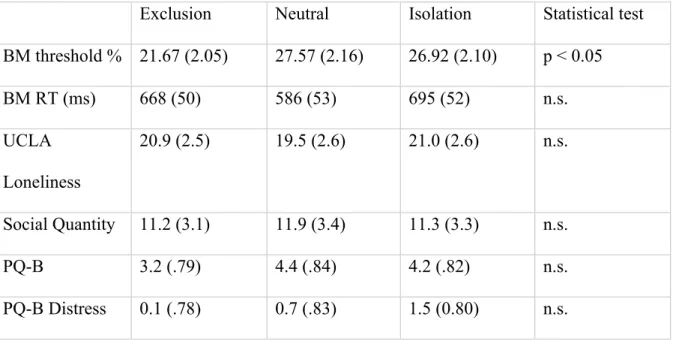
The results of the BM task are presented in Table 2 and in Figure 2. Average biological motion classification thresholds were compared across the Exclusion, Isolation and Neutral social manipulation groups. We replicated a statistically significant main effect of group (F(2,57)= 3.15, p < 0.05), with t-tests showing significant differences in
perceptual discrimination between the Exclusion and the Isolation conditions (t(36) = 2.21, p = 0.02,) and between the Exclusion and Neutral (t(36) = 1.77, p = 0.04). There was in fact no significant difference found between the Isolation and Neutral groups (p = 0.57).
See Figure 3.
Figure 3.
Effects of Social Manipulation on Biological Motion Classification Threshold
Fig 3. Significant difference in interpretation of social stimuli was found between the Excluded experimental group and Neutral groups, as well as between Excluded and Isolated groups. Error bars are across observers.
No significant difference was found between Neutral and Isolation conditions.
Table 6.
Group Differences on Measures Collected Post-Social Manipulation
Exclusion Neutral Isolation Statistical test BM threshold % 21.67 (2.05) 27.57 (2.16) 26.92 (2.10) p < 0.05
BM RT (ms) 668 (50) 586 (53) 695 (52) n.s.
UCLA Loneliness
20.9 (2.5) 19.5 (2.6) 21.0 (2.6) n.s.
Social Quantity 11.2 (3.1) 11.9 (3.4) 11.3 (3.3) n.s.
PQ-B 3.2 (.79) 4.4 (.84) 4.2 (.82) n.s.
PQ-B Distress 0.1 (.78) 0.7 (.83) 1.5 (0.80) n.s.
Average BioMotion Scramble Threshold
0 5 10 15 20 25 30
Exclusion Neutral Isolation
Social Manipulation Condition
Mean
There were no significant group differences in UCLA Loneliness scores, Social Quantity or Prodromal symptom endorsement. However, regardless of social
manipulation, increased Loneliness was again found to be positively correlated with increased PQ-B (ρ = 0.55, p < 0.001). As in Experiment 1, we did not find a relationship between subjective Loneliness and BM perception threshold (ρ = -0.13, p = 0.386). We did not find a significant relationship between PQ-B Distress and BM threshold, as PQ-B endorsement was minimal.
In the second, forced choice Recognition task, we again found group differences after social manipulation. Average False Alarms (endorsing biological motion where it is ambiguous or not present) were compared across the Exclusion, Isolation and Neutral social manipulation groups and a statistically significant main effect of group was found (F(2,57)= 4.01, p < 0.05), with t-tests showing significant differences in perceptual
discrimination between the Exclusion and the Isolation conditions (t(36) = 2.09, p = 0.02,) and between the Exclusion and Neutral (t(36) = 2.92, p = 0.006). No significant difference was found between Isolation and Neutral manipulation conditions on False Alarm rate (t(36) = 0.57, p = 0.56). See Figure 4. D’ was calculated revealing no significant
differences, driven by a high average Hit rate which also did not differ significantly. No relationship was found between Recognition task abilities and Loneliness scores. However, a trend relationship between scarcer daily social interaction and more frequent
endorsement of biological motion in random noise was observed (ρ = - 0.24, p = 0.06).
Figure 4.
Effects of Social Manipulation on Biological Motion False Alarm Rate
Discussion
Results from Experiment 1B replicated the findings from Experiment 1A in that an acute episode of social isolation significantly altered one’s judgments about the visual portrayal of human activity in PL animations. Participants in the Exclusion group again showed significantly altered judgments of BM compared to those comprising the Neutral group. Attempts to clarify contributing factors to this alteration by including a pure
Isolation group indicate that the Isolation group and Neutral groups differ from one another on measures of social perceptual discrimination. This suggests that acute social defeat and exclusion compared to simple absence of social stimulation may be more important in altering social perception in an, on-average, highly socially saturated population. As in Experiment 1A, distress levels on the PQ-B and average subjective loneliness were very low in this student population. Despite this, brief exclusion altered social perception.
Forced Choice Task False Alarms
0 5 10 15 20 25 30
Exclusion Neutral Isolation
Social Manipulation Condition
Exp Group?
1 2 3