AN UNDERGRADUATE THESIS
IMPROVING THE STUDENTS’ READING COMPREHENSION BY USING CIRC STRATEGY
AT THE EIGHTH GRADE OF SMPN 10 METRO IN ACADEMIC YEAR OF 2016/2017
By:
INDARTIANA Student Number:1292177
Tarbiyah Faculty English Education Department
STATE ISLAMIC ISTITUTE OF METRO 1438 H/2017 M
Presented as a Partial Fulfillment of the Requirements for the Degree of Sarjana Pendidikan (S.Pd)
in English Education Department
By:
INDARTIANA Student Number 1292177
Tarbiyah Faculty
English Education Department
Sponsor : Dr. Widhiya Ninsiana, M.Hum Co-sponsor : Trisna Dinillah Harya, M.Pd
STATE ISLAMIC ISTITUTE OF METRO 1438 H/2017 M
ii
IMPROVING THE STUDENTS’ READING COMPREHENSION BY USING CIRC STRATEGY
AT THE EIGHTH GRADE OF SMPN 10 METRO IN ACADEMIC YEAR OF 2016/2017
ABSTRACT BY INDARTIANA
The purpose of this research was to know whether the use of Cooperative Integrated Reading and Composition (CIRC) strategy can improve the students’
reading comprehension in English learning at the SMPN 10 Metro.
The kind of this research was classroom action research (CAR) which was conducted in two cycles. Each cycle consists of planning, acting, observing and reflecting. Object of this research was the students’ reading comprehension. In collecting the data, used test, observation, and documentation.
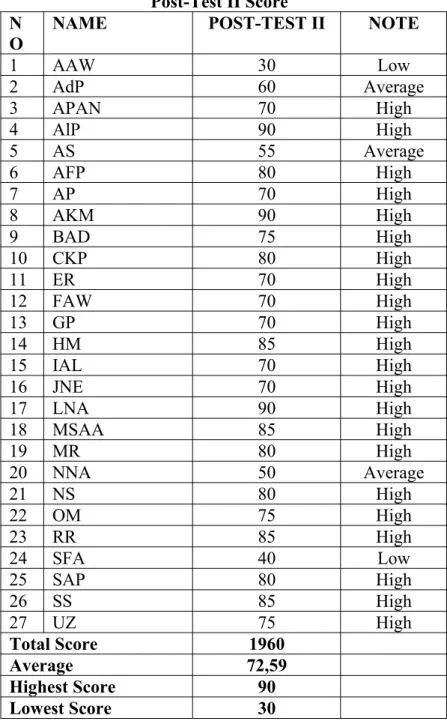
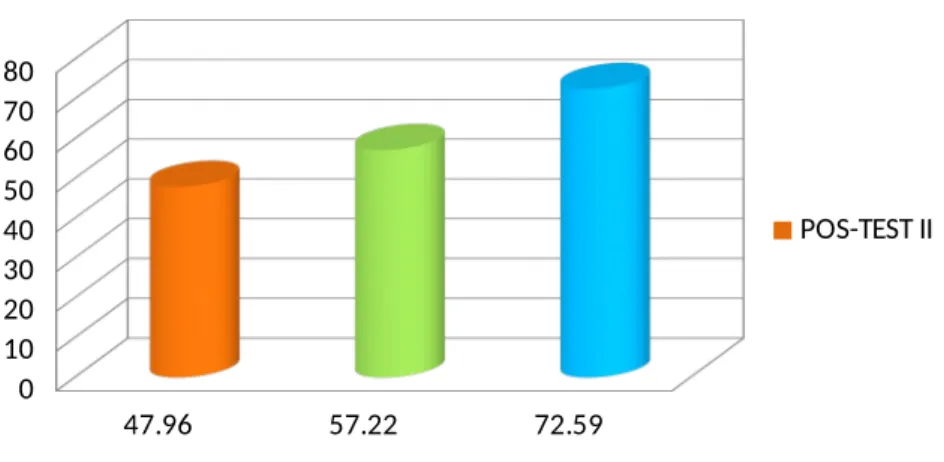
The result of this research showed that Cooperative Integrated Reading and Composition (CIRC) strategy had positive role in improving the reading comprehension at the eighth grade of SMPN 10 Metro. It can be proved by the students’ average score from pre test to post test. The average score in pre test was 47,96 and in post test was 57.22 became 72.96. It means that the using of Cooperative Integrated Reading and Composition (CIRC) strategy in reading especially text can improve the students’ reading comprehension. Based on the result above, could be conclude that by using CIRC as a alternative strategy to improve the students’ reading comprehension at the SMPN 10 Metro.
Key word : Reding comprehension, CIRC strategy, CAR
iii
ABSTRAK OLEH INDARTIANA
Tujuan penelitian ini adalah untuk mengetahui apakah penggunaan Cooperative Integrated Reading and Composition (CIRC) memperbaiki kemampuan pemahaman membaca siswa dalam pelajaran Bahasa Inggris di SMPN 10 Metro.
Penelitian ini menerapkan Penelitian Tindakan Kelas (PTK) yang dilakukan dalam 2 siklus. Setiap siklus terdiri dari perencanaan, tindakan, pengamatan dan refleksi. Objek dari penelitian ini adalah pemahaman membaca siswa. Pengumpulan data menggunakan test, observasi, dan dokumentasi.
Hasil dari penelitian ini menunjukkan bahwa Cooperative Integrative Reading and Composition (CIRC) memiliki peran positif dalam meningkatkan kemampuan pemahaman membaca siswa kelas VIII SMPN 10 Metro. Hal ini dapat dibuktikan berdasarkan nilai rata-rata mereka mulai dari pre-test ke post- test. Nilai rata-rata siswa pada saat pre test adalah 47,96, dan post test 57,22 menjadi 72,59. Ini berarti penggunaan strategi Kooperative Integrated Reading and Composition (CIRC) dapat memperbaiki pemahaman baca. Penggunaan CIRC sebgai salah satu strategi untuk memperbaiki pemahaman membaca siswa di SMPN 10 Metro.
Kata kunci : Pemahaman membaca, Strategi CIRC, Penelitian Tindakan Kelas.
iv
v
Name : INDARTIANA
NPM : 1292177
Study Program : English Education Department Department : Tarbiyah
States that this undergraduate thesis is originally the result of the writer’s research, in exception of certain parts which are excepted from the bibliography mentioned.
Metro, Febuary 2017 The Writer
INDARTIANA St. Number 1292177
vi
ORISINALITAS PENELITIAN
Yang bertandatangan dibawah ini
Nama : INDARTIANA
NPM : 1292177
Jurusan : Tadris Bahasa Inggris
Menyatakan bahwa skripsi ini secarakeseluruhan adalah asli hasil penelitian saya kecuali bagian-bagian tertentu yang dirujuk dari sumbernya dan disebutkan dalam daftarpustaka.
Metro, Febuari 2017 Penulis
INDARTIANA St. ID1292177
vii
ِلله ِلْيِب َس ىِف َوُهَف ِمْلِعْلا ِبَل َط ىِف َج َر َخ ْنَم
“"Those who are looking out for Those who are looking out for knowledge then they are on the path of Allah"Those who are looking out for . ( HR. Turmudzi)
viii
DEDICATION PAGE
I highly dedicate this undergraduate thesis to:
1. My beloved parents, Mr. Damiri and Mrs. Salamiyah who always support me in their endless love.
2. My lovely brother and sisters there are Safrianda, Riantori Eka Saputra, Samsul Arifin, Devita Puspita Sari, and Elvera Desma, who have given wonderful motivation to me.
ix
life, that the researcher finally can finish the undergraduate thesis entitled“Improving Students’ Reading Comprehension by Using Cooperative Integrated Reading and Composition (CIRC) Atthe Eighth Grade of Junior High School 10 Metro in Academic Years 2016/2017”. This undergraduate is arranged as fulfillment of the requirement for the degree of Sarjana Pendidikan (S.Pd) in State Islamic Institute of Metro.
The first of all, the deepest gratitude would be addressed to my beloved parents, Mr.Damiri and Mrs.Salamiyahfor their endless love, for understanding and supporting me to finish the undergraduate thesissoon, and always pray for me to be successful person someday (amin). The greatest gratitude would also be addressed to both of my advisors,Dr. Widhiya Ninsiana, M.Humand Trisna Dinillah Harya, M.Pd who have constantly given their endorsement, time and guidance so that researcher could finish the undergraduate thesis.
Hopefully, this undergraduate thesis can give many advantages to all of us properly.
Metro,Febuary 2017
Indartiana St. Number 1292177
x
TABLE OF CONTENTS
COVER...
I
TITLE... II ABSTRACT... III APPROVAL PAGE... V STATEMENT OF RESEARCH ORIGINALITY... VI MOTTO... VIII DEDICATION PAGE... IX ACKNOWLEDGMENT... X TABLE OF CONTENT... XI LIST OF FIGURES...
...
XIV
LIST OF TABLES...
...
XV
LIST OF APPENDIXES...
...
XVII
CHAPTER I INTRODUCTION... 1
A. Background of The Study... 1
B. Problem Identification ... 4
C. Problem Limitation ... 4
D. Problem Formulation ... 4
E. Objective of The Study ... 4
F. Benefits of The Study ... 5
CHAPTER II REVIEW OF THE RELATED THEORIES... 6
A. Theoretical Review... 6
1. Reading Comprehension... 6
a. Concept of Reading Comprehension... 7
b. Types of Reading... 9
c. Strategy of Teaching Reading Comprehension... 11
d. Reading Assessment... 13
e. Recount Text... 15
xi
b. Prosedurof CIRC Strategy... 21
B. Action Hypothesis... 23
CHAPTER III RESEARCH METHODOLOGY... 24
A. Variable and Definition Operational Variable... 24
B. Setting of the research... 24
C. Object of the study... 25
D. Action Plan... 25
1. Cycle 1... 26
2. Cycle 2... 39
E. Data Collation Method... 30
1. Test ... 31
2. Observation ... 31
3. Documentation ... 32
4. Filed Note... 32
F. Data Analysis Method ... 32
G. The Indicator of Success... 34
CHAPTER IV RESULT OF THE RESEARCH AND INTERPRETATION... 35 A. Result of the Research... 35
1. Description of Research Location... 35
a. History of SMPN 10 Metro... 35
b. Condition of Teacher Official Employers at SMPN 10 Metro... 36 c. Quantity Student of SMPN 10 Metro ... 38
d. Building of SMPN 10 Metro ... 38
e. Organization Structure of SMPN 10 Metro ... 39 f. Location Sketch of SMPN 10 Metro ... 40
2. Description of the Reserch ... 41
xii
a. Cycle I ... 41
b. Cycle II ... 50
B. Interpretation ... 57
1. Cycle I ... 57
2. Cycle II ... 58
3. Student’ Score in Pre-test, Post-test Cycle I, and Post-test Cycle II... 59 4. The Result of Students’ Learning Activities in Cycle I and Cycle II... 61 C. Discussion ... 63
CHAPTER V CONCLUSION AND SUGGESTION ... 65
A. Conclusion ... 65
B. Sugestion... 66
BIBLIOGRAPHY APPENDIXES
CURRICULUM VITAE
xiii
Page Figure 1 : Sequences of action-reflection cycles... 26 Figure 2 : Organization Structure of SMPN 10 Metro... 39 Figure 3 : Location Sketch of SMPN 10 Metro in Academic Year
2016/2017... 40 Figure 4 :Graph of the result of Pre-test, Pos-test I, and Pos-test II... 60 Figure 5 : Graph Of Student’s Result of Learning Activities In Cycle I And
Cycle II... 62
xiv
LIST OF TABLES
Page
Table 1 : Students’ Reading Score at Class D... 2
Table 2 : Generic Structure of Recount Text... 18
Table 3 : Linguistic Feature of Recount Text... 19
Table 4 : The Subject of the Research...24
Table 5 :Condition of Teacher and the Official Employers at SMPN 10 Metro in Academic Year 2016/2017 ...36
Table 6 : Students Quantity of SMPN 10 Metro in Academic Year 2016/2017...38
Table 7 : Building of State SMPN 10 Metro in Academic Year2016/2017...48
Table 8 : Pre- Test Score of Reading Recount Text...41
Table 9 :Students’ Reading Score at class D...42
Table 10 : Post-Test 1 Score of Reading Recount Text...45
Table 11 : Students’ Mark of Post-test I of Reading...46
Table 12 : Students’ Mark of Post-test I of Reading...47
Table 13 : Students’ score at Pre-Test&Post-Test I of recount Text...59
Table 14 : Post-Test II Score of Reading Recount Text...52
Table 15 : Students’ Mark of Post-test II of Reading Comprehension...53
Table 16 : The Students’ Activity in Cycle II...54
Table 17 : Students’ Score at Post-Test I and Post-Test II of Reading Recount Text...55
Table 18 : The Table of Students’ Activities in Cycle I and Cycle II...55 xv
Table 20 : The Table of Students’ Activities in Cycle I and Cycle II...61
xvi
LIST OF APPENDIXES
1. Attendance List... 69
2. Syllabus... 73
3. Lesson Plan... 87
4. Instrument Pre-Test ... 107
5. Instrument Post-Test... 110
6. Key Answer ... 118
7. Answer Sheets... 119
8. Observation Sheet of Students... 128
9. Observation Sheet of Teacher... 132
10. Students Score... 135
11. Documentation of Research ... 138
12. Research Letter... 142
13. Curriculum Vitae ... 147
xvii
A. Background of The Study
Language is a system of arbitrary conventionalized vocal, written, or gestural symbol that enable members of a given community to communicate intelligibly with one another. Many languages are used in this world, one of which is English. Nowdays, it has become an international language that is almost used by all countries as the first, the second or the foreign language. Moreover, it has been declared as a formal language on international communication for a long time ago.
Reading is not easy to be learned because it needs maximal reading skill.
Many problems that faced by reader when they want to achieve a purpose of reading. Those problems are about reading habit, reading technique, motivation and reading interest. Motivation is needed by reader to read texts or books.
Unfortunately, most of readers do not have motivation to read, they think that reading is something bored.
Reading is very important because by mastering reading comprehension, people can get information and add their knowledge from the text. There are many different purposes for reading. Sometimes we read a text to learn material, sometimes we read for pure pleasure, and sometimes we need to follow a set of directions. As a student, many of reading texts will be learnt assigned material.
1
2
We get information from everything we read and yet we do not read everything for the same reason or in the same way or at the same rate.
Cooperative Integrated Reading and Composition (CIRC) is learning model where the students divided into some group and usually each group consist of four or six members. This technique is used to improve rading and composition or writing. It consist of some mojor component namely reading groups, teams, story related activities, partner checking, test, direct instruction in reading comprehension, and integrated language arts and writing. With Cooperative Integrated Reading and Composition (CIRC), students learn to use combination some strategies that support their understanding of some texts by using Cooperative Integrated Reading and Composition (CIRC). A pre-survey research had done on February 12th, 2016.
Table 1
Students’ Reading Score at class D
No Score Explanatio
n
Frequenc y
Percentage
1 ≤ 70 Fail 20 74,07%
2 ≥ 70 Pas s 7 25,92%
Total 27 100%
Source: Teacher’s archive, English Reading Score at the Eighth Grade of SMPN 10 Metro, on Febuary 12th, 2016.
Referring the Table 1, it can be seen that total students at the Eighth Grade of SMPN 10 Metro are 27 students. The English minimum passing grade in this
school is 70. It means that the students who got the score below 70 do not pass the examination. In fact, there are only 7 students got ≥ 70 or 25.92% who pass the minimum passing grade and 20 students got ≤ 70 or 74,07%. The average score is 57, 5 the total of students, it can be concluded that students’ reading score at the Eighth Grade is still low.
Another case on students’ reading comprehension of the eighth grade, those are: 1) students do not more motivation to read in English text; 2) students have low score in reading subject; 3) students do not know how to conclude the meaning of reading text well; 4) students have the difficulties in to comprehend a text; and 5) students have lack vocabulary.
To minimize the problem above, the researcher is interested in finding out an effective way in teaching English, especially in improving students’ reading comprehension by using Cooperative Integrated Reading and Composition (CIRC).
The goal of applying CIRC strategy is it can improve reading comprehension and raise up conceptual learning in maximizing participation for the learners. So, it is expected giving good effect for increasing good score in reading subject. Consequently, the researcher proposes to improve the students’
reading comprehension by using Cooperative Integrated Reading and
4
Composition (CIRC) strategy at the Eighth Grade of Junior High School 10 Metro in Academic Year 2016/2017”.
B. Problem Identification
Based on the background above, the problem can be identified as follows:
1. The students have not more motivation to read a English text.
2. The students have low score.
3. The students have the difficulties to comprehend a text.
4. The students have lack vocabularies.
5. The lack of using strategies in learning prosess.
C. Problem Limitation
In line with the problems mentioned above, the writer limits the problem only the students’ have to comprehend a text the eighth grade students of SMPN 10 Metro.
D. Problem Formulation
The problems that study in this research is formulated as follows:
Can the Cooperative Integrated Reading and Composition (CIRC) strategy improve the students’ reading comprehension of the eighth grade students of SMP N 10 Metro?
E. Objectives of the Study
Generally, the objective of this research is to improve the students’ reading comprehension at the eighth grade in SMPN 10 Metro; specifically, it is to find out whether Cooperative Integrated Reading and Composition (CIRC) can improve students’ activities in learning English.
F. Benefit of The Study
The results of this classroom action research are expected:
1. For the Teachers:
As a information to English teacher if CIRC can be effectivess to improve students’ reading comprehension.
2. For the students:
As motivation for the students to learning reading.
3. For the School
This research can be used as information to improve learning English in the future.
CHAPTER II
REVIEW OF RELATED THEORIES A. Theoretical Review
1. Reading Comprehension
Reading is about understanding written texts. It is a complex activity that involves both perception and thought.1 In reading there is a process of constructing meaning between reader and text. Comprehension has an important role in reading because with it students can understand and interpretwhat is the meaning of the text. This chapter will discuss about reading, reading comprehension, Cooperative Integrated Reading and Composition, and Classroom Action Research.
Terminologically, there are some experts that have different definitions for reading, but here the researcher will take several definitions according to the expert as follows:
According to Anthony, Pearson, and Raphael in Thomas S.C Farrell state that reading is the process of constructing meaning through the dynamic interaction among the reader’s existing knowledge, the information suggested by the written language, and the context of the reading situation.2
Moreover, Tri Wiratno sates that reading is absorb written text to get the comprehension of the content3. It means that to get information of
1Elizabeth S, Pang et.al, Teaching Reading, IAE, Palais des Academies, Switzerland, 2003 P.6
2 Thomas S.C. Farrell, Planning Lesson for a Reading Class, Singapore, SEMEO Regional Language Centre,2002, P.1
3 Tri Wiratno, Mencerna Buku Text Bahasa Inggris Melalui Pemahaman Gramatika.
Pustaka Fajar Yogyakarta, 2002, P.162
6
the text, the reader should comprehend more about written text meticulously and carefully. This statement is supported by Aebersold and Field who state that “Reading is what happens when people look at the text and assign meaning to the written symbols in that text”.4 It is the interaction between the text and the reader that creates meaning.
Furthermore, Soedarsono states that reading is a complex activity which uses all of separate actionincludes comprehension and fantasy, observation, and remembering.5
Based on the quotations above, the reading is assumed that is a complex activity which is very important involving the language and thought in order to get meaningful message, science or information which is sent by the writer trough printed language or text such as graphic, symbols, written verbal symbols, it is the interaction between text and reader in making meaning. Reading is used to ease people get information from the text, book, newspaper, magazine and other.
a. The Concept of Reading Comprehension
Comprehension is the understanding and interpretation of what is read. To be able to accurately understand written material, children need to be able to 1) decode what they read; 2) make connections between what they read and what they already know: 3) think deeply about what they have read. One of big part of comprehension is having
4 Thomas S.C.Farrell, P.ii
5Soedarsono, Sistem Membaca Cepatdan Efektif, Gramedia PustakaUtama, Jakarta, 2010, P.4
8
a sufficient vocabulary, or knowing the meanings of enough words.
This quotation is supported by Walter and Eileen Kintsch in Scott and Steven (2005) state that comprehension is not single unitary process. It requires the delicate interaction of several component processes that integrate information for the page that the student is reading with his or her background knowledge and experience, subject to multitude of contextual constraints.6
Moreover, Elizabeth S. Pang and friends states that ability is the process of deriving meaning from connected text. It involves word recognition (vocabulary) as well as thinking and reasoning.7 Based on these quotations the researcher can make a conclusion that ability is a unitary process which requires delicate information, understanding and interpretation from reading material and students can understand it with their background knowledge and experience.
There are many experts that have different definition of reading comprehension. Douglas Brown states that reading comprehension is primarily a matter of developing appropriate, efficient comprehension strategies.8 It means that reading comprehension purpose is to efficiency of reading. Furthermore, in reading activities, students should have good reading comprehension to get information from the reading text.
6 Scott G. Paris and Steven A. Stahl, P.71
7Elizabeth S, Pang et.al, P. 14
8 H. Douglas Brown, Teaching by Principles an Interactive Approach to language Pedagogy second edition (San Francisco State University 2000),P.306
According to Kasihani (2007), reading comprehension is one of reading activities, the aim is to get information from the text or passage which is read. It means that after reading students are expected get general information of the text. Harris and Sipay (1980) in Ria state that reading comprehension is taught to be a set of generalized knowledge acquisition skills that permit people to acquire and exhibit information gained as a consequence of reading printed language9.
Based on the quotations above, the researcher can make a conclusion that reading comprehension is looking for the information suggested from the text or written language, the readers understand the total meaning of the reading text selection.
b. Types of Reading
1) The Models of Reading
There are three models of reading as follows:
a) Top-down Model
Top-down model is a reading model which argues that readers bring prior knowledge and experiences to the text and that they continue to read as long as the text confirms their expectations.10
b) Bottom-up Model
9AntengRia, Undergraduate Thesis, The Teaching of Reading Comprehension by Using Small Group Discussion,Uneversitas Negeri Semarang, 2006,P. 9
10 Thomas S.C. Farrell, P.2
10
Bottom-up model is a reading model which suggests that a reader reads the words, and sentences and looks at the organization of the text (without relating it to experience or prior knowledge ) in order to construct meaning from what was written in the text, meaning depends both on vocabulary and syntax. 11
c) Interactive Model
Interactive model is a reading model which argues that both top-down and bottom-up-down reading processes occur when person reads a text12. It means combination between top- down and bottom–up process.
2) Influence Factors in Reading
Aebersold and Field (1997) have compiled a list of factors that may influences reading in a second or foreign language as follows:
a) Cognitive development and learning style orientation at the time of beginning second/foreign language study.
b) Language proficiency in the first language and the foreign language.
c) Metacognitive knowledge of the first language structure, grammar, and syntax.
11Thomas S.C. Farrell, P.3
12Ibid
d) Cultural orientations, attitudes toward text and purpose for reading.13
c. Strategy of Teaching Reading Comprhension Reading Comprehension Strategies
Based on thomas reading comperehension strategies devided into;
a) Activating Prior Knowledge
In this case teachers can play a vital role in seeing that the readers’ knowledge about the new topic is built up so they can successfully comprehend a new text.14
b) Predicting
Prediction creates anticipation and gets students thinking about previous experiences they may have had about the topic before they read about it.15
c) Skimming
Skimming is a reading strategy that involves students looking through the text rapidly for the general meaning of an article. It means getting the main point or gist before one reads for detail.16
13 Ibid, P.5
14 Thomas S.C.Farrell, P.24
15Ibid, P.27
16Ibid, P.28
12
d) Scanning
Scanning is a reading strategy that involves students reading a text in order to find specific information.17
e) Guessing meaning of unknown words using contextual clues
Sometimes students may need to guess the meaning of a word they do not know while reading a text because they have no dictionary or they are in an examination type situation.18
f) Identifying topic and main ideas
Mikukecky suggest that students practice these skills in a developmental sequence from simple to more complex cognitive tasks. For example, the sequence of exercises includes the following:
1. Finding the topic from a list words 2. Recognizing the topic of a paragraph 3. Identifying the main idea of passage.19 g) Use of questions
Another important strategy good readers use is questioning. Asking before reading and posing question
17Ibid, P.29
18Ibid, P.30
19Ibid, P.35
while reading are strategies that have been identified as being effective by fluent readers of English.20
d. Reading Assessment
One of the causes why informal measurement strength result in good performances is the emotional state of the reader persuade by the test. Commonly apprehensive readers might hopes threatening conditions, for instance during study reading, regardless of expressed intentions.21
Davey argued the contribution of part of variables, question, and format types on reading performance. The question-type variable is place of information and conclusion type, and the multiple-choice format variables were things like steam length(stem is the first part of a multiple-choice question, appearing before the optional choices), stem content words, stem-unique content words (unique content words are those nouns, verbs and modifiers that appear in the question but not passage), true choice length, false choice plausibility, and so on.22
There are many assessment of first-language reading is dialed with the recognition of such components, and many test batteries particularly require to measure diagnostically.23
Reading performance assessment has different goals. The first one is to compare students’ understanding levels that of students in a
20Ibid, P.38
21 J. Charles Alderson, Assessing Reading, Cambridge, United Kingdom, 2000, P.54-55
22 J. Charles Alderson, P.88
23 Ibid, P.111
14
norming example. The second one is to find out if students have match pre-established criteria for their class level. And the third goal is to inform guidline to determine when students understand what they read and how efficiently they use which understanding strategies.
Same as an important goal is establish why a student possiblestruggling. The teachers should be adept at collecting assessment data so that they can plan what, how, and when to teach.24
The kinds of assessment substance and activities the teacher (or other examiner) uses must be determined by the goal of the assessment. If the teacher know what kind of information need, their be able to establish what process to follow. 25
Employing of available reading comprehension assessment typically distance fromestablishing a student’s reading comprehension ability relative to a normative group, to determining students’ general power and disadvantage, to assessing a student’s reading level, and to assisting teachers, researchers, and others in establish the effects of an intervention on reading comprehension. For example, comparing a student’s scores with those of other-age or –grade students needs a normative assessment. Seeking information about what a student does while reading needsa personall assessment that includes reading aloud.26
24Janette K. Klinger, P.14
25Ibid
26Ibid, P.16-17
There are some reasons for assessing reading and the skills and knowledge that are involved in reading. They include assessing to motivated learning, assessing to monitor development and give feedback, assessing to diagnose problems, and assessing to survey proficiency. The similiar to form of assessment possible used for a variety of purposes.27
e. Recount Text
1. Understanding of recount text
The definition of text is important to be known. Before the writer explains about recount text the writer will explain about the text first. When talking about the text, it can be known that it was a group of word related each other into sentence, and a group of sentence related each other into paragraph and create a meaning.
So, people can communicate easily each other. Mark and Kathy also highlight in their book that “people live in the world of words, when these words are put together to communicate a meaning, a piece of text is created. When we speak or write to communicate a message, we are constructing a text. When we read, listen to, or view a pieceof text. We are interpreting its meaning.”28
They are two type of text, literally and factual. Literary text include aboriginal dreaming stories, movie scripts, limericks, fairy
27 I.S.P Nation, Teaching Esl/EFL Reading and Writing, Routledge, New York, 2009, p.75
28 Mark Anderson and Kathy Anderson, Text Type in English, (South Yara: McMillan, 1997),P.1.
16
tales, plays, novels, song lyrics, mimics and soap operas. Their constructed to appeals our emotions and imagination. There are three main text types in this category, narrative, poetic and drama.
While factual type includes advertisement, announcement, internet website, current affair shows, debates, recipes, report and instruction. They present information or ideas and aim to show, tell or persuade. The main text type in this category is recount, response, explanation, discussion, information report, exposition and procedure.29 In other word, the purposes of this type are to persuade, to inform and to construct the reader.
In this research the writer only focuses on recount text. Anderson clearly highlight in his book that “recount is a piece of a text that retells past events, usually in the order in which they happened.
The purpose of a recount is to give the audience a description of what occurred and when it occurred.30 This statement also supported by Mukarto dkk, they clearly highlight in their book that
“personal recount usually retells an experience in which the writer was personally involved. It list and describe past experiences by
iretelling events. It presents the events chronologically. (in the order iiin which they happened). The purpose of personal recount are to inform, entertain the audience (listeners or readers), or both.31
29 Ibid. P. 3.
30 Ibid, P.48.
31 Mukarto, dkk, EOS English on Sky 2, (Jakarta:Erlangga, 2006), P. 62.
Recount is a text which retells events or experiences in the past. Its purpose is either to inform or to entertain the audience.22 Form those statements above, it can be conclude that recount text is a part of category of factual text because it give the explanation of some information and ideas that really happen. In other word, the purpose of a recount is to list and describe past experiences by retelling events in the order in which they happened (chronological order). Recounts are written to retell events with the purpose of either informing or entertaining their audience (or both).
2. Generic Structure of Recount Text
There are three important generic structures that take account on recount text described detail bellow.
1.Orientation
This is the introductory part of the story. It provide the background information where the author tell the reader who is in the story, where the story is happening, and when the story take place. From this part the reader can get the insight what will happens in the next part of the story.
2.Events
It presents events: what people do? It tells the events chronologically. It uses conjunctions or connectives like: first, next, then, finally and so on. They show the sequence of events 3. Re-orientation
18
It presents the concluding comments. It expresses the author’s personal opinion regarding the events described.32
3. The Example of Recount Text Table 2
Generic Structure of Recount Text Generic
Structure
A beautiful day at jogja
Orientation This morning my friends and I went to EOS studio. It’s not very far from our school,
so we just rode our bicycles
Events First, we met Shanty and Rico outside the studio. Then, they took us into the studio and
showed us around. After that, we had lunch at
EOS canteen. The food was delicious.
Before
we went home, we took some photographs
with Shanty and Rico
Re-orientation It was tiring but we were very happy.
Table 3
32 Mark Anderson and Kathy Anderson, Text Type in English, (South Yara: McMillan, 1997),P. 50.
Linguistic Feature of Recount Text Past tense Went, rode, met, took, showed, Connectors First, then, after that, before, but
This morning, EOS Studio, EOS Canteen (Adapted from 2nd grade junior high school of English text book)25
2. The Concept of Cooperative Integrated Reading and Composition (CIRC)
a. Definition of CIRC
CIRC is a comprehensive strategy to instruction in reading, composition, and spelling for upper grades of elementary level.33 It means that CIRC is more suitable for the advanced English learner especially for reading and writing. In other hand, we can say that it is a good strategy in teaching learning reading.
CIRC provides a structure to help teachers and students succeed in helping all students become effective reader.34 It means this strategy s recognized the students in reading effectively. It really help the teacher teaches easily.
Madden (2004) stated that studies that CIRC is teaching technique that focuses on two skills,reading and writing.35 It means this technique focuses on cooperative learning that emphasizes on group study creating effective learning. In addition, reading, writing and other language arts are included in the technique. This technique
33 International Journal of Research in Humanities, Arts and Literature
34 Ibid
35 Dwi Sundary.S, THE EFFECT OF COOPERATIVE INTEGRATED READING AND COMPOSITION (CIRC)
20
accommodates contextual and effective learning to gain purpose of reading comprehension.
Hadiwinarto argued that CIRC learning model can improve students’ learning motivation.36 It means that CIRC learning process prioritizes the cooperation that can develop skills in appreciatingothers’ opinions, telling opinions, practicing patience in waiting for the turn, speaking skill, activelistening skill, asking skill, and checking precision.
According to Senemoglu CIRC strategy is developed to support traditionallyused “skill-based reading groups” approach.37 It means that They help each other inperforming basic skill-building activities (such as oralreading, contextual guessing, asking questions summarizing, writing a composition based on the story,revising- correcting composition). In general, team books are published at the end of this process. Teams are rewarded for all reading and writing assignments on thebasis of the average performance of group members. Thus, equal change for achievement, group support for achievement, and the performance, all basic componentsnof cooperative learning ensure realization of personal responsibility b. Prosedur of CIRC Strategy
36 Hadiwinarto, Novianti. (2015). The Effects of Using CIRC Model on the English
Learning Skills among Junior High School Students. Journal of Education andLearning. Vol.9 (2) P. 117-124.
37 Educational Research and Reviews Vol. 6(1), P. 102-109, January 2011
CIRC consists of three principal elements: basal-related activities, direct instruction in reading comprehension, and integrated language arts and writing.
Rachmad Widodo describes the steps of this method. The steps are:
1) Make groups consist of 4 members heterogeneously 2) Teacher give text with of topic learning
3) Students cooperate read to each other, find main idea, and give opinion to text. At the end, the students write the result on the paper.
4) Make presentation or read to the result from group’s discussion 5) Have the students to make conclusion
6) closing
From describe in above that conclude steps of CIRC in learning process. Students work in a group to understand the main idea and master other comprehension skills. They work on materials appropriate to their reading level. They have equal opportunities for success. CIRC provide a structure for teacher to teach and students to learn which help all students become more effective readers and writers .
While,also proposes some steps of conducting CIRC that students can be active in joining the teaching learning process.
1). Grouping the class that consists of four students heterogeneously
22
2). Teacher gives a text/ clipping which is appropriate with the topic 3). Students work together in reading and finding main idea and
giving idea toward the discourse/ clipping which is and they are written on paper
4). Presenting/reading the result
5). Have the students to make conclution 6). Closing
In reference to the explanation above, the steps of CIRC used in the
classroom activities contribute to the students’ reading learning process. The steps of CIRC should be appropriate to the students. So, the teacher can achieve the target of achieving students’ learning process. From the explanation of the steps of CIRC from some experts above, it can be concluded that the steps of CIRC should be included with teacher presentation, grouping consisted of four or three students, giving a text that appropriate with the topic, working in group doing some tasks based on the text and topic, discussion, presenting the result of students’ work, teacher’ conclusion, and closing.38
38J. Charles Aldersont, p. 89
B. Action Hypothesis
Based on the frame of theories and assumption the researcher formulates the hypothesis as follows:
By using Cooperative Integrated Reading and Composition (CIRC) strategy, the students will be able to improve their reading comprehension at the eighth grade students of SMPN 10 Metro.
i ii
A. Variable and Definition Operational Variable
The research is the Classroom Action Research. This is research conduct in SMPN 10 of Metro in the academic year 2016/2017. In this research the writer will investigate the eighth grader of SMPN 10 of Metro in the academic year 2016/2017.
B. Setting of the research
This research is Classroom Action Research (CAR). The writer conduct this research at the eighth grade of SMPN 10 of Metro in academic year 2016/2017.
It contains 27 students with the explanation as follows:
Table 4.
The Subject of the Research
No Class Sex
Total
Male Female
1 VIII 8 19 27
Total 8 19 27
The writer selects this class because most of students did not get the creteria minimum standart grade of English mainly in reading comprehension.
Furthermore, it has the lowest English ability, especially in reading. Moreover, the students are also not interested in learning English.
24
25
C. Object of the Study
The object of this research is the students' reading comprehension. The kind of this research is Classroom Action Research. In this research, the writer collaborate with an English teacher, his name is Mr. Mahyudin Efendi, S. Pd. as the object is reading comprehension, the teacher or writer should know how to select the reading material in this research. Thus, the writer and the teacher will determine to select the reading text.
D. Action Plan
Classroom Action Research is a method to find out what works best in your own classroom so that student learning be improved. The goal of CAR is to improve the teacher's teaching in the classroom (or your department or school).17 In this classroom action research, the researcher conduct the research in two cycles. Between one cycle with the other has relationship. They are include of planning, action, observation, and reflection.
17 Mettetal Gwynn. The What, Why and How of Classroom Action Research. Volume 2, Number 1 (2001). Indiana University. P.7
Figure 1.
Sequences of action-reflection cycles18
Classroom Action Research (CAR) Cycles are:
1. Cycles 1 a. Planning
Planning is the first step in each activity. Arikunto states that in this step the researcher explain about what, why, when, where, who, and how doing action.19 Without planning, the researcher’s activity not be focus. The planning be reference for doing action. In the
18 Suharsini Arikunto, Dasar – dasar Evaluasi Pendidikan (Jakarta:Bumi Aksara, 2003).,
p.16.
19 Ibid, p.17.
Reflecting
Planning Cycle I Observing
Planning Cycle II Observing Reflecting
Acting
Acting
27
planning, the researcher focus to make lesson plan. The researcher conduct some plans namely:
1) The researcher identified the problems and found the problem solving.
2) The researcher made a lesson plan to teach reading.
3) The researcher prepared the material, technique, and media of teaching reading.
4) The researcher prepared observation and evaluation sheet.
b. Action
According to Arikunto “the second step from research is action as the implementation or applying the content of planning, that is action”.20 Without the action, the planning is just imagination that never is real.
After finishing the planning, the leaning process will do in the eighth grade of Junior High School 10 Metro. It describes about teaching procedures of the research. In this step, the researcher acts as follows:
1. The researcher divide the students into some small groups.
2. The researcher give a topic related to Recount text to each group.
20 Ibid., P.18.
be learnt by the students related to the topic.
4. During reading, the researcher help the students identify unfamiliar words based on the text.
5. The researcher help the students comprehend and memorize about the information that they have read.
6. After reading, the students use question word namely : who, what, when, where, why, and how to summarize the crucial information which they get from the text.
7. The researcher gives the evaluation.
c. Observation
Observation is the activity recording the event and action.
Mahmud states that observation is controlling the result or effect from the action which done for the students.21 Based on the observation, the researcher can determine whether is there anything that the researcher has to be improve soon in order that action achieve the aim of the researchers’ wants. The observation is done in teaching and learning process.
The researcher observes the students’ activity using notes. It is to know how far the students’ reading performance is. Accordingly,
21 Mahmud, P.220.
29
the researcher will write the important things on observation sheet to get the accurate data to make reparation for next cycle.
d. Reflection
The reflection is the fourth step that the researcher done.
Mahmud states that in this step, the researcher tries to learn, to see, and to consider the result or effect of the action from some criteria.22 In this step, the researcher and collaborator identified how the effect of the acting was, what thing which had to be repaired was, and what thing which became an attention on the next acting was. Thus, the result of reflecting was a reference for the researcher to make new plan in the next cycle.
2. Cycles 2 a. Planning
Some plans in cycle II are:
1) The researcher found the problem solving in the learning process of cycle I.
2) The researcher prepared lesson plan, material and media, technique, observation, and evaluation sheet.
b. Action
22 Ibid.
first cycle, as follows:
1. The researcher divide the students into some small groups.
2. The researcher give a different topic from the first cycle related to Recount text to each group.
3. The researcher assist the students predict what the information that will be learnt by the students related to the topic.
4. During reading, the researcher help the students identify unfamiliar words based on the text.
5. The researcher will help the students comprehend and memorize about the information that they have read.
6. After reading, the students use question word namely : who, what, when, where, why, and how to summarize the crucial information which they get from the text.
7. The researcher gives the evaluation.
c. Observation
The researcher observe and record the learning process by using observation sheet to collect the data in action plan II. It will be done to know how far the increase of students’ comprehension in reading.
d. Reflection
31
The researcher and collaborator identified how the effect of the acting was, what thing which had to be repaired was, and what thing which became an attention on the next acting was. Moreover, the researcher will reflect the acting which will be conducted and identify the result of observation in the learning process.
E. Data Collection Method
To collect the data, the researcher use the data quantitative and qualitatif.
The researcher would administer test (pre-test and post test).
In collecting the data, the researcher will use the following techniques:
1. Test
In present research, the researcher uses tests for the instrument.
Mahmud states that test is a set of stimulation used to measure skill, knowledge, intelligent, competence, or talent of person or group.23 It means that test is some questions or exercises and others tool used to measure the skill, knowledge, intelligent, competence, or talent. The test were divided into two parts: pre-test and post-test. The material of pre-test and post-test is different. But, have the same difficulties.
a. Pre-test
The pre-test be given in the first meeting before doing treatments in order to know ability of the students before doing the action research.
23 Ibid. P.185
The post-test be given in the last meeting after doing treatments in order to find out whether treatments gave any contribution to the students’
achievement in the class. The improvement can be seen if the average score of the pre-test is higher than the post-test.
2. Observation
In this research, the observation do in learning process related as the schedule. The observation will do to collect the data by observing directly to the object that examined. In this observation, the researcher made some notes and check list to recheck the students’ activity and also the teacher’s contribution in learning. It aims to know the activity and the progress of the students’ learning.
3. Documentation
The writer used the documentation methotd to support and obtine the detail information about the history of SMPN 10 Metro, the number of teacher, official employer, and structure of organization. Also, this method is used to collect the valid data of the students’ reading comprehension ability in pre-test and post-test.
4. Field Note
In this research, the writer used field notes to focuse on a particular issue or teaching behavior over a period of time. Morever, the researcher
33
will take field note related to the classroom situation, classroom management, clasroom interactions between teacher and students or students with students, etc.
F. Data Analysis Method
Data analysis method be conducted step by step the average score of the pre test and post test. Furthermore, to know the gain, the researcher compared between pre test and post-test by t-test.
The formula to get the average of pre-test and post-test as follow:
´x=
∑
Nn Note:
´x = Average
∑ = Total of Score n = Total of Students.24
The formula to get precentage P = F
Nx 100%
P = Class Percentage
24 Sudjono, Metode Statistika, Tarsito, Bandung, 2002, P. 67
F = Total presentage score
Furthermore, to know the result the researcher compare between pre- test and post test. Then, the result be matched by minimum standard (MS) at the school at least 70. If from the cycle 1, there are some students are not successful so we conduct cycle 2. The minimum cycle in classroom action research is two cycles. So, if in cycle 2 all of the students are successful. It is not continue to other cycle.
G. The Indicator of Succes
The research be called success if 70% of students get a minimum score 70 and if the target achieved, so the research is completed and no need to do the next cycle.
CHAPTER IV
RESULT OF THE RESEARCH AND INTERPRETATION A. Result of the Research
1. Description of Research Location a. Brief of SMPN 10 Metro
Short Story About the Establishment of Junior High School 10 Metro. Junior High School 10 Metro was founded since 2006 when it was joined by SDN 7 Metro Centre. In 2007, on the initiative and good cooperation between the government and people from West Hadimulyo (Mr. Sukadi (headman), Karang Rejo (Drs.Sudarsono), Yosomulyo (Mr. Dasim, SH). As chairman of the UNS instituted Mr. Marsidi.S.Pd., Mr. Secretary. Yusri, SE and Treasurer Ir. Cahyo N. The school has received student to learning place is still in SD Negeri 7 Metro, and the student start in the afternoon as much as 3 local or 108 students.
Confidence and enthusiasm the citizen enter the children in these institutions is quite evident in the first year of registration has reached 176 registrants both originating within and outside is ready to compete. It is ironic to the seats number available only reached 108 learners. It is solely because of limited space and facilities available.
35
Since SMPN 10 Metro was established, State SMPN 10 Metro has been led by the following principles:
1. Drs. Hargunawan (2006-2010) 2. Marsidi, S.Pd (2010-2016)
b. Condition of Teacher and Official Employees at SMPN 10 Metro
Condition of Teacher and the Official Employers SMPN 10 Metro, the numbers of teacher and official employers in SMPN 10 Metro in the academic year of 2016/2017 are that can be identified as follows:
Table 5
Condition of Teacher and the Official Employers at SMPN 10 Metro In the academic year of 2016/2017
No Name Sex Occupation
1. MARSIDI, S.Pd. Male Principal
2. Partono, BA. Male Vice Principal
3. Supardi, S.Pd. Male Curriculum Affair
4. Sugeng, S.Pd Male Counselor
5. Siti Halimah, S.Pd. Femal
e PKN Teacher
6. Dimyati, S.Pd Male IPA Teacher
7. Dra. Royani Femal
e
IPA Teacher
8. Supriyanto, S.Pd. Male IPA Teacher 9. Abdul Basit, S.Pd. Male Religion Teacher 10 Siti Fatimah, S.Pd Femal Matematic Teacher
37
. e
11 .
Puput Tisia R, S.Pd. Femal e
Lampung Language Teacher
12 .
Fransisca Dwi I, S.Pd. Femal e
Indonesia Language Teacher
13 .
Ngadimin, S.Pd. Male Social Teacher
14
. Dra.Farida Humayati Femal
e PKN Teacher
15
. Mahyudin Effendy, S.Pd. Male English Teacher 16
.
Masfiandi, S.Pd. Male English Teacher
17 .
Lili Apriyani, M.Pd. Femal e
Indonesia Language Teacher
18 .
Drs.HeniTrisnanto Male Mathematics Teacher
19 .
Dwi Retnowati, S.Pd. Femal e
Sport Teacher
20
. Nur Anggreini, Amd. Femal
e Indonesia Language Teacher
21
. Umi Hasanah, S.Pd. Femal
e Mathematic Teacher 22
.
Dra. Andiani Eka P, S.Pd Femal e
Social Teacher
23 .
Supriyanto, S.Pd. Male Religion Teacher
24 .
Siti Fatimah, S.Pd. Femal e
Mathematics Teacher
25 .
Anetta Helga, S.Pd. Femal e
IPA Teacher
26 .
Gono Irianto, S.Pd. Male Social Teacher
27
. Drs.Gatot Siswanto Male Social Teacher 28
.
Endang Sriwidanty, S.Pd Femal e
Indonesia Language Teacher
29 .
Abidin Achmad Male Painting and Art Teacher
30 .
Purwanto, S.Pd. Male IPA Teacher
32 .
Dwi Maria, S.Pd Femal
e
Lampung Language Teacher
33 .
Y Singgih Rumatio, S.Pd. Male Library Officer
34
. Setyono Male Officer
c. Quantity Students of SMPN 10 Metro
The quantities of the student sat SMPN 10 Metro that can be identified as follows:
Table 6
Students Quantity of SMPN 10 Metro in the Academic Year of 2016/2017
No. Class Sex Total
Male Female
1. Class VII(A-F) 70 73 143
2. Class VIII(A-F) 65 95 160
3. Class IX(A-E) 70 57 127
Total 205 225 430
d. Building of SMPN 10 Metro
The condition of facilities in SMPN 10 Metro in the academic year of 2016/2017 that can be seen on the table below:
39
Table 7
Building of State SMPN 10 Metro in the Academic Year of 2016/2017
No Names of Building Total
1. Headmaster Room 1
2. Teachers Room 2
3. Administration Room 1
4. Student Council 1
5. Art Room 1
6. Mosque 1
7. Language and IPA Laboratory 1
8. Library 1
9. Kitchen 1
10. Class Room 17
e. Organization Structure of SMPN 10 Metro
The Organization Structure of SMPN 10 Metro in the Academic Year of 2016/2017 can be shown in the figure as follows:
Figure 2
Organization Structure of SMPN 10 Metro
Principal Marsidi, S.Pd.
The Organization Structure of SMPN 10 Metro
f. Location Sketch of SMPN 10 Metro
The Location Sketch of SMPN 10 Metro in the academic year of 2016/2017 that can be seen on the figure below:
Figure 3
Location Sketch of SMPN 10 Metro in the academic year of 2016/2017 f.
Vice Principal of Curriculum Supardi, S.Pd.
Laboratory Officer Anneta Helga, S.Pd Administration
Tiwi Anggreini, S.Pd
Library Officer Y Singgih R, S.Pd.
Students
Vice Principal of Student Partono, S.Pd
Councelor Sugeng, S.Pd
Vice Public Service Drs. Heni Trisnanto
Teachers
Administration Room
Teachers Room Principal
room Kitchen
Room Toilet
Mosque
Class Class Clss
Class Class Class
Parkirng Area N
41
2. Description of the Research
In this research, the researcher as an English teacher and Mr.
Mahyudin Effendi S.Pd the collaborator conducted the research in two cycles and each cycle consist of planning, acting, observing and reflecting.
a. Cycle 1
Cycle 1 consist of planning, acting, observing and reflecting.
The researcher conducted pre-test to know the students’ reading comprehension in recount text before giving treatment and it used
as the comparison score with post-test. The students were given task to answer the test about recount text. After they finished the pre-test, the researcher asked them to submit the answer sheets.
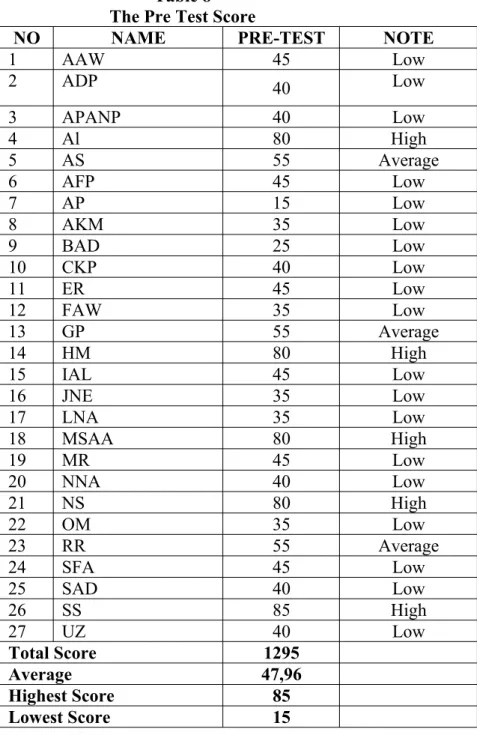
The result of pre-test could be seen on the table below:
Table 8 The Pre Test Score
NO NAME PRE-TEST NOTE
1 AAW 45 Low
2 ADP 40 Low
3 APANP 40 Low
4 Al 80 High
5 AS 55 Average
6 AFP 45 Low
7 AP 15 Low
8 AKM 35 Low
9 BAD 25 Low
10 CKP 40 Low
11 ER 45 Low
12 FAW 35 Low
13 GP 55 Average
14 HM 80 High
15 IAL 45 Low
16 JNE 35 Low
17 LNA 35 Low
18 MSAA 80 High
19 MR 45 Low
20 NNA 40 Low
21 NS 80 High
22 OM 35 Low
23 RR 55 Average
24 SFA 45 Low
25 SAD 40 Low
26 SS 85 High
27 UZ 40 Low
Total Score 1295
Average 47,96
Highest Score 85
Lowest Score 15
43
Table 9
Students’ Reading Score at class D
No Score Explanation Frequency Percentage
1 ≤ 70 Fail 22 81.48%
2 ≥ 70 Pass 5 18.51%
Total 27 100%
Based on the table, it could be analyzed that there were 5 students (18.51%) who passed the pre-test and 22 students (81.48%) who failed the pre-test. The lowest score in pre-test was 15 and the highest score was 85. It means that the students did not fulfill the minimum standard at SMPN 10 Metro and the students’
reading comprehension was low. Besides, from the result of pre- test, the researcher got the average 47,96. So, it was the reason why the researcher used cooperative integrated reading and composition to increase the students’ reading comprehension.
1) Planning
The first meeting was done on Saturday, february 10th, 2017. It was open by praying, greeting, checking attendance list, and introducing the researcher as a teacher for the students.
At the day, the researcher has taken the students’ pre-test score.
Based on the result of pre-test score, the researcher has identified and found the problems after taking the students’
pre-test score. Therefore, the researcher and collaborator prepared several things related to teaching and learning process such as the English subject lesson plan, the material, media,
work sheet, observation sheet that contains about list of students’ names and activity, and evaluation for the second meeting.
2) Acting
The second meeting was treatment. The researcher conducted the treatment February 11rd, 2017. In this meeting, the researcher as an English teacher and Mr. Mahyudin Effendi, S.Pd as a collaborator. The researcher started the meeting by praying, greeting, checking attendance list and asking the condition of the students. Afterwards, the researcher gave the material about recount text.
At the beginning of teaching learning process, the researcher asked to the students about recount text. Some of the students forgot and just a little of them have known the definition about recount text. Secondly, the researcher explained about definition, generic structure, social function and language feature of recount text. After that, the researcher gave some recount text.
After that, the researcher asks to the students to make a group consist 4-6 students, the researcher explained about recount text. The students must be understood about the text.
The researcher guided the students to be active and expression their idea. As long as the students studied to understand recount
45
text. In the end of meeting, the researcher gave feedback to the students of the learning process. The researcher gave motivation and informed to the students about the activities in the next meeting. Then, the researcher closed the material by praying together.
After did a treatment, the researcher gave post-test to the students. The post-test was conducted February 17rd, 2017.
The post test was done to know how the students’ reading comprehension after giving treatment. Then the researcher gave post-test to the students. Read about recout text.
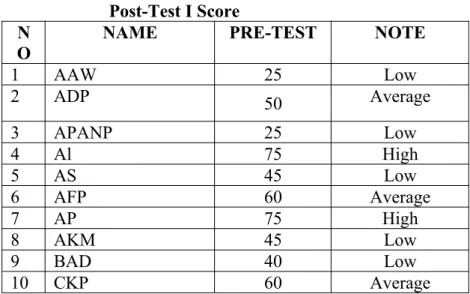
In the post-test 1, only 12 students who got good mark, but the result of the students’ test was better than the students’ test before giving treatment. In this session, the researcher got the result of the students’ post test 1 in cycle 1. The result can be seen as follow:
Table 10 Post-Test I Score N
O
NAME PRE-TEST NOTE
1 AAW 25 Low
2 ADP 50 Average
3 APANP 25 Low
4 Al 75 High
5 AS 45 Low
6 AFP 60 Average
7 AP 75 High
8 AKM 45 Low
9 BAD 40 Low
10 CKP 60 Average
11 ER 85 High
12 FAW 60 Average
13 GP 50 Average
14 HM 90 High
15 IAL 85 High
16 JNE 30 Low
17 LNA 85 High
18 MSAA 80 High
19 MR 50 Average
20 NNA 30 Low
21 NS 80 High
22 OM 45 Low
23 RR 80 High
24 SFA 25 Low
25 SAD 55 Average
26 SS 75 High
27 UZ 40 Low
Total Score 1545
Average 57,22
Highest Score 90
Table 11
Students’ Mark of Post-test I of Reading No Score Explanatio
n
Frequency Percentage
1 ≤ 70 Fail 15 55,55%
2 ≥ 70 Pass 12 44,44%
Total 27 100%
From the table 8, it could be analyzed that the students’
average score was 57,22. The highest score was 90 and the lowest score was 25. Based on the minimum standard (MS), there were 12 students that had passed on post-test 1 or got score ≥70 .It means that in cycle 1 the students’ achievement could improve enough, but it was not successful yet.
3) Observing