This narrative of prosperity and growth is juxtaposed with a second narrative of the city as unevenly developed and struggling with rising housing costs, increasing risks of displacement, and disruptions to the aesthetic nature of neighborhoods' built environments. Although it remains the dominant social, political and economic force of the contemporary era, neoliberalism is also seen as an incomplete and contradictory process, consisting of rounds of self-destruction and creation, contention and entrenchment (Brenner & Theodore, 2002; Peck, Theodore and Brenner, 2009). Although the label “gentrification” has become commonplace in the city, a close analysis of the ways in which residents give meaning to their neighborhoods sheds light on these everyday and everyday problems.
Such theories promulgate analyzes and discourses of the 'benefits of gentrification' - eg how an influx of wealth and cultural differences can add social mix to poor and often Black neighbourhoods. Indeed, the framing of the gentrification literature as a binary of production-consumption theories has shifted as urban scholars deny the incomparability of these explanations and posit a 'continuum' model of gentrification (Shaw, 2008). The current study examines how the meanings of place expressed in residents' discourses can lead to greater understanding of the marginalization experienced and resistances waged in gentrifying neighbourhoods.
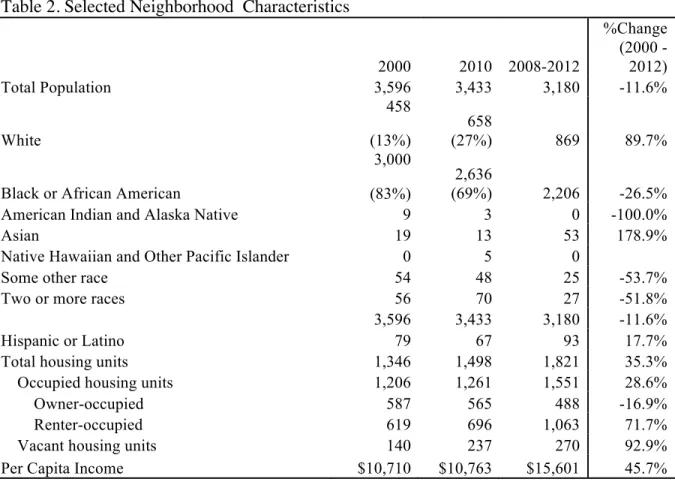
The CPNA emerged in the early 2000s as residents came together to address the immediate needs of the neighborhood – specifically to eradicate drugs and violence and demand that the city provide more police and security services. Over the course of the study, the number of African Americans declined: at the first meeting in January 2015, an estimated 45 of the 60 attendees were African American, while at the last meeting (a year later) only five of the 30 attended. Meanings were those data segments in which the speaker identified, referred to, or expressed a belief, value, or attitude toward the neighborhood's identity.
In my descriptions of the study site and data collection methods, I provide thick description as a means of tracing the natural history of the study and ensuring transparency (Lincoln & Guba, 1985).
STUDY CONTEXT
As of this writing, none of NOAH's member organizations are based in Cleveland Park. The tensions surrounding the meaning of place point to the ongoing negotiation of neighborhood identity, social character, and civic values that form the fabric of neighborhood life. These neighborhood meanings posit a concept of development that naturalizes capitalist investment as a path to improvement.
The east side of Gallatin rapidly gentrified in the early 2000s and is considered one of the "hippest" areas of Nashville, if not the South. One day she was there and one of the new neighbors said, “I'm so glad you're here.” Paradoxically, it is the historic character of the neighborhood that is being used in branding and marketing the area to gentrifiers.
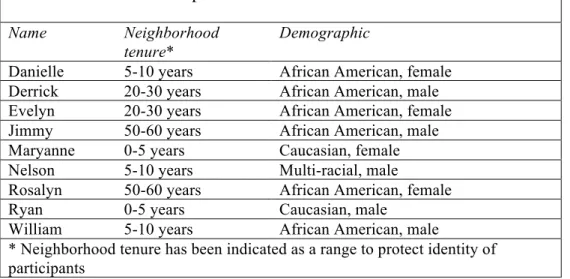
For new residents of Cleveland Park, the history of the neighborhood represents an obstacle to improvement—something that “holds it back a little bit” (Ryan, personal interview). Rather, it shows how such expressions are politically charged, depending on the speaker's positionality. The discourses of gentrification as positive development due to increased exchange value are contested through interpretations of the neighborhood as more diverse than.
Indeed, the significance of Cleveland Park as a site of struggle is crucial to understanding the various dimensions of the current moment of gentrification in the neighborhood. Some urban studies scholars recommend a critical reading of the code enforcement phenomenon (Betancur 2002, Kennedy & Leonard, 2001, Bates 2013). Long-term and African-American residents detect this appropriation of the neighborhood's racial character, as evidenced by their explanations of what Cleveland Park's racial identity should represent.
Some African American participants interpret the glorified “diversity” as a product of the racial character of the neighborhood and as a lack of real appreciation of what diversity means. Derrick pointed to the black skin on his arm and explained - "things just aren't right when you know they want this out of the neighborhood." Nelson characterizes CPNA as increasingly attended by new, young residents who are adding to what he perceives as positive change and growth in the neighborhood.
In the absence of this confrontation, the desires of the most active participants – here the new and white residents. Rosalyn also resists the loss of political voice by asserting neighborhood definitional rights. In creating the new organization, a group of African-American residents foregrounded neighborhood tensions, including racial tensions and divisions.
Like CPNA, Inc., Moving with Change (MWC) was founded to address concerns of a specific demographic of the neighborhood that the organizers believed were not.
CONCLUSION
While expressing a hope for MWC to stimulate greater democratic participation among African-American and longtime residents in the neighborhood, the organizers themselves (who are also leaders of CPNA, Inc.) had their energy strained by the psychic burden from their struggling neighbors and are pulled in various directions between family, work and community work. The pressures of gentrification take a toll not only on residents who are at risk of displacement, but also on the organizers whose face burns out and on the imagination of more transformative alternatives. While concerned community members acted in the past to drive out illegal activity, long-term and African-American residents now choose not to report illegal behavior or form relationships with those involved in drug activity to help them find another road (William, personal correspondence).
Massey (2004) suggests that there may be a crucial political interest in challenging and changing the hegemonic identity of place and the way in which the inhabitants of a particular place imagine it and thus use the imaginative resource to to reconstruct (p. 7). In Cleveland Park, this political importance of counter-hegemonic place meanings is to disrupt the normalization of gentrification. Gentrification and displacement study: Implementing an equitable inclusive development strategy in the context of gentrification.
Retrieved from https://www.portlandoregon.gov/bps/article/. The Politics of Gentrification: The Case of Chicago's West Town. Cities for people, not for profit: Critical urban theory and the right to the city. Retrieved from http://archive.tennessean.com/article NEWS In-Cleveland-Park-leaders-try-preserve-next-neighborhood Francaviglia, R. Xenia rebuilds: effects of pre-disaster conditioning on post-disaster.
The urban injustices of New Labour's 'New Urban Renewal': The case of the Aylesbury estate in London. Ways to get people active: The role of place attachment, cultural capital and neighborhood ties. The racialization of space and the spatialization of race: Theorizing the hidden architecture of landscape.
Know your community: data and maps from Metropolitan Social Services. http://www.nashville.gov/Portals/0/SiteContent/SocialServices/docs/plann_coord/Council DataOnlineMay2016.pdf. Retrieved from: http://www.bizjournals.com/nashville/. blog/2015/10/nashville-only-u-s-city-on-lonely-planets-high.html. The right to remain in place revisited: Gentrification and resistance to displacement in New York City. http://www.nashville.gov/Portals/0/SiteContent/Planning/docs/NashvilleNext/next-report-Housing.pdf.