https://iaeme.org/Home/journal/IJEET
https://iaeme.com/Home/journal/IJMET https://iaeme.com/Home/journal/IJMET
INTERNATIONAL JOURNAL OF MECHANICAL ENGINEERING AND TECHNOLOGY (IJMET)
Volume 8, Issue 11, November (2017) ISSN 0976 – 6340(Print) ISSN 0976 – 6359(Online)
High Quality Refereed Peer Reviewed International Journal of Mechanical Engineering and Technology
CHIEF EDITOR Dr. Ajeet Kumar Rai SSET, SHIATS-DU, Allahabad.
E-mail: [email protected], [email protected]
Publisher
Dr. S. BALASUBRAMANIAN IAEME Publication
Plot: 03, Flat- S 1,
Poomalai Santosh Pearls Apartment, Plot No. 10, Vaiko Salai 6
thStreet, Jai Shankar Nagar,
Palavakkam,
Chennai – 600 041, Tamilnadu, India
© Copyright with IAEME Publication. No part of the publications may be reproduced in any for without prior permission of Chief Editor, IAEME Publication, Chennai.
The Chief Editor/ Editorial Board and distinguished referees are in no-way responsible
individually or collectively for the views, data and technical details presented in the journal. The
whole responsibility vests with authors of the article/ manuscript
INTERNATIONAL JOURNAL OF MECHANICAL ENGINEERING AND TECHNOLOGY (IJMET)
ISSN 0976-6359 (Online) ISSN 0976-6340 (Print)
AIM AND SCOPE
International Journal of Mechanical Engineering and Technology (IJMET) is an international journal dedicated to the latest advancements in mechanical engineering. The goal of this journal is to provide a platform for scientists and academicians all over the world to promote, share, and discuss various new issues and developments in different areas of mechanical engineering.
IJMET is an online and print journal, which publishes research articles, reviews, and letters in all areas of mechanical engineering. It is peer-reviewed journal, aims to provide the most complete and reliable source of information on current developments in the field. The emphasis will be on publishing quality papers rapidly and available to researchers worldwide.
JOURNAL DESCRIPTION
International Journal of Mechanical Engineering and Technology, a peer-reviewed open access journal published in English-language, provides a international forum for the publication and dissemination of theoretical and practice oriented papers, dealing with problems of modern technology.
RESEARCH ARTICLES
A research article is a regular article which aims to present new findings.
LETTERS TO THE EDITOR
A letter to the editor is a short article which aims to present new findings that require fast publication procedures.
REVIEW ARTICLES
A review article is an article which aims to present comprehensively already existing findings.
SUBJECT AREA
Subject areas include, but are not limited to the following fields:
• Fluid Mechanics
• Applied Mathematics and Mechanics
• Biomechanics
• Heat Transfer
• Solid Mechanics
• Refrigeration and Air Conditioning
• Renewable Energy Technology
• Quality Control
• Mechanical Maintenance
• Tribology
12/2/22, 12:33 PM IAEME Publication, IJMET, IJCIET, IJCET, IJECET, IJARET, IJEET, IJM, International Journal Publisher & Journal Impact Fa…
https://iaeme.com/Home/issue/IJMET?Volume=8&Issue=11 2/7
Articles Archive (https://iaeme.com/Home/issue/IJMET?Volume=13&Issue=12) Subject Area
Indexing Aims & Scope Editorial Board (https://iaeme.com/Home/editorial_board/IJMET) For Authors Publication Fees
Indexing
SCOPE DATABASE
INTERNATIONAL JOURNAL OF MECHANICAL ENGINEERING AND TECHNOLOGY (IJMET) is indexed in Scope Database from 2010 to 2021
Please click the following link to see the Details
(https://iaeme.com/uploads/INDXE12021_05_21_17_10_48.pdf)
Google Scholar
Total citation of 7154 from IJMET Journal published from 2010 to 2021
Please click the following link to see the Details (https://iaeme.com/uploads/Google.pdf)
SCOPUS
Total citation of 1691 from 3769 indexed documents 3769 from 2010 to 2021 Please click the following link to see the Details
(https://iaeme.com/uploads/INDEX32021_05_21_17_47_13.pdf)
Scope Database Source link
(http:// https://scopedatabase.com/Sourceid/00000011)https://sdbindex.com/Sourceid/00000002 (https://sdbindex.com/Sourceid/00000011)
Our IAEME Publication journals are indexed in various indexing search engines given below Scope Database (www.sdbindex.com (http://www.sdbindex.com))
Scopus (www.scopus.com (http://www.scopus.com))
Google Scholar (https://scholar.google.com (https://scholar.google.com)) ResearchGate (https://www.researchgate.net/ (https://www.researchgate.net/)) Academia (https://www.academia.edu/ (https://www.academia.edu/))
Current Issue (https://iaeme.com/Home/current_issue/IJMET) Peer Review Policies (https://iaeme.com/Home/journal_editorial_policy/IJMET) Publication Ethics
(https://iaeme.com/Home/publication_ethics/IJMET) Submit Online (https://iaeme.com/Page/online_paper_submission)
Articles Published: 5275
Articles - 25634 Journals - 129 Authors - 87474
Peer Reviewers - 2980 Downloads - 2009930 Views - 4237823
12/2/22, 12:33 PM IAEME Publication, IJMET, IJCIET, IJCET, IJECET, IJARET, IJEET, IJM, International Journal Publisher & Journal Impact Fa…
https://iaeme.com/Home/issue/IJMET?Volume=8&Issue=11 3/7
SSRN (https://www.ssrn.com/ (https://www.ssrn.com/))
Indian Citation Index (ICI) (http://www.indiancitationindex.com/
(http://www.indiancitationindex.com/))
Advanced Science Index (https://journal-index.org/ (https://journal-index.org/)) ResearchBib (https://www.researchbib.com/ (https://www.researchbib.com/))
●
IJMET Journal Status
Citation Analysis
Publication years 2010-2022
Publication count 5275
Total Volumes 13
Total Issues 115
Downloads 462951
Views 949902
Downloads/article 87.76
Open Special Issue (https://iaeme.com/Home/special_issue/IJMET)
Journal Statistics (https://iaeme.com/Home/journal_statistics/IJMET)
Google Scholar (https://scholar.google.com/citations?user=YlsYA54AAAAJ&hl=en) Academia.edu (https://iaeme.academia.edu/publication)
Research Bible (https://www.researchbib.com/view/issn/0976-6340) ResearchGate (https://www.researchgate.net/)
IJMET Subscription (https://iaeme.com/Home/subscription/IJMET) E-mail Alert (https://iaeme.com/Home/mailalert/IJMET)
IJMET Most popular papers (https://iaeme.com/Home/popular_downloads/IJMET)
Publication Ethics & OA Statement (https://iaeme.com/Home/publication_ethics/IJMET) IJMET News (https://iaeme.com/Home/journal_news/IJMET)
Frequently Asked Questions (https://iaeme.com/Page/faq) Articles - 25634
Journals - 129 Authors - 87474
Peer Reviewers - 2980 Downloads - 2009930 Views - 4237823
EDITORIAL BOARD MEMBERS OF INTERNATIONAL JOURNAL OF MECHANICAL ENGINEERING AND TECHNOLOGY (IJMET)
EDITORIAL BOARD
CHIEF EDITOR
Dr. Ajeet Kumar Rai SSET, SHIATS-DU, Allahabad MANAGING EDITORS
Dr. Mohammad Israr Principal, Balaji Engineering College, Gujarat Dr. M.Narayana Rao Shri Sapthagiri Institute Of Technology,Chennai Dr. G. Arthanareeswaran NIT Trichy, India
ASSOCIATE EDITORS
Dr. V.Antony Joe Raja Sri Muthukumaran Institute of Technology, India Prof. B. Arthi Gandhimathi IAEME Publication, India
Dr. N. Tamil Selvan IAEME Publication, India Er. D. S. Chengalvarayam IAEME Publication, India COPY EDITORS
Mr. K.Prasanth IAEME Publication, India Mr. T.Nagarajan IAEME Publication, India EDITORIAL BOARD
Dr. Barish Dantal Application Development Engineer, Momentive Performance Materials, USA.
Dr. Mohamed Saber National Research Center (NRC) El Dokki, Giza, Egypt.
Dr. H. N. Reddappa Bangalore Institute of Technology, Karnataka, India.
Dr. Fateh Mebarek-Oudina Skikda University, Algeria.
Dr. Audai Hussein Al-Abbas Al-Musaib Technical College, Babylon, Iraq.
Dr. Mohd Azman Bin Abdullah Universitiy Teknikal Malaysia Melaka, Malaysia.
Dr. T.R.Vijayaram VIT University,Chennai.
Dr. M. Chithirai Pon Selvan Amity University, Dubai.
Dr. Chao Wang Nanyang Technological University, Singapore.
Dr. Madhu D Govt. Engineering College, KRPET, India.
Dr. R. Dilli babu Anna University, India.
Dr. A.Elaya perumal Anna University, India.
Dr. Mohamed Kchaou University Of Sousse, Tunisia.
Dr. Anan Suebsomran King Mongkut’s University of Technology North Bangkok , Thailand.
Dr. A. G. Matani Govt. College of Engineering, Amravati ,India.
Dr. Vivek Sachan SHIATS, Allahabad, India
Dr. Pallavi.H.Agarwal Babaria Institute of Technology, Gujarat, India
Prof. Raj Kumar Yadav Adina Institute Of Science And Technology, Sagar, M.P Dr. İlhan ASİLTÜRK Selcuk University, Turkey
Dr. Sudarshan Rao K Shri Madhwa Vadiraja Institute of Technology and Management, Karnataka, India
Dr. Kondaveeti Srinivasa Rao CMR College of Engineering & Technology, Hyderabad, India
Dr. Ravi Burla Autodesk Inc., Novi, MI
Dr. Jingchao Zhang University of Nebraska-Lincoln,USA Dr. Nilaj N. Deshmukh Fr.C.Rodrigues Institute of Technology, India
Dr. Nadia MOUHIB National School of Electricity and Mechanic MOROCCO Dr. M. L. Meena Malaviya National Institute of Technology, Jaipur, India Dr. Raffi Mohammed NRI Institute of Technology, Indian
Dr. Ajay Verma Padmashri Dr. V.B. Kolte College of Engineering, Maharashtra, India
Dr. Sathish Rao U Manipal University,Karnataka-India
Dr. Irfan. G Akshaya Institute of Technology, Karnataka, India Dr. Sunada Chakravarthy Sunedison Inc, USA
Prof. S. Sathish Kumar Vel Tech, Chennai, India
Dr. M. Ganesan Saranathan College of Engineering, Trichy, India
Dr. CH V K N S N MOORTHY Institute of Aeronautical Engineering(Autonomous), Telangana State, INDIA
Er. Anshul Singhal Massachusetts Institute of Technology (MIT), USA Dr. Ornella Chiavola ROMA TRE University, Rome, Italy
Dr. H. Erdem Çamurlu Akdeniz University, TÜRKİYE
Dr. GIRISHA L PES Institute of Technology and Management, Karnataka, India
Dr. M. Mubarak MEA Engineering College, Kerala, India Dr. Ahmed Daabo University of Mosul, Mosul, Iraq Dr. Ambarish Maji MLR Institute of Technology, India
Dr. Hao Yi Chongqing University, China
Dr. Bambang Leo Handoko Bina Nusantara University of Indonesia
Prof. Jaafar Jaber Abdulhameed Almustansiririyah University, College of Engineering, Baghdad, Iraq
Dr. S A Mojhan Krishna
Associate Professor, Department of Mechanical Engineering, Vidyavardhaka College of Engineering, Mysuru, Karnataka, India.
Dr. Prateek Nigam Bansal College of Engineering, Madhya Pradesh, India Dr. Ehsaan Bagherian Inspection Technology & Quality Assurance National
Institute (ITQAN), Saudi Arabia Dr. Mohamed KCHAOU
College of Engineering, University of Bisha, Saudi Arabia;
National Engineering School of Sfax, University of Sfax, Tunisia
Dr. Shubham R Suryawanshi MET’s Institute of Engineering, Bhujbal Knowledge City, Nashik, India
Dr. Diwan Mohit Balkrishna Shankersinh Vaghela Bapu Institute of Technology, Gujarat India
Dr. Maryam Sadri Sharif University of Technology and Aerospace Research Institute, Tehran-Iran.
Dr. A R Pradeep Kumar Dhanalakshmi College of Engineering, Tamilnadu, India Dr. Siamak Hosseinzadeh University of Pretoria, Pretoria, South Africa
Dr. Eriki Ananda kumar
Associate Professor, Dept. of Mechanical Engineering, Faculty of Engineering, Science and Technology, Nilai University, Malaysia
Dr. Dhanasekaran S Annamalai University, Tamil Nadu, India
Dr. Basanta Kumar Bhuyan Professor, MNNIT Allahabad, FET-MRIIRS, Faridabad, India.
Prof. Pavlo Maruschak Vice-Rector for Scientific Research of Ternopil Ivan Puluj National Technical University, Ternopil, Ukraine.
Dr. T. Kamatchi Associate Professor, Mechanical Department, Velammal College of Engineering and Technology, Tamilnadu, India.
Dr. P. Vivek
Head of the Department, Department of Automobile Engineering, Annapoorana Engineering College, Salem, Tamilnadu, India
Dr. Deepa Kodali Department of Materials Science and Engineering, Tuskegee University, Tuskegee, Alabama
REVIEWER BOARD
Dr.K.S.Zakiuddin Priyadarshini College of Engineering, India Dr.R.Edison Chandraseelan SMKFIT,India
Dr.Syed Anisuddin Caledonian College of Engineering, Sultanate of Oman
Er.Vinod Singh Yadav MNIT, India
Dr.S.Sreenatha Reddy Universal College of Engineering and Technology, India Dr.M. Victor Raj Sardar Raja College of Engineering, India
Dr.V.Baskaran Bannari Amman Institute of Technology, India
Dr.Ratri Parida IIT Kharagpur, India
Dr.G.Kalivarathan PSN Institute of Technology and Science,India Er.N.Vijayponraj PSN Institute of Technology and Science, India Dr.R.Uday Kumar Mahatma Gandhi Institute of Technology, India Prof.Manikandapirapu P.K Dayananda Sagar College of Engineering, India Dr.Srinivasa G.R Dayananda Sagar College of Engineering, India Dr.Sudhakar K.G K L University, India
Dr.Chavan Dattatraya K. MMCOE, Karvenagar, Pune
Dr.Rahul Davis SHIATS-DU, Allahabad
Prof.Potnuru Govinda Rao GMR Institute of Technology,Rajam Dr.Velamala Rambabu G.M.R.Institute of Technology,Rajam Dr.V. Chitti Babu GMR Institute of Technology, Rajam, A.P
Dr.Ravindra D. Jilte Vidyavardhini’s College of Engineering and Technology,MSQ Dr.Gurudutt Sahni DGM & HOD Leader Valves Ltd, Punjab, India
Dr.Prashant H.S Sir M Visvesvaraya Institute of Technology, Bangalore, India
CiteScore
.
=Calculated on May,
Source details
International Journal of Mechanical Engineering and Technology
Scopus coverage years: from to
Publisher: IAEME Publication
ISSN: - E-ISSN: -
Subject area: Engineering: Industrial and Manufacturing Engineering Engineering: Mechanical Engineering Engineering: Mechanics of Materials
Source type: Journal
(coverage discontinued in Scopus)
View all documents ▻ Set document alert Save to source list Source Homepage
CiteScore
.
SJR
.
SNIP
.
CiteScore CiteScore rank & trend Scopus content coverage
i Improved CiteScore methodology
CiteScore counts the citations received in - to articles, reviews, conference papers, book chapters and data papers published in - , and divides this by the number of publications published in - . Learn more▻
×
, Citations - , Documents -
CiteScore rank
Category Rank Percentile
Engineering
/ th
Engineering
/ th
Industrial and Manufacturing Engineering
Mechanical Engineering
View CiteScore methodology▻ CiteScore FAQ▻ Add CiteScore to your site🔗
Source details
International Journal of Mechanical Engineering and Technology
Scopus coverage years: from to
Publisher: IAEME Publication
ISSN: - E-ISSN: -
Subject area: Engineering: Industrial and Manufacturing Engineering Engineering: Mechanical Engineering Engineering: Mechanics of Materials
Source type: Journal
(coverage discontinued in Scopus)
View all documents ▻ Set document alert Save to source list Source Homepage
CiteScore
.
SJR
.
SNIP
.
CiteScore CiteScore rank & trend Scopus content coverage
Export content for category
International Journal of Mechanical Engineering
and Technology .
⋆
CiteScore rank
In category:th percentile
⋆
Rank Source title CiteScore Percentile⋆
. th percentile⋆
. th percentile⋆
. th percentile⋆
. th percentile⋆
. th percentile⋆
. th percentile⋆
. th percentile⋆
. th percentile⋆
. th percentile⋆
. th percentile⋆
. th percentile⋆
. th percentile⋆
. th percentile⋆
. th percentile Industrial and Manufacturing …
IEEE Industrial Electronics Magazine Journal of Operations Management Chemical Engineering Journal Composites Part B: Engineering
International Journal of Production Economics
International Journal of Machine Tools and Manufacture
Critical Reviews in Food Science and Nutrition Virtual and Physical Prototyping
Manufacturing Letters Energy
Journal of Cleaner Production
Reliability Engineering and System Safety International Journal of Greenhouse Gas Control Food Engineering Reviews
CiteScore trend
CiteScore value Percentile in category
CiteScore value Percentile in category .
. . .
Source details
International Journal of Mechanical Engineering and Technology
Scopus coverage years: from to
Publisher: IAEME Publication
ISSN: - E-ISSN: -
Subject area: Engineering: Industrial and Manufacturing Engineering Engineering: Mechanical Engineering Engineering: Mechanics of Materials
Source type: Journal
(coverage discontinued in Scopus)
View all documents ▻ Set document alert Save to source list Source Homepage
CiteScore
.
SJR
.
SNIP
.
CiteScore CiteScore rank & trend Scopus content coverage
Year Documents published Actions
documents View citation overview ▻
, documents View citation overview ▻
, documents View citation overview ▻
documents View citation overview ▻
12/2/22, 12:48 PM International Journal of Mechanical Engineering and Technology
https://www.scimagojr.com/journalsearch.php?q=21100808402&tip=sid&clean=0 1/12
also developed by scimago: SCIMAGO INSTITUTIONS RANKINGS Scimago Journal & Country Rank
Home Journal Rankings Country Rankings Viz Tools Help About Us
International Journal of Mechanical Engineering and Technology
Discontinued in Scopus as of 2019
COUNTRY
India
SUBJECT AREA AND CATEGORY
Engineering
PUBLISHER
IAEME Publication
H-INDEX
24
PUBLICATION TYPE Journals
ISSN
09766340, 09766359
COVERAGE 2016-2019
SCOPE
Information not localized
Join the conversation about this journal
Enter Journal Title, ISSN or Publisher Name
Journal of Surgery
Submit Your Manuscript
Journal of Surgery is an International Peer Reviewed Open Access Surgery Journal.
surgeryopenaccess.org OPEN
Universities and research institutions in India
Industrial and Manufacturing Engineering Mechanical Engineering Mechanics of Materials
Quartiles
Ads by
12/2/22, 12:48 PM International Journal of Mechanical Engineering and Technology
https://www.scimagojr.com/journalsearch.php?q=21100808402&tip=sid&clean=0 2/12
FIND SIMILAR JOURNALS
1
International Journal of Advanced Research in IND
54%
similarity
2
International Journal of Civil Engineering and Technology IND
45%
similarity
3
International Journal of Mechanical and Production IND
41%
similarity
4
Journal of M Engineering BGD
2
s
SJR
The SJR is a size-independent prestige indicator that ranks journals by their 'average prestige per article'. It is based on the idea that 'all citations are not created equal'. SJR is a measure of scienti c in uence of journals that accounts for both the number of citations received by a journal and the importance or prestige of the journals where such citations come from It measures the scienti c in uence of the average article in a journal it expresses how central to the global
Total Documents
Evolution of the number of published documents. All types of documents are considered, including citable and non citable documents.
Year Documents 2016 232 2017 1213 2018 1931 2019 393
Citations per document
This indicator counts the number of citations received by documents from a journal and divides them by the total number of documents published in that journal. The chart shows the evolution of the average number of times documents published in a journal in the past two, three and four years have been cited in the current year.
The two years line is equivalent to journal impact factor
™ (Thomson Reuters) metric.
Cites per document Year Value Cites / Doc. (4 years) 2016 0.000 Cites / Doc. (4 years) 2017 2.142 Cites / Doc. (4 years) 2018 0.736 Cites / Doc. (4 years) 2019 0.740 Cites / Doc. (3 years) 2016 0.000 Cites / Doc. (3 years) 2017 2.142 Cites / Doc. (3 years) 2018 0.736 Cites / Doc. (3 years) 2019 0.740 Cites / Doc. (2 years) 2016 0.000 Cites / Doc. (2 years) 2017 2.142 Total Cites Self-Cites
Evolution of the total number of citations and journal's self-citations received by a journal's published documents during the three previous years.
Journal Self-citation is de ned as the number of citation from a journal citing article to articles published by the same journal.
Cites Year Value
f
External Cites per Doc Cites per Doc
Evolution of the number of total citation per document and external citation per document (i.e. journal self- citations removed) received by a journal's published documents during the three previous years. External citations are calculated by subtracting the number of self-citations from the total number of citations received by the journal’s documents.
% International Collaboration
International Collaboration accounts for the articles that have been produced by researchers from several countries. The chart shows the ratio of a journal's documents signed by researchers from more than one country; that is including more than one country address.
Citable documents Non-citable documents
Not every article in a journal is considered primary research and therefore "citable", this chart shows the ratio of a journal's articles including substantial research (research articles, conference papers and reviews) in
2017 2018 2019
0.2 0.25 0.3
2016 2017 2018 2019
0 900 1.8k 2.7k
Cites / Doc. (4 years) Cites / Doc. (3 years) Cites / Doc. (2 years)
2016 2017 2018 2019
0 0.5 1 1.5 2 2.5
2016 2017 2018 2019
0 2k 4k
2016 2017 2018 2019
0 2 4
Ads by
Send feedback Why this ad?
12/2/22, 12:48 PM International Journal of Mechanical Engineering and Technology
https://www.scimagojr.com/journalsearch.php?q=21100808402&tip=sid&clean=0 3/12
Metrics based on Scopus® data as of April 2022
worapong.b 2 years ago Year International Collaboration
2016 1.72 2017 3.05
three year windows vs. those documents other than research articles, reviews and conference papers.
Cited documents Uncited documents
Ratio of a journal's items, grouped in three years windows, that have been cited at least once vs. those not cited during the following year.
Documents Year Value
Uncited documents 2016 0 Uncited documents 2017 59 Uncited documents 2018 903 Uncited documents 2019 2358
←Show this widget in your own website Just copy the code below and paste within your html code:
<a href="https://www.scimag
SCImago GraphicaSCImago GraphicaSCImago Graphica Explore, visuallyExplore, visuallyExplore, visually
communicate and makecommunicate and makecommunicate and make sense of data with oursense of data with oursense of data with our new data visualizationnew data visualizationnew data visualization tooltooltool...
A
M SCImago Team
W
8
12 4k
2016 2017 2018 2019
0 2k 4k
Ads by
INTERNATIONAL JOURNAL OF MECHANICAL ENGINEERING AND TECHNOLOGY (IJMET)
Volume 8, Issue 11, November (2017) ISSN 0976 – 6340(Print) ISSN 0976 – 6359(Online) TABLE OF CONTENTS
S.NO ARTICLE ID TITLE OF THE PAPER AUTHORS NAME PAGE
1 IJMET_08_11_001 GRACEFUL LABELING OF NOVA CLOUD
CONNECTED IN A PATH G. Sathiamoorthy 1-9
2 IJMET_08_11_002 SURVEY ON DATA MINING K. Vanishree , K. Jayanthi 10-20 3 IJMET_08_11_003
A COMPARATIVE STUDY FOR EVALUATION OF DIFFERENT FORM WORK SYSTEMS UTILIZATION IN CONSTRUCTION PROJECTS
SS. Asadi , PV. Praneeth 21-29 4 IJMET_08_11_004
DESIGN, DEVELOPMENT, MOTION SIMULATION AND ANALYSIS OF ROLLER WITH COIL LIFTER FOR HEAVY COIL WRAPPING MACHINE
Sharath G S , Manjunatha G ,
Srinivas S 30-37
5 IJMET_08_11_005
EXPERIMENTAL STUDIES ON THE ENERGY ABSORPTION CAPACITY OF AXIALLY COMPRESSED METAL TUBES
Manjunatha G , Sharath G S ,
Srinivas S 38-47
6 IJMET_08_11_006
EXPERIMENTAL INVESTIGATIONS AND IMPROVING THE PERFORMANCE AND EFFICIENCY OF TWIN CYLINDER TRACTOR ENGINE USING BIODIESEL FROM COTTON SEED OIL
R. Saravana Kumar , S. Madhu ,
D. Masilamani , G. Guna 48-56
7 IJMET_08_11_007
AN EXPERIMENTAL INVESTIGATION INTO BIODIESEL IN COBUSTION INGNITION ENGINE BY USING GREASE TRAP OIL
S. Saikiran , T. Sivakrishna , C.
Srinivasan , G. Jayaram , S.
Madhu
57-66
8 IJMET_08_11_008
MATERIALS MANAGEMENT OF POWER
TRANSMISSION LINE CONSTRUCTION PROJECT:
A MODEL STUDY FROM RAMPURA TO JAGULUR POWER TRANSMISSION LINE CONSTRUCTION
SS. Asad , M. Siva Krishna Reddy 67-77
9 IJMET_08_11_009
MECHANICAL, THERMAL, AND
MORPHOLOGICAL PROPERTIES OF COCONUT SHELL BIOCOMPOSITES REINFORCED WITH CARDANOL RESIN
R. Udhayasankar , B. Karthikeyan 78-88
10 IJMET_08_11_010
SPEED RESPONSE OF BRUSHLESS DC MOTOR USING FUZZY TUNED PID BASED CONTROLLER UNDER DIFFERENT LOAD CONDITION
S. Swapna , Joseph Henry , K.
Siddappa Naidu 89-98
11 IJMET_08_11_011 REMOVAL OF SUSPENDED SOLIDS FROM DAIRY WASTEWATER USING FLOCCULATION
C R Girish , Sushant Kumar Singh
, Suhas Shenoy 99-105
12 IJMET_08_11_012
COMPARATIVE PERFORMANCE OF A DOUBLE CONDENSING CHAMBER SOLAR STILL WITH A CONVENTIONAL SOLAR STILL
Richa Dubey , Ajeet Kumar Rai 106-112 13 IJMET_08_11_013 ANALYZING THE EFFECT OF PRE-HEATER IN THE
TEMPERATURE PROCESS
L.D. Vijay Anand , P. Poongodi ,
J. Jayakumar , D. Hepsiba 113-120
14 IJMET_08_11_014
DETERMINATION OF FLOW CHARACTERISTICS IN FIRE-TUBE BOILER USING NUMERICAL SIMULATION
Somya Ranjan Gochhayat , Kunjan Modi , Amrutkar Pranit Sanjay , Satwik , Talegaonkar , Saumen Dutta , Shivam Sanjay Singh , Premkartikkumar SR
121-128
15 IJMET_08_11_015 DESIGN AND FABRICATION OF PORTABLE 3D PRINTER
Rajashekar Patil , Ishtiaq Ahmed , Mohammed Shoaib Shariff , Syed Ismail Zeeshan , Prashanth S , Harsha N , Pradeep Kumar K
129-135
16 IJMET_08_11_016
LOAD RESPONSES BASED OPTIMIZED CASCADED PID CONTROL SCHEME USING PLC-HMI IN
HYDRO ELECTRIC PUMPED STORAGE POWER PLANT
A. Selwin Mich Priyadharson , S.
Priya 136-146
17 IJMET_08_11_017
EXPERIMENTAL INVESTIGATION ON
PERFORMANCE OF COMPRESSION IGNITION ENGINE FUELLED WITH MAHUA OIL METHYL ESTERS
K. Srinivasa Reddy , P. Revanth , M. Yatheendar , J.S.V.M Teja , P. Rajavardhan Reddy
147-155
18 IJMET_08_11_018 NANOFLUID HEAT TRANSFER MECHANISM AND THERMO-PHYSICAL PROPERTIES: A REVIEW
Prashant K. Singh , Dhruv Khandelwal , C. Sidhant , A.
Shubham , Priyanshu , N.
Govindha Rasu
156-164
19 IJMET_08_11_019
PRACTICES IN FSW WELDING AND INVESTIGATE EFFECT OF TOOL TURNING SPEED ON TENSILE PROPERTIES AND MICROHARDNESS OF
DISSIMILAR ALUMINIUM ALLOYS 2024 & 6061
Kamarapu Santhosh , Aruri
Devaraju 165-172
20 IJMET_08_11_020
A CASE STUDY: HOME ENVIRONMENT MONITORING SYSTEM USING INTERNET OF THINGS
R. Raghavan , John Singh. K , Thippa Reddy G , Sudheer K , Venkatesh P , Stephen Olatunde Olabiyisi
173-180
21 IJMET_08_11_021 FRICTION STIR WELDING OF ALUMINIUM ALLOY WITH A DISTINCT MATERIAL SANDWICHED
Akash Sharma , Ramesh Chand , Rahul Wandra , Prashant K.
Pandey , Hitesh Arora
181-188
22 IJMET_08_11_022
PRIORITIZATION OF SUPPLIER SELECTION ATTRIBUTES USING FUZZY KANO MODEL ANALYSIS
Suresh Kilaparthi , Naryanarao
Sambana 189-196
23 IJMET_08_11_023
DETERMINATION OF MODE-I FRACTURE TOUGHNESS OF EPOXY-GLASS FIBER COMPOSITE LAMINATE
D. Srikanth Rao , P. Ravinder
Reddy , S. Venkatesh 197-203 24 IJMET_08_11_024 SHAPE OPTIMIZATION OF SUBMERSIBLE PUMP
IMPELLER DESIGN
Joe Ajay A , S. Elizabeth
Amudhini Stephen 204-219 25 IJMET_08_11_025
DESIGN AND ANALYSIS OF FLYBACK MICRO INVERTER FOR INTEGRATION OF FUEL CELLS WITH SINGLE PHASE GRID
Elangovan D , Arunkumar G , Indragandhi V , Venkatesh S , Ramani Kannan
220-228
26 IJMET_08_11_026
PARAMETERS OPTIMISATION FOR DRILLING OF AUSTENITIC STAINLESS STEEL BY TAGUCHI METHOD USING DESIRABILITY FUNCTION ANALYSIS
M. Ramachandran , Vishal Fegade
, U. Ragavendran 229-237 27 IJMET_08_11_027 PREFABRICATING AND TESTING OF AIR DRIVEN
ENGINE L. Radhakrishna , N. Gopikrishna 238-251
28 IJMET_08_11_028
EXPERIMENTAL INVESTIGATION AND ANALYSIS OF TENSILE AND FORMING BEHAVIOUR OF COLD ROLLED SHEET METAL
K. Logesh , V. K. Bupesh Raja , D. Gokula Krishnan , Md Azeemudeen M , A. Nikhil Andrew , K.S. Hariprasath
252-264 29 IJMET_08_11_029 INFLUENCE OF DEMOGRAPHIC VARIABLES ON
USAGE OF E-PAYMENT SYSTEM K. Vinitha , S. Vasantha 265-276 30 IJMET_08_11_030
COMPARATIVE STUDIES ON MECHANICAL CHARACTERISTICS OF GRANULATED BLAST FURNACE SLAG AND FLY ASH REINFORCED ALUMINIUM COMPOSITES
J. Manoj Kumar , N. Gopikrishna 277-284
31 IJMET_08_11_031
EFFECT OF RIBS ON NATURAL CONVECTION HEAT TRANSFER IN VERTICAL ISOTHERMAL HEAT CHANNEL
Praveena Devi N , Kiran Kumar
K 285-291
32 IJMET_08_11_032 IMPACT OF MOBILE COMMERCE IN CHENNAI S Muthukumar , N Muthu 292-299 33 IJMET_08_11_033 INVESTIGATION ON THE EFFCETIVE USE OF
SOLAR ENERGY FOR SOLAR AIRCONDITIONER
Shaik Saidulu , P. Sanjeeva
Rayudu , Sk.Moulali , B.Saidulu 300-311 34 IJMET_08_11_034
CFD ANALYSIS AND COMPARISON USING ANSYS AND STAR-CCM+ OF MODEL AEROFOIL SELIG 1223
Narendiranath Babu T , Prateek Parmeshwar , Arth Beladiya , Akshay Bhabhra
312-318 35 IJMET_08_11_035 PHENOL REMOVAL IN PACKED BED USING
COCONUT STALK AS ADSORBENT C R Girish , Swaroop M Shajahan 319-326 36 IJMET_08_11_036
INFLUENCE OF TAPER TOOL PROFILE ON MECHANICAL AND MICROSTRUCTURAL
CHARACTERIZATION OF FRICTION STIR WELDED 5083 ALUMINIUM ALLOY
M. Shiva Chander , P. Satish
Kumar , A. Devaraju 327-334
37 IJMET_08_11_037
IMPACT OF TOOL ROTATIONAL SPEED AND PIN PROFILE ON MECHANICAL AND
MICROSTRUCTURAL CHARACTERIZATION OF FRICTION STIR WELDED 5083 ALUMINIUM ALLOY
P. Satish Kumar , Ch. S.R. Sastr ,
M. Shiva Chander 335-344
38 IJMET_08_11_038
A SIMPLE SCHEME OF TWO STAGE PHOTO VOLTAIC SYSTEM USING FUZZY LOGIC BASED VOLTAGE CONTROL TECHNIQUE
S. Suchithra , S.R Akshaya 345-353 39 IJMET_08_11_039
SOLVING FULLY FUZZY NONLINEAR PROGRAMMING WITH INEQUALITY CONSTRAINTS
C.Loganathan , M.Lalitha 354-362
40 IJMET_08_11_040 BUCKLING ANALYSIS OF NOSE LANDING GEAR UNDER STATIC CONDITION
G Krishnaveni , E.S Elumalai , S.Mayakkannan , S.
Pragadheswaran
363-367 41 IJMET_08_11_041
ACTION RECONGNITION IN VIDEO
SURVILLANCE USING HIPI AND MAP REDUCING MODEL
Ushapreethi P , Balajee Jeyakumar
, BalaKrishnan P 368-375 42 IJMET_08_11_042 MECHANICAL PROPERTIES IDENTIFICATION OF
STITCHED SANDWICH BY COMPRESSION
B. Mouddene , B. Labbaci , L.
Missoum , R. Abdeldjebar 376-384 43 IJMET_08_11_043
PERFORMANCE ANALYSIS OF LOCALIZATION ALGORITHM FOR ENERGY EFFICIENT NODE DEPLOYMENT IN UNDERWATER ACOUSTIC SENSOR NETWORKS
Hema.R , Sofia Rose.S , Sudha.S 385-393
44 IJMET_08_11_044
TOWARDS AN ENHANCED EFFICIENT CROSS LAYER PROTOCOL (EECLAP) FOR WIRELESS SENSOR NETWORKS
Geetha.M , J.Prassanna ,
M.Nivedita , Prabhakaran.R 394-402 45 IJMET_08_11_045
INTEGRATION OF HEATING SYSTEM USING OUTPUT SIGNAL OF MYDAQ CONTROLLED BY LABVIEW
Vipul Kumar Sharma , Ajeet
Kumar 403-412
46 IJMET_08_11_046
METHODS FOR ESTIMATING THE FATIGUE PROPERTIES OF UNS C70600 COPPER-NICKEL 90/10
Muhammad Faiz Harun , Roslina Mohammad , Norazli Othman , Astuty Amrin , Shreeshivadasan Chelliapan , Nurazean Maarop
413-422
47 IJMET_08_11_047 A REVIEW ON GUIDELINES RELATED TO THE RISK ASSESSMENT OF A CONFINED SPACE
Zamree Amin , Roslina Mohammad , Norazli Othman , Astuty Amrin , Shreeshivadasan , Chelliapan , Saárdin Abdul Aziz , Nurazean Maarop
423-448
48 IJMET_08_11_048
DECAY CHARACTERISTICS OF A SUPERSONIC JET ISSUING FROM C-D NOZZLES WITH TRIANGULAR GROOVES
Dominic Xavier.D , R.Sarath
Kumar , Kavitha G , Elumalai E.S 449-456
49 IJMET_08_11_049
STUDY OF ONE DIMENSIONAL CONDUCTION HEAT TRANSFER FOR CONSTANT THERMAL CONDUCTIVITY THROUGH COMPOSITE PLANE SLAB AND IN CYLINDER AT STEADY STATE CONDITION
Jaivignesh J , Sachin Menon , Shyam Gadhwala , Vishnu Prakash , Basil Punnus , Akhil Kandunoor , Pratap Babu , Reshma Sreekumar , Ankit Gokul Govind , Praveen Kumar
457-466
50 IJMET_08_11_050
TENSILE, FLEXURAL AND IMPACT PROPERTIES OF GLASS FIBRE REINFORCED POLYMER MATRIX COMPOSITES
Bino Prince Raja D , Stanly Jones Retnam B , Mohini Shukla , Likitha Thimmaraju Girijadevi
467-475
51 IJMET_08_11_051 INVESTIGATION OF HEAT TRANSFER FOR STAGGERED AND IN-LINE TUBES
Mohammad A. Saraireh , Falah M. Alsaraireh , Saad S.
Alrwashdeh
476-483 52 IJMET_08_11_052
MULTIFACTORIAL MATHEMATICAL MODELS OF TOOL LIFE FOR TURNING OPERATION BASED ON TOOL WEAR AND CUTTING PARAMETERS
Nexhat Qehaja , Fitore Abdullahu
, Fatlume Zhujani 484-493 53 IJMET_08_11_053
FABRICATION, CHARACTERIZATION AND TESTING OF ALUMINUM BASED COMPOSITE MATERIAL
P. Nagabharam 494-499
54 IJMET_08_11_054
EXPERIMENTAL STUDY OF CONVECTIVE HEAT TRANSFER IN A FINNED TUBE COUNTER FLOW HEAT EXCHANGER WITH Fe3O4-WATER
NANOFLUID
Mohammad. Sikindar Baba , M.
Bhagvanth Rao , A. V. Sita Rama Raju
500-509
55 IJMET_08_11_055
RECENT ADVANCEMENTS IN INVESTIGATIONS OF ELBOW PIPE FATIGUE UNDER VARIOUS LOADING CONDITIONS
Muhammad Faiz Harun , Roslina Mohammad , Norazli Othman , Astuty Amrin , Shreeshivadasan Chelliapan , Nurazean Maarop
510-527
56 IJMET_08_11_056
INFLUENCE OF PROCESS PARAMETERS ON MECHANICAL PROPERTIES OF FRICTION STIR WELDING OF AA 6061-T6 ALLOY
D.Raghavendra , S.Sravya 528-534
57 IJMET_08_11_057 RISK ASSESSMENT OF HUMAN RISK FACTORS IN PORT ACCIDENTS
Zuritah A.Kadir , Roslina Mohammad , Norazli Othman , Shreeshivadasan Chelliapan , Astuty Amrin
535-551 58 IJMET_08_11_058 NFLUENCE OF MECHANICAL PROPERTIES ON
HYBRIED COMPOSITES S.Sravya , D.Raghavendra 552-560
59 IJMET_08_11_059
A CASE STUDY ON APPLICATION OF SOLAR PARABOLIC TROUGH COLLECTOR FOR REDUCING PROCESSING COST
P. M. Sirsat , R. S. Tupkar , Washimraja Sheikh , V. S. Shende , S. M. Awatade , S. A. Welekar
561-570
60 IJMET_08_11_060 HOLISTIC BRAND MANAGEMENT:
CONTEMPORARY ISSUES AND CHALLENGES
Makarand Upadhyaya ,
Abdulsattar Abdulbaqi Alazzawi , Waleed A. Aziz , Shaju George , Fatema Mohamed Almalki
571-586
61 IJMET_08_11_061
MODELING, REGULATION, AND OPTIMIZATION OF THERMAL FLUX AND TEMPERATURE TO A RADIATION SHIELD BETWEEN THE TWO PLANAR SURFACES
Xhevat Berisha , Rexhep Selimaj 587-595
62 IJMET_08_11_062 ELECTRIC FIELD ASSISTED DOWNWARD SPREADING FLAME
Poorva Shrivastava , Vinoth Kumar Annamalai , Vikram Ramanan , Vinayak Malhotra , Chakshu Baweja , Herambraj Nalawade
596-615
63 IJMET_08_11_063
EFFECT OF FILLER MATERIAL FOR HEMP FIBER REINFORCED POLYMER COMPOSITES IN
AUTOMOBILE APPLICATION
K.G Prakash , H.K Rangavittal , A
Thimmana Gouda 616-627
64 IJMET_08_11_064
A STUDY ON CUSTOMER SATISFACTION TOWARDS RULER PIPES PVT LTD, ANDRAPRADESH
D. Rajasekar , A. Krishna
Sudheer 628-634
65 IJMET_08_11_065 MANUFACTURING PRODUCTIVITY
IMPROVEMENT THROUGH DMAIC Pardeep Rana , Prabhakar Kaushik 635-648
METHODOLOGY: A CASE STUDY OF AUTOMOTIVE ANCILLARY UNIT
66 IJMET_08_11_066 STUDENT PERFORMANCE PREDICTION USING
SVM K. B. Eashwar , R. Venkatesan 649-662
67 IJMET_08_11_067 GRACEFUL LABELING OF SPLITTING GRAPH OF A CATERPILLAR
G. Sathiamoorthy , C. Natarajan , S. K. Ayyaswamy , T. N.
Janakiraman
663-667
68 IJMET_08_11_068 THERMOELECTRIC COOLING RADIATOR FOR INTERNAL COMBUSTION ENGINE
Nikolay Anatolyevich Khripach , Viktor Sergeevich Korotkov , Igor Arkadyevich Papkin
668-675
69 IJMET_08_11_069
A METHOD OF CONTROL OF INJECTION RATE SHAPE BY ACTING UPON ELECTROMAGNETIC CONTROL VALVE OF COMMON RAIL INJECTOR
M.G. Shatrov , L.N. Golubkov , A.Yu. Dunin , P.V. Dushkin , A.L.
Yakovenko
676-690
70 IJMET_08_11_070
SUBSTANTIATION OF EXPEDIENT PARAMETERS AND OPERATING MODES OF THE STRIPPING DEVICE FOR HARVESTING GRAIN CROPS IN KAZAKHSTAN
Alim Shakirovich Dzhamburshin , Gulzuhra Djurabekovna
Turymbetova
691-698
71 IJMET_08_11_071
PLASTICIZATION OF SECONDARY POLYPROPYLENE AND ITS
PHYSICOMECHANICAL PROPERTIES IN COMPARISON WITH THE PRIMARY POLYMER
Vadim Petrovich Zakharov , Rail Kamilovich Fakhretdinov , Linar Rizovich Galiyev , Elena Ivanovna Kulish , Elena Mikhailovna Zakharova
699-706
72 IJMET_08_11_072
MATHEMATICAL MODEL OF THE TRANSIENT AND VARIABLE OPERATING MODES OF A STEAM MINITURBINE
Vladimir Ivanovich Parshukov , Nikolay Nikolaevich Efimov , Vadim Valerievich Kopitsa , Ivan Maksimovich Kihtev , Vladimir Vladimirovich Papin , Roman Vladimirovich Bezuglov
707-713
73 IJMET_08_11_073
ADAPTIVE ENERGY-SAVING CULTIVATOR EQUIPPED WITH THE SIMULTANEOUS ADJUSTER OF SECTIONS FOR WORKING STONY SOILS
Anatoly Beshtauovich Kudzaev , Taimuraz Aslanbekovich Urtaev , Alan Elbrusovich Tsgoev , Ivan Anatolyevich Korobeynik , David Valeryanovich Tsgoev
714-720
74 IJMET_08_11_074
NEURO-FUZZY SYSTEM FOR MANAGING THE AERATION MODE IN THE PERIODIC PROCESS OF FERMENTATION
E.V. Lubentsova , D.L. Piotrovsky , S.A. Podgorny , V.F. Lubentsov , I.S. Zhukova
721-734 75 IJMET_08_11_075 ENGINEERING ENTREPRENEURSHIP FROM JOB
SEEKERS TO JOB PROVIDERS G. Satheesh Raju , Kafila 735-738 76 IJMET_08_11_076 VIRTUAL SENSOR OF CAR DRIFT ANGULAR
VELOCITY
Sergei Evgenevich Buznikov , Denis Vladimirovich Endachev , Dmitrii Sergeevich Elkin , Nikolai Sergeevich Shabanov , Vladislav Olegovich Strukov
739-745
77 IJMET_08_11_077 PRODUCTION OF SUPERHYDROPHOBOUS SURFACES USING LASER TEXTURING
A.V. Ryzhenkov , M.R. Dasaev , A.V. Kurshakov , O.V.
Ryzhenkov , S.V. Grigoriev , M.V. Lukin
746-755
78 IJMET_08_11_078 LIGHTNING THREAT FOR MODERN AIRPLANES
Sergey K. Kamzolov , Igor G.
Kirpichev , Alexey A. Komov , Evgeniy A. Konyaev , Alexander A. Kuleshov
756-768
79 IJMET_08_11_079 VIRTUAL DRIVER STATE SENSOR
Sergei Evgenevich Buznikov , Denis Vladimirovich Endachev , Dmitrii Sergeevich Elkin , Nikolai Sergeevich Shabanov , Vladislav Olegovich Strukov
769-776
80 IJMET_08_11_080
EFFECTIVENESS ANALYSIS AND DESIGN OF SHELL AND TUBE HEAT EXCHANGER USING COMSOL MULTIPHYSICS
Gagandeep Singh Aujla , Saurabh Pandey , Yuvraj Trived , Diganta Ghosh , Pulkit Sharma , Abhijeet
777-785
Tyagi , Anshul Jain , Praveen Kumar
81 IJMET_08_11_081 TEST CASE SELECTION USING LOGISTIC REGRESSION PREDICTION MODEL
Kiran Jammalamadaka , V
Ramakrishna 786-796
82 IJMET_08_11_082
OPTIMIZATION OF PRODUCT CHARACTERISTICS IN QFD USING OPTIMIZATION TECHNIQUES: A COMPARATIVE STUDY
Jandel S Yadav , Anshul Gangele 797-811
83 IJMET_08_11_083
REVIEW ON RISK, RISK ASSESSMENT
TECHNIQUES, GUIDELINES AND FRAMEWORK IN PORT SAFETY
Zuritah A. Kadir , Roslina Mohammad , Norazli Othman , Shreeshivadasan Chelliapan , Astuty Amrin
812-838
84 IJMET_08_11_084
AVAILABILITY ANALYSIS AND OPTIMIZATION OF LACTOGEN MILK POWDER PRODUCTION SYSTEM USING PSO
Mukesh Kumar , Vineet Kumar
Singla , Vikas Modgil 839-849 85 IJMET_08_11_085
EXPERIMENTAL STUDY OF A PARABOLIC DISH CONCENTRATED CYLINDRICAL CAVITY RECEIVER WITH PCM
R. Senthil , K. Thyagarajan , P.
Senguttuvan 850-856
86 IJMET_08_11_086
EMERGING AND CHANGING PATTERN OF PUBLIC EXPENDITURE (WITH SPECIAL REFERENCE TO TAMILNADU STATE)
S.Chandrachud , S. Thangamayan
, S.N. Sukumar 857-865
87 IJMET_08_11_087
REMOTE SENSING AND GIS BASED LAND
UTILIZATION ANALYSIS: A MODEL STUDY FROM VAMSADHARA RIVER BASIN
Kallakunta Ravi Kumar , SS.
Asadi , Venkata Ratnam Kolluru 866-873 88 IJMET_08_11_088 CONTENT ANALYSIS OF VERNACULAR DAILY:
AN INVESTIGATIVE STUDY
Jaafar A.M. Almahy , Makarand
Upadhyaya 874-884
89 IJMET_08_11_089 HOW TO PROTECT EMBANKMENT FROM
EROSION KNSP Kamaraju 885-888
90 IJMET_08_11_090 DESIGN AND ANALYSIS OF INDEXING TYPE DRILL JIG FOR A MISSSILE COMPONENT
S R V Narsaiah .S ,
L.Radhakrishna , Lakshmipathi Yerra , Prasanna V
889-898
91 IJMET_08_11_091 EFFECT OF COWL ANGLE IN THE PERFORMANCE OF SCRAMJET AIR INTAKES
Senthilkumar P , Sharan Chandran M , Sreeja Sadasivan , Govindha rasu N , K Senthil kumar
899-909 92 IJMET_08_11_092
EXPERIMENTAL STUDY ON A CASCADED PCM STORAGE RECEIVER FOR PARABOLIC DISH COLLECTOR
R. Senthil , P. Senguttuvan , K.
Thyagarajan 910-917
93 IJMET_08_11_093
FACTORING AS A FINANCING ALTERNATIVE OF BUSINESS DEVELOPMENT FOR SMALL AND MEDIUM ENTERPRISES
Siti Malikhatun Badriyah , S.H., M.Hum , Siti Mahmudah, S.H., MH , Indah Susilowati
918-931 94 IJMET_08_11_094
OPTIMIZATION OF TIG WELDING PROCESS PARAMETERS USING TAGUCHI’S ANALYSIS AND RESPONSE SURFACE METHODOLOGY
Sanjay Kumar , Pravin Kumar Singh , Dharmendra Patel , S. B.
Prasad
932-941
95 IJMET_08_11_095
ONE THOUGHT ON “THE DOCTRINE OF
SUBROGATION UNDER TRANSFER OF PROPERTY
ACT” M.V. Chandramathi 942-948
96 IJMET_08_11_096
ELECTROCHEMICAL CORROSSION STUDIES AND MECHANICAL CHARACTERIZATION OF AL7050 METAL MATRIX COMPOSITE REINFORCED WITH ZRO2 PARTICULATE BY STIR CASTING METHOD
Dipin Krishna , Jyothish , Ajai Anil Kumar , Subraminian , Mohan Kumar S , Ravi Kumar V
949-957
97 IJMET_08_11_097
A SIMULATED ANNEALING APPROACH TO SOLVE A VEHICLE ROUTING PROBLEM IN A FMCG COMPANY
Darshan Hegde , Samta Phull , Deepak Ravi , Srinivas Rao T , Prakash Marimuthu K
958-963
98 IJMET_08_11_098
A CASE STUDY ON ATTACK MODELS AND PRIVACY MODELS IN MINING MEDICAL DATASETS
Rajeswari C , M.Asha Jerlin , Jayakumar Sadhasivam , Nithya.S , Robin Rohit
964-976 99 IJMET_08_11_099
EVALUATION OF BRIQUETTES MADE OF BIODEGRADABLE MATERIALS AS AN ALTERNATE SOURCE OF ENERGY
Atluri Praneeth , Pramod Kumar K V S , Raghavendra Ravikiran K , Prakash Marimuthu K
977-983
100 IJMET_08_11_100 PAPR REDUCTION IN WIRELESS OFDM SYSTEM USING PTS & SLM TECHNIQUE
Priti Subramanium , Rajeshree. D.
Raut 984-990
101 IJMET_08_11_101
MICRO STRUCTURAL BEHAVIOR ANALYSIS OF FRICTION STIR PROCESSED AL ALLOY
AA6063/SiC
Rajesh , Prabhakar Kaushik 991-998 102 IJMET_08_11_102 ASSOCIATION RULE MINING USING BIOINSPIRED
BEES AND SWARM INTELLIGENCE ALGORITHMS D. Ravikiran , S.V.N Srinivasu 999-1008 103 IJMET_08_11_103
DETERMINING THE EFFECT OF COATED AND UNCOATED TOOL INSERT DURING TURNING OF EN31 STEEL
Manish Chaudhari , K
Karunamurthy 1009-1019
104 IJMET_08_11_104 REVIEW ON DESIGN AND OPTIMIZATION OF THRESHER IN CROP CUTTING MACHINE
Rahul S. Warghane , Rajkumar E , Vaibhav K. Bhagat , Swapnil B.
Nawale
1020-1028 105 IJMET_08_11_105 EFFECT OF HOLE SPACING AND NUMBER OF PIPE
ON DRYER BOX TEMPERATURE
I Gede Bawa Susana , I G. N. K.
Yudhyadi , Ida Bagus Alit , Mirmanto , I D.K. Okariawan
1029-103 106 IJMET_08_11_106
TRACKING OF MULTI UAVS USING CAT SWARM OPTIMISATION AND D STAR ALGORITHM FOR AEROSPACE CONTROL APPLICATIONS
K. Pranesh , Namrata Chakka , Vishwanathraddi. Adagimani , S.Sofana Reka
1036-1042
107 IJMET_08_11_107
ACCOUNTING OF POST MERGER FINANCIAL PERFORMANCE OF PUNJAB NATIONAL BANK (PNB) AND NEDUNGADI BANK
Azeem Ahmad khan , Sarfaraz
Javed 1043-1062
108 IJMET_08_11_108 EFFECT OF HUMIDITY ON PASSIVE SPACE
COOLING IN POT IN POT CHILLER M Sivashankar , P Sundaram 1063-1070 109 IJMET_08_11_109
STUDY ON THE PERFORMANCE ANALYSIS OF FOUR STROKE SINGLE CYLINDER DIESEL ENGINE FUELLED WITH TOBACCO SEED METHYL ESTERS AND CASTOR SEED METHYL ESTERS.
K.Srinivasa Reddy , T.T.Sandeep ,
Y.V.Hanumantha Rao 1071-1082
110 IJMET_08_11_110
EXPERIMENTAL INVESTIGATION ON HEAT TRANSFER AND FLUID FLOW OF AIR FLOWING UNDER THREE SIDES CONCAVE DIMPLE ROUGHENED DUCT
Vikash Kumar , Laljee Prasad 1083-1094
111 IJMET_08_11_111 A COMPARATIVE ANALYSIS OF COX EMISSIONS
BY ROAD AND SEA TRANSPORT R. Srinivasan , S. Poongavanam 1095-1102 112 IJMET_08_11_112 A STUDY ON COASTAL CONTAINER SERVICES
OPERATION IN INDIA R. Srinivasan , S. Poongavanam 1103-1110
113 IJMET_08_11_113 TESTING OF THERMOELECTRIC COOLING RADIATOR OF INTERNAL COMBUSTION ENGINE
Nikolay Anatolyevich Khripach , Boris Arkadyevich Papkin , Roman Viktorovich Stukolkin , Igor Arkadyevich Papkin , Alexander Sergeevich Nekrasov , Dmitry Anatolyevich Petrichenko
1111-1118
114 IJMET_08_11_114
DETERMINATION OF FOCAL LENGTH FOR CUMULATIVE CHARGES WITH VARIOUS CONCAVITY SHAPES
Vladimir Kovalevskyi , Dmitriy
Moldovan , Vladimir Chernobai 1119-1125 115 IJMET_08_11_115
RESEARCH OF PRODUCT MANAGEMENT QUALITY OF FEED MILLING PLANTS OF THE REPUBLIC OF KAZAKHSTAN
Zhanar Erbolatovna Tolemissova , Zheksenkul Sarmankulovich Alimkulov
1126-1132
116 IJMET_08_11_116
SOLVING THE ISSUE OF REGULATING THE GRANULOMETRIC COMPOSITION OF SHATTERED ROCK MASS DEPENDING ON THE QUALITY OF LOCKING EXPLOSION PRODUCTS IN THE EXPLOSION CAVITY
Dmitriy Moldovan , Vladimir Chernobai , Vladimir Kovalevskyi
1133-1142
117 IJMET_08_11_117 SPATIALLY-ORIENTED AIR-BLAST SUPPLY IN THE AUGMENTED MODE
Georgy Vladimirovich Konovalov , Tatiana reonaldovna Kosovtseva , Tsybizov Alexey Vasilyevich
1143-1151
118 IJMET_08_11_118
MECHANISMS OF DEVELOPING SCIENTIFIC TECHNICAL CREATIVITY OF CHILDREN AND YOUTH BY MEANS OF EDUCATIONAL ROBOTICS
AmbartsumRobertovichGalustov , AndrejAlekseevichDikoj , InnaVladimirovnaDikaja , Yuriy Pavlovich Vetrov , Vladimir StepanovichGlukhov
1152-1160
http://www.iaeme.com/IJMET/index.asp 1029 [email protected] International Journal of Mechanical Engineering and Technology (IJMET)
Volume 8, Issue 11, November 2017, pp. 1029–1035, Article ID: IJMET_08_11_105
Available online at http://www.iaeme.com/IJMET/issues.asp?JType=IJMET&VType=8&IType=11 ISSN Print: 0976-6340 and ISSN Online: 0976-6359
© IAEME Publication Scopus Indexed
EFFECT OF HOLE SPACING AND NUMBER OF PIPE ON DRYER BOX TEMPERATURE
I Gede Bawa Susana, I G. N. K. Yudhyadi, Ida Bagus Alit, Mirmanto and I D.K. Okariawan
Department of Mechanical Engineering, Mataram University, Jl. Majapahit no. 62, Mataram, NTB, 83125, Indonesia
ABSTRACT
This research designed and tested dryers operated using rice husk waste as fuel, and based on heat exchange mechanism. Heat exchangers are placed at the bottom of the chaff pile and forced forcible air through the pipes. The heat exchanger receives heat from the chaff burning in the stove, and then releases the heat in the dryer box.
The purpose of this research is to know the influence of hole distance and the number of heat exchanger pipe to drying box temperature. The dimensions of the stove are 500 x 500 x 800 mm, and the drying box is 500 x 500 x 600 mm. The result of this study is the time required to burn 20 kg of husk in the stove that is ranging from 720 to 785 minutes. The amount of dryer box temperature is greatly influenced by the temperature of the heat exchanger pipe. The highest drying box temperature is obtained at the stove with a 50 mm hole spacing, but the heat release time in the dryer box becomes shorter. The more heat exchanger pipe, the higher the temperature on the dryer box.
Key words: Dryer, rice husk waste, stove and heat exchanger.
Cite this Article: I Gede Bawa Susana, I G. N. K. Yudhyadi, Ida Bagus Alit, Mirmanto and I D.K. Okariawan, Effect of Hole Spacing and Number of Pipe on Dryer Box Temperature, International Journal of Mechanical Engineering and Technology 8(11), 2017, pp. 1029–1035.
http://www.iaeme.com/IJMET/issues.asp?JType=IJMET&VType=8&IType=11
1. INTRODUCTION
Drying is a way of removing the water content from a substance that is dried with the aid of natural and artificial heat, Sontakke [1]. The drying process is heat transfer as well as mass transfer in the form of water or moisture from the material to the surface. The energy used in the drying process can be derived from solar energy, electricity, and other fuels.
Research on the use of dryers has been widely practiced, such as Moharaj and Candra [2].
They conducted research on the performance of the convection heat-drying solar dryers to dry
the peppers. The systems made consist of flat plate solar collectors, centrifugal blowers and
drying racks. The blower circulates air with an airflow rate of 0.25 kg/s. The use of dryer
efficiency is 21%. Sushrut et al. [3] compared the conventional solar dryers and natural
I Gede Bawa Susana, I G. N. K. Yudhyadi, Ida Bagus Alit, Mirmanto and I D.K. Okariawan
http://www.iaeme.com/IJMET/index.asp 1030 [email protected]
convection dryers. The designed collector area was 2 m
2, and was used for drying chili and wine. The results showed that the solar dryers with forced convection heat transfer had better drying speed and quality than natural convection. The weakness of the solar dryer is that the drying process is highly dependent on the weather so that drying continuity cannot be maintained. Gunasekaran et al. [4] tested the performance of fluidized bed dryers. This system consists of blower, heater, and dryer rack. The design drum rack is 375mm x 740mm. They used the dryers to dry cassava and corn. The parameters observed were moisture content, air humidity, and drying time. The results show that the higher the drying temperature the shorter the drying time. To reduce the cassava water content from 74% to 11% at 60o drying temperature takes 150 minutes.
Artificial dryers often require substantial costs, so artificial dryers become inefficient. The use of waste as an energy source can be one solution. Chaff waste, as a by-product of rice milling can be used as an energy source. In the process of rice milling, the resulting husk waste is as much as 22%, Ajay et al. [5]. Rice husk waste has a high calorific value of 13.9 MJ/kg or equivalent to half the calorific value of coal. Therefore, rice husk is very potential to be used as fuel, Haykiri-Acma [6]. Utilization of rice husk waste as fuel has been developed such as the use of rice husk waste as fuel of briquettes, Efomah and Gbabo [7].
The briquettes are 0.21 m tall, 0.08 m in diameter, 1.1 kg in weight, and 1.1 kg / m3 density. The briquettes are made of good quality because of high volatile matter values (68.2%) and low ash content (16.1%). Srinath [8] investigated the characteristics of rice husk combustion in rectangular fluidized bed combustors. Fluidized bed is operated with 15-25 kg / h husk feed rate with excess air factor ranging from 20 to 100%. The results showed that the excess air factor of 25 -70% had a significant effect on combustion efficiency, except the high excess air factor (> 80%). The highest combustion efficiency was obtained at 95%. Mirani et al [9], examined the use of waste-fueled rice husk gasifies to dry rice. The designed system consists of feeder chaff, combustion chamber, ash chamber, centrifugal fan and drying chamber. The average drying air temperature is 45°C. To reduce the water content of material from 24% to 14% required 3.33 hours with tool efficiency of 58%.
However, all of the above dryers have a weakness. The weakness of the dryers is that they cannot be used to dry the fruits or processed food products, because the combustion gas can contaminate the food. To overcome this problem, a dry-fuel chamber exchanger is developed and presented in this current study. Actually, study on the drying box utilizing heat exchangers as the heat source has ever been conducted by Mirmanto et al. [10,11]. They used parallel and serpentine pipe heat exchanger. The hot water was flowed inside the heat exchanger, and then the heat came out from the heat exchanger and heated up the drying box.
However, the problem encountered in their study was that the heat released by the heat
exchanger was too small so that the efficiency of the drying box was very low. This study try
to improve the similar method used by Mirmanto et al. [10,11]. However, in [10,11], the hot
water flowing inside the heat exchanger was produced using an electrical power, while in this
current study, the working fluid is air heated up using a heat exchanger placed under the
combustion chamber, and the heat is gained from rice husk combustion. Based on the above
literature survey, a similar study with this study does not yet exist. Therefore, using a heat
exchanger as a heat source by utilizing rice husk waste is selected for examination and it
indicates a new thing in drying method areas. The objective of this research is to get the effect
of the distance of the stove hole and the number of heat exchanger pipes to the dryer
temperature.
Effect of Hole Spacing and Number of Pipe on Dryer Box Temperature
http://www.iaeme.com/IJMET/index.asp 1031 [email protected]
2. EXPERIMENTAL SETUP
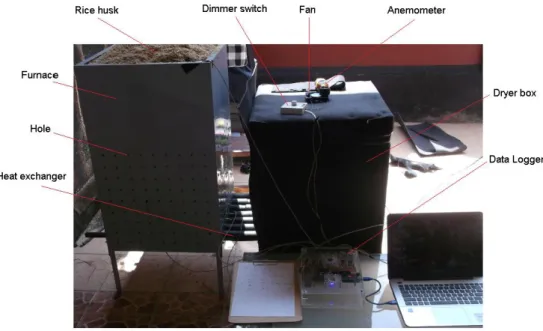
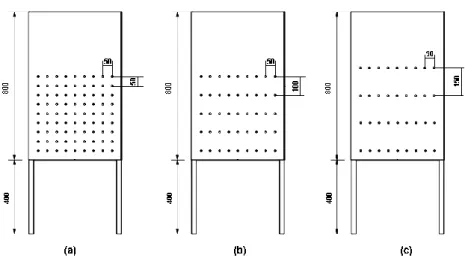
This study is an experimental study, with a schematic diagram shown in Figure 1-3. The tested system consists of a chamber combustion stove, heat exchanger pipes, dryer box, and fan. The stove has a dimension of 500 x 500 x 800 mm. On the wall of the stove there are air circulation holes. The diameter of the airspace is 50 mm with the distance of the hole varied.
The drying chamber has a dimension of 500 x 500 x 600 mm. The drying room wall is made of 6mm plywood and 6mm insulating rubber. Above the dryer box is installed fan to circulate the air in the dryer box. Heat exchanger pipes are made of steel pipe with a diameter of 25.4 mm. The pipes are placed at the bottom of the stove connected to the drying chamber. The air enters through the heat exchanger in the stove and receives heat from the chaff burning, then flows to the dryer box.
Figure 1 Schematic diagram of the test facility
Figure 2 Hole spacing variaton: (a) 50 mm, (b) 100 mm, (c) 150 mm
I Gede Bawa Susana, I G. N. K. Yudhyadi, Ida Bagus Alit, Mirmanto and I D.K. Okariawan
http://www.iaeme.com/IJMET/index.asp 1032 [email protected] Figure 3 Number of heat exchanger pipe variations: (a) 5 pipes, (b) 7 pipes, (c) 9 pipes
Put 20 kg of rice husk into the stove, then burn, and record all the temperatures in the heat exchanger pipe, dryer box, and ambient temperature. In addition, it noted a decrease in the surface height of rice husks in the stove per unit of time. In this study, the dryer box is conditioned without load with a fixed air velocity of 2 m/s. The hole distances on the stove wall and the number of heat exchanger pipes are varied to obtain the best dryer performance.
3. RESULTS AND DISCUSSIONS
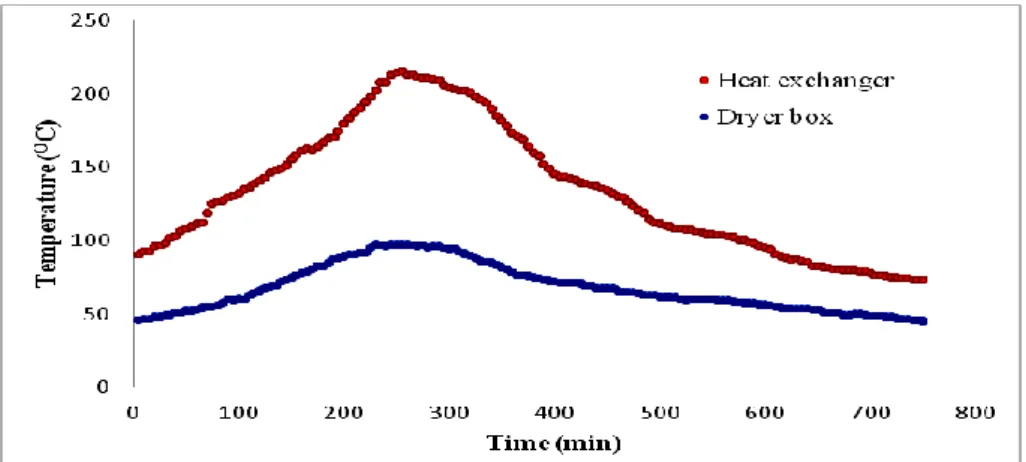
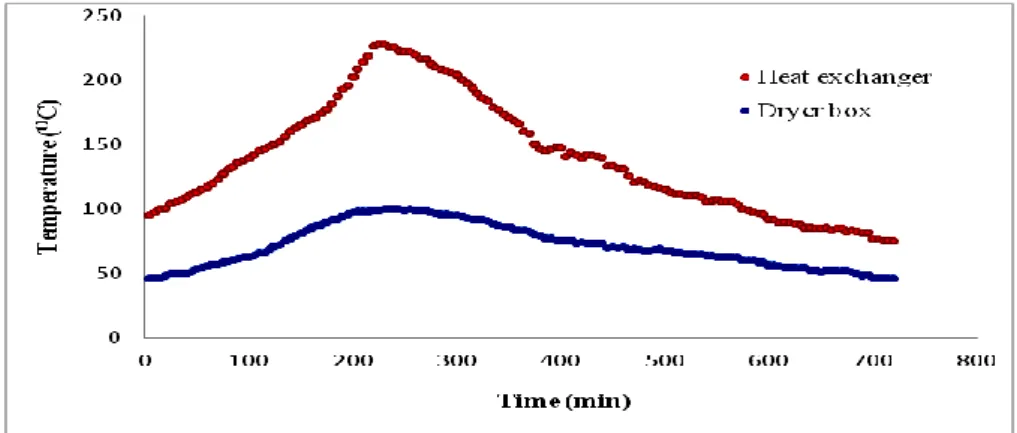
The first experiment was performed by varying the distance of the hole. Three stoves with hole spacing of 50 mm, 100 mm, and 150 mm, were tested using 9 heat exchanger pipes. The combustion air naturally enters through the air holes on the stove wall, while the dryer air enters from the heat exchanger pipe and exits the dryer box by force with the help of the fan placed above the dryer box. The air velocity out of the dryer box is set using a dimmer switch with a speed of 2 m / s. The results are shown in figures 4 through 6.
As shown in Figure 4-6, the temperature of both heat exchanger and dryer box increases from 0 to of approximately 225 second, after that the temperature decreases with the time. At the time of more than 600 second the temperature seems to be constant. This indicates that the heating process for both heat exchanger and dryer box are in transient condition. When the fire in the combustion chamber is started, then all components of the test facility also start to be hot. This is indicated by the increase in the temperature. After the heat absorbed by the components gets a maximum value then the system tries to be in equilibrium so that the temperature decreases and tends to be constant at more than 600 second. Furthermore, In the first two hundred minutes, the temperature of the heat exchanger rises, as the combustion of the husk begins at the bottom of the stove just above the heat exchanger. As time progresses, the combustion process propagate upward until all the fuel has been burned. The further burning of chaff from heat exchanger the heat exchange temperature decreases. This phenomenon occurs for all stoves with different hole spacing.
Figure 4 Temperature versus time observation for the stove with a hole spacing of 150 mm
Effect of Hole Spacing and Number of Pipe on Dryer Box Temperature
http://www.iaeme.com/IJMET/index.asp 1033 [email protected] Figure 5 Temperature versus time observation for the stove with a hole spacing of 100 mm
Figure 6 Temperature versus time observation for the stove with a hole spacing of 50 mm
The amount of dryer box temperature is greatly influenced by the heat exchange temperature. The temperature of the heat exchanger itself is affected by the combustion process in the furnace. The burning of the husk in the furnace requires the supply of air coming from the hole on the furnace wall, so the hole spacing on the furnace affects the combustion process.
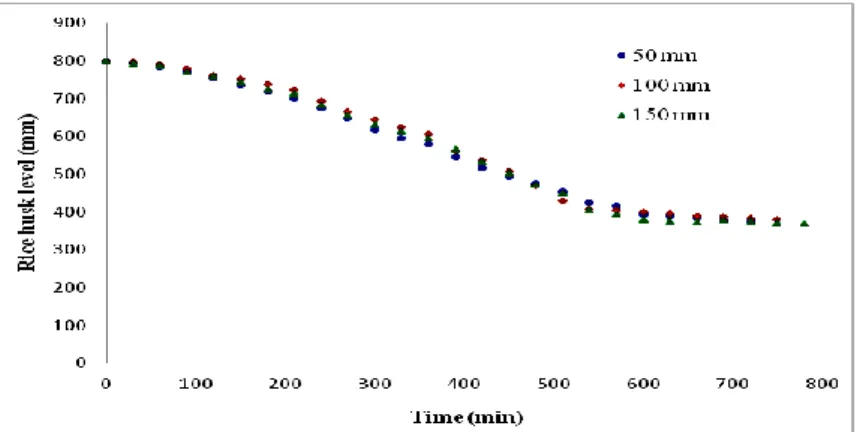
The relation of time to the height of rice husk in the furnace is shown in Figure 7. Of the three furnaces tested, the furnace with a 50 mm pit spacing resulted in the quickest drop in the chaff's height. The shorter the distance between the holes the more air holes in the wall of the furnace, so the combustion air more easily get into the furnace. This causes the combustion process faster. The faster combustion process of rice husk leads to a decrease in the chaff's height faster as well. The decrease in husk from the start of burning to the 600th minute is quite rapid, but then slows down in the subsequent minutes; this is because the fuel of the husk is almost burned out.
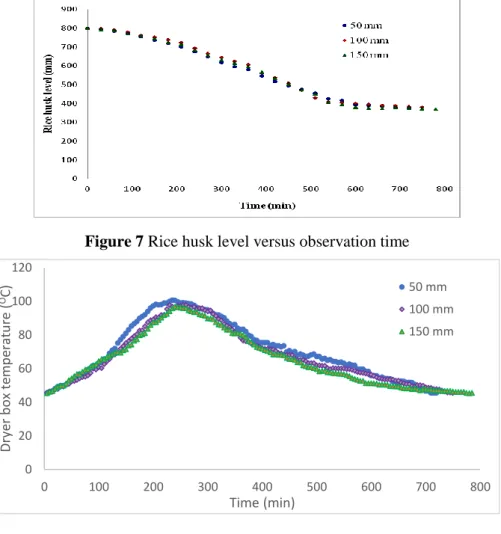
Figure 8 shows the time relation to drying box temperature at the variation of hole spacing. The time taken to burn 20 kg of rice husk in the furnace ranges from 720 to 785 minutes. The highest drying box temperature, obtained at the furnace using a 50 mm hole distance, but the hot release time in the dryer box becomes shorter.
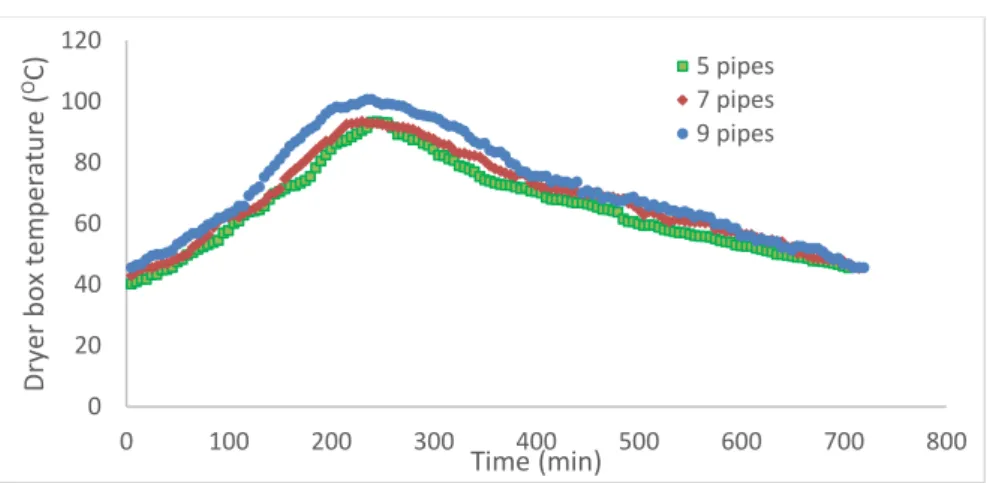
Subsequent research is to vary the number of pipes on heat exchangers. The numbers of
the pipes used are 5, 7, and 9 pieces. The furnace used is a furnace with a distance of 50 mm
hole with air flow velocity in the dryer box of 2 m/s. The highest temperature in the dryer box
is generated on the furnace with heat exchanger consisting of 9 pipes, as shown in figure 9.
I Gede Bawa Susana, I G. N. K. Yudhyadi, Ida Bagus Alit, Mirmanto and I D.K. Okariawan
http://www.iaeme.com/IJMET/index.asp 1034 [email protected]
The more pipes in the heat exchanger, the more heat transfer surfaces that occur in the furnace or in the dryer box. The greater the contact surface of the heat transfer in the furnace causes the greater the heating of rice husks to be absorbed by the heat exchanger. Increased heat energy absorbed in the furnace which further increases the heat released in the dryer box.
Therefore, the temperature in the dryer box becomes higher.
Figure 7 Rice husk level versus observation time
Figure 8 Dryer box temperature versus observation time
Figure 9 Dryer box temperature versus observation time for the heat exchanger with pipe number variations
0 20 40 60 80 100 120
0 100 200 300 400 500 600 700 800
Dryer box temperature (OC)
Time (min)
50 mm 100 mm 150 mm
0 20 40 60 80 100 120
0 100 200 300 400 500 600 700 800
Dryer box temperature (OC)
Time (min)
5 pipes 7 pipes 9 pipes
Effect of Hole Spacing and Number of Pipe on Dryer Box Temperature
http://www.iaeme.com/IJMET/index.asp 1035 [email protected]
4. CONCLUSIONS
The time taken to burn 20 kg of rice husk in the furnace ranges from 720 to 785 minutes. The amount of dryer box temperature is greatly influenced by the temperature of heat exchanger pipe. The highest temperature in the dryer box is obtained by using a furnace with 50 mm hole spacing. But the heat release time in the dryer box becomes the shortest. The shorter the distance of the hole, the process of burning rice husk will be faster, so the decrease of rice husk in the furnace is also faster. The more the number of pipes in the heat exchanger, the greater the heat from the burning of rice