
The Series Education in the Asia-Pacific Region: Issues, Concerns and Prospects, and Handbook of Educational Research in the Asia-Pacific Region, are both publications of the Asia-Pacific Educational Research Association. The quality of this book ensures its place in the international literature of educational sociology, as well as in the sociological literature of Indonesia.
Contents
Editors and Contributors
About the Editors
Contributors
Edi Subkhan Jurusan Kurikulum dan Teknologi Pendidikan, Fakultas Ilmu Pendidikan, Universitas Negeri Semarang (UNNES), Semarang, Indonesia. Komite Etik Penelitian Kedokteran dan Kesehatan MHREC MK Mahkamah Konstitusi Kemendikbud Kementerian Pendidikan dan Kebudayaan.
List of Figures
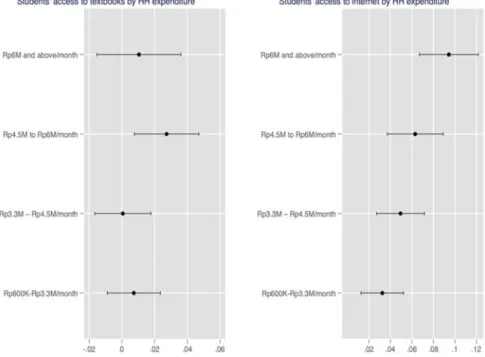
We then calculate the average marginal effects for each monthly expenditure group with a base group of students from households with less than Rp 600,000 in expenditure per month. A confidence interval overlapping at 0 means that there is no significant difference between the interest group and the baseline group.
List of Tables
Chapter 1
Introduction: Education
The Landscape of Education in Indonesia
Beyond the equitable distribution of educational resources, researchers may need to pay attention to the "nature" of the educational service, its capitalist ideological basis, and its consequences for society. Finally, we provide a summary of the chapters in the volume that examine various issues in current Indonesian education through critical lenses.
The Indonesian Education System: Past and Present .1 Islam and Early Forms of Education
- Modern Education System
- Contemporary Trends in Education
This promise of education for all is enshrined in the National Constitution, which ensures “the rights of every citizen to have access to education” (1945 Constitution, Article 31, verse 1). As the youngest minister in Jokowi's cabinet, Nadiem introduced several reforms to the Indonesian education system, represented by the slogan Merdeka Belajar (free/independent learning).
Indonesian Education Through Critical Lenses: Overview of the Chapters
Politically, Indonesia's post-1998 democratization has allowed new discourses to enter the educational arena, including decentralization (Hariri et al., Chapter 10), human rights (Rosser & Joshi, Chapter 9), and inclusivity (Yulindrasari et al., Chapter 4 ). ), and gender and sexual justice (Pangastuti, chap. Building on the identification of the roots of social-educational injustice, critical education scholars also explore opportunities for advancing social justice through critical pedagogy across domains and contextual particularities, including homeschooling .(Nugroho, Chapter 13), and critical reflective praxis (Mambu & Kurniwan, Chapter 11).
10, Hariri, Izzati and Sumintono examine the implementation of decentralization – as part of the democratization of Indonesia – in the education sector. They show how tensions between the central government (i.e. the Ministry of Education), local education agencies, and school leaders have characterized Indonesia's decentralization of education over the past two decades.
Part I
Equality and Inclusiveness in Indonesian Education: Gender, Class, and Identity
Chapter 2
The (Dis-)Appearance of “(M)others”
The Roles of International Development Organizations on the Discourses
- Introduction
- Tracing the Silence
- Overview of Early Childhood Education in Indonesia .1 The Role of the World Bank
- Maternalist Norms
- Discourses of Women in Early Childhood Education
- The “Problems” with Poor Mothers
- The Unspoken and Unpaid Teachers
- Maternal Caring in Neoliberal Times
- Chapter 3
As highlighted by Goldstein (1993): "the separation of educational feminism and early childhood education feels artificial, awkward. The theory measures funding on ECE in relation to the efficiency gained from higher tax revenues and social welfare spending – the economic return (Doyle et al., 2009).
COVID-19 Widening the Gap
Introduction
At the time of writing this study, the regional government plans to continue the learning from within policy in the 2021-2022 academic year. There are concerns about the readiness of students, teachers and parents in implementing the home learning process.
Methodology .1 Sampling Design
- Questionnaire Design
- Implementation
- Data Analysis
We conducted a pilot of the online survey and in-depth telephone interview between June 8 and July 3, 2020. After completion of the online survey, we randomly select respondents for the in-depth telephone interview.

Results .1 Parents
- Teachers
However, we find that teachers in schools with little poverty are more likely to be civil servants or permanent teachers. On the other hand, teachers in high-poverty schools are more likely to be temporary, supportive contract teachers.
Conclusion
Data from an online survey and in-depth interviews with teachers also point to inequality in educational input. Ethics approval We obtained approval from the Ethics Committee with reference number KE/FK/0561/EC/2020 of the Medical and Health Research Ethics Committee (MHREC), Faculty of Medicine, Public Health and Nursing, Universitas Gadjah Mada. 3 COVID-19 Widening the Gap in Education: Evidence from Urban Jakarta 55 thank Lina Marliana and Buhat Yuliant for their support during the study.
3 COVID-19 Widening the Education Gap: Evidence from Urban Jakarta 57 Gumilang Aryo Sahadewo is Associate Professor at the Department of Economics, Universitas Gadjah Mada, and an invited researcher at the Abdul Latif Jameel Poverty Action Lab in Southeast Asia.

Chapter 4
Rethinking the Discourse of School
Readiness in Indonesian Early Childhood Education
- Introduction
- Conceptualizing School Readiness
- Method
- Findings
- The State’s Version of School Readiness
- The Market-Driven Academic School Readiness and the Issue of Inequality
- Conclusion
How school readiness discourse has influenced early childhood education policy and practice (Moss, 2013) is rarely discussed. We will then conceptualize school readiness that is more comprehensive in the context of Indonesian early childhood education. There is no substantive research-based evidence behind the pathologizing of the academic discourse of school readiness.
Rethinking school readiness and transition policy and practice in early childhood education (ECE): The whole schooling framework.
Part II
The Neoliberalization of Indonesian Education System
Chapter 5
Vocationalizing Education: The Dangers of Link-And-Match Paradigm
Introduction
The implementation of link-and-match paradigm during Suharto's era led to several reforms in educational policy. Here, the link-and-match paradigm has led to the decreasing autonomy of education and the increasing role of market interests in the education system. In Indonesian contexts, studies on market-driven education have been conducted using different terminologies such as liberalism, neoliberalism and link-and-match education in addition to market-driven education and professionalization of education.
The purpose of this chapter is to expand the debate on VET based on the match-and-match paradigm, particularly its potential dangers for students' futures.
Vocational School in Indonesia: Technicizing Education, Perpetuating Inequity
- Problem 1: Vocational School Curriculum
- Problem 2: Vocational School Policies
The structure of the vocational school curriculum placed a strong emphasis on technical skills because the government treated vocational schools as suppliers to the labor market, especially in the industrial world. These market-driven and link-and-match concepts of the vocational school curriculum can be seen in the existing curriculum policy. First, the majority of vocational school students in Indonesia come from lower-income families (Asian Development Bank Vocational and Technical Education in Indonesia, 2012).
Unfortunately, the grand design of the current vocational school curriculum in Indonesia is still far from this ideal form.
Competency-Based Curriculum: Reducing the Purpose of Education
- Problem 1: The Orientation of the Curriculum
- Problem 2: The Content of the Curriculum
- Problem 3: The Implementation of the Curriculum
Then, in 2004, the government officially issued a new national curriculum called the Competence-based Curriculum (CBC), and its framework became the basis for curriculum development for the next curriculum in 2006 and 2013. The problem arises when the goals of the national education system conflict with dominant market-oriented interests in the national curriculum. This orientation may have neglected other goals of the national education system, especially the social, cultural and political purposes of education.
Instead of refocusing the curriculum structure to equip students to be competent to meet specific market demands, the national curriculum structure is still overloaded.
Conclusion and Further Discussions
Sebagaimana dikritisi oleh banyak pemikir pendidikan Indonesia, misalnya Soedijarto (2009), salah satu tujuan utama sistem pendidikan nasional Indonesia adalah membangun Indonesia menjadi bangsa yang modern, demokratis, sejahtera, dan berkeadilan sosial berdasarkan Pancasila. Direktorat Pembinaan SMK Direktorat Jenderal Pendidikan Dasar dan Menengah Kementerian Pendidikan dan Kebudayaan. Beberapa catatan mengenai cita-cita dan tujuan sistem pendidikan nasional Indonesia serta inkonsistensi implementasinya: Analisis komparatif.
Link and fit dunia pendidikan dan industri untuk meningkatkan daya saing tenaga kerja dan industri.
Chapter 6
- Introduction
- Higher Education and the Public Good
- The Concept of Knowledge
- Indonesian Higher Education and the Public Good
- Changing Knowledge Production: Is It a Bare Pedagogy?
- The Corporatization of Research
- The Vocationalization of the Curriculum
- Conclusion
- Chapter 7
Communitarianism considers public goods that have social and public charters in the traditional model of higher education. Consequently, Delanty (1998b) even claimed that there had been "the end of knowledge" in higher education. The phenomena described above indicate that there has been a reorientation of the meaning of knowledge embraced by Indonesian higher education.
This suggests that the public welfare of Indonesian higher education has been compromised by market values.
The Part-Time Academic Identity
An “Englishman in New York”?
- Academic Identity in a Changing Academic Profession
- The Higher Education Context in Indonesia
- Part-Time Academics in Indonesia
- Individual Perceptions of Roles .1 The Half-Academics?
- Inter-Groups’ Perception of Values
- Alienation in Social Life
- The Institution and the System: Creating Legal Aliens
- Abusing the System: Easy to Come, Not Easy to Go
- Understanding of the Rules and Regulations
- Discussion and Conclusion: Academic Identity of PTAs
- What to Do Next?
The chapter will first provide an overview of the higher education context in Indonesia and who are the part-time academics in the system. Followed by the contribution of larger social structures to the academic identity of PTA. Therefore, there is a salient hierarchy, which is “the self that responds to the expectations of the situation rather than the desires of the self” (Burke & Stets, 2009, p. 41).
Her difficulty was actually only because her offer letter from the new institution did not have the phrase "load of 12 credits per semester" and it took her nearly two years to get through the red tape.

Part III
Education and the State Apparatus
Religion, Law, and Local Politics
Chapter 8
Pesantren in Contemporary Indonesia
Negotiating Between Equity and the Market
Falikul Isbah and Zulfa Sakhiyya
- Introduction
- Pesantren in Pre-Independent Indonesia
- Pesantren in Independent Indonesia
- Mainstreaming Pesantren in National Education
- Pesantren in Contemporary Indonesia
- Schooling Model and Learning Arrangement
- Curriculum Design and Orientation
- Adapting to Modernity Versus Maintaining Equity
- Pesantren, Life Dreams, and Aspired Social Mobility
- Concluding Thoughts
The change in the position of farmers in the national educational space is then analyzed with a view to the social processes of the integration of farmers into the national education system. First, in the 1990s, she saw many peasant-educated parents, especially those living in cities, not sending their children to farmers. However, the boundary between local and cosmopolitan pesantren is not defined, as there are border pesantren – a third type of pesantren.
The pesantren tradition: The role of kyai in preserving traditional Islam in Java.
Chapter 9
Courts and the Right to Education in Indonesia
- Introduction
- Conceptual Framework
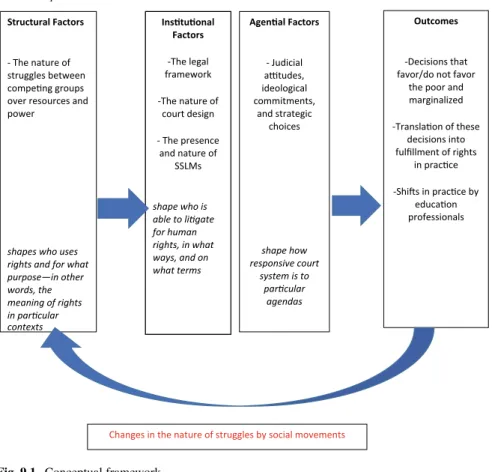
- Education Rights Litigation in Indonesia .1 Structural Factors
- Institutional Factors
- Litigation
- Agential Factors and Outcomes
- Conclusion
- Chapter 10
In the final section, we speculate on the likely future effectiveness of R2E litigation in Indonesia and consider the broader implications of the analysis. Their submission called on the government to change various aspects of the examination and issue a public apology for failing to protect the right to education (Rosser, 2015a). After the law came into force, all these groups challenged the law in the Constitutional Court.
So what are the broader lessons from the Indonesian case regarding the effectiveness of R2E litigation in promoting the realization of the right to education in developing country democracies.
Attraction of Authority: The Indonesian Experience of Educational
Decentralization
- Introduction
- Early Development: Exercising Power and Authority at the District Level
- Regaining the Missing Legitimacy and Its Local Responses
- New Regime of Standardization
- School Operational Cost
- Teachers and Principals
- National Exam
- Conclusion
The Minister of Education and Culture spoke positively about SBM in the media, stating that "the implementation of the school-based management policy is to support school autonomy to increase the quality of education in accordance with national and international standards" (Sumintono, 2006, p. 93). One of the famous jargons of that period referred to the changing role of the central government, which instead of "rowing" the country's educational development had turned to "managing" it. In one of the articles of the new law, it is stated that any matter related to teachers is subject to the Teachers' Act.
The Directorate-General for Teachers and Education Personnel is one of the institutions in the MoEC to recentralize teacher management.