Credit market imperfections are pervasive in the case of education loans, at least in part because of the moral hazard problem borrowers face, since human capital is inalienable and does not serve as collateral for loans. Empirical evidence on the existence of credit constraints in the context of human capital accumulation is abundant. For example, Lazear (1980) and Jacoby and Skoufias (1997) find strong links between financial market imperfections and human capital accumulation in the context of U.S.
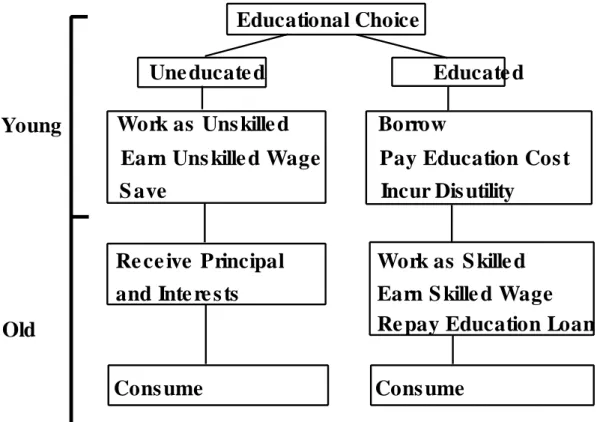
We concentrate on the implications of credit market imperfections for the school decision, assuming no imperfection in the credit market for the purchase of physical capital goods. They become skilled in the second period and earn a high wage, which enables them to consume and repay the loan.
CREDIT RATIONING
THE BASIC MODEL
Note that in this model default will not be observed in equilibrium, although its possible occurrence is crucial to generate some of our results. But with competition this would not be possible – if a lender offered a financial contract to a borrower with an effective interest rate greater than r, he would be underbid by another lender. The above considerations provide a simple way to endogenize the credit constraints, in contrast to the exogenous borrowing constraints in the conventional literature, such as Hare and Ulph (1981), Azariadis and Smith (1993) and De Gregorio (1996).
A non-degenerate steady-state equilibrium with credit rationing (NSSECR) is a tuple of
It is clear that a monopoly lender will do this (those with lower "'s are required to repay more). It is useful to compare the constrained level of education xc with the unconstrained one in the absence of credit rationing (which we denoted by xu).) in terms of factor prices and parameters. The first inequality implies xu > xc and the second ensures that in a non-degenerate steady-state equilibrium with credit rationing, the real interest rate is positive (r > 0).
One could solve for the NSSECR values of (k, x) using (4b), (11) and (13), giving the corresponding value of r and eliminating r from the statement of condition C, but this would make the condition far less transparent. Moreover, as will be seen later, the second inequality is sufficient but not necessary for an NSSECR to exist.
Existence of NSSECR) Under Conditions E and C, there is a unique non-degenerate steady-
AN ALTERNATIVE APPROACH TO MODELING MORAL HAZARD
- PUBLIC POLICY
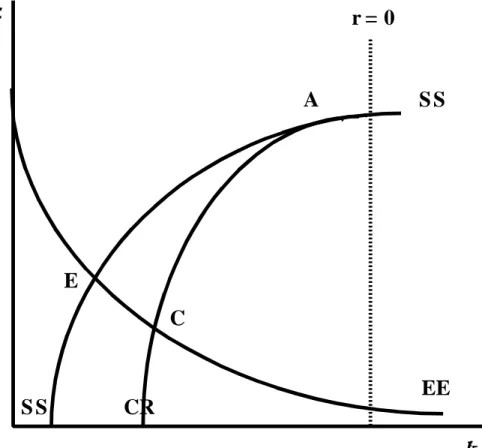
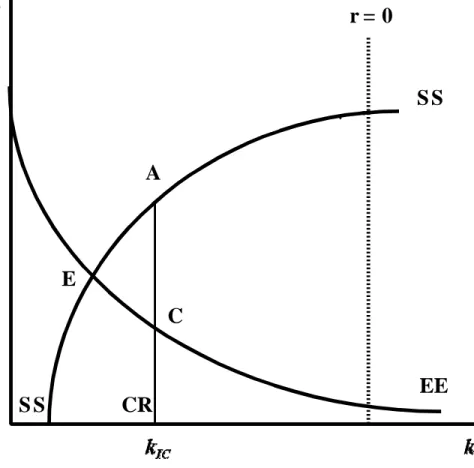
When k $ kIC, the real interest rate is at such a low level that the loan repayment becomes less than the starting cost, thus ensuring incentive compatibility. The reader may find that this incentive compatibility constraint is analogous to the limited liability constraint (PAii) in Sappington (1983, p. 6). The first inequality of Condition CN guarantees that the incentive compatibility constraint is binding (so point C is to the right of point E).
Comparing the constrained and unconstrained equilibria, we can easily see that credit rationing results in a lower level of education, a higher ratio of capital to labor, a lower real interest rate, and a higher wage rate for skilled workers in the steady state than in the benchmark model. However, the stationary response of education to changes in the monetary costs of education and the effect of a change in escape costs remain qualitatively unchanged. This can be easily seen by comparing the two incentive compatibility constraints and noting that lenders will only lend to borrowers for whom the net benefits of education (ie, the wage of skilled workers minus loan repayment minus subjective costs) are non-negative.
If the expected cost of default is always higher than (1 + r)2 (for possible values of r), then there is incentive compatibility. We assume that there is nothing the government can do that directly addresses the source of the problem, which is that there is no way for borrowers to do so. We consider two policy issues: (i) whether a Pigovian subsidy for education can restore the Pareto efficient unconstrained equilibrium and (ii) an optimal public supply of education.
The first is a tax on the beneficiaries of education and is therefore (arguably) justified on grounds of equity; on the contrary, the latter does not affect the state of equilibrium in the goods market (see discussion later) and could therefore be argued to be non-distorting.
EFFECTIVENESS OF A PIGOVIAN SUBSIDY TO EDUCATION
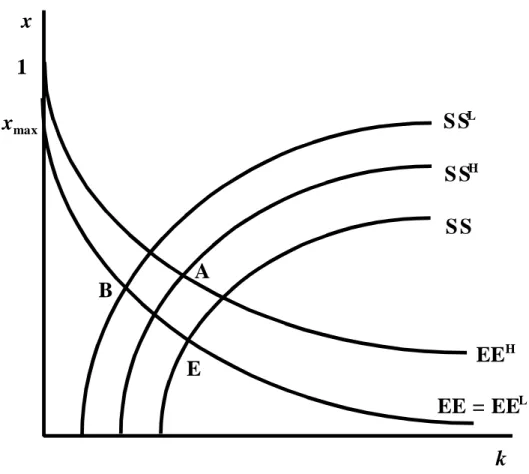
Addressing these issues raises the question of how government spending is financed. We allow two options: the first is a tax on the educated elderly, the second is a tax on the unskilled young. So a subsidy shifts the location of EE only if it is financed, at least in part, by a tax on the educated (JH).
If it is financed by a tax on the uneducated (JL), it does not change the resources available for financing education. When JH > 0, a simple Pigovian subsidy ensuring that the CR and original SS loci coincide causes a shift in the EE locus. These conditions are sufficient to ensure that an education subsidy at the level s = (2 - v) - B/(1 + r), financed by a tax on the unskilled leads to unambiguous Pareto improvements over the constrained equilibrium in the absence of policy intervention.
Although the unskilled are worse off because of the tax, they are better off because of the resulting increase in the real interest rate and, under condition P, the second effect. In this case, those who remain skilled or unskilled and who switch from unskilled to skilled are all better off, and so such an education subsidy policy is Pareto-improving.
OPTIMAL PUBLIC PROVISION OF EDUCATION
- CONCLUSION
Intuitively, ' represents the net benefit of education of the person with the greatest disutility of education ("") who is educated. Since taxation of the unskilled does not affect the locus of EE, it is possible to reach an unbounded equilibrium allocation in this case, interestingly, in this case social optimality means that exactly the same level of education is chosen, but taxation of the unskilled does not affect the locus of EE, but clearly affects the attractiveness of education for the unskilled (who, compared to the unconstrained case, are at a disadvantage in terms of the amount of taxes they pay to finance education ; those who are getting an education are better off, because now they don't have to pay for their education at all).
This "tax avoidance" effect does not exist in the case where the beneficiaries of education are taxed. The optimal level of government spending on education is greater if it is financed by taxation of the educated than by taxes on the uneducated; the second optimum, but not the first, involves rationing education. It seems that on both efficiency and equity grounds a strong case can be made for education to be funded by taxing the educated – this is relevant to the debate taking place in a number of countries about the funding of education (especially higher education).
We have observed that by providing public education (free to users) there will often be excessive demand for education and thus rationing (although there are circumstances in which compulsory education may be desirable). Proof of Proposition 4: The first part of the proposition about the possibility of each type of educational subsidy to restore the unbounded equilibrium is proved in the text. We therefore focus on the second part: an education subsidy by taxing the unskilled can generate Pareto improvement under Condition P.
Proof of Proposition 5: We denote the private net benefit of education in the case of taxation of the unskilled (JH . = 0) by 'L, and by 'H for the taxation of the skilled (JL = 0). At 'H = 0, socially optimal educational provision is neither compulsory nor rationed; however, the optimal level of x (and k) is associated with 'U < 0, implying more investment in education (and capital accumulation) than in the unconstrained equilibrium. Therefore, social optimality requires rationing of education (since 'L > 0) and the optimal level of x (and k) coincides exactly with the unconstrained equilibrium (with 'U . = 0).
Young
Educational Choice
Receive Principal Work as Skilled
Repay Education Loanand Interests Earn Skilled Wage
EE HSSH
We discuss the differences between our paper and the rest of the literature in more detail later in the Introduction. One might question whether the term "credit rationing" is appropriate since we do not have observationally equivalent borrowers, some of whom are given loans while others are rejected—those who are rejected for credit are denied credit because they are worse risks than they are. . who are successful. Whether the credit market imperfection in our model should be described as credit rationing is something we consider purely semantic, although it is consistent with the use of the term in some literature; objecting readers might substitute "credit market imperfection(s)" for "credit rationing."
Since credit rationing is endogenous, one might object to our discussion of "the effects of credit rationing". If the outcome of the uncertainty is such that some individuals will not be able to repay their loans in full, there will be a number of changes (for example, lenders will require a higher interest rate on loans) that the analysis will complicated without changing anything essential, therefore we prefer to maintain the certainty assumption about the outcome of education. Although we do not consider this alternative model to be particularly realistic, it allows us to check how robust the results of the benchmark model are.
The results turned out to be virtually identical to those of the benchmark model. If there is no interest rate at which this happens, then there is no lending - a rather extreme case of credit rationing. However, the negative effect of credit rationing on the real interest rate persists as long as its effect on the wage of the unskilled dominates its effect on the marginal product of capital.
Notably, in the static partial equilibrium loanable funds model of Stiglitz and Weiss (1981), credit rationing is also associated with a lower real interest rate, due to an entirely different reason—a lower interest rate reduces borrowers' incentive to undertake riskier projects.