THE EFFECT OF USING DIRECTED LISTE NING THINKING ACTIVITY (DLTA) METHOD TO LISTENING SKILL IN UNDERSTANDING THE MEANING OF SONG AT 7
thGRADE OF SMP NEGERI 1
BINTAN
SKRIPSI
Pristya Dhea Natasya NIM 150388203024
ENGLISH EDUCATION STUDY PROGRAM FACULTY OF TEACHING TRAINING EDUCATION
UNIVERSITAS MARITIM RAJA ALI HAJI TANJUNGPINANG
2019
i
THE EFFECT OF USING DIRECTED LISTENING THINKING ACTIVITY (DLTA) METHOD TO LISTENING SKILL IN UNDERSTANDING THE MEANING OF SONG AT 7
thGRADE OF SMP NEGERI 1
BINTAN
Skripsi
Submitted as a Partial Fulfilment for the Undergraduate Degree in English Education
Pristya Dhea Natasya NIM 150388203024
ENGLISH EDUCATION STUDY PROGRAM FACULTY OF TEACHING TRAINING EDUCATION
UNIVERSITAS MARITIM RAJA ALI HAJI TANJUNGPINANG
2019
ii
APPROVAL SHEET
iii
INTELLECTUAL PROPERTY STATEMENT
iv MOTTO
“Life isn’t about findings yourself. life is about creating yourself”
This Skripsi in Especially Dedicated for
My Dearly parents,
Sularno and Refida
I cannot describe how much your prays, and tears in order supporting me. Thank you so much for your endles love motivating, teaching and open my way to achieve my
dreams.
v
ACKNOWLEDGMENT
Alhamdulillah, all prasies be to Allah, the single power, the lord of the universe,master of the Day of Judgement, God Almighty, for all blessings and mercies so the researcher was able to finish this research entitled “The Effect of Using Directed Listening Thinking Activity (DLTA) Method to Listening Skill in Understanding the Meaning of Song at 7th Grade of SMP NEGERI 1 Bintan”. Peace be upon prophet Muhammad SAW, the great leader and good inspiration of world revolution.
The reseracher is sure that this research would not be completed without the helps, supports, and suggestion from several sides. Thus the researcher would like to express her deppest thanks to all of those who had helped, supported, and suggested her during the process of writing this thesis. This goes to:
1. Prof. DR. Syafsir Akhlus, M.Sc., as the Rector of Universitas Maritim Raja Ali Haji Tanjungpinang.
2. Drs. H. Abdul Malik, S.Pd., M.Pd., as the Dean of faculty of Teaching Training and Education of Universitas Maritim Raja Ali Haji Tanjungpinang.
3. Mrs. Dewi Nopita, S.Pd., M.Pd., as the Head of English Education Department of Universitas Maritim Raja Ali Haji and as my Second Advisor.
4. Mr. Gatot Subroto, S.S., M.Pd., as the Secretary of English Education Department Universitas Maritim Raja Ali Haji Tanjungpinang.
5. Mr. Satria Agust, S.S., M.Pd., as my First Advisor.
6. For my beloved parents, my father Sularno and my mother, Refida who have been supporting researcher to completing this thesis
7. For my beloved aunty, Eny who have been supporting researcher.
vi
8. The researcher’s best friends, Jihan Pratidya, Mekar Pratiwi, Oktavia Andrian Yuri, Cindy Ida Ayunesia, Regita Maharani Ardhia Safitri.
9. Thank for all people who have given the reseacher the great support in conducting and finishing this skripsi.
Finally, the researcher realizes that this skripsi is so far from being perfect.
Therefore, readers’ comments, critiques, and constructive suggestion will be very much appreciated. May Allah Almight, the lord of universe bless you All. Amien….
The Researcher
vii
TABLE OF CONTENT
COVER...i
APPROVAL SHEET... ii
INTELLECTUAL PROPERTY STATEMENT ... iii
MOTTO ... iv
ACKNOWLEDGMENT ... v
TABLE OF CONTENT ... i
LIST OF FIGURES ... i
LIST OF TABLES ... i
LIST OF APPENDIX ... i
ABSTRAK ... i
ABSTRACT ... i
CHAPTER 1 INTRODUCTION... 1
1.1 Background of the Problem ... 1
1.2 The Identification Problem ... 2
1.3 Limitation of the problem ... 2
1.4 Research Question ... 2
1.5 Objective of the Study ... 2
1.6 The Significant of study ... 2
1.7 Definition of Key Terms ... 2
CHAPTER II LITERATURE REVIEW ... 6
2.1 Definition of Listening Skill ... 6
vii
2.1.1 Micro and Macro Skills of Listening ... 6
2.1.2 Listening Skill in Secondary School ... 12
2.1.3 Directed Listening Thinking Activity (DLTA) Method ... 11
2.1.4 The Using of Directed Listening Thingking Activity ... 11
2.2 Relevant Study... 11
2.3 Conceptual Framework ... 11
2.4 Research Hypothesis ... 11
CHAPTER III RESEARCH METHODOLGY ... 11
3.1 Research Method and Design ... 11
3.2 Place and Time of Study... 11
3.3 Population, Sample, and Sampling ... 16
3.4 Data Collection Technique ... 16
3.5 Research Instruments... 16
3.6 Research Procedures ... 16
3.7 Data Analysis Technique ... 16
CHAPTER IV RESEARCH FINDINGS AND DISCUSSION ... 16
4.1 Findings ... 16
CHAPTER V CONCLUSION AND SUGGESTION ... 34
5.1 Conclusion ... 34
5.2 Suggestion ... 34
REFERENCES ... 18
viii
LIST OF FIGURES
Figure 2.1 Conceptual Framework...14
Figure 4.1 Normality Test in Experimental Class...29
Figure 4.2 Normality Test in Control Class...29
Figure 4.3 Homogeneity Test...30
ix
LIST OF TABLES
Table 3.1 Pretest ans Posttest Nonequivalent Control Group Design...18
Table 3.2 Level Scoring of Listening...19
Table 4.1 Score Gained on Experimental Class...22
Table 4.2 Score Gained on Control Class...23
Table 4.3 Frequency Distribution of Pretest Score at Experimental Class...25
Table 4.4 Data Distribution of Pretest Score at Experimental Class...25
Table 4.5 Frequency Distribution of Pretest Score at Control Class...26
Table 4.6 Data Distribution of Pretest Score at Control Class...26
Table 4.7 Frequency Distribution of Posttest Score at Experimental Class...27
Table 4.8 Data Distribution of Posttest Score of Experimental Class...27
Table 4.9 Frequency Distribution of Posttest Score at Control Class...28
Table 4.10 Data Distribution of Posttest Score of Control Class...28
Table 4.11 Result Hypothesis Test...31
x
LIST OF APPENDIX Appendix 1 T-Table
Appendix 2 Research License
Appendix 3 Pretest Score of Experimental Class Appendix 4 Posttest Score of Experimental Appendix 5 Pretest Score of Control Class Appendix 6 Posttest Score of Control Class Appendix 7 Lesson Plan of Experimental Class Appendix 8 Lesson Plan of Control Class Appendix 9 Syllabus of VII Grade
Appendix 10 Lyric of the song Appendix 11 Documentation
xi ABSTRAK
Natasya, Pristya Dhea. 2019. The Effect of Directed Listening Thinking Activity (DLTA) Method in Understanding The Meaning of Song at 7th Grade of SMP Negeri 1 Bintan. Skripsi. Tanjungpinang: Jurusan Pendidikan Bahasa Inggris, Fakultas Keguruan dan Ilmu Pendidikan, Universitas Maritim Raja Ali Haji.
Pembimbing 1: Satria Agust, S.S., M.Pd. Pembimbing II: Dewi Nopita, S.Pd., M.Pd.
Kata Kunci: Directed Listening Thinking Activity, Keterampilan Mendengar
Tujuannya penelitian ini adalah untuk mengetahui pengaruh metode DLTA terhadap keterampilan mendengar siswa di SMP Negeri 1 Bintan. Metode yang dilakukan adalah metode kuanitatif dimana data disajikan secara numerik dan diuji dengan t-test. Desain penelitian adalah desain kuasi-eksperimental yang mellibatkan 25 siswa di VII G sebagai kelas eksperimental dan 25 siswa di VII H sebagai kelas kontrol.
Kelas eksperimental diajarkan dengan menggunakan metode DLTA dan kelas kontrol menggunakan metode konvensional. Peneliti memberikan pretest sebelum aktivitas pembelajaran. Setelah kegiatan belajar mengajar selesai peneliti memberikan posttest untuk mengetahui prestasi keterampilan mendengarkan siswa. Skor pretest dan posttest dianalisis dengan uji statistik deskriptif. Kemudian data di uji dengan uji homogenitas, uji normalitas, dan uji hipotesis. Dapat disimpulkan bahwa ada pengaruh signifikan dari metoda DLTA terhadap keterampilan mendengarkan siswa di SMP Negeri 1 Bintan.
xii ABSTRACT
Natasya, Pristya Dhea. 2019. The Effect of Directed Listening Thinking Activity (DLTA) Method in Understanding The Meaning of Song at 7th Grade of SMP Negeri 1 Bintan. Skripsi. Tanjungpinang: English Eduvation Study Program, Faculty of Teacher Training and Education, Universitas Maritim Raja Ali Haji. Advisor:
Satria Agust, S.S., M.Pd. Co-advisor: Dewi Nopita, S.Pd., M.Pd.
Kata Kunci: Directed Listening Thinking Activity, Listening Skill
The purpouse of this study was to determine the effect of the DLTA method on the listening skills of students in SMP Negeri 1 Bintan. The method used is a quantitative method where data is presented numerically and tested by t-test. The research design was a quasi-experimental design involving 25 students in VII G as experimental class and 25 students in VII H as a control class. Experimental class are taught using the DLTA method and the control class uses conventional methods. The researcher gave the pretest before the learning activity. After the teaching and learning activities were completed the researcher gave posttest to find out the achievement of students' listening skills. Pretest and posttest scores were analyzed by descriptive statistical tests. Then the data is tested by homogeneity test, normality test, and hypothesis test. It can be concluded that there is a significant effect of the DLTA method on listening skills of students in SMP Negeri 1 Bintan.
1 CHAPTER 1 INTRODUCTION 1.1 Background of the Problem
The target of teaching and learning English at SMP/MTs is to enable the learners to achieve the functional level to communicate orally and written. To reach the target, the junior high school students have to master the four skills of English.
Teaching as an intentional activity to increase understanding, skill or knowledge of others to reduce the gap between teacher and learner Frye and Ziv (2005). According to many researchers, listening is one of the important skills that should be mastered because it helps students to improve other English skills. In the daily life, people listen more than they read, speak or write. The second grade students of junior high schools have to master the listening skills so that they can understand some instructions from their teacher in the English teaching and learning process and they can finally respond to them well.
Listening is one of four skills in English language learning. This skill allows the student to communicate the message and gets the point from the communication.
Listening is a complex web, involving ‘what is immediately heard, including the unspoken, the articulateness of objects and the listening that comes through participating’ (Bennett, 2015). Listening facilitates a ‘welling up of memories’ that carry a unique knowing. The language learners will be successful, if they master the language which they learn to the point of using it in communication. In receiving something, the listeners will hear language produced by other people first, and they are
2
going to respond them. Language learners not only need the ability to understand the linguistic forms but also need the abillity to use the language in actual use.
Listening is a skill in a language that is applied to English lesson. It is important as the preparation of learning foreign language sepecially English language. The students have to answer the question to the listening material. Although it is hard, in curriculum k-13 students in junior high school in Indonesia are demanded to master listening skill. Curriculum 2013 that these students have to learn is to be able to understand spoken and written texts expressing hopes and prayers, suggestions, offers, opinions/thoughts and their responses. Based on the syllabus, students should listen a song especially for Seventh grade students in junior high school. Students should be able to understand the meanings of song as required in the K-13 curriculum. The outcome is that, students are able to understand the meaning of song.
Based on researcher’s experience in teaching English at SMPN 1 Bintan, there were some problems faced by students in learning listening skill. One of them was that they were not familiar with the spoken words and missed catching the word. Hassan (2014) says that the differences of the sound system between (L1) and the (L2), the inconsistency of some sounds in English language, the mother tangue interference and the influence of spelling on pronouncitation. Besides, they were lack of understanding the whole spoken text. In this case, listening becomes complex skill since they were lack of ability to catch the word, and grab the meaning of the lyrics. The students also could not hear the song lyrics clearly and it becomes problem for them.
Connecting to the problem, it is needed to provide the students a method i.e with the directed listening and thinking activity (DLTA). It is a strategy that was first
3
identified by Stauffer (1980). It is used with early childhood students or students who are not yet successful independent readers. The purpose of DLTA method is to give the students skills so that they can eventually internalize listening skill such as, setting puposes for listening and summarizing what they have listened to.
Teaching listening by using DLTA method has been applied to university’s students at Iraq. The use of modern teaching methods has become a priority. To attain this goal, the Ministry of High Education encourages teachers and instructors to be enrolled in teaching training sessions. It is expected that this study will add a foundation stone to the efforts that aim at constructing a reasonable and flexible listening teaching method, which may help in developing learners' achievement integrating the four language skills when learning and teaching English. The DLTA provides teachers with a structure for introducing and discussing stories through reading aloud while supplying the students with a generalizable framework for listening to these stories Reutzel in Al-khayyat (1992).
Based on the facts above the researcher concerns to experiment this method in order to look whether there is an effect of using DLTA method to listning skill in understanding the meaning of song at Seventh grade of SMPN 1 Bintan. Researcher is expects this method can be applied to give positive effect on students listening skill.
1.2 The Identification Problem
Based on researcher experinces when teaching in SMPN 1 Bintan, students found it diffult to take long time to catch the point of teacher’s order. The teacher had little creativity a students method to facilitate. The teacher did not try to use any medium or teaching method to motivate students in listening activity.
4
1.3 Limitation of the problem
Based on the identification above, the limitation of this study focused on the effect of using Directed Listening Thinking Activity Method to listening skill in understanding the meaning of song at Seventh grade of SMPN 1 Bintan.
1.4 Research Question
Based on the limitation above, the researcher formulates the research question
“Is there any effect of using Directed Listening Thinking Activity method to listening skill in understanding the meaning of song at seventh grade of SMPN 1 Bintan?”
1.5 Objective of the Study
Based on the formulation of the problem above, the researcher’s objective is to know whether or not Directed Listening Thinking Activity method affects to listening skill in understanding the meaning of song at seventh grade of SMPN 1 Bintan.
1.6 The Significant of study
The researcher expects that the result of this study can be useful practically and theoretically.
1. Theoretically Benefits
The result of the research can be useful method to teach listening skill.
2. Practical Benefits a. The Students
The result of this reserach was expected to be useful for the students to make them interested in listening
5
b. The English Teacher
The result of this research was expected to be useful for the English teacher to teach listening by using DLTA method as a teching method in order to give variation in the teaching learning process in listening.
c. The Future Researchers
The result of this research was expected to be useful for the researcher who are interested in DLTA method. It could be used as reference and source information.
1.7 Definition of Key Terms
Based on several definitions from the expert, researcher can define the key terms as follows:
1. Directed Listening Thinking Activity: the directed listening thinking activity is a method involves predicting what will happen, talking about what happened, and talking about how they know what is happening to teach students how to listen to the materials (Wang, 2010)
2. Listening: the major component in language learning and teaching because in the classroom learners do more listening than speaking (Brown, 2001).
3. Song: a usually short piece of music with words that are sung (Cambridge Dictionary)
4. Effect: a measure of the strength of one variable’s effect on another or the relationship between two or more variables (Jack C.R et al, 2002)
6 CHAPTER II LITERATURE REVIEW 2.1 Definition of Listening Skill
Listening is the activity of paying attention to sounds and trying to get meaning from them. Listening is a complex web, involving ‘what is immediately heard, including the unspoken, the articulateness of objects and the listening that comes through participating’ (Bennett, 2015). Benet (2015) said that listening is a combination or dual process, the two processes occur simultaneously and thus they are interrelated.
Listening is the ability to identify and understand what the speaker is saying through understanding his accent, pronunciation, grammar, vocabulary and grasping his meaning (Rost, 1994).
2.1.1 Micro and Macro Skills of Listening
Brown’s (2007) listening micro-skills for conversational discourse are as follows.
1. Retain chunks of language of different lengths in short-term memory.
2. Discriminate among the distinctive sounds of English.
3. Recognize English stress patterns, words in stressed and unstressed positions.
rhythmic structure, intonational contours, and their role in signaling information.
4. Recognize reduced forms of words.
7
5. Distinguish word boundaries, recognize a core of words, and interpret word order patterns and their significance.
6. Process speech containing pauses, errors, corrections, and other performance variables.
7. Process speech at different rates of delivery.
8. Recognize grammatical word classes (nouns, verbs, etc.), systems (e.g., tense, agreement, pluralization), patterns, rules, and elliptical forms.
9. Detect sentence constituents and distinguish between major and minor constituents.
10. Recognize that a particular meaning may be expressed in different grammatical forms.
Brown’s (2007) macro-skills for conversational discourse are:
1. Recognize cohesive devices in spoken discourse.
2. Recognize the communicative functions of utterances, according to situations, participants, goals.
3. Infer situations, participants, goals using real-world knowledge (pragmatic competence).
4. From events, ideas, etc., describe, predict outcomes, infer links and connections between events, deduce causes and effects, and detect such relations such as main idea, supporting idea, new information, given information, generalization, and exemplification.
5. Distinguish between literal and implied meanings.
6. Use facial, kinetic, body language, and other nonverbal cues to decipher meanings.
7. Develop and use a battery of listening strategies, such as
8
detecting key words, guessing the meaning of words from context, appealing for help, and signaling comprehension or lack thereof.
2.1.2 Listening Skill in Secondary School
English in secondary school is directed to develop some skills so that the graduates are able to communicate in English on a certain level of literacy. Because of that, the teaching and learning process should be appropriate with the purposes. The purposes have already been mentioned in basic competence.
Teaching listening in secondary school is one of the most difficult tasks. This is because to have successful listening skill, the teacher should spend more times and the teacher should ask the students to practices more. Kenneth, (2007) says that it is frustrating for the students, because there are no rules as in a grammar teaching. The fact, many students make many mistakes in listening test because they deal with unfamiliar english words. Listening skill should be balanced with the other language skills, so that the students will get intragted skills.
An ideal listening class, the secondary school should provide both practice and instruction. The students need practice in listening for meaning and also some instructions about how to do effectively. Puspita (in Hasyuni 2006) states that a suitable material can make the students want to learn. The material has to be interesting, be in the right level of difficulty, and be presented in various activities. That is why a teacher should meet the students’ needs. In addition, the material should be relevant to the students’ real life, so that they can get better understanding.
9
2.1.3 Directed Listening Thinking Activity (DLTA) Method
The Directed Listening Thinking Activity (DLTA) is a strategy that was first identified by Stauffer 1980. It is used with early childhood students or students who are not yet successful independent readers. Barone (2005) said that DLTA is a strategy that can be used to teach comprehension while reading aloud to students. It is explained that when students listenwhat the topic read by teacher. Reutzel in Al-khayyat (2015) said that the DLTA is a method to provides teachers with a structure for introducing and discussing stories read aloud to students while supplying the students with a generalizable framework for listening to these stories. Staufer (2005) also said that Directed Listening Thinking Activity is an activity the students are to summarize and make predictions about the story content. Alan (2005) states that the Directed Listening-Thinking Activity teaches students to listen or read actively, develop skill in comprehension of narratives, and use their awareness of genre and their understanding of plot structures to guide predictions
1. Step 1 : Introducing the Story and Predicting
Teachers can introduce a story like The Three Billy Goats Gruff by showing students the cover of the book and reading the title. After discussing the title, the cover, and some of the pictures, the teacher may ask students to make a prediction about the story.
This is usually accomplished by asking a series of questions such as:
a. What do you think this story may be about?
b. What do you think might happen in this story?
c. Do the pictures give you any clues about what might happen?
10
Sometimes the teacher may read the first few paragraphs of the story to provide students with enough information to make reasonable predictions. Following an initial discussion, students decide which of the predictions they wish to accept. This process can be also facilitated by asking questions such as:
a. Which of the ideas do you think about how the story will turn out do you think is most likely correct?
b. Have you ever wished that you could live somewhere else?
c. Have you ever thought some of your friends have a better life than you do?
Relating questions to the real-life experiences of the children help them make vital connections with their background knowledge and experience to guide their predictions.
2. Step 2 : Listening, Thinking, and Predicting
Once students commit to a prediction, they have in effect set their own purpose for listening as the teacher reads the story aloud. As the story unfolds during the reading, students begin to confirm, reject, or modify their predictions. The teacher usually stops at key points in the story and asks students more questions. These questions are meant to involve children in confirming, rejecting, or modifying their predictions using the new information they have heard. Teachers may ask questions such as:
a. Have you changed your original predictions about how the story will turn out?
b. What do you think will happen next?
c. If ... happens, how will that change your ideas?
The teacher continues to read the story aloud, stopping at key points in the story to repeat this procedure until the end of the story is reached.
11
3. Step 3: Supporting with Evidence
During the final part of the DLTA, the teacher asks students to remember information from the story to support their predictions. She may also ask students to recall which information in the story caused students to change their predictions. Again, the teacher uses questioning to invite students to respond to the story. Examples of such questions follow:
a. Can you remember how many times your predictions changed?
b. What happened in the story that caused you to change your predictions?
The Directed Listening-Thinking Activity is used when the teacher has only one copy of a text, or wants to engage the students in understanding a story without their having to read it. The activity may be used to teach students to comprehend better, or it may be a means of having students listen attentively to a text that will be discussed in depth later.
2.1.4 The Using of Directed Listening Thingking Activity
The DLTA provides teachers with a structure for introducing and discussing stories read aloud to children while supplying the children with a generalizable framework for listening to these stories. In this activity, students listen to a story that is told or read to them and make predictions about what will come next. A suitable material can make the students want to learn. The material which suitable with the students have to interesting, in the right level of students‟ difficulty, and presented in various activities Puspita in Hasyuni (2006). Research has shown that using a DLTA significantly increases children's listening comprehension of a story.
12
Listening as comprehension is the traditional way of thinking about the nature of listening. Listening is the main function of listening in second language learning to facilitate understanding of spoken discourse. Underwood (1989) explains the goal of while-listening tasks as being something that helps the learners understand the messages of the listening text. When nobody listen to a speaker or when a listener fails to understand the message, we say that communication has broken down. From the explanation, by using DLTA to teach the students in listening activity it can increase their listening comprehension and make them enjoy in the classroom.
2.1.5 Definition of Song
According to Cakir in Ara (2009), song being a source of motivation, interest and enjoyment, it is much easier for children to mitivate and remember language than words which are spoken. Thus, a song can be used very effectively to teach children the sounds and rhythm of the language and to reinforce structures and vocabulary.
2.2 Relevant Study
The first was done by Ali Sabah Jameel Al-Khayyat in Iraq, 2015” The Impact of Directed Listening Thinking Activity (DLTA) on Developing University Students' Listening Competencies”. The research conducted with 15 participants from first grade evening class. He conducted a short test on the students and the compared the result. He found that using DLTA has helped students to comprehend a text and enjoy analyzing it. The final outcome and the production of the test show that DLTA via story for teaching listening comprehension has enhanced students to listen with entertainment.
Another research was done by Susilawati (2013) about “The Effect Of Using Directed Listening Thinking Activity Toward Listening Comrehension Of The First
13
Year Students At State Senior High School 11 Pekanbaru.” The object of this research was the effect of using Directed Listening-Thinking Activity toward Listening Comprehension. The test was divided into two kinds of tests; pre-test and post-test. Pre- test was given just one time before treatment and post-test was also given one time after treatment. In conclusion, teaching listening by implementing directed listening thinking activity at the first year students of State Senior High School 11 Pekanbaru is better than without implementing directed listening-thinking activity.
The last is, a project from Alma Rosa Gonzáles, 1993 “Using Directed Listening Thinking Activities The researcher To Increase Production In English For Spanish Speaking Fourth And Fifth Graders”. The researcher takes six female students and give the quistinnaire. In her study the use of DLTA method gives positives effect toward students Spanish speaking in production English”
The big differences between those studies and this study. From those studies used short test, story, and quistionnare, those conducted on university, senior high school students, and students Spanish speaker. In this study researcher wants to conduct a research in the Seventh grade of SMPN 1 Bintan. Besides that, this study only discuss about students listening skill on understanding the meaning of song.
2.3 Conceptual Framework
Based on review of the related theory stated above, directed listening tinking activity method will play important role for students, when they have the listening tasks. By using directed listening thinking activity method in teaching listening the researcher expect that it can give the positive effect on students listening skill.
However, there are some problems on students’ listening skill. Through this method,
14
students can avoid the problem that always happened when they do listening.
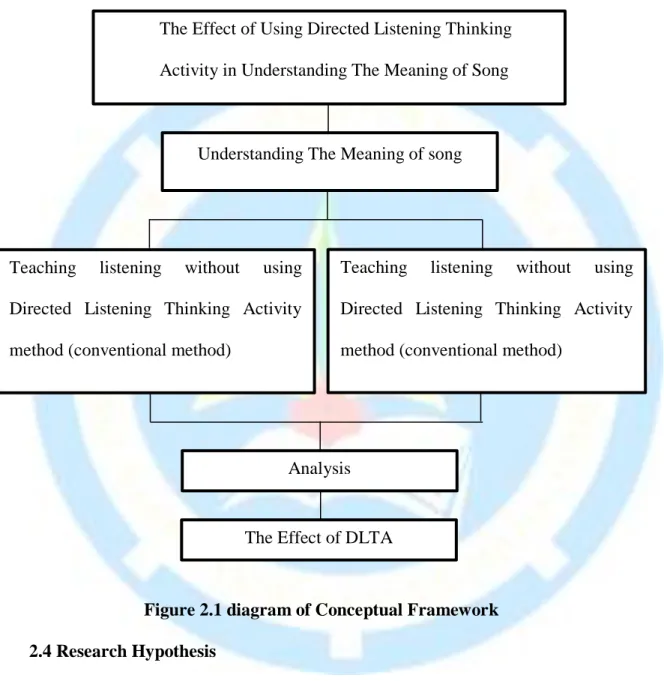
The researcher will find out the effect of directed listening thinking activity in listening skill. Here is the conceptual framework:
Figure 2.1 diagram of Conceptual Framework 2.4 Research Hypothesis
This research assumes that there is significant effect of using Directed Listening Thinking Activity on students’ listening skill.
The Effect of Using Directed Listening Thinking Activity in Understanding The Meaning of Song
Understanding The Meaning of song
Teaching listening without using Directed Listening Thinking Activity method (conventional method)
Teaching listening without using Directed Listening Thinking Activity method (conventional method)
Analysis
The Effect of DLTA
15
Ho: there is no significant effect of using DLTA method on students’ listening skill in understanding the meaning of song at SMPN 1 Bintan.
Ha: there is significant effect of using DLTA method on students’ listening skill in understanding the meaning of song at SMPN 1 Bintan.
CHAPTER III
RESEARCH METHODOLGY 3.1 Research Method and Design
The method of this research was quantitative, especially in quasi-experimental research design with Pretest-Posttest Control Design. Nunan in Pertiwi (2018) argues that quantitative research uses a deductive method which it begins with a hypothesis or theory then searches for evidence either to support or to refute that hypothesis or theory. The data collected for this type of research was called quantitative data i.e. data which were recorded in numerical form. A quasi-experimental method was used when random picking was unable to be applied in determined sample and commonly used because the researcher was attempted to search the effect of a variable.
Gay, et al (2012) state that an experiment typically involves a comparison of two groups (although some experimental studies have only one group or even three or more groups). The experimental comparison was usually one of three types: (1) comparison of two different approaches (A versus B), (2) comparison of a new approach and the existing approach (A versus no A), and (3) comparison of different amounts of a single approach (a little of A versus a lot of A).
3.2 Place and Time of Study
This research took the class at the Seventh grade of SMP Negeri 1 Bintan, which was located at Jalan Raja Haji Km. 26 Kelurahan Kijang Kota, Kecamatan Bintan Timur, Kabupaten Bintan. This study was expected to be conducted in May-Juni 2019.
17
Before did research, the researcher would do an observation and give a pre-test to both experimental and control classes. During the research, the experimental class would be treated with Directed Listening Thinking Activity Method, and the control class would be treated without Directed Listening Thinking Activity Method to see the effect on students’ listening skill. In the last meeting, the researcher would give a post- test to students of the both classes.
3.3 Population, Sample, and Sampling
According to Sugiono (2010) Population was geographic generalization there were: object/subject has quality and certain of characteristic that set by researcher to learning then make the conclusion. The population of this research was the seventh grade students at SMPN 1 Bintan in the academic year of 2018-2019.
Based on Ary (2002) a sample was a group of a population. Selection of the sample was very important step in conducting a research study. Sample was a part of population which would be analyzed. Sample must be representative as one was to be able to generalize with confidence from the sample to population.
In this research, researcher would be used cluster sampling technique to take the sample. According to Kennedy et al (2003) A cluster sample is a probability sample in which each sampling unit is a collection or a group of elements.
The researcher only would take two classes as the sample. That are VII G as an experimental class, and VII H as a control class.
3.4 Data Collection Technique
The technique of data collections in this research is by using pre-test and post- test with non-equivalent control group. The pre-test was itended to know preliminary
18
listening skill of the students and the post-test intended to know whether the Directed Listening Thinking Activity can give an effect or not toward students’
listening skill. These tests were used to measure or to know the mean scores of sudents listening skill. The test was prepared based on the course outline of the 7th grade Students syllabus of SMPN 1 Bintan in the academic year of 2018/2019.
In the pre-test, students in control and experimental classes would be asked to listen to a familiar english song. Students would be given several chance to listen to the song and find the meaning of song. In the post-test, students in control and experimental classes would be asked to find the meaning of the same song.
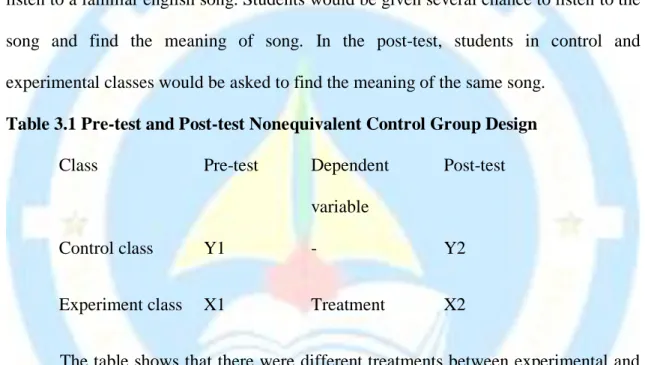
Table 3.1 Pre-test and Post-test Nonequivalent Control Group Design
Class Pre-test Dependent
variable
Post-test
Control class Y1 - Y2
Experiment class X1 Treatment X2
The table shows that there were different treatments between experimental and cotrolled classes. The experimental class used Directed Listening Thinking Activity method and the contol class did not use Directed Listening Thinking Activity method.
Thus, the data which was collected from the post-test would be analyzed to know whether there was significant effect of Directed Listening Thinking Activity method on students listening skill.
3.5 Research Instruments
Arikunto (2000) revealed that instrument in collecting data was a tool that was used by researchers to help them in collecting data in order to make it more systematic
19
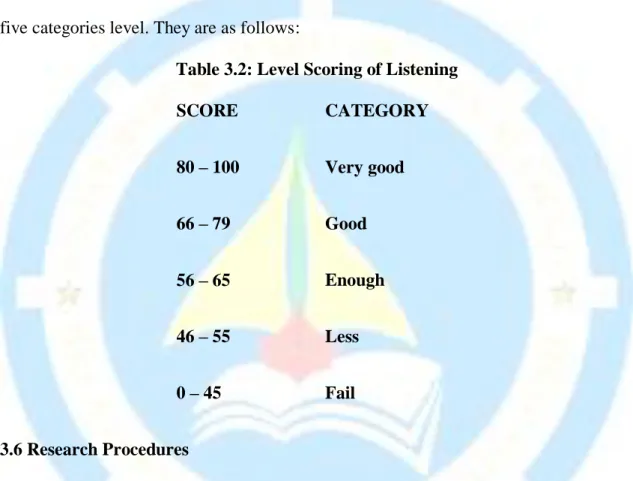
and easy. The researcher gave test to know how well the students mastered the listening skill and it was also to prove the effectiveness of using DLTA method in teaching listening. In this research, the researcher gave pre-test and post-test. The researcher established categories to classify the result of the test as main instruments of this research. Sudijhono in Putri (2003) categorized levels of listening achievement into five categories level. They are as follows:
Table 3.2: Level Scoring of Listening
SCORE CATEGORY
80 – 100 Very good
66 – 79 Good
56 – 65 Enough
46 – 55 Less
0 – 45 Fail
3.6 Research Procedures
There are several stages which should be followed by the researcher. Those are Preparation stage, implication, and final stage.
1. Preparation Stage
a. Creating the research license by Universitas Maritim Raja Ali Haji Tanjungpinang.
b. Giving the resarch license to SMP Negeri 1 Bintan and observing the condition of place for pretest.
19
c. Creating the research instrument based on syllabus such as lesson plan, students authentic text book, evaluation tools, etc. with the teacher as the advisor.
20
2. Implementation Stage
a. Dividing sample of the research into two groups, experimental and control groups.
b. Giving the pre-test to both control and experimental groups to know the mean scores of the listening.
c. Giving treatments by using DLTA method in experiment class.
d. Giving no treatments in the control class.
e. Giving the post-test to both control an experimental classes at the end of teaching learning process to know the student’s mean scores.
f. Comparing the result of pre-test and post-test to both classes to know the differences between.
3. Final Stage
a. Analyzing the data
b. concluding the result of data 3.7 Data Analysis Technique 3.1.3 Descriptive Statistics
Statistical analysis technique include instrument testing, pre-test and hypothesis test. The aim of statistics descriptive test was at describing the information from a research study. This test divided into six types. They are interval, mode, median, mean, variants, and standard deviation. In this data analysis can use the help of Minitab software.
21
3.7.2 Inferential Statistics
The inferential statistics focused on qustion, if there was significant differences in reading ability between students who will be taught using DLTA method and those who would be not taught using DLTA method.
a. Normality Test
Normality test was used to know whether the data of the sample are from the normal distribution. If the data was distributed normal then it can be used parametric statistics whereas if the data was not normally distributed, nonparametric statistics are used. In this data normality test can use the help of Minitab software.
b. Homogenity Test
Homogenity test was used to know whether the research data are homogeneous.
This test was used to know whether the both classes have the same variant. Homogenity test use significance criteria for two-sided test calculation results > 0.05 means the variance in each group is the same (homogeneous) using Minitab software for windows.
b. Hyphotesis Test
The researcher would process the data to know the mean scores of pre-test and post- test from both experimental and control classes and their differences. To find out the differences of the students’ scores, the researcher used the t-test formula. According to sugiyono (2014), using the formula:
𝑡 =𝑟√𝑛 − 2
√1 − 𝑟² Information:
22
t = distribution t r = partial corelation
r2 = coefficeient of determination n = amount of data
The researcher would establish the hypothesis of the research as follows:
(Ho): there is no significant difference between students’ understanding the meaning of song taught by using DLTA method and without by using DLTA method at seventh grade students of SMP Negeri 1 Bintan.
(Ha): there is a significant difference between students’ understanding the meaning of song taught by using DLTA method and without by using DLTA method at seventh grade students of SMP Negeri 1 Bintan
The result of the hyphotesis can be determined based on criteria:
1. If t-test (t0) > t-table tt, in significant degree of 0,05, null hyphotest (Ho) is rejected. It means that there is an effect on students’ understanding the meaning of song taught by using DLTA method and without by using DLTA method.
2. If t-test (t0) < t-table tt, in significant degree of 0,05, null hyphotest (Ho) is accepted. It means that there is no effect on students’ understanding the meaning of song taught by using DLTA method and without by using DLTA method.
To determine whether there is an effect of DLTA metod on students’ listening skill, the researcher uses statistical hyphotesis which can be formulated below:
Ho: µ1 = µ2
Ha: µ1 > µ2
28
CHAPTER IV
RESEARCH FINDINGS AND DISCUSSION 4.1 Findings
4.1.1 Data Description
The researcher described the data as the gained score data, where both of the table bellowed showed the students’ score before the treatment (pre-test) and after the treatment (post-test).
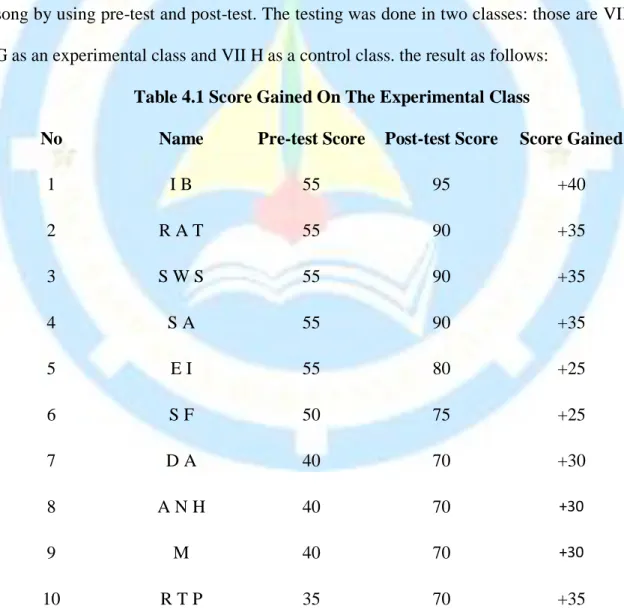
The researcer measured students’ listening skill in understanding the meaning of song by using pre-test and post-test. The testing was done in two classes: those are VII G as an experimental class and VII H as a control class. the result as follows:
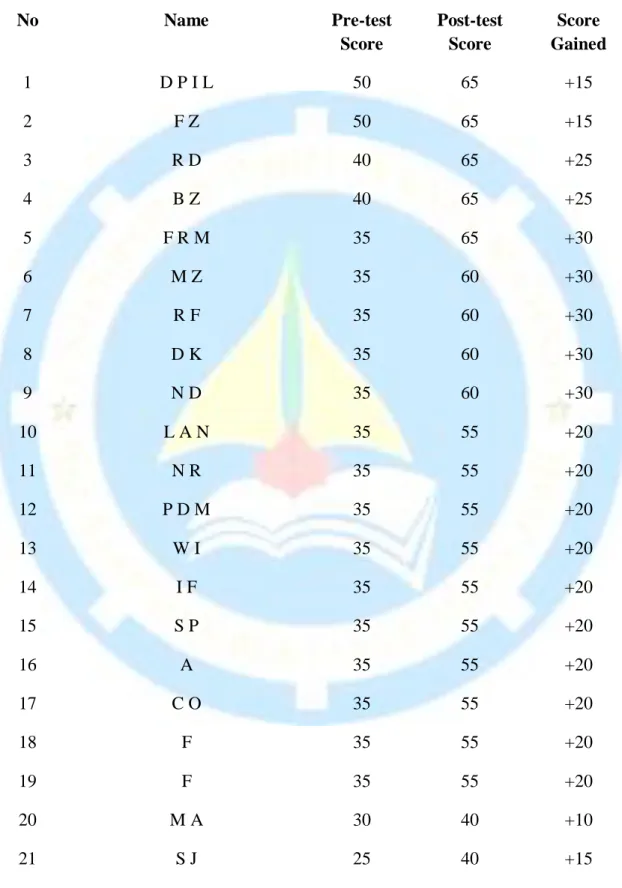
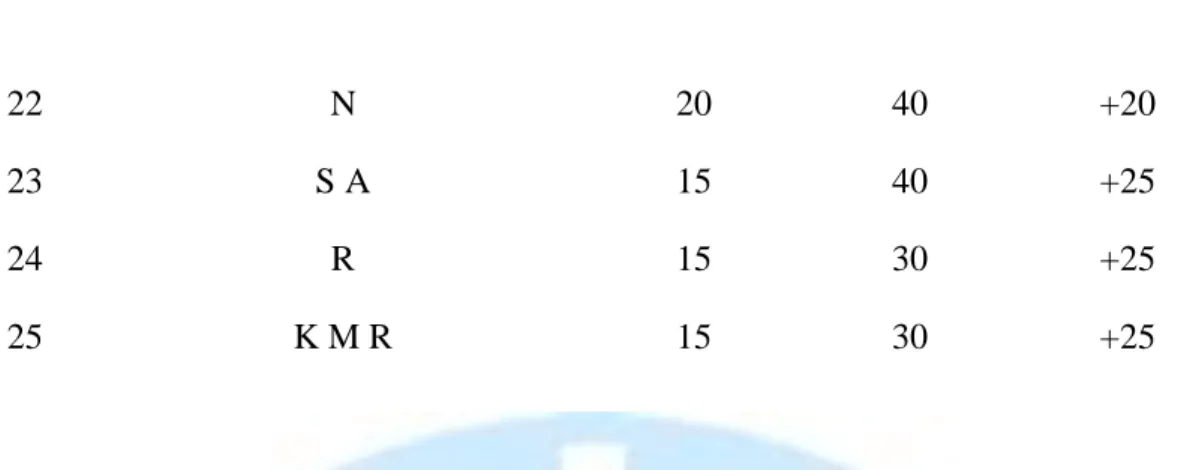
Table 4.1 Score Gained On The Experimental Class
No Name Pre-test Score Post-test Score Score Gained
1 I B 55 95 +40
2 R A T 55 90 +35
3 S W S 55 90 +35
4 S A 55 90 +35
5 E I 55 80 +25
6 S F 50 75 +25
7 D A 40 70 +30
8 A N H 40 70 +30
9 M 40 70 +30
10 R T P 35 70 +35
28
11 A S 35 70 +35
12 C A T 35 70 +35
13 A D 35 70 +35
14 F A 35 70 +35
15 N R 35 70 +35
16 N H 35 70 +35
17 A W 35 70 +35
18 M H 35 70 +35
19 K I 25 70 +45
20 A D 25 70 +45
21 M Z M 25 70 +45
22 T M P 25 70 +45
23 P C 25 70 +45
24 G R 20 60 +40
25 D 20 60 +40
The table shows that the progress of students’ scores after the researcher gave the treatment. For example, the student number 1 from experimental class with initial
“IB” got 55 for his pre-test result and got 95 for his post-test, it means that the treatment have worked and success. This data also showed that the lowest and highest scores from the pre-test were 55 and 20, while on the post-test they were 95 and 60.
28
The score gained table result for control class as follows:
Table 4.2 Score Gained The Control Class
No Name Pre-test
Score
Post-test Score
Score Gained
1 D P I L 50 65 +15
2 F Z 50 65 +15
3 R D 40 65 +25
4 B Z 40 65 +25
5 F R M 35 65 +30
6 M Z 35 60 +30
7 R F 35 60 +30
8 D K 35 60 +30
9 N D 35 60 +30
10 L A N 35 55 +20
11 N R 35 55 +20
12 P D M 35 55 +20
13 W I 35 55 +20
14 I F 35 55 +20
15 S P 35 55 +20
16 A 35 55 +20
17 C O 35 55 +20
18 F 35 55 +20
19 F 35 55 +20
20 M A 30 40 +10
21 S J 25 40 +15
28
22 N 20 40 +20
23 S A 15 40 +25
24 R 15 30 +25
25 K M R 15 30 +25
From the data can be seen the progress of students’ scpres after the reseacrher gave the control treatment: For example, the student number 1 from control class with initial “D” got 50 for her pre-test result and got 65 for her post-test result, it means that the treatments have worked and success.
4.1.2 Data Analysis
The researcher described the test result on this part. The test result may gained from pre-test and post-test that had been done in the experimental and control classes. The tests were done to find out whether DLTA method effective for students’ listening skill in understanding the meaning of song.
4.1.3 Pre-test in experimental class
From the pre-test result of experimental class, the researcher got the distribution table as follows:
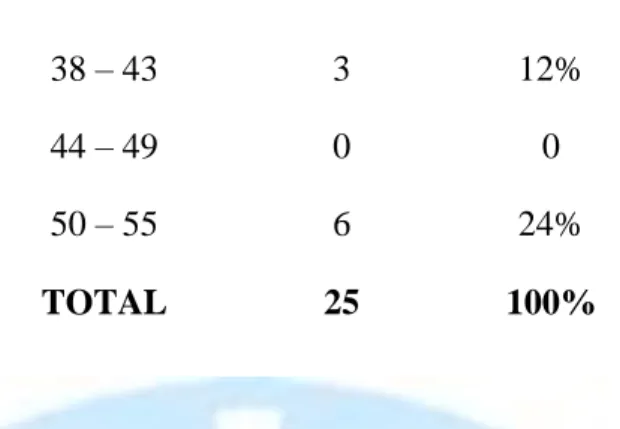
Table 4.3 Frequency Distribution of Pretest Score at Experimental Class Score Interval Frequency Percentage
20 – 25 2 8%
26 – 31 0 0
32 – 37 14 56%
28
38 – 43 3 12%
44 – 49 0 0
50 – 55 6 24%
TOTAL 25 100%
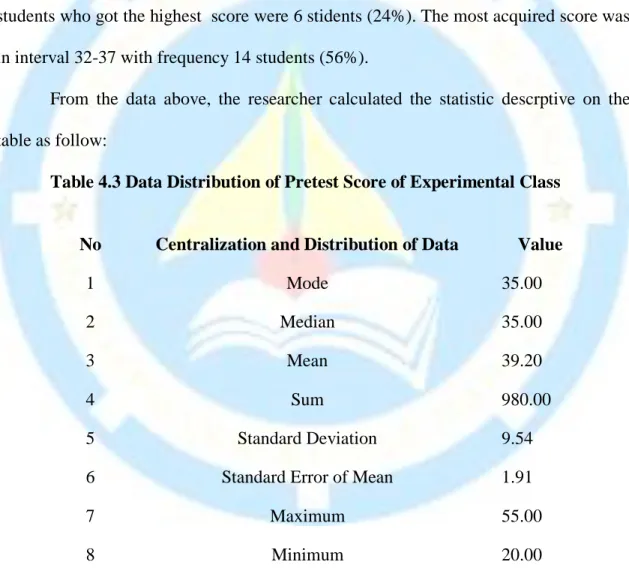
Table 4.3 shows that students’ lowest score is in score interval 20-25 which were two students, and the percentage was 8%. The highest score was in interval 50-55. the students who got the highest score were 6 stidents (24%). The most acquired score was in interval 32-37 with frequency 14 students (56%).
From the data above, the researcher calculated the statistic descrptive on the table as follow:
Table 4.3 Data Distribution of Pretest Score of Experimental Class
No Centralization and Distribution of Data Value
1 Mode 35.00
2 Median 35.00
3 Mean 39.20
4 Sum 980.00
5 Standard Deviation 9.54
6 Standard Error of Mean 1.91
7 Maximum 55.00
8 Minimum 20.00
28
4.1.2.2 Pre-test in control class
From the pre-test result of control class, the researcher got the distribution table as follows:
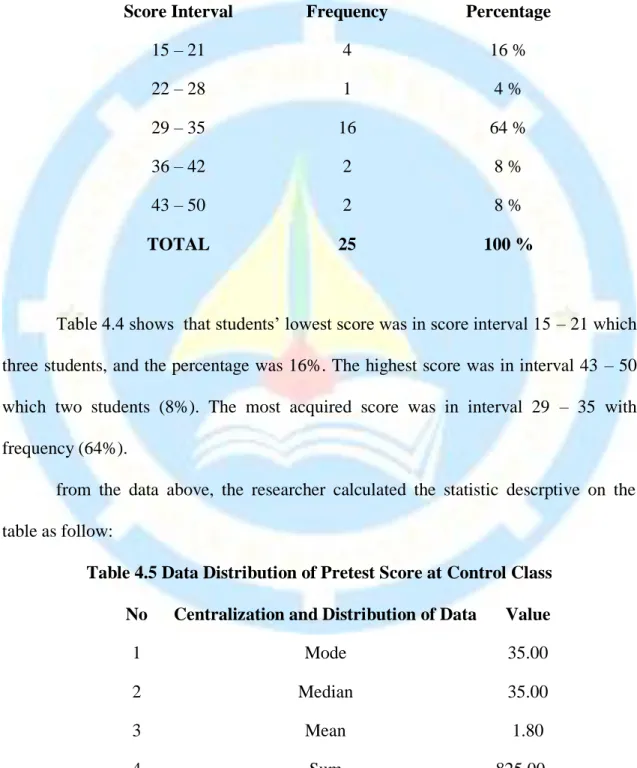
Table 4.4 Frequency Distribution of Pretest Score at Control Class Score Interval Frequency Percentage
15 – 21 4 16 %
22 – 28 1 4 %
29 – 35 16 64 %
36 – 42 2 8 %
43 – 50 2 8 %
TOTAL 25 100 %
Table 4.4 shows that students’ lowest score was in score interval 15 – 21 which three students, and the percentage was 16%. The highest score was in interval 43 – 50 which two students (8%). The most acquired score was in interval 29 – 35 with frequency (64%).
from the data above, the researcher calculated the statistic descrptive on the table as follow:
Table 4.5 Data Distribution of Pretest Score at Control Class No Centralization and Distribution of Data Value
1 Mode 35.00
2 Median 35.00
3 Mean 1.80
4 Sum 825.00
28
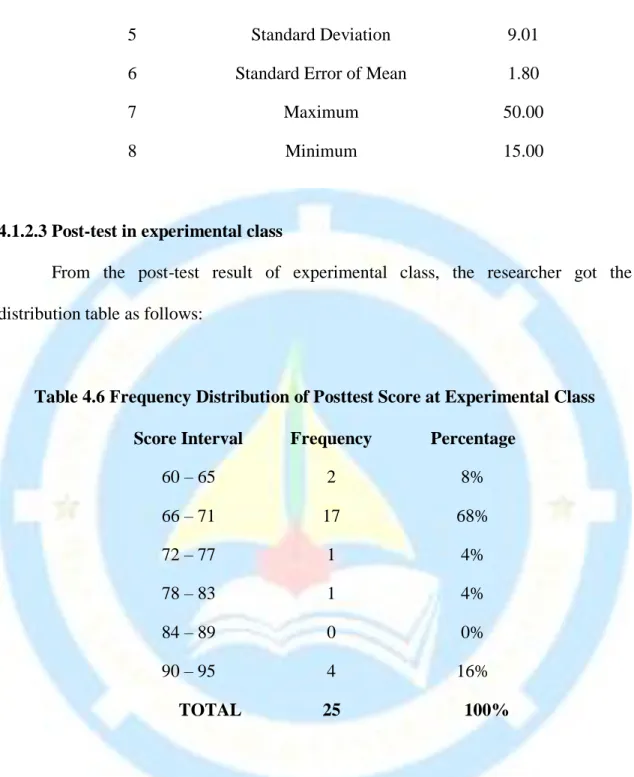
5 Standard Deviation 9.01
6 Standard Error of Mean 1.80
7 Maximum 50.00
8 Minimum 15.00
4.1.2.3 Post-test in experimental class
From the post-test result of experimental class, the researcher got the distribution table as follows:
Table 4.6 Frequency Distribution of Posttest Score at Experimental Class Score Interval Frequency Percentage
60 – 65 2 8%
66 – 71 17 68%
72 – 77 1 4%
78 – 83 1 4%
84 – 89 0 0%
90 – 95 4 16%
TOTAL 25 100%
Table 4.6 shows that students’ lowest score is in score interval 60 - 65 which was two student, and the percentage was 8%. The highest score was in score interval 90 - 95. The students who got the highest score was 4 students (16%). The most acquired score was in interval 66 - 71 with frequency 17 students (68%).
The researcher calculated the statistic descrptive on the table as follows
28
Table 4.6 Data Distribution of Posttest Score of Experimental Class No Centralization and Distribution of Data Value
1 Mode 70.00
2 Median 70.00
3 Mean 73.20
4 Sum 1830.00
5 Standard Deviation 8.88
6 Standard Error of Mean 1.78
7 Maximum 95.00
8 Minimum 60.00
4.1.2.4 Post-test in control class
From the post-test result of control class, the researcher got the distribution table as follows
Table 4.7 Frequency Distribution of Posttest Score at Control Class Score Interval Frequency Percentage
30 – 35 2 8%
36 – 41 4 16%
42 - 47 0 0
48 - 53 0 0
54 - 59 10 40%
60 - 65 9 36%
TOTAL 25 100%
28
Table 4.7 shows that the lowest score was in score interval 30 – 35 which two students, adm percentage 8%. The highest score was in interval 60 – 65 which 9 students (36%). The most acquired score was in inteval 54 – 59 with frequency (40%).
From the data above, the researcher calculated the statistic descrptive on the table as follow:
Table 4.12 Data Distribution of Posttest Score at Control Class No Centralization and Distribution of Data Value
1 Mode 55.00
2 Median 55.00
3 Mean 53.40
4 Sum 1335.00
5 Standard Deviation 10.58
6 Standard Error of Mean 2.12
7 Maximum 65.00
8 Minimum 30.00
4.1.2.5 Normality Test
The normality test was perfomed using Ryan-Joiner. The test was for the two groups, both pos-test and pretest group, to determine if the distribution of the data from the sample is normal. Thus, the researcher used Minitab software. If the normality test
29
result was higher than the level of significance α (0.05), the score woud be normally distributed.
Figure 4.1 Normality test on experiment class
From the picture above, it is show that p-Value is 0.063, and the p-Value is 0.05. So 0.063 > 0.05, it can be says that data of experimental class is in normal distribution.
Figure 4.2 Normality test on control class
From the picture above, it shows that p-Value is 0.076, and the p-Value is 0.05.
So 0.076 > 0.05, it can be said that data of control class is in normal distribution.
30
4.1.2.6 Homogenity test
Homogenity test was used to test whether the data from the two groups have the same variant in order that the hypothesis can be tested by t-test. Like a normality test, this test also used Minitab software
Figure 4.4 Homogenity test
Picture 4.4 shows that P-Value Bonett’s is 0.388 and P-Value Levene’s test is 0.917 with the P-Value is 0.05. So, both homogenity test result are higher than 0.05.Thus it can be concluded that data of experiment and control classes was homogeneous.
4.1.2.7 Hypothesis test
In this part, the researcher calculated the data to test the hypothesis that whether there was an effect on students’ understanding the meaning of song in experimental class which used DLTA method and students’ understanding the meaning of song in control class without DLTA method.
Based on the hypothesis that had been explained in chapter III, which is:
31
(Ho): there is no significant difference between students’ understanding the meaning of song taught by using DLTA method and without by using DLTA method at seventh grade students of SMP Negeri 1 Bintan.
(Ha): there is a significant difference between students’ understanding the meaning of song taught by using DLTA method and without by using DLTA method at seventh grade students of SMP Negeri 1 Bintan.
For the hypothesis test, the researcher used T-test. T-test is a statistical test used to test the truth of the null hypothesis. The statistical T-test basically showed how much the influence of one independent variable individually in expalining the variation of the dependent variable
Table 4.13Result hypothesis test analysis on both sample
Varible Class N Ttest Ttable Note
Undertanding the Meaning of Song
Experiment 25 6.082 2.060 Ttest > Ttable it means significant
4.2 Data Discussion
The table above shows that the result of testing hypotheses, it can be explained that the result of the hypotheses test shows that there is a significant difference of effect on the students’ listening skill in understanding the meaning of song between those who are taught using DLTA method and those are using conventional method.
32
It is important to train students to listen effectively rather than to test their listening skills (Thompson, 2004, as cited in Desouky, 2012). The students’ listening skill in understanding the meaning of song after using DLTA method was good. There were 17 students got score 66–71, it means that on the students’ listening skill in understanding the meaning of song was good, 4 students got score 90–95 it means that on the students’ listening skill in understanding the meaning of song was very good.
Using conventional method is the lack of the ability to slow down the tempo of the song when a grammatically difficult part is playing, or to fasten it when there is the repetition of certain parts (Miller, 2002). The students’ listening skill in understanding the meanig of song after using conventional method, there were 10 students got score 54–59, it means that on the students listening skill in understanding the meaning of song was less, 9 students got score 60–65 it means that on the students’ listening skill in understanding the meaning of song was enough.
The posttest mean score of the experimental class was 73.20 while the posttest score of the control class was 53.40. The mean score of the experimental class was higher than the mean score of the controll class. It shows a difference between the two means. Based on the data analysis t0 is higher than tt. It means that the alternative hyphoteses (Ha) was accepted and the null hyphoteses (H0) was rejected. So there was significant effect of the DLTA method through students’ understanding the meaning of song. The result of this study was in line with a studiy conducted by Al-Khayyat (2015). Learning English via DLTA was an easy method for students who are studyied English as a foreign language. So, it was found that using DLTA has helped students to comprehend a text and enjoy analyzing it.
33
The result of this study showed the same result of by Susilawati (2013). There was the influence of usage of DLTA method on understanding the meaning of song.
This researcher concluded that teaching listening by using DLTA method could motivate students become interested. The result of the students’ understanding the meaning of song was good. Based on the researcher’s analysis in the field, the students feel enjoy and free to lstening. In other words, DLTA method effective to teaching listening in understanding the meaning of song, especially for the students of SMP Negeri 1 BINTAN.
34
34 CHAPTER V
CONCLUSION AND SUGGESTION 5.1 Conclusion
After conducting the research and calculating the data, the conclusion could be stated that it was effective of using DLTA method on students’ understanding the meaning of song. The experimental class, the lowest score in pretest was 20 and the highest score was 55. After the researcher gave the treatment by using DLTA method in teaching understanding the meaning of song,, the researcher gave the students’ posttest.
The data showed in the postest that the lowest score was 60 and the highest score was 95. the control class, the lowest score in pretest was 15 and the highest score was 50.
The data showed in posttest that the lowest score was 30 and the highest score was 65.
Students’ understanding the meaning of song got the higher score if students used DLTA method to help them in understanding the meaning of song. Students who did not receive treatment got the lower score than students who received treatment. So the answer of research problem was proven that there was effective of using DLTA method on students’ listening skill in understanding the meaning of song. where there was a significant progress in students’ understanding the meaning of song.
5.2 Suggestion 5.1.2 For Teacher
It is recommended to teacher to use Directed Listening-Thinking Activity in teaching listening. The teacher should be creative to teaching listening in students’
understanding the meaning of song by giving some assignment or homework,
especially the question in form of content of the text and supporting details, which is regarded more difficult for the students.
5.2.2 For Students
The students should pay more attention to the lesson that has been explained by the teacher. It can make students to be a self-supporting learner and students will have good habbit if they are comfort.
5.2.3 For Other Researcher
This study needs to be developed in order to get the deeper concept of the DLTA method in teaching listening. a longer experimental period is needed to enable the research to draw a more valid conclusion.
36
REFERENCES
Ajay, S, and B Micah. 2014. “SAMPLING TECHNIQUES & DETERMINATION OF SAMPLE SIZE IN APPLIED STATISTICS RESEARCH : AN OVERVIEW.” II (11): 1–22.
Al-khayyat, Ali Sabah Jameel. 2015. “International Journal of English and Education University Students’ Listening Competencies.” (4).
Alan Crawford et al, Teaching and Learning Strategies for the Thinking Classroom (New York: The International Debate Education Association, 2005)
Alma Rosa Gonzáles. 1993. “Using Directed Listening-Thinking Activities to Increase Production in English for Spanish Speaking Fourth and Fifth Graders.”
Apin, English Education, and Study Program. 2013. “*Apin Graduated in 22 February 2013 from English Education Study Program of Indonesia University of Education.” 1(February): 21–29.
Ara, Shaheen. 2009. Use of Songs, Rhymes and Games in Teaching English to Young Learners in Bangladesh. The Dhaka University Journal of Linguistics
Arikunto, S. 2000. Prosedur Penelitian Suatu Pendekatan Praktek. Jakarta: Rineka Cipta
Ary, D., Jacobs, L. and Razavieh, A. (2002) Introduction to Research. 6th Edition, Wadsworth, Belmont
Beare , Kenneth. 2007. The Challenge of Teaching Listening Skills
Barone, Diane M. (2005). TeachingEarly Literacy: Development,Assessment, and Instruction.New York: The GuilfordPress
Bennett, Katy, Allan Cochrane, Giles Mohan, and Sarah Neal. 2015. “Emotion, Space and Society Listening.” 17: 7–14.
Brown, H. D. (2001). Teaching by Principles: An Interactive Approach to Language Pedagogy. New-York: Longman.
Brown, H. Douglas. 2007. Principles of Language Learning and Teaching. USA: Longman Cahyono, Bambang Yudi, and Utami Widiati. 2015. “The Teaching of Efl Listening in
the Indonesian Context: The State of the Art.” TEFLIN Journal 20(2): 194–211.
http://journal.teflin.org/index.php/journal/article/view/92.
David, R Fred. 2012. Strategic Management Concepts & Cases. Pearson Academic; 14th edition
Education, Language. 2014. “Improving Students Listening Skill through Interactive Multimedia in Indonesia.” 5(1): 63–69
Eng, Lin Siew, Abdul Rashid Mohamed, and Muhammad Javed. 2013. “Analysis of Students’ Competency in Listening Comprehension of the English Language at Pakistani Secondary School Level.” (April 2017).
English, American, Australian English, and Caribbean English. “Assessing Listening in the Language Classroom.”
Frye, D., & Ziv, M. (2005). Teaching and Learning as Intentional Activities. In B. D.
Homer & C. S. Tamis-LeMonda (Eds.), The development of social cognition and communication (pp. 231-258). Mahwah, NJ, US: Lawrence Erlbaum Associates Publishers.
37
Hasan, A. 2014.The effect of using task-based learning in teaching English on the oral performance of the secondary school students. International interdisciplinary journal of education. 32. 251.
Hasyuni. 2006. The Students’ Preferred Activities for English Listening Classes (A Survey Conducted to the Second and Fourth Semester Students of English Department of FKIP Universitas Bengkulu Academic Year 2005/2006). Unpublished Thesis of Teacher Training and Education Faculty of Universitas Bengkulu.
“INCREASING STUDENTS’ MICRO SKILLS OF LISTENING THROUGH DRILLS AT THE SECOND YEAR STUDENTS Tri Lestari, M . Sukirlan, Ramlan Ginting Suka Institution : Lampung University Listening Is an Active Process Recquiring Participation on the Part of Listener”: 1–14.
Koziol, Stephen, Dwight L. Burton, and John S. Simmons. 2006. “Teaching English in Today’s High Schools.” The English Journal 60(9): 1254.
Kennedy et al (2003) A cluster-randomised controlled trial of a patient-centred guidebook for patients with ulcerative colitis: effect on knowledge, anxiety and quality of life. Health and Social Care in the Community, 11: 64
Nunan, David. (2000). LanguageTeaching Methodology: A Textbook for Teachers.
Malaysia:
Longman.Ratnam, Charishma. 2019. “Listening to Difficult Stories: Listening as a Research Methodology.” Emotion, Space and Society 31(September 2018): 18–25.
Richards, Jack C., et al. METHODOLOGY IN LANGUAGE TEACHING: AN ANTHOLOGY OF CURRENT PRACTICE (2002).
Rismawat. 2006. “TEACHING LISTENING BY USING AUTHENTIC VIDEOS By Rismawati 1 Syiah Kuala University, Banda Aceh.”: 222–33.
Rost, M. (1994). Introducing Listening. London: Penguin books.
Sabinus, Kornelius Ujang. 2013. “INCREASING STUDENTS’ LISTENING COMPREHENSION BY USING VOA : SPECIAL ENGLISH VIDEO By : BY USING VOA : SPECIAL ENGLISH VIDEO.”
Sudhjono, 2003; in rima dewi putri. the effect of using song in increasing students’
listening ability at the second year students of sman 1 kuantan hilir (unpublished thesis, 2008), p.14
Sugiyono. 2010. Metode Penelitian Pendidikan Pendekatan Kuantitatif, kualitatif, dan R&D. Bandung: Alfabeta
Thesis, A, and Bella Aldama. 2017. “ANALYZING TEACHERS’ DIFFICULTIES IN TEACHING LISTENING COMPREHENSION TOWARDS THE FIRST GRADE STUDENTS OF MAN 3 BONE.”
Underwood, M. (1989). Teaching listening. New York: Longman.
38
Wang, S. (2010). An experimental study of Chinese English major students’ listening anxiety of classroom learning activity at the university level. Journal of Language Teaching and Research, 1, 562-568