THE EFFECT OF USING FLASH CARDS ON STUDENTS’ VOCABULARY AT 7th GRADE OF SMPN 5 JONGGAT
ACADEMIC YEAR 2019/2020
By:
Alan Satriawan NIM 1501071029
STUDY PROGRAM OF ENGLISH LANGUAGE EDUCATION FACULTY OF EDUCATION AND TEACHER TRAININGSTATE
ISLAMIC UNIVERSITY OF MATARAM MATARAM
2019
THE EFFECT OF USING FLASH CARDS ON STUDENTS’
VOCABULARY AT 7th GRADE OF SMPN 5 JONGGAT ACADEMIC YEAR 2019/2020
A Thesis of Sarjana
Submitted to State Islamic University of Mataram to fulfil the requirement for Bachelor Degree
By:
Alan Satriawan NIM 1501071029
STUDY PROGRAM OF ENGLISH LANGUAGE EDUCATION FACULTY OF EDUCATION AND TEACHER TRAINING
STATE ISLAMIC UNIVERSITY OF MATARAM MATARAM
2019
APPROVAL
This Thesis conducted by Alan Satriawan, NIM: 1501071029 entitled “The Effect of Using Flash cards on Students‟ Vocabulary at 7th Grade of SMPN 5 Jonggat academic year 2019/2020” has been approved by the advisors as the requirement for the Sarjana Degree in Study Program of English Language Education.
Approved on:
Advisor I, Advisor II,
Dr. Muhammad, M.Pd, M.S Hery Rahmat, S.Pd, M.Hum
NIP. 196801051994031003 NIP.197707012006041002
SUPERVISOR’S OFFICIAL NOTE
Mataram,________________
About: Examination (Munaqasyah)
Respectable to Dean of Education and Teacher Training Faculty in Mataram Assalamu’alaikum, Wr. Wb.
Be delivered with respectably, this Thesis has been got correction, suggestion, and assistance, so we admit this thesis of.
Name : Alan Satriawan Student Number : 1501071029
Study program : English Language Education
Title : The Effect of Using Flash cards on Students‟ Vocabulary at 7th Grade of SMPN 5 Jonggat academic year 2019/2020 It has been required to be examined at Faculty of Education and Teacher Training, State Islamic University of Mataram. That is why, we hope this thesis will be examined soon.
Wassalammu’alaikum, Wr. Wb.
Advisor I, Advisor II,
Dr. Muhammad, M.Pd, M.S Hery Rahmat, S.Pd, M.Hum
NIP. 196801051994031003 NIP.197707012006041002
RATIFICATION
This Thesis conducted by: Alan Satriawan, NIM: 1501071029 entitled “The Effect of Using Flash cards on Students‟ Vocabulary at 7th Grade of SMPN 5 Jonggat academic year 2019/2020,” has been approved by the board of examiners in Study Program of English Language Education, Faculty of Education and Teacher Training, State Islamic University of Mataram on __________________
The Examiners
Dr. H. Muhammad, M.Pd, M.S ________________________
Advisor I
Hery Rahmat, S.Pd, M.Hum ________________________
Advisor II
Dr. Hj. Nurul Lailatul Khusniyah, M.Pd.
________________________
(Examiner I)
Dr. Ribahan, M.Pd ________________________
(Examiner II)
Acknowledged by,
Dean of Education and Teacher Training Faculty
Dr. Hj. Lubna, M.Pd NIP: 196812311993032008
MOTTO
لاقو ﺮ ﻢﻜ دا ﻲ ﯣﻋ ا ﻢﻜﻟ ا ا ﺮ ﻜ ﭔ ﭔﺬﻟ و
ا ﻋ ﻋ ﻲ ﺪ ﻴد ﻟﺧ و ﻢ ﻬ اد ﭔﺮﺧ
Artinya, “Dan Tuhanmu berfirman, Berdoalah kepada-Ku, niscaya akan Aku perkenankan bagimu. Sesungguhnya orang-orang yang sombong tidak mau menyembah-Ku akan masuk ke Neraka Jahanam dalam keadaan hina dina”.
Meanings, “And your Lord says, call upon Me; I will respond to you. Indeed, those who disdain My worship will enter Hell (rendered) contemptible”.
(QS. Gafir (40): 60)1
DEDICATION
1 Kementerian Agama RI, Al-Qur’an 20 Baris Terjemah: Terjemah Dua Muka, (Bandung: CV Mikraj Khazanah Ilmu, 2014), p. 238.
“This thesis is dedicated to my beloved mother Selamah, father Sudiarta, brother Alm. Doni Setiawan, grandmother Semah, wife Sri Datin Najihah, aunt Yuni, and all of my family.”
ACKNOWLEDGMENT
Alhamdulillah, all praise is to Allah. The most magnanimous God that gives his blessing and his help so that the researcher can finish his thesis as one of the partial requirements for achieving the undergraduate Degree in Study Program of English Language Education.
The researcher realizes that it would be impossible for him when the process of the study until he finishes his study without many contributions, support and help from the other. The researcher would like to express his deep gratitude and appreciation to the following:
1. Dr. Muhammad, M.Pd, M.S, and Mr. Hery Rahmat, S.Pd, M.Hum, the first and second advisors who has kindly given the time, guidance, correction, motivation, and suggestion in completing the thesis.
2. Dr. Syarifudin, M.Pd, the Head in Study Program of English Language Education Department.
3. Dr. Hj Lubna, M.Pd, the Dean of Education and Teacher Training Faculty, State Islamic University of Mataram for giving permission and approving to carry out the thesis.
4. Prof Dr. H. Mutawalli, M.Ag, the Rector of State Islamic University of Mataram for giving researcher permission.
5. The researcher‟s precious friends for their motivation, support, aid and pray.
6. The researcher‟ friends in Study Program of English Language Education for their support and pray.
Hopefully those sides will get better reward from Allah SWT from what they have done and hopefully this scientific work will be useful.
Mataram, 19 December 2019 Researcher,
Alan Satriawan
TABLE OF CONTENTS COVER
TITLE PAGE ... ….. ii
APPROVAL ... …. iii
SUPERVISIOR’S OFFICIAL NOTE ... …. iv
STATEMENT OF ORIGINALITY ... ….. v
RATIFICATION ... …. vi
MOTTO ... … vii
DEDICATION ... ... viii
ACKNOWLEGMENT ... …. ix
TABLE OF CONTENT ... …. xi
LIST OF TABLES ……… xiii
LIST OF APPENDICES ……….. xiv
ABSTRACT ……… xv
CHAPTER I INTRODUCTION A. Background of the Study ... ….. 1
B. The Statement of Problem and Research limitation ... …. 3
C. Objective and Significance of Research ... ….. 4
D. Definitions of Key Terms... .…. 5
CHAPTER II REVIEW OF RELATED LITERATURE AND RESERCH HYPOTHESIS A. Review of Previous Research... ….. 6
B. Theoretical Bases ... ….. 8
1. The Nature of Vocabulary ……….. 8 a. Definition of Vocabulary ………..
8
b. The Types of Vocabulary ………..
9
c. Assessing Vocabulary ……….
10
2. The Nature of Flash Cards ……….
13
a. Definition of Flash Cards ………
13
b. Flash cards as teaching aids of Vocabulary ………...
14
c. The Advantages and Disadvantages of using Flash cards 17
C. Research Hypothesis ... … 18
CHAPTER III RESERCH METHOD A.Approach and Type of Research ... … 19
B.Population and Sample ... … 20
C.Setting and Time of Research ... … 21
D.Variable of Research ... … 21
E.Research Design ... … 22
F. Instrument of Research ... … 23
G.Procedure of Data Collection ... … 25
H.Technique of Data Analysis ... … 26
I. Validity and Reliability ... … 29
CHAPTER IV FINDING AND DISCUSSION A. Finding ... … 31
B. Discussion ... … 38
CHAPTER V CONCLUSION AND SUGGESTION A. Conclusion ... … 42
B. Suggestion ... … 42
REFERENCES ... … 44
APPENDICES ………... 46
LIST OF TABLES
Table 3.1 Population of the research, 20.
Table 3.2 Sample of the research, 21.
Table 3.3 The test illustration of quasi experimental design, 22.
Table 3.4 Scoring system, 24.
Table 4.1 Pre-test and post-test score of experimental class, 31.
Table 4.2 Pre-test and post-test score of control class, 33.
Table 4.3 Comparison between t-test and t-table, 38.
LIST OF APPENDICES
Appendix 1 General description of SMPN 5 Jonggat Appendix 2 Lesson plan of experimental class Appendix 3 Lesson plan of control class Appendix 4 Students‟ answer sheet of pre-test Appendix 5 Students‟ answer sheet of post-test Appendix 6 Individual score
Appendix 7 Documentations Appendix 8 Distribution of t-table Appendix 9 Letters
THE EFFECT OF USING FLASH CARDS ON STUDENTS’
VOCABULARY AT 7th GRADE OF SMPN 5 JONGGAT
ACADEMIC YEAR 2019/2020 By:
Alan Satriawan NIM 1501071029
ABSTRACT
The objective of this research is to find out the use of flash cards effective on students‟ vocabulary at 7th grade of SMPN 5 Jonggat academic year 2019/2020. This research was classified as quasi- experimental research. It involved 52 students of two classes. Class VII A as the experimental class and VII C as the control class. The experimental class was taught by using flash cards. The instruments used to collect data in this research was test. The researcher found that there was a significant difference between the students‟ score in experimental class and control class. It was proved by the mean score that the post-test was higher than mean score in the pre-test. In the experimental class, the mean score of pre-test was 71 and the mean score of post-test was 84. While the control class, the mean score of pre-test was 69 and the mean score of post-test was 77. While, both of the classes are improved, the significant improvement happened in experimental class. In addition, the value of the t-test 17,85 was higher than t- table 2,021 at the level of significant 0.05 with degree of freedom (df)=50. Based on the result of this research, the researcher concluded that the use of flash cards effective on students‟ vocabulary at 7th grade of SMPN 5 Jonggat academic year 2019/2020.
Keywords: Flash cards, Vocabulary
CHAPTER I INTRODUCTION
A. Background of Research
English is a very important language world. It is used by people from different countries to understand each other because they have different languages. It also helps the people to have good international relationship with people from all nations or all countries. Therefore, people in many countries use it as second or foreign language.
In Indonesia, English is the first foreign language and is taught formally from elementary school up to the university level. Therefore, all of the students have to study it at schools. As a matter of fact, many students of junior high school find difficulties in understanding English as their foreign language such as in terms of vocabulary and grammar.
Consequently, the learners should study vocabulary intensively to master vocabulary of English.
Palmer, as cited in Richards stated that vocabulary is one of the most essential components of foreign language learning.2 In addition, students need to learn about language vocabulary. It means that they need to know about its form, meaning and its use.3
Mastering vocabulary is one of the most important things that plays a great role for learners in acquiring a language.4 It is also essential for successful foreign language use because without an extensive vocabulary,
2Jack Richards, Approaches and Methods in Language Teaching, (America: Cambridge University Press, 2001), p. 37.
3Jeremy Harmer, The Practice of English Language Teaching, (New York: Longman, 1991), p.23.
4Mofareh Alqahtani, The Importance of Vocabulary in Language Learning and How to be Taught,International Journal of Teaching and Education, Vol. III, No 3/2015, p. 22.
we will be unable to use the structures and functions we may have learned for comprehensible communication.5 Thus it is expected that students are able to understand simple English used in daily context through mastering vocabulary.
Nowadays, students often find difficulties to master vocabulary.6 It is based on the researcher‟s early observation at SMPN 5 Jonggat. The problems may be caused teachers teach vocabulary by using conventional ways. Such as, teachers ask students to read a text, and write down the difficult words and then the teacher would translate the words, or teachers give students vocabulary list and ask them to memorize the words.
Furthermore, students have low motivation in learning English vocabulary.
It is because they feel bored when remembering vocabulary by using vocabulary list only.
However, the teachers should help students to aquire vocabulary with appropriate teaching strategy. Additionally, the teacher needs to have good materials and well preparation in teaching proces. Related to this problems, teacher can give students materials accompanied by visual. The media which can be used in teaching and learning process is flash cards.
Flash cards is sets of cards with picture or only cards with words which can be handle easily by the teacher.7 It is means flash cards may help students to facilitate them to improve their vocabulary. It is also
5Ibid.
6 Early observation in SMPN 5 Jonggat, 2 April 2019.
7 Dinar VincyYunitakaBahrudin, The Implementation of Flashcard Game on Vocabulary Mastery, JurnalPemikiranPenelitiandanSains, Vol. 3, No. 6, Desember 2015, p. 97.
media that presents visual symbols, numbers, ideas by word and image.8 Flash cards is also an attractive medium and it can be used as a medium to groups competing of students in learning English vocabulary which helping students in memorizing the meanings.
Based on the information which has been gathered from the observation, the researcher was interested in doing a research entitle the effect of using flash cards on students‟ vocabulary at 7th grade of SMPN 5 Jonggat academic year 2019/2020.
B. The Statement of Problem and Research Limitation 1. Statement of Problem
Based on the background above, the researcher would like to answer the following problem “Does the use of flash cards effective on students‟ vocabulary at 7th grade of SMPN 5 Jonggat academic year 2019/2020?”
2. Research Limitation
This study is limited to teaching vocabulary by using flash cards in order to find out the effectiveness on students‟ vocabulary before and after using this medium at 7th grade students of SMPN 5 Jonggat academic year 2019/2020.
C. Objective and Significance of Research 1. Objective of Research
8Herlina, Flashcard Media: Media ForDeveloving Students Understanding for English Vocabulary at Elementary School, Indonesian Journal of Educational Review, Vol. 4, No 1, July 2017, p. 117.
The objective of this research is to find out the use of flash cards effective on students‟ vocabulary at 7th grade of SMPN 5 Jonggat academic year 2019/2020.
2. Significance of Research
The result of this research falls into two significances: theoretical and practical.
a. Theoretically, the result of this research is expected that the information and findings of this research contribute to the development of the materials and references for those who are interested in doing a research the same topic.
b. Practically, the result of this research are expected to be useful for students, English teachers, school, readers, and the researcher.
1) For the students: The result of this research can inform the students about their English vocabulary and to motivate them to learn vocabulary seriously.
2) For the teachers: The result of this research is attended to be an input for teachers to use flash cards as a media in teaching their students in order to improve students‟ vocabulary. they can modify or prepare better and more interesting teaching using flash cards in teaching vocabulary to help students in mastering English vocabulary.
3) For the school: The finding of this research help the school to get more information about students‟ vocabulary and the
researcher hopefully can help improve the quality of English teaching in the school.
4) For the readers or next researcher: They can use the finding of this research as their additional reference in doing next research related to the similar topic.
5) For the researcher: hopefully can give contribution to teach English by using this medium, especially in teaching vocabulary.
D. Definition of Key Terms
1. Vocabulary is the total number of words that are needed to communicate ideas and express the speakers‟ meaning.9
2. Flash cards is a card that has two sides with one side containing images, text, or symbol mark and the other side in the form of definitions, captions, answers, or descriptions which help remind or directing students to something associated with the existing image on the card.10
CHAPTER II
REVIEW OF RELATED LITERATURE AND HYPOTHESIS A. Review of Previous Research
9MofarehAlqahtani, The Importance of Vocabulary in Language Learning and How to be Taught, International Journal of Teaching and Education, Vol. III, No 3/2015, p. 25.
10Herlina, Flashcard Media: Media for Develoving Students Understanding for English Vocabulary at Elementary School, Indonesian Journal of Educational Review, Vol. 4, No 1, July 2017, p. 118.
The researcher took three people who had done the research that related to similar topic. The first one is Yasinta Tri Arliana Sutresno with the title is Using Flashcards to Improve 7th Grade Students‟ Vocabulary in SMP Maria Immaculata Yogyakarta. The objective of her research is to answer the two formulated research questions which are how are flashcards used in improving the vocabulary of seventh grade students of SMP Maria Immaculata Yogyakarta and to what extend do flashcards improve the vocabulary. The method in this research is a classroom action research. The sample are 16 participants. She used two instrument to gathered the data are the tests and an interview with the participants. The result of this research showed that flashcards could improve the students‟
vocabulary. The pre-test score was low (55.00). Then, after conducting cycle one and two, the researcher found that the result increase (97.87).
The interview result also showed that the students was happy and they enjoyed the learning activity.11
The second is Mar‟atus Sholikhah with the title is Improving Students‟ Vocabulary by Using Flash Cards at the 5th grade students of SDN Singaraja II. The objective of this research is to describe the improving students‟ vocabulary by using flash cards. The method used in this research is Classroom Action Research (CAR). The sample of this research was students of V grade of SDN Singajaya II, where the total
11Yasinta Tri ArlianaSutresno, “Using Flashcards To Improve 7th Grade Students‟ Vocabulary:
A Classroom Action Research in SMP Maria Immaculata Yogyakarta, (Thesis, Faculty of Taeacher Training and Education Sanata Dharma University Yogyakarta, Yogyakarta, 2017).
number 29 students are 15 males and 14 females. The instrument of this research are interview, observation, questionnaire. The result of this research showed that there was improving on students‟ vocabulary. It can be seen from the mean score of pre-test were 58.8, the mean score of post- test cycle 1 was 66. 1 and then score of post-test cycle 2 was 78.3.12
The last one is Yosephus Setyo Nugroho with the title is Improving Students‟ Vocabulary Mastery Using flashcards. (a classroom action research at the fourth grade of SD Negeri II Watuagung, Baturetno, Wonogori in the academic year 2011/2012). The objective of this research is to identify whether the use of flashcards can improve students‟
vocabulary mastery at the fourth grade students of SDN II Watuagung and to describe the learning motivation of the 4th grade students of SDN Watuagung when flashcards is used. The method used in this research is classroom action research. The sample of this research is 23 students consisting of 14 boys and 13 girls. The instrument of this research are interview, observation, documents, and test. The result of this research shows that flashcards can improve students‟ vocabulary mastery. The students‟ mean score in the pre-test is 45.70. The students‟ mean score in the post-test 1 is 70.52 and the mean score in the post-test 2 is 80.13.13
12Mar‟atusSholikhah, “Improving Students‟ Vocabulary by Using Flash Cards at the Fifth Grade Students of SDN Singaraja II, (Thesis, EED Tarbiyah FacultySyekhNurjati State Institute for Islamic Studies Cirebon, Cirebon, 2013).
13 Yosephus Setyo Nugroho, “Improving Students‟ Vocabulary Mastery Using Flashcards (A Classroom Action Research at The Fourth Grade of SD Negeri II Watuagung, Baturetno, Wonogiri in The Academic Year 2011/2012), (Thesis, EED Teacher Training and Education Faculty Sebelas Maret University Surakarta, Surakarta, 2012).
Based on information above, the first, second, and third researcher is using classroom action research while the researcher in this research is using experimental research. So, this research is different from the three research above.
B. Theoretical Bases
1. The Nature of Vocabulary a. Definition of Vocabulary
Generally, students are required to master four language skills in learning a foreign language are speaking, listening, writing, and reading. In mastering those language cannot be separated from vocabulary. Richards stated that vocabulary is one of the most tangible parts of language and one of the first things to take attention.14 Additionally, vocabulary is principal to successful language acquisition.15 It is a basic unit in building up skills and knowledge.16
Furthermore, some experts explain the importance of vocabulary learning. First, according to David Wilkins, as cited by Thornbury stated that vocabulary learning is important than grammar learning because
“without grammar very little can be conveyed, without vocabulary nothing can be conveyed.” Hence, someone learns grammar can say very little with grammar and someone who learns words and expression can say almost
14 Jack Richards, Curriculum Development in Language Teaching, (America: Cambridge University Press, 2001), p. 4.
15 David Nunan, Teaching English to Speakers of Other Languages, (New York: Routledge, 2015), p. 105.
16Lynne Cameron, Teaching Languages to Young Learners, (UK: Cambridge University Press, 2001), p. 73.
anything with words.17 Second, McCarthy stated that no matter how well and successfully the students learns grammar and the sounds of second language are mastered, without words communication cannot happen in meaningful way.18
Base on definition above, researcher be able to conclude that vocabulary is one of the most essential aspect of language and vocabulary has important role in meaningful communication.
b. The Types of Vocabulary The types of vocabulary are:
1). Receptive Vocabulary
Receptive vocabulary is vocabulary that learners know or understand in reading text but they cannot use in speaking and writing. It is also words which learners know when they are use in context, but they cannot produce.
2). Productive vocabulary
Productive vocabulary is vocabulary which learners can pronounce correctly, understand, and use constructively in
17 Scott Thornbury, How to Teach Vocabulary, (Malaysia: Pearson Education Limited, 2002), p. 13.
18Michael McCarthy, Language Teaching: A Scheme for Teacher Education; Vocabulary, (New York: Oxford University Press, 1990), p. viii.
speaking and writing. It is related to what is needed for receptive vocabulary as ability to write or speak at the appropriate time. In addition, productive vocabulary can be namely as an active process. It is because the learners can use or produce the words to express their thoughts to others.19
c. Assessing Vocabulary
According to Ur, as cited in Nugroho, there are many aspects of vocabulary that the learners should be mastered and the teacher should be taught in order to help the learners in mastering vocabulary are:20 1) Form (pronunciation and spelling)
Here, the mastery of vocabulary involves the mastery on pronunciation and spelling. The learner has to know how the word sounds and how the words spells. In teaching, the teacher should have to make sure that both aspects are accurately presented and learned.
2) Grammar
19MofarehAlqahtani, The Importance of Vocabulary in Language Learning and How to be Taught, International Journal of Teaching and Education, Vol. III, No 3/2015, p. 25.
20YoshepusSetyoNugroho, “Improving Students‟ Vocabulary Mastery Using Flashcards (A Classroom Action Research at The Fourth Grade of SD Negeri II Watuagung, Baturetno, Wonogiri in The Academic Year 2011/2012), (Thesis, EED Teacher Training and Education Faculty
SebelasMaret University Surakarta, Surakarta, 2012), p. 13.
The grammar of a new word will need to be taught if this is not obviously covered by general grammatical rules. A word may have an unpredictable change of form in certain grammatical contexts or may have some idiosyncratic way of concerning with other words in sentences.
3) Collocation
The collocation typical of particular item are another factor that makes a particular combination sound „right‟ or „wrong‟ in a given
context.
4) Aspect of meaning
a) Denotation, connotation, and appropriateness.
Denotation is the meaning of a word is primarily what it refers to in the real world or it is often the sort of definition in dictionary. A less obvious component of the meaning of an item is its connotation. The associations, or positive or negative feelings it evokes, which may or may not be indicated in a dictionary definition. An aspect of meaning that also needs to be taught is whether a particular item is appropriate one to use in a certain context or not. Thus, it is useful for a learner to know what a certain word is very common, or relatively rare, or taboo in polite conversation or is more suitable for formal than informal situation, or belongs to a certain dialect.
b) Meaning relationship
It is the meaning of one item involve to the meaning of others. There are various such relationships: here are some of the mean ones.
(1) Synonyms, it is items that mean of word the same, or nearly the same: such as, bright, clever, smart may serve as synonym of intelligent.
(2) Antonyms, it is items that mean the opposite; smart is antonym of stupid.
(3) Hyponyms, it is items that serve as specific examples of general concept; cat, tiger, cow, are hyponyms of animal.
(4) Co-hyponyms or co-ordinates, it is other items that are the same kind of thing; yellow, black, white, and green, are co- ordinates.
(5) Super ordinates, it is general concepts that cover specific items; animal is the super ordinates of cat, tiger, cow, and etc.
(6) Translations, it is words or expressions in the learners‟
mother tongue which more or less equivalent in meaning to the item being taught.
5) Word formation
It is vocabulary item that one or multi word can often be broken down into their component of words. Especially how these words are put together is another piece of useful information.
From all the aspects of vocabulary above, the appropriate aspects for teaching to junior high school are the form (pronunciation and spelling) and the meaning (denotation meaning). It is because they are basic aspects in presenting vocabulary.21 Before learning the higher aspects of vocabulary they have to know how the word sounds, how the word spells, and what the meaning is. It means that before mastering the three aspects correctly, the students will find the difficulties when they learn the vocabulary by using grammar, collocation, connotation, appropriateness, meaning relationship, and word formation.
2. The Nature of Flash Cards a. Definition of Flash Cards
Flash cards can be used as one of visual aids to illustrate meaning of words and it can also be used to practice words.22 Flash cards are teaching aid for pictures which teachers can show them to the all students in class.23 Haycraft stated that flash cards are cards with words and pictures on them.
Flash cards should be big enough to be seen clearly by the whole class.
21Ibid.
22Scott Thornbury, How to Teach Vocabulary, (Malaysia: Pearson Education Limited, 2002), p.
78.
23Jim Scrivener, Learning Teaching: The Essential Guide to English Language Teaching, (Macmillan), p. 349.
They can be used for joining vocabulary, practicing structure and word order or for kinds of games.24
Furthermore, flash cards are cards with pictures which teachers hold them up in the class. Flash cards have various benefits as teaching tools, they can be used for presenting and practicing new words and structures and for revision.25 Flash cards are useful for teaching aid and can be used as part of various activities.
In conclusion, pictures have been used for long time to help student in learning various aspects of foreign language. Pictures can motivate students in learning process, make the subject clearer, and illustrate general idea of language.26 Flash cards are picture cards, therefore they could help students to understand the material which especially in this study vocabulary achievement in interesting way for junior high school.
Additionally, it is also helpful for teachers in presenting vocabulary with flash cards or pictures rather than bringing the real object in class for instance.
b. Flash cards as teaching aids of Vocabulary
There are two stages in teaching vocabulary, they are namely:
1) Introducing vocabulary
24John Haycraft, An Introduction to English Language Teaching, (Singapore: Longman Group, 1986), p. 102.
25Adrian Doff, Teach English: A Training Course for Teachers, (UK: Cambridge University Press, 1992), p. 349.
26Andrew Wright, Pictures for Language Learning, (New York: Cambridge University Press, 1989), p. 139.
The first stage, the teachers pronounce and introduce the new words or vocabularies with the good pronunciations. The teachers can use some of pictures or the real things such as flash cards. It hoped by using flash cards, the students will remember or memorize the words quickly and they can pronounce it well since they know the words.
2) Practicing vocabulary
Secondly, the teachers give exercises to the students in other to practice the subject items that they more or less know, but which they need to be provoked into using, or get them to think about word meaning, especially in context such as matching words, making completion, words classification, vocabulary games, and so on. Those are several kinds of exercise that can be used by the teacher.27
The researcher uses flash cards to teach vocabulary because flash cards are visual aids which can give motivation and stimulation in teaching process. It aims to practice English in real context or in situation which they can make it to communicate their ideas.
27Jeremy Harmer, The Practice of English Language Teaching Fourth Edition, (London:
Longman, 2007), p. 229.
Jeremy stated that Flash cards are particularly useful for drilling grammar items, for cueing different sentences and practicing vocabulary.28 There are several applications of flash cards as teaching aid to teach vocabulary:
1) Drills can be done to help the student understand the new vocabulary.
This technique can be used frequently.
2) Matching Activity is the activity which the students need to match the written flash cards with the pictures in face down memory game.
3) Guess the card is the activity in which the students try to guess what the picture it is.
4) The mime trick game is the game that asks the students to mime the action.
5) Describing the action is activity that asks the students to tell what they see on the card.
6) Act it out is a fun activity to learn vocabulary. One of the students is asked to act out the word and the other guess the word.
Based on six activities of using flash cards above, the researcher applies two activities are matching and guess. The researcher also combines with other activities.
1) The researcher pronounces the words in front of the class then the students repeat the words until they pronounce the words correctly.
28Jeremy Harmer, The Practice of English Language Teaching Fourth Edition, (London:
Longman, 2007), p. 178.
2) The researcher put a set of flash cards on the board and drill the words to the students. Then the students are asked to close their eyes and the researcher remove one or several of flash cards and then the researcher asks the students to match the flash cards. So the students should remember which flash cards are need to be matching.
3) The researcher put a set of flash cards on the board. After that, the researcher mentions some characteristics of one of flash cards, next the students answer what the flash cards that the researcher means.
4) The researcher shows the flash cards one by one with the words are covered. After that, the researcher asks the students by pointing the flash cards, and the students answer the words based on the flash cards, next the researcher shows the words of flash cards.
These are some applications of using flash cards to teach vocabulary. The researcher considers that application of flash cards above can be used to teach vocabulary for students at 7th grade of SMPN 5 Jonggat.
c. The advantages and Disadvantages of using Flash cards The advantages of using flash cards:
1). Flash cards are easy to use
2). Flash cards can be used in games for learning vocabularies 3). New words can be practiced easily
4). Learners can separate words into different categories 5). Flash cards can be fun
Disadvantages of using flash cards:
1). Difficult and abstract words are not easy to be learned by flash cards
2). The use of L1 may cause some problems for the students while remembering synonyms of the words
3). They have no access to any listening part 4). They cannot listen to the pronunciation
5). Having no review plan for flash cards may cause lots of problems in vocabulary learning.29
Possible ways to overcome them are:
1). The teacher should control the students during activity in using flash cards.
2). The teachers can pronounce vocabularies before activity in using flash cards.
C. Research Hypothesis
Based on the assumptions above the researcher formulates two hypotheses as follows:
Ha: The use of Flash cards effective on students‟ vocabulary at 7th grade of SMPN 5 Jonggat academic year 2019/2020.
Ho: The use of Flash cards does not effective on students‟ vocabulary at 7th grade of SMPN 5 Jonggat academic year 2019/2020.
29Mozaheb, Comparing Vocabulary Learning of EFL Learners by Using Two Different Strategies: Mobile Learning vs. Flashcards, The EUROCALL Review, Vol. 20, No. 2, September 2012, p. 53.
CHAPTER III RESEARCH METHOD A. Approach and Type of Research
This research is quantitative approach. It is systematic investigation of phenomena by gathering quantifiable data and performing statistical, mathematical or computational techniques to get results.
This research used quasi experimental design which nonequivalent control group design. This design is almost the same with pretest- posttest control group design, but in this design the experimental and control group are not taken by random.30 The researcher would like to investigate the use of flash cards significantly improve students‟
vocabulary or not. In collecting the data, researcher conducted a pre- test to see the students‟ vocabulary ability before using the medium.
Then researcher treated the students by using flash cards in teaching vocabulary, and after giving the students some treatments, the researcher conducted a post-test. After the data have been obtained, the test result was compared and analyzed.
30Sugiyono, MetodePenelitianPendidikan (PendekatanKuantitatif, Kualitatif, dan R&D), (Bandung: Alfabeta, 2015), p. 116.
B. Population and Sample 1. Population
Population is a group generalization consists of objects or subjects that has some qualities and characteristics chosen to be learned and to be concluded by the researcher.31
Based on that statement above, the population of this research are all the students at 7th grade of SMPN 5 Jonggat that consist of 67 students. The seventh grade of SMPN 5 Jonggat are consists of three classes. The quantity of students in each class of the population is as follow:
Table 3.1
Population of the Research
Class Male Female X ( total students)
VII A 14 12 26
VII B 13 12 25
VII C 15 11 26
∑X = 77
2. Sample
Sample are a part of total and characteristic that have by the population.32 In this research, the researcher used purposive sampling are technique of sampling with certain opinion. It was because the total participants of two classes are the same between VII A and VII C classes. The researcher was taken VII A as an
31Sugiyono, MetodePenelitianPendidikan (PendekatanKuantitatif, Kualitatif, dan R&D), (Bandung: Alfabeta, 2015), p. 117.
32Ibid., p. 118.
experimental class and VII C as a control class, it was based on lottery. Look at the following table:
Table 3.2
Sample of the Research
Class Male Female X (total students)
VII A 14 12 26
VII C 15 11 26
∑X = 52
C. Setting and Time of Research
After administering the pre-test, the researcher gave the treatment to the students. The researcher applied the treatment of English by using flash cards on 11 to 21 November 2019.
D. Variables of Research
Variable of research is everything that researcher sets for obtained the information, and then drew a conclusion.33 The variables of this research are two variables, they are independent variable and dependent variable.
1. Independent variable (X)
Sugiyono stated that independent variable is free variable. It is variable that influences or affect the dependent variable.34 In this research independent variable was flash cards.
33Sugiyono, MetodePenelitianPendidikan (PendekatanKuantitatif, Kualitatif, dan R&D), (Bandung: Alfabeta, 2015), p. 60.
34Ibid.,p. 61.
2. Dependent variable (Y)
Dependent variable is variable that affected by independent variable or variable output. The dependent variable in this research was the ability of student‟s vocabulary.
E. Design of Research
This research was classified as quasi experimental design because it had a control variable. In this research, the researcher put two classes are experimental class and control class. The researcher used pre-test and post-test to see the results of the test.
Table 3.3
The Test Illustration of Quasi Experimental Design Pre-test Independent Variable
(treatment)
Post-test
O1 X O2
O3 O4
Where:
O1 : pre-test experimental group O2 : post-test experimental group O3 : pre-test control group O4 : post-test control group X : treatment
Based on the table above, both the experimental and control groups were given pre-test and post-test. The experimental group was given treatment by using flash cards while the control group without using flash cards (white board).
The students were given a vocabulary test at the first meeting (pre- test) and the treatment was given after the pre-test on the following meeting. The treatment was delivered in four meetings. Then the researcher gave the post-test.
Pre-test and post-test were given to measure if there were significant difference scores before and after the students were being taught by using flash cards. So, the researcher saw the improvement when the students got scores.
F. Instrument of Research
Research instrument is a tool or instrument used to measure nature and social phenomena observed.35 In this research, the researcher collected the data through administering test and documentation.
1. Test
Test is a set of question and exercises used to measure the achievement or capability of the individual or group.36
a. Pre-test
In pre-test the researcher used two kinds of test. The test one was filling the blank in order to test the students‟ spelling and meaning. After that the researcher used oral test in order to test the students‟ pronunciation. The students were given 10
35Sugiyono, Metode Penelitian Pendidikan (PendekatanKuantitatif, Kualitatif, dan R&D), (Bandung: Alfabeta, 2015), p. 148.
36Suharsimi Arikunto, Prosedure Penelitian: Suatu Pendekatan Praktik, (Jakarta: PT Rineka Cipta, 2010), p.193.
items of incomplete sentences, and each correct answer was given the higher score in the test was 3 and law score was 1.
b. Post-test
In post-test the researcher used two kinds of test. The test one was filling the blank in order to test the students‟ spelling and meaning. After that the researcher used oral test in order to test the students‟ pronunciation. The students were given 10 items of incomplete sentences, and each correct answer was given the higher score in the test was 3 and law score was 1.
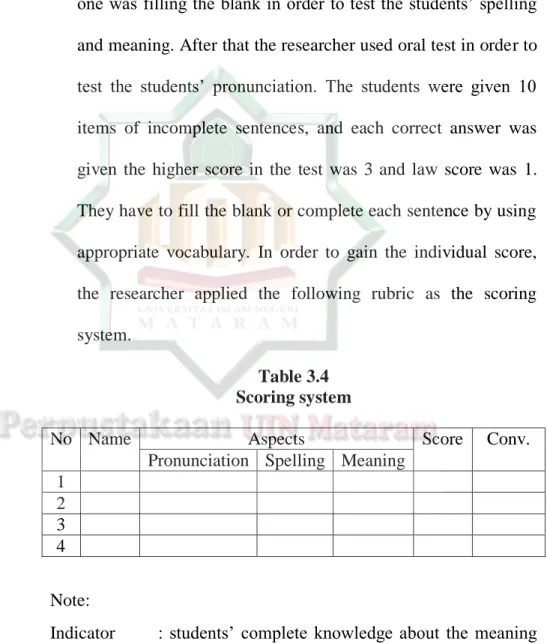
They have to fill the blank or complete each sentence by using appropriate vocabulary. In order to gain the individual score, the researcher applied the following rubric as the scoring system.
Table 3.4 Scoring system
No Name Aspects Score Conv.
Pronunciation Spelling Meaning 1
2 3 4 Note:
Indicator : students‟ complete knowledge about the meaning of the words and also it deals with students‟
pronunciation.
Good = 3 Fair = 2 Poor = 1
Convention =
x 100 S: score individual Max s: maximal score 2. Documentation
Documentation is one method for collecting data in forms such as book documents, regulations, students‟ answer sheet, photograph, syllabus, lesson plan and so on. In this research, the researcher used some documents, they are:
a. Photographs
Photographs are records of activities happening in the class, it could give real description about teaching learning process.
b. Students‟ answer sheet
There were two students‟ answer sheets: pre-test and post-test answer sheets.
c. Lesson plan
There are two kinds of lesson plans used in this research, namely for experimental class and control class. Each class was taught using four lesson plans for four meetings.
G. Procedure of Data Collection
This study used a test to collect the data. The test was administered before and after giving a treatment to identify the problem in this research. Firstly, the students were given a pretest of vocabulary to ascertain their homogeneity in terms of their knowledge of vocabulary.
Then, the students in the experimental group were taught by using
flash cards after the researcher put a set of flash cards on the board.
After that, the researcher pronounced the words and then the students repeated the words until they pronounced the words correctly. Next, students were asked to close their eyes and the researcher removed one or several of flash cards then the researcher asked the students to match the flash cards. So the students should remember which flash cards were needed to be matching. The test aimed as a quiz to evaluate their ability of vocabulary. Finally, at the end of the treatment period the students were given a posttest of vocabulary to examine their vocabulary development.
The students in the control group were taught vocabulary by using white board. The researcher wrote some vocabularies on the board.
Then the researcher pronounced the word to the students. Then the students repeated again until they pronounced correctly. At the end of the term they were given a posttest of vocabulary to see how they performed on vocabulary test.
H. Technique of Data Analysis
The data obtained from the students was analyzed as follows:
a. Individual score.
x 100
S: Score individual Max S: Maximal score
b. To find out the mean score of the two groups, the writer applied the following formula:
a). Mean score of experimental group:
MX = ∑
b). Mean score of control group:
MY = ∑ Where:
M: the mean score of the Two groups
X: The students final score for experimental group Y: the student final score for control group
N: is the number of sample ∑: is the sum of...
c. Finding the standard deviation of two groups. The formula as follows:
a). Find out the standard deviation of experimental group. The formula is: ∑x2
Where:
∑x2: the standard deviation for experimental group
b). Find out the standard deviation of control group. The formula is ∑y2
Where:
∑y2: the standard deviation for control group
The last, in the testing the hypothesis of this research, the researcher used the -test
Where:
Mx: mean score of control group My: mean score of experimental group N: total number of the subject
x: the deviation of control group y: the deviation of experimental group
If t-test < t-table in the significance of 0,05 (p-o,01), Ha is rejected. It means that the experimental group have lower skill in vocabulary than control groups.
If t-test > t-table in the significance level of 0,05 (p-0,01), Ha is accepted. It means that the control group have lower skill in vocabulary than experimental groups.
The mean deviation and the square deviation of experimental class:
Mx = ∑ (Mean deviation)
∑x2 = ∑x2 ─ ∑ (Square deviation)
The mean deviation and the square deviation of the control class:
My = ∑ (Mean deviation)
∑y2 = ∑y2 ─ ∑ (Square deviation)
Finally, the researcher computed the correlation coefficient of two mean scores to know whether it is significant or not by using t-test formula. Here is the formula.
√ ∑ ∑
Where:
My = The mean deviation score of control class
Y = The mean deviation pre-test and post-test of control group
Mx= The mean deviation score of control class
X = The deviation pre-test and post-test of experimental group
N = number of sample
Nx = number of sample in experimental class Ny = number of sample in control class. 37 I. Validity and Reliability
1. Validity
To measure whether the test has a good validity, the researcher analyzed the test from content validity. In this research, content validity is the degree to which a test measures an intended content area and the test must appropriate with the grade. The researcher made a
37Suharsimi Arikunto, Prosedure Penelitian: Suatu Pendekatan Praktik, (Jakarta: PT Rineka Cipta, 2010), p, 354.
test based on the objectives of syllabus so that it was not out of contents. Moreover, to find out whether the instrument is valid or not by expert judgment, and the instrument of this research was clarified validly after the expert examines the research instrument. Validation was carried out by one of lecturers from material experts in TBI. From the validation activities, the researcher was given input from the validator experts to determine the validation from the use of flash cards significantly improve students‟ vocabulary at 7th grade of SMPN 5 Jonggat.
2. Reliability
A reliable instrument is an instrument that, when used several times to measure the same object, will produce the same data.38 It means that simply reliability is the consistency of a measuring instrument, or the extent to which the measuring instrument can measure the same subject in different times but shows relatively the same results.
38Sugiyono, Metode Penelitian Pendidikan: Pendekatan kuantitatif Kualitatif, dan R&D, (Bandung: Alfabeta, 2017), p, 173.
CHAPTER IV
RESEARCH FINDINGS AND DISCUSSION A. Research findings
1. Data Description
There were two classes used as the subject in this study. The first class was VII A as the experimental class and the second was VII C as the control class. The researcher conducted test before and after giving treatments to both classes in order to get scores of the students‟
vocabulary ability.
a. Experimental class
The result of the students‟ pre-test and post-test score of experimental class were presented as follows: The detail is in the appendix 6.
Table 4.1
Pre-test and post-test score of experimental class No Initial name Pre-test Post-test Differenc
e
Square deviation
1 AS 73 93 20 400
2 ADS 75 93 18 324
3 AKS 71 80 9 81
4 AF 68 78 10 100
5 AFA 66 78 12 144
6 AG 72 83 11 121
7 AQN 72 85 13 169
8 AAC 69 72 3 9
9 AN 69 75 6 36
10 AS 70 85 15 225
11 AL 73 86 13 169
12 UA 74 82 8 64
Note:
Pre-test is the students‟ score before the researcher gave the treatment by flash cards.
Post-test is the students‟ score after the researcher gave the treatment by flash cards.
Difference is deviation between post-test and pre-test. The formula is post-test – pre-test. For example: 93 (pos-test) – 73 (pre- test) = 20.
Square deviation is the value of deviation or difference which is it‟s made quadrat. The formula is x². For example: 20² = 400.
Based on the table above, it could be seen the highest score and the lowest score from 26 students in experimental class. The highest score of pre-test was 75 and the lowest score was 66. After the researcher
13 AW 75 85 10 100
14 AA 74 87 13 169
15 AK 70 83 13 169
16 AUD 71 84 13 169
17 BW 72 86 14 196
18 BS 72 85 13 169
19 CR 74 89 15 225
20 DA 73 86 13 169
21 DP 70 84 14 196
22 DAP 75 90 15 225
23 ES 72 84 12 144
24 EM 73 85 12 144
26 EP 75 92 17 289
26 FE 70 85 15 225
∑ ∑
∑
∑
∑
Average 71 84 12
gave the treatment by using flash cards that it was conducted four meetings, the researcher gave the students post-test. The result shows that the highest score of post-test was 93 and the lowest score was 72.
In addition, the average of pre-test score was 71 and the average of post-test score was 84 in experimental class.
b. Control class
The result of the students‟ pre-test and post-test score of control class were presented as follows: The detail is in the appendix 6.
Table 4.2
Pre-test and post-test score of control class No Initial name Pre-test Post-test Differenc
e
Square deviatio
n
1 MW 70 81 11 121
2 MK 74 83 9 81
3 MM 69 80 11 121
4 MRF 70 80 10 100
5 MT 65 71 6 36
6 MF 64 71 7 49
7 MH 70 78 8 64
8 MI 71 78 7 49
9 MN 70 75 5 25
10 NH 72 76 4 16
11 NR 69 75 6 36
12 NS 67 75 8 64
13 N 71 80 9 81
14 PH 74 81 7 49
15 RM 73 82 9 81
16 RF 67 76 9 81
17 RA 69 77 8 64
18 RO 69 76 7 49
19 S 68 75 7 49
20 UA 67 75 8 64
21 W 70 77 7 49
22 WA 72 80 8 64
23 YEL 68 76 8 64
24 ZR 73 82 9 81
26 PKP 65 74 9 81
26 FT 71 80 9 81
∑ ∑
∑
∑
∑
Average 69 77 7
Note:
Pre-test is the students‟ score before the researcher gave the treatment by conventional ways.
Post-test is the students‟ score after the researcher gave the treatment by conventional ways.
Difference is deviation between post-test and pre-test. The formula is post-test – pre-test. For example: 80 (pos-test) – 71 (pre- test) = 9.
Square deviation is the value of deviation or difference which is it‟s made quadrat. The formula is x². For example: 9² = 81.
Based on the table above, it could be seen the highest score and the lowest score from 26 students in control class. The highest score of pre-test was 74 and the lowest score was 64. The highest score of post- test was 83 and the lowest score was 71. In addition, the average of pre-test score was 69 and the average of post-test score was 77 in control class.
2. Data analysis
Then the researcher computed the pre-test and post-test of both classes. Next, mean score of both classes could be distributed in a table and compared them.
a. Mean deviation and the square deviation score of experimental class.
a). Mean deviation score of experimental class
Mx =
=
= 12, 57
b). Square deviation
x2 can be obtained from:
x2 = x2 -
= 4.431 - = 4.431 -
= 4.431 - 4.112 = 319
b. Mean deviation and square deviation score of control class.
a). Mean deviation of control class
My =
=
= 7, 92
b). Square deviation of control class x2 can be obtained from:
x2 = x2 -
= 1.697 - = 1.697 -
= 1.697 - 1.632 = 65
Where:
Mx: mean score of control group My: mean score of experimental group N: total number of the subject
x: the deviation of control group y: the deviation of experimental group
Finally, the researcher computed the correlation coefficient of two mean scores to know whether it is significant or not by using t-test formula. Here is the formula.
√ ∑ ∑
Where:
My = The mean deviation score of control class
Y = The mean deviation pre-test and post-test of control group
Mx = The mean deviation score of control class
X = The deviation pre-test and post-test of experimental group
N = number of sample
Nx = number of sample in experimental class Ny = number of sample in control class.
Based on data above, the value of test could be found and operated as follows:
Mx: 12 My: 7
x2: 319 y2: 65
√ ∑ ∑
√
√ √ √
17,85
From the result of data analysis above shows that the experimental group got better result than the control group. However, the researcher needs to determine the level of significance and degree of freedom used in this research. The level of the table significance with the degree of freedom 52-2 = 50, t-test 17.85 > t-table 2,021, this indicate that the degree of difference between mean score is significant in both confidence level 5% is 50. The result of t-test showed that t-test 17.85 was higher than t-table 2,021. It means that, there is significant different improvement of students who used flash card and without used flash cards. It was proved in the table below:
Table 4.3
Comparison between t-test and t-table Value of t-test Value of t-table
Df 0,05
B. Discussion
This research was conducted by using flash cards effective on students‟ vocabulary at 7th grade of SMPN 5 Jonggat. The process of research was described below.
1. Pre-test
The pre-test was administered in order to measure the students‟
current vocabulary before the treatment. It was conducted on 11 November 2019 for experimental group and 13 November 2019 for control group.
The researcher used two kinds of test. The test one was filling the blank in order to test students‟ spelling and meaning. After that the researcher used oral test in order to test students‟ pronunciation. The researcher given 10 items of incomplete sentences.
The result of experimental group and control group were not really high. The highest score of experimental group was 75 and the lowest score was 66. In other hand, the highest score of control group was 74 and the lowest score was 64. The mean score of experimental group was 71 while control group was 69.
2. Post-test
Post-test was given after researcher given treatment by using flash cards. it was conducted on 20 November 2019 for experimental group and 21 November 2019 for control group.
17,85 50 2,021
The highest score of experimental group was 93 and the lowest score was 72. The mean score was 84. It means that the vocabulary of experimental group got improvement. In addition, the students‟
pronunciation was better after got the treatment than before.
In other hand, the highest score of control group was 83 and the lowest score was 71. The mean score was 77. It means that the improvement of students‟ vocabulary in control group was not really significant.
3. The effect of using flash cards on students‟ vocabulary
At the beginning of experimental group, the researcher informed the students that the objective of study. After that the researcher informed the procedure activities in teaching learning.
The data were obtained from the pre-test and post-test scores in experimental group and control group. The result of experimental group was more improve by flash cards than control group by conventional ways. The result of experimental group showed that the highest score of pre-test was 75 and the post-test was 93. The lowest score of pre-test was 66 and the post-test was 72. The mean score of pre-test was 71 and the post-test was 84. The mean score of deviation was 12.
In other hand, the result of control group showed that the highest score of pre-test was 74 and the post-test was 83. The lowest score of