THE EFFECT OF GIVING REWARD ON LEARNING ENGLISH OF THE SECOND GRADE OF SMP NEGERI 2 BANGKELEKILA’
TORAJA UTARA
SKRIPSI
BY
MARPYANTI SALU 4513101042
ENGLISH LANGUAGE EDUCATION DEPARTMENT FACULTY OF TEACHER TRAINING AND EDUCATION
UNIVERSITAS BOSOWA MAKASSAR 2017
SKRIPSI
THE EFFECT OF GIVING REWARD ON LEARNING ENGLISH OF THE SECOND GRADE STUDENTS OF SMPN 2 BANGKELEKILA’, TORAJA
UTARA
Arranged and Submited by MARPYANTI SALU
4513101042
After completely checked, the skripsi has fulfilled the standard to be examined.
Approved by:
Supervisor I,
Dr. Drs. H. Herman Mustafa, M.Pd
NIDN. 09311226306
Supervisor II,
Ulfah Syam, S.S., M.Pd.
NIDN. 0914127804
Known by:
Dean of Faculty of Teacher Training and Education
Dr. H. Mas’ud Muhammadiah,M.Si NIK.D: 450096
Head of English Education Department
Hj. RestuJanuarty Hamid, S.Pd.I, M.Pd NIDN: 0905018503
SURAT PERNYATAAN
Dengan ini saya menyatakan bahwa skripsi dengan judul “The Effect of Giving Reward on Learning English of the Second Grade Students of SMPN 2 Bangkelekila” beserta seluruh isinya adalah benar karya saya sendiri, bukan karya hasil plagiat. Saya siap menanggung resiko/ sanksi apabila ternyata ditemukan adanya perbuatan tercela yang melanggar etika keilmuan dalam karya saya ini, termasuk adanya klaim dari pihak lain terhadap keaslian karya saya ini.
Makassar, 24 Agustus 2017 Yang membuat pernyataan
Marpyanti Salu
ABSTRACT
Marpyanti Salu. 2017. The Effect of Giving Reward on Learning English of SMPN 2 Bangkelekila’. (Supervised by Herman Mustafa and Ulfah Syam).
The purpose of this study was to find out the effect of giving reward in students’ achievement on learning English. The result in this research was expected to be useful for students to improved students’ vocabulary mastery, and it can help the teachers to be more creative.
This study used a pre-experimental method. Population of this research was the second grade students of SMPN 2 Bangkelekila’ in academic year 2016/2017 and sample was students of VIII-B class which consisted of 30 students. The data collected by using test (pre-test and post-test).
The result of the research and discussion that obtained by the writer in SMPN 2 Bangkelekila’ that there was an improving of students’ achievement by giving reward. It can be seen from the data that has been collected where the total mean score in pre-test (49.7) and post-test (78.5). The results of t- test calculation was (27.72) is accepted as the results of t-test is greater than t-Table (27.72>2.045). Thus, concluded that the use reward was one of the effective methods in increasing students’ achievement on learning English of VIII-B class of SMPN 2 Bangkelekila’.
Keywords: Effect, Giving Reward, Learning English
ABSTRAK
Marpyanti Salu. 2017. The Effect of Giving Reward on Learning English of the Second Grade of SMPN 2 Bangkelekila’. (Dibimbing oleh Herman Mustafa and Ulfah Syam).
Penelitian ini bertujuan untuk mengetahui pengaruh pemberian hadiah dalam meningkatkan kemampuan dan prestasi siswa dalam pembelajaran bahasa Inggris. Hasil penelitian ini diharapkan dapat bermanfaat bagi siswa dalam meningkatkan prestasi siswa pada pembelajaran bahasa Inggris, dan dapat membantu guru untuk lebih kreatif.
Penelitian ini menggunakan metode pre-experimental. Populasi dan penelitian adalah siswa SMPN 2 Bangkelekila’ tahun pengajaran 2016/2017 dan sampelnya adalah siswa VIII-B yang berjumlah 30 orang. Pengumpulan data dilakukan dengan menggunakan tes (pre-test dan post-test).
Hasil analisis data penelitian dan pembahasan yang didapatkan penulis di SMPN 2 Bangkelekila’ yaitu terdapat peningkatan prestasi siswa dalam pembelajaran bahasa Inggris dengan menggunakan hadiah. Hal ini dapat dilihat dari data yang telah dikumpulkan dimana jumlah nilai mean score pada pre-test (49.7) dan post-test (78.5) hasil dari perhitungan t-test adalah (27.72) diterima karena hasil t-test Table (27.72>2.045). Dengan demikian dapat disimpulkan bahwa menggunakan reward merupakan salah satu metode yang efektif dalam meningkatkan prestasi pada pembelajaran bahasa Inggris siswa kelas VIII-B SMPN 2 Bangkelekila’.
Kata Kunci: Pengaruh, Pemberian Reward, Pembelajaran Bahasa Inggris.
AKNOWLEDGMENT
Praise and Gratitude to God because the mercy, blessing, and opportunity that the writer was able to finish this skripsi.
The writer realizes that, without motivation and the people who have given their valuable suggestion, guidance, assistance and advice in a process of the research and writing, the writer cannot finish quickly this skripsi.
Therefore, the writer would like to express his appreciation to:
Dr. Mas’ud Muhammadiyah, M.Si as the Dean of Faculty of Teacher Training and Education.
The writer’s parents, Yunus Pasang and Marthina believed in her and supported her and always be there for her no matter what.
Dr. Drs. H. Herman Mustafa, M.Pd as the first supervisor and Ulfah Syam S.S, M.Pd as the second supervisors, who has been so patient in helping and guiding the writer finishing the skripsi and also giving the writer some helpful suggestion to work through skripsi.
All lecturers of Faculty of Teacher Training and Education of Universitas Bosowa Makassar who have taught the writer valuable knowledge during her study in this university and that are very useful for the writer and all staffs who have given administration.
The Head Master of SMP Negeri 2 Bangkelekila’ who has believed and give me the opportunity to do a research in his school.
The principal and English teacher of VIII-B of SMPN 2 Bangkelekila’
who has allowed the writer conducted her research in their school and also given suggestion to carry out the treatments.
UnforgetTable to my brothers Yohanes Salu and Nober Mallisa, and my sisters Selpyanti Salu Mallisa, Abe Mallisa, Damaris Ati’, and Mariana Salu who has always supported the writer.
The writer’s friends, Hendrik Siruru, Sriwana Thalib, Windia Nastiti, Zakiah, Herawati Ramli, Resky Markus, Siti Aminah, Nur wahyuni, Suri Inda Pratiwi, Andi Krisna Adiyatma, Merlin Thomas, M. Aswar, Hijrah Ridwan and Abd. Rahmat Basir because of their support and help, the writer could finish this skripsi well.
Finally, the writer sincere gratitude also goes to some people who she cannot mention one by one, but the writer really thanks them for their cares, and encouragement.
Thank you so much.
Makassar, 24 August 2017
Marpyanti salu
TABLE OF CONTENTS
Page
PAGE OF TITTLE i
APPROVAL SHEET ii
SURAT PERNYATAAN iii
ABSTRACT v
ABSTRAK vi
ACKNOWLEDGMENT vii
TABLE OF CONTENT ix
LIST OF TABLE xi
LIST OF APPENDIX LE OF CONTENTS xii
CHAPTER I INTRODUCTION 1
A. Background 1
B. Problem Statement 3
C. Objectives of the Research 4
D. Significance of the Research 4
E. The Scope of the Research 4
CHAPTER II REVIEW OF RELATED LITERATURE 5
A. Previous Related Findings 5
B. The Concept of Reward 6
C. The Stage of Giving Reward 10
D. Definitions of Learning English 11
E. Resume 13
F. Theoretical Framework 13
G. Hypothesis 14
CHAPTER III METHOD OF THE RESEARCH 15
A. Research design 15
B. The Time and Place of Research 16
C. Population and sample 16
D. Variables and the Operational Definitions 16
E. Instrument of the Research 17
F. The Procedure of Collecting Data 17
G. Technique of Analysis Data 18
CHAPTER IV FINDING AND DISCUSSION 21
A. Finding 21
B. Discussion 30
CHAPTER V CONCLUSION AND SUGGESTION 35
A. Conclusion 35
B. Suggestion 36
BIBLIOGRAPHY 37
APPENDICES 39
ABBREVIATION 95
BIOGRAPHY 96
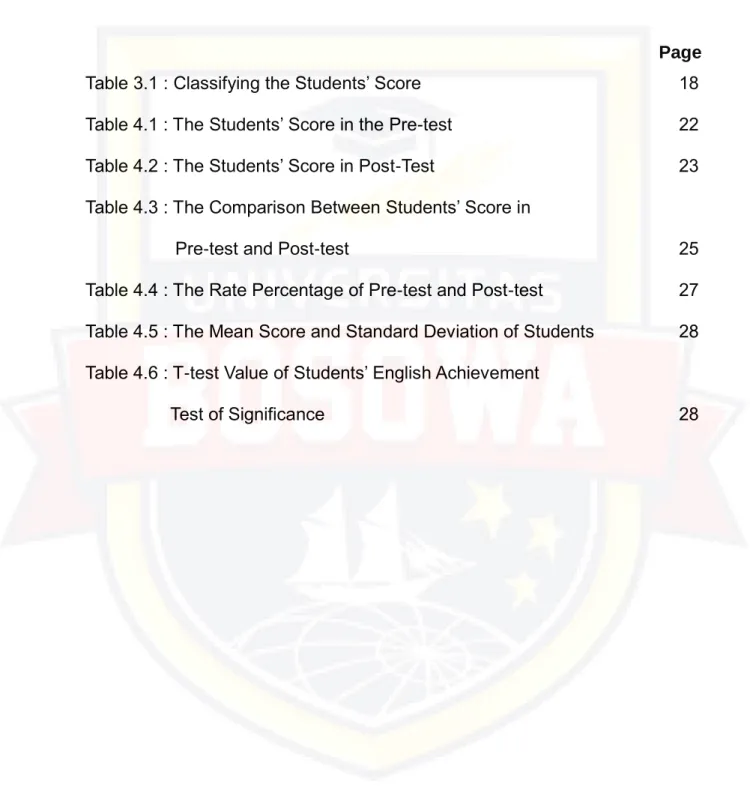
LIST OF TABLE
Page
Table 3.1 : Classifying the Students’ Score 18
Table 4.1 : The Students’ Score in the Pre-test 22
Table 4.2 : The Students’ Score in Post-Test 23
Table 4.3 : The Comparison Between Students’ Score in
Pre-test and Post-test 25
Table 4.4 : The Rate Percentage of Pre-test and Post-test 27 Table 4.5 : The Mean Score and Standard Deviation of Students 28 Table 4.6 : T-test Value of Students’ English Achievement
Test of Significance 28
LIST OF APPENDIX
Page
Appendix 1 : Lesson Plan 40
Appendix 2 : Instrument of the Research in pre-test and in Post-Test 46 Appendix 3 : Instrument of the Research in treatment 50 Appendix 4 : The Results of Students in Pre-Test 52 Appendix 5 : The Results of Students in Post-Test 64 Appendix 6 : The Results of Students in Treatment 76 Appendix 7 : The Students’ Score and Classification in Pre-Test 80 Appendix 8 : The Students’ Score and Classification in Post-Test 81 Appendix 9 : The Rate Percentage and Frequency of the Pre-Test 82 Appendix 10 : The Mean Score and Standard Deviation of Pre-Test
and Post-Test 83
Appendix 11 : T-test Value of Students’ English Achievement Test 85 of Significance
Appendix 12 : Test of Significance (T-test) 86
Appendix 13 : The Distribution of Critical T-values 87 Appendix 14 : The Students Pre-Test and Post-Test, The Gain
and the Square of the Gain 89
Appendix 15 : Pictures of the Research 91
CHAPTER I INTRODUCTION
This chapter presents background, research question, objective of the research, significance of the research and the scope of the research.
A. Background
Many students think that learning English is very difficult and boring.
Based on the curriculum, the students that have graduated from junior high school are expected to master the four language skills (Listening, Speaking, Reading, and Writing) and also have ability to communicate both in written and oral language to achieve functional and informational literary. Therefore, the teaching in English of junior high school is aimed at developing the four language skills in order that the teacher can build students’ interest in learning English language.
English is a difficult lesson for students, most teachers and parents have to cooperate to make students realize and want to study English well. English is not an easy lesson studied because they do not feel English is important.
Moreover, English at elementary school as addition of lesson in the curriculum. Based on the psychology of human, a person will not follow some lesson if that person does not like the lesson, but if the person likes is of course he will follow it. In teaching English, the teacher should cooper with
the media, family approaching of student’s mentality, or invite student to share the problem in learning English. Besides, teacher technique to approach the student interest to English lesson through teaching by meaningfully. In an effort to improve student achievement, factors that affect student achievement needs to be given serious attention. The problem is how to persuade the students or learners to strive to develop the spirit of learning in order to obtain optimal achievement. The spirit can come from within or from outside the individual, so we need a study in order to provide the right solution how to foster the spirit of learning that can support the achievement of maximum learning achievement or desired.
In the study we still found that students mostly silent, only listening to the explanation of the teacher and record material described. In fact, sometimes when not told to take down, they are passively listening to the explanation from the teacher. Such a situation shows the low motivation of the students in the learning process.
Therefore, the teacher must motivate the students in learning English because we know that English is a very important language in the world and English is a globalization language. In the case the teachers can motivate the students by giving the rewards.
In this learning the role of reward is very important needed in learning process in school. By the implementation of the reward are expected students can be passionate in the process of learning in class. As for various kinds of
rewards in the form of sign of smiling face, star, praise, touch (body gestures), addition of points (values), praise, giving something useful to students. In the classroom, the teacher asks some questions and the students must answer.
The students who can answer the question will get the reward from the teacher.
The role of teachers in this learning process, teachers should be more sensitive to read the situation and condition of students in learning the art of dance. So, that is important of mastery the teacher to create a fun atmosphere of learning. By application of reward in the process of learning in class students are able to develop English proficiency.
Reward given that all teachers being fun homage students on the basis of good results have been achieved in the educational process to improve performance.
From the description, the researcher try to arrange skripsi with the title
"The effect of Giving Reward on Learning English of the Second Grade of SMPN 2 Bangkelekila’ Toraja Utara”, the researcher hope the students were not bored in learning English and become more active and can improve their knowledge about English.
B. Research Question
Based on the background, the researcher formulates the research question as follows:
What is the effect of giving reward on learning English of the second grade of SMP Negeri 2 Bangkelelekila’?
C. Objective of the Research
In relation to the research question above, the objective of the research is to find out the effect of giving reward on learning English of the second grade of SMP Negeri 2 Bangkelekila?
D. Significance of the Research
Theoretically, this research can be a useful input in English teaching- learning process it can enrich the theory of teaching and learning for those who want to conduct a research in English teaching – learning process.
Practically, the researcher hopes that this research will increase the students’
achievement in learning English in the classroom. The researcher also hopes that this research is useful for the students to stimulate them to increase their English ability.
E. The Scope of the research
By discipline, this research is under applied linguistic. It deals with teaching and learning English. This research is focused on impact of giving reward in Learning English. The teacher gives questions for students and students who get high score will get reward from the teacher.
CHAPTER II
REVIEW OF RELATED LITERATURE
This chapter presents the concept of reward, the stage of reward, definition of learning English, resume, theoretical framework, and hypothesis.
A. Previous Related Findings
There have been some researchers done related to writing which are cited below:
Sardiman (2011) with the tittle “Interaksi dan Motivasi Belajar Mengajar”.
It showes that reward is a form to foster motivation in school activities.
Slameto (2010) stated that reward is form of maintenance and increase motivation of students to encourage students to make further efforts to achieve the purpose of teaching.
Hamalik (2013) stated that reward is a way to move or generate students’ motivation.
From the above previous findings, the researcher would like to use test to measure the effect of giving reward on learning English with the population is the second grade of SMPN 2 Bangkelekila’.
B. The Concept of Reward 1. The Definitions of Reward
Reward is a form of positive reinforcement theory derived from behavioristic theory. According to the behavioristic theory of learning is a change in behavior as a result of the interaction between stimulus and response. In other words learning is a form of change experienced by students in terms of its ability to behave in a new way as a result of the interaction between the stimulus and the response. According to Purnomo Ngalim (2006:182), Reward is a tool to educate children so that children can feel happy because his job was awarded. Ramayulis (2008:211) reward is given for the actions or the good things.
Furthermore Hasbullah (2006: 27) stated that reward in education is an educational tool in the form of educator actions that affect the behavior of students. While the educational tool it is an action or situation that deliberately held for the achievement of a certain educational goals. Educational tools are educational factors that are deliberately created and used for the achievement of desired goals.
From some of the above opinion, it can be concluded that the reward a form of appreciation that everything unpleasant feeling given to student for good results in the process of education with the goal to always do a good job and commendable.
2. The Purpose of Reward
About the problem of rewards is, the author discusses the problem about the goals to be achieved in the awarding of rewards. This is meant, in order to do something not because of the act merely, but there is something to be accomplished with his actions, because with the goal will give direction in stepping.
The goal to be achieved in rewarding is to further develop and optimize the motivation that is intrinsic and extrinsic, in the sense that students do an action, then the action arises from the student's own awareness. And with the reward is also expected to build a positive relationship between teachers and students, because the reward is a part of the incarnation of a teacher's love affection to students.
So, the purpose of the reward is the most important is not the results achieved by a student, but with the results achieved students, teachers aimed at forming a heart and a better willingness and more hard on the students.
As has been mentioned above, that reward in addition is a repressive educational tool that is fun, rewards can also be a driver or motivation for students to study harder.
3. The Forms of Reward a. Praise
Verbal praise is the most common form of rewards that teachers offer students; it consists of complimenting students when they behave in a way that is positive. This behavior could be the exhibition of a trait such as resourcefulness, compassion, courage or general intelligence.
b. Symbolic Rewards
Symbolic rewards are rewards in the form of objects that represent exemplary performance of character or achievement. Perhaps the most common form of symbolic reward is the gold star. Others could be the inclusion of the student's name or photograph on a bulletin board or poster.
Symbolic rewards operate similarly to praise in that they are public demonstrations of favor toward a student. The gold star or photograph on the bulletin board proclaims that the student has done something admirable.
c. Token Rewards
Tokens are physical rewards that represent value, or a form of currency that can be redeemed for a prize.
d. Tangible and Activity Rewards
Tangible rewards and activity rewards are awards you supply directly to the student, without the step of symbols or tokens in between. A tangible reward is a prize for positive behavior or achievement, and includes items such as toys, school supplies or other physical objects.
4. The Kinds of Reward
a. Smile face is one of the sign like a face and give for the students who can answer the question for the teacher.
b. Star is teacher give students a star if the student can give a right answer.
c. Praise is the something can increase students’ motivation in learning English like when the students can answers the question the teacher give praise. Examples teacher can say very good, you a smart, I like your answers.
d. Score is the teacher gives a score to students when the students can answers the teacher question.
5. Reward Principles
In the provision of rewards there are principles - principles that must be considered by parents and teachers. The principles according to Lukman Bin Ma'sa are as follows:
1) Assessment is based on 'behavior' and the offender.
2) Giving rewards must have a limit 3) Rewards of attention
4) The agreement is required
5) Standardized process, not results 6. The Terms of Reward
1) To give rewards that pedagogical necessary once the teacher knows really his students and know appreciate appropriately.
2) Rewards given to children should not cause jealousy or envy for other children who feel his job is also better but not get rewards.
3) Give rewards should be sparingly.
4) Do not give promising rewards in advance before the children show their work performance let alone the rewards that are given throughout the class.
5) The teacher must be careful to give rewards, not to the reward given to the children - the child received as a wage from the effort that has been done.
C. The Stage of Giving Reward
As for the steps of giving reward in learning according to Prayitno (2002:85) are as follows:
a. The teacher gives an explanation of the material to be discussed at each meeting in the learning activities
b. Students pay attention to the teacher when the teacher explains the material to be taught
c. Teachers motivate students by giving rewards that will be given by the teacher when the time learning.
d. Any student who completes the task well and correctly will get rewards from the teacher or all students.
e. And so on as student progress and succeed f. Doing what the teacher instructs
g. Conclusion and closing
From the above opinion it is clear that in the provision of rewards must be educational and must be accompanied by considerations whether the rewards given to students in accordance with good deeds that have been done or achievements that have been achieved.
D. Definition of Learning English 1. Learning
Brown (2007:7) stated that “learning is acquiring or getting of knowledge of a subject or a skill by study, experience, or instruction”.
Based on Brown (2007:8), there are many concepts of learning:
a. Learning is acoustic or “getting”.
b. Learning is retention of information or skill.
c. Retention implies storage systems, memory, and cognitive organization d. Learning involves active, conscious focus on and acting upon events
outside or inside the organism.
e. Learning is relatively permanent but subject to forgetting.
f. Learning involves some form of practice, perhaps reinforced practice.
g. Learning is a change behavior.
These concepts above, also give way to a number of subfields within discipline of psychology: acquisition processes, perception, memory (storage) system, short-and long term memory, recall, motivation, conscious and subconscious learning styles and strategies, theories of forgetting and also reinforcement. The role of practice very quickly the concept learning becomes every bit as complex the concept of language.
According Ritcher (2002:95) learning is the activities of educating or instructing; activities that impart knowledge or skill.
Webster (1913) stated that “learning is impart the knowledge to give intelligence concerning as knowledge before unknown, or rules for practice to inculcate as true or important to exhibit impressively".
2. English
English is the first Germanic language spoken in England in the early Middle Ages and is currently the most commonly spoken language in the
world. English is spoken as the first language by a majority of the population in various countries, including Great Britain, Ireland, the United States, Canada, Australia, New Zealand, and a number of Caribbean countries; As well as being the official language in nearly 60 sovereign nations. English is the third most spoken mother tongue in the world, after Mandarin and Spanish. English is also used as a second language and official language by the European Union, Commonwealth, and the United Nations, as well as various other organizations (Mydans, 2007).
E. Resume
Based on the above explanation, we can make some important point or resume as follows:
1. The students have low ability in learning English.
2. The students need rewards to increase their achievement in learning English.
F. Theoretical Framework
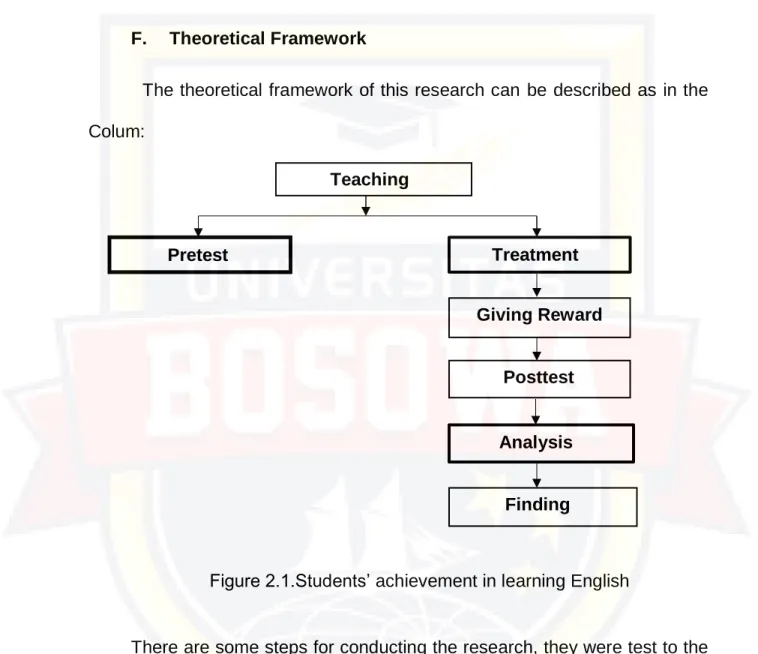
The theoretical framework of this research can be described as in the Colum:
Figure 2.1.Students’ achievement in learning English
There are some steps for conducting the research, they were test to the students to know their prior knowledge after that the researcher give treatment in the form giving reward. Then, the researcher give test namely posttest same with the pretest before. And the last the researcher analyzed the students’ answer and finally find the result of the researcher.
Analysis Treatment Pretest
Teaching Englis h
Finding Posttest Giving Reward
G. Hypothesis
Giving rewards can increase the students’ achievement in learning English of the second grade of SMP Negeri 2 Bangkelekila’.
CHAPTER III
METHOD OF THE RESEARCH
This chapter contains method and research design, the time and place of research, population and sample, variable of the research, instrument of the research, the procedures of collecting data and technique of data analysis.
A. Method and Research Design
The method of this research was pre - experimental where the researcher wanted to know surely about the effect of giving reward on learning English of the second grade of SMP Negeri 2 Bangkelekila’. As a pre – experimental, there was only one group as the subject. The design can be seen in the following:
Notation:
T1 = Pre-test
X = Treatment T2 = Post-test
(Arikunto, 2007:45) T1 X
T2
B. The Time and Place of Research
This research was held on July 2017 at SMP Negeri 2 Bangkelekila’.
The school is located at Batu Limbong, Toraja Utara (South Sulawesi).
C. Population and Sample 1. Population
The population of this research was all the second grade students of SMP Negeri 2 Bangkelekila 2017/2018 academic year. There were 150 students placed in 5 classes.
2. Sample
This research used pre – experimental method the number of sample is only one class that is class VIII-B. It consists of 30 students.
D. Variables of the Research
Sugiyono (2011: 61) explains that the research variable was an attribute, the nature or value of people, objects or activities that have certain variations set by the researchers to be studied and then drawn conclusions.
In this research there was only one variable (single variable) that was the effect of giving reward in finishing the skripsi.
E. Instrument of the Research
The research used test as the instrument. The writer distributed test and then explained how to answer it. It aimed at finding out to know the comparison of prior knowledge with after treatment.
F. The Procedure of Collecting Data
The researcher collected data was following procedures:
1. Pre-test
In the pre-test, the writer distributed test of students. The test was a multiple choice test. It’s consisted 20 numbers about English material for the second grade.
2. Treatment
After giving pre-test, the writer checked the students’ answer to know their prior knowledge. The next meeting, the writer taught some material and after that the writer gave some questions about the material that taught by writer. After the writer checked the students’ answer, the writer gave reward as treatment. All students got reward. But, the students who got high score they got big rewards and otherwise.
3. Post-test
The writer distributed the test same test in pre-test. After giving reward, the researcher gave the post test. It aimed to find out the value of treatment,
2 0
whether or not the result of the post test is better than the result of the pre- test. The content of the pre-test is the same of the post-test.
G. Technique of Data Analysis
The date collected through test. As have been stated before, the form of the test is a multiple choice test. The test is a test that consists of “to be”, vocabulary, simple present and present continuous tenses, and sentences structure. It aims to know how far the students know student’s English ability.
There were 20 numbers of the items. Each number is score 5 so the maximum score of each item is 100. The scoring is based on the analytic method. This method will be better when we want to inform our students about their achievement, Heaton in Maryati (2015:39).
The steps to collecting data undertaken the quantitative analyses are follow:
1. Scoring the students answer.
2. Tabulating the score of the students’ test results.
3. Classifying the students score into six levels as follow.
Criteria of Mastery Grade
91-100 Excellent
81-90 Very good
71-80 Good
61-70 Fair
51-60 Poor
Less than 50 Very poor
Gay cited in Maryati (2015:40) 4. The calculating the mean score of the students by using the following
formula:
X= Σx N Where:
X = Mean score
Σx = Raw of number score
N = The total number of students
Gay in Maryati, 2015:40) 5. Computing the frequency of the percentage of the students score.
P = 𝐹
𝑁
𝑥100
Where: P = Percentage
F = The cumulative frequency of subject N = The total number of the students
(Sugiono, 2010:109) 6. Finding out standard deviation of the students pre-test and post-test
applying formula below:
SD = √Σ𝑥2−(Σx)2 𝑁 − 1𝑁
Where:
SD = Standard Deviation Σx = The sum all of score
N = The total number of students
Gay in Sugito (2006:40) 7. Finding out the significant differences between and pretest and posttest
by using formula:
𝑡 = D
√Σx2−(ΣD)2 𝑁(𝑁 − 1)𝑁
Where:
t = Test of the significant differences D = The mean of differences score ΣD = The sum of the differences score N = The total number of students
(Sutedi, 2011:218-219)
CHAPTER IV
FINDINGS AND DISCUSSION
This chapter presented the findings of the research and discussion.
The finding consists of the description of the result of data collected through test. In the discussion part, the writer presented interpretation of the findings.
Then the writer analysis the data obtained from the result of the students’ pre- test and post-test.
A. Findings
The findings of the research based on the result of data analysis. The data analysis used the effect of giving reward in Learning English of the second grade of SMPN 2 Bangkelekila’. The data used multiple choice test to collect the data. The multiple choice test consisted of pre-test and post-test.
The pre-test was given to find out the prior students’ English ability before presenting problem solving task and the post-test was given to find out the effect of giving reward in learning English after giving the treatment.
The finding of the research deal with the students’ score of pre-test and post-test, the frequency and rate percentage of the students’ score, the mean score and standard deviation of students, test of significance (t-test) and hypothesis testing.
1. The Analysis of the Students’ Score
In collected data the writer employed a test, which used in pre-test and post-test. The pre-test was applied before giving treatment whereas the post- test was administrated after giving treatment. In analyzing data, the writer presented the result of multiple choice test in pre-test and post-test.
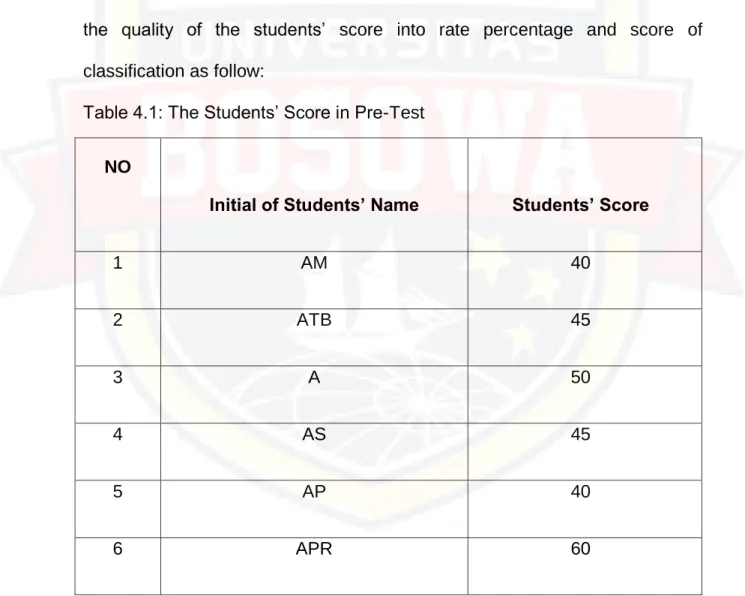
The students’ score was obtained through the test, in order to know the students’ English ability through giving reward. Then the writer determined the quality of the students’ score into rate percentage and score of classification as follow:
Table 4.1: The Students’ Score in Pre-Test NO
Initial of Students’ Name Students’ Score
1 AM 40
2 ATB 45
3 A 50
4 AS 45
5 AP 40
6 APR 60
To be continued
7 D 45
8 DR 45
9 DS 60
10 E 45
11 FYP 65
12 FP 50
13 J 55
14 JP 45
15 KP 45
16 LS 60
17 LL 65
18 MGT 45
19 MDT 60
20 MD 55
21 MT 50
Continuation
22 PT 45
23 PL 50
24 RH 50
25 R 35
26 RP 45
27 RPP 60
28 ST 50
29 SS 50
30 TP 35
Total 1490
Source: SMPN 2 Bangkelekila’
Based on the table 4.1 above, the writer concludes that the students’
score in pre-test is low than average. Most of them got less than 50, they have low ability in learning English. It seems that most of them are lack in vocabulary and expression sentences, so they need more time to the writer needed to conduct treatment to improve the students’ English ability. In this test there are 2 students were higher. They are Febryanti Paliwan (FYP) and Continuation
Lesa Liga (LL) they have good basic in English and also they are smartest in their class. Beside that there are 2 students Rante (R) and Thomas Pawarrangan (TP) were the lower because while test they were not seriously.
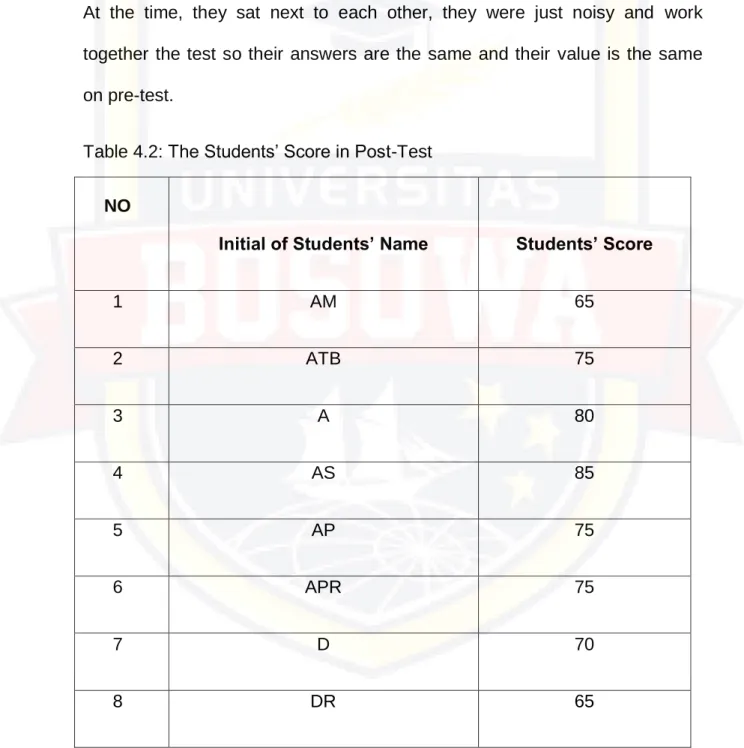
At the time, they sat next to each other, they were just noisy and work together the test so their answers are the same and their value is the same on pre-test.
Table 4.2: The Students’ Score in Post-Test NO
Initial of Students’ Name Students’ Score
1 AM 65
2 ATB 75
3 A 80
4 AS 85
5 AP 75
6 APR 75
7 D 70
8 DR 65
To be continued
9 DS 90
10 E 70
11 FYP 95
12 FP 75
13 J 80
14 JP 75
15 KP 65
16 LS 80
17 LL 85
18 MGT 80
19 MDT 70
20 MD 80
21 MT 85
22 PT 75
23 PL 85
Continuation
24 RH 80
25 R 70
26 RP 70
27 RPP 85
28 ST 70
29 SS 95
30 TP 60
Total 2355
Source : SMPN 2 Bangkelekila’
Based on the table 4.2 above, the writer concluded that there was a significant achievement students’ score in post-test. Most of them got very good classification and good classification, one none of them got very poor classification. In this test, Rante (R) got a good score than in pre-test after he learned (To be and vocabulary) through treatment. He was enthusiastic when the writer gave treatment and actually he is smart but in pre-test he was not seriously while working the test, whereas Thomas Pawarrangan (TP) still got the lowest score in post-test because he was still not seriously and he always out of the class in learning process. Febryanti Paliwan (FYP) is still at the Continuation
higher value. She only has one wrong number, its problem is only the expression sentence.
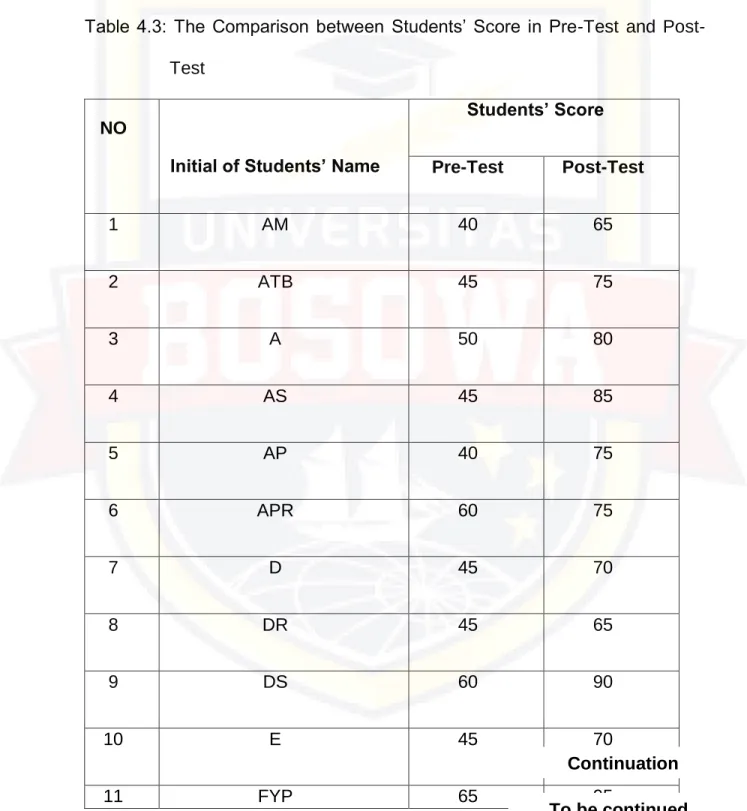
Table 4.3: The Comparison between Students’ Score in Pre-Test and Post- Test
NO
Initial of Students’ Name
Students’ Score
Pre-Test Post-Test
1 AM 40 65
2 ATB 45 75
3 A 50 80
4 AS 45 85
5 AP 40 75
6 APR 60 75
7 D 45 70
8 DR 45 65
9 DS 60 90
10 E 45 70
11 FYP 65 95
To be continued Continuation
12 FP 50 75
13 J 55 80
14 JP 45 75
15 KP 45 65
16 LS 60 80
17 LL 65 85
18 MGT 45 80
19 MDT 60 70
20 MD 55 80
21 MT 50 85
22 PT 45 75
23 PL 50 85
24 RH 50 80
25 R 35 70
26 RP 45 70
27 RPP 60 85
28 ST 50 70
29 SS 50 95
30 TP 35 60
Total 1490 2355
Source: SMPN 2 Bangkelekila’
Table in the previous page of above show the comparison between students’ score in pre-test and post-test, from the table the writer conclude that the students’ score in post-test is higher than pre-test. It means that giving reward can improve students’ achievement in learning English. Its shows a significant difference of the students score after treatment was given the pre-test and post-test. In the table pre-test indicates twenty one students’
categories as poor, while in post-test, table 4.3 indicates that after giving treatment, it was only one student has a lowest score or students’ categories as poor, it means the most of the students’ categories as poor before giving treatment than after giving treatment.
The table describes that lowest score the pre-test is 35 and the highest score is 65, while the lowest score of post-test is 60 and the highest score is
Continuation
95. Its shows the significance improvement of students, in this case Sarni Sattu (SS) got the highest improvement from 50 to 95, Kurniawati Palombu (KP) had not good improvement from 45 to 65 and Lesa Liga (LL) It’s on pre- test she is got the higher score but on post-test she had not good improvement from 65 to 85. She is not active when learning process.
Table 4.4: The Rate Percentage of Pre-test and Post-test
Classificatio n
Scor e
Pre-test Post-test
Frequenc y
Percentag e
Frequenc y
Percentag e Excellent 91-
100
- 0% 2 7%
Very good 81-90 - 0% 9 30%
Good 71-80 - 0% 10 33%
Fair 61-70 2 7% 8 27%
Poor 51-60 7 23% 1 3%
Very poor <50 21 70% - 0%
Total 30 100% 30 100%
Source: SMPN 2 Bangkelekila’
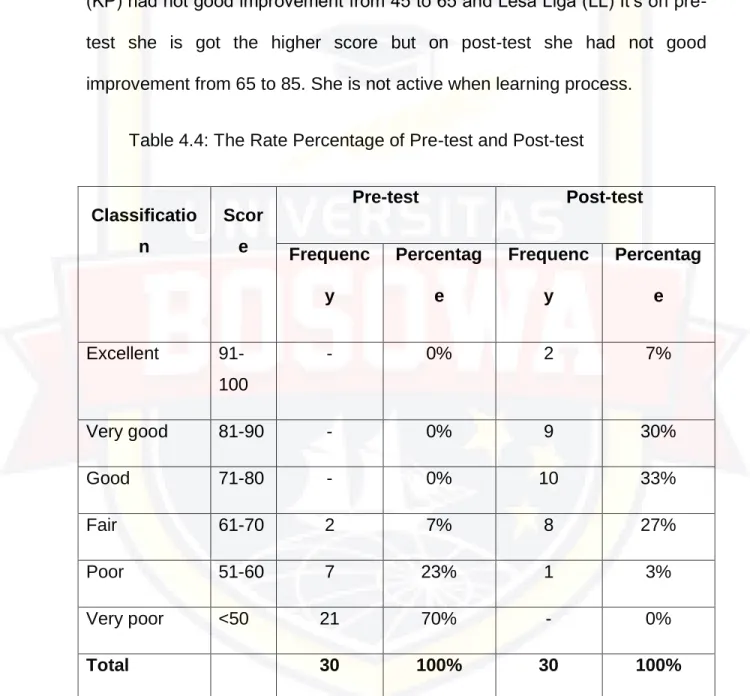
Table In previous page shows the students’ score percentage in pre- test and post-test. In pre-test none of student got excellent classification, very good classification, and good classification, 2 students (7%) got fair classification, 7 students (23%) got poor classification, and 21 students (70%) got very poor classification.
In the post there were 2 students (7%) got excellent classification, 9 students (30%) got very good classification, 10 students (33%) got good classification, 8 students (27%) got fair classification, 1 students (3%) got poor classification and none of the students got very poor classification.
Based on the table above the writer find the percentage of students in post- test is higher that pre-test. It proved after applying the effect of giving reward.
It means that the effect of giving reward was effective way to improved students’ achievement in learning English.
2. The Mean Score and Standard Deviation of Students in Pre-test and Post- test
The mean score and standard deviation of the students is used to know the significance difference of the students’ achievement in pre-test and post- test.
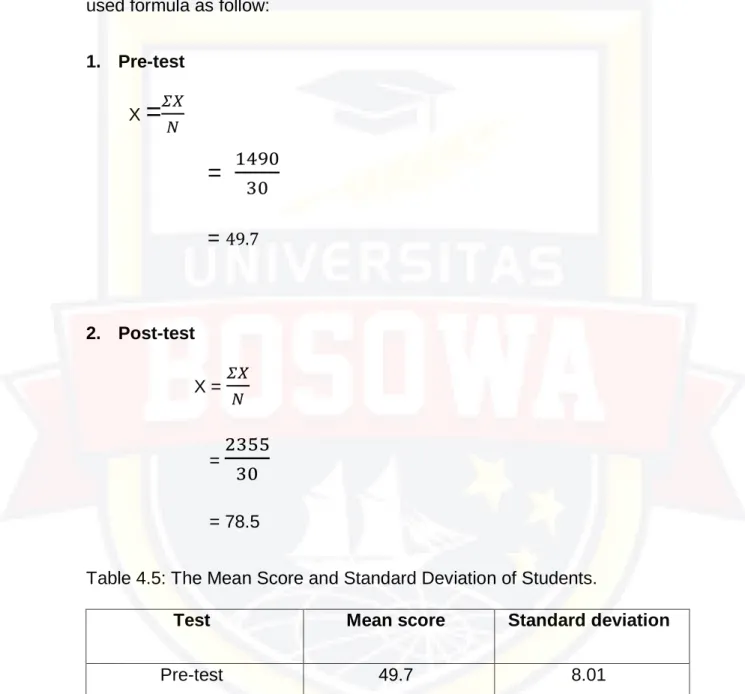
To know the mean score of the test, the writer calculated all score by used formula as follow:
1. Pre-test X
=
𝛴𝑋𝑁
=
149030
=
49.72. Post-test X = 𝛴𝑋
𝑁
= 2355 30 = 78.5
Table 4.5: The Mean Score and Standard Deviation of Students.
Test Mean score Standard deviation
Pre-test 49.7 8.01
Post-test 78.5 9.11
Source: SMPN 2 Bangkelekila’
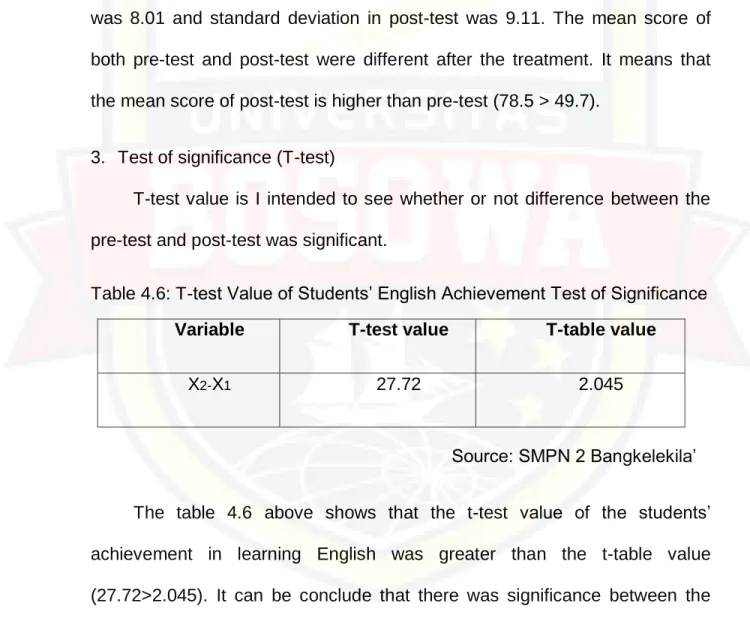
The mean score and standard deviation were difference in pre-test and post-test. The results of the students’ mean score in pre-test and post-test shows significance different. This means that there was an improvement after giving treatment. In the pre-test the students’ mean score was 49.7 and in the post-test the students’ mean score was 78.5. Standard deviation in pre-test was 8.01 and standard deviation in post-test was 9.11. The mean score of both pre-test and post-test were different after the treatment. It means that the mean score of post-test is higher than pre-test (78.5 > 49.7).
3. Test of significance (T-test)
T-test value is I intended to see whether or not difference between the pre-test and post-test was significant.
Table 4.6: T-test Value of Students’ English Achievement Test of Significance Variable T-test value T-table value
X2-X1 27.72 2.045
Source: SMPN 2 Bangkelekila’
The table 4.6 above shows that the t-test value of the students’
achievement in learning English was greater than the t-table value (27.72>2.045). It can be conclude that there was significance between the students’ pre-test and the post-test. It means that giving reward can improve students’ achievement in learning English.
4. Hypothesis Testing
To find out the degree of freedom (df) the research used the following formula:
Df = N-1 Df = 30-1 Df = 29
For the level of significant (p) = 0.05 and degree freedom (df) 29. Than t- table value = 2.045 and t-test value = 27.72, this the value of t-test is greater than t-table (27.72 ≥ 2.045). It means that there was a significant difference between the pre-test and post-test of the students in giving reward to improved students’ achievement in learning English. It means that null hypothesis (H0) is rejected while alternative hypothesis is accepted. In other word, there was a significant of the result of the pre-test and post-test.
Based on the data analysis above it was found the effect of giving reward on learning of SMPN 2 Bangkelekila’.
B. DISCUSSION
This section presents the discussion as in interpretation of the result of the data analysis. This section discuss about the result after doing the research to improve students’ achievement, furthermore this section
describing the students’ achievement in learning English after giving reward method in teaching English.
The data show that the result of the rate percentage of the students’
post-test higher than pre-test after giving treatment. It is supported that the students’ achievement has a significant effective after giving reward. Based on the result of the t-test, the writer found that there was a significance different between the result of pre-test and post-test. It means that there significant different result of the pre-test and after teaching and learning process by giving reward.
The writer assumes that the teaching English by giving reward is helpful to effect student’ achievement because it was supported by the frequency and the rate percentage of the result of the students’ score in pre-test and post-test . The students score after presenting teaching English (To be, vocabulary, expression, and tenses) through scientific approach strategy.
During the learners were through by giving reward method, the writer explained about English and invited all students to thought through giving test, to aims the teacher want to know students’ ability in learning English.
The writer taken 20 minutes to explain about English before giving test, and 10 minutes to prepare themselves before answer the test to understand all at once. The writer gave the time to search the meaning of test. But the writer got a lot of problems for any students’ and confuse about the
vocabulary. So the students need to know more the vocabulary to help them to make easy for the translation process. Because of that, the students have to improved their achievement in learning English for memorize some vocabulary.
The post-test is done in one meeting, in the first meeting the writer divided the test and for the students. After that the students was finding the meaning of the test, the writer gave the students opportunity to answer the question from the teacher one by one.
The writer found many problems from the students’ about the multiple choice test. Part of them still mumbling, confusing, and low think when they are answered the question in multiple choice test.
The treatment is done in second meetings. In the second meeting the writer divide the same test for the students, in this section the writer started teaching the students. And after teaching, the writer gave question to get reward. In the process the students have motivation in learning English.
The description of the data collected through treatment test as explained in the previous section shows that students’ achievement was improved. It’s proven by the rate percentage and the frequency of the students’ pretest and post-test. Students’ score after taught is better than before the treatment given to students.
The writer found that the students were motivated to learn English by giving reward. After given treatment twice, the students’ achievement on learning English is categorized good because there are 2 students got excellent (7%) 9 students got very good (30%) 10 students got good (33%), 8 students got fair (27%), and 1 students got poor (3%).
Based on the calculation, it means that giving reward can significantly improve the students’ achievement on learning English of the students in class VIII-b of SMPN 2 Bangkelekila’. Thus, this research supported (H1), there is significant difference of the students’ achievement on learning English before and after given treatment. It is because the result of the significantly t-test shows that these means statistically different, which is the t- test value is greater (27.72) than t-table value (2.045) for 0.05 significant. So that, it means the null hypothesis rejected and the alternative hypothesis is accepted.
Reward makes fun and interest for the students, thus make them learn and know the meaning of words more easily, involve friendly and competition but keep students interested, because this method create the motivation for the students of English to get the involved and participate actively in learning activities.
Therefore it can be concluded that the students’ English achievement by giving reward can give effect on the students on learning English of the second grade of SMP Negeri 2 Bangkelekila.
CHAPTER V
CONCLUSION AND SUGGESSTION
This chapter consists of two sections. The first section is conclusion, which is based on the research findings and suggestion, the second section is suggestion based on the conclusion.
A. Conclusion
Based on the result of data analysis and the result of previous chapter, the writer concluded that:
1. Giving reward is very helpful and effective way in improving students’
achievement in learning English.
2. There is significance difference between the result of pre-test and post- test of the students after taught to be, Expression by reward. Reward is an effective way of students’ achievement in learning English to the students class VIII-b of SMPN 2 Bangkelekila’. It provides by the means score of the students in pretest is 49.7 and the mean score of the
students in post-test is 78.5, beside that the result of t-test is 27.72 that is greater than t-table 2.045. It means that the use of reward is effective to improve students’ achievement.
3. The students’ achievement of the second grade of SMPN 2 Bangkelekila’
was poor before the writer giving reward on strategy in learning English and their achievement enhanced from poor level to good level after giving treatment.
4. The improvement of students’ achievement on learning English is obtained through giving reward. Giving rewards to the students have a big motivation and interested to learn English.
B. Suggestion
Based on the conclusion above the writer proposes the followings suggestion:
1. The English’s teachers should be more active and creative to choose some strategies and technic in teaching.
2. Most of students might be brave for asking question when they get some difficulties in learning process in order to get knowledge and exploring their ideas.
Finally, the writer do hopes this skripsi can be meaningful contribution for English teachers, students and further writer.
BIBLIOGRAPHY
Adrian Sutedi. 2011. Good Corporate Governance. Jakarta: Sinar Grafika
Arikunto, S. 2007. Prosedur Penelitian Suatu Pendekatan Praktek.
Jakarta:PT Rineka Cipta
Baharuddin, 2008. Teori Belajar dan Pembelajaran. Jogjakarta : AR-RUUZ MEDIA.
Brown. 2007. Principles of Language Learning and Teaching. Fifth edition.
Addison Wesley Longman, Inc. A Pearson Education Company.
Dimyati and Mujiono. 1994. Belajar dan Pembelajaran. Malang University.
Gay. 2000.Education Research: Competencies for Analysis and Application.
Columbus. New York: Charles Merril Publishing Company
Hanafiah, Nanang. 2010. Konsep Strategi Pembelajaran. Bandung: Rafika Aditama.
Hasbullah. 2006. Pengantar Ilmu Pendidikan. Surabaya: Usaha Nasional.
Hedge, Tricia. 2003. Teaching in Learning in the Classroom. China: Oxford Press University.
M. Ngalim Purwanto. 2006. Ilmu Pendidikan Teoritis dan Praktis. Bandung:
Remaja
Maryati. 2015. The Effect of Short Animation Video Towards Listening Comprehension. Makassar
Mudzakir Ahmad & Joko Sutrisno. 1997. Psikologi Pendidikan. Bandung:
Pustaka Setia.
Mydans, Seth. 2007. "Across Cultures, English is the Word". New York
Pinter, Annamaria. 2006. Teaching Young Language Learner. Oxford University Press.
Prayitno. 2002. Penguatan Dalam Meningkatkan Motivasi. Bandung: Pioner jaya.
Purwanto. 2011. Psikologi Pendidikan. Bandung: PT. Remaja Rosdakarya Ramayulis. 2008. Pengertian dan Definisi Reward. Bandung: Alfabeta
Sugiyono. 2010. Metode Penelitian Pendidikan. Bandung: Alfabeta.
2011. Metode Penelitian Kuantitatif, Kualitatif dan R&D. Bandung:
IKAPI.
Surachim Ahim. 2016. Efektifitas Pembelajaran Pola Pendidikan Sistem Ganda. Bandung: Alfabeta.
Slameto. 2010 Belajar dan Faktor – Faktor yang Mempengaruhi. Jakarta:
Rineka Cipta.
APPENDICES
Appendix : 1. Lesson Plan of the Research A. KOMPETENSI INTI (KI)
K1. Menghayati dan mengamalkan ajaran agama yang dianutnya
K2. Menghayati dan mengamalkan perilaku jujur, disiplin, tanggungjawab, peduli (gotong royong, kerjasama, toleran, damai), santun, responsif dan pro-aktif dan menunjukkan sikap sebagai bagian dari solusi atas berbagai permasalahan dalam berinteraksi secara efektif dengan lingkungan sosial dan alam serta dalam menempatkan diri sebagai cerminan bangsa dalam pergaulan dunia.
K3. Memahami, menerapkan, menganalisis pengetahuan faktual, konseptual,proseduralberdasarkan rasa ingin tahunya tentang ilmu pengetahuan, teknologi, seni, budaya, dan humaniora dengan wawasan kemanusiaan, kebangsaan, kenegaraan, dan peradaban terkait penyebab fenomena dan kejadian, serta menerapkan pengetahuan prosedural pada bidang kajian yang spesifik sesuai dengan bakat dan minatnya untuk memecahkan masalah
K4. Mengolah, menalar, dan menyaji dalam ranah konkret dan ranah abstrak terkait dengan pengembangan dari yang dipelajari di sekolah secara mandiri, dan mampu menggunakan metode sesuai kaidah keilmuan.
B. KOMPETENSI DASAR DAN INDIKATOR
NO KOMPETENSI DASAR INDIKATOR 1 1Mensyukuri kesempatan dapat
mempelajari bahasa Inggris sebagai bahasa pengantar komunikasi internasional yang diwujudkan dalam semangat belajar.
Mengungkapkan rasa syukur setiap saat mendapat kesempatan belajar bahasa Inggris
2. 1.Menunjukkan perilaku santun dan peduli dalam melaksanakan komunikasi interpersonal dengan guru dan teman.
Menyapa guru dan teman dengan santun
3. 4.2 Menyusun teks lisan untuk menyatakan dan merespon ungkapan menyatakan pendapat dan pikiran, dengan memperhatikan fungsisosial, struktur teks,
4.2 .1. Mengucapkan tindak tutur menyampaikan pendapat dan meminta pendapat disertai responnya secara lisan 4.2. 2. Menggunakan tindak
dan unsur kebahasaan yang benar dan sesuai konteks.
tutur menyampaikan pendapat dan meminta pendapat disertai responnya secara lisan sesuai konteks
C. TUJUAN PEMBELAJARAN
Setelah mengikuti serangkaian pembelajaran, peserta didik mampu :
1. Mengungkapkan rasa syukur setiap saat mendapat kesempatan belajar bahasa Inggris dengan tepat dan berterima
2. Menyapa guru dan teman dengan santun dalam setiap komunikasi interpersonal pembelajaran dengan tepat dan berterima
3. Mengucapkan tindak tutur menyampaikan pendapat dan meminta pendapat disertai responnya secara lisan dengan memperhatikan fungsi sosial, struktur teks, dan unsur kebahasaan yang benar setelah diberi contoh.Menggunakan tindak tutur menyampaikan pendapat dan meminta pendapat disertai responnya secara lisan sesuai konteks dalam kehidupan sehari-hari dengan penuh percaya diri setelah diberi contoh D. MATERI PEMBELAJARAN
1. Knowing about the used TO BE 2. Memorizing the expression word
3. Knowing about the meaning of vocabulary
4. Knowing and practice to make example sentences of 5W+1H 5. Understand about the structure of sentences
E. METODE PEMBELAJARAN
Pendekatan : Scientific Approach
Strategi : pengamatan, pemodelan, individuality, dan Mempraktekkan.
F. MEDIA PEMBELAJARAN Reward
G. SUMBER BELAJAR Experience, book
H. LANGKAH-LANGKAH PEMBELAJARAN PENDAHULUAN (15 menit)
Tahap Kegiatan
Kegiatan Awal - Apersepsi dan motivasi - ice breaking or warming up
- Penyampaian tujuan pembelajaran KEGIATAN INTI (60 menit)
Observation Peserta didik dapat menuliskan kosa kata tentang hal hal apa saja yang berada dilingkungan sekitarnya, contohnya kosa kata yang berkaitan dengan yang ada dilingkungan
sekolah.
Questioning Dengan bimbingan guru, peserta didik dapat membuat kalimat dalam bentuk lisan atau tulisan dari kosa kata yang telah dipelajari.
Exploration Peserta didik belajar menyampaikan pengalaman baik dalam bentuk lisan maupun tulisandengan memperhatikan struktur kalimatnya
Association Peserta didik dapat memberitahukan pengalamannya kepada yang lain melalui lisan maupun tulisan dengan memperhatikan struktur kalimatnya.
Communication Peserta didik dapat menyampaikan pengalamannya dengan baik dan benar sesuai dengan grammaticalnya.
PENUTUP (15 menit)
Penutup - Menyimpulkan hal-hal yang telah dipelajari - Refleksi
- Penugasan
I. PENILAIAN
1. Tehnik Penilaian Sikap : Non test berupa pengamatan langsung 2. Pengetahuan : Students Sentral Approach
3. Keterampilan : Unjuk kerja (performance)
Kegiatan akhir
1) Menanyakan kesulitan yang di hadapi oleh siswa 2) Menyimpulkan materi pembelajaran
3) Mengevaluasi siswa 1. Aspek penilaian:
Jumlah soal adalah 20, dan setiap nomor mendapatkan 5 point, dan jawaban yang salah tidak memperoleh point.
Bangkelekila’, 26 Juli 2017 Mengetahui
Kepala Sekolah Peneliti
(________________________) (______________________)
Appendix 2 : Instrument of the Research (Pre-test and Post-test)
TITTLE: “The Effect of Giving Reward on Learning English of the Second Grade Students of SMPN 2 Bangkelekila’, Toraja Utara”.
Keterangan:
1. Peneliti mengharapkan kiranya siswa menjawab soal ini.
2. Maksud pengisian tes ini adalah untuk penyusunan skripsi pada program strata satu (S1) jurusan pendidikan bahasa Inggris fakultas keguruan dan ilmu pendidikan Universitas Bosowa Makassar. Oleh karena itu, atas pengisian tes ini kami ucapkan terima kasih.
Nama : Nim : Class :
Petunjuk pengisian :
1. Bacalah soal ini dengan seksama sebelum anda menjawabnya!
2. Jawablah soal dengan baik dan benar!
3. Isilah titik yang terdapat dalam soal dan pilihlah jawaban yang benar pada soal multiple choice (pilihan ganda)!
Choose the correct answer by crossing a, b, c, or d based on the question below!
1. I ... a student
a. Are b. Is c. Am d. Do 2. Tomi ... a police
a. Is b. Am c. Are d. Were 3. They ...SMP student
a. Are not b. Was not c. Am not d. Do not 4. ...you a teacher?
a. Are b. Am c. Is d. Does
5. Dina : ………….is your name?
Vina : My name is Vina.
a. Where b. What c. Whom d. Who 6. Tiwi : …………do you live?
Ina : I live in Rantepao
a. When b. Where c. Why d. What
Andy : “……….., Dewi!”
Dewi : “Good morning, too Andy!”
7. To complete the dialogue, the suitable expression is ...
a. Good morning c. Good evening b. Good night d. Good afternoon
Doni : Good morning Windi, ………are you today?
Windi : I am fine, and you?
Doni : I am fine too, thanks.
8. To complete the dialogue, the suitable expression is ...
a. How b. Who c. What d. Where
Kiya : “Do you have a test today?”
Resky : “Yes, I do.”
Kiya : “ ………”
9. To complete the dialogue, the suitable expression is ...
a. Have a nice dream! c. See you tomorrow!
b. Enjoy your day! d. Good luck!
Lina : Can you help me?
Budi : Yes, of course. What can I do for you?
Lina : Please, ………… this bag to my room.
Budi : Yes, Sir.
10. To complete the dialogue, the suitable expression is ...
a. Bring b. Help c. Give d. Put
11. This exercise was too …… for me. I got score 100.
a. Difficult b. Easy c. Expensive d. High 12. My father always reads …… every morning.
a. Radio b. Computer c. Television d.Newspaper 13. The teacher’s duty is to ……… the students in the school.
a. Teach b. Play c. Make d.Work
14. Lisa …... to market yesterday.
a. Go b. Goes c. Gone d. Went
15. I am so hungry. So, I want ………. some food.
a. Eat b. Drink c. Kick d. Wear
16. The synonym for begins is ….
a. Sees b. Does c. Arrives d. Starts
17. Arrange the following words in to good sentences: were – neighbors – the – very – kind – helpful – and.
a. 2-1-4-6-5-3-7 c. 4-2-1-3-5-7-6 b. 3-2-1-4-5-7-6 d. 4-2-1-6-3-7-5 18. Bob : “let’s go to the canteen to buy some food!’
Lina : “………….. I am hungry”
a. It’s a good idea c. It’s not good idea
b. I disagree d. I hate it 19. Nita : “……… of our new friend?
Yani : “She is beautiful and friendly”
a. Who is the girl b. What a beautiful girl c. Would you mind d. What do you think
20. Romy : May I help you ?
Deny : Hmmm don’t bother yourself, thanks . The underlined sentences express……..
a. Asking help c. Offering help b. Giving help d. Refusing an offer Appendix 3: Instrument of the Research (Treatment)
TITTLE : “The Effect of Giving Reward on Learning English of the Second Grade Students of SMPN 2 Bangkelekila’, Toraja Utara.
Keterangan:
1. Peneliti mengharapkan kiranya siswa menjawab soal ini.
2. Tes ini diberikan untuk mendapatkan hadiah (reward)
3. Maksud pengisian tes ini adalah untuk penyusunan skripsi pada program strata satu (S1) jurusan pendidikan bahasa Inggris fakultas keguruan dan ilmu pendidikan Universitas Bosowa Makassar. Oleh karena itu, atas pengisian tes ini kami ucapkan terima kasih.
Nama : Nim : Class :
Petunjuk pengisian :
1. Bacaah soal ini dengan seksama sebelum anda menjawabnya!
2. Jawablah soal dengan baik dan benar!
3. Isilah titik yang terdapat dalam soal dan pilihlah jawaban yang benar pada soal multiple choice (pilihan ganda)!
Choose the correct answer by crossing a, b, c, or d based on the question below!
1. Tomi and Aslan ...a students
a. Is b. Am c. Are d. Does 2. ...shea teacher?
a. Are b. Am c. Is d. Was.
3. We ………the best students in the school.
a. Am b. Is c. Are d. Was
4. My region………..katolik?
a. Are b. Is c. Were d. Am
5. I ……… like playing game online.
a. Do not b. Does not c. Did d. Not 6. Because she is sick, she ………go to school a. Do not b. Does not c. Did not d. Not 7. Jeni want to introduce Jack to her sister.
Jeni : Jack, this is my sister Mona, and Mona this is Jack Jack : ………...
Mona : Nice to meet you, too.
a. How is she c. How is your sister b. Hi! Nice to meet you d. Let introduce myself 8. Before goes to school Rina says ...
a. Good morning c. Good bye b. Good afternoon d. Good night 9. Teacher : How do you do?.
Students : ………..
To complete the dialogue, the suitable expression is ...
a. I'm very well c. I'm fine, and you b. How are you d. How do you do
10. Diana meets Toni in the evening. She says …………..to him.
a. Good noon c. Good night b. Good morning d. Good day
Appendix 4: The Results of Students in Pre-test
Appendix 5: The Results of Students in Post-test