STUDENT’S WRITING SKILL ATSMPN 3 BALUSU (A Pre-Experimental Research at the 8thGrade Students
of SMPN 3 Balusu)
A THESIS
Submitted to the Faculty of Teacher Training and Education Makassar Muhammadiyah University in Part Fulfillment
Of the Requirement for the Degree of Sarjana Pendidikan
RUSNAH 10535 4821 11
ENGLISH EDUCATION DEPARTMENT
FACULTY OF TEACHERS TRAINING AND EDUCATION MUHAMMADIYAH UNIVERSITY OF MAKASSAR
2015
FAKULTAS KEGURUAN DANILMU PENDⅡ
)IKANPROGRAM SttIPENDⅡ )IKAN BAHAttINGGRIS
Title
Name Reg.Number Program Faculty
: Eng瑾蟻口可g『雷cation Dep凌静衡暉喝Ft strata l(Sl)
鼈 蜃 rず TOn
≧
Makaζ留 Ⅲ
26N軍中
Eber 2015酬 鋪
鐵
NBM:860934
ratakL.€/,Lt',si l,6tit'{si
̀ ││■
録 proVed tty: │
.
Consult*stI
ConsultantII
││││ ‐ ‐ │ ‐
む
omsui轟議 lII I■ ■‐ ‐ . ‐ ‐ Con由
1 1■ │■ 1・
1写
ぶ Z 耽 ‐
.l.、■ 4贔
FAKULTAS KEGURUAN DAN ILMU PENDIDIKAN Jl. Sultan Alauddin No. 259 Telp. (0411) 860 132 Makassar 90221
SURAT PERNYATAAN
Saya yang bertanda tangan di bawah ini:
Name : Rusnah
Reg. Number : 10535 4821 11 Program : English Education
Title : The Use of Portfolio Assessment in Developing Student’s Writing Skill at SMPN 3 Balusu(A Pre-Experimental Research at the 8th
Grade Students of SMPN 3 Balusu)
Dengan ini saya menyatakan bahwa:
Skripsi yang saya ajukan di depan tim penguji adalah hasil karya saya sendiri, bukan hasil jiplakan dan tidak dibuatkan oleh siapapun.
Demikian pernyataan ini saya buat dengan sebenar-benarnya dan bersedia menerima sanksi apabila pernyataan saya tidak benar.
Makassar, November 2015 Yang membuat pernyataan
RUSNAH
FAKULTAS KEGURUAN DAN ILMU PENDIDIKAN Jl. Sultan Alauddin No. 259 Telp. (0411) 860 132 Makassar 90221
SURAT PERJANJIAN
Saya yang bertanda tangan di bawah ini:
Name : RUSNAH
Reg. Number : 10535 4821 11 Program : English Education
Title : The Use of Portfolio Assessment in Developing Student’s Writing Skill at SMPN 3 Balusu (A Pre-Experimental Research at the 8th
Grade Students of SMPN 3 Balusu)
Dengan ini menyatakan perjanjian sebagai berikut:
1. Mulai dari penyusunan proposal sampai dengan selesainya skripsi saya, saya akan menyusun sendiri skripsi saya, tidak dibuatkan oleh siapapun.
2. Dalam menyusun skripsi, saya akan selalu melakukan konsultasi dengan pembimbing.
3. Saya tidak akan melakukan penjiplakan (plagiat) dalam menyusun skripsi ini.
4. Apabila saya melanggar perjanjian saya seperti yang tertera pada butir 1,2 dan 3 maka saya bersedia menerima sanksi sesuai dengan aturan yang berlaku.
Demikian perjanjian ini saya buat dengan penuh kesadaran.
Makassar, November 2015 Yang membuat perjanjian
RUSNAH
vii
Alhamdulillah Robbil Alamin, the writer expresses his sincere gratitude to the almighty God, Allah S.W. T, who has given guidance, mercy, and good health. So that he could finish writing this proposal. Salam and Shalawat are delivered to the final, chosen, religious messenger, the prophet Muhammad S.A.W.
The researcher realizes that in carrying out the research and writing this thesis, many people had contributed their valuable suggestion, guidance, assistance, and advice for the completion of this thesis. Therefore I would like to thank them:
1. Dr. Irwan Akib, M.Pd, the rector of the Makassar Muhammadiyah University for his advices during I study at the University.
2. Dr. A. Sukri Syamsuri, M.Hum, the dean of teacher training and education.
3. Erwin akib, S.Pd.,M.Pd, the head of English education department of FKIP UNISMUH Makassar, who gave me valuable authorities and suggestion in doing thesis.
4. My greatest thanks are due to all the examiner who involve in finishing my graduation.
5. My greatest thanks are due to my first consultant Prof. Dr. H. Basri Dalle, M.Hum and Awalia Azis, S.Pd., M.Pd. as the second consultant who had given their valuable time and patient, to support assistance and guidance to finish this thesis.
viii
father Rusdi Al Hakim, my mother Sitti Fatimah my brother Nirwang and my little boy Mubarraq Ramadhan for their prayer, financial, motivation and sacrificed.
7. To all my friends at A class, Attractive , EDSA for all support and motivation in finishing this thesis.
8. My greatest friends “IndoLogo” (Kak Evi, Wahe, Ria, Rosa, Tikho, Inhu, tante Lina, iduna, and bebeb ozy) thanks to all support and amazing friendship until today.
9. My lovely big family “LKIM-PENA” specially for the Rainbow Castle thanks deeply for your support and amazing moment with you all.
10.My lovely friend “BFF” (indah and Imha) and you thanks for support and motivation in finishing this thesis.
11. Finally, for all that could not be mentioned one by one, may Allah almighty bless us now and forever.
Makassar, October 2015
Rusnah
ix
MOTTO
“And seek help in patience and prayer”
(Al- Baqarah 2:45)
Its not what you have in your life. Its who you have in your life. That counts!
I Lovingly dedicated this thesis to my beloved parents, my big family, My brother, All of my friends and you. Thank you for your endless love, prayer, care, and support.
x
Rusnah. 2015.The Use of Portfolio Assessment in Developing Student’s Writing Skill at SMPN 3 Balusu (A Pre-Experimental Research At The 8th Grade Students Of SMPN 3 Balusu Academic Year 2015/2016). Guided by H. M. Basri Dalle and Awalia Azis.
This research was intended to explain the students’ writing in vocabulary grammar by use of Portfolio Assessment in class VIII-I of SMPN 3 Balusu Academic Year 2015/2016.
This research used pre-experimental study. It had conducted in six meetings. The subjects of this research were students in class VIII-I involved 19 students. Those consisted of 11 women and 9 men. The researcher took real data from the class to know the students’writing skill. The instruments of this research were writing test fill the blank test.
The research findings indicated that the use of portfolio assessment improved the students’ writing skills covered students’ vocabulary and grammar in class VIII-I of SMPN 3 Balusu in Academic Year 2015/2016. In the result of data analysis shows that the students score of writing skills in posttest improved after using the Portfolio Assessment. The students score’ in pretest for writing vocabulary was 3.96 and writing grammar was 3.67. These results are classified into poor and very poor. However, after giving treatment the students’ score in posttest improves to be 6.06 for vocabulary and 5.90 for grammar. These scores are classified as a good category. It means that, the use of portfolio assessment gives improvement to the students’ writing skills. This means that the data of posttest as the final result gives significant improvement. It was concluded that the use of portfolio assessment is able to give greater contribution in teaching and learning writing skills.
.
xi
TITLE PAGE ... i
APPROVAL SHEET ... ii
SURAT PERNYATAAN ... iii
SURAT PERSETUJUAN ... iv
LEMBAR PERSETUJUAN JUDUL... v
MOTTO ... vi
ABSTRACT ... vii
ACKNOWLEDGEMENT... viii
TABLE OF CONTENTS... x
LIST OF TABLES ... xi
LIST OF GRAPHICS ... xiii
LIST OF APPENDICES ... xiv
CHAPTER I:INTRODUCTION A. Background ... 1
B. Problem Statement ... 4
C. Objective of the Study ... 4
D. Significance of the Study ... 4
xii
CHAPTER II: REVIEW OF RELATED LITERATURE
A. Portfolio Assessment ... 6
B. Writing Skill ... 11
C. Conceptual Framework ... 26
CHAPTER III: RESEARCH METHOD A. Research Design ... 28
B. Variables and Indicators ... 29
C. Research Hypotheses ... 30
D. Population and Sample ... 31
E. Research Instrument ... 31
F. Data Collection ... 31
G. Data Analysis... 32
CHAPTER IV:FINDINGS AND DISCUSSION A. Findings ... 38
B. Discussion... 45
CHAPTER IV:CONCLUSIONS AND SUGGESTIONS A. Conclusions ... 48
B. Suggestions... 49 BIBLIOGRAPHY
APPENDICES
xiii
Table 1: The students’ mean score in the term of grammar Table 2: The students’ mean score in the term of vocabulary Table 3: The students’ improvement inwriting vocabulary Table 4: The students’ improvement inwriting skill of grammar Table 5: The students’ improvement in writingskills
Table 6: T-test of the students’ speaking skills
xiv
Figure 1: The improvements of the students’ mean score in writing skill in vocabulary achievement
Figure 2: The rate percentage of the improvement of the students’ writing skill in vocabulary achievement
Figure 3: The improvement of the students’ mean score in writing skill of grammar achievement
Figure 4: The rate percentage of the improvement of the students’ Grammar Achievement
Figure 5 : The improvement of the students’ mean score in writing skills Figure 6 : The rate percentage of the improvement of the students’ writing
skills
xv Appendix A: Lesson Plan
Appendix B: Instrument of the Research
Appendix C: Students’ score in writing Vocabulary and Grammar Appendix D: Students’ Improvement in Vocabulary
Appendix E: Students’ Improvement inGrammar Appendix F: Students’ score classification of Grammar Appendix G: Students’ Final Score
Appendix H: Students’Final Score Improvement
Appendix I: The Mean Score of Students’ Writing Skill Appendix J: The Significant Score of Student’s Writing Skill Appendix K: Attendance List
Appendix L: Documentation
1
INTRODUCTION
This chapter deals with background, problem statement, objective of the research, significance of the research, and scope of the research.
A. Background
English, as a foreign language in Indonesia, has four skills, namely listening, speaking, reading, and writing. All of them have to be mastered by the students based on the School-Based Curriculum 2006. Writing can be considered as the most difficult skill since there are many aspects in writing such as punctuation, spelling, and grammar. The students have to pay attention to those aspects to produce good writing. It makes writing not as easy as it is assumed.
There are several reasons why students have to master writing skills. First, writing is one of the most important means of communication. It is very beneficial for the students. Students, who want to enroll at an international school or a college, have to acquire good writing skills since it is used in any subject of study.
In this era, writing is needed in almost all aspects of human activities such as education and business. People need to write in almost all their activities for example emailing, writing a job application, writing a business proposal or report.
The next reason is that writing can help people to express their feelings when they cannot express their feelings verbally. Writing can be used as a tool for them to express their ideas such as writing short stories, novels, and other forms of writing
products. Another reason is that writing can generate ideas. Sometimes, people get new ideas when they are writing.
Writing is an activity to produce the graphic symbols, not just as speech is more than the production of sounds but the symbols have to be arranged to form sentences, although again we can say ‘writing’ if we are merely making lists of words such as shopping lists. Writing sometimes comes easily, if we are in the right ‘mood’ or have a clear and perhaps pressing need to express something, but as a rule it requires some conscious mental effort: we think out our sentences and consider various ways of combining and arranging them (Byrne, 1990: 72).
Simpson, JE (1992: 1) says that as any writing teacher has experienced, students are frequently worried about the prospect of writing in English. They worry about paragraph writing almost as much as about longer research papers in English. They worry about expressing their ideas clearly within the boundaries of correct usage, grammar, spelling, and punctuation. Often in the first years of their language learning, there is little focus on the creative aspects of writing because exams focus on grammar, spelling, or punctuation. Because of this, students develop a fear of writing and think that everything they write is riddled with errors. These fears hinder them and frequently make their writing process slow and also unsuccessful.
The students’ low writing skills could be caused by many factors such as the teacher, students, writing assessment, and other aspects. Based on the interview with the teacher and the students, the researcher found that the teacher used to ask the students to do writing tasks at home. Therefore, they did not
practice writing optimally in the classroom. Moreover, the writing assessment did not run well. Assessment is an ongoing process which is a part of the teaching and learning process (Brown, 2004). In other words, it is the part of writing process.
Considering the importance of writing skills for language learners, the researcher thought that there should be some efforts to be done in order to improve the students’ writing skills. She intended to conduct action research as a follow up to those problems. By conducting the research, she intended to improve the students’ writing skills through portfolio assessment. Portfolio assessment can be used as a tool to improve the students’ writing because, according to Brown (2004), it is one of alternative assessments that is oriented to the process as well as the product and facilitates revision processes. It means that there will be regular feedback given to the students’ writing until the students write the final draft. By learning the feedback given in every draft, they are expected not to write the same errors in their next writing. As a collection of the students’ work, portfolio assessment can also capture the students learning progress. Moreover, the students can review their own writing over time so that they can reflect on their own learning. Since the work can be studied comprehensively, they can make improvement on the writing skills.
B. Problem Statement
Relating to the background above, the researcher formulated research questions:
1. How does the implementation of portfolio assessment significantly develop the vocabulary of writing skill?
2. How does the implementation of portfolio assessment significantly develop the grammar of writing skill?
C. Objective of the Research
1. To know how the implementation of portfolio assessment significantly develop the vocabulary of writing skill.
2. To know how the implementation of portfolio assessment significantly develop the grammar of writing skill.
3. Significance of the Research 1. Practically
a. For the English teachers, this research can be useful information about the use of portfolio assessment to improve the students’ writing skills. The teachers can see the progress of the students’ achievement in writing.
b. For the students, through the use of portfolio assessment, they are facilitated to practice writing more. They can also see their own progress in writing.
Moreover, by doing self-reflection, they can reflect their own learning in writing.
c. For the researcher, the research can enrich her knowledge of educational research. In addition, it gives her experience in doing the research and working with others.
2. Theoretically
The findings of the research can be used as a reference for next researches that are similar to this topic.
E. Scope of the Research
This research is limited on the use of portfolio assessment to improve the students’ writing ability. It is focused on the students’ writing skill at the second year students of SMPN 3 Balusu in academic year 2015/2016 which consists of recount text about the vocabulary and grammar. Vocabulary consist of three indicators (Form, Meaning and Use), grammar also consist of three indicators (Past Tense, Nouns and Adverb).
CHAPTER II
REVIEW OF RELATED LATERATURE
A. Portfolio Assessment
According to Birgin (2007), portfolio has been used for different purposes it may be different from than that of artists. It is not possible to use only one definition for portfolio. Definition of portfolio may change according to users’
purpose and way of usage. Many researchers defined portfolio in order to explain its features.
For determining assessment criteria: First, the purpose of portfolio is mentioned explicitly and then, assessment criteria of the each item in portfolio need to be explained. It is very important to determine the criteria for assessing the portfolio. Because an assessment criterion allows students to recognize, and select work that is considered high quality. It also allows and encourages discussions among teachers, students, and other concerning the outcomes and quality of outcomes. Assessment criteria which have been used to determine the quality of the student’s performance should be clear and easy to understand. This is quite important in terms of student to assess his own works and to be able to fulfill his weaknesses. Rubrics should be used in order to determine quality of the evidence in portfolio and to make a reliable and valid assessment.
6
1. The Nature of Portfolio Assessment
Portfolios are various samples of writing that are written over time which can represent the students’ development and ability in a certain context (Hyland, 2003). Stecher in Evers and Walberg (2004) supports that “portfolio is a collection of student work that reflects the skills that the student has mastered in a particular subject domain”. Meanwhile, related to Moya and O’Malley (1994), a portfoliois considered as a collection of a student’s work, knowledge, and self judgment.
Besides, portfolio assessment is a procedure that is used to plan, collect, and analyze those data that are contained in the portfolio. Hyland (2003) adds that portfolio assessment refers to the practice of writing courses where the students write their writing by using some useful information sources as references, revise and resubmit it after getting feedback from the teacher and peers.
In addition to the portfolio definitions, a portfolio can be defined as a collection of student’s work in a certain theme. The function is to record the achievement of the students in learning (Damiani, 2004; Genesee and Upshur in Brown, 2004). Moreover, Damiani says that portfolio can show the strengths of the students. It can consist of drafts, reflections, diaries, teachers’ and peers’
feedback, and the final draft (Hyland, 2003). In summary, a portfolio is a collection of student’s work that can be used to assess the student’s achievement in a certain area of learning.
2. The Advantages of Portfolio Assessment
There are many experts that describe the advantages of portfolio assessment. Moya and O’Malley (1994) say that portfolio assessment is an alternative assessment that can be used to see the strengths and weaknesses of the students. Moreover, Öztürk and Çeçen (2007) state that portfolio provides the real information about the students’ learning development because it keeps records of the students’ knowledge and skills. Besides, the students can also get the advantages of using portfolio assessment. They can observe their own progress in learning and know their strength and weaknesses because it focuses on Multi drafting, feedback, and revision (Hyland, 2003). Moreover, Stecher in Evers and Walberg (2004) says that portfolios can encourage the students to do self reflection and self-evaluation. By reviewing their own work, they can be more self-aware and will have better understanding of what they have learned. Being more detail, Brown (2004) mentions some advantages of portfolio assessment.
1) It can promote the students’ intrinsic motivation, responsibility, and ownership.
2) It can increase the interaction between the students and the teacher.
3) It can prepare for learning and celebrate the uniqueness of the students individually.
4) It offers the real information of the students’ work.
5) It helps critical thinking, self-assessment, and revision process.
6) It gives opportunities for the students to work with their peers.
7) It can allow assessment of multiple dimensions of language learning.
In conclusion, portfolio assessment has many advantages for language learning. For the students, it can promote their intrinsic motivation since they get regular feedback from the teacher and they will get opportunities to revise their writing. In addition, the students will get benefit by doing self-reflection and self assessment. It allows them to find what they can do and what they cannot do in their learning. They can also be more self-aware and will have better understanding of what they have learned by reviewing their work. Moreover, portfolio can help the teacher see the students’ progress of their learning and identify the strengths and weaknesses of the students.
3. The Implementation of Portfolio Assessment in Teaching Writing
In using portfolios as a tool for assessing students’ learning development, there are several steps that have to be done by the teacher. Birgin and Baki (2007) propose three steps in developing portfolio assessment. These include determining (1) the purpose of the portfolio, (2) the evidence including in portfolio, and (3) the assessment criteria. The first step in developing portfolio is determining the purpose of the portfolio. It is the most important step of portfolio preparation. The purpose of portfolio will affect the process of creating the portfolio. It also will affect the evidence that should be in it. After considering the purpose of portfolio, the next step is determining the evidence that should be collected, who will collect the evidence, how often it will be collected, and how it will be assessed. The last step is determining the criteria of each item in portfolio. It is very crucial to determine the assessment criteria. It allows the students to maximize their works.
In other words, they will attempt to have a high quality work. Therefore, a rubric
should be used in order to determine the criteria. In line with the steps above, Brown (2004) proposes more steps in preparing portfolio assessment. The steps are presented below.
1) Deciding the purpose of the portfolio The teacher should determine what purpose that is expected to be achieved in the portfolio. The purpose in the portfolio must be related to an integrated goal of the school curriculum.
2) Considering the evidence including in the portfolio. After deciding the objectives, the teacher has to tell the students what items that will be included in the portfolio. The teacher can give the students a sample of a portfolio from a previous student to make them clear about the content of the portfolio.
3) Communicating the assessment criteria Brown considers that this part is the most important and the most complex aspect of portfolio development. The teacher has to integrate both self-assessment and teacher assessment so the students can get more advantages.
4) Determining the time for portfolio development The teacher has to ensure that the students have ample time to complete the materials and reflect on them.
5) Determining regular schedules to review and conferencing There should be periodic schedules for the students and the teacher to review the materials in the portfolio. The teacher has to provide time with the students for discussing the students’ progress in their learning personally.
6) Deciding a place to keep the portfolio It is inconvenient for the students if they are asked to bring the portfolio a home. It will be easier for both the students and the teacher to keep the portfolio in a place in the reading room or the school library.
7) Giving positive wash back and final assessment Wolcott in Brown (2004) states that the teacher is recommended to give holistic scoring to a portfolio containing written work that has been completed.
In short, when a teacher considers using portfolio assessment to capture and assess the students’ learning, they have to do several steps. To begin with the steps, the teacher have to specify the goal of the portfolio. The purpose of the portfolio must be in line with an integrated goal of the school curriculum. The second step is that they must consider the content of the portfolio. Then, they have to decide the assessment criteria and tell the students about the criteria. The next step is that the teacher determines schedule for reviewing. It is to discuss the students’ progress with the students personally. After that, the teacher has to think carefully where the students’ portfolios will be kept. Finally, after the students complete their portfolio, the teacher has to score their work
4. The Characteristics of Portfolio
Portfolio is not just simply an activity of collecting students’ woks in a period of time. Hamp- Lyons and Condon as cited in Weigle (2002:199) explain that there are several characteristics of portfolios as follow:
1) A portfolio is a collection of written works, rather than a single writing sample.
2) It enables the writer to display a range of writing performances, in different genres and for different audiences and purposes.
3) A portfolio possesses context richness insofar as it reflects closely the learning situation and demonstrates what the writer has accomplished within that context.
4) An important characteristic of most portfolio programs is delayed evaluation, giving students both the opportunity and the motivation to revise written products before a final evaluation is given.
5) Portfolios generally involve selection of the pieces to be included in the portfolio, usually by the student with some guidance from the instructor.
6) Delayed evaluation and selection offer opportunities for students established evaluation criteria and can revise them before putting them into their portfolios.
7) A portfolio usually involves reflection and self-assessment, in that students must reflect on their work in deciding how to arrange the portfolio, and are frequently asked to write a reflective essay about their development as writers and how the pieces in the portfolio represent that development.
8) Portfolios can provide a means for measuring growth along specific parameters, such as linguistic accuracy or the ability to organize and develop an argument.
9) Portfolios provide a means for measuring development over time in ways that neither the teacher nor the student may have anticipated.
Hamp-Lyons and Condon state that from those characteristics, the most important aspects of portfolio are collection, reflection, and selection. Nunan (2004), additionally, explains that the following items are some characteristics of using portfolios to assess students’ learning.
1) The teacher and the students should work together in the assessment.
2) The portfolios should contain specific items.
3) The students’ work included in the portfolios should show the progress of students’ learning.
4) The students have to get a clear explanation about the content and assessment criteria at the beginning of using portfolios.
In summary, the characteristics of portfolio mentioned above are very beneficial to improve the students’ writing skills. The students will get benefits if portfolio is implemented in teaching writing. Some of the benefits are that the students are given opportunities to revise their work before the final evaluation is given. Moreover, portfolio involves reflection and self-assessment which will be very useful for the students to evaluate their strengths and weaknesses.
B. Writing Skill 1. Writing
a. The Nature of Writing
Writing is a gradual improvement process which means that when students write their first draft they have already known what they are going to write in their paper (Oshima and Hogue, 1997). After finishing their written work, they have to read it over time to evaluate and improve their writing. Thus, Oshima and Hogue
(1997) define writing as a process that has several steps such as prewriting, planning, writing and revising drafts, and writing the final copy. Related to The Center for Teaching International Relation of University of Denver (1990) writing is an active process that involves students’ feelings, observations, and personal experiences. This process can help students reinforce other skills especially reading since almost all good writers are good readers. Moreover, Hamadouche (2010) defines writing as an activity to produce written language that is going to be read. This activity is not simply arranging language using symbols but it has to apply appropriate words to convey them into sentences.
Lounis (2009) adds that writing is the most essential skill that has to be mastered by English as Second Language (ESL) or English as Foreign Language (EFL) learners. Besides, Sierra (2012) argues that writing skill can help learners express their feeling, thought, and experiences in written forms. Writing can also help learners develop independent, fluent, and creative writers. Lounis (2009) says that to be good writers the students have to do a lot of practices and follow effective formal teaching and learning. For that reason, the students have to be provided with a lot of practices in order to fulfil their need as language learners.
However, as mentioned in the background of the problems, Grenville (2001) describes writing as a process which is not as simple as it is assumed. It is because students often feel confused about how to begin their writing and how to organize their sentences to be an interesting writing. Richard and Renandya (2002) add that writing is the most difficult skill among others. What makes it
difficult is not only generating and organizing ideas but also transcribing those ideas into an interesting writing.
In summary, writing is a process which can help students express their feelings, ideas, and even personal experiences. Writing is also a good tool that can help students reinforce the other skills. Compared to other skills, writing is defined as the most difficult skills. To be a good writer, a student has to do a lot of practices. Therefore, the teacher has to help them by providing enough practices in and out of the classroom.
b. The Micro- and Macro-Skills of Writing
According to Brown (2004), there are micro- and macro-skills of writing that can be used to define an appropriate kind of assessment to assess students’
writing. The micro-skills of writing are more appropriate to be applied to imitative and intensive types of writing task. Besides, the macro-skills of writing are needed to master responsive and extensive writing. Those micro- and macro- skills of writing are presented below:
Micro-skills of writing:
1) producing graphemes and orthographic English pattern, 2) producing writing in an efficient speed,
3) using appropriate words and word order patterns,
4) applying grammatical systems, patterns, and rules correctly, 5) using different grammatical forms to convey a certain meaning, 6) applying cohesive devices in written discourse.
Macro-skills of writing:
1) applying the organizational forms, styles, and conventions of written discourse,
2) achieving the communicative function of written texts based on the form and purpose,
3) connecting events appropriately and conveying main idea, supporting idea, new information, given information, generalization, and exemplification, 4) understanding the differences between literal and implied meaning when
writing,
5) conveying specific references in the written te xt context appropriately, 6) using and developing a large number of writing strategies.
c. The Process of Writing
Oshima and Hogue (1997) mention that there are four steps in the process of writing. They are prewriting, planning, writing and revising drafts, and writing the final copy. Prewriting helps writers generate their ideas. There are some activities in prewriting such as choosing and narrowing a topic and brainstorming.
After doing this stage, the next stage is planning or outlining the writing. In this stage, the writers organise and outline their ideas that are generated when brainstorming. In writing and revising drafts stage, the writers have to write and revise several drafts until they produce the final product of their writing. Oshima and Hogue state that there is no writing that is perfect in the first draft. When a writer writes a draft, he has to refine and improve his writing. The last stage of writing process is writing the final copy. After the writers are satisfied with the revision stages, they have to write the final product of their writing.
Similar to them, Harmer (2004) says that in the writing process there are four main stages to create good writing. They are planning, drafting, editing, and final version. In the planning stage, the writers think what they are going to write.
In this stage, they decide the purpose of their writing, the audience, and how they organize the facts that will be included in their writing. Then, they write the first draft of their writing. They can be going to write several drafts until they come to the final draft. The next step of writing process is editing. When editing the writing, the writers can ask other readers to review and give comment or suggestion to their writing. After doing this stage, the writers have to produce the final version of their writing as the last stage of writing process.
Furthermore, Spivey (2006) argues that in learning to write there are seven steps in the writing process. The first step is prewriting. The students can use charts and story webs to help them generate ideas. In this step, they decide the kind of writing, the audience, and the purpose of their writing. Then, they start to make the rough draft as the next step of the writing process. They put their ideas on the paper without fully paying attention to the other aspect of writing such as punctuation, grammar, and other writing aspects. The third step is peer editing.
The students ask other writers to share their first draft to give suggestion to improve their writing. After that, they revise their writing by using their friends’
suggestions from the previous step. This is called revision step. In this step, the teacher gives feedback to the writing. The fifth step is editing. The students together with their teacher correct all of the mistakes in spelling and grammar.
After doing this step, the students have to write the final draft of their writing with
all of the corrections made in the editing stage. The students discuss the draft with the teacher to get the last suggestions to improve their writing. After that, the students come to the last step that is publishing. They share their writing to the other students or send their work to local magazine or newspaper.
From those explanations about the writing process, the researcher draws a conclusion that there are several steps in writing. In prewriting stage, the students brainstorm for getting ideas. The second stage is while-writing. While-writing is a process where the students write the first, second, and other drafts of their writing and revise those drafts until producing good writing. The last stage is finishing.
The students have to write the final product of their writing in this stage. After copying the final draft, they can send their writing to the school magazines or other local publications.
2. Assessment in Writing a. The Nature of Assessment
According to the Centre for Advancement of Learning and Teaching of University of Tasmania (2011), assessment is an essential part of language teaching and learning. It can be said that it is a process of making judgment related to the students’ achievements in their learning in a particular period.
This process includes devising assessment tasks, writing the rubric, judging the students’ achievement based on those tasks, giving feedback to the students, and deciding grades.
Brown (2004) adds that assessment is an ongoing process that includes various aspects within. He mentions that there are two types of assessments.
They are formal and informal assessment. Formal assessment is a planned and designed procedure that is used to see students’ achievement in their learning.
On the other hand, informal assessment is a spontaneous feedback to the students such as unplanned comments and suggestions. Richard and Renandya (2002) state that kinds of authentic assessments, such as portfolio, journal, and project work are increasingly popular in language teaching and learning.
These kinds of assessment provide opportunities for students to evaluate their own learning and give more useful information to the teacher to improve the teaching plans.
In other words, assessment is a tool to appraisal students’ achievement in language learning that can be useful information for the students and the teacher. The students can see the result of their learning so they can evaluate and control their own learning. The teacher can use the assessment to improve the teaching process.
b. Types of Writing Assessment
In language teaching and learning, particularly writing, to examine the students’ achievement in what they have learned, the teacher can use various traditional types of assessment and can use the alternative ones. Traditional assessment is a kind of assessments which the students require to select a possible answer(s) from several choices or answer to several written questions. According to Brown (2004), the characteristics of traditional assessment focus on the correct answer and product.
On the other hand, Brown states that alternative assessment focuses on the process as well as the product. Alternatives assessment is a kind of assessment that requires students to show what they can do (Macías in Richard and Renandya, 2002). Thus, this assessment requires students to perform, produce, or do something (Brown, 2004). Richard and Renandya (2002) add that various alternative assessments are increasingly used in ESL (English as Second Language) classroom because they allow students to be more involved in their learning and give more opportunities to them to control their own learning. Being more detailed, Dikli (2013) mentions that there are several kinds of traditional assessments that are commonly used in the classroom. They are multiple choices tests, true-false tests, essays, and short-answer tests. Brown (2004) clarifies that portfolios, journals, observations, self-assessments, and peer assessments are kinds of alternative assessments.
In conclusion, there are two kinds of writing assessment, namely traditional and alternative assessment. Traditional assessment focuses on the product of writing. Besides, alternative assessment focuses on the process as well as the product of writing. There are several kinds of traditional assessment. They are multiple choices tests, true-false tests, essays, and short-answer tests.
Meanwhile, the kinds of alternative assessment are portfolio, journals, observations, self-assessment, and peer-assessment.
c. Scoring Method for Responsive Writing
As mentioned earlier, the type of writing performance in junior high school is responsive writing. It means that the students have to perform various of
genres such as descriptive, recount, narrative, procedures, report, and various short functional texts. After the students finish writing the final draft of the text, the teacher has to score the student’s work to know the ability of the students in writing. There are three types of scoring method for responsive writing. They are holistic, primary trait, and analytical scoring (Brown, 2004).
According to Weigle (2002),holistic scoring is used to judge the students’
writing by assigning a single score after reading the overall text. In other word, the teachers score the students’ writing based on their personal assumption as a reader about a text. It means that this scoring cannot diagnose the students’ ability in writing because the teacher cannot rate the aspects of writing such as content, organisation, vocabulary, language use, and mechanics. Primary trait scoring can be used to know “how well students can write within a narrowly define range of discourse” (Weigle, 2002:110). It means that this scoring assesses writing based on its function (Brown, 2004). Lloyd-Jones in Brown (2004) states that primary trait scoring almost does not evaluate the organisation, supporting details, grammatical features, and other aspects in writing.
Weigle (2002) says that analytical scoring is used to assess the students’
writing based on the aspects of writing such as content, organization, vocabulary, language use, and mechanics. The advantage of using this type of scoring is that it is more useful to diagnose the students’ writing ability than holistic scoring.
Therefore, the researcher adapted this scoring method in the research. One of the most popular analytical scoring rubrics is made by Jacob et al. in Weigle, (2002:115).
3. Recount Text
a. Definition of Recount Text
According to Hyland (2004), Recount is a kind of genre that has social function to retell event for the purpose of informing or entertaining.
The tense that used in recount text is past tense. Social purpose of recount is to reconstruct past experiences by retelling events in original sequence.
We can look at the sample of recount in personal letters, police report, insurance claims, and incident reports.
b. Generic Concepts of Recount
There are three generic structure of recount. They are:
1) Orientation: provides the setting and produces participants. It provides information about ‘who’, ‘where’, and ‘when’.
2) Record of Events: tell what happened, present event in temporal sequence. It is usually recounted in chronological order. Personal comments and/ or evaluative remarks, which are interspersed throughout the record of events.
3) Re-orientation: optional-closure of events. It is ‘rounds off’ the sequence of events.
c. Grammatical Features of Recount
The common grammatical features of recount text are:
1) Use of nouns and pronouns to identify people, animals, things involved.
2) Use of actions verbs to refer to events.
3) Use of past tense to locate events in relation to speaker’s or writer’s time.
4) Use of conjunctions and time connectives to sequence of events.
5) Use of adverb and adverbial phrase to indicate place and time.
6) Use of adjective to describe nouns.
d. Types of Recount
There are three types of recount:
1) Personal recount: retelling of an activity that the writer or speaker has been personally involved in (e.g. oral anecdote, diary entry).
2) Factual recount: recording the particulars of an accident (e.g.
report of a science experiment, police report, news report, historical account).
3) Imaginative recount: taking on a imaginary role and giving details of events (e.g. a day in the life of a roman slave; how I invented).
e. Example of Recount Text
A Day Visit to Yogyakarta
Last week, I went to Yogyakarta with my family. My father drove the car. My mother sat beside him. My sister and I sat in the back seats.
We woke up early in the morning. My father prepared the car in the garage while mother was preparing food for breakfast and some snacks for us. My sister and I packed some clothes. After everything got ready and we had our breakfast, we left the house at six o'clock.
It was about nine A.M. We arrived at Yogyakarta. First of all we visited our uncle. We stayed there for an hour. Then we went to Parangtritis beach. We got there at eleven o'clock. There were a lot of tourists because it was holiday. I saw many foreign visitors too.
C. Conceptual Framework
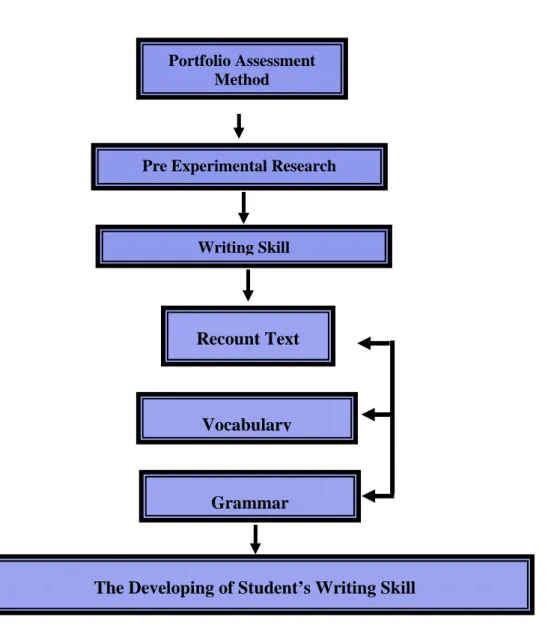
The conceptual framework underlying this research is given in the following diagram:
Figure 2.1 : Conceptual Framework
Learning process is the main activity in the school. There is interaction between teacher and students. Teaching and learning process is done and guided to reach the maximal result. To reach the maximal result, the teacher must be able to design the learning model based on the material subject and to practice the students’ thinking.
Many factors can improve the students’ ability in speaking; one of them is using Portfolio Assessment. portfolio making process some necessary steps are;
Pre Experimental Research
Writing Skill
Recount Text Portfolio Assessment
Method
The Developing of Student’s Writing Skill Vocabulary
Grammar
students’ ideas should be taken, each study should have a purpose, assessment of studies should be clearly explained, the process should cover a certain time period, portfolio should encourage students to learn. Learning and writing process through sustained portfolio assessment can improve the students’ writing skills and improve the student motivation to write.
CHAPTER III RESEARCH METHOD
A. Research Design
The research design employed pre-experimental method, with one group pretest and posttest design. In this research, t-test was used to test the significance of the instrument. Its diagram is given below:
O1 X O2
Where:
O1 : Pretest
X : Treatment by using Portfolio Assessment O2 : Posttest
(Gay, 2006 : 252) 1. Treatment.
In this activity it had scenario learning process it should based on the portfolio assessment method in writing ability conclude first meeting as like that:
a. The teacher came to the class and explained about portfolio assessment method.
b. The teacher distributed the text and Introduce it too the students.
O1 X O2
c. The teacher asked the students to read the title and asked them to to make logical predictions about what they think happened in the text.
d. Then the teacher asked the students to form and justify new predictions before they read to the next stopping point. Ask them to evaluate their predictions after each section of the text is write and refer back to the text to compare their predictions with the text.
e. The teacher checked to make sure the learners were used the process effectively and that everyone were contributed in this section.
f. The students explained about the text.
g. In the end of the treatment, the teacher gave the students evaluation.
The teacher has taught six times to students with the same steps but the material is different every meeting .
B. Research Variables and Indicators
There was two variables in this research, namely independent variable and dependent variable, they were:
1. The Independent Variable
The independent variable was the portfolio assessment method. It was applied by the researcher when teaching the material.
2. The Dependent Variable
The variables of this research were vocabulary and grammar which indicators as follow:
1) Vocabulary, consist of some indicators such us:
29
a. Form : can be define that how the word pronounced, how the word written and spelled and how the word parts are needed to express the reading.
b. Meaning : can be defined that hw the word form can be used to express the meaning or what items can the concept refer to? And what other words could understand.
c. Use : can be define that Where, when, and how often can people use this word.
2) Grammar : consist of some indicators, such us:
a. past tense : can be define that how to locate events in relation to speaker’s or writer’s time.
b. Nouns : can be define that how to identify people, animals, things involved.
c. Adverb: can be define that how to indicate place and time in the text.
C. Research Hypotheses
This research used statistic hypotheses, namely:
a. Null Hypothesis ( H0 ) : the second year students of SMPN 3 Balusu are not able to improve the students’ writing ability by use of portfolio assessment.
b. Alternative hypothesis ( H1) : the second year students of SMPN 3 Balusu are able to improve the students’ speaking ability by use of portfolio assessment.
D. Research Instrument
In this research, the researcher was used test as the instrument of collecting data, which was administered in pretest and posttest. Pretest was be intend to find out the prior level of the students’ writing skill, while the posttest would be intend to find out the improvement of the treatment.
E. Population and Sample 1. Population
The population of this research was the second year students of SMPN 3 Balusu, academic year 2015/2016 which consist of two 2 classes (VIII A and VIII B). the total number of students are 40.
2. Sample
The researcher uses random sampling technique. There are two classes and the researcher will choose one of the class as a sample.
F. Procedure of Collecting Data
The procedure of collecting data present in chronological order as follow:
2. Preparing the Material
The materials given to the experimental group were about recount text
3. Pretest
Before gave treatment, the researcher gave pre-test for the experimental class. The researcher distributes writing material that is relevant with the based material on the curriculum of SMPN 3 Balusu.
4. Post-test.
After giving treatment the researcher gave the post-test to found out the value of treatment whether or not the result of the posttest is better than the result of the pretest.
G. Technique of Data Analysis
In this section, the researcher tried to find out the score of each student and the mean score of the students. To determine the score of each student, the researcher used the following formula:
1. Scoring the students’ correct answer of pre-test and post-test by using the formula:
= ℎ
10
2. Classifying score into seven levels
In analyzing data collect was through the pre-test and post-test. The researcher analyze by use the following procedures:
a. In giving score of this research, the researcher notice some elements in the following:
Table. Grammar No. Classification
Ability Score Criteria
1.
2.
3.
4.
Very Good
Good
Poor
Very poor
6-9
5-6
3-4
1-2
- Errors of grammar or word order fairly frequent; occasional re-reading necessary for full comprehension.
- Errors of grammar or word order frequent;
efforts of interpretation sometimes required on reader’s part.
- Errors of grammar or word order very frequent; reader often has to rely on own interpretation
- Errors of grammar or word order as severe as to make comprehension virtually impossible.
Table. Vocabulary No. Classification
Ability Score Criteria
1.
2.
3.
4.
Very Good
Good Poor
Very poor
6-9
5-6 3-4
1-2
- Uses wrong or inappropriate words fairly frequently; expression of ideas may be limited because of inadequate vocabulary.
- Limited vocabulary and frequent errors clearly hinder expression of ideas.
- Vocabulary so limited and so frequently misused that reader must often rely on own interpretation.
- Vocabulary limitations so extreme as to make comprehension virtually impossible.
b. Calculating the mean score of students’ pre-test and post-test using this formula:
X = N
xWhere:
X = Mean
∑x = The sum of all score
N = Total number of subject (Gay, 2006 : 252)
c. Finding the significant difference between the mean score of pre-test and post-test by calculating the value of t-test using the following formula.
t =
∑ (∑ )
( )
where , =∑
Where: t = Test of significance
= The mean of different score
∑D= the sum of total score of significance
∑D2 = the square of the sum for difference N = the total number of subject
(Gay, 2006 : 252)
CHAPTER IV
FINDINGS AND DISCUSSIONS
This chapter consists of two sections, the findings of the research and the discussions of the findings.
A. Findings
The findings of this research deal with the use Portfolio Assessment in developing the students’ writing skills which consists of the students’
improvement of writing vocabulary and grammar.
1. The improvement of the students’ writing in Vocabulary Achievement
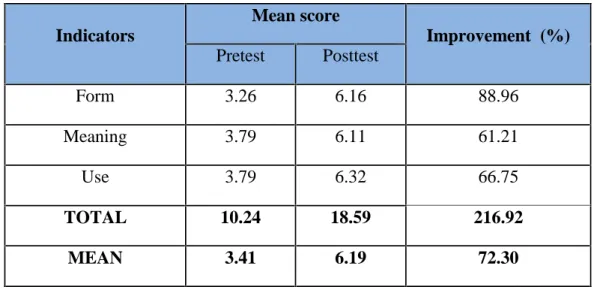
The findings of this research present the result description of the research through the distribution score of pretest and posttest on the term of vocabulary, consist of three indicator like form, meaning and use by using portfolio assessment. It also describes the students’ writing in vocabulary achievement in general through the distribution score of pretest and posttest. The result is presented in this following table:
36
Table 3: The students’ improvement inwriting vocabulary
Indicators
Mean score
Improvement (%) Pretest Posttest
Form 3.26 6.16 88.96
Meaning 3.79 6.11 61.21
Use 3.79 6.32 66.75
TOTAL 10.24 18.59 216.92
MEAN 3.41 6.19 72.30
Table 3 indicates that the students score in posttest developed after teaching writing by using Portfolio Assessment for the term of vocabulary that consist of form, meaning and use. Before giving treatment the students score’ in pretest for form was 3.26, meaning was 3.79, and use was 3.79. These results are classified as poor category. However, after giving treatment the students’ score in posttest improved to be 6.16 for form, 6.11 for meaning, and 6.32 for use. These scores are classified as fairly good category. It means that, Portfolio Assessment gives improvement tothe students’ writing skill in vocabulary achievement. It can be described in this following chart:
0,00%
20,00%
40,00%
60,00%
80,00%
100,00%
Form Meaning Use
Vocabulary Improvement (%)
Figure 1: The improvements of thestudents’ mean score in writing skill in vocabulary achievement
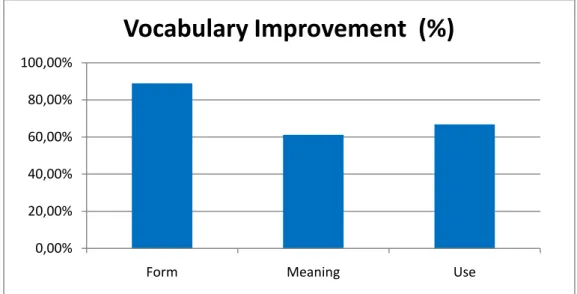
Figure 1shows the improvement of the students’ mean score of pretest and posttest in all the term of vocabulary. In another type, the following graphic is designed to show the percentage of students’ improvement in vocabulary achievement.
Figure 2: The rate percentage of the improvementof the students’writing skill in vocabulary achievement
0 1 2 3 4 5 6
Past Tense Noun Adverb
Writing Skills' Improvement
Pre-test Post-test
Figure 2 shows the percentage of the students’ writing skill in vocabularyimprovement. The students’ improvement in the term of past tense from pretest and posttest was 88.96%, in the term of meaning was 61.21 % and in the term of use was 66.75%. The form improvement is the highest of them. From the chart, it can be concluded that using Portfolio Assessment is effective to developing the students’ writing skill, especially for the indicators of vocabulary like form, meaning and use.
2. The improvement of thestudents’writing skill in grammar achievement The findings of this research present the result description of the research through the distribution score of pretest and posttest on the term of grammar, consist of three indicators like past tense, nouns and adverb by using portfolio assessment. It also describes the students’ writing in grammar achievement in general through the distribution score of pretest and posttest.
The result is presented in this following table:
Table 4: The students’ improvement inwriting skill of grammar achievement
Indicators
Mean score
Improvement (%) Pretest Posttest
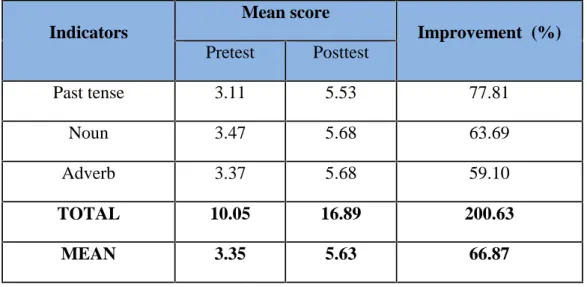
Past tense 3.11 5.53 77.81
Noun 3.47 5.68 63.69
Adverb 3.37 5.68 59.10
TOTAL 10.05 16.89 200.63
MEAN 3.35 5.63 66.87
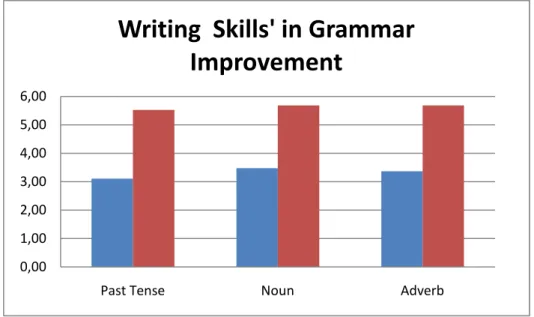
Table 4 indicates that the students score in posttest developed after teaching writing by using Portfolio Assessment for the term of grammar that consist of past tense, nouns and adverb. Before giving treatment the students score’ in pretest for past tense was 3.11, nouns was 3.47, and adverb was3.37.
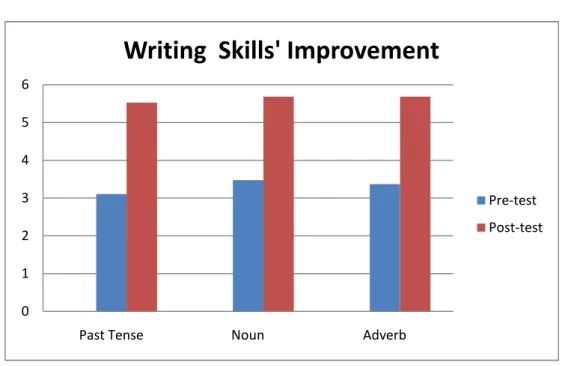
These results are classified as poor category. However, after giving treatment the students’ score in posttest improved to be 5.53 past tense, 5.68 for nouns, and 5.68 for adverb. These scores are classified as fairly good category. It means that, Portfolio Assessment gives improvement to the students’ writing skill in grammar achievement. It is described in this following chart:
Figure 3:Theimprovement of the students’ mean score inwriting skill of grammar achievement
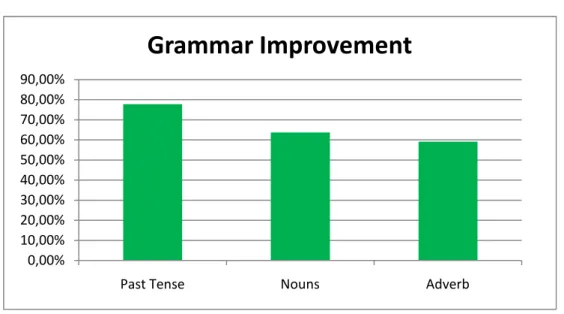
Figure 3shows the improvement of the students’ mean score of pretest and posttest in all the term of grammar. In another type, the following graphic is designed to show the percentage of students’ improvement in grammar achievement.
0,00 1,00 2,00 3,00 4,00 5,00 6,00
Past Tense Noun Adverb
Writing Skills' in Grammar
Improvement
Figure 4:The rate percentage of the improvement of the students’Grammar Achievement
Figure 4 shows the percentage of the students’ writing skill in grammar improvement. The students’ improvement in the term of form from pretest and posttest was 77.81%, in the term of nouns was 63.69 % and in the term of adverb was 59.10%. The past tense improvement is the highest of them. From the chart, it can be concluded that using Portfolio Assessment is effective to developing the students’ writing skill, especially for the indicators of grammar (past tense, nouns and verb).
3. The final score improvement of students’ writingskills
After conducting the pretest and posttest, the students’ improvement in all the terms of writing skills includes such as form, meaning and use which belong to vocabulary achievement and past tense, nouns and adverb which belong to grammar achievement. The result can be described in the following table.
0,00%
10,00%
20,00%
30,00%
40,00%
50,00%
60,00%
70,00%
80,00%
90,00%
Past Tense Nouns Adverb
Grammar Improvement
Table 5: The students’ improvement in writingskills
Variables
Mean score Improvement (%) Pretest Posttest
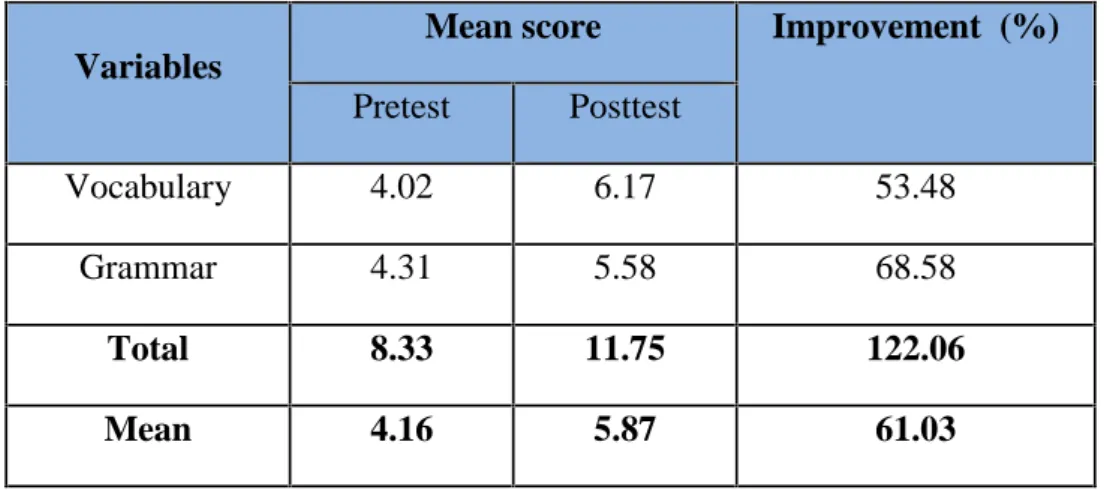
Vocabulary 4.02 6.17 53.48
Grammar 4.31 5.58 68.58
Total 8.33 11.75 122.06
Mean 4.16 5.87 61.03
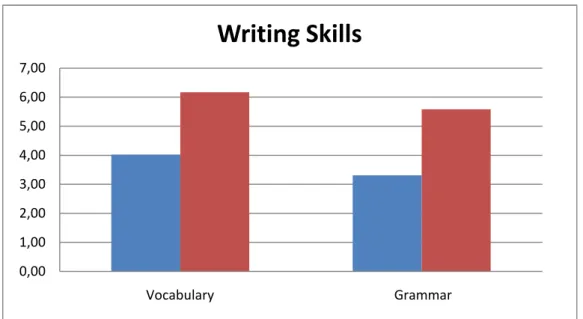
Table 5 indicates that the students score in posttest improved after teaching writing by using Portfolio Assessment for vocabulary achievement and grammar achievement. Before giving treatment the students score’ in pretest for vocabulary was 4.02 and grammar was 4.31. These results are classified into poor and very poor. However, after giving treatment the students’ score in posttest improves to be 6.17 for vocabulary and 5.58 for grammar. These scores are classified as a fairly good category. It means that, the using Portfolio Assessment gives improvement to the students’ writing skills. For more detail can be described in this following chart:
Figure 5: The improvement of thestudents’ mean score in writingskills Figure 5 shows that all the terms of the students’ vocabulary include of form, meaning and use developed. It is proved by the students’ final mean score of the students pretest in the final score was 4.02, and improved in the posttest where the posttest was 6.17. The students’ writing skill improvement could be seen clearly in this following chart:
0,00 1,00 2,00 3,00 4,00 5,00 6,00 7,00
Vocabulary Grammar
Writing Skills
0,00 10,00 20,00 30,00 40,00 50,00 60,00 70,00 80,00
Vocabulary Grammar
writing Skills (%)
Grammar
Figure 6:The rate percentage of the improvement of the students’writing skills Figure 6 shows the students’ improvement before and after applying the treatment. There speaking skills which are researched; vocabulary and grammar. The students’ improvement invocabulary was 53.48% and grammar was 68.58%. The grammar in the term of past tense was the highest improvement from them. Using Portfolio Assessment was effective to developing the students’ writing skill, especially for vocabulary that includes of form, meaning and use and for grammar that includes of past tense, nouns and adverb.
4. Test of Significance (t-test)
The researcher used t-test (test of significance) for independent sample test, that is, a test to know the significant difference between the result of students’ mean scores in pretest and posttest. Assuming that the level of significance (α) = 0.05, the only thing which is needed; the degree of freedom (df) = 19, where n-1 = 18; then the result of t-test is presented in the following table:
Table 6: T-test of the students’ speaking skills
Variable t-test t-table Remark
Vocabulary 11.298 1.734 Significantly different
Grammar 11.695 1.734 Significantly different
Final score 15.682 1.734 Significantly different The table 4.4 above shows that t-test for vocabulary is greater than t- table (11.298 > 1.734) and t-test for grammar was 11.695>1.734. The final
result shows that t-test for the final score of students’ writing skill was 15.682 was greater than t-table 1.734 (15.682>1.734)
Based on the final result of two variables of speaking skills shows that Ho is rejected and H1is accepted. It means that there is a significant difference between pre-test and post-test. In other words, it can be concluded that the use ofportfolio assessment can develop the students’ writingskills.
B. Discussion
Relating to the data collected through the pre-test and post-test show that the writing skill of the eighth year students of SMPN 3 Balusu academic year 2015 / 2016 is good. It is supported by the rate percentage of the result of the students’ pre-test and post-test. Students’ score after being taught by using Portfolio Assessment in writing is better than before the treatment given to the students.
In the pre-test, the students’ writing skillwhich marked according to:
1. Vocabulary ; that there are 2 (10.52%) out of students classified into very poor score, 14 (73.68%) out of them classified into poor score, 2 (10.52%) out of them classified into good score, none of them classified into very good score.
2. Grammar that there are 2 (10.52%) out of students classified into very poor score, 17 (89.47%) out of them classified into poor score.
From the data collected in pre-test, the researcher can conclude that the difficulty in writing skill was mostly caused by two factors.