EFFICACY OF TEACHERS TRAINING PARAPROFESSIONALS TO IMPLEMENT PEER SUPPORT ARRANGEMENTS
By
Matthew E. Brock
Dissertation
Submitted to the faculty of the Graduate School of Vanderbilt University
in partial fulfillment of the requirements for the degree of
DOCTOR OF PHILOSOPHY in
Special Education May, 2014 Nashville, Tennessee
Approved:
Erik W. Carter, Ph.D.
Joseph H. Wehby, Ph.D.
Robert M. Hodapp, Ph.D.
ACKNOWLEDGEMENTS
I would like to thank the following faculty members who have served on my doctoral committee and offered invaluable feedback and guidance throughout this and other research projects: Dr. Erik Carter, Dr. Joseph Wehby, Dr. Mary Louise Hemmeter, Dr. Robert Hodapp, and Dr. Samual Odom. I also thank Gillian Cattey, Kevin Raley, Rebecca Feldman, and Mary Beth Carlton for their assistance with data collection. In addition, I am also very grateful for the teachers, paraprofessionals, and students who participated in this study. Finally, this work would not have been possible without financial support from a Peabody Dean’s Fellowship and
departmental funds from the SEE endowment.
TABLE OF CONTENTS
Page
ACKNOWLEDGEMENTS ... ii
LIST OF TABLES ...v
LIST OF FIGURES ... vi
Chapter I. INTRODUCTION ...1
Direct Support from Paraprofessionals ...2
Peer Support Arrangements as an Alternative to Direct Paraprofessional Support ...4
Preparing Paraprofessionals to Facilitate Peer Support Arrangements ...7
Research Questions ...10
II. METHOD ...12
Students with Disabilities, Paraprofessionals, and Special Education Teachers ...12
Destiny and Darrell ...12
Thomas and Renee ...13
Steven and Susan ...14
Olivia and Erin ...15
Peers without Disabilities ...16
School and Classroom Settings ...17
Destiny’s Class ...17
Thomas’s Class ...18
Steven’s Class ...19
Olivia’s Class...19
Experimental Design and Procedures ...20
Baseline Procedures ...22
Pre-Intervention Procedures ...20
Intervention ...22
Teacher Procedural Fidelity ...27
Dependent Measures and Recording ...27
Orientation with Peers ...27
Classroom Observations ...28
Observer Training and Interobserver Agreement ...30
Observer Training ...30
Reliability ...30
Social Validity ...31
II. RESULTS...33
Paraprofessional Implementation of Initial Meeting with Peers ...33
Paraprofessional Facilitation of Peer Support Arrangements ...33
Student Outcomes ...37
Peer Interactions ...37
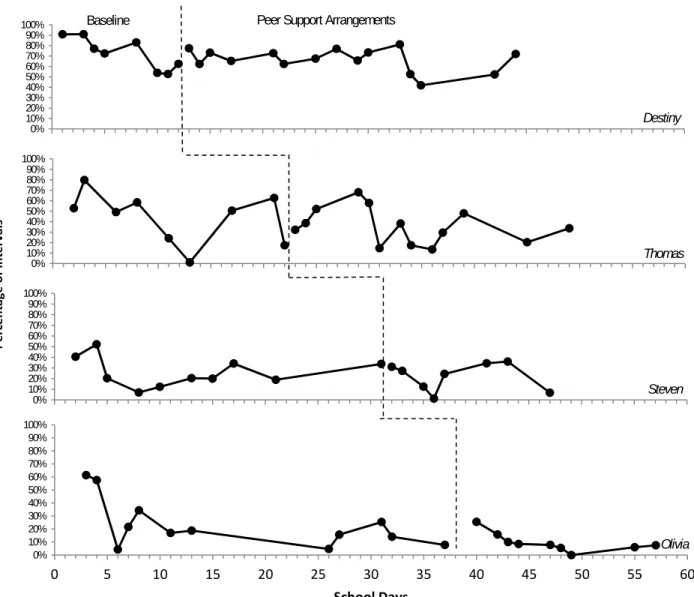
Consistent Academic Engagement ...38
Social Validity ...40
Professional Development Package ...40
Peer Support Arrangements ...41
IV. DISCUSSION ...43
Implications for Practice ...49
Limitations and Directions for Future Research ...50
Conclusion ...51
Appendix A. Example of Peer Support Plan ...52
B. Initial Meeting Checklist ...54
C. Paraprofessional Facilitation Strategies ...55
D. Data Collection Form ...56
E. Behavior Coding Manual ...57
F. Professional Development Checklist ...63
G. Social Validity Measures ...66
REFERENCES ...70
LIST OF TABLES
Table Page
1. Paraprofessional Behaviors, definitions, and Examples ...25
2. Student Behaviors, Definitions, and Examples...29
3. Interobserver Agreement of All Dependent Variables ...30
4. Interactions, Academic Engagement, Proximity to Peers, and Facilitation ...35
LIST OF FIGURES
Figure Page
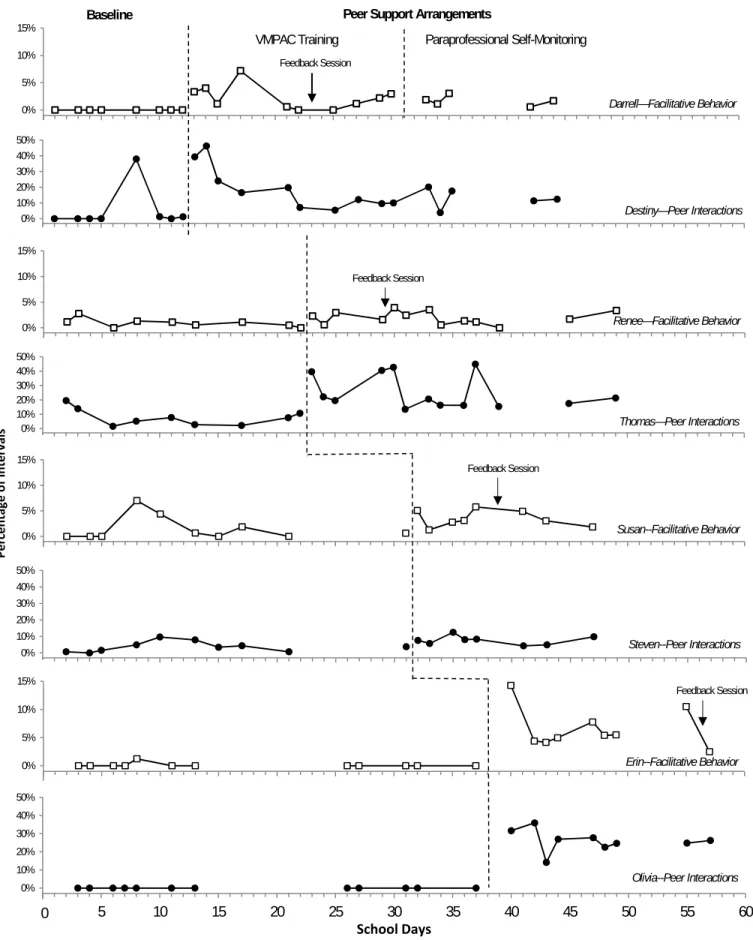
1. Paraprofessional Behaviors and Student Interactions ...34 2. Academic Engagement of Student with Disabilities ...39
CHAPTER I
INTRODUCTION
Legislative mandates, current best practice, and advocacy efforts assert that students with severe disabilities (i.e., students with intellectual disability and/or autism who are eligible for alternate assessment) should be included in general education classrooms with same-aged peers without disabilities. The Individuals with Disabilities Education Improvement Act (2004) and the No Child Left Behind Act (2001) require all students—including students with severe
disabilities—to access the general education curriculum. Many researchers argue students with severe disabilities cannot access important parts of the general education curriculum without learning alongside peers without disabilities in the same classrooms (Halle & Dymond, 2008/2009; Jackson, Ryndak, & Wehmeyer, 2008/2009). Indeed, research shows inclusive education can enable students with severe disabilities to learn academic content (e.g., Coyne, Pisha, Dalton, Zeph, & Smith, 2012), build social competence and develop friendships with peers (e.g., Carter, Moss, Hoffman, Chung, & Sisco, 2011; Fisher & Meyer, 2002), and improve adaptive behavior and functional skills (e.g., McDonnell et al., 2003). Advocacy groups have long argued inclusive education is an issue of equality and justice, and students with severe disabilities deserve to learn alongside peers without disabilities in general education classrooms (TASH, 2009).
Inclusion may be especially critical for middle and high school students with severe disabilities. For students preparing to transition to adulthood and begin careers, building strong interpersonal skills and social competence is critical (Carter, Trainor, Ditchman, Swedeen, &
Owens, 2011), and these skills may best be learned by interacting with peers without disabilities in general education settings (Logan & Malone, 1998). In addition, social relationships take on increased importance and prominence in adolescence (Wentzel, Barry, & Caldwell, 2004). All adolescents, including those with disabilities, desire interactions and acceptance from peer groups. Developing these peer relationships is associated with improved global outcomes, including overall quality of life (Rubin, Bukowski, & Laursen, 2009). Without participation in general education classrooms, middle and high school students with severe disabilities have few opportunities to interact with their peers without disabilities.
Direct Support from Paraprofessionals
In recent years, schools have increasingly turned to paraprofessionals to support students with disabilities in inclusive settings. The number of special education paraprofessionals has nearly tripled in the past 25 years (Pickett, 1986; U.S. Department of Education, 2012). Since 2010, special education paraprofessionals have outnumbered special education teachers in the United States (401,285 paraprofessionals employed FTE to 370,456 teachers employed FTE;
U.S. Department of Education, 2012). In a statewide survey, more than 80% of paraprofessionals reported spending some or most of their time supporting students with disabilities in inclusive environments (Carter, O’Rourke, Sisco, & Pelsue, 2009).
A substantial proportion of paraprofessionals is assigned to provide direct support to individual students with severe disabilities in general education classrooms (Giangreco & Broer, 2007; Suter & Giangreco, 2009). In a direct support model, paraprofessionals assume almost exclusive responsibility for meeting the needs of one or more students with a disability in a particular classroom. These paraprofessionals spend much of their time delivering instruction, providing behavioral support, and supervising the students to whom they are assigned
(Giangreco & Broer, 2005). Although these roles actually extend far beyond recommended responsibilities for paraprofessionals, in this support model students functionally receive the majority of their instruction from paraprofessionals (Giangreco, Edelman, Broer, & Doyle, 2001).
Paraprofessionals typically do not receive adequate training to be the primary instructional agent for students with severe disabilities. In fact, most paraprofessionals have received very little or no formal training related to educating students with extensive support needs (Carter et al., 2009; Riggs & Mueller, 2001). Many paraprofessionals have no education past high school (Fisher & Pleasants, 2012) and most have never received in-service training on basic instructional strategies (Carter et al.). Moreover, paraprofessionals indicate they need further training in strategies to support students with disabilities in general education settings (Riggs & Mueller) and that their current level of training is inadequate (Breton, 2010).
Due to this lack of training, direct paraprofessional support can have unintended negative consequences. First, direct paraprofessional support may foster unnecessary dependence on adults. Because their sole responsibility is to provide support to individual students,
paraprofessionals sometimes provide more guidance and direction then students actually require, fostering dependence and learned helplessness (Giangreco, 2010). For example, parents have raised concerns that direct paraprofessional support decreases their children’s opportunities to make their own choices and exercise independence (Giangreco, Yuan, McKenzie, Cameron, &
Fialka, 2005). Similarly, some paraprofessionals have noted the students with disabilities whom they support are overly dependent on them (Giangreco & Broer, 2005). Despite these concerns, plans to fade direct paraprofessional support over time rarely exist (Giangreco, 2010).
Second, direct paraprofessional support can hinder social outcomes. For example,
paraprofessionals providing direct support sometimes sit with students in the back of the classroom away from peers without disabilities, decreasing opportunities for interaction
(Giangreco & Broer, 2005). In addition, paraprofessionals providing direct support often remain in close physical proximity to students with severe disabilities, and this close proximity is associated with decreased interactions between adolescents with disabilities and their peers. In a descriptive study involving middle and high school students with developmental disabilities, students had the fewest interactions with peers when in close proximity to a paraprofessional providing direct support (Carter Sisco, Brown, Brickham, & Al-Khabbaz, 2008). The presence of an adult disrupted natural interactions between students with and without disabilities. In another study, Giangreco, Broer, and Edelman (2001) found direct paraprofessional support promoted insular relationships between paraprofessionals and elementary, middle, and high school students with developmental disabilities. Students interacted almost exclusively with a paraprofessional, and were socially isolated and stigmatized. Giangreco and Broer found many paraprofessionals reported that students with severe disabilities thought of them or other paraprofessionals as their primary “friends” at school. Indeed, without adequate training, direct paraprofessional support can decrease opportunities for students with severe disabilities to build independence and social competence—two of the primary aims of inclusion for this population (Cushing, Carter, Clark, Wallis, & Kennedy, 2009).
Peer Support Arrangements as an Alternative to Direct Paraprofessional Support
Emerging research shows when given adequate training and support, paraprofessionals can facilitate peer support arrangements that promote opportunities for interaction with peers and independence from adults (Carter et al., 2011; Carter, Sisco, Chung, & Stanton-Chapman, 2010).
Peer support arrangements involve one or more peers without disabilities providing ongoing
social and academic support to classmates with disabilities in a general education classroom.
First, an adult facilitator (i.e., a paraprofessional) invites one or more peers to provide support to a student with a severe disability. The facilitator meets with peers to orient them to their new roles and identify specific ways they might support the student with a disability. Peers might provide support in a variety of ways, depending on the characteristic of the student with a disability. Roles may include, but are not limited to, helping the student prepare for class activities, providing frequent feedback and encouragement, modeling appropriate
communication and social skills, promoting interaction with other classmates, identifying a role in a small-group activity that matches the student’s strengths, or supporting behavior intervention plans as appropriate. Instead of providing only direct support to students with disabilities,
paraprofessionals shift to a facilitative role by coaching, supervising, and providing feedback to peers who provide support. As peers take on support roles, adult proximity and support are faded, enabling students with severe disabilities to benefit from natural supports from peers and avoid overreliance on adult support (Carter et al.).
Four single-case design studies show paraprofessionals can assist in implementing peer support arrangements in ways that improve outcomes for middle and high school students with disabilities, including increased interaction with peers and consistent or increased levels of engagement. In two studies using a reversal design, Shukla, Kennedy, and Cushing (1998, 1999) investigated the effects of peer support arrangements for a total of five middle school students with moderate or severe intellectual disability. Compared to paraprofessional direct support, both studies showed peer support arrangements resulted in more frequent and longer interactions with peers, and similar or modestly higher levels of engagement in class activities. In two studies using a multiple-baseline-across-participants design, Carter and colleagues (Carter et al., 2011;
Carter, Sisco, Melekoglu, & Kurkowski, 2007) studied the effects of peer support arrangements for a total of seven high school students with moderate or severe intellectual disability. In both studies, peer support resulted in more frequent social interactions with peers compared to adult direct support. There were no clear differences in academic engagement between conditions.
Furthermore, peer support arrangements may also benefit the peers who provide support.
In two studies, researchers intentionally selected peers with a history of low academic
engagement (Cushing & Kennedy, 1997) or low academic performance (Shukla et al., 1998). In both cases, peers participated more in class (i.e., engaged in class activities longer) when
providing support to their classmates with severe disabilities. Cushing and Kennedy also found that peers demonstrated improved academic performance when providing peer support. In addition to potential academic benefits, providing support gives peers the opportunity to develop a relationship with a student with a severe disability they might not otherwise have had. In the only study to interview peers providing support, peers described several potential benefits of providing peer support, including a better understanding of students with disabilities and developing new friendships (Carter et al., 2011).
Although peer support arrangements are associated with improved outcomes for both the students who receive and provide support, it is not clear from these studies if paraprofessionals can facilitate these arrangements in everyday settings without ongoing support from a member of a research team. In two of the aforementioned studies (Carter et al., 2007; Carter et al., 2011), a member of the research team provided ongoing support and implemented key parts of the intervention, including identifying ways peers might provide support and orienting peers to their new roles. In the other two studies (Shukla et al., 1998, 1999), paraprofessionals were primarily responsible for training and supervising peers with ongoing support by a member of the research
team. Given the heavy researcher involvement in these studies, it is unclear if peer support arrangements would produce similar results under more typical circumstances without outside involvement.
Preparing Paraprofessionals to Facilitate Peer Support Arrangements
At present, it is unclear how paraprofessionals should be trained to facilitate peer support arrangements, or who should provide this training. Models for how to train paraprofessionals to facilitate peer support arrangements have not been described in the research literature. In fact, there are very few studies about preparing paraprofessionals to implement any intervention for students with severe disabilities. In a recent systematic review, Brock and Carter (in press) found only 13 experimental studies that involved training paraprofessionals to implement any type of intervention for students with intellectual or developmental disabilities. Nearly all studies in this review involved one-to-one coaching or mentoring where a professional development coach delivered individualized follow-up training to the paraprofessional. Within this context of one-to- one coaching, three components were included in intervention packages associated with
paraprofessional acquisition of correct implementation behaviors: modeling, performance feedback, and accountability. Modeling involved live (e.g., Gilligan, Luiselli, & Pace, 2007) or video modeling (e.g., Robinson, 2011) of the targeted intervention as the coach highlighted key steps of the intervention. Performance feedback involved a coach observing the paraprofessional implementing the intervention and providing constructive verbal, visual, or video feedback on his or her performance (e.g., Bingham, Spooner, & Browder, 2007; Hall, Grundon, Pope, &
Romero, 2010; McDonnell, Johnson, Polychronis, & Riesen, 2002). Both modeling and performance feedback are associated with improved implementation in the broader coaching literature, including studies involving follow-up training for special educators (Kretlow &
Bartholomew, 2010) and early childhood practitioners (Snyder et al., 2012). In addition to modeling and performance feedback, these studies all incorporated some degree of
accountability. For example, researchers explicitly instructed paraprofessionals to implement the targeted interventions in daily practice and followed up to ensure implementation actually occurred.
Together, these components represent three critical training features. Trainers should clearly communicate how to implement an intervention (modeling), ensure participants attempt to implement the intervention in everyday practice (accountability), and then follow up with participants to reinforce what they are doing well and to help them correct their mistakes
(performance feedback). In a recent pilot study (Brock & Carter, 2013), we combined modeling, performance feedback, and accountability into a flexible and replicable training package called Video Modeling Plus Abbreviated Coaching (VMPAC). This training package involves an initial training workshop followed by video modeling and brief on-site performance feedback. The initial training workshop includes a description and demonstration of the instructional practice, as well as opportunities for practitioners to simulate the instructional practice through role play.
Video modeling involves having practitioners compare their own performance to video exemplars reflecting a range of students. While watching a video exemplar of an instructional practice, practitioners review the steps associated with the practice and plan how they might implement it with a student in their classroom. The performance feedback session involves a single 1-hr meeting in which a coach—someone with expertise in the targeted strategy—
observes the practitioner implementing the instructional strategy in the natural school setting, provides targeted instructive feedback, models the correct implementation steps, and gives the practitioner additional opportunities for guided practice. During the performance feedback
session, the coach holds the paraprofessional accountable for planning and attempting to implement the instructional strategy ensuring paraprofessionals have completed written plans.
The VMPAC training package is designed to capitalize on effective components of training while considering the logistical and resource constraints of public school districts providing professional development. Most individualized coaching models require extensive one-to-one consultation over the course of weeks or months (e.g., Fixsen, Naoom, Blase,
Friedman, & Wallace 2005; Kretlow & Bartholmew, 2010). School systems looking for efficient ways to train large numbers of paraprofessionals are unlikely to invest in approaches that require considerable time and resources while only impacting a single practitioner at a time (Russo, 2004). In contrast, VMPAC only requires one hour of one-to-one consultation and utilizes technology to provide low-cost supplemental training through video modeling.
Results from a pilot study of the training package were promising. In a small
randomized-controlled trial, Brock and Carter (2013) taught 25 paraprofessionals to implement constant time delay, a simple behavioral intervention for systematically fading prompts.
Paraprofessionals who received the VMPAC training package were able to accurately implement constant time delay to teach a variety of new skills to students with disabilities at their schools.
Compared to paraprofessionals receiving only a standalone training workshop, paraprofessionals receiving VMPAC implemented constant time delay with far superior fidelity (d = 2.67).
One limitation of this pilot study was that the training was provided by members of a research team, rather than school-based staff. In typical schools, the individuals best positioned to provide widespread sustainable training to paraprofessionals might be the special education teachers who supervise them. Special education teachers are already charged with directing how paraprofessionals provide support and instruction to students with disabilities (IDEA, 2004).
Certified special education teachers should have the expertise in instructional and support strategies for students with disabilities required to provide training to paraprofessionals. In addition, these teachers already have established working relationships with the
paraprofessionals they supervise. Although special education teachers are prime candidates for providing training to paraprofessionals, it is unclear from existing research if special educators are able to train paraprofessionals to accurately implement interventions with students with severe disabilities (Brock & Carter, in press).
Research Questions
If special education teachers could use VMPAC to teach paraprofessionals to accurately implement promising education practices like peer support arrangements, this could provide a vehicle to improve the quality of instruction and support provided to students with severe disabilities. At present, it is unclear (a) if teachers can deliver training to paraprofessionals that enables them to accurately implement recommended educational practices for students with severe disabilities, (b) how teachers should train paraprofessionals to facilitate peer support arrangements with fidelity, and (c) if peer support arrangements implemented by
paraprofessionals (without substantial involvement from a research team) result in improved outcomes for students with severe disabilities. The present study addresses the following research questions:
1. Does a teacher-delivered professional development package consisting of an initial training session, video modeling, and a performance feedback session, improve paraprofessional implementation fidelity of peer support arrangements?
2. Do peer support arrangements facilitated by paraprofessionals result in improved social and academic outcomes for students with severe disabilities?
3. How do the special education teachers and paraprofessionals perceive the feasibility and acceptability of the professional development package?
CHAPTER II
METHOD
Students with Disabilities, Paraprofessionals, and Special Education Teachers
Four triads of students with severe disabilities, paraprofessionals who provided one-to- one support, and supervising special education teachers participated in this study. To be included in this study, students had to (a) be enrolled in middle school, (b) be receiving special education services under the category of intellectual disability or autism, (c) be eligible for alternate
assessment, (d) be enrolled in at least one general education class, (e) provide assent and parental consent, (f) receive ongoing support from a paraprofessional who consented to participate in the study and (g) be on the caseload of a special education teacher who consented to participate in the study. After reviewing the study overview with the researcher, special education teachers selected students whom they believed might benefit from a peer support arrangement and met inclusion criteria.
Destiny and Darrell. Destiny was a 12-year-old European American female with intellectual disability and attention deficit disorder in the sixth grade. She used verbal speech to communicate. Destiny’s teacher indicated Destiny enjoyed interacting with her peers but had few opportunities to do so. Destiny was enrolled in four general education classes, including related arts (e.g., art, physical education, music), study hall, science, and social studies. She also received speech services. Her Individual Education Program (IEP) reported the following assessment scores: Wechsler Intelligence Scale for Children, Fourth Edition (Wechsler, 2003;
standard score of 54, percentile of .1); and Adaptive Behavior Assessment System, Second
Edition (Harrison & Oakland, 2003; standard score of 65, percentile of .1). Destiny’s IEP included goals targeting improved use of language and communication, working independently on class activities, basic math skills (e.g., counting money, solving simple word problems), and reading comprehension.
Darrell, a special education paraprofessional, supported Destiny in science class. Darrell was an African American male with 14 years of experience in special education, including 7 years of experience in his current role. At the time of the study, Darrell had not yet earned a college degree but was pursuing teacher certification in special education. Darrell also supported other students with mild, moderate, or severe disabilities in general education classrooms. In addition, Darrell supervised several students with disabilities—including Destiny—as they worked on vocational skills in the school office, school store, or cafeteria. Darrell was supervised by a European American female special education teacher who had a master’s degree, 29 years of experience in special education, and 13 years of experience in her current role.
Thomas and Renee. Thomas was a 14-year-old European American male with
intellectual disability, speech impairment, and hearing impairment in the eighth grade. He used verbal speech to communicate. Based on notes from baseline observations, Thomas enjoyed interacting with peers, but his conversations with peers were often repetitive and centered on his restricted interests. Thomas was enrolled in three general education classes including science, social studies, and related arts (e.g., art, physical education, music). Thomas received
occupational therapy and hearing/audiology services. His IEP reported the following assessment scores: Stanford–Binet Intelligence Scales, Fifth Edition (Roid, 2004; standard score of 40, percentile of .1); and the Adaptive Behavior Assessment System, Second Edition (Harrison &
Oakland, 2003; standard score of 54, percentile of .1). His IEP included goals targeting oral
language and listening, functional math (e.g., counting money, telling time), fine motor skills, and pre-vocational skills (e.g., personal safety, following multiple-step directions).
Renee, a special education paraprofessional, supported Thomas in science class. Renee was a European American female with 2 years of experience in special education, both in her current role. Renee had earned a bachelor’s degree in an unrelated field. Renee also supported other students with mild, moderate, and severe disabilities in general education and self- contained settings. Renee was supervised by a European American female special education teacher who had a master’s degree, 12 years of experience in special education, including 8 years of experience in her current role.
Steven and Susan. Steven was a 12-year-old European American male with intellectual disability in the sixth grade. He used a combination of verbal speech, gestures, and a speech- generating device to communicate. During the research study, Steven’s speech-generating device was not available because it was broken and sent to the manufacturer for repair. According to notes from baseline observations, Steven’s verbal speech was difficult for some of his peers to understand, and he typically only spoke in 2-3 word utterances. He received both speech and occupational therapy services. Steven was enrolled in four general education classes, including reading, social studies, study hall, and related arts classes (e.g., art, physical education, music).
Steven’s IEP included goals targeting improved communication and speech, basic literacy, functional math (e.g., telling time, counting money) and increased independence with daily living skills. His IEP reported the following assessment scores: Differential Ability Scales, Second Edition (Elliot, 2007; standard score of 37, percentile of <.1); and the Adaptive Behavior Assessment System, Second Edition (Harrison & Oakland, 2003; standard score of 43, percentile of .1).
Susan, a special education paraprofessional, supported Steven in science class. Susan was a European American female with 8 years of experience in special education, all in her current role. Susan’s highest level of education was a high school diploma. Susan also supported a number of other students with mild or moderate disabilities in general education classrooms.
Renee was supervised by a European American female special education teacher who had a master’s degree and 3 total years of experience in special education, all in her current role.
Olivia and Erin. Olivia was a 10-year-old African American female with autism in the fifth grade. She used a combination of vocalizations, gestures, and a speech-generating device to communicate. According to notes from baseline observations, her speech-generating device was present during observations but was almost always turned off and inaccessible to Olivia. Olivia’s special education teacher reported that peers were sometimes apprehensive around Olivia
because she was bigger than most of her classmates and sometimes engaged in vocal outbursts and stereotypic behavior (e.g., body rocking, hand washing movements, repetitive touching of face). Olivia was enrolled in four general education classes including math, science, reading, and physical education. Olivia’s IEP included goals targeting communication with her peers,
improved communication of her needs and wants, functional literacy skills (e.g., recognizing signs), functional math skills (e.g., recognizing coins) and fine motor skills. Her IEP reported the following assessment scores: Differential Ability Scales, Second Edition (Elliot, 2007; standard score of 40; percentile of 0.1); Vineland Adaptive Behavior Scales, Second Edition (Sparrow, Cicchetti, & Balla, 2005; standard score of 55, percentile of 0.1).
Erin, a special education paraprofessional, supported Olivia throughout the school day.
Erin was a European American female with 14 years of experience in special education,
including 2 years of experience in her current role. Erin’s highest level of education was a high
school diploma. Erin’s primary responsibility was to support Olivia’s needs throughout the school day in a combination of inclusive and self-contained settings, although she did also
support one other student with a severe disability during one class period. Erin was supervised by a European American female special education teacher who had a master’s degree, 25 total years of experience in special education, including 7 years of experience in her current role.
Peers without Disabilities
Special education teachers, general education teachers, and paraprofessionals worked together to select peers whom they believed would be good candidates to provide support to students with disabilities, and might themselves benefit from providing support. I instructed teachers to select peers who (a) were already enrolled in the same class as the focal student, (b) did not have a severe disability, (c) had a good record of attendance, (d) worked well with adults, and (e) had a history of positive interactions with the student with a disability. Although they consulted the paraprofessionals and general education teachers, special education teachers were ultimately responsible for selecting and inviting peers.
Across participants, teachers invited 12 peers to provide support to students with
disabilities. Eleven students agreed to participate and returned assent and parental consent forms;
the remaining peer indicated he was interested but forgot to give the consent form to his parent.
Two sixth-grade peers supported Destiny, including one European American female and one European American male. Both peers were reported to have learning disabilities. The female peer sometimes worked with Destiny during small-group activities during baseline observation.
Three eighth-grade peers supported Thomas, including two European American males and one European American female. One of the male peers occasionally interacted with Thomas and helped him participate in small-group activities during baseline observation. Three sixth-grade
peers supported Steven, including two European American females and one European American male. One of the female peers had a younger sibling with autism. The other female peer had approached the paraprofessional about helping Thomas with his academic work during baseline observation. Three fifth-grade peers supported Olivia, including two African American females (twins), and an Asian-American female. Erin reported that all three peers had shown an interest in interacting with Olivia and sat with her most days during lunch.
School and Classroom Settings
I recruited participants from two local school districts. I approached prospective schools through special education administrators and school principals. When special education teachers contacted me, I met with them individually to share an overview of the study and confirm they worked with students who met inclusion criteria. The first three participants (Destiny, Thomas, and Steven) attended two different middle schools in a school district serving rural and suburban communities. One school served more than 800 students, approximately 90% of whom were European American and about one sixth receiving free or reduced-price lunch. The second school served more than 500 students, approximately 90% of whom were European American and less than ten percent receiving free or reduced-price lunch. The fourth participant (Olivia) attended a middle school that served more than 700 students in a large urban school district.
Approximately half of the student body at this school was European American and just over half received free or reduced-price lunch. All schools were located in the southeastern United States.
Across participants, the classrooms in which peer support arrangements were implemented included 22-35 students.
Destiny’s Class. Destiny attended a 50-min sixth grade science class each morning.
Based on baseline observations, 70.2% of class consisted of large-group instruction, 9.4%
entailed small-group instruction, and 43.8% entailed independent seatwork. (Percentages do not add to 100% because instructional formats were recorded every 10 min, and some 10-min intervals included more than one instructional format.) Small-group instruction most often involved laboratory activities. Students usually sat at clusters of 4-5 desks, although the seating arrangement occasionally varied based on the nature of some assignments (e.g., the desks would occasionally be rearranged so students could work at laptop computers and cords would reach power outlets). Destiny sat in a cluster of desks with peers without disabilities before and after the peer support arrangement began, although sometimes she would leave class to complete independent work with Darrell in a resource room. Prior to intervention, Destiny was in close proximity to peers without severe disabilities for an average of 88.5% of the class period (range
= 52.7-100%). Darrell (paraprofessional) either sat in a rolling chair or stood within a few feet of Destiny. In addition to Darrell and the general education teacher, there typically was one other special education paraprofessional in the classroom who was responsible for supporting students with mild disabilities. Destiny was the only student with a severe disability enrolled in the class.
Thomas’s Class. Thomas attended a 50-min eighth-grade science class each afternoon.
Students sat at nine different rectangular tables, with 3-4 students at each table. Approximately 75.0% of class consisted of large-group instruction, 4.7% entailed small-group instruction, 4.8%
entailed students working with partners, and 32.5% entailed independent seatwork. Prior to intervention, Thomas was in close proximity to peers without severe disabilities an average of 98.6% of the class period (range = 95.1-100%). Renee typically sat at the same table beside Thomas. In addition to Renee and the general educator, there typically was also a special education teacher in the classroom who was responsible for supporting students with mild
disabilities. One other student with a severe disability was enrolled in the class and sat at a different table from Thomas.
Steven’s Class. Steven attended a 50-min sixth grade science class each morning.
Students almost always sat at clusters of 4-5 desks, although they occasionally visited the library where 4 students sat at each table. Steven sat in a cluster of desks with peers without disabilities before and after the peer support arrangement began. Approximately 83.7% of class consisted of large-group instruction, 17.3% entailed small-group instruction, 1.7% entailed students working in partners, and 44.3% entailed independent seatwork. Prior to intervention, Steven was in close proximity to peers without severe disabilities for an average of 93.5% of the class period (range
= 71.1-100%). Susan (the paraprofessional) sat at one of the desks in the same cluster as Steven.
Aside from Susan and the general education teacher, there were typically no other adults in the classroom. Steven was the only student with a severe disability enrolled in the class.
Olivia’s Class. Olivia attended a sixth-grade science and math block each afternoon.
Although the entire block lasted about 90 min, Olivia rarely attended more than the first 45 minutes. Class-wide instructional formats in this class included large-group (55.0% of 10-min intervals), small-group (16.3%), partners (4.9%) and independent seatwork (45.6%). Most students sat in rows of desks facing a blackboard and a projector screen. However, Olivia sat at a large table in the back of the room with Erin (the paraprofessional). The table was oriented so Olivia would have to turn her body to the left to see the blackboard or projector screen. Prior to intervention, Olivia was in close proximity to peers without severe disabilities for an average of 2.5% of the class period (range = 0.0-16.0%), usually during transition times when Olivia stood in line with other students or when another student would come to the back of the room. Erin delivered one-to-one instruction for the bulk of the class period, with short breaks during which
Olivia went for a walk, used the bathroom, or sat quietly by herself. Sometimes Olivia would fall asleep during class, which Erin and the special education teacher attributed to changes in her medication. In addition to the general education teacher and Erin, the special education teacher (Erin’s supervising teacher) and a student teacher were also typically in the classroom. Olivia was the only student with a severe disability enrolled in the class.
Experimental Design and Procedures
I used a multiple-probe-across-participants design, which involves repeated intermittent measurement of the dependent variable and staggered introduction of the independent variable across participants (Gast, 2010). All participants began the study in the baseline condition. The order in which the intervention was introduced to participants was based on whether baseline data patterns were stable (i.e., flat trend of paraprofessional facilitation and student interations) and when special education teachers and paraprofessionals were available outside of school time for professional development.
Baseline procedures. The baseline condition involved direct paraprofessional support without additional training from the supervising teacher. I instructed paraprofessionals to provide support to students with severe disabilities just as they had prior to the study. I instructed
supervising teachers not to provide any training to paraprofessionals directly related to peer support arrangements. Paraprofessional behavior related to encouraging focal students and peers to interact and work together during the baseline phase is described in the results section.
Pre-intervention procedures. During the baseline condition, I met with supervising teachers about how to deliver professional development about peer support arrangements. After this session, teachers worked with general education teachers and paraprofessionals to identify 2- 3 peers to provide support to students with severe disabilities during the intervention condition.
Teacher training. Shortly before the intervention condition began, I provided a 4.5-hr, one-to-one orientation session with the teacher who would train the paraprofessional. This training focused both on peer support implementation and professional development
components. I provided an intervention manual detailing all implementation steps associated with implementation of peer support arrangements, and I described and modeled each
implementation step. Implementation steps were grouped into three sections: (a) development of a peer support plan, (b) orientation with peers, and (c) facilitation of social interactions and academic support between peers and focal student. In addition, I provided a professional development implementation checklist (see Appendix F), and I described and modeled each implementation step associated with professional development. Professional development implementation steps were grouped into three sections including initial training session, video models, and facilitation of interactions and academic support. (Specific implementation behaviors are described in detail in the subsequent Intervention section.) At the end of the training, teachers were asked to conduct a mock abbreviated training while pretending I was the paraprofessional. This mock training ensured teachers were prepared to implement all
professional development components correctly. When a teacher did not correctly follow an implementation step, I provided corrective feedback and asked the teacher to repeat the step. All four teachers successfully implemented all training steps by the end of the 4.5-hr training
session.
Peer recruitment. During the baseline condition, I directed the supervising teacher to work with the general education teacher and paraprofessionals to identify peers who would provide support in the intervention condition. The general educator sent consent forms home with the nominated peers, collected signed forms, and returned these forms to the special
education teacher.
Intervention. The intervention condition involved two levels of intervention: teacher- delivered professional development for paraprofessionals, and paraprofessional facilitation of peer strategies to benefit students with severe disabilities. Teacher-delivered paraprofessional development involved a three-part training package: (a) a 2-hr initial training session, (b) access to two online video models, and (c) one 1-hr performance feedback session. Paraprofessional facilitation of peer support arrangements involved (a) holding a 45-min orientation meeting with peers who would provide support, (b) use of facilitation strategies to promote peer support with direct training from the supervising teacher, and (c) continued use of facilitation strategies after the formal training was complete.
Initial paraprofessional training session. Once teachers were trained and peers recruited, teachers delivered an initial 2-hr training session to paraprofessionals. During this training
session, the teachers (a) explained the rationale for peer support arrangements, (b) outlined implementation steps associated with peer support arrangements, (c) explained and provided examples of specific strategies for how to facilitate peer interactions and academic support (see Appendix C), and (d) provided a preview of the other components of the training package (i.e., video models and performance feedback). The teacher conveyed the implementation steps in multiple ways, including verbal description, provision of an intervention manual, and showing video models of implementation steps (provided by the research team). In addition, the teacher guided the paraprofessional to create a peer support plan (see example in Appendix A). Peer support plans outlined potential roles for focal students, peers, and the paraprofessional during different instructional contexts or activities that typically made up the class (e.g., lecture, laboratory experiments, independent work time). When developing plans, teachers and
paraprofessionals were directed to first consider how focal students could participate independently, and then brainstorm how peers could provide support to enhance class
participation and interaction. Finally, they discussed how paraprofessionals might encourage peers and focal students to interact and work together. All components of the 2-hr initial training session are described in Appendix F.
Orientation with peers. After the initial training session, paraprofessionals held an orientation meeting with the 2-3 peers (who were identified during the baseline condition). All meetings were held in empty classrooms. Paraprofessionals coordinated the timing of orientation meetings based on if and when general education teachers were willing to excuse the peers from class. Meetings were held during the focal class, a different class, or lunch. I attended all
meetings to measure fidelity of implementation. During this orientation meeting
paraprofessionals shared (a) a rationale for peer support arrangements, (b) background about the focal student with severe disabilities, (c) general goals of peer support including promoting social interactions and academic engagement, (d) the importance of confidentiality and respectful language, (e) expectations specific to the classroom (e.g., sitting with student, checking in with the paraprofessional), (e) individualized strategies to provide support from the peer support plan, and (f) guidance on when to seek assistance from the general educator or paraprofessional (Carter, Cushing, & Kennedy, 2009). Paraprofessionals also solicited and answered questions from the peers about their new roles. In addition, paraprofessionals explained to students that the peer support arrangement would begin with the next class meeting, and that the seating
arrangement would change to allow peers to sit next to the student with a disability.
Paraprofessional facilitation of social interactions and academic support. On the first class meeting after holding the orientation session with peers, the paraprofessionals began to
facilitate peer support arrangements using the facilitative strategies introduced in the initial training. These strategies include prompting social interactions, reinforcing social interactions, providing information for social interaction, prompting academic support, reinforcing academic support, providing information for academic support, prompting proximity, and checking-in with peers (see Table 1 for operational definitions of facilitation behaviors; additional examples and non-examples can be found in Appendix E).
Video models of facilitation. Paraprofessionals viewed two (researcher-created) 10-min video models of facilitating social interactions and academic support between peers and the focal student. Video models were designed to follow-up the initial training session by reviewing and providing examples of facilitation behaviors. The first video focused on facilitating social interactions, and the second video focused on facilitating academic support between peers and the focal student. These videos featured graduate students demonstrating the behaviors with middle and high school students with and without disabilities in mock settings. Immediately after the orientation with peers, I sent the paraprofessional an email containing electronic links to access the videos from an online video-sharing website. Each video included a description of specific strategies to facilitate interactions between peers and the student with severe disabilities (see Appendix C), a video model of an adult using these strategies, and a prompt to the
paraprofessional to list ways he or she might use these strategies. The teacher asked the
paraprofessional to see completed lists from both videos, and reminded the paraprofessional to view the videos if he or she had not already done so.
Performance feedback. At least one week after the paraprofessional had begun
implementation of the peer support arrangement, teachers delivered a 1-hr performance feedback session to paraprofessionals. First, teachers either conducted a live observation in the classroom,
Table 1
Paraprofessional Behaviors, Definitions, and Examples
Behavior Definition Example
Paraprofessional support Paraprofessional does one or more of the following: prompts or reminds students to stay close together by sitting together or joining the same group; prompts, reinforces, or provides information to promote social interaction;
prompts, reinforces, or provides information to promote academic support; checks in with peers to ensure they are comfortable in role or offer help. This definition is an umbrella category for any paraprofessional facilitation behavior (below).
See examples of any specific facilitation strategy below.
Prompt social interaction Paraprofessional encourages or suggests a way for the focal student to interact with a peer, or a peer with the focal student.
Paraprofessional points to a symbol on augmentative communication device to prompt the focal student to answer a question from a peer.
Reinforce social interaction
Paraprofessional praises the focal student and/or peer for social interactions (verbally or with gestures).
The paraprofessional gives the focal student a ‘thumbs up’
when he greets a peer.
Provide information for social interaction
Paraprofessional provides information to peers that might help peers to better interact with the student. This includes information about how the focal student communicates, interpreting the focal student’s behavior, the focal student’s interests, and possible conversation topics.
Paraprofessional says to peer,
“Sometimes when Dylan rocks back and forth, it’s his way of letting you know he is anxious and needs some space.”
Prompt academic support Paraprofessional encourages or suggests a way for peers to work with the focal student to help him/her participate in class.
Paraprofessional says to peer,
“Maybe after the lecture, you could explain to Sarah in a few sentences what it was about.”
Reinforce academic support
Paraprofessional praises the peers for the way they are working with the focal student to help him/her participate in class.
Paraprofessionals says to peer,
“That was really smart to think of helping Marty outline his paper so he could go back and fill in the information.”
Provide information for academic support
Paraprofessional provides information to peers so that they might better support the student.
This includes information about strengths and needs related to class participation,
accommodations and modifications, and instructional strategies.
Paraprofessionals says to peer,
“Olivia has a really hard time writing. Maybe she could tell you the answer and you could write it down.”
Prompt proximity Paraprofessional prompts the focal student and peers to be in close proximity (verbally or with gestures).
Paraprofessional asks the focal student to sit by a peer so they can partner for an activity Check-in with peers Paraprofessional communicates with peers to
see if they are comfortable in their role providing support, if there is anything they want to talk about or discuss, or if there would like assistance from the paraprofessional.
Paraprofessional says to peer,
“You look frustrated. Is there something I can do to help?”
or watched a video recording of the paraprofessional and students in the classroom. Two teachers chose to conduct live observations, while the other two chose to watch video recordings.
Paraprofessionals collected video recordings by setting up a video recorder on a tripod or stable surface so that the focal student, peers, and paraprofessional were all visible in the frame.
Observations were at least 30 min in length. After observing, teachers met with paraprofessionals after school to conduct a performance feedback session. Specifically, the teacher reinforced examples of excellent implementation and provided feedback about how to take advantage of missed opportunities for facilitation. Then the teacher and paraprofessional discussed steps that could be taken to improve facilitation of peer support. I was present at each performance feedback session to collect implementation fidelity data.
Maintenance of paraprofessional implementation. After training was complete, teachers instructed paraprofessionals to continue facilitating peer support through the remainder of the semester. Although the teachers did not deliver any additional formal training, they were free to support paraprofessionals by (a) initiating informal discussions with paraprofessionals about facilitation of peer support arrangements, and (b) being responsive to paraprofessional questions and requests for guidance.
Self-monitoring. Only Darrell used a self-monitoring system. Because Darrell’s facilitation of peer support was inconsistent after receiving the complete training package, I asked Darrell to complete a self-monitoring checklist each day. I gave Darrell a folder with enough checklists for the rest of the study, and a vibrating timer set to 15 min. Every 15 min, Darrell recorded whether he had engaged in any facilitation behaviors (i.e., prompting,
reinforcing or providing information for social interactions; prompting, reinforcing, or providing information for academic support).
Teacher procedural fidelity. I used an implementation checklist (see Appendix F) to measure the degree to which each supervising teacher implemented the professional
development steps with fidelity. I was present for the initial training session and performance feedback session, and assessed implementation as I observed. If a step was not independently implemented with fidelity by the teacher, I recorded the step as incorrect and provided corrective feedback to ensure the training package was implemented correctly. Unprompted
implementation fidelity of the training package was calculated as the number of steps
implemented correctly (prior to receiving corrective feedback) divided by the total number of steps. Teachers independently implemented almost all steps correctly. Erin’s supervising teacher independently implemented all 41 steps correctly (100%), both Renee and Susan‘s supervising teacher implemented 40 steps correctly (97.6%), and Darrell’s supervising teacher independently implemented 39 steps correctly (95.1%). All errors involved teachers completely omitting a step (e.g., neglecting to provide an example of reinforcing social interactions), with no clear pattern in errors across teachers (i.e., no two teachers omitted the same step). I provided corrective
feedback immediately after all implementation errors so that all paraprofessionals would receive the complete professional development package as designed. I confirmed teachers had followed up with paraprofessionals regarding video models by obtaining worksheets completed in
conjunction with watching videos. Teachers ensured paraprofessionals watched both video models as directed.
Dependent Measures and Recording
Orientation meeting with peers. I used an implementation checklist (see Appendix B) to measure the degree to which paraprofessionals implemented the initial orientation meeting with peers with fidelity. Correct implementation of the orientation meeting was calculated as the
number of steps implemented correctly divided by the total number of steps. If a step was not independently implemented with fidelity by the paraprofessional, I recorded the step as incorrect and provided corrective feedback to ensure the meeting was implemented correctly. Unprompted implementation fidelity of the orientation meeting was calculated as the number of steps
implemented correctly (prior to receiving corrective feedback) divided by the total number of steps.
Classroom observations. Two to five times each week, a member of the research team collected data in the general education classroom in which the student with severe disabilities was enrolled. Observers asked the general education teacher for guidance on how to position themselves in proximity to the paraprofessional and the focal student without interfering with classroom activities. Observers collected data from the moment the student entered the
classroom (often during a passing period) until the moment the student left the classroom. Data collectors used an interval timer smartphone application (e.g., A HIIT Interval Timer by Pimpim Mobile) and a paper-and-pencil data collection sheet (see Appendix D). The data collector observed the paraprofessional and student with severe disabilities for 10 s, and then took 10 s to record whether behaviors of interest occurred in the previous observation interval. The interval timer was set to vibrate every 10 s and direct the data collector whether to observe or record.
Behaviors of interest (operationally defined in Tables 1 and 2) included whether (a) the focal student was in proximity to peers, (b) the paraprofessional used facilitative strategies, (c) the focal student interacted with a peer, (d) a peer interacted with the focal student, and (e) the focal student was engaged in academic activities consistent with the rest of the class. All measures were converted to the percentage of intervals in which a behavior occurred during the
observation session.
Table 2
Student Behaviors, Definitions, and Examples
Behavior Definition Example
Focal student interaction Focal student directs verbal or nonverbal (e.g., gestures, signs)
communicative behaviors toward a peer without severe disabilities. This
definition includes use of a
communication system (e.g., PECS, AAC device) to communicate toward a peer.
The focal student gives/shows a peer his artwork (with or without speech).
Peer interaction Peer without severe disabilities direct verbal or nonverbal (e.g., gestures, signs) communicative behavior toward focal student. If a peer initiates toward a group of students including the focal student, code as an interaction if the peer’s interactive behaviors clearly directed toward or includes the focal student.
A peer asks the focal student,
“What are you going to do this weekend?”
Proximity to peer Focal student is sitting or standing beside or across from peer without severe disabilities. No more than one meter separates the focal student and the peer.
The SWD and a peer are sitting in desks that are side-by-side.
Consistent engagement Engagement: Focal student is looking at materials (e.g., textbook, worksheet, overheads) related to ongoing
instructional activities, looking at the teacher, writing related to the assigned activity, following teacher
instructions/directions, raising hand, or asking questions of the teacher about instructional activities.
Consistent: Focal student is engaged in or attending to instructional activities and/or tasks assigned by the teacher or the paraprofessional that are consistent or aligned with the content provided to the majority of the class (i.e., identical or appropriately modified from the class curriculum with respect to difficulty, modality, response format, length and/or materials).
The focal student is listening to the same lecture as the rest of the class (body/head oriented toward teacher)
Observer Training and Interobserver Agreement
Observer training. Observers included five graduate students in special education. I provided observers with a training manual that included definitions of all codes (see Appendix E). In two 2-hr training sessions, I reviewed the training manual with observers, and provided verbal, written, and video examples and non-examples of all codes. Observers did not collect primary intervention data until they met the following criteria: 100% accuracy on a written test of coding definitions, at least 90% accuracy on all variables when coding three 10-min video recordings, and at least 90% agreement with an expert coder on all variables in a live setting.
Reliability. A secondary observer collected data on 33.7% of classroom observations, balanced across study participants and experimental conditions. Agreement was calculated for each variable in three ways: (a) total agreement (i.e., the number of intervals the secondary observer coded the same variable [occurrence or nonoccurrence] as the primary observer divided by the total number of intervals); (b) occurrence agreement (i.e., the number of intervals both
Table 3
Interobserver Agreement on All Dependent Measures
Measure Overall Occurrence Non-occurrence
Total interactions with peers 97.2 (91.5-100) 85.2 (50-100) 98.1 (92.8-100) Peer interactions toward focal student 97.2 (91.4-100) 83.2 (50-100) 98.1 (91.7-100) Focal interactions toward peer 98.3 (89.1-100) 81.0 (50-100) 99.1 (93.1-100) Academic engagement 91.8 (81.1-100) 87.8 (25-100) 87.8 (39.6-100) Proximity to peers 99.2 (94.1-100) 99.0 (82.1-100) 83.1 (0.0-100) Total paraprofessional facilitation behaviors 99.3 (96.7-100) 85.8 (20-100) 99.7 (98.2-100)
Prompt social interactions 99.9 (99.2-100) 83.0 (0-100) 100.0 (99.4-100) Reinforce social interactions 100.0 (100-100) — 100.0 (100-100) Provide information for social interactions 100.0 (100-100) — 100.0 (100-100) Prompt academic support 99.6 (98.2-100) 83.3 (0.0-100) 99.7 (98.2-100) Reinforce academic support 99.8 (98.1-100) 54.2 (0.0-100) 99.9 (99.4-100) Provide information for academic support 99.9 (98.3-100) 59.5 (0.0-100) 100.0 (99.4-100) Prompt proximity 100.0 (99.4-100) 100.0 (100-100) 100.0 (99.4-100) Check-in with peers 99.9 (98.3-100) 50.0 (0.0-100) 99.9 (98.3-100)
coders coded the occurrence of the same variable divided by the number of intervals the primary observer coded the occurrence of the variable); and (c) nonoccurrence agreement (i.e., the number of intervals both coders coded the nonoccurrence of the same variable divided by the number of intervals the primary observer coded the nonoccurrence of the variable; Gast, 2010).
Overall, occurrence, and nonoccurrence data for all primary (i.e., graphed) dependent variables exceeded 85%. In three cases, occurrence agreement for certain low-frequency paraprofessional behaviors was below 80% (i.e., reinforcement of academic support, information for academic support, check-in with peers). Inter-observer agreement for all variables is reported in Table 3.
Social Validity
After the experiment was over, I asked each teacher and paraprofessional to complete a questionnaire about the acceptability and feasibility of the training package. Surveys asked teachers and paraprofessionals to characterize (a) how they viewed the acceptability and
feasibility of the VMPAC training package, (b) how they viewed the acceptability and feasibility of peer support arrangements, (c) the likelihood that teachers might offer and paraprofessionals might participate in similar training in the future, and (d) the likelihood that teachers and paraprofessionals would implement peer support arrangements in the future. Each question was rated on a 5-point scale. For questions about perceived relative efficacy, anchors included much less effective, somewhat less effective, about the same, somewhat more effective, and much more effective. For questions regarding difficulty of implementation, anchors included not difficult at all, a little difficult, somewhat difficult, quite difficult, and extremely difficult. For questions about likelihood of future behavior, anchors included not at all likely, a little likely, somewhat likely, quite likely, and extremely likely. In addition, teachers were asked three and
paraprofessionals were asked six open-ended questions about their experience. For a complete list of the questions, see Appendix G.
CHAPTER III
RESULTS
Paraprofessional Implementation of Initial Meeting with Peers
After receiving the initial training session, including viewing a video model on
implementation of the initial meeting with peers, paraprofessionals implemented most steps of the initial meeting with peers with fidelity. Erin and Susan independently implemented eight of the ten steps correctly (80%), while Darrell and Renee independently implemented all ten steps correctly (100%). All errors involved paraprofessionals completely skipping an implementation step; in no case did paraprofessionals attempt to implement a step but do so incorrectly. I
provided corrective feedback immediately after all implementation errors so that all peers would experience the initial orientation meeting as designed.
Paraprofessional Facilitation of Peer Support Arrangements
All four paraprofessionals increased the frequency with which they demonstrated facilitation behaviors associated with peer support arrangements immediately after receiving initial training, although in most cases this increase was modest (see Figure 1). Frequency of facilitation behaviors maintained but did not sharply increase after teachers delivered
performance feedback in a performance feedback session. Across all paraprofessionals, academic facilitation behavior was more frequent than social (see Table 4).
Darrell did not demonstrate any facilitation behaviors during the baseline condition. After receiving the initial training session and access to the video models, the frequency of Darrell’s facilitative behavior increased to an average of 2.0% of intervals (range = 0.0%-7.2%). Most