1
SHOWING VIDEOS THROUGH LCD AS AN ELECTRONIC MEDIA AT THE SEVENTH GRADE OF MTS ASSALAM TIMBUSENG
(A Pre-experimental Research)
A THESIS
“Submitted to the Faculty of Teacher Training and Education Muhammadiyah University of Makassar in Partial Fulfillment of
Requirement for the Degree of Sarjana Pendidikan in English Department”
MUTLI ASYSYAMSI 10535653015
ENGLISH EDUCATION DEPARTMENT
FACULTY OF TEACHERS TRAINING AND EDUCATION UNIVERSITAS MUHAMMADIYAH MAKASSAR
2020
ii
iii
iv
Kantor: Jl. Sultan Alauddin no.259, Telp. (0411)-866132, Fax. (0411)-860132 SURAT PERNYATAAN
Saya yang bertanda tangan di bawah ini:
Nama : MUTLI ASYSYAMSI
NIM : 10535 6530 15
Program Studi : Pendidikan Bahasa Inggris Dengan Judul : :
Dengan ini menyatakan bahwa skripsi yang saya ajukan di depan tim penguji adalah hasil karya saya sendiri dan bukan hasil ciptaan orang lain atau dibuatkan siapapun.
Demikian pernyataan ini saya buat dan saya bersedia menerima sanksi apabila pernyataan ini tidak benar.
Makassar, 2020 Yang Membuat Pernyataan
Mutli Asysyamsi
Efforts in Improving Students' Speaking Skill by Showing Videos Through Lcd as an Electronic Media at The Seventh Grade of Mts Assalam Timbuseng
v
UNIVERSITAS MUHAMMADIYAH MAKASSAR FAKULTAS KEGURUAN DAN ILMU PENDIDIKAN
Kantor: Jl. Sultan Alauddin no.259, Telp. (0411)-866132, Fax. (0411)-860132 SURAT PERJANJIAN
Saya yang bertanda tangan di bawah ini:
Nama : MUTLI ASYSYAMSI
NIM : 10535 6530 15
Program Studi : Pendidikan Bahasa Inggris Fakultas : Keguruan dan Ilmu Pendidikan Dengan ini menyatakan perjanjian sebagai berikut:
1. Mulai dari penyusunan proposal sampai selesai penyusunan skripsi ini, saya akan menyusun sendiri skripsi saya (tidak dibuatkan oleh siapapun).
2. Dalam penyusunan skripsi, saya akan selalu melakukan konsultasi dengan pembimbing yang ditetapkan oleh pimpinan fakultas.
3. Saya tidak akan melakukan penjiplakan (plagiat) dalam penyusunan skripsi.
4. Apabila saya melanggar perjanjian seperti pada butir 1, 2, dan 3, saya bersedia menerima sanksi sesuai dengan aturan yang berlaku.
Demikian perjanjian ini saya buat dengan penuh kesadaran.
Makassar, 2020 Yang Membuat Perjanjian
Mutli Asysyamsi
vi
“Sambut masa depan cemerlang dengan berilmu. Hari ini berjuang, besok raih kemenangan”
I dedicate this thesis to:
My beloved parents, my siblings, and all my friends for the sincerity and support to conduct this thesis.
vii
Mutli Asysyamsi, 2020. Efforts in Improving Students' Speaking Skill by Showing Videos Through Lcd as an Electronic Media at The Seventh Grade of Mts Assalam Timbuseng (Guided by Nurdevi Bte Abdul and Sitti Maryam Hamid)
This research was aimed to find out whether the showing videos through LCD as an electronic media effective to improve students pronunciation at MTS Assalam Timbuseng or not. The researcher used pre-experimental research by quantitative method that the data gained from the oral test. The sample of this research used cluster random sampling technique and choose the VII.A grade of Mts Assalam Timbuseng Takalar, in the Academic Year 2020/2021 consist of 17 students.
The research findings by showing videos through LCD as an electronic media, the mean score of the students’ speaking skill especially on pronunciation in English of the students’ posttest had a higher score than the pretest. Furthermore, the result indicated that, the average score of the pretest was significantly different from the post test. Thus, it can be concluded that there was an improvement of students’ speaking skill especially on pronunciation before and after the researcher gave treatment by using electronic media.
Keyword: Electronic Media, Speaking, LCD, Video
viii
Mutli Asysyamsi, 2020. Upaya Meningkatkan Keterampilan Berbicara Siswa dengan Menampilkan Video Melalui Lcd Sebagai Media Elektronik di Kelas VII Mts Assalam Timbuseng (Dipandu oleh Nurdevi Bte Abdul dan Sitti Maryam Hamid)
Penelitian ini bertujuan untuk mengetahui apakah penggunaan LCD sebagai media elektronik efektif untuk meningkatkan pengucapan siswa di Mts Assalam Timbuseng atau tidak. Peneliti menggunakan penelitian pra eksperimental dengan metode kuantitatif dimana data diperoleh dari tes lisan. Sampel penelitian ini menggunakan teknik cluster random sampling dan memilih siswa kelas VII.A MTs Assalam Timbuseng Takalar Tahun Ajaran 2020/2021 yang berjumlah 17 siswa.
Hasil penelitian dengan menunjukkan video dengan menggunakan LCD sebagai media elektroniknya, nilai rata-rata kemampuan berbicara siswa khususnya pada posttest pengucapan bahasa Inggris siswa memiliki nilai yang lebih tinggi dari pada pretest. Lebih lanjut, hasil penelitian menunjukkan bahwa nilai rata-rata pretes berbeda nyata dengan nilai post test. Dengan demikian dapat disimpulkan bahwa terdapat peningkatan kemampuan berbicara siswa khususnya pada pengucapan sebelum dan sesudah peneliti memberikan perlakuan dengan menggunakan media elektronik.
Kata Kunci: Media Elektronik, Berbicara, LCD, Video
ix
ميحرلا نمحرلا الله مس
Alhamdulillahi Rabbil ‘Alamin, the researcher would like to express her deepest gratitude to the almighty Allah Subhanawata’ala, the only provider, the most merciful who gives his guidance, inspiration and good health all the time to conduct this research till the end. Next, shalawat and salam are delivered to the greatest prophet Muhammad Sallallahu’alaihi wasallamm who has brough us with his adherent from the darkness to the lightness.
Further, the researcher decotes her highest thanks, love and appreciation to her lovely parents, the best father ever, Harjun, who always gives her so much love, support, attention, advices, braveness in living her life and keep struggling on facing all of the things, and her lovely mother, Salma, many thanks for love and everything that she gives along her life. The researcher also devotes profound appreciation the the siblings she has.
Thanks for love and support that have been given.
The researcher realized that in carrying out this thesis, many people have contributed their valuable suggestion, guidance, assistance, and advice for the completion of this thesis. Therefore, the researcher would like to express the greatest thanks and appreciation for these people, they are:
1. Rector of Muhammadiyah University of Makassar, Prof. Dr. Ambo Asse, M.Ag 2. Dean of Faculty of Teacher Training and Education (FKIP), Erwin Akib, M.Pd.,
Ph.D.
3. Head of English Education Department, Ummi Khaerati Syam, S.Pd., M.Pd.
4. My greatest thanks are due to my first consultant Dr.Nurdevi Bte Abdul, S.Pd., M.Pd and my second consultant Sitti Maryam Hamid, S.Pd., M.Pd who have given their valuable time and patient, to support assistance and guidance to finish this thesis.
5. All of the lectures of FKIP UNISMUH who have taught all knowledge for the researcher.
6. The researcher’ classmate in English Department 2015 and other best friends that cannot be mention one by one. Thanks for your love, help, support and encouragement.
x for you all.
The researcher realized that the writing of this thesis is far from the perfectness and still the simplest one. Remaining errors are the researcher’s own. Therefore, constructive criticism and suggestions will be highly appreciated.
Finally, let the researcher prays, may all our efforts are blessed by Allah Subhanawata’ala. Amin Allahumma Amin
Makassar, October 2020 The researcher
Mutli Asysyamsi
xi
COVER ... i
APPROVAL SHEET ... ii
LEMBAR PENGESAHAN ... iii
SURAT PERNYATAAN ... v
SURAT PERJANJIAN ... vi
MOTTO ... vii
ACKNOWLEGEMENT ... viii
ABSTRACT ... ix
LIST OF TABLES ... xi
LIST OF APPENDICES ... xii
CHAPTER I INTRODUCTION A. Background ... 1
B. Problem of the Research ... 4
C. Objective of the Research ... 4
D. Significance of the Research ... 4
E. Scope of the Research ... 5
CHAPTER II REVIEW OF RELATED LITERATURE A. Previous of Related Studies ... 6
B. Concept of Speaking ... 8
1. Definition of Speaking ... 8
2. Basic Types of Speaking ... 11
3. Components of Speaking ... 13
C. Concept of Media ... 15
1. Definition of Media ... 15
2. Functions of Media in Teaching and Learning Process 17 D. The Concept of Electronic Media ... 19
1. Definition of Electronic Media ... 19
2. Types of Electronic Media ... 19
E. The Concept of LCD ... 22
1. Definition of LCD ... 22
F. The Steps of Using LCD as an Electronic Media ... 24
xii
H. Conceptual Framework ... 25
CHAPTER III RESEARCH METHOD A. Research Design ... 26
B. Research Variable ... 27
C. Indicator ... 27
D. Population and Sample ... 27
E. Research Instrument ... 28
F. Data Collection Procedure ... 28
G. Data Analysis Technique ... 29
CHAPTER IV FINDING AND DISCUSSION A. FINDING ... 32
B. DISCUSSION ... 35
CHAPTER V CONCLUSSION AND SUGGESSION A. CONCLUSSION ... 38
B. SUGGESSION ... 38
BIBLIOGRAPHY ... 40
xiii
Page
Table 3.1. Scoring of students pronunciation ... 29
Table 3.2. Classification score of students ... 30
Table 4.1. The mean score of pre-test and post-test ... 32
Table 4.2. The percentage of students’ pronunciation ... 33
Table 4.3. T test of value of the students’ pronunciation ... 43
xiv
Appendix I: Treatment Materials ... 44 Appendix II: Lesson Plan ... 45 Appendix III: The result of students’pre-test and post-test... 55 Appendix IV: The significance different of the students’ pronunciation after
showing some videos with lcd as an electronic media between the score of pre-test and post-test ... 61 Appendix V: Documentation ... 64 Appendix VI: Curriculum Vitae ... 65
1 CHAPTER I INTRODUCTION A. Background
One important notice of developing speaking skills is to use language for learning as well as communication, it needs to be noted that speaking skills a very significant place in foreign language learning because through speech messages are conveyed. Speaking also one of the communications means to express our ideas or opinion. Speaking is important because to be able to function in another language is characterized by being able to use that language in an oral communication, among the four skills taught at junior high schools, speaking is the most difficult skill to build in the classroom, whereas, as what Thornbury (2005:1) says that speaking is so much a part of daily life that we take it for granted. Speaking is very important, since it is the most used skill when someone wants to convey messages and exchange information.
Richards (2008:19) concerns that the mastery of speaking skills in English is a priority for many second language or foreign language learners. Consequently, learners often evaluate their success in language learning as well as the effectiveness of their English course on the basis of how much they feel they have improved in their spoken language proficiency
In terms of speaking, teachers should be concerned about the micro skills in English. One of the micro skills is pronunciation. Pronunciation, it is one of problems in learning teaching, and communicating process. Many students as a foreign language have major difficulties with English pronunciation even after
years of learning the language. This often results in them facing difficulties in areas such as finding employment.
English pronunciation is still ignored at many EFL classrooms. When teaching pronunciation it is impossible to have a lesson that is only focused on pronunciation practice because pronunciation is unfortunately taken as an additional activity in some university courses. The other problem is that more emphasis is given to individual sounds. Gilbert (2008) stated that there are two main reasons why English pronunciation is ignored in EFL classes. The first reason is that many EFL teachers lack sufficient time in their pronunciation classes and if they have enough time more attention is paid to drills that disappoint both students and teachers to learn and teach English pronunciation.
The second reason deals with psychological factors that have a key role in learning pronunciation because students are not certain about their English pronunciation as they are about their grammar and lexis knowledge. These psychological obstacles are unconscious and prohibit students from improving their understandability.
In other hand, Kelly (2001) states that in English the relationship between spelling and the pronunciation is more complex, however the English sp spelling is not as it seems. Furthermore, in the teaching class the lack of media on the speaking teaching and learning process is so regretted because nowadays, technology has become part of human life, the roles of technology are able to be felt in every single aspect of human life and, positively, in the teaching-learning process. Teaching media can be everything including electronic things which
encompass broad areas of specialty, such as audio systems, digital computers, communication systems, instrumentation, and automatics controls. Furthermore, electronic media which can be used as the facilities in teaching-learning process include video, television, diagrams, radio and the newer learning technologies (products) such as computer, LCD proyektor, compact disk, digital videodisks (DVD), satellite communication and the internet (Smalldino et al. 2007).
The use of electronic media can be very helpful for teacher to transfer the materials and helped the students to understand the materials easily.
Unfortunately, after doing Magang 3 at MTS Muhammadiyah Lempangang, the researcher found that English teachers do not use these strengths to support the speaking teaching and learning process as well as at the most schools ever the researcher visited. In case even if they have computer laboratory, it was rarely used as a support media in the teaching and learning process especially in speaking mastery. So the researcher used media LCD to support the speaking teaching and learning process by showing some videos with using LCD as an electronic media to improve the students speaking skill especially on pronunciation.
Based on the explanation above, the researcher carried out the research under the title “Efforts in Improving Students' Speaking Skill by Showing Videos through LCD as an Electronic Media at The Seventh Grade of Mts Assalam Timbuseng”
B. Problem of the Research
Whether or not showing videos through LCD as an electronic media were able to improve students speaking skill effectively especially on pronoun?
C. The Objective of the Research
Based on the problem statements above, the researcher intended to find out whether or not showing videos through LCD as an electronic media were able to improve students speaking skill effectively especially on pronunciation or not.
D. Significance of the Research
By doing this research, the researcher hoped that the result of this research was useful to add insight and also as a reference to find out the more easy and effective way to improve students’ speaking skill especially on pronunciation.
Moreover, the activities provided were expected to motivate and encouraged the students to join the learning class. Teaching that used electronic media also make students felt that English was fun and joyful. Besides, this research also helped English teacher easily and effectively and to improving their teaching strategy, This research could be a useful tool to gain a new reference for other researchers who were going to conduct a research that focus on the designing a set of teaching materials and for the school, it will function as the first step to act efforts in improving students’ skills.
E. Scope of the Research
The scope of this research focused on the effectiveness of showing videos through LCD as an electronic media in improving students’ speaking skill especially on pronunciation.
CHAPTER II
REVIEW OF THE LITERATURE
This chapter discussed some theories related to the research. They were previous of related studies, some pertinent ideas, hypothesis and conceptual framework.
A. Previous of Related Studies
Before conduct this research, There are some previous studies had been conducted by the researchers related to the use of electronic media in the classroom process, such:
According to Mandasari (2014) in her thesis by the title (Improving Students’ Speaking Skill through Video Dubbing) she found that the use of video dubbing can be used to improve students speaking skill. The achievement can be seen by the score improvement from test to test that was she done. There is also better improvement in classroom situation during the learning process. Students pay more attention to the teacher from cycle to cycle. She also say the students very interested and enthusiastic in learning process especially during the dubbing process because that was their first experience in English learning using technology.
Refnil. (2016) states on her thesis that the students have posstive perception toward LCD Projector as a media in learning English at the classroom. There are three reasons why the students supporting and have possitive perception toward LCD Projector, there are interesting, efficiency, and effectiveness. LCD Projector is an interesting media because LCD Projector is a media that suitable with
technology development, LCD Projector is an interesting media because LCD Projector is a media that suitable with technology development, then by using LCD Projector the teacher can show the materials with good image, good color, interesting slide and it can show video also. Using LCD Projector is efficiency because it saves more time and energy. Besides that, using LCD Projector is effectiveness because by using LCD Projector the atmosphere of class will be conducive. then by using LCD Projector the teacher can show the materials with good image, good color, interesting slide and it can show video also. Using LCD Projector is efficiency because it save more time and anergy. Beside that, using LCD Projector is effectiveness because by using LCD Projector the atmosphere of class will be condusive.
Another finding, Fathorrahman (2013:38) states that applying projector in the speaking class especially on retell story, many benefits will be gotten, those are; interesting, efficiency and effectiveness. Applying LCD Projector, the students motivated in teaching and learning activity. Students can acquire their lessons better and more interested than other ways. The main focus of using of LCD Projector in the classroom is not only to help students to learn more effectively but also to have fun. Then, applying LCD Projector can help teacher in explaining material easily.
Best on findings above, media is a good for teaching and learning. In this research, the researcher was used LCD as an electronic media. The similarity of this research and the previous studies above is the use of electronic media which
is LCD and the differences among them, this esearch showing video wiht using LCD as an electronic media and the material about self-introduction.
B. Concept of speaking 1. Definition of Speaking
There are many definitions of speaking that have been proposed by some experts in language learning. Cameron & Lynne (2001) states that speaking is the active use of language to express meaning so other people can make sense of them. Thornbury (2001) mentions that speaking is interactive and require the ability to cooperate in the management of speaking turns. Further, he adds the nature of speaking process means that the grammar of the spoken language differs in the member of significant ways from the grammar of the written language.
According to Harmer (2001: 46), speaking happens when two people are communicating to each other. It is fairly clear that they are doing so for saying something or delivering message and information. They have some communication purposes and they select from their language store.
Bailey and Savage in Celce & Murcia (2001: 163) state that for most people, the ability to speak a language is synonymous with knowing the language since speech is the most basic means of human communication.
They add that speaking in the second or foreign language has often been viewed as the most demanding of the four skills. Furthermore, success in communication is often dependent as much on the listener as on the speaker Abdul (2013).
Supporting the above definitions, Brown (2001: 267) processes that when someone can speak a language it means that he can carry on a conversation reasonably and competently. In addition, Pinter (2006: 55) says that to be able to speak fluently, we have to speak and think at the same time. Thus, it requires plenty and careful sources of skills. As supported by Harmer (2001: 269), elements of speaking are the ability to speak fluently on purpose and the ability to process information and “language on the spot”.
According to Richards et all (2002: 204), effective oral communication requires the ability to use the language appropriately in social interactions that involves not only verbal communication but also paralinguistic elements of speech such as pitch, stress, and intonation. Moreover, nonlinguistic elements such as gestures, body language, and expressions are needed in conveying messages directly without any accompanying speech.
Brown (2007: 237) adds that social contact in interactive language functions is a key importance and in which it is not what you say that counts but how you say it what you convey with body language, gestures, eye contact, physical distance and other nonverbal messages.
A spoken language has a number of forms which is also important to be covered in the language course. Nunan (1991) in Brown (2001: 250-251) divides spoken language into two types, monologues and dialogues. The first type is monologue in which a speaker uses spoken language for any length of time as in speeches, lectures, readings, news broadcasts, and the
like. Planned and unplanned monologues differ considerably in their discourse structures. Planned monologues usually manifest little redundancy and are therefore relatively difficult to comprehend. While unplanned monologues exhibit more redundancy, which make for ease in comprehensions, but the presence of more performance variables and other hesitations can either help or hinder comprehension. As opposed to monologues, dialogues involve two or more speakers. The exchange can be interpersonal, which promotes social relationship, and transactional of which the aim is to exchange information.
According to Nunan (1989: 32) successful oral communication involves:
1. The ability to articulate phonological features of the language comprehensibly.
2. Mastery of stress, rhythm, intonation patterns.
3. An acceptable degree of fluency 4. Transactional and interpersonal skills
5. Skills in taking short and long speaking turns 6. Skills in the management of interaction 7. Skills in negotiating meaning
8. Conversational listening skills (successful conversations require good listeners as well as good speakers)
9. Skills in knowing about and negotiating purposes for conversations 10. Using appropriate conversational formulate and fillers.
In conclusion, speaking is a productive skill in which the activity includes two or more people have interaction in order to transfer or to get message and information. Speaking skill is always related to communication. Thus, a speaker needs to use appropriate words and correct grammar to convey meaning accurately and precisely based on context.
2. Basic Types of Speaking
Basically, Brown (2004:141) said that the basic types of speaking are divided into five categories, namely:
a. Imitative
Imitative is the ability to simply imitate a word or phrase or possibly a sentence. While this is purely phonetic level of oral production, a number of prosodic, lexical, and grammatical properties of language may be in the criterion performance. On the other words, imitative focused on intonation, vocals, and so forth.
b. Intensive
Intensive is the production of short stretches of oral language designed to demonstrate competence in a narrow band of grammatical, phrasal, or phonological relationship (such as prosodic elements-intonation, stress, juncture). For example, reading aloud sentence and dialogue completion. In other words, intensive is someone ability to gain the meaning of the conversation based on content.
c. Responsive
Responsive includes interaction and test comprehension but at somewhat limited level of very short conversation, standard greeting and small talk, simple request and comments. It means, the teacher teach how to respond and comment on a statement or a topic.
d. Interactive
Interactive speaking is similar to responsive one, the differences between them is the length and complexity of the interaction which sometimes includes multiple exchanges or multiple participants. The interaction can take two forms of transactional language which carried out for the purpose of conveying or exchanging specific information and interpersonal exchanges which carried out more for the purpose of maintaining social relationship than for transmission of fact and information. For instance: interviews, role lays, games, and discussion.
e. Extensive (monologue) Extensive is oral production includes speech, oral presentation, and story-telling, during which the opportunity for oral interaction from listeners is either highly limited (perhaps to nonverbal responses) or ruled out altogether. In other words, this type needs more action and interaction to the listeners.
The researcher concludes that there are several types of speaking such as interactive, intensive, monologue and so on. Speaking needs an action and response between speakers and listeners. Based on
types of speaking, every word should relate to the content on the topic. In addition, speaking needs an intonation to persuade the listeners to believe or follow the speakers’ intention and to understand the easily speaker’s meaning.
3. Components of Speaking
As proverb say “practice makes perfect”. Therefore, students must practice to speak English as often as possible so that they are able to speak English fluently and accurately. A part of that, to speak English we have to some important component. The component is the aspects influencing how well people speak English. Here is the component of speaking skill according to Brown (2004:27) namely:
1. Pronunciation
Pronunciation is the way of students to produce clearer language when they speak. It deals with the phonological process that refers to the components of grammar made up of the elements and principles that determine how sound and pattern in a language. Second language learners therefore need knowledge of the language they wish to speak, an understanding of the phonetic structure of the language at the level of individual word, and understanding of intonation.
2. Vocabulary
Vocabulary is one of the language aspects which are very crucial in any language learning including speaking. Therefore, to be able to communicate as clearly as possible in a target 11 languages, the students have to master a lot of vocabulary. Vocabulary is an important aspect in teaching leaning process; students must continually learn words as they learn structure and as they practice sound system.
Vocabulary is about the words, where they come from, how they change, how they related to each other and how to use them to view the world. In brief, vocabulary is a total number of words that make up the language.
3. Grammar
Grammar and pronunciation have a close relationship. Grammar is very crucial in speaking because if the speaker does not mastering grammar or structure, she/he cannot speak English well. In addition the listener will not understand what the speakers are trying to say.
4. Fluency
In speaking, fluency can be defined as the ability to speak fluently and accurately. Fluency is the ability to talk freely without too much stopping or hesitating. From the explanation above, it can be concluded that someone will be 12 able to speak fluently and accurately when they have sufficient vocabulary and know how to pronounce the word
correctly. In addition, their ability in using grammar also will help them to have a good speaking.
5. Comprehension
In oral communication, responding to a speaker speech is certainly required because when the listeners give respond well and correctly, it shows that the listeners “comprehend and understanding well what the speakers” are saying. In short, comprehension is important to avoid misunderstanding between a speaker and a listener.
C. Concept of Media 1. Definition of Media
The activity without media teaching and learning process will not be successfully. Media can be in the form of source, audiotape, video, visual aid, music, and text book. Teacher can choose appropriate media to get students’ interest in teaching learning process. Most of students have already known about the development of technology and how to use technology.
The students are more interested to use media of technology than another media. In this condition the teacher should know how to keep this condition in the classroom to make the students have interest in learning English.
Media are any devices that can be used to transmit any knowledge or information to the people. Media as a mean of communication and sources of information. Media provide message with an instructional purpose. For the learners, media will send out facts, skills, attitudes, knowledge or additional materials to make learning easier, as it intends to help both the
teacher to teach reflectively and the learner to grasp the lesson effectively.
In daily life, there are many media that are often seen such as television, radio, book, record, DVD and computer/laptop. Maryam & reza (2014) divide teaching media in wide meaning and narrow meaning. Media in wide meaning is people, material or event which can create condition so that students can get new knowledge, skill or attitude. In this meaning teacher, book, and environment is included in media. While media in narrow meaning is graphic, photo, picture, mechanic and electronic tools that use to express.
Media have undoubtedly always facilitated the tasks of language learning both instructed and non-instructed learners as a tool for language learning or teaching (Brinton:2001). The use of media is needed to ensure an effective communication in order to improve the quality of instruction.
Another definition of media is proposed by Heinich in Arsyad (2002: 4). He cites that media act as mediator that transmits information from resource to receiver.
From the explanation above, media can be identified as any forms of communication whether printed or audio visual, as well as their instrumentation around the students that can convey messages that motivated the students to learn. It can help the teacher to communicate and transmit the knowledge or material to the students.
2. Functions of Media in Teaching and Learning Process
Media have undoubtedly always facilitated the tasks of language learning both instructed and non-instructed learners as a tool for language learning or teaching (Brinton: 2001). The use of media is needed to ensure an effective communication in order to improve the quality of teaching learning process. Media offer some positive contributions toward the teaching and learning process, for instance, media provide clear context, meaning and guidance that can make students enthusiastic in learning English. In line with this, Roblyer et al (2010) states media such as slides and films delivered information in more concrete and therefore more effective ways than lectures and books did.
Smaldino et al (2007: 12) explains five roles of media in learning as follows:
1) Thematic Instruction
Thematic instruction is known as the teachers’ ways on organizing their instructions around topics. A good theme must capture and hold students’ attention, provide problem solving experiences, support interdisciplinary activities, and include a variety of media and technology.
2) Portfolios
A portfolio is a collection of students’ work that illustrates growth over a period of time. Portfolios include such artifacts as students- produced illustrated books, videos and computer multimedia projects.
3) Distance Education
A rapidly developing approach to instruction worldwide is known as distance education. The distinguishing characteristic of distance education is the separation of the instructional team and students during learning. As a consequence, the course content must be delivered by instructional media.
4) Instructor-directed learning
A common use of media in an instructional situation is for supplemental support of the “live’ instructor in the classroom.
Certainly, properly designed media can enhance and promote learning and support teacher-based instruction.
5) Learner-directed learning
Media can also be used effectively in formal education situations where a teacher is not available or is working with other students.
Media are often “packaged” for this purpose; objectives are listed, guidance in achieving objectives is given, materials are assembled, and self-evaluation guidelines are provided.
Based on the discussion above, it can be concluded that media play an important role in the teaching and learning of English. Media are able to be elements of reality and motivate the students to learn by carrying the part of real 30 life into the classroom. It has been clearly stated that media are very useful and needed for the teaching and learning process.
D. The Concept of Electronic Media 1. Definition of Electronic Media
Electronic media are media that utilize electronic or electromechanical energy for the end user to access the content. This is in contrast with static media (mainly print media), which are most often created electronically, but do not require electronic to be accessed by the end user in the printed form.
Currently when most people hear the words electronic media they think of products like radio and television. Actually, electronic media cover a broad range of products of technology. As mentioned above electronic media are media which require electricity. These cover not only television and radio but also computers, DVD, LCD projector.
Carl.(2015) states that Electronic media is the media that one can share on any electronic device for the audiences viewing, unlike static media (Printing) electronic media is broadcasted to the wider community.
Examples of Electronic media are things such as the television the radio or the wide internet.
2. Types of Electronic Media
There are some kinds of media. Such as:
1. Laptop
The findings indicate that school leadership has been pivotal to the provision of the technological infrastructure and organizational support needed for teacher use of the laptops. Departmental leadership has been crucial in supporting teacher use of laptops for teaching and learning.
2. LCD projector
Learning media projector LCD is one of the electronic media that can be used by teachers in the teaching and learning process.
Projector LCD media can help teachers to more easily teach and learners more easily accept.
3. Learning Radio
Radio is a senior component of electronic media has maintained a very good influence. It covers almost all parts of our country reaching public everywhere. Besides providing information, preserving art and culture, it is also playing a very important role in imparting education.
It has significantly contributed towards national development.
Radio is a scientific device that functions as an effective auditory instrument for communication. It also plays an important role in education. It is not only informed but also inspires human being for learning more and more
But In this research the researcher only use a video by using laptop, speaker, and LCD in the classroom to improve students’ speaking skills. The use of those electronic media can be more interesting than long explanation.
4. DVD
Techopedia explains a digital video disc (DVD) is an optical disc storage medium similar to a compact disc, but with enhanced data storage capacities as well as with higher quality of video and audio
formats. Furthmore. Shepherd (1998, 66) who stated that the DVD’s value lies in its ability to bring together a range of teaching materials in one single digital environment so that students can compare, analyze and interact with a range of information.
There are many advantages associated with the DVD format.
Compared to a CD, the audio quality is superior thanks to DTS or Dolby Digital technology. The picture quality is also superior to CD and the DVD player is capable of taking one to a specific moment in the video or audio, unlike a CD player. Based on the user needs, the formats of the digital versatile disc can be altered. Again, digital video discs are capable of storing more data compared to CD. This is due to smaller size of the pits and bumps and high density of the tracks in the DVD. A large amount of space is wasted in codes, to avoid errors in information in the case of CD. Digital video discs are backward compatible as well. One disadvantage of DVD is the higher access time, which is mainly because of the higher amount of data and greater density. Padayance et.al (2011), the DVD technology is easily accessible and affordable supports a case that the DVD approach could also help to address the shortage of adequately qualified teachers and lack of teaching resources at previously disadvantaged schools in South Africa. From that study it was clear that this blended approach offers a workable teaching approach with definite advantages. One of the advantages of using DVD technology within a blended approach is
accessibility of the subject content and presentation outside the classroom.
E. The Concept of LCD 1. Definition of LCD
Timothy J. Sluckin (2008) stated An LCD projector is a type of projector based on liquid crystal displays which can display images, data or video. An LCD projector works on tran’s missive technology. LCD projectors are more popular than many alternatives due to the fact that they are cheaper to produce and have excellent color reproduction. They are commonly used in business meetings, presentations, seminars and also media in teaching.
Furthermore. The days of overhead projectors being used in schools are fading fast. More and more educational institutes are transitioning to more modern technologies, such as LCD projectors. Gone, too, are the days of blackboards being filled up with quotations, math’s equations and science diagrams? Digital projectors are now paving the way seamlessly for teachers to concentrate on teaching and for learners to effortlessly learn without the need to erase or have messy white chalk marks.
Here, we will explore why LCD projectors are beneficial in education 1. A better interactive learning experience
Through the new LCD projectors, new learning experiences can occur, such as using Google Earth for geography, or looking at maps.
Or using interactive school plans to learn a foreign language, or, even
better using webcam functionalities to visit partner communities and schools for cross collaboration lessons. Schools can also stream videos with ease — something you cannot obviously do with either a whiteboard or an overhead projector.
2. New ways to learn
The new LCD projectors offer ways of reaching students in different ways. They allow the teacher to interact with students better, to use a multimodal form of teaching and to provide more entertaining ways to teach and get their lesson objectives and facts across.
3. Ease of use
In the past, connecting projectors to computers used to require specialist knowledge of connections and for training to be provided to teachers. Nowadays, teachers are a lot more clued up with technology, or if they aren’t particularly savvy, projectors are now user-friendly enough to troubleshoot themselves if and when problems occur.
4. Easy to connect
Linked to above, LCD projectors allow images to be projected in a crystal clear format. This means that images be seen by all students in a lecture theatre or classroom, no matter the size of the room. Before LCD projectors came along, images were often blurry and small, which meant that only a certain amount of people (usually those in the front rows) could clearly see the image on the screen.
F. The Steps of Using LCD as an Electronic Media
There are some types of using LCD as an electronic media in the teaching and learning process.
a. The teacher prepared laptop, LCD projector, speaker, and video in the laptop.
b. The teacher prepared the students to study, after gaining the students’
attention, the teachers tells them what there are going to do.
c. The teacher ask the students to watch a video which has been prepared d. The students will watch a video is about self-introduction.
e. After the students watch the video, the teacher will ask the students to explain again the video that they watch.
f. The teacher also ask to students to come in front of the class to introduce them self on by one.
G. Hypothesis
There are two hypotheses in this research, H0 (Null Hypothesis) and H1 (Alternative Hypothesis), based on the theoretical assumption above, the researcher would like to propos the hypothesis as follows:
H1: There is significant improvement of students’ speaking skill by showing videos through LCD as an Electronic Media
H0: There is no significant improvement of students’ speaking skill by by Showing Videos through LCD as an Electronic Media
H. Conceptual Framework
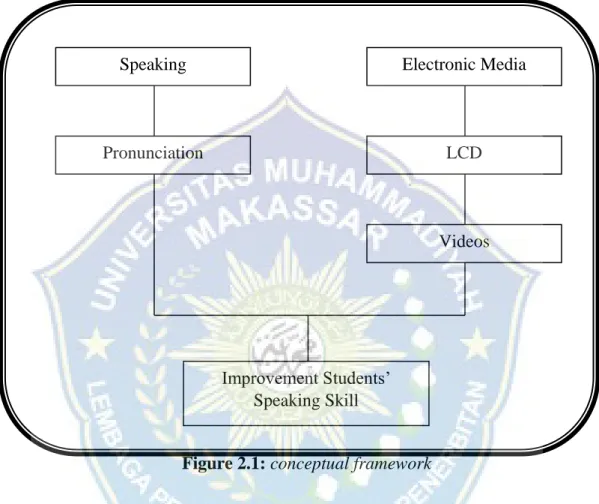
The theoretical framework underlying of this research was presented in the following diagram:
Figure 2.1: conceptual framework
The conceptual framework above described about all of the research which conducted by the researcher. The tittle of this research was “Efforts in Improving Students' Speaking Skill by Showing Videos Through Lcd as an Electronic Media at The Seventh Grade of Mts Assalam Timbuseng”, it indicates in mastery English skill, the researcher was use electronic media which is LCD to improve students’
speaking skill. There exist some video about self-introduction. Further in conduct this research, the researcher focused only on students’ pronunciation improvement.
Speaking Electronic Media
Pronunciation LCD
Videos
Improvement Students’
Speaking Skill
CHAPTER III RESEARCH METHOD
In this chapter, the researcher explained about research design, research variable and operational definition, research population and sample, research instrument, procedure of collecting data, and data analysis.
A. Research Design
This research used experimental design and quantitative method.
According to Maheshwari (2017), experimental research is a method used by researchers through manipulating one variable and control the rest of the variables. The process, treatment, and program in this type of research are also introduced and the conclusion is observed.
The research design of this research was pre-experimental design quantitative method in form of experimental design.
This design was presented as follows:
O1 X O2
Where:
O1 = Pre-test X = Treatment O2 = Post-test
(Gay, 2006: 225)
B. Research Variable 1. Independent Variable
Independent variable was showing videos through LCD as an electronic media in teaching and learning process of speaking class.
2. Dependent Variable
Dependent Variable is a variable which caused or influenced by another variable. The dependent variable in this research was the result of the test about students’ speaking skill.
C. Indicator
The indicator of this research was improvement students' speaking skill by Showing Videos through LCD as an Electronic Media
D. Population and Sample 1. Population
The population of this research was the first year students of MTS Assalam Timbuseng in the academic 2020/2021. There are three classes in MTS Assalam Timbuseng, each class consists of 17 students. Total of population is 51 students.
2. Sample
The sample of this research used Cluster Random Sampling Technique, because the population was too large. Meanwhile, the technique was used to give some opportunity for the population to become the research samples.
and the researcher choose 7.A grade of MTS Assalam Timbusseng which consist of 17 students.
E. Research Instrument
The instrument of this research was a test; the researcher gave pre-test and post-test. That test was oral test. The test consisted of 10 items. It aims to find out the significant difference between students' speaking skill before and after the research gave a treatment by showing some videos with using LCD as an electronic media.
F. Data Collection Procedure
In data collection, the researcher used three steps as following:
1. Pre-test
In the pre-test, the researcher ask the students to introduce them self in front of the class randomly to know the students pronunciation before treatment.
2. Treatment
After giving pre-test, the researcher applying the treatment to the students by implementing Video emitted using an LCD as electronic media while teaching and learning process. The treatment conducted four meetings and takes 45 minutes each meeting. The steps of treatment as follows:
a. The researcher prepares the students to study, after gaining the students’ attention, the teachers tells them what there are going to do.
b. The researcher asks the students to watch the video emitted using an LCD as an electronic media about self-introduction.
c. The researcher and the students discuss the video and the researcher asking what is the video talking about?
d. the researcher ask to students to make a text about self-introduction that they watch before
3. Post-test
The researcher gave the last oral test to the students, to know the students pronunciation after giving the treatment.
G. Data Analysis Technique
In the data analysis technique, the researcher used some procedure. The steps undertake in quantitative analysis employing the following formulas:
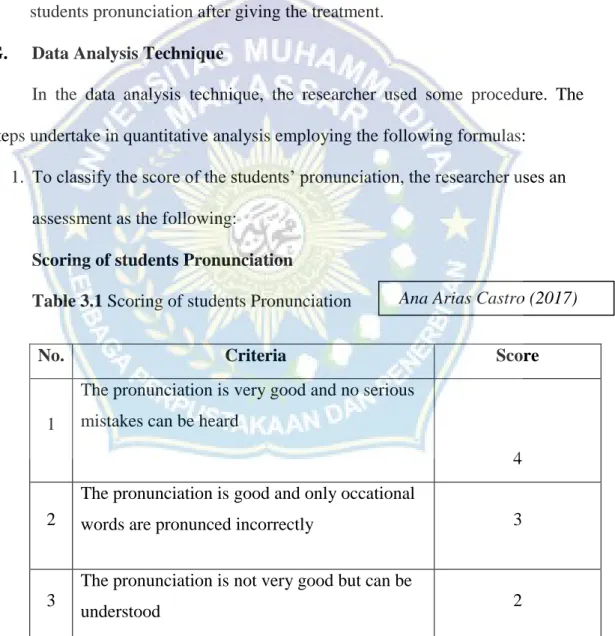
1. To classify the score of the students’ pronunciation, the researcher uses an assessment as the following:
Scoring of students Pronunciation
Table 3.1 Scoring of students Pronunciation
No. Criteria Score
1
The pronunciation is very good and no serious mistakes can be heard
4 2
The pronunciation is good and only occational
words are pronunced incorrectly 3
3
The pronunciation is not very good but can be
understood 2
Ana Arias Castro (2017)
4
The pronunciation is very bad and the
exposition can not be understood. 1
Scoring the students’ answer of test by using this formula (Pusat Kurikulum, 2006:32) in Julita (2011):
Score =Students′correct answer Total number of score X100
2. The mean score of the students’ achievement (Gay, 1981:298).
X =∑x N Where:
X : Mean score
∑x: The sum of all score N : The number of students
3. Classifying the score of the students that adapted from Julita (2011) Table 1: Classification Score of Students
No Classification Score
1 2 3 4 5
Very good Good Fair Poor Very poor
90-100 70-89 50-69 30-49 10-29
Calculating the rate percentage of the students score:
P =N𝑓X 100 % Where:
P : Percentage ƒ : Frequency
N : The total number of the students
(Gay, 1981:448) 4. The formulation of the test is:
2
2 ( )
( 1)
t MD D D
N N N
Where:
t = score of computation
MD= average difference between pre-test and post-test
∑D2= different scores squared, then summed (∑D)2= difference scores summed then squared
N = Subject of sample d.b= Decided by N-1
(Gay, 2006: 331)
CHAPTETR IV
FINDINGS AND DISCUSSION
This chapter answered of problem statements in the previous chapter and consisted of findings and discussion. Findings showed description of result from the data that had collected through speaking test in pre-test and post-test. Then, discussion was explanation of findings and showed r-esult of the data.
A. The Findings
The findings of the research that the teaching using LCD as a media by showing some videos could improve students’ pronunciation. The research report are based on the analysis of data by using the test (Pretest and Posttest) for further interpretation of the data analysis are given below:
1. The Improvement of the students’ pronunciation by Showing Videos Through Lcd as an Electronic Media
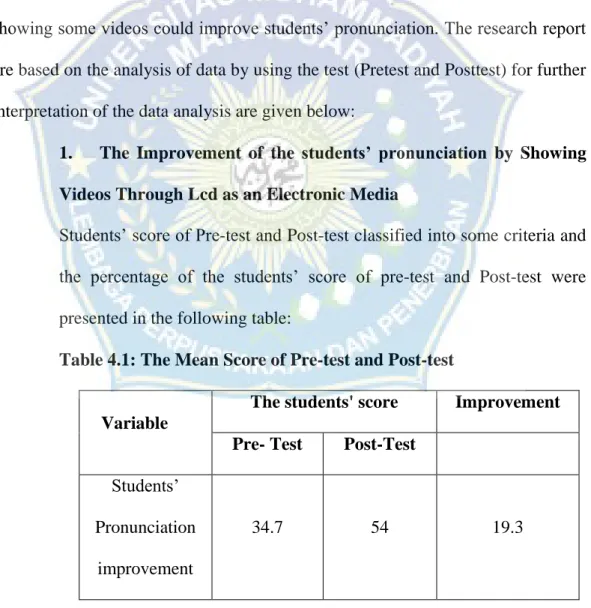
Students’ score of Pre-test and Post-test classified into some criteria and the percentage of the students’ score of pre-test and Post-test were presented in the following table:
Table 4.1: The Mean Score of Pre-test and Post-test Variable
The students' score Improvement Pre- Test Post-Test
Students’
Pronunciation improvement
34.7 54 19.3
The table above showed that the mean score of the students’
pronunciation improvement before giving a treatment was 34.7 and the mean scores of the students’ pronunciation improvement after giving a treatment was 54. Therefore, the improvement of the students’
pronunciation improvement was 19.3.
2. The Rate Percentage of Students’ Scores Through the Test
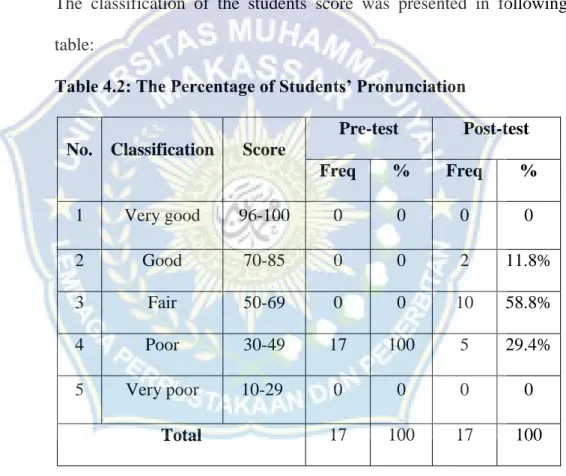
The classification of the students score was presented in following table:
Table 4.2: The Percentage of Students’ Pronunciation
No. Classification Score
Pre-test Post-test Freq % Freq %
1 Very good 96-100 0 0 0 0
2 Good 70-85 0 0 2 11.8%
3 Fair 50-69 0 0 10 58.8%
4 Poor 30-49 17 100 5 29.4%
5 Very poor 10-29 0 0 0 0
Total 17 100 17 100
The table above showed that the percentage of the students’
pronunciation that 17 (100%) students got poor classification and none of the students got the other classification.
After the researcher gave a treatment by using LCD as an Electronic media in teaching speaking especially on pronunciation, the percentage of the students’ pronunciation became where 5 students (29.4%) got poor classification, 10 students (58.8%) got fair classification, 2 students (11.8%) got good classifications, and none of the student got very good and very poor classifications.
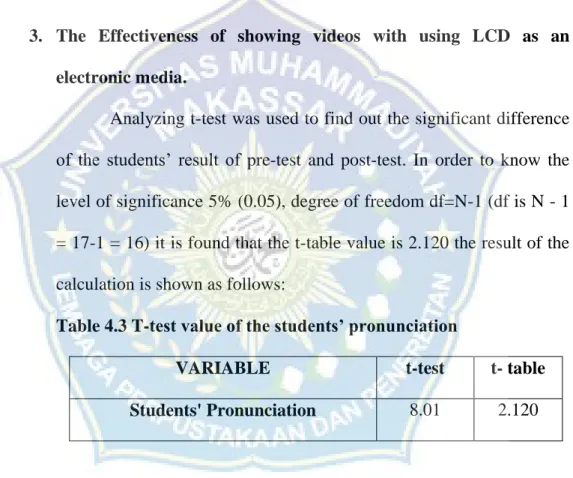
3. The Effectiveness of showing videos with using LCD as an electronic media.
Analyzing t-test was used to find out the significant difference of the students’ result of pre-test and post-test. In order to know the level of significance 5% (0.05), degree of freedom df=N-1 (df is N - 1
= 17-1 = 16) it is found that the t-table value is 2.120 the result of the calculation is shown as follows:
Table 4.3 T-test value of the students’ pronunciation
VARIABLE t-test t- table
Students' Pronunciation 8.01 2.120
The table above shows about the comparison between the students’ t-test and t-table to improve students’ speaking skill especially on pronunciation after using LCD as an electronic media.
The value of the t-test is greater than t-table. The score in variable of speaking skill especially on pronunciation was (8.01 > 2.120). It can be concluded that there was significant difference between the results of
the student speaking skill before and after using LCD as an electronic media. This also means that null hypothesis (Ho): The use of LCD as an electronic media does not effective in improved the students’
speaking skill especially on pronunciation at the seventh grade of MTs Assalam Timbuseng is rejected and the alternative hypothesis (H1) . The use of LCD as an electronic media does effective in improved the students’ speaking skill especially on pronunciation at the seventh grade of Mts Assalam Timbuseng is accepted.
B. Discussion
In this part, the result of findings was explained clearly about students’
speaking skill especially on pronunciation improvement by using LCD as an electronic media. In findings, the data showed that the increase of students’ in speaking skill was significant after analyzing t-test and t-table value.
1. The improvement students’ skill especially on pronunciation In improving students’ production of English pronunciation in terms of English the researcher used LCD as an electronic media. Where used electronic media could help the students to improve their speaking skill. The students thought that the teaching English that used Electronic media was very helpful to improve the students’ speaking skill especially on vocabulary. The effectiveness of this technique is that it made increase students’ self confidence in pronouncing word, phrase, or sentences and how to make the interesting pronunciation in order to easier to understand what the students convey.
All of students were interested to use every kinds of technology because it could make life easier. For example, people use hand pone and laptop to make their activities become easier and more practice. Thus, LCD Projector is also an interesting media which is suitable with the developing of technology. Based on this condition the students also were interest and enjoy in learning English when the teacher uses the LCD Projector as a media in learning English in the classroom. The students were really exited in learning English by using LCD Projector rather than using another media.
It was because the teacher used technology as a media such as LCD Projector related to the students’ need.
The finding of this research is similar to Fathorrahman (2013:38).
State that applying projector in the classroom, many benefits will be gotten, those are; interesting, efficiency and effectiveness. Applying LCD Projector as an electronic media the students motivated in teaching 2 and learning activity. Students can acquire their lessons better and more interested than other ways. The main focus of using of LCD Projector in the classroom is not only to help students to learn more effectively but also to have fun.
Then, applying LCD Projector can help teacher in explaining material easily. The purpose of this research is to identify and describe students’
perception in learning English toward LCD Projector at the classroom.
Abila (2016) Liquid Crystal Display (LCD) based instruction engages students, enjoys and help them to concentrate and learn better as well as saves their time during learning process in their classrooms. Because it saves
more energy. Using LCD Projector the material becomes clearer, thus the students do not need to ask to the teacher about the material. Actually, this condition makes the students do not come to the front of the class to ask the material to the teacher. It saves their energy, therefore the students will have fun and are not bored in learning English in the classroom, he also found the use of LCD in learning process can be improve the students speaking skill.
The data had been showed in pre-test there were any students’ get inadequate score. In pre-test, all students found many difficulties in pronunciation. It was too different with post-test that some of students got higher than the value in pre-test. The students got a significant development after giving treatment. The students could improve their pronunciation and vocabulary.
From the result of pre-test, the mean score of the students’
pronunciation in term of English intonation, the result of the post-test was 53.7. Based on the result of the data, the researcher concluded that after the treatment by showing some videos with using LCD as an electronic media, the students were in excellent category. It means that using electronic media in teaching English the students can improve their pronunciation. Therefore, using electronic media in this research had a big influence in improving students’ English pronunciation.
CHAPTER V
CONSLUSION AND SUGGESTION
There are two sub-chapters in this section. They are conclusion and suggestion. The conclusion based on the data analysis and findings in the previous chapter. The suggestion based on the findings and conclusion of this research.
A. Conclusion
Based on the findings on the previous chapter, the researcher formulated some conclusion about the difference between before and after implementing electronic media in teaching English in terms of English pronunciation. It would briefly formulated in two points, they were: Showing videos through LCD as an electronic media to improve students’ speaking skill especially on pronunciation of English because there was a higher score of the post-test than the students’ pre- test.
Furthermore there was significant improvement between the students’
pronunciation before and after showing videos through LCD as an electronic media. Thus, the conclusion was null hypothesis was rejected, while the alternative hypothesis was accepted.
B. Suggestion
Based on the conclusion above, the researcher presented some suggestion as follows:
1. The English teachers are suggested to apply LCD as an electronic media technique in teaching and learning process, especially in speaking material. Showing videos with using LCD as electronic media will
expectedly help the students in improving students’ speaking skill especially on pronunciation of English.
2. In teaching English teachers can also use LCD as an electronic media help the students in constructing their interest to learn and make the students not bored during in the class.
3. For the future researchers can apply the electronic media especially LCD to improve students’ speaking skill.
BIBLIOGRAPHY
Arsyad, A (2002). Media Pembelajaran (3rd edition). Jakarta: Grafindo
Abdul, N, B (2013). The Implementation of Information Gap Activities to Improve Students’ Speaking and Reading Skills. Muhammadiyah University of Makassar
Abila, T.M (2016). Improving Students’ Learning Through Liquid Crystal Display (LCD) Based Instruction: an Action Research. Point Journal of Educational Research and Behavioral Sciences
Brown, H. D. (2004). Language Assesment Principles and Classroom Practices, 141. San Francisco: states University.
Brown, H. D. (2001). Teaching by Principles: an Interactive Approach to Language Pedagogy. (2nd ed). New York: Longman, Inc.
Brown, H.D. 2007. Principles of Language Learning and Teaching (5th Edition).
New York: Pearson Education Inc.
Brinton, M, D. (2001). The Use of Media in Language Teaching. New York:
Thomson
Carl, X (2015). Electronic Media and Technology Use. Skill maker
Castro, A, A (2017). Scoring of students’ Pronunciation Yogyakarta: Sanata Dharma University.
Cameron & Lynne. (2001). Teaching Languages to Young Learners. New York:
Cambridge University Press.
Celce & Murcia, M. (2001). Teaching English as a Second or Foreign Language (3rd Edition). Boston: Heinle ELT.
Fathorrahman. (2013). Improving Students’ English Achievement Through Lcd Projector As Media Of Teaching. ISSN Journal: Pendidikan Bahasa Inggris FKIP Unisma.
Gay, L, R (1981). Education Research. Competencies for Analysis and Application Second Addition, A Bell & Howel Company: London.
Gay. (2006). Educational Research Competencies for Analysis and Application.
Oiho: Cherles E. Merrill Publishing.Co
Gilbert, J, B, (2008). Teaching Pronunciation Using the Prosody Pyramid. New Harmer, J. (2001). The Practice of English Language Teaching (3rd Edition).
London: Longman Group Ltd.
Julita. (2011). Improving Students’ Vocabulary Through Clustering Technique At The Third Year of SMPN 1 Ladong (A Classroom Action Research).
Unpublished Thesis of The Degree of Master of English Language Teaching. Makassar : Alauddin State Islamic University of Makassar..
Kelly, Gerald. (2001). How to Teach Pronunciation. England: Longman.
Maryam, Bahadorfar & Reza, Omidvar. (2014). Technology in Teaching Speaking skill. Creative Common Attribution
Maheshwari, (2017). Experimental Research in Education. India: WordPress Mandasari. Z, V (2014). Improving Students’ Speaking Skill through Video
Dubbing
Nunan, (1989). Designing Tasks for the Communicative Classroom. New York:
Nunan. David (1991). Language teaching methodology : A textbook for teachers.
New York: Prentice Hall International Ltd.
Padayachee, P., Boshoff, H., Olivier, W., & Harding, A. (2011). A blended learning Grade 12 intervention using DVD technology to enhance the teaching and learning of mathematics. Pythagoras
Pinter, (2006) Classroom Interaction: An Analysis of Teacher Talk and Student Talk in English for Young Learners (EYL)
Roblyer, M. D., Doering, Aaron H. (2010). Integrating Educational Technology into Teaching (5th Edition). United States of America: Pearson Education, Inc.
Richards, Jack C., and Renandya, Willy A. (2002). Methodology in Language Teaching: An Anthology of Current Practice. United States of America:
Cambridge University Press.
Refni, D, (2016). Students’ perception of using LCD Projector as a media in learning English at the classroom
Richards, J. (2008). Teaching Listening and Speaking from Theory to Practice.
Cambridge: Cambridge University Press.
Shepherd, I (1998). Teaching and Learning Geography with Information and Communication Technologies. Gloucester, UK: Geography Discipline Network.
Smaldino, S.E, Lowther, D.L., and Russell, J.D. (2007). Instructional Technology and Media for Learning (9th Edition). New Jersey: Prentice Hall.
Thornbury, S. (2001). Uncovering Grammar. The Teacher Development. Oxford:
Macmillan Heinemann English Language Teaching.
Thornbury, S. (2005). How to Teach Speaking. London: Longman.
Timothy, J. S (2008) Physics of colloidal dispersions in nematic liquid crystals display. Elsevier
A P
P
E
N
D
I
C
E
S
APPENDIX I Treatment Materials