IMPROVING STUDENTS’ READING COMPREHENSION OF NARRATIVE TEXTS THROUGH JIGSAW TECHNIQUE AT
GRADE VIII A OF SMPN I BANGKINANG
THESIS
By
ELYA MINARNIS NIM. 93221
Submitted a Partial Fulfillment of the Requirements For the Award of Master Degree
In English Language Education Program
ENGLISH EDUCATION SECTION LANGUAGE EDUCATION PROGRAM
GRADUATE PROGRAM STATE UNIVERSITY OF PADANG
2012
ABSTRAK
Elya Minarnis, 2012. Meningkatkan Kemampuan Siswa Kelas VIII.A. SMPN I Bangkinang dalam Memahami Teks Naratif melalui Teknik Jigsaw. Thesis.
Program Studi Pendidikan Bahasa Inggris, Program Pasca Sarjana, Universitas Negeri Padang
Penelitian ini berawal dari masalah rendahnya kemampuan membaca pemahaman teks naratif siswa Kelas VIII A SMPN I Bangkinang. Hal ini terlihat pada nilai rata-rata siswa yang berada dibawah Kriteria Ketuntasan Minimum (KKM) sehingga pembelajaran pemahaman teks narratif belum berjalan sebagaimana yang diharapkan.
Untuk meningkatkan kemampuan membaca pemahaman teks narratif tersebut, peneliti melakukan penelitian tindakan kelas dengan menerapkan tehnik Jigsaw.
Tujuan penelitian ini adalah untuk mengetahui sejauh mana tehnik Jigsaw bisa meningkatkan kemampuan membaca pemahaman teks narratif siswa kelas VIII A SMPN I Bangkinang dan untuk mengetahui faktor apa yang mempengaruhi kemampuan membaca pemahaman teks narratif tersebut. Dalam pengumpulan data penelitian, peneliti menggunakan tes membaca pemahaman (data kuantitatif), pengamatan, catatan untukmenulis kejadian- kejadian selama penelitian berlangsung yang dibantu oleh seorang teman sejawat serta wawancara (kualitatif data). Penelitian tindakan kelas ini terdiri dari tiga siklus dan empat kali pertemuan pada setiap siklusnya dimana tiga pertemuan untuk proses belajar mengajar membaca pemahaman teks naratif dan satu pertemuan lagi untuk melaksanakan tes.
Berdasarkan temuan penelitian, peneran tehnik Jigsaw bisa meningkatkan kemampuan membaca pemahaman teks naratif siswa Kelas VIII A SMPN I Bangkinang.
Peningkatan ini dibuktikan dengan meningkatnya nilai siswa dari siklus pertama, siklus kedua, dan siklus ketiga. Nilai rata- rata siswa pada siklus pertama adalah 66.0, kemudian pada siklus kedua adalah 72.3, dan nilai rata- rata pada siklus ketiga adalah 77.3
Faktor yang mempengaruhi meningkatnya nilai siswa adalah penggunaan topik yang menarik sebagai bahan ajar, kreativitas guru, dan strategi belajar yang mampu memotivasi siswa untuk membaca siswa untuk membaca merupakan hal yang sangat penting bagi guru bahasa Inggris karna membaca merupakan aktivitas yang seringkali membosankan bagi siswa. Penggunaan tehnik Jigsaw dalam meningkatkan kemampuan membaca pemahaman teks naratif siswa Kelas VIII A SMPN I Bangkinang bertujuan untuk memotivasi siswa untuk membaca dan menentukan tujuan mereka dalam membaca. Sebagai kesimpulan, penelitian tindakan kelas dengan menerapkan tehnik Jigsaw bisa meningkatkan kemampuan membaca pemahaman teks naratif siswa Kelas VIII A SMPN I Bangkinang.
ABSTRACT
Elya Minarnis, 2011. Improving Students’ Reading Comprehension of Narrative Texts Through Jigsaw Technique at Class VIII A of SMPN I Bangkinang. Thesis.
English Education Program, Graduate Program, State University of Padang.
This research started from the problem of students’ low reading comprehension of Narrative texts. It can be seen from the students’ average score under the minimum criteria of achievement (KKM) so that their comprehension of Narrative texts has not gone as expected. To increase the students’ reading comprehension of Narrative texts, the researcher conducted a classroom action research by applying Jigsaw technique.
The purposes of this research are to identify to extent to which Jigsaw technique can improve students’ reading comprehension of narrative text at grade VIII A of SMPN I Bangkinang and to identify the factors that influence the changes of students reading comprehension of narrative text by using Jigsaw technique at grade VIII A of SMPN I Bangkinang. In collecting the data, the researcher used reading comprehension of narrative text test, observation checklist, field notes which were helped by a collaborator and interview. This classroom action research consisted of three cycles and four meetings of each cycles; three meetings for the teaching reading comprehension of narrative texts and another meeting for the reading comprehension of narrative texts test.
Based on the findings, the implementation of Jigsaw technique could better improve students’ reading comprehension of narrative texts at grade VIII A of SMPN I Bangkinang. The improvement was confirmed by the increasing average students’ score from cycle I, cycle II, until cycle II. The average score during cycle I was 66.0, then during cycle II was 72.3 and the average score during cycle II was 77.3.
The factors that influenced the increasing of the students’ score were using interesting topic as teaching material, creative teacher, and instructional and motivated strategy to teach reading comprehension of narrative texts are very important for the English teacher because reading is such kinds of activities that often bored the students mostly. The use of Jigsaw technique in teaching reading comprehension of narrative texts is aimed to motivate the students’ to read and set the students’ purpose before reading.
Using Jigsaw technique is very good to be applied in teaching narrative reading comprehension. Finally, the classroom action research by applying Jigsaw technique could improve the students’ reading comprehension of narrative text at grade VIII A of SMPN I Bangkinang.
ACKNOWLEDGEMENT
First of all, the researcher would like to thanks to Allah SWT for all of his mercy.
Thanks God for giving me bless, kindness, healthy, and ability in accomplishing this thesis entitled Improving Students’ Reading Comprehension of Narrative Texts Through Jigsaw Technique at Class VIII A of SMPN I Bangkinang.
This thesis intended to fulfill one of the requirements for the degree of Master in Education. In writing this thesis, the researcher received a lot of guidance, supports, and valuable advices from many people. Therefore, the researcher would like to give the best gratitude to:
1. Prof. DR. H. Mukhayar, M.Pd and DR. Kusni, M. Pd. as the advisors. This thesis would like never come to existence without their encouragement, valuable guidance, and time given to the researcher during the accomplishment this thesis.
2. Prof. Drs. H. Zainil, M.A,. P. hd., Prof. DR. M. Zaim, M. Hum, and Prof. DR.
Gusril, M. Pd. as the examiners who gave valuable contributions and suggestions.
3. Director of Graduate Program of State University of Padang, all of lecturers, especially those of English Language Education Section, and all of the Staffs of State University of Padang.
4. My beloved parents and all of my family who had given their valuable understanding and supports in finishing this study.
5. The principal of SMPN I Bangkinang, H. Rusdi Mulya, S. Pd, who give the researcher a chance to continue her study.
6. The collaborator, Nurhidayah Sari, S. Pd, all of the teacher, and all of my beloved students especially class VIII.A of SMPN I Bangkinang who gave their supports and participations.
7. All of dearest classmates at English Language Section. Language Education Program, state University of Padang, Academic Year 2009.
8. Everyone who helped the researcher to complete this thesis.
Although the researcher has given her best effort in completing this thesis, it might be possible that there are still some mistakes that can be found. Therefore, critics and suggestions are expected. Thank you.
Padang, March 2012 The Researcher,
Elya minarnis 93221
TABLE OF CONTENT
ABSTRACT………. ... i
ACKNOWLEDGEMENT……… . ii
TABLE OF CONTENTS……….. .... iv
LIST OF TABLES……… ... vi
LIST OF FIGURES………. .. vii
LIST OF CHARTS………... .... viii
CHAPTER I INTRODUCTION A. Background of the Problems ... 1
B. Identification of the Problems... 4
C. Limitation of the Problems ... 4
D. Research Question ... 5
E. Purpose of the Research ... 5
F. Significance of the Research ... 6
G. Definition of the Key Terms ... 6
CHAPTER II REVIEW OF THE RELATED LITERATURE A. Review of the Related Theories…... . 8
1. Reading Comprehension ………...……… ... . 8
2. Narrative Texts... . 16
3. Jigsaw Technique ... 18
4. Teaching Narrative Texts Through Jigsaw Technique ... 23
a. Steps in Teaching Narrative Texts Through Jigsaw Technique ... 23
B. Review of the Related Findings ... 27
C. Conceptual Framework ... 32
CHAPTER III METHOD OF THE RESEARCH
A. Type of the Research ... 34
B. Location ... 36
C. Participants ... 36
D. Instrumentation ... 37
E. Procedure of the Research ... 42
F. Technique of Collections the Data ... 50
G. Tecnique of Analyzing the Data ... 51
CHAPTER IV FINDINGS AND DISCUSSIONS A. Findings ... 54
1. To extent to which Jigsaw technique can improve students’ reading comprehension of narrative texts ... 55
2. The factors that influence the changes of students’ reading comprehension by applying Jigsaw technique ... 67
B. Discussion……….. 80
CHAPTER V CONCLUSIONS, IMPLICATIONS, AND SUGGESTIONS A. Conclusions... 83
B. Implications……… 83
C. Suggestions………. 84
BIBLIOGRAPHY ... 85
APPENDICES ... 88
LIST OF TABLES
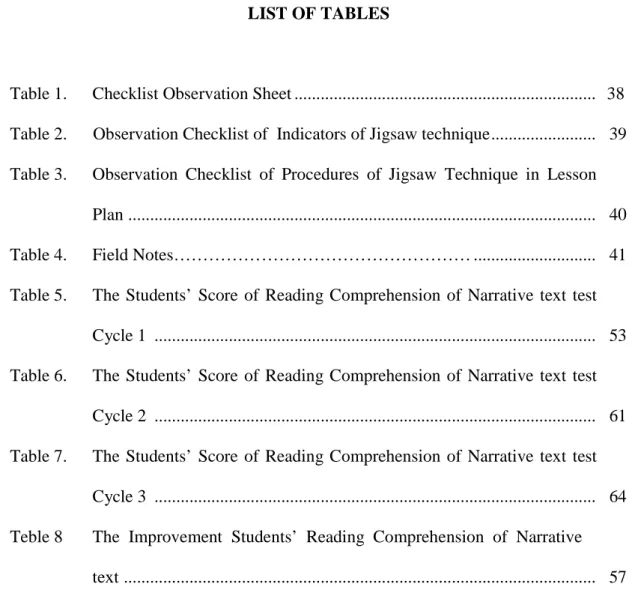
Table 1. Checklist Observation Sheet ... 38 Table 2. Observation Checklist of Indicators of Jigsaw technique ... 39 Table 3. Observation Checklist of Procedures of Jigsaw Technique in Lesson
Plan ... 40 Table 4. Field Notes……… ... 41 Table 5. The Students’ Score of Reading Comprehension of Narrative text test
Cycle 1 ... 53 Table 6. The Students’ Score of Reading Comprehension of Narrative text test
Cycle 2 ... 61 Table 7. The Students’ Score of Reading Comprehension of Narrative text test
Cycle 3 ... 64 Teble 8 The Improvement Students’ Reading Comprehension of Narrative
text ... 57
LIST OF FIGURES
Figure 1. Conceptual Framework……….. ... 35 Figure 2. Procedure of the Research………... ... 44
LIST OF CHARTS
Chart 1. The Average Score of Indicator after Cycle I………….. ... . 56 Chart 2. The Average Score of Indicators After Cycle II……….. ... . 69 Chart 3. The Average Score of Indicators After Cycle III……….. ... . 80 Chart 4. The Improvement Students’ Reading Conmprehension of Narrative
Text……… ... . 86
LIST OF APPENDICES
Appendix I Lesson Plan Cycle 1 ... 88
Appendix II Lesson Plan Cycle 2 ... 94
Appendix III Lesson Plan Cycle 3 ... 100
Appendix IV Research Instrument for Cycle 1 ... 106
Appendix V Research Instrument for Cycle 2 ... 110
Appendix VI Research Instrument for Cycle 3 ... 114
Appendix VII Teachers’ Observation Checklist Cycle 1 ... 118
Appendix VIII Teachers’ Observation Checklist Cycle 2 ... 120
Appendix IX Teachers’ Observation Checklist Cycle 3 ... 122
Appendix X Students’ Observation Checklist Cycle 1 ... 124
Appendix XI Students’ Observation Checklist Cycle 2 ... 125
Appendix XII Students’ Observation Checklist Cycle 3 ... 127
Appendix XIII Field Note Cycle 1 meeting 1 ... 128
Appendix XIV Field Note Cycle 1 meeting 2 ... 129
Appendix XV Field Note Cycle 1 meeting 3 ... 130
Appendix XVI Field Note Cycle 2 meeting 1 ... 131
Appendix XVII Field Note Cycle 2 meeting 2 ... 132
Appendix XVII Field Note Cycle 2 meeting 3 ... 133
Appendix XIX Field Note Cycle 3 meeting 1 ... 134
Appendix XX Field Note Cycle 3 meeting 2 ... 135
Appendix XXI Field Note Cycle 3 meeting 3 ... 136
Appendix XXII The Result of Students’ Score Cycle 1 ... 137
Appendix XXIII The Result of Students’ Score Cycle 2 ... 138
Appendix XXIV The Result of Students’ Score Cycle 3 ... 139
Appendix XXV The Students’ Average Score Cycle 1 ... 140
Appendix XXVI The Students’ Average Score Cycle 2 ... 141
Appendix XXVII The Students’ Average Score Cycle 3 ... 142
CHAPTER I INTRODUCTION
A. Background of the Problem
Reading is one of four major language skills. It is very important in teaching and learning English which need to be developed, because it is the key for someone’s efficacy in acquiring sciences and technology. Furthermore, reading is also useful for other purposes as well. For example: it can be used to improve someone’s careers, for pleasure, and especially for studying purposes. For students, reading is very important for the studying purposes since it is a part of the learning process of language acquisition. If the students have ability to read, the language acquisition is likely to be even more successful. In reading activity, the students are not only demanded to be able to read the text, but they also have to be able to comprehend what the text tells them about.
Based on the writer experience during teaching reading at Junior High School 1 Bangkinang (Sekolah Menengah Pertama Negeri, SMPN 1 Bangkinang for short), the writer faces the facts that there were many students who got difficulties in comprehending texts. There are about 70% (19 from 28 students) of students who got low score in a daily reading comprehension test on September 4th 2010. Some of students still got difficulties to answer the questions based on the narrative text. About 63% (21 from 28) students could not answer the questions based on the text on October 16th 2010.
The other evidences to prove the problems above that were in learning process progress. First, a great numbers of students still got difficulties in finding main idea of the text, information structure of the text, opinion in the text, and facts in narrative text. For example, when the writer asked them to answer questions about a text orally, there were just two or three students active in answering the questions. It happens because of their lack of vocabulary. Some of them tended to used dictionary to found the meaning of the unfamiliar words they found in the text. In another case, the students’ motivations are still low in learning English. In fact, they usually do not pay much attention to the teacher explaining the lesson. They were not active in responding or answering the questions, they became passive students, they have no bravery to give comments, and they got bored of the English texts given. In addition, the teaching strategy used by the teacher was also another reason for the low ability of students in comprehending the texts.
Furthermore, some purposes of developing students’ reading skill as follows:
First, the students are expected to find certain information from the reading material.
Second, the students can find the general information. Third, the students can find main idea. Fourth, the students can find all details information. Fifth, the students can guess the meaning of the words; phrases and sentences based on the context. (Departemen Pendidikan Nasional, 2003)
Therefore, it was very important to provide an alternative technique to improved students’ reading comprehension. To improve the students’ reading comprehension, the writer used jigsaw technique in teaching reading as an implementation for improving the
students’ reading comprehension. Jigsaw technique was a very powerful technique for improving students’ reading comprehension.
Theoretically, there are many techniques that can be used in teaching reading to improve the students comprehension such as; Students Team Achievement Division (STAD), Jigsaw, Team- Games Tournaments (TGT), Team Accelerated Instruction (TAI), and Cooperative Integrated Reading and Comprehension (CIRC). In this research, the researcher was interested to apply jigsaw technique in teaching narrative texts. The writer was also interested to explored jigsaw technique as one of the cooperative learning technique to solve the students’ problems in reading, because jigsaw technique can be applied across different subjects and levels. The goal of the technique is to enhance the motivation, performance, and develops social skill for group work of students. Jigsaw is one of interactive techniques that have function to help students explain, summarize, apply, analyze, synthesize, and evaluate an aspect of the subject matter. Jigsaw also helps students to practice essential social, problem solving, communication skills needed for success in the workplace and make the students understand about how to comprehend the text well. Jigsaw technique is also one of the cooperative learning techniques to solve the students’ problems in reading. This kind of cooperative learning can be applied for use across most subjects and levels. The goal of the method is to enhance the motivation, performance and develops social skill for group work of students.
In teaching reading at Junior High School, there are some reading texts that are taught, they are; Procedure text, Descriptive text, Narrative Text, Recount text, Report
text, and etc. But, in this research the researcher was interested in using Narrative text.
Some reasons why the writer chased narrative text in her research to the class VIII A students of SMP Negeri I Bangkinang. First, because narrative is a story that is created in a constructive format (as work of writing, speech, poetry, prose, pictures, song, motion pictures, video games, theatre, or dance). So it will be quite easy to the students in reading and producing the simple text. Another reason why the writer chased narrative text, because in Curriculum it must be presented in the second year students of Junior High School.
B. Identification of the Problem
Based on the background of the problems above, the writer identified some problems in the teaching and learning process, they were: First, some students had low reading comprehension to comprehend the texts. They had problems in finding information, main idea, or opinion from the text. Second, students’ lack of vocabulary, in this case they did not have good understanding of what is the text about because they have limited vocabulary. Third, the teacher did not apply appropriate strategies in teaching reading. Fourth, some students found difficulties in retelling what they have read. They had difficulties to express their ideas about the texts.
C. Limitation of the Problem
Based on the identification of the problem above, it was necessary for the writer to limit the problems due to her limited research experience to cover all problems. This
research was focused on the problem about the difficulties of students in reading comprehension of Narrative texts. To solve this problem, the researcher used jigsaw technique which was developed by Aronson in improving students’ reading comprehension of Narrative text. The text which was used was narrative texts, because it was the text for grade VIII of Junior High School Students. The writer only focused her research in SMPN I Bangkinang.
D. Research Question
Based on the statement of the problem, the questions of this research were:
1. To what extent can Jigsaw technique improve the students’ reading comprehension of Narrative texts at grade VIII A of SMPN I Bangkinang?
2. What factors influence the changes of students’ reading comprehension of Narrative texts by using Jigsaw technique at grade VIII A of SMPN I Bangkinang?
E. Purpose of the Research
The purposes of this research are as follows:
1. To judge whether Jigsaw technique can improve students’ reading comprehension of Narrative texts at grade VIII A of SMPN I Bangkinang.
2. To identify the factors that influence the changes of students’ reading comprehension of Narrative texts at grade VIII A of SMPN I Bangkinang.
F. Significance of the Problem
By doing this research, the researcher expected that theoretically, the finding of this research will contribute to the development of the empirical prove of effectiveness of Jigsaw technique in teaching reading comprehension. And practically, the finding of this research will be useful for the teacher who interested in analyzing teaching reading. The writer hoped it can give contribution for English teacher and become a reference to improve their ability and competence in teaching English. The writer also hoped this research can give clear understanding about the process of teaching reading using cooperative learning technique, especially Jigsaw technique to the readers.
G. Definition of the Key Terms
In order to avoid misunderstanding and misinterpreting, there are some terms in this report are given as follows:
1. Reading comprehension referred to an interactive process between the students and the author via texts. Reading comprehension also the ability that provided accurate responses regarded questions concerning the written language. It referred to reading narrative texts that were examined by using test.
2. Narrative text referred to the texts which were used for students of SMPN I Bangkinang. Narrative text is a text which used to amuse, entertain, and to deal with actual or vicarious experience in different ways. It dealt with problematic events
which lead to a crisis or turning point of some kinds, which turned to find a resolution.
3. Jigsaw technique referred to a group learning technique in which students worked individually within the group. Each students studied different aspects, or pieces of a topic in another group name “expert group”, then came together to their “home group” to teach one another about what they have learned, and ultimately resulting in the entire group learning about all of the studied aspects of the topic.
CHAPTER II
REVIEW OF THE RELATED LITERATURES
Review of the related literature in this research was used as references in conducting the research. Those were related with: review of the related theories, review of the related finding, and conceptual framework.
A. Review of the Related Theories 1. Reading Comprehension
Reading is one of the four language skills. The purpose of reading is to understand the ideas and the meanings of the text. Reading comprehension ability is the basic skill to master various knowledges. Comprehension will be usually found in the readers mind. It is clear that reading comprehension is not only a process of knowing the meaning of words semantically, but also a process of catching the idea of the text whether it is stated explicitly or not.
Some experts have introduced several interesting views of reading comprehension concepts. They share their definitions about what does reading comprehension mean.
Burnes and Page (1985: 46) state that reading comprehension is the process world knowledge of readers interacts with the message encoded in text to generate an understanding of the author’s message.
Furthermore, reading comprehension skill is a basic in mastery various skill and knowledge, because reading comprehension is the activity between the reader’s knowledge and the meaning in the text. If the students do not have reading comprehension skill, they will face many difficulties in learning knowledges.
Kamil (2000) difines that Skilled comprehension requires fluid articulation of all these processes, beginning with the sounding out and recognition of individual words to the understanding of sentences in paragraphs as part of much longer texts. There is instruction at all of these levels that can be carried out so as to increase student understanding of what is read. Perhaps it is a truth, but students cannot understand texts if they cannot read the words. Before they can read the words, they have to be aware of the letters and the sounds represented by letters so that sounding out and blending of sounds can occur to pronounce words. Once pronounced, the good reader notices whether the word as recognized makes sense in the sentence and the text context being read and, if it does not, takes another look at the word to check if it might have been misread. Of course, reading educators have paid enormous attention to the development of children’s word-recognition skills because they recognize that such skills are critical to the development of comprehension’s skill.
The ability to comprehend written language involves many factors such as interest, motivation, vocabulary, sentence structure, and many others Burnes (in Kamil 2000).
Furthermore, Burnes (in Kamil 2000: 46) measures that in reading comprehension the
reader interacts with the message encoded in the text to generate an understanding of an author’s message.
Brooks et. al, (2001 :47) point out in order to understand and remember what is read, students must be able to relate the new information to previous knowledge and this is obviously a complicated process entailing a number of transformations in the written material to match it with previous knowledge.
It is recommended to educators who want to improve students’ comprehension skills is to teach them to decode well. Explicit instruction in sounding out words, which has been so well validated as helping many children to recognize words more certainly, is a start in developing good comprehender, but it is just a start. Word-recognition skills must be developed to the point of fluency if comprehension benefits are to be maximized.
Reading comprehension can be affected by world knowledge, with many demonstrations that readers who possess rich prior knowledge about the topic of a reading often understand the reading better than classmates with low prior knowledge (Anderson & Pearson, 2001). That said, readers do not always relate their world knowledge to the content of a text, even when they possess knowledge relevant to the information it presents. Often, they do not make inferences based on prior knowledge unless the inferences are absolutely demanded to make sense of the text.
According to Olson and Diller (in Tan and Nicholson 2001: 64), what is meant by reading comprehension is a term used to identify those skills needed to understand and apply information contained in a written material. This statement is supported by Harris
and Sipay (in Rusli :2002), who say that reading comprehension ability is taught to be a set of generalized knowledge acquisition skills that permits people to acquire and exhibit information gained as a consequence of reading printed language.
Along with that, according to McNeil (2002:129), a dominant goal of reading is comprehension the ability to find the meaning in what is read. According to Nuttal (2002), one reason for reading is that readers want to understand other people’s ideas; if we were all identical, there would be no point in most communication. It means that the background of someone is important in understanding reading text. If the writer and the reader are closely similar in background, training, attitude and so on, the reader is likely to interpret the text with no conscious effort.
However, when readers process text containing new factual information, they do not automatically relate that information to their prior knowledge, even if they have a wealth of knowledge that could be related. In many cases, more is needed for prior knowledge to be beneficial in reading comprehension.
Burnes and Page (2003: 46), explains the factors affecting comprehension fall into three broad categories: First, Reader-related factors consist of: Cognitive structures of reader, knowledge, background, purposes, attentions, interests, focus assumption about reading, assumptions about text, and strategies. Second, author-related factors consist of: Cognitive structures of reader, knowledge, background, purpose, assumptions about reader, text references, and theme mode of publication. Third, text- related factors consist of: Ideas, relationship between ideas, structural
tendencies,cohesions, and stylistic tendencies. It is supported by Sweet and Snow (2003) define reading comprehension as the process of simultaneously extracting and constructing meaning. Along with that, Sweet and Snow (2003:2) say that there are three elements that entail comprehension. First, the reader who is doing the comprehending. Second, the text that is to be comprehend. Third, the activity in which comprehension is a part.
It can be concluded that in considering the reader, the researcher includes all the capacities, abilities, knowledge, and experiences that a person brings to the act of reading. By text, the researcher means anything that is read whether printed or electronic.
In addition, in considering activity, the researcher includes three dimensions: purposes–
why readers read; process- what mental activity they engage in while reading; and consequences- what readers learn or experience as a result of reading.
Colorín Colorado (2007); explicit teaching of reading comprehension skills will help students apply these strategies to all subject matter. Examples of comprehension skills that can be taught and applied to all reading situations include: Summarizing, Sequencing, Inferencing, Comparing and contrasting, Drawing conclusions, Self- questioning, Problem-solving, Relating background knowledge ,distinguishing between fact and opinion, Finding the main idea, important facts, and supporting details. These skills are particularly important for comprehending what is generally known as information reading or expository reading.
The case is very strong that teacher in teaching junior high school students is recomended to use some of comprehension strategies which can increase their comprehension of text. Teachers should model and explain comprehension strategies, have their students practice using such strategies with teacher support, and let students know they are expected to continue using the strategies when reading on their own. Such teaching should occur across every school day, for as long as required to get all readers using the strategies independently, which means including it in reading instruction for years.
From the opinion above, it is known that there are some reading skills needed in understanding reading text and reading comprehension. It is needed finding the main idea, getting information from the text, finding important facts, supporting details, finding opinion from the text and conclusion.
King and Stanly (in Goldstein 1997) state that there are five components of reading comprehension that may help the students to read carefully:
1. Finding Factual Information
Factual information requires the students to scan specific details. The factual information questions are generally prepared for students and usually appear with “Wh” question words, such as: when, where, who.
2. Finding Main Idea
Recognition of the main idea of a paragraph helps the students to understand the paragraph on the first reading and also helps them to remember the content later. The main idea of a paragraph develops.
3. Finding the Meaning of the Vocabulary in Context
The reader develops his or her guessing ability to the word which is not familiar with him or her by relating the close meaning of unfamiliar words to the text and the topic of the text that is read.
4. Identifying Reference
Instead of repeating the same word of phrase several times, after it has been used we can usually refer to it than repeat it. For this purpose, we use reference words. Recognizing reference words and being able to identify the word to which they refer to will help the reader understand the reading passage. Reference words are usually short and very frequently pronoun, such as; it, he, they, this, etc.
5. Making Inference
Inference is a skill where the reader has to be able to read between the lines, such as draw logical inferences and make accurate prediction.
Howatt and Dakin in Santi (2011: 12) also state that there are five elements that should be Included in teaching reading comprehension as follows:
1. Factual information. It states in the text clearly and describes the real situation of fact. Usually no words hope, wish, will, etc.
2. Main idea. It usually, states at the first sentence or in conclusion forms at the last sentence.
3. Supporting idea. It usually states after main idea.
4. Reference. It must be place before the word given.
5. Word meaning. Finding the synonym of the words or identify the root of the words.
Related to the theories of Reading comprehension above, the indicator for Reading comprehension are finding factual information, finding main idea, finding the meaning of vocabulary in context, identifying reference, making inference, and identifying generic structures.
To measure the students’ reading comprehension, it is necessary to give the tests. Weir in Purnomo (2001: 18) state that there are some forms of reading comprehension test: Multiple Choice Questions, Short Answer Questions, Cloze, Selecting Deletion Gap Filling, cloze Elide, and Information Transfer.
According to Hughes in Santi (2010: 14), there are some kinds of reading test:
1. Multiple Choice. The candidate provides evidence of successful reading by making a mark against one out of a number alternative.
2. Unique Answer. There is only one possible correct response.
3. Short Answer. When unique answer items are not possible, short answer items may be used.
4. Summary Cloze. A reading passage is summarized by the tester, and then gaps are left in the summary for completion by the candidate.
5. Information Transfer. Identifying order of events, topics, or arguments.
From the explanation above, the researcher used multiple choices test to measure the students’ reading comprehension of narrative texts. It’s because it was suitable for the participant of her research that was students of Junior High School.
2. Narrative Texts
Narrative text is one of the text which is taught for high school’s students.
Narrative is also as one of the genres that learn in junior high school. According to Dan McAdams (2000), narrative is a story or part of a story. It may be spoken, written or imagined, and it will have one or more points of view representing some or all of the participants or observers.
In stories told orally, this is distinguishable from the written form in which the author must gauge the readers likely reaction when they are decoding the text and make a final choice of words in the hope of achieving the desired response.
According to Derewianka (2003: 40), the basic purpose of narrative text is to entertain, to gain, and hold the readers’ interest in a story. Moreover, narrative text can also educate to inform, deliver the writer’s reflection of his experience, and one thing, the most important one is to expand the readers’ imagination.
There are some kinds of narrative text. They are typically imaginary but sometimes also factual for example, fairy tales, mysteries, science fictions, romances, fables, myths, historicals, and legends.
Narrative texts have special generic structures that make it different from other genres. The generic structures are Orientation, Complication, and Resolution.
Narrative is started by an orientation in which the author paints the world of his story. The reader is introduced the participants, place, and time the story happened. The writer makes a kind of atmosphere that makes the readers want to follow the plot of the story. Orientation can be short or remains one more pages.
Next, there is a complication or problem arise. It makes the story more interesting, because the main character face the problem in getting his intention. It is the shadow or real like as to ensure the readers that any problem could be solved.
In complete narrative text present a resolution for a complication. Eventhough there is sometimes a narrative text found without resolution. The readers may ask themselves “how is the end of the story?”. Whatever the form, the content may concern real- world people and events. And this termed personal experience narrative.
To know the features or characteristics of the text, there are some features of Narrative text. According to Bates (2007) states that narrative consists of three parts:
1. Orientation/ introduction
Orientation usually contains the introduction of the characters and setting (i.e.
when and where the story takes place).
2. Problems
The problem tells the problem(s) or conflict(s) faced by the major characters and that makes the story interesting.
3. Resolution
Resolution tells the reader how the characters solve the problem(s)
Mukarto (2007: 123) states that narrative texts has three components, they are:
1. Orientation
It tells about the setting in time and place, and characters.
2. Complication(s)
This part tells about problem(s) to solved by characters.
3. Resolution
It describes the solution to the complication(s) and gives an ending to the story.
Based on the explanation above, there are some different points of the generic structures, but they also have similar points.
3. Jigsaw Technique
Jigsaw technique is a part of cooperative learning. Cooperative learning is a generic term or a teaching strategy used to describe teaching methodology that foster interaction and cooperation among groups of students and they work in small groups to helps one another in learning academic contents toward a common goals. The jigsaw technique was invented and named in 1971 by a graduate professor named Elliot Aronson’s. The jigsaw technique is also a cooperative learning technique appropriate for students from elementary school, junior high school, and senior high school.
Johnson and Johnson (1988: 34) says that jigsaw activities are very useful tools for trying to help students integrated knowledge and understanding from various sources, and it is also used to develop the skills and expertise needed to participate effectively in group activities.
Furthermore, Kagan (1992) says that jigsaw activity is a multifunctional structure of cooperative learning. It can be caused in a variety goals, but it is primary used for acquisition and presenting new material or review. The use of structure creates interdependent and states equalization. Harrakinen (1992) stated that Jigsaw activities are very useful not only for students in learning process but also for the teachers in teaching.
Jigsaw facilities learning into two areas; the social skills of positive interdependence and equal participation and the academic skill of acquire knowledge and understanding. Jigsaw can be used whenever the material to be studied is in reading narrative form. In this strategy, students work heterogeneous teams. Jigsaw group with the four or five students set up. Each group member is assigned some materials to learn and then to teach to his group member. To help in learning students accross the class working on the same sub- section get together to decide what is important and how to teach it. After practice in these “expert” groups, the original group reform and students teach each other.
According to Brown (1994: 182), jigsaw techniques are a particular form of information gap in which each member of a group is given some detailed information and the purpose of it is to put together all information to get some objective. By doing so, the
students are trained to be independent because they must try to do their own tasks. Then, they are also taught to be proactive since they have to share information that they have to each other and learned to listen to what they friend say.
Along with that, Kagan (1994) said that Jigsaw technique is an effective strategy to use when you want to increase students’ mastery or a topic at a hand, boost their concept development, enhanced targeted discussion among students, and foster group project participation and learning
The jigsaw technique is a cooperative learning technique appropriate for students from 3rd to 12th grade. It is also used extensively in adult English Foreign Language (or EFL) classes. The technique is an efficient teaching way that also encourages listening, engagement, interaction, peer teaching, and cooperation by giving each member of the group an essential part to play in the academic activity. Both individual and group accountability are built into the process. In EFL classrooms, jigsaws are a four- skills approach, integrating reading, speaking, listening and writing.
Hammer (2003), says that Jigsaw technique is a coopeartive learning activity. For instance, five students are discussing a topic. In groups, they tend to participate more equally. It gives students chances for greater independence. Because they are working together without the teacher controlling every move, they take some of their own learning decisions. They decide what language to use to complete a certain task.
Along with that, according to Abdul Kholid (2006; 4), Jigsaw technique was designed to increase students responsibility to their own learning and other students learning. Students not only learn the material which is given, but they have to be ready to give the material to their group.
According to Hanze & Berger (2007), Jigsaw technique is a cooperative learning technique appropriate for students from 3rd to 12 grade. It is also use extensively in adult English Second Language (or ESL) classes. The technique is an efficient teaching technique that also encourages listening, engagement, interaction, teaching, and cooperation by giving each member of the group an essential part to play in the academic activity. Both individual and group accountability are built into the process.
Jigsaw technique has many functions. As Kagan (2008) says, jigsaw activity is a multifunctional structure of cooperative learning. It can be used in many ways for variety goals, but it is mainly used for achieving and presenting new material, review or informed debate. The use of this structure creates interdependent and status equalization.
In teaching reading by using jigsaw technique the atmosphere in the classroom can be changed into better situation. Teacher will be not the only one as the sole provider of knowledge, there will be more effiicient way to learn, students can take ownership in the work and achievement, and it can build interpersonal and interactive skills.
The role of teacher in jigsaw activities according to Richard (2003: 11) was:
a. As s designer, teacher design the materials, the classroom management, and keeps the learning process flowing smoothly and efficiently.
b. As an organizer, the teacher keeps all attention focused on him/her acts as a source of comprehensive input and the facilitator of output, and maintains the whole class running in a cooperative atmosphere.
c. As a participant and a prompter, the teacher talks to the learners in a personal way, encourage some quiet and shy pairs or groups to talk without worrying about mistakes, and prompts them with information they have forgotten.
d. As an investigator and an assessor, the teacher sees the feedback of how the learners performed in the activities, evaluates the appropriateness of the activities they set.
From the explanation above, it can be concluded that the Jigsaw technique is a cooperative learning that help the teacher and student to solve the problems in teaching learning process. In other words, the way of teaching learning process is not teacher- centered. Hence, the knowledge is got not only from the teacher but also from other students which is called as information gap. The role of teacher in jigsaw activities was quite hard, starting from designing, participating, investigating, and evaluating the students’ activities in the classroom. In sum, jigsaw technique was assumed to be suitable for the students of Junior High School especially for learning reading. Jigsaw technique was also hoped to be able to improve the students’ participation in learning and improved their reading comprehension ability.
4. Teaching Narrative Texts Through Jigsaw Technique
Jigsaw technique was originally developed by Elliot Aronson (1971). In this technique each student within a team has a piece to be learned by all students and each student is responsible for teaching their section to the other students on ther team. When all the pieces are put together, the students should have the whole pieces- hence the name, Jigsaw. This is one of co-operative learning strategies. It’s a great way to cover narrative text in the class. In addition, Ledlow (1996) also has found that when students are teaching each other, they come to understand the material in a way that far deeper than when listen to the teacher explain it.
In doing Jigsaw activity, students will be required to work cooperatively for example they will be asked to read a narrative text. By applying this type of cooperative learning it is hope that it will be valluable to train students to appreciate the opinion from other people. To enhance the students’ knowledge with various activities, the teacher needs to prepare some different sources of teaching materials, thus the students get more new experiences.
a. Steps in Teaching Narrative Texts Through Jigsaw Technique
Aronson (1987) gives steps to do the jigsaw technique, which are: First, the teacher divides students into 5-6 persons jigsaw groups. Here, the groups should be various in terms of gender, ethnicity, race, and ability. Next, the teacher picks one student from each group as the leader. It is better if the leader is the most mature in group. Third,
the material taught that day is divided into 5-6 parts. Then, each student is assigned to learn one part. Fifth, the students are given time to read or think over their part for several minutes and become familiar with it. After the teacher forms temporary ‘expert groups’
by having one student from each jigsaw group join other students join other students assigned to the same parts; give students in these expert groups time to discuss the main points of their part and to rehearse the presentations they will make to their jigsaw group.
After a while, the students get back into their jigsaw groups. Soon after, the teacher asks each student to present his or her part to the group and encourages others in the group to ask questions for clarification. The teacher floats from group to group, obbserving the process. If any group is having trouble, he or she makes an appropriate intervention.
Eventually, it is best for the group leader to handle this task. Leaders can be trained by whispering an instruction on how to intervene, until the leader gets the hang of it. At the end of the session, give a quit on the material so that the students quickly come to realize that these sessions are not just fun and games but really count.
There are some steps in using Jigsaw technique in the classroom. Ledlow (1996:
1):
First, divide the material needed to cover a topic into four roughly equal parts. Second, assign a different subtopic to each team member.
Make the assignment, for example: all #1’s will read the article by Johnson Johnson ; all #2’s will read the article by Kagan: all the #3’s will read the article by Milis; and all #4’s will read the article by Davidson.
Third, develop and assign homework questions or essays over the material.
Fourth, put students in experts group and give them instructions. They meet in experts group. This means that all #1’s meet together, all #2’s meet together, etc. Fifth, when expert group time is up, have expert return
to their team and teach. Sixth, provide a team syntesis activity. Finally, assess students learning.
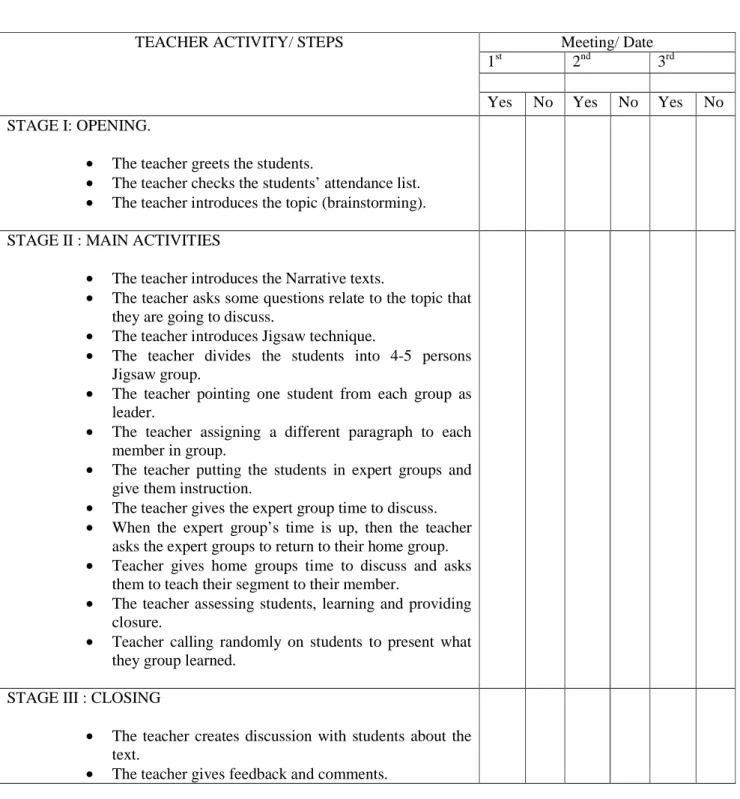
In this research, the researcher will combine the steps from Ledlow and Aronson The steps in applying jigsaw technique are as follow:
1. Dividing the students into 4-5 persons Jigsaw group. The group should be diverse in term of ability.
2. Pointing one student from each group as leader.
3. Assigning a different paragraph to each member in group, such as picture below:
1 2 3 4
1 2 3 4
1 2 3 4
1 2 3 4
1 2 3 4 Group A Group B Group C Group D Group E 1 2
3 4
1 2 3 4 Group A Group B
All student1 read orientation all student2 read complication 1, all student3 read complication 2, all student4 read resolution. In this step the researcher will only divided the task for each member of them before they work in expert group.
4. Putting the students in expert groups and give them instruction. They will meet in expert group. This means that all students1 in group A,B,C,D, and E with the same segment will meet together. It could be seen in the following picture:
1 1
1 1 1 1 1
2 2
2 2 2 2 2
3 3
3 3 3 3 3
4 4
4 4 4 4 4 Team 1 Team 2 Team 3 Team 4 5. Giving the expert group time to discuss.
6. When expert group time are up, then the expert group return to their home group such as picture below:
1 2 3 4
1 2 3 4
1 2 3 4
1 2 3 4
1 2 3
4 Group A Group B Group C Group D Group E 1 2
3 4
1 2 3
4 Group A Group B
7. When students return to their home group, they have to teach their segment to each group member.
8. Providing a team synthesis activity. The researcher will ask the students to design an activity which would synthesize the information that student learned in the four segments of paragraphs.
9. Assessing students, learning and providing closure. Then, calling randomly on students to present what their group learned.
From the explanation above, the researcher concludes some steps of Jigsaw technique are:
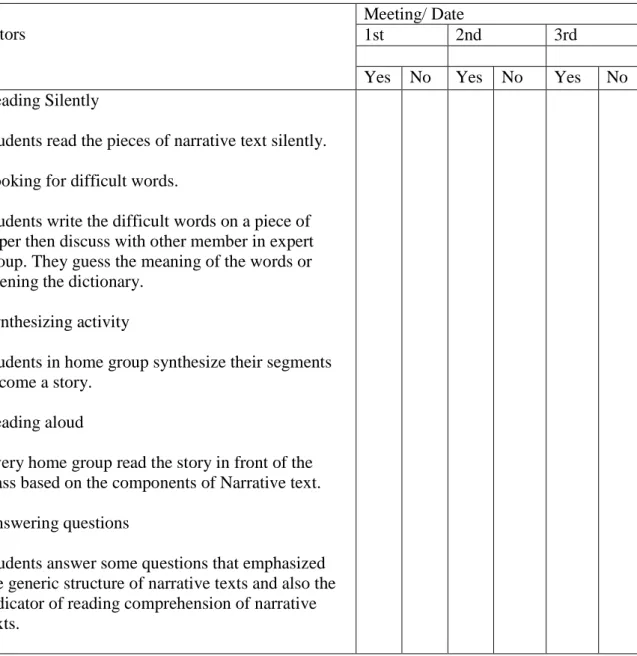
a. Reading silently. Students read the pieces of narrative text silently.
b. Looking for difficult words. Students write the difficult words on a piece of paper then discuss with other member in expert group. They guess the meaning of the words or opening the dictionary.
c. Synthesizing activity. Students in home group synthesize their segments become a story.
d. Reading aloud. Every home group read the story in front of the class based on the components of Narrative text.
e. Answering questions. Students answer some questions that emphasized the generic structure of narrative texts and also the indicator of reading comprehension of narrative texts.
B. Review of the Related Findings
There are some related studies that have been done by many researchers about reading.
The relationship of applying the jigsaw technique to improve students reading comprehension could be seen from the related findings. Triono (1994) in his reasearch about The influence of jigsaw technique to the result of social study at SMAN 1 Pamulang. He found that using the students’ own speaking for jigsaw is one way that
teacher can achieve a more learner- centre. At that time, he was successfull to develop students’ skill and also he was able to make students become interdependent. The relationship between researcher’s research with Triono is that the researcher also will use jigsaw technique. But, the researcher has different level of students in conducting her research with Triono. In his research, Triono wanted to see the influence of jigsaw technique to the students’ result in social study, while the researcher wants use jigsaw to improve her students’ reading comprehension of narrative text. Triono conducted his research in senior high school, but the researcher will conduct her research in junior high school.
Purnomo (2001) in his research about the Influence of Jigsaw Technique to the learning result of Social Subject in SMAN 3 Banyumas found that the result of students increase by using Jigsaw technique in the classroom. From Purnomo’s research, the researcher found that she will also use the same technique in her research. Purnomo has proven that jigsaw technique could make the learning result of students increased.
That’s why the researcher choose jigsaw technique to see wheter it can be useful in narrative text. The researcher has different level of students in conducting her research with Purnomo. Purnomo conducted his research in senior high school, but the researcher will conduct her research in junior high school.
Then, Kiptiyah (2004) also conducted her research by using jigsaw technique entitled The comparison of study between jigsaw technique and mental concept on electrolity solution and concept for tenth year students of SMAN 1 Kaliwungu. She
found that this jigsaw technique was better than mental concept. It is effective to improve students’ concept understanding. Kiptiyah’s research has similarity with the writer’s research, that is about the application of jigsaw technique. She found the benefit of jigsaw technique in teaching and learning at certain subject that is the comparison between jigsaw and mental concept. Then, the research above also have distinguished with the writer’s research. The writer will conduct a research to find out how well the use of jigsaw can improve students’ reading comprehension of narrative text at class VIII A of SMPN I Bangkinang.
Ardinur (2005) in his research about the implementation of jigsaw technique in learning mathematics at the third year students of SMPN 2 Probolinggo founded that the result of students’ post-test which was taught by using Jigsaw technique was more highest rather than the result of the test by using conventional method. Ardinur conducted his research for getting higher scores in the test, but the researcher will conduct her research to improve the teaching and learning process.
The research above has similarity with the writer’s research, that is about applying jigsaw technique in Junior High School. She found the benefit of jigsaw technique in teaching and learning at certain subject such as mathematics. In her research, the writer will conduct a research to find out how well the use of jigsaw can improve students’ reading comprehension of narrative text at class VIII A of SMPN I Bangkinang.
Next, Supriono (2006) conducted a research entitled The application of cooperative learning of jigsaw technique on civic study. The result of the research showed that jigsaw technique could grow students’ motivation and increase learning achievement. Based on the result of the research, jigsaw technique can be applied as one of alternative in carrying out the learning activities well. The above researcher, has proven that jigsaw technique could grow students’ motivation and increased learning achievement on civic study. Because of the above researcher used jigsaw technique and it is relate to her research, so the researcher also wants to use that technique in improving her students’ reading comprehension of narrative text at Class VIII A SMPN I Bangkinang.
The other research has been done by Fitriani (2007) in her research about The influence of cooperative learning type jigsaw technique in learning social in at class X SMAN 3 Surakarta found that obviously the situation in the classroom which is using Jigsaw technique get the highest result, positive relationship and psychology adaptation rather than the situation in the classroom which is full of individualize competion.
Although the researcher has differents level of students with Fitriani, but the researcher has the same situation with Fitriani’s research that is the researcher will conduct her research in the classroom.
As been done by Ferianty (2008) in her research about improving students speaking skill through Jigsaw Technique at Junior High School 1 Bukittinggi. She found that her students’ ability in speaking was not good and not all students participate
in the group. Then, after she applied jigsaw technique, the condition has changed. She found that by using jigsaw technique could improve students’ speaking skill at Junior High School 1 Bukittinggi. It is because teaching and learning process was more interesting and communicative.
The researcher sees that there is similarity between her research with Ferianty.
She is also conduct her research in the junior high school. But there is difference that Ferianty has conducted her research to improve students’ speaking skill but the researcher will conduct her research to improve students’ reading comprehension skill.
Those above researchers have proven that several techniques can improve students’ English reading comprehension skills. But the researcher could not find the research that conducts about the narrative text.
From the related study above, it could be concluded that Jigsaw technique can give contrbution to improve students’ reading comprehension skill in the classroom.
When teaching reading comprehension in the classroom, the teacher is as a facilitator must be able to facilitate the students to communicate and the classroom should be the learner- center. To sum up, jigsaw technique is effective to create and develop the students’ reading comprehension skill. That’s why the researcher also wants to conduct this jigsaw technique in her classroom.
C. Conceptual Framework
Based on the theoretical framework and the relevant research above, the researcher can conceptualize this research into three parts, namely the problem to be solved, the action for solving the problem, and expected result after the action.
Based on the background of the problem, the students’ reading comprehension of narrative text is still low. It can be measured from their answer when asking about the factual information, main idea, meaning of vocabulary, reference, inference, and generic structure of narrative text as indicators of reading comprehension of narrative text.
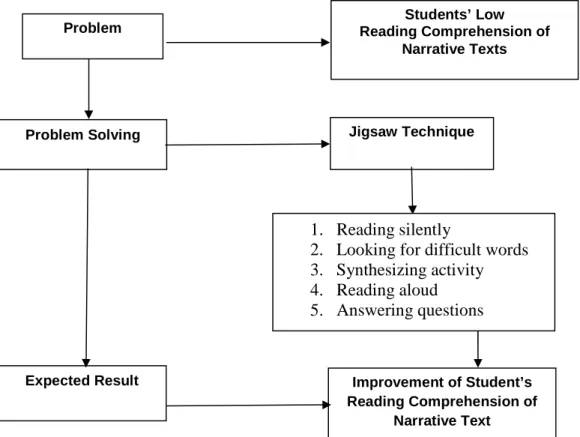
In this research, the writer wants to solve the students’ problems in improving students’ reading comprehension of narrative text through Jigsaw activity. The writer uses this technique with some steps, reading silently, looking for difficult words, synthesizing activity, reading aloud, and answering questions.
By applying Jigsaw activity, the students of SMP Negeri I Bangkinang especially grade VIII A are expected to be able to overcome their difficulties in comprehending narrative text.
Figure 1: Conceptual Framework
Students’ Low Reading Comprehension of
Narrative Texts
Jigsaw Technique Problem Solving
Problem
Improvement of Student’s Reading Comprehension of
Narrative Text Expected Result
1. Reading silently
2. Looking for difficult words 3. Synthesizing activity 4. Reading aloud 5. Answering questions
CHAPTER III
METHOD OF THE RESEARCH
A. Type of the Research
This kind of study was an action research which applied the Jigsaw technique in teaching reading reading comprehension of narrative text. It means that a teacher can apply certain treatment in order to give improvement to the students. when there is no improvement after giving the treatment, the teacher can give more treatment until the teacher sees a good improvement of the students.
Kemmis and Taggart (1988:5) states that action research is deliberate, solution- oriented investigation that is group of personally owned and conducted. It is characterized by spiraling cycles of problem identification, systematic data collection, affection, analysis, data driven action taken, and finally, problem redefinition. The linking of the terms “classroom action research” highlights the essential features of this method: trying out ideas in practice as a means of increasing knowledge about or improving curriculum, teaching and learning.
It meant that the participants in action research were hoped to get more knowledge and understanding about a certain subject, so that they will be able to solve the problem.
Mc Niff et al (1996) defines that classroom action research is an intervention in personal practice to bring about the improvement and it has special kind of research
problem. In supporting above statement, Johnson (2005), adds that classroom action research can be as the process of studying a real situation to improve the quality of action and instruction.
The purpose of action research is to provide educational practitioners with new knowledge and resolve significant problems in classrooms and schools (Stringer, 2008:13). It means that the participants in action research are hoped to get more knowledge and understanding about a certain subject, so that they will be able to solve the problems.
Moreover, Dirstine, et. al (1998) define classroom action research as an attempt to study real school situation with a view to improve the quality of actions and results within it, its purpose is also to improve one’s own professional judgment and to give insight into better, more effective means of achieving desirable outcomes. It is about learning reading through Jigsaw technique to improve the reading comprehension of narrative texts at class VIII A of SMPN I Bangkinang.
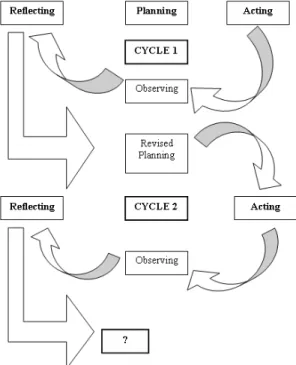
Classroom action research is a cycle process: planning, action, observation and reflection. It is about learning reading comprehension of narrative texts related to Jigsaw technique in order to improve the reading comprehension of narrative texts of at class VIII A of SMPN I Bangkinang.
It can be concluded that classroom action research tries to make solution in the classroom toward the problems that have been faced by the teachers at their subject areas.
In this research, the researcher used the classroom action research method that proposed by Kemmis and Taggart. Because this method has systimatical process and clear intention in improving teaching and learning process in the classroom.
B. Location
Location of this research was in Class VIII A SMP Negeri 1 Bangkinang. It is on Jalan Olahraga Bangkinang Kabupaten Kampar. SMP Negeri 1 Bangkinang is one of a big school. It has 27 classrooms, 879 students, and 75 teachers.
SMPN I Bangkinang consist of 27 classes, class VII are 9 classes, class VIII are 9 classes and class IX are 9 classes. Each of the class consists of 24-30 students. It has 1 language laboratories, 2 science laboratories, 1 library, 1 art room, 1 computer laboratory, 1 multimedia laboratory, 1 musholla, 1 post security, 1 big hall, 6 canteens, 1 teacher’s room, 1 office, and 1 headmaster’s room.
C. Participants
The participants of this research were 28 students of grade VIII A of SMP Negeri 1 Bangkinang, Kabupaten Kampar in 2010/2011 academic year. The students were 11 boys, and 17 girls. This class was chosen due to the researcher’s experience in this class.
The researcher found that most of students had problems in comprehending reading texts.
In addition, based on the 2006 curriculum, the students in this class learnt about narrative text for the second semester. Besides, the English teacher didn’t try various techniques in teaching.
D. Instrumentation
There were three kinds of instrumentation that were used in this research. They were observation, test, and interview.
1. Observation
Firstly, the researcher was a key instrument. She involved in every cycle or in every activity. She observed the activities that were happen during the reading comprehension class intensively. Furthermore, the researcher made a note dealt with the observation result. It was created before conducting the research and used to collect real information in teaching learning process during the action done. Moreover, she was also helped by a collaborator. The collaborator was another English teacher, she is Ms.
Nurhidayah Sari, S.Pd. She observed the teaching- learning process during the research.
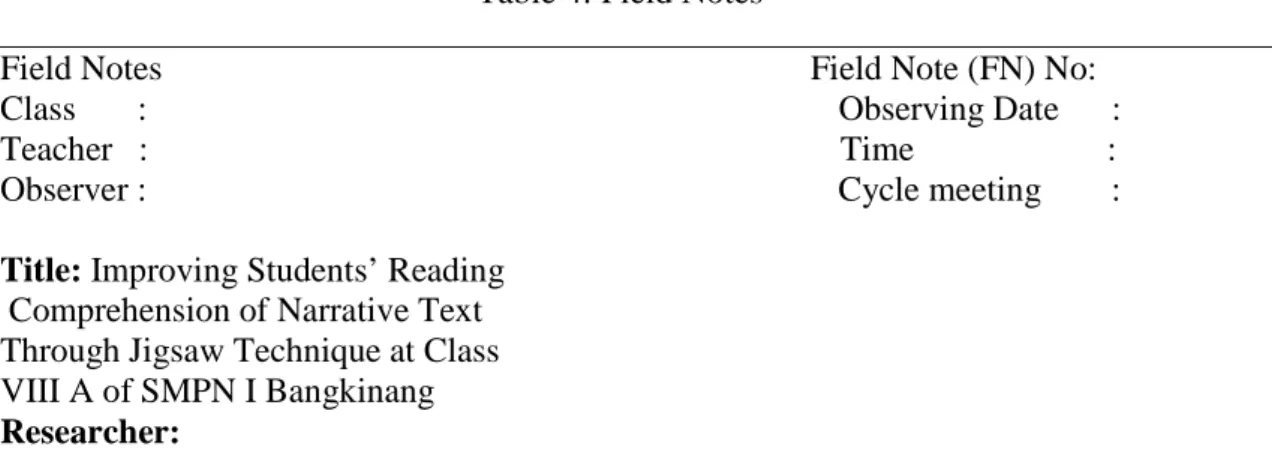
In other words, in doing the action, the researcher followed the lesson plan to did the action, the collaborator observed the teacher and students during teaching and learning process by filling in the observation checklist to collect the real data or information about the students’ activities in reading narrative text through jigsaw technique. There were four kinds of observation checklists. They were checklist for indicators of reading comprehension, checklist for indicators of Jigsaw technique, checklist for the procedure of Jigsaw technique in lesson plan, and field notes.
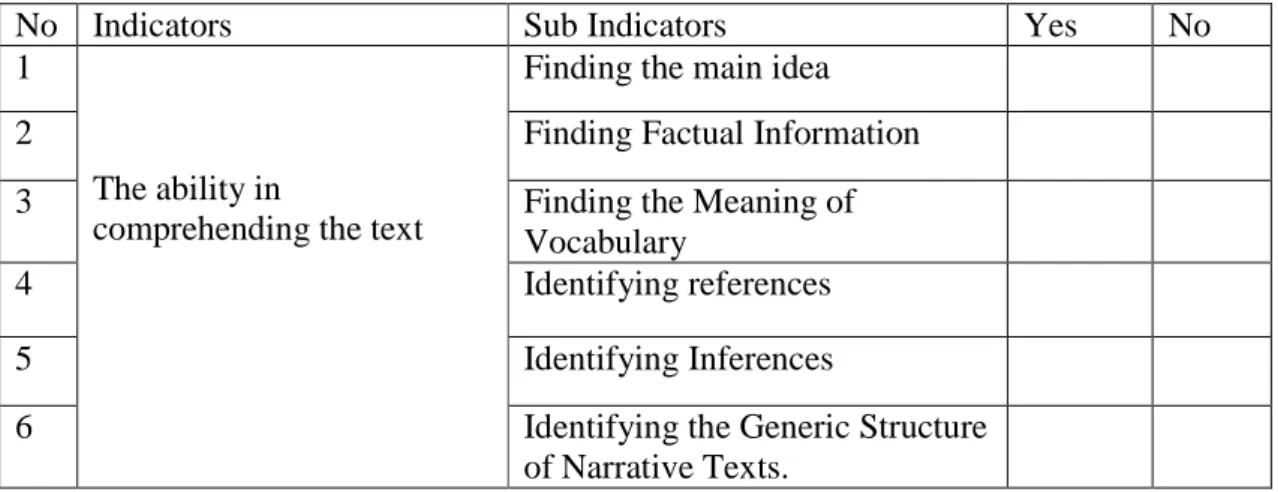
a. Observation checklist for indicators of reading comprehension:
Table 1.Checklist Observation Sheet 1 Cycle
No Indicators Sub Indicators Yes No
1
The ability in
comprehending the text
Finding the main idea
2 Finding Factual Information
3 Finding the Meaning of
Vocabulary
4 Identifying references
5 Identifying Inferences
6 Identifying the Generic Structure
of Narrative Texts.
This checklist was used by the collaborator for observing the vocabolary teaching and process whether there were indicators on it or not.